
Exodus 26:35

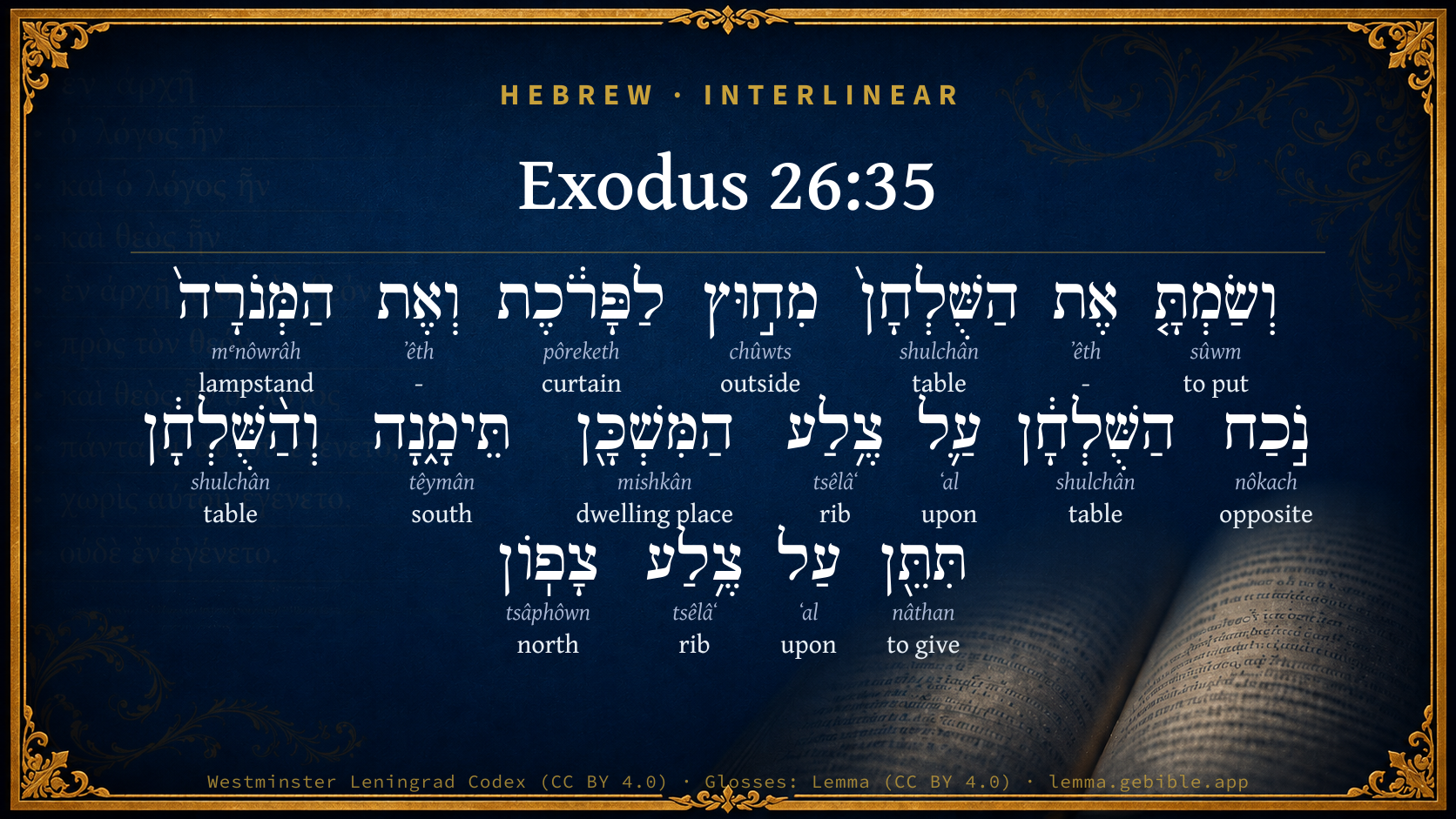
Hebrew (Westminster Leningrad Codex) Exodus 26:35 appears in the Hebrew Old Testament. The text above is from the Westminster Leningrad Codex. Each word links to its Strong’s number, a concise gloss, and parsing drawn from the Open Scriptures Hebrew Bible morphology. Click any word for its full Brown-Driver-Briggs (BDB) entry.
Download image
Cite this verse

Exodus 26:35 (World English Bible). Public Domain. Lemma interlinear Bible study tool, https://lemma.gebible.app/v/exodus/26/35.

Show BibTeX & RIS
BibTeX
RIS
English Translation
You shall set the table outside the veil, and the lampstand over against the table on the side of the tent toward the south: and you shall put the table on the north side.
World English Bible · Public Domain
Download a study sheet

One document with this verse’s original text, its word-by-word gloss line, the meaning frame, cross-references with their text, attributed commentary, and full source and license credits — printable, and it pastes into notes with its structure intact.

This verse Autodidact and up

Study sheet (.html) Plain text (.txt)

A passage Seminary Student

Up to 50 verses in one chapter. A passage sheet keeps up to 6 commentary sources and 12 cross-references per verse, in the order this page ranks them, and says so on the sheet whenever that leaves anything out. Ask for a single verse and you get the Autodidact verse sheet above.

Everything on this page stays free to read, with no account — the sheet is a download of what is already on screen, not access to it.

Want to remove ads? Support Godless Engineer
Compare translations 3

The same verse in 3 English versions, stacked beneath the original-language interlinear above. Click any original word for its lexicon entry.

Each is an independent rendering of the whole verse — the interlinear is not word-aligned to these translations.

Highlighted words mark where these versions differ — a whole-verse word diff, not a word-by-word alignment.

  • World English Bible Public Domain
    You shall set the table outside the veil, and the lampstand over against the table on the side of the tent toward the south: and you shall put the table on the north side.
  • King James Version Public Domain
    And thou shalt set the table without the vail, and the candlestick over against the table on the side of the tabernacle toward the south: and thou shalt put the table on the north side.
  • unfoldingWord Literal Text CC BY-SA 4.0
    And you shall put the table outside the curtain and the lampstand opposite the table on the south side of the Dwelling. And put the table on the north side.

unfoldingWord Literal Text — © unfoldingWord, licensed CC BY-SA 4.0. Word-aligned USFM3 via Door43 (git.door43.org/unfoldingWord/en_ult).

Versions to compare (up to 4)

3 of 4 selected

Show all 18 translations

Every available English version of this verse, each an independent rendering of the whole verse.

  • World English Bible Public Domain
    You shall set the table outside the veil, and the lampstand over against the table on the side of the tent toward the south: and you shall put the table on the north side.
  • Berean Standard Bible Public Domain
    And place the table outside the veil on the north side of the tabernacle, and put the lampstand opposite the table, on the south side.
  • Majority Standard Bible Public Domain
    And place the table outside the veil on the north side of the tabernacle, and put the lampstand opposite the table, on the south side.
  • King James Version Public Domain
    And thou shalt set the table without the vail, and the candlestick over against the table on the side of the tabernacle toward the south: and thou shalt put the table on the north side.
  • American Standard Version (1901) Public Domain
    And thou shalt set the table without the veil, and the candlestick over against the table on the side of the tabernacle toward the south: and thou shalt put the table on the north side.
  • Revised Version (1885) Public Domain
    And thou shalt set the table without the veil, and the candlestick over against the table on the side of the tabernacle toward the south: and thou shalt put the table on the north side.
  • Geneva Bible (1599) Public Domain
    And thou shalt set the Table without the vaile, and the Candlesticke ouer against the Table on the Southside of the Tabernacle, and thou shalt set the Table on the Northside.
  • Douay-Rheims (1899) Public Domain
    And the table without the veil: and over against the table the candlestick in the south side of the tabernacle; for the table shall stand in the north side.
  • Young's Literal Translation Public Domain
    `And thou hast set the table at the outside of the vail, and the candlestick over-against the table on the side of the tabernacle southward, and the table thou dost put on the north side.
  • Literal Standard Version CC BY-SA 4.0
    And you have set the table at the outside of the veil, and the lampstand opposite the table on the side of the Dwelling Place southward, and you put the table on the north side.
  • Unlocked Literal Bible CC BY-SA 4.0
    You must place the table outside the curtain. You must place the lampstand opposite the table on the south side of the tabernacle. The table must be on the north side.
  • unfoldingWord Literal Text CC BY-SA 4.0
    And you shall put the table outside the curtain and the lampstand opposite the table on the south side of the Dwelling. And put the table on the north side.
  • Darby Bible Public Domain
    And thou shalt set the table outside the veil, and the lamp-stand opposite to the table on the side of the tabernacle southward; and thou shalt put the table on the north side.
  • World Messianic Bible Public Domain
    You shall set the table outside the veil, and the lamp stand opposite the table on the side of the tabernacle toward the south. You shall put the table on the north side.
  • Webster's Bible Public Domain
    And thou shalt set the table without the vail, and the candlestick over against the table on the side of the tabernacle towards the south: and thou shalt put the table on the north side.
  • Free Bible Version CC BY-SA 4.0
    Place the table outside the veil on the north side of the Tabernacle and put the lampstand opposite it on the south side.
  • Bible in Basic English Public Domain
    And outside the veil you are to put the table, and the support for the lights opposite the table on the south side of the House; and the table is to be on the north side.
  • JPS Tanakh (1917) Public Domain
    And thou shalt set the table without the veil, and the candlestick over against the table on the side of the tabernacle toward the south; and thou shalt put the table on the north side.

Literal Standard Version (2020), Covenant Press — licensed CC BY-SA 4.0. Text via the HelloAO Bible API (eBible.org). Unlocked Literal Bible (unfoldingWord) — licensed CC BY-SA 4.0. Text via the HelloAO Bible API (eBible.org). unfoldingWord Literal Text — © unfoldingWord, licensed CC BY-SA 4.0. Word-aligned USFM3 via Door43 (git.door43.org/unfoldingWord/en_ult). Free Bible Version, Dr. Jonathan Gallagher — licensed CC BY-SA 4.0. Text via the HelloAO Bible API (eBible.org).

Word by word

More ways to search: Search by grammar → Find every occurrence → Compare this word →

Practice this passage: Drill this verse → Learn its vocabulary →

נֹ֣כַח
nôkach
H5227
“opposite”
Preposition
Part of Speech
Preposition
Full BDB Definition

Origin: from the same as H5226

TWOT: 1365a

be in front of - in front of, opposite to, in the sight of, before, to the front, right on - towards the front of, in front of, on behalf of, as far as in front of
  1. וְשַׂמְתָּ֤ sûwm H7760 “and · to put” Conjunction + Verb, Qal, Sequential Perfect, 2nd Person, Masculine, Singular
  2. אֶת ʼêth H853 “-” Particle, Direct Object
  3. הַשֻּׁלְחָן֙ shulchân H7979 “the · table” Particle, Definite Article + Noun, Common, Masculine, Singular, Absolute
  4. מִח֣וּץ chûwts H2351 “from · outside” Preposition + Noun, Common, Masculine, Singular, Absolute
  5. לַפָּרֹ֔כֶת pôreketh H6532 “to/for the · curtain” Preposition, Determined + Noun, Common, Feminine, Singular, Absolute
  6. וְאֶת ʼêth H853 “and · -” Conjunction + Particle, Direct Object
  7. הַמְּנֹרָה֙ mᵉnôwrâh H4501 “the · lampstand” Particle, Definite Article + Noun, Common, Feminine, Singular, Absolute
  8. הַשֻּׁלְחָ֔ן shulchân H7979 “the · table” Particle, Definite Article + Noun, Common, Masculine, Singular, Absolute
  9. עַ֛ל ʻal H5921 “upon” Preposition
  10. צֶ֥לַע tsêlâʻ H6763 “rib of” Noun, Common, Both, Singular, Construct
  11. הַמִּשְׁכָּ֖ן mishkân H4908 “the · dwelling place” Particle, Definite Article + Noun, Common, Masculine, Singular, Absolute
  12. תֵּימָ֑נָה têymân H8486 “south · toward” Noun, Common, Feminine, Singular, Absolute + Suffix, Demonstrative
  13. וְהַ֨שֻּׁלְחָ֔ן shulchân H7979 “and · the · table” Conjunction + Particle, Definite Article + Noun, Common, Masculine, Singular, Absolute
  14. תִּתֵּ֖ן nâthan H5414 “to give” Verb, Qal, Imperfect, 2nd Person, Masculine, Singular
  15. עַל ʻal H5921 “upon” Preposition
  16. צֶ֥לַע tsêlâʻ H6763 “rib of” Noun, Common, Both, Singular, Construct
  17. צָפֽוֹן tsâphôwn H6828 “north” Noun, Common, Feminine, Singular, Absolute

About this verse

These counts appear in no published source. They are computed here, from the morphology-tagged text and Lemma’s own curated glosses. What Lemma adds →

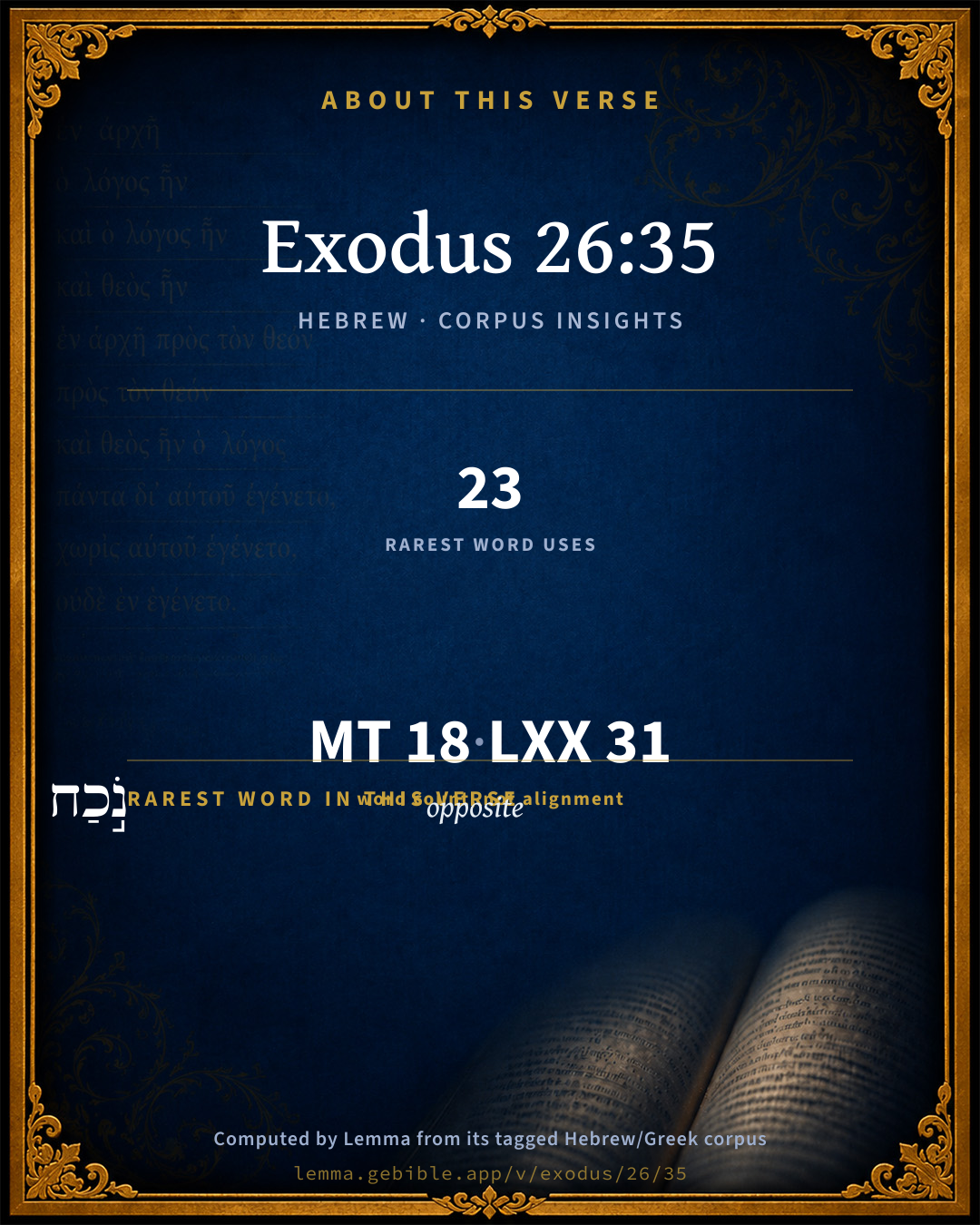
18
words
13
distinct lemmas
Pentateuch
section

Notable vocabulary

The rarest word here is נֹ֣כַח opposite H5227 — appearing just 23 times in the whole Hebrew Bible.

Shared distinctive vocabulary

נֹ֣כַח opposite H5227 occurs in 22 verses of the Hebrew Bible. Also found in:

Grammatical profile

  • 2 verbs
  • 11 nouns
  • 3 prepositions
  • 2 particles

Verb forms

  • וְשַׂמְתָּ֤ Qal · Sequential Perfect
  • תִּתֵּ֖ן Qal · Imperfect

Repetition

Words recur within this verse — often emphatic in Hebrew:

  • הַשֻּׁלְחָן֙ table H7979 ×3
  • עַ֛ל upon H5921 ×2
  • צֶ֥לַע rib H6763 ×2

Hebrew & Septuagint length

In English translation the verse runs 34 words from the Hebrew and 35 from the Septuagint (LXX English) — closely comparable.

A rough comparison of the two English renderings, which tokenize alike — not a word-level alignment.

Word counts can differ between the Hebrew and the Greek without any difference in meaning — e.g. the Hebrew direct-object marker אֵת has no separate Greek word, and Greek often adds the article ὁ.

In the original languages it is 18 Hebrew tokens and 31 Greek tokens — but the two are counted differently (Hebrew bundles its prefixes and suffixes into one token; the Greek is in lemma form), so that isn’t a like-for-like length.

Cross-references

5

Topical passages linked to Exodus 26:35 in the Treasury of Scripture Knowledge — connected by theme and wording, ordered by reader-vote popularity; previews shown in the World English Bible.

  • Exodus 40:22 He put the table in the tent of meeting, on the side of the tent northward, outside of the veil.
  • Exodus 40:24 He put the lampstand in the tent of meeting, opposite the table, on the side of the tent southward.
  • Hebrews 9:2 For there was a tabernacle prepared. In the first part were the lampstand, the table, and the show bread; which is called the Holy Place.
  • Exodus 25:31–37 "You shall make a lampstand of pure gold. Of hammered work shall the lampstand be made, even its base, its shaft, its cups, its buds, and its flowers, shall be of one piece with it.
  • Hebrews 9:8–9 The Holy Spirit is indicating this, that the way into the Holy Place wasn't yet revealed while the first tabernacle was still standing;

Cross-references courtesy of OpenBible.info (CC BY 4.0).

Hebrew and Greek witnesses Masoretic Hebrew ↔ Greek Septuagint

The same verse in the two great witnesses to the Old Testament, shown verse-for-verse.

These are two independent witnesses, not word-aligned to each other, and the Septuagint is shown in lemma (dictionary) form.

Hebrew Exodus 26:35 Masoretic · Westminster Leningrad Codex

וְשַׂמְתָּ֤ אֶת הַשֻּׁלְחָן֙ מִח֣וּץ לַפָּרֹ֔כֶת וְאֶת הַמְּנֹרָה֙ נֹ֣כַח הַשֻּׁלְחָ֔ן עַ֛ל צֶ֥לַע הַמִּשְׁכָּ֖ן תֵּימָ֑נָה וְהַ֨שֻּׁלְחָ֔ן תִּתֵּ֖ן עַל צֶ֥לַע צָפֽוֹן

You shall set the table outside the veil, and the lampstand over against the table on the side of the tent toward the south: and you shall put the table on the north side.

World English Bible · Public Domain

Greek LXX Exodus 26:35 Septuagint · lemma form

καί τίθημι ὁ τράπεζα ἔξωθεν ὁ καταπέτασμα καί ὁ λυχνία ἀπέναντι ὁ τράπεζα ἐπί μέρος ὁ σκηνή ὁ πρός νότος καί ὁ τράπεζα τίθημι ἐπί μέρος ὁ σκηνή ὁ πρός βορέας

And you shall set the table outside the veil, and the candlestick opposite the table on the south side of the tabernacle; and you shall put the table on the north side of the tabernacle.

LXX2012 (modern English Septuagint) · Public Domain

Hebrew: Westminster Leningrad Codex (CC BY 4.0). Greek: Septuagint (public domain); English from LXX2012 (modern English Septuagint) (Public Domain). How the Septuagint differs from the Hebrew →

Targum (Aramaic paraphrase)

2

The Targum is the ancient Jewish Aramaic paraphrase of the Hebrew Scriptures — an interpretive translation, not the Hebrew text itself. Onkelos (literal) and Pseudo-Jonathan (expansive) render the Torah, and Jonathan the Prophets. Coverage is partial: where no permissively-licensed English translation exists for a verse, only the Aramaic is shown. This is verse-level text, not a word-by-word alignment to the Hebrew.

  1. Targum Onkelos Torah (Genesis–Deuteronomy)
    וּתְשַׁוִי יָת פָּתוֹרָא מִבָּרָא לְפָרֻכְתָּא וְיָת מְנַרְתָּא לָקֳבֵל פָּתוֹרָא עַל צִדָּא דְמַשְּׁכְּנָא דָרוֹמָא וּפָתוֹרָא תִתֵּן עַל סְטַר צִפּוּנָא:

    (no public-domain English translation for this verse)

    Targum Onkelos — Aramaic: “Onkelos Genesis” (public domain); “Onkelos Exodus” (public domain); “Onkelos Leviticus” (public domain); “Onkelos Numbers” (public domain); “Onkelos Deuteronomy” (public domain). English: “Sefaria Community Translation” (CC0 1.0 (public-domain dedication)); “J.W. Etheridge. The Targums of Onkelos and Jonathan Ben Uzziel on the Pentateuch. London: Longmans, Green, 1862” (public domain). Text via Sefaria.

  2. Targum Pseudo-Jonathan Torah (Genesis–Deuteronomy)
    וּתְשַׁוֵּי יַת פָּתוֹרָא מִבָּרָא לְפַרְגוֹדָא וְיַת מְנַרְתָּא כָּל קְבֵיל פָּתוֹרָא עַל סְטַר מַשְׁכְּנָא דָרוֹמָא וּפְתוֹרָא תְּסַדֵּר עַל סְטַר צִיפוּנָא

    And thou shalt set the Table outside of the veil, and the Candelabrum over against the table on the southern side of the tabernacle; but the table thou shalt arrange on the northern side.

    Targum Pseudo-Jonathan — Aramaic: “Targum Jonathan on Genesis” (public domain); “Targum Jonathan on Exodus” (public domain); “Targum Jonathan on Leviticus” (public domain); “Targum Jonathan on Numbers” (public domain); “Targum Jonathan on Deuteronomy” (public domain). English: “The Targum of Jonathan ben Uzziel, trans. J. W. Etheridge, London, 1862” (public domain). Text via Sefaria.

Commentary

Notes on Exodus 26:35 from classic Christian and Jewish commentators (each source and its license shown beneath its notes). The classic Christian expositions comment on the surrounding passage and are grouped to its opening verse, so a note may address several verses; the Jewish commentaries on the Tanakh (Rashi and others) are per-verse, so they appear only where the commentator wrote on this verse.

Lemma curates 59 commentaries, every one of them public domain or Creative Commons licensed, each selected and text-cleaned for this edition rather than reprinted as found. About our sources →

Geneva Bible (1599)

Geneva Bible translators

Meaning, in the holy place.

Geneva Bible (1599) marginal notes — public domain. Text via Bolls.life.

The Cambridge Bible for Schools and Colleges

gen. ed. J. J. S. Perowne

35. over against] opposite to, on the south side of the table.

The Cambridge Bible for Schools and Colleges (gen. ed. J. J. S. Perowne; Cambridge University Press, 1878–1918) — public domain. Text from a community e-Sword module.

Whedon's Commentary on the Bible

Daniel D. Whedon

35. Table… candlestick — For description see Exo_25:23-37, and notes. They were to be set over against each other, that is, on opposite sides of the holy place, the table on the north side, and the candlestick on the south side. The golden altar of incense, which was to stand between, in front of the vail, is mentioned further on, in connexion with the laws for offering incense. Exo_30:1-10.

Daniel D. Whedon (gen. ed.), Commentary on the Old and New Testaments (1874–1909) — public domain. Text from a community e-Sword module.

The Pulpit Commentary

The table here is, of course, "the table of shew-bread" described in the preceding chapter (vers. 23-30), immediately after the mercy-seat It was to be set "without the veil," in the holy place or outer chamber, against the north wall. The candlestick is the seven-branched lamp-stand described in Exo_25:31-39. It was to be placed over against the table, and consequently on the south side. (Exo_40:24)

The Pulpit Commentary (1880–1919), ed. H.D.M. Spence-Jones & Joseph S. Exell — public domain. Text from a community e-Sword module.

Keil & Delitzsch

C. F. Keil & F. Delitzsch

The two other things (already described) were to be placed outside the curtain, viz., in the holy place; the candlestick opposite to the table, the former on the south side of the dwelling, the latter towards the north.

Keil & Delitzsch — Biblical Commentary on the Old Testament (1861–1891) — public domain (CC PDM 1.0). Text via the HelloAO Bible API. (Old Testament only.)

Rashi

Rabbi Shlomo Yitzchaki (Rashi)

ושמת את השלחן AND THOU SHALT PUT THE TABLE [WITHOUT THE PARTITION VEIL] — The table was in the north, distant from the north wall two cubits and a half. The candelabrum was in the south, distant from the south wall two cubits and a half. The golden altar was opposite the space which was between the table and candelabrum drawn back slightly towards the east (cf. Rashi on Exodus 30:6). All these three were placed in that part which extended from one-half the length of the Tabcrnacle (not including the Holy of Holies) inward. How so? The length of the Tabernacle from the entrance to the partition veil was 20 cubits, and the altar, the table and the candelabrum were distant from the entrance in a western direction 10 cubits(Yoma 33b).

Rashi on the Tanakh — English translations: “The Judaica Press complete Tanach with Rashi, translated by A. J. Rosenberg” (CC BY 4.0); “Pentateuch with Rashi's commentary by M. Rosenbaum and A.M. Silbermann, 1929-1934” (public domain); “The Metsudah Tanach series, Lakewood, N.J” (CC BY 4.0); and “The Book of Joshua, Metsudah Publications, 1997” (CC BY 4.0). Text via Sefaria.

Lesson kit

Teaching starters — assembled from the data on this page, not authored interpretation. Every prompt links to the verse data it draws on. Edit before teaching.

Exodus, in the Pentateuch, opens this verse with 18 words (13 distinct Hebrew lemmas). Its most distinctive word is nôkach (“opposite”). A historical commentator’s framing appears above. Read the whole chapter for the surrounding context.

Discussion questions

  1. How does “opposite” (nôkach) shape what this verse is saying?
  2. Genesis 25:21 shares the word «opposite» with this verse. How do the two illuminate each other?
  3. “table” occurs 3× in this one verse. What is the effect of the repetition?
  4. These translations render this verse differently; the difference is in the English rendering, not the original. What questions does that raise?
  5. The verb «וְשַׂמְתָּ֤» is Qal Sequential Perfect. How does its form color the action?
  6. Reading how Geneva Bible (1599) and The Cambridge Bible for Schools and Colleges read this verse, where do the two commentators agree and where do they part?

Things to notice

Reading settings

Reading text

Shown beneath each verse's original-language words.

Old Testament
Old Testament edition

Read the OT as the Masoretic Hebrew (MT) or the Greek Septuagint (LXX).

English shown for the Greek Septuagint (in the Hebrew ↔ Greek comparison).

Comparing translations? Open the Compare panel on any verse page to stack up to four side by side.