
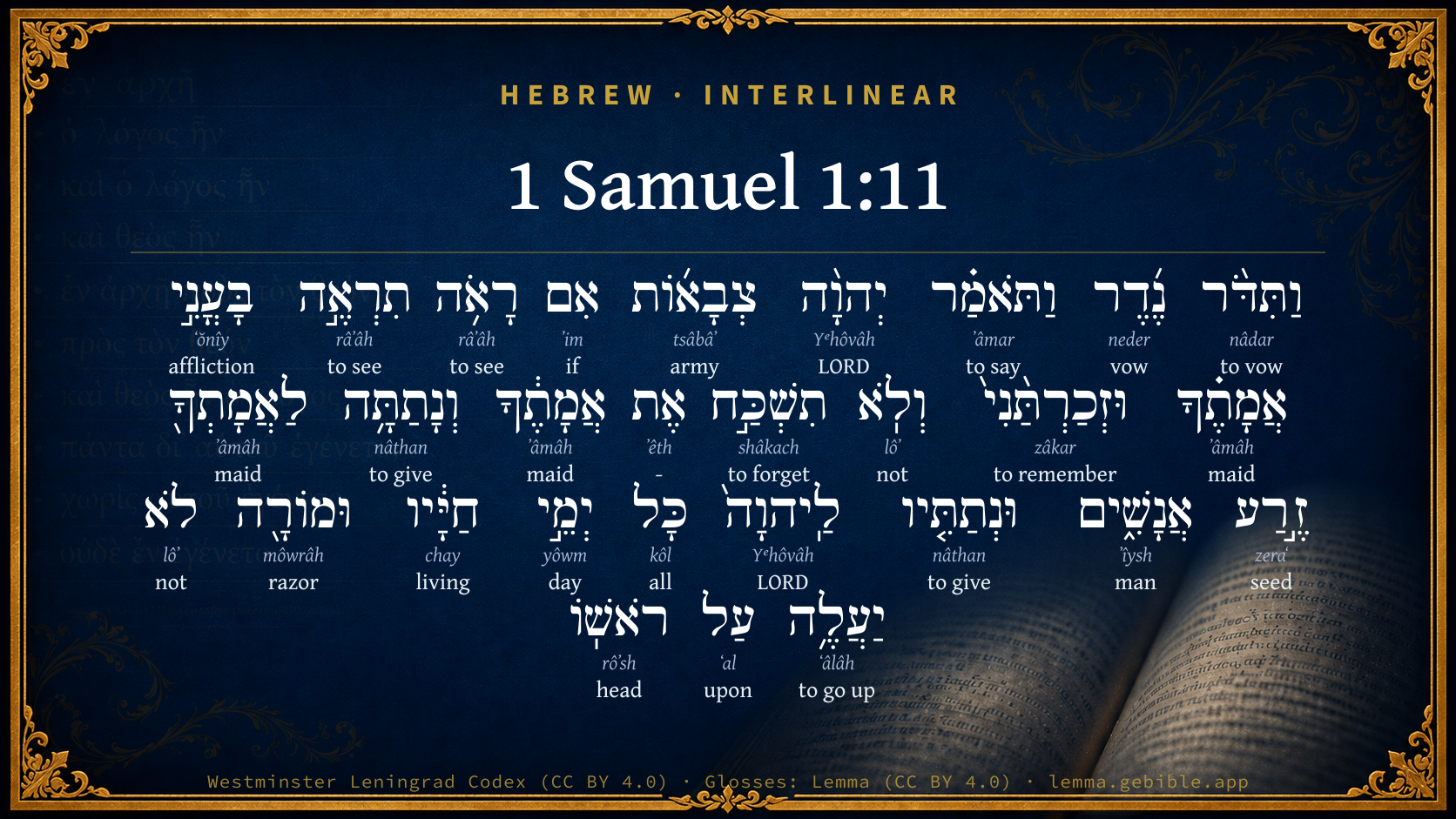
1 Samuel 1:11

Hebrew (Westminster Leningrad Codex) 1 Samuel 1:11 appears in the Hebrew Old Testament. The text above is from the Westminster Leningrad Codex. Each word links to its Strong’s number, a concise gloss, and parsing drawn from the Open Scriptures Hebrew Bible morphology. Click any word for its full Brown-Driver-Briggs (BDB) entry.
Download image
Cite this verse

1 Samuel 1:11 (World English Bible). Public Domain. Lemma interlinear Bible study tool, https://lemma.gebible.app/v/1-samuel/1/11.

Show BibTeX & RIS
BibTeX
RIS
English Translation
She vowed a vow, and said, Yahweh of hosts, if you will indeed look on the affliction of your handmaid, and remember me, and not forget your handmaid, but will give to your handmaid a man-child, then I will give him to Yahweh all the days of his life, and there shall no razor come on his head.
World English Bible · Public Domain
Download a study sheet

One document with this verse’s original text, its word-by-word gloss line, the meaning frame, cross-references with their text, attributed commentary, and full source and license credits — printable, and it pastes into notes with its structure intact.

This verse Autodidact and up

Study sheet (.html) Plain text (.txt)

A passage Seminary Student

Up to 50 verses in one chapter. A passage sheet keeps up to 6 commentary sources and 12 cross-references per verse, in the order this page ranks them, and says so on the sheet whenever that leaves anything out. Ask for a single verse and you get the Autodidact verse sheet above.

Everything on this page stays free to read, with no account — the sheet is a download of what is already on screen, not access to it.

Want to remove ads? Support Godless Engineer
Compare translations 3

The same verse in 3 English versions, stacked beneath the original-language interlinear above. Click any original word for its lexicon entry.

Each is an independent rendering of the whole verse — the interlinear is not word-aligned to these translations.

Highlighted words mark where these versions differ — a whole-verse word diff, not a word-by-word alignment.

  • World English Bible Public Domain
    She vowed a vow, and said, Yahweh of hosts, if you will indeed look on the affliction of your handmaid, and remember me, and not forget your handmaid, but will give to your handmaid a man-child, then I will give him to Yahweh all the days of his life, and there shall no razor come on his head.
  • King James Version Public Domain
    And she vowed a vow, and said, O LORD of hosts, if thou wilt indeed look on the affliction of thine handmaid, and remember me, and not forget thine handmaid, but wilt give unto thine handmaid a man child, then I will give him unto the LORD all the days of his life, and there shall no razor come upon his head.
  • unfoldingWord Literal Text CC BY-SA 4.0
    And she vowed a vow, and she said, “Yahweh of Armies, if looking, you will look on the affliction of your female servant and remember me and not forget your female servant and give to your female servant a seed of men, then I will give him to Yahweh all of the days of his life, and a razor will not go up on his head.”

unfoldingWord Literal Text — © unfoldingWord, licensed CC BY-SA 4.0. Word-aligned USFM3 via Door43 (git.door43.org/unfoldingWord/en_ult).

Versions to compare (up to 4)

3 of 4 selected

Show all 18 translations

Every available English version of this verse, each an independent rendering of the whole verse.

  • World English Bible Public Domain
    She vowed a vow, and said, Yahweh of hosts, if you will indeed look on the affliction of your handmaid, and remember me, and not forget your handmaid, but will give to your handmaid a man-child, then I will give him to Yahweh all the days of his life, and there shall no razor come on his head.
  • Berean Standard Bible Public Domain
    And she made a vow, pleading, “O LORD of Hosts, if only You will look upon the affliction of Your maidservant and remember me, not forgetting Your maidservant but giving her a son, then I will dedicate him to the LORD all the days of his life, and no razor shall ever come over his head.”
  • Majority Standard Bible Public Domain
    And she made a vow, saying, “O LORD of Hosts, if only You will look upon the affliction of Your maidservant and remember me, not forgetting Your maidservant but giving her a son, then I will dedicate him to the LORD all the days of his life, and no razor shall ever touch his head.”
  • King James Version Public Domain
    And she vowed a vow, and said, O LORD of hosts, if thou wilt indeed look on the affliction of thine handmaid, and remember me, and not forget thine handmaid, but wilt give unto thine handmaid a man child, then I will give him unto the LORD all the days of his life, and there shall no razor come upon his head.
  • American Standard Version (1901) Public Domain
    And she vowed a vow, and said, O Jehovah of hosts, if thou wilt indeed look on the affliction of thy handmaid, and remember me, and not forget thy handmaid, but wilt give unto thy handmaid a man-child, then I will give him unto Jehovah all the days of his life, and there shall no razor come upon his head.
  • Revised Version (1885) Public Domain
    And she vowed a vow, and said, O LORD of hosts, if thou wilt indeed look on the affliction of thine handmaid, and remember me, and not forget thine handmaid, but wilt give unto thine handmaid a man child, then I will give him unto the LORD all the days of his life, and there shall no razor come upon his head.
  • Geneva Bible (1599) Public Domain
    Also she vowed a vowe, and sayd, O Lord of hostes, if thou wilt looke on the trouble of thine handmaide, and remember me, and not forget thine handmaide, but giue vnto thine handmaide a manchilde, then I will giue him vnto the Lord all the dayes of his life, and there shall no rasor come vpon his head.
  • Douay-Rheims (1899) Public Domain
    And she made a vow, saying: O Lord, of hosts, if thou wilt look down on the affliction of thy servant, and wilt be mindful of me, and not forget thy handmaid, and wilt give to thy servant a man child: I will give him to the Lord all the days of his life, and no razor shall come upon his head.
  • Young's Literal Translation Public Domain
    and voweth a vow, and saith, `Jehovah of Hosts, if Thou dost certainly look on the affliction of Thy handmaid, and hast remembered me, and dost not forget Thy handmaid, and hast given to Thy handmaid seed of men -- then I have given him to Jehovah all days of his life, and a razor doth not go up upon his head.'
  • Literal Standard Version CC BY-SA 4.0
    and vows a vow, and says, “YHWH of Hosts, if You certainly look on the affliction of Your handmaid, and have remembered me, and do not forget Your handmaid, and have given to Your handmaid seed of men—then I have given him to YHWH all [the] days of his life, and a razor does not go up on his head.”
  • Unlocked Literal Bible CC BY-SA 4.0
    She made a vow and said, “Yahweh of hosts, if you will look on the affliction of your servant and call me to mind, and do not forget your servant, but give your servant a son, then I will give him to Yahweh all the days of his life, and no razor will ever touch his head.”
  • unfoldingWord Literal Text CC BY-SA 4.0
    And she vowed a vow, and she said, “Yahweh of Armies, if looking, you will look on the affliction of your female servant and remember me and not forget your female servant and give to your female servant a seed of men, then I will give him to Yahweh all of the days of his life, and a razor will not go up on his head.”
  • Darby Bible Public Domain
    And she vowed a vow, and said, O Jehovah of hosts, if thou wilt indeed look on the affliction of thy handmaid, and remember me, and not forget thy handmaid, but wilt give unto thy handmaid a man child, then I will give him to Jehovah all the days of his life, and there shall no razor come upon his head.
  • World Messianic Bible Public Domain
    She vowed a vow, and said, “LORD of Hosts, if you will indeed look at the affliction of your servant and remember me, and not forget your servant, but will give to your servant a boy, then I will give him to the LORD all the days of his life, and no razor shall come on his head.”
  • Webster's Bible Public Domain
    And she vowed a vow, and said, O LORD of hosts, if thou wilt indeed look on the affliction of thy handmaid, and remember me, and not forget thy handmaid, but wilt give to thy handmaid a male child, then I will give him to the LORD all the days of his life, and there shall no razor come upon his head.
  • Free Bible Version CC BY-SA 4.0
    She made a vow, asking, “Lord Almighty, if only you would pay attention to the suffering of your servant and remember me, and not forget me but give me a son, then I will dedicate him to the Lord for his whole life, and no razor shall ever touch his head.”
  • Bible in Basic English Public Domain
    And she made an oath, and said, O Lord of armies, if you will truly take note of the sorrow of your servant, not turning away from me but keeping me in mind, and will give me a man-child, then I will give him to the Lord all the days of his life, and his hair will never be cut.
  • JPS Tanakh (1917) Public Domain
    And she vowed a vow, and said: 'O LORD of hosts, if Thou wilt indeed look on the affliction of Thy handmaid, and remember me, and not forget Thy handmaid, but wilt give unto Thy handmaid a man-child, then I will give him unto the LORD all the days of his life, and there shall no razor come upon his head.'

Literal Standard Version (2020), Covenant Press — licensed CC BY-SA 4.0. Text via the HelloAO Bible API (eBible.org). Unlocked Literal Bible (unfoldingWord) — licensed CC BY-SA 4.0. Text via the HelloAO Bible API (eBible.org). unfoldingWord Literal Text — © unfoldingWord, licensed CC BY-SA 4.0. Word-aligned USFM3 via Door43 (git.door43.org/unfoldingWord/en_ult). Free Bible Version, Dr. Jonathan Gallagher — licensed CC BY-SA 4.0. Text via the HelloAO Bible API (eBible.org).

Word by word

More ways to search: Search by grammar → Find every occurrence → Compare this word →

Practice this passage: Drill this verse → Learn its vocabulary →

וּמוֹרָ֖ה
môwrâh
H4177
“and · razor”
Conjunction + Noun, Common, Masculine, Singular, Absolute
Part of Speech
Conjunction + Noun
Type
Common
Gender
Masculine
Number
Singular
State
Absolute
Full BDB Definition

Origin: from H4171 in the sense of shearing

TWOT: 1166

razor
  1. וַתִּדֹּ֨ר nâdar H5087 “and · to vow” Conjunction + Verb, Qal, Sequential Imperfect, 3rd Person, Feminine, Singular
  2. נֶ֜דֶר neder H5088 “vow” Noun, Common, Masculine, Singular, Absolute
  3. וַתֹּאמַ֗ר ʼâmar H559 “and · to say” Conjunction + Verb, Qal, Sequential Imperfect, 3rd Person, Feminine, Singular
  4. יְהוָ֨ה Yᵉhôvâh H3068 “LORD” Noun, Proper
  5. צְבָא֜וֹת tsâbâʼ H6635 “armies” Noun, Common, Both, Plural, Absolute
  6. אִם ʼim H518 “if” Conjunction
  7. רָאֹ֥ה râʼâh H7200 “to see” Verb, Qal, Infinitive Absolute
  8. תִרְאֶ֣ה râʼâh H7200 “to see” Verb, Qal, Imperfect, 2nd Person, Masculine, Singular
  9. בָּעֳנִ֣י ʻŏnîy H6040 “in/at · affliction of” Preposition + Noun, Common, Masculine, Singular, Construct
  10. אֲמָתֶ֗ךָ ʼâmâh H519 “maid · your” Noun, Common, Feminine, Singular, Construct + Suffix, Personal, 2nd Person, Masculine, Singular
  11. וּזְכַרְתַּ֨נִי֙ zâkar H2142 “and · to remember · me” Conjunction + Verb, Qal, Sequential Perfect, 2nd Person, Masculine, Singular + Suffix, Personal, 1st Person, Common, Singular
  12. וְלֹֽא lôʼ H3808 “and · not” Conjunction + Particle, Negative
  13. תִשְׁכַּ֣ח shâkach H7911 “to forget” Verb, Qal, Imperfect, 2nd Person, Masculine, Singular
  14. אֶת ʼêth H853 “-” Particle, Direct Object
  15. אֲמָתֶ֔ךָ ʼâmâh H519 “maid · your” Noun, Common, Feminine, Singular, Construct + Suffix, Personal, 2nd Person, Masculine, Singular
  16. וְנָתַתָּ֥ה nâthan H5414 “and · to give” Conjunction + Verb, Qal, Sequential Perfect, 2nd Person, Masculine, Singular
  17. לַאֲמָתְךָ֖ ʼâmâh H519 “to/for · maid · your” Preposition + Noun, Common, Feminine, Singular, Construct + Suffix, Personal, 2nd Person, Masculine, Singular
  18. זֶ֣רַע zeraʻ H2233 “seed of” Noun, Common, Masculine, Singular, Construct
  19. אֲנָשִׁ֑ים ʼîysh H376 “men” Noun, Common, Masculine, Plural, Absolute
  20. וּנְתַתִּ֤יו nâthan H5414 “and · to give · him” Conjunction + Verb, Qal, Sequential Perfect, 1st Person, Common, Singular + Suffix, Personal, 3rd Person, Masculine, Singular
  21. לַֽיהוָה֙ Yᵉhôvâh H3068 “to/for · LORD” Preposition + Noun, Proper
  22. כָּל kôl H3605 “all of” Noun, Common, Masculine, Singular, Construct
  23. יְמֵ֣י yôwm H3117 “days of” Noun, Common, Masculine, Plural, Construct
  24. חַיָּ֔יו chay H2416 “living things · his” Noun, Common, Masculine, Plural, Construct + Suffix, Personal, 3rd Person, Masculine, Singular
  25. לֹא lôʼ H3808 “not” Particle, Negative
  26. יַעֲלֶ֥ה ʻâlâh H5927 “to go up” Verb, Qal, Imperfect, 3rd Person, Masculine, Singular
  27. עַל ʻal H5921 “upon” Preposition
  28. רֹאשֽׁוֹ rôʼsh H7218 “head · his” Noun, Common, Masculine, Singular, Construct + Suffix, Personal, 3rd Person, Masculine, Singular

About this verse

These counts appear in no published source. They are computed here, from the morphology-tagged text and Lemma’s own curated glosses. What Lemma adds →

29
words
23
distinct lemmas
Historical
section

Notable vocabulary

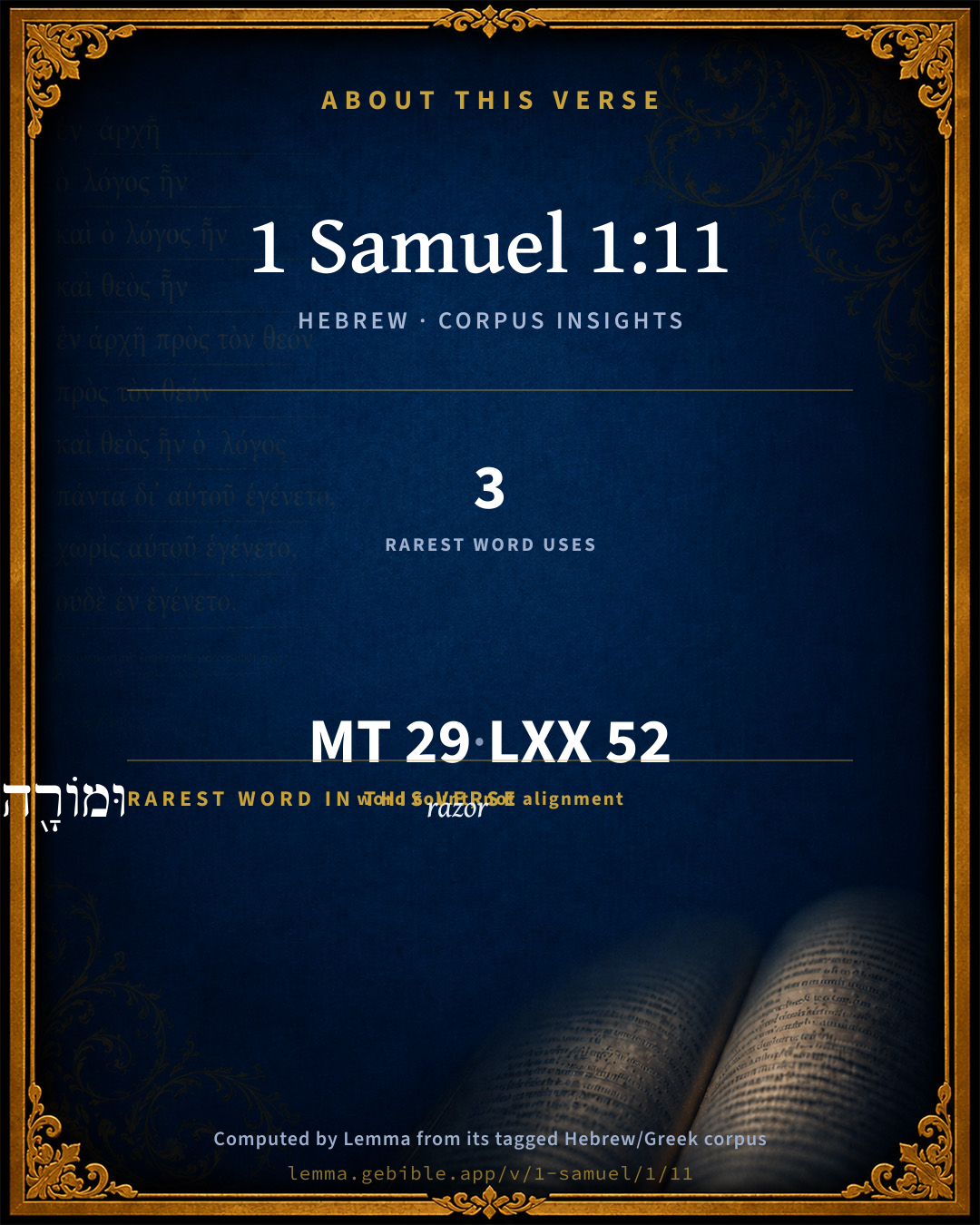
The rarest word here is וּמוֹרָ֖ה razor H4177 — appearing just 3 times in the whole Hebrew Bible.

Shared distinctive vocabulary

וּמוֹרָ֖ה razor H4177 occurs in 3 verses of the Hebrew Bible. Also found in:

Grammatical profile

  • 9 verbs
  • 15 nouns
  • 1 preposition
  • 1 conjunction
  • 3 particles

Verb forms

  • וַתִּדֹּ֨ר Qal · Sequential Imperfect
  • וַתֹּאמַ֗ר Qal · Sequential Imperfect
  • רָאֹ֥ה Qal · Infinitive Absolute
  • תִרְאֶ֣ה Qal · Imperfect
  • וּזְכַרְתַּ֨נִי֙ Qal · Sequential Perfect
  • תִשְׁכַּ֣ח Qal · Imperfect
  • וְנָתַתָּ֥ה Qal · Sequential Perfect
  • וּנְתַתִּ֤יו Qal · Sequential Perfect
  • יַעֲלֶ֥ה Qal · Imperfect

Repetition

Words recur within this verse — often emphatic in Hebrew:

  • אֲמָתֶ֗ךָ maid H519 ×3
  • יְהוָ֨ה LORD H3068 ×2
  • רָאֹ֥ה to see H7200 ×2
  • וְנָתַתָּ֥ה to give H5414 ×2
  • וְלֹֽא not H3808 ×2

Hebrew & Septuagint length

In English translation the verse runs 58 words from the Hebrew and 66 from the Septuagint (LXX English) — closely comparable.

A rough comparison of the two English renderings, which tokenize alike — not a word-level alignment.

Word counts can differ between the Hebrew and the Greek without any difference in meaning — e.g. the Hebrew direct-object marker אֵת has no separate Greek word, and Greek often adds the article ὁ.

In the original languages it is 29 Hebrew tokens and 52 Greek tokens — but the two are counted differently (Hebrew bundles its prefixes and suffixes into one token; the Greek is in lemma form), so that isn’t a like-for-like length.

Cross-references

17

Topical passages linked to 1 Samuel 1:11 in the Treasury of Scripture Knowledge — connected by theme and wording, ordered by reader-vote popularity; previews shown in the World English Bible.

  • Judges 13:5 for, behold, you shall conceive, and bear a son; and no razor shall come on his head; for the child shall be a Nazirite to God from the womb: and he shall begin to save Israel out of the hand of the Philistines.
  • Numbers 6:5 "All the days of his vow of separation there shall no razor come on his head, until the days are fulfilled, in which he separates himself to Yahweh. He shall be holy. He shall let the locks of the hair of his head grow long.
  • Genesis 29:32 Leah conceived, and bore a son, and she named him Reuben. For she said, "Because Yahweh has looked at my affliction. For now my husband will love me."
  • Ecclesiastes 5:4 When you vow a vow to God, don't defer to pay it; for he has no pleasure in fools. Pay that which you vow.
  • Genesis 28:20 Jacob vowed a vow, saying, "If God will be with me, and will keep me in this way that I go, and will give me bread to eat, and clothing to put on,
  • Judges 11:30 Jephthah vowed a vow to Yahweh, and said, If you will indeed deliver the children of Ammon into my hand,
  • 1 Samuel 1:19 They rose up in the morning early, and worshiped before Yahweh, and returned, and came to their house to Ramah: and Elkanah knew Hannah his wife; and Yahweh remembered her.
  • Psalms 25:18 Consider my affliction and my travail. Forgive all my sins.
  • Numbers 6:8 All the days of his separation he is holy to Yahweh.
  • Numbers 21:2 Israel vowed a vow to Yahweh, and said, If you will indeed deliver this people into my hand, then I will utterly destroy their cities.
  • Numbers 30:3–8 Also when a woman vows a vow to Yahweh, and binds herself by a bond, being in her father's house, in her youth,
  • Genesis 30:22 God remembered Rachel, and God listened to her, and opened her womb.
  • Exodus 4:31 The people believed, and when they heard that Yahweh had visited the children of Israel, and that he had seen their affliction, then they bowed their heads and worshiped.
  • Numbers 6:11 The priest shall offer one for a sin offering, and the other for a burnt offering, and make atonement for him, because he sinned by reason of the dead, and shall make his head holy that same day.
  • 2 Samuel 16:12 It may be that Yahweh will look on the wrong done to me, and that Yahweh will requite me good for [his] cursing of me this day.
  • Psalms 132:1–2 Yahweh, remember David and all his affliction,
  • Genesis 8:1 God remembered Noah, all the animals, and all the cattle that were with him in the ark; and God made a wind to pass over the earth. The waters subsided.

Cross-references courtesy of OpenBible.info (CC BY 4.0).

Hebrew and Greek witnesses Masoretic Hebrew ↔ Greek Septuagint

The same verse in the two great witnesses to the Old Testament, shown verse-for-verse.

These are two independent witnesses, not word-aligned to each other, and the Septuagint is shown in lemma (dictionary) form.

Hebrew 1 Samuel 1:11 Masoretic · Westminster Leningrad Codex

וַתִּדֹּ֨ר נֶ֜דֶר וַתֹּאמַ֗ר יְהוָ֨ה צְבָא֜וֹת אִם רָאֹ֥ה תִרְאֶ֣ה בָּעֳנִ֣י אֲמָתֶ֗ךָ וּזְכַרְתַּ֨נִי֙ וְלֹֽא תִשְׁכַּ֣ח אֶת אֲמָתֶ֔ךָ וְנָתַתָּ֥ה לַאֲמָתְךָ֖ זֶ֣רַע אֲנָשִׁ֑ים וּנְתַתִּ֤יו לַֽיהוָה֙ כָּל יְמֵ֣י חַיָּ֔יו וּמוֹרָ֖ה לֹא יַעֲלֶ֥ה עַל רֹאשֽׁוֹ

She vowed a vow, and said, Yahweh of hosts, if you will indeed look on the affliction of your handmaid, and remember me, and not forget your handmaid, but will give to your handmaid a man-child, then I will give him to Yahweh all the days of his life, and there shall no razor come on his head.

World English Bible · Public Domain

Greek LXX 1 Samuel 1:11 Septuagint · lemma form

καί εὔχομαι εὐχή κύριος λέγω ἀδωναί κύριος ελωαι σαβαωθ ἐάν ἐπιβλέπω ἐπιβλέπω ἐπί ὁ ταπείνωσις ὁ δούλη σύ καί μιμνήσκω ἐγώ καί δίδωμι ὁ δούλη σύ σπέρμα ἀνήρ καί δίδωμι αὐτός ἐνώπιον σύ δοτός ἕως ἡμέρα θάνατος αὐτός καί οἶνος καί μέθυσμα οὐ πίνω καί σίδηρος οὐ ἀναβαίνω ἐπί ὁ κεφαλή αὐτός

And she vowed a vow to the Lord, saying, O Lord God of Sabaoth, if you welt indeed look upon the humiliation of your handmaid, and remember me, and give to your handmaid a boy, then will I indeed dedicate him to you till the day of his death; and he shall drink no wine nor strong drink, and no razor shall come upon his head.

LXX2012 (modern English Septuagint) · Public Domain

On this verse, Ellicott's Commentary for English Readers discusses the Septuagint’s reading. Read the note in Commentary ↓

Hebrew: Westminster Leningrad Codex (CC BY 4.0). Greek: Septuagint (public domain); English from LXX2012 (modern English Septuagint) (Public Domain). How the Septuagint differs from the Hebrew →

Targum (Aramaic paraphrase)

1

The Targum is the ancient Jewish Aramaic paraphrase of the Hebrew Scriptures — an interpretive translation, not the Hebrew text itself. Onkelos (literal) and Pseudo-Jonathan (expansive) render the Torah, and Jonathan the Prophets. Coverage is partial: where no permissively-licensed English translation exists for a verse, only the Aramaic is shown. This is verse-level text, not a word-by-word alignment to the Hebrew.

  1. Targum Jonathan Prophets (Joshua–Malachi)
    וְקַיָימַת קְיָים וַאֲמָרַת יְיָ צְבָאוֹת אִם מִגְלָא גְלֵי קֳדָמָךְ סִגוּף אַמְתָךְ וְיֵעוּל דָכְרָנִי קֳדָמָךְ וְלָא תַרְחִיק יַת אַמְתָךְ וְתִתֵּן לְאַמְתָךְ בַּר בְּגוֹ בְּנֵי אֱנָשָׁא וְאֶמְסְרִינֵיהּ דִיהֵי מְשַׁמֵשׁ קֳדָם יְיָ כָּל יוֹמֵי חַיוֹהִי וּמַרְוַת אֱנָשׁ לָא תְהֵי עֲלוֹהִי:

    (no public-domain English translation for this verse)

    Targum Jonathan — Aramaic: “Mikraot Gedolot” (public domain). English: “Sefaria Community Translation” (CC0 1.0 (public-domain dedication)); “London "Chaldee Paraphrase," 1871” (public domain). Text via Sefaria.

Commentary

Notes on 1 Samuel 1:11 from classic Christian and Jewish commentators (each source and its license shown beneath its notes). The classic Christian expositions comment on the surrounding passage and are grouped to its opening verse, so a note may address several verses; the Jewish commentaries on the Tanakh (Rashi and others) are per-verse, so they appear only where the commentator wrote on this verse.

Lemma curates 59 commentaries, every one of them public domain or Creative Commons licensed, each selected and text-cleaned for this edition rather than reprinted as found. About our sources →

Trapp's Complete Commentary

John Trapp

1Sa 1:11 And she vowed a vow, and said, O LORD of hosts, if thou wilt indeed look on the affliction of thine handmaid, and remember me, and not forget thine handmaid, but wilt give unto thine handmaid a man child, then I will give him unto the LORD all the days of his life, and there shall no razor come upon his head.

Ver. 11. And she vowed a vow.] Not without the consent of her husband, {1Sa 1:22} who else had power to vacate and disannul it. {Num 30:8} A vow is a binding of one’s self to God by a holy and religious promise, to do or not to do something that is lawful, possible, and useful for our increase in godliness. This promise is to be made with prayer, and paid with thanksgiving.

And remerber me, and not forget thine handmaid.] This was a masculine prayer; though made by a woman; and the same request thus repeated, argueth her fervency.

Then I will give him unto the Lord.] He shall be a Diodat, a Nazarite, extraordinarily devoted to God’s service.

John Trapp, A Commentary or Exposition upon All the Books of the Old and New Testament (1647–1656) — public domain. Text from a community e-Sword module.

The Biblical Illustrator

Joseph S. Exell

1Sa_1:11

And she vowed a vow.

About setting our hearts upon things

And Hannah,--what shall we say of her passionate longing and prayer for a child? Was this sinful, like the longing of the Israelites for gross and stimulating food? or was it foolish, and wanting in judgment, like good King Hezekiahs prayer for a longer life? There are traces in the story of its having been neither the one nor the other. In the first place, the granting of her request turned out thoroughly well; it turned out not only for her own happiness and honour, but for the good of the Church and people of God, which does not look as if God was displeased with it. Then look at the mind of the woman herself--what a holy and good woman she seems to have been. Then observe, too, how little of herself there is in her petition, as it is expressed in her vow. She vows that she will give the child Unto the Lord all the days of his life. Her child, as being a Levite, would, in the ordinary course of things, be bound to the service of the tabernacle from the age of twenty to the age of fifty; but Hannah vows that she will give him up to the service of the Lord from his earliest childhood. And so she did. It was clear that she had great, disinterested, patriotic views for the child, altogether distinct from any consideration of her own comfort in him; and probably in making her vow she must have been guided by some intimation from the Holy Spirit that a great honour was in store for her, but that she must seek it in the appointed way in which all blessings are to be had--in prayer and sacrifice of the mere natural inclinations. (Dean Goulburn.)

The Biblical Illustrator, edited by Joseph S. Exell (c. 1880s–1900s) — public domain. Text from a community e-Sword module.

Joseph Benson's Commentary

1Sa 1:11. But wilt give unto thy handmaid — She thrice calls herself God’s handmaid, out of a profound sense of her meanness, and his majesty. And she desires a man-child, because only such could wait upon the Lord in the service of the tabernacle, as she intended her son should do, if God bestowed one upon her. Then will I give him unto the Lord — That is, consecrate him to his service in his house. No razor shall come upon his head — He shall be a perpetual Nazarite, part of whose description this is, Num 6:5.

Joseph Benson's Commentary on the Old and New Testaments (1811–1818) — public domain. Text from a community e-Sword module.

Tyndale Open Study Notes

Tyndale Open Resources

1:11 Hannah’s vow was a promise to give the child back to the Lord as a Nazirite (see Num 6:1-21). Hannah might have hoped that her child would be another Samson (cp. Judg 13), a deliverer of God’s people.

Tyndale Open Study Notes — © Tyndale Open Resources, licensed CC BY-SA 4.0. Text via the HelloAO Bible API.

Jamieson, Fausset & Brown

Robert Jamieson, A. R. Fausset & David Brown

HANNAH'S PRAYER. (Sa1 1:9-18)

she prayed . . . she vowed a vow--Here is a specimen of the intense desire that reigned in the bosoms of the Hebrew women for children. This was the burden of Hannah's prayer; and the strong preference she expressed for a male child originated in her purpose of dedicating him to the tabernacle service. The circumstance of his birth bound him to this; but his residence within the precincts of the sanctuary would have to commence at an earlier age than usual, in consequence of the Nazarite vow.

Jamieson, Fausset & Brown — Commentary Critical and Explanatory on the Whole Bible (1871) — public domain (CC PDM 1.0). Text via the HelloAO Bible API.

Adam Clarke's Commentary

Verse 11. I will give him unto the Lord] Samuel, as a descendant of the house of Levi, was the Lord's property from twenty-five years of age till fifty; but the vow here implies that he should be consecrated to the Lord from his infancy to his death, and that he should not only act as a Levite, but as a Nazarite, on whose head no razor should pass.

Adam Clarke's Commentary on the Bible (1810–1826) — public domain. Text from a community e-Sword/MySword module.

Ellicott's Commentary for English Readers

(11) And she vowed a vow.—The vow of Hannah contained two solemn promises—the one pledged the son she prayed for to the service of the Eternal all the days of his life. The mother looked on to a life-long service in the ritual of the Tabernacle for him, but the Being who heard her prayer destined her son for higher work; in his case the priestly duties were soon merged in the far more responsible ones of the prophet—the great reformer of the people. The second promise undertook that he should be a Nazarite. Now the Nazariteship included three things—the refraining from intoxicating drinks, the letting the hair grow, and the avoiding all ceremonial defilement by corpses even of the nearest kin. Samuel was what the Talmud calls a perpetual Nazarite.

These strange restrictions and customs had an inner signification. The abstinence from wine and strong drink typified that the Nazarite determined to avoid all sensual indulgence which might cloud the mind and render the man unfit for prayer to, and work for, the Lord; the avoiding contact with the dead was a perpetual outward protest that the vower of the solemn vow renounced all moral defilement, that he gave up every thing which could stain and soil the life consecrated to the Eternal’s service; the untouched hair, which here is especially mentioned, was a public protest that the consecrated one had determined to refrain from intercourse with the world, and to devote the whole strength and fulness of life to the Lord’s work. The LXX. (Greek) Version here inserts the words, “and he shall drink neither wine nor strong drink,” wishing to bring the passage into stricter accordance with Numbers 6. The original Hebrew text, however, contents itself with specifying merely the outward sign of the untouched hair, by which these solemnly consecrated ones were publicly known.

A Bible Commentary for English Readers, edited by Charles John Ellicott (1878–1897) — public domain. Text from a community e-Sword module.

The Cambridge Bible for Schools and Colleges

gen. ed. J. J. S. Perowne

11. vowed a vow] The law of vows, with special limitations in the case of married women, is given in Numbers 30.

look on the affliction of thine handmaid] The rendering of the LXX. “If thou wilt indeed regard the low estate of thine handmaiden” (ἐὰν ἐπιβλέπων ἐπιβλέψῃς ἐπὶ τὴν ταπείνωσιν τῆς δούλης σου) gives the words adopted by the Virgin Mary (Luk_1:48).

I will give him) The vow is twofold, involving (1) the lifelong consecration of the child to the service of Jehovah, for as a Levite he would serve from the age of 25 or 30 to 50 only, and very possibly at this time many Levites, e.g. Elkanah himself, had no official duties: (2) the special Nazirite vow, the characteristics of which were (a) abstinence from intoxicating drinks, as an act of self-denial and a protest against sensual indulgence: (b) the free growth of the hair, symbolizing apparently the complete dedication of all the man’s powers to Jehovah: (c) the avoidance of defilement by a dead body, as a token of absolute purity of life. See Numbers 6. The vow was usually taken for a limited time only, but Samson, Samuel, and St John the Baptist were dedicated to a perpetual Nazirate from their birth.

The Cambridge Bible for Schools and Colleges (gen. ed. J. J. S. Perowne; Cambridge University Press, 1878–1918) — public domain. Text from a community e-Sword module.

John Gill's Exposition

And she vowed a vow,.... Which might be confirmed by her husband; otherwise the vow of a woman, if disapproved of by her husband, was not valid, Num 30:8 and Elkanah might make the same vow his wife did, and so it stood; for as this was a vow of Nazariteship, it is a tradition of the Jews (r), that a man may vow his son to be a Nazarite, but a woman may not; but as this instance contradicts the tradition, they endeavour to explain away this vow, as it may respect a Nazarite, as will be observed hereafter:

and said, O Lord of hosts; this is properly the first time this title was used by any that we know of; for though it is expressed in Sa1 1:3 there it is used as the words of the writer of this history, and so long after this prayer was put up; See Gill on Sa1 1:3; and it is an observation in the Talmud (s), that from the day God created the world, no man called him the Lord of hosts till Hannah came and called him so:

if thou wilt indeed look upon the affliction of thine handmaid the sorrow of heart she had, the reproach she met with, on account of her having no children:

and remember me, and not forget thine handmaid; which petitions are the same in other words, and are repeated to denote her vehemence and importunity in prayer, and may allude to usages among men, that will look upon a person in distress, and turn away and forget them, and never think of them more; which she deprecates may not be her case with God:

but wilt give unto thine handmaid a man child; or, "a seed of men" (t); a son in the midst of men, as the Targum; such as is desirable by men, as a male child for the most part is; though some Jewish writers interpret it of the seed of righteous, wise, and understanding men, such as be fit to serve the Lord, which seems to be a sense foreign to the text; a man child she asks, because no other could serve the Lord in the temple; and that she meant by this phrase such an one is clear, because she vowed that a razor should not come on its head, which is never said of females, as Kimchi observes:

then will I give him unto the Lord all the days of his life; to serve him, and minister unto him in the sanctuary; being born a Levite, it was incumbent on him to serve the Lord, and he had a right to his service; but then a common Levite did not enter on it until twenty five or thirty years of age, and was not always serving, but was dismissed from it at fifty Num 8:24; but the child she vows, if the Lord would give her such an one, should be trained up in his service from his infancy, and continue it all the days of his life; and was to be also a perpetual Nazarite, as Samson was, as follows:

and there shall no razor come upon his head; as was not to come upon a Nazarite, during his Nazariteship, Num 6:5 and as such a vow made by a woman contradicts the tradition of the Jews before mentioned, they give another sense of this clause; as the Targum, which paraphrases it,"and the fear of man shall not be upon him;''but about this there is a division (u); but that Samuel was Nazarite, and a perpetual one, is the sense of their best interpreters.

(r) Misn. Sotah. c. 3. sect. 8. (s) T. Bab. Beracot, fol. 31. 2. (t) "semen virorum", Montanus. (u) Misn. Nazir, c. 9. sect. 5.

John Gill's Exposition of the Whole Bible (1746–1763) — public domain (CC PDM 1.0). Text via the HelloAO Bible API.

Albert Barnes' Notes on the Bible

vows are characteristic of this particular age of the Judges. (Compare Jdg 11:30; Jdg 21:5; 1Sa 14:24.) For the law of vows in the case of married women, see Num 30:6-16; and for the nature of the vow, see the marginal references.

Albert Barnes' Notes on the Bible (1834–1885) — public domain. Text from a community e-Sword/MySword module.

Haydock's Catholic Bible Commentary

A vow; rightly trusting that her husband would give his consent, Numbers xxx. 7. --- Razor. Hebrew mora, "scissors." Septuagint, "iron." Some copies add, "he shall not drink wine, nor any intoxicating drink." In quality of Levite, Samuel was bound to serve the tabernacle from 25 or 30 years of age till he was 50, Numbers iv. 2. Anna consecrates him to the Lord for life, and promises that he shall be a Nazarite, like Samson, and St. John the Baptist. The law prescribes no rules for these perpetual Nazarites, Numbers vi. 3. Many of the ancients believe that Samuel always observed the prescriptions of Moses, and abstained from intoxicating liquors; though the Hebrew and Vulgate are silent on this head. We find that during his administration as Judge, he was not able to continue always near the tabernacle. (Calmet) --- When he came to years of discretion, he might depart if he thought proper, like other Levites. Had he been of another tribe, he must have been redeemed. (Worthington) --- Esther, Elcana, or Samuel, might have annulled this vow. (Salien, the year of the world 2900.)

George Leo Haydock (1774–1849), Haydock's Catholic Family Bible and Commentary, 1859 edition — public domain. Excludes Psalms (Douay-Rheims chapter numbering differs from Protestant) and Deuterocanonical books (Catholic canon only).

Matthew Poole's English Annotations

She vowed a vow; knowing that her husband would willingly consent to it, otherwise she had not power to do it.

If thou wilt indeed look on, to wit, favourably, so as to remove it.

The affliction, i.e. the barrenness and reproach which attends it.

Give him unto the Lord, i.e. consecrate him to God’s service in his temple, as far as in me lies; for if he had any blemish, she might not do it.

All the days of his life; not only from his twenty-fifth to his fiftieth year, as all the Levites, and so he himself, were obliged by God, Num 4:3; 8:24, but for his whole time; which is still to be understood with a reservation of God’s right, which her now must give place to, as indeed it did; for God called him to be a prophet, and a general of the army, and a judge.

There shall no razor come upon his head, i.e. he shall be a perpetual Nazarite; for under this one rule, as the chief, all the rest are contained; as elsewhere the whole Mosaical law is understood, under the title of circumcision.

Matthew Poole's English Annotations on the Holy Bible (1683–1685) — public domain. Text from a community e-Sword/MySword module.

Whedon's Commentary on the Bible

Daniel D. Whedon

11. All… his life, and… no razor… upon his head — So he would differ from the ordinary Nazarite (compare Numbers vi) in that the vow was binding not for a certain number of days, but for his whole lifetime.

Samson and John the Baptist are supposed to have been the only other examples of a Nazarite for life.

Daniel D. Whedon (gen. ed.), Commentary on the Old and New Testaments (1874–1909) — public domain. Text from a community e-Sword module.

The Pulpit Commentary

Vers. 11 (21, 23, 28). (SHILOH.)

Vows.

she vowed a vow." The first recorded instance of a religious yowls that of Jacob. (Gen_28:20 Gen_31:13) Under a sense of obligation to God, he entered into a spontaneous and solemn engagement before him to do what he believed would be pleasing in his sight, joining with it the desire of obtaining certain benefits at his hand. He did not, as it has been said, make a bargain with God; but gratefully repeated what had been virtually promised ("if" or "since God will be with me," etc.), and simply desired those blessings, without which it would be impossible for him to fulfil his purpose. Directions concerning the practice of making vows were given in the Law. (Le 27 Num_6:3) The age of the judges was an age of vows. "Then appears a new power of the age, the binding vow a spasmodic impulse, dangerous to many, yet in the greatest emergencies of life indispensable; bracing up the deepest energies, and working the greatest marvels; often renovating, or else entirely transforming, whole nations and religions; assuming a thousand forms, and in all, while the first fidelity endures, exercising an indomitable power" (Ewald). Jephthah Samson Samuel. Vows are seldom alluded to in the New Testament (Luk_1:15; Act_18:18 Act_21:23) In some of their forms, and in so far as they might embody a legal spirit, they are done away. But they are not prohibited; and, understood as denoting a solemn binding of ourselves to the service of God, or resolutions and engagements made before him to perform or omit certain definite acts, they are often needful and beneficial. Consider that

I THERE ARE CERTAIN THINGS TO WHICH THEY MAY LAWFULLY PERTAIN.

1. Things over which we possess a rightful authority. We may not vow what does not belong to us.

2. Things which ought to be done, independently of vows; but the obligation of which is felt for the first time, or with unusual force.

3. Things which are in themselves indifferent; being right or wrong according to the individual conscience, but with reference to which a vow creates a new obligation. The vow of a Nazarite to abstain from wine, etc.

1. Things, more particularly, that relate to the use of

1. property (Gen_28:22; 1Co_16:2)

2. time;

3. influence over others, especially in the training of children;

4. the various powers of body and soul. (Rom_12:1)

II THERE ARE SPECIAL OCCASIONS ON WHICH THEY ARE APPROPRIATELY MADE.

1. Severe trouble personal affliction, nearness to death, bereavement; bringing the invisible and eternal nigh, teaching dependence on God, and exciting desire for his help. (Isa_66:13, Isa_66:14)

2. Singular prosperity unexpected recovery from illness, extraordinary deliverance from danger, unwonted providential and spiritual benefits, temporal success.

3. Spiritual exercises in public worship, private meditation, religious profession.

4. Starting points of life a birthday, the first day of a new year, the commencement of a fresh enterprise. These things are often occasions of spiritual illumination and impression, mountain heights that rise above the mists of ordinary life; and it is well to embody the views and feelings then entertained in fixed purposes, definite resolutions, solemn vows for future guidance and help. "Vow, and pay unto the Lord your God". (Psa_76:11)

III THEY SHOULD ALWAYS BE MADE IN A PROPER SPIRIT. With

1. Due deliberation, (Ecc_5:2) so as to ascertain "what the will of the Lord is," and what we may reasonably hope to accomplish, lest they should become a burden and temptation.

2. A sense of dependence on Divine grace; and not in a self-righteous spirit, as if our service were exceedingly meritorious, and deserved to be richly rewarded.

3. Humble and earnest prayer for the aid of the Divine Spirit. Vows made in our own strength are "as the morning cloud and the early dew.

4. Faith in Christ, the perfect pattern of self-surrender and self-sacrifice, the way of approach to God, the medium of Divine blessing. "Bind the sacrifice with cords, even unto the horns of the altar". (Psa_118:27)

IV WHEN MADE THEY OUGHT TO BE STRICTLY FULFILLED. Their making is optional, voluntary; not so their performance. Their obligation

1. Changes not with a change of feeling, even with respect to those things which are, in themselves, indifferent.

The things which are in insight willed Must be in hours of gloom fulfilled.

2. Rests upon the same ground as that of the obligation of promises generally, and is specially strong because of their sacred character.

3. Is enforced by the consequences of their observance or neglect. Their fulfilment is a means of grace. Broken vows undermine the foundations of character, interfere with Divine fellowship, and pave the way to destruction. (Ecc_5:4-6)

4. Requires their performance with sincerity (in the sense intended, not by the substitution of something else, not in part merely), cheerfulness, (Psa_116:17, Psa_116:18) and promptitude. "Defer not." "There is a Greek mythical story of the treatment of the goddess Juno by Mandrabulus the Samian. This man had, under her auspices, and by her directions, discovered a golden mine. In the first flush of gratitude he vowed to her a golden ram; however, he presently exchanged that for a silver one, and again that for a very small brass one, and that for nothing at all" (Trench).

is storied of a merchant that in a great storm at sea vowed to Jupiter, if he would save him and his vessel, to give him a hecatomb. The storm ceaseth, and he bethinks that a hecatomb was unreasonable; he resolves on seven oxen. Another tempest comes, and now again he vows the seven at least. Delivered, then also he thought that seven were too many, and one ox would serve his turn. Yet another peril comes, and now he vows solemnly to fall no lower; if he might be rescued, an ox Jupiter shall have. Again freed, the ox sticks in his stomach, and he would fain draw his devotion to a lower rate; a sheep was sufficient. But at last, being set ashore, he thought a sheep too much, and purposeth to carry to the altar only a few dates. But by the way he eats up the dates, and lays on the altar only the shells. After this manner do many perform their vows" (Adams, vol. 1. p. 112). D.

The Pulpit Commentary (1880–1919), ed. H.D.M. Spence-Jones & Joseph S. Exell — public domain. Text from a community e-Sword module.

John Wesley's Explanatory Notes

Give him - That is, consecrate him to God's service in his temple. No razor - That is, he shall be a perpetual Nazarite.

John Wesley, Explanatory Notes Upon the Whole Bible (1754–1765) — public domain. Text via the GEBible commentary corpus.

unfoldingWord translationNotes

Door43 World Missions Community

Connecting Statement:

Hannah's prayer to Yahweh continues.

the affliction of your servant

The abstract noun "affliction" can be translated as a verb phrase. This refers either to 1) Hannah being unable to become pregnant. AT: "how I am suffering because I cannot become pregnant" or 2) the way Peninnah always insulted her. AT: "how that woman is afflicting me" (See: Abstract Nouns)

call me to mind

This is a special plea to God to take action on Hannah's behalf. God does know what is happening to Hannah; he has not forgotten.

do not forget your servant

This phrase says almost the same thing as "call me to mind." (See: Parallelism)

translationWords

vow

Yahweh of hosts

afflicted

servant

call

mind

Yahweh

life

unfoldingWord translationNotes — © Distant Shores Media and the Door43 World Missions Community, licensed CC BY-SA 4.0. Source: git.door43.org/Door43/en_tn.

Rashi

Rabbi Shlomo Yitzchaki (Rashi)

Adonoy of Hosts. Why was this Name designated here? She [Chana] said before Him, "Lord of the universe, You created two hosts in Your world. The heavenly beings neither multiply nor do they die; the earthly beings both multiply and die. If I am of the earthly beings, let me multiply and die, and if I am of the heavenly beings, let me not die." I found [this explanation] in the Aggadah of R. Eliezer the son of R. Yose Haglili. Our Rabbis in Maseches Berachos, expounded what they expounded: —Until then, there was no one person who called the Holy One, Blessed is He, [Master of] Hosts. She said thus before Him; "Lord of the universe, of all the hosts which You created in Your world, is it difficult for you to grant me one son?"

If You look at. In Maseches Berachos, our Sages expounded what they expounded.

Your maidservant. [The word 'maidservant'] is stated three times in this verse, corresponding to the three mitzvos which a woman is commanded to observe.

Male offspring. I.e., righteous men, as it is written, "Two men [אֲנָשִׁים] who were righteous."

Males. I.e., important men, as it is written, "wise… and known men ]אֲנָשִׁים[.

Then I will give him to Adonoy. I.e., that he be fit to be given to Adonoy.

And a razor. Targum Yonoson renders, "and the fear [וּמַרְוַת] of man will not be upon him."

Rashi on the Tanakh — English translations: “The Judaica Press complete Tanach with Rashi, translated by A. J. Rosenberg” (CC BY 4.0); “Pentateuch with Rashi's commentary by M. Rosenbaum and A.M. Silbermann, 1929-1934” (public domain); “The Metsudah Tanach series, Lakewood, N.J” (CC BY 4.0); and “The Book of Joshua, Metsudah Publications, 1997” (CC BY 4.0). Text via Sefaria.

Radak

Rabbi David Kimhi (Radak)

And she made a vow: I wonder how her vow attached itself upon her son, such that he be a nazerite? Moreover, he was not in the world, so how could the vow attach itself to him? And even if he was in the world, behold they said (Sotah 3:8), "A man can vow that his son be a nazirite, but a woman cannot vow that her son be a nazirite!" And even with a man, they did not find a reason, but rather said it is a law [transmitted without explanation] in the case of a nazerite. And if you would say that Elkanah also made the vow after he heard [it] from his wife - we have not seen this! And how did the verse leave out the main vow and write the vow of Channah, which is not a [true] vow? That is remote. And I wonder [even] more how our Rabbis, may their memory be blessed, did not say anything about this thing. For I did not find anything at all about this in their words, not in the Midrash and not in the Talmud.

O Lord of hosts: Our Rabbis, may their memory be blessed, expounded - since until then, we did not find one person who called the Lord, the Lord of Hosts. For what it stated above (I Samuel 1:3), "to the Lord of Hosts in Shiloh," is the narrative from the writer of the book. Hence they said, "Why did this name come specifically here? Channah said before the Holy One, blessed be He, 'You created two hosts in Your world. The heavenly beings neither multiply nor do they die; the earthly beings multiply and die. If I am of the earthly beings, let me multiply, and if I am of the heavenly beings, let me not die." And our Rabbis, may their memory be blessed, also said, "Rav said, 'The steps of the pilgrims were going up. Channah said before the Holy One, blessed be He, "Master of the worlds, From all of these masses that you have before You, can you not remember me with one of them?"'"

If You will surely look (lit., look, you will look): They expounded because of the doubling (of the word, look). But it is not necessary, for this is the way of the language, to join the infinitive with verbs, like (Jeremiah 17:24), "if you will surely listen (lit., listen, you will listen). And it said [it], because this combination is to strengthen the matter. And they, may their memory be blessed, expounded about it (Berakhot 31b), "If You will look, fine; but if not, You will look: I will go and have Elkanah, my husband, be jealous of me, and I will give birth, as You have written in Your Torah, (Numbers 5:28), 'But if the woman was not defiled and she is pure [... and shall bear seed].'"

Upon the affliction of your maidservant: [The word, "your maidservant," appears] three times in the verse; like [Noach, in] "These are the generations of Noach" (Genesis 6:9); and Israel, five times, in the verse (Numbers 8:19). For this is the way of the Scriptures, to embellish. But they expounded about it (Pesikta Rabbati 43:1) - Channah said, "A woman is commanded with three commandments, and I have not transgressed [even] one of them."

And You will remember me and not forget your maidservant: The repetition is to strengthen the prayer and the request. And likewise (Deuteronomy 25:17-18), "Remember that which Amalek did to you [...] do not forget," is to strengthen the commandment. And our Rabbis, may their memory be blessed, expounded (Pesikta Rabbati 43:1), "'And You will remember me,' with males; 'and not forget your maidservant,' with females."

The offspring of men: Its explanation is males; and that which it stated, "and a razor shall never come on his head," shows that she said it about males. For this is not said about females. And Yonatan translated it [in the Targum] as, "a son amidst people." And in the homiletical teachings: The offspring of men, that their faces not be similar to a monkey, nor to a eunuch. Another explanation - the offspring of men, wise men, as you say (Deuteronomy 1:13), "wise and understanding men"; men, prophets, as you say (Numbers 11:26), "And two men remained." And they also said, offspring that is equivalent to two men. And who were they? Moshe and Aharon, as it is stated (Psalms 99:6), "Moshe and Aharon among His priests, and Shmuel among those who call His name."

Then I will give him to the Lord: That he should be a holy nazirite before the Lord. And Yonatan translated it [in the Targum] as, "and I will give him over to serve before the Lord." But if it is like his words, what did Channah give to Him; are not all Levites given to the Lord? We can [however] explain that the other Levites would come to the service of the Lord from twenty-five years old, whereas she gave him to the Lord "all his days." And in the homiletical teachings: They said to Channah, "Why are you requesting the offspring of wise men, the offspring of prophetical men?" She said to them, "So that he be suitable to give him to the Lord."

And a morah: It is a razor, like (Judges 13:5), "And no razor (morah) shall come upon his head," about Shimshon. But Yonatan translated the one about Shimshon [in the Targum], "razor," and this one, "and there shall be no fear of people upon him." And its content, according to his opinion, is like it would be with an alef [at the end of the word, instead of a hey]. And there is a disagreement about this in the words of our Rabbis (Nazir 9:5): Rabbi Nehorai says, "Shmuel was a nazirite, as it is stated, 'and no morah shall come upon his head.' Just as that which is stated with regard to Shimson [means he was] a nazirite, so too morah that is stated with regard to Shmuel [means he was] a nazirite." Rabbi Yose said, "Morah means nothing other than [the fear of] flesh and blood." [Rabbi Yosef said, "Like whom do we translate, 'and there shall be no fear of people upon him?' Like whom? Like Rabbi Yose."] And in the homiletical teaching, it explains why a razor is called a morah: Rabbi Ammi said, "'The fear yiratof worm and snail will not come there' (Isaiah 7:25) - just as this stalk only fears iron, so too does this hair only fear iron."

Radak on the Tanakh — English translations: “Sefaria Community Translation” (CC0 1.0 (public-domain dedication)); “Eliyahu Munk, HaChut Hameshulash” (CC BY 4.0); “Rabbi Mike Feuer, Jerusalem Anthology” (CC BY 4.0); and “R. David Kimhi on the first book of Psalms, Translated by R.G. Finch, London, 1919” (public domain). Text via Sefaria.

Lesson kit

Teaching starters — assembled from the data on this page, not authored interpretation. Every prompt links to the verse data it draws on. Edit before teaching.

1 Samuel, in the Historical, opens this verse with 29 words (23 distinct Hebrew lemmas). Its most distinctive word is môwrâh (“razor”). A historical commentator’s framing appears above. Read the whole chapter for the surrounding context.

Discussion questions

  1. What does “razor” (môwrâh) contribute to the verse as a whole?
  2. How does Judges 13:5, which shares the word «razor», read alongside this verse?
  3. What does the repetition of “maid” (3× in this one verse) do in this verse?
  4. The translations on this page render this verse differently — a whole-verse word diff, not a word-by-word alignment. What might account for the different wordings?
  5. «וַתִּדֹּ֨ר» is a Qal Sequential Imperfect verb. How does that grammatical form shape the action described?
  6. Compare how Trapp's Complete Commentary and The Biblical Illustrator read this verse. Where do they agree or differ?

Things to notice

Reading settings

Reading text

Shown beneath each verse's original-language words.

Old Testament
Old Testament edition

Read the OT as the Masoretic Hebrew (MT) or the Greek Septuagint (LXX).

English shown for the Greek Septuagint (in the Hebrew ↔ Greek comparison).

Comparing translations? Open the Compare panel on any verse page to stack up to four side by side.