
Ezekiel 16:34

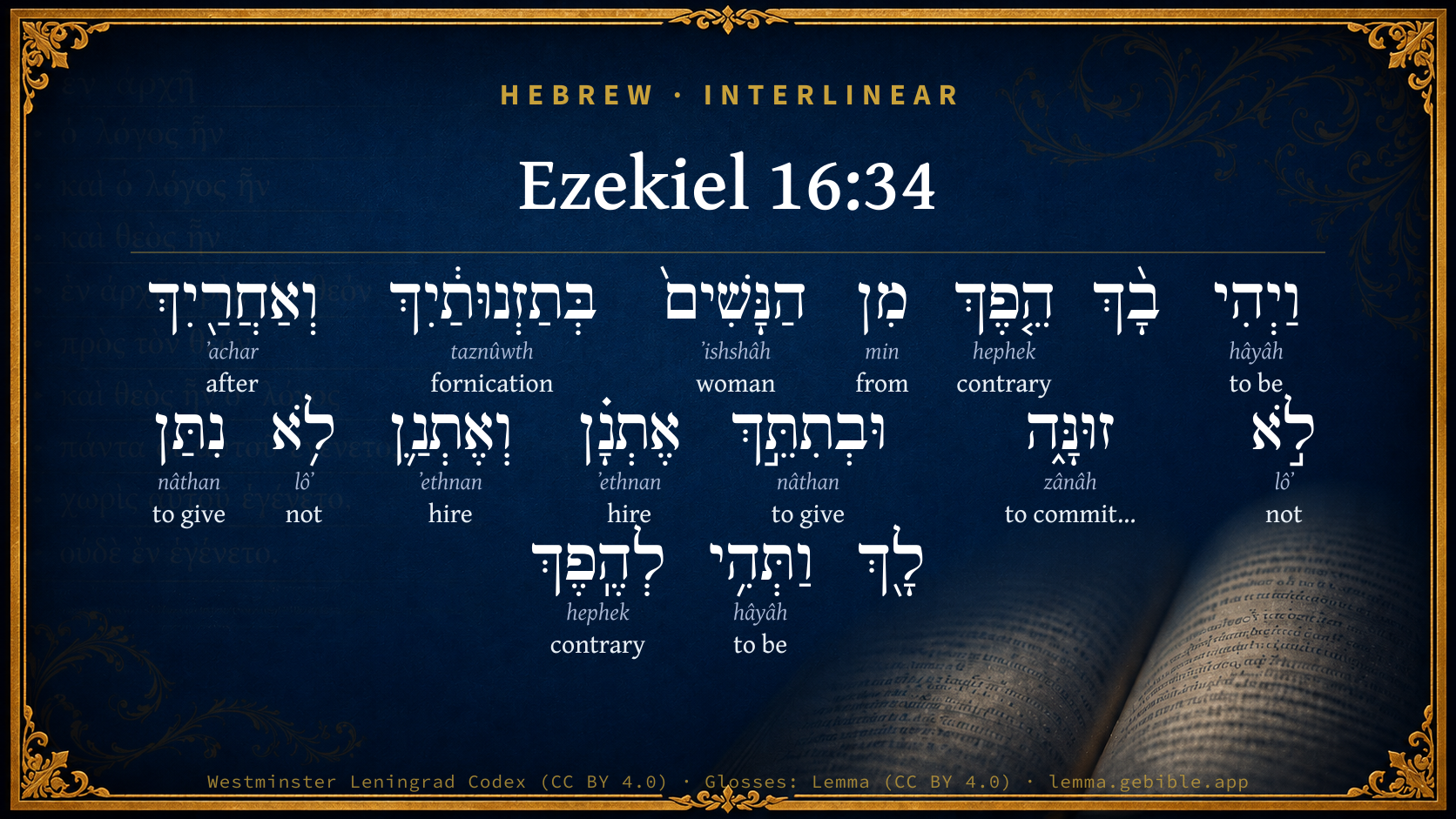
Hebrew (Westminster Leningrad Codex) Ezekiel 16:34 appears in the Hebrew Old Testament. The text above is from the Westminster Leningrad Codex. Each word links to its Strong’s number, a concise gloss, and parsing drawn from the Open Scriptures Hebrew Bible morphology. Click any word for its full Brown-Driver-Briggs (BDB) entry.
Download image
Cite this verse

Ezekiel 16:34 (World English Bible). Public Domain. Lemma interlinear Bible study tool, https://lemma.gebible.app/v/ezekiel/16/34.

Show BibTeX & RIS
BibTeX
RIS
English Translation
You are different from [other] women in your prostitution, in that none follows you to play the prostitute; and whereas you give hire, and no hire is given to you, therefore you are different.
World English Bible · Public Domain
Highlights
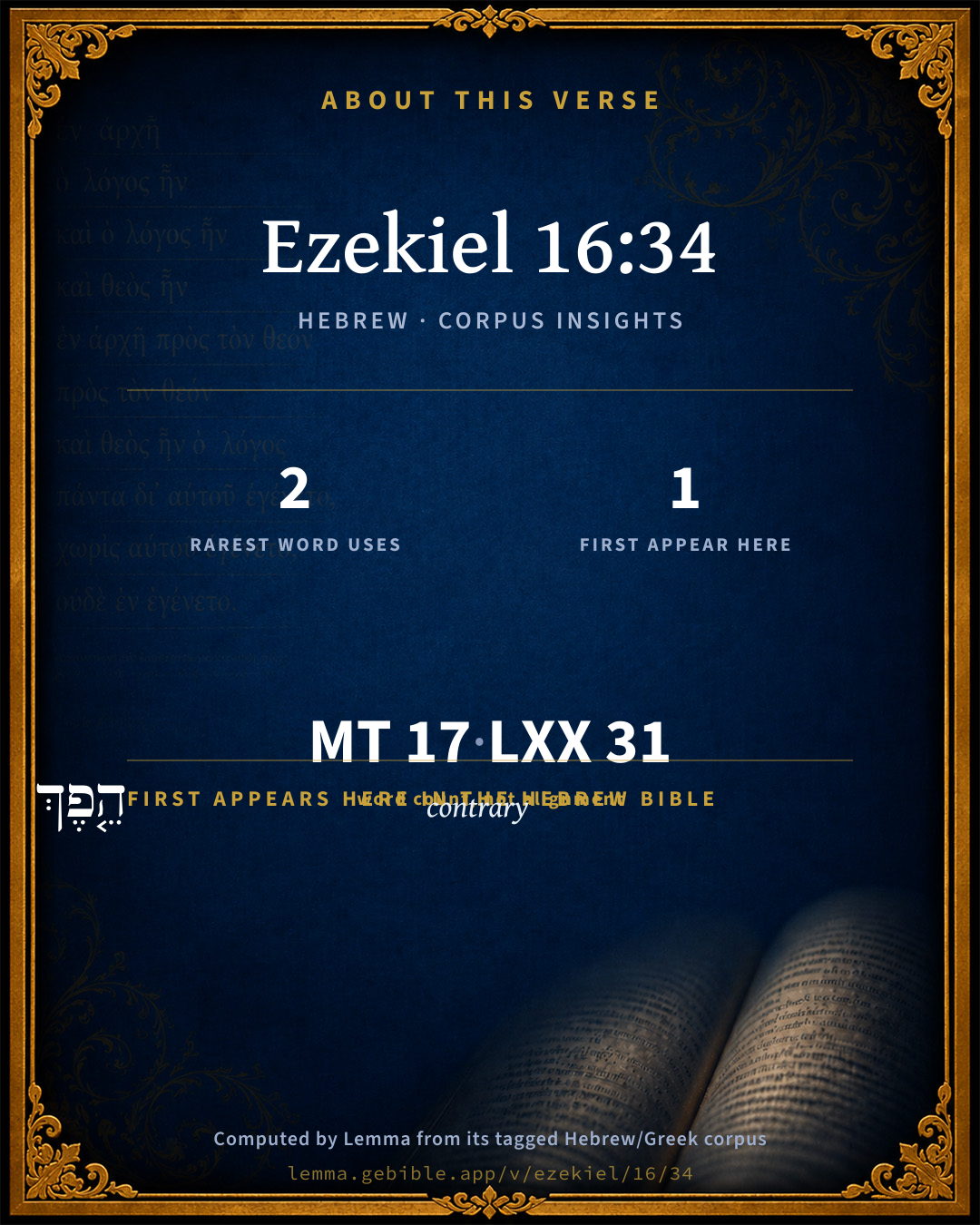
  • 1 first appearance in the Hebrew Bible
Full analysis ↓
Download a study sheet

One document with this verse’s original text, its word-by-word gloss line, the meaning frame, cross-references with their text, attributed commentary, and full source and license credits — printable, and it pastes into notes with its structure intact.

This verse Autodidact and up

Study sheet (.html) Plain text (.txt)

A passage Seminary Student

Up to 50 verses in one chapter. A passage sheet keeps up to 6 commentary sources and 12 cross-references per verse, in the order this page ranks them, and says so on the sheet whenever that leaves anything out. Ask for a single verse and you get the Autodidact verse sheet above.

Everything on this page stays free to read, with no account — the sheet is a download of what is already on screen, not access to it.

Want to remove ads? Support Godless Engineer
Compare translations 3

The same verse in 3 English versions, stacked beneath the original-language interlinear above. Click any original word for its lexicon entry.

Each is an independent rendering of the whole verse — the interlinear is not word-aligned to these translations.

Highlighted words mark where these versions differ — a whole-verse word diff, not a word-by-word alignment.

  • World English Bible Public Domain
    You are different from [other] women in your prostitution, in that none follows you to play the prostitute; and whereas you give hire, and no hire is given to you, therefore you are different.
  • King James Version Public Domain
    And the contrary is in thee from other women in thy whoredoms, whereas none followeth thee to commit whoredoms: and in that thou givest a reward, and no reward is given unto thee, therefore thou art contrary.
  • unfoldingWord Literal Text CC BY-SA 4.0
    So there is a difference between you and other women. No one offers payment for you to act as a prostitute. You are the very opposite. You gave them payment and none was given to you.

unfoldingWord Literal Text — © unfoldingWord, licensed CC BY-SA 4.0. Word-aligned USFM3 via Door43 (git.door43.org/unfoldingWord/en_ult).

Versions to compare (up to 4)

3 of 4 selected

Show all 18 translations

Every available English version of this verse, each an independent rendering of the whole verse.

  • World English Bible Public Domain
    You are different from [other] women in your prostitution, in that none follows you to play the prostitute; and whereas you give hire, and no hire is given to you, therefore you are different.
  • Berean Standard Bible Public Domain
    So your prostitution is the opposite of that of other women: No one solicited your favors, and you paid a fee instead of receiving one; so you are the very opposite!
  • Majority Standard Bible Public Domain
    So your prostitution is the opposite of that of other women: No one solicited your favors, and you paid a fee instead of receiving one; so you are the very opposite!
  • King James Version Public Domain
    And the contrary is in thee from other women in thy whoredoms, whereas none followeth thee to commit whoredoms: and in that thou givest a reward, and no reward is given unto thee, therefore thou art contrary.
  • American Standard Version (1901) Public Domain
    And thou art different from `other' women in thy whoredoms, in that none followeth thee to play the harlot; and whereas thou givest hire, and no hire is given unto thee, therefore thou art different.
  • Revised Version (1885) Public Domain
    And the contrary is in thee from other women in thy whoredoms, in that none followeth thee to commit whoredom: and whereas thou givest hire, and no hire is given unto thee, therefore thou art contrary.
  • Geneva Bible (1599) Public Domain
    And the contrary is in thee from other women in thy fornications, neither the like fornication shall be after thee: for in that thou giuest a rewarde, and no reward is giuen vnto thee, therefore thou art contrary.
  • Douay-Rheims (1899) Public Domain
    And it hath happened in thee contrary to the custom of women in thy fornications, and after thee there shall be no such fornication: for in that thou gavest rewards, and didst not take rewards, the contrary hath been done in thee.
  • Young's Literal Translation Public Domain
    And the contrary is in thee from women in thy whoredoms, That after thee none doth go a-whoring; And in thy giving a gift, And a gift hath not been given to thee; And thou art become contrary.
  • Literal Standard Version CC BY-SA 4.0
    And you are opposite from [other] women in your whoredoms, || That none go whoring after you; And in your giving a wage, || And a wage has not been given to you; Therefore you are the opposite.
  • Unlocked Literal Bible CC BY-SA 4.0
    So there is a difference between you and those other women, since no one goes to you to ask you to sleep with them. Instead, you pay them. No one pays you.
  • unfoldingWord Literal Text CC BY-SA 4.0
    So there is a difference between you and other women. No one offers payment for you to act as a prostitute. You are the very opposite. You gave them payment and none was given to you.
  • Darby Bible Public Domain
    And in thee is the contrary from [other] women, in thy whoredoms, in that none followeth thee to commit fornication; and whereas thou givest a reward, and no reward is given unto thee, so art thou contrary.
  • World Messianic Bible Public Domain
    You are different from other women in your prostitution, in that no one follows you to play the prostitute; and whereas you give hire, and no hire is given to you, therefore you are different.”’
  • Webster's Bible Public Domain
    And the contrary is in thee from other women in thy unlawful commerce, whereas none followeth thee to commit lewdness: and in that thou givest a reward, and no reward is given to thee, therefore thou art contrary.
  • Free Bible Version CC BY-SA 4.0
    So you're the opposite of other prostitutes. No one comes to you asking for sex, and you pay the prostitute's fee instead of receiving it. You're the exact opposite!
  • Bible in Basic English Public Domain
    And in your loose behaviour you are different from other women, for no one goes after you to make love to you: and because you give payment and no payment is given to you, in this you are different from them.
  • JPS Tanakh (1917) Public Domain
    And the contrary is in thee from other women, in that thou didst solicit to harlotry, and wast not solicited; and in that thou givest hire, and no hire is given unto thee, thus thou art contrary.

Literal Standard Version (2020), Covenant Press — licensed CC BY-SA 4.0. Text via the HelloAO Bible API (eBible.org). Unlocked Literal Bible (unfoldingWord) — licensed CC BY-SA 4.0. Text via the HelloAO Bible API (eBible.org). unfoldingWord Literal Text — © unfoldingWord, licensed CC BY-SA 4.0. Word-aligned USFM3 via Door43 (git.door43.org/unfoldingWord/en_ult). Free Bible Version, Dr. Jonathan Gallagher — licensed CC BY-SA 4.0. Text via the HelloAO Bible API (eBible.org).

Word by word

More ways to search: Search by grammar → Find every occurrence → Compare this word →

Practice this passage: Drill this verse → Learn its vocabulary →

הֵ֤פֶךְ
hephek
H2016
“contrary”
Noun, Common, Masculine, Singular, Absolute
Part of Speech
Noun
Type
Common
Gender
Masculine
Number
Singular
State
Absolute
Full BDB Definition

Origin: from H2015

TWOT: 512a

contrary, opposite, a difference, reversed, contrariness, perversity
  1. וַיְהִי hâyâh H1961 “and · to be” Conjunction + Verb, Qal, Sequential Imperfect, 3rd Person, Masculine, Singular
  2. מִן min H4480 “from” Preposition
  3. הַנָּשִׁים֙ ʼishshâh H802 “the · women” Particle, Definite Article + Noun, Common, Feminine, Plural, Absolute
  4. בְּתַזְנוּתַ֔יִךְ taznûwth H8457 “in/at · fornications · your” Preposition + Noun, Common, Feminine, Plural, Construct + Suffix, Personal, 2nd Person, Feminine, Singular
  5. וְאַחֲרַ֖יִךְ ʼachar H310 “and · after · you” Conjunction + Preposition + Suffix, Personal, 2nd Person, Feminine, Singular
  6. לֹ֣א lôʼ H3808 “not” Particle, Negative
  7. זוּנָּ֑ה zânâh H2181 “to commit fornication” Verb, Pual, Perfect, 3rd Person, Masculine, Singular
  8. וּבְתִתֵּ֣ךְ nâthan H5414 “and · in/at · to give · you” Conjunction + Preposition + Verb, Qal, Infinitive Construct + Suffix, Personal, 2nd Person, Feminine, Singular
  9. אֶתְנָ֗ן ʼethnan H868 “hire” Noun, Common, Masculine, Singular, Absolute
  10. וְאֶתְנַ֛ן ʼethnan H868 “and · hire” Conjunction + Noun, Common, Masculine, Singular, Absolute
  11. לֹ֥א lôʼ H3808 “not” Particle, Negative
  12. נִתַּן nâthan H5414 “to give” Verb, Niphal, Perfect, 3rd Person, Masculine, Singular
  13. וַתְּהִ֥י hâyâh H1961 “and · to be” Conjunction + Verb, Qal, Sequential Imperfect, 3rd Person, Feminine, Singular
  14. לְהֶֽפֶךְ hephek H2016 “to/for · contrary” Preposition + Noun, Common, Masculine, Singular, Absolute

About this verse

These counts appear in no published source. They are computed here, from the morphology-tagged text and Lemma’s own curated glosses. What Lemma adds →

17
words
10
distinct lemmas
Prophets
section

Notable vocabulary

The rarest word here is הֵ֤פֶךְ contrary H2016 — appearing just 2 times in the whole Hebrew Bible.

First appearance in Scripture

This word makes its first canonical appearance in the Hebrew Bible here:

  • הֵ֤פֶךְ contrary H2016

Grammatical profile

  • 5 verbs
  • 6 nouns
  • 4 prepositions
  • 2 particles

Verb forms

  • וַיְהִי Qal · Sequential Imperfect
  • זוּנָּ֑ה Pual · Perfect
  • וּבְתִתֵּ֣ךְ Qal · Infinitive Construct
  • נִתַּן Niphal · Perfect
  • וַתְּהִ֥י Qal · Sequential Imperfect

Repetition

Words recur within this verse — often emphatic in Hebrew:

  • וַיְהִי to be H1961 ×2
  • הֵ֤פֶךְ contrary H2016 ×2
  • וּבְתִתֵּ֣ךְ to give H5414 ×2
  • אֶתְנָ֗ן hire H868 ×2
  • לֹ֣א not H3808 ×2

Hebrew & Septuagint length

In English translation the verse runs 34 words from the Hebrew and 41 from the Septuagint (LXX English) — closely comparable.

A rough comparison of the two English renderings, which tokenize alike — not a word-level alignment.

Word counts can differ between the Hebrew and the Greek without any difference in meaning — e.g. the Hebrew direct-object marker אֵת has no separate Greek word, and Greek often adds the article ὁ.

In the original languages it is 17 Hebrew tokens and 31 Greek tokens — but the two are counted differently (Hebrew bundles its prefixes and suffixes into one token; the Greek is in lemma form), so that isn’t a like-for-like length.

Hebrew and Greek witnesses Masoretic Hebrew ↔ Greek Septuagint

The same verse in the two great witnesses to the Old Testament, shown verse-for-verse.

These are two independent witnesses, not word-aligned to each other, and the Septuagint is shown in lemma (dictionary) form.

Hebrew Ezekiel 16:34 Masoretic · Westminster Leningrad Codex

וַיְהִי בָ֨ךְ הֵ֤פֶךְ מִן הַנָּשִׁים֙ בְּתַזְנוּתַ֔יִךְ וְאַחֲרַ֖יִךְ לֹ֣א זוּנָּ֑ה וּבְתִתֵּ֣ךְ אֶתְנָ֗ן וְאֶתְנַ֛ן לֹ֥א נִתַּן לָ֖ךְ וַתְּהִ֥י לְהֶֽפֶךְ

You are different from [other] women in your prostitution, in that none follows you to play the prostitute; and whereas you give hire, and no hire is given to you, therefore you are different.

World English Bible · Public Domain

Greek LXX Ezekiel 16:34 Septuagint · lemma form

καί γίγνομαι ἐν σύ διαστρέφω παρά ὁ γυνή ἐν ὁ πορνεία σύ καί μετά σύ πορνεύω ἐν ὁ προςδίδωμι σύ μίσθωμα καί σύ μίσθωμα οὐ δίδωμι καί γίγνομαι ἐν σύ διαστρέφω

And there has happened in you perverseness in your fornication beyond other women, and they have committed fornication with you, in that you give hires over and above, and hires were not given to you; and thus perverseness happened in you.

LXX2012 (modern English Septuagint) · Public Domain

Hebrew: Westminster Leningrad Codex (CC BY 4.0). Greek: Septuagint (public domain); English from LXX2012 (modern English Septuagint) (Public Domain). How the Septuagint differs from the Hebrew →

Targum (Aramaic paraphrase)

1

The Targum is the ancient Jewish Aramaic paraphrase of the Hebrew Scriptures — an interpretive translation, not the Hebrew text itself. Onkelos (literal) and Pseudo-Jonathan (expansive) render the Torah, and Jonathan the Prophets. Coverage is partial: where no permissively-licensed English translation exists for a verse, only the Aramaic is shown. This is verse-level text, not a word-by-word alignment to the Hebrew.

  1. Targum Jonathan Prophets (Joshua–Malachi)
    וַהֲוָה בִּיךְ שְׁנוּ כְנִשְׁתָּא דְיִשְׂרָאֵל מִן מְדִינָתָא בְּטַעֲוָתַיִךְ וּבַתְרִיךְ לָא הֲוַת דְטָעִית כְּוָתִיךְ וּבְמִתְּנִיךְ אֲגַר וְאֲגַר לָא אִתְיְהַב לִיךְ וַהֲוֵית לִשְׁנוּ:

    (no public-domain English translation for this verse)

    Targum Jonathan — Aramaic: “Mikraot Gedolot” (public domain). English: “Sefaria Community Translation” (CC0 1.0 (public-domain dedication)); “London "Chaldee Paraphrase," 1871” (public domain). Text via Sefaria.

Commentary

Notes on Ezekiel 16:34 from classic Christian and Jewish commentators (each source and its license shown beneath its notes). The classic Christian expositions comment on the surrounding passage and are grouped to its opening verse, so a note may address several verses; the Jewish commentaries on the Tanakh (Rashi and others) are per-verse, so they appear only where the commentator wrote on this verse.

Lemma curates 59 commentaries, every one of them public domain or Creative Commons licensed, each selected and text-cleaned for this edition rather than reprinted as found. About our sources →

Trapp's Complete Commentary

John Trapp

Eze 16:34 And the contrary is in thee from [other] women in thy whoredoms, whereas none followeth thee to commit whoredoms: and in that thou givest a reward, and no reward is given unto thee, therefore thou art contrary.

Ver. 34. And the contrary is in thee, &c.] The Jews, before the Babylonish captivity, were madly and above measure set upon the sin of idolatry, say their own Rabbis; so that if one clothed never so richly had seen an idol on the further side of a broad pool, he would have gone through thick and thin, etiam in cloacalem foetulentam, end even in foul smelling sewers to have worshipped it. {a}

{a} Oecolamp.

John Trapp, A Commentary or Exposition upon All the Books of the Old and New Testament (1647–1656) — public domain. Text from a community e-Sword module.

John Calvin's Commentaries

But the Prophet only confirms his former teaching, that the Jews were seized with such lust, and in so unaccustomed a manner, that they could only satisfy their desires with severe loss; but this comparison only magnifies their crime, since they were worse than any harlots; for although they basely sell themselves, yet the hope of gain is a kind of pretext and excuse, and a starving woman may be led into great excess; but far fouler and less excusable is her conduct who purchases her lovers. It now follows —

John Calvin's Commentaries (1540-1563) — public domain. Text from the Calvin Translation Society English edition (1840s-50s) via the Christian Classics Ethereal Library (ccel.org). Calvin's coverage is partial (roughly two-thirds of the Bible); uncommented books and verses are honest gaps, never fabricated. The 19th-century editor's footnotes and remarks are omitted so the notes are faithfully Calvin's own voice.

The Cambridge Bible for Schools and Colleges

gen. ed. J. J. S. Perowne

34. from other women] Point thus: “from other women: in that thou committest whoredom, and none goeth a whoring after thee; and in that thou givest hire, and no hire is given unto thee; therefore thou art contrary.” Hos_8:9, Ephraim hireth lovers; Jer_2:23-25; Jer_3:1-2.

The Cambridge Bible for Schools and Colleges (gen. ed. J. J. S. Perowne; Cambridge University Press, 1878–1918) — public domain. Text from a community e-Sword module.

John Gill's Exposition

Wherefore, O harlot, hear the word of the Lord. The sentence about to be pronounced; adjudging to be slain with the sword, to be stoned and burned; the crime for which is to be read in the name of harlot, justly given to an apostate people; as it often is to the church of Rome in the book of the Revelation. The Targum is,

"whose works are as an harlots; O congregation of Israel, receive the words of the Lord;''

which follow:

John Gill's Exposition of the Whole Bible (1746–1763) — public domain (CC PDM 1.0). Text via the HelloAO Bible API.

Haydock's Catholic Bible Commentary

Fornication unpunished, or comparable with thine, ver. 16. (Haydock) --- All such actions are abominable; but still more so, when the woman solicts[solicits?]. (Worthington)

George Leo Haydock (1774–1849), Haydock's Catholic Family Bible and Commentary, 1859 edition — public domain. Excludes Psalms (Douay-Rheims chapter numbering differs from Protestant) and Deuterocanonical books (Catholic canon only).

Matthew Poole's English Annotations

That which subverts the order of nature, is contrary to the innate modesty of thy sex. Thou followest them, treatest, importunest, promisest, payest, and caressest them. Thus, as a shameless adulteress, Israel had carried it toward her God, who espoused, enriched, beautified, and delighted in her; but she hired the nations round about her to enter covenant with her; entertained and maintained all their idolatrous worship, gave the nuptial gifts to hateful idols.

Matthew Poole's English Annotations on the Holy Bible (1683–1685) — public domain. Text from a community e-Sword/MySword module.

Whedon's Commentary on the Bible

Daniel D. Whedon

34. Whereas — Literally, seeing that.

A reward — Literally, hire.

Daniel D. Whedon (gen. ed.), Commentary on the Old and New Testaments (1874–1909) — public domain. Text from a community e-Sword module.

John Wesley's Explanatory Notes

Contrary - Here we may see, what the nature of men is, when God leaves them to themselves: yea, tho' they have the greatest advantage, to be better, and to do better.

John Wesley, Explanatory Notes Upon the Whole Bible (1754–1765) — public domain. Text via the GEBible commentary corpus.

Rashi

Rabbi Shlomo Yitzchaki (Rashi)

there was no such harlotry No harlotry was done with any harlot like your harlotry.

Rashi on the Tanakh — English translations: “The Judaica Press complete Tanach with Rashi, translated by A. J. Rosenberg” (CC BY 4.0); “Pentateuch with Rashi's commentary by M. Rosenbaum and A.M. Silbermann, 1929-1934” (public domain); “The Metsudah Tanach series, Lakewood, N.J” (CC BY 4.0); and “The Book of Joshua, Metsudah Publications, 1997” (CC BY 4.0). Text via Sefaria.

Lesson kit

Teaching starters — assembled from the data on this page, not authored interpretation. Every prompt links to the verse data it draws on. Edit before teaching.

Ezekiel, in the Prophets, opens this verse with 17 words (10 distinct Hebrew lemmas). Its most distinctive word is hephek (“contrary”). A historical commentator’s framing appears above. Read the whole chapter for the surrounding context.

Discussion questions

  1. The word hephek carries the sense “contrary.” How does it shape the verse?
  2. This is the first place “contrary” appears in Scripture (first appears here). What does its debut here establish?
  3. What does the repetition of “to be” (2× in this one verse) do in this verse?
  4. These translations render this verse differently; the difference is in the English rendering, not the original. What questions does that raise?
  5. «וַיְהִי» is a Qal Sequential Imperfect verb. How does that grammatical form shape the action described?
  6. Compare how Trapp's Complete Commentary and John Calvin's Commentaries read this verse. Where do they agree or differ?

Things to notice

Reading settings

Reading text

Shown beneath each verse's original-language words.

Old Testament
Old Testament edition

Read the OT as the Masoretic Hebrew (MT) or the Greek Septuagint (LXX).

English shown for the Greek Septuagint (in the Hebrew ↔ Greek comparison).

Comparing translations? Open the Compare panel on any verse page to stack up to four side by side.