
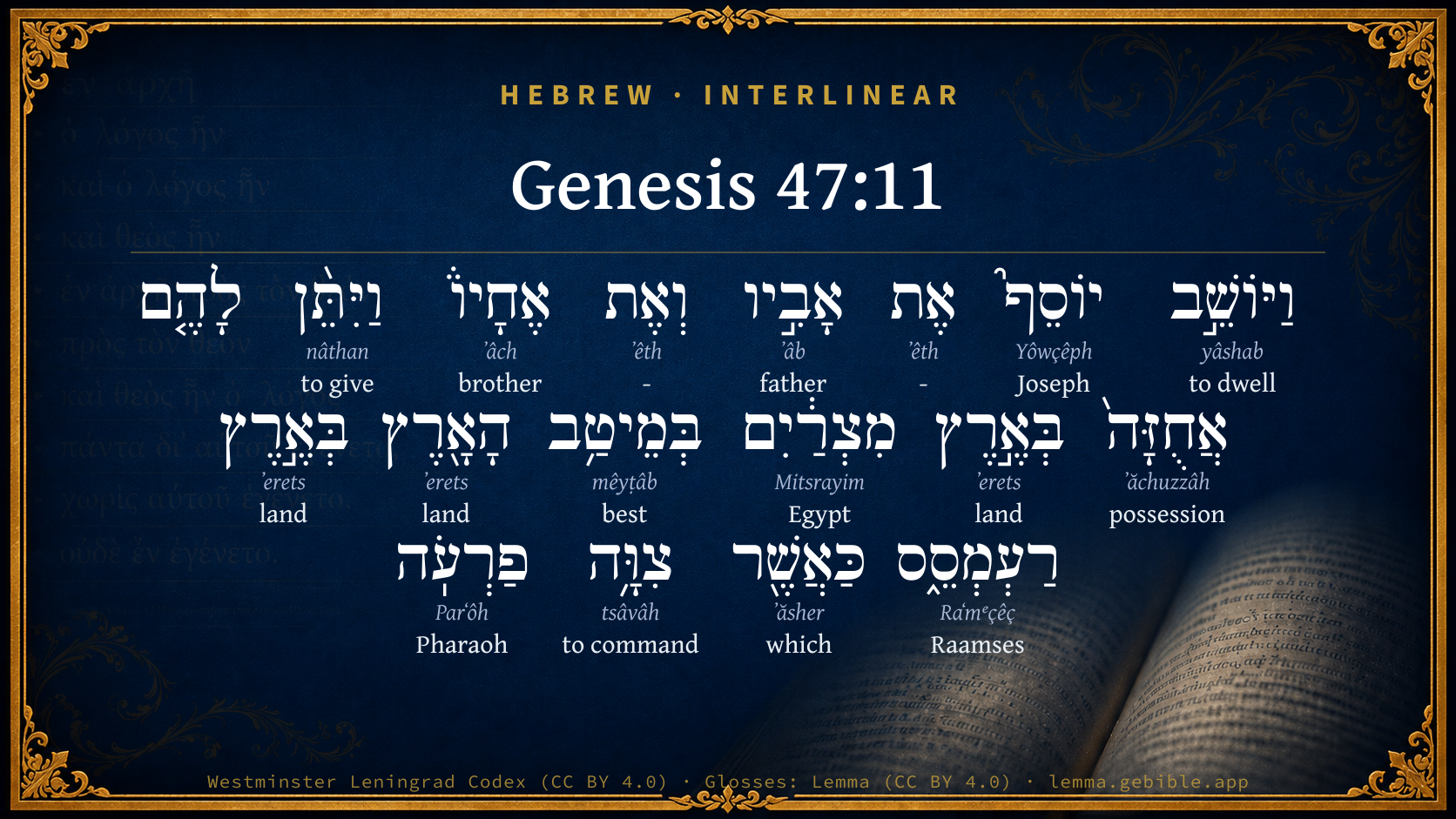
Genesis 47:11

Hebrew (Westminster Leningrad Codex) Genesis 47:11 appears in the Hebrew Old Testament. The text above is from the Westminster Leningrad Codex. Each word links to its Strong’s number, a concise gloss, and parsing drawn from the Open Scriptures Hebrew Bible morphology. Click any word for its full Brown-Driver-Briggs (BDB) entry.
Download image
Cite this verse

Genesis 47:11 (World English Bible). Public Domain. Lemma interlinear Bible study tool, https://lemma.gebible.app/v/genesis/47/11.

Show BibTeX & RIS
BibTeX
RIS
English Translation
Joseph placed his father and his brothers, and gave them a possession in the land of Egypt, in the best of the land, in the land of Rameses, as Pharaoh had commanded.
World English Bible · Public Domain
Highlights
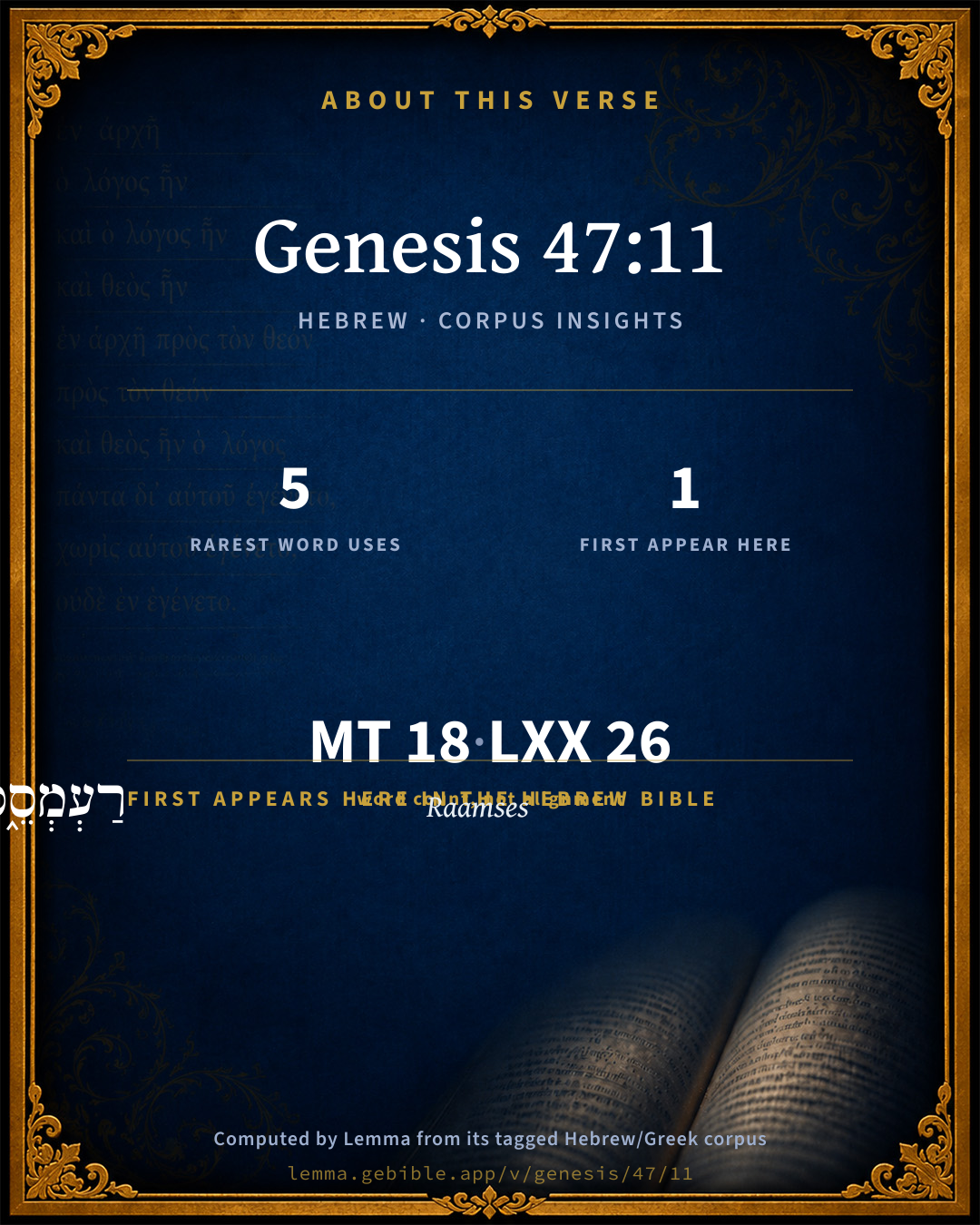
  • 1 first appearance in the Hebrew Bible
Full analysis ↓
Download a study sheet

One document with this verse’s original text, its word-by-word gloss line, the meaning frame, cross-references with their text, attributed commentary, and full source and license credits — printable, and it pastes into notes with its structure intact.

This verse Autodidact and up

Study sheet (.html) Plain text (.txt)

A passage Seminary Student

Up to 50 verses in one chapter. A passage sheet keeps up to 6 commentary sources and 12 cross-references per verse, in the order this page ranks them, and says so on the sheet whenever that leaves anything out. Ask for a single verse and you get the Autodidact verse sheet above.

Everything on this page stays free to read, with no account — the sheet is a download of what is already on screen, not access to it.

Want to remove ads? Support Godless Engineer
Compare translations 3

The same verse in 3 English versions, stacked beneath the original-language interlinear above. Click any original word for its lexicon entry.

Each is an independent rendering of the whole verse — the interlinear is not word-aligned to these translations.

Highlighted words mark where these versions differ — a whole-verse word diff, not a word-by-word alignment.

  • World English Bible Public Domain
    Joseph placed his father and his brothers, and gave them a possession in the land of Egypt, in the best of the land, in the land of Rameses, as Pharaoh had commanded.
  • King James Version Public Domain
    And Joseph placed his father and his brethren, and gave them a possession in the land of Egypt, in the best of the land, in the land of Rameses, as Pharaoh had commanded.
  • unfoldingWord Literal Text CC BY-SA 4.0
    Then Joseph settled his father and his brothers, and he gave them property in the land of Egypt, in the best land, in the land of Rameses, as Pharaoh had commanded.

unfoldingWord Literal Text — © unfoldingWord, licensed CC BY-SA 4.0. Word-aligned USFM3 via Door43 (git.door43.org/unfoldingWord/en_ult).

Versions to compare (up to 4)

3 of 4 selected

Show all 18 translations

Every available English version of this verse, each an independent rendering of the whole verse.

  • World English Bible Public Domain
    Joseph placed his father and his brothers, and gave them a possession in the land of Egypt, in the best of the land, in the land of Rameses, as Pharaoh had commanded.
  • Berean Standard Bible Public Domain
    So Joseph settled his father and brothers in the land of Egypt and gave them property in the best part of the land, the district of Rameses, as Pharaoh had commanded.
  • Majority Standard Bible Public Domain
    So Joseph settled his father and brothers in the land of Egypt and gave them property in the best part of the land, the district of Rameses, as Pharaoh had commanded.
  • King James Version Public Domain
    And Joseph placed his father and his brethren, and gave them a possession in the land of Egypt, in the best of the land, in the land of Rameses, as Pharaoh had commanded.
  • American Standard Version (1901) Public Domain
    And Joseph placed his father and his brethren, and gave them a possession in the land of Egypt, in the best of the land, in the land of Rameses, as Pharaoh had commanded.
  • Revised Version (1885) Public Domain
    And Joseph placed his father and his brethren, and gave them a possession in the land of Egypt, in the best of the land, in the land of Rameses, as Pharaoh had commanded.
  • Geneva Bible (1599) Public Domain
    And Ioseph placed his father, and his brethren, and gaue them possession in the lande of Egypt, in the best of the land, euen in the lande of Rameses, as Pharaoh had commanded.
  • Douay-Rheims (1899) Public Domain
    But Joseph gave a possession to his father and his brethren in Egypt, in the best place of the land, in Ramesses, as Pharao had commanded.
  • Young's Literal Translation Public Domain
    And Joseph settleth his father and his brethren, and giveth to them a possession in the land of Egypt, in the best of the land, in the land of Rameses, as Pharaoh commanded;
  • Literal Standard Version CC BY-SA 4.0
    And Joseph settles his father and his brothers, and gives a possession to them in the land of Egypt, in the best of the land, in the land of Rameses, as Pharaoh commanded;
  • Unlocked Literal Bible CC BY-SA 4.0
    Then Joseph settled his father and his brothers. He gave them a territory in the land of Egypt, the best of the land, in the land of Rameses, as Pharaoh had commanded.
  • unfoldingWord Literal Text CC BY-SA 4.0
    Then Joseph settled his father and his brothers, and he gave them property in the land of Egypt, in the best land, in the land of Rameses, as Pharaoh had commanded.
  • Darby Bible Public Domain
    And Joseph settled his father and his brethren, and gave them a possession in the land of Egypt, in the best of the land, in the land of Rameses, as Pharaoh had commanded.
  • World Messianic Bible Public Domain
    Joseph placed his father and his brothers, and gave them a possession in the land of Egypt, in the best of the land, in the land of Rameses, as Pharaoh had commanded.
  • Webster's Bible Public Domain
    And Joseph placed his father and his brethren, and gave them a possession in the land of Egypt, in the best of the land, in the land of Rameses, as Pharaoh had commanded.
  • Free Bible Version CC BY-SA 4.0
    So Joseph arranged for his father and brothers to live in Egypt and gave them land in the best part near Rameses, as Pharaoh had ordered.
  • Bible in Basic English Public Domain
    And Joseph made a place for his father and his brothers, and gave them a heritage in the land of Egypt, in the best of the land, the land of Rameses, as Pharaoh had given orders.
  • JPS Tanakh (1917) Public Domain
    And Joseph placed his father and his brethren, and gave them a possession in the land of Egypt, in the best of the land, in the land of Rameses, as Pharaoh had commanded.

Literal Standard Version (2020), Covenant Press — licensed CC BY-SA 4.0. Text via the HelloAO Bible API (eBible.org). Unlocked Literal Bible (unfoldingWord) — licensed CC BY-SA 4.0. Text via the HelloAO Bible API (eBible.org). unfoldingWord Literal Text — © unfoldingWord, licensed CC BY-SA 4.0. Word-aligned USFM3 via Door43 (git.door43.org/unfoldingWord/en_ult). Free Bible Version, Dr. Jonathan Gallagher — licensed CC BY-SA 4.0. Text via the HelloAO Bible API (eBible.org).

Word by word

More ways to search: Search by grammar → Find every occurrence → Compare this word →

Practice this passage: Drill this verse → Learn its vocabulary →

רַעְמְסֵ֑ס
Raʻmᵉçêç
H7486
“Raamses”
Noun, Proper
Part of Speech
Noun
Type
Proper
Full BDB Definition

Origin: of Egyptian origin

TWOT: None

Raamses or Rameses = "child of the sun" - a city in lower Egypt built by Hebrew slaves; probably in Goshen
  1. וַיּוֹשֵׁ֣ב yâshab H3427 “and · to dwell” Conjunction + Verb, Hiphil, Sequential Imperfect, 3rd Person, Masculine, Singular
  2. יוֹסֵף֮ Yôwçêph H3130 “Joseph” Noun, Proper
  3. אֶת ʼêth H853 “-” Particle, Direct Object
  4. אָבִ֣יו ʼâb H1 “father · his” Noun, Common, Masculine, Singular, Construct + Suffix, Personal, 3rd Person, Masculine, Singular
  5. וְאֶת ʼêth H853 “and · -” Conjunction + Particle, Direct Object
  6. אֶחָיו֒ ʼâch H251 “brothers · his” Noun, Common, Masculine, Plural, Construct + Suffix, Personal, 3rd Person, Masculine, Singular
  7. וַיִּתֵּ֨ן nâthan H5414 “and · to give” Conjunction + Verb, Qal, Sequential Imperfect, 3rd Person, Masculine, Singular
  8. אֲחֻזָּה֙ ʼăchuzzâh H272 “possession” Noun, Common, Feminine, Singular, Absolute
  9. בְּאֶ֣רֶץ ʼerets H776 “in/at · land of” Preposition + Noun, Common, Both, Singular, Construct
  10. מִצְרַ֔יִם Mitsrayim H4714 “Egypt” Noun, Proper
  11. בְּמֵיטַ֥ב mêyṭâb H4315 “in/at · best of” Preposition + Noun, Common, Masculine, Singular, Construct
  12. הָאָ֖רֶץ ʼerets H776 “the · land” Particle, Definite Article + Noun, Common, Both, Singular, Absolute
  13. בְּאֶ֣רֶץ ʼerets H776 “in/at · land of” Preposition + Noun, Common, Both, Singular, Construct
  14. כַּאֲשֶׁ֖ר ʼăsher H834 “like/as · which” Preposition + Particle, Relative
  15. צִוָּ֥ה tsâvâh H6680 “to command” Verb, Piel, Perfect, 3rd Person, Masculine, Singular
  16. פַרְעֹֽה Parʻôh H6547 “Pharaoh” Noun, Proper

About this verse

These counts appear in no published source. They are computed here, from the morphology-tagged text and Lemma’s own curated glosses. What Lemma adds →

18
words
14
distinct lemmas
Pentateuch
section

Notable vocabulary

The rarest word here is רַעְמְסֵ֑ס Raamses H7486 — appearing just 5 times in the whole Hebrew Bible.

First appearance in Scripture

This word makes its first canonical appearance in the Hebrew Bible here:

  • רַעְמְסֵ֑ס Raamses H7486

Shared distinctive vocabulary

רַעְמְסֵ֑ס Raamses H7486 occurs in 5 verses of the Hebrew Bible. Also found in:

Grammatical profile

  • 3 verbs
  • 11 nouns
  • 1 preposition
  • 3 particles

Verb forms

  • וַיּוֹשֵׁ֣ב Hiphil · Sequential Imperfect
  • וַיִּתֵּ֨ן Qal · Sequential Imperfect
  • צִוָּ֥ה Piel · Perfect

Repetition

A word recurs within this verse — often emphatic in Hebrew:

  • בְּאֶ֣רֶץ land H776 ×3

Hebrew & Septuagint length

In English translation the verse runs 32 words from the Hebrew and 30 from the Septuagint (LXX English) — closely comparable.

A rough comparison of the two English renderings, which tokenize alike — not a word-level alignment.

Word counts can differ between the Hebrew and the Greek without any difference in meaning — e.g. the Hebrew direct-object marker אֵת has no separate Greek word, and Greek often adds the article ὁ.

In the original languages it is 18 Hebrew tokens and 26 Greek tokens — but the two are counted differently (Hebrew bundles its prefixes and suffixes into one token; the Greek is in lemma form), so that isn’t a like-for-like length.

Cross-references

9

Topical passages linked to Genesis 47:11 in the Treasury of Scripture Knowledge — connected by theme and wording, ordered by reader-vote popularity; previews shown in the World English Bible.

  • Genesis 47:6 The land of Egypt is before you. Make your father and your brothers dwell in the best of the land. Let them dwell in the land of Goshen. If you know any able men among them, then put them in charge of my cattle."
  • Exodus 1:11 Therefore they set taskmasters over them to afflict them with their burdens. They built storage cities for Pharaoh: Pithom and Raamses.
  • Exodus 12:37 The children of Israel traveled from Rameses to Succoth, about six hundred thousand on foot who were men, besides children.
  • John 10:10 The thief only comes to steal, kill, and destroy. I came that they may have life, and may have it abundantly.
  • John 10:28 I give eternal life to them. They will never perish, and no one will snatch them out of my hand.
  • John 14:2 In my Father's house are many mansions. If it weren't so, I would have told you. I am going to prepare a place for you.
  • John 14:23 Jesus answered him, "If a man loves me, he will keep my word. My Father will love him, and we will come to him, and make our home with him.
  • John 17:2 even as you gave him authority over all flesh, he will give eternal life to all whom you have given him.
  • John 17:24 Father, I desire that they also whom you have given me be with me where I am, that they may see my glory, which you have given me, for you loved me before the foundation of the world.

Cross-references courtesy of OpenBible.info (CC BY 4.0).

Hebrew and Greek witnesses Masoretic Hebrew ↔ Greek Septuagint

The same verse in the two great witnesses to the Old Testament, shown verse-for-verse.

These are two independent witnesses, not word-aligned to each other, and the Septuagint is shown in lemma (dictionary) form.

Hebrew Genesis 47:11 Masoretic · Westminster Leningrad Codex

וַיּוֹשֵׁ֣ב יוֹסֵף֮ אֶת אָבִ֣יו וְאֶת אֶחָיו֒ וַיִּתֵּ֨ן לָהֶ֤ם אֲחֻזָּה֙ בְּאֶ֣רֶץ מִצְרַ֔יִם בְּמֵיטַ֥ב הָאָ֖רֶץ בְּאֶ֣רֶץ רַעְמְסֵ֑ס כַּאֲשֶׁ֖ר צִוָּ֥ה פַרְעֹֽה

Joseph placed his father and his brothers, and gave them a possession in the land of Egypt, in the best of the land, in the land of Rameses, as Pharaoh had commanded.

World English Bible · Public Domain

Greek LXX Genesis 47:11 Septuagint · lemma form

καί καταοἰκίζω ιωσηφ ὁ πατήρ καί ὁ ἀδελφός αὐτός καί δίδωμι αὐτός κατάσχεσις ἐν γῆ αἴγυπτος ἐν ὁ βελτίων γῆ ἐν γῆ ραμεσση καθά προςτάσσω φαραώ

And Joseph settled his father and his brethren, and gave them a possession in the land of Egypt, in the best land, in the land of Ramesses, as Pharao commanded.

LXX2012 (modern English Septuagint) · Public Domain

On this verse, The Cambridge Bible for Schools and Colleges discusses the Septuagint’s reading. Read the note in Commentary ↓

Hebrew: Westminster Leningrad Codex (CC BY 4.0). Greek: Septuagint (public domain); English from LXX2012 (modern English Septuagint) (Public Domain). How the Septuagint differs from the Hebrew →

Targum (Aramaic paraphrase)

2

The Targum is the ancient Jewish Aramaic paraphrase of the Hebrew Scriptures — an interpretive translation, not the Hebrew text itself. Onkelos (literal) and Pseudo-Jonathan (expansive) render the Torah, and Jonathan the Prophets. Coverage is partial: where no permissively-licensed English translation exists for a verse, only the Aramaic is shown. This is verse-level text, not a word-by-word alignment to the Hebrew.

  1. Targum Onkelos Torah (Genesis–Deuteronomy)
    וְאוֹתֵיב יוֹסֵף יָת אֲבוּהִי וְיָת אֲחוֹהִי וִיהַב לְהוֹן אַחֲסָנָא בְּאַרְעָא דְמִצְרַיִם בִּדְשַׁפִּיר בְּאַרְעָא בְּאַרְעָא דְרַעְמְסֵס כְּמָא דִי פַקֵּיד פַרְעֹה

    (no public-domain English translation for this verse)

    Targum Onkelos — Aramaic: “Onkelos Genesis” (public domain); “Onkelos Exodus” (public domain); “Onkelos Leviticus” (public domain); “Onkelos Numbers” (public domain); “Onkelos Deuteronomy” (public domain). English: “Sefaria Community Translation” (CC0 1.0 (public-domain dedication)); “J.W. Etheridge. The Targums of Onkelos and Jonathan Ben Uzziel on the Pentateuch. London: Longmans, Green, 1862” (public domain). Text via Sefaria.

  2. Targum Pseudo-Jonathan Torah (Genesis–Deuteronomy)
    וְאוֹתִיב יוֹסֵף יַת אָבוֹי וְיַת אָחוֹי וִיהַב לְהוֹן אַחְסָנָא בְּאַרְעָא דְמִצְרַיִם בְּבֵית שְׁפַר אַרְעָא בְּאַרְעָא דְפִילוּסִין הֵיכְמָא דְפַקֵיד פַּרְעה

    And Joseph brought his father and brethren to dwell, and gave them a possession in the land of Mizraim, in a goodly part of the country, in the country of Pilusin, as Pharoh had commanded.

    Targum Pseudo-Jonathan — Aramaic: “Targum Jonathan on Genesis” (public domain); “Targum Jonathan on Exodus” (public domain); “Targum Jonathan on Leviticus” (public domain); “Targum Jonathan on Numbers” (public domain); “Targum Jonathan on Deuteronomy” (public domain). English: “The Targum of Jonathan ben Uzziel, trans. J. W. Etheridge, London, 1862” (public domain). Text via Sefaria.

Commentary

Notes on Genesis 47:11 from classic Christian and Jewish commentators (each source and its license shown beneath its notes). The classic Christian expositions comment on the surrounding passage and are grouped to its opening verse, so a note may address several verses; the Jewish commentaries on the Tanakh (Rashi and others) are per-verse, so they appear only where the commentator wrote on this verse.

Lemma curates 59 commentaries, every one of them public domain or Creative Commons licensed, each selected and text-cleaned for this edition rather than reprinted as found. About our sources →

Trapp's Complete Commentary

John Trapp

Gen 47:11 And Joseph placed his father and his brethren, and gave them a possession in the land of Egypt, in the best of the land, in the land of Rameses, as Pharaoh had commanded.

Ver. 11. In the land of Rameses.] That is, in the whole territory where Rameses was afterwards built. {Exo 1:11}

John Trapp, A Commentary or Exposition upon All the Books of the Old and New Testament (1647–1656) — public domain. Text from a community e-Sword module.

Geneva Bible (1599)

Geneva Bible translators

Which was a city in the country of Goshen, Exod. 1:11.

Geneva Bible (1599) marginal notes — public domain. Text via Bolls.life.

Jamieson, Fausset & Brown

Robert Jamieson, A. R. Fausset & David Brown

Joseph placed his father and his brethren . . . in the best of the land--best pasture land in lower Egypt. Goshen, "the land of verdure," lay along the Pelusiac or eastern branch of the Nile. It included a part of the district of Heliopolis, or "On," the capital, and on the east stretched out a considerable length into the desert. The ground included within these boundaries was a rich and fertile extent of natural meadow, and admirably adapted for the purposes of the Hebrew shepherds (compare Gen 49:24; Psa 34:10; Psa 78:72).

Jamieson, Fausset & Brown — Commentary Critical and Explanatory on the Whole Bible (1871) — public domain (CC PDM 1.0). Text via the HelloAO Bible API.

The Cambridge Bible for Schools and Colleges

gen. ed. J. J. S. Perowne

11. placed] Lit. “caused to dwell”; as we should say, “settled.”

the land of Rameses] This description of the land of Goshen appears only here, and in the LXX of ch. Gen_46:28. A town named Rameses is mentioned in Exo_1:11; Exo_12:37; Num_33:3; Num_33:5. In Exo_1:11 Rameses is the name of one of the two store cities built by the children of Israel on the east of the Delta, according to Petrie = Tel er-Reṭabeh. The name given to it was probably that of the Pharaoh of the oppression, Rameses II. If so, the description of this region, where Joseph’s brethren are settled, by the name of “the land of Rameses,” is, strictly speaking, an anachronism, i.e. a chronological anticipation of facts, the country being denoted by a name which it came to bear two centuries later. It is a very natural thing for the Israelite writer to do; and can hardly be regarded in the light of a literary error.

The Cambridge Bible for Schools and Colleges (gen. ed. J. J. S. Perowne; Cambridge University Press, 1878–1918) — public domain. Text from a community e-Sword module.

John Gill's Exposition

And. Joseph nourished his father, and his brethren, and his father's household, with bread,.... For though there might be in Rameses pasture sufficient for their cattle, yet not corn for their families, the famine still continuing; during which time Joseph, as a dutiful and affectionate son, and as a kind brother, supplied them with all necessary provision, signified by bread:

according to their families; according to the number of them, some of his brethren having more and others less in their families; and in proportion to their number he distributed food unto them, so that there was no want: or "according to the mouth of an infant" (a); he nourished them like infants, he put as it were the bread into their mouths, and fed them with as much care and tenderness as infants are fed; and they had no more care to provide food for themselves than children have, such a full and constant supply was handed forth to them: in this Joseph was an eminent type of Christ, who supplies the wants of his people.

(a) "ad os parvuli", Montanus, Schmidt.

John Gill's Exposition of the Whole Bible (1746–1763) — public domain (CC PDM 1.0). Text via the HelloAO Bible API.

Matthew Poole's English Annotations

The land of Rameses; a part of the land of Goshen, possibly that part where afterwards the city Rameses was built by the Israelites, Exo 1:11; 12:37, whence it is so called here by anticipation; for the Israelites were not now numerous enough to possess the whole land of Goshen, which was given to them, but contented themselves with a part of it, leaving the rest to the management of the Egyptians; and therefore when they increased greatly, they were forced to spread their habitations amongst the Egyptians. See Exo 12:7,23,35,37.

Matthew Poole's English Annotations on the Holy Bible (1683–1685) — public domain. Text from a community e-Sword/MySword module.

Whedon's Commentary on the Bible

Daniel D. Whedon

11. Rameses — See notes on Gen_47:6, and Exo_1:11.

Daniel D. Whedon (gen. ed.), Commentary on the Old and New Testaments (1874–1909) — public domain. Text from a community e-Sword module.

The Pulpit Commentary

CHAPTER 47:11:27

And Joseph placed his father and his brethren (i.e. gave them a settlement, the import of which the next clause explains), and gave them a possession (i.e. allowed them to acquire property) in the land of Egypt, in the best of the land, in the land of Rameses, either that district of Goshen in which Jacob and his family first settled (Michaelis, Rosenm or, what seems more probable, the land of Goshen itself (LXX, Keil, Hengstenberg, Kalisch, et alii), being so named proleptically from the town Rameses, which was subsequently built, (Exo_1:11) or, if the town existed in the time of Joseph, and was only afterwards fortified by the Israelites, deriving its designation from the name of its chief cityas Pharaoh had commanded.

Vers. 11-27.

Joseph"s policy in Egypt.

I TOWARDS THE ISRAELITES.

1. He gave them a settlement in Goshen. Though in one sense the land of Goshen was Pharaoh"s grant, it is apparent from the story that they owed it chiefly to the wise and prudent management of Joseph that they found themselves located in the fattest corner of the land. In thus providing for them Joseph had without doubt an eye to their enrichment, to their separation as a people from the Egyptian inhabitants of the land, and to their convenience when the day came for their return. Thus we see an evidence of Joseph"s fervent piety.

2. He supplied them with food while the famine lasted. That he did so without charges to them the narrative explicitly asserts. Nor can Joseph"s right so to provide for his own household be legitimately challenged, the more especially that it was owing purely to his wise administration that the king"s granaries were filled with corn. That Joseph did so was a proof of his natural affection.

3. He allowed them to acquire possessions. That is to say, he secured them in their rights of property while they resided among strangers. He cast around them the protection of the law all the same as if they had been Egyptians. This was a testimony to Joseph"s political equity.

II TOWARDS THE EGYPTIANS.

1. Joseph"s policy described.

(1) Before the coming of the famine. Joseph gathered up a fifth part of the produce of the land and stored it up in granaries against the succeeding years of famine, paying doubtless for what he took, and affording the inhabitants of the country an example of economy and foresight.

(2) During the continuance of the famine he resold the grain which he had previously collected; in the first instance, for money; in the second instance, when the money failed, for horses and cattle; and in the third instance) when nothing remained between the people and starvation, for their lands and their persons.

(3) At the close of the famine Joseph returned to the people their lands, along with seed, and of necessity also cattle for its cultivation, exacting from them in return as rent a fifth part of the produce, the same proportion that he had lifted from them during the seven prosperous years.

2. Josephs policy challenged. It has been vigorously assailed,

(1) for its severity; eloquent writers dilating with much indignation on its arbitrary, oppressive, tyrannical, and ferocious character, representing Joseph as little other than a semi-royal despot who little wrecked of the lives and liberties of his groveling subjects so long as he could aggrandize himself and his royal patron;

(2) for its injustice, being very different treatment from that which had been measured out to the Israelites, who were strangers and foreigners in the land, while they (the Egyptians) were the native population; and

(3) for its impiety, Joseph having sinfully taken advantage of the necessities of the people to reduce them by one bold stroke to a condition of abject and helpless slavery.

3. Josephs policy defended.

(1) The alleged severity is greater in appearance than reality, since it is certain that Joseph did nothing harsh in selling corn for money so long as people had it, or horses and cattle when money failed, and it cannot be fairly proved that Joseph did not give them full value for their lands.

(2) The imputation of partiality will disappear if it be remembered that Joseph"s brethren were only expected to be temporary settlers in Egypt, and besides were few in number, so that a gratuitous distribution of corn amongst them was not at all an unwarrantable exercise of philanthropy, whereas to have pauperized a whole nation would have been to inflict upon them the greatest possible injury.

(3) The charge of having enslaved a free people may be answered by stating first that the narrative when fairly construed implies nothing more than that Joseph changed the land tenure from that of freehold to a rent charge, and that for the convenience of supporting the people while the famine lasted he distributed them (i.e. the country folks) among the cities where the grain was stored; and secondly, that instead of complaining against Joseph as the destroyer of their liberties, the people applauded him as the savior of their lives.

HOMILIES BY R.A. REDFORD

Vers. 11, 12.

The settlement of the children of Israel in Goshen.

I A CONSUMMATION. Distinctly the act of Joseph, under the command of Pharaoh.

1. The fruit of righteousness reaped.

2. The fulfillment of God"s word.

II A NEW LIFE BASED UPON THE TESTIMONY OF DIVINE GRACE. The weak things have been proved mighty, the elect of God has been exalted. The best of the land" is for the seed of the righteous: "The meek shall inherit the earth." Goshen the type of the Divine kingdom.

The Pulpit Commentary (1880–1919), ed. H.D.M. Spence-Jones & Joseph S. Exell — public domain. Text from a community e-Sword module.

Keil & Delitzsch

C. F. Keil & F. Delitzsch

Joseph assigned to his father and his brethren, according to Pharaoh's command, a possession (אחזּה) for a dwelling-place in the best part of Egypt, the land of Ramses, and provided them with bread, "according to the mouth of the little ones," i.e., according to the necessities of each family, answering to the larger or smaller number of their children. כּלכּל with a double accusative (Ges. 139). The settlement of the Israelites is called the land of Ramses (רעמסס, in pause רעמסס Exo 1:11), instead of Goshen, either because the province of Goshen (Γεσέμ, lxx) is indicated by the name of its former capital Ramses (i.e., Heroopolis, on the site or in the immediate neighbourhood of the modern Abu Keisheib, in Wady Tumilat (vid., Exo 1:11), or because Israel settled in the vicinity of Ramses. The district of Goshen is to be sought in the modern province of el Sharkiyeh (i.e., the eastern), on the east side of the Nile, towards Arabia, still the most fertile and productive province of Egypt (cf. Robinson, Pal. i. 78, 79). For Goshen was bounded on the east by the desert of Arabia Petraea, which stretches away to Philistia (Exo 13:17, cf. Ch1 7:21) and is called Γεσέμ Ἀραβίας in the Septuagint in consequence (Gen 45:10; Gen 46:34), and must have extended westwards to the Nile, since the Israelites had an abundance of fish (Num 11:5). It probably skirted the Tanitic arm of the Nile, as the fields of Zoan, i.e., Tanis, are said to have been the scene of the mighty acts of God in Egypt (Psa 78:12, Psa 78:43, cf. Num 13:22). In this province Joseph assigned his relations settlements near to himself (Gen 45:10), from which they could quickly and easily communicate with one another (Gen 46:28; Gen 48:1.). Whether he lived at Ramses or not, cannot be determined, just because the residence of the Pharaoh of that time is not known, and the notion that it was at Memphis is only based upon utterly uncertain combinations relating to the Hyksos.

Keil & Delitzsch — Biblical Commentary on the Old Testament (1861–1891) — public domain (CC PDM 1.0). Text via the HelloAO Bible API. (Old Testament only.)

Kretzmann's Popular Commentary

Paul E. Kretzmann

The Consequences of the Severe Famine.

v. 11. And Joseph placed his father and his brethren, he assigned them land where they might live, and gave them a possession in the land of Egypt, in the best of the land, in the land of Rameses, another name for Goshen, probably from its capital or chief city, as Pharaoh had commanded. Thus Joseph fulfilled all the obligations which his love for his father and for his brothers demanded of him, a shining example for our selfish age.

v. 12. And Joseph nourished his father and his brethren and all his father’s household with bread, according to their families, literally, after the mouth of the little ones, in accordance with the needs of each family, depending upon the number of children. He provided well for them.

v. 13. And there was no bread in all the land; for the famine was very sore, so that the land of Egypt and all the land of Canaan fainted by reason of the famine, they were wasting away for loss of strength. This fact is recorded to emphasize the greatness of the benefit which Joseph conferred upon his relatives.

v. 14. And Joseph gathered up all the money that was found in the land of Egypt and in the land of Canaan For the corn which they bought; and Joseph brought the money in to Pharaoh’s house. The actual cash in the hands of the people of both countries was consumed in the first years of the famine, finding its way into the treasury of the king of Egypt through the hands of Joseph.

v. 15. And when money failed in the land of Egypt and in the land of Canaan, all the Egyptians came unto Joseph and said, Give us bread; for why should we die in thy presence? For the money faileth. He surely could not bear to see them die before him, while he had the means to preserve their lives. There was simply no more money to pay out; their last bit of silver had been spent for food.

v. 16. And Joseph said, Give your cattle; and I will give you for your cattle, if money fail.

v. 17. And they brought their cattle unto Joseph; and Joseph gave them bread in exchange for horses, and for the flocks, and for the cattle of the herds, and for the asses; and he fed them with bread for all their cattle for that year. He guided them according to his proposal, he provided for their needs, taking their entire possessions in herds and flocks in payment.

v. 18. When that year was ended, they came unto him the second year, that is, the second year after they had spent their last money for food, and said unto him, We will not hide it from my lord how that our money is spent; my lord also hath our herds of cattle; there is not aught left in the sight of my lord but our bodies and our lands, they had been stripped bare of all their movable possessions, they had given up all their personal property.

v. 19. Wherefore shall we die before thine eyes, both we and our land? They had stated their plight frankly, and now looked to Joseph for relief. Buy us and our land for bread, and we and our land will be servants unto Pharaoh, they were willing to sell themselves into slavery or peonage; and give us seed that we may live and not die, that the land be not desolate. It was a last, but also the only, desperate resort.

v. 20. And Joseph bought all the land of Egypt for Pharaoh; for the Egyptians sold every man his field, because the famine prevailed over them; so the land became Pharaoh’s. Joseph bought it in exchange for the food which he gave to the people to keep them alive.

v. 21. And as for the people, he removed them to cities from one end of the borders of Egypt even to the other end thereof. Their lands being in possession of the crown, the people were ordered to settle in and near the cities, where the storehouses were located. This measure simplified the matter of feeding the great masses during the remaining years of famine.

v. 22. Only the land of the priests bought he not; for the priests had a portion assigned them of Pharaoh, and did eat their portion which Pharaoh gave them; wherefore they sold not their lands. They were provided for at royal expense, and therefore were not placed before the alternative of selling their land or starving.

v. 23. Then Joseph said unto the people, Behold, I have bought you this day and your land for Pharaoh, they were now in servitude or serfdom to the crown; lo, here is seed for you, and ye shall sow the land.

v. 24. And it shall come to pass in the increase that ye shall give the fifth part unto Pharaoh, and four parts shall be your own, for seed of the field, and for your food, and for them of your households, and for food for your little ones. Considering the fact that all the land had now been transferred to the king’s name, this tax, or rental, was really remarkably low, even if it included serfdom.

v. 25. And they said, thou hast saved our lives; let us find grace in the sight of my lord, and we will be Pharaoh’s servants. The people declared themselves fully satisfied with this arrangement, since they felt the wisdom of Joseph’s rule. He had prevented wasteful squandering and had averted a universal famine. He had had their welfare in mind at all times and had introduced an economic system which was to the advantage of the entire nation.

v. 26. And Joseph made it a law over the land of Egypt unto this day that Pharaoh should have the fifth part, twenty percent of the income going into the royal treasury as revenue; except the land of the priests only, which became not Pharaoh’s. It was a great blessing for Egypt that a man was ruler in those days who combined a high degree of wisdom with the fear of God, a combination for which any country has reasons to be thankful.

Paul E. Kretzmann, Popular Commentary of the Bible (1921–1924) — public domain. Text from a community e-Sword module.

unfoldingWord translationNotes

Door43 World Missions Community

Then Joseph settled his father and his brothers

"Then Joseph took care of his father and his brothers and helped them establish where they would live"

the land of Rameses

This is another name for the land of Goshen. (See: How to Translate Names)

according the number of their dependents

Here, the word "dependents" means the small children in the family. AT: "according to how many small children were in their families"

translationWords

Joseph (OT)

Egypt

Pharaoh

command

household

unfoldingWord translationNotes — © Distant Shores Media and the Door43 World Missions Community, licensed CC BY-SA 4.0. Source: git.door43.org/Door43/en_tn.

Rashi

Rabbi Shlomo Yitzchaki (Rashi)

רעמסס RAMESES — This is part the land of Goshen.

Rashi on the Tanakh — English translations: “The Judaica Press complete Tanach with Rashi, translated by A. J. Rosenberg” (CC BY 4.0); “Pentateuch with Rashi's commentary by M. Rosenbaum and A.M. Silbermann, 1929-1934” (public domain); “The Metsudah Tanach series, Lakewood, N.J” (CC BY 4.0); and “The Book of Joshua, Metsudah Publications, 1997” (CC BY 4.0). Text via Sefaria.

Ramban (Nachmanides)

Rabbi Moshe ben Nachman (Ramban / Nachmanides)

AND JOSEPH SETTLED HIS FATHER AND HIS BRETHREN AND GAVE THEM A POSSESSION, etc. The meaning thereof is that he settled them in the choicest land and with the possession which he gave them since he did not want them to be as strangers in the land. Thus he bought them houses and gave them an inheritance of fields and vineyards. This he did with the permission of Pharaoh because they had said, “To sojourn in the land are we come, not to live, and when the famine will pass we will return to our land.” But Pharaoh said to Joseph, Settle thy father, meaning that he settle them in the manner of citizens of the land who reside in the land of Goshen.

Ramban (Nachmanides) on the Tanakh — English translation: “Commentary on the Torah by Ramban (Nachmanides). Translated and annotated by Charles B. Chavel. New York, Shilo Pub. House, 1971-1976” (CC BY 4.0). Text via Sefaria.

Radak

Rabbi David Kimhi (Radak)

ויושב, Joseph made his family settle in Goshen and gave them parcels of land as permanent ancestral property.

במיטב הארץ, in the most fertile part of the country, which is around Raamses and near the province of Goshen, כאשר צוה פרעה, in accordance with what Pharaoh had commanded (verse 6). Unless Pharaoh himself had authorised this Joseph would not have done this on his own authority, even though he had the power to shift around the entire population of Egypt, as we know from verse 21. His powers were those of an absolute ruler but he did not become guilty of abusing it in order to favour members of his own family.

Radak on the Tanakh — English translations: “Sefaria Community Translation” (CC0 1.0 (public-domain dedication)); “Eliyahu Munk, HaChut Hameshulash” (CC BY 4.0); “Rabbi Mike Feuer, Jerusalem Anthology” (CC BY 4.0); and “R. David Kimhi on the first book of Psalms, Translated by R.G. Finch, London, 1919” (public domain). Text via Sefaria.

Lesson kit

Teaching starters — assembled from the data on this page, not authored interpretation. Every prompt links to the verse data it draws on. Edit before teaching.

Genesis, in the Pentateuch, opens this verse with 18 words (14 distinct Hebrew lemmas). Its most distinctive word is Raʻmᵉçêç (“Raamses”). A historical commentator’s framing appears above. Read the whole chapter for the surrounding context.

Discussion questions

  1. What does “Raamses” (Raʻmᵉçêç) contribute to the verse as a whole?
  2. This is the first place “Raamses” appears in Scripture (first appears here). What does its debut here establish?
  3. How does Exodus 1:11, which shares the word «Raamses», read alongside this verse?
  4. What does the repetition of “land” (3× in this one verse) do in this verse?
  5. The translations on this page render this verse differently — a whole-verse word diff, not a word-by-word alignment. What might account for the different wordings?
  6. «וַיּוֹשֵׁ֣ב» is a Hiphil Sequential Imperfect verb. How does that grammatical form shape the action described?
  7. Compare how Trapp's Complete Commentary and Geneva Bible (1599) read this verse. Where do they agree or differ?

Things to notice

Reading settings

Reading text

Shown beneath each verse's original-language words.

Old Testament
Old Testament edition

Read the OT as the Masoretic Hebrew (MT) or the Greek Septuagint (LXX).

English shown for the Greek Septuagint (in the Hebrew ↔ Greek comparison).

Comparing translations? Open the Compare panel on any verse page to stack up to four side by side.