
Genesis 16:3

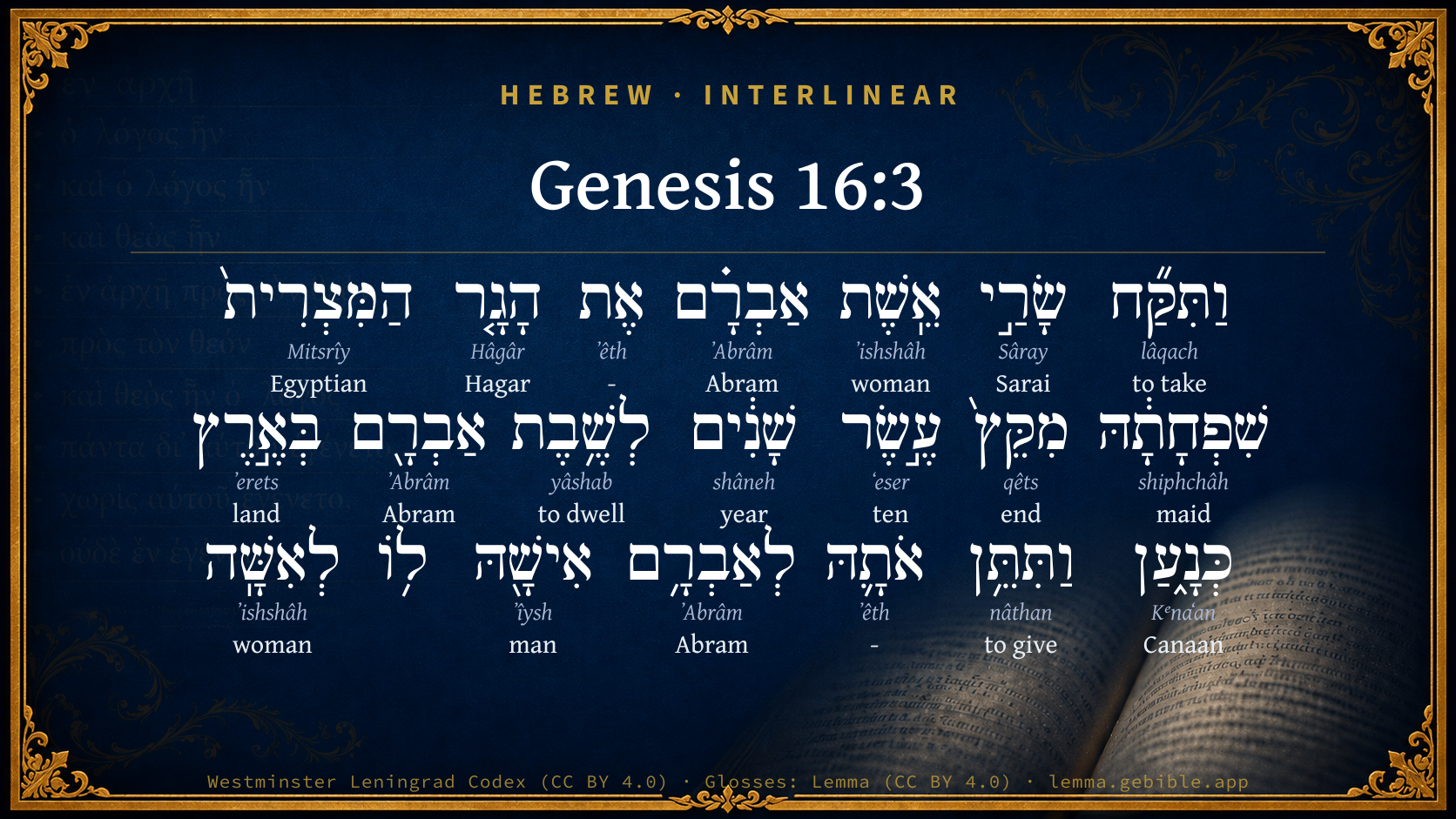
Hebrew (Westminster Leningrad Codex) Genesis 16:3 appears in the Hebrew Old Testament. The text above is from the Westminster Leningrad Codex. Each word links to its Strong’s number, a concise gloss, and parsing drawn from the Open Scriptures Hebrew Bible morphology. Click any word for its full Brown-Driver-Briggs (BDB) entry.
Download image
Cite this verse

Genesis 16:3 (World English Bible). Public Domain. Lemma interlinear Bible study tool, https://lemma.gebible.app/v/genesis/16/3.

Show BibTeX & RIS
BibTeX
RIS
English Translation
Sarai, Abram's wife, took Hagar the Egyptian, her handmaid, after Abram had lived ten years in the land of Canaan, and gave her to Abram her husband to be his wife.
World English Bible · Public Domain
Download a study sheet

One document with this verse’s original text, its word-by-word gloss line, the meaning frame, cross-references with their text, attributed commentary, and full source and license credits — printable, and it pastes into notes with its structure intact.

This verse Autodidact and up

Study sheet (.html) Plain text (.txt)

A passage Seminary Student

Up to 50 verses in one chapter. A passage sheet keeps up to 6 commentary sources and 12 cross-references per verse, in the order this page ranks them, and says so on the sheet whenever that leaves anything out. Ask for a single verse and you get the Autodidact verse sheet above.

Everything on this page stays free to read, with no account — the sheet is a download of what is already on screen, not access to it.

Want to remove ads? Support Godless Engineer
Compare translations 3

The same verse in 3 English versions, stacked beneath the original-language interlinear above. Click any original word for its lexicon entry.

Each is an independent rendering of the whole verse — the interlinear is not word-aligned to these translations.

Highlighted words mark where these versions differ — a whole-verse word diff, not a word-by-word alignment.

  • World English Bible Public Domain
    Sarai, Abram's wife, took Hagar the Egyptian, her handmaid, after Abram had lived ten years in the land of Canaan, and gave her to Abram her husband to be his wife.
  • King James Version Public Domain
    And Sarai Abram's wife took Hagar her maid the Egyptian, after Abram had dwelt ten years in the land of Canaan, and gave her to her husband Abram to be his wife.
  • unfoldingWord Literal Text CC BY-SA 4.0
    So Sarai, the wife of Abram, took Hagar, her Egyptian maidservant, at the end of ten years that Abram had lived in the land of Canaan, and gave her to Abram her husband as a wife for him.

unfoldingWord Literal Text — © unfoldingWord, licensed CC BY-SA 4.0. Word-aligned USFM3 via Door43 (git.door43.org/unfoldingWord/en_ult).

Versions to compare (up to 4)

3 of 4 selected

Show all 18 translations

Every available English version of this verse, each an independent rendering of the whole verse.

  • World English Bible Public Domain
    Sarai, Abram's wife, took Hagar the Egyptian, her handmaid, after Abram had lived ten years in the land of Canaan, and gave her to Abram her husband to be his wife.
  • Berean Standard Bible Public Domain
    So after he had lived in Canaan for ten years, his wife Sarai took her Egyptian maidservant Hagar and gave her to Abram to be his wife.
  • Majority Standard Bible Public Domain
    So after he had lived in Canaan for ten years, his wife Sarai took her Egyptian maidservant Hagar and gave her to Abram to be his wife.
  • King James Version Public Domain
    And Sarai Abram's wife took Hagar her maid the Egyptian, after Abram had dwelt ten years in the land of Canaan, and gave her to her husband Abram to be his wife.
  • American Standard Version (1901) Public Domain
    And Sarai, Abram's wife, took Hagar the Egyptian, her handmaid, after Abram had dwelt ten years in the land of Canaan, and gave her to Abram her husband to be his wife.
  • Revised Version (1885) Public Domain
    And Sarai Abram’s wife took Hagar the Egyptian, her handmaid, after Abram had dwelt ten years in the land of Canaan, and gave her to Abram her husband to be his wife.
  • Geneva Bible (1599) Public Domain
    Then Sarai Abrams wife tooke Hagar her maide the Egyptian, after Abram had dwelled ten yeere in the land of Canaan, and gaue her to her husband Abram for his wife.
  • Douay-Rheims (1899) Public Domain
    She took Agar the Egyptian her handmaid, ten years after they first dwelt in the land of Chanaan, and gave her to her husband to wife.
  • Young's Literal Translation Public Domain
    And Sarai, Abram's wife, taketh Hagar the Egyptian, her handmaid, at the end of the tenth year of Abram's dwelling in the land of Canaan, and giveth her to Abram her husband, to him for a wife,
  • Literal Standard Version CC BY-SA 4.0
    And Sarai, Abram’s wife, takes Hagar the Egyptian, her handmaid, at the end of the tenth year of Abram’s dwelling in the land of Canaan, and gives her to her husband Abram—to him for a wife,
  • Unlocked Literal Bible CC BY-SA 4.0
    It was after Abram had lived ten years in the land of Canaan that Sarai, Abram's wife, gave Hagar, her Egyptian servant, to her husband as a wife.
  • unfoldingWord Literal Text CC BY-SA 4.0
    So Sarai, the wife of Abram, took Hagar, her Egyptian maidservant, at the end of ten years that Abram had lived in the land of Canaan, and gave her to Abram her husband as a wife for him.
  • Darby Bible Public Domain
    And Sarai Abram's wife took Hagar, the Egyptian, her maidservant, at the end of ten years that Abram had dwelt in the land of Canaan, and gave her to her husband Abram, as his wife.
  • World Messianic Bible Public Domain
    Sarai, Abram’s wife, took Hagar the Egyptian, her servant, after Abram had lived ten years in the land of Canaan, and gave her to Abram her husband to be his wife.
  • Webster's Bible Public Domain
    And Sarai, Abram's wife, took Hagar her maid, the Egyptian, after Abram had dwelt ten years in the land of Canaan, and gave her to her husband Abram to be his wife.
  • Free Bible Version CC BY-SA 4.0
    So Sarai, Abram's wife took her Egyptian slave Hagar and gave her to her husband as his wife. Abram had been living in the land of Canaan for ten years when this happened.
  • Bible in Basic English Public Domain
    So after Abram had been living for ten years in the land of Canaan, Sarai took Hagar, her Egyptian servant, and gave her to Abram for his wife.
  • JPS Tanakh (1917) Public Domain
    And Sarai Abram's wife took Hagar the Egyptian, her handmaid, after Abram had dwelt ten years in the land of Canaan, and gave her to Abram her husband to be his wife.

Literal Standard Version (2020), Covenant Press — licensed CC BY-SA 4.0. Text via the HelloAO Bible API (eBible.org). Unlocked Literal Bible (unfoldingWord) — licensed CC BY-SA 4.0. Text via the HelloAO Bible API (eBible.org). unfoldingWord Literal Text — © unfoldingWord, licensed CC BY-SA 4.0. Word-aligned USFM3 via Door43 (git.door43.org/unfoldingWord/en_ult). Free Bible Version, Dr. Jonathan Gallagher — licensed CC BY-SA 4.0. Text via the HelloAO Bible API (eBible.org).

Word by word

More ways to search: Search by grammar → Find every occurrence → Compare this word →

Practice this passage: Drill this verse → Learn its vocabulary →

הָגָ֤ר
Hâgâr
H1904
“Hagar”
Noun, Proper
Part of Speech
Noun
Type
Proper
Full BDB Definition

Origin: of uncertain (perhaps foreign) derivation

TWOT: None

Hagar = "flight" - Sarah's Egyptian slave girl, Abraham's concubine, Ishmael's mother
  1. וַתִּקַּ֞ח lâqach H3947 “and · to take” Conjunction + Verb, Qal, Sequential Imperfect, 3rd Person, Feminine, Singular
  2. שָׂרַ֣י Sâray H8297 “Sarai” Noun, Proper
  3. אֵֽשֶׁת ʼishshâh H802 “woman of” Noun, Common, Feminine, Singular, Construct
  4. אַבְרָ֗ם ʼAbrâm H87 “Abram” Noun, Proper
  5. אֶת ʼêth H853 “-” Particle, Direct Object
  6. הַמִּצְרִית֙ Mitsrîy H4713 “the · Egyptian” Particle, Definite Article + Noun, Gentilic, Feminine, Singular, Absolute
  7. שִׁפְחָתָ֔הּ shiphchâh H8198 “maid · her” Noun, Common, Feminine, Singular, Construct + Suffix, Personal, 3rd Person, Feminine, Singular
  8. מִקֵּץ֙ qêts H7093 “from · end of” Preposition + Noun, Common, Masculine, Singular, Construct
  9. עֶ֣שֶׂר ʻeser H6235 “ten” Adjective, Cardinal number, Feminine, Singular, Absolute
  10. שָׁנִ֔ים shâneh H8141 “years” Noun, Common, Feminine, Plural, Absolute
  11. לְשֶׁ֥בֶת yâshab H3427 “to dwell” Preposition + Verb, Qal, Infinitive Construct
  12. אַבְרָ֖ם ʼAbrâm H87 “Abram” Noun, Proper
  13. בְּאֶ֣רֶץ ʼerets H776 “in/at · land of” Preposition + Noun, Common, Both, Singular, Construct
  14. כְּנָ֑עַן Kᵉnaʻan H3667 “Canaan” Noun, Proper
  15. וַתִּתֵּ֥ן nâthan H5414 “and · to give” Conjunction + Verb, Qal, Sequential Imperfect, 3rd Person, Feminine, Singular
  16. אֹתָ֛הּ ʼêth H853 “- · her” Particle, Direct Object + Suffix, Personal, 3rd Person, Feminine, Singular
  17. לְאַבְרָ֥ם ʼAbrâm H87 “to/for · Abram” Preposition + Noun, Proper
  18. אִישָׁ֖הּ ʼîysh H376 “man · her” Noun, Common, Masculine, Singular, Construct + Suffix, Personal, 3rd Person, Feminine, Singular
  19. לְאִשָּֽׁה ʼishshâh H802 “to/for · woman” Preposition + Noun, Common, Feminine, Singular, Absolute

About this verse

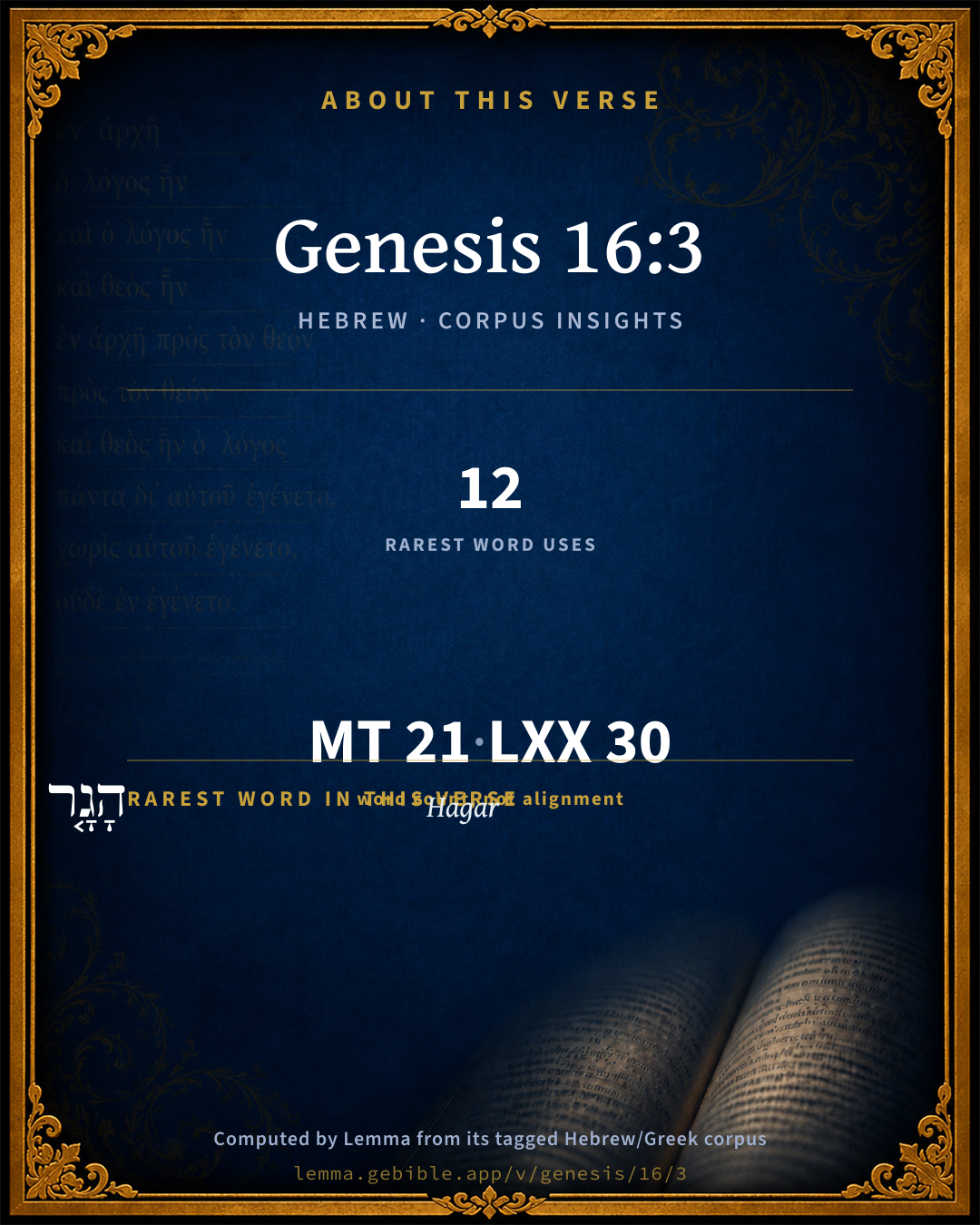
These counts appear in no published source. They are computed here, from the morphology-tagged text and Lemma’s own curated glosses. What Lemma adds →

21
words
16
distinct lemmas
Pentateuch
section

Notable vocabulary

The rarest word here is הָגָ֤ר Hagar H1904 — appearing just 12 times in the whole Hebrew Bible.

Shared distinctive vocabulary

הָגָ֤ר Hagar H1904 occurs in 10 verses of the Hebrew Bible. Also found in:

Grammatical profile

  • 3 verbs
  • 14 nouns
  • 1 adjective
  • 1 preposition
  • 2 particles

Verb forms

  • וַתִּקַּ֞ח Qal · Sequential Imperfect
  • לְשֶׁ֥בֶת Qal · Infinitive Construct
  • וַתִּתֵּ֥ן Qal · Sequential Imperfect

Repetition

Words recur within this verse — often emphatic in Hebrew:

  • אַבְרָ֗ם Abram H87 ×3
  • אֵֽשֶׁת woman H802 ×2

Hebrew & Septuagint length

In English translation the verse runs 31 words from the Hebrew and 35 from the Septuagint (LXX English) — closely comparable.

A rough comparison of the two English renderings, which tokenize alike — not a word-level alignment.

Word counts can differ between the Hebrew and the Greek without any difference in meaning — e.g. the Hebrew direct-object marker אֵת has no separate Greek word, and Greek often adds the article ὁ.

In the original languages it is 21 Hebrew tokens and 30 Greek tokens — but the two are counted differently (Hebrew bundles its prefixes and suffixes into one token; the Greek is in lemma form), so that isn’t a like-for-like length.

Cross-references

12

Topical passages linked to Genesis 16:3 in the Treasury of Scripture Knowledge — connected by theme and wording, ordered by reader-vote popularity; previews shown in the World English Bible.

  • Genesis 12:4–5 So Abram went, as Yahweh had spoken to him. Lot went with him. Abram was seventy-five years old when he departed out of Haran.
  • Genesis 16:5 Sarai said to Abram, "This wrong is your fault. I gave my handmaid into your bosom, and when she saw that she had conceived, I was despised in her eyes. Yahweh judge between me and you."
  • 2 Samuel 5:13 David took him more concubines and wives out of Jerusalem, after he was come from Hebron; and there were yet sons and daughters born to David.
  • Genesis 25:6 but to the sons of the concubines who Abraham had, Abraham gave gifts. He sent them away from Isaac his son, while he yet lived, eastward, to the east country.
  • Genesis 28:9 Esau went to Ishmael, and took, besides the wives that he had, Mahalath the daughter of Ishmael, Abraham's son, the sister of Nebaioth, to be his wife.
  • Genesis 30:4 She gave him Bilhah her handmaid as wife, and Jacob went in to her.
  • Genesis 30:9 When Leah saw that she had finished bearing, she took Zilpah, her handmaid, and gave her to Jacob as a wife.
  • Genesis 32:22 He rose up that night, and took his two wives, and his two handmaids, and his eleven sons, and passed over the ford of the Jabbok.
  • Genesis 35:22 It happened, while Israel lived in that land, that Reuben went and lay with Bilhah, his father's concubine, and Israel heard of it. Now the sons of Jacob were twelve.
  • Judges 19:1–4 It happened in those days, when there was no king in Israel, that there was a certain Levite sojourning on the farther side of the hill-country of Ephraim, who took to him a concubine out of Bethlehem Judah.
  • 1 Kings 11:3 He had seven hundred wives, princesses, and three hundred concubines; and his wives turned away his heart.
  • Galatians 4:25 For this Hagar is Mount Sinai in Arabia, and answers to the Jerusalem that exists now, for she is in bondage with her children.

Cross-references courtesy of OpenBible.info (CC BY 4.0).

Hebrew and Greek witnesses Masoretic Hebrew ↔ Greek Septuagint

The same verse in the two great witnesses to the Old Testament, shown verse-for-verse.

These are two independent witnesses, not word-aligned to each other, and the Septuagint is shown in lemma (dictionary) form.

Hebrew Genesis 16:3 Masoretic · Westminster Leningrad Codex

וַתִּקַּ֞ח שָׂרַ֣י אֵֽשֶׁת אַבְרָ֗ם אֶת הָגָ֤ר הַמִּצְרִית֙ שִׁפְחָתָ֔הּ מִקֵּץ֙ עֶ֣שֶׂר שָׁנִ֔ים לְשֶׁ֥בֶת אַבְרָ֖ם בְּאֶ֣רֶץ כְּנָ֑עַן וַתִּתֵּ֥ן אֹתָ֛הּ לְאַבְרָ֥ם אִישָׁ֖הּ ל֥וֹ לְאִשָּֽׁה

Sarai, Abram's wife, took Hagar the Egyptian, her handmaid, after Abram had lived ten years in the land of Canaan, and gave her to Abram her husband to be his wife.

World English Bible · Public Domain

Greek LXX Genesis 16:3 Septuagint · lemma form

καί λαμβάνω σαρα ὁ γυνή αβραμ αγαρ ὁ αἰγυπτία ὁ ἑαυτοῦ παιδίσκη μετά δέκα ἔτος ὁ οἰκέω αβραμ ἐν γῆ χανααν καί δίδωμι αὐτός αβραμ ὁ ἀνήρ αὐτός αὐτός γυνή

So Sara the wife of Abram having taken Agar the Egyptian her handmaid, after Abram had lived ten years in the land of Chanaan, gave her to Abram her husband as a wife to him.

LXX2012 (modern English Septuagint) · Public Domain

Hebrew: Westminster Leningrad Codex (CC BY 4.0). Greek: Septuagint (public domain); English from LXX2012 (modern English Septuagint) (Public Domain). How the Septuagint differs from the Hebrew →

Targum (Aramaic paraphrase)

2

The Targum is the ancient Jewish Aramaic paraphrase of the Hebrew Scriptures — an interpretive translation, not the Hebrew text itself. Onkelos (literal) and Pseudo-Jonathan (expansive) render the Torah, and Jonathan the Prophets. Coverage is partial: where no permissively-licensed English translation exists for a verse, only the Aramaic is shown. This is verse-level text, not a word-by-word alignment to the Hebrew.

  1. Targum Onkelos Torah (Genesis–Deuteronomy)
    וּדְבָרַת שָׂרַי אִתַּת אַבְרָם יָת הָגָר מִצְרֵיתָא אַמְתַהּ מִסוֹף עֲשַׂר שְׁנִין לְמִיתַּב אַבְרָם בְּאַרְעָא דִכְנָעַן וִיהָבַת יָתַהּ לְאַבְרָם בַּעֲלַהּ לֵהּ לְאִנְתּוּ

    (no public-domain English translation for this verse)

    Targum Onkelos — Aramaic: “Onkelos Genesis” (public domain); “Onkelos Exodus” (public domain); “Onkelos Leviticus” (public domain); “Onkelos Numbers” (public domain); “Onkelos Deuteronomy” (public domain). English: “Sefaria Community Translation” (CC0 1.0 (public-domain dedication)); “J.W. Etheridge. The Targums of Onkelos and Jonathan Ben Uzziel on the Pentateuch. London: Longmans, Green, 1862” (public domain). Text via Sefaria.

  2. Targum Pseudo-Jonathan Torah (Genesis–Deuteronomy)
    וְדַבָּרַת שָרַי אִתַּת אַבְרָם יַת הָגָר מִצְרֵיתָא אַמְתָהּ מִסוֹף עֶשֶר שְׁנִין לְמֵיתַב אַבְרָם בְּאַרְעָא דִכְנָעַן וַחֲרַרְתָּא וְיַהֲבָא יָתָהּ לְאַבְרָם בַּעֲלָהּ לֵיהּ לְאִנְתּוּ

    And Sara the wife of Abram took Hagar the Mizreitha handmaid, when Abram had dwelt ten years in the land of Kenaan, and set her free, and gave her to Abram her husband to wife.

    Targum Pseudo-Jonathan — Aramaic: “Targum Jonathan on Genesis” (public domain); “Targum Jonathan on Exodus” (public domain); “Targum Jonathan on Leviticus” (public domain); “Targum Jonathan on Numbers” (public domain); “Targum Jonathan on Deuteronomy” (public domain). English: “The Targum of Jonathan ben Uzziel, trans. J. W. Etheridge, London, 1862” (public domain). Text via Sefaria.

Commentary

Notes on Genesis 16:3 from classic Christian and Jewish commentators (each source and its license shown beneath its notes). The classic Christian expositions comment on the surrounding passage and are grouped to its opening verse, so a note may address several verses; the Jewish commentaries on the Tanakh (Rashi and others) are per-verse, so they appear only where the commentator wrote on this verse.

Lemma curates 59 commentaries, every one of them public domain or Creative Commons licensed, each selected and text-cleaned for this edition rather than reprinted as found. About our sources →

Trapp's Complete Commentary

John Trapp

Gen 16:3 And Sarai Abram’s wife took Hagar her maid the Egyptian, after Abram had dwelt ten years in the land of Canaan, and gave her to her husband Abram to be his wife.

Ver. 3. After Abram had dwelt ten years.] The Rabbis tell us of a tradition that the Hebrews grounded from hence, that if a woman had no child in the first ten years, she might be held barren, and another wife taken. But this is like one of their ill glosses that marred so many good texts, and refuted by our Saviour the Lawgiver, who best understood his own meaning. {Mat 5:31-32}

John Trapp, A Commentary or Exposition upon All the Books of the Old and New Testament (1647–1656) — public domain. Text from a community e-Sword module.

The Pulpit Commentary

And Sarai Abram"s wife took Hagar her maid the Egyptian, after Abram had dwelt ton years in the land of Canaan (i.e. in his eighty-fifth, and her seventy-fifth year; a note of time introduced, probably,.to account for their impatience in waiting for the promised seed), and gave her to her husband Abram to be his wife. Afterwards styled a pilgash or concubine, (Gen_25:6) she is here improperly called a wife quae praeterDei legem is alienum thorum inducitur (Calvin), from whom the pilgash or concubine differed

(1) in power over the family, which belonged solely to the true wife, not to the secondary;

(2) in the manner of espousal, which in the case of the former was accompanied with solemn rites of espousal and liberal gifts of dowry; and

(3) in privilege of issue, the offspring of the secondary wife having no title to inherit. The act of Sarai (cf. the similar behavior of Stratonice, the wife of King Deiotarus, who, according to Plutarch, gave her maid Electra to her husband, and so obtained an heir to the crown) is as little to be imitated as the conduct of Abram. The apparent repetitions in Vers. 1-3 do not require the hypothesis of different authorship (Tuch, Colenso, Bleek, Davidson) for their explanation, but are characteristic of the genius of Hebrew composition, (cf. Gen_7:1-10) and may even be considerably removed by connecting Vers. 1, 2 with Genesis 15., and commencing the new sub-section with Gen_16:3. (Quarry, p. 331)

HOMILETICS.

Crooked ways, or marrying with Hagar.

I THE SPECIOUS PROPOSAL.

1. The author of it; Sarai, the wife of Abram, a daughter of the faith, the mistress of a household. To the first, the suggestion referred to in the narrative should have been impossible; in the second, it was inconsistent; while, proceeding from the third, it was calculated to be harmful.

2. The wickedness of it. It was

(1) a clear violation of the law of God (cf. Gen_2:24; 1Co_6:16; Eph_5:28, Eph_5:31)

(2) a direct offence against the soul of Abram, being in reality the placing of a dangerous temptation in his way (Deu_13:6; Rom_14:13) and

(3) an unjustifiable invasion of the liberties of Hagar. Though permitted in the providence of God to be a bondmaid in the house of Sarai, she was not in the power of her mistress to be disposed of in the way proposed, without consent either asked or obtained.

3. The extenuations of it.

(1) The practice was common. Secondary wives being then in vogue, the scheme recommended by Sarai may not have been regarded by her as sinful.

(2) The motive was good. It had its origin undoubtedly in a firm belief in the promise, and a strong desire that her husband should no longer be debarred from its realization through her apparently permanent sterility.

(3) The self-denial was great. The entire conduct of Sarai, in giving Hagar to her husband, evinced certain truly engaging features in her personal and wifely character, which must not be overlooked in forming an estimate of her peculiar action; such as genuine humility in yielding to another the honor of being the mother of Abram"s seed, and intense devotion to her husband in submitting for his sake to a displacement which must have carried anguish to her breast.

II THE SINFUL COMPLIANCE. "Abram hearkened unto the voice of Sarai.

1. Deliberately. He was not surprised into this secondary marriage with the Egyptian maiden. The scheme of Sarai appears to have been talked over between them; and if at first he had scruples in complying with her proposition, they were eventually overcome.

2. Inconsiderately. That is, the ulterior consequences were not taken into account in assenting to this device for the anticipation of the promised seed; only its immediate feasibility and superficial recommendations. So men are morally shortsighted, and cannot see afar off when confronted by some sweet temptation. Had Abram only dimly discerned the outcome of Sarai"s counsel, he would have seen that the thing was not of God. A perception of the coming whirlwind would often hinder the sowing of the wind.

3. Inexcusably. Though not dictated by carnal desire, Abram"s acquiescence in Sarai"s scheme was far from being faultless. It evinced a want of faith, and, indeed, a want of true spiritual discernment in supposing that what God had promised as a gift of grace could be surreptitiously snatched from his Divine hand in the way proposed, or even by any purely human stratagem; and a want of patience in not calmly waiting for the accomplishment of God"s word in God"s own time and way.

III THE SORROWFUL RESULT.

1. Humiliation to Sarai. Elated by the prospect of maternity, the young Egyptian slave-girl despised her mistress; by haughtiness of carriage, perhaps silently discovering contempt for Sarai s sterility, and possibly assuming airs of superiority, as if, in consequence of approaching motherhood, anticipating her displacement from the throne of Abram"s. (Pro_30:23)

1. Misery to Abram. The womanly nature of Sarai, stung to jealousy by the success of her own plan, and incapable of longer enduring the scornful triumph of a maiden whom her own hands had transformed into a favored rival, with something like vindictive heat turned upon her meek, submissive, and in this matter wholly innocent lord, reproaching him as, if not the cause of her barrenness, at least the patient and half-satisfied witness of her humiliation; she almost called down upon him the judgment of Heaven. To a noble spirit like that of Abram the anguish of Sarai must

2. have been distressing to behold; and the pain which it occasioned must have been intensified when he came to realize the painful dilemma in which he stood between her and Hagar.

3. Oppression to Hagar. Reminding Sarai that Hagar, though a wife to him, was still a maid to her, the patriarch unwisely extended sanction to whatever remedy the heated breast of Sarai might devise. The result was that the favored maiden was at once thrust back into her original condition of servitude, deprived of whatever tokens of honor and affection she had received as Abram"s wife, and subjected to injurious treatment at the hands of her incensed mistress and rival, from which she ultimately sought refuge in flight.

Learn

1. That eminent saints may lapse into grievous sins.

2. That a child of God is specially liable to temptation after seasons of high religious privilege.

3. That the strongest temptations sometimes proceed from the least expected quarters.

4. That trying to anticipate the Divine promise is not an uncommon form of temptation.

5. That when God"s people take to crooked ways, nothing but evil can come of it.

The Pulpit Commentary (1880–1919), ed. H.D.M. Spence-Jones & Joseph S. Exell — public domain. Text from a community e-Sword module.

Jamieson, Fausset & Brown

Robert Jamieson, A. R. Fausset & David Brown

Sarai . . . gave her to . . . Abram to be his wife--"Wife" is here used to describe an inferior, though not degrading, relation, in countries where polygamy prevails. In the case of these female slaves, who are the personal property of his lady, being purchased before her marriage or given as a special present to her, no one can become the husband's secondary wife without her mistress consent or permission. This usage seems to have prevailed in patriarchal times; and Hagar, Sarai's slave, of whom she had the entire right of disposing, was given by her mistress' spontaneous offer, to be the secondary wife of Abram, in the hope of obtaining the long-looked-for heir. It was a wrong step--indicating a want of simple reliance on God--and Sarai was the first to reap the bitter fruits of her device.

Jamieson, Fausset & Brown — Commentary Critical and Explanatory on the Whole Bible (1871) — public domain (CC PDM 1.0). Text via the HelloAO Bible API.

Adam Clarke's Commentary

Verse 3. And Sarai, Abram's wife, took Hagar - and gave her to her husband - to be his wife.] There are instances of Hindoo women, when barren, consenting to their husbands marrying a second wife for the sake of children; and second marriages on this account, without consent, are very common. - Ward

Adam Clarke's Commentary on the Bible (1810–1826) — public domain. Text from a community e-Sword/MySword module.

John Calvin's Commentaries

3. And gave her to her husband Abram to be his wife. Moses states what was the design of Sarai; for neither did she intend to make her house a brothel, nor to be the betrayer of her maid’s chastity, nor a pander for her husband. Yet Hagar is improperly called a wife; because she was brought into another person’s bed, against the law of God. Wherefore, let us know that this connection was so far illicit, as to be something between fornication and marriage. The same thing takes place with all those inventions which are appended to the word of God. For with whatever fair pretext they may be covered, there is an inherent corruption, which degenerates from the purity of the word, and vitiates the whole.

John Calvin's Commentaries (1540-1563) — public domain. Text from the Calvin Translation Society English edition (1840s-50s) via the Christian Classics Ethereal Library (ccel.org). Calvin's coverage is partial (roughly two-thirds of the Bible); uncommented books and verses are honest gaps, never fabricated. The 19th-century editor's footnotes and remarks are omitted so the notes are faithfully Calvin's own voice.

Ellicott's Commentary for English Readers

(3) Abram had dwelt ten years in the land of Canaan.—He was now, therefore, eighty-five years of age (see Gen_16:16 and Gen_12:4), and this long delay had not only tried his faith, but brought him and Sarai to the conclusion that the promised seed was to be obtained by other means.

A Bible Commentary for English Readers, edited by Charles John Ellicott (1878–1897) — public domain. Text from a community e-Sword module.

The Cambridge Bible for Schools and Colleges

gen. ed. J. J. S. Perowne

3. And Sarai Abram’s wife] This verse is P’s duplicate version of Gen_16:1-2, adding the number of years that Abram had dwelt in Canaan.

The Cambridge Bible for Schools and Colleges (gen. ed. J. J. S. Perowne; Cambridge University Press, 1878–1918) — public domain. Text from a community e-Sword module.

John Gill's Exposition

And Sarai, Abram's wife, took Hagar her maid, the Egyptian,.... Took her by the hand, it is probable, and led her into the apartment where Abram was, and presented her to him; their characters are very exactly described, and the contrast beautifully given, that the affair might be the more remarkable and observable:

after Abram had dwelt ten years in the land of Canaan; so that he was now eighty five years of age, for he was sventy five when he departed from Haran and came into Canaan, Gen 12:4; and Sarai, being ten years younger than he, must be sventy five; the Jews from hence have formed a rule or canon; that if a man marries a woman, and she has no children in ten years, he is obliged to marry another (h):

and gave her to her husband Abram to be his wife; his secondary wife, or concubine; which, though contrary to the first institution of marriage, was connived at of God, and was practised by good men: nothing can excuse them but their earnest desire after the Messiah, the promised seed; and one may conclude, that nothing but this especially could move Sarai to take such a step, so contrary to the temper and disposition of women in common.

(h) Bereshit Rabba, ut supra. (sect. 45. fol. 40. 2.). Jarchi & Aben Ezra in loc.

John Gill's Exposition of the Whole Bible (1746–1763) — public domain (CC PDM 1.0). Text via the HelloAO Bible API.

Haydock's Catholic Bible Commentary

Ten years after she was 65; which shews that she might reasonably conclude she would now have no children herself; and as she knew God had promised Abram a son, she thought he might follow the custom of those times, and have him by a second wife. Abram shewed no eagerness on this matter, but only yielded to his wife’s petition, deprecanti, being well aware of the inconveniences of polygamy, which Sarai had soon reason to observe. This is the first time we read of polygamy since the deluge; but it is not mentioned as any thing singular or unlawful. This was a matter in which God could dispense; but it was never left to the disposal of any man. Hence, when Luther and his associates ventured to dispense with the Landgrave of Hesse, to keep two wives at once, he required him to keep it a secret, being ashamed of his own conduct. He still maintained it was a thing indifferent, even in the law of grace, though Christ has so expressly condemned it. See præp 62, 65. The practice, so common of late in this country, of marrying again after a bill of divorce has been passed, is no less contrary to the Catholic doctrine, which allows only a separation of the parties from bed and board, in cases of adultery; but never of a second marriage, while both the parties are living. (1 Corinthians vii.; St. Augustine de Adult. Conj. i., City of God xvi. 25, 38; and other fathers.) (Haydock) --- It was never lawful for one woman to have two husbands. (Worthington) --- To wife. Plurality of wives, though contrary to the primitive institution of marriage, Genesis ii. 24, was by Divine dispensation allowed to the patriarchs; which allowance seems to have continued during the time of the law of Moses. But Christ our Lord reduced marriage to its primitive institution, St. Matthew xix.

George Leo Haydock (1774–1849), Haydock's Catholic Family Bible and Commentary, 1859 edition — public domain. Excludes Psalms (Douay-Rheims chapter numbering differs from Protestant) and Deuterocanonical books (Catholic canon only).

Matthew Poole's English Annotations

i.e. His concubine, or secondary wife. Polygamy, though it was forbidden by God's first institution, Gen 2:24, compared with Mat 19:5, and brought into the world by wicked Lamech, yet it was sometimes practised by the patriarchs, either by God's permission, who could rightly dispense with his own laws when and where he pleased; or by their mistake about the lawfulness of it. As for the present case, it is most evident this action was not the effect of an inordinate lust, but of an earnest desire of having children, and especially of obtaining the blessed and promised Seed.

Matthew Poole's English Annotations on the Holy Bible (1683–1685) — public domain. Text from a community e-Sword/MySword module.

Whedon's Commentary on the Bible

Daniel D. Whedon

3. Ten years in… Canaan — Abram was now eighty-five years old, (compare Gen_16:16; Gen_12:4,) and Sarai seventy-five. Gen_17:17.

Daniel D. Whedon (gen. ed.), Commentary on the Old and New Testaments (1874–1909) — public domain. Text from a community e-Sword module.

Scofield Reference Notes

C. I. Scofield

Hagar

Hagar is a type of the law "which gendereth to bondage" Gal 4:24; Gal 4:25.

The Scofield Reference Bible (1917 edition), notes by C. I. Scofield — public domain. Text from a community e-Sword module.

Rashi

Rabbi Shlomo Yitzchaki (Rashi)

ותקח שרי AND (SARAI TOOK [HAGAR] — She took (won her over) by kindly speech saying, “Happy are you in that you will be privileged to consort with so holy a person as this” (Genesis Rabbah 45:3).

מקץ עשר שנים AFTER [ABRAM HAD DWELT] TEN YEARS — the period appointed for a woman who has lived with her husband for ten years without having borne children to him when he is bound to take another.

'לשבת אברם וגו [TEN YEARS] AFTER ABRAHAM HAD DWELT IN THE LAND OF CANAAN — As Abraham had been married to Sarah before he entered Canaan this statement virtually informs us that the period he dwelt outside the land was not to be included in the number of these ten years (Yevamot 64a), for the promise, “And I will make of thee a great nation” was made to him with the intention of being fulfilled only after he had come into the land of Israel.

Rashi on the Tanakh — English translations: “The Judaica Press complete Tanach with Rashi, translated by A. J. Rosenberg” (CC BY 4.0); “Pentateuch with Rashi's commentary by M. Rosenbaum and A.M. Silbermann, 1929-1934” (public domain); “The Metsudah Tanach series, Lakewood, N.J” (CC BY 4.0); and “The Book of Joshua, Metsudah Publications, 1997” (CC BY 4.0). Text via Sefaria.

Ramban (Nachmanides)

Rabbi Moshe ben Nachman (Ramban / Nachmanides)

AT THE END OF TEN YEARS. This is the established period for a woman who has lived with her husband for ten years without having given birth to children, after which he is bound to take another.

AFTER ABRAM DWELLED IN THE LAND OF CANAAN. This tells us that the period he dwelled outside of the Land is not to be included in the count of those ten years since he was not told And I will make of thee a great nation until after he had come to the land of Israel. Thus the language of Rashi.This reason is not proper since it is a clear-cut halachic decision that the time spent living outside the Land is not to be included in the ten year period for any person in the world., was made to Abraham after he had come to the Land of Israel?” This language would make it appear that only in Abraham’s case was the time spent living outside the Land excluded from the ten year period, when it really applies to everyone. The Mishnah containing this principle applies to all men. And if it were as Rashi stated it, i.e., on account of this promise made to Abram, then for other people [the years they dwelled outside the land of Israel] should be included in the ten years period! Some Talmudic commentators have already made another mistake concerning this rule, stating that the law does not require a person who dwells outside the Land to divorce a woman with whom he has lived for ten years without her giving birth, nor does the law require him to marry another woman. But the matter is not so. Rather, the intent [of the law which excludes the period one dwells outside the land of Israel from the ten year total] is that if a man lived with his wife for five or ten years outside the Land and then they came to the land of Israel, we give them a period of ten years from the time they came to the Land, for perhaps due to the merit of the Land they will build up a family. And thus did Abraham and Sarah our mother do from the time they came there.

Ramban (Nachmanides) on the Tanakh — English translation: “Commentary on the Torah by Ramban (Nachmanides). Translated and annotated by Charles B. Chavel. New York, Shilo Pub. House, 1971-1976” (CC BY 4.0). Text via Sefaria.

Radak

Rabbi David Kimhi (Radak)

ותקח... מקץ עשר שנים, ten years had elapsed since Avram and Sarai had moved to the land of Canaan. She had waited all these years thinking that G'd would give Avram a son from her in that land. After all, the instruction to Avram to go forth from his birthplace, etc. had been followed by the promise that there G'd would make him into a great nation. (Genesis 12,2). Our sages in Yevamot 64 state that if someone was married to a woman for 10 years during which she was unable to bear a child for him he is not allowed to simply forego the chance of having children, but should pay her out her marriage settlement (Ketuvah) and divorce her as it is possible that G'd only decreed that he should not have children from that particular woman. The Talmud, while admitting that there is no proof for the above, claims that Avram's example can serve as a guide for such conduct, seeing that he waited ten years after settling in the land of Israel, having discounted the earlier years during which Sarai had not conceived.

Radak on the Tanakh — English translations: “Sefaria Community Translation” (CC0 1.0 (public-domain dedication)); “Eliyahu Munk, HaChut Hameshulash” (CC BY 4.0); “Rabbi Mike Feuer, Jerusalem Anthology” (CC BY 4.0); and “R. David Kimhi on the first book of Psalms, Translated by R.G. Finch, London, 1919” (public domain). Text via Sefaria.

Lesson kit

Teaching starters — assembled from the data on this page, not authored interpretation. Every prompt links to the verse data it draws on. Edit before teaching.

Genesis, in the Pentateuch, opens this verse with 21 words (16 distinct Hebrew lemmas). Its most distinctive word is Hâgâr (“Hagar”). A historical commentator’s framing appears above. Read the whole chapter for the surrounding context.

Discussion questions

  1. The word Hâgâr carries the sense “Hagar.” How does it shape the verse?
  2. Genesis 16:1 shares the word «Hagar» with this verse. How do the two illuminate each other?
  3. “Abram” occurs 3× in this one verse. What is the effect of the repetition?
  4. These translations render this verse differently; the difference is in the English rendering, not the original. What questions does that raise?
  5. The verb «וַתִּקַּ֞ח» is Qal Sequential Imperfect. How does its form color the action?
  6. Reading how Trapp's Complete Commentary and The Pulpit Commentary read this verse, where do the two commentators agree and where do they part?

Things to notice

Reading settings

Reading text

Shown beneath each verse's original-language words.

Old Testament
Old Testament edition

Read the OT as the Masoretic Hebrew (MT) or the Greek Septuagint (LXX).

English shown for the Greek Septuagint (in the Hebrew ↔ Greek comparison).

Comparing translations? Open the Compare panel on any verse page to stack up to four side by side.