Genesis 18:7

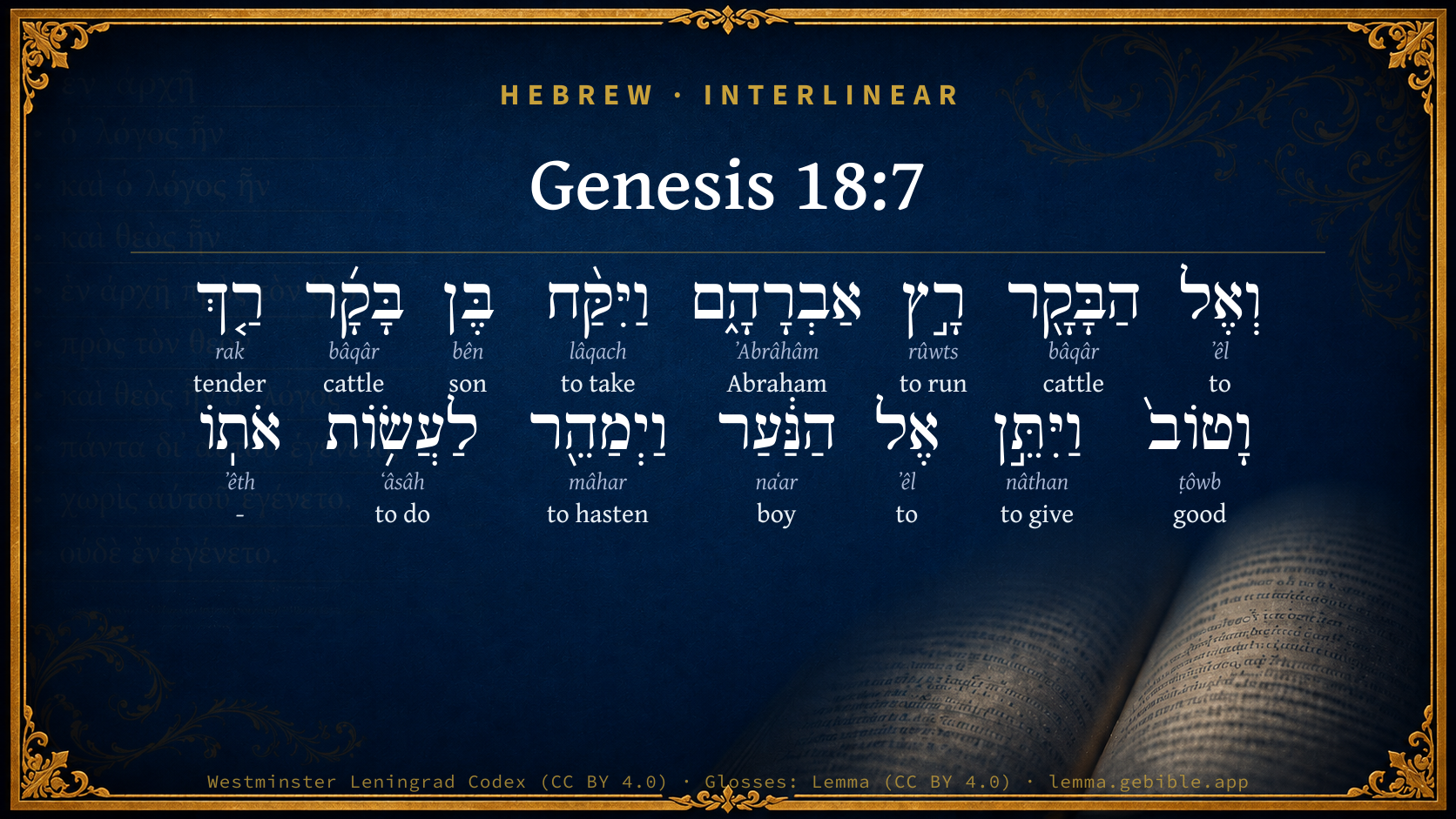
Hebrew (Westminster Leningrad Codex) Genesis 18:7 appears in the Hebrew Old Testament. The text above is from the Westminster Leningrad Codex. Each word links to its Strong’s number, a concise gloss, and parsing drawn from the Open Scriptures Hebrew Bible morphology. Click any word for its full Brown-Driver-Briggs (BDB) entry.
Download image
Cite this verse

Genesis 18:7 (World English Bible). Public Domain. Lemma interlinear Bible study tool, https://lemma.gebible.app/v/genesis/18/7.

Show BibTeX & RIS
BibTeX
RIS
English Translation
Abraham ran to the herd, and fetched a tender and good calf, and gave it to the servant. He hurried to dress it.
World English Bible · Public Domain
Highlights
  • 1 first appearance in the Hebrew Bible
Full analysis ↓
Download a study sheet

One document with this verse’s original text, its word-by-word gloss line, the meaning frame, cross-references with their text, attributed commentary, and full source and license credits — printable, and it pastes into notes with its structure intact.

This verse Autodidact and up

Study sheet (.html) Plain text (.txt)

A passage Seminary Student

Up to 50 verses in one chapter. A passage sheet keeps up to 6 commentary sources and 12 cross-references per verse, in the order this page ranks them, and says so on the sheet whenever that leaves anything out. Ask for a single verse and you get the Autodidact verse sheet above.

Everything on this page stays free to read, with no account — the sheet is a download of what is already on screen, not access to it.

Want to remove ads? Support Godless Engineer
Compare translations 3

The same verse in 3 English versions, stacked beneath the original-language interlinear above. Click any original word for its lexicon entry.

Each is an independent rendering of the whole verse — the interlinear is not word-aligned to these translations.

Highlighted words mark where these versions differ — a whole-verse word diff, not a word-by-word alignment.

  • World English Bible Public Domain
    Abraham ran to the herd, and fetched a tender and good calf, and gave it to the servant. He hurried to dress it.
  • King James Version Public Domain
    And Abraham ran unto the herd, and fetched a calf tender and good, and gave it unto a young man; and he hasted to dress it.
  • unfoldingWord Literal Text CC BY-SA 4.0
    Then Abraham ran to the herd and selected a tender and choice calf. Then he gave it to a servant and he hurried to prepare it.

unfoldingWord Literal Text — © unfoldingWord, licensed CC BY-SA 4.0. Word-aligned USFM3 via Door43 (git.door43.org/unfoldingWord/en_ult).

Versions to compare (up to 4)

3 of 4 selected

Show all 18 translations

Every available English version of this verse, each an independent rendering of the whole verse.

  • World English Bible Public Domain
    Abraham ran to the herd, and fetched a tender and good calf, and gave it to the servant. He hurried to dress it.
  • Berean Standard Bible Public Domain
    Meanwhile, Abraham ran to the herd, selected a tender and choice calf, and gave it to a servant, who hurried to prepare it.
  • Majority Standard Bible Public Domain
    Meanwhile, Abraham ran to the herd, selected a tender and choice calf, and gave it to a servant, who hurried to prepare it.
  • King James Version Public Domain
    And Abraham ran unto the herd, and fetched a calf tender and good, and gave it unto a young man; and he hasted to dress it.
  • American Standard Version (1901) Public Domain
    And Abraham ran unto the herd, and fetched a calf tender and good, and gave it unto the servant; and he hasted to dress it.
  • Revised Version (1885) Public Domain
    And Abraham ran unto the herd, and fetched a calf tender and good, and gave it unto the servant; and he hasted to dress it.
  • Geneva Bible (1599) Public Domain
    And Abraham ranne to the beastes, and tooke a tender and good calfe, and gaue it to the seruant, who hasted to make it ready.
  • Douay-Rheims (1899) Public Domain
    Abraham made haste into the tent to Sera, and said to her: Make haste, temper together three measures of flour, and make cakes upon the hearth.
  • Young's Literal Translation Public Domain
    and Abraham ran unto the herd, and taketh a son of the herd, tender and good, and giveth unto the young man, and he hasteth to prepare it;
  • Literal Standard Version CC BY-SA 4.0
    and Abraham ran to the herd, and takes a son of the herd, tender and good, and gives to the young man, and he hurries to prepare it;
  • Unlocked Literal Bible CC BY-SA 4.0
    Then Abraham ran to the herd, and took a calf that was tender and good, and gave it to the servant, and he hurried to prepare it.
  • unfoldingWord Literal Text CC BY-SA 4.0
    Then Abraham ran to the herd and selected a tender and choice calf. Then he gave it to a servant and he hurried to prepare it.
  • Darby Bible Public Domain
    And Abraham ran to the herd, and took a calf tender and good, and gave [it] to the attendant; and he hasted to dress it.
  • World Messianic Bible Public Domain
    Abraham ran to the herd, and fetched a tender and good calf, and gave it to the servant. He hurried to dress it.
  • Webster's Bible Public Domain
    And Abraham ran to the herd, and brought a calf tender and good, and gave it to a young man; and he hasted to dress it.
  • Free Bible Version CC BY-SA 4.0
    Then Abraham ran to the cattle herd and chose a good, young calf and gave it to his servant who quickly killed and cooked it.
  • Bible in Basic English Public Domain
    And running to the herd, he took a young ox, soft and fat, and gave it to the servant and he quickly made it ready;
  • JPS Tanakh (1917) Public Domain
    And Abraham ran unto the herd, and fetched a calf tender and good, and gave it unto the servant; and he hastened to dress it.

Literal Standard Version (2020), Covenant Press — licensed CC BY-SA 4.0. Text via the HelloAO Bible API (eBible.org). Unlocked Literal Bible (unfoldingWord) — licensed CC BY-SA 4.0. Text via the HelloAO Bible API (eBible.org). unfoldingWord Literal Text — © unfoldingWord, licensed CC BY-SA 4.0. Word-aligned USFM3 via Door43 (git.door43.org/unfoldingWord/en_ult). Free Bible Version, Dr. Jonathan Gallagher — licensed CC BY-SA 4.0. Text via the HelloAO Bible API (eBible.org).

Word by word

More ways to search: Search by grammar → Find every occurrence → Compare this word →

Practice this passage: Drill this verse → Learn its vocabulary →

רַ֤ךְ
rak
H7390
“tender”
Adjective, Adjective, Masculine, Singular, Absolute
Part of Speech
Adjective
Type
Adjective
Gender
Masculine
Number
Singular
State
Absolute
Full BDB Definition

Origin: from H7401

TWOT: 2164a

tender, soft, delicate, weak - tender, delicate (of flesh) - weak of heart, timid - soft (of words) - gentle words (substantive)
  1. וְאֶל ʼêl H413 “and · to” Conjunction + Preposition
  2. הַבָּקָ֖ר bâqâr H1241 “the · cattle” Particle, Definite Article + Noun, Common, Both, Singular, Absolute
  3. רָ֣ץ rûwts H7323 “to run” Verb, Qal, Perfect, 3rd Person, Masculine, Singular
  4. אַבְרָהָ֑ם ʼAbrâhâm H85 “Abraham” Noun, Proper
  5. וַיִּקַּ֨ח lâqach H3947 “and · to take” Conjunction + Verb, Qal, Sequential Imperfect, 3rd Person, Masculine, Singular
  6. בֶּן bên H1121 “son of” Noun, Common, Masculine, Singular, Construct
  7. בָּקָ֜ר bâqâr H1241 “cattle” Noun, Common, Both, Singular, Absolute
  8. וָטוֹב֙ ṭôwb H2896 “and · good” Conjunction + Adjective, Adjective, Masculine, Singular, Absolute
  9. וַיִּתֵּ֣ן nâthan H5414 “and · to give” Conjunction + Verb, Qal, Sequential Imperfect, 3rd Person, Masculine, Singular
  10. אֶל ʼêl H413 “to” Preposition
  11. הַנַּ֔עַר naʻar H5288 “the · boy” Particle, Definite Article + Noun, Common, Masculine, Singular, Absolute
  12. וַיְמַהֵ֖ר mâhar H4116 “and · to hasten” Conjunction + Verb, Piel, Sequential Imperfect, 3rd Person, Masculine, Singular
  13. לַעֲשׂ֥וֹת ʻâsâh H6213 “to do” Preposition + Verb, Qal, Infinitive Construct
  14. אֹתֽוֹ ʼêth H853 “- · him” Particle, Direct Object + Suffix, Personal, 3rd Person, Masculine, Singular

About this verse

These counts appear in no published source. They are computed here, from the morphology-tagged text and Lemma’s own curated glosses. What Lemma adds →

15
words
13
distinct lemmas
Pentateuch
section

Notable vocabulary

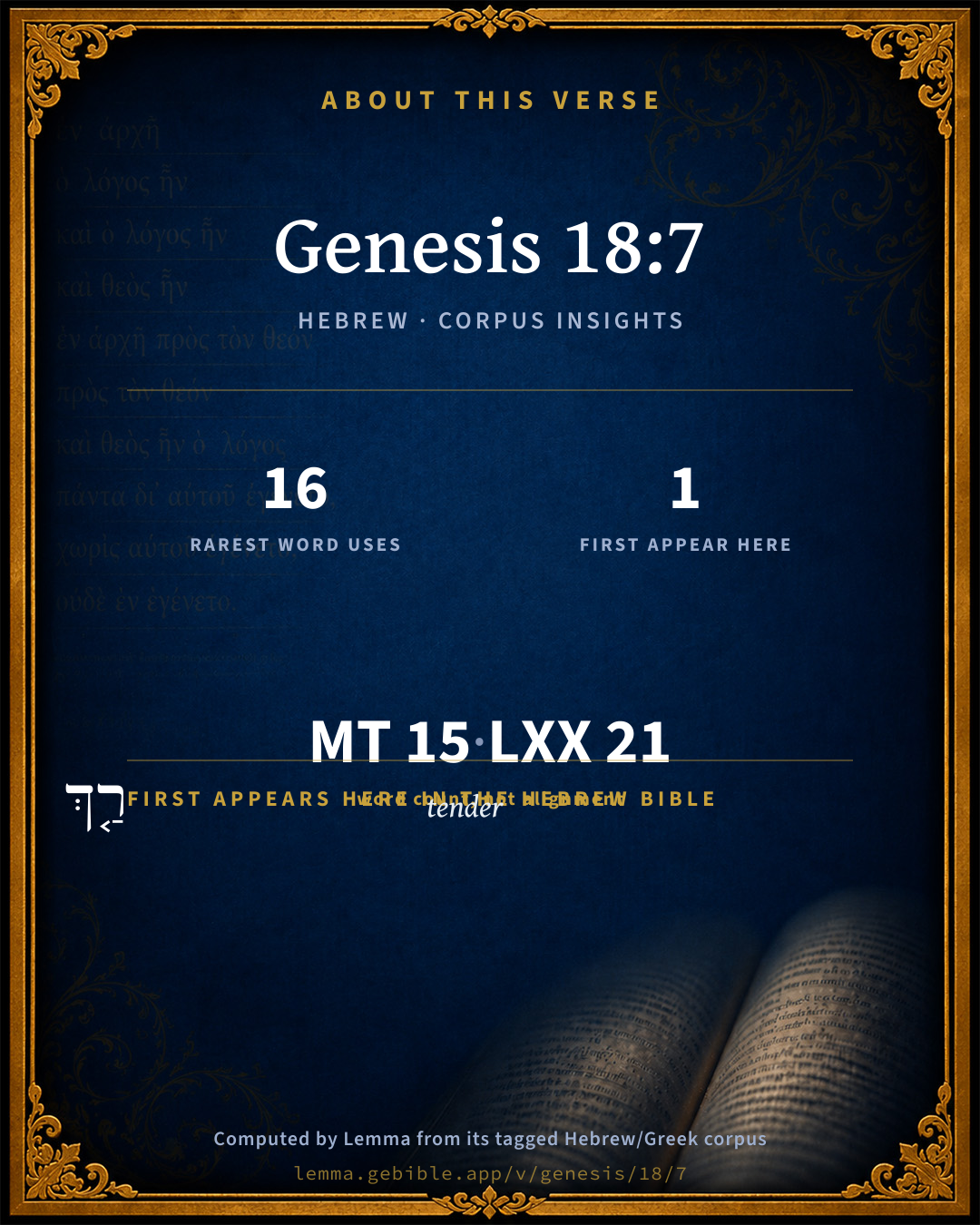
The rarest word here is רַ֤ךְ tender H7390 — appearing just 16 times in the whole Hebrew Bible.

First appearance in Scripture

This word makes its first canonical appearance in the Hebrew Bible here:

  • רַ֤ךְ tender H7390

Shared distinctive vocabulary

רַ֤ךְ tender H7390 occurs in 16 verses of the Hebrew Bible. Also found in:

Grammatical profile

  • 5 verbs
  • 5 nouns
  • 2 adjectives
  • 2 prepositions
  • 1 particle

Verb forms

  • רָ֣ץ Qal · Perfect
  • וַיִּקַּ֨ח Qal · Sequential Imperfect
  • וַיִּתֵּ֣ן Qal · Sequential Imperfect
  • וַיְמַהֵ֖ר Piel · Sequential Imperfect
  • לַעֲשׂ֥וֹת Qal · Infinitive Construct

Repetition

Words recur within this verse — often emphatic in Hebrew:

  • הַבָּקָ֖ר cattle H1241 ×2
  • וְאֶל to H413 ×2

Hebrew & Septuagint length

In English translation the verse runs 23 words from the Hebrew and 26 from the Septuagint (LXX English) — closely comparable.

A rough comparison of the two English renderings, which tokenize alike — not a word-level alignment.

Word counts can differ between the Hebrew and the Greek without any difference in meaning — e.g. the Hebrew direct-object marker אֵת has no separate Greek word, and Greek often adds the article ὁ.

In the original languages it is 15 Hebrew tokens and 21 Greek tokens — but the two are counted differently (Hebrew bundles its prefixes and suffixes into one token; the Greek is in lemma form), so that isn’t a like-for-like length.

Cross-references

8

Topical passages linked to Genesis 18:7 in the Treasury of Scripture Knowledge — connected by theme and wording, ordered by reader-vote popularity; previews shown in the World English Bible.

  • Judges 13:15–16 Manoah said to the angel of Yahweh, I pray you, let us detain you, that we may make ready a kid for you.
  • Genesis 19:3 He urged them greatly, and they came in with him, and entered into his house. He made them a feast, and baked unleavened bread, and they ate.
  • Amos 6:4 Who lie on beds of ivory, And stretch themselves on their couches, And eat the lambs out of the flock, And the calves out of the midst of the stall;
  • Malachi 1:14 "But the deceiver is cursed, who has in his flock a male, and vows, and sacrifices to the Lord a blemished thing; for I am a great King," says Yahweh of hosts, "and my name is awesome among the nations."
  • Matthew 22:4 Again he sent out other servants, saying, 'Tell those who are invited, "Behold, I have made ready my dinner. My oxen and my fatlings are killed, and all things are ready. Come to the marriage feast!"'
  • Luke 15:23 Bring the fattened calf, kill it, and let us eat, and celebrate;
  • Luke 15:27 He said to him, 'Your brother has come, and your father has killed the fattened calf, because he has received him back safe and healthy.'
  • Luke 15:30 But when this, your son, came, who has devoured your living with prostitutes, you killed the fattened calf for him.'

Cross-references courtesy of OpenBible.info (CC BY 4.0).

Hebrew and Greek witnesses Masoretic Hebrew ↔ Greek Septuagint

The same verse in the two great witnesses to the Old Testament, shown verse-for-verse.

These are two independent witnesses, not word-aligned to each other, and the Septuagint is shown in lemma (dictionary) form.

Hebrew Genesis 18:7 Masoretic · Westminster Leningrad Codex

וְאֶל הַבָּקָ֖ר רָ֣ץ אַבְרָהָ֑ם וַיִּקַּ֨ח בֶּן בָּקָ֜ר רַ֤ךְ וָטוֹב֙ וַיִּתֵּ֣ן אֶל הַנַּ֔עַר וַיְמַהֵ֖ר לַעֲשׂ֥וֹת אֹתֽוֹ

Abraham ran to the herd, and fetched a tender and good calf, and gave it to the servant. He hurried to dress it.

World English Bible · Public Domain

Greek LXX Genesis 18:7 Septuagint · lemma form

καί εἰς ὁ βοῦς τρέχω αβρααμ καί λαμβάνω μοσχάριον ἁπαλός καί καλός καί δίδωμι ὁ παῖς καί ταχύνω ὁ ποιέω αὐτός

And Abraam ran to the kine, and took a young calf, tender and good, and gave it to his servant, and he hasted to dress it.

LXX2012 (modern English Septuagint) · Public Domain

Hebrew: Westminster Leningrad Codex (CC BY 4.0). Greek: Septuagint (public domain); English from LXX2012 (modern English Septuagint) (Public Domain). How the Septuagint differs from the Hebrew →

Targum (Aramaic paraphrase)

2

The Targum is the ancient Jewish Aramaic paraphrase of the Hebrew Scriptures — an interpretive translation, not the Hebrew text itself. Onkelos (literal) and Pseudo-Jonathan (expansive) render the Torah, and Jonathan the Prophets. Coverage is partial: where no permissively-licensed English translation exists for a verse, only the Aramaic is shown. This is verse-level text, not a word-by-word alignment to the Hebrew.

  1. Targum Onkelos Torah (Genesis–Deuteronomy)
    וּלְוַת תּוֹרֵי רְהַט אַבְרָהָם וּדְבַר בַּר תּוֹרֵי רַכִּיךְ וְטַב וִיהַב לְעוּלֵמָא וְאוֹחִי לְמֶעְבַּד יָתֵהּ

    (no public-domain English translation for this verse)

    Targum Onkelos — Aramaic: “Onkelos Genesis” (public domain); “Onkelos Exodus” (public domain); “Onkelos Leviticus” (public domain); “Onkelos Numbers” (public domain); “Onkelos Deuteronomy” (public domain). English: “Sefaria Community Translation” (CC0 1.0 (public-domain dedication)); “J.W. Etheridge. The Targums of Onkelos and Jonathan Ben Uzziel on the Pentateuch. London: Longmans, Green, 1862” (public domain). Text via Sefaria.

  2. Targum Pseudo-Jonathan Torah (Genesis–Deuteronomy)
    וּלְבַקְרוּתָא רְהַט אַבְרָהָם וּנְסַב בַּר תּוֹרֵי רַכִּיךְ וּשְׁמַן וִיהַב לְעוּלֵימָא וְאוֹחִי לְמֶעְבְדֵיהּ תַּבְשִׁילִין

    And unto the flock ran Abraham, and took a calf, tender and fat, and gave to a young man, and hastened to make prepared meats;

    Targum Pseudo-Jonathan — Aramaic: “Targum Jonathan on Genesis” (public domain); “Targum Jonathan on Exodus” (public domain); “Targum Jonathan on Leviticus” (public domain); “Targum Jonathan on Numbers” (public domain); “Targum Jonathan on Deuteronomy” (public domain). English: “The Targum of Jonathan ben Uzziel, trans. J. W. Etheridge, London, 1862” (public domain). Text via Sefaria.

Commentary

Notes on Genesis 18:7 from classic Christian and Jewish commentators (each source and its license shown beneath its notes). The classic Christian expositions comment on the surrounding passage and are grouped to its opening verse, so a note may address several verses; the Jewish commentaries on the Tanakh (Rashi and others) are per-verse, so they appear only where the commentator wrote on this verse.

Lemma curates 59 commentaries, every one of them public domain or Creative Commons licensed, each selected and text-cleaned for this edition rather than reprinted as found. About our sources →

Trapp's Complete Commentary

John Trapp

Gen 18:7 And Abraham ran unto the herd, and fetcht a calf tender and good, and gave [it] unto a young man; and he hasted to dress it.

Ver. 7. And gave it unto a young man.] Here was a well-ordered family; every one knew his office, and did it. In every society, say the politicians, as in a well-tuned harp, the several strings must concur to make up a harmony.

John Trapp, A Commentary or Exposition upon All the Books of the Old and New Testament (1647–1656) — public domain. Text from a community e-Sword module.

Joseph Benson's Commentary

Gen 18:7. Abraham ran to the herd — In the several particulars here mentioned, we have a lively picture of the hospitality, simplicity, benevolence, and liberality of these ancient patriarchs. How different was their manner of life from the refinement and modish formality of the higher classes in modern times!

Joseph Benson's Commentary on the Old and New Testaments (1811–1818) — public domain. Text from a community e-Sword module.

Jamieson, Fausset & Brown

Robert Jamieson, A. R. Fausset & David Brown

Abraham ran unto the herd, and fetched a calf--Animal food is never provided, except for visitors of a superior rank when a kid or lamb is killed. A calf is still a higher stretch of hospitality, and it would probably be cooked as is usually done when haste is required--either by roasting it whole or by cutting it up into small pieces and broiling them on skewers over the fire. It is always eaten along with boiled corn swimming in butter or melted fat, into which every morsel of meat, laid upon a piece of bread, is dipped, before being conveyed by the fingers to the mouth.

Jamieson, Fausset & Brown — Commentary Critical and Explanatory on the Whole Bible (1871) — public domain (CC PDM 1.0). Text via the HelloAO Bible API.

The Cambridge Bible for Schools and Colleges

gen. ed. J. J. S. Perowne

7. fetched a calf] We must remember that meat is rarely eaten by the tent-dwelling nomads. The killing of an animal for a repast indicated a desire to do special honour to a guest.

The Cambridge Bible for Schools and Colleges (gen. ed. J. J. S. Perowne; Cambridge University Press, 1878–1918) — public domain. Text from a community e-Sword module.

John Gill's Exposition

And Abraham ran unto the herd,.... While Sarah and her maids were kneading the dough and making the cakes:

and fetched a calf tender and good; a fine fat calf, which was reckoned very delicious food, and much in use with the ancients (q) and generally made a part in any grand entertainment, and was accounted fit for a king, see Sa1 28:24,

and gave it unto a young man: one of his servants, to kill and dress as soon as possible; Jarchi says this was Ishmael, whom he trained up to such service:

and he hasted to dress it; the young man made all the haste he could to get it ready, according to the orders of Abraham.

(q) --Orpheus de lapidibus, ver. 63.

John Gill's Exposition of the Whole Bible (1746–1763) — public domain (CC PDM 1.0). Text via the HelloAO Bible API.

Haydock's Catholic Bible Commentary

Himself. These rich and truly noble people, do not esteem it beneath themto wait on strangers. They provide abundance, but no dainties. (Haydock)

George Leo Haydock (1774–1849), Haydock's Catholic Family Bible and Commentary, 1859 edition — public domain. Excludes Psalms (Douay-Rheims chapter numbering differs from Protestant) and Deuterocanonical books (Catholic canon only).

Whedon's Commentary on the Bible

Daniel D. Whedon

7. A calf tender and good — He selects the choicest of his young cattle, “the fatted calf,” (Luk_15:23; Luk_15:30,) the greatest luxury of the kind at his command.

Daniel D. Whedon (gen. ed.), Commentary on the Old and New Testaments (1874–1909) — public domain. Text from a community e-Sword module.

The Pulpit Commentary

And Abraham ran unto the herd, and fetched a calf tender and good, the greatness of the honor done to the strangers was evinced by the personal activity of the patriarch, and the offering of animal food, which was not a common article of consumption among Orientalsand gave it unto a young man; i.e. the servant in attendance (cf. Gen_14:24) and he hasted to dress it.

The Pulpit Commentary (1880–1919), ed. H.D.M. Spence-Jones & Joseph S. Exell — public domain. Text from a community e-Sword module.

Rashi

Rabbi Shlomo Yitzchaki (Rashi)

בן בקר רך וטוב A CALF, TENDER AND GOOD — There were three calves so that he might give them to eat three tongues together with mustard condiment (Bava Metzia 86b).

אל הנער TO THE YOUNG MAN — This was Ishmael whom he bade to do this in order to train him to the performance of religious duties (in this case the duty of hospitality) (Genesis Rabbah 48:13).

Rashi on the Tanakh — English translations: “The Judaica Press complete Tanach with Rashi, translated by A. J. Rosenberg” (CC BY 4.0); “Pentateuch with Rashi's commentary by M. Rosenbaum and A.M. Silbermann, 1929-1934” (public domain); “The Metsudah Tanach series, Lakewood, N.J” (CC BY 4.0); and “The Book of Joshua, Metsudah Publications, 1997” (CC BY 4.0). Text via Sefaria.

Ramban (Nachmanides)

Rabbi Moshe ben Nachman (Ramban / Nachmanides)

AND ABRAHAM RAN UNTO THE HERD. The purport thereof is to tell us of his great desire to bestow kindness. This great man had three hundred and eighteen men in his house, each one a swordsman, and he was very old and weakened by his circumcision, yet he went personally to Sarah’s tent to urge her in the making of the bread, and afterwards he ran to the place of the herd to chose a calf, tender and good, to prepare for his guests, and he did not have all these done by means of one of his servants who stood ready to serve him.

Ramban (Nachmanides) on the Tanakh — English translation: “Commentary on the Torah by Ramban (Nachmanides). Translated and annotated by Charles B. Chavel. New York, Shilo Pub. House, 1971-1976” (CC BY 4.0). Text via Sefaria.

Radak

Rabbi David Kimhi (Radak)

ואל הבקר רץ אברהם, the term רץ is a variant of the term וימהר, he hastened. The Torah wished to give us an impression of the speed with which a man of 99 years old performed the task of entertaining unexpected guests, preparing a virtual feast for them.

בן בקר, male and young, so that it would be both tender and tasty. The word טוב refers to it being juicy, fat; we find this expression used in that sense also in Jeremiah 44,17 ונשבע לחם ונהיה טובים, “we had plenty of bread and were fat.”

אל הנער; to the servant. According to an allegorical interpretation [based on the definitive article ה seeing that Avraham had many servants, Ed.] this is a reference to Ishmael.

לעשות אותו, to prepare it and to cook it.

Radak on the Tanakh — English translations: “Sefaria Community Translation” (CC0 1.0 (public-domain dedication)); “Eliyahu Munk, HaChut Hameshulash” (CC BY 4.0); “Rabbi Mike Feuer, Jerusalem Anthology” (CC BY 4.0); and “R. David Kimhi on the first book of Psalms, Translated by R.G. Finch, London, 1919” (public domain). Text via Sefaria.

Lesson kit

Teaching starters — assembled from the data on this page, not authored interpretation. Every prompt links to the verse data it draws on. Edit before teaching.

Genesis, in the Pentateuch, opens this verse with 15 words (13 distinct Hebrew lemmas). Its most distinctive word is rak (“tender”). A historical commentator’s framing appears above. Read the whole chapter for the surrounding context.

Discussion questions

  1. How does “tender” (rak) shape what this verse is saying?
  2. The word “tender” first appears here in Scripture. What is being introduced at this debut?
  3. Genesis 29:17 shares the word «tender» with this verse. How do the two illuminate each other?
  4. “cattle” occurs 2× in this one verse. What is the effect of the repetition?
  5. The translations on this page render this verse differently — a whole-verse word diff, not a word-by-word alignment. What might account for the different wordings?
  6. The verb «רָ֣ץ» is Qal Perfect. How does its form color the action?
  7. Reading how Trapp's Complete Commentary and Joseph Benson's Commentary read this verse, where do the two commentators agree and where do they part?

Things to notice

Reading settings

Reading text

Shown beneath each verse's original-language words.

Old Testament
Old Testament edition

Read the OT as the Masoretic Hebrew (MT) or the Greek Septuagint (LXX).

English shown for the Greek Septuagint (in the Hebrew ↔ Greek comparison).

Comparing translations? Open the Compare panel on any verse page to stack up to four side by side.