Genesis 28:22

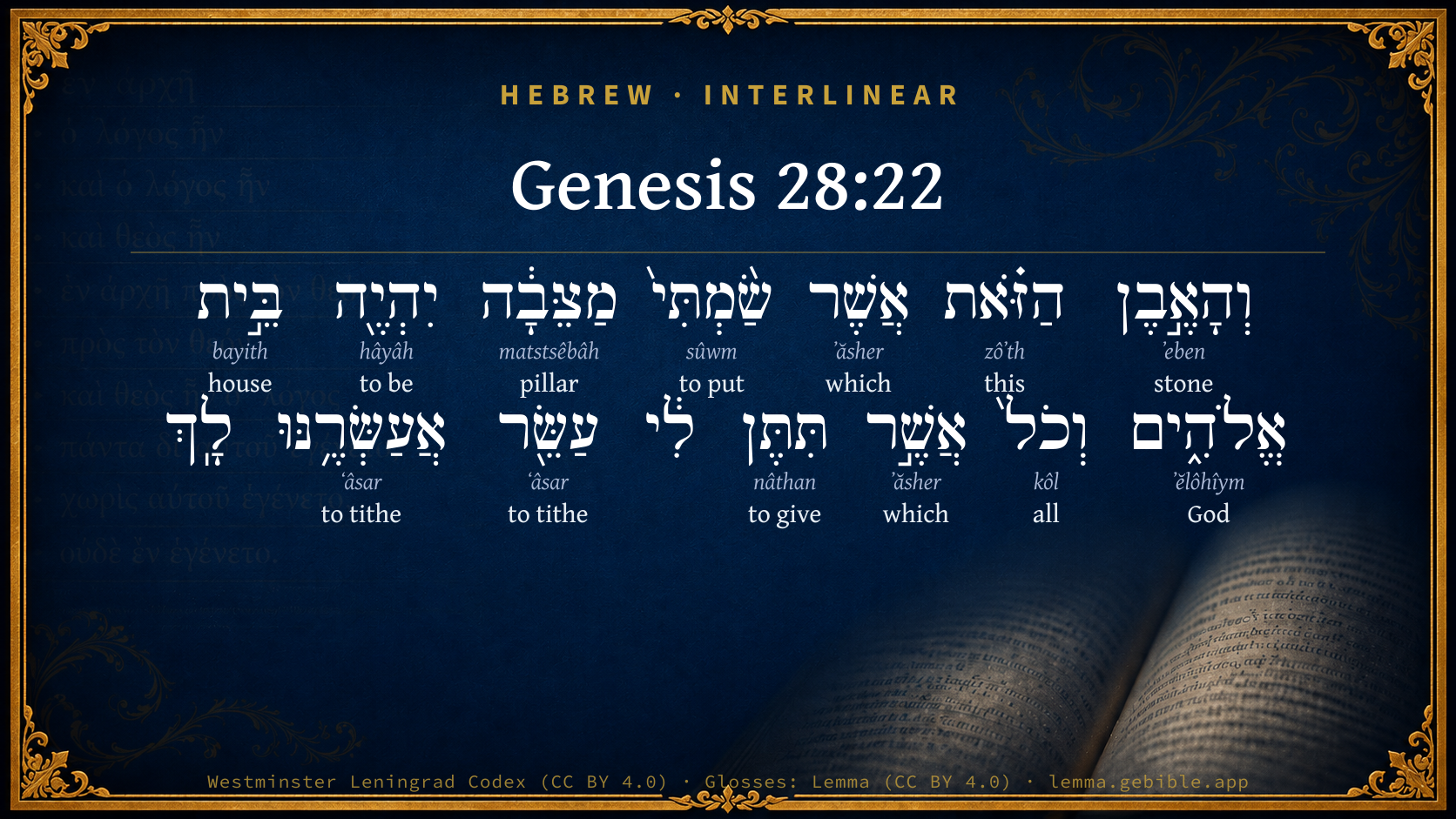
Hebrew (Westminster Leningrad Codex) Genesis 28:22 appears in the Hebrew Old Testament. The text above is from the Westminster Leningrad Codex. Each word links to its Strong’s number, a concise gloss, and parsing drawn from the Open Scriptures Hebrew Bible morphology. Click any word for its full Brown-Driver-Briggs (BDB) entry.
Download image
Cite this verse

Genesis 28:22 (World English Bible). Public Domain. Lemma interlinear Bible study tool, https://lemma.gebible.app/v/genesis/28/22.

Show BibTeX & RIS
BibTeX
RIS
English Translation
then this stone, which I have set up for a pillar, will be God's house. Of all that you will give me I will surely give the tenth to you."
World English Bible · Public Domain
Highlights
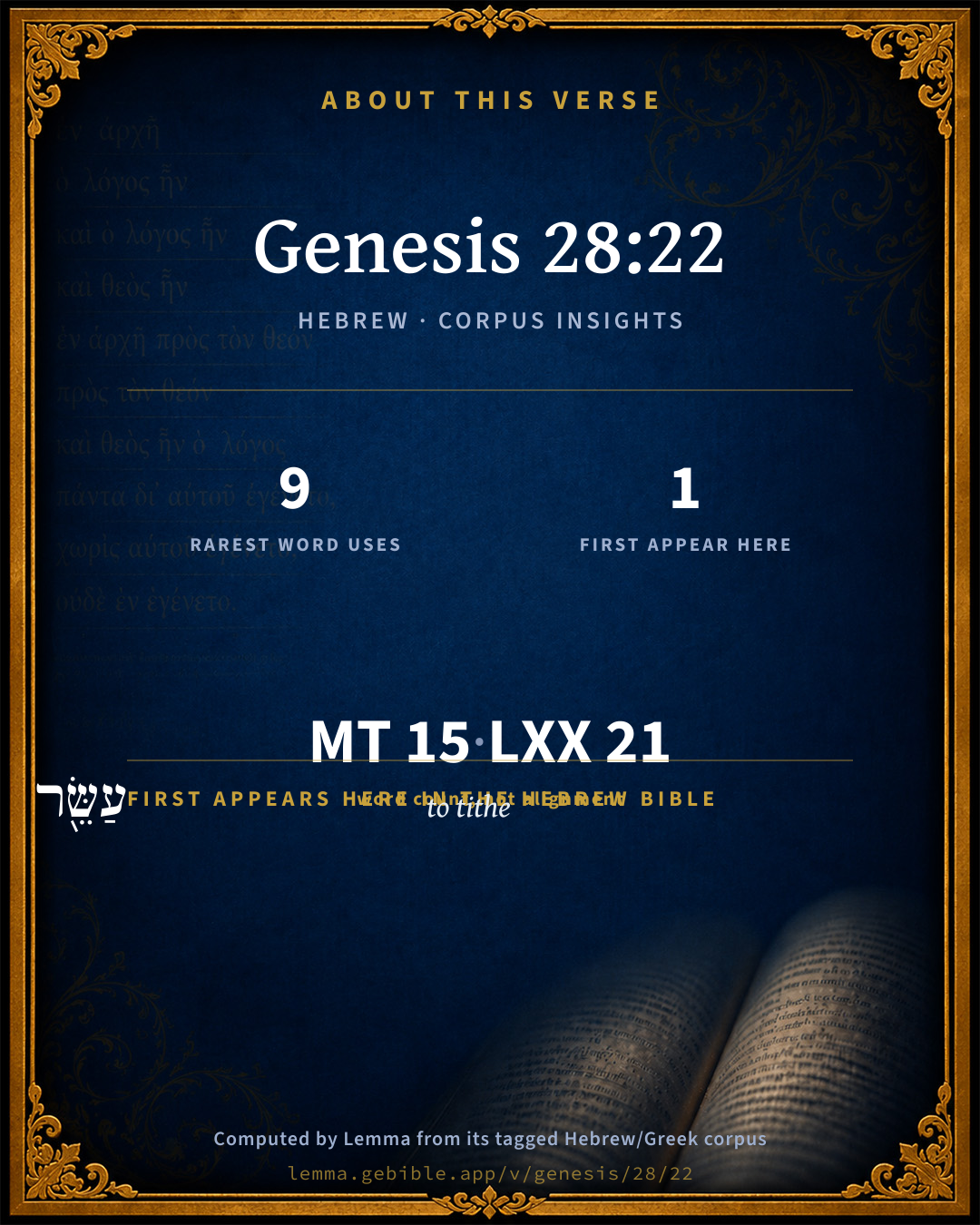
  • 1 first appearance in the Hebrew Bible
Full analysis ↓
Download a study sheet

One document with this verse’s original text, its word-by-word gloss line, the meaning frame, cross-references with their text, attributed commentary, and full source and license credits — printable, and it pastes into notes with its structure intact.

This verse Autodidact and up

Study sheet (.html) Plain text (.txt)

A passage Seminary Student

Up to 50 verses in one chapter. A passage sheet keeps up to 6 commentary sources and 12 cross-references per verse, in the order this page ranks them, and says so on the sheet whenever that leaves anything out. Ask for a single verse and you get the Autodidact verse sheet above.

Everything on this page stays free to read, with no account — the sheet is a download of what is already on screen, not access to it.

Want to remove ads? Support Godless Engineer
Compare translations 3

The same verse in 3 English versions, stacked beneath the original-language interlinear above. Click any original word for its lexicon entry.

Each is an independent rendering of the whole verse — the interlinear is not word-aligned to these translations.

Highlighted words mark where these versions differ — a whole-verse word diff, not a word-by-word alignment.

  • World English Bible Public Domain
    then this stone, which I have set up for a pillar, will be God's house. Of all that you will give me I will surely give the tenth to you."
  • King James Version Public Domain
    And this stone, which I have set for a pillar, shall be God's house: and of all that thou shalt give me I will surely give the tenth unto thee.
  • unfoldingWord Literal Text CC BY-SA 4.0
    and this stone that I have stood up a pillar will be the house of God, and all that you give to me I will tithe a tenth to you.”

unfoldingWord Literal Text — © unfoldingWord, licensed CC BY-SA 4.0. Word-aligned USFM3 via Door43 (git.door43.org/unfoldingWord/en_ult).

Versions to compare (up to 4)

3 of 4 selected

Show all 18 translations

Every available English version of this verse, each an independent rendering of the whole verse.

  • World English Bible Public Domain
    then this stone, which I have set up for a pillar, will be God's house. Of all that you will give me I will surely give the tenth to you."
  • Berean Standard Bible Public Domain
    And this stone I have set up as a pillar will be God’s house, and of all that You give me I will surely give You a tenth.”
  • Majority Standard Bible Public Domain
    And this stone I have set up as a pillar will be God’s house, and of all that You give me I will surely give You a tenth.”
  • King James Version Public Domain
    And this stone, which I have set for a pillar, shall be God's house: and of all that thou shalt give me I will surely give the tenth unto thee.
  • American Standard Version (1901) Public Domain
    then this stone, which I have set up for a pillar, shall be God's house. And of all that thou shalt give me I will surely give the tenth unto thee.
  • Revised Version (1885) Public Domain
    and this stone, which I have set up for a pillar, shall be God’s house: and of all that thou shalt give me I will surely give the tenth unto thee.
  • Geneva Bible (1599) Public Domain
    And this stone, which I haue set vp as a pillar, shall be Gods house: and of all that thou shalt giue me, wil I giue the tenth vnto thee.
  • Douay-Rheims (1899) Public Domain
    And this stone, which I have set up for a title, shall called the house of God: and of all things that thou shalt give to me, I will offer tithes to thee.
  • Young's Literal Translation Public Domain
    then this stone which I have made a standing pillar is a house of God, and all that Thou dost give to me -- tithing I tithe to Thee.'
  • Literal Standard Version CC BY-SA 4.0
    then this stone which I have made a standing pillar is a house of God, and all that You give to me—tithing I tithe to You.”
  • Unlocked Literal Bible CC BY-SA 4.0
    Then this stone that I have set up as a pillar will be a sacred stone. From everything that you give me, I will surely give a tenth back to you.”
  • unfoldingWord Literal Text CC BY-SA 4.0
    and this stone that I have stood up a pillar will be the house of God, and all that you give to me I will tithe a tenth to you.”
  • Darby Bible Public Domain
    And this stone, which I have set up [for] a pillar, shall be God's house; and of all that thou wilt give me I will without fail give the tenth to thee.
  • World Messianic Bible Public Domain
    then this stone, which I have set up for a pillar, will be God’s house. Of all that you will give me I will surely give a tenth to you.”
  • Webster's Bible Public Domain
    And this stone, which I have set for a pillar, shall be God's house: and of all that thou shalt give me, I will surely give the tenth to thee.
  • Free Bible Version CC BY-SA 4.0
    This stone pillar that I've set up will be the house of God, and I will give you one tenth of all you give me.”
  • Bible in Basic English Public Domain
    And this stone which I have put up for a pillar will be God's house: and of all you give me, I will give a tenth part to you.
  • JPS Tanakh (1917) Public Domain
    and this stone, which I have set up for a pillar, shall be God's house; and of all that Thou shalt give me I will surely give the tenth unto Thee.'

Literal Standard Version (2020), Covenant Press — licensed CC BY-SA 4.0. Text via the HelloAO Bible API (eBible.org). Unlocked Literal Bible (unfoldingWord) — licensed CC BY-SA 4.0. Text via the HelloAO Bible API (eBible.org). unfoldingWord Literal Text — © unfoldingWord, licensed CC BY-SA 4.0. Word-aligned USFM3 via Door43 (git.door43.org/unfoldingWord/en_ult). Free Bible Version, Dr. Jonathan Gallagher — licensed CC BY-SA 4.0. Text via the HelloAO Bible API (eBible.org).

Word by word

More ways to search: Search by grammar → Find every occurrence → Compare this word →

Practice this passage: Drill this verse → Learn its vocabulary →

עַשֵּׂ֖ר
ʻâsar
H6237
“to tithe”
Verb, Piel, Infinitive Absolute
Part of Speech
Verb
Stem
Piel
Form
Infinitive Absolute
Full BDB Definition

Origin: a primitive root (ident. with H6238 )

TWOT: 1711c

to tithe, take the tenth part of, give a tithe, take a tithe - (Qal) to tithe - (Piel) to give a tithe - (Hiphil) to take a tithe
  1. וְהָאֶ֣בֶן ʼeben H68 “and · the · stone” Conjunction + Particle, Definite Article + Noun, Common, Feminine, Singular, Absolute
  2. הַזֹּ֗את zôʼth H2063 “the · this” Particle, Definite Article + Pronoun, Demonstrative, Feminine, Singular
  3. אֲשֶׁר ʼăsher H834 “which” Particle, Relative
  4. שַׂ֨מְתִּי֙ sûwm H7760 “to put” Verb, Qal, Perfect, 1st Person, Common, Singular
  5. מַצֵּבָ֔ה matstsêbâh H4676 “pillar” Noun, Common, Feminine, Singular, Absolute
  6. יִהְיֶ֖ה hâyâh H1961 “to be” Verb, Qal, Imperfect, 3rd Person, Masculine, Singular
  7. בֵּ֣ית bayith H1004 “house of” Noun, Common, Masculine, Singular, Construct
  8. אֱלֹהִ֑ים ʼĕlôhîym H430 “God(s)” Noun, Common, Masculine, Plural, Absolute
  9. וְכֹל֙ kôl H3605 “and · all” Conjunction + Noun, Common, Masculine, Singular, Absolute
  10. אֲשֶׁ֣ר ʼăsher H834 “which” Particle, Relative
  11. תִּתֶּן nâthan H5414 “to give” Verb, Qal, Imperfect, 2nd Person, Masculine, Singular
  12. אֲעַשְּׂרֶ֥נּוּ ʻâsar H6237 “to tithe · him” Verb, Piel, Imperfect, 1st Person, Common, Singular + Suffix, Personal, 3rd Person, Masculine, Singular

About this verse

These counts appear in no published source. They are computed here, from the morphology-tagged text and Lemma’s own curated glosses. What Lemma adds →

15
words
11
distinct lemmas
Pentateuch
section

Notable vocabulary

The rarest word here is עַשֵּׂ֖ר to tithe H6237 — appearing just 9 times in the whole Hebrew Bible.

First appearance in Scripture

This word makes its first canonical appearance in the Hebrew Bible here:

  • עַשֵּׂ֖ר to tithe H6237

Shared distinctive vocabulary

עַשֵּׂ֖ר to tithe H6237 occurs in 7 verses of the Hebrew Bible. Also found in:

Grammatical profile

  • 5 verbs
  • 5 nouns
  • 1 pronoun
  • 2 prepositions
  • 2 particles

Verb forms

  • שַׂ֨מְתִּי֙ Qal · Perfect
  • יִהְיֶ֖ה Qal · Imperfect
  • תִּתֶּן Qal · Imperfect
  • עַשֵּׂ֖ר Piel · Infinitive Absolute
  • אֲעַשְּׂרֶ֥נּוּ Piel · Imperfect

Repetition

Words recur within this verse — often emphatic in Hebrew:

  • עַשֵּׂ֖ר to tithe H6237 ×2
  • אֲשֶׁר which H834 ×2

Hebrew & Septuagint length

In English translation the verse runs 30 words from the Hebrew and 34 from the Septuagint (LXX English) — closely comparable.

A rough comparison of the two English renderings, which tokenize alike — not a word-level alignment.

Word counts can differ between the Hebrew and the Greek without any difference in meaning — e.g. the Hebrew direct-object marker אֵת has no separate Greek word, and Greek often adds the article ὁ.

In the original languages it is 15 Hebrew tokens and 21 Greek tokens — but the two are counted differently (Hebrew bundles its prefixes and suffixes into one token; the Greek is in lemma form), so that isn’t a like-for-like length.

Cross-references

10

Topical passages linked to Genesis 28:22 in the Treasury of Scripture Knowledge — connected by theme and wording, ordered by reader-vote popularity; previews shown in the World English Bible.

  • Genesis 35:7 He built an altar there, and called the place El Beth El; because there God was revealed to him, when he fled from the face of his brother.
  • Genesis 14:20 and blessed be God Most High, who has delivered your enemies into your hand." Abram gave him a tenth of all.
  • Deuteronomy 14:22–23 You shall surely tithe all the increase of your seed, that which comes forth from the field year by year.
  • Leviticus 27:30–33 "'All the tithe of the land, whether of the seed of the land or of the fruit of the trees, is Yahweh's. It is holy to Yahweh.
  • Genesis 35:1 God said to Jacob, "Arise, go up to Bethel, and live there. Make there an altar to God, who appeared to you when you fled from the face of Esau your brother."
  • Genesis 12:8 He left from there to the mountain on the east of Bethel, and pitched his tent, having Bethel on the west, and Ai on the east. There he built an altar to Yahweh, and called on the name of Yahweh.
  • Genesis 28:17 He was afraid, and said, "How dreadful is this place! This is none other than God's house, and this is the gate of heaven."
  • Genesis 33:20 He erected an altar there, and called it El Elohe Israel.
  • Genesis 35:14–15 Jacob set up a pillar in the place where he spoke with him, a pillar of stone. He poured out a drink-offering on it, and poured oil on it.
  • Genesis 21:33 Abraham planted a tamarisk tree in Beersheba, and called there on the name of Yahweh, the Everlasting God.

Cross-references courtesy of OpenBible.info (CC BY 4.0).

Hebrew and Greek witnesses Masoretic Hebrew ↔ Greek Septuagint

The same verse in the two great witnesses to the Old Testament, shown verse-for-verse.

These are two independent witnesses, not word-aligned to each other, and the Septuagint is shown in lemma (dictionary) form.

Hebrew Genesis 28:22 Masoretic · Westminster Leningrad Codex

וְהָאֶ֣בֶן הַזֹּ֗את אֲשֶׁר שַׂ֨מְתִּי֙ מַצֵּבָ֔ה יִהְיֶ֖ה בֵּ֣ית אֱלֹהִ֑ים וְכֹל֙ אֲשֶׁ֣ר תִּתֶּן לִ֔י עַשֵּׂ֖ר אֲעַשְּׂרֶ֥נּוּ לָֽךְ

then this stone, which I have set up for a pillar, will be God's house. Of all that you will give me I will surely give the tenth to you."

World English Bible · Public Domain

Greek LXX Genesis 28:22 Septuagint · lemma form

καί ὁ λίθος οὗτος ὅς ἵστημι στήλη εἰμί ἐγώ οἶκος θεός καί πᾶς ὅς ἐάν ἐγώ δίδωμι δέκατος ἀποδεκατόω αὐτός σύ

And this stone, which I have set up for a pillar, shall be to me a house of God; and of all whatever you shall give me, I will tithe a tenth for you.

LXX2012 (modern English Septuagint) · Public Domain

Hebrew: Westminster Leningrad Codex (CC BY 4.0). Greek: Septuagint (public domain); English from LXX2012 (modern English Septuagint) (Public Domain). How the Septuagint differs from the Hebrew →

Targum (Aramaic paraphrase)

2

The Targum is the ancient Jewish Aramaic paraphrase of the Hebrew Scriptures — an interpretive translation, not the Hebrew text itself. Onkelos (literal) and Pseudo-Jonathan (expansive) render the Torah, and Jonathan the Prophets. Coverage is partial: where no permissively-licensed English translation exists for a verse, only the Aramaic is shown. This is verse-level text, not a word-by-word alignment to the Hebrew.

  1. Targum Onkelos Torah (Genesis–Deuteronomy)
    וְאַבְנָא הָדָא דִי שַׁוֵּיתִי קָמָא תְּהֵי דִי אֵהֵי פָלַח עֲלַהּ קֳדָם יְיָ וְכֹל דִּי תִתֶּן לִי חַד מִן עַשְׂרָא אַפְרְשִׁנֵּהּ קֳדָמָךְ

    (no public-domain English translation for this verse)

    Targum Onkelos — Aramaic: “Onkelos Genesis” (public domain); “Onkelos Exodus” (public domain); “Onkelos Leviticus” (public domain); “Onkelos Numbers” (public domain); “Onkelos Deuteronomy” (public domain). English: “Sefaria Community Translation” (CC0 1.0 (public-domain dedication)); “J.W. Etheridge. The Targums of Onkelos and Jonathan Ben Uzziel on the Pentateuch. London: Longmans, Green, 1862” (public domain). Text via Sefaria.

  2. Targum Pseudo-Jonathan Torah (Genesis–Deuteronomy)
    וְאַבְנָא הָדָא דִשַׁוִיתִי קָמָא תְּהֵי מְסַדְרָא בְּבֵי מוּקְדְשָׁא דַיְיָ וִיהוֹן דָרַיָא פַּלְחִין עֲלָהּ לִשְׁמָא דַיְיָ וְכָל דְתִתֵּן לִי חַד מִן עַסְרָא אַפְרְשִׁינֵיהּ קֳדָמָךְ

    and this stone which I have set (for) a pillar shall be ordained for the house of the sanctuary of the Lord, and upon it shall generations worship the Name of the Lord; and of all that Thou mayest give me, the tenth will I separate before Thee.

    Targum Pseudo-Jonathan — Aramaic: “Targum Jonathan on Genesis” (public domain); “Targum Jonathan on Exodus” (public domain); “Targum Jonathan on Leviticus” (public domain); “Targum Jonathan on Numbers” (public domain); “Targum Jonathan on Deuteronomy” (public domain). English: “The Targum of Jonathan ben Uzziel, trans. J. W. Etheridge, London, 1862” (public domain). Text via Sefaria.

Commentary

Notes on Genesis 28:22 from classic Christian and Jewish commentators (each source and its license shown beneath its notes). The classic Christian expositions comment on the surrounding passage and are grouped to its opening verse, so a note may address several verses; the Jewish commentaries on the Tanakh (Rashi and others) are per-verse, so they appear only where the commentator wrote on this verse.

Lemma curates 59 commentaries, every one of them public domain or Creative Commons licensed, each selected and text-cleaned for this edition rather than reprinted as found. About our sources →

Tyndale Open Study Notes

Tyndale Open Resources

28:22 I will present to God a tenth: By paying a tithe (a tenth) as an act of worship, a person acknowledges that everything is a gift from God and belongs to God (see 14:19-20; Num 18:21-32; Deut 14:22-29; 2 Chr 31:5-6; Mal 3:7-12; Matt 23:23).

Tyndale Open Study Notes — © Tyndale Open Resources, licensed CC BY-SA 4.0. Text via the HelloAO Bible API.

Adam Clarke's Commentary

Verse 22. This stone shall be God's house] That is, (as far as this matter refers to Jacob alone,) should I be preserved to return in safety, I shall worship God in this place. And this purpose he fulfilled, for there he built an altar, anointed it with oil, and poured a drink-offering thereon.

For a practical use of Jacob's vision, See Clarke on Ge 28:12.

ON the doctrine of tithes, or an adequate support for the ministers of the Gospel, I shall here register my opinion. Perhaps a word may be borne from one who never received any, and has Done in prospect. Tithes in their origin appear to have been a sort of eucharistic offering made unto God, and probably were something similar to the minchah, which we learn from Gen. iv. was in use almost from the foundation of the world. When God established a regular, and we may add an expensive worship, it was necessary that proper provision should be made for the support of those who were obliged to devote their whole time to it, and consequently were deprived of the opportunity of providing for themselves in any secular way. It was soon found that a tenth part of the produce of the whole land was necessary for this purpose, as a whole tribe, that of Levi, was devoted to the public service of God; and when the land was divided, this tribe received no inheritance among their brethren. Hence, for their support, the law of tithes was enacted; and by these the priests and Levites were not only supported as the ministers of God, but as the teachers and intercessors of the people, performing a great variety of religious duties for them which otherwise they themselves were bound to perform. As this mode of supporting the ministers of God was instituted by himself, so we may rest assured it was rational and just. Nothing can be more reasonable than to devote a portion of the earthly good which we receive from the free mercy of God, to his own service; especially when by doing it we are essentially serving ourselves. If the ministers of God give up their whole time, talents, and strength, to watch over, labour for, and instruct the people in spiritual things, justice requires that they shall receive their support from the work. How worthless and wicked must that man be, who is continually receiving good from the Lord's hands without restoring any part for the support of true religion, and for charitable purposes! To such God says, Their table shall become a snare to them, and that he will curse their blessings. God expects returns of gratitude in this way from every man; he that has much should give plenteously, he that has little should do his diligence to give of that little.

It is not the business of these notes to dispute on the article of tithes; certainly it would be well could a proper substitute be found for them, and the clergy paid by some other method, as this appears in the present state of things to be very objectionable; and the mode of levying them is vexatious in the extreme, and serves to sow dissensions between the clergyman and his parishioners, by which many are not only alienated from the Church, but also from the power as well as the form of godliness. But still the labourer is worthy of his hire; and the maintenance of the public ministry of the word of God should not be left to the caprices of men. He who is only supported for his work, will be probably abandoned when he is no longer capable of public service. I have seen many aged and worn-out ministers reduced to great necessity, and almost literally obliged to beg their bread among those whose opulence and salvation were, under God, the fruits of their ministry! Such persons may think they do God service by disputing against "tithes, as legal institutions long since abrogated," while they permit their worn-out ministers to starve: - but how shall they appear in that day when Jesus shall say, I was hungry, and ye gave me no meat; thirsty, and ye gave me no drink; naked, and ye clothed me not? It is true, that where a provision is established on a certain order of priesthood by the law, it may be sometimes claimed and consumed by the worthless and the profane; but this is no necessary consequence of such establishment, as there are laws which, if put in action, have sufficient energy to expel every wicked and slothful servant from the vineyard of Christ. This however is seldom done. At all events, this is no reason why those who have served God and their generation should not be comfortably supported during that service; and when incapable of it, be furnished at least with the necessaries of life. Though many ministers have reason to complain of this neglect, who have no claims on a legal ecclesiastical establishment, yet none have cause for louder complaint than the generality of those called curates, or unbeneficed ministers, in the Church of England: their employers clothe themselves with the wool, and feed themselves with the fat; they tend not the flock, and their substitutes that perform the labour and do the drudgery of the office, are permitted at least to half starve on an inadequate remuneration. Let a national worship be supported, but let the support be derived from a less objectionable source than tithes; for as the law now stands relative to them, no one purpose of moral instruction or piety can be promoted by the system. On their present plan tithes are oppressive and unjust; the clergyman has a right by law to the tenth of the produce of the soil, and to the tenth of all that is supported by it. He claims even the tenth egg, as well as the tenth apple; the tenth of all grain, of all hay, and even of all the produce of the kitchen garden; but he contributes nothing to the cultivation of the soil. A comparatively poor man rents a farm; it is entirely out of heart, for it has been exhausted; it yields very little, and the tenth is not much; at the expense of all he has, he dresses and manures this ungrateful soil; to repay him and keep up the cultivation would require three years' produce. It begins to yield well, and the clergyman takes the tenth which is now in quantity and quality more in value than a pound, where before it was not a shilling. But the whole crop would not repay the farmer's expenses. In proportion to the farmer's improvement is the clergyman's tithe, who has never contributed one shilling to aid in this extra produce! Here then not only the soil pays tithes, but the man's property brought upon the soil pays tithes: his skill and industry also are tithed; or if he have been obliged to borrow cash, he not only has to pay tithes on the produce of this borrowed money, but five per cent interest for the money itself. All this is oppressive and cruelly unjust. I say again, let there be a national religion, and a national clergy supported by the state; but let them be supported by a tax, not by tithes, or rather let them be paid out of the general taxation; or, if the tithe system must be continued, let the poor-rates be abolished, and the clergy, out of the tithes, support the poor in their respective parishes, as was the original custom.

Adam Clarke's Commentary on the Bible (1810–1826) — public domain. Text from a community e-Sword/MySword module.

John Calvin's Commentaries

22. And this stone which I have set for a pillar. This ceremony was an appendage to divine worship; for external rites do not make men true worshippers of God, but are only aids to piety. But because the holy fathers were then at liberty to erect altars wherever they pleased, Jacob poured a libation upon the stone, because he had then no other sacrifice to offer; not that he worshipped God according to his own will, (for the direction of the Spirit was instead of the written law,) but he erected in that place a stone — as he was permitted to do by the kindness and permission of God, which should be a testimony of the vision. Moreover, this form of speech, that the stone shall be Beth-el, is metonymical; as we are sanctioned, by common usage, to transfer to external signs what properly belongs to the things represented. I have lately shown how ignorantly posterity has abused this holy exercise of piety. What next follows respecting the offering of tithes, is not a simple ceremony, but has a duty of charity annexed; for Jacob enumerates, in a threefold order, first, the spiritual worship of God; then the external rite, by which he both assists his own piety, and makes profession of it before men; in the third place, an oblation, by which he exercises himself in giving friendly aid to his brethren; for there is no doubt that tithes were applied to that use.

John Calvin's Commentaries (1540-1563) — public domain. Text from the Calvin Translation Society English edition (1840s-50s) via the Christian Classics Ethereal Library (ccel.org). Calvin's coverage is partial (roughly two-thirds of the Bible); uncommented books and verses are honest gaps, never fabricated. The 19th-century editor's footnotes and remarks are omitted so the notes are faithfully Calvin's own voice.

The Cambridge Bible for Schools and Colleges

gen. ed. J. J. S. Perowne

22. God’s house] See note on Gen_28:17. Here the title “God’s house” is applied to the stone itself.

of all … give the tenth] Very strange is this concluding promise to pay a tithe to Jehovah. In Gen_14:20, Abraham pays a tithe to Melchizedek of Jerusalem (?). The payment of tithe was maintained at Bethel in the times of the Israelite monarchy, cf. Amo_4:4. The mention of Jacob’s promise at Bethel to pay a tenth to Jehovah, shews that this Israelite religious usage was believed to go back to pre-Mosaic times. For the Levitical tenth or tithe, cf. Lev_27:30-33.

The Cambridge Bible for Schools and Colleges (gen. ed. J. J. S. Perowne; Cambridge University Press, 1878–1918) — public domain. Text from a community e-Sword module.

John Gill's Exposition

And this stone, which I have set for a pillar, shall be God's house,.... Building an altar of it with some others, and sacrificing to God on it; and wherever God is worshipped, that place is his house, be it what or where it will; and Jacob did as he promised to do, see Gen 35:3,

and of all that thou shalt give me, I will surely give the tenth unto thee; for the support of his worship; for the maintenance of such that were employed in it; for the provision of sacrifice, and for the relief of the poor, or for any use or service in which God might be glorified: this was imitated by the Heathens in later times, who gave the tenth of their substance to their gods, Jupiter, Hercules, and others (w).

(w) Herodot. Clio sive, l. 1. c. 89. Varro apud Macrob. Saturnal. l. 3. c. 12. Pompon. Laet. de Sacerdot. Rom. c. 3.

Next: Genesis Chapter 29

John Gill's Exposition of the Whole Bible (1746–1763) — public domain (CC PDM 1.0). Text via the HelloAO Bible API.

Matthew Poole's English Annotations

God’s house, i.e. a place where I will offer prayers and sacrifices to God; such places being commonly called God’s houses, and God is oft said to dwell in them, in regard of his special presence there. See Exo 20:24. Compare Gen 28:17, and Gen 35:1,3,7.

I will surely give the tenth unto thee, to be laid out in thy service, and for sacrifices, and for the use and benefit of those who shall attend upon sacred things; as also for the relief of the poor and needy, whom God hath substituted in his room, and to whom part of the tithes were to be given by a following law, Deu 14:28,29.

Matthew Poole's English Annotations on the Holy Bible (1683–1685) — public domain. Text from a community e-Sword/MySword module.

Whedon's Commentary on the Bible

Daniel D. Whedon

22. This stone… God’s house — Jacob undoubtedly means that here he will establish some sanctuary of worship, and the tenth, which he vows unto God, is what he proposes to devote to maintaining such a place of worship. On the fulfilling of this vow, see Gen_35:7. It is noticeable how in this case, as in that of Abraham, Gen_14:20, the tithe of all is specified as the proper portion of one’s increase to be consecrated to God. It is mentioned, not as a new, strange thing, but in such an incidental way as to imply that even in Abraham’s and Jacob’s day the custom was one of long previous standing. Thus early, it would seem, God had in some way revealed to man his claim to the tenth part of his gains. Jacob himself here recognises that whatever prosperity he might have would be a gift of God, for which the tithe would be on his part only a fitting acknowledgment.

Jacob’s dream and vow at Bethel have more than a mere historical importance. The dream was prophetic and far-reaching in its scope and bearings. We should note especially the four beholds, three of vision: “behold a ladder,” “behold the angels,” “behold Jehovah,” (Gen_28:12-13,) and one of promise. Gen_28:15. These words denote the intensely realistic character of the whole revelation, appealing at once to heart and soul and mind and strength. By symbol and by promise the great prophetic future of Jacob and his seed is opened to his soul.

We think of the lonely, helpless man at the bottom of the ladder, and Jehovah at the top, and the angels ascending and descending, and at once the vision becomes a complex symbol. It indicates: 1) That there is a passageway for spirits between earth and heaven; an invisible bridge between God and man; but a way supernaturally prepared and spiritually discerned. 2) The ministry of angels. Whatever revelation had previously been made of angelic natures, and there had been not a few, this vision deepened and confirmed them all. 3) The special and mighty providence of God, caring for his chosen by his own omnipresent gaze, and by innumerable ministering spirits. 4) The mystery of the Incarnation. The ladder was a symbol of the Son of Man, as Mediator of the New Covenant, upon whom (as on the sole ground and basis of all possibility of grace) the angels of God ascend and descend to minister to the heirs of salvation. John 1:52. In that mystery of grace Jehovah himself comes down, as from the top of the ladder, and reaching frail and helpless man below, lifts him upward to the heavens, and redeems him with the power of an endless life.

The vision and promise would serve to soften and change the heart of Jacob. It marked an epoch in his life, and we may now, with New Testament light, observe how grandly it fore-shadowed that his seed should be the depositaries of Divine revelation. To them were committed the oracles of God, and through them have those oracles been communicated to the world.

CHAPTER 29.

JACOB’S ARRIVAL AT HARAN, 1-14.

Daniel D. Whedon (gen. ed.), Commentary on the Old and New Testaments (1874–1909) — public domain. Text from a community e-Sword module.

The Pulpit Commentary

And (or then, the apodosis now commencing) this stone which I have set for a pillar (vide on ver. 18) shall be God"s house Bethel, meaning that he would afterwards erect there an altar for the celebration of Divine worship a resolution which was subsequently carried out. (vide Gen_35:1, Gen_35:15) "The pillar or cairn or cromlech of Bethel must have been looked upon by the Israelites, and may be still looked upon in thought by us, as the precursor of every "house of God" that has since arisen in the Jewish and Christian world the temple, the cathedral, the church, the chapel; nay, more, of those secret places of worship that are marked by no natural beauty and seen by no human eye the closet, the catacomb, the thoroughfare of the true worshipper (Stanley"s "Jewish Church," lect. 3. p. 60). And of all that thou shalt give me I will surely give the tenth unto thee. Literally, giving I will give the tenth (cf. Gen_14:20) The case of Jacob affords another proof that the practice of voluntary tithing was known and observed antecedent to the tune of Moses

The Pulpit Commentary (1880–1919), ed. H.D.M. Spence-Jones & Joseph S. Exell — public domain. Text from a community e-Sword module.

Rashi

Rabbi Shlomo Yitzchaki (Rashi)

והאבן הזאת THEN THIS STONE — This is how you should explain the ו of והאבן: if He will do these things mentioned in Genesis 28:15 as He promised, then I, also, will do this:

והאבן הזאת אשר שמתי מצבה THEN THIS STONE WHICH I HAVE SET UP FOR A PILLAR etc. — Explain it as the Targum translates it: “I shall serve the Lord upon it” This, indeed, he did on his return from Padan-aram, when God said to him, (Genesis 35:1) “Arise, go up to Bethel”. What is stated there? “And Jacob set up a pillar … and he poured out a drink-offering thereon” (Genesis 35:14).

Rashi on the Tanakh — English translations: “The Judaica Press complete Tanach with Rashi, translated by A. J. Rosenberg” (CC BY 4.0); “Pentateuch with Rashi's commentary by M. Rosenbaum and A.M. Silbermann, 1929-1934” (public domain); “The Metsudah Tanach series, Lakewood, N.J” (CC BY 4.0); and “The Book of Joshua, Metsudah Publications, 1997” (CC BY 4.0). Text via Sefaria.

Lesson kit

Teaching starters — assembled from the data on this page, not authored interpretation. Every prompt links to the verse data it draws on. Edit before teaching.

Genesis, in the Pentateuch, opens this verse with 15 words (11 distinct Hebrew lemmas). Its most distinctive word is ʻâsar (“to tithe”). A historical commentator’s framing appears above. Read the whole chapter for the surrounding context.

Discussion questions

  1. How does “to tithe” (ʻâsar) shape what this verse is saying?
  2. The word “to tithe” first appears here in Scripture. What is being introduced at this debut?
  3. Deuteronomy 14:22 shares the word «to tithe» with this verse. How do the two illuminate each other?
  4. “to tithe” occurs 2× in this one verse. What is the effect of the repetition?
  5. These translations render this verse differently. What is at stake in choosing one wording over another?
  6. The verb «שַׂ֨מְתִּי֙» is Qal Perfect. How does its form color the action?
  7. Reading how Tyndale Open Study Notes and Adam Clarke's Commentary read this verse, where do the two commentators agree and where do they part?

Things to notice

Reading settings

Reading text

Shown beneath each verse's original-language words.

Old Testament
Old Testament edition

Read the OT as the Masoretic Hebrew (MT) or the Greek Septuagint (LXX).

English shown for the Greek Septuagint (in the Hebrew ↔ Greek comparison).

Comparing translations? Open the Compare panel on any verse page to stack up to four side by side.