
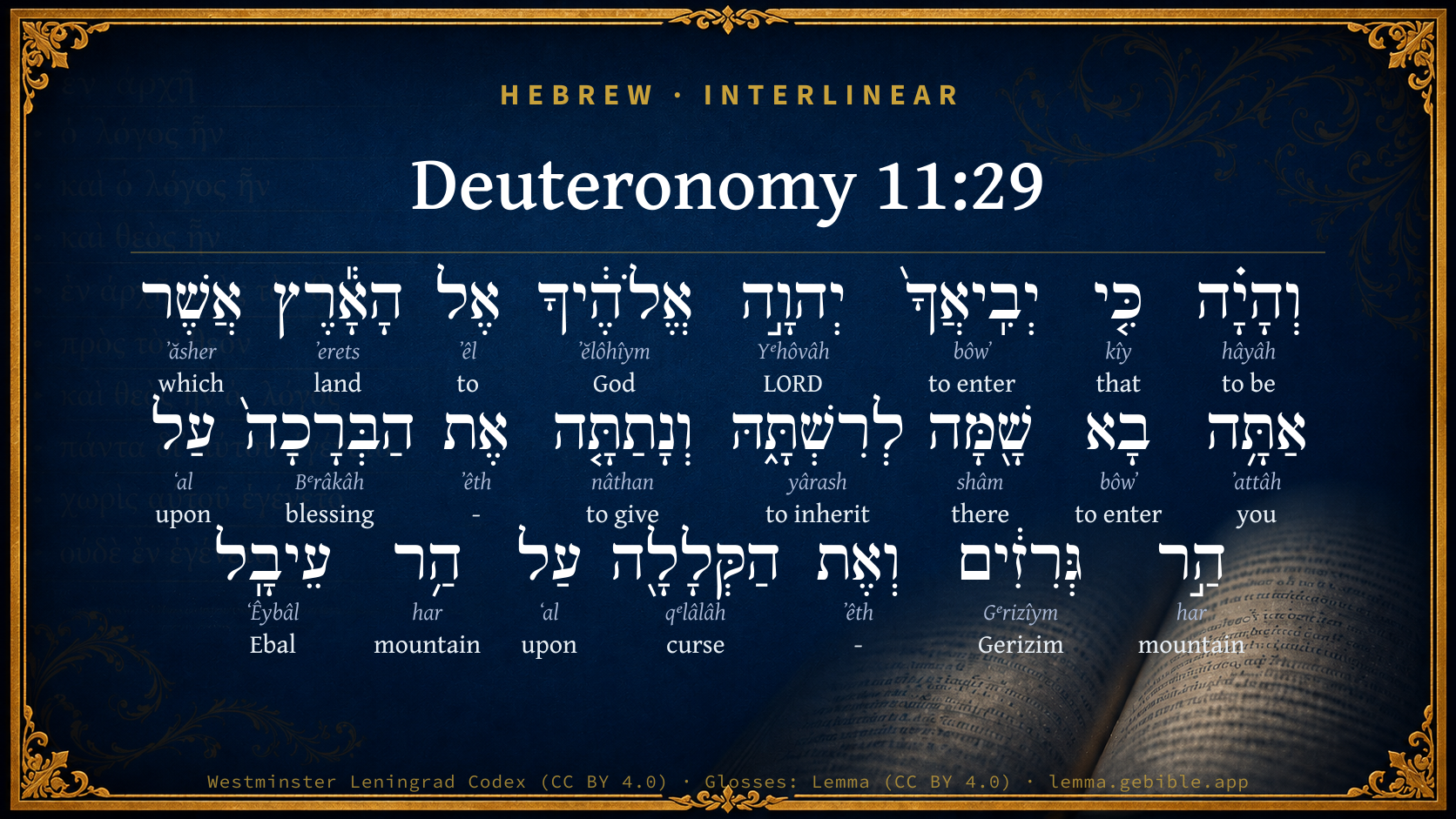
Deuteronomy 11:29

Hebrew (Westminster Leningrad Codex) Deuteronomy 11:29 appears in the Hebrew Old Testament. The text above is from the Westminster Leningrad Codex. Each word links to its Strong’s number, a concise gloss, and parsing drawn from the Open Scriptures Hebrew Bible morphology. Click any word for its full Brown-Driver-Briggs (BDB) entry.
Download image
Cite this verse

Deuteronomy 11:29 (World English Bible). Public Domain. Lemma interlinear Bible study tool, https://lemma.gebible.app/v/deuteronomy/11/29.

Show BibTeX & RIS
BibTeX
RIS
English Translation
It shall happen, when Yahweh your God shall bring you into the land where you go to possess it, that you shall set the blessing on Mount Gerizim, and the curse on Mount Ebal.
World English Bible · Public Domain
Highlights
  • 1 first appearance in the Hebrew Bible
Full analysis ↓
Download a study sheet

One document with this verse’s original text, its word-by-word gloss line, the meaning frame, cross-references with their text, attributed commentary, and full source and license credits — printable, and it pastes into notes with its structure intact.

This verse Autodidact and up

Study sheet (.html) Plain text (.txt)

A passage Seminary Student

Up to 50 verses in one chapter. A passage sheet keeps up to 6 commentary sources and 12 cross-references per verse, in the order this page ranks them, and says so on the sheet whenever that leaves anything out. Ask for a single verse and you get the Autodidact verse sheet above.

Everything on this page stays free to read, with no account — the sheet is a download of what is already on screen, not access to it.

Want to remove ads? Support Godless Engineer
Compare translations 3

The same verse in 3 English versions, stacked beneath the original-language interlinear above. Click any original word for its lexicon entry.

Each is an independent rendering of the whole verse — the interlinear is not word-aligned to these translations.

Highlighted words mark where these versions differ — a whole-verse word diff, not a word-by-word alignment.

  • World English Bible Public Domain
    It shall happen, when Yahweh your God shall bring you into the land where you go to possess it, that you shall set the blessing on Mount Gerizim, and the curse on Mount Ebal.
  • King James Version Public Domain
    And it shall come to pass, when the LORD thy God hath brought thee in unto the land whither thou goest to possess it, that thou shalt put the blessing upon mount Gerizim, and the curse upon mount Ebal.
  • unfoldingWord Literal Text CC BY-SA 4.0
    And it will happen, when Yahweh your God brings you into the land which you are going in to possess it, that you will set the blessing on Mount Gerizim and the curse on Mount Ebal.

unfoldingWord Literal Text — © unfoldingWord, licensed CC BY-SA 4.0. Word-aligned USFM3 via Door43 (git.door43.org/unfoldingWord/en_ult).

Versions to compare (up to 4)

3 of 4 selected

Show all 18 translations

Every available English version of this verse, each an independent rendering of the whole verse.

  • World English Bible Public Domain
    It shall happen, when Yahweh your God shall bring you into the land where you go to possess it, that you shall set the blessing on Mount Gerizim, and the curse on Mount Ebal.
  • Berean Standard Bible Public Domain
    When the LORD your God brings you into the land you are entering to possess, you are to proclaim the blessing on Mount Gerizim and the curse on Mount Ebal.
  • Majority Standard Bible Public Domain
    When the LORD your God brings you into the land you are entering to possess, you are to proclaim the blessing on Mount Gerizim and the curse on Mount Ebal.
  • King James Version Public Domain
    And it shall come to pass, when the LORD thy God hath brought thee in unto the land whither thou goest to possess it, that thou shalt put the blessing upon mount Gerizim, and the curse upon mount Ebal.
  • American Standard Version (1901) Public Domain
    And it shall come to pass, when Jehovah thy God shall bring thee into the land whither thou goest to possess it, that thou shalt set the blessing upon mount Gerizim, and the curse upon mount Ebal.
  • Revised Version (1885) Public Domain
    And it shall come to pass, when the LORD thy God shall bring thee into the land whither thou goest to possess it, that thou shalt set the blessing upon mount Gerizim, and the curse upon mount Ebal.
  • Geneva Bible (1599) Public Domain
    When the Lord thy God therefore hath brought thee into ye lande, whither thou goest to possesse it, then thou shalt put the blessing vpon mount Gerizim, and the curse vpon mount Ebal.
  • Douay-Rheims (1899) Public Domain
    A curse, if you obey not the commandments of the Lord your. God, but revolt from the way which now I shew you, and walk after strange gods which you know not.
  • Young's Literal Translation Public Domain
    `And it hath been, when Jehovah thy God doth bring thee in unto the land whither thou art going in to possess it, that thou hast given the blessing on mount Gerizim, and the reviling on mount Ebal;
  • Literal Standard Version CC BY-SA 4.0
    And it has been, when your God YHWH brings you into the land to where you are going in to possess it, that you have given the blessing on Mount Gerizim and the reviling on Mount Ebal;
  • Unlocked Literal Bible CC BY-SA 4.0
    It will happen, when Yahweh your God brings you into the land which you go to possess, that you will set the blessing on Mount Gerizim, and the curse on Mount Ebal.
  • unfoldingWord Literal Text CC BY-SA 4.0
    And it will happen, when Yahweh your God brings you into the land which you are going in to possess it, that you will set the blessing on Mount Gerizim and the curse on Mount Ebal.
  • Darby Bible Public Domain
    And it shall come to pass, when Jehovah thy God hath brought thee into the land whither thou enterest in to possess it, that thou shalt put the blessing upon mount Gerizim, and the curse upon mount Ebal.
  • World Messianic Bible Public Domain
    It shall happen, when the LORD your God brings you into the land that you go to possess, that you shall set the blessing on Mount Gerizim, and the curse on Mount Ebal.
  • Webster's Bible Public Domain
    And it shall come to pass when the LORD thy God hath brought thee in to the land whither thou goest to possess it, that thou shalt put the blessing upon mount Gerizim, and the curse upon mount Ebal.
  • Free Bible Version CC BY-SA 4.0
    When the Lord your God takes you into the country you are going in to occupy, announce the blessing on Mount Gerizim and the curse on Mount Ebal.
  • Bible in Basic English Public Domain
    And when the Lord your God has taken you into the land of your heritage, you are to put the blessing on Mount Gerizim and the curse on Mount Ebal.
  • JPS Tanakh (1917) Public Domain
    And it shall come to pass, when the LORD thy God shall bring thee into the land whither thou goest to possess it, that thou shalt set the blessing upon mount Gerizim, and the curse upon mount Ebal.

Literal Standard Version (2020), Covenant Press — licensed CC BY-SA 4.0. Text via the HelloAO Bible API (eBible.org). Unlocked Literal Bible (unfoldingWord) — licensed CC BY-SA 4.0. Text via the HelloAO Bible API (eBible.org). unfoldingWord Literal Text — © unfoldingWord, licensed CC BY-SA 4.0. Word-aligned USFM3 via Door43 (git.door43.org/unfoldingWord/en_ult). Free Bible Version, Dr. Jonathan Gallagher — licensed CC BY-SA 4.0. Text via the HelloAO Bible API (eBible.org).

Word by word

More ways to search: Search by grammar → Find every occurrence → Compare this word →

Practice this passage: Drill this verse → Learn its vocabulary →

גְּרִזִ֔ים
Gᵉrizîym
H1630
“Gerizim”
Noun, Proper
Part of Speech
Noun
Type
Proper
Full BDB Definition

Origin: plural of an unused noun from H1629

TWOT: None

Gerizim = "cuttings off" - a mountain in northern Israel in Ephraim near Shechem from which the blessings were read to the Israelites on entering Canaan; site of the Samaritan temple built after the captivity
  1. וְהָיָ֗ה hâyâh H1961 “and · to be” Conjunction + Verb, Qal, Sequential Perfect, 3rd Person, Masculine, Singular
  2. כִּ֤י kîy H3588 “that” Conjunction
  3. יְבִֽיאֲךָ֙ bôwʼ H935 “to enter · you” Verb, Hiphil, Imperfect, 3rd Person, Masculine, Singular + Suffix, Personal, 2nd Person, Masculine, Singular
  4. יְהוָ֣ה Yᵉhôvâh H3068 “LORD” Noun, Proper
  5. אֱלֹהֶ֔יךָ ʼĕlôhîym H430 “God(s) · your” Noun, Common, Masculine, Plural, Construct + Suffix, Personal, 2nd Person, Masculine, Singular
  6. אֶל ʼêl H413 “to” Preposition
  7. הָאָ֕רֶץ ʼerets H776 “the · land” Particle, Definite Article + Noun, Common, Both, Singular, Absolute
  8. אֲשֶׁר ʼăsher H834 “which” Particle, Relative
  9. אַתָּ֥ה ʼattâh H859 “you” Pronoun, Personal, 2nd Person, Masculine, Singular
  10. בָא bôwʼ H935 “entering” Verb, Qal, Participle Active, Masculine, Singular, Absolute
  11. שָׁ֖מָּה shâm H8033 “there · toward” Adverb + Suffix, Demonstrative
  12. לְרִשְׁתָּ֑הּ yârash H3423 “to inherit · her” Preposition + Verb, Qal, Infinitive Construct + Suffix, Personal, 3rd Person, Feminine, Singular
  13. וְנָתַתָּ֤ה nâthan H5414 “and · to give” Conjunction + Verb, Qal, Sequential Perfect, 2nd Person, Masculine, Singular
  14. אֶת ʼêth H853 “-” Particle, Direct Object
  15. הַבְּרָכָה֙ Bᵉrâkâh H1293 “the · blessing” Particle, Definite Article + Noun, Common, Feminine, Singular, Absolute
  16. עַל ʻal H5921 “upon” Preposition
  17. הַ֣ר har H2022 “mountain of” Noun, Common, Masculine, Singular, Construct
  18. וְאֶת ʼêth H853 “and · -” Conjunction + Particle, Direct Object
  19. הַקְּלָלָ֖ה qᵉlâlâh H7045 “the · curse” Particle, Definite Article + Noun, Common, Feminine, Singular, Absolute
  20. עַל ʻal H5921 “upon” Preposition
  21. הַ֥ר har H2022 “mountain of” Noun, Common, Masculine, Singular, Construct
  22. עֵיבָֽל ʻÊybâl H5858 “Ebal” Noun, Proper

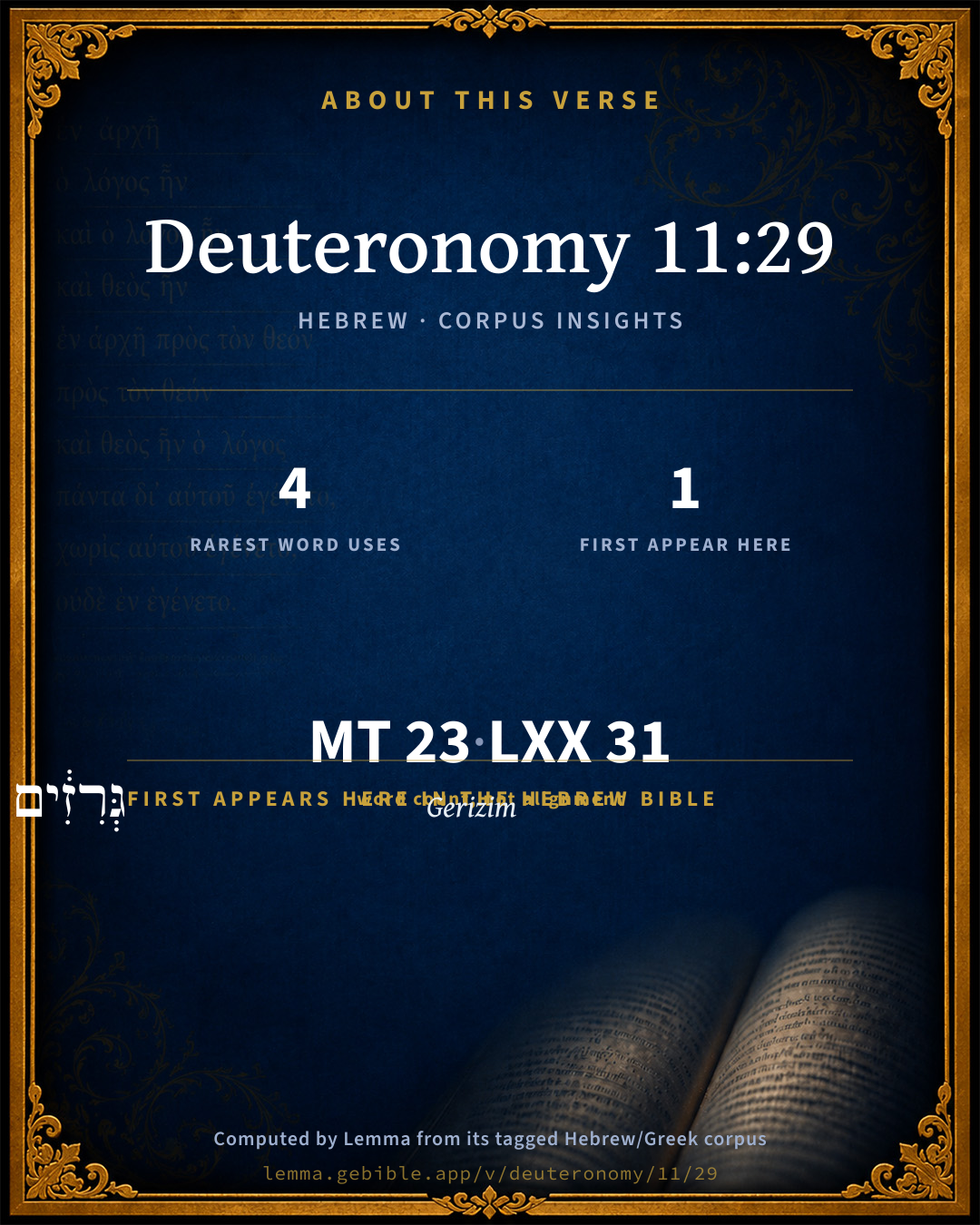
About this verse

These counts appear in no published source. They are computed here, from the morphology-tagged text and Lemma’s own curated glosses. What Lemma adds →

23
words
19
distinct lemmas
Pentateuch
section

Notable vocabulary

The rarest word here is גְּרִזִ֔ים Gerizim H1630 — appearing just 4 times in the whole Hebrew Bible.

First appearance in Scripture

This word makes its first canonical appearance in the Hebrew Bible here:

  • גְּרִזִ֔ים Gerizim H1630

Shared distinctive vocabulary

גְּרִזִ֔ים Gerizim H1630 occurs in 4 verses of the Hebrew Bible. Also found in:

Grammatical profile

  • 5 verbs
  • 9 nouns
  • 1 pronoun
  • 3 prepositions
  • 1 conjunction
  • 1 adverb
  • 3 particles

Verb forms

  • וְהָיָ֗ה Qal · Sequential Perfect
  • יְבִֽיאֲךָ֙ Hiphil · Imperfect
  • בָא Qal · Participle Active
  • לְרִשְׁתָּ֑הּ Qal · Infinitive Construct
  • וְנָתַתָּ֤ה Qal · Sequential Perfect

Repetition

Words recur within this verse — often emphatic in Hebrew:

  • יְבִֽיאֲךָ֙ to enter H935 ×2
  • עַל upon H5921 ×2
  • הַ֣ר mountain H2022 ×2

Hebrew & Septuagint length

In English translation the verse runs 34 words from the Hebrew and 40 from the Septuagint (LXX English) — closely comparable.

A rough comparison of the two English renderings, which tokenize alike — not a word-level alignment.

Word counts can differ between the Hebrew and the Greek without any difference in meaning — e.g. the Hebrew direct-object marker אֵת has no separate Greek word, and Greek often adds the article ὁ.

In the original languages it is 23 Hebrew tokens and 31 Greek tokens — but the two are counted differently (Hebrew bundles its prefixes and suffixes into one token; the Greek is in lemma form), so that isn’t a like-for-like length.

Cross-references

2

Topical passages linked to Deuteronomy 11:29 in the Treasury of Scripture Knowledge — connected by theme and wording, ordered by reader-vote popularity; previews shown in the World English Bible.

  • Deuteronomy 27:12–26 These shall stand on Mount Gerizim to bless the people, when you are passed over the Jordan: Simeon, and Levi, and Judah, and Issachar, and Joseph, and Benjamin.
  • Joshua 8:30–35 Then Joshua built an altar to Yahweh, the God of Israel, in Mount Ebal,

Cross-references courtesy of OpenBible.info (CC BY 4.0).

Hebrew and Greek witnesses Masoretic Hebrew ↔ Greek Septuagint

The same verse in the two great witnesses to the Old Testament, shown verse-for-verse.

These are two independent witnesses, not word-aligned to each other, and the Septuagint is shown in lemma (dictionary) form.

Hebrew Deuteronomy 11:29 Masoretic · Westminster Leningrad Codex

וְהָיָ֗ה כִּ֤י יְבִֽיאֲךָ֙ יְהוָ֣ה אֱלֹהֶ֔יךָ אֶל הָאָ֕רֶץ אֲשֶׁר אַתָּ֥ה בָא שָׁ֖מָּה לְרִשְׁתָּ֑הּ וְנָתַתָּ֤ה אֶת הַבְּרָכָה֙ עַל הַ֣ר גְּרִזִ֔ים וְאֶת הַקְּלָלָ֖ה עַל הַ֥ר עֵיבָֽל

It shall happen, when Yahweh your God shall bring you into the land where you go to possess it, that you shall set the blessing on Mount Gerizim, and the curse on Mount Ebal.

World English Bible · Public Domain

Greek LXX Deuteronomy 11:29 Septuagint · lemma form

καί εἰμί ὅταν εἰςἄγω σύ κύριος ὁ θεός σύ εἰς ὁ γῆ εἰς ὅς διαβαίνω ἐκεῖ κληρονομέω αὐτός καί δίδωμι ὁ εὐλογία ἐπί ὄρος γαριζιν καί ὁ κατάρα ἐπί ὄρος γαιβαλ

And it shall come to pass when the Lord your God shall have brought you into the land into which you go over to inherit it, then you shall put blessing on mount Garizin, and the curse upon mount Gaebal.

LXX2012 (modern English Septuagint) · Public Domain

On this verse, The Cambridge Bible for Schools and Colleges discusses the Septuagint’s reading. Read the note in Commentary ↓

Hebrew: Westminster Leningrad Codex (CC BY 4.0). Greek: Septuagint (public domain); English from LXX2012 (modern English Septuagint) (Public Domain). How the Septuagint differs from the Hebrew →

Targum (Aramaic paraphrase)

2

The Targum is the ancient Jewish Aramaic paraphrase of the Hebrew Scriptures — an interpretive translation, not the Hebrew text itself. Onkelos (literal) and Pseudo-Jonathan (expansive) render the Torah, and Jonathan the Prophets. Coverage is partial: where no permissively-licensed English translation exists for a verse, only the Aramaic is shown. This is verse-level text, not a word-by-word alignment to the Hebrew.

  1. Targum Onkelos Torah (Genesis–Deuteronomy)
    וִיהֵי אֲרֵי יָעֵלִנָךְ יְיָ אֱלָהָךְ לְאַרְעָא דִי אַתְּ עָלֵל תַּמָן לְמֵירְתַהּ וְתִתֵּן יָת מְבָרְכַיָא עַל טוּרָא דִגְרִזִין וְיָת מְלַטְטַיָא עַל טוּרָא דְעֵיבָל

    (no public-domain English translation for this verse)

    Targum Onkelos — Aramaic: “Onkelos Genesis” (public domain); “Onkelos Exodus” (public domain); “Onkelos Leviticus” (public domain); “Onkelos Numbers” (public domain); “Onkelos Deuteronomy” (public domain). English: “Sefaria Community Translation” (CC0 1.0 (public-domain dedication)); “J.W. Etheridge. The Targums of Onkelos and Jonathan Ben Uzziel on the Pentateuch. London: Longmans, Green, 1862” (public domain). Text via Sefaria.

  2. Targum Pseudo-Jonathan Torah (Genesis–Deuteronomy)
    וִיהֵי אֲרוּם יֵיעָל יַתְכוֹן יְיָ אֱלָהָכוֹן לְאַרְעָא דְאַתּוּן עָלְלִין לְתַמָּן לְמֵירְתָהּ וְתִתְּנוּן שִׁית שִׁבְטִין עַל טַוְורָא דִגְרִיזִים וְשִׁית שִׁבְטִין עַל טַוְורָא דְעֵיבָל מְבָרְכַיָא יֶהֱווֹן הָפְכִין אַפֵּיהוֹן לְקָבֵיל טַוְורָא דִגְרִיזִים וּמְלַטְטַיָא יֶהֱווֹן הָפְכִין אַפֵּיהוֹן לְקָבֵל טַוְורָא דְעֵיבָל

    And it shall be, when the Lord your God will have brought you to the land into which you are going, to possess it, you shall place six tribes upon the mountain of Gerizim, and six tribes on the mountain of Ebal. They who recite the blessings shall turn their faces towards Mount Gerizim, and they who recite the curses shall turn their faces towards Mount Ebal.

    Targum Pseudo-Jonathan — Aramaic: “Targum Jonathan on Genesis” (public domain); “Targum Jonathan on Exodus” (public domain); “Targum Jonathan on Leviticus” (public domain); “Targum Jonathan on Numbers” (public domain); “Targum Jonathan on Deuteronomy” (public domain). English: “The Targum of Jonathan ben Uzziel, trans. J. W. Etheridge, London, 1862” (public domain). Text via Sefaria.

Commentary

Notes on Deuteronomy 11:29 from classic Christian and Jewish commentators (each source and its license shown beneath its notes). The classic Christian expositions comment on the surrounding passage and are grouped to its opening verse, so a note may address several verses; the Jewish commentaries on the Tanakh (Rashi and others) are per-verse, so they appear only where the commentator wrote on this verse.

Lemma curates 59 commentaries, every one of them public domain or Creative Commons licensed, each selected and text-cleaned for this edition rather than reprinted as found. About our sources →

Trapp's Complete Commentary

John Trapp

Deu 11:29 And it shall come to pass, when the LORD thy God hath brought thee in unto the land whither thou goest to possess it, that thou shalt put the blessing upon mount Gerizim, and the curse upon mount Ebal.

Ver. 29. Put the blessing upon mount Gerizim.] That is, Pronounce it there. See Jos 8:33. Hence the Samaritans built their temple on this mount as a blessed place, and there worshipped they knew not what {Joh 4:20; Joh 4:22} calling themselves, Those that belong to the blessed mount.

John Trapp, A Commentary or Exposition upon All the Books of the Old and New Testament (1647–1656) — public domain. Text from a community e-Sword module.

Joseph Benson's Commentary

Deu 11:29-30. Put — Hebrew, Thou shalt give; that is, speak, or pronounce, or cause to be pronounced. This is more particularly expressed Deu 27:12-13. Over against — Looking toward Gilgal, though at some considerable distance from it. Beside the plains of Moreh — This was one of the first places that Abraham came to in Canaan. So that in sending them thither to hear the blessing and the curse, they were reminded of the promise made to Abram in that very place, Gen 12:6-7.

Joseph Benson's Commentary on the Old and New Testaments (1811–1818) — public domain. Text from a community e-Sword module.

Tyndale Open Study Notes

Tyndale Open Resources

11:29 Mount Gerizim is a prominent hill lying just west of Shechem. In later times, the Samaritans built a temple there (cp. John 4:20). • Mount Ebal is across the valley from Mount Gerizim, to the east of Shechem.

Tyndale Open Study Notes — © Tyndale Open Resources, licensed CC BY-SA 4.0. Text via the HelloAO Bible API.

Adam Clarke's Commentary

Verse 29. Thou shalt put the blessing upon Mount Gerizim, and the curse upon Mount Ebal.] The etymology of these names may be supposed to cast some light on this institution. גרזים gerizzim, from גרז garaz, to cut, cut off, cut down; hence גרזים gerizzim, the cutters down, fellers, and reapers or harvest-men, this mountain being supposed to have its name from its great fertility, or the abundance of the crops it yielded, which is a possible case. Of עיבל ebal or eybal the root is not found in Hebrew; but in Arabic [Arabic] abala signifies rough, rugged, curled, c. and [Arabic] abalo, from the same root, signifies white stones, and a mountain in which such stones are found; [Arabic] alabalo, the mount of white stones. See Giggeius and Golius. And as it is supposed that the mountain had this name because of its barrenness, on this metaphorical interpretation the sense of the passage would appear to be the following: God will so superintend the land, and have it continually under the eye of his watchful providence, that no change can happen in it but according to his Divine counsel, so that its fertility shall ever be the consequence of the faithful obedience of its inhabitants, and a proof of the blessing of God upon it; on the contrary, its barrenness shall be a proof that the people have departed from their God, and that his curse has in consequence fallen upon the land. See the manner of placing these blessings and curses, De 27:12, c. That Gerizim is very fruitful, and that Ebal is very barren, is the united testimony of all who have travelled in those parts. See Ludolf, Reland, Rab, Benjamin, and Mr. Maundrell. Sychem lies in the valley between these two mountains.

THAT the land of Judea was naturally very fertile, can scarcely be supposed by any who considers the accounts given of it by travellers with the exception of a few districts, the whole land is dry, stony, and barren, and particularly all the southern parts of Judea, and all the environs of Jerusalem, most of which are represented as absolutely incapable of cultivation. How then could it ever support its vast number of inhabitants? By the especial providence of God. While God kept that people under his continual protection, their land was a paradise; they lent to all nations and borrowed from none. What has it been since? A demi-solitude, because that especial blessing no longer descends upon it. No land, says Calmet, was more fertile while under the benediction of God; none more barren when under his curse. Its present state is a proof of the declaration of Moses, De 28:23: "The heaven over their head is brass; the earth under their feet, iron." The land itself, in its present state is an ample proof of the authenticity of the Pentateuch. Should facts of this kind be lost sight of by any who read the sacred writings?

Adam Clarke's Commentary on the Bible (1810–1826) — public domain. Text from a community e-Sword/MySword module.

Ellicott's Commentary for English Readers

(29) The blessing . . . and the curse . . .—The Targum of Onkelos says, “Those that bless,” and “those that curse.” (See Deu_27:12-13, and Note.[1])

[1] The other Targums say, “When they bless they shall turn their faces towards Mount Gerizim; and when they curse they shall turn their faces towards Mount Ebal.” This confirms the antiquity of the view taken in the Talmud.

A Bible Commentary for English Readers, edited by Charles John Ellicott (1878–1897) — public domain. Text from a community e-Sword module.

The Cambridge Bible for Schools and Colleges

gen. ed. J. J. S. Perowne

29–30. A return to the Sg. form of address, with phrases peculiar to that form (see Deu_6:10, Deu_7:1). Whether it is original here, or dependent on Deu_27:12 f. (cp. Jos_8:33 f.), is doubtful.

29. shall bring thee unto the land, etc.] Son_7:1, q.v.

the blessing upon mount Gerizim, and the curse upon mount Ebal] The two most prominent hills on the Western Range, whether seen from the Mediterranean or from the E. of Jordan, on either side of what is not only the natural centre of Western Palestine, but the part most open to approach from E. Palestine. See the present writer’s HGHL, ch. vi., and pp. 335 ff. Gerizim lies to the S., or, according to Semitic orientation, the right hand and lucky quarter of the heavens; ‘Ebal on the N., the left or sinister quarter. But the visitor to the locality will also be struck by the sympathy between our verse and the contrasted aspects of the two hills as they face each other: the N. face of Gerizim, the mount of blessing, is the more fertile; the opposite face of ‘Ebal, the mount of curse, much the more bare.

30. A geographical gloss similar to those in Deu_1:2, and in chs. 2, 3, and introduced by are they not, as Deu_3:11.

beyond Jordan] True to the speaker’s position on the E. of Jordan, so Deu_3:20; Deu_3:25. Contrast, as untrue to the speaker’s position, Deu_3:8 (part of Moses’speech), Deu_1:1; Deu_1:5, Deu_4:46-47; Deu_4:49 (all titles), and Deu_4:41 (a historical fragment).

behind the way of the going down of the sun] Of doubtful meaning. Behind is, of course, west of (according to the orientation alluded to above). But what is the way? It has been understood by most as the great road traversing Western Palestine from N. to S., to the immediate west of which the two mountains lie (Dillm., who quotes Ritter, Erdkunde von Asien, xvi. 658 f. = Geog. of Pal. iv. 293 ff., Driver, Marti). Steuern. proposes, by the addition of one letter, to read west of it, i.e. the Jordan, and to translate the rest in the direction of the sunsetting; cp. the LXX ὀπίσω ὁδὸν (not ὁδοῦ) δυσμῶν ἡλίου ‘behind (it) towards the sunset.’ Such redundance is not uncharacteristic of the deuteronomic editors.

in the land of the Canaanites] Not D’s usual name for the inhabitants of the land; see on Deu_1:7.

which dwell in the Arabah] See on Deu_1:1 : the Jordan valley, not relevant to the position of ‘Ebal and Gerizim. The whole clause is very probably a still later addition, especially as the following clause connects naturally with that position. So, too, the Massoretic punctuation of the text implies.

over against Gilgal, beside the oaks of Moreh] The Gilgal, i.e. stone-circle. There were several places of this name W. of Jordan and still marked by Arabic forms of it (see ‘Gilgal’ in E. B. by the present writer): (1) One was the Gilgal near Jericho, and with this certain Rabbis, followed by Eusebius, Jerome, and a constant Christian tradition, have identified the Gilgal of our text. So, too, a number of modern commentators. Others, changing the punctuation, refer the words over against the Gilgal to the Canaanites which dwell in the ‘Arabah. (2) A second Gilgal lay on the Western Range above Bethel (2Ki_2:1-8) and has been identified with the present Jiljilyeh seven miles N. of Bethel, which, though actually lower than Bethel, stands on a hill so bold and isolated that the phrase to go down thence to Bethel would not be inappropriate. This also has been identified with the Gilgal of our text, yet it is at a good distance from Gerizim and ‘Ebal, and stands in no definite relation to them. (3) Dillmann supposed some Gilgal near Shechem, and his hypothesis has been justified by the discovery of the name Juleijil (Ar. dimin. of Gilgal) on the plain one mile E. of the foot of Gerizim and 2½ miles SE. of Shechem. This suits the data of our passage (including the following oaks or terebinths of Moreh), and its claims have been defended in detail by Schlatter (Zur Topogr. u. Gesch. Palästinas, 246 ff.) and accepted by Buhl (Pal. 202 ff.); cp. the present writer in Critical Review, Oct. 1895, 346 ff., and art. ‘Gilgal’ in E.B.; and Driver, Deuteronomy 3 rd ed. (1901), p. xxi. In 1901 the present writer visited Juleijil, and a thorough examination of the site convinced him that it is the Gilgal of our text. A hill, some two hundred feet high, rises from the Makhneh plain just opposite the valley between Gerizim and ‘Ebal. The trace of a broad winding road leads to the summit, which is covered with ancient remains, including those of a large stone-circle composed of huge blocks. There is no more suitable site for a sanctuary in all W. Palestine. Cp. G. Hölscher, ZDPV, xxxiii. 102 f.

beside the oaks of Moreh] Read, with Sam. and LXX, the oak. The oak or terebinth of Moreh, ‘the Revealer,’ takes us back to Abraham, who found it here by Shechem and built an altar, Gen_12:6 (J), from which the above mention of the Canaanites (it is J’s word for the inhabitants of the land) may have been derived by the annotating editor. On trees, as impressing especially the nomads of the treeless desert with their speaking and oracular powers, see on Deu_12:2 and the present writer’s Early Poetry of Israel, 32 f.

The Cambridge Bible for Schools and Colleges (gen. ed. J. J. S. Perowne; Cambridge University Press, 1878–1918) — public domain. Text from a community e-Sword module.

Albert Barnes' Notes on the Bible

Thou shalt put the blessing upon mount Gerizim - literally, thou shalt give, i. e., “give” utterance to it. On the ceremony see Deu 27:14 ff.

Mount Gerizim, barren like Ebal, was probably selected as the hill of benediction because it was the southernmost of the two, the south being the region, according to Hebrew ideas, of light, and so of life and blessing. The situation of the mountains is described more accurately in Deu 11:30. The words “by the way where the sun goeth down,” should run, beyond the road of the west; i. e., on the further side of the main track which ran from Syria and Damascus to Jerusalem and Egypt through the center of Palestine. This is called “the way of the west” in contrast to the ether main route from Damascus to the south which passed through the district east of Jordan. The further specifications “Gilgal” and “the plains (rather, the oaks, compare Gen 12:6 note) of Moreh,” are added to define more particularly the section of Canaanites intended.

This Gilgal is perhaps to be found in Jiljilia, a large village about twelve miles south of Gerizim.

Albert Barnes' Notes on the Bible (1834–1885) — public domain. Text from a community e-Sword/MySword module.

Haydock's Catholic Bible Commentary

Put the blessing, &c. See Deuteronomy xxvii. 12, &c., and Josue viii. 33, &c. (Challoner) --- Six tribes were to be stationed on each of these mountains, chap. xxviii. --- Garizim. Eusebius says that the Samaritans are grossly deceived, in placing this mountain in the vicinity of Sichem, instead of Jericho. But this is a mistake; for Jotham addressed the inhabitants of Sichem from that mountain, Judges ix. 7. Morizon informs us that it is of the same shape as Hebal, and separated from it only by a valley of about 200 paces, in which the town of Sichem stands. Hebal is a barren rock, while Garizim is very fertile, (Ludolf.) though an ancient poet makes both equally covered with verdure. (Ap. Eusebius, præp. ix. 22.) (Calmet)

George Leo Haydock (1774–1849), Haydock's Catholic Family Bible and Commentary, 1859 edition — public domain. Excludes Psalms (Douay-Rheims chapter numbering differs from Protestant) and Deuterocanonical books (Catholic canon only).

Matthew Poole's English Annotations

Thou shalt put the blessing, Heb. thou shalt give, i.e. speak or pronounce, or cause to be pronounced. So the word to give is used, Deu 13:1,2; Job 36:3; Pro 9:9. This is more particularly expressed Deu 27:12,13; Jos 8:33, whither I refer the reader.

Matthew Poole's English Annotations on the Holy Bible (1683–1685) — public domain. Text from a community e-Sword/MySword module.

Whedon's Commentary on the Bible

Daniel D. Whedon

29. Thou shalt put the blessing upon Mount Gerizim, and the curse upon Mount Ebal — There were special reasons for selecting these mountains. They are almost at the geographical centre of the land. They lie opposite each other, with a beautiful, well-watered valley between — Ebal on the north and Gerizim on the south, each rising more than twenty-five hundred feet in height above the level of the sea. In the valley was Shechem — modern Nablus. The modern town is beautifully surrounded with well-watered and productive gardens. Shechem was so prominent in the history of the patriarchs that the gathering of the tribes there would be especially impressive and significant. This was the first spot where Abraham pitched his tent in Canaan, and where he built an altar. To this place Jacob came on his return from Mesopotamia, and pitched his tent east of the city near to Shechem. Here he bought the parcel of a field from Hamor, Shechem’s father. Gen_33:19. Here, too, he built an altar for worship. Here the tribes were soon to bury the bones of Joseph. See Jos_24:32.

Daniel D. Whedon (gen. ed.), Commentary on the Old and New Testaments (1874–1909) — public domain. Text from a community e-Sword module.

The Pulpit Commentary

Vers. 29, 30. (cf. Deu_27:11) Thou shalt put the blessing; thou shalt give (hTtn), i.e. give forth, utter, announce, proclaim (Gen_49:21; Job_1:22 gave, i.e. uttered impiety to God) Ps 1, gavest, didst utter, slandered. The two mountains named stand opposite to each other, with a valley between, about two hundred yards broad at the widest part, in which stood the town of Shechem, now Nablus. They were selected for the purpose mentioned, doubtless, because of their relative position, and probably also because they stand in the center of the land both from north to south, and from east to west. It has been suggested that Ebal was appointed for the uttering of the curse, and Gerizim for the uttering of the blessing, because the former was barren and rugged, the latter fertile and smooth; but this is not borne out by the actual appearance of the two bills, both being equally barren-looking, though neither is wholly destitute of culture and vegetation. That Gerizim was selected for the blessing because of its position on the south side of the valley "towards the region of light," while Ebal was appointed for the curse because it was on the north side, can be regarded only as an ingenious fancy. In ver. 30, the position of the two mountains is defined as on the other side of Jordan, i.e. on the side opposite to where the Israelites then were, the western side; and as by the way rather, behind the waywhere the sun goeth down; i.e. the road of the west, the great road which passed through the west-Jordan country, and which is still the main route from south to north in Palestine (Ritter, 4:293, etc.; Robinson, 3:127), passing Nablus and the two menu-rains on the east, so that they are behind it. Which dwell in the Champaign; in the "Arabah, (see Deu_1:1) "mentioned here as that portion of the land on the west of the Jordan which lay stretched out before the eyes of the Israelites, who were encamped in the steppes of Moab" (Keil). Over against Gilgal; i.e. not the Gilgal mentioned in Jos_4:19, which was east of Jericho. (hod Jiljulia) nor the Gilgal of Jos_12:23 (probably the modern Jiljulieh, in the plain of Sharon) but the Gilgal of Jos_9:6 Jos_10:6; and, 2Ki_2:1 (hod. Jiljilia) to the north of Bethel, from which there is "a very extensive prospect over the great lower plain, and also over the sea" (Robinson, "Bib. Res," 3:138); so that the mountains by Nablus may be very well described as "over against it." Beside the plains of Moreh; for "plains" read oaks (cf. Gen_12:6 Gen_35:4)

Vers. 29, 30. Gerizim and Ebal (cf. De 27) This putting of the blessing and the curse on Gerizim and Ebal had significance

I AS A SOLEMN TRANSFERENCE OF THE BLESSING AND THE CURSE TO THE LAND OF POSSESSION. Blessing and curse, representing the award of eternal righteousness, must follow us so long as disobedience is possible. "If ye live after the flesh, ye shall die". (Rom_8:13) "That which beareth thorns and briers is rejected, and is nigh unto cursing; whose end is to be burned". (Heb_6:8) In heaven there is "no more curse", (Rev_22:3) but only because, confirmed in holiness, God"s servants can no more fall away.

II AS A SOLEMN REMINDER OF TEE TENURE ON WHICH THE LAND WAS HELD. We cannot render perfect obedience, but our duty is to aim at it. The condition of inheritance is that we are doers of the Father"s will. (Mat_7:21)

III As CONNECTED WITH A SOLEMN RENEWAL OF VOWS. Fitting on such occasions that both blessing and curse should be remembered. J.O.

The Pulpit Commentary (1880–1919), ed. H.D.M. Spence-Jones & Joseph S. Exell — public domain. Text from a community e-Sword module.

John Wesley's Explanatory Notes

Put - Hebrew. Thou shalt give, that is, speak or pronounce, or cause to be pronounced. So the word to give is used, chap. xiii, 1, 2Job xxxvi, 3 Prov. ix, 9. This is, more particularly expressed, chap. xxvii, 12, 13.

John Wesley, Explanatory Notes Upon the Whole Bible (1754–1765) — public domain. Text via the GEBible commentary corpus.

unfoldingWord translationNotes

Door43 World Missions Community

General Information:

Moses continues speaking to the people of Israel.

you will set the blessing on Mount Gerizim, and the curse on Mount Ebal

The blessing and the curse are spoken of as if they were objects that someone will set on the mountains. AT: "some of you must stand on top of Mount Gerazim and proclaim what will cause Yahweh to bless you, and the others must stand on top of Mount Ebal and proclaim what will cause Yahweh to curse you" (See: Metaphor)

Mount Gerizim ... Mount Ebal

These are names of mountains on the west side of the Jordan River. (See: How to Translate Names)

Are they not beyond the Jordan ... Moreh?

The Israelites are on the eastern side of the Jordan River. Moses uses a question to remind the people where these mountains are located. This question can be translated as a statement. AT: "As you know, they are beyond the Jordan ... Moreh." (See: Rhetorical Question)

beyond the Jordan

"on the west side of the Jordan River"

west of the western road

"in the west"

over against Gilgal

"near Gilgal" This may not be the same place as the city near Jericho. Moses may be referring to a place that is near Shechem. (See: How to Translate Names)

oaks of Moreh

These are sacred trees near Gilgal. (See: How to Translate Names)

translationWords

possess

Jordan River

Canaan

life

Arabah

Gilgal

oak

unfoldingWord translationNotes — © Distant Shores Media and the Door43 World Missions Community, licensed CC BY-SA 4.0. Source: git.door43.org/Door43/en_tn.

Rashi

Rabbi Shlomo Yitzchaki (Rashi)

ונתת את הברכה THEN THOU SHALT PUT THE BLESSING [UPON MOUNT GERIZIM] — Understand this as the Targum renders it: ית מברכיא those who pronounce the blessing.

על הר גרזים means “towards Mount Gerizim”: they (the Levites) turned their faces towards it and began with a formula of blessing: “Blessed be the man that doth not make any graven or molten image etc.”. For each of the paragraphs beginning with the expression ארור as set forth in the chapter (Deuteronomy 27), they first recited in a converse form, beginning with the expression ברוך, “Blessed be etc.” and only afterwards did they turn their faces towards Mount Ebal and began to recite the corresponding curse (Sifrei Devarim 55:2; Sotah 32a; cf. Rashi on Deuteronomy 27).

Rashi on the Tanakh — English translations: “The Judaica Press complete Tanach with Rashi, translated by A. J. Rosenberg” (CC BY 4.0); “Pentateuch with Rashi's commentary by M. Rosenbaum and A.M. Silbermann, 1929-1934” (public domain); “The Metsudah Tanach series, Lakewood, N.J” (CC BY 4.0); and “The Book of Joshua, Metsudah Publications, 1997” (CC BY 4.0). Text via Sefaria.

Ramban (Nachmanides)

Rabbi Moshe ben Nachman (Ramban / Nachmanides)

AND THOU SHALT PUT ‘ETH HABRACHAH’ UPON MOUNT GERIZIM. “This is to be understood as the Targum [Onkelos] rendered it: yath m’vorchaya — ‘the blessers’ [i.e., those who will pronounce the blessings]. Upon Mount Gerizim — toward Mount Gerizim.” This is Rashi’s language, but it is not correct according to the plain meaning of Scripture, for he has not yet instructed concerning [the identity of] those who were to pronounce the blessing [which is only mentioned further on, in Chapter 27:11-14; hence the verse here could not refer to them with the definite article — habrachah which implies that their identity was already known]. Rather, the meaning of the verses is as follows: “I have set ‘before you’ a way [to attain] blessing and a way [to attain] curse. And the expression before you signifies that you are to choose for yourselves what you desire, and I inform you that the blessing will be yours when you perform the commandments, and the curse if you do not fulfill them.” This is similar to what he further said. See, I have set before thee this day the life and the good, the death and the evil etc. [This verse clearly does not pertain to the setting at Mount Gerizim and Mount Ebal, thus disproving Rashi’s interpretation that the blessing refers to “those who will pronounce the blessings.”] Then he stated here [in the verse before us], that they were to bestow this blessing of which he speaks, upon them [i.e., the tribes] on Mount Gerizim and the curse on Mount Ebal, this [“bestowal”] being by word of mouth [rather than by some physical act of placing the blessers there, as Rashi rendered it]. In a similar way is the interpretation of Rabbi Abraham ibn Ezra, on this verse, and he shall ‘put’ them upon the head of the goat. “Putting” refers to the confession of sins. This coincides with the interpretation of Ramban that the “bestowal” does not refer to the blessers, but to the recitation of the blessing. [meaning that the High Priest, by confessing the sins of the people, “puts” them upon the head of the goat that was to be sent to Azazel]. Thus he is saying here by way of admonition that they are to “put” [or pronounce] the blessing on Mount Gerizim, blessing the people if they will hearken to the commandments of G-d; and the curse on Mount Ebal, saying, “Cursed be he that will not hearken to the commandments and will turn aside from the way which G-d has commanded.” Now it would have been possible [in accordance with the plain meaning of this verse] that all the tribes utter the blessing and all of them [utter] the curse, or that the Levites pronounce them all, or that one individual proclaim them all. Hence he later reverted to explain there, These shall stand upon Mount Gerizim to bless the people, And these shall stand for the curse, Verse 13. and he further declared, And the Levites shall speak, Verse 14. and he explained the whole subject., Verses 15-26. For here, because of his admonition which he stated, Behold, I set before you etc., he mentioned part of the commandment and then he reverted to explain it [fully] in its proper place. It is possible that Mount Gerizim is to the south which is “the right” [side of a person who turns eastward facing the sunrise, in which case his right hand is to the south], and Mount Ebal is to the north, as it is said, Out of the north the evil shall break forth.

Ramban (Nachmanides) on the Tanakh — English translation: “Commentary on the Torah by Ramban (Nachmanides). Translated and annotated by Charles B. Chavel. New York, Shilo Pub. House, 1971-1976” (CC BY 4.0). Text via Sefaria.

Lesson kit

Teaching starters — assembled from the data on this page, not authored interpretation. Every prompt links to the verse data it draws on. Edit before teaching.

Deuteronomy, in the Pentateuch, opens this verse with 23 words (19 distinct Hebrew lemmas). Its most distinctive word is Gᵉrizîym (“Gerizim”). A historical commentator’s framing appears above. Read the whole chapter for the surrounding context.

Discussion questions

  1. How does “Gerizim” (Gᵉrizîym) shape what this verse is saying?
  2. The word “Gerizim” first appears here in Scripture. What is being introduced at this debut?
  3. Deuteronomy 27:12 shares the word «Gerizim» with this verse. How do the two illuminate each other?
  4. “to enter” occurs 2× in this one verse. What is the effect of the repetition?
  5. These translations render this verse differently; the difference is in the English rendering, not the original. What questions does that raise?
  6. The verb «וְהָיָ֗ה» is Qal Sequential Perfect. How does its form color the action?
  7. Reading how Trapp's Complete Commentary and Joseph Benson's Commentary read this verse, where do the two commentators agree and where do they part?

Things to notice

Reading settings

Reading text

Shown beneath each verse's original-language words.

Old Testament
Old Testament edition

Read the OT as the Masoretic Hebrew (MT) or the Greek Septuagint (LXX).

English shown for the Greek Septuagint (in the Hebrew ↔ Greek comparison).

Comparing translations? Open the Compare panel on any verse page to stack up to four side by side.