Exodus 27:5

Hebrew (Westminster Leningrad Codex) Exodus 27:5 appears in the Hebrew Old Testament. The text above is from the Westminster Leningrad Codex. Each word links to its Strong’s number, a concise gloss, and parsing drawn from the Open Scriptures Hebrew Bible morphology. Click any word for its full Brown-Driver-Briggs (BDB) entry.
Download image
Cite this verse

Exodus 27:5 (World English Bible). Public Domain. Lemma interlinear Bible study tool, https://lemma.gebible.app/v/exodus/27/5.

Show BibTeX & RIS
BibTeX
RIS
English Translation
You shall put it under the ledge around the altar beneath, that the net may reach halfway up the altar.
World English Bible · Public Domain
Highlights
  • 1 first appearance in the Hebrew Bible
Full analysis ↓
Download a study sheet

One document with this verse’s original text, its word-by-word gloss line, the meaning frame, cross-references with their text, attributed commentary, and full source and license credits — printable, and it pastes into notes with its structure intact.

This verse Autodidact and up

Study sheet (.html) Plain text (.txt)

A passage Seminary Student

Up to 50 verses in one chapter. A passage sheet keeps up to 6 commentary sources and 12 cross-references per verse, in the order this page ranks them, and says so on the sheet whenever that leaves anything out. Ask for a single verse and you get the Autodidact verse sheet above.

Everything on this page stays free to read, with no account — the sheet is a download of what is already on screen, not access to it.

Want to remove ads? Support Godless Engineer
Compare translations 3

The same verse in 3 English versions, stacked beneath the original-language interlinear above. Click any original word for its lexicon entry.

Each is an independent rendering of the whole verse — the interlinear is not word-aligned to these translations.

Highlighted words mark where these versions differ — a whole-verse word diff, not a word-by-word alignment.

  • World English Bible Public Domain
    You shall put it under the ledge around the altar beneath, that the net may reach halfway up the altar.
  • King James Version Public Domain
    And thou shalt put it under the compass of the altar beneath, that the net may be even to the midst of the altar.
  • unfoldingWord Literal Text CC BY-SA 4.0
    And you shall put it under the ledge of the altar below, and the network shall be up to the middle of the altar.

unfoldingWord Literal Text — © unfoldingWord, licensed CC BY-SA 4.0. Word-aligned USFM3 via Door43 (git.door43.org/unfoldingWord/en_ult).

Versions to compare (up to 4)

3 of 4 selected

Show all 18 translations

Every available English version of this verse, each an independent rendering of the whole verse.

  • World English Bible Public Domain
    You shall put it under the ledge around the altar beneath, that the net may reach halfway up the altar.
  • Berean Standard Bible Public Domain
    Set the grate beneath the ledge of the altar, so that the mesh comes halfway up the altar.
  • Majority Standard Bible Public Domain
    Set the grate beneath the ledge of the altar, so that the mesh comes halfway up the altar.
  • King James Version Public Domain
    And thou shalt put it under the compass of the altar beneath, that the net may be even to the midst of the altar.
  • American Standard Version (1901) Public Domain
    And thou shalt put it under the ledge round the altar beneath, that the net may reach halfway up the altar.
  • Revised Version (1885) Public Domain
    And thou shalt put it under the ledge round the altar beneath, that the net may reach halfway up the altar.
  • Geneva Bible (1599) Public Domain
    And thou shalt put it vnder the compasse of the altar beneath, that the grate may be in the middes of the altar.
  • Douay-Rheims (1899) Public Domain
    Which thou shalt put under the hearth of the altar: and the grate shall be even to the midst of the altar.
  • Young's Literal Translation Public Domain
    and hast put it under the compass of the altar beneath, and the net hath been unto the middle of the altar.
  • Literal Standard Version CC BY-SA 4.0
    and have put it under the rim of the altar beneath, and the net has been up to the middle of the altar.
  • Unlocked Literal Bible CC BY-SA 4.0
    You must put the grate under the ledge of the altar, halfway down to the bottom.
  • unfoldingWord Literal Text CC BY-SA 4.0
    And you shall put it under the ledge of the altar below, and the network shall be up to the middle of the altar.
  • Darby Bible Public Domain
    and thou shalt put it under the ledge of the altar beneath, and the net shall be to the very middle of the altar.
  • World Messianic Bible Public Domain
    You shall put it under the ledge around the altar beneath, that the net may reach halfway up the altar.
  • Webster's Bible Public Domain
    And thou shalt put it under the compass of the altar beneath, that the net may be even to the midst of the altar.
  • Free Bible Version CC BY-SA 4.0
    Put the grate under the ledge of the altar, so that the mesh comes halfway down the altar.
  • Bible in Basic English Public Domain
    And put the network under the shelf round the altar so that the net comes half-way up the altar.
  • JPS Tanakh (1917) Public Domain
    And thou shalt put it under the ledge round the altar beneath, that the net may reach halfway up the altar.

Literal Standard Version (2020), Covenant Press — licensed CC BY-SA 4.0. Text via the HelloAO Bible API (eBible.org). Unlocked Literal Bible (unfoldingWord) — licensed CC BY-SA 4.0. Text via the HelloAO Bible API (eBible.org). unfoldingWord Literal Text — © unfoldingWord, licensed CC BY-SA 4.0. Word-aligned USFM3 via Door43 (git.door43.org/unfoldingWord/en_ult). Free Bible Version, Dr. Jonathan Gallagher — licensed CC BY-SA 4.0. Text via the HelloAO Bible API (eBible.org).

Word by word

More ways to search: Search by grammar → Find every occurrence → Compare this word →

Practice this passage: Drill this verse → Learn its vocabulary →

כַּרְכֹּ֥ב
karkôb
H3749
“rim of”
Noun, Common, Masculine, Singular, Construct
Part of Speech
Noun
Type
Common
Gender
Masculine
Number
Singular
State
Construct
Full BDB Definition

Origin: expanded from the same as H3522

TWOT: 1038a

edge, rim
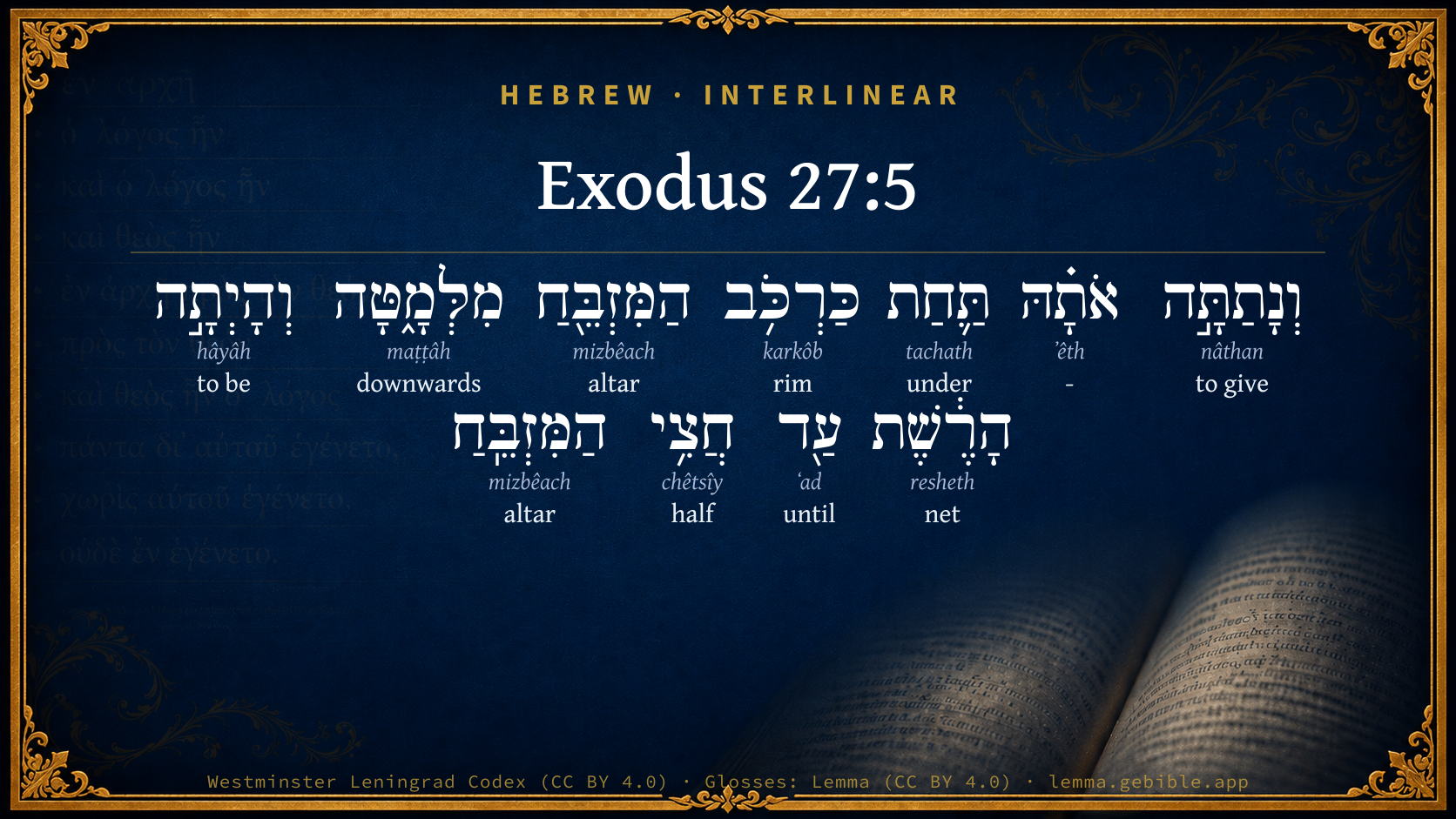
  1. וְנָתַתָּ֣ה nâthan H5414 “and · to give” Conjunction + Verb, Qal, Sequential Perfect, 2nd Person, Masculine, Singular
  2. אֹתָ֗הּ ʼêth H853 “- · her” Particle, Direct Object + Suffix, Personal, 3rd Person, Feminine, Singular
  3. תַּ֛חַת tachath H8478 “under” Preposition
  4. הַמִּזְבֵּ֖חַ mizbêach H4196 “the · altar” Particle, Definite Article + Noun, Common, Masculine, Singular, Absolute
  5. מִלְּמָ֑טָּה maṭṭâh H4295 “from · to/for · downwards” Preposition + Preposition + Adverb
  6. וְהָיְתָ֣ה hâyâh H1961 “and · to be” Conjunction + Verb, Qal, Sequential Perfect, 3rd Person, Feminine, Singular
  7. הָרֶ֔שֶׁת resheth H7568 “the · net” Particle, Definite Article + Noun, Common, Feminine, Singular, Absolute
  8. עַ֖ד ʻad H5704 “until” Preposition
  9. חֲצִ֥י chêtsîy H2677 “half of” Noun, Common, Masculine, Singular, Construct
  10. הַמִּזְבֵּֽחַ mizbêach H4196 “the · altar” Particle, Definite Article + Noun, Common, Masculine, Singular, Absolute

About this verse

These counts appear in no published source. They are computed here, from the morphology-tagged text and Lemma’s own curated glosses. What Lemma adds →

11
words
10
distinct lemmas
Pentateuch
section

Notable vocabulary

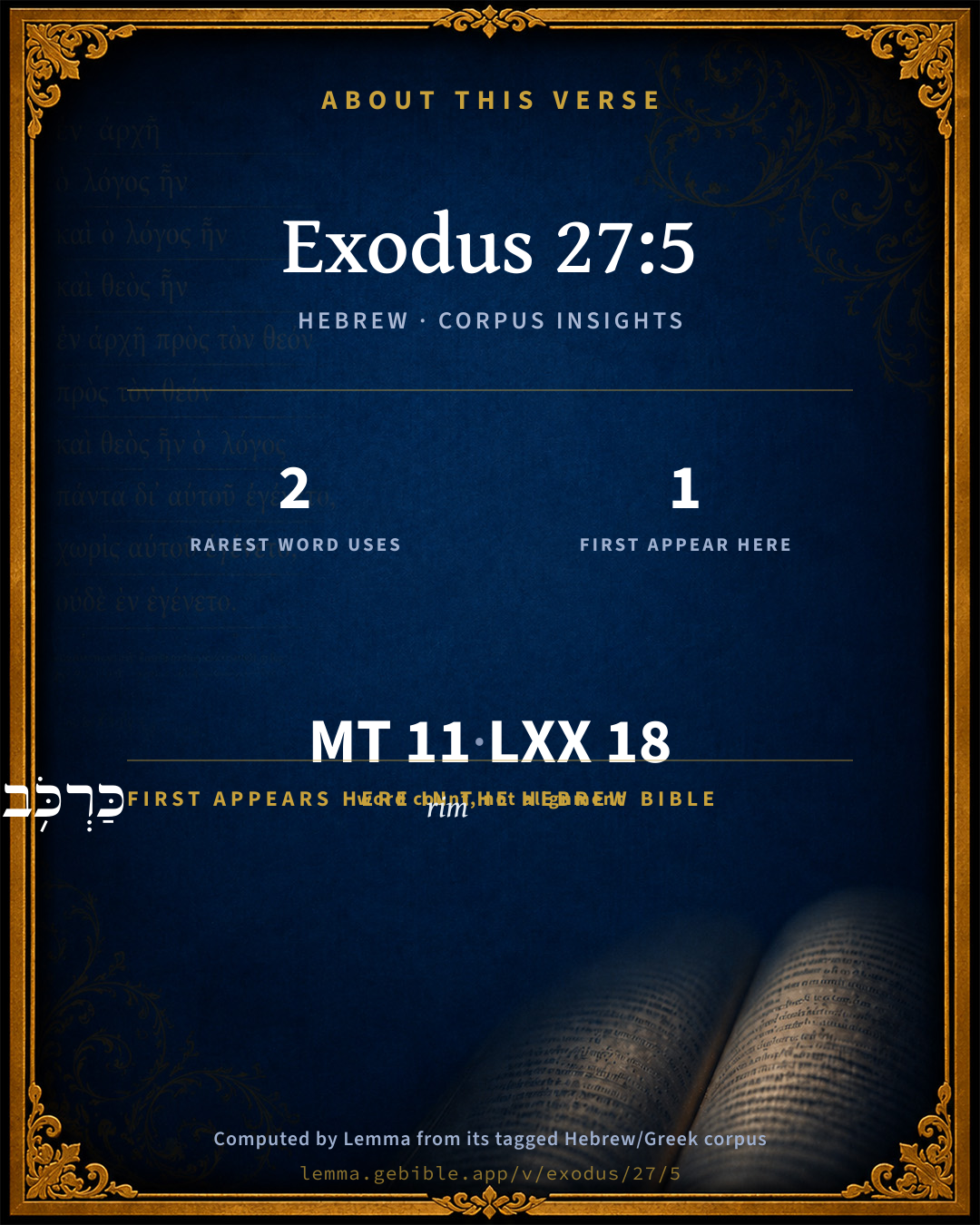
The rarest word here is כַּרְכֹּ֥ב rim H3749 — appearing just 2 times in the whole Hebrew Bible.

First appearance in Scripture

This word makes its first canonical appearance in the Hebrew Bible here:

  • כַּרְכֹּ֥ב rim H3749

Shared distinctive vocabulary

כַּרְכֹּ֥ב rim H3749 occurs in 2 verses of the Hebrew Bible. Also found in:

Grammatical profile

  • 2 verbs
  • 5 nouns
  • 2 prepositions
  • 1 adverb
  • 1 particle

Verb forms

  • וְנָתַתָּ֣ה Qal · Sequential Perfect
  • וְהָיְתָ֣ה Qal · Sequential Perfect

Repetition

A word recurs within this verse — often emphatic in Hebrew:

  • הַמִּזְבֵּ֖חַ altar H4196 ×2

Hebrew & Septuagint length

In English translation the verse runs 20 words from the Hebrew and 23 from the Septuagint (LXX English) — closely comparable.

A rough comparison of the two English renderings, which tokenize alike — not a word-level alignment.

Word counts can differ between the Hebrew and the Greek without any difference in meaning — e.g. the Hebrew direct-object marker אֵת has no separate Greek word, and Greek often adds the article ὁ.

In the original languages it is 11 Hebrew tokens and 18 Greek tokens — but the two are counted differently (Hebrew bundles its prefixes and suffixes into one token; the Greek is in lemma form), so that isn’t a like-for-like length.

Cross-references

1

Topical passages linked to Exodus 27:5 in the Treasury of Scripture Knowledge — connected by theme and wording, ordered by reader-vote popularity; previews shown in the World English Bible.

  • Exodus 38:4 He made for the altar a grating of a network of brass, under the ledge around it beneath, reaching halfway up.

Cross-references courtesy of OpenBible.info (CC BY 4.0).

Hebrew and Greek witnesses Masoretic Hebrew ↔ Greek Septuagint

The same verse in the two great witnesses to the Old Testament, shown verse-for-verse.

These are two independent witnesses, not word-aligned to each other, and the Septuagint is shown in lemma (dictionary) form.

Hebrew Exodus 27:5 Masoretic · Westminster Leningrad Codex

וְנָתַתָּ֣ה אֹתָ֗הּ תַּ֛חַת כַּרְכֹּ֥ב הַמִּזְבֵּ֖חַ מִלְּמָ֑טָּה וְהָיְתָ֣ה הָרֶ֔שֶׁת עַ֖ד חֲצִ֥י הַמִּזְבֵּֽחַ

You shall put it under the ledge around the altar beneath, that the net may reach halfway up the altar.

World English Bible · Public Domain

Greek LXX Exodus 27:5 Septuagint · lemma form

καί ὑποτίθημι αὐτός ὑπό ὁ ἐσχάρα ὁ θυσιαστήριον κάτωθεν εἰμί δέ ὁ ἐσχάρα ἕως ὁ ἥμισυς ὁ θυσιαστήριον

And you shall put them below under the grate of the altar, and the grate shall extend to the middle of the altar.

LXX2012 (modern English Septuagint) · Public Domain

On this verse, Haydock's Catholic Bible Commentary discusses the Septuagint’s reading. Read the note in Commentary ↓

Hebrew: Westminster Leningrad Codex (CC BY 4.0). Greek: Septuagint (public domain); English from LXX2012 (modern English Septuagint) (Public Domain). How the Septuagint differs from the Hebrew →

Targum (Aramaic paraphrase)

2

The Targum is the ancient Jewish Aramaic paraphrase of the Hebrew Scriptures — an interpretive translation, not the Hebrew text itself. Onkelos (literal) and Pseudo-Jonathan (expansive) render the Torah, and Jonathan the Prophets. Coverage is partial: where no permissively-licensed English translation exists for a verse, only the Aramaic is shown. This is verse-level text, not a word-by-word alignment to the Hebrew.

  1. Targum Onkelos Torah (Genesis–Deuteronomy)
    וְתִתֵּן יָתַהּ תְּחוֹת סוֹבָבֵי מַדְבְּחָא מִלְרָע וּתְהֵי מְצַדְתָּא עַד פַּלְגוּת מַדְבְּחָא:

    (no public-domain English translation for this verse)

    Targum Onkelos — Aramaic: “Onkelos Genesis” (public domain); “Onkelos Exodus” (public domain); “Onkelos Leviticus” (public domain); “Onkelos Numbers” (public domain); “Onkelos Deuteronomy” (public domain). English: “Sefaria Community Translation” (CC0 1.0 (public-domain dedication)); “J.W. Etheridge. The Targums of Onkelos and Jonathan Ben Uzziel on the Pentateuch. London: Longmans, Green, 1862” (public domain). Text via Sefaria.

  2. Targum Pseudo-Jonathan Torah (Genesis–Deuteronomy)
    וְתִיתֵּן יָתָהּ תְּחוֹת סוֹבְבֵי מַדְבְּחָא מִלְרַע וּתְהֵי מְצַרְתָּא עַד פַּלְגוּת מַדְבְּחָא וְאִין נָפִיל גּוֹמָא אוֹ גוּמְרָא דְאֵשָׁא מֵעִילַוֵי מַדְבְּחָא נָפִיל עִילַוֵי קַנְקַל וְלָא יִתְמְטֵי לְאַרְעָא וְנַסְבִין יָתֵיהּ כַהֲנַיָא מֵעִילַוֵי קַנְקַל וּמְהַדְרִין יָתֵיהּ עַל מַדְבְּחָא

    And thou shalt place it under the surroundings of the altar, beneath, that the network may be to the middle of the altar, that, if any fragment or fiery coal fall from the altar, it may fall upon the grate, and not touch the ground, and that the priests may take it from the grate, and replace it upon the altar.

    Targum Pseudo-Jonathan — Aramaic: “Targum Jonathan on Genesis” (public domain); “Targum Jonathan on Exodus” (public domain); “Targum Jonathan on Leviticus” (public domain); “Targum Jonathan on Numbers” (public domain); “Targum Jonathan on Deuteronomy” (public domain). English: “The Targum of Jonathan ben Uzziel, trans. J. W. Etheridge, London, 1862” (public domain). Text via Sefaria.

Commentary

Notes on Exodus 27:5 from classic Christian and Jewish commentators (each source and its license shown beneath its notes). The classic Christian expositions comment on the surrounding passage and are grouped to its opening verse, so a note may address several verses; the Jewish commentaries on the Tanakh (Rashi and others) are per-verse, so they appear only where the commentator wrote on this verse.

Lemma curates 59 commentaries, every one of them public domain or Creative Commons licensed, each selected and text-cleaned for this edition rather than reprinted as found. About our sources →

Tyndale Open Study Notes

Tyndale Open Resources

27:5 The altar was evidently a hollow square (27:1, 8), with the grating placed inside it to allow ashes to fall to the ground underneath.

Tyndale Open Study Notes — © Tyndale Open Resources, licensed CC BY-SA 4.0. Text via the HelloAO Bible API.

Jamieson, Fausset & Brown

Robert Jamieson, A. R. Fausset & David Brown

put it under the compass of the altar beneath--that is, the grating in which they were carried to a clean place (Lev 4:12).

Jamieson, Fausset & Brown — Commentary Critical and Explanatory on the Whole Bible (1871) — public domain (CC PDM 1.0). Text via the HelloAO Bible API.

Ellicott's Commentary for English Readers

(5) Under the compass of the altar beneath.—The position of the network depends upon this expression. Was “the compass of the altar” its circumference at the top, or was it a belt or step encircling the altar half-way up? The low height of the altar—four feet six inches—would seem to make a “step” unnecessary; but the altar may undoubtedly have been surrounded by a “belt” for ornament.

A Bible Commentary for English Readers, edited by Charles John Ellicott (1878–1897) — public domain. Text from a community e-Sword module.

The Cambridge Bible for Schools and Colleges

gen. ed. J. J. S. Perowne

5. the ledge] ‘the ledge’ (Exo_38:4†) which such an altar would naturally have for the priests to stand upon: cf. the frequent use of the phrases to go up to and to come down from an altar in connexion with sacrificing: Exo_20:26, Lev_9:22, 1Ki_12:33, 2Ki_16:12; 2Ki_23:9; Sir_50:11; Sir_50:20.

The Cambridge Bible for Schools and Colleges (gen. ed. J. J. S. Perowne; Cambridge University Press, 1878–1918) — public domain. Text from a community e-Sword module.

John Gill's Exposition

And thou shalt put it under the compass of the altar beneath,.... That is, the grate was to be put within the square compass of the altar, in the hollow part of it, for the wood and sacrifice to be laid upon it:

that the net may be even to the midst of the altar; and as the altar was three cubits high, this net or grate was let down by chains to its rings a cubit and a half, and being of such a depth was capable of containing a great deal.

John Gill's Exposition of the Whole Bible (1746–1763) — public domain (CC PDM 1.0). Text via the HelloAO Bible API.

Haydock's Catholic Bible Commentary

Midst. Hanging down half way. On this, the wood designed to consume the victim, was placed. The Septuagint and Vulgate refer which to the rings, and the present Hebrew refers to the grate, or net. But it seems to be inaccurate. The rings were fixed about the middle of the altar’s height, to the same holes, through which the bars intended for its removal were put. The altar stood upon feet, which took up half the height, and let in air below the grate, to fan the fire, and to prevent the brass from melting. All the altars described in the table of Isis, are of this nature. (Calmet) --- The Septuagint do not distinguish the grate from the hearth, or little altar, (arula) as they use the word hearth, escharaboth, (ver. 4. and 5,) and place it about the middle of the altar, or where the feet supported the box or frame of the altar, which was almost a yard high. The hearth may therefore denote the bottom of the frame, where the grate was suspended by four rings.

George Leo Haydock (1774–1849), Haydock's Catholic Family Bible and Commentary, 1859 edition — public domain. Excludes Psalms (Douay-Rheims chapter numbering differs from Protestant) and Deuterocanonical books (Catholic canon only).

Matthew Poole's English Annotations

Under the compass, i.e. within the square and hollow space of the altar.

That the net may be even to the midst of the altar, or, and the net shall be at (the Hebrew ad being here used for el, as Hos 14:2; Joe 2:12; Amo 4:6,8), the midst of the altar. And these words seem added to explain the word

beneath, to show that as it was not to be at the top, so neither at the bottom of the altar, but in the midst of it.

Matthew Poole's English Annotations on the Holy Bible (1683–1685) — public domain. Text from a community e-Sword/MySword module.

The Pulpit Commentary

Thou shalt put it under the compass. The "compass" (karkob) is spoken of as if it were something well-known; yet it had not been previously mentioned. Etymologically the word should mean "a cincture" or "band" round the altar; and thus far critics are generally agreed. But its position, size, and object, are greatly disputed. Some hold that it was a broad bench, or step, on which the officiating priests stood at the time of a sacrifice, and that its position was about the middle of the altar. Others think that it was a mere border round the top, from which the net-work depended, and that the object of both was to catch anything that might fall from the altar. Others again, while placing it mid-way in the altar, regard it as a mere ornament, only projecting slightly, and forming a sort of finish to the net-work. This, which is the view of Knobel, seems to be, on the whole, the most probable one. That the net may be even to the midst of the altar. If the" compass" was at the top, the net must have extended thence to the middle. If it was mid-way in the altar, the net must have covered the lower half. To us this latter seems the more probable view. But the point is uncertain.

The Pulpit Commentary (1880–1919), ed. H.D.M. Spence-Jones & Joseph S. Exell — public domain. Text from a community e-Sword module.

unfoldingWord translationNotes

Door43 World Missions Community

General Information:

Yahweh continues to tell Moses what the people need to do.

You must put the grate under the ledge of the altar

The grate was placed inside the altar. This can be stated clearly in the translation. AT: "You must put the grate under the rim of the altar, on the inside of the altar" (See: Assumed Knowledge and Implicit Information)

grate

This is a frame of crossed bars for holding wood when burning. See how you translated this in Exodus 27:4.

You must make poles for the altar

These poles were used for carrying the altar. This can be stated clearly in the translation. AT: "You must make poles for carrying the altar" (See: Assumed Knowledge and Implicit Information)

translationWords

altar

acacia

bronze

unfoldingWord translationNotes — © Distant Shores Media and the Door43 World Missions Community, licensed CC BY-SA 4.0. Source: git.door43.org/Door43/en_tn.

Rashi

Rabbi Shlomo Yitzchaki (Rashi)

כרכב המזבח THE COMPASS OF THE ALTAR — כרכב is a surround. Anything which encompasses an object all the way round is called כרכב, just as we read in the Talmudical section beginning with the words הכל שוחטין (Chullin 25a): The following come under the description of unfinished wooden vessels — all such as have still to be polished and to be rounded off (ולכרכב; i. e. making a rim by hollowing out the centre). This is similar to the practice of making rounded grooves in the boards that form the sides of chests and wooden chairs. For the altar too he made a hollowing round about — its width was a cubit — in its wall for ornamentation. It was made at the end of three cubits of its height (measuring from the top of the altar). This is according to the view of him who says (cf. v. 1): its (the altar's) height was twice its length. And if you ask how, then, can I explain the statement, “and the height thereof shall be three cubits” I reply, that this gives the measurement from the edge of the surround upwards. This surround served only as an ornamentation, but a surround for the priests to walk upon when officiating the copper altar had only on its top within its horns (running from one horn to the other). Thus we read in Treatise Zevachim 62a: What is the כרכב? The sunken space between one horn of the altar and the other, this being a cubit in width, and, from that space inward (towards the centre of the altar) a space of another cubit upon which the priests could walk right round the altar, thus making a surround two cubits in width. These two cubits were called כרכב. The criticism is there made to this definition: But is it not written, “[and thou shalt put it (the grate)] under the compass of the altar beneath” — which statement teaches us that the כרכב was on the side of the altar and not on its top since the covering formed by the grate was beneath it? Whereupon the Talmud replies (lit., the replier replies), that in fact there were two surrounds, one for ornamentation (that below) and another (on the top) for the priests that they should not slip off when walking round. The one on the side of the altar was intended for ornamentation, and beneath it they put the grate as a covering and its width reached to the middle of its (the altar’s) height, measuring this from the ground. It also served to mark the middle of its height separating the two halves of the altars side upon which were put respectively the sacrifical blood which had to be sprinkled above (on the upper part; this was the blood of a חטאת) and the blood which had to be sprinkled below (that of עולה,שלמים and אשם). Corresponding to this there was made for the altar in the “Eternal House” (the Temple at Jerusalem) a sign consisting of a red line (Zevachim 53a; Mishnah Middot 3:1). As to the ascent (כבש — the inclined plane) upon which they went up to the top of the altar, it is true that Scripture does not expressly mention it in this section but we have it already implied in the statement in the section beginning with the words מזבח אדמה תעשה לי (Exodus 20:21—23): “Thou shalt not go up by steps [unto my altar]” — i. e. thou shalt not make steps on its ascent, but thou shalt make an unbroken ascent, — this tells us that it had such an ascent. — So do we read in the Mechilta d'Rabbi Yishmael 20:23:1). — For the altar of earth there spoken of is identical with the altar of copper described here and it was called an altar of earth because they used to fill the hollow space within it (within its coppered walls) with earth at every place where they encamped in the wilderness. This ascent was on the south of the altar, its top standing away from the altar just a hair’s breadth (i. e. almost touching the altar). Its foot reached to the cubit adjacent to the hangings of the court on the south, (i. e. it was one cubit distant from those hangings of the enclosure). This latter statement is according to him who holds that its height (that of the altar) was ten cubits, whilst according to him who holds that the command, (v. 1) “and three cubits shall be the height thereof” is to be taken literally (cf. Rashi on v. 1) the length of the ascent was only ten cubits, for since the altar was lower the slope leading to its top could not be a very long one. So did I find in the Boraitha דמ"ט מדות (cf. Yalkut Shimoni on Torah 419). And as regards this statement that it stood away from the top of the altar just a hair’s breadth, in Treatise Zevachim 62b they (the Rabbis) derived it from a Biblical text.

Rashi on the Tanakh — English translations: “The Judaica Press complete Tanach with Rashi, translated by A. J. Rosenberg” (CC BY 4.0); “Pentateuch with Rashi's commentary by M. Rosenbaum and A.M. Silbermann, 1929-1934” (public domain); “The Metsudah Tanach series, Lakewood, N.J” (CC BY 4.0); and “The Book of Joshua, Metsudah Publications, 1997” (CC BY 4.0). Text via Sefaria.

Lesson kit

Teaching starters — assembled from the data on this page, not authored interpretation. Every prompt links to the verse data it draws on. Edit before teaching.

Exodus, in the Pentateuch, opens this verse with 11 words (10 distinct Hebrew lemmas). Its most distinctive word is karkôb (“rim”). A historical commentator’s framing appears above. Read the whole chapter for the surrounding context.

Discussion questions

  1. What does “rim” (karkôb) contribute to the verse as a whole?
  2. The word “rim” first appears here in Scripture. What is being introduced at this debut?
  3. Exodus 38:4 shares the word «rim» with this verse. How do the two illuminate each other?
  4. “altar” occurs 2× in this one verse. What is the effect of the repetition?
  5. These translations render this verse differently; the difference is in the English rendering, not the original. What questions does that raise?
  6. The verb «וְנָתַתָּ֣ה» is Qal Sequential Perfect. How does its form color the action?
  7. Reading how Tyndale Open Study Notes and Jamieson, Fausset & Brown read this verse, where do the two commentators agree and where do they part?

Things to notice

Reading settings

Reading text

Shown beneath each verse's original-language words.

Old Testament
Old Testament edition

Read the OT as the Masoretic Hebrew (MT) or the Greek Septuagint (LXX).

English shown for the Greek Septuagint (in the Hebrew ↔ Greek comparison).

Comparing translations? Open the Compare panel on any verse page to stack up to four side by side.