
Genesis 28:4

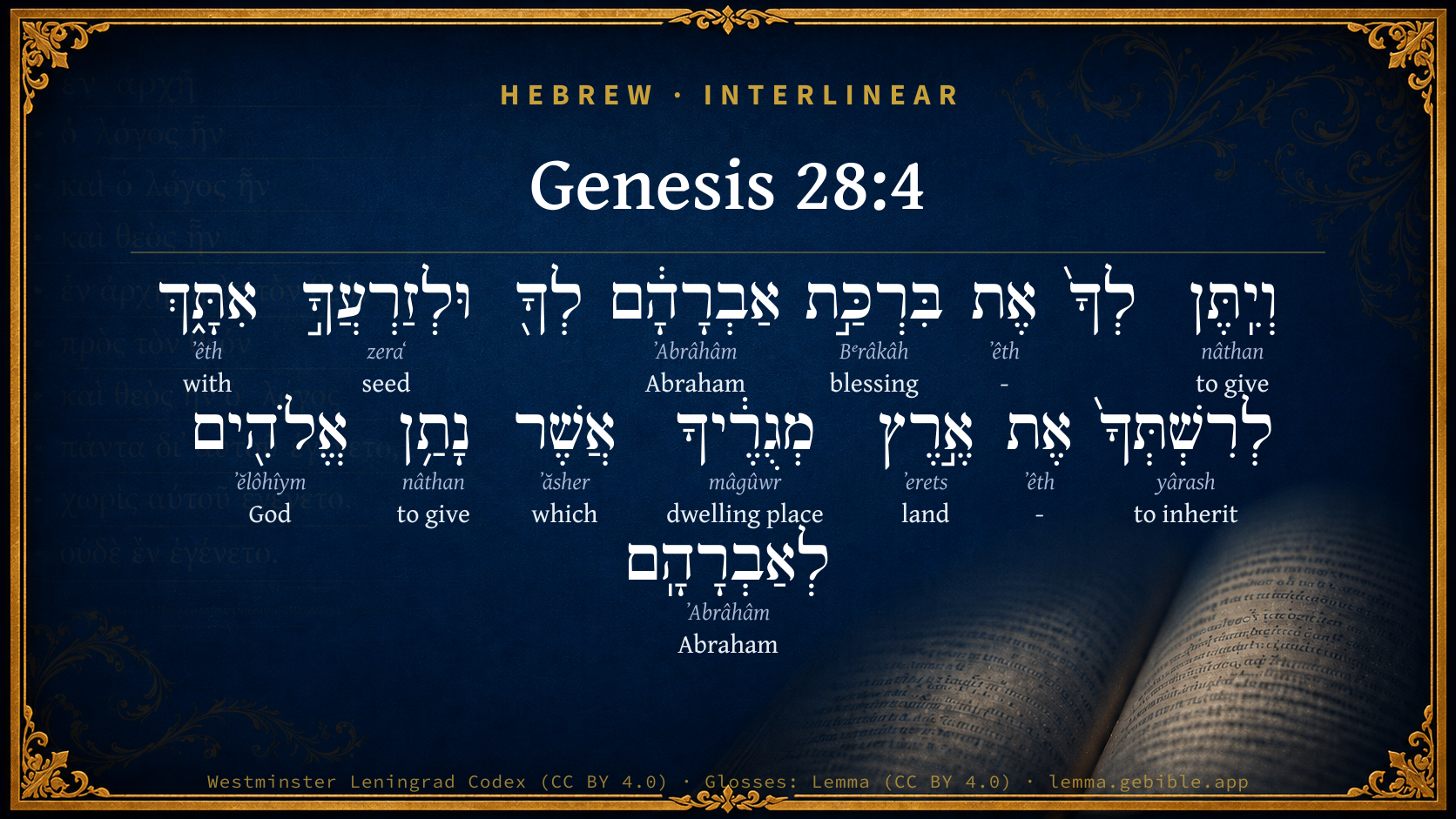
Hebrew (Westminster Leningrad Codex) Genesis 28:4 appears in the Hebrew Old Testament. The text above is from the Westminster Leningrad Codex. Each word links to its Strong’s number, a concise gloss, and parsing drawn from the Open Scriptures Hebrew Bible morphology. Click any word for its full Brown-Driver-Briggs (BDB) entry.
Download image
Cite this verse

Genesis 28:4 (World English Bible). Public Domain. Lemma interlinear Bible study tool, https://lemma.gebible.app/v/genesis/28/4.

Show BibTeX & RIS
BibTeX
RIS
English Translation
and give you the blessing of Abraham, to you, and to your seed with you, that you may inherit the land where you travel, which God gave to Abraham."
World English Bible · Public Domain
Download a study sheet

One document with this verse’s original text, its word-by-word gloss line, the meaning frame, cross-references with their text, attributed commentary, and full source and license credits — printable, and it pastes into notes with its structure intact.

This verse Autodidact and up

Study sheet (.html) Plain text (.txt)

A passage Seminary Student

Up to 50 verses in one chapter. A passage sheet keeps up to 6 commentary sources and 12 cross-references per verse, in the order this page ranks them, and says so on the sheet whenever that leaves anything out. Ask for a single verse and you get the Autodidact verse sheet above.

Everything on this page stays free to read, with no account — the sheet is a download of what is already on screen, not access to it.

Want to remove ads? Support Godless Engineer
Compare translations 3

The same verse in 3 English versions, stacked beneath the original-language interlinear above. Click any original word for its lexicon entry.

Each is an independent rendering of the whole verse — the interlinear is not word-aligned to these translations.

Highlighted words mark where these versions differ — a whole-verse word diff, not a word-by-word alignment.

  • World English Bible Public Domain
    and give you the blessing of Abraham, to you, and to your seed with you, that you may inherit the land where you travel, which God gave to Abraham."
  • King James Version Public Domain
    And give thee the blessing of Abraham, to thee, and to thy seed with thee; that thou mayest inherit the land wherein thou art a stranger, which God gave unto Abraham.
  • unfoldingWord Literal Text CC BY-SA 4.0
    And may he give the blessing of Abraham to you, to you and to your offspring with you, so that you possess the land of your sojournings, which God gave to Abraham.”

unfoldingWord Literal Text — © unfoldingWord, licensed CC BY-SA 4.0. Word-aligned USFM3 via Door43 (git.door43.org/unfoldingWord/en_ult).

Versions to compare (up to 4)

3 of 4 selected

Show all 18 translations

Every available English version of this verse, each an independent rendering of the whole verse.

  • World English Bible Public Domain
    and give you the blessing of Abraham, to you, and to your seed with you, that you may inherit the land where you travel, which God gave to Abraham."
  • Berean Standard Bible Public Domain
    And may He give the blessing of Abraham to you and your descendants, so that you may possess the land where you dwell as a foreigner, the land God gave to Abraham.”
  • Majority Standard Bible Public Domain
    And may He give the blessing of Abraham to you and your descendants, so that you may possess the land where you dwell as a foreigner, the land God gave to Abraham.”
  • King James Version Public Domain
    And give thee the blessing of Abraham, to thee, and to thy seed with thee; that thou mayest inherit the land wherein thou art a stranger, which God gave unto Abraham.
  • American Standard Version (1901) Public Domain
    And give thee the blessing of Abraham, to thee, and to thy seed with thee. That thou mayest inherit the land of thy sojournings, which God gave unto Abraham.
  • Revised Version (1885) Public Domain
    and give thee the blessing of Abraham, to thee, and to thy seed with thee; that thou mayest inherit the land of thy sojournings, which God gave unto Abraham.
  • Geneva Bible (1599) Public Domain
    And giue thee the blessing of Abraham, euen to thee and to thy seede with thee, that thou mayest inherite the lande (wherein thou art a stranger,) which God gaue vnto Abraham.
  • Douay-Rheims (1899) Public Domain
    And give the blessings of Abrabam to thee, and to thy seed after thee: that thou mayst possess the land of thy sojournment, which he promised to thy grandfather.
  • Young's Literal Translation Public Domain
    and He doth give to thee the blessing of Abraham, to thee and to thy seed with thee, to cause thee to possess the land of thy sojournings, which God gave to Abraham.'
  • Literal Standard Version CC BY-SA 4.0
    and He gives to you the blessing of Abraham, to you and to your seed with you, to cause you to possess the land of your sojournings, which God gave to Abraham.”
  • Unlocked Literal Bible CC BY-SA 4.0
    May he give you the blessing of Abraham, to you, and to your descendants after you, that you may inherit the land where you have been living, which God gave to Abraham.”
  • unfoldingWord Literal Text CC BY-SA 4.0
    And may he give the blessing of Abraham to you, to you and to your offspring with you, so that you possess the land of your sojournings, which God gave to Abraham.”
  • Darby Bible Public Domain
    And may he give thee the blessing of Abraham, to thee and to thy seed with thee, in order that thou mayest possess the land of thy sojourning, which God gave to Abraham!
  • World Messianic Bible Public Domain
    and give you the blessing of Abraham, to you and to your offspring with you, that you may inherit the land where you travel, which God gave to Abraham.”
  • Webster's Bible Public Domain
    And give thee the blessing of Abraham, to thee, and to thy seed with thee; that thou mayest inherit the land in which thou art a stranger, which God gave to Abraham.
  • Free Bible Version CC BY-SA 4.0
    May he grant you and your descendants the same blessing he gave to Abraham, so that you may take over the land where you now live as a foreigner, the land God gave to Abraham.”
  • Bible in Basic English Public Domain
    And may God give you the blessing of Abraham, to you and to your seed, so that the land of your wanderings, which God gave to Abraham, may be your heritage.
  • JPS Tanakh (1917) Public Domain
    and give thee the blessing of Abraham, to thee, and to thy seed with thee; that thou mayest inherit the land of thy sojournings, which God gave unto Abraham.'

Literal Standard Version (2020), Covenant Press — licensed CC BY-SA 4.0. Text via the HelloAO Bible API (eBible.org). Unlocked Literal Bible (unfoldingWord) — licensed CC BY-SA 4.0. Text via the HelloAO Bible API (eBible.org). unfoldingWord Literal Text — © unfoldingWord, licensed CC BY-SA 4.0. Word-aligned USFM3 via Door43 (git.door43.org/unfoldingWord/en_ult). Free Bible Version, Dr. Jonathan Gallagher — licensed CC BY-SA 4.0. Text via the HelloAO Bible API (eBible.org).

Word by word

More ways to search: Search by grammar → Find every occurrence → Compare this word →

Practice this passage: Drill this verse → Learn its vocabulary →

מְגֻרֶ֔יךָ
mâgûwr
H4033
“dwelling places · your”
Noun, Common, Masculine, Plural, Construct + Suffix, Personal, 2nd Person, Masculine, Singular
Part of Speech
Noun
Type
Common
Gender
Masculine
Number
Plural
State
Construct
Full BDB Definition

Origin: from H1481 in the sense lodging

TWOT: 330c

sojourning place, dwelling-place, sojourning - dwelling-place - sojourning, lifetime
  1. וְיִֽתֶּן nâthan H5414 “and · to give” Conjunction + Verb, Qal, Jussive, 3rd Person, Masculine, Singular
  2. אֶת ʼêth H853 “-” Particle, Direct Object
  3. בִּרְכַּ֣ת Bᵉrâkâh H1293 “blessing of” Noun, Common, Feminine, Singular, Construct
  4. אַבְרָהָ֔ם ʼAbrâhâm H85 “Abraham” Noun, Proper
  5. וּלְזַרְעֲךָ֣ zeraʻ H2233 “and · to/for · seed · your” Conjunction + Preposition + Noun, Common, Masculine, Singular, Construct + Suffix, Personal, 2nd Person, Masculine, Singular
  6. אִתָּ֑ךְ ʼêth H854 “with · you” Preposition + Suffix, Personal, 2nd Person, Feminine, Singular
  7. לְרִשְׁתְּךָ֙ yârash H3423 “to inherit · you” Preposition + Verb, Qal, Infinitive Construct + Suffix, Personal, 2nd Person, Masculine, Singular
  8. אֶת ʼêth H853 “-” Particle, Direct Object
  9. אֶ֣רֶץ ʼerets H776 “land of” Noun, Common, Both, Singular, Construct
  10. אֲשֶׁר ʼăsher H834 “which” Particle, Relative
  11. נָתַ֥ן nâthan H5414 “to give” Verb, Qal, Perfect, 3rd Person, Masculine, Singular
  12. אֱלֹהִ֖ים ʼĕlôhîym H430 “God(s)” Noun, Common, Masculine, Plural, Absolute
  13. לְאַבְרָהָֽם ʼAbrâhâm H85 “to/for · Abraham” Preposition + Noun, Proper

About this verse

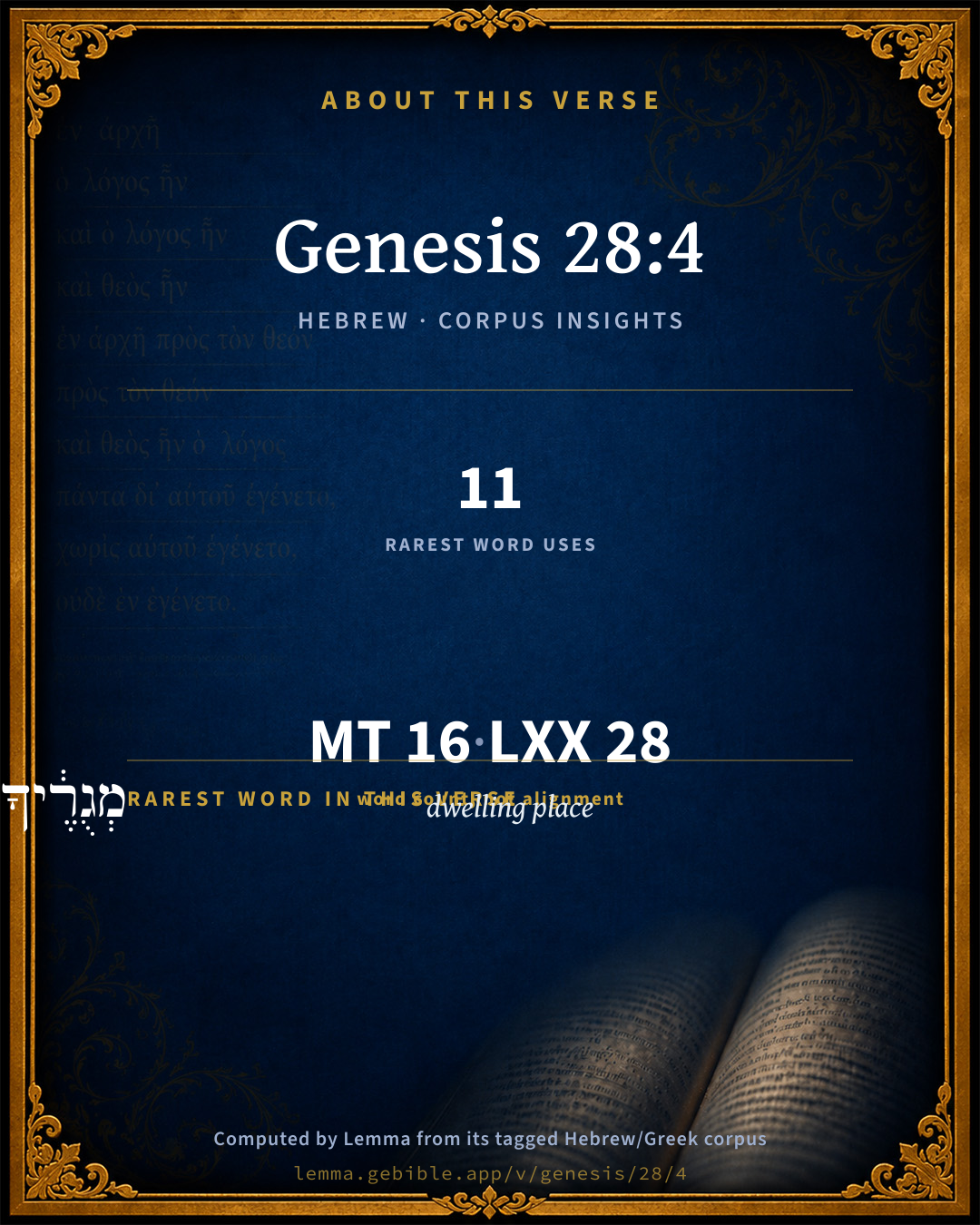
These counts appear in no published source. They are computed here, from the morphology-tagged text and Lemma’s own curated glosses. What Lemma adds →

16
words
11
distinct lemmas
Pentateuch
section

Notable vocabulary

The rarest word here is מְגֻרֶ֔יךָ dwelling place H4033 — appearing just 11 times in the whole Hebrew Bible.

Shared distinctive vocabulary

מְגֻרֶ֔יךָ dwelling place H4033 occurs in 10 verses of the Hebrew Bible. Also found in:

Grammatical profile

  • 3 verbs
  • 7 nouns
  • 3 prepositions
  • 3 particles

Verb forms

  • וְיִֽתֶּן Qal · Jussive
  • לְרִשְׁתְּךָ֙ Qal · Infinitive Construct
  • נָתַ֥ן Qal · Perfect

Repetition

Words recur within this verse — often emphatic in Hebrew:

  • וְיִֽתֶּן to give H5414 ×2
  • אַבְרָהָ֔ם Abraham H85 ×2

Hebrew & Septuagint length

In English translation the verse runs 29 words from the Hebrew and 32 from the Septuagint (LXX English) — closely comparable.

A rough comparison of the two English renderings, which tokenize alike — not a word-level alignment.

Word counts can differ between the Hebrew and the Greek without any difference in meaning — e.g. the Hebrew direct-object marker אֵת has no separate Greek word, and Greek often adds the article ὁ.

In the original languages it is 16 Hebrew tokens and 28 Greek tokens — but the two are counted differently (Hebrew bundles its prefixes and suffixes into one token; the Greek is in lemma form), so that isn’t a like-for-like length.

Cross-references

15

Topical passages linked to Genesis 28:4 in the Treasury of Scripture Knowledge — connected by theme and wording, ordered by reader-vote popularity; previews shown in the World English Bible.

  • Galatians 3:14 that the blessing of Abraham might come on the Gentiles through Christ Jesus; that we might receive the promise of the Spirit through faith.
  • Genesis 12:7 Yahweh appeared to Abram, and said, "I will give this land to your seed." He built an altar there to Yahweh, who appeared to him.
  • Genesis 17:6–8 I will make you exceeding fruitful, and I will make nations of you. Kings will come out of you.
  • Ephesians 1:3 Blessed be the God and Father of our Lord Jesus Christ, who has blessed us with every spiritual blessing in the heavenly places in Christ;
  • Genesis 12:1–3 Now Yahweh said to Abram, "Get out of your country, and from your relatives, and from your father's house, to the land that I will show you.
  • Genesis 13:14–17 Yahweh said to Abram, after Lot was separated from him, "Now, lift up your eyes, and look from the place where you are, northward and southward and eastward and westward,
  • Genesis 15:5–7 Yahweh brought him outside, and said, "Look now toward the sky, and count the stars, if you are able to count them." He said to Abram, "So shall your seed be."
  • Genesis 15:18–21 In that day Yahweh made a covenant with Abram, saying, "To your seed have I given this land, from the river of Egypt to the great river, the river Euphrates:
  • Genesis 22:17–18 that in blessing I will bless you, and in multiplying I will multiply your seed as the stars of the heavens, and as the sand which is on the seashore. Your seed will possess the gate of his enemies.
  • Psalms 72:17 His name endures forever. His name continues as long as the sun. Men shall be blessed by him. All nations will call him blessed.
  • Galatians 3:8 The Scripture, foreseeing that God would justify the Gentiles by faith, preached the Gospel beforehand to Abraham, saying, "In you all the nations will be blessed."
  • Psalms 39:12 "Hear my prayer, Yahweh, and give ear to my cry. Don't be silent at my tears. For I am a stranger with you, A foreigner, as all my fathers were.
  • Psalms 105:6–12 You seed of Abraham, his servant, You children of Jacob, his chosen ones.
  • Romans 4:7–8 "Blessed are they whose iniquities are forgiven, Whose sins are covered.
  • Hebrews 11:9–13 By faith, he lived as an alien in the land of promise, as in a land not his own, dwelling in tents, with Isaac and Jacob, the heirs with him of the same promise.

Cross-references courtesy of OpenBible.info (CC BY 4.0).

Hebrew and Greek witnesses Masoretic Hebrew ↔ Greek Septuagint

The same verse in the two great witnesses to the Old Testament, shown verse-for-verse.

These are two independent witnesses, not word-aligned to each other, and the Septuagint is shown in lemma (dictionary) form.

Hebrew Genesis 28:4 Masoretic · Westminster Leningrad Codex

וְיִֽתֶּן לְךָ֙ אֶת בִּרְכַּ֣ת אַבְרָהָ֔ם לְךָ֖ וּלְזַרְעֲךָ֣ אִתָּ֑ךְ לְרִשְׁתְּךָ֙ אֶת אֶ֣רֶץ מְגֻרֶ֔יךָ אֲשֶׁר נָתַ֥ן אֱלֹהִ֖ים לְאַבְרָהָֽם

and give you the blessing of Abraham, to you, and to your seed with you, that you may inherit the land where you travel, which God gave to Abraham."

World English Bible · Public Domain

Greek LXX Genesis 28:4 Septuagint · lemma form

καί δίδωμι σύ ὁ εὐλογία αβρααμ ὁ πατήρ ἐγώ σύ καί ὁ σπέρμα σύ μετά σύ κληρονομέω ὁ γῆ ὁ παροίκησις σύ ὅς δίδωμι ὁ θεός ὁ αβρααμ

And may he give you the blessing of my father Abraam, even to you and to your seed after you, to inherit the land of your sojourning, which God gave to Abraam.

LXX2012 (modern English Septuagint) · Public Domain

On this verse, The Pulpit Commentary discusses the Septuagint’s reading. Read the note in Commentary ↓

Hebrew: Westminster Leningrad Codex (CC BY 4.0). Greek: Septuagint (public domain); English from LXX2012 (modern English Septuagint) (Public Domain). How the Septuagint differs from the Hebrew →

Targum (Aramaic paraphrase)

2

The Targum is the ancient Jewish Aramaic paraphrase of the Hebrew Scriptures — an interpretive translation, not the Hebrew text itself. Onkelos (literal) and Pseudo-Jonathan (expansive) render the Torah, and Jonathan the Prophets. Coverage is partial: where no permissively-licensed English translation exists for a verse, only the Aramaic is shown. This is verse-level text, not a word-by-word alignment to the Hebrew.

  1. Targum Onkelos Torah (Genesis–Deuteronomy)
    וְיִתֶּן לָךְ יָת בִּרְכְּתָא דְאַבְרָהָם לָךְ וְלִבְנָיךְ עִמָּךְ לְמֵירְתָךְ יָת אֲרַע תּוֹתָבוּתָךְ דִּי יְהַב יְיָ לְאַבְרָהָם

    (no public-domain English translation for this verse)

    Targum Onkelos — Aramaic: “Onkelos Genesis” (public domain); “Onkelos Exodus” (public domain); “Onkelos Leviticus” (public domain); “Onkelos Numbers” (public domain); “Onkelos Deuteronomy” (public domain). English: “Sefaria Community Translation” (CC0 1.0 (public-domain dedication)); “J.W. Etheridge. The Targums of Onkelos and Jonathan Ben Uzziel on the Pentateuch. London: Longmans, Green, 1862” (public domain). Text via Sefaria.

  2. Targum Pseudo-Jonathan Torah (Genesis–Deuteronomy)
    וְיִתֶּן לָךְ יַת בִּרְכָתָא דְאַבְרָהָם לָךְ וְלִבְנָךְ עִמָךְ וְתַיְיבִינָךְ לְמֵירְתָךְ יַת אֲרַע תּוֹתָבוּתָךְ דִי יְהַב יְיָ לְאַבְרָהָם

    And He will give the blessing of Abraham to thee, and to thy sons with thee, and cause thee to inherit the land of thy sojourning, which he gave unto Abraham.

    Targum Pseudo-Jonathan — Aramaic: “Targum Jonathan on Genesis” (public domain); “Targum Jonathan on Exodus” (public domain); “Targum Jonathan on Leviticus” (public domain); “Targum Jonathan on Numbers” (public domain); “Targum Jonathan on Deuteronomy” (public domain). English: “The Targum of Jonathan ben Uzziel, trans. J. W. Etheridge, London, 1862” (public domain). Text via Sefaria.

Commentary

Notes on Genesis 28:4 from classic Christian and Jewish commentators (each source and its license shown beneath its notes). The classic Christian expositions comment on the surrounding passage and are grouped to its opening verse, so a note may address several verses; the Jewish commentaries on the Tanakh (Rashi and others) are per-verse, so they appear only where the commentator wrote on this verse.

Lemma curates 59 commentaries, every one of them public domain or Creative Commons licensed, each selected and text-cleaned for this edition rather than reprinted as found. About our sources →

Trapp's Complete Commentary

John Trapp

Gen 28:4 And give thee the blessing of Abraham, to thee, and to thy seed with thee; that thou mayest inherit the land wherein thou art a stranger, which God gave unto Abraham.

Ver. 4. And give thee the blessing of Abraham.] Here he is made "heir of the blessing," as are also all true Christians. {1Pe 3:9} Caesar, when he was sad, said to himself, Cogita te esse Caesarem :so, think thou art an heir of heaven, and be sad if thou canst.

John Trapp, A Commentary or Exposition upon All the Books of the Old and New Testament (1647–1656) — public domain. Text from a community e-Sword module.

Geneva Bible (1599)

Geneva Bible translators

The godly fathers were put in mind continually, that they were but strangers in this world: to the intent they should lift up their eyes to the heavens where they should have a sure dwelling.

Geneva Bible (1599) marginal notes — public domain. Text via Bolls.life.

Adam Clarke's Commentary

Verse 4. Give thee the blessing of Abraham] May he confirm the inheritance with all its attendant blessings to thee, to the exclusion of Esau; as he did to me, to the exclusion of Ishmael. But, according to St. Paul, much more than this is certainly intended here, for it appears, from Ga 3:6-14, that the blessing of Abraham, which is to come upon the Gentiles through Jesus Christ, comprises the whole doctrine of justification by faith, and its attendant privileges, viz., redemption from the curse of the law, remission of sins, and the promise of the Holy Spirit, including the constitution and establishment of the Christian Church.

Adam Clarke's Commentary on the Bible (1810–1826) — public domain. Text from a community e-Sword/MySword module.

The Cambridge Bible for Schools and Colleges

gen. ed. J. J. S. Perowne

4. the blessing of Abraham] Probably a reference to Gen_17:8. The same blessing as Abraham received is now pronounced by Isaac upon Jacob, recognizing him as the religious representative of the family, and ignoring Esau. This verse would be almost unintelligible, if we were not on literary grounds sure that this section is from the P tradition, and is independent of the J narrative (chap. 27), which describes Isaac’s age and Jacob’s deceit towards his father in obtaining the blessing of the firstborn. This is not the blessing of a dying man, but of a father parting with a son. It repeats, in a summary form, the national aspect of Abraham’s blessing. It lacks the poetical vigour and spiritual interest of the blessing in J (Gen_27:27-29).

the land of thy sojournings] A P phrase: see note on Gen_17:8, and cf. Gen_36:7, Gen_37:1. It is here applied by Isaac to Jacob’s residence in Canaan after his return from Paddan-aram.

The Cambridge Bible for Schools and Colleges (gen. ed. J. J. S. Perowne; Cambridge University Press, 1878–1918) — public domain. Text from a community e-Sword module.

John Gill's Exposition

And give thee the blessing of Abraham, to thee, and to thy seed with thee,.... Which was promised to Abraham, and was entailed upon Isaac and his seed, and now upon Jacob and his seed, which follows:

that thou mayest inherit the land wherein thou art a stranger, which God gave to Abraham; the land of Canaan, which was given to Abraham by promise, but not in possession; he was a sojourner and stranger in it, and so Isaac had been all his days, and now Jacob, who through the blessing was become heir of it; but as yet neither he nor his posterity must enjoy it, but be strangers and sojourners in it, for the exercise of faith, and for the leading of their minds off of all earthly enjoyments, to the better and heavenly country God has provided for his people; see Heb 11:9.

John Gill's Exposition of the Whole Bible (1746–1763) — public domain (CC PDM 1.0). Text via the HelloAO Bible API.

Haydock's Catholic Bible Commentary

Grandfather. Isaac, out of modesty, does not mention that the same promises had been made to himself. He determines the right over Chanaan to belong solely to Jacob, and to his posterity. (Haydock)

George Leo Haydock (1774–1849), Haydock's Catholic Family Bible and Commentary, 1859 edition — public domain. Excludes Psalms (Douay-Rheims chapter numbering differs from Protestant) and Deuterocanonical books (Catholic canon only).

The Pulpit Commentary

And give thee the Blessing of Abraham, i.e. promised to Abraham. (vide Gen_12:2 Gen_22:17, Gen_22:18) The additions of tou parov mou (LXX), = tou patrov sou (Samaritan), are unwarranted to thee, and to thy seed with thee; that thou mayest inherit the land wherein thou art a stranger, literally, the land of thy sojournings (Gen_17:8) which God gave unto Abraham by promise (cf. Gen_12:7 Gen_13:15 Gen_15:7, 18 17:8)

The Pulpit Commentary (1880–1919), ed. H.D.M. Spence-Jones & Joseph S. Exell — public domain. Text from a community e-Sword module.

Rashi

Rabbi Shlomo Yitzchaki (Rashi)

את ברכת אברהם THE BLESSING OF ABRAHAM, (i. e. the blessing which He gave to (Abraham) to whom He promised, (12:2) “and I will make of thee a great nation”, and (26:4) “and all the nations shall bless themselves by thy seed”: may these blessings have been said regarding you — may that great nation and that blessed seed issue from you.

Rashi on the Tanakh — English translations: “The Judaica Press complete Tanach with Rashi, translated by A. J. Rosenberg” (CC BY 4.0); “Pentateuch with Rashi's commentary by M. Rosenbaum and A.M. Silbermann, 1929-1934” (public domain); “The Metsudah Tanach series, Lakewood, N.J” (CC BY 4.0); and “The Book of Joshua, Metsudah Publications, 1997” (CC BY 4.0). Text via Sefaria.

Radak

Rabbi David Kimhi (Radak)

וא-ל שדי...ויתן לך את ברכת אברהם, which G’d pronounced concerning you and your descendants, for just as I was a special seed to my father, though he had other children beside me, you are my special seed and will be the bearer of this promise/prophecy.

Radak on the Tanakh — English translations: “Sefaria Community Translation” (CC0 1.0 (public-domain dedication)); “Eliyahu Munk, HaChut Hameshulash” (CC BY 4.0); “Rabbi Mike Feuer, Jerusalem Anthology” (CC BY 4.0); and “R. David Kimhi on the first book of Psalms, Translated by R.G. Finch, London, 1919” (public domain). Text via Sefaria.

Lesson kit

Teaching starters — assembled from the data on this page, not authored interpretation. Every prompt links to the verse data it draws on. Edit before teaching.

Genesis, in the Pentateuch, opens this verse with 16 words (11 distinct Hebrew lemmas). Its most distinctive word is mâgûwr (“dwelling place”). A historical commentator’s framing appears above. Read the whole chapter for the surrounding context.

Discussion questions

  1. What does “dwelling place” (mâgûwr) contribute to the verse as a whole?
  2. Genesis 17:8 shares the word «dwelling place» with this verse. How do the two illuminate each other?
  3. “to give” occurs 2× in this one verse. What is the effect of the repetition?
  4. These translations render this verse differently; the difference is in the English rendering, not the original. What questions does that raise?
  5. The verb «וְיִֽתֶּן» is Qal Jussive. How does its form color the action?
  6. Reading how Trapp's Complete Commentary and Geneva Bible (1599) read this verse, where do the two commentators agree and where do they part?

Things to notice

Reading settings

Reading text

Shown beneath each verse's original-language words.

Old Testament
Old Testament edition

Read the OT as the Masoretic Hebrew (MT) or the Greek Septuagint (LXX).

English shown for the Greek Septuagint (in the Hebrew ↔ Greek comparison).

Comparing translations? Open the Compare panel on any verse page to stack up to four side by side.