Exodus 12:36

Hebrew (Westminster Leningrad Codex) Exodus 12:36 appears in the Hebrew Old Testament. The text above is from the Westminster Leningrad Codex. Each word links to its Strong’s number, a concise gloss, and parsing drawn from the Open Scriptures Hebrew Bible morphology. Click any word for its full Brown-Driver-Briggs (BDB) entry.
Download image
Cite this verse

Exodus 12:36 (World English Bible). Public Domain. Lemma interlinear Bible study tool, https://lemma.gebible.app/v/exodus/12/36.

Show BibTeX & RIS
BibTeX
RIS
English Translation
Yahweh gave the people favor in the sight of the Egyptians, so that they let them have what they asked. They despoiled the Egyptians.
World English Bible · Public Domain
Download a study sheet

One document with this verse’s original text, its word-by-word gloss line, the meaning frame, cross-references with their text, attributed commentary, and full source and license credits — printable, and it pastes into notes with its structure intact.

This verse Autodidact and up

Study sheet (.html) Plain text (.txt)

A passage Seminary Student

Up to 50 verses in one chapter. A passage sheet keeps up to 6 commentary sources and 12 cross-references per verse, in the order this page ranks them, and says so on the sheet whenever that leaves anything out. Ask for a single verse and you get the Autodidact verse sheet above.

Everything on this page stays free to read, with no account — the sheet is a download of what is already on screen, not access to it.

Want to remove ads? Support Godless Engineer
Compare translations 3

The same verse in 3 English versions, stacked beneath the original-language interlinear above. Click any original word for its lexicon entry.

Each is an independent rendering of the whole verse — the interlinear is not word-aligned to these translations.

Highlighted words mark where these versions differ — a whole-verse word diff, not a word-by-word alignment.

  • World English Bible Public Domain
    Yahweh gave the people favor in the sight of the Egyptians, so that they let them have what they asked. They despoiled the Egyptians.
  • King James Version Public Domain
    And the LORD gave the people favor in the sight of the Egyptians, so that they lent unto them such things as they required. And they spoiled the Egyptians.
  • unfoldingWord Literal Text CC BY-SA 4.0
    And Yahweh gave the people favor in the eyes of the Egyptians. And they made the request, and they plundered the Egyptians.

unfoldingWord Literal Text — © unfoldingWord, licensed CC BY-SA 4.0. Word-aligned USFM3 via Door43 (git.door43.org/unfoldingWord/en_ult).

Versions to compare (up to 4)

3 of 4 selected

Show all 18 translations

Every available English version of this verse, each an independent rendering of the whole verse.

  • World English Bible Public Domain
    Yahweh gave the people favor in the sight of the Egyptians, so that they let them have what they asked. They despoiled the Egyptians.
  • Berean Standard Bible Public Domain
    And the LORD gave the people such favor in the sight of the Egyptians that they granted their request. In this way they plundered the Egyptians.
  • Majority Standard Bible Public Domain
    And the LORD gave the people such favor in the sight of the Egyptians that they granted their request. In this way they plundered the Egyptians.
  • King James Version Public Domain
    And the LORD gave the people favor in the sight of the Egyptians, so that they lent unto them such things as they required. And they spoiled the Egyptians.
  • American Standard Version (1901) Public Domain
    And Jehovah gave the people favor in the sight of the Egyptians, so that they let them have what they asked. And they despoiled the Egyptians.
  • Revised Version (1885) Public Domain
    and the LORD gave the people favour in the sight of the Egyptians, so that they let them have what they asked. And they spoiled the Egyptians.
  • Geneva Bible (1599) Public Domain
    And the Lord gaue the people fauour in the sight of the Egyptians: and they graunted their request: so they spoyled the Egyptians.
  • Douay-Rheims (1899) Public Domain
    And the Lord gave favour to the people in the sight of the Egyptians, so that they lent unto them: and they stripped the Egyptians.
  • Young's Literal Translation Public Domain
    and Jehovah hath given the grace of the people in the eyes of the Egyptians, and they cause them to ask, and they spoil the Egyptians.
  • Literal Standard Version CC BY-SA 4.0
    and YHWH has given the grace of the people in the eyes of the Egyptians, and they cause them to ask, and they spoil the Egyptians.
  • Unlocked Literal Bible CC BY-SA 4.0
    Yahweh made the Egyptians eager to please the Israelites. So the Egyptians gave them whatever they asked for. In this way, the Israelites plundered the Egyptians.
  • unfoldingWord Literal Text CC BY-SA 4.0
    And Yahweh gave the people favor in the eyes of the Egyptians. And they made the request, and they plundered the Egyptians.
  • Darby Bible Public Domain
    And Jehovah had given the people favour in the eyes of the Egyptians, and they gave to them; and they spoiled the Egyptians.
  • World Messianic Bible Public Domain
    The LORD gave the people favor in the sight of the Egyptians, so that they let them have what they asked. They plundered the Egyptians.
  • Webster's Bible Public Domain
    And the LORD gave the people favor in the sight of the Egyptians, so that they lent to them such things as they requested: and they spoiled the Egyptians.
  • Free Bible Version CC BY-SA 4.0
    The Lord had made the Egyptians look so favorably on the Israelites that they agreed to their request. In this way they took the wealth of the Egyptians.
  • Bible in Basic English Public Domain
    And the Lord had given the people grace in the eyes of the Egyptians so that they gave them whatever was requested. So they took away all their goods from the Egyptians.
  • JPS Tanakh (1917) Public Domain
    And the LORD gave the people favour in the sight of the Egyptians, so that they let them have what they asked. And they despoiled the Egyptians.

Literal Standard Version (2020), Covenant Press — licensed CC BY-SA 4.0. Text via the HelloAO Bible API (eBible.org). Unlocked Literal Bible (unfoldingWord) — licensed CC BY-SA 4.0. Text via the HelloAO Bible API (eBible.org). unfoldingWord Literal Text — © unfoldingWord, licensed CC BY-SA 4.0. Word-aligned USFM3 via Door43 (git.door43.org/unfoldingWord/en_ult). Free Bible Version, Dr. Jonathan Gallagher — licensed CC BY-SA 4.0. Text via the HelloAO Bible API (eBible.org).

Word by word

More ways to search: Search by grammar → Find every occurrence → Compare this word →

Practice this passage: Drill this verse → Learn its vocabulary →

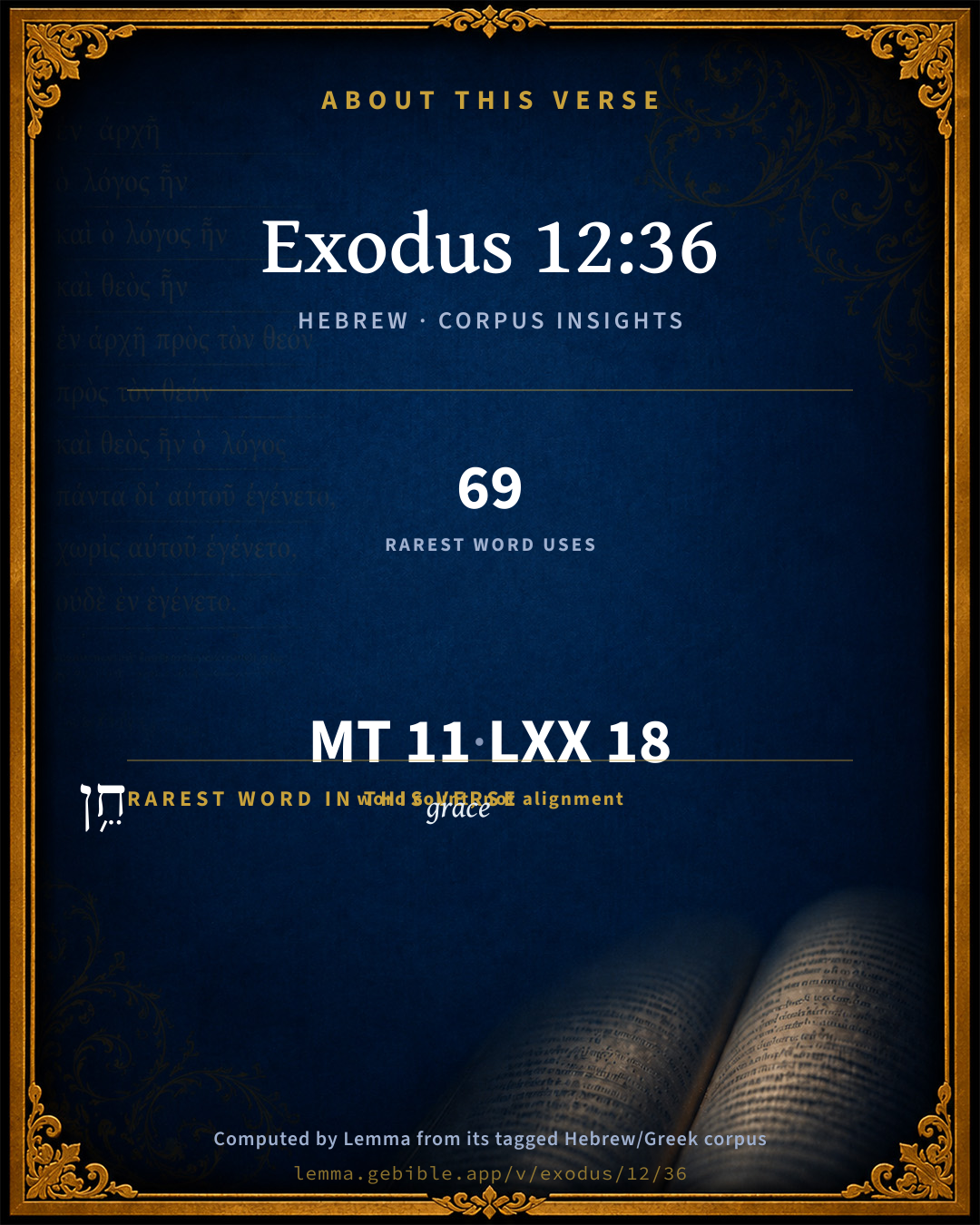
חֵ֥ן
chên
H2580
“grace of”
Noun, Common, Masculine, Singular, Construct
Part of Speech
Noun
Type
Common
Gender
Masculine
Number
Singular
State
Construct
Full BDB Definition

Origin: from H2603

TWOT: TWOT- 694a

favour, grace, charm - favour, grace, elegance - favour, acceptance
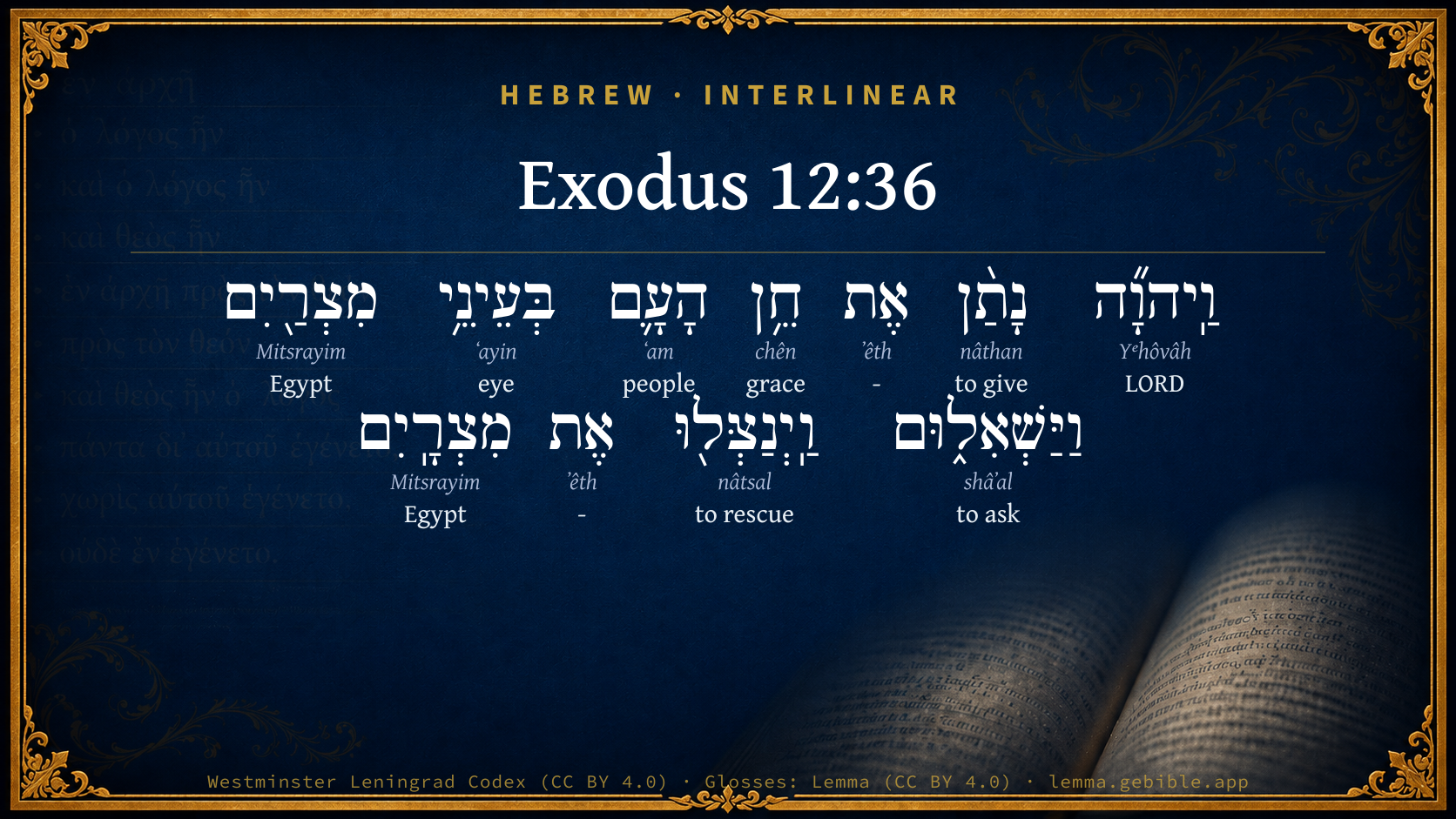
  1. וַֽיהוָ֞ה Yᵉhôvâh H3068 “and · LORD” Conjunction + Noun, Proper
  2. נָתַ֨ן nâthan H5414 “to give” Verb, Qal, Perfect, 3rd Person, Masculine, Singular
  3. אֶת ʼêth H853 “-” Particle, Direct Object
  4. הָעָ֛ם ʻam H5971 “the · people” Particle, Definite Article + Noun, Common, Masculine, Singular, Absolute
  5. בְּעֵינֵ֥י ʻayin H5869 “in/at · eyes of” Preposition + Noun, Common, Both, Dual, Construct
  6. מִצְרַ֖יִם Mitsrayim H4714 “Egypt” Noun, Proper
  7. וַיַּשְׁאִל֑וּם shâʼal H7592 “and · to ask · them” Conjunction + Verb, Hiphil, Sequential Imperfect, 3rd Person, Masculine, Plural + Suffix, Personal, 3rd Person, Masculine, Plural
  8. וַֽיְנַצְּל֖וּ nâtsal H5337 “and · to rescue” Conjunction + Verb, Piel, Sequential Imperfect, 3rd Person, Masculine, Plural
  9. אֶת ʼêth H853 “-” Particle, Direct Object
  10. מִצְרָֽיִם Mitsrayim H4714 “Egypt” Noun, Proper

About this verse

These counts appear in no published source. They are computed here, from the morphology-tagged text and Lemma’s own curated glosses. What Lemma adds →

11
words
9
distinct lemmas
Pentateuch
section

Grammatical profile

  • 3 verbs
  • 6 nouns
  • 2 particles

Verb forms

  • נָתַ֨ן Qal · Perfect
  • וַיַּשְׁאִל֑וּם Hiphil · Sequential Imperfect
  • וַֽיְנַצְּל֖וּ Piel · Sequential Imperfect

Repetition

A word recurs within this verse — often emphatic in Hebrew:

  • מִצְרַ֖יִם Egypt H4714 ×2

Hebrew & Septuagint length

In English translation the verse runs 24 words from the Hebrew and 23 from the Septuagint (LXX English) — closely comparable.

A rough comparison of the two English renderings, which tokenize alike — not a word-level alignment.

Word counts can differ between the Hebrew and the Greek without any difference in meaning — e.g. the Hebrew direct-object marker אֵת has no separate Greek word, and Greek often adds the article ὁ.

In the original languages it is 11 Hebrew tokens and 18 Greek tokens — but the two are counted differently (Hebrew bundles its prefixes and suffixes into one token; the Greek is in lemma form), so that isn’t a like-for-like length.

Cross-references

9

Topical passages linked to Exodus 12:36 in the Treasury of Scripture Knowledge — connected by theme and wording, ordered by reader-vote popularity; previews shown in the World English Bible.

  • Genesis 15:14 I will also judge that nation, whom they will serve. Afterward they will come out with great substance.
  • Acts 7:10 and delivered him out of all his afflictions, and gave him favor and wisdom before Pharaoh, king of Egypt. He made him governor over Egypt and all his house.
  • Exodus 3:21–22 I will give this people favor in the sight of the Egyptians, and it will happen that when you go, you shall not go empty-handed.
  • Exodus 11:3 Yahweh gave the people favor in the sight of the Egyptians. Moreover the man Moses was very great in the land of Egypt, in the sight of Pharaoh's servants, and in the sight of the people.
  • Psalms 105:37 He brought them forth with silver and gold. There was not one feeble person among his tribes.
  • Genesis 39:21 But Yahweh was with Joseph, and showed kindness to him, and gave him favor in the sight of the keeper of the prison.
  • Daniel 1:9 Now God made Daniel to find kindness and compassion in the sight of the prince of the eunuchs.
  • Proverbs 16:7 When a man's ways please Yahweh, He makes even his enemies to be at peace with him.
  • Acts 2:47 praising God, and having favor with all the people. The Lord added to the assembly day by day those who were being saved.

Cross-references courtesy of OpenBible.info (CC BY 4.0).

Hebrew and Greek witnesses Masoretic Hebrew ↔ Greek Septuagint

The same verse in the two great witnesses to the Old Testament, shown verse-for-verse.

These are two independent witnesses, not word-aligned to each other, and the Septuagint is shown in lemma (dictionary) form.

Hebrew Exodus 12:36 Masoretic · Westminster Leningrad Codex

וַֽיהוָ֞ה נָתַ֨ן אֶת חֵ֥ן הָעָ֛ם בְּעֵינֵ֥י מִצְרַ֖יִם וַיַּשְׁאִל֑וּם וַֽיְנַצְּל֖וּ אֶת מִצְרָֽיִם

Yahweh gave the people favor in the sight of the Egyptians, so that they let them have what they asked. They despoiled the Egyptians.

World English Bible · Public Domain

Greek LXX Exodus 12:36 Septuagint · lemma form

καί κύριος δίδωμι ὁ χάρις ὁ λαός αὐτός ἐναντίον ὁ αἰγύπτιος καί χράω αὐτός καί σκυλεύω ὁ αἰγύπτιος

And the Lord gave his people favor in the sight of the Egyptians, and they lent to them; and they spoiled the Egyptians.

LXX2012 (modern English Septuagint) · Public Domain

Hebrew: Westminster Leningrad Codex (CC BY 4.0). Greek: Septuagint (public domain); English from LXX2012 (modern English Septuagint) (Public Domain). How the Septuagint differs from the Hebrew →

Targum (Aramaic paraphrase)

2

The Targum is the ancient Jewish Aramaic paraphrase of the Hebrew Scriptures — an interpretive translation, not the Hebrew text itself. Onkelos (literal) and Pseudo-Jonathan (expansive) render the Torah, and Jonathan the Prophets. Coverage is partial: where no permissively-licensed English translation exists for a verse, only the Aramaic is shown. This is verse-level text, not a word-by-word alignment to the Hebrew.

  1. Targum Onkelos Torah (Genesis–Deuteronomy)
    וַייָ יְהַב יָת עַמָא לְרַחֲמִין בְּעֵינֵי מִצְרַיִם וּשְׁאֵילִנוּן וְרוֹקִינוּ יָת מִצְרַיִם:

    (no public-domain English translation for this verse)

    Targum Onkelos — Aramaic: “Onkelos Genesis” (public domain); “Onkelos Exodus” (public domain); “Onkelos Leviticus” (public domain); “Onkelos Numbers” (public domain); “Onkelos Deuteronomy” (public domain). English: “Sefaria Community Translation” (CC0 1.0 (public-domain dedication)); “J.W. Etheridge. The Targums of Onkelos and Jonathan Ben Uzziel on the Pentateuch. London: Longmans, Green, 1862” (public domain). Text via Sefaria.

  2. Targum Pseudo-Jonathan Torah (Genesis–Deuteronomy)
    וַיְיָ יְהַב יַת עַמָּא לְחֵן וָחֶסֶד קֳדָם מִצְרָאֵי וְשַׁיְילִינוּן וְרוֹקִינוּן יַת מִצְרָאֵי מִנִכְסֵיהוֹן

    And the Lord gave the people favour and compassion before the Mizraee, and they brought forth to them, and they emptied the Mizraee of their riches.

    Targum Pseudo-Jonathan — Aramaic: “Targum Jonathan on Genesis” (public domain); “Targum Jonathan on Exodus” (public domain); “Targum Jonathan on Leviticus” (public domain); “Targum Jonathan on Numbers” (public domain); “Targum Jonathan on Deuteronomy” (public domain). English: “The Targum of Jonathan ben Uzziel, trans. J. W. Etheridge, London, 1862” (public domain). Text via Sefaria.

Commentary

Notes on Exodus 12:36 from classic Christian and Jewish commentators (each source and its license shown beneath its notes). The classic Christian expositions comment on the surrounding passage and are grouped to its opening verse, so a note may address several verses; the Jewish commentaries on the Tanakh (Rashi and others) are per-verse, so they appear only where the commentator wrote on this verse.

Lemma curates 59 commentaries, every one of them public domain or Creative Commons licensed, each selected and text-cleaned for this edition rather than reprinted as found. About our sources →

Trapp's Complete Commentary

John Trapp

Exo 12:36 And the LORD gave the people favour in the sight of the Egyptians, so that they lent unto them [such things as they required]. And they spoiled the Egyptians.

Ver. 36. Spoiled the Egyptians.] {See Trapp on "Exo 8:2"}

John Trapp, A Commentary or Exposition upon All the Books of the Old and New Testament (1647–1656) — public domain. Text from a community e-Sword module.

Geneva Bible (1599)

Geneva Bible translators

Or, lent them.

Geneva Bible (1599) marginal notes — public domain. Text via Bolls.life.

Jamieson, Fausset & Brown

Robert Jamieson, A. R. Fausset & David Brown

the Lord gave the people favour in the sight of the Egyptians--Such a dread of them was inspired into the universal minds of the Egyptians, that whatever they asked was readily given.

spoiled the Egyptians--The accumulated earnings of many years being paid them at this moment, the Israelites were suddenly enriched, according to the promise made to Abraham (Gen 15:14), and they left the country like a victorious army laden with spoil (Psa 105:37; Eze 39:10).

Jamieson, Fausset & Brown — Commentary Critical and Explanatory on the Whole Bible (1871) — public domain (CC PDM 1.0). Text via the HelloAO Bible API.

Ellicott's Commentary for English Readers

(36) They lent.—Rather, “they, gave.” It is that the Egyptians neither expected nor wished the Israelites to return.

A Bible Commentary for English Readers, edited by Charles John Ellicott (1878–1897) — public domain. Text from a community e-Sword module.

The Cambridge Bible for Schools and Colleges

gen. ed. J. J. S. Perowne

36. let them have] lit. let them ask (viz. successfully), i.e. granted them, let them have, not necessarily ‘lent’ them. So Exo 1Sa_1:28 (lit. ‘let one ask him for Jehovah’), correlative of ‘ask’ in vv. 17, 27, as of the same word here in v. 35. Still, it is remarkable that the ordinary word for ‘gave’ is not used: and it cannot be denied that ‘let ask’ may, as in Syriac (Luk_11:5 Pesh.), have had in Heb. the meaning lend. In this case, we must suppose that the things were ‘lent’ for use at the festival in the wilderness; Pharaoh’s subsequent pursuit of the Israelites put their return out of the question, and so they ‘spoiled’ the Egyptians (Ewald, Hist. ii. 66). Dillm. writes: ‘In reality the fundamental idea of the narrative is this: God, in His contest for the oppressed and against the oppressor, brings it about by His judgements that the enemy is obliged not only to allow the people to hold their festival in the wilderness, but also at their request to provide them willingly with garments and ornaments to wear at it (cf. on Exo_3:21 f.); and eventually even to give these things up to them, as lawful spoil, and also, probably, as a reward for long and hard service (so Jubilees 48:18, Philo, Vit. Mos. i. p. 103, Clem. Al. Strom. i. p. 345, Iren. iv. 49, and other Fathers), and as partial compensation for what the Hebrews left behind them in Egypt.’

The Cambridge Bible for Schools and Colleges (gen. ed. J. J. S. Perowne; Cambridge University Press, 1878–1918) — public domain. Text from a community e-Sword module.

John Gill's Exposition

And a mixed multitude went up also with them,.... Some of these were Egyptians, and some of other nations that had resided in Egypt, and who, on various accounts, might choose to go along with the children of Israel; some through intermarriages with them, being loath to part with their relations, see Lev 20:10, others on account of religion, being proselytes of righteousness, and others through worldly interest, the land of Egypt being by the plagues a most desolate place; and such wonders being wrought for the children of Israel, they saw they were a people that were the favourites of heaven, and judged it safest and best and most for their interest to keep with them; the Targum of Jonathan computes the number of those to be two hundred and forty myriads:

and flocks and herds, even very much cattle; the greatest part of which must be supposed to belong to the children of Israel, whose cattle were not destroyed when those of the Egyptians were; and the rest might be the cattle of such who feared and regarded the word of God, and took their cattle into their houses at the time of the plague of hail, whereby they were preserved; and which might be an inducement to them to take their herds and their flocks, and go along with the children of Israel, see Exo 9:20.

John Gill's Exposition of the Whole Bible (1746–1763) — public domain (CC PDM 1.0). Text via the HelloAO Bible API.

Albert Barnes' Notes on the Bible

Lent - Or gave. The word in the Hebrew means simply “granted their request.” Whether the grant is made as a loan, or as a gift, depends in every instance upon the context. Here the word “spoiled” ought to be regarded as conclusive that the grant was a gift, a moderate remuneration for long service, and a compensation for cruel wrongs.

Albert Barnes' Notes on the Bible (1834–1885) — public domain. Text from a community e-Sword/MySword module.

Haydock's Catholic Bible Commentary

The Egyptians, who afterwards, pursuing them unjustly, put it out of their power to restore, if they had not been otherwise dispensed with by God. (Haydock)

George Leo Haydock (1774–1849), Haydock's Catholic Family Bible and Commentary, 1859 edition — public domain. Excludes Psalms (Douay-Rheims chapter numbering differs from Protestant) and Deuterocanonical books (Catholic canon only).

Matthew Poole's English Annotations

The Lord gave the people favour in the sight of the Egyptians, i.e. inclined their hearts to do it willingly, and not only out of fear.

So that they lent unto him; Heb. and they lent them, to wit, the jewels or vessels mentioned Exo 12:35.

They spoiled the Egyptians, to wit, of their ornaments.

Quest. Was not this unjustly done of the Israelites to borrow these jewels which they never paid again?

Answ. No,

1. Because they did nothing in this matter but by God’s appointment, Exo 11:1,2; so that if there be any injustice, it must be in God, in whom there neither can be in any thing, nor is in this thing, the least blot or shadow of injustice, as well because he hath an unquestionable right in and power to dispose of all persons and things, as being the Maker, and Giver, and Lord of all; as because there was great and evident reason both why the Israelites should be recompensed for all their hard labours and sufferings, and why the Egyptians should be spoiled for their idolatry, luxury, and cruelty to the Israelites, and the great benefits which they had received from Joseph, and from the service of the Israelites.

2. Because the supreme Lord of all forbad them to restore what they borrowed, and gave them the entire right and sole propriety therein.

3. Because though there was a form and appearance of borrowing and lending, yet indeed the Israelites did not so much borrow as desire, as the Hebrew word rendered borrow Exo 12:35 signifies; and the Egyptians did not reckon these thing; as lent, and to be restored, but as given, and never to be expected again; even as Pharaoh and his people rightly judged, that if the Israelites were once permitted to go out of the land with their whole families and estates, they would never return again, Exo 14:5. And in truth the Egyptians did and might esteem it a good bargain to give these things to redeem their lives, and to engage the Israelites to a speedy departure, knowing that otherwise both their persons and all their estates were in extreme hazard.

4. Because, if these jewels were properly borrowed, yet the Egyptians, by their causeless and hostile pursuit after the Israelites with intent to destroy them, did fully discharge them from all obligations to restitution, and give them a right not only to keep these goods, but to take ally other which they could from the Egyptians, according to the known and approved laws of war.

Matthew Poole's English Annotations on the Holy Bible (1683–1685) — public domain. Text from a community e-Sword/MySword module.

The Pulpit Commentary

So that they lent unto them such things as they required. Rather, "So that they granted them what they asked." They spoiled the Egyptians. See the comment on Exo_3:22, ad fin. The result was that the Israelites went forth, not as slaves, but as conquerors, decked with the jewels of the Egyptians, as though they had conquered and despoiled them

The Pulpit Commentary (1880–1919), ed. H.D.M. Spence-Jones & Joseph S. Exell — public domain. Text from a community e-Sword module.

Rashi

Rabbi Shlomo Yitzchaki (Rashi)

וישאלום lit., AND THEY HANDED THEM OVER — Even what they did not ask of them did they give to them: “You say “one” — take “two”, but only go!” (Mekhilta).

וינצלו The Targum translates this by ורוקינו, AND THEY EMPTIED OUT.

Rashi on the Tanakh — English translations: “The Judaica Press complete Tanach with Rashi, translated by A. J. Rosenberg” (CC BY 4.0); “Pentateuch with Rashi's commentary by M. Rosenbaum and A.M. Silbermann, 1929-1934” (public domain); “The Metsudah Tanach series, Lakewood, N.J” (CC BY 4.0); and “The Book of Joshua, Metsudah Publications, 1997” (CC BY 4.0). Text via Sefaria.

Lesson kit

Teaching starters — assembled from the data on this page, not authored interpretation. Every prompt links to the verse data it draws on. Edit before teaching.

Exodus, in the Pentateuch, opens this verse with 11 words (9 distinct Hebrew lemmas). Its most distinctive word is chên (“grace”). A historical commentator’s framing appears above. Read the whole chapter for the surrounding context.

Discussion questions

  1. How does “grace” (chên) shape what this verse is saying?
  2. Genesis 15:14 shares this passage’s theme. How do the two illuminate each other?
  3. “Egypt” occurs 2× in this one verse. What is the effect of the repetition?
  4. The translations on this page render this verse differently — a whole-verse word diff, not a word-by-word alignment. What might account for the different wordings?
  5. The verb «נָתַ֨ן» is Qal Perfect. How does its form color the action?
  6. Reading how Trapp's Complete Commentary and Geneva Bible (1599) read this verse, where do the two commentators agree and where do they part?

Things to notice

Reading settings

Reading text

Shown beneath each verse's original-language words.

Old Testament
Old Testament edition

Read the OT as the Masoretic Hebrew (MT) or the Greek Septuagint (LXX).

English shown for the Greek Septuagint (in the Hebrew ↔ Greek comparison).

Comparing translations? Open the Compare panel on any verse page to stack up to four side by side.