Genesis 12:7

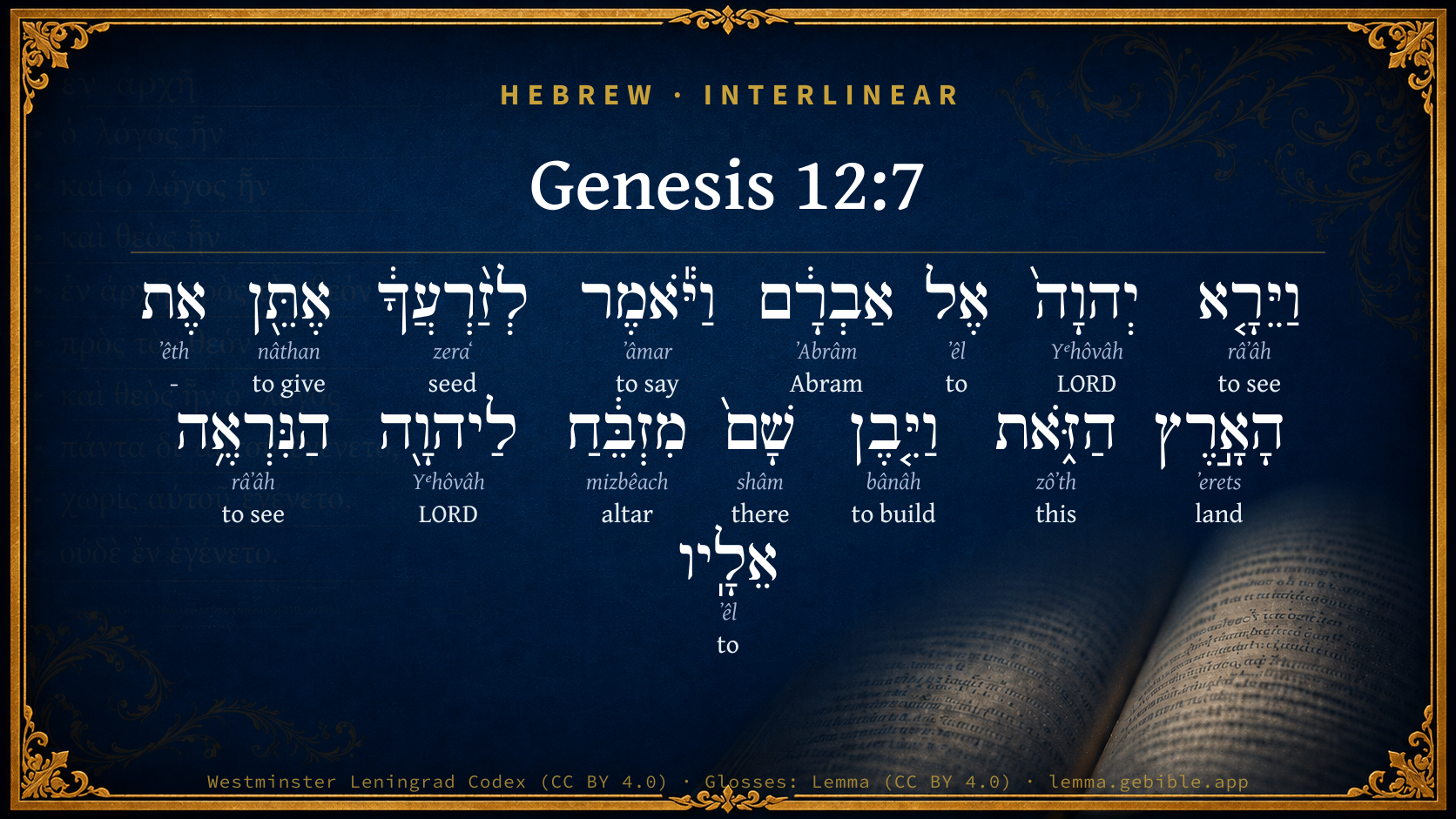
Hebrew (Westminster Leningrad Codex) Genesis 12:7 appears in the Hebrew Old Testament. The text above is from the Westminster Leningrad Codex. Each word links to its Strong’s number, a concise gloss, and parsing drawn from the Open Scriptures Hebrew Bible morphology. Click any word for its full Brown-Driver-Briggs (BDB) entry.
Download image
Cite this verse

Genesis 12:7 (World English Bible). Public Domain. Lemma interlinear Bible study tool, https://lemma.gebible.app/v/genesis/12/7.

Show BibTeX & RIS
BibTeX
RIS
English Translation
Yahweh appeared to Abram, and said, "I will give this land to your seed." He built an altar there to Yahweh, who appeared to him.
World English Bible · Public Domain
Download a study sheet

One document with this verse’s original text, its word-by-word gloss line, the meaning frame, cross-references with their text, attributed commentary, and full source and license credits — printable, and it pastes into notes with its structure intact.

This verse Autodidact and up

Study sheet (.html) Plain text (.txt)

A passage Seminary Student

Up to 50 verses in one chapter. A passage sheet keeps up to 6 commentary sources and 12 cross-references per verse, in the order this page ranks them, and says so on the sheet whenever that leaves anything out. Ask for a single verse and you get the Autodidact verse sheet above.

Everything on this page stays free to read, with no account — the sheet is a download of what is already on screen, not access to it.

Want to remove ads? Support Godless Engineer
Compare translations 3

The same verse in 3 English versions, stacked beneath the original-language interlinear above. Click any original word for its lexicon entry.

Each is an independent rendering of the whole verse — the interlinear is not word-aligned to these translations.

Highlighted words mark where these versions differ — a whole-verse word diff, not a word-by-word alignment.

  • World English Bible Public Domain
    Yahweh appeared to Abram, and said, "I will give this land to your seed." He built an altar there to Yahweh, who appeared to him.
  • King James Version Public Domain
    And the LORD appeared unto Abram, and said, Unto thy seed will I give this land: and there builded he an altar unto the LORD, who appeared unto him.
  • unfoldingWord Literal Text CC BY-SA 4.0
    Then Yahweh appeared to Abram and said, “To your offspring I will give this land.” So he built an altar there to Yahweh, who had appeared to him.

unfoldingWord Literal Text — © unfoldingWord, licensed CC BY-SA 4.0. Word-aligned USFM3 via Door43 (git.door43.org/unfoldingWord/en_ult).

Versions to compare (up to 4)

3 of 4 selected

Show all 18 translations

Every available English version of this verse, each an independent rendering of the whole verse.

  • World English Bible Public Domain
    Yahweh appeared to Abram, and said, "I will give this land to your seed." He built an altar there to Yahweh, who appeared to him.
  • Berean Standard Bible Public Domain
    Then the LORD appeared to Abram and said, “I will give this land to your offspring.” So Abram built an altar there to the LORD, who had appeared to him.
  • Majority Standard Bible Public Domain
    Then the LORD appeared to Abram and said, “I will give this land to your offspring.” So Abram built an altar there to the LORD, who had appeared to him.
  • King James Version Public Domain
    And the LORD appeared unto Abram, and said, Unto thy seed will I give this land: and there builded he an altar unto the LORD, who appeared unto him.
  • American Standard Version (1901) Public Domain
    And Jehovah appeared unto Abram, and said, Unto thy seed will I give this land: and there builded he an altar unto Jehovah, who appeared unto him.
  • Revised Version (1885) Public Domain
    And the LORD appeared unto Abram, and said, Unto thy seed will I give this land: and there builded he an altar unto the LORD, who appeared unto him.
  • Geneva Bible (1599) Public Domain
    And the Lord appeared vnto Abram, and said, Vnto thy seede will I giue this land. And there builded he an altar vnto the Lord, which appeared vnto him.
  • Douay-Rheims (1899) Public Domain
    And the Lord appeared to Abram, and said to him: To thy seed will I give this land. And he built there an altar to the Lord, who had appeared to him.
  • Young's Literal Translation Public Domain
    And Jehovah appeareth unto Abram, and saith, `To thy seed I give this land;' and he buildeth there an altar to Jehovah, who hath appeared unto him.
  • Literal Standard Version CC BY-SA 4.0
    And YHWH appears to Abram and says, “To your seed I give this land”; and there he builds an altar to YHWH, who has appeared to him.
  • Unlocked Literal Bible CC BY-SA 4.0
    Yahweh appeared to Abram, and said, “To your descendants I will give this land.” So there Abram built an altar to Yahweh, who had appeared to him.
  • unfoldingWord Literal Text CC BY-SA 4.0
    Then Yahweh appeared to Abram and said, “To your offspring I will give this land.” So he built an altar there to Yahweh, who had appeared to him.
  • Darby Bible Public Domain
    And Jehovah appeared to Abram, and said, Unto thy seed will I give this land. And there he built an altar to Jehovah who had appeared to him.
  • World Messianic Bible Public Domain
    The LORD appeared to Abram and said, “I will give this land to your offspring.” He built an altar there to the LORD, who had appeared to him.
  • Webster's Bible Public Domain
    And the LORD appeared to Abram, and said, To thy seed will I give this land: and there he erected an altar to the LORD, who appeared to him.
  • Free Bible Version CC BY-SA 4.0
    The Lord appeared to Abram and said, “I'm going to give this land to your descendants.” So Abram built an altar to the Lord there because that was where the Lord appeared to him.
  • Bible in Basic English Public Domain
    And the Lord came to Abram, and said, I will give all this land to your seed; then Abram made an altar there to the Lord who had let himself be seen by him.
  • JPS Tanakh (1917) Public Domain
    And the LORD appeared unto Abram, and said: 'Unto thy seed will I give this land'; and he builded there an altar unto the LORD, who appeared unto him.

Literal Standard Version (2020), Covenant Press — licensed CC BY-SA 4.0. Text via the HelloAO Bible API (eBible.org). Unlocked Literal Bible (unfoldingWord) — licensed CC BY-SA 4.0. Text via the HelloAO Bible API (eBible.org). unfoldingWord Literal Text — © unfoldingWord, licensed CC BY-SA 4.0. Word-aligned USFM3 via Door43 (git.door43.org/unfoldingWord/en_ult). Free Bible Version, Dr. Jonathan Gallagher — licensed CC BY-SA 4.0. Text via the HelloAO Bible API (eBible.org).

Word by word

More ways to search: Search by grammar → Find every occurrence → Compare this word →

Practice this passage: Drill this verse → Learn its vocabulary →

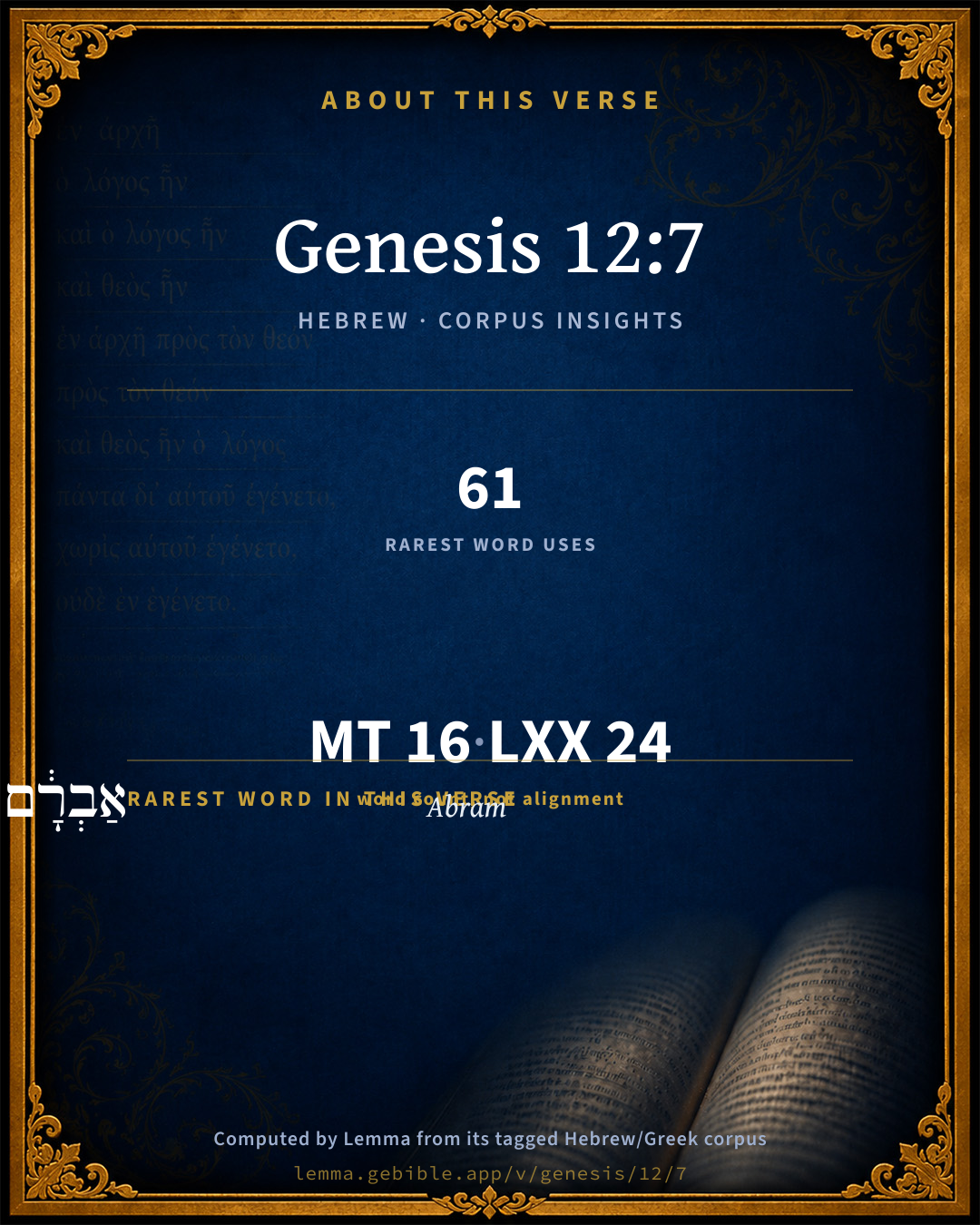
אַבְרָ֔ם
ʼAbrâm
H87
“Abram”
Noun, Proper
Part of Speech
Noun
Type
Proper
Full BDB Definition

Origin: contracted from H48

TWOT: None

Abram = "exalted father" - original name of Abraham
  1. וַיֵּרָ֤א râʼâh H7200 “and · to see” Conjunction + Verb, Niphal, Sequential Imperfect, 3rd Person, Masculine, Singular
  2. יְהוָה֙ Yᵉhôvâh H3068 “LORD” Noun, Proper
  3. אֶל ʼêl H413 “to” Preposition
  4. וַיֹּ֕אמֶר ʼâmar H559 “and · to say” Conjunction + Verb, Qal, Sequential Imperfect, 3rd Person, Masculine, Singular
  5. לְזַ֨רְעֲךָ֔ zeraʻ H2233 “to/for · seed · your” Preposition + Noun, Common, Masculine, Singular, Construct + Suffix, Personal, 2nd Person, Masculine, Singular
  6. אֶתֵּ֖ן nâthan H5414 “to give” Verb, Qal, Imperfect, 1st Person, Common, Singular
  7. אֶת ʼêth H853 “-” Particle, Direct Object
  8. הָאָ֣רֶץ ʼerets H776 “the · land” Particle, Definite Article + Noun, Common, Both, Singular, Absolute
  9. הַזֹּ֑את zôʼth H2063 “the · this” Particle, Definite Article + Pronoun, Demonstrative, Feminine, Singular
  10. וַיִּ֤בֶן bânâh H1129 “and · to build” Conjunction + Verb, Qal, Sequential Imperfect, 3rd Person, Masculine, Singular
  11. שָׁם֙ shâm H8033 “there” Adverb
  12. מִזְבֵּ֔חַ mizbêach H4196 “altar” Noun, Common, Masculine, Singular, Absolute
  13. לַיהוָ֖ה Yᵉhôvâh H3068 “to/for · LORD” Preposition + Noun, Proper
  14. הַנִּרְאֶ֥ה râʼâh H7200 “the · seeing” Particle, Definite Article + Verb, Niphal, Participle Active, Masculine, Singular, Absolute
  15. אֵלָֽיו ʼêl H413 “to · him” Preposition + Suffix, Personal, 3rd Person, Masculine, Singular

About this verse

These counts appear in no published source. They are computed here, from the morphology-tagged text and Lemma’s own curated glosses. What Lemma adds →

16
words
13
distinct lemmas
Pentateuch
section

Grammatical profile

  • 5 verbs
  • 6 nouns
  • 1 pronoun
  • 2 prepositions
  • 1 adverb
  • 1 particle

Verb forms

  • וַיֵּרָ֤א Niphal · Sequential Imperfect
  • וַיֹּ֕אמֶר Qal · Sequential Imperfect
  • אֶתֵּ֖ן Qal · Imperfect
  • וַיִּ֤בֶן Qal · Sequential Imperfect
  • הַנִּרְאֶ֥ה Niphal · Participle Active

Repetition

Words recur within this verse — often emphatic in Hebrew:

  • וַיֵּרָ֤א to see H7200 ×2
  • יְהוָה֙ LORD H3068 ×2
  • אֶל to H413 ×2

Hebrew & Septuagint length

In English translation the verse runs 25 words from the Hebrew and 31 from the Septuagint (LXX English) — closely comparable.

A rough comparison of the two English renderings, which tokenize alike — not a word-level alignment.

Word counts can differ between the Hebrew and the Greek without any difference in meaning — e.g. the Hebrew direct-object marker אֵת has no separate Greek word, and Greek often adds the article ὁ.

In the original languages it is 16 Hebrew tokens and 24 Greek tokens — but the two are counted differently (Hebrew bundles its prefixes and suffixes into one token; the Greek is in lemma form), so that isn’t a like-for-like length.

Cross-references

27

Topical passages linked to Genesis 12:7 in the Treasury of Scripture Knowledge — connected by theme and wording, ordered by reader-vote popularity; previews shown in the World English Bible.

  • Genesis 17:8 I will give to you, and to your seed after you, the land where you are traveling, all the land of Canaan, for an everlasting possession. I will be their God."
  • Genesis 13:15 for all the land which you see, I will give to you, and to your offspring forever.
  • Genesis 17:1 When Abram was ninety-nine years old, Yahweh appeared to Abram, and said to him, "I am God Almighty. Walk before me, and be blameless.
  • Genesis 18:1 Yahweh appeared to him by the oaks of Mamre, as he sat in the tent door in the heat of the day.
  • Galatians 3:16 Now the promises were spoken to Abraham and to his seed. He doesn't say, "To seeds," as of many, but as of one, "To your seed," which is Christ.
  • Genesis 13:4 to the place of the altar, which he had made there at the first. There Abram called on the name of Yahweh.
  • Psalms 105:9–12 The covenant which he made with Abraham, His oath to Isaac,
  • Genesis 13:18 Abram moved his tent, and came and lived by the oaks of Mamre, which are in Hebron, and built an altar there to Yahweh.
  • Genesis 26:25 He built an altar there, and called on the name of Yahweh, and pitched his tent there. There Isaac's servants dug a well.
  • Genesis 32:30 Jacob called the name of the place Peniel: for, he said, "I have seen God face to face, and my life is preserved."
  • Exodus 33:1 Yahweh spoke to Moses, "Depart, go up from here, you and the people that you have brought up out of the land of Egypt, to the land of which I swore to Abraham, to Isaac, and to Jacob, saying, 'I will give it to your seed.'
  • Genesis 12:8 He left from there to the mountain on the east of Bethel, and pitched his tent, having Bethel on the west, and Ai on the east. There he built an altar to Yahweh, and called on the name of Yahweh.
  • Numbers 32:11 Surely none of the men who came up out of Egypt, from twenty years old and upward, shall see the land which I swore to Abraham, to Isaac, and to Jacob; because they have not wholly followed me:
  • Genesis 15:18 In that day Yahweh made a covenant with Abram, saying, "To your seed have I given this land, from the river of Egypt to the great river, the river Euphrates:
  • Genesis 17:3 Abram fell on his face. God talked with him, saying,
  • Genesis 22:9 They came to the place which God had told him of. Abraham built the altar there, and laid the wood in order, bound Isaac his son, and laid him on the altar, on the wood.
  • Romans 9:8 That is, it is not the children of the flesh who are children of God, but the children of the promise are counted as a seed.
  • Hebrews 11:13 These all died in faith, not having received the promises, but having seen them and embraced them from afar, and having confessed that they were strangers and pilgrims on the earth.
  • Genesis 8:20 Noah built an altar to Yahweh, and took of every clean animal, and of every clean bird, and offered burnt offerings on the altar.
  • Genesis 26:3 Sojourn in this land, and I will be with you, and will bless you. For to you, and to your seed, I will give all these lands, and I will establish the oath which I swore to Abraham your father.
  • Genesis 28:13 Behold, Yahweh stood above it, and said, "I am Yahweh, the God of Abraham your father, and the God of Isaac. The land whereon you lie, to you will I give it, and to your seed.
  • Genesis 33:20 He erected an altar there, and called it El Elohe Israel.
  • Exodus 6:3 and I appeared to Abraham, to Isaac, and to Jacob, as God Almighty; but by my name Yahweh I was not known to them.
  • Deuteronomy 1:8 Behold, I have set the land before you: go in and possess the land which Yahweh swore to your fathers, to Abraham, to Isaac, and to Jacob, to give to them and to their seed after them.
  • Deuteronomy 6:10 It shall be, when Yahweh your God shall bring you into the land which he swore to your fathers, to Abraham, to Isaac, and to Jacob, to give you, great and goodly cities, which you didn't build,
  • Deuteronomy 30:20 to love Yahweh your God, to obey his voice, and to cleave to him; for he is your life, and the length of your days; that you may dwell in the land which Yahweh swore to your fathers, to Abraham, to Isaac, and to Jacob, to give them.
  • Galatians 4:28 Now we, brothers, as Isaac was, are children of promise.

Cross-references courtesy of OpenBible.info (CC BY 4.0).

Hebrew and Greek witnesses Masoretic Hebrew ↔ Greek Septuagint

The same verse in the two great witnesses to the Old Testament, shown verse-for-verse.

These are two independent witnesses, not word-aligned to each other, and the Septuagint is shown in lemma (dictionary) form.

Hebrew Genesis 12:7 Masoretic · Westminster Leningrad Codex

וַיֵּרָ֤א יְהוָה֙ אֶל אַבְרָ֔ם וַיֹּ֕אמֶר לְזַ֨רְעֲךָ֔ אֶתֵּ֖ן אֶת הָאָ֣רֶץ הַזֹּ֑את וַיִּ֤בֶן שָׁם֙ מִזְבֵּ֔חַ לַיהוָ֖ה הַנִּרְאֶ֥ה אֵלָֽיו

Yahweh appeared to Abram, and said, "I will give this land to your seed." He built an altar there to Yahweh, who appeared to him.

World English Bible · Public Domain

Greek LXX Genesis 12:7 Septuagint · lemma form

καί ὁράω κύριος ὁ αβραμ καί εἶπον αὐτός ὁ σπέρμα σύ δίδωμι ὁ γῆ οὗτος καί οἰκοδομέω ἐκεῖ αβραμ θυσιαστήριον κύριος ὁ ὁράω αὐτός

And the Lord appeared to Abram, and said to him, I will give this land to your seed. And Abram built an altar there to the Lord who appeared to him.

LXX2012 (modern English Septuagint) · Public Domain

Hebrew: Westminster Leningrad Codex (CC BY 4.0). Greek: Septuagint (public domain); English from LXX2012 (modern English Septuagint) (Public Domain). How the Septuagint differs from the Hebrew →

Targum (Aramaic paraphrase)

2

The Targum is the ancient Jewish Aramaic paraphrase of the Hebrew Scriptures — an interpretive translation, not the Hebrew text itself. Onkelos (literal) and Pseudo-Jonathan (expansive) render the Torah, and Jonathan the Prophets. Coverage is partial: where no permissively-licensed English translation exists for a verse, only the Aramaic is shown. This is verse-level text, not a word-by-word alignment to the Hebrew.

  1. Targum Onkelos Torah (Genesis–Deuteronomy)
    וְאִתְגְּלִי יְיָ לְאַבְרָם וַאֲמַר לִבְנָךְ אֶתֵּן יָת אַרְעָא הָדָא וּבְנָא תַמָּן מַדְבְּחָא קֳדָם יְיָ דְּאִתְגְּלִי לֵהּ

    And the Lord revealed Himself unto Abram, and said, To thy sons will I give this land. And he builded there an altar before the Lord who had been revealed to him.

    Targum Onkelos — Aramaic: “Onkelos Genesis” (public domain); “Onkelos Exodus” (public domain); “Onkelos Leviticus” (public domain); “Onkelos Numbers” (public domain); “Onkelos Deuteronomy” (public domain). English: “Sefaria Community Translation” (CC0 1.0 (public-domain dedication)); “J.W. Etheridge. The Targums of Onkelos and Jonathan Ben Uzziel on the Pentateuch. London: Longmans, Green, 1862” (public domain). Text via Sefaria.

  2. Targum Pseudo-Jonathan Torah (Genesis–Deuteronomy)
    וְאִתְגְלֵי יְיָ לְאַבְרָם וַאֲמַר לִבְנָךְ אֶתֵּן יַת אַרְעָא הָדָא וּבְנָא תַמָן מַדְבְּחָא קֳדָם יְיָ דְאִתְגְלֵי לֵיהּ

    And the Lord was revealed unto Abram, and said, To thy sons will I give this land. And he builded there an altar before the Lord, who was revealed to him.

    Targum Pseudo-Jonathan — Aramaic: “Targum Jonathan on Genesis” (public domain); “Targum Jonathan on Exodus” (public domain); “Targum Jonathan on Leviticus” (public domain); “Targum Jonathan on Numbers” (public domain); “Targum Jonathan on Deuteronomy” (public domain). English: “The Targum of Jonathan ben Uzziel, trans. J. W. Etheridge, London, 1862” (public domain). Text via Sefaria.

Commentary

Notes on Genesis 12:7 from classic Christian and Jewish commentators (each source and its license shown beneath its notes). The classic Christian expositions comment on the surrounding passage and are grouped to its opening verse, so a note may address several verses; the Jewish commentaries on the Tanakh (Rashi and others) are per-verse, so they appear only where the commentator wrote on this verse.

Lemma curates 59 commentaries, every one of them public domain or Creative Commons licensed, each selected and text-cleaned for this edition rather than reprinted as found. About our sources →

Trapp's Complete Commentary

John Trapp

Gen 12:7 And the LORD appeared unto Abram, and said, Unto thy seed will I give this land: and there builded he an altar unto the LORD, who appeared unto him.

Ver. 7. And there builded he an altar to Jehovah.] Although the Canaanite was then in the land. God hath promised, when he cleanseth his Church, that "the Canaanite shall be there no more". {Zec 14:21} But while they are there, we must "shine as lamps amidst a crooked and cursed generation, holding forth the word of life"; {Php 2:15-16} as an ensign, bearing up God’s name as a badge, or beacon; wearing his mark in our foreheads, {Rev 9:4} the place of open profession; setting up an altar even amidst idolaters, as Abram, and calling it "Jehovahnissi - the Lord is my banner," as Moses. {Exo 17:15} Some that seemed to wish well to Edmund Allan Martyr, {a} bid him keep his conscience to himself, and to follow Baruch’s counsel: {/APC Bar 6} Wherefore, when ye see the multitude of people worshipping them behind and before, say in your hearts, O Lord, it is thou that oughtest only to be worshipped. These had more of Nicodemus in them than of Nathanael.

{a} Act. and Mon., fol. 1796.

John Trapp, A Commentary or Exposition upon All the Books of the Old and New Testament (1647–1656) — public domain. Text from a community e-Sword module.

The Biblical Illustrator

Joseph S. Exell

Gen_12:7

And the Lord appeared unto Abram, and said, Unto thy seed will I give this land

The land of promise

1.

The first feature which eminently marked out the land for the residence of Gods chosen nation is this: it unites, as no other does, the two indispensable conditions of central position and yet of isolation. To lie in the midst of the nations, at the focus and gathering place of those mighty and cultured empires, whose rivalries ruled the politics, as their example led the civilization of antiquity, yet at the same time be shut off from such contact with them as must of necessity prove injurious, seemed to be opposite requirements, very hard to be reconciled. To a curious extent they are reconciled in the land of promise.

2. Another characteristic which qualified Palestine to be a training ground for the Hebrews was this: that it combined to an unusual degree high agricultural fertility with exposure to sudden and severe disasters. In most years it could sustain a dense population of cultivators, supposing them to be industrious and frugal, without any excessive or grinding toil. Enough, not always for export, but for home consumption at least, its well-watered valleys and vine-clad hills could furnish in ordinary seasons. For comfortable sustenance, therefore, though not for wealth or luxury, such a nation of peasants was sufficiently provided within its own borders. It could dwell apart, yet experience no want. At the same time, the people were kept in close dependence for the fruits of harvest upon the bounty of Providence.

3. To these advantages for its special design, this perhaps ought to be added: that hardly any regions offer so few temptations to corrupt the complicity of their inhabitants, or better facilities for the defence of their liberties. (J. O. Dykes, D. D.)

There builded he an altar unto the Lord

Worship

I. THIS ALTAR WAS REARED ENTIRELY IN HONOUR OF GOD. No self-glorying In it.

II. ABRAHAMS ACT EXPRESSED HIS ACKNOWLEDGMENT OF THE FACT OF DIVINE GUIDANCE IN HIS PAST LIFE. He found it a joy to be under the leadership of God, and he built this altar to express his gratitude.

III. ABRAHAMS ALTAR EXPRESSED HIS DEPENDENCE ON THE MERCY THAT COMES THROUGH A PROPITIATORY SACRIFICE.

IV. THIS ALTAR WAS VALUABLE IN GODS SIGHT, BECAUSE IT EXPRESSED ABRAHAMS READINESS TO CONSECRATE HIMSELF ENTIRELY TO GOD.

V. THE RAISED ALTAR EXPRESSED THE PATRIARCHS FAITH IN THE FULFILMENT OF THE DIVINE PROMISES. (F. Hastings.)

The altar at Sichem

1. The first thing Abraham does on his arrival is to acknowledge God. He recognizes Him as the One who has protected him.

2. We see in this erection of the altar an acknowledgment of God in time of prosperity.

3. That altar signified a grateful heart.

4. The altar was a token of Abrams faith.

5. This altar was not the product of a spasmodic exertion, or something to meet a sudden emergency. It was the result of a fixed purpose, a fixed state of mind, a character.

6. Again, this altar suggests to us that local worship is important. God is not always to be thought of as the broad blaze of light, but rather like the pointed rays. It is when the rays are brought to a focus that the heat and fire are manifested. God is everywhere, but is in this place and that in a special sense. We need to localize God. There are spots specially holy. The closet, the family altar, the church--how sacred!

7. Finding this spirit in Abraham, we are not surprised that God manifested Himself to him. As we advance in holiness, we advance toward God, and communion is more easy. (I. Simmons, D. D.)

Outward signs of piety

Abram set up his altar along the line of his march. Blessed are they whose way is known by marks of worship. The altar is the highest seal of ownership. God will not lightly forsake His temple. This setting up of the altar shows that our spiritual life ought to be attested by outward sign and profession. Abram had the promise in his heart, yet he did not live a merely contemplative life; he was not lost in religious musings and prophesyings--he built his altar and set up his testimony in the midst of his people, and made them sharers of a common worship. (J. Parker, D. D.)

The Biblical Illustrator, edited by Joseph S. Exell (c. 1880s–1900s) — public domain. Text from a community e-Sword module.

Joseph Benson's Commentary

Gen 12:7. And the Lord appeared to Abram — Probably in a vision, and spoke to him comfortable words: Unto thy seed will I give this land — No place or condition can shut us out from God’s gracious visits. Abram is a sojourner, unsettled, among Canaanites, and yet here also he meets with him that lives, and sees him. Enemies may part us and our tents, us and our altars, but not us and our God.

Joseph Benson's Commentary on the Old and New Testaments (1811–1818) — public domain. Text from a community e-Sword module.

Scofield Reference Notes

C. I. Scofield

appeared

The theophanies. Gen 17:1; Gen 12:7; Rev 1:10.

The Scofield Reference Bible (1917 edition), notes by C. I. Scofield — public domain. Text from a community e-Sword module.

Tyndale Open Study Notes

Tyndale Open Resources

12:7 The Lord appeared to Abram at Shechem (12:6) to confirm that this land was the Promised Land. Israel was to occupy this land, but sharing in God’s promises required their faith (cp. Num 14; Josh 1:6-9). • to your descendants: Abram did not yet possess the land; he lived as a temporary settler.

Tyndale Open Study Notes — © Tyndale Open Resources, licensed CC BY-SA 4.0. Text via the HelloAO Bible API.

Geneva Bible (1599)

Geneva Bible translators

It was not enough for him to worship God in his heart, but it was expedient to declare by outward profession his faith before men, whereof this altar was a sign.

Geneva Bible (1599) marginal notes — public domain. Text via Bolls.life.

Jamieson, Fausset & Brown

Robert Jamieson, A. R. Fausset & David Brown

Unto thy seed will I give this land--God was dealing with Abram not in his private and personal capacity merely, but with a view to high and important interests in future ages. That land his posterity was for centuries to inhabit as a peculiar people; the seeds of divine knowledge were to be sown there for the benefit of all mankind; and considered in its geographical situation, it was chosen in divine wisdom as the fittest of all lands to serve as the cradle of a divine revelation designed for the whole world.

and there builded he an altar unto the Lord--By this solemn act of devotion Abram made an open profession of his religion, established the worship of the true God, and declared his faith in the promise.

Jamieson, Fausset & Brown — Commentary Critical and Explanatory on the Whole Bible (1871) — public domain (CC PDM 1.0). Text via the HelloAO Bible API.

Adam Clarke's Commentary

Verse 7. The Lord appeared] In what way this appearance was made we know not; it was probably by the great angel of the covenant, Jesus the Christ. The appearance, whatsoever it was, perfectly satisfied Abram, and proved itself to be supernatural and Divine. It is worthy of remark that Abram is the first man to whom God is said to have shown himself or appeared:

1. In Ur of the Chaldees, Ac 7:2; and

2. At the oak of Moreh, as in this verse. As מורה Moreh signifies a teacher, probably this was called the oak of Moreh or the teacher, because God manifested himself here, and instructed Abram concerning the future possession of that land by his posterity, and the dispensation of the mercy of God to all the families of the earth through the promised Messiah. See Clarke on Ge 15:7.

Adam Clarke's Commentary on the Bible (1810–1826) — public domain. Text from a community e-Sword/MySword module.

John Calvin's Commentaries

7. And the Lord appeared unto Abram. He now relates that Abram was not left entirely destitute, but that God stretched forth his hand to help him. We must, however, mark, with what kind of assistance God succours him in his temptations. He offers him his bare word, and in such a way, indeed, that Abram might deem himself exposed to ridicule. For God declares he will give the land to his seed: but where is the seed, or where the hope of seed; seeing that he is childless and old, and his wife is barren? This was therefore an insipid consolation to the flesh. But faith has a different taste; the property of which is, to hold all the senses of the pious so bound by reverence to the word, that a single promise of God is quite sufficient. Meanwhile, although God truly alleviates and mitigates the evils which his servants endure, he does it only so far as is expedient for them, without indulging the desire of the flesh. Let us hence learn, that this single remedy ought to be sufficient for us in our sufferings: that God so speaks to us in his word, as to cause our minds to perceive him to be propitious; and let us not give the reins to the importunate desires of our flesh. God himself will not fail on his part; but will, by the manifestation of his favor, raise us when we are cast down.

And there builded he an altar. This altar was a token of gratitude. As soon as God appeared to him he raised an altar: to what end? That he might call upon the name of the Lord. We see, therefore, that he was intent upon giving of thanks; and that an altar was built by him in memory of kindness received. Should any one ask, whether he could not worship God without an altar? I answer, that the inward worship of the heart is not sufficient unless external profession before men be added. Religion has truly its appropriate seat in the heart; but from this root, public confession afterwards arises, as its fruit. For we are created to this end, that we may offer soul and body unto God. The Canaanites had their religion; they had also altars for sacrifices: but Abram, that he might not involve himself in their superstitions, erects a domestic altar, on which he may offer sacrifice; as if he had resolved to place a royal throne for God within his house. But because the worship of God is spiritual, and all ceremonies which have no right and lawful end, are not only vain and worthless in themselves, but also corrupt the true worship of God by their counterfeited and fallacious appearance; we must carefully observe what Moses says, that the altar was erected for the purpose of calling upon God. The altar then is the external form of divine worship; but invocation is its substance and truth. This mark easily distinguishes pure worshippers from hypocrites, who are far too liberal in outward pomp, but wish their religion to terminate in bare ceremonies. Thus all their religion is vague, being directed to no certain end. Their ultimate intention, indeed, is (as they confusedly speak) to worship God: but piety approaches nearer to God; and therefore does not trifle with external figures, but has respect to the truth and the substance of religion. On the whole, ceremonies are no otherwise acceptable to God, than as they have reference to the spiritual worship of God.

To invoke the name of God, or to invoke in his name, admits of a twofold exposition; namely, either to pray to God, or to celebrate his name with praises. But because prayer and thanksgiving are things conjoined, I willingly include both. We have before said, in the fourth chapter (Genesis 4:1), that the whole worship of God was not improperly described, by the figure synecdoche, under this particular expression; because God esteems no duty of piety more highly, and accounts no sacrifice more acceptable, than the invocation of his name, as is declared in Psalm 50:23, and Psalm 51:19. As often, therefore, as the word altar occurs, let the sacrifices also come into our mind; for from the beginning, God would have mankind informed, that there could be no access to himself without sacrifice. Therefore Abram, from the general doctrine of religion, opened for himself a celestial sanctuary, by sacrifices, that he might rightly worship God. But we know that God was never appeased by the blood of beasts. Wherefore it follows, that the faith of Abram was directed to the blood of Christ.

It may seem, however, absurd, that Abram built himself an altar, at his own pleasure, though he was neither a priest, nor had any express command from God. I answer, that Moses removes this scruple in the context: for Abram is not said to have made an altar simply to God, but to God who had appeared unto him. The altar therefore had its foundation in that revelation; and ought not to be separated from that of which it formed but a part and an appendage. Superstition fabricates for itself such a God as it pleases and then invents for him various kinds of worship; just as the Papists, at this days most proudly boast that they worship God, when they are only trifling with their foolish pageantry. But the piety of Abram is commended, because, having erected an altar, he worshipped God who had been manifested to him. And although Moses declares the design with which Abram built the altar, when he relates that he there called upon God, he yet, at the same time, intimates, that such a service was pleasing to God: for this language implies the approval of the Holy Spirit, who thereby pronounces that he had rightly called upon God. Others, indeed confidently boasted that they worshipped God; but God, in praising Abram only, rejects all the rites of the heathen as a vile profanation of his name.

John Calvin's Commentaries (1540-1563) — public domain. Text from the Calvin Translation Society English edition (1840s-50s) via the Christian Classics Ethereal Library (ccel.org). Calvin's coverage is partial (roughly two-thirds of the Bible); uncommented books and verses are honest gaps, never fabricated. The 19th-century editor's footnotes and remarks are omitted so the notes are faithfully Calvin's own voice.

Ellicott's Commentary for English Readers

(7) The Lord appeared unto Abram.—This is the first time that any appearance of the Deity is men tioned. Always previously the communications between God and man had been direct, without the intervention of any visible medium. Thus, God commanded Adam (Gen_2:16); Adam and Eve heard His voice (Gen_3:8), and He called them (Gen_3:9); He said unto Cain (Gen_4:6-9); unto Noah (Gen_6:13; Gen_7:1), and spake unto him (Gen_8:15; Gen_9:8): but henceforward we read repeatedly of a Divine appearance, and this visible manifestation is subsequently connected with the phrase “an angel of Jehovah” (see Gen_16:7; Gen_22:11, &c), and less frequently “an angel of God” (Gen_21:17; Jdg_6:20; Jdg_13:9). Upon the question whether this was a created angel, or whether it was an anticipation of the incarnation of Christ, see Excursus on “Angel of Jehovah” at end of this book.

There builded he an altar unto the Lord.—By so doing he took possession of the land for Jehovah, and consecrated it to Him. The altar would, further, be a place of public worship and of sacrifice. In a similar spirit Noah had taken possession of the renovated earth (Gen_8:20).

A Bible Commentary for English Readers, edited by Charles John Ellicott (1878–1897) — public domain. Text from a community e-Sword module.

The Cambridge Bible for Schools and Colleges

gen. ed. J. J. S. Perowne

7. And the Lord appeared] The first mention of a Theophany in the patriarchal narrative. What form it took, and in what way it was connected with the “sacred tree” or the altar, is not related.

Unto thy seed will I give this land] The continuance of the Divine promise. In Gen_12:2-3 we had the blessing of the people and the patriarch, in general terms. In this verse, immediately after the mention of the Canaanite occupation, possession of “this land” is promised to the descendants of Abram. This verse lays the foundation of the imperishable devotion of “the seed of Abram” to the Land of Promise.

builded he an altar] Cf. Gen_8:20. The building of an altar which implies the rite of sacrifice is mentioned in connexion with the promises and appearances of God, cf. 8, Gen_13:18, Gen_33:20, Gen_35:1; Gen_35:7.

Sacrifice was the expression of the patriarch’s dependence on, communion with, and devotion to, Jehovah.

The Cambridge Bible for Schools and Colleges (gen. ed. J. J. S. Perowne; Cambridge University Press, 1878–1918) — public domain. Text from a community e-Sword module.

John Gill's Exposition

And the Lord appeared unto Abram,.... Perhaps in an human form, and so it was the Son of God; for whenever there was any visible appearance of a divine Person, under the former dispensation, it seems to be always of the essential Word, that was to be incarnate, and who spake with an articulate voice:

and said, unto thy seed will I give this land; the whole of it inhabited by Canaanites and others; and it was for this end chiefly that Abram was called out of Chaldea into Canaan, to be shown the land, and have the grant of it for his posterity:

and there builded an altar unto the Lord, who appeared unto him: by way of gratitude and thankfulness for his kind and gracious appearance, and for the gift of the land of Canaan to his offspring; for on this altar he no doubt offered sacrifice in a way of thanksgiving, as Noah did when he came out of the ark.

John Gill's Exposition of the Whole Bible (1746–1763) — public domain (CC PDM 1.0). Text via the HelloAO Bible API.

Matthew Poole's English Annotations

The Lord appeared unto Abram, to encourage and comfort him against his wicked neighbours: see Gen 13:15; 15:18; 17:8; 24:7; Deu 34:4.

There built he an altar, a place for sacrifice, and other parts of Divine worship, erected by him both to keep his family in the true religion, and to separate himself and them from that idolatrous neighbourhood.

Matthew Poole's English Annotations on the Holy Bible (1683–1685) — public domain. Text from a community e-Sword/MySword module.

Whedon's Commentary on the Bible

Daniel D. Whedon

7. The Lord appeared unto Abram — This is the first time that Jehovah is said to have appeared to man; and here, at Shechem, Christ revealed himself as the Messiah to a woman of Samaria. How Jehovah appeared at this time to Abram no man is now competent to say, and speculation and theories seem idle. Here was the first altar built to Jehovah as the covenant God; but we may be sure that “Melchizedek, king of Salem, and priest of the Most High God,” was also at this time offering acceptable worship in this land of idolatry. Now for the first time Abram is told what is the land promised him, and yet it is not to be an inheritance for him, but only for his children.

Unto thy seed will I give this land — There was now no established priesthood; the head of the family was priest in his own household. Abram builds an altar of earth and rough stones, and in the midst of his assembled household calls upon God by the mysterious covenant Name. He thus enters the land of promise with the solemn worship of Jehovah.

Daniel D. Whedon (gen. ed.), Commentary on the Old and New Testaments (1874–1909) — public domain. Text from a community e-Sword module.

The Pulpit Commentary

And the Lord appeared. The first mention of a theophany, Act_7:2 alleges that such a Divine manifestation had previously occurred in Ur of the Chaldees. Though not a direct vision of Jehovah, (Joh_1:18) that there was some kind of outward appearance may be inferred from the subsequent Divine manifestations to the patriarch, (Gen_18:2, Gen_18:17, 33 22:11-18) to Hagar, (Gen_16:7-14 Gen_21:17, Gen_21:18) and to Jacob. (Gen_31:11-13 Gen_32:24-30) On the relation of the angel of Jehovah to Jehovah vide. (Ge 16 Ge 17) Unto Abram. "Jam paene fatigato Abraha isto duro exsilio et perpetuis migrationibus" (Luther) And said, Unto thy seed to himself God gave "none inheritance in it, no, not so much as to set his foot on"; (Act_7:5) the land was promised to his seed "when as yet he had no child will I give this land. Now occupied by the Canaanites. Undoubtedly a great promise, that the Canaanites should be dispossessed, and their country given to the offspring of a childless old man already over seventy-five years. The apparent improbability of its ever being accomplished rendered it a strong trial to the patriarch"s faith. And there builded he an altar. "Constituit certum locum, in quo conveniat ecclesia, auditura verbum Dei, factura preess, laudatura Deum, sacrificatura Dee" (Luther). "Altare forma est Divini cultus; invocatio autem substantia et veritas" (Calvin). "The rearing of an altar in the land was, in fact, a form of taking possession of it on the ground of a right secured to the exercise of his faith" (Bush). "It is often said of Abraham and the patriarchs that they built altars to the Lord; it is never said they built houses for themselves" (Wordsworth). Unto the Lord who had appeared to him.

HOMILIES BY F. HASTINGS Ver. 7.

Abraham worshipping.

there he builded an altar unto the Lord, who appeared unto him." Abraham is at length Divinely informed that he is in the land hereafter to be his. He was at the spot where the great temple, to be set up by his descendants, would stand. Here he builds an altar. It was doubtless a very plain altar of rough stones, but large enough for the sacrifices to be offered. It would have little attraction in the eyes of many, but it would be approved of by God.

I IT WAS REARED ENTIRELY IN THE HONOR OF GOD. There was no self-glorifying in it. It was erected as a spontaneous act of gratitude. The men of Babel by the tower-building sought to get themselves a name; Abraham by his altar-building seeks to honor God"s name. His act was a protest against the prevalent and surrounding idolatry. This was the first altar reared in Canaan to the great I AM.

II IT WAS AN EXPRESSION OF ABRAHAM"S DESIRE TO ACKNOWLEDGE THE DIVINE GUIDANCE IN HIS PAST LIFE. He found it a joy to be under the leadership of God. "Wherever Abraham had his tent God had his altar." In how many families is the altar in need of repair! In many it has not even been set up.

III IT EXPRESSED ABRAHAM"S DEPENDENCE ON THE MERCY REVEALED THROUGH A PROPITIATORY SACRIFICE. He evidently believed in an atonement, lie offered a heifer, goat, ram, turtle-dove, and pigeon. After the rude manner of that day he offered sacrifices for his own sins and for those of his household. He found that God was brought nearer through the sacrifice, even as we discover that fact through the Christ of Calvary.

IV IT EXPRESSED ALSO ABRAHAM"S READINESS TO CONSECRATE HIMSELF ENTIRELY TO GOD. An altar that failed to express this would have been a mockery. God is not flattered by an outward show of reverence. He must have inner and absolute consecration if we are to know the heights of spiritual power.

V IT EXPRESSED THE PATRIARCH"S FAITH IN THE FULFILMENT OF THE DIVINE PROMISES. Abraham was already in the land of promise, and could leave the future to his God. He was, by rearing that altar, taking possession of the land for himself, and of the world for God, even as Columbus, with befitting pomp, planted in the newly-discovered continent a cross, and named the land San Salvador, thus consecrating it to the holy Savior. H.

The Pulpit Commentary (1880–1919), ed. H.D.M. Spence-Jones & Joseph S. Exell — public domain. Text from a community e-Sword module.

John Wesley's Explanatory Notes

And the Lord appeared to Abram - Probably in a vision, and spoke to him comfortable words; Unto thy seed will I give this land - No place or condition can shut us out from God's gracious visits. Abram is a sojourner, unsettled, among Canaanites, and yet here also he meets with him that lives, and sees him. Enemies may part us and our tents, us and our altars, but not us and our God.

John Wesley, Explanatory Notes Upon the Whole Bible (1754–1765) — public domain. Text via the GEBible commentary corpus.

Keil & Delitzsch

C. F. Keil & F. Delitzsch

Here in Sichem Jehovah appeared to him, and assured him of the possession of the land of Canaan for his descendants. The assurance was made by means of an appearance of Jehovah, as a sign that this land was henceforth to be the scene of the manifestation of Jehovah. Abram understood this, "and there builded he an altar to Jehovah, who appeared to him," to make the soil which was hallowed by the appearance of God a place for the worship of the God who appeared to him.

Keil & Delitzsch — Biblical Commentary on the Old Testament (1861–1891) — public domain (CC PDM 1.0). Text via the HelloAO Bible API. (Old Testament only.)

Rashi

Rabbi Shlomo Yitzchaki (Rashi)

ויבן שם מזבח AND HE BUILDED THERE AN ALTAR — in thanksgiving for the good tidings that he would have children, and for the good tidings that they would possess the land of Israel.

Rashi on the Tanakh — English translations: “The Judaica Press complete Tanach with Rashi, translated by A. J. Rosenberg” (CC BY 4.0); “Pentateuch with Rashi's commentary by M. Rosenbaum and A.M. Silbermann, 1929-1934” (public domain); “The Metsudah Tanach series, Lakewood, N.J” (CC BY 4.0); and “The Book of Joshua, Metsudah Publications, 1997” (CC BY 4.0). Text via Sefaria.

Ramban (Nachmanides)

Rabbi Moshe ben Nachman (Ramban / Nachmanides)

The sense of the expression, And there he built an altar unto the Eternal, who appeared unto him, is that he gave praise to the Glorious Name and offered unto Him a sacrifice of thanksgiving for His having appeared to him. Until now G-d had not appeared to him neither in a mar’eh nor in a machzeh. and Machzeh are terms for different degrees of prophetic vision. See Ramban further, 15:1. See also Moreh Nebuchim, II, 41-5, for full discussion of these terms and other prophetic experiences. Rather, the command, Get thee out of thy country, was said to him in a nocturnal dream or through Ruach Hakodesh., Chapter 45, beginning: “second degree of prophecy.” It is possible that the expression, Who appeared unto him, alludes to the mystery of the sacrifice. The one enlightened [in the mysteries of the Torah] will understand.

Ramban (Nachmanides) on the Tanakh — English translation: “Commentary on the Torah by Ramban (Nachmanides). Translated and annotated by Charles B. Chavel. New York, Shilo Pub. House, 1971-1976” (CC BY 4.0). Text via Sefaria.

Radak

Rabbi David Kimhi (Radak)

וירא ה' אל אברם, at Elon Moreh, He appeared to him, telling him that this is the land He promised to show him.

ויאמר לזרעך אתן, G’d told him that although He had bidden him to leave his homeland and to come to this country and to settle in it, He had not said that He would give this land to Avram forthwith by dispossessing the present inhabitants, as this was not practical, Avram being only a single individual. Possession of this land was possible only after his descendants had become sufficiently numerous. As of the time G’d was speaking to Avram, the land, instead of being an inheritance, would be like a gift to him, and he was expected to familiarise himself with his gift. He would encounter only sympathy and goodwill from the local inhabitants. When, in due course, his descendants, more than 600.000 strong, would come back here they would encounter hostility, and the conquest would take quite a while, the inhabitants being killed or driven out in stages, as was spelled out in greater detail in Exodus 23,30.

ויבן שם מזבח, in response to this promise, Avram erected an altar there in honour of the G’d Who had appeared to him.

Radak on the Tanakh — English translations: “Sefaria Community Translation” (CC0 1.0 (public-domain dedication)); “Eliyahu Munk, HaChut Hameshulash” (CC BY 4.0); “Rabbi Mike Feuer, Jerusalem Anthology” (CC BY 4.0); and “R. David Kimhi on the first book of Psalms, Translated by R.G. Finch, London, 1919” (public domain). Text via Sefaria.

Lesson kit

Teaching starters — assembled from the data on this page, not authored interpretation. Every prompt links to the verse data it draws on. Edit before teaching.

Genesis, in the Pentateuch, opens this verse with 16 words (13 distinct Hebrew lemmas). Its most distinctive word is ʼAbrâm (“Abram”). A historical commentator’s framing appears above. Read the whole chapter for the surrounding context.

Discussion questions

  1. What does “Abram” (ʼAbrâm) contribute to the verse as a whole?
  2. Genesis 17:8 shares this passage’s theme. How do the two illuminate each other?
  3. “to see” occurs 2× in this one verse. What is the effect of the repetition?
  4. These translations render this verse differently. What is at stake in choosing one wording over another?
  5. The verb «וַיֵּרָ֤א» is Niphal Sequential Imperfect. How does its form color the action?
  6. Reading how Trapp's Complete Commentary and The Biblical Illustrator read this verse, where do the two commentators agree and where do they part?

Things to notice

Reading settings

Reading text

Shown beneath each verse's original-language words.

Old Testament
Old Testament edition

Read the OT as the Masoretic Hebrew (MT) or the Greek Septuagint (LXX).

English shown for the Greek Septuagint (in the Hebrew ↔ Greek comparison).

Comparing translations? Open the Compare panel on any verse page to stack up to four side by side.