Deuteronomy 8:10

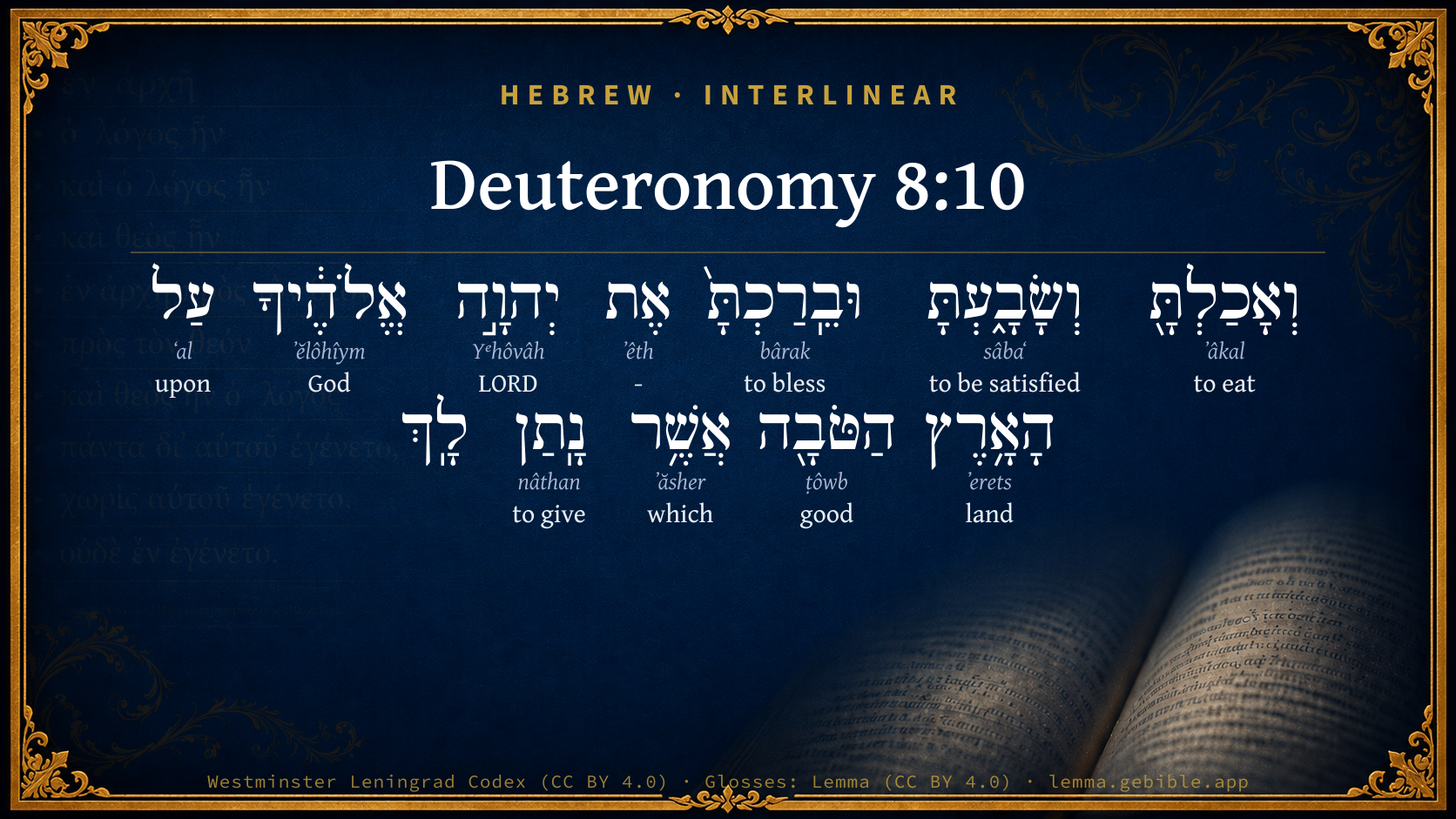
Hebrew (Westminster Leningrad Codex) Deuteronomy 8:10 appears in the Hebrew Old Testament. The text above is from the Westminster Leningrad Codex. Each word links to its Strong’s number, a concise gloss, and parsing drawn from the Open Scriptures Hebrew Bible morphology. Click any word for its full Brown-Driver-Briggs (BDB) entry.
Download image
Cite this verse

Deuteronomy 8:10 (World English Bible). Public Domain. Lemma interlinear Bible study tool, https://lemma.gebible.app/v/deuteronomy/8/10.

Show BibTeX & RIS
BibTeX
RIS
English Translation
You shall eat and be full, and you shall bless Yahweh your God for the good land which he has given you.
World English Bible · Public Domain
Download a study sheet

One document with this verse’s original text, its word-by-word gloss line, the meaning frame, cross-references with their text, attributed commentary, and full source and license credits — printable, and it pastes into notes with its structure intact.

This verse Autodidact and up

Study sheet (.html) Plain text (.txt)

A passage Seminary Student

Up to 50 verses in one chapter. A passage sheet keeps up to 6 commentary sources and 12 cross-references per verse, in the order this page ranks them, and says so on the sheet whenever that leaves anything out. Ask for a single verse and you get the Autodidact verse sheet above.

Everything on this page stays free to read, with no account — the sheet is a download of what is already on screen, not access to it.

Want to remove ads? Support Godless Engineer
Compare translations 3

The same verse in 3 English versions, stacked beneath the original-language interlinear above. Click any original word for its lexicon entry.

Each is an independent rendering of the whole verse — the interlinear is not word-aligned to these translations.

Highlighted words mark where these versions differ — a whole-verse word diff, not a word-by-word alignment.

  • World English Bible Public Domain
    You shall eat and be full, and you shall bless Yahweh your God for the good land which he has given you.
  • King James Version Public Domain
    When thou hast eaten and art full, then thou shalt bless the LORD thy God for the good land which he hath given thee.
  • unfoldingWord Literal Text CC BY-SA 4.0
    And you will eat and be full, and you will bless Yahweh your God for the good land that he has given to you.

unfoldingWord Literal Text — © unfoldingWord, licensed CC BY-SA 4.0. Word-aligned USFM3 via Door43 (git.door43.org/unfoldingWord/en_ult).

Versions to compare (up to 4)

3 of 4 selected

Show all 18 translations

Every available English version of this verse, each an independent rendering of the whole verse.

  • World English Bible Public Domain
    You shall eat and be full, and you shall bless Yahweh your God for the good land which he has given you.
  • Berean Standard Bible Public Domain
    When you eat and are satisfied, you are to bless the LORD your God for the good land that He has given you.
  • Majority Standard Bible Public Domain
    When you eat and are satisfied, you are to bless the LORD your God for the good land that He has given you.
  • King James Version Public Domain
    When thou hast eaten and art full, then thou shalt bless the LORD thy God for the good land which he hath given thee.
  • American Standard Version (1901) Public Domain
    And thou shalt eat and be full, and thou shalt bless Jehovah thy God for the good land which he hath given thee.
  • Revised Version (1885) Public Domain
    And thou shalt eat and be full, and thou shalt bless the LORD thy God for the good land which he hath given thee.
  • Geneva Bible (1599) Public Domain
    And when thou hast eaten and filled thy selfe, thou shalt blesse the Lord thy God for the good land, which he hath giuen thee.
  • Douay-Rheims (1899) Public Domain
    That when thou hast eaten, and art full, thou mayst bless the Lord thy God for the excellent land which he hath given thee.
  • Young's Literal Translation Public Domain
    and thou hast eaten, and been satisfied, and hast blessed Jehovah thy God, on the good land which he hath given to thee.
  • Literal Standard Version CC BY-SA 4.0
    And you have eaten and been satisfied, and have blessed your God YHWH on the good land which he has given to you.
  • Unlocked Literal Bible CC BY-SA 4.0
    You will eat and be full, and you will bless Yahweh your God for the good land that he has given you.
  • unfoldingWord Literal Text CC BY-SA 4.0
    And you will eat and be full, and you will bless Yahweh your God for the good land that he has given to you.
  • Darby Bible Public Domain
    And thou shalt eat and be filled, and shalt bless Jehovah thy God for the good land which he hath given thee.
  • World Messianic Bible Public Domain
    You shall eat and be full, and you shall bless the LORD your God for the good land which he has given you.
  • Webster's Bible Public Domain
    When thou hast eaten and art full, then thou shalt bless the LORD thy God for the good land which he hath given thee.
  • Free Bible Version CC BY-SA 4.0
    When you eat and are full, make sure you thank the Lord your God for the good land that he's given you.
  • Bible in Basic English Public Domain
    And you will have food enough and be full, praising the Lord your God for the good land he has given you.
  • JPS Tanakh (1917) Public Domain
    And thou shalt eat and be satisfied, and bless the LORD thy God for the good land which He hath given thee.

Literal Standard Version (2020), Covenant Press — licensed CC BY-SA 4.0. Text via the HelloAO Bible API (eBible.org). Unlocked Literal Bible (unfoldingWord) — licensed CC BY-SA 4.0. Text via the HelloAO Bible API (eBible.org). unfoldingWord Literal Text — © unfoldingWord, licensed CC BY-SA 4.0. Word-aligned USFM3 via Door43 (git.door43.org/unfoldingWord/en_ult). Free Bible Version, Dr. Jonathan Gallagher — licensed CC BY-SA 4.0. Text via the HelloAO Bible API (eBible.org).

Word by word

More ways to search: Search by grammar → Find every occurrence → Compare this word →

Practice this passage: Drill this verse → Learn its vocabulary →

וְשָׂבָ֑עְתָּ
sâbaʻ
H7646
“and · to be satisfied”
Conjunction + Verb, Qal, Sequential Perfect, 2nd Person, Masculine, Singular
Part of Speech
Conjunction + Verb
Stem
Qal
Form
Sequential Perfect
Person
2nd Person
Gender
Masculine
Number
Singular
Full BDB Definition

Origin: a primitive root

TWOT: 2231

to be satisfied, be sated, be fulfilled, be surfeited - (Qal) - to be sated (with food) - to be sated, be satisfied with, be fulfilled, be filled, have one's fill of (have desire satisfied) - to have in excess, be surfeited, be surfeited with - to be weary of (figuratively) - (Piel) to satisfy - (Hiphil) - to satisfy - to enrich - to sate, glut (with the undesired)
  1. וְאָכַלְתָּ֖ ʼâkal H398 “and · to eat” Conjunction + Verb, Qal, Sequential Perfect, 2nd Person, Masculine, Singular
  2. וּבֵֽרַכְתָּ֙ bârak H1288 “and · to bless” Conjunction + Verb, Piel, Sequential Perfect, 2nd Person, Masculine, Singular
  3. אֶת ʼêth H853 “-” Particle, Direct Object
  4. יְהוָ֣ה Yᵉhôvâh H3068 “LORD” Noun, Proper
  5. אֱלֹהֶ֔יךָ ʼĕlôhîym H430 “God(s) · your” Noun, Common, Masculine, Plural, Construct + Suffix, Personal, 2nd Person, Masculine, Singular
  6. עַל ʻal H5921 “upon” Preposition
  7. הָאָ֥רֶץ ʼerets H776 “the · land” Particle, Definite Article + Noun, Common, Both, Singular, Absolute
  8. הַטֹּבָ֖ה ṭôwb H2896 “the · good” Particle, Definite Article + Adjective, Adjective, Feminine, Singular, Absolute
  9. אֲשֶׁ֥ר ʼăsher H834 “which” Particle, Relative
  10. נָֽתַן nâthan H5414 “to give” Verb, Qal, Perfect, 3rd Person, Masculine, Singular

About this verse

These counts appear in no published source. They are computed here, from the morphology-tagged text and Lemma’s own curated glosses. What Lemma adds →

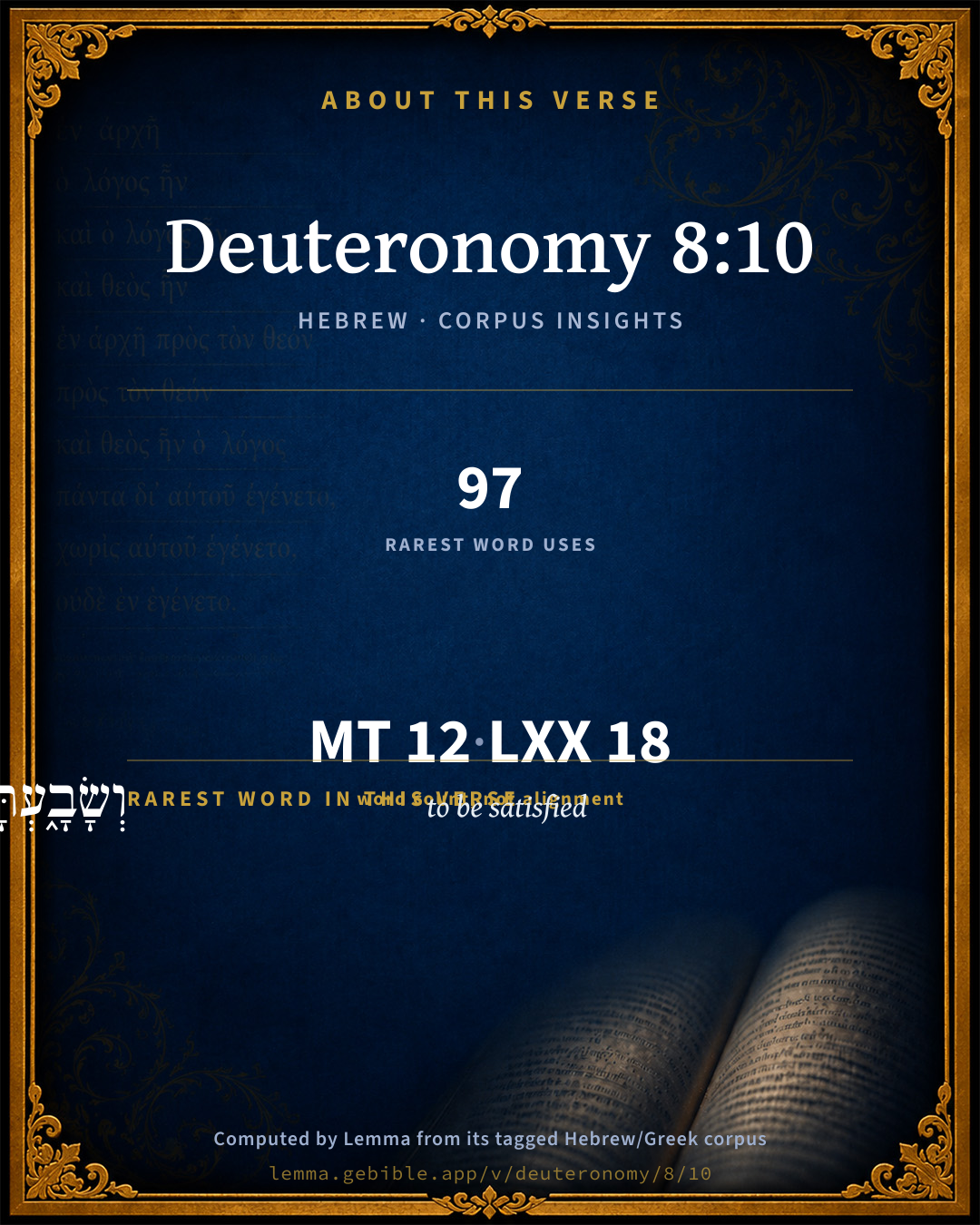
12
words
11
distinct lemmas
Pentateuch
section

Grammatical profile

  • 4 verbs
  • 3 nouns
  • 1 adjective
  • 2 prepositions
  • 2 particles

Verb forms

  • וְאָכַלְתָּ֖ Qal · Sequential Perfect
  • וְשָׂבָ֑עְתָּ Qal · Sequential Perfect
  • וּבֵֽרַכְתָּ֙ Piel · Sequential Perfect
  • נָֽתַן Qal · Perfect

Hebrew & Septuagint length

In English translation the verse runs 22 words from the Hebrew and 23 from the Septuagint (LXX English) — closely comparable.

A rough comparison of the two English renderings, which tokenize alike — not a word-level alignment.

Word counts can differ between the Hebrew and the Greek without any difference in meaning — e.g. the Hebrew direct-object marker אֵת has no separate Greek word, and Greek often adds the article ὁ.

In the original languages it is 12 Hebrew tokens and 18 Greek tokens — but the two are counted differently (Hebrew bundles its prefixes and suffixes into one token; the Greek is in lemma form), so that isn’t a like-for-like length.

Cross-references

10

Topical passages linked to Deuteronomy 8:10 in the Treasury of Scripture Knowledge — connected by theme and wording, ordered by reader-vote popularity; previews shown in the World English Bible.

  • Psalms 103:2 Praise Yahweh, my soul, And don't forget all his benefits;
  • Proverbs 3:9 Honor Yahweh with your substance, With the first fruits of all your increase:
  • Romans 14:6 He who observes the day, observes it to the Lord; and he who does not observe the day, to the Lord he does not observe it. He who eats, eats to the Lord, for he gives God thanks. He who doesn't eat, to the Lord he doesn't eat, and gives God thanks.
  • Deuteronomy 6:11–12 and houses full of all good things, which you didn't fill, and cisterns dug out, which you didn't dig, vineyards and olive trees, which you didn't plant, and you shall eat and be full;
  • 1 Chronicles 29:14 But who am I, and what is my people, that we should be able to offer so willingly as this? For all things come of you, and of your own have we given you.
  • Matthew 14:19 He commanded the multitudes to sit down on the grass; and he took the five loaves and the two fish, and looking up to heaven, he blessed, broke and gave the loaves to the disciples, and the disciples gave to the multitudes.
  • 1 Timothy 4:4–5 For every creature of God is good, and nothing is to be rejected, if it is received with thanksgiving.
  • 1 Corinthians 10:31 Whether therefore you eat, or drink, or whatever you do, do all to the glory of God.
  • 1 Thessalonians 5:18 In everything give thanks, for this is the will of God in Christ Jesus toward you.
  • John 6:23 However boats from Tiberias came near to the place where they ate the bread after the Lord had given thanks.

Cross-references courtesy of OpenBible.info (CC BY 4.0).

Hebrew and Greek witnesses Masoretic Hebrew ↔ Greek Septuagint

The same verse in the two great witnesses to the Old Testament, shown verse-for-verse.

These are two independent witnesses, not word-aligned to each other, and the Septuagint is shown in lemma (dictionary) form.

Hebrew Deuteronomy 8:10 Masoretic · Westminster Leningrad Codex

וְאָכַלְתָּ֖ וְשָׂבָ֑עְתָּ וּבֵֽרַכְתָּ֙ אֶת יְהוָ֣ה אֱלֹהֶ֔יךָ עַל הָאָ֥רֶץ הַטֹּבָ֖ה אֲשֶׁ֥ר נָֽתַן לָֽךְ

You shall eat and be full, and you shall bless Yahweh your God for the good land which he has given you.

World English Bible · Public Domain

Greek LXX Deuteronomy 8:10 Septuagint · lemma form

καί ἐσθίω καί ἐνπίμπλημι καί εὐλογέω κύριος ὁ θεός σύ ἐπί ὁ γῆ ὁ ἀγαθός ὅς δίδωμι σύ

And you shall eat and be filled, and shall bless the Lord your God on the good land, which he has given you.

LXX2012 (modern English Septuagint) · Public Domain

Hebrew: Westminster Leningrad Codex (CC BY 4.0). Greek: Septuagint (public domain); English from LXX2012 (modern English Septuagint) (Public Domain). How the Septuagint differs from the Hebrew →

Targum (Aramaic paraphrase)

2

The Targum is the ancient Jewish Aramaic paraphrase of the Hebrew Scriptures — an interpretive translation, not the Hebrew text itself. Onkelos (literal) and Pseudo-Jonathan (expansive) render the Torah, and Jonathan the Prophets. Coverage is partial: where no permissively-licensed English translation exists for a verse, only the Aramaic is shown. This is verse-level text, not a word-by-word alignment to the Hebrew.

  1. Targum Onkelos Torah (Genesis–Deuteronomy)
    וְתֵיכוּל וְתִשְׂבַּע וּתְבָרַךְ יָת יְיָ אֱלָהָךְ עַל אַרְעָא טַבְתָא דִיהַב לָךְ

    (no public-domain English translation for this verse)

    Targum Onkelos — Aramaic: “Onkelos Genesis” (public domain); “Onkelos Exodus” (public domain); “Onkelos Leviticus” (public domain); “Onkelos Numbers” (public domain); “Onkelos Deuteronomy” (public domain). English: “Sefaria Community Translation” (CC0 1.0 (public-domain dedication)); “J.W. Etheridge. The Targums of Onkelos and Jonathan Ben Uzziel on the Pentateuch. London: Longmans, Green, 1862” (public domain). Text via Sefaria.

  2. Targum Pseudo-Jonathan Torah (Genesis–Deuteronomy)
    וְתֶהֱווֹן זְהִירִין בִּזְמַן דְּאַתּוּן אָכְלִין וּשְבֵעִין הֲווֹן מוֹדִין וּמְבָרְכִין קֳדָם יְיָ אֱלָהָכוֹן עַל כָּל פֵּירֵי אַרְעָא מְשַׁבְּחָא דִיהַב לְכוֹן

    Be mindful, therefore, in the time when you will have eaten and are satisfied, that you render thanksgiving and blessing before the Lord your God for all the fruit of the goodly land which He hath given you,

    Targum Pseudo-Jonathan — Aramaic: “Targum Jonathan on Genesis” (public domain); “Targum Jonathan on Exodus” (public domain); “Targum Jonathan on Leviticus” (public domain); “Targum Jonathan on Numbers” (public domain); “Targum Jonathan on Deuteronomy” (public domain). English: “The Targum of Jonathan ben Uzziel, trans. J. W. Etheridge, London, 1862” (public domain). Text via Sefaria.

Commentary

Notes on Deuteronomy 8:10 from classic Christian and Jewish commentators (each source and its license shown beneath its notes). The classic Christian expositions comment on the surrounding passage and are grouped to its opening verse, so a note may address several verses; the Jewish commentaries on the Tanakh (Rashi and others) are per-verse, so they appear only where the commentator wrote on this verse.

Lemma curates 59 commentaries, every one of them public domain or Creative Commons licensed, each selected and text-cleaned for this edition rather than reprinted as found. About our sources →

Matthew Henry's Commentary

Moses, having mentioned the great plenty they would find in the land of Canaan, finds it necessary to caution them against the abuse of that plenty, which was a sin they would be the more prone to new that they came into the vineyard of the Lord, immediately out of a barren desert.

I. He directs them to the duty of a prosperous condition, Deu 8:10. They are allowed to eat even to fulness, not to surfeiting no excess; but let them always remember their benefactor, the founder of their feast, and never fail to give thanks after meat: Then thou shalt bless the Lord thy God. 1. They must take heed of eating or drinking so much as to indispose themselves for this duty of blessing God, rather aiming to serve God therein with so much the more cheerfulness and enlargement. 2. They must not have any fellowship with those that, when they had eaten and were full, blessed false gods, as the Israelites themselves had done in their worship of the golden calf, Exo 32:6. 3. Whatever they had the comfort of God must have the glory of. As our Saviour has taught us to bless before we eat (Mat 14:19, Mat 14:20), so we are here taught to bless after meat. That is our Hosannah - God bless; this is our Hallelujah - Blessed be God. In every thing we must give thanks. From this law the religious Jews took up a laudable usage of blessing God, not only at their solemn meals, but upon other occasions; if they drank a cup of wine they lifted up their hands and said, Blessed be he that created the fruit of the vine to make glad the heart. If they did but smell at a flower, they said, Blessed be he that made this flower sweet. 4. When they gave thanks for the fruits of the land they must give thanks for the fruits of the land itself, which was given them by promise From all our comfortable enjoyments we must take occasion to thank God for our comfortable settlements; and I know not but we of this nation have as much reason as they had to give thanks for a good land.

II. He arms them against the temptations of a prosperous condition, and charges them to stand upon their guard against them: "When thou art settled in goodly houses of thy own building," Deu 8:12 (for though God gave them houses which they builded not, Deu 6:10, these would not serve them, they must have larger and finer), - "and when thou hast grown rich in cattle, in silver, and in gold (Deu 8:13), as Abraham (Gen 13:2), - when all thou hast is multiplied," 1. "Then take heed of pride. Beware lest then thy heart be lifted up," Deu 8:14. When the estate rises, the mind is apt to rise with it, in self-conceit, self-complacency, and self-confidence. Let us therefore strive to keep the spirit low in a high condition; humility is both the ease and the ornament of prosperity. Take heed of saying, so much as in thy heart, that proud word, My power, even the might of my hand, hath gotten me this wealth, Deu 8:17. Note, We must never take the praise of our prosperity to ourselves, nor attribute it to our ingenuity or industry; for bread is not always to the wise, nor riches to men of understanding, Ecc 9:11. It is spiritual idolatry thus to sacrifice to our own net, Hab 1:16. 2. "Then take heed of forgetting God." This follows upon the lifting up on the heart; for it is through the pride of the countenance that the wicked seek not after God, Psa 10:4. Those that admire themselves despise God. (1.) "Forget not thy duty to God." Deu 8:11. We forget God if we keep not his commandments; we forget his authority over us, and our obligations to him and expectations from him, if we are not obedient to his laws. When men grow rich they are tempted to think religion a needless thing. They are happy without it, think it a thing below them and too hard upon them. Their dignity forbids them to stoop, and their liberty forbids them to serve. But we are basely ungrateful if the better God is to us the worse we are to him. (2.) "Forget not God's former dealings with thee. Thy deliverance out of Egypt, Deu 8:14. The provision he made for thee in the wilderness, that great and terrible wilderness." They must never forget the impressions which the horror of that wilderness made upon them; see Jer 2:6, where it is called the very shadow of death. There God preserved them from being destroyed by the fiery serpents and scorpions, though sometimes he made use of them for their correction: there he kept them from perishing for want of water, following them with water out of a rock of flint (Deu 8:15), out of which (says bishop Patrick) one would rather have expected fire than water. There he fed them with manna, of which before (Deu 8:3), taking care to keep them alive, that he might do them good at their latter end, Deu 8:16. Note, God reserves the best till the last for his Israel. However he may seem to deal hardly with them by the way, he will not fail to do them good at their latter end. (3.) "Forget not God's hand in thy present prosperity, Deu 8:18. Remember it is he that giveth thee wealth; for he giveth thee power to get wealth." See here how God's giving and our getting are reconciled, and apply it to spiritual wealth. It is our duty to get wisdom, and above all our gettings to get understanding; and yet it is God's grace that gives wisdom, and when we have got it we must not say, It was the might of our hand that got it, but must own it was God that gave us power to get it, and therefore to him we must give the praise and consecrate the use of it. The blessing of the Lord on the hand of the diligent makes rich both for this world and for the other. He giveth thee power to get wealth, not so much to gratify thee, and make thee easy, as that he may establish his covenant. All God's gifts are in pursuance of his promises.

III. He repeats the fair warning he had often given them of the fatal consequences of their apostasy from God, Deu 8:19, Deu 8:20. Observe, 1. How he describes the sin; it is forgetting God, and then worshipping other gods. What wickedness will not those fall into that keep thoughts of God out of their minds? And, when once the affections are displaced from God, they will soon be misplaced upon lying vanities. 2. How he denounces wrath and ruin against them for it: "If you do so, you shall surely perish, and the power and might of your hands, which you are so proud of, cannot help you. Nay, you shall perish as the nations that are driven out before you. God will make no more account of you, notwithstanding his covenant with you and your relation to him, than he does of them, if you will not be obedient and faithful to him." Those that follow others in sin will certainly follow them to destruction. If we do as sinners do, we must expect to fare as sinners fare.

Matthew Henry's Commentary on the Whole Bible (1708–1710) — public domain (CC PDM 1.0). Text via the HelloAO Bible API.

Trapp's Complete Commentary

John Trapp

Deu 8:10 When thou hast eaten and art full, then thou shalt bless the LORD thy God for the good land which he hath given thee.

Ver. 10. Then thou shalt bless.]

“ Rarm fumaut foelicibus arm. ”

Solomon’s wealth did him more harm than ever his wisdom did him good. But that should not have been. Solomon’s altar was four times as large as Moses’s, {Exo 27:1} to teach us, that as our peace and prosperity is more than others, so should our service in a due proportion.

John Trapp, A Commentary or Exposition upon All the Books of the Old and New Testament (1647–1656) — public domain. Text from a community e-Sword module.

The Biblical Illustrator

Joseph S. Exell

Deu_8:10

When thou hast eaten and art full, then thou shalt bless the Lord thy God.

Prosperity a test

These words occur in Moses farewell charge to the Israelites. Moses had long stood to his people in the relation of father as well as general, and, like a father, has at the end a good many last words to speak. This whole Book of Deuteronomy is made up of last words; his last will and testament to the Hebrew people. He wanted to clinch the instruction that had been given them already. His anxiety outran his responsibility. He had been their saviour in the past, and now would like to take out a policy of insurance in their behalf for the time to come. And they needed everything in the shape of counsel and insurance that could be given them. They had hardly earned the confidence of their leader. He did not much believe in the Israelites. He did not expect with any confidence that they would bless the Lord when they had eaten and were full. They had hardly been a match for adversity, still less could they be expected to be for prosperity. He had carried them forty years, and been one of them a hundred and twenty. He understood their composition and drift. They were a nation of backsliders. Their history was full of ebb tides. They were not to be trusted. God had kept them worn down into manageableness simply by force of disaster; had always driven them with a curb and a check. Liberty they regularly corrupted into license. The point is reached now, however, where a new experiment is to be tried with them. There are some elements in the case that warrant at least a hope that the experiment will succeed. The wilderness and the manna are now put behind them; in front is the Jordan, and across the Jordan cities and well-watered plains--a land flowing with milk and honey. How will they bear the longer, laxer tether of plenty and prosperity? It, lay in Moses thought as a question. It is important to understand that it is Gods desire for His people to load them as heavily with luxuries and gladnesses as they can bear. Evil and suffering are all around us, but it is a part of our faith in the Fatherliness of God to believe that He doth not afflict willingly nor grieve the children of men; and to say with the Psalmist. I know, O Lord, that Thy judgments are right, and that Thou in faithfulness hast afflicted me. The universe is in the interests of comfort and happiness and joy. It is Gods desire that we should eat and be full. Everything looks to a good time coming. Everything is contrived to bend toward a blessing; God started man in Paradise--as good a Paradise as he could bear, and a good deal better; and all that lies after Paradise is preparation for a Paradise improved. There is no sorrow that has not lodged in it the possible seed kernel of fruition. Faith in the Fatherliness of God involves all this. When we experience vexation and tribulation we must always bethink ourselves of the issue to which in our Christian faith we are sure it is divinely designed to conduct. Mans chief end is to glorify God and to enjoy Him. The mountain sermon begins with the promise of blessing. A whole octave of blessedness ushers in the Gospel. This is a wholesome reflection for our mind to rest in. That there is sin in the world and suffering we can get along with as soon as we learn to interpret them instrumentally. Suffering is a means of grace, and is education toward a better holiness. It is a singular thing, however, that although gladness is the souls destination, and a destination that God is concerned to have us reach, yet the fact of the matter with us is that gladness is itself very apt to impair our capacity for gladness, and to hinder our attainment of it. We are in this respect like a sick man who requires nourishment, but has not the power to digest it, and so is harmed by the very thing he needs. Recognising, as we do, that every good gift is from God, it would certainly seem as though everything we obtained from Him would be a fresh reminder of Him and a new bond to bind us to Him. But we know how it works with children sometimes, whose parents, the more they do for their children the less are they regarded and loved by their children. This was the point of Moses anxiety in our text. This fact of the corrupting power of prosperity is a practical and a serious one. Prosperity is dangerous, dangerous for a man, a family, a country; it makes men indifferent, infidel, atheistic, if not in their creed, at least in their life. The more God gives us, the less, as a rule, we have of God. It is not easy to escape being injured by mercies. It is easy to be ruined by success, success is very often failure, and failure success. To our eye God gets eclipsed by His own bestowments. We bless God when we want anything, and congratulate ourselves when we get it. When thou hast eaten and art full, then thou shalt bless the Lord thy God. It takes considerably more piety to make a man thankful to God for what He has done than prayerfully dependent upon God for what we would like to have Him do. It is for that reason that thanksgiving forms so small an element in our prayers; and one reason, most likely, why our petitions bring us so little that is new, is that our thanksgivings so scantily recognise what is old. It is the tendency of the heart to forget God, and the more sunshiny things are, the more likely is that tendency to become realised. Our thoughts and regards are continually slipping away from Him. Our eyes drop from God to some representation of Him, and we become idolaters; from God to some theories of Him, and we become philosophers; from God to the gifts He confers, and in our fulness we fondle the gift and ignore the Giver. Sunshine is not the only parent of the harvest. Men fell in Paradise. Angels fell in heaven. I do not know that there is any good thing that cannot be given in so great measure as to alienate the recipient from the Giver. The fruits of the Holy Ghost can be produced in us so profusely as to work disaster. You remember how when the Seventy returned from their evangelistic tour they commenced to parade the fact of the submissiveness of the devils unto their word. And the Lord rebuked them, and bade them rejoice rather that their names were written in heaven. We sometimes think it is well and possible for us to have all the grace we are willing to receive. I am not sure of that. I have met people that I thought had more grace given them than they had grace to bear; people that were really so holy as to be conscious of it, Men get puffed up oven by their heavenly enrichments. Any possession or power we may happen to have stimulates self-consciousness, and that alienates us from God. I once heard a professor in one of our popular classical schools make this petition at evening prayers: O Lord, Thou to whom the darkness is as the light, we commit ourselves unto Thee for the night, praying that Thou wilt care for us in those hours when we cannot so well take care of ourselves. It is so easy to think that we can almost get along alone, and should hardly need to put our trust in God were it not for dark nights, and days that are stormy. It is such facts as these that explain why it is that our lives have sometimes to be made desolate and vacant. Read the entire Book of Judges, and you will find it the continuous repetition of the same sequence of events. When the Israelites had gone across Jordan and tasted the milk and the honey and were full, they stopped blessing God, just as Moses told them not to do, but as he feared all the while they would do. Then the Lord sent in upon them an invasion of Philistines, or of Hivites, or Jebusites, or Moabites, or Midianites, or Ammonites, who ground them, and trampled upon them, and devoured them till they were willing to cry unto the Lord and acknowledge Him again. This gives to us the philosophy of disasters in national life, and explains to us as well the impoverishments and emptinesses that have to be wrought in our individual lives. Men are quite uniformly disposed to be devout when they get into difficult places. Men are like certain kinds of vegetation, which do best in poor soil. I have somewhere met with this illustration: The Alpine flower does not bear transplanting, and can only thrive, perhaps like some souls, amidst wind and tempest, with only brief summer sunshine and heat. I do not believe there is any man but what prays when there is nothing else left that he can do. It is a large part of the philosophy of distress that it makes us look up. We ask when we are hungry. When we are empty we are devout. When He slew them, then they sought Him, said the Psalmist. In their affliction they will seek Me early, wrote Hosea. The prodigal went back to his father when he got down as low as the husks. The bruised flower yields the sweetest perfume, and the finest poetry of the Church has been inspired in seasons of persecution. Horace Bushnell once said: I have learned more of experimental religion since my little boy died than in all my life before. It was he also who wrote: Deserts and stone pillows prepare for an open heaven and an angel-crowded ladder. St. John did not receive his revelations till he was shut up in a little sea-girt Patmos. St. Pauls most jubilant epistle was written in gaol; as birds sometimes have their cage darkened in order to teach them to sing. I trust that if we have eaten and are filled with the pleasant outward gifts of the Lord, we are able still to live in distinct and hourly recognition of Him from whom they flow, and to walk with Him in relations of reverent but friendly intimacy. We often pray that God would enable us to bear adversity; there is quite as much need of His grace to keep us from falling in seasons of prosperity. (C. H. Parkhurst, D. D.)

Thou shalt bless the Lord thy God for the good land.

Possession and praise

Now that there is no longer need for strenuous effort, Moses fears that, like other conquerors, they will become lax in their morality and luxurious in their habits: that they will forget the help they have received from God, and act as though their own strength or cleverness had secured these blessings.

I. The novelty of new possessions quickly passes away. Persons who suffer misfortune often think they must be happy who escape it. They rejoice at the first removal of such misfortune, but soon become so accustomed to their new freedom as to scarcely give it a thought. The pleasure we derive from new joys seldom lasts longer than the novelty. On the other hand, troubles are ever new.

II. Possessions that cost little personal effort are but lightly valued. It is proverbial that receivers of gifts seldom estimate them at sufficient value; also, that those who have not experienced the toil and self-denial needful in acquiring wealth, squander that for which their fathers laboured long years. There is danger that the greatness of Gods gifts shall be a cause of ingratitude.

III. Prosperity is a severer test of faithfulness than poverty. Then will be the time to see if they can cling to the Lord. Many a man serves God well so long as he is afflicted, but forgets Him when the affliction is removed. There was a saying of the heathen that altars rarely smoke on account of new joys. Solomon found the possession of wealth his greatest trial. Temptations could be resisted in days of strenuous effort and toil which were yielded to in days of ease and prosperity.

IV. God appreciates mans gratitude. To bless is really to praise in worship. Yet the thought underlying the conception is that man can render to God that which will add to His joy. Though He is the ever-blessed God, He cares for the love of His children. His nature is love, and therefore He both gives us blessing and craves our hearts in return. (R. C. Ford, M. A.)

The Biblical Illustrator, edited by Joseph S. Exell (c. 1880s–1900s) — public domain. Text from a community e-Sword module.

Joseph Benson's Commentary

Deu 8:10. Bless the Lord — Solemnly praise him for thy food; which is a debt both of gratitude and justice, because it is from his providence and favour that thou receivest both thy food and refreshment, and strength by it. The more unworthy and absurd is that too common profaneness of them, who, professing to believe in God, from whom all their comforts come, grudge to own him at their meals, either by desiring his blessing before them, or by offering due praise to God after them.

Joseph Benson's Commentary on the Old and New Testaments (1811–1818) — public domain. Text from a community e-Sword module.

Geneva Bible (1599)

Geneva Bible translators

For to receive God’s benefits, and not to be thankful, is to contemn God in them.

Geneva Bible (1599) marginal notes — public domain. Text via Bolls.life.

Ellicott's Commentary for English Readers

(10) When thou hast eaten.—Literally, and thou shalt eat and be satisfied, and shalt bless the Lord thy God. There is a saying in the Talmud (Berachoth, p. 35a.), “It is forbidden to any man to take any enjoyment from this present world without thanksgiving; and every one who does so is a transgressor.”

A Bible Commentary for English Readers, edited by Charles John Ellicott (1878–1897) — public domain. Text from a community e-Sword module.

The Cambridge Bible for Schools and Colleges

gen. ed. J. J. S. Perowne

10. And thou shalt eat … and … bless, etc.] ‘The verse is the proof-text for the Jewish custom of prayer at table; possibly, however, the custom is older than our passage; cp. 1Sa_9:13’ (Bertholet). D’s renewed emphasis that Jehovah is the giver of the land and its fruits: see on Deu_7:13.

The Cambridge Bible for Schools and Colleges (gen. ed. J. J. S. Perowne; Cambridge University Press, 1878–1918) — public domain. Text from a community e-Sword module.

John Gill's Exposition

Beware that thou forget not the Lord thy God,.... The Father of mercies and fountain of goodness, the author and donor of every good and perfect gift. Plenty is apt to induce a forgetfulness of God, when on the contrary one would think it should keep him in continual remembrance, and engage to daily thankfulness to him:

in not keeping his commandments, and his judgments, and his statutes, which I command thee this day; gave a repetition of, and in the name of God afresh enjoined them, even laws moral, ceremonial, and judicial, which, when not observed, God is forgotten.

John Gill's Exposition of the Whole Bible (1746–1763) — public domain (CC PDM 1.0). Text via the HelloAO Bible API.

Haydock's Catholic Bible Commentary

Bless, not forgetting to give thanks after meat, as well as to beg God’s blessing before: for it is sanctified by the word of God and prayer, 1 Timothy iv. 45. (Menochius) --- In all things give thanks, 1 Thessalonians v. 18. Our Saviour did so at the last supper, Matthew xxvi. 26. At taking the cup, the Jews say, "Blessed be thou, O Lord, who createdst the fruit of the vine." At the end of the repast, one of the most dignified at table, holding a cup full of wine, says, "Let us bless Him, who has fed us with his goods, and who preserves our life by his goodness;" and all answer, "Blessed be He from whom we have received food and life:" after which a long prayer is recited. (Fagius) --- In compliance with this custom, our Lord took the cup after supper, and recited (Haydock) or sung a hymn, Luke xxii. 20., and Matthew xxvi. 30. (Calmet)

George Leo Haydock (1774–1849), Haydock's Catholic Family Bible and Commentary, 1859 edition — public domain. Excludes Psalms (Douay-Rheims chapter numbering differs from Protestant) and Deuterocanonical books (Catholic canon only).

Matthew Poole's English Annotations

i.e. Solemnly praise him for thy food; which is a debt both of gratitude and justice, because it is from his providence and favour that thou receivest both thy food and refreshment and strength by it. The more unworthy and absurd is that too common profaneness of them, who, professing to believe a God and his providence, from whom all their comforts come, grudge to own him at their meals, either by desiring his blessing before them, or by offering due praise to God after them.

Matthew Poole's English Annotations on the Holy Bible (1683–1685) — public domain. Text from a community e-Sword/MySword module.

The Pulpit Commentary

When thou hast eaten and art full, then thou shalt bless the Lord thy God. "From this place the Jews have made it a general rule, or, as they call it, an affirmative precept, that every one bless God at their meals, that is, give him thanks for his benefits; for he blesses us when he bestows good things on us, and we bless him when we thankfully acknowledge his goodness therein" (Patrick).

Vers. 10-19. The dangers of wealth.

I WEALTH IS DANGEROUS WITHOUT THE PREVIOUS TRAINING OF ADVERSITY. Those who, cradled in the lap of luxury, have never known struggle and difficulty are rarely persons of meek, humble, chastened dispositions. As rarely are those whose schemes have been so uniformly prosperous as to give color to the thought, "My power and the might of mine hand hath gotten me this wealth." The former class lack moral fiber, are seldom competent to grapple with the problems of earnest life, shrink from action, and consequently fall an easy prey to the temptations of their wealth. The others are bold, daring, self-sufficient, and superior to religious considerations. They waive God aside from their plans and schemes do not need that hypothesis and refuse to worship, honor, pray to, or serve him. Adversity, to a certain extent, tends to correct these faults. It teaches humility and dependence, proves the heart, and forms it to habits which enable it to use wealth rightly.

II WEALTH IS DANGEROUS, EVEN WITH THE TRAINING OF ADVERSITY, UNLESS THE LESSONS OF ADVERSITY HAVE BEEN IMPROVED. Adversity, unhappily, does not always produce in men"s hearts the salutary effects which philosophy assigns to it. It may harden instead of softening and subduing. Multitudes pass through it and are none the better. They are unyielding, unsubmissive, impenitent. They grow bitter in spirit, and accuse the God of heaven. In such a case the return of prosperity, or the gift of it, is no blessing. The heart gets haughtier than ever, and God is defied. (Oba_1:3, Oba_1:4) It is a serious question for a nation to put to itself, after passing through a period of adversity, Is it morally the better for its sufferings? For, if not, the revival of prosperity will mean but the revival of the old follies, extravagances, and inflations the very things which formerly led God to turn his frown upon it.

III THERE IS A DANGER, WHEN WEALTH COMES, OF THE LESSONS LEARNED IN ADVERSITY BEING AGAIN FORGOTTEN. This is the peculiar danger apprehended in the text. Wealth has so subtle and ensnaring an influence, it draws the affections so stealthily away from God, that no temptation is to be compared with it in point of insidiousness. A threefold danger:

1. Undue elation of heart.

2. Forgetfulness of God.

3. A spirit of self-sufficiency and self-glorification.

The preventive lies in the cultivation of a thankful spirit (ver. 10), and in the recollection that the power to get wealth is not of ourselves, but from God (ver. 18). This is the root-error in the matter stopping at second causes, putting nature and nature"s laws, or our own wisdom, energy, and forethought, in place of him without whom we could not think a thought, move a muscle, or carry through to completion one of our purposes. Best preventive of all is the laying up of treasure in heaven; for, "where your treasure is, there will your heart be also". J.O. (Mat_6:19-22)

The blessing of a thankful spirit.

I A THANKFUL SPIRIT CONSERVES THE BLESSINGS OF THE FAST. It goes back on God"s dealings with it. It keeps alive the memory of his goodness. It delights in counting over the blessings it has received. (Psa_40:5) In it the fountain of gratitude can never get frozen up, for the springs are daily flowing from a warm heart. (Psa_103:1-4)

II A THANKFUL SPIRIT ENABLES US TO USE ARIGHT THE BLESSINGS OF THE PRESENT. It guards against sinful elation, against proud self-sufficiency. It keeps us from forgetting whence our blessings flow. By a sense of God"s goodness daily renewing itself, it makes the heart kind and sympathetic, sensitive to the wants and woes of others. The spirit is softened and sweetened. Under adversity, it conduces to resignation and cheerfulness.

III A THANKFUL SPIRIT HELPS US TO PRAY FOR BLESSINGS IN THE FUTURE. Hence the rule that prayer is to be accompanied with thanksgivings. (Eph_5:20; Col_3:15; Php_4:6) Thanksgiving strengthens faith, gives encouragement, enables us to pray with due submission to God"s will, prepares us for the reception of the blessings that we seek. Without thankfulness for past mercies, it is impossible to pray aright for future ones. J.O.

The Pulpit Commentary (1880–1919), ed. H.D.M. Spence-Jones & Joseph S. Exell — public domain. Text from a community e-Sword module.

John Wesley's Explanatory Notes

Bless the Lord - Solemnly praise him for thy food; which is a debt both of gratitude and justice, because it is from his providence and favour that thou receivest both thy food and refreshment and strength by it. The more unworthy and absurd is that too common profaneness of them, who, professing to believe a God, from whom all their comforts come, grudge to own him at their meals, either by desiring his blessing before them, or by offering due praise to God after them.

John Wesley, Explanatory Notes Upon the Whole Bible (1754–1765) — public domain. Text via the GEBible commentary corpus.

Keil & Delitzsch

C. F. Keil & F. Delitzsch

But if the Israelites were to eat there and be satisfied, i.e., to live in the midst of plenty, they were to beware of forgetting their God; that when their prosperity - their possessions, in the form of lofty houses, cattle, gold and silver, and other good things - increased, their heart might not be lifted up, i.e., they might not become proud, and, forgetting their deliverance from Egypt and their miraculous preservation and guidance in the desert, ascribe the property they had acquired to their own strength and the work of their own hands. To keep the people from this danger of forgetting God, which follows so easily from the pride of wealth, Moses once more enumerates in Deu 8:14-16 the manifestations of divine grace, their deliverance from Egypt the slave-house, their being led through the great and terrible desert, whose terrors he depicts by mentioning a series of noxious and even fatal things, such as snakes, burning snakes (saraph, see at Num 21; 6), scorpions, and the thirsty land where there was no water. The words from נחשׁ, onwards, are attached rhetorically to what precedes by simple apposition, without any logically connecting particle; though it will not do to overlook entirely the rhetorical form of the enumeration, and supply the preposition בּ before נחשׁ and the words which follow, to say nothing of the fact that it would be quite out of character before these nouns in the singular, as a whole people could not go through one serpent, etc. In this parched land the Lord brought he people water out of the flinty rock, the hardest stone, and fed them with manna, to humble them and tempt them (cf. Deu 8:2), in order (this was the ultimate intention of all the humiliation and trial) "to do thee good at thy latter end." The "latter end" of any one is "the time which follows some distinct point in his life, particularly an important epoch-making point, and which may be regarded as the end by contrast, the time before that epoch being considered as the beginning" (Schultz). In this instance Moses refers to the period of their life in Canaan, in contrast with which the period of their sojourn in Egypt and their wandering in the desert is recorded as the beginning; consequently the expression does not relate to death as the end of life, as in Num 23:10, although this allusion is not to be altogether excluded, as a blessed death is only the completion of a blessed life. - Like all the guidance of Israel by the Lord, what is stated here is applicable to all believers. It is through humiliations and trials that the Lord leads His people to blessedness. Through the desert of tribulation, anxiety, distress, and merciful interposition, He conducts them to Canaan, into the land of rest, where they are refreshed and satisfied in the full enjoyment of the blessings of His grace and salvation; but those alone who continue humble, not attributing the good fortune and prosperity to which they attain at last, to their own exertion, strength, perseverance, and wisdom, but gratefully enjoying this good as a gift of the grace of God. חיל עשׂה, to create property, to prosper in wealth (as in Num 24:18). God gave strength for this (Deu 8:18), not because of Israel's merit and worthiness, but to fulfil His promises which He had made on oath to the patriarchs. "As this day," as was quite evident then, when the establishment of the covenant had already commenced, and Israel had come through the desert to the border of Canaan (see Deu 4:20).

Keil & Delitzsch — Biblical Commentary on the Old Testament (1861–1891) — public domain (CC PDM 1.0). Text via the HelloAO Bible API. (Old Testament only.)

Ramban (Nachmanides)

Rabbi Moshe ben Nachman (Ramban / Nachmanides)

AND THOU SHALT EAT AND BE SATISFIED, AND BLESS THE ETERNAL THY G-D FOR THE GOOD LAND. He is stating that when you remember the bondage in Egypt and the affliction in the wilderness, and you will eat and be satisfied in the good Land, you will bless G-d for it. And our Rabbis have received by tradition that this is a positive commandment, its meaning thus being, “and you shall bless the Eternal your G-d.” Similarly, then thou shalt make a parapet for thy roof; and thou shalt keep the Passover;, 16:1. and thou shalt take of the first of all the fruit of the ground, 26:2. and so also many similar verses [which appear to be mere optional, but are, nevertheless, interpreted as positive commandments]. The meaning of the expression for the good Land is “and for the good Land;” that is, He commands that you are to bless Him at all times for the food you eat to satisfaction, and for the Land that He gave you in order that you might have it forever as an inheritance and be satisfied with its goodness. Thus the obligatory nature of this commandment is in all places [i.e., even outside of the Land of Israel, since the commandment to bless Him for the food we eat is independent of the duty to bless Him for the Land He has given us].

Ramban (Nachmanides) on the Tanakh — English translation: “Commentary on the Torah by Ramban (Nachmanides). Translated and annotated by Charles B. Chavel. New York, Shilo Pub. House, 1971-1976” (CC BY 4.0). Text via Sefaria.

Lesson kit

Teaching starters — assembled from the data on this page, not authored interpretation. Every prompt links to the verse data it draws on. Edit before teaching.

Deuteronomy, in the Pentateuch, opens this verse with 12 words (11 distinct Hebrew lemmas). Its most distinctive word is sâbaʻ (“to be satisfied”). A historical commentator’s framing appears above. Read the whole chapter for the surrounding context.

Discussion questions

  1. How does “to be satisfied” (sâbaʻ) shape what this verse is saying?
  2. Psalms 103:2 shares this passage’s theme. How do the two illuminate each other?
  3. These translations render this verse differently. What is at stake in choosing one wording over another?
  4. The verb «וְאָכַלְתָּ֖» is Qal Sequential Perfect. How does its form color the action?
  5. Reading how Matthew Henry's Commentary and Trapp's Complete Commentary read this verse, where do the two commentators agree and where do they part?

Things to notice

Reading settings

Reading text

Shown beneath each verse's original-language words.

Old Testament
Old Testament edition

Read the OT as the Masoretic Hebrew (MT) or the Greek Septuagint (LXX).

English shown for the Greek Septuagint (in the Hebrew ↔ Greek comparison).

Comparing translations? Open the Compare panel on any verse page to stack up to four side by side.