Exodus 22:7

Hebrew (Westminster Leningrad Codex) Exodus 22:7 appears in the Hebrew Old Testament. The text above is from the Westminster Leningrad Codex. Each word links to its Strong’s number, a concise gloss, and parsing drawn from the Open Scriptures Hebrew Bible morphology. Click any word for its full Brown-Driver-Briggs (BDB) entry.
Download image
Cite this verse

Exodus 22:7 (World English Bible). Public Domain. Lemma interlinear Bible study tool, https://lemma.gebible.app/v/exodus/22/7.

Show BibTeX & RIS
BibTeX
RIS
English Translation
"If a man delivers to his neighbor money or stuff to keep, and it is stolen out of the man's house; if the thief is found, he shall pay double.
World English Bible · Public Domain
Download a study sheet

One document with this verse’s original text, its word-by-word gloss line, the meaning frame, cross-references with their text, attributed commentary, and full source and license credits — printable, and it pastes into notes with its structure intact.

This verse Autodidact and up

Study sheet (.html) Plain text (.txt)

A passage Seminary Student

Up to 50 verses in one chapter. A passage sheet keeps up to 6 commentary sources and 12 cross-references per verse, in the order this page ranks them, and says so on the sheet whenever that leaves anything out. Ask for a single verse and you get the Autodidact verse sheet above.

Everything on this page stays free to read, with no account — the sheet is a download of what is already on screen, not access to it.

Want to remove ads? Support Godless Engineer
Compare translations 3

The same verse in 3 English versions, stacked beneath the original-language interlinear above. Click any original word for its lexicon entry.

Each is an independent rendering of the whole verse — the interlinear is not word-aligned to these translations.

Highlighted words mark where these versions differ — a whole-verse word diff, not a word-by-word alignment.

  • World English Bible Public Domain
    "If a man delivers to his neighbor money or stuff to keep, and it is stolen out of the man's house; if the thief is found, he shall pay double.
  • King James Version Public Domain
    If a man shall deliver unto his neighbor money or stuff to keep, and it be stolen out of the man's house; if the thief be found, let him pay double.
  • unfoldingWord Literal Text CC BY-SA 4.0
    If a man gives silver or goods to his neighbor for safekeeping, and if it is stolen from the house of the man, if the thief is found, he shall compensate double.

unfoldingWord Literal Text — © unfoldingWord, licensed CC BY-SA 4.0. Word-aligned USFM3 via Door43 (git.door43.org/unfoldingWord/en_ult).

Versions to compare (up to 4)

3 of 4 selected

Show all 18 translations

Every available English version of this verse, each an independent rendering of the whole verse.

  • World English Bible Public Domain
    "If a man delivers to his neighbor money or stuff to keep, and it is stolen out of the man's house; if the thief is found, he shall pay double.
  • Berean Standard Bible Public Domain
    If a man gives his neighbor money or goods for safekeeping and they are stolen from the neighbor’s house, the thief, if caught, must pay back double.
  • Majority Standard Bible Public Domain
    If a man gives his neighbor money or goods for safekeeping and they are stolen from the neighbor’s house, the thief, if caught, must pay back double.
  • King James Version Public Domain
    If a man shall deliver unto his neighbor money or stuff to keep, and it be stolen out of the man's house; if the thief be found, let him pay double.
  • American Standard Version (1901) Public Domain
    If a man shall deliver unto his neighbor money or stuff to keep, and it be stolen out of the man's house; if the thief be found, he shall pay double.
  • Revised Version (1885) Public Domain
    If a man shall deliver unto his neighbour money or stuff to keep, and it be stolen out of the man’s house; if the thief be found, he shall pay double.
  • Geneva Bible (1599) Public Domain
    If a man deliuer his neighbour money or stuffe to keepe, and it be stollen out of his house, if the thiefe be found, he shall pay the double.
  • Douay-Rheims (1899) Public Domain
    If a man deliver money, or any vessel unto his friend to keep, and they be stolen away from him that received them: if the thief be found he shall restore double:
  • Young's Literal Translation Public Domain
    `When a man doth give unto his neighbour silver, or vessels to keep, and it hath been stolen out of the man's house; if the thief is found, he repayeth double.
  • Literal Standard Version CC BY-SA 4.0
    When a man gives silver or vessels to his neighbor to keep, and it has been stolen out of the man’s house; if the thief is found, he repays double.
  • Unlocked Literal Bible CC BY-SA 4.0
    If a man gives money or goods to his neighbor for safe keeping, and if it is stolen out of the man's house, if the thief is found, that thief must pay double.
  • unfoldingWord Literal Text CC BY-SA 4.0
    If a man gives silver or goods to his neighbor for safekeeping, and if it is stolen from the house of the man, if the thief is found, he shall compensate double.
  • Darby Bible Public Domain
    -- If a man deliver unto his neighbour money or stuff to keep, and it be stolen out of the man's house; if the thief be found, let him restore double;
  • World Messianic Bible Public Domain
    “If a man delivers to his neighbor money or stuff to keep, and it is stolen out of the man’s house, if the thief is found, he shall pay double.
  • Webster's Bible Public Domain
    If a man shall deliver to his neighbor money or stuff to keep, and it be stolen out of the man's house; if the thief shall be found, let him pay double.
  • Free Bible Version CC BY-SA 4.0
    If someone gives his neighbor money or possessions to be kept safe and they are stolen from the neighbor's house, if the thief is caught they must pay back double.
  • Bible in Basic English Public Domain
    If a man puts money or goods in the care of his neighbour to keep for him, and it is taken from the man's house, if they get the thief, he will have to make payment of twice the value.
  • JPS Tanakh (1917) Public Domain
    (22-6) If a man deliver unto his neighbour money or stuff to keep, and it be stolen out of the man's house; if the thief be found, he shall pay double.

Literal Standard Version (2020), Covenant Press — licensed CC BY-SA 4.0. Text via the HelloAO Bible API (eBible.org). Unlocked Literal Bible (unfoldingWord) — licensed CC BY-SA 4.0. Text via the HelloAO Bible API (eBible.org). unfoldingWord Literal Text — © unfoldingWord, licensed CC BY-SA 4.0. Word-aligned USFM3 via Door43 (git.door43.org/unfoldingWord/en_ult). Free Bible Version, Dr. Jonathan Gallagher — licensed CC BY-SA 4.0. Text via the HelloAO Bible API (eBible.org).

Word by word

More ways to search: Search by grammar → Find every occurrence → Compare this word →

Practice this passage: Drill this verse → Learn its vocabulary →

הַגַּנָּ֖ב
gannâb
H1590
“the · thief”
Particle, Definite Article + Noun, Common, Masculine, Singular, Absolute
Part of Speech
Particle + Noun
Type
Common
Gender
Masculine
Number
Singular
State
Absolute
Full BDB Definition

Origin: from H1589

TWOT: 364b

thief
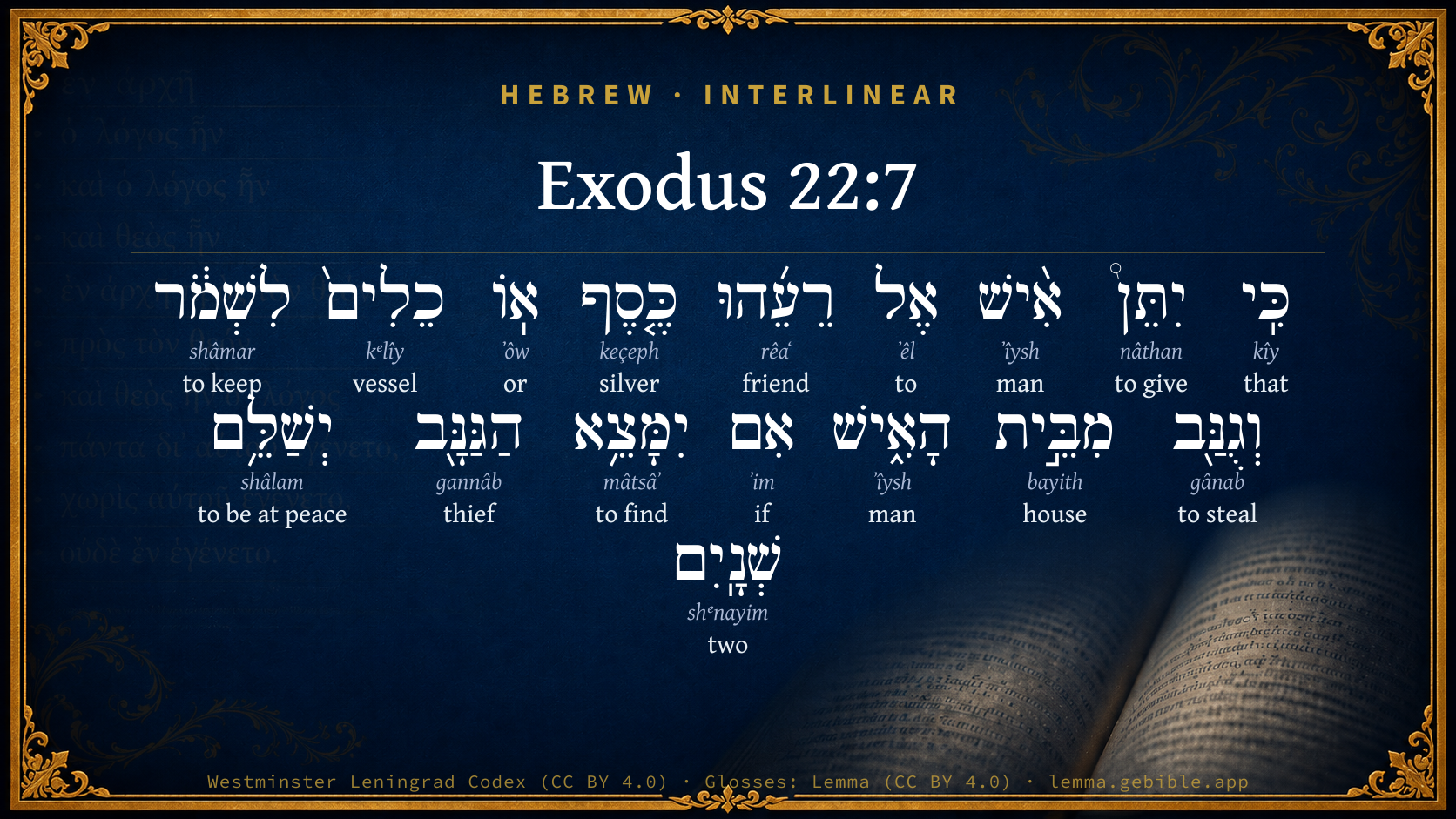
  1. כִּֽי kîy H3588 “that” Conjunction
  2. יִתֵּן֩ nâthan H5414 “to give” Verb, Qal, Imperfect, 3rd Person, Masculine, Singular
  3. אִ֨ישׁ ʼîysh H376 “man” Noun, Common, Masculine, Singular, Absolute
  4. אֶל ʼêl H413 “to” Preposition
  5. רֵעֵ֜הוּ rêaʻ H7453 “friend · his” Noun, Common, Masculine, Singular, Construct + Suffix, Personal, 3rd Person, Masculine, Singular
  6. כֶּ֤סֶף keçeph H3701 “silver” Noun, Common, Masculine, Singular, Absolute
  7. אֽוֹ ʼôw H176 “or” Conjunction
  8. כֵלִים֙ kᵉlîy H3627 “vessels” Noun, Common, Masculine, Plural, Absolute
  9. לִשְׁמֹ֔ר shâmar H8104 “to keep” Preposition + Verb, Qal, Infinitive Construct
  10. וְגֻנַּ֖ב gânab H1589 “and · to steal” Conjunction + Verb, Pual, Sequential Perfect, 3rd Person, Masculine, Singular
  11. מִבֵּ֣ית bayith H1004 “from · house of” Preposition + Noun, Common, Masculine, Singular, Construct
  12. הָאִ֑ישׁ ʼîysh H376 “the · man” Particle, Definite Article + Noun, Common, Masculine, Singular, Absolute
  13. אִם ʼim H518 “if” Conjunction
  14. יִמָּצֵ֥א mâtsâʼ H4672 “to find” Verb, Niphal, Imperfect, 3rd Person, Masculine, Singular
  15. יְשַׁלֵּ֥ם shâlam H7999 “to be at peace” Verb, Piel, Imperfect, 3rd Person, Masculine, Singular
  16. שְׁנָֽיִם shᵉnayim H8147 “two” Adjective, Cardinal number, Masculine, Dual, Absolute

About this verse

These counts appear in no published source. They are computed here, from the morphology-tagged text and Lemma’s own curated glosses. What Lemma adds →

17
words
16
distinct lemmas
Pentateuch
section

Notable vocabulary

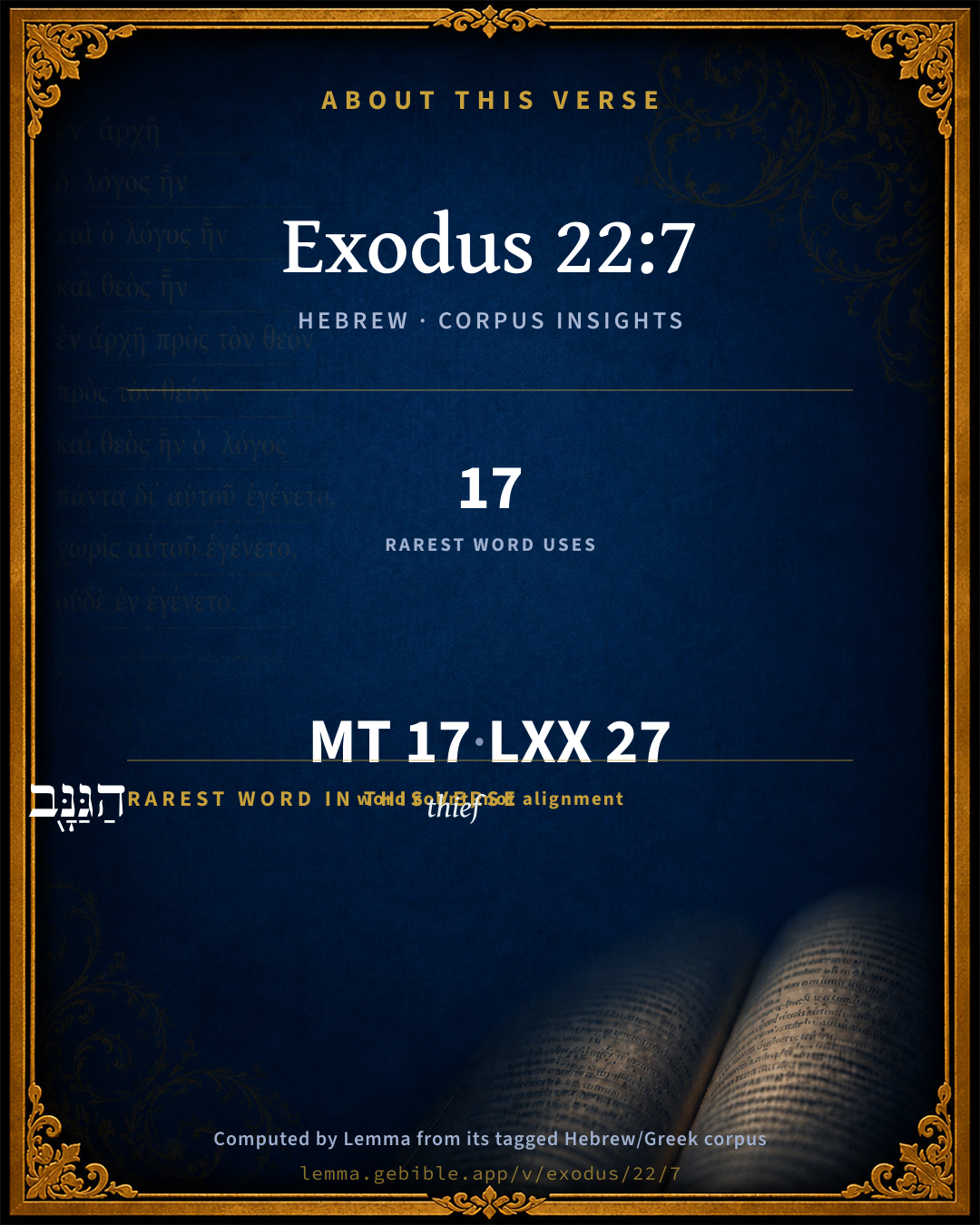
The rarest word here is הַגַּנָּ֖ב thief H1590 — appearing just 17 times in the whole Hebrew Bible.

Shared distinctive vocabulary

הַגַּנָּ֖ב thief H1590 occurs in 17 verses of the Hebrew Bible. Also found in:

Grammatical profile

  • 5 verbs
  • 7 nouns
  • 1 adjective
  • 1 preposition
  • 3 conjunctions

Verb forms

  • יִתֵּן֩ Qal · Imperfect
  • לִשְׁמֹ֔ר Qal · Infinitive Construct
  • וְגֻנַּ֖ב Pual · Sequential Perfect
  • יִמָּצֵ֥א Niphal · Imperfect
  • יְשַׁלֵּ֥ם Piel · Imperfect

Repetition

A word recurs within this verse — often emphatic in Hebrew:

  • אִ֨ישׁ man H376 ×2

Hebrew & Septuagint length

In English translation the verse runs 30 words from the Hebrew and 31 from the Septuagint (LXX English) — closely comparable.

A rough comparison of the two English renderings, which tokenize alike — not a word-level alignment.

Word counts can differ between the Hebrew and the Greek without any difference in meaning — e.g. the Hebrew direct-object marker אֵת has no separate Greek word, and Greek often adds the article ὁ.

In the original languages it is 17 Hebrew tokens and 27 Greek tokens — but the two are counted differently (Hebrew bundles its prefixes and suffixes into one token; the Greek is in lemma form), so that isn’t a like-for-like length.

Cross-references

2

Topical passages linked to Exodus 22:7 in the Treasury of Scripture Knowledge — connected by theme and wording, ordered by reader-vote popularity; previews shown in the World English Bible.

  • Exodus 22:4 If the stolen property is found in his hand alive, whether it is ox, donkey, or sheep, he shall pay double.
  • Proverbs 6:30–31 Men don't despise a thief, If he steals to satisfy himself when he is hungry:

Cross-references courtesy of OpenBible.info (CC BY 4.0).

Hebrew and Greek witnesses Masoretic Hebrew ↔ Greek Septuagint

The same verse in the two great witnesses to the Old Testament, shown verse-for-verse.

These are two independent witnesses, not word-aligned to each other, and the Septuagint is shown in lemma (dictionary) form.

Hebrew Exodus 22:7 Masoretic · Westminster Leningrad Codex

כִּֽי יִתֵּן֩ אִ֨ישׁ אֶל רֵעֵ֜הוּ כֶּ֤סֶף אֽוֹ כֵלִים֙ לִשְׁמֹ֔ר וְגֻנַּ֖ב מִבֵּ֣ית הָאִ֑ישׁ אִם יִמָּצֵ֥א הַגַּנָּ֖ב יְשַׁלֵּ֥ם שְׁנָֽיִם

"If a man delivers to his neighbor money or stuff to keep, and it is stolen out of the man's house; if the thief is found, he shall pay double.

World English Bible · Public Domain

Greek LXX Exodus 22:7 Septuagint · lemma form

ἐάν δέ μή εὑρίσκω ὁ κλέπτω προςἔρχομαι ὁ κύριος ὁ οἰκία ἐνώπιον ὁ θεός καί ὄμνυμι ἤ μήν μή αὐτός πονηρεύομαι ἐπί ὅλος ὁ παρακαταθήκη ὁ πλησίον

And if any one give to his neighbor money or goods to keep, and they be stolen out of the man's house, if the thief be found he shall repay double.

LXX2012 (modern English Septuagint) · Public Domain

Hebrew: Westminster Leningrad Codex (CC BY 4.0). Greek: Septuagint (public domain); English from LXX2012 (modern English Septuagint) (Public Domain). How the Septuagint differs from the Hebrew →

Targum (Aramaic paraphrase)

2

The Targum is the ancient Jewish Aramaic paraphrase of the Hebrew Scriptures — an interpretive translation, not the Hebrew text itself. Onkelos (literal) and Pseudo-Jonathan (expansive) render the Torah, and Jonathan the Prophets. Coverage is partial: where no permissively-licensed English translation exists for a verse, only the Aramaic is shown. This is verse-level text, not a word-by-word alignment to the Hebrew.

  1. Targum Onkelos Torah (Genesis–Deuteronomy)
    אִם לָא יִשְׁתְּכַח גַנָבָא וְיִתְקָרֵב מָרֵי דְבֵיתָא לִקֳדָם דַיָנַיָא אִם לָא אוֹשִׁיט יְדֵהּ בְּמָא דִמְסַר לֵהּ חַבְרֵהּ:

    (no public-domain English translation for this verse)

    Targum Onkelos — Aramaic: “Onkelos Genesis” (public domain); “Onkelos Exodus” (public domain); “Onkelos Leviticus” (public domain); “Onkelos Numbers” (public domain); “Onkelos Deuteronomy” (public domain). English: “Sefaria Community Translation” (CC0 1.0 (public-domain dedication)); “J.W. Etheridge. The Targums of Onkelos and Jonathan Ben Uzziel on the Pentateuch. London: Longmans, Green, 1862” (public domain). Text via Sefaria.

  2. Targum Pseudo-Jonathan Torah (Genesis–Deuteronomy)
    אִין לָא אִישְׁתַּכַּח גַּנְבָא וְיִתְקְרֵיב מָרֵיהּ בֵּיתָא לִקְדָם דַּיָינַיָא וְיוֹמֵי דְלָא אוֹשִׁיט יְדֵיהּ בְּעִיסְקָא דְחַבְרֵיהּ

    if the thief be found, he shall restore two for one. If the thief be not found, the master of the house shall be brought before the judges, and shall swear that he hath not put forth his own hand upon the property of his neighbour.

    Targum Pseudo-Jonathan — Aramaic: “Targum Jonathan on Genesis” (public domain); “Targum Jonathan on Exodus” (public domain); “Targum Jonathan on Leviticus” (public domain); “Targum Jonathan on Numbers” (public domain); “Targum Jonathan on Deuteronomy” (public domain). English: “The Targum of Jonathan ben Uzziel, trans. J. W. Etheridge, London, 1862” (public domain). Text via Sefaria.

Commentary

Notes on Exodus 22:7 from classic Christian and Jewish commentators (each source and its license shown beneath its notes). The classic Christian expositions comment on the surrounding passage and are grouped to its opening verse, so a note may address several verses; the Jewish commentaries on the Tanakh (Rashi and others) are per-verse, so they appear only where the commentator wrote on this verse.

Lemma curates 59 commentaries, every one of them public domain or Creative Commons licensed, each selected and text-cleaned for this edition rather than reprinted as found. About our sources →

Matthew Henry's Commentary

These laws are,

I. Concerning trusts, Exo 22:7-13. If a man deliver goods, suppose to a carrier to be conveyed, or to a warehouse-keeper to be preserved, or cattle to a farmer to be fed, upon a valuable consideration, and if a special confidence be reposed in the person they are lodged with, in case these goods be stolen or lost, perish or be damaged, if it appear that it was not by any fault of the trustee, the owner must stand to the loss, otherwise he that has been false to this trust must be compelled to make satisfaction. The trustee must aver his innocence upon oath before the judges, if the case was such as afforded no other proof, and they were to determine the matter according as it appeared. This teaches us, 1. That we ought to be very careful of every thing we are entrusted with, as careful of it, though it be another's, as if it were our own. It is unjust and base, and that which all the world cries shame on, to betray a trust. 2. That there is such a general failing of truth and justice upon earth as gives too much occasion to suspect men's honesty whenever it is their interest to be dishonest. 3. That an oath for confirmation is an end of strife, Heb 6:16. It is called an oath for the Lord (Exo 22:11), because to him the appeal is made, not only as to a witness of truth, but as to an avenger of wrong and falsehood. Those that had offered injury to their neighbour by doing any unjust thing, yet, it might be hoped, had not so far debauched their consciences as to profane an oath of the Lord, and call the God of truth to be witness to a lie: perjury is a sin which natural conscience startles at as much as any other. The religion of an oath is very ancient, and a plain indication of the universal belief of a God, and a providence, and a judgment to come. 4. That magistracy is an ordinance of God, designed, among other intentions, to assist men both in discovering rights disputed and recovering rights denied; and great respect ought to be paid to the determination of the judges. 5. That there is no reason why a man should suffer for that which he could not help: masters should consider this, in dealing with their servants, and not rebuke that as a fault which was a mischance, and which they themselves, had they been in their servants' places, could not have prevented.

II. Concerning loans, Exo 22:14, Exo 22:15. If a man (suppose) lent his team to his neighbour, if the owner was with it, or was to receive profit for the loan of it, whatever harm befel the cattle the owner must stand to the loss of: but if the owner was so kind to the borrower as to lend it to him gratis, and put such a confidence in him as to trust it from under his own eye, then, if any harm happened, the borrower must make it good. Let us learn hence to be very careful not to abuse any thing that is lent us; it is not only unjust, but base and disingenuous, inasmuch as it is rendering evil for good; we should much rather choose to lose ourselves than that any should sustain loss by their kindness to us. Alas, master! for it was borrowed, Kg2 6:5.

Matthew Henry's Commentary on the Whole Bible (1708–1710) — public domain (CC PDM 1.0). Text via the HelloAO Bible API.

Trapp's Complete Commentary

John Trapp

Exo 22:7 If a man shall deliver unto his neighbour money or stuff to keep, and it be stolen out of the man’s house; if the thief be found, let him pay double.

Ver. 7. Or stuff.] Heb., Vessels, instruments, ornaments, apparel, furniture, weapons, &c.

John Trapp, A Commentary or Exposition upon All the Books of the Old and New Testament (1647–1656) — public domain. Text from a community e-Sword module.

The Biblical Illustrator

Joseph S. Exell

Exo_22:7-13

If a man shall deliver unto his neighbour money or stuff to keep.

The law of trusts

1. Gods law provides strictly to keep men faithful to their trusts by men.

2. Theft may abuse and frustrate the trust of the most faithful men.

3. Such theft discovered is punished with double restitution by God.

4. In theft undiscovered and upon suspicion, trustees are bound to clear themselves by oath.

5. A right oath as it terminates upon God, so ought in some cases to be taken before magistrates (Exo_22:8).

6. In doubtful cases about trust, civil powers are enabled to try men, and judge by oath.

7. The falsifier of trust convicted must restore double (Exo_22:9).

8. Living stuff trusted to any and dying, none knowing how, the trustees oath must clear him (Exo_22:10-11).

9. Living goods trusted to keeping upon consideration if stolen, must be made good by the keeper (Exo_22:12).

10. No law binds men to restore what Providence takes away from men by wild beasts (Exo_22:13). (G. Hughes, B. D.)

The Biblical Illustrator, edited by Joseph S. Exell (c. 1880s–1900s) — public domain. Text from a community e-Sword module.

Joseph Benson's Commentary

Exo 22:7-13. If a man deliver goods, suppose to a carrier to be conveyed, or to a warehouse-keeper to be preserved, or cattle to a farmer to be fed, upon a valuable consideration, and a special confidence reposed in the person they are lodged with, in case these goods be stolen or lost, perish or be damaged, if it appear that it was not by any fault of the trustee, the owner must stand to the loss; otherwise, he that has been false to his trust must be compelled to make satisfaction.

Joseph Benson's Commentary on the Old and New Testaments (1811–1818) — public domain. Text from a community e-Sword module.

The Preacher's Complete Homiletical Commentary

Joseph S. Exell (gen. ed.)

CRITICAL NOTES.—

Exo_22:8-9. Judges.] See Critical Note on Exo_21:6.

SUGGESTIVE COMMENTS ON THE VERSES

THE SANCTITY OF HUMAN TRUSTS.—Exo_22:7-13

This paragraph recognises the sanctity of trust reposed on the principles—

1. of neighbourliness;

2. of trade.

I. If a man entrusted property, Exo_22:7, “money or stuff,” which it was impossible or inconvenient to keep himself, to his neighbour, the trustee was responsible for its safety.

1. If it was stolen and the thief discovered, of course the thief was punished.

2. But if the thief escaped, the holder, either as negligent or guilty, was fined double its value. From Exo_22:9, however, it would appear that the judges had some discretion in the matter.

II. In the case of any beast, lent presumably for the purposes of trade, being hurt or lost.

1. If upon oath the borrower declared his innocence and proved his carefulness, that was deemed sufficient.

2. But if stolen, as careless, he had to make restitution.

3. Or if slain by wild beasts, and the carcase were produced, then, as his courage and vigilance were not at fault, he was released from responsibility.

III. But the responsibility must be submitted to judicial examination and decision, Exo_22:9. Thus guarding on the one hand recklessness, and on the other unreasonable exactions.

Application.—“Bear ye one another’s burdens, and so fulfil,” not only the law of Moses, but “the law of Christ.”

i. On the one hand—

(1.) Be neighbourly (Luk_6:30, &c.).

(2.) Take the same care of the matters in which you have obliged your neighbours, as you do of your own. If he has entrusted his goods to you, protect them. If his secrets, do not divulge them. If his liberty or character, through previous service of yours, do not threaten them. If the guardianship of his defenceless children, do not neglect them. ii. On the other hand, if your neighbour has obliged you—

(1.) Do not impose on his good nature.

(2.) Don’t suspect that, if your interests have been damaged because it was his interest to damage them, he has done so.

(3.) In ordinary cases, unless you have good reason for the contrary, take his word.

(4.) Don’t make him suffer for circumstances over which he had no control. The whole subject it full of interest to masters and servants, employers and employed.—J. W. Burn.

ILLUSTRATIONS

BY

REV. WILLIAM ADAMSON

Divine Enactments! Exo_22:1-31.

(1) There is a world of difference between a stained glass window and a kaleidoscope. Their relative values are very different, and so is their structure. The pieces of variegated glass are flung anyhow, for the prism to arrange; whereas, those employed in the window are all arranged to give a beautiful, effective, and abiding impression. These separate enactments are not strung together haphazard. On the contrary, they are chords divinely arranged to produce harmony in the world, and give forth strains of Divine adoration in their observance.

(2) If one side of a tree grows, and the other does not, the tree acquires a crooked form. It may be fruitful, but it cannot be beautiful. God would have humanities and nationalities, theocracies and individualities, both rich in the beauties of holiness and the fruits of righteousness. The unequal growth of the Christian graces is undesirable; hence the numerous Divine precautions to make them alike fair, fragrant, and fruitful.

“Stern lawgiving! yet thou dost wear

The Godhead’s most benignant grace;

Flowers laugh before thee on their beds;

And fragrance in thy footing treads;

Thou dost preserve the stars from wrong.”

—Wordsworth.

Honesty! Exo_22:9.

(1) Entrusted! A writer in the “Sunday at Home,” alluding to the honesty of the Malays in the Dutch Indies, says that his business required frequent absences, during which he left his house in their care. Before setting out, he gave the key of his bureau to the mandoor, and told him to take care of the money it contained. He says he never found a single farthing amissing—that sometimes returning late, the servant would be found sleeping close to the bureau for its greater security—and that during all the time he passed in the island, he had no occasion to complain of the theft of any article.

(2) Lost! Not far from St. Petersburgh lived a poor woman, whose only livelihood arose from the visits of a few shipmasters on their way to the capital. One of these left behind a sealed bag of money; which the woman put away in her cupboard till it should be claimed. Years rolled on; and though often in great want, the bag of gold still remained sacredly intact. Seven years afterwards, some shipmasters were again staying at her house, when one of them remarked that he would never forget the town they were then visiting, for he had years before lost a sealed bag of 700 roubles. The poor woman overhearing the remark, said, “Would you know it by the seal?” The shipmaster pointed to a seal hanging by his watch-chain; and the bag was at once produced and restored to its rightful owner.

“An honest man is still an unmoved rock,

Washed whiter, but not shaken with the shock.”

—Davenport.

Trust-Restitution! Exo_22:9.

(1) Recently & lady went to parison on a visit, entrusting her house and furniture to a friend, on whose honesty she relied. Unfortunately the confidence was misplaced; and during her absence, articles of considerable value were removed. On her return, the discovery was made, and the person guilty of so contemptible a breach of trust arraigned. The judge ordered him to restore all the objects of vertu which he had purloined, and to suffer a term of imprisonment for his breach of trust.

(2) A poor widow entrusted the title-deeds of some properly, left by her husband, to a solicitor, in whom she had confidence. Her trust was, however, grossly abused, as he retained the deeds on the plea of some false debt due by the husband. After long and persistent endeavours to obtain recovery of the documents, but in vain, the defrauded widow was advised to apply to the Lord Chancellor. On inquiry, the judge decided that the dishonest lawyer must either deliver up the title-deeds and make restitution for their retention, or be struck off the roll of solicitors.

“Justice has her laws,

That will not brook infringement; in all time,

All circumstances, all state, in every clime,

She holds aloft the same avenging sword.”

—Percival.

Conscience-Restitution! Exo_22:12. Gray mentions that as a gentleman in London entered his house, he found a well-dressed female sitting on the stairs. She asked pardon for the liberty she had taken, saying that she had taken refuge for a few minutes in his house from a mad dog. On hearing her story, he gave her some refreshment before she left. In the evening, his wife missed her gold watch—it having been purloined by the forenoon visitor. Fifteen years afterwards, the watch was returned, with a note from the. thief. It stated that the Gospel had recently changed her heart, and that in consequence she desired to return the watch to its rightful owner.

“Conscience! It is a dangerous thing.

It made me once

Restore a purse of gold.”

—Shakespeare.

The Preacher's Complete Homiletical Commentary (gen. ed. Joseph S. Exell; Funk & Wagnalls, c. 1892) — public domain (pre-1929). A full-Bible homiletical/sermon-outline anthology covering 65 of 66 books (2 John is absent from the source module). Text from a community e-Sword module.

Keil & Delitzsch

C. F. Keil & F. Delitzsch

In cases of dishonesty, or the loss of property entrusted, the following was to be the recognised right: If money or articles (כּלים, not merely tools and furniture, but clothes and ornaments, cf. Deu 22:5; Isa 61:10) given to a neighbour to keep should be stolen out of his house, the thief was to restore double if he could be found; but if he could not be discovered, the master of the house was to go before the judicial court (האלהים אל, see Exo 21:6; אל נקרב to draw near to), to see "whether he has not stretched out his hand to his neighbour's goods." מלאכה: lit., employment, then something earned by employment, a possession. Before the judicial court he was to cleanse himself of the suspicion of having fraudulently appropriated what had been entrusted to him; and in most cases this could probably be only done by an oath of purification. The Sept. and Vulg. both point to this by interpolating καὶ ὀμεῖται, et jurabit ("and he shall swear"), though we are not warranted in supplying ויּשּׁבע in consequence. For, apart from the fact that אם־לא is not to be regarded as a particle of adjuration here, as Rosenmller supposes, since this particle signifies "truly" when employed in an oath, and therefore would make the declaration affirmative, whereas the oath was unquestionably to be taken as a release from the suspicion of fraudulent appropriation, and in case of confession an oath was not requisite at all; - apart from all this, if the lawgiver had intended to prescribe an oath for such a case, he would have introduced it here, just as he has done in Exo 22:11. If the man could free himself before the court from the suspicion of unfaithfulness, he would of course not have to make compensation for what was lost, but the owner would have to bear the damage. This legal process is still further extended in Exo 22:9 : על־כּל־דּבר־פּשׁע, "upon every matter of trespass" (by which we are to understand, according to the context, unfaithfulness with regard to, or unjust appropriation of, the property of another man, not only when it had been entrusted, but also if it had been found), "for ox, for ass, etc., or for any manner of lost thing, of which one says that it is this ("this," viz., the matter of trespass), the cause of both (the parties contending about the right of possession) shall come to the judicial court; and he whom the court (Elohim) shall pronounce guilty (of unjust appropriation) shall give double compensation to his neighbour: only double as in Exo 22:4 and Exo 22:7, not four or fivefold as in Exo 22:1, because the object in dispute had not been consumed.

Keil & Delitzsch — Biblical Commentary on the Old Testament (1861–1891) — public domain (CC PDM 1.0). Text via the HelloAO Bible API. (Old Testament only.)

Adam Clarke's Commentary

Verse 7. Deliver unto his neighbour] This is called pledging in the law of bailments; it is a deposit of goods by a debtor to his creditor, to be kept till the debt be discharged. Whatever goods were thus left in the hands of another person, that person, according to the Mosaic law, became responsible for them; if they were stolen, and the thief was found, he was to pay double; if he could not be found, the oath of the person who had them in keeping, made before the magistrates, that he knew nothing of them, was considered a full acquittance. Among the Romans, if goods were lost which a man had intrusted to his neighbour, the depositary was obliged to pay their full value. But if a man had been driven by necessity, as in case of fire, to lodge his goods with one of his neighbours, and the goods were lost, the depositary was obliged to pay double their value, because of his unfaithfulness in a case of such distress, where his dishonesty, connected with the destruction by the fire, had completed the ruin of the sufferer. To this case the following law is applicable: Cum quis fidem elegit, nec depositum redditur, contentus esse debet simplo: cum vero extante necessitate deponat, crescit perfidia crimen, &c. - Digest., lib. xvi., tit. 3, 1. 1.

Adam Clarke's Commentary on the Bible (1810–1826) — public domain. Text from a community e-Sword/MySword module.

Ellicott's Commentary for English Readers

(7) If a man shall deliver unto his neighbour money or stuff to keep.—The practice of making deposits of this kind was widespread among ancient communities, where there were no professional bankers or keepers of warehouses. The Greeks called such a deposit παρακαταθήκη. It was usually made in money, or at any rate in the precious metals. A refusal to restore the thing deposited was very rare, since a special nemesis was considered to punish such conduct (Herod, vii. 86). However, at Athens it was found necessary to have a peculiar form of action for the recovery of deposits (παρακαταθήκης δίκη).

(7-13) Property deposited in the hands of another for safe keeping might be so easily embezzled by the trustee, or lost through his negligence, that some special laws were needed for its protection. Conversely the trustee required to be safe-guarded against incurring loss if the property intrusted to his care suffered damage or disappeared without fault of his. The Mosaic legislation provided for both cases. On the one hand, it required the trustee to exercise proper care, and made him answerable for the loss if a thing intrusted to him was stolen and the thief not found. Embezzlement it punished by requiring the trustee guilty of it to “pay double.” On the other hand, in doubtful cases it allowed the trustee to clear himself by an oath (Exo_22:10), and in clear cases to give proof that the loss had happened through unavoidable accident (Exo_22:12).

A Bible Commentary for English Readers, edited by Charles John Ellicott (1878–1897) — public domain. Text from a community e-Sword module.

The Cambridge Bible for Schools and Colleges

gen. ed. J. J. S. Perowne

7. stuff] Heb. kçlim, plur. of keli, a very general term, including both household articles (Gen_45:20; Jos_7:11 ‘stuff,’ as here; Lev_13:49 ‘thing’), vessels (ch. Exo_27:3; 2Ki_4:3), jewels or ornaments (ch. Exo_3:22), as also weapons or armour (Gen_27:3, 1Sa_14:1, &c.), instruments (Exo_27:19 al.; Amo_6:5), &c.

to keep] for safety (cf. the story of the παρακαταθήκη, or ‘deposit,’ entrusted to the Spartan, Glaucus, in Hdt. vi. 86).

7, 8. If a man receives money or any household article for safe custody, and it is stolen, the thief, if he can be discovered, is to repay twofold (v. 7); if the thief cannot be discovered, the man to whom the property was entrusted must be acquitted at a sanctuary of the suspicion which will then naturally light upon him (v. 8).

7–13. Compensation for loss or damage in various cases of deposit. At the present day, among the Bedawin, a man going on a journey for instance will deposit money or goods with another for safety during his absence. Such a deposit is regarded by the Arabs as a sacred trust (Cook, p. 227; Doughty, i. 176, 267, 280, ii. 301).

The Cambridge Bible for Schools and Colleges (gen. ed. J. J. S. Perowne; Cambridge University Press, 1878–1918) — public domain. Text from a community e-Sword module.

John Gill's Exposition

If a man shall deliver unto his neighbour money or stock to keep,.... Without any reward for keeping it, as the Targum of Jonathan; and so other Jewish writers (p) understand this passage of such as keep a deposit freely, having nothing for it; whether it be money or goods, gold, silver, jewels, raiment, household stuff or any kind of vessels or instruments used in the house, or in trade; and also cattle, as appears from Exo 22:9.

and if it be stolen out of the man's house; into whose custody it was delivered:

if the thief be found, let him pay double: the worth of what is stolen, agreeably to the law in Exo 22:4 that is, if it was found in his hands; but if he had disposed of it, then he was to pay five fold or four fold, as in Exo 22:1, and so runs the Jewish canon (q),"if anyone delivers to his neighbour a beast or vessels, and they are stolen or lost, he shall make restitution; but if he will not swear, for they say, one that keeps for nothing, may swear and be free; then if the thief should be found he shall pay double; if he has killed or sold, he shall pay four fold or five fold: to whom shall he pay? to him with whom the depositum is: if he swears, and will not pay, and the thief is found, he shall pay double; if he has killed or sold he shall pay four fold and five fold: to whom shall he pay? to the owner of the depositum.''

(p) Jarchi in ver. 10. Bartenora in Misn. Shebuot, c. 6. sect. 5. (q) Misn. Bava Metzia, c. 3. sect. 1.

John Gill's Exposition of the Whole Bible (1746–1763) — public domain (CC PDM 1.0). Text via the HelloAO Bible API.

Matthew Poole's English Annotations

Stuff, Heb. vessels, garments, utensils, or any kind of household stuff.

Matthew Poole's English Annotations on the Holy Bible (1683–1685) — public domain. Text from a community e-Sword/MySword module.

The Pulpit Commentary

Vers. 7-13. LAW OF DEPOSITS. Deposition of property in the hands of a friend, to keep and guard, was a marked feature in the life of primitive societies, where investments were difficult, and bankers unknown. Persons about to travel, especially merchants, were wont to make such a disposition of the greater part of their movable property, which required some one to guard it in their absence. Refusals to return such deposits were rare; since ancient morality regarded such refusal as a crime of deep dye (Heb 7:86). Sometimes, however, they took place; and at Athens there was a special form of action which might be brought in such cases called parakataqhkhv dikh. The penalty, if a man were east in the suit, was simple restitution, which is less satisfactory than the Mosaic enactment shall pay double" (ver. 9).

Stuff. Literally "vessels but the word is used in a very wide sense, of almost any inanimate movables.

Ver. 7, 8. The sacred character of trusts.

The main teaching of this third paragraph of ch. 22. is the sacred character of human trusts. Men are taught that they must carefully guard the property of others when committed to their charge, and religiously restore it upon demand to its rightful owner. No conversion of such property to the use of the trustee, under any circumstances whatever, is to be tolerated. The principle laid down with respect to ancient, will apply equally to modern, trusts:

I If the thing entrusted be stolen, without the trustee being justly chargeable with having contributed to the theft by negligence, the loss must fall on the owner.

II If it be lost by. non-preventible accident, as when a lion carries off a lamb, or when a ship goes down at sea, the case is the same the trustee is not liable.

III If, on the other hand, the trustee neglect to take sufficient care, and damage occurs, he is bound to make good the injury caused by his own laches.

IV If he actually embezzle the trust, simple restitution will not meet the full claims of justice. He ought to be made to refund, and to be punished besides.

V In doubtful cases the oath, or solemn assurance, of the trustee, that he has conveyed no part of the trust to his own use, ought to be accepted.

Trusts are among the most important of the contracts and obligations, whereby human society is carried on. Strict honesty and much thought and care are requisite on the one hand, confidence, gratitude and tender consideration on the other. Trustees, it is to be remembered, do, for the most part, unpaid work. No one can be compelled to be a trustee. And. unless a generous confidence is put in them, and their good intentions are presumed, alike by the law and by those for whom they act, trusteeship will be declined by prudent men, and great inconveniences will follow.

The Pulpit Commentary (1880–1919), ed. H.D.M. Spence-Jones & Joseph S. Exell — public domain. Text from a community e-Sword module.

John Wesley's Explanatory Notes

If a man deliver goods, suppose to a carrier to be conveyed, or to a warehouse-keeper to be preserved, or cattle to a farmer to be fed upon a valuable consideration, and a special confidence reposed in the person they are lodged with; in case these goods be stolen or lost, perish or be damaged, if it appear that it was not by any fault of the trustee, the owner must stand to the loss, otherwise he that has been false to his trust must be compelled to make satisfaction.

John Wesley, Explanatory Notes Upon the Whole Bible (1754–1765) — public domain. Text via the GEBible commentary corpus.

unfoldingWord translationNotes

Door43 World Missions Community

for safe keeping

"to watch over it" or "to keep it safe"

if it is stolen

This can be stated in active form. AT: "if someone steals it" (See: Active or Passive)

thief

someone who steals something

if the thief is found

This can be stated in active form. AT: "if you find the thief" (See: Active or Passive)

come before the judges to see whether

"come before the judges so that they can find out if"

has put his own hand on his neighbor's property

This is an idiom. If you have a way of saying this in your language, you can use it here. AT: "has stolen his neighbor's property" (See: Idiom)

the claim of both parties must come before the judges

The judges must listen to both people who claim that the item belongs to them and the judges will decide who is guilty.

translationWords

neighbor

judge, judges

guilt

unfoldingWord translationNotes — © Distant Shores Media and the Door43 World Missions Community, licensed CC BY-SA 4.0. Source: git.door43.org/Door43/en_tn.

Rashi

Rabbi Shlomo Yitzchaki (Rashi)

אם לא ימצא הגנב IF THE THIEF BE NOT FOUND then this bailee — who is בעל הבית “the owner of the house” for the time being (since the bailment is then in his possession although he is not really its owner) — shall come.

ונקרב אל AND SHALL APPROACH UNTO THE אלהים — the judges, to put his case against the other and to swear unto him that he has not put forth his hands against his property (Bava Kamma 63b).

Rashi on the Tanakh — English translations: “The Judaica Press complete Tanach with Rashi, translated by A. J. Rosenberg” (CC BY 4.0); “Pentateuch with Rashi's commentary by M. Rosenbaum and A.M. Silbermann, 1929-1934” (public domain); “The Metsudah Tanach series, Lakewood, N.J” (CC BY 4.0); and “The Book of Joshua, Metsudah Publications, 1997” (CC BY 4.0). Text via Sefaria.

Ramban (Nachmanides)

Rabbi Moshe ben Nachman (Ramban / Nachmanides)

WHETHER HE HAVE NOT PUT HIS HAND UNTO HIS NEIGHBOR’S GOODS. In the opinion of Rashi this means that the guardian is to come before the judges to swear that he has not put his hand to his fellow-man’s goods [i.e., that he is not guilty of embezzlement]. The correct interpretation is that he is to come before the judges to swear that it was stolen and thus substantiate his claim, but he can only swear thus if he did not put his hand to make use of his neighbor’s goods, for he who puts to his own use what had been left in his keeping is answerable for it as if he were a robber, and is liable to make restitution even if it was lost through an unavoidable accident.

Ramban (Nachmanides) on the Tanakh — English translation: “Commentary on the Torah by Ramban (Nachmanides). Translated and annotated by Charles B. Chavel. New York, Shilo Pub. House, 1971-1976” (CC BY 4.0). Text via Sefaria.

Lesson kit

Teaching starters — assembled from the data on this page, not authored interpretation. Every prompt links to the verse data it draws on. Edit before teaching.

Exodus, in the Pentateuch, opens this verse with 17 words (16 distinct Hebrew lemmas). Its most distinctive word is gannâb (“thief”). A historical commentator’s framing appears above. Read the whole chapter for the surrounding context.

Discussion questions

  1. What does “thief” (gannâb) contribute to the verse as a whole?
  2. How does Exodus 22:2, which shares the word «thief», read alongside this verse?
  3. What does the repetition of “man” (2× in this one verse) do in this verse?
  4. These translations render this verse differently. What is at stake in choosing one wording over another?
  5. «יִתֵּן֩» is a Qal Imperfect verb. How does that grammatical form shape the action described?
  6. Compare how Matthew Henry's Commentary and Trapp's Complete Commentary read this verse. Where do they agree or differ?

Things to notice

Reading settings

Reading text

Shown beneath each verse's original-language words.

Old Testament
Old Testament edition

Read the OT as the Masoretic Hebrew (MT) or the Greek Septuagint (LXX).

English shown for the Greek Septuagint (in the Hebrew ↔ Greek comparison).

Comparing translations? Open the Compare panel on any verse page to stack up to four side by side.