Exodus 26:32

Hebrew (Westminster Leningrad Codex) Exodus 26:32 appears in the Hebrew Old Testament. The text above is from the Westminster Leningrad Codex. Each word links to its Strong’s number, a concise gloss, and parsing drawn from the Open Scriptures Hebrew Bible morphology. Click any word for its full Brown-Driver-Briggs (BDB) entry.
Download image
Cite this verse

Exodus 26:32 (World English Bible). Public Domain. Lemma interlinear Bible study tool, https://lemma.gebible.app/v/exodus/26/32.

Show BibTeX & RIS
BibTeX
RIS
English Translation
You shall hang it on four pillars of acacia overlaid with gold; their hooks shall be of gold, on four sockets of silver.
World English Bible · Public Domain
Highlights
  • 1 first appearance in the Hebrew Bible
Full analysis ↓
Download a study sheet

One document with this verse’s original text, its word-by-word gloss line, the meaning frame, cross-references with their text, attributed commentary, and full source and license credits — printable, and it pastes into notes with its structure intact.

This verse Autodidact and up

Study sheet (.html) Plain text (.txt)

A passage Seminary Student

Up to 50 verses in one chapter. A passage sheet keeps up to 6 commentary sources and 12 cross-references per verse, in the order this page ranks them, and says so on the sheet whenever that leaves anything out. Ask for a single verse and you get the Autodidact verse sheet above.

Everything on this page stays free to read, with no account — the sheet is a download of what is already on screen, not access to it.

Want to remove ads? Support Godless Engineer
Compare translations 3

The same verse in 3 English versions, stacked beneath the original-language interlinear above. Click any original word for its lexicon entry.

Each is an independent rendering of the whole verse — the interlinear is not word-aligned to these translations.

Highlighted words mark where these versions differ — a whole-verse word diff, not a word-by-word alignment.

  • World English Bible Public Domain
    You shall hang it on four pillars of acacia overlaid with gold; their hooks shall be of gold, on four sockets of silver.
  • King James Version Public Domain
    And thou shalt hang it upon four pillars of shittim wood overlaid with gold: their hooks shall be of gold, upon the four sockets of silver.
  • unfoldingWord Literal Text CC BY-SA 4.0
    And you shall hang it on four pillars of acacia wood covered with gold and their hooks of gold on four bases of silver.

unfoldingWord Literal Text — © unfoldingWord, licensed CC BY-SA 4.0. Word-aligned USFM3 via Door43 (git.door43.org/unfoldingWord/en_ult).

Versions to compare (up to 4)

3 of 4 selected

Show all 18 translations

Every available English version of this verse, each an independent rendering of the whole verse.

  • World English Bible Public Domain
    You shall hang it on four pillars of acacia overlaid with gold; their hooks shall be of gold, on four sockets of silver.
  • Berean Standard Bible Public Domain
    Hang it with gold hooks on four posts of acacia wood, overlaid with gold and standing on four silver bases.
  • Majority Standard Bible Public Domain
    Hang it with gold hooks on four posts of acacia wood, overlaid with gold and standing on four silver bases.
  • King James Version Public Domain
    And thou shalt hang it upon four pillars of shittim wood overlaid with gold: their hooks shall be of gold, upon the four sockets of silver.
  • American Standard Version (1901) Public Domain
    And thou shalt hang it upon four pillars of acacia overlaid with gold; their hooks `shall be' of gold, upon four sockets of silver.
  • Revised Version (1885) Public Domain
    and thou shalt hang it upon four pillars of acacia overlaid with gold, their hooks shall be of gold, upon four sockets of silver.
  • Geneva Bible (1599) Public Domain
    And thou shalt hang it vpon foure pillars of Shittim wood couered with gold, (whose hookes shalbe of gold) stading vpon foure sockets of siluer.
  • Douay-Rheims (1899) Public Domain
    And thou shalt hang it up before four pillars of setim wood, which themselves also shall be overlaid with gold, and shall have heads of gold, but sockets of silver.
  • Young's Literal Translation Public Domain
    and thou hast put it on four pillars of shittim wood, overlaid `with' gold, their pegs `are' of gold, on four sockets of silver.
  • Literal Standard Version CC BY-SA 4.0
    and you have put it on four pillars of shittim wood, overlaid [with] gold, their pegs [are] of gold, on four sockets of silver.
  • Unlocked Literal Bible CC BY-SA 4.0
    You must hang it on four pillars of acacia wood covered with gold. These pillars must have hooks of gold set on four silver bases.
  • unfoldingWord Literal Text CC BY-SA 4.0
    And you shall hang it on four pillars of acacia wood covered with gold and their hooks of gold on four bases of silver.
  • Darby Bible Public Domain
    And thou shalt attach it to four pillars of acacia-wood overlaid with gold, their hooks of gold; they shall be on four bases of silver.
  • World Messianic Bible Public Domain
    You shall hang it on four pillars of acacia overlaid with gold; their hooks shall be of gold, on four sockets of silver.
  • Webster's Bible Public Domain
    And thou shalt hang it upon four pillars of shittim wood overlaid with gold: their hooks shall be of gold, upon the four sockets of silver.
  • Free Bible Version CC BY-SA 4.0
    Using gold hooks hang it from four posts of acacia wood covered with gold, held up by four silver stands.
  • Bible in Basic English Public Domain
    Hanging it by gold hooks from four pillars of wood, plated with gold and fixed in silver bases.
  • JPS Tanakh (1917) Public Domain
    And thou shalt hang it upon four pillars of acacia overlaid with gold, their hooks being of gold, upon four sockets of silver.

Literal Standard Version (2020), Covenant Press — licensed CC BY-SA 4.0. Text via the HelloAO Bible API (eBible.org). Unlocked Literal Bible (unfoldingWord) — licensed CC BY-SA 4.0. Text via the HelloAO Bible API (eBible.org). unfoldingWord Literal Text — © unfoldingWord, licensed CC BY-SA 4.0. Word-aligned USFM3 via Door43 (git.door43.org/unfoldingWord/en_ult). Free Bible Version, Dr. Jonathan Gallagher — licensed CC BY-SA 4.0. Text via the HelloAO Bible API (eBible.org).

Word by word

More ways to search: Search by grammar → Find every occurrence → Compare this word →

Practice this passage: Drill this verse → Learn its vocabulary →

וָוֵיהֶ֖ם
vâv
H2053
“hooks · their”
Noun, Common, Masculine, Plural, Construct + Suffix, Personal, 3rd Person, Masculine, Plural
Part of Speech
Noun
Type
Common
Gender
Masculine
Number
Plural
State
Construct
Full BDB Definition

Origin: probably a hook (the name of the sixth heb. letter)

TWOT: 520

hook, peg, nail, pin
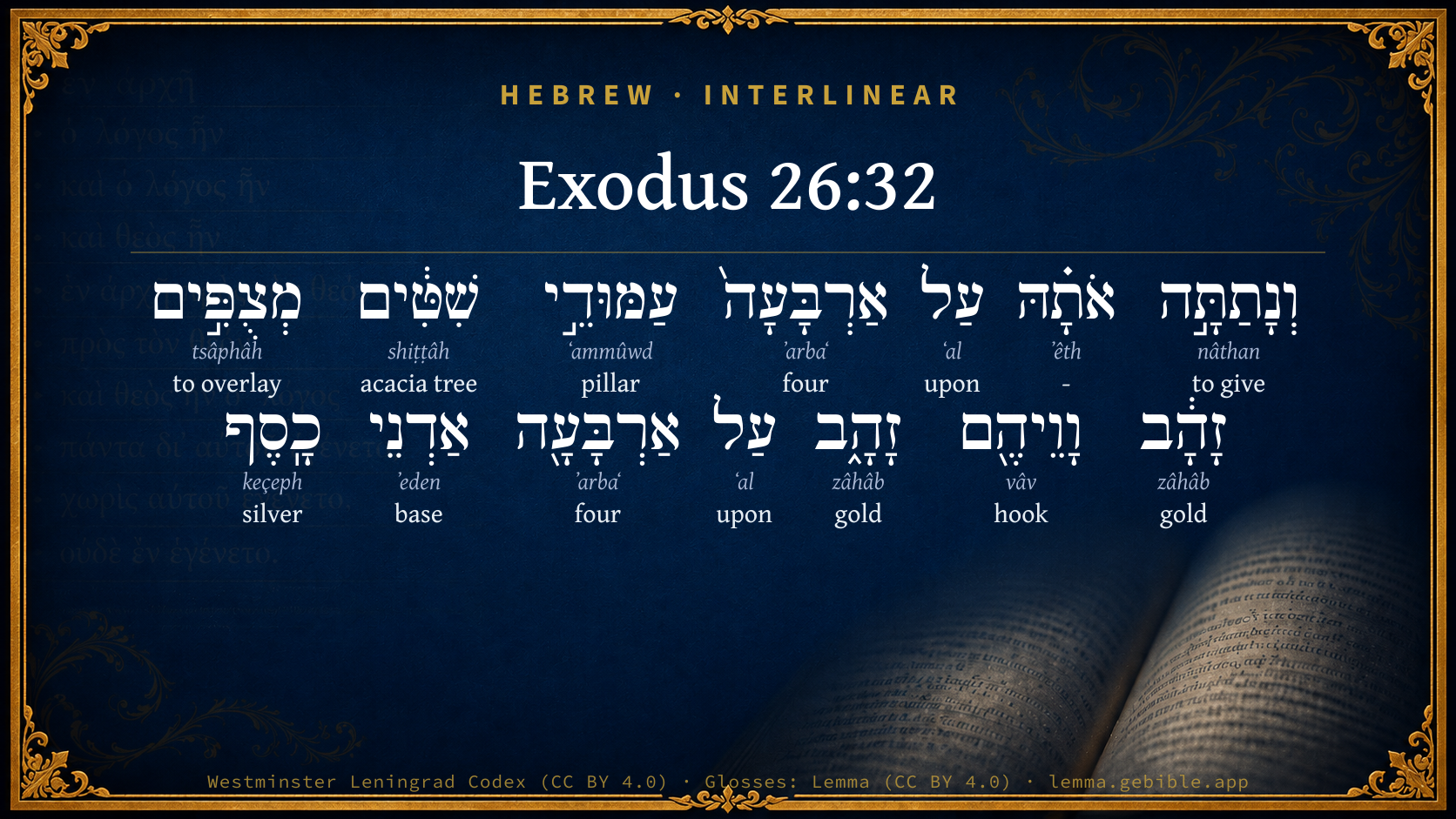
  1. וְנָתַתָּ֣ה nâthan H5414 “and · to give” Conjunction + Verb, Qal, Sequential Perfect, 2nd Person, Masculine, Singular
  2. אֹתָ֗הּ ʼêth H853 “- · her” Particle, Direct Object + Suffix, Personal, 3rd Person, Feminine, Singular
  3. עַל ʻal H5921 “upon” Preposition
  4. אַרְבָּעָה֙ ʼarbaʻ H702 “four” Adjective, Cardinal number, Masculine, Singular, Absolute
  5. עַמּוּדֵ֣י ʻammûwd H5982 “pillars of” Noun, Common, Masculine, Plural, Construct
  6. שִׁטִּ֔ים shiṭṭâh H7848 “acacia trees” Noun, Common, Feminine, Plural, Absolute
  7. מְצֻפִּ֣ים tsâphâh H6823 “overlayed” Verb, Pual, Participle Passive, Masculine, Plural, Absolute
  8. זָהָ֔ב zâhâb H2091 “gold” Noun, Common, Masculine, Singular, Absolute
  9. זָהָ֑ב zâhâb H2091 “gold” Noun, Common, Masculine, Singular, Absolute
  10. עַל ʻal H5921 “upon” Preposition
  11. אַרְבָּעָ֖ה ʼarbaʻ H702 “four” Adjective, Cardinal number, Masculine, Singular, Absolute
  12. אַדְנֵי ʼeden H134 “bases of” Noun, Common, Masculine, Plural, Construct
  13. כָֽסֶף keçeph H3701 “silver” Noun, Common, Masculine, Singular, Absolute

About this verse

These counts appear in no published source. They are computed here, from the morphology-tagged text and Lemma’s own curated glosses. What Lemma adds →

14
words
11
distinct lemmas
Pentateuch
section

Notable vocabulary

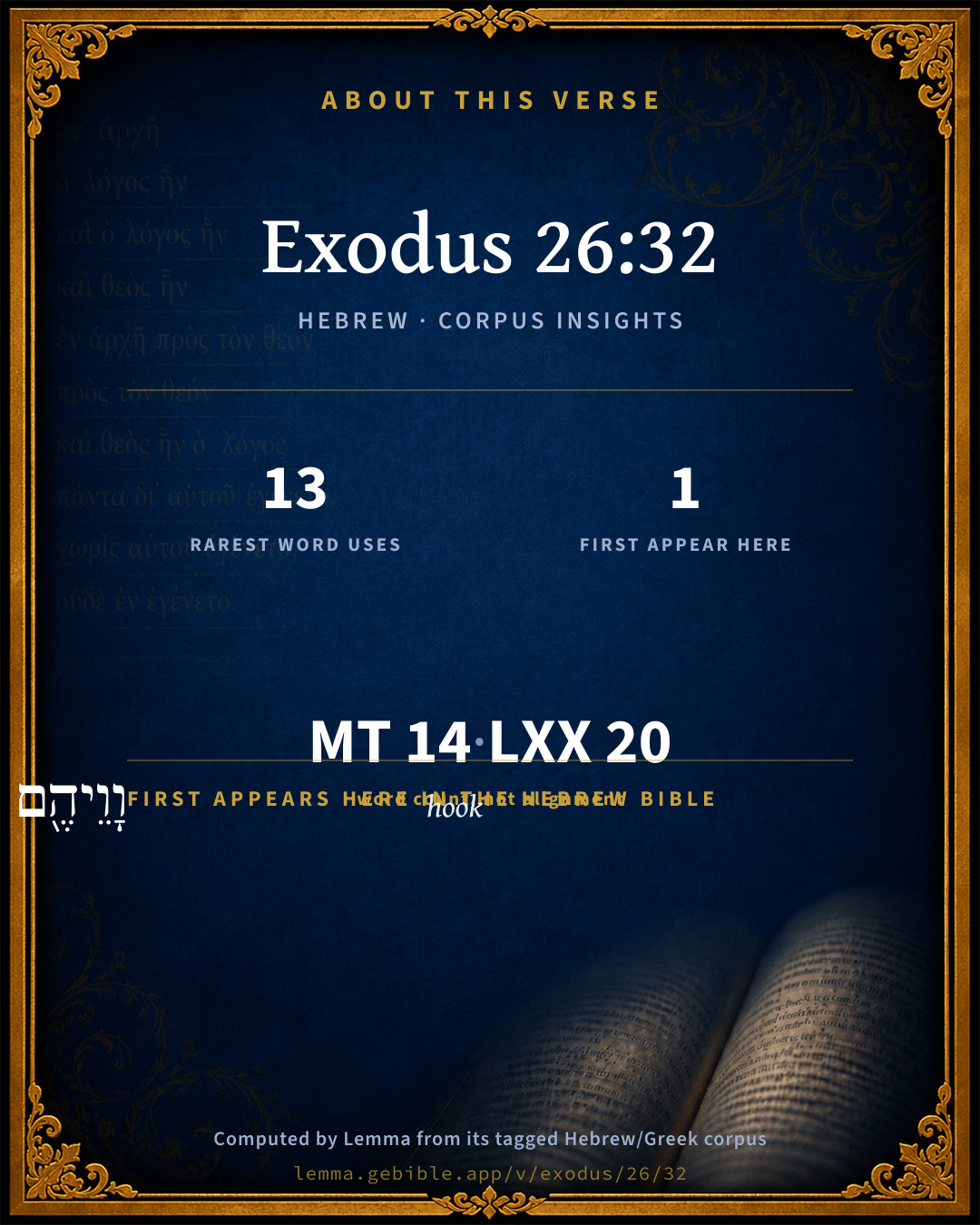
The rarest word here is וָוֵיהֶ֖ם hook H2053 — appearing just 13 times in the whole Hebrew Bible.

First appearance in Scripture

This word makes its first canonical appearance in the Hebrew Bible here:

  • וָוֵיהֶ֖ם hook H2053

Shared distinctive vocabulary

וָוֵיהֶ֖ם hook H2053 occurs in 13 verses of the Hebrew Bible. Also found in:

Grammatical profile

  • 2 verbs
  • 7 nouns
  • 2 adjectives
  • 2 prepositions
  • 1 particle

Verb forms

  • וְנָתַתָּ֣ה Qal · Sequential Perfect
  • מְצֻפִּ֣ים Pual · Participle Passive

Repetition

Words recur within this verse — often emphatic in Hebrew:

  • עַל upon H5921 ×2
  • אַרְבָּעָה֙ four H702 ×2
  • זָהָ֔ב gold H2091 ×2

Hebrew & Septuagint length

In English translation the verse runs 23 words from the Hebrew and 28 from the Septuagint (LXX English) — closely comparable.

A rough comparison of the two English renderings, which tokenize alike — not a word-level alignment.

Word counts can differ between the Hebrew and the Greek without any difference in meaning — e.g. the Hebrew direct-object marker אֵת has no separate Greek word, and Greek often adds the article ὁ.

In the original languages it is 14 Hebrew tokens and 20 Greek tokens — but the two are counted differently (Hebrew bundles its prefixes and suffixes into one token; the Greek is in lemma form), so that isn’t a like-for-like length.

Cross-references

3

Topical passages linked to Exodus 26:32 in the Treasury of Scripture Knowledge — connected by theme and wording, ordered by reader-vote popularity; previews shown in the World English Bible.

  • Exodus 26:37 You shall make for the screen five pillars of acacia, and overlay them with gold: their hooks shall be of gold: and you shall cast five sockets of brass for them.
  • Exodus 36:38 and the five pillars of it with their hooks. He overlaid their capitals and their fillets with gold, and their five sockets were of brass.
  • Esther 1:6 [There were hangings of] white [cloth], [of] green, and [of] blue, fastened with cords of fine linen and purple to silver rings and pillars of marble: the couches were of gold and silver, on a pavement of red, and white, and yellow, and black marble.

Cross-references courtesy of OpenBible.info (CC BY 4.0).

Hebrew and Greek witnesses Masoretic Hebrew ↔ Greek Septuagint

The same verse in the two great witnesses to the Old Testament, shown verse-for-verse.

These are two independent witnesses, not word-aligned to each other, and the Septuagint is shown in lemma (dictionary) form.

Hebrew Exodus 26:32 Masoretic · Westminster Leningrad Codex

וְנָתַתָּ֣ה אֹתָ֗הּ עַל אַרְבָּעָה֙ עַמּוּדֵ֣י שִׁטִּ֔ים מְצֻפִּ֣ים זָהָ֔ב וָוֵיהֶ֖ם זָהָ֑ב עַל אַרְבָּעָ֖ה אַדְנֵי כָֽסֶף

You shall hang it on four pillars of acacia overlaid with gold; their hooks shall be of gold, on four sockets of silver.

World English Bible · Public Domain

Greek LXX Exodus 26:32 Septuagint · lemma form

καί ἐπιτίθημι αὐτός ἐπί τέσσαρες στῦλος ἄσηπτος χρυσόω χρυσίον καί ὁ κεφαλίς αὐτός χρυσοῦς καί ὁ βάσις αὐτός τέσσαρες ἀργυροῦς

And you shall set it upon four posts of incorruptible wood overlaid with gold; and their tops shall be gold, and their four sockets shall be of silver.

LXX2012 (modern English Septuagint) · Public Domain

On this verse, Adam Clarke's Commentary discusses the Septuagint’s reading. Read the note in Commentary ↓

Hebrew: Westminster Leningrad Codex (CC BY 4.0). Greek: Septuagint (public domain); English from LXX2012 (modern English Septuagint) (Public Domain). How the Septuagint differs from the Hebrew →

Targum (Aramaic paraphrase)

2

The Targum is the ancient Jewish Aramaic paraphrase of the Hebrew Scriptures — an interpretive translation, not the Hebrew text itself. Onkelos (literal) and Pseudo-Jonathan (expansive) render the Torah, and Jonathan the Prophets. Coverage is partial: where no permissively-licensed English translation exists for a verse, only the Aramaic is shown. This is verse-level text, not a word-by-word alignment to the Hebrew.

  1. Targum Onkelos Torah (Genesis–Deuteronomy)
    וְתִתֵּן יָתַהּ עַל אַרְבְּעָא עַמוּדֵי שִׁטִין מְחַפְּיָן דַהֲבָא וָוֵיהוֹן דַהֲבָא עַל אַרְבְּעָא סַמְכֵי דִכְסָף:

    (no public-domain English translation for this verse)

    Targum Onkelos — Aramaic: “Onkelos Genesis” (public domain); “Onkelos Exodus” (public domain); “Onkelos Leviticus” (public domain); “Onkelos Numbers” (public domain); “Onkelos Deuteronomy” (public domain). English: “Sefaria Community Translation” (CC0 1.0 (public-domain dedication)); “J.W. Etheridge. The Targums of Onkelos and Jonathan Ben Uzziel on the Pentateuch. London: Longmans, Green, 1862” (public domain). Text via Sefaria.

  2. Targum Pseudo-Jonathan Torah (Genesis–Deuteronomy)
    וּתְסַדַּר יָתָהּ עַל אַרְבָּעָה עַמּוּדֵי שִׁיטָא מְחַפִּין דַּהֲבָא וָוֵיהוֹן דַּהֲבָא עַל אַרְבְּעָה חוֹמְרִין דִּכְסַף

    And thou shalt range it upon four pillars of sitta, covered with gold, their hooks of gold, upon four bases of silver.

    Targum Pseudo-Jonathan — Aramaic: “Targum Jonathan on Genesis” (public domain); “Targum Jonathan on Exodus” (public domain); “Targum Jonathan on Leviticus” (public domain); “Targum Jonathan on Numbers” (public domain); “Targum Jonathan on Deuteronomy” (public domain). English: “The Targum of Jonathan ben Uzziel, trans. J. W. Etheridge, London, 1862” (public domain). Text via Sefaria.

Commentary

Notes on Exodus 26:32 from classic Christian and Jewish commentators (each source and its license shown beneath its notes). The classic Christian expositions comment on the surrounding passage and are grouped to its opening verse, so a note may address several verses; the Jewish commentaries on the Tanakh (Rashi and others) are per-verse, so they appear only where the commentator wrote on this verse.

Lemma curates 59 commentaries, every one of them public domain or Creative Commons licensed, each selected and text-cleaned for this edition rather than reprinted as found. About our sources →

Adam Clarke's Commentary

Verse 32. Their hooks shall be of gold] וויהם vaveyhem, which we translate their hooks, is rendered κεφαλιδες, capitals, by the Septuagint, and capita by the Vulgate. As the word וו vav or vau, plural ווים vavim, occurs only in this book, Ex 26:32, Ex 26:37; Ex 27:10-11, Ex 27:17; Ex 36:36, Ex 36:38; Ex 38:10-12, Ex 38:17, Ex 38:19, Ex 38:28; and is used in these places in reference to the same subject, it is very difficult to ascertain its precise meaning. Most commentators and lexicographers think that the ideal meaning of the word is to connect, attach, join to, hook; and that the letter vau has its name from its hooklike form, and its use as a particle in the Hebrew language, because it serves to connect the words and members of a sentence, and the sentences of a discourse together, and that therefore hook must be the obvious meaning of the word in all the above texts. Calmet thinks this reason of no weight, because the vau of the present Hebrew alphabet is widely dissimilar from the vau of the primitive Hebrew alphabet, as may be seen on the ancient shekels; on these the characters appear as in the word JEHOVAH, Ex 28:36. This form bears no resemblance to a hook; nor does the Samaritan [Samaritan] vau, which appears to have been copied from this ancient character.

Calmet therefore contends, 1. That if Moses does not mean the capitals of the pillars by the ווים vavim of the text, he mentions them nowhere; and it would be strange that while he describes the pillars, their sockets, bases, fillets, c., c., with so much exactness, as will appear on consulting the preceding places, that he should make no mention of the capitals or that pillars, every way so correctly formed, should have been destitute of this very necessary ornament.

2. As Moses was commanded to make the hooks, ווים vavim, of the pillars and their fillets of silver, Ex 27:10-11, and the hooks, vavim, of the pillars of the veil of gold, Ex 36:36; and as one thousand seven hundred and seventy-five shekels were employed in making these hooks, vavim, overlaying their chapiters, rasheyhem, their heads, and filleting them, Ex 38:28; it is more reasonable to suppose that all this is spoken of the capitals of the pillars than of any kind of hooks, especially as hooks are mentioned under the word taches or clasps in other places. On the whole it appears much more reasonable to translate the original by capitals than by hooks.

After this verse the Samaritan Pentateuch introduces the ten first verses of chap. xxx., and this appears to be their proper place. Those ten verses are not repeated in the thirtieth chapter in the Samaritan, the chapter beginning with the 11th verse.

Adam Clarke's Commentary on the Bible (1810–1826) — public domain. Text from a community e-Sword/MySword module.

Geneva Bible (1599)

Geneva Bible translators

Some read, heads of the pillars.

Geneva Bible (1599) marginal notes — public domain. Text via Bolls.life.

Ellicott's Commentary for English Readers

(32) Four pillars.—These seem to have been true pillars or columns, and not tent-poles. They were probably of equal height, and equally spaced, and were perhaps connected at the top by a cornice or beam. Together with the vail they formed a screen, which shut off the “Holy of Holies” from the outer chamber. They were, doubtless, of the same height as the boards, i.e., fifteen feet (Exo_26:16).

Their hooks.—Each pillar was to have a hook near the top, whereto the vail was to be attached.

Upon the four sockets.—Heb., upon four sockets.—Each pillar was to have its “socket,” into which it was to be inserted, and which was itself probably to be sunk into the ground.

A Bible Commentary for English Readers, edited by Charles John Ellicott (1878–1897) — public domain. Text from a community e-Sword module.

The Cambridge Bible for Schools and Colleges

gen. ed. J. J. S. Perowne

32. four bases of silver] such as the frames rested upon, v. 19 ff.

The Cambridge Bible for Schools and Colleges (gen. ed. J. J. S. Perowne; Cambridge University Press, 1878–1918) — public domain. Text from a community e-Sword module.

John Gill's Exposition

And thou shalt put the mercy seat upon ark of the testimony,.... With the cherubim of glory overshadowing it; all which were a representation of the way of man's salvation flowing from the mercy and grace of God, through the propitiation by Christ, and his perfect righteousness, by which the law is fulfilled; and all this is published in the Gospel by the ministers of it, signified by the cherubim: and these are all the things that were "in the most holy place"; and they were placed at the west end of it.

And thou shalt put the mercy seat upon ark of the testimony,.... With the cherubim of glory overshadowing it; all which were a representation of the way of man's salvation flowing from the mercy and grace of God, through the propitiation by Christ, and his perfect righteousness, by which the law is fulfilled; and all this is published in the Gospel by the ministers of it, signified by the cherubim: and these are all the things that were "in the most holy place"; and they were placed at the west end of it.

Exodus 26:35

exo 26:35

exo 26:35

exo 26:35And thou shalt set the table without the vail,.... The table of shewbread, of which see Exo 25:23, this was not to be within the vail, but without it, in the holy place: and the candlestick opposite the table, of which see Exo 25:31, &c. signifying, that in the church of God, in the present state of things, which the holy place was an emblem of, there are both food and light: the candlestick was placed

on the side of the tabernacle, toward the south; according to Jarchi, two cubits and a half from the side of it:

and thou shalt put the table on the north side; of the tabernacle, directly opposite the candlestick, two cubits and a half from the south side, as the same writer says;

John Gill's Exposition of the Whole Bible (1746–1763) — public domain (CC PDM 1.0). Text via the HelloAO Bible API.

Haydock's Catholic Bible Commentary

Heads. Chaptrels of setim-wood, overlaid with gold, --- (Vovim), not little hooks for curtains. (Calmet)

George Leo Haydock (1774–1849), Haydock's Catholic Family Bible and Commentary, 1859 edition — public domain. Excludes Psalms (Douay-Rheims chapter numbering differs from Protestant) and Deuterocanonical books (Catholic canon only).

Matthew Poole's English Annotations

The hooks were fastened to the tops of the pillars, as the veil was fastened to them.

Matthew Poole's English Annotations on the Holy Bible (1683–1685) — public domain. Text from a community e-Sword/MySword module.

The Pulpit Commentary

Four pillars. The contrast between these four pillars of the interior, and the five pillars" at "the door of the tent" (vers. 36, 37), is striking, and justifies the supposition that the veil in the tabernacle did not completely divide the holy of holies from the holy place, but formed a screen, above which the space was open. If the veil had been hung from the top of the tented roof, so as completely to separate the two places, there must have been fire pillars, or at any rate an odd number, m the interior. Their hooks shall be of gold. These are hooks attached to the pillars, for the purpose of their having the curtains hung upon them. Upon the four sockets. The word "sockets" has no article. Translate shalt hang it upon four pillars of shittim wood overlaid with gold, with their hooks of gold, and standing upon four sockets of silver. The pillars probably had "tenons," like the boards (ver. 17), which were inserted into silver sockets, let into the ground.

The Pulpit Commentary (1880–1919), ed. H.D.M. Spence-Jones & Joseph S. Exell — public domain. Text from a community e-Sword module.

Scofield Reference Notes

C. I. Scofield

shittim

i.e. acacia.

The Scofield Reference Bible (1917 edition), notes by C. I. Scofield — public domain. Text from a community e-Sword module.

Rashi

Rabbi Shlomo Yitzchaki (Rashi)

ארבעה עמודי FOUR COLUMNS inserted into four sockets. Hooks were fixed upon them, bent upward, upon each of which to hang a pole round which the top of the partition veil was wrappped. The hooks are the ווים mentioned in the text, for they were made in the form of the letter וי"ו. The partition veil was ten cubits long corresponding to the breadth of the Tabernacle and ten cubits wide as was the height of the boards. It was hung at one-third of the length of the Tabernacle from the western side so that from it there should be inward (i. e. to that side) ten cubits and from it outward (to the entrance) twenty cubits. It follows therefore that the Holy of Holies was ten by ten cubits, and this agrees with what is said, (v. 33) “and thou shalt hang up the partition veil under the catches” that coupled the two sections of the curtaining of the Tabernacle together. For the breadth of one section was twenty cubits and when it was laid over the top of the Tabernacle from the entrance to the west, its end with the catches came at two-thirds of the length of the Tabernacle (20 cubits), exactly where we have stated that the veil was hanging. The second section covered the other third of the length of the Tabornacle (10 cubits) and what was left over (10 cubits) hung behind to cover the boards (which were 10 cubits in height; cf. Rashi on v. 5).

Rashi on the Tanakh — English translations: “The Judaica Press complete Tanach with Rashi, translated by A. J. Rosenberg” (CC BY 4.0); “Pentateuch with Rashi's commentary by M. Rosenbaum and A.M. Silbermann, 1929-1934” (public domain); “The Metsudah Tanach series, Lakewood, N.J” (CC BY 4.0); and “The Book of Joshua, Metsudah Publications, 1997” (CC BY 4.0). Text via Sefaria.

Lesson kit

Teaching starters — assembled from the data on this page, not authored interpretation. Every prompt links to the verse data it draws on. Edit before teaching.

Exodus, in the Pentateuch, opens this verse with 14 words (11 distinct Hebrew lemmas). Its most distinctive word is vâv (“hook”). A historical commentator’s framing appears above. Read the whole chapter for the surrounding context.

Discussion questions

  1. The word vâv carries the sense “hook.” How does it shape the verse?
  2. This is the first place “hook” appears in Scripture (first appears here). What does its debut here establish?
  3. How does Exodus 26:37, which shares the word «hook», read alongside this verse?
  4. What does the repetition of “upon” (2× in this one verse) do in this verse?
  5. These translations render this verse differently; the difference is in the English rendering, not the original. What questions does that raise?
  6. «וְנָתַתָּ֣ה» is a Qal Sequential Perfect verb. How does that grammatical form shape the action described?
  7. Compare how Adam Clarke's Commentary and Geneva Bible (1599) read this verse. Where do they agree or differ?

Things to notice

Reading settings

Reading text

Shown beneath each verse's original-language words.

Old Testament
Old Testament edition

Read the OT as the Masoretic Hebrew (MT) or the Greek Septuagint (LXX).

English shown for the Greek Septuagint (in the Hebrew ↔ Greek comparison).

Comparing translations? Open the Compare panel on any verse page to stack up to four side by side.