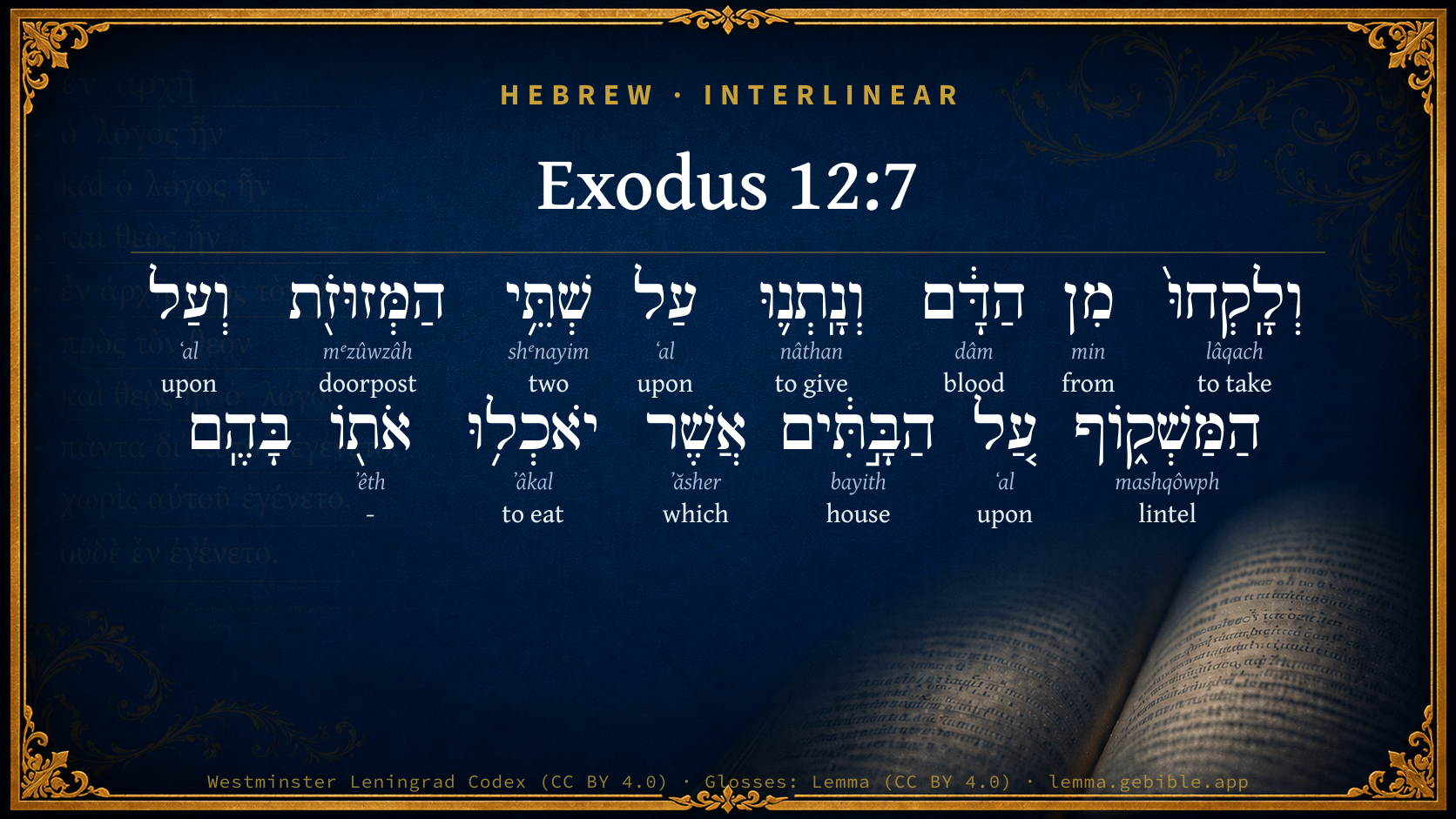
Exodus 12:7

Hebrew (Westminster Leningrad Codex) Exodus 12:7 appears in the Hebrew Old Testament. The text above is from the Westminster Leningrad Codex. Each word links to its Strong’s number, a concise gloss, and parsing drawn from the Open Scriptures Hebrew Bible morphology. Click any word for its full Brown-Driver-Briggs (BDB) entry.
Download image
Cite this verse

Exodus 12:7 (World English Bible). Public Domain. Lemma interlinear Bible study tool, https://lemma.gebible.app/v/exodus/12/7.

Show BibTeX & RIS
BibTeX
RIS
English Translation
They shall take some of the blood, and put it on the two side-posts and on the lintel, on the houses in which they shall eat it.
World English Bible · Public Domain
Highlights
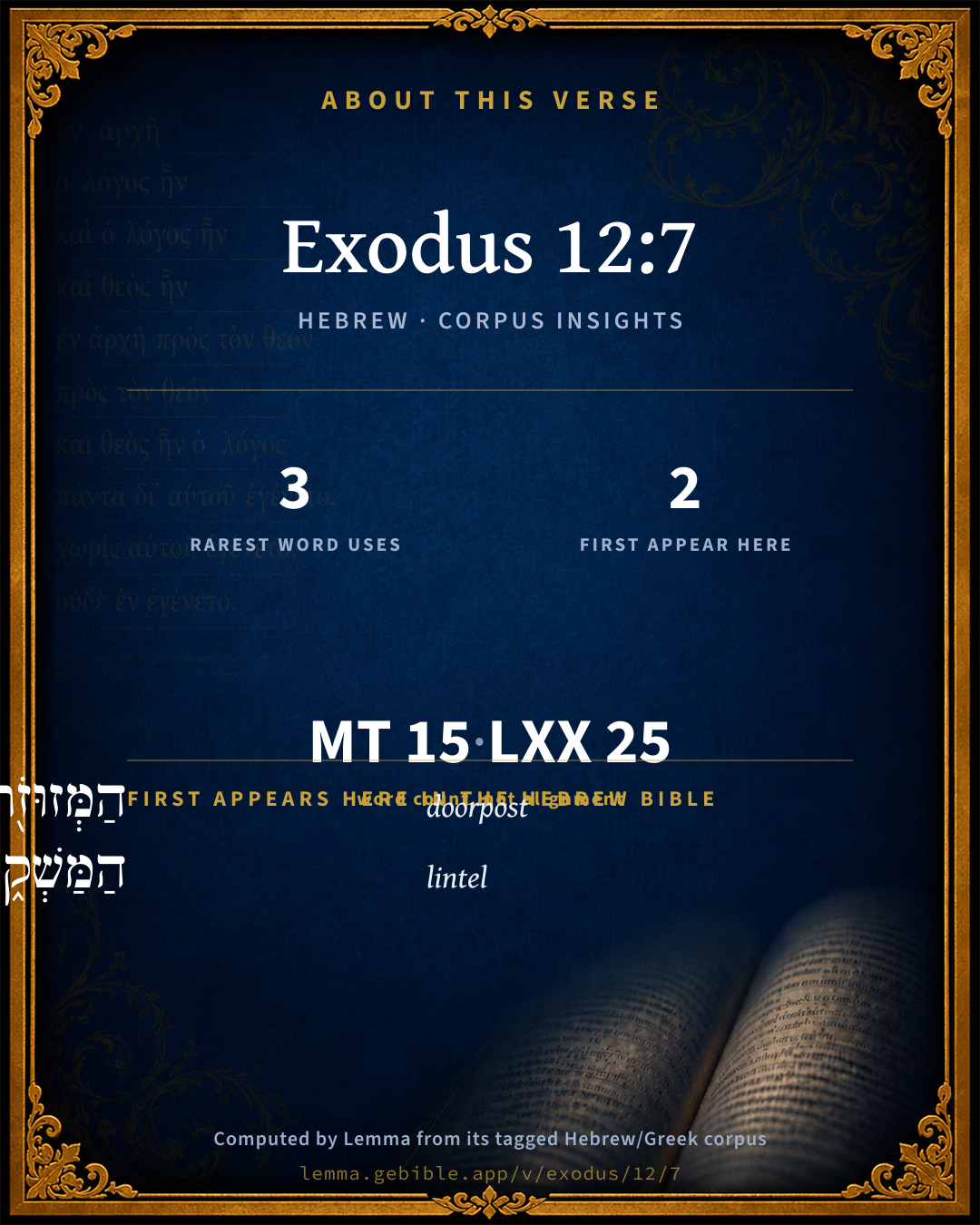
  • 2 first appearances in the Hebrew Bible
Full analysis ↓
Download a study sheet

One document with this verse’s original text, its word-by-word gloss line, the meaning frame, cross-references with their text, attributed commentary, and full source and license credits — printable, and it pastes into notes with its structure intact.

This verse Autodidact and up

Study sheet (.html) Plain text (.txt)

A passage Seminary Student

Up to 50 verses in one chapter. A passage sheet keeps up to 6 commentary sources and 12 cross-references per verse, in the order this page ranks them, and says so on the sheet whenever that leaves anything out. Ask for a single verse and you get the Autodidact verse sheet above.

Everything on this page stays free to read, with no account — the sheet is a download of what is already on screen, not access to it.

Want to remove ads? Support Godless Engineer
Compare translations 3

The same verse in 3 English versions, stacked beneath the original-language interlinear above. Click any original word for its lexicon entry.

Each is an independent rendering of the whole verse — the interlinear is not word-aligned to these translations.

Highlighted words mark where these versions differ — a whole-verse word diff, not a word-by-word alignment.

  • World English Bible Public Domain
    They shall take some of the blood, and put it on the two side-posts and on the lintel, on the houses in which they shall eat it.
  • King James Version Public Domain
    And they shall take of the blood, and strike it on the two side posts and on the upper door post of the houses, wherein they shall eat it.
  • unfoldingWord Literal Text CC BY-SA 4.0
    And they shall take from the blood and put it on the two doorposts and on the lintel of the houses in which they eat it.

unfoldingWord Literal Text — © unfoldingWord, licensed CC BY-SA 4.0. Word-aligned USFM3 via Door43 (git.door43.org/unfoldingWord/en_ult).

Versions to compare (up to 4)

3 of 4 selected

Show all 18 translations

Every available English version of this verse, each an independent rendering of the whole verse.

  • World English Bible Public Domain
    They shall take some of the blood, and put it on the two side-posts and on the lintel, on the houses in which they shall eat it.
  • Berean Standard Bible Public Domain
    They are to take some of the blood and put it on the sides and tops of the doorframes of the houses where they eat the lambs.
  • Majority Standard Bible Public Domain
    They are to take some of the blood and put it on the sides and tops of the doorframes of the houses where they eat the lambs.
  • King James Version Public Domain
    And they shall take of the blood, and strike it on the two side posts and on the upper door post of the houses, wherein they shall eat it.
  • American Standard Version (1901) Public Domain
    And they shall take of the blood, and put it on the two side-posts and on the lintel, upon the houses wherein they shall eat it.
  • Revised Version (1885) Public Domain
    And they shall take of the blood, and put it on the two side posts and on the lintel, upon the houses wherein they shall eat it.
  • Geneva Bible (1599) Public Domain
    After, they shall take of the blood, and strike it on the two postes, and on the vpper doore post of the houses where they shall eate it.
  • Douay-Rheims (1899) Public Domain
    And they shall take of the blood thereof, and put it upon both the side posts, and on the upper door posts of the houses, wherein they shall eat it.
  • Young's Literal Translation Public Domain
    and they have taken of the blood, and have put on the two side-posts, and on the lintel over the houses in which they eat it.
  • Literal Standard Version CC BY-SA 4.0
    and they have taken of the blood, and have put [it] on the two doorposts, and on the lintel over the houses in which they eat it.
  • Unlocked Literal Bible CC BY-SA 4.0
    You must take some of the blood and put it on the two side doorposts and on the tops of the doorframes of the houses in which you will eat the meat.
  • unfoldingWord Literal Text CC BY-SA 4.0
    And they shall take from the blood and put it on the two doorposts and on the lintel of the houses in which they eat it.
  • Darby Bible Public Domain
    And they shall take of the blood, and put [it] on the two door-posts and on the lintel of the houses in which they eat it.
  • World Messianic Bible Public Domain
    They shall take some of the blood, and put it on the two door posts and on the lintel, on the houses in which they shall eat it.
  • Webster's Bible Public Domain
    And they shall take of the blood, and strike it on the two side-posts, and on the upper door-post of the houses, in which they shall eat it.
  • Free Bible Version CC BY-SA 4.0
    They are to take some of the blood and put it on the sides and tops of the doorframes of the houses where they have the meal.
  • Bible in Basic English Public Domain
    Then take some of the blood and put it on the two sides of the door and over the door of the house where the meal is to be taken.
  • JPS Tanakh (1917) Public Domain
    And they shall take of the blood, and put it on the two side-posts and on the lintel, upon the houses wherein they shall eat it.

Literal Standard Version (2020), Covenant Press — licensed CC BY-SA 4.0. Text via the HelloAO Bible API (eBible.org). Unlocked Literal Bible (unfoldingWord) — licensed CC BY-SA 4.0. Text via the HelloAO Bible API (eBible.org). unfoldingWord Literal Text — © unfoldingWord, licensed CC BY-SA 4.0. Word-aligned USFM3 via Door43 (git.door43.org/unfoldingWord/en_ult). Free Bible Version, Dr. Jonathan Gallagher — licensed CC BY-SA 4.0. Text via the HelloAO Bible API (eBible.org).

Word by word

More ways to search: Search by grammar → Find every occurrence → Compare this word →

Practice this passage: Drill this verse → Learn its vocabulary →

הַמַּשְׁק֑וֹף
mashqôwph
H4947
“the · lintel”
Particle, Definite Article + Noun, Common, Masculine, Singular, Absolute
Part of Speech
Particle + Noun
Type
Common
Gender
Masculine
Number
Singular
State
Absolute
Full BDB Definition

Origin: from H8259 in its original sense of overhanging

TWOT: 2458c

lintel (of door)
  1. וְלָֽקְחוּ֙ lâqach H3947 “and · to take” Conjunction + Verb, Qal, Sequential Perfect, 3rd Person, Common, Plural
  2. מִן min H4480 “from” Preposition
  3. הַדָּ֔ם dâm H1818 “the · blood” Particle, Definite Article + Noun, Common, Masculine, Singular, Absolute
  4. וְנָֽתְנ֛וּ nâthan H5414 “and · to give” Conjunction + Verb, Qal, Sequential Perfect, 3rd Person, Common, Plural
  5. עַל ʻal H5921 “upon” Preposition
  6. שְׁתֵּ֥י shᵉnayim H8147 “two” Adjective, Cardinal number, Feminine, Dual, Construct
  7. הַמְּזוּזֹ֖ת mᵉzûwzâh H4201 “the · doorposts” Particle, Definite Article + Noun, Common, Feminine, Plural, Absolute
  8. וְעַל ʻal H5921 “and · upon” Conjunction + Preposition
  9. עַ֚ל ʻal H5921 “upon” Preposition
  10. הַבָּ֣תִּ֔ים bayith H1004 “the · houses” Particle, Definite Article + Noun, Common, Masculine, Plural, Absolute
  11. אֲשֶׁר ʼăsher H834 “which” Particle, Relative
  12. יֹאכְל֥וּ ʼâkal H398 “to eat” Verb, Qal, Imperfect, 3rd Person, Masculine, Plural
  13. אֹת֖וֹ ʼêth H853 “- · him” Particle, Direct Object + Suffix, Personal, 3rd Person, Masculine, Singular

About this verse

These counts appear in no published source. They are computed here, from the morphology-tagged text and Lemma’s own curated glosses. What Lemma adds →

15
words
12
distinct lemmas
Pentateuch
section

Notable vocabulary

The rarest word here is הַמַּשְׁק֑וֹף lintel H4947 — appearing just 3 times in the whole Hebrew Bible.

First appearance in Scripture

These words make their first canonical appearance in the Hebrew Bible here:

  • הַמְּזוּזֹ֖ת doorpost H4201
  • הַמַּשְׁק֑וֹף lintel H4947

Shared distinctive vocabulary

הַמַּשְׁק֑וֹף lintel H4947 occurs in 3 verses of the Hebrew Bible. Also found in:

Grammatical profile

  • 3 verbs
  • 4 nouns
  • 1 adjective
  • 5 prepositions
  • 2 particles

Verb forms

  • וְלָֽקְחוּ֙ Qal · Sequential Perfect
  • וְנָֽתְנ֛וּ Qal · Sequential Perfect
  • יֹאכְל֥וּ Qal · Imperfect

Repetition

A word recurs within this verse — often emphatic in Hebrew:

Hebrew & Septuagint length

In English translation the verse runs 27 words from the Hebrew and 29 from the Septuagint (LXX English) — closely comparable.

A rough comparison of the two English renderings, which tokenize alike — not a word-level alignment.

Word counts can differ between the Hebrew and the Greek without any difference in meaning — e.g. the Hebrew direct-object marker אֵת has no separate Greek word, and Greek often adds the article ὁ.

In the original languages it is 15 Hebrew tokens and 25 Greek tokens — but the two are counted differently (Hebrew bundles its prefixes and suffixes into one token; the Greek is in lemma form), so that isn’t a like-for-like length.

Cross-references

8

Topical passages linked to Exodus 12:7 in the Treasury of Scripture Knowledge — connected by theme and wording, ordered by reader-vote popularity; previews shown in the World English Bible.

  • Exodus 12:22–23 You shall take a bunch of hyssop, and dip it in the blood that is in the basin, and strike the lintel and the two side-posts with the blood that is in the basin; and none of you shall go out of the door of his house until the morning.
  • Hebrews 11:28 By faith, he kept the Passover, and the sprinkling of the blood, that the destroyer of the firstborn should not touch them.
  • Hebrews 9:22 According to the law, nearly everything is cleansed with blood, and apart from shedding of blood there is no remission.
  • Ephesians 1:7 in whom we have our redemption through his blood, the forgiveness of our trespasses, according to the riches of his grace,
  • Hebrews 10:14 For by one offering he has perfected forever those who are being sanctified.
  • 1 Peter 1:2 according to the foreknowledge of God the Father, in sanctification of the Spirit, that you may obey Jesus Christ and be sprinkled in his blood: Grace to you and peace be multiplied.
  • Hebrews 10:29 How much worse punishment, do you think, will he be judged worthy of, who has trodden under foot the Son of God, and has counted the blood of the covenant with which he was sanctified an unholy thing, and has insulted the Spirit of grace?
  • Hebrews 9:13–14 For if the blood of goats and bulls, and the ashes of a heifer sprinkling those who have been defiled, sanctify to the cleanness of the flesh:

Cross-references courtesy of OpenBible.info (CC BY 4.0).

Hebrew and Greek witnesses Masoretic Hebrew ↔ Greek Septuagint

The same verse in the two great witnesses to the Old Testament, shown verse-for-verse.

These are two independent witnesses, not word-aligned to each other, and the Septuagint is shown in lemma (dictionary) form.

Hebrew Exodus 12:7 Masoretic · Westminster Leningrad Codex

וְלָֽקְחוּ֙ מִן הַדָּ֔ם וְנָֽתְנ֛וּ עַל שְׁתֵּ֥י הַמְּזוּזֹ֖ת וְעַל הַמַּשְׁק֑וֹף עַ֚ל הַבָּ֣תִּ֔ים אֲשֶׁר יֹאכְל֥וּ אֹת֖וֹ בָּהֶֽם

They shall take some of the blood, and put it on the two side-posts and on the lintel, on the houses in which they shall eat it.

World English Bible · Public Domain

Greek LXX Exodus 12:7 Septuagint · lemma form

καί λαμβάνω ἀπό ὁ αἷμα καί τίθημι ἐπί ὁ δύο σταθμός καί ἐπί ὁ φλιά ἐν ὁ οἶκος ἐν ὅς ἐάν ἐσθίω αὐτός ἐν αὐτός

And they shall take of the blood, and shall put it on the two door-posts, and on the lintel, in the houses in which soever they shall eat them.

LXX2012 (modern English Septuagint) · Public Domain

Hebrew: Westminster Leningrad Codex (CC BY 4.0). Greek: Septuagint (public domain); English from LXX2012 (modern English Septuagint) (Public Domain). How the Septuagint differs from the Hebrew →

Targum (Aramaic paraphrase)

2

The Targum is the ancient Jewish Aramaic paraphrase of the Hebrew Scriptures — an interpretive translation, not the Hebrew text itself. Onkelos (literal) and Pseudo-Jonathan (expansive) render the Torah, and Jonathan the Prophets. Coverage is partial: where no permissively-licensed English translation exists for a verse, only the Aramaic is shown. This is verse-level text, not a word-by-word alignment to the Hebrew.

  1. Targum Onkelos Torah (Genesis–Deuteronomy)
    וְיִסְבוּן מִן דְמָא וְיִתְּנוּן עַל תְּרֵין סִפַּיָא וְעַל שַׁקְפָא עַל בָּתַּיָא דְיֵכְלוּן יָתֵהּ בְּהוֹן:

    (no public-domain English translation for this verse)

    Targum Onkelos — Aramaic: “Onkelos Genesis” (public domain); “Onkelos Exodus” (public domain); “Onkelos Leviticus” (public domain); “Onkelos Numbers” (public domain); “Onkelos Deuteronomy” (public domain). English: “Sefaria Community Translation” (CC0 1.0 (public-domain dedication)); “J.W. Etheridge. The Targums of Onkelos and Jonathan Ben Uzziel on the Pentateuch. London: Longmans, Green, 1862” (public domain). Text via Sefaria.

  2. Targum Pseudo-Jonathan Torah (Genesis–Deuteronomy)
    וְיִסְבוּן מִן דְּמָא וְיִתְּנוּן עַל תְּרֵין סִיפַיָּיא וְעִילוֹי מִסְקוּפָא עִלָּאָה מִלְּבַּר עַל בָּתַּיָא דְיֵיכְלוּן יָתֵיהּ וּדְדַמְכוּן בְּהוֹן

    And you shall take of the blood and set it upon the two posts and upon the upper board outside of the houses in which you eat and sleep.

    Targum Pseudo-Jonathan — Aramaic: “Targum Jonathan on Genesis” (public domain); “Targum Jonathan on Exodus” (public domain); “Targum Jonathan on Leviticus” (public domain); “Targum Jonathan on Numbers” (public domain); “Targum Jonathan on Deuteronomy” (public domain). English: “The Targum of Jonathan ben Uzziel, trans. J. W. Etheridge, London, 1862” (public domain). Text via Sefaria.

Commentary

Notes on Exodus 12:7 from classic Christian and Jewish commentators (each source and its license shown beneath its notes). The classic Christian expositions comment on the surrounding passage and are grouped to its opening verse, so a note may address several verses; the Jewish commentaries on the Tanakh (Rashi and others) are per-verse, so they appear only where the commentator wrote on this verse.

Lemma curates 59 commentaries, every one of them public domain or Creative Commons licensed, each selected and text-cleaned for this edition rather than reprinted as found. About our sources →

Trapp's Complete Commentary

John Trapp

Exo 12:7 And they shall take of the blood, and strike [it] on the two side posts and on the upper door post of the houses, wherein they shall eat it.

Ver. 7. And strike it on the two sideposts.] Not on the threshold. We may not "tread under foot the Son of God, or count the blood of the covenant an unholy thing," {Heb 10:29} but get "our hearts sprinkled" tberewith by the hyssop branch of faith "from an evil conscience, that we may serve the living God." {Heb 9:14}

John Trapp, A Commentary or Exposition upon All the Books of the Old and New Testament (1647–1656) — public domain. Text from a community e-Sword module.

Joseph Benson's Commentary

Exo 12:7. They shall take of the blood — Which was to be sprinkled before the flesh was eaten. Strike it on the two side-posts, and the upper door- post — These were to be sprinkled by dipping a bunch of hyssop into the blood, Exo 12:22; but not the threshold, lest any one should tread upon the blood, which would have been profane.

Joseph Benson's Commentary on the Old and New Testaments (1811–1818) — public domain. Text from a community e-Sword module.

Tyndale Open Study Notes

Tyndale Open Resources

12:7 blood: God could not simply exempt his people from this plague as he had preserved them from the other plagues. Death reigns in the world because of sin, and in light of God’s justice, sin cannot be ignored; it must be either punished or atoned for. Since the blood represents life (Lev 17:11), it alone is acceptable for the forgiveness of sins (Heb 9:22). As Deut 6:9 suggests, doorframes represent the totality of life as the place of going in and coming out.

Tyndale Open Study Notes — © Tyndale Open Resources, licensed CC BY-SA 4.0. Text via the HelloAO Bible API.

Jamieson, Fausset & Brown

Robert Jamieson, A. R. Fausset & David Brown

take of the blood, and strike it on the two side-posts, &c.--as a sign of safety to those within. The posts must be considered of tents, in which the Israelites generally lived, though some might be in houses. Though the Israelites were sinners as well as the Egyptians, God was pleased to accept the substitution of a lamb--the blood of which, being seen sprinkled on the doorposts, procured them mercy. It was to be on the sideposts and upper doorposts, where it might be looked to, not on the threshold, where it might be trodden under foot. This was an emblem of the blood of sprinkling (Heb 12:24; Heb 10:29).

Jamieson, Fausset & Brown — Commentary Critical and Explanatory on the Whole Bible (1871) — public domain (CC PDM 1.0). Text via the HelloAO Bible API.

Adam Clarke's Commentary

Verse 7. Take of the blood, and strike it on the two side posts] This was to be done by dipping a bunch of hyssop into the blood, and thus sprinkling it upon the posts, c. see Ex 12:22. That this sprinkling of the blood of the paschal lamb was an emblem of the sacrifice and atonement made by the death of Jesus Christ, is most clearly intimated in the sacred writings, 1Pe 1:2; Heb 9:13; Heb 9:14; Heb 8:10. It is remarkable that no blood was to be sprinkled on the threshold, to teach, as Mr. Ainsworth properly observes, a reverent regard for the blood of Christ, that men should not tread under foot the Son of GOD, nor count the blood of the covenant wherewith they were sanctified an unholy thing; Heb 10:29.

Adam Clarke's Commentary on the Bible (1810–1826) — public domain. Text from a community e-Sword/MySword module.

Ellicott's Commentary for English Readers

(7) Strike it.—With a bunch of hyssop. (See Exo_12:22.)

The two side posts and on the upper door post.—The idea seems to have been that the destroying influence, whatever it was, would enter the house by the door. The sight of the bloody stains above the door and on either side would prevent its entering. The word translated “upper door post” appears to be derived from shâcaph, “to look out,” and to signify properly the latticed window above the door, through which persons reconnoitred those who knocked before admitting them. Such windows are frequently represented in the early Egyptian monuments. The blood thus rendered conspicuous would show that atonement had been made for the house, i.e., for its inmates.

A Bible Commentary for English Readers, edited by Charles John Ellicott (1878–1897) — public domain. Text from a community e-Sword module.

The Cambridge Bible for Schools and Colleges

gen. ed. J. J. S. Perowne

7. The blood of the slain lamb to be applied to the doorposts and lintel of the house in which it is eaten,—as it were, to consecrate the house, and protect its inmates against destruction. This rite is probably a survival of an earlier, perhaps pre-Yahwistic stage, of usage. The Bedawin of the present day, when a new house is dedicated, sprinkle its doors and front with the blood of a goat slaughtered at the ceremony. See p. 411; and Lees, The Witness of the Wilderness (1909), p. 180.

The Cambridge Bible for Schools and Colleges (gen. ed. J. J. S. Perowne; Cambridge University Press, 1878–1918) — public domain. Text from a community e-Sword module.

John Gill's Exposition

And they shall take of the blood,.... Of the lamb, being received into a basin, Exo 12:22,

and strike it on the two side posts; with a bunch of hyssop dipped into it:

and on the upper doorpost of the houses, wherein they shall eat it; but not on the posts of those houses, the inhabitants of which joined with their neighbours in eating it; though Levi Ben Gersom thinks they were sprinkled as the rest; but to what purpose, when there were no Israelites, and no firstborn in them? the two side posts were the posts of a folding door, on which the two folds were hung, and the upper doorpost is what is afterwards called the lintel, Exo 12:23 and has its name in Hebrew from looking out; for, as Aben Ezra says, there was a window over the door, as is the custom throughout the whole country of the Ishmaelites or Arabians; and so Schindler says (o), which perhaps he took from him, that the word signifies either a lintel, or a little window over the door, through which it might be seen who called or knocked at the door; and adds, in Egypt, as now in Arabia, there were windows over the doors of houses. The sprinkling the blood of the paschal lamb was typical of the sprinkling of the blood of Christ upon the hearts and consciences of his people, and of their peace, safety, and security by it from the wrath of God, and the vengeance of divine justice; of the further use of this rite, see Exo 12:22, Aben Ezra mentions it as the opinion of some, that the sprinkling of the blood on those places was to show that they slew the abomination of the Egyptians openly; but he himself gives a much better reason for this rite, namely, that it was to be a propitiation for everyone that ate in the house, and was a sign to the destroyer, that he might look upon it in like manner, as it is said Eze 9:4, "set a mark, &c." this seems to be peculiar to the passover in Egypt, and was not used in later times.

(o) Lex. Pentaglott. col. 1938.

John Gill's Exposition of the Whole Bible (1746–1763) — public domain (CC PDM 1.0). Text via the HelloAO Bible API.

Albert Barnes' Notes on the Bible

The upper door post - Or lintel, Exo 12:23. This direction was understood by the Hebrews to apply only to the first Passover: it was certainly not adopted in Palestine. The meaning of the sprinkling of blood is hardly open to question. It was a representation of the offering of the life, substituted for that of the firstborn in each house, as an expiatory and vicarious sacrifice.

Albert Barnes' Notes on the Bible (1834–1885) — public domain. Text from a community e-Sword/MySword module.

Haydock's Catholic Bible Commentary

Houses. Those who joined their neighbours to eat the paschal lamb, were therefore to continue with them that night, if they would escape destruction, ver. 23. (Menochius)

George Leo Haydock (1774–1849), Haydock's Catholic Family Bible and Commentary, 1859 edition — public domain. Excludes Psalms (Douay-Rheims chapter numbering differs from Protestant) and Deuterocanonical books (Catholic canon only).

Matthew Poole's English Annotations

This was afterwards restrained to the priests, but at this time it was allowed to the masters of families, as their present circumstances required.

They shall strike it; with a bunch of hyssop, Exo 12:22, as a badge of distinction between their houses and the Egyptians; not to direct the destroying angel where they were, who could as well discern the houses as the blood in the night, but to direct their thoughts to Christ, whose blood was hereby evidently typified, by whose merits and mediation they obtained this preservation and deliverance from Egypt, as well as their great deliverance from hell.

Matthew Poole's English Annotations on the Holy Bible (1683–1685) — public domain. Text from a community e-Sword/MySword module.

Whedon's Commentary on the Bible

Daniel D. Whedon

7. They shall take of the blood — Each doorway was made an altar, the lintel and side-posts of which were to be sprinkled with blood from a bunch of hyssop, (Exo_12:22,) and thus was each person who entered consecrated. The blood was not dropped upon the threshold, lest it should be trodden under foot. This was the outward token of expiation and consecration which all the families of Israel were required to set upon themselves, as the outward sacraments are ordained in the Church of Christ; not that God needs to see these signs, but that we need to make them.

Daniel D. Whedon (gen. ed.), Commentary on the Old and New Testaments (1874–1909) — public domain. Text from a community e-Sword module.

The Pulpit Commentary

They shall take of the blood. The blood, which, according to Hebrew ideas, "is the life," and so the very essence of the sacrifice, was always regarded as the special symbol of that expiation and atonement, with a view to which sacrifice was instituted. As by the Paschal sacrifice atonement was made for the house, which was therefore to escape unscathed, the sign of atonement was to be conspicuously placed upon it. And strike. The "striking" was to be by means of a bunch of hyssop dipped in the blood (ver. 22). The selection of the doorway as the part of the house to receive the stains of blood is probably to be connected with the idea that the secondary agency producing death, whatever it was, would enter by the door and if the door showed the house to have been atoned for, would not enter. The upper door-past. The word used is elsewhere translated "lintel"; (Exo_12:22, Exo_12:23) but it seems properly to mean the latticed window which was commonly placed over a doorway in Egyptian houses, and which is often represented in the facades of tombs. (See Lepsius, Denkmaler, pt. 2. pls. 16, 17, 147, etc.) It is derived from a root signifying "to look out.

Vers. 7-13. Christ his people"s salvation and strength.

I THE MEANS OF SAFETY vers. 7-13).

1. They took the blood and struck it on the door posts and the lintel. Wemust appropriate Christ"s atonement. We must say by faith, "he died for me.

2. They passed within the blood-stained portals. Christ"s blood must standbetween us and condemnation, between us and sin. Our safety lies in setting that between oar soul and them. The realising of Christ"s death for our sins is, salvation.

II THE MEANS OF STRENGTH FOR THE ONWARD WAY. Feeding upon Christ. While Egypt was slumbering Israel was feasting. While the world is busy with its dreams we must feast upon the joy of eternity, and, comprehending with all saints the infinite love of Christ, be filled with all the fulness of God. "Except ye eat the flesh of the Son of Man, and drink his blood, ye have no life in you.

III HOW CHRIST MUST BE PARTAKEN OF.

1. With unleavened bread and bitter herbs. The old leaven of malice andwickedness must be put away, and the feasting on Christ"s love must be accompanied with repentance and self denial. There may be now and again a momentary glimpse of Christ"s love where sin is not parted with, but there can be no communion, no enduring vision.

2. Christ must be taken as God has set him before us, in the simplicity ofthe Gospel, with nothing of man"s invention, addition, or diminution. The Gospel remedy avails only when taken in the Gospel way (vers. 9, 10).

3. He must b? partaken of in the union of love. The Passover is a social, afamily feast. Those who refuse to seek church-fellowship are despising God"s arrangements for their own salvation, and proving themselves devoid of the spirit which, loving him that begat, loveth him also that is begotten of him.

4. He must be partaken of with the pilgrim spirit and preparedness (ver.11). They who will be saved by Jesus must take up their cross and follow him. U.

The Pulpit Commentary (1880–1919), ed. H.D.M. Spence-Jones & Joseph S. Exell — public domain. Text from a community e-Sword module.

Rashi

Rabbi Shlomo Yitzchaki (Rashi)

ולקחו מן הדם AND THEY SHALL TAKE OF THE BLOOD — This refers to the ritual reception of the blood. One might think that they must take it in the hand; therefore Scripture states, (v. 22) “[and ye shall dip it in the blood] which is in the basin (Mekhilta).

המזוזת THE SIDE POSTS — These are the upright posts, one on this side of the entrance and one on that side.

המשקוף THE LINTEL — This is the upper post upon which the door beats (שוקף) when it is being closed; old French lintel. The expression שקף (from which משקוף lintel is derived) denotes beating, as may be seen from the Targum on, (Leviticus 26:36) “the sound of a leaf that is beaten (by another)”, which Onkelos renders by דשקיף; and from the Targum on, (Exodus 21:25) חַבּוּרָה “wheal” (a beaten spot), where משקופי is the rendering.

אל הבתים אשר יאכלו אתו בהם ON THE HOUSES WHEREIN THEY SHALL EAT IT — and not upon the lintel and the doorposts which are in the place used for storing straw or in the stalls of oxen, in which people do not live and eat. (Cf. Mekhilta and הגהות הגר״א thereon).

Rashi on the Tanakh — English translations: “The Judaica Press complete Tanach with Rashi, translated by A. J. Rosenberg” (CC BY 4.0); “Pentateuch with Rashi's commentary by M. Rosenbaum and A.M. Silbermann, 1929-1934” (public domain); “The Metsudah Tanach series, Lakewood, N.J” (CC BY 4.0); and “The Book of Joshua, Metsudah Publications, 1997” (CC BY 4.0). Text via Sefaria.

Lesson kit

Teaching starters — assembled from the data on this page, not authored interpretation. Every prompt links to the verse data it draws on. Edit before teaching.

Exodus, in the Pentateuch, opens this verse with 15 words (12 distinct Hebrew lemmas). Its most distinctive word is mashqôwph (“lintel”). A historical commentator’s framing appears above. Read the whole chapter for the surrounding context.

Discussion questions

  1. What does “lintel” (mashqôwph) contribute to the verse as a whole?
  2. 2 words here appear for the first time in Scripture. What is being introduced at this debut?
  3. Exodus 12:22 shares the word «lintel» with this verse. How do the two illuminate each other?
  4. “upon” occurs 3× in this one verse. What is the effect of the repetition?
  5. These translations render this verse differently. What is at stake in choosing one wording over another?
  6. The verb «וְלָֽקְחוּ֙» is Qal Sequential Perfect. How does its form color the action?
  7. Reading how Trapp's Complete Commentary and Joseph Benson's Commentary read this verse, where do the two commentators agree and where do they part?

Things to notice

Reading settings

Reading text

Shown beneath each verse's original-language words.

Old Testament
Old Testament edition

Read the OT as the Masoretic Hebrew (MT) or the Greek Septuagint (LXX).

English shown for the Greek Septuagint (in the Hebrew ↔ Greek comparison).

Comparing translations? Open the Compare panel on any verse page to stack up to four side by side.