Leviticus 26:4

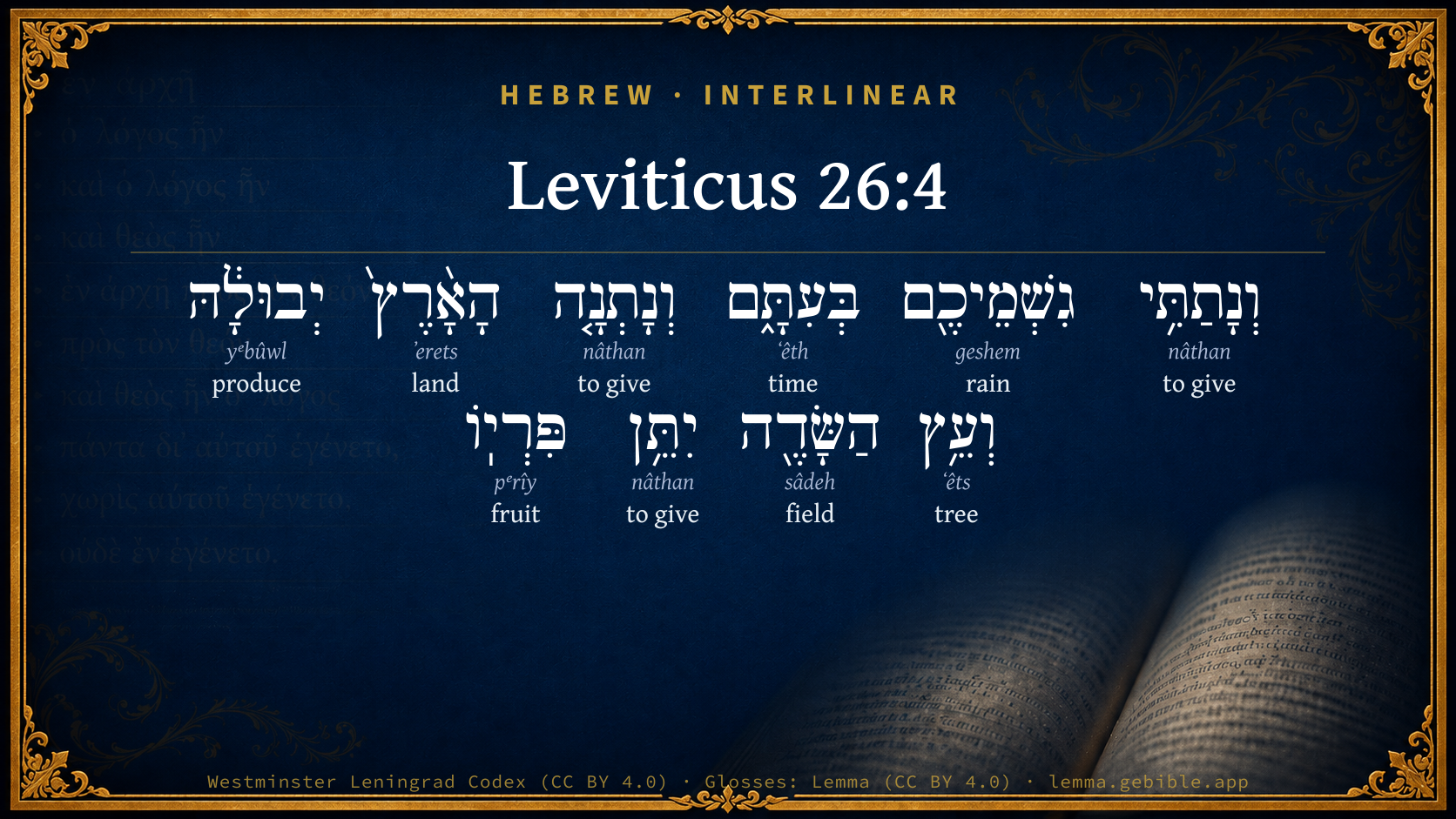
Hebrew (Westminster Leningrad Codex) Leviticus 26:4 appears in the Hebrew Old Testament. The text above is from the Westminster Leningrad Codex. Each word links to its Strong’s number, a concise gloss, and parsing drawn from the Open Scriptures Hebrew Bible morphology. Click any word for its full Brown-Driver-Briggs (BDB) entry.
Download image
Cite this verse

Leviticus 26:4 (World English Bible). Public Domain. Lemma interlinear Bible study tool, https://lemma.gebible.app/v/leviticus/26/4.

Show BibTeX & RIS
BibTeX
RIS
English Translation
then I will give you your rains in their season, and the land shall yield its increase, and the trees of the field shall yield their fruit.
World English Bible · Public Domain
Highlights
  • 1 first appearance in the Hebrew Bible
Full analysis ↓
Download a study sheet

One document with this verse’s original text, its word-by-word gloss line, the meaning frame, cross-references with their text, attributed commentary, and full source and license credits — printable, and it pastes into notes with its structure intact.

This verse Autodidact and up

Study sheet (.html) Plain text (.txt)

A passage Seminary Student

Up to 50 verses in one chapter. A passage sheet keeps up to 6 commentary sources and 12 cross-references per verse, in the order this page ranks them, and says so on the sheet whenever that leaves anything out. Ask for a single verse and you get the Autodidact verse sheet above.

Everything on this page stays free to read, with no account — the sheet is a download of what is already on screen, not access to it.

Want to remove ads? Support Godless Engineer
Compare translations 3

The same verse in 3 English versions, stacked beneath the original-language interlinear above. Click any original word for its lexicon entry.

Each is an independent rendering of the whole verse — the interlinear is not word-aligned to these translations.

Highlighted words mark where these versions differ — a whole-verse word diff, not a word-by-word alignment.

  • World English Bible Public Domain
    then I will give you your rains in their season, and the land shall yield its increase, and the trees of the field shall yield their fruit.
  • King James Version Public Domain
    Then I will give you rain in due season, and the land shall yield her increase, and the trees of the field shall yield their fruit.
  • unfoldingWord Literal Text CC BY-SA 4.0
    then I will give your rains in their time, and the land will give its produce, and the tree of the field will give its fruit.

unfoldingWord Literal Text — © unfoldingWord, licensed CC BY-SA 4.0. Word-aligned USFM3 via Door43 (git.door43.org/unfoldingWord/en_ult).

Versions to compare (up to 4)

3 of 4 selected

Show all 18 translations

Every available English version of this verse, each an independent rendering of the whole verse.

  • World English Bible Public Domain
    then I will give you your rains in their season, and the land shall yield its increase, and the trees of the field shall yield their fruit.
  • Berean Standard Bible Public Domain
    I will give you rains in their season, and the land will yield its produce, and the trees of the field will bear their fruit.
  • Majority Standard Bible Public Domain
    I will give you rains in their season, and the land will yield its produce, and the trees of the field will bear their fruit.
  • King James Version Public Domain
    Then I will give you rain in due season, and the land shall yield her increase, and the trees of the field shall yield their fruit.
  • American Standard Version (1901) Public Domain
    then I will give your rains in their season, and the land shall yield its increase, and the trees of the field shall yield their fruit.
  • Revised Version (1885) Public Domain
    then I will give your rains in their season, and the land shall yield her increase, and the trees of the field shall yield their fruit.
  • Geneva Bible (1599) Public Domain
    I will then sende you raine in due season, and the land shall yelde her increase, and the trees of the fielde shall giue her fruite.
  • Douay-Rheims (1899) Public Domain
    And the ground shall bring forth its increase, and the trees shall be filled with fruit.
  • Young's Literal Translation Public Domain
    then I have given your rains in their season, and the land hath given her produce, and the tree of the field doth give its fruit;
  • Literal Standard Version CC BY-SA 4.0
    then I have given your rains in their season, and the land has given her produce, and the tree of the field gives its fruit;
  • Unlocked Literal Bible CC BY-SA 4.0
    then I will give you rain in its season; the land will yield its produce, and the trees of the field will yield their fruit.
  • unfoldingWord Literal Text CC BY-SA 4.0
    then I will give your rains in their time, and the land will give its produce, and the tree of the field will give its fruit.
  • Darby Bible Public Domain
    then I will give your rain in the season thereof, and the land shall yield its produce, and the trees of the field shall yield their fruit;
  • World Messianic Bible Public Domain
    then I will give you your rains in their season, and the land shall yield its increase, and the trees of the field shall yield their fruit.
  • Webster's Bible Public Domain
    Then I will give you rain in due season, and the land shall yield her increase, and the trees of the field shall yield their fruit:
  • Free Bible Version CC BY-SA 4.0
    I will make sure it rains at the right time so that the ground will grow good crops and the fruit trees will be productive.
  • Bible in Basic English Public Domain
    Then I will give you rain at the right time, and the land will give her increase and the trees of the field will give their fruit;
  • JPS Tanakh (1917) Public Domain
    then I will give your rains in their season, and the land shall yield her produce, and the trees of the field shall yield their fruit.

Literal Standard Version (2020), Covenant Press — licensed CC BY-SA 4.0. Text via the HelloAO Bible API (eBible.org). Unlocked Literal Bible (unfoldingWord) — licensed CC BY-SA 4.0. Text via the HelloAO Bible API (eBible.org). unfoldingWord Literal Text — © unfoldingWord, licensed CC BY-SA 4.0. Word-aligned USFM3 via Door43 (git.door43.org/unfoldingWord/en_ult). Free Bible Version, Dr. Jonathan Gallagher — licensed CC BY-SA 4.0. Text via the HelloAO Bible API (eBible.org).

Word by word

More ways to search: Search by grammar → Find every occurrence → Compare this word →

Practice this passage: Drill this verse → Learn its vocabulary →

יְבוּלָ֔הּ
yᵉbûwl
H2981
“produce · her”
Noun, Common, Masculine, Singular, Construct + Suffix, Personal, 3rd Person, Feminine, Singular
Part of Speech
Noun
Type
Common
Gender
Masculine
Number
Singular
State
Construct
Full BDB Definition

Origin: from H2986

TWOT: 835c

produce, fruit, produce (of the soil)
  1. וְנָתַתִּ֥י nâthan H5414 “and · to give” Conjunction + Verb, Qal, Sequential Perfect, 1st Person, Common, Singular
  2. גִשְׁמֵיכֶ֖ם geshem H1653 “rains · your” Noun, Common, Masculine, Plural, Construct + Suffix, Personal, 2nd Person, Masculine, Plural
  3. בְּעִתָּ֑ם ʻêth H6256 “in/at · time · their” Preposition + Noun, Common, Both, Singular, Construct + Suffix, Personal, 3rd Person, Masculine, Plural
  4. וְנָתְנָ֤ה nâthan H5414 “and · to give” Conjunction + Verb, Qal, Sequential Perfect, 3rd Person, Feminine, Singular
  5. הָאָ֨רֶץ֙ ʼerets H776 “the · land” Particle, Definite Article + Noun, Common, Both, Singular, Absolute
  6. וְעֵ֥ץ ʻêts H6086 “and · tree of” Conjunction + Noun, Common, Masculine, Singular, Construct
  7. הַשָּׂדֶ֖ה sâdeh H7704 “the · field” Particle, Definite Article + Noun, Common, Masculine, Singular, Absolute
  8. יִתֵּ֥ן nâthan H5414 “to give” Verb, Qal, Imperfect, 3rd Person, Masculine, Singular
  9. פִּרְיֽוֹ pᵉrîy H6529 “fruit · his” Noun, Common, Masculine, Singular, Construct + Suffix, Personal, 3rd Person, Masculine, Singular

About this verse

These counts appear in no published source. They are computed here, from the morphology-tagged text and Lemma’s own curated glosses. What Lemma adds →

10
words
8
distinct lemmas
Pentateuch
section

Notable vocabulary

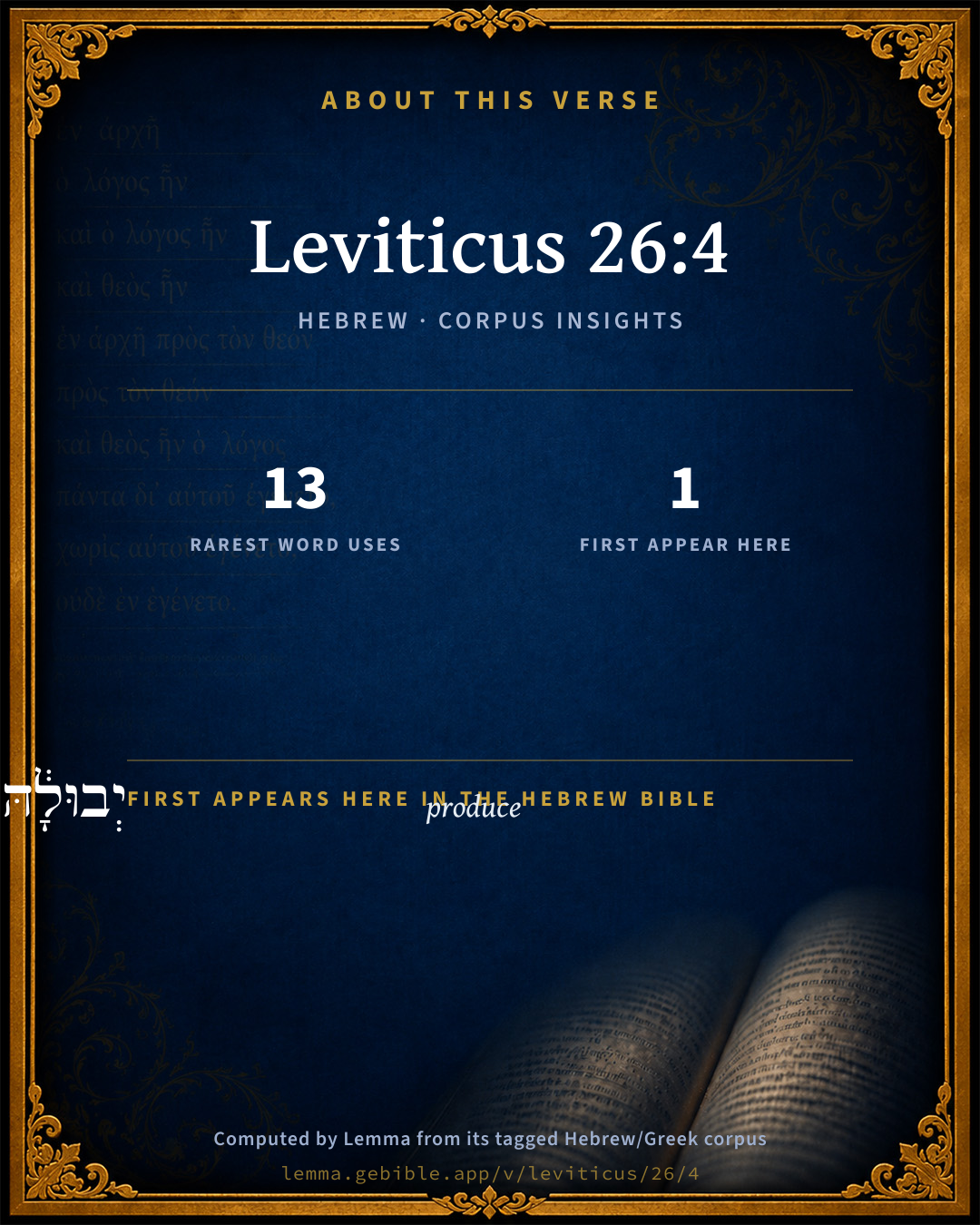
The rarest word here is יְבוּלָ֔הּ produce H2981 — appearing just 13 times in the whole Hebrew Bible.

First appearance in Scripture

This word makes its first canonical appearance in the Hebrew Bible here:

  • יְבוּלָ֔הּ produce H2981

Shared distinctive vocabulary

יְבוּלָ֔הּ produce H2981 occurs in 13 verses of the Hebrew Bible. Also found in:

Grammatical profile

  • 3 verbs
  • 7 nouns

Verb forms

  • וְנָתַתִּ֥י Qal · Sequential Perfect
  • וְנָתְנָ֤ה Qal · Sequential Perfect
  • יִתֵּ֥ן Qal · Imperfect

Repetition

A word recurs within this verse — often emphatic in Hebrew:

  • וְנָתַתִּ֥י to give H5414 ×3

Hebrew & Septuagint length

In English translation the verse runs 27 words from the Hebrew and 27 from the Septuagint (LXX English) — the same length.

A rough comparison of the two English renderings, which tokenize alike — not a word-level alignment.

Word counts can differ between the Hebrew and the Greek without any difference in meaning — e.g. the Hebrew direct-object marker אֵת has no separate Greek word, and Greek often adds the article ὁ.

Cross-references

26

Topical passages linked to Leviticus 26:4 in the Treasury of Scripture Knowledge — connected by theme and wording, ordered by reader-vote popularity; previews shown in the World English Bible.

  • Zechariah 8:12 "For the seed of peace and the vine will yield its fruit, and the ground will give its increase, and the heavens will give their dew; and I will cause the remnant of this people to inherit all these things.
  • Psalms 67:6 The earth has yielded its increase. God, even our own God, will bless us.
  • Leviticus 25:21 then I will command my blessing on you in the sixth year, and it shall bring forth fruit for the three years.
  • Deuteronomy 11:14 that I will give the rain of your land in its season, the former rain and the latter rain, that you may gather in your grain, and your new wine, and your oil.
  • Deuteronomy 28:12 Yahweh will open to you his good treasure in the sky, to give the rain of your land in its season, and to bless all the work of your hand: and you shall lend to many nations, and you shall not borrow.
  • Job 5:10 Who gives rain on the earth, And sends waters on the fields;
  • Isaiah 30:23 He will give the rain for your seed, with which you shall sow the ground; and bread of the increase of the ground, and it shall be fat and plenteous. In that day shall your cattle feed in large pastures;
  • Ezekiel 34:26–27 I will make them and the places round about my hill a blessing; and I will cause the shower to come down in its season; there shall be showers of blessing.
  • Ezekiel 36:30 I will multiply the fruit of the tree, and the increase of the field, that you may receive no more the reproach of famine among the nations.
  • Joel 2:23–24 "Be glad then, you children of Zion, And rejoice in Yahweh, your God; For he gives you the former rain in just measure, And he causes the rain to come down for you, The former rain and the latter rain, As before.
  • Job 38:25–28 Who has cut a channel for the flood water, Or the path for the thunderstorm;
  • Psalms 65:9–13 You visit the earth, and water it. You greatly enrich it. The river of God is full of water. You provide them grain, for so you have ordained it.
  • Psalms 68:9 You, God, sent a plentiful rain. You confirmed your inheritance, when it was weary.
  • Psalms 85:12 Yes, Yahweh will give that which is good. Our land will yield its increase.
  • Haggai 2:18–19 'Consider, please, from this day and backward, from the twenty-fourth day of the ninth month, since the day that the foundation of Yahweh's temple was laid, consider it.
  • Matthew 5:45 that you may be children of your Father who is in heaven. For he makes his sun to rise on the evil and the good, and sends rain on the just and the unjust.
  • Acts 14:17 Yet he didn't leave himself without witness, in that he did good and gave you rains from the sky and fruitful seasons, filling our hearts with food and gladness."
  • 1 Kings 17:1 Elijah the Tishbite, who was of the foreigners of Gilead, said to Ahab, As Yahweh, the God of Israel, lives, before whom I stand, there shall not be dew nor rain these years, but according to my word.
  • Job 37:11–13 Yes, he loads the thick cloud with moisture. He spreads abroad the cloud of his lightning.
  • Psalms 104:13 He waters the mountains from his chambers. The earth is filled with the fruit of your works.
  • Isaiah 5:6 I will lay it a wasteland. It won't be pruned nor hoed, But it will grow briers and thorns. I will also command the clouds that they rain no rain on it."
  • Jeremiah 14:22 Are there any among the vanities of the nations that can cause rain? or can the sky give showers? Aren't you he, Yahweh our God? therefore we will wait for you; for you have made all these things.
  • Amos 4:7–8 "I also have withheld the rain from you, When there were yet three months to the harvest; And I caused it to rain on one city, And caused it not to rain on another city. One place was rained on, And the piece where it didn't rain withered.
  • James 5:7 Be patient therefore, brothers, until the coming of the Lord. Behold, the farmer waits for the precious fruit of the earth, being patient over it, until it receives the early and late rain.
  • James 5:17–18 Elijah was a man with a nature like ours, and he prayed earnestly that it might not rain, and it didn't rain on the earth for three years and six months.
  • Revelation 11:6 These have the power to shut up the sky, that it may not rain during the days of their prophecy. They have power over the waters, to turn them into blood, and to strike the earth with every plague, as often as they desire.

Cross-references courtesy of OpenBible.info (CC BY 4.0).

Hebrew and Greek witnesses Masoretic Hebrew ↔ Greek Septuagint

The same verse in the two great witnesses to the Old Testament, shown verse-for-verse.

These are two independent witnesses, not word-aligned to each other, and the Septuagint is shown in lemma (dictionary) form.

Hebrew Leviticus 26:4 Masoretic · Westminster Leningrad Codex

וְנָתַתִּ֥י גִשְׁמֵיכֶ֖ם בְּעִתָּ֑ם וְנָתְנָ֤ה הָאָ֨רֶץ֙ יְבוּלָ֔הּ וְעֵ֥ץ הַשָּׂדֶ֖ה יִתֵּ֥ן פִּרְיֽוֹ

then I will give you your rains in their season, and the land shall yield its increase, and the trees of the field shall yield their fruit.

World English Bible · Public Domain

Greek LXX Leviticus 26:4 Septuagint · lemma form

καί δίδωμι ὁ ὑετός σύ ἐν καιρός αὐτός καί ὁ γῆ δίδωμι ὁ γένημα αὐτός καί ὁ ξύλον ὁ πεδίον ἀποδίδωμι ὁ καρπός αὐτός

then will I give you the rain in its season, and the land shall produce its fruits, and the trees of the field shall yield their fruit.

LXX2012 (modern English Septuagint) · Public Domain

Hebrew: Westminster Leningrad Codex (CC BY 4.0). Greek: Septuagint (public domain); English from LXX2012 (modern English Septuagint) (Public Domain). How the Septuagint differs from the Hebrew →

Targum (Aramaic paraphrase)

2

The Targum is the ancient Jewish Aramaic paraphrase of the Hebrew Scriptures — an interpretive translation, not the Hebrew text itself. Onkelos (literal) and Pseudo-Jonathan (expansive) render the Torah, and Jonathan the Prophets. Coverage is partial: where no permissively-licensed English translation exists for a verse, only the Aramaic is shown. This is verse-level text, not a word-by-word alignment to the Hebrew.

  1. Targum Onkelos Torah (Genesis–Deuteronomy)
    וְאֶתֵּן מַטְּרְכוֹן בְּעִדָנְהוֹן וְתִתֵּן אַרְעָא עֲלַלְתָּהּ וְאִילַן חַקְלָא יִתֵּן אִבֵּהּ

    (no public-domain English translation for this verse)

    Targum Onkelos — Aramaic: “Onkelos Genesis” (public domain); “Onkelos Exodus” (public domain); “Onkelos Leviticus” (public domain); “Onkelos Numbers” (public domain); “Onkelos Deuteronomy” (public domain). English: “Sefaria Community Translation” (CC0 1.0 (public-domain dedication)); “J.W. Etheridge. The Targums of Onkelos and Jonathan Ben Uzziel on the Pentateuch. London: Longmans, Green, 1862” (public domain). Text via Sefaria.

  2. Targum Pseudo-Jonathan Torah (Genesis–Deuteronomy)
    וְאֶתֵּן מִטְרַיָא דְאַרְעֲכוֹן בְּעִידַנְכוֹן בַּכִּיר וְלָקִישׁ וְתִתֵּן אַרְעָא פֵּירֵי עֲלַלְתָּהּ וְאִילַן דְאַנְפֵּי בָרָא יַצְלַח בְּפֵירוֹי

    then will I give you the rains for your lands in your seasons, the early and the late, and the land shall yield the fruits of increase, and the tree on the face of the field shall be prosperous in its fruit.

    Targum Pseudo-Jonathan — Aramaic: “Targum Jonathan on Genesis” (public domain); “Targum Jonathan on Exodus” (public domain); “Targum Jonathan on Leviticus” (public domain); “Targum Jonathan on Numbers” (public domain); “Targum Jonathan on Deuteronomy” (public domain). English: “The Targum of Jonathan ben Uzziel, trans. J. W. Etheridge, London, 1862” (public domain). Text via Sefaria.

Commentary

Notes on Leviticus 26:4 from classic Christian and Jewish commentators (each source and its license shown beneath its notes). The classic Christian expositions comment on the surrounding passage and are grouped to its opening verse, so a note may address several verses; the Jewish commentaries on the Tanakh (Rashi and others) are per-verse, so they appear only where the commentator wrote on this verse.

Lemma curates 59 commentaries, every one of them public domain or Creative Commons licensed, each selected and text-cleaned for this edition rather than reprinted as found. About our sources →

Trapp's Complete Commentary

John Trapp

Lev 26:4 Then I will give you rain in due season, and the land shall yield her increase, and the trees of the field shall yield their fruit.

Ver. 4. Rain in due season.] The best almanac we should rely upon for seasonable weather is our obedience to God, love to our neighbour, care of ourselves.

John Trapp, A Commentary or Exposition upon All the Books of the Old and New Testament (1647–1656) — public domain. Text from a community e-Sword module.

Geneva Bible (1599)

Geneva Bible translators

By promising abundance of earthly things, he stirreth the mind to consider the rich treasures of the spiritual blessings.

Geneva Bible (1599) marginal notes — public domain. Text via Bolls.life.

Jamieson, Fausset & Brown

Robert Jamieson, A. R. Fausset & David Brown

I will give you rain in due season, and the land shall yield her increase--Rain seldom fell in Judea except at two seasons--the former rain at the end of autumn, the seedtime; and the latter rain in spring, before the beginning of harvest (Jer 5:24).

Jamieson, Fausset & Brown — Commentary Critical and Explanatory on the Whole Bible (1871) — public domain (CC PDM 1.0). Text via the HelloAO Bible API.

Adam Clarke's Commentary

Verse 4. Rain in due season] What in Scripture is called the early and the latter rain. The first fell in Palestine at the commencement of spring, and the latter in autumn. - Calmet.

Adam Clarke's Commentary on the Bible (1810–1826) — public domain. Text from a community e-Sword/MySword module.

Ellicott's Commentary for English Readers

(4) Then I will give you rain in due season.—Better, then I will give you your rains in due season, that is, the former and latter rains (Deu_11:14). In Palestine the proper season for the early rain is from about the middle of October until December, thus preparing the ground for receiving the seed, whilst that of the latter or vernal rain is in the months of March and April, just before the harvest. Thus, also, in the covenant which God is to make with His people, a similar promise is made, “I will cause the showers to come down in his season; there shall be showers of blessing” (Eze_34:26).

A Bible Commentary for English Readers, edited by Charles John Ellicott (1878–1897) — public domain. Text from a community e-Sword module.

John Gill's Exposition

And your threshing shall reach unto the vintage, and the vintage shall reach unto the sowing time,.... Signifying that there should be such plentiful harvests of barley and wheat, the first of which began in March, as would employ them in threshing them out unto the time of vintage, which may be supposed to, be in the month of July; for on the twenty ninth of Sivan, which was about the middle of June, was the time of the first ripe grapes, as appears; see Gill on Num 13:20; and that they should have such quantities of grapes on their vines, as would employ them in gathering and pressing them until seedtime, which was usually in October, see Amo 9:13,

and ye shall eat your bread to the full; which is put for all provisions; and the meaning is, they should have plenty of food, eat full meals, or however, what they ate, whether little or much, should be satisfying and refreshing to them, having it with a divine blessing:

and dwell in your land safely; would have no need to go out of it into other lands for the sake of food, and would be in no danger from enemies invading them and carrying off their substance; plenty without safety would not be so great a blessing as with it, since, though they had it, they might be deprived of it, wherefore security from enemies is promised.

John Gill's Exposition of the Whole Bible (1746–1763) — public domain (CC PDM 1.0). Text via the HelloAO Bible API.

Matthew Poole's English Annotations

I will give you rain; therefore God placed them not in a land where there were such rivers as Nilus to water it and make it fruitful, but in a land which depended wholly upon the rain of heaven, the key whereof God kept in his own hand, that so he might the more effectually oblige them to obedience, in which their happiness consisted.

Matthew Poole's English Annotations on the Holy Bible (1683–1685) — public domain. Text from a community e-Sword/MySword module.

Whedon's Commentary on the Bible

Daniel D. Whedon

4. Rain in due season — When the moral character of men influences the course of nature, the personality of God and his interest in human affairs are indubitably demonstrated. See Lev_26:19, note. A God who sways his scepter over the physical world in the interest of his moral government is especially offensive to the depraved heart.

Daniel D. Whedon (gen. ed.), Commentary on the Old and New Testaments (1874–1909) — public domain. Text from a community e-Sword module.

The Pulpit Commentary

Vers. 4-6. These verses appear to have been in the mind, not of Joel only, as already pointed out, but of Ezekiel. (Eze_34:20-31) In Leviticus we find, Then I will give you rain in due season; in Ezekiel, "And I will cause the shower to come down in his season; there shall be showers of blessing." In Leviticus, And the land shall yield her increase, and the trees of the field shall yield their fruit; in Ezekiel, "And the tree of the field shall yield her fruit, and the earth her increase." In Leviticus, Ye shall dwell in your land safely; in Ezekiel, "They shall dwell safely in the wilderness, and sleep in the woods." In Leviticus, And I will give peace in the land, and ye shall lie down, and none shall make you afraid: and will rid evil beasts out of the land, neither shall the sword go through your land; in Ezekiel, "And I will make with them a covenant of peace, and will cause the evil beasts to cease out of the land.... And they shall no more be a prey to the heathen, neither shall the beast of the land devour them; but they shall dwell safely, and none shall make them afraid." The promise, Your threshing shall reach unto the vintage, and the vintage shall reach unto the sowing time, is similar to that in the prophet Amos, "Behold, the days come, saith the Lord, that the plowman shall overtake the reaper, and the treader of grapes him that soweth seed". (Amo_9:13)

The Pulpit Commentary (1880–1919), ed. H.D.M. Spence-Jones & Joseph S. Exell — public domain. Text from a community e-Sword module.

John Wesley's Explanatory Notes

Rain - Therefore God placed them not in a land where there were such rivers as the Nile, to water it and make it fruitful, but in a land which depended wholly upon the rain of heaven, the key whereof God kept in his own hand, that so he might the more effectually oblige them to obedience, in which their happiness consisted.

John Wesley, Explanatory Notes Upon the Whole Bible (1754–1765) — public domain. Text via the GEBible commentary corpus.

Rashi

Rabbi Shlomo Yitzchaki (Rashi)

בעתם [THEN I WILL GIVE YOU RAIN] IN ITS SEASON — i. e. at times when the rain is “seasonable”, at such moments when people do not usually go out on journeys, as, for instance, in the nights preceding the Sabbaths (Friday nights) (Sifra, Bechukotai, Chapter 1 1; cf. Taanit 23a).

ועץ השדה AND THE TREES OF THE FIELD [SHALL YIELD THEIR FRUIT] — This refers to the wild trees; and even these will bear fruits in future (Sifra, Bechukotai, Chapter 1 6).

Rashi on the Tanakh — English translations: “The Judaica Press complete Tanach with Rashi, translated by A. J. Rosenberg” (CC BY 4.0); “Pentateuch with Rashi's commentary by M. Rosenbaum and A.M. Silbermann, 1929-1934” (public domain); “The Metsudah Tanach series, Lakewood, N.J” (CC BY 4.0); and “The Book of Joshua, Metsudah Publications, 1997” (CC BY 4.0). Text via Sefaria.

Ramban (Nachmanides)

Rabbi Moshe ben Nachman (Ramban / Nachmanides)

THEN WILL I GIVE YOUR RAINS IN THEIR SEASON. He mentioned the matter of rains first [of all the blessings] because if they come in their proper season, the air is pure and good and the springs and rivers are good [clear], and thus it [the rain] is a [prime] cause of physical health, and all produce will increase and be blessed by it, just as He said, and the Land shall yield her produce, and the trees of the field shall yield their fruit. Thus because of this [pure state of the environment] people do not become sick, and none shall miscarry, nor be barren, even among their cattle, and they will live out [the full extent of] their days. For when the material frame [of human beings] is large and healthy, they can continue [in health] as in the days of Adam., on Verse 4, (Vol. I pp. 98-99). Thus this [blessing — the rains in their seasons] is the greatest of all blessings [and therefore it is given first place].Now He said that the heavens will respond to the earth with rains in their seasons, and the earth shall respond, Verse 24. with its “produce”, which includes vegetation and all moving creatures — cattle, beasts, creeping things and fowl, as well as fish — for the term ha’aretz [“the earth” or “the land,” in and ‘the land’ shall yield her produce] includes the whole of the lower sphere [i.e., everything under the sphere of the moon], just as [in the verses]: In the beginning G-d created the heaven and ‘ha’aretz’ (the earth);, Verse 3 (Vol. I, p. 25) where he discusses this topic fully, and mentions also the verses cited in the following text. And the heaven and ‘ha’aretz’ (the earth) were finished;, 2:1. and similarly, Praise the Eternal from ‘ha’aretz’ (the earth), ye sea-monsters and all deeps, and so also in most verses in Scripture [where this word occurs]. Thus all things created in the lower spheres are “the produce of the earth.”

Ramban (Nachmanides) on the Tanakh — English translation: “Commentary on the Torah by Ramban (Nachmanides). Translated and annotated by Charles B. Chavel. New York, Shilo Pub. House, 1971-1976” (CC BY 4.0). Text via Sefaria.

Lesson kit

Teaching starters — assembled from the data on this page, not authored interpretation. Every prompt links to the verse data it draws on. Edit before teaching.

Leviticus, in the Pentateuch, opens this verse with 10 words (8 distinct Hebrew lemmas). Its most distinctive word is yᵉbûwl (“produce”). A historical commentator’s framing appears above. Read the whole chapter for the surrounding context.

Discussion questions

  1. The word yᵉbûwl carries the sense “produce.” How does it shape the verse?
  2. The word “produce” first appears here in Scripture. What is being introduced at this debut?
  3. Leviticus 26:20 shares the word «produce» with this verse. How do the two illuminate each other?
  4. “to give” occurs 3× in this one verse. What is the effect of the repetition?
  5. These translations render this verse differently; the difference is in the English rendering, not the original. What questions does that raise?
  6. The verb «וְנָתַתִּ֥י» is Qal Sequential Perfect. How does its form color the action?
  7. Reading how Trapp's Complete Commentary and Geneva Bible (1599) read this verse, where do the two commentators agree and where do they part?

Things to notice

  • 1 word makes its first canonical appearance in Scripture here.
  • These translations choose different wording for 12 words in this verse.
  • “to give” occurs 3× in this single verse.
  • 8 distinct Hebrew lemmas span 10 words in this verse.

Reading settings

Reading text

Shown beneath each verse's original-language words.

Old Testament
Old Testament edition

Read the OT as the Masoretic Hebrew (MT) or the Greek Septuagint (LXX).

English shown for the Greek Septuagint (in the Hebrew ↔ Greek comparison).

Comparing translations? Open the Compare panel on any verse page to stack up to four side by side.