Joshua 24:33

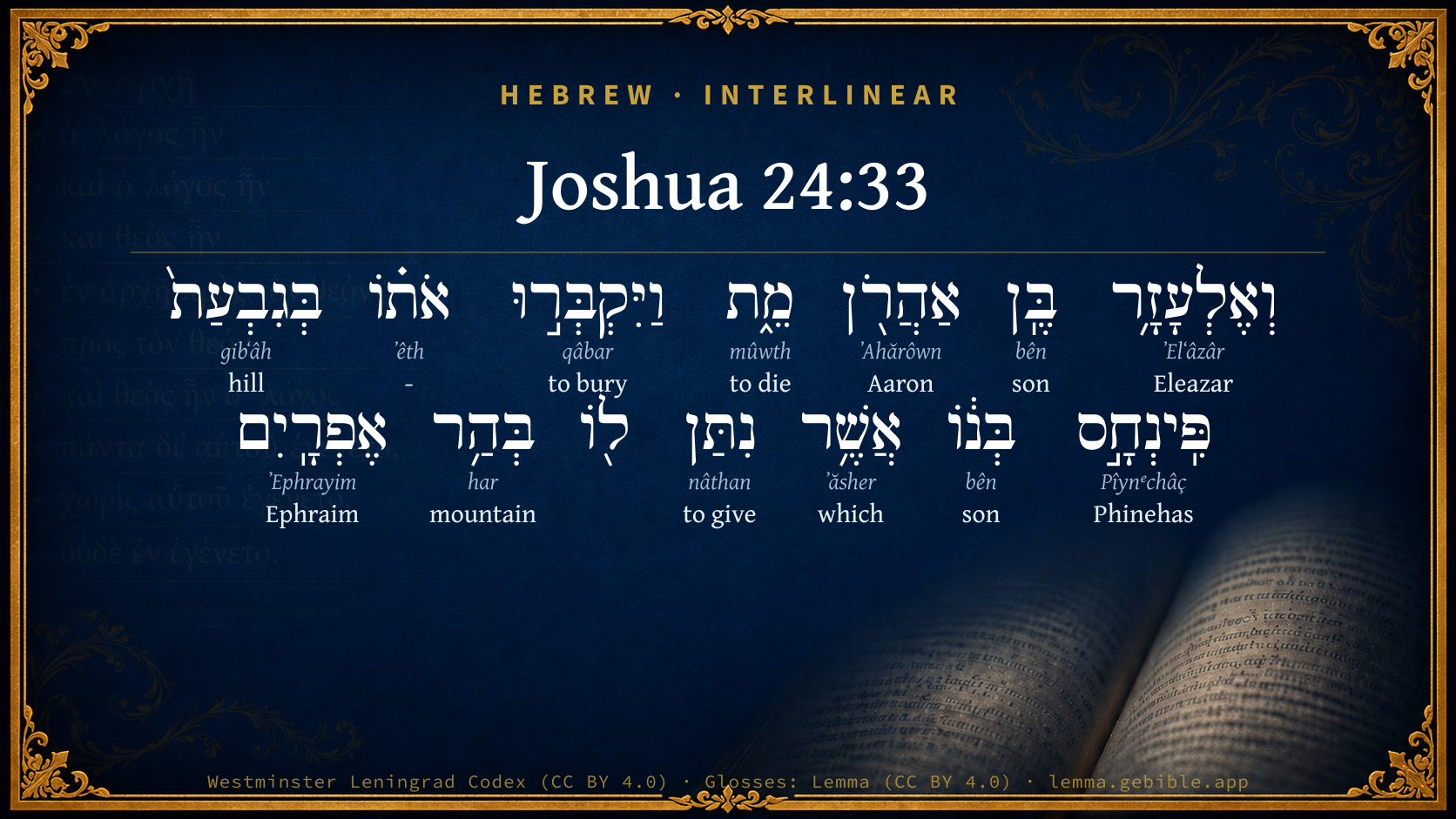
Hebrew (Westminster Leningrad Codex) Joshua 24:33 appears in the Hebrew Old Testament. The text above is from the Westminster Leningrad Codex. Each word links to its Strong’s number, a concise gloss, and parsing drawn from the Open Scriptures Hebrew Bible morphology. Click any word for its full Brown-Driver-Briggs (BDB) entry.
Download image
Cite this verse

Joshua 24:33 (World English Bible). Public Domain. Lemma interlinear Bible study tool, https://lemma.gebible.app/v/joshua/24/33.

Show BibTeX & RIS
BibTeX
RIS
English Translation
Eleazar the son of Aaron died; and they buried him in the hill of Phinehas his son, which was given him in the hill-country of Ephraim.
World English Bible · Public Domain
Download a study sheet

One document with this verse’s original text, its word-by-word gloss line, the meaning frame, cross-references with their text, attributed commentary, and full source and license credits — printable, and it pastes into notes with its structure intact.

This verse Autodidact and up

Study sheet (.html) Plain text (.txt)

A passage Seminary Student

Up to 50 verses in one chapter. A passage sheet keeps up to 6 commentary sources and 12 cross-references per verse, in the order this page ranks them, and says so on the sheet whenever that leaves anything out. Ask for a single verse and you get the Autodidact verse sheet above.

Everything on this page stays free to read, with no account — the sheet is a download of what is already on screen, not access to it.

Want to remove ads? Support Godless Engineer
Compare translations 3

The same verse in 3 English versions, stacked beneath the original-language interlinear above. Click any original word for its lexicon entry.

Each is an independent rendering of the whole verse — the interlinear is not word-aligned to these translations.

Highlighted words mark where these versions differ — a whole-verse word diff, not a word-by-word alignment.

  • World English Bible Public Domain
    Eleazar the son of Aaron died; and they buried him in the hill of Phinehas his son, which was given him in the hill-country of Ephraim.
  • King James Version Public Domain
    And Eleazar the son of Aaron died; and they buried him in a hill that pertained to Phinehas his son, which was given him in mount Ephraim.
  • unfoldingWord Literal Text CC BY-SA 4.0
    And Eleazar, the son of Aaron, died. And they buried him in Gibeah of Phinehas his son, which had been given to him in the hill country of Ephraim.

unfoldingWord Literal Text — © unfoldingWord, licensed CC BY-SA 4.0. Word-aligned USFM3 via Door43 (git.door43.org/unfoldingWord/en_ult).

Versions to compare (up to 4)

3 of 4 selected

Show all 18 translations

Every available English version of this verse, each an independent rendering of the whole verse.

  • World English Bible Public Domain
    Eleazar the son of Aaron died; and they buried him in the hill of Phinehas his son, which was given him in the hill-country of Ephraim.
  • Berean Standard Bible Public Domain
    Eleazar son of Aaron also died, and they buried him at Gibeah, which had been given to his son Phinehas in the hill country of Ephraim.
  • Majority Standard Bible Public Domain
    Eleazar son of Aaron also died, and they buried him at Gibeah, which had been given to his son Phinehas in the hill country of Ephraim.
  • King James Version Public Domain
    And Eleazar the son of Aaron died; and they buried him in a hill that pertained to Phinehas his son, which was given him in mount Ephraim.
  • American Standard Version (1901) Public Domain
    And Eleazar the son of Aaron died; and they buried him in the hill of Phinehas his son, which was given him in the hill-country of Ephraim.
  • Revised Version (1885) Public Domain
    And Eleazar the son of Aaron died; and they buried him in the hill of Phinehas his son, which was given him in the hill country of Ephraim.
  • Geneva Bible (1599) Public Domain
    Also Eleazar the sonne of Aaron died, whome they buried in the hill of Phinehas his sonne, which was giuen him in mount Ephraim.
  • Douay-Rheims (1899) Public Domain
    Eleazar also the son of Aaron died: and they buried him in Gabaath that belongeth to Phinees his son, which was given him in mount Ephraim.
  • Young's Literal Translation Public Domain
    And Eleazar son of Aaron died, and they bury him in the hill of Phinehas his son, which was given to him in the hill-country of Ephraim.
  • Literal Standard Version CC BY-SA 4.0
    And Eleazar son of Aaron died, and they bury him in a hill of his son Phinehas, which was given to him in the hill-country of Ephraim.
  • Unlocked Literal Bible CC BY-SA 4.0
    Eleazar son of Aaron also died. They buried him at Gibeah, the city of Phinehas his son, which had been given to him. It was in the hill country of Ephraim.
  • unfoldingWord Literal Text CC BY-SA 4.0
    And Eleazar, the son of Aaron, died. And they buried him in Gibeah of Phinehas his son, which had been given to him in the hill country of Ephraim.
  • Darby Bible Public Domain
    And Eleazar the son of Aaron died; and they buried him in the hill of Phinehas his son, which had been given him in mount Ephraim.
  • World Messianic Bible Public Domain
    Eleazar the son of Aaron died. They buried him in the hill of Phinehas his son, which was given him in the hill country of Ephraim.
  • Webster's Bible Public Domain
    And Eleazar the son of Aaron died; and they buried him in a hill that pertained to Phinehas his son, which was given him in mount Ephraim.
  • Free Bible Version CC BY-SA 4.0
    And Eleazar, son of Aaron, died and they buried him at Gibeah, in the hill country of Ephraim, land which had been given to his son Phinehas.
  • Bible in Basic English Public Domain
    Then the death of Eleazar, the son of Aaron, took place; and his body was put in the earth in the hill of Phinehas his son, which had been given to him in the hill-country of Ephraim.
  • JPS Tanakh (1917) Public Domain
    And Eleazar the son of Aaron died; and they buried him in the Hill of Phinehas his son, which was given him in mount Ephraim.

Literal Standard Version (2020), Covenant Press — licensed CC BY-SA 4.0. Text via the HelloAO Bible API (eBible.org). Unlocked Literal Bible (unfoldingWord) — licensed CC BY-SA 4.0. Text via the HelloAO Bible API (eBible.org). unfoldingWord Literal Text — © unfoldingWord, licensed CC BY-SA 4.0. Word-aligned USFM3 via Door43 (git.door43.org/unfoldingWord/en_ult). Free Bible Version, Dr. Jonathan Gallagher — licensed CC BY-SA 4.0. Text via the HelloAO Bible API (eBible.org).

Word by word

More ways to search: Search by grammar → Find every occurrence → Compare this word →

Practice this passage: Drill this verse → Learn its vocabulary →

פִּֽינְחָ֣ס
Pîynᵉchâç
H6372
“Phinehas”
Noun, Proper
Part of Speech
Noun
Type
Proper
Full BDB Definition

Origin: apparently from H6310 and a variation of H5175

TWOT: None

Phinehas = "mouth of brass" - son of Eleazar and grandson of Aaron; his zealousness for the Lord averted a plague on Israel and gained him the promise of the Lord of an everlasting priesthood in his family - a priest and the son of the priest Eli - the father of a helper of Ezra
  1. וְאֶלְעָזָ֥ר ʼElʻâzâr H499 “and · Eleazar” Conjunction + Noun, Proper
  2. בֶּֽן bên H1121 “son of” Noun, Common, Masculine, Singular, Construct
  3. אַהֲרֹ֖ן ʼAhărôwn H175 “Aaron” Noun, Proper
  4. מֵ֑ת mûwth H4191 “to die” Verb, Qal, Perfect, 3rd Person, Masculine, Singular
  5. וַיִּקְבְּר֣וּ qâbar H6912 “and · to bury” Conjunction + Verb, Qal, Sequential Imperfect, 3rd Person, Masculine, Plural
  6. אֹת֗וֹ ʼêth H853 “- · him” Particle, Direct Object + Suffix, Personal, 3rd Person, Masculine, Singular
  7. בְּגִבְעַת֙ gibʻâh H1389 “in/at · hill of” Preposition + Noun, Common, Feminine, Singular, Construct
  8. בְּנ֔וֹ bên H1121 “son · his” Noun, Common, Masculine, Singular, Construct + Suffix, Personal, 3rd Person, Masculine, Singular
  9. אֲשֶׁ֥ר ʼăsher H834 “which” Particle, Relative
  10. נִתַּן nâthan H5414 “to give” Verb, Niphal, Perfect, 3rd Person, Masculine, Singular
  11. בְּהַ֥ר har H2022 “in/at · mountain of” Preposition + Noun, Common, Masculine, Singular, Construct
  12. אֶפְרָֽיִם ʼEphrayim H669 “Ephraim” Noun, Proper

About this verse

These counts appear in no published source. They are computed here, from the morphology-tagged text and Lemma’s own curated glosses. What Lemma adds →

14
words
12
distinct lemmas
Historical
section

Notable vocabulary

The rarest word here is פִּֽינְחָ֣ס Phinehas H6372 — appearing just 25 times in the whole Hebrew Bible.

Shared distinctive vocabulary

פִּֽינְחָ֣ס Phinehas H6372 occurs in 24 verses of the Hebrew Bible. Also found in:

Grammatical profile

  • 3 verbs
  • 8 nouns
  • 1 preposition
  • 2 particles

Verb forms

  • מֵ֑ת Qal · Perfect
  • וַיִּקְבְּר֣וּ Qal · Sequential Imperfect
  • נִתַּן Niphal · Perfect

Repetition

A word recurs within this verse — often emphatic in Hebrew:

  • בֶּֽן son H1121 ×2

Hebrew & Septuagint length

In English translation the verse runs 26 words from the Hebrew and 128 from the Septuagint (LXX English) — the Septuagint runs noticeably longer here. See the side-by-side →

A rough comparison of the two English renderings, which tokenize alike — not a word-level alignment.

Word counts can differ between the Hebrew and the Greek without any difference in meaning — e.g. the Hebrew direct-object marker אֵת has no separate Greek word, and Greek often adds the article ὁ.

Cross-references

14

Topical passages linked to Joshua 24:33 in the Treasury of Scripture Knowledge — connected by theme and wording, ordered by reader-vote popularity; previews shown in the World English Bible.

  • Exodus 6:25 Eleazar Aaron's son took one of the daughters of Putiel as his wife; and she bore him Phinehas. These are the heads of the fathers' houses of the Levites according to their families.
  • Joshua 22:13 The children of Israel sent to the children of Reuben, and to the children of Gad, and to the half-tribe of Manasseh, into the land of Gilead, Phinehas the son of Eleazar the priest,
  • Exodus 6:23 Aaron took Elisheba, the daughter of Amminadab, the sister of Nahshon, as his wife; and she bore him Nadab and Abihu, Eleazar and Ithamar.
  • Numbers 3:32 Eleazar the son of Aaron the priest shall be prince of the princes of the Levites, with the oversight of those who keep the charge of the sanctuary.
  • Numbers 20:26–28 and strip Aaron of his garments, and put them on Eleazar his son: and Aaron shall be gathered [to his people], and shall die there.
  • Joshua 14:1 These are the inheritances which the children of Israel took in the land of Canaan, which Eleazar the priest, and Joshua the son of Nun, and the heads of the fathers' [houses] of the tribes of the children of Israel, distributed to them,
  • Judges 20:28 and Phinehas, the son of Eleazar, the son of Aaron, stood before it in those days), saying, Shall I yet again go out to battle against the children of Benjamin my brother, or shall I cease? Yahweh said, Go up; for tomorrow I will deliver him into your hand.
  • Job 30:23 For I know that you will bring me to death, To the house appointed for all living.
  • Psalms 49:10 For he sees that wise men die; Likewise the fool and the senseless perish, And leave their wealth to others.
  • Isaiah 57:1–2 The righteous perishes, and no man lays it to heart; and merciful men are taken away, none considering that the righteous is taken away from the evil [to come].
  • Zechariah 1:5 Your fathers, where are they? And the prophets, do they live forever?
  • Acts 13:36 For David, after he had in his own generation served the counsel of God, fell asleep, and was laid with his fathers, and saw decay.
  • Hebrews 7:24 But he, because he lives forever, has his priesthood unchangeable.
  • Hebrews 9:26–27 or else he must have suffered often since the foundation of the world. But now once at the end of the ages, he has been revealed to put away sin by the sacrifice of himself.

Cross-references courtesy of OpenBible.info (CC BY 4.0).

Hebrew and Greek witnesses Masoretic Hebrew ↔ Greek Septuagint

The same verse in the two great witnesses to the Old Testament, shown verse-for-verse.

Here the Septuagint runs noticeably longer than the Hebrew — LXX2012 (modern English Septuagint) 128 words vs World English Bible 26. A rough length comparison of the two English translations, not a word-level alignment — read both below.

These are two independent witnesses, not word-aligned to each other, and the Septuagint is shown in lemma (dictionary) form.

Hebrew Joshua 24:33 Masoretic · Westminster Leningrad Codex

וְאֶלְעָזָ֥ר בֶּֽן אַהֲרֹ֖ן מֵ֑ת וַיִּקְבְּר֣וּ אֹת֗וֹ בְּגִבְעַת֙ פִּֽינְחָ֣ס בְּנ֔וֹ אֲשֶׁ֥ר נִתַּן ל֖וֹ בְּהַ֥ר אֶפְרָֽיִם

Eleazar the son of Aaron died; and they buried him in the hill of Phinehas his son, which was given him in the hill-country of Ephraim.

World English Bible · Public Domain

Greek LXX Joshua 24:33 Septuagint · lemma form

καί γίγνομαι μετά οὗτος καί ελεαζαρ υἱός ἀαρών ὁ ἀρχιερεύς τελευτάω καί θάπτω ἐν γαβααθ φινεες ὁ υἱός αὐτός ὅς δίδωμι αὐτός ἐν ὁ ὄρος ὁ ἐφράιμ ἐν ἐκεῖνος ὁ ἡμέρα λαμβάνω ὁ υἱός ἰσραήλ ὁ κιβωτός ὁ θεός περιφέρω ἐν ἑαυτοῦ καί φινεες ἱερατεύω ἀντί ελεαζαρ ὁ πατήρ αὐτός ἕως ἀποθνήσκω καί καταὀρύσσω ἐν γαβααθ ὁ ἑαυτοῦ ὁ δέ υἱός ἰσραήλ ἀποἔρχομαι ἕκαστος εἰς ὁ τόπος αὐτός καί εἰς ὁ ἑαυτοῦ πόλις καί σέβω ὁ υἱός ἰσραήλ ὁ ἀστάρτη καί ασταρωθ καί ὁ θεός ὁ ἔθνος ὁ κύκλος αὐτός καί παραδίδωμι αὐτός κύριος εἰς χείρ εγλωμ ὁ βασιλεύς μωαβ καί κυριεύω αὐτός ἔτος δέκα ὀκτώ

And it came to pass afterwards that Eleazar the high-priest the son of Aaron died, and was buried in Gabaar of Phinees his son, which he gave him in mount Ephraim. In that day the children of Israel took the ark of God, and carried it about among them; and Phinees exercised the priest's office in the room of Eleazar his father till he died, and he was buried in his own place Gabaar: but the children of Israel departed every one to their place, and to their own city: and the children of Israel worshipped Astarte, and Astaroth, and the gods of the nations round about them; and the Lord delivered them into the hands of Eglom king of Moab and he ruled over them eighteen years.

LXX2012 (modern English Septuagint) · Public Domain

On this verse, Adam Clarke's Commentary discusses the Septuagint’s reading. Read the note in Commentary ↓

Hebrew: Westminster Leningrad Codex (CC BY 4.0). Greek: Septuagint (public domain); English from LXX2012 (modern English Septuagint) (Public Domain). How the Septuagint differs from the Hebrew →

Targum (Aramaic paraphrase)

1

The Targum is the ancient Jewish Aramaic paraphrase of the Hebrew Scriptures — an interpretive translation, not the Hebrew text itself. Onkelos (literal) and Pseudo-Jonathan (expansive) render the Torah, and Jonathan the Prophets. Coverage is partial: where no permissively-licensed English translation exists for a verse, only the Aramaic is shown. This is verse-level text, not a word-by-word alignment to the Hebrew.

  1. Targum Jonathan Prophets (Joshua–Malachi)
    וְאֶלְעָזָר בַּר אַהֲרֹן מִית וּקְבָרוּ יָתֵיהּ בְּגִבְעֲתָא דְפִּנְחָס בְּרֵיהּ דְאִתְיְהִיבַת לֵיהּ בְּטוּרָא דְבֵית אֶפְרָיִם:

    (no public-domain English translation for this verse)

    Targum Jonathan — Aramaic: “Mikraot Gedolot” (public domain). English: “Sefaria Community Translation” (CC0 1.0 (public-domain dedication)); “London "Chaldee Paraphrase," 1871” (public domain). Text via Sefaria.

Commentary

Notes on Joshua 24:33 from classic Christian and Jewish commentators (each source and its license shown beneath its notes). The classic Christian expositions comment on the surrounding passage and are grouped to its opening verse, so a note may address several verses; the Jewish commentaries on the Tanakh (Rashi and others) are per-verse, so they appear only where the commentator wrote on this verse.

Lemma curates 59 commentaries, every one of them public domain or Creative Commons licensed, each selected and text-cleaned for this edition rather than reprinted as found. About our sources →

Trapp's Complete Commentary

John Trapp

Jos 24:33 And Eleazar the son of Aaron died; and they buried him in a hill [that pertained to] Phinehas his son, which was given him in mount Ephraim.

Ver. 33. In a hill that pertained to Phinehas.] Or, In Gibeathpineas, the name of a city, bearing his name.

Which was given him.] By the synagogue, saith Vatablus, in an extraordinary way; that, being the high priest, he might be near to Joshua, and not far from the tabernacles where his business lay.

John Trapp, A Commentary or Exposition upon All the Books of the Old and New Testament (1647–1656) — public domain. Text from a community e-Sword module.

Joseph Benson's Commentary

Jos 24:33. They buried him in a hill which was given him — By special favour, and for his better conveniency in attending upon the ark, which then was, and for a long time was to be, in Shiloh, near this place: whereas the cities which were given to the priests were in Judah, Benjamin, and Simeon, which were remote from Shiloh, though near the place where the ark was to have its settled abode; namely, at Jerusalem. It is probable Eleazar died about the same time with Joshua, as Aaron did in the same year with Moses. While Joshua lived, religion was kept up, under his care and influence; but after he and his cotemporaries were gone, it swiftly went to decay. How well is it for the gospel church that Christ, our Joshua, is still with it by his Spirit, and will be always, even to the end of the world!

Joseph Benson's Commentary on the Old and New Testaments (1811–1818) — public domain. Text from a community e-Sword module.

Tyndale Open Study Notes

Tyndale Open Resources

24:33 Eleazar the high priest had stood beside Joshua during the process of allotting portions of the land to the tribes of Israel. • Joshua, Joseph, and Eleazar were all buried in Ephraim, in the central part of the newly conquered land. Their burial served as a final sign that God had fulfilled his promise to give Israel the land.

Tyndale Open Study Notes — © Tyndale Open Resources, licensed CC BY-SA 4.0. Text via the HelloAO Bible API.

Geneva Bible (1599)

Geneva Bible translators

Hebrew, Gibeath Phinehas.

Geneva Bible (1599) marginal notes — public domain. Text via Bolls.life.

Jamieson, Fausset & Brown

Robert Jamieson, A. R. Fausset & David Brown

Eleazar the son of Aaron died, and they buried him in . . . mount Ephraim--The sepulchre is at the modern village Awertah, which, according to Jewish travellers, contains the graves also of Ithamar, the brother of Phinehas, the son of Eleazar [VAN DE VELDE].

Next: Judges Introduction

Jamieson, Fausset & Brown — Commentary Critical and Explanatory on the Whole Bible (1871) — public domain (CC PDM 1.0). Text via the HelloAO Bible API.

Adam Clarke's Commentary

Verse 33. And Eleazar - died] Probably about the same time as Joshua, or soon after; though some think he outlived him six years. Thus, nearly all the persons who had witnessed the miracles of God in the wilderness were gathered to their fathers; and their descendants left in possession of the great inheritance, with the Law of God in their hands, and the bright example of their illustrious ancestors before their eyes. It must be added that they possessed every advantage necessary to make them a great, a wise, and a holy people. How they used, or rather how they abused, these advantages, their subsequent history, given in the sacred books, amply testifies.

A hill that pertained to Phinehas his son] This grant was probably made to Phinehas as a token of the respect of the whole nation, for his zeal, courage, and usefulness: for the priests had properly no inheritance. At the end of this verse the Septuagint add: -

"In that day the children of Israel, taking up the ark of the covenant of God, carried it about with them, and Phinehas succeeded to the high priest's office in the place of his father until his death; and he was buried in Gabaath, which belonged to himself.

"Then the children of Israel went every man to his own place, and to his own city.

"And the children of Israel worshipped Astarte and Ashtaroth, and the gods of the surrounding nations, and the Lord delivered them into the hands of Eglon king of Moab, and he tyrannized over them for eighteen years."

THE last six verses in this chapter were, doubtless, not written by Joshua; for no man can give an account of his own death and burial. Eleazar, Phinehas, or Samuel, might have added them, to bring down the narration so as to connect it with their own times; and thus preserve the thread of the history unbroken. This is a common case; many men write histories of their own lives, which, in the last circumstances, are finished by others, and who has ever thought of impeaching the authenticity of the preceding part, because the subsequent was the work of a different hand? Hirtius's supplement has never invalidated the authenticity of the Commentaries of Caesar, nor the work of Quintus Smyrnaeus, that of the Iliad and Odyssey of Homer; nor the 13th book of AEneid, by Mapheus Viggius, the authenticity of the preceding twelve, as the genuine work of Virgil. We should be thankful that an adequate and faithful hand has supplied those circumstances which the original author could not write, and without which the work would have been incomplete.

Mr. Saurin has an excellent dissertation on this grand federal act formed by Joshua and the people of Israel on this very solemn occasion, of the substance of which the reader will not be displeased to find the following very short outline, which may be easily filled up by any whose business it is to instruct the public; for such a circumstance may with great propriety be brought before a Christian congregation at any time: -

"SEVEN things are to be considered in this renewal of the covenant.

I. The dignity of the mediator.

II. The freedom of those who contracted.

III. The necessity of the choice.

IV. The extent of the conditions.

V. The peril of the engagement.

VI. The solemnity of the acceptance.

VII. The nearness of the consequence.

"I. The dignity of the mediator. - Take a view of his names, Hosea and Jehoshua. God will save: he will save. The first is like a promise; the second, the fulfilment of that promise. God will save some time or other: - this is the very person by whom he will accomplish his promise. Take a view of Joshua's life: his faith, courage, constancy, heroism, and success. A remarkable type of Christ. See Heb 4:8.

"II. The freedom of those who contracted. - Take away the gods which your fathers served beyond the flood; and in Egypt, c., Jos 24:14, c. Joshua exhibits to the Israelites all the religions which were then known:

1. That of the Chaldeans, which consisted in the adoration of fire.

2. That of the Egyptians, which consisted in the worship of the ox Apis, cats, dogs, and serpents which had been preceded by the worship even of vegetables, such as the onion, c.

3. That of the people of Canaan, the principal objects of which were Astarte, (Venus), and Baal Peor, (Priapus.) Make remarks on the liberty of choice which every man has, and which God, in matters of religion, applies to, and calls into action.

"III. The necessity of the choice. - To be without religion, is to be without happiness here, and without any title to the kingdom of God. To have a false religion, is the broad road to perdition and to have the true religion, and live agreeably to it, is the high road to heaven. Life is precarious - death is at the door - the Judge calls - much is to be done, and perhaps little time to do it in! Eternity depends on the present moment. Choose - choose speedily - determinately, c.

"IV. The extent of the conditions. - Fear the Lord, and serve him in truth and righteousness. Fear the Lord. Consider his being, his power, holiness, justice, &c. This is the gate to religion. Religion itself consists of two parts.

I. TRUTH.

1. In opposition to the detestable idolatry of the forementioned nations.

2. In reference to that revelation which God gave of himself.

3. In reference to that solid peace and comfort which false religions may promise, but cannot give and which the true religion communicates to all who properly embrace it.

II. UPRIGHTNESS or integrity, in opposition to those abominable vices by which themselves and the neighbouring nations had been defiled.

1. The major part of men have one religion for youth, another for old age. But he who serves God in integrity, serves him with all his heart in every part of life.

2. Most men have a religion of times, places, and circumstances. This is a defective religion. Integrity takes in every time, every place, and every circumstance God's law being ever kept before the eyes, and his love in the heart, dictating purity and perfection to every thought, word, and work.

3. Many content themselves with abstaining from vice, and think themselves sure of the kingdom of God because they do not sin as others. But he who serves God in integrity, not only abstains from the act and the appearance of evil, but steadily performs every moral good.

4. Many think that if they practice some kind of virtues, to which they feel less of a natural repugnance, they bid fair for the kingdom; but this is opposite to uprightness. The religion of God equally forbids every species of vice, and recommends every kind of virtue.

"V. The peril of the engagement. - This covenant had in it the nature of an oath; for so much the phrase before the Lord implies: therefore those who entered into this covenant bound themselves by oath unto the Lord, to be steady and faithful in it. But it may be asked, 'As human nature is very corrupt, and exceedingly fickle, is there not the greatest danger of breaking such a covenant; and is it not better not to make it, than to run the risk of breaking it, and exposing one's self to superadded punishment on that account?' Answer: He who makes such a covenant in God's strength, will have that strength to enable him to prove faithful to it. Besides, if the soul do not feel itself under the most solemn obligation to live to God, it will live to the world and the flesh. Nor is such a covenant as this more solemn and strict than that which we have often made; first in our baptism, and often afterwards in the sacrament of the Lord's Supper, c. Joshua allows there is a great danger in making this covenant. Ye cannot serve the Lord, for he is a holy, strong, and jealous God, c. But this only supposes that nothing could be done right but by his Spirit, and in his strength. The energy of the Holy Spirit is equal to every requisition of God's holy law, as far as it regards the moral conduct of a believer in Christ.

"VI. The solemnity of the acceptance. - Notwithstanding Joshua faithfully laid down the dreadful evils which those might expect who should abandon the Lord yet they entered solemnly into the covenant. God forbid that we should forsake the Lord, but we will serve the Lord. They seemed to think that not to covenant in this case was to reject.

"VII. The nearness of the consequence. - There were false gods among them, and these must be immediately put away. As ye have taken the Lord for your God, then put away the strange gods which are among you, Jos 24:23. The moment the covenant is made, that same moment the conditions of it come into force. He who makes this covenant with God should immediately break off from every evil design, companion, word, and work. Finally, Joshua erected two monuments of this solemn transaction:

1. He caused the word to be written in the book of the law, Jos 24:26.

2. He erected a stone under an oak, Jos 24:27 that these two things might be witnesses against them if they broke the covenant which they then made, c."

There is the same indispensable necessity for every one who professes Christianity, to enter into a covenant with God through Christ. He who is not determined to be on God's side, will be found on the side of the world, the devil, and the flesh. And he who does not turn from all his iniquities, cannot make such a covenant. And he who does not make it now, may probably never have another opportunity. Reader, death is at the door, and eternity is at hand. These are truths which are everywhere proclaimed - everywhere professedly believed - everywhere acknowledged to be important and perhaps nowhere laid to heart as they should be. And yet all grant that they are born to die!

ON the character and conduct of Joshua, much has already been said in the notes and particularly in the preface to this book. A few particulars may be added.

It does not appear that Joshua was ever married, or that he had any children. That he was high in the estimation of God, we learn from his being chosen to succeed Moses in the government of the people. He was the person alone, of all the host of Israel, who was deemed every way qualified to go out before the congregation, and go in: to lead them out, and bring them in; and be the shepherd of the people, because the Spirit of God was in him. See Nu 27:17, c. He is called the servant of God, as was Moses and was, of all men of that generation, next in eminence to that great legislator.

Like his great master, he neither provided for himself nor his relatives; though he had it constantly in his power so to do. He was the head and leader of the people; the chief and foremost in all fatigues and dangers; without whose piety, prudence, wisdom, and military skill, the whole tribes of Israel, humanly speaking, must have been ruined. And yet this conqueror of the nations did not reserve to him self a goodly inheritance, a noble city, nor any part of the spoils of those he had vanquished. His countrymen, it is true, gave him an inheritance among them, Jos 19:50. This, we might suppose, was in consideration of his eminent services, and this, we might naturally expect, was the best inheritance in the land! No! they gave him Timnath-serah, in the barren mountains of Ephraim, and even this he asked Jos 19:50. But was not this the best city in the land? No - it was even NO city; evidently no more than the ruins of one that had stood in that place; and hence it is said, he builded the city and dwelt therein - he, with some persons of his own tribe, revived the stones out of the rubbish, and made it habitable.

Joshua believed there was a God; he loved him, acted under his influence, and endeavoured to the utmost of his power to promote the glory of his Maker, and the welfare of man: and he expected his recompense in another world.

Like HIM of whom he was an illustrious type, he led a painful and laborious life, devoting himself entirely to the service of God and the public good. How unlike was Joshua to those men who, for certain services, get elevated to the highest honours: but, not content with the recompense thus awarded them by their country, use their new influence for the farther aggrandizement of themselves and dependents, at the expense, and often to the ruin of their country!

Joshua retires only from labour when there is no more work to be done, and no more dangers to be encountered. He was the first in the field, and the last out of it; and never attempted to take rest till all the tribes of Israel had got their possessions, and were settled in their inheritances! Of him it might be truly said as of Caesar, he continued to work, nil actum reputans, si quid superesset agendum: for "he considered nothing done, while any thing remained undone."

Behold this man retiring from office and from life without any kind of emolument! the greatest man of all the tribes of Israel; the most patriotic, and the most serviceable; and yet the worst provided for! Statesmen! naval and military commanders! look Joshua in the face; read his history; and learn from IT what true PATRIOTISM means. That man alone who truly fears and loves God, credits his revelation, and is made a partaker of his Spirit, is capable of performing disinterested services to his country and to mankind!

MASORETIC NOTES ON JOSHUA

The number of verses in the Book of Joshua is 656, (should be 658, see on Jos 21:36, c.), of which the symbol is found in the word ותרן vetharon, (and shall sing), Isa 35:6.

Its middle verse is the Jos 13:26.

Its Masoretic sections are 14 the symbol of which is found in the word יד yad, (the hand), Eze 37:1. See the note at the end of Genesis, Clarke "Ge 50:26", and the Haphtaras at the end of the Pentateuch.

Adam Clarke's Commentary on the Bible (1810–1826) — public domain. Text from a community e-Sword/MySword module.

Ellicott's Commentary for English Readers

(33) And Eleazar the son of Aaron died.—“Eleazar the priest, and Joshua the son of Nun,” were the Moses and Aaron of this period. It is fitting that the Book of Joshua should close with the death of Eleazar, who was Joshua’s appointed counsellor; for when Joshua was given as a shepherd to Israel, in answer to the prayer of Moses, Eleazar was also given to Joshua for a counsellor (Num_27:21). At Eleazar’s word he was to go out and come in, “both he and all the children of Israel with him, even all the congregation.” It is rather singular that nothing but this has been recorded of Eleazar’s personal history. Everything stated about him in his lifetime is official. Not a word that he uttered has been preserved.

A hill. . . . given him in mount Ephraim.—The inheritance of Phinehas as a priest would lie within the tribe of Judah (Jos_21:13, &c.) or Benjamin. This gift to Phinehas in Mount Ephraim, near the seat of government, seems to have been a special grant to him over and above his inheritance. But inasmuch as the tabernacle itself was at Shiloh, in Mount Ephraim, it was altogether suitable and natural that some place of abode should be assigned to the priests in that neighbourhood, where they were compelled to reside.

Although Phinehas himself was “zealous for his God,” he lived to see the tribe of Benjamin nearly exterminated from Israel for repeating the sin of the Canaanites. (See Jdg_20:28.) We can hardly say that the people served Jehovah all the days of Phinehas. With Eleazar and Joshua the spirit of strict obedience to the law seems to have, in a great measure, passed away.

A Bible Commentary for English Readers, edited by Charles John Ellicott (1878–1897) — public domain. Text from a community e-Sword module.

The Cambridge Bible for Schools and Colleges

gen. ed. J. J. S. Perowne

33. Eleazar the son of Aaron] It seems probable that Eleazar had died during the lifetime of Joshua. He was the third son of Aaron, by Elisheba, daughter of Amminadab. After the death of Nadab and Abihu without children (Lev_10:1-2; Num_3:4), Eleazar was appointed chief over the principal Levites. He comes before us

(a) Ministering with his brother Ithamar during their father’s lifetime.

(b) Invested on Mount Hor, as the successor of Aaron, with the sacred garments (Num_20:28).

(c) Superintending the census of the people (Num_26:3-4).

(d) Taking part in the distribution of the Land after the conquest (Jos_14:1).

and they buried him in a hill] “Et sepelierunt eum in Gabaath-Phinees filii ejus,” Vulgate, which Wyclif curiously mistranslates “and Phynees and his sones birieden him in Gabaa.”

in a hill] The word here employed for “hill” is “Gibeah,” which gives its name to several towns and places in Palestine, which would doubtless be generally on or near a hill. This place was Gibeah-Phinehas, the city of his son, which had been given to the latter on Mount Ephraim. Robinson identifies it with the Gaba of Eusebius and Jerome, and the modern Chirbet Jibia, 5 miles north of Guphna, towards Nablûs or Shechem. “His tomb is still shewn in a little close overshadowed by venerable terebinths, at Awertah, a few miles S. E. of Nablûs.” Stanley’s Lectures, i. 281, n.

The Cambridge Bible for Schools and Colleges (gen. ed. J. J. S. Perowne; Cambridge University Press, 1878–1918) — public domain. Text from a community e-Sword module.

Albert Barnes' Notes on the Bible

(Eleazar’s burial-place is placed by Conder not at Tibneh but in the village of ‘Awertah.)

Albert Barnes' Notes on the Bible (1834–1885) — public domain. Text from a community e-Sword/MySword module.

Haydock's Catholic Bible Commentary

Eleazar, the second high priest, was succeeded by his son Phinees. They were both of a very unexceptionable character. The Holy Ghost says, (Ecclesiasticus xlv. 28,) Phinees, the son of Eleazar, is the third in glory, by imitating him (his father or grandfather) in the fear of the Lord, &c. The Jews seem to have adopted the doctrine of Pythagoras, with respect to Phinees, (Haydock) as they say that he was the man of God, (3 Kings ii. 27,) who appeared to Heli, (Trad. Heb. in Reg.) and that he was consulted by Jephte, and gave him advice to fulfil his vow; that he was the same person with Elias, and with one Phinees, who returned from the captivity with Esdras, 1 Paralipomenon ix. 20. They will even have him to be an incarnate angel. (Ap. Munster, &c.) But without dwelling any longer on these fabulous accounts, (Calmet) he was surely a man of the greatest zeal and piety. (Haydock) --- In consideration of his extraordinary merit, the city of Gabaath was given to him, though it was not properly a sacerdotal city, and priests could not regularly possess any land as their inheritance. Grotius supposes that he obtained this city along with his wife, as she was an heiress of the tribe of Ephraim. But if that had been the case, must she not have married some of the same tribe? Numbers xxxvi. 8. (Calmet) --- Septuagint (Grabe) add, "In that day the children of Israel taking the ark of the covenant of God, carried it about among themselves, and Phinees was priest instead of his father, till he died, and he was buried in Gabaath, his own city. But the Israelites went each to his own place and city; and the children of Israel worshipped Astarte and Asteroth, and the gods of the surrounding nations, and the Lord delivered them into the hands of Eglon, the king of Moab, and he held them in subjection 18 years. See Judges iii. 12, 14. Why this is recorded in this place does not appear, unless it be to insinuate that the servitude under Eglon did not commence till after the death of Phinees, who had been high priest 40 years. Abisue, his son, entered upon the pontificate in the first year of the administration of Aod, 1 Paralipomenon vi. 4, 50. (Salien, in the year of the world 2641, in the year before Christ 1412.) Josue and Eleazar had reigned nearly during the same period of time, and finished their course together. They had assisted each other in keeping the people of God under due restraint. Their successors in office acted with the like zeal and concord, though they were not quite so successful. It is probable that Phinees would have the chief sway in "the aristocracy" of the ancients, which Josephus says took place between Josue and Othoniel. Their government is acknowledged by most authors, though Salien supposes that their authority, as distinct from the Sanhedrim, consisted in giving good example. Many assert that Phinees ruled the people twenty-three years. (Haydock)

George Leo Haydock (1774–1849), Haydock's Catholic Family Bible and Commentary, 1859 edition — public domain. Excludes Psalms (Douay-Rheims chapter numbering differs from Protestant) and Deuterocanonical books (Catholic canon only).

Matthew Poole's English Annotations

By special favour, and for his better conveniency in attending upon the ark, which then was, and for a long time was to be, in Shiloh, which was near to this place; whereas the cities which were given to the priests were in Judah, Benjamin, and Simeon, which were remote from Shiloh, though near to the place where the ark was to have its settled abode, to wit, to Jerusalem.

Matthew Poole's English Annotations on the Holy Bible (1683–1685) — public domain. Text from a community e-Sword/MySword module.

The Pulpit Commentary

A hill that pertained to Phinehas his son. The LXX, Syriac, and Vulgate translate this as a proper name, Gibeath or Gabaath Phineas. But it may also mean Phinehas" hill. A city may or may not have been built there. Keil and Delitzsch believe it to be the Levitical town, Geba of Benjamin; but of this we cannot be sure. The tomb of Eleazar is still shown near Shechem, "overshadowed by venerable terebinths," as Dean Stanley tells us. And so the history ends with the death and burial of the conqueror of Palestine, the lieutenant of Moses, the faithful and humble servant of God, and of the successor of Aaron, who had been solemnly invested with the garments of his father before that father"s death. A fitting termination to so strange and marvellous a history. With the death of two such men a new era had begun for the chosen people; a darker page had now to be opened. The LXX adds to this passage, "In that day the children of Israel took the ark and carried it about among them, and Phinehas acted as priest, instead of Eleazar his father, until he died, and was buried in his own property at Gabaath. And the children of Israel went each one to his place and to his own city. And the children of Israel worshipped Astarte and Ashtaroth, the gods of the nations around them. And the Lord delivered them into the hand of Eglon king of the Moabites, and he had dominion over them eighteen years." The passage is an obvious compilation from the Book of Judges. It has no counterpart in the Hebrew, and the mention of Astarte and Ashtaroth as different deities is sufficient to discredit it.

The Pulpit Commentary (1880–1919), ed. H.D.M. Spence-Jones & Joseph S. Exell — public domain. Text from a community e-Sword module.

John Wesley's Explanatory Notes

Given him - By special favour, and for his better conveniency in attending upon the ark, which then was, and for a long time was to be in Shiloh, near this place: whereas the cities which were given to the priests, were in Judah. Benjamin, and Simeon, which were remote from Shiloh, tho' near the place where the ark was to have its settled abode, namely, at Jerusalem. It is probable Eleazar died about the same time with Joshua, as Aaron did in the same year with Moses. While Joshua lived, religion was kept up, under his care and influence, but after he and his contemporaries were gone, it swiftly went to decay. How well is it for the gospel church, that Christ, our Joshua, is still with it by his Spirit, and will be always, even to the end of the world?

John Wesley, Explanatory Notes Upon the Whole Bible (1754–1765) — public domain. Text via the GEBible commentary corpus.

Rashi

Rabbi Shlomo Yitzchaki (Rashi)

In the hill of his son, Pinchos. From where did Pinchos have a portion in the land? He inherited it from his wife.

Rashi on the Tanakh — English translations: “The Judaica Press complete Tanach with Rashi, translated by A. J. Rosenberg” (CC BY 4.0); “Pentateuch with Rashi's commentary by M. Rosenbaum and A.M. Silbermann, 1929-1934” (public domain); “The Metsudah Tanach series, Lakewood, N.J” (CC BY 4.0); and “The Book of Joshua, Metsudah Publications, 1997” (CC BY 4.0). Text via Sefaria.

Lesson kit

Teaching starters — assembled from the data on this page, not authored interpretation. Every prompt links to the verse data it draws on. Edit before teaching.

Joshua, in the Historical, opens this verse with 14 words (12 distinct Hebrew lemmas). Its most distinctive word is Pîynᵉchâç (“Phinehas”). The Greek Septuagint runs longer here. A historical commentator’s framing appears above. Read the whole chapter for the surrounding context.

Discussion questions

  1. The word Pîynᵉchâç carries the sense “Phinehas.” How does it shape the verse?
  2. Exodus 6:25 shares the word «Phinehas» with this verse. How do the two illuminate each other?
  3. “son” occurs 2× in this one verse. What is the effect of the repetition?
  4. Compared with the Hebrew, the Septuagint runs longer here. What questions does that raise?
  5. These translations render this verse differently; the difference is in the English rendering, not the original. What questions does that raise?
  6. The verb «מֵ֑ת» is Qal Perfect. How does its form color the action?
  7. Reading how Trapp's Complete Commentary and Joseph Benson's Commentary read this verse, where do the two commentators agree and where do they part?

Things to notice

Reading settings

Reading text

Shown beneath each verse's original-language words.

Old Testament
Old Testament edition

Read the OT as the Masoretic Hebrew (MT) or the Greek Septuagint (LXX).

English shown for the Greek Septuagint (in the Hebrew ↔ Greek comparison).

Comparing translations? Open the Compare panel on any verse page to stack up to four side by side.