Genesis 38:17

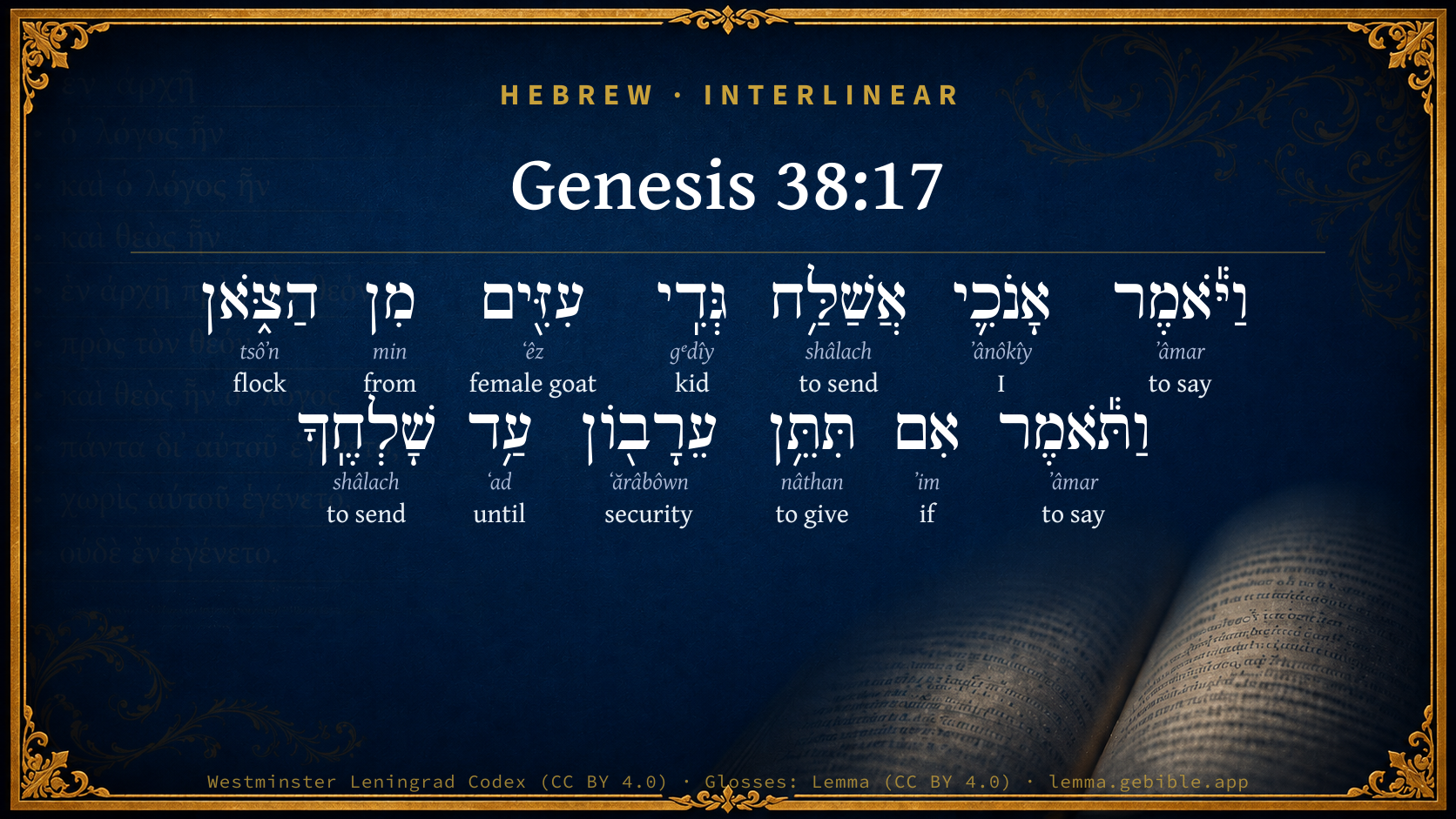
Hebrew (Westminster Leningrad Codex) Genesis 38:17 appears in the Hebrew Old Testament. The text above is from the Westminster Leningrad Codex. Each word links to its Strong’s number, a concise gloss, and parsing drawn from the Open Scriptures Hebrew Bible morphology. Click any word for its full Brown-Driver-Briggs (BDB) entry.
Download image
Cite this verse

Genesis 38:17 (World English Bible). Public Domain. Lemma interlinear Bible study tool, https://lemma.gebible.app/v/genesis/38/17.

Show BibTeX & RIS
BibTeX
RIS
English Translation
He said, "I will send you a kid of the goats from the flock." She said, "Will you give me a pledge, until you send it?"
World English Bible · Public Domain
Highlights
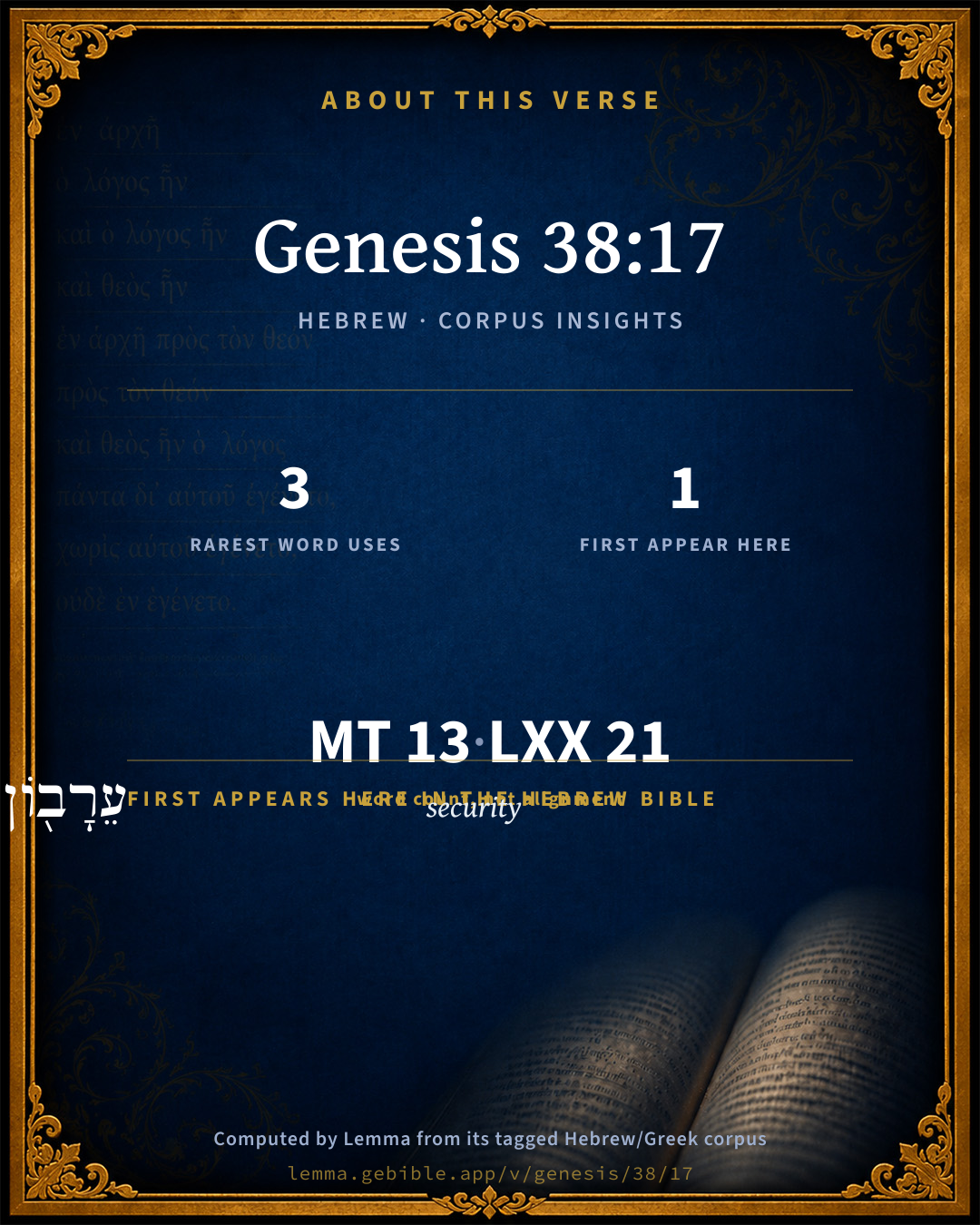
  • 1 first appearance in the Hebrew Bible
Full analysis ↓
Download a study sheet

One document with this verse’s original text, its word-by-word gloss line, the meaning frame, cross-references with their text, attributed commentary, and full source and license credits — printable, and it pastes into notes with its structure intact.

This verse Autodidact and up

Study sheet (.html) Plain text (.txt)

A passage Seminary Student

Up to 50 verses in one chapter. A passage sheet keeps up to 6 commentary sources and 12 cross-references per verse, in the order this page ranks them, and says so on the sheet whenever that leaves anything out. Ask for a single verse and you get the Autodidact verse sheet above.

Everything on this page stays free to read, with no account — the sheet is a download of what is already on screen, not access to it.

Want to remove ads? Support Godless Engineer
Compare translations 3

The same verse in 3 English versions, stacked beneath the original-language interlinear above. Click any original word for its lexicon entry.

Each is an independent rendering of the whole verse — the interlinear is not word-aligned to these translations.

Highlighted words mark where these versions differ — a whole-verse word diff, not a word-by-word alignment.

  • World English Bible Public Domain
    He said, "I will send you a kid of the goats from the flock." She said, "Will you give me a pledge, until you send it?"
  • King James Version Public Domain
    And he said, I will send thee a kid from the flock. And she said, Wilt thou give me a pledge, till thou send it?
  • unfoldingWord Literal Text CC BY-SA 4.0
    And he said, “I will send a kid goat from the flock.” And she said, “If you will give a pledge until you send.”

unfoldingWord Literal Text — © unfoldingWord, licensed CC BY-SA 4.0. Word-aligned USFM3 via Door43 (git.door43.org/unfoldingWord/en_ult).

Versions to compare (up to 4)

3 of 4 selected

Show all 17 translations

Every available English version of this verse, each an independent rendering of the whole verse.

  • World English Bible Public Domain
    He said, "I will send you a kid of the goats from the flock." She said, "Will you give me a pledge, until you send it?"
  • Berean Standard Bible Public Domain
    “I will send you a young goat from my flock,” Judah answered. But she replied, “Only if you leave me something as a pledge until you send it.”
  • Majority Standard Bible Public Domain
    “I will send you a young goat from my flock,” Judah answered. But she replied, “Only if you leave me something as a pledge until you send it.”
  • King James Version Public Domain
    And he said, I will send thee a kid from the flock. And she said, Wilt thou give me a pledge, till thou send it?
  • American Standard Version (1901) Public Domain
    And he said, I will send thee a kid of the goats from the flock. And she said, Wilt thou give me a pledge, till thou send it?
  • Revised Version (1885) Public Domain
    And he said, I will send thee a kid of the goats from the flock. And she said, Wilt thou give me a pledge, till thou send it?
  • Geneva Bible (1599) Public Domain
    Then said he, I will sende thee a kid of the goates from the flocke. and she said, Well, if thou wilt giue me a pledge, till thou sende it.
  • Young's Literal Translation Public Domain
    and he saith, `I -- I send a kid of the goats from the flock.' And she saith, `Dost thou give a pledge till thou send `it'?'
  • Literal Standard Version CC BY-SA 4.0
    And he says, “I send a kid of the goats from the flock.” And she says, “Do you give a pledge until you send [it]?”
  • Unlocked Literal Bible CC BY-SA 4.0
    He said, “I will send you a young goat from the flock.” She said, “Will you give me a pledge until you send it?”
  • unfoldingWord Literal Text CC BY-SA 4.0
    And he said, “I will send a kid goat from the flock.” And she said, “If you will give a pledge until you send.”
  • Darby Bible Public Domain
    And he said, I will send [thee] a kid of the goats from the flock. And she said, Wilt thou give [me] a pledge, until thou send it?
  • World Messianic Bible Public Domain
    He said, “I will send you a young goat from the flock.” She said, “Will you give me a pledge, until you send it?”
  • Webster's Bible Public Domain
    And he said, I will send thee a kid from the flock: and she said, Wilt thou give me a pledge, till thou sendest it?
  • Free Bible Version CC BY-SA 4.0
    “I'll send you a young goat from my flock,” he replied. “What guarantee will you give me to make sure you'll send it?” she asked.
  • Bible in Basic English Public Domain
    And he said, I will give you a young goat from the flock. And she said, What will you give me as a sign till you send it?
  • JPS Tanakh (1917) Public Domain
    And he said: 'I will send thee a kid of the goats from the flock.' And she said: 'Wilt thou give me a pledge, till thou send it?'

Literal Standard Version (2020), Covenant Press — licensed CC BY-SA 4.0. Text via the HelloAO Bible API (eBible.org). Unlocked Literal Bible (unfoldingWord) — licensed CC BY-SA 4.0. Text via the HelloAO Bible API (eBible.org). unfoldingWord Literal Text — © unfoldingWord, licensed CC BY-SA 4.0. Word-aligned USFM3 via Door43 (git.door43.org/unfoldingWord/en_ult). Free Bible Version, Dr. Jonathan Gallagher — licensed CC BY-SA 4.0. Text via the HelloAO Bible API (eBible.org).

Word by word

More ways to search: Search by grammar → Find every occurrence → Compare this word →

Practice this passage: Drill this verse → Learn its vocabulary →

עֵרָב֖וֹן
ʻărâbôwn
H6162
“security”
Noun, Common, Masculine, Singular, Absolute
Part of Speech
Noun
Type
Common
Gender
Masculine
Number
Singular
State
Absolute
Full BDB Definition

Origin: from H6148 (in the sense of exchange)

TWOT: 1686b

pledge, security
  1. וַיֹּ֕אמֶר ʼâmar H559 “and · to say” Conjunction + Verb, Qal, Sequential Imperfect, 3rd Person, Masculine, Singular
  2. אָנֹכִ֛י ʼânôkîy H595 “I” Pronoun, Personal, 1st Person, Common, Singular
  3. אֲשַׁלַּ֥ח shâlach H7971 “to send” Verb, Piel, Imperfect, 1st Person, Common, Singular
  4. גְּדִֽי gᵉdîy H1423 “kid of” Noun, Common, Masculine, Singular, Construct
  5. עִזִּ֖ים ʻêz H5795 “female goats” Noun, Common, Feminine, Plural, Absolute
  6. מִן min H4480 “from” Preposition
  7. הַצֹּ֑אן tsôʼn H6629 “the · flock” Particle, Definite Article + Noun, Common, Both, Singular, Absolute
  8. וַתֹּ֕אמֶר ʼâmar H559 “and · to say” Conjunction + Verb, Qal, Sequential Imperfect, 3rd Person, Feminine, Singular
  9. אִם ʼim H518 “if” Conjunction
  10. תִּתֵּ֥ן nâthan H5414 “to give” Verb, Qal, Imperfect, 2nd Person, Masculine, Singular
  11. עַ֥ד ʻad H5704 “until” Preposition
  12. שָׁלְחֶֽךָ shâlach H7971 “to send · you” Verb, Qal, Infinitive Construct + Suffix, Personal, 2nd Person, Masculine, Singular

About this verse

These counts appear in no published source. They are computed here, from the morphology-tagged text and Lemma’s own curated glosses. What Lemma adds →

13
words
11
distinct lemmas
Pentateuch
section

Notable vocabulary

The rarest word here is עֵרָב֖וֹן security H6162 — appearing just 3 times in the whole Hebrew Bible.

First appearance in Scripture

This word makes its first canonical appearance in the Hebrew Bible here:

  • עֵרָב֖וֹן security H6162

Shared distinctive vocabulary

עֵרָב֖וֹן security H6162 occurs in 3 verses of the Hebrew Bible. Also found in:

Grammatical profile

  • 5 verbs
  • 4 nouns
  • 1 pronoun
  • 2 prepositions
  • 1 conjunction

Verb forms

  • וַיֹּ֕אמֶר Qal · Sequential Imperfect
  • אֲשַׁלַּ֥ח Piel · Imperfect
  • וַתֹּ֕אמֶר Qal · Sequential Imperfect
  • תִּתֵּ֥ן Qal · Imperfect
  • שָׁלְחֶֽךָ Qal · Infinitive Construct

Repetition

Words recur within this verse — often emphatic in Hebrew:

  • וַיֹּ֕אמֶר to say H559 ×2
  • אֲשַׁלַּ֥ח to send H7971 ×2

Hebrew & Septuagint length

In English translation the verse runs 26 words from the Hebrew and 30 from the Septuagint (LXX English) — closely comparable.

A rough comparison of the two English renderings, which tokenize alike — not a word-level alignment.

Word counts can differ between the Hebrew and the Greek without any difference in meaning — e.g. the Hebrew direct-object marker אֵת has no separate Greek word, and Greek often adds the article ὁ.

In the original languages it is 13 Hebrew tokens and 21 Greek tokens — but the two are counted differently (Hebrew bundles its prefixes and suffixes into one token; the Greek is in lemma form), so that isn’t a like-for-like length.

Cross-references

5

Topical passages linked to Genesis 38:17 in the Treasury of Scripture Knowledge — connected by theme and wording, ordered by reader-vote popularity; previews shown in the World English Bible.

  • Genesis 38:20 Judah sent the kid of the goats by the hand of his friend, the Adullamite, to receive the pledge from the woman's hand, but he didn't find her.
  • Ezekiel 16:33 They give gifts to all prostitutes; but you give your gifts to all your lovers, and bribe them, that they may come to you on every side for your prostitution.
  • Genesis 38:24–25 It happened about three months later, that it was told Judah, saying, "Tamar, your daughter-in-law, has played the prostitute; and moreover, behold, she is with child by prostitution." Judah said, "Bring her forth, and let her be burnt."
  • Proverbs 20:16 Take the garment of one who puts up collateral for a stranger; And hold him in pledge for a wayward woman.
  • Luke 16:8 "His lord commended the dishonest manager because he had done wisely, for the children of this world are, in their own generation, wiser than the children of the light.

Cross-references courtesy of OpenBible.info (CC BY 4.0).

Hebrew and Greek witnesses Masoretic Hebrew ↔ Greek Septuagint

The same verse in the two great witnesses to the Old Testament, shown verse-for-verse.

These are two independent witnesses, not word-aligned to each other, and the Septuagint is shown in lemma (dictionary) form.

Hebrew Genesis 38:17 Masoretic · Westminster Leningrad Codex

וַיֹּ֕אמֶר אָנֹכִ֛י אֲשַׁלַּ֥ח גְּדִֽי עִזִּ֖ים מִן הַצֹּ֑אן וַתֹּ֕אמֶר אִם תִּתֵּ֥ן עֵרָב֖וֹן עַ֥ד שָׁלְחֶֽךָ

He said, "I will send you a kid of the goats from the flock." She said, "Will you give me a pledge, until you send it?"

World English Bible · Public Domain

Greek LXX Genesis 38:17 Septuagint · lemma form

ὁ δέ εἶπον ἐγώ σύ ἀποστέλλω ἔριφος αἴξ ἐκ ὁ πρόβατον ὁ δέ εἶπον ἐάν δίδωμι ἀρραβών ἕως ὁ ἀποστέλλω σύ

And he said, I will send you a kid of the goats from my flock; and she said, Well, if you will give me an earnest, until you send it.

LXX2012 (modern English Septuagint) · Public Domain

On this verse, John Gill's Exposition discusses the Septuagint’s reading. Read the note in Commentary ↓

Hebrew: Westminster Leningrad Codex (CC BY 4.0). Greek: Septuagint (public domain); English from LXX2012 (modern English Septuagint) (Public Domain). How the Septuagint differs from the Hebrew →

Targum (Aramaic paraphrase)

2

The Targum is the ancient Jewish Aramaic paraphrase of the Hebrew Scriptures — an interpretive translation, not the Hebrew text itself. Onkelos (literal) and Pseudo-Jonathan (expansive) render the Torah, and Jonathan the Prophets. Coverage is partial: where no permissively-licensed English translation exists for a verse, only the Aramaic is shown. This is verse-level text, not a word-by-word alignment to the Hebrew.

  1. Targum Onkelos Torah (Genesis–Deuteronomy)
    וַאֲמַר אֲנָא אֲשַׁלַּח גַּדְיָא בַר עִזֵּי מִן עָנָא וַאֲמֶרֶת אִם תִּתֵּן מַשְׁכּוֹנָא עַד דְּתִשְׁלָח

    (no public-domain English translation for this verse)

    Targum Onkelos — Aramaic: “Onkelos Genesis” (public domain); “Onkelos Exodus” (public domain); “Onkelos Leviticus” (public domain); “Onkelos Numbers” (public domain); “Onkelos Deuteronomy” (public domain). English: “Sefaria Community Translation” (CC0 1.0 (public-domain dedication)); “J.W. Etheridge. The Targums of Onkelos and Jonathan Ben Uzziel on the Pentateuch. London: Longmans, Green, 1862” (public domain). Text via Sefaria.

  2. Targum Pseudo-Jonathan Torah (Genesis–Deuteronomy)
    וַאֲמַר אֲנָא אֲשַׁדֵר גִידֵי בַּר עִיזֵי מִן עָנָא וַאֲמָרַת אִין תִּתֵּן מַשְׁכּוֹנָא עַד דְתִשְׁדַר

    And he said, I will send thee a kid of the goats from the flock. And she said, If thou wilt give me a pledge until thou shalt have sent.

    Targum Pseudo-Jonathan — Aramaic: “Targum Jonathan on Genesis” (public domain); “Targum Jonathan on Exodus” (public domain); “Targum Jonathan on Leviticus” (public domain); “Targum Jonathan on Numbers” (public domain); “Targum Jonathan on Deuteronomy” (public domain). English: “The Targum of Jonathan ben Uzziel, trans. J. W. Etheridge, London, 1862” (public domain). Text via Sefaria.

Commentary

Notes on Genesis 38:17 from classic Christian and Jewish commentators (each source and its license shown beneath its notes). The classic Christian expositions comment on the surrounding passage and are grouped to its opening verse, so a note may address several verses; the Jewish commentaries on the Tanakh (Rashi and others) are per-verse, so they appear only where the commentator wrote on this verse.

Lemma curates 59 commentaries, every one of them public domain or Creative Commons licensed, each selected and text-cleaned for this edition rather than reprinted as found. About our sources →

Trapp's Complete Commentary

John Trapp

Gen 38:17 And he said, I will send [thee] a kid from the flock. And she said, Wilt thou give [me] a pledge, till thou send [it]?

Ver. 17. Wilt thou give me.] The love of money breeds noisome lusts. {1Ti 6:9} Harlots are sordida poscinummia, as Plautus hath it.

John Trapp, A Commentary or Exposition upon All the Books of the Old and New Testament (1647–1656) — public domain. Text from a community e-Sword module.

Joseph Benson's Commentary

Gen 38:17-21. A kid from the flock — A goodly price at which her chastity and honour were valued! Had the consideration been a thousand rams, and ten thousands of rivers of oil, it had not been a valuable consideration. The favour of God, the purity of the soul, the peace of the conscience, and the hope of heaven, are too precious to be exposed to sale at any such rates. It is a good account, if it be but true, of any place, that which they here gave, that there is no harlot in this place, for such sinners are the scandals and plagues of any place. Judah sits down content to lose his signet and his bracelets, and forbids his friend to make any further inquiry.

Joseph Benson's Commentary on the Old and New Testaments (1811–1818) — public domain. Text from a community e-Sword module.

Tyndale Open Study Notes

Tyndale Open Resources

38:17 It would be normal for Tamar to ask for a pledge if the man did not have the money to pay. A woman in such a position would not trust anyone to send the money.

Tyndale Open Study Notes — © Tyndale Open Resources, licensed CC BY-SA 4.0. Text via the HelloAO Bible API.

Adam Clarke's Commentary

Verse 17. Wilt thou give me a pledge till thou send it?] The word ערבון erabon signifies an earnest of something promised, a part of the price agreed for between a buyer and seller, by giving and receiving of which the bargain was ratified; or a deposit, which was to be restored when the thing promised should be given. St. Paul uses the same word in Greek letters, αππαβων, 2Co 1:22; Eph 1:14. From the use of the term in this history we may at once see what the apostle means by the Holy Spirit being the EARNEST, αππαβων, of the promised inheritance; viz., a security given in hand for the fulfilment of all God's promises relative to grace and eternal life. We may learn from this that eternal life will be given in the great day to all who can produce this erabon or pledge. He who has the earnest of the Spirit then in his heart shall not only be saved from death, but have that eternal life of which it is the pledge and the evidence. What the pledge given by Judah was, See Clarke on Ge 38:25.

Adam Clarke's Commentary on the Bible (1810–1826) — public domain. Text from a community e-Sword/MySword module.

John Gill's Exposition

And he said, what pledge shall I give thee?.... Being willing to part with anything for the gratification of his lust:

and she said, thy signet, and thy bracelets, and thy staff that is in thine hand; she asks all these, that if one should be lost, or fail of being sufficient proof, the other might: the first of these the Septuagint version renders, "thy ring"; the ring upon his finger, which had a seal on it, and was the signet of his right hand; so Onkelos and Ben Melech: the second word seems not so well rendered, since "bracelets" were wore by women and not men: Jarchi takes it to be a garment with which he was covered; so Ben Melech and the Targum, a cloak, which is not likely, that she should desire him to strip off his clothes: it seems to be either a covering of his head, a wrap of linen such as the Turks wear, or else a handkerchief he had in his pocket; and the staff in his hand was either his walking staff or a shepherd's crook or staff:

and he gave it her, all the above things as a pledge:

and came in unto her; not on the public road, but in some private place at some distance, to which they retired. Maimonides (c) says, before the law was given, if a man met a woman in the street, and he and she agreed, he gave her hire, and he lay with her, and went away, and such an one was called "Kedeshah", a harlot, the word used afterwards for Tamar:

and she conceived by him; she proved with child upon it.

(c) Hilchot lshot, c. 1. sect. 4.

John Gill's Exposition of the Whole Bible (1746–1763) — public domain (CC PDM 1.0). Text via the HelloAO Bible API.

The Pulpit Commentary

And he said, I will send thee a kid from the flock literally, a kid of the goats (ver. 20; cf. Jud_1:15:1) And she said, Wilt thou give me a pledge, till thou send it? literally, if thou wilt give me a pledge (zObre, from b to give in pledge, a word peculiar to traders which the Greeks and Romans appear to have borrowed from the Phoenicians, the originators of traffic: cf. ajrjrJabwn, arrhabo: vide Gesenius, p. 652) until thy sending (sc. then I consent to thy proposal).

The Pulpit Commentary (1880–1919), ed. H.D.M. Spence-Jones & Joseph S. Exell — public domain. Text from a community e-Sword module.

John Wesley's Explanatory Notes

A kid from the flock - A goodly price at which her chastity and honour were valued! Had the consideration been thousands of rams, and ten thousand rivers of oil, it had not been a valuable consideration. The favour of God, the purity of the soul, the peace of the conscience, and the hope of heaven: are too precious to be exposed to sale at any such rates. He lost his Jewels by the bargain: He sent the kid according to his promise, to redeem his pawn, but the supposed harlot could not be found. He sent it by his friend, (who was indeed his back-friend, because he was aiding and abetting in his evil deeds) the Adullamite; who came back without the pledge. 'Tis a good account, if it be but true, of any place that which they here gave, that there is no harlot in this place, for such sinners are the scandals and plagues of any place. Judah sits down content to lose his signet and his bracelets, and forbids his friend to make any further enquiry.

John Wesley, Explanatory Notes Upon the Whole Bible (1754–1765) — public domain. Text via the GEBible commentary corpus.

unfoldingWord translationNotes

Door43 World Missions Community

from the flock

"from my flock of goats"

seal and cord ... staff

A "seal" is similar to a coin with a design engraved on it, used to imprint melted wax. The "cord" was put through the seal so the owner could wear it around his neck. A staff was long wooden stick that helped in walking over rough ground.

she became pregnant by him

This can be stated in active form. AT: "he caused her to become pregnant" (See: Active or Passive)

translationWords

goat

flocks

pledge

seal

staff

had relations with

unfoldingWord translationNotes — © Distant Shores Media and the Door43 World Missions Community, licensed CC BY-SA 4.0. Source: git.door43.org/Door43/en_tn.

Rashi

Rabbi Shlomo Yitzchaki (Rashi)

ערבון means a PLEDGE.

Rashi on the Tanakh — English translations: “The Judaica Press complete Tanach with Rashi, translated by A. J. Rosenberg” (CC BY 4.0); “Pentateuch with Rashi's commentary by M. Rosenbaum and A.M. Silbermann, 1929-1934” (public domain); “The Metsudah Tanach series, Lakewood, N.J” (CC BY 4.0); and “The Book of Joshua, Metsudah Publications, 1997” (CC BY 4.0). Text via Sefaria.

Lesson kit

Teaching starters — assembled from the data on this page, not authored interpretation. Every prompt links to the verse data it draws on. Edit before teaching.

Genesis, in the Pentateuch, opens this verse with 13 words (11 distinct Hebrew lemmas). Its most distinctive word is ʻărâbôwn (“security”). A historical commentator’s framing appears above. Read the whole chapter for the surrounding context.

Discussion questions

  1. What does “security” (ʻărâbôwn) contribute to the verse as a whole?
  2. This is the first place “security” appears in Scripture (first appears here). What does its debut here establish?
  3. How does Genesis 38:18, which shares the word «security», read alongside this verse?
  4. What does the repetition of “to say” (2× in this one verse) do in this verse?
  5. The translations on this page render this verse differently — a whole-verse word diff, not a word-by-word alignment. What might account for the different wordings?
  6. «וַיֹּ֕אמֶר» is a Qal Sequential Imperfect verb. How does that grammatical form shape the action described?
  7. Compare how Trapp's Complete Commentary and Joseph Benson's Commentary read this verse. Where do they agree or differ?

Things to notice

Reading settings

Reading text

Shown beneath each verse's original-language words.

Old Testament
Old Testament edition

Read the OT as the Masoretic Hebrew (MT) or the Greek Septuagint (LXX).

English shown for the Greek Septuagint (in the Hebrew ↔ Greek comparison).

Comparing translations? Open the Compare panel on any verse page to stack up to four side by side.