Exodus 6:4

Hebrew (Westminster Leningrad Codex) Exodus 6:4 appears in the Hebrew Old Testament. The text above is from the Westminster Leningrad Codex. Each word links to its Strong’s number, a concise gloss, and parsing drawn from the Open Scriptures Hebrew Bible morphology. Click any word for its full Brown-Driver-Briggs (BDB) entry.
Download image
Cite this verse

Exodus 6:4 (World English Bible). Public Domain. Lemma interlinear Bible study tool, https://lemma.gebible.app/v/exodus/6/4.

Show BibTeX & RIS
BibTeX
RIS
English Translation
I have also established my covenant with them, to give them the land of Canaan, the land of their travels, in which they lived as aliens.
World English Bible · Public Domain
Download a study sheet

One document with this verse’s original text, its word-by-word gloss line, the meaning frame, cross-references with their text, attributed commentary, and full source and license credits — printable, and it pastes into notes with its structure intact.

This verse Autodidact and up

Study sheet (.html) Plain text (.txt)

A passage Seminary Student

Up to 50 verses in one chapter. A passage sheet keeps up to 6 commentary sources and 12 cross-references per verse, in the order this page ranks them, and says so on the sheet whenever that leaves anything out. Ask for a single verse and you get the Autodidact verse sheet above.

Everything on this page stays free to read, with no account — the sheet is a download of what is already on screen, not access to it.

Want to remove ads? Support Godless Engineer
Compare translations 3

The same verse in 3 English versions, stacked beneath the original-language interlinear above. Click any original word for its lexicon entry.

Each is an independent rendering of the whole verse — the interlinear is not word-aligned to these translations.

Highlighted words mark where these versions differ — a whole-verse word diff, not a word-by-word alignment.

  • World English Bible Public Domain
    I have also established my covenant with them, to give them the land of Canaan, the land of their travels, in which they lived as aliens.
  • King James Version Public Domain
    And I have also established my covenant with them, to give them the land of Canaan, the land of their pilgrimage, wherein they were strangers.
  • unfoldingWord Literal Text CC BY-SA 4.0
    And moreover, I established my covenant with them, to give to them the land of Canaan, the land of their sojourning, in which they sojourned.

unfoldingWord Literal Text — © unfoldingWord, licensed CC BY-SA 4.0. Word-aligned USFM3 via Door43 (git.door43.org/unfoldingWord/en_ult).

Versions to compare (up to 4)

3 of 4 selected

Show all 18 translations

Every available English version of this verse, each an independent rendering of the whole verse.

  • World English Bible Public Domain
    I have also established my covenant with them, to give them the land of Canaan, the land of their travels, in which they lived as aliens.
  • Berean Standard Bible Public Domain
    I also established My covenant with them to give them the land of Canaan, the land where they lived as foreigners.
  • Majority Standard Bible Public Domain
    I also established My covenant with them to give them the land of Canaan, the land where they lived as foreigners.
  • King James Version Public Domain
    And I have also established my covenant with them, to give them the land of Canaan, the land of their pilgrimage, wherein they were strangers.
  • American Standard Version (1901) Public Domain
    And I have also established my covenant with them, to give them the land of Canaan, the land of their sojournings, wherein they sojourned.
  • Revised Version (1885) Public Domain
    And I have also established my covenant with them, to give them the land of Canaan, the land of their sojournings, wherein they sojourned.
  • Geneva Bible (1599) Public Domain
    Furthermore as I made my couenant with them to giue them ye land of Canaan, the land of their pilgrimage, wherein they were strangers:
  • Douay-Rheims (1899) Public Domain
    And I made a covenant with them, to give them the land of Chanaan, the land of their pilgrimage wherein they were strangers.
  • Young's Literal Translation Public Domain
    and also I have established My covenant with them, to give to them the land of Canaan, the land of their sojournings, wherein they have sojourned;
  • Literal Standard Version CC BY-SA 4.0
    and I have also established My covenant with them, to give the land of Canaan to them, the land of their sojournings, wherein they have sojourned;
  • Unlocked Literal Bible CC BY-SA 4.0
    I also established my covenant with them, in order to give them the land of Canaan, the land where they lived as non-citizens, the land in which they wandered about.
  • unfoldingWord Literal Text CC BY-SA 4.0
    And moreover, I established my covenant with them, to give to them the land of Canaan, the land of their sojourning, in which they sojourned.
  • Darby Bible Public Domain
    And I established also my covenant with them, to give them the land of Canaan, the land of their pilgrimage, in which they were sojourners.
  • World Messianic Bible Public Domain
    I have also established my covenant with them, to give them the land of Canaan, the land of their travels, in which they lived as aliens.
  • Webster's Bible Public Domain
    And I have also established my covenant with them, to give them the land of Canaan, the land of their pilgrimage, in which they were strangers.
  • Free Bible Version CC BY-SA 4.0
    I also confirmed my solemn agreement with them to give them the land of Canaan, the country where they were living as foreigners.
  • Bible in Basic English Public Domain
    And I made an agreement with them, to give them the land of Canaan, the land of their wanderings.
  • JPS Tanakh (1917) Public Domain
    And I have also established My covenant with them, to give them the land of Canaan, the land of their sojournings, wherein they sojourned.

Literal Standard Version (2020), Covenant Press — licensed CC BY-SA 4.0. Text via the HelloAO Bible API (eBible.org). Unlocked Literal Bible (unfoldingWord) — licensed CC BY-SA 4.0. Text via the HelloAO Bible API (eBible.org). unfoldingWord Literal Text — © unfoldingWord, licensed CC BY-SA 4.0. Word-aligned USFM3 via Door43 (git.door43.org/unfoldingWord/en_ult). Free Bible Version, Dr. Jonathan Gallagher — licensed CC BY-SA 4.0. Text via the HelloAO Bible API (eBible.org).

Word by word

More ways to search: Search by grammar → Find every occurrence → Compare this word →

Practice this passage: Drill this verse → Learn its vocabulary →

מְגֻרֵיהֶ֖ם
mâgûwr
H4033
“dwelling places · their”
Noun, Common, Masculine, Plural, Construct + Suffix, Personal, 3rd Person, Masculine, Plural
Part of Speech
Noun
Type
Common
Gender
Masculine
Number
Plural
State
Construct
Full BDB Definition

Origin: from H1481 in the sense lodging

TWOT: 330c

sojourning place, dwelling-place, sojourning - dwelling-place - sojourning, lifetime
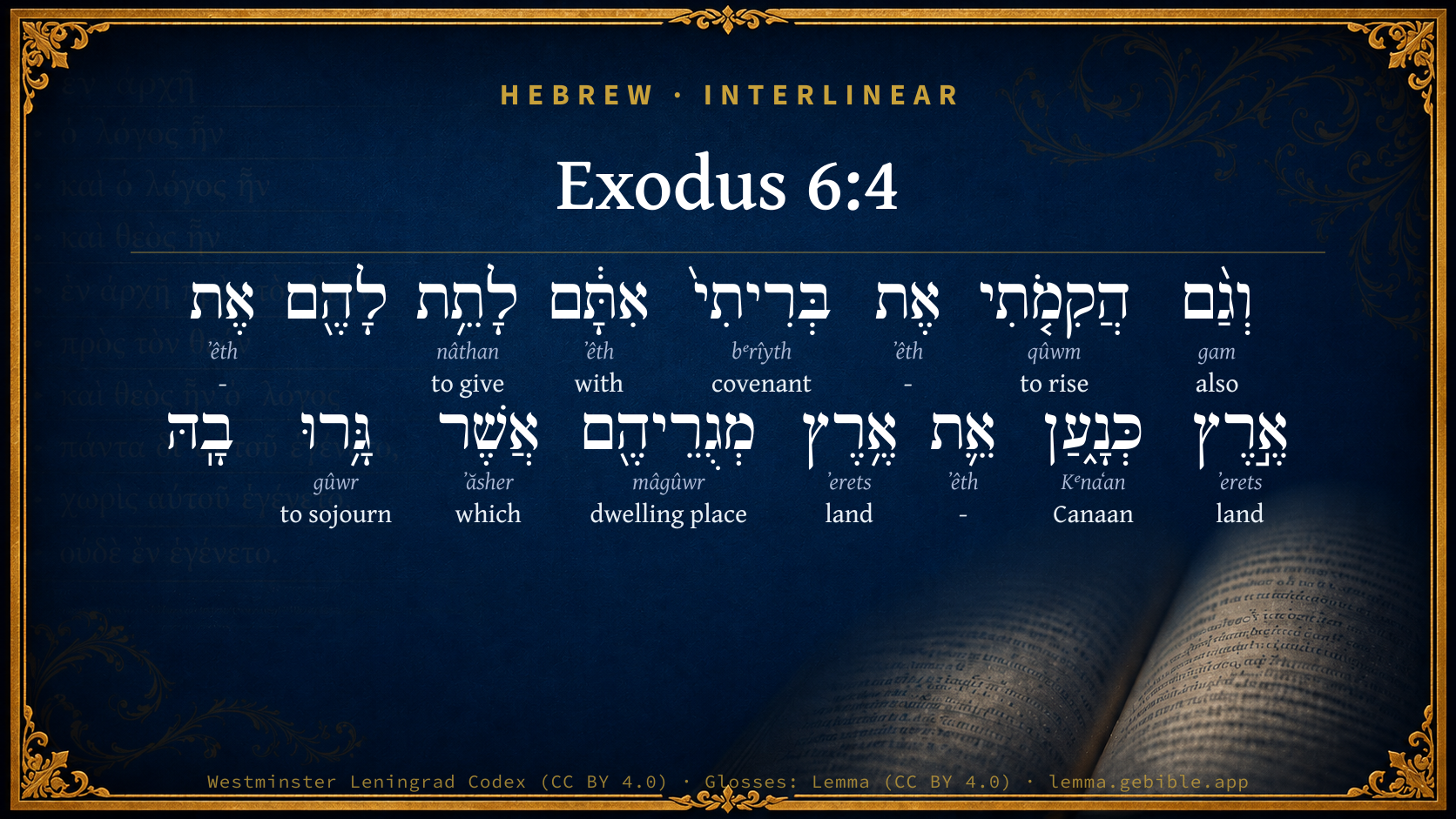
  1. וְגַ֨ם gam H1571 “and · also” Conjunction + Particle, Accusative
  2. הֲקִמֹ֤תִי qûwm H6965 “to rise” Verb, Hiphil, Perfect, 1st Person, Common, Singular
  3. אֶת ʼêth H853 “-” Particle, Direct Object
  4. בְּרִיתִי֙ bᵉrîyth H1285 “covenant · my” Noun, Common, Feminine, Singular, Construct + Suffix, Personal, 1st Person, Common, Singular
  5. אִתָּ֔ם ʼêth H854 “with · them” Preposition + Suffix, Personal, 3rd Person, Masculine, Plural
  6. לָתֵ֥ת nâthan H5414 “to give” Preposition + Verb, Qal, Infinitive Construct
  7. אֶת ʼêth H853 “-” Particle, Direct Object
  8. אֶ֣רֶץ ʼerets H776 “land of” Noun, Common, Both, Singular, Construct
  9. כְּנָ֑עַן Kᵉnaʻan H3667 “Canaan” Noun, Proper
  10. אֵ֛ת ʼêth H853 “-” Particle, Direct Object
  11. אֶ֥רֶץ ʼerets H776 “land of” Noun, Common, Both, Singular, Construct
  12. אֲשֶׁר ʼăsher H834 “which” Particle, Relative
  13. גָּ֥רוּ gûwr H1481 “to sojourn” Verb, Qal, Perfect, 3rd Person, Common, Plural

About this verse

These counts appear in no published source. They are computed here, from the morphology-tagged text and Lemma’s own curated glosses. What Lemma adds →

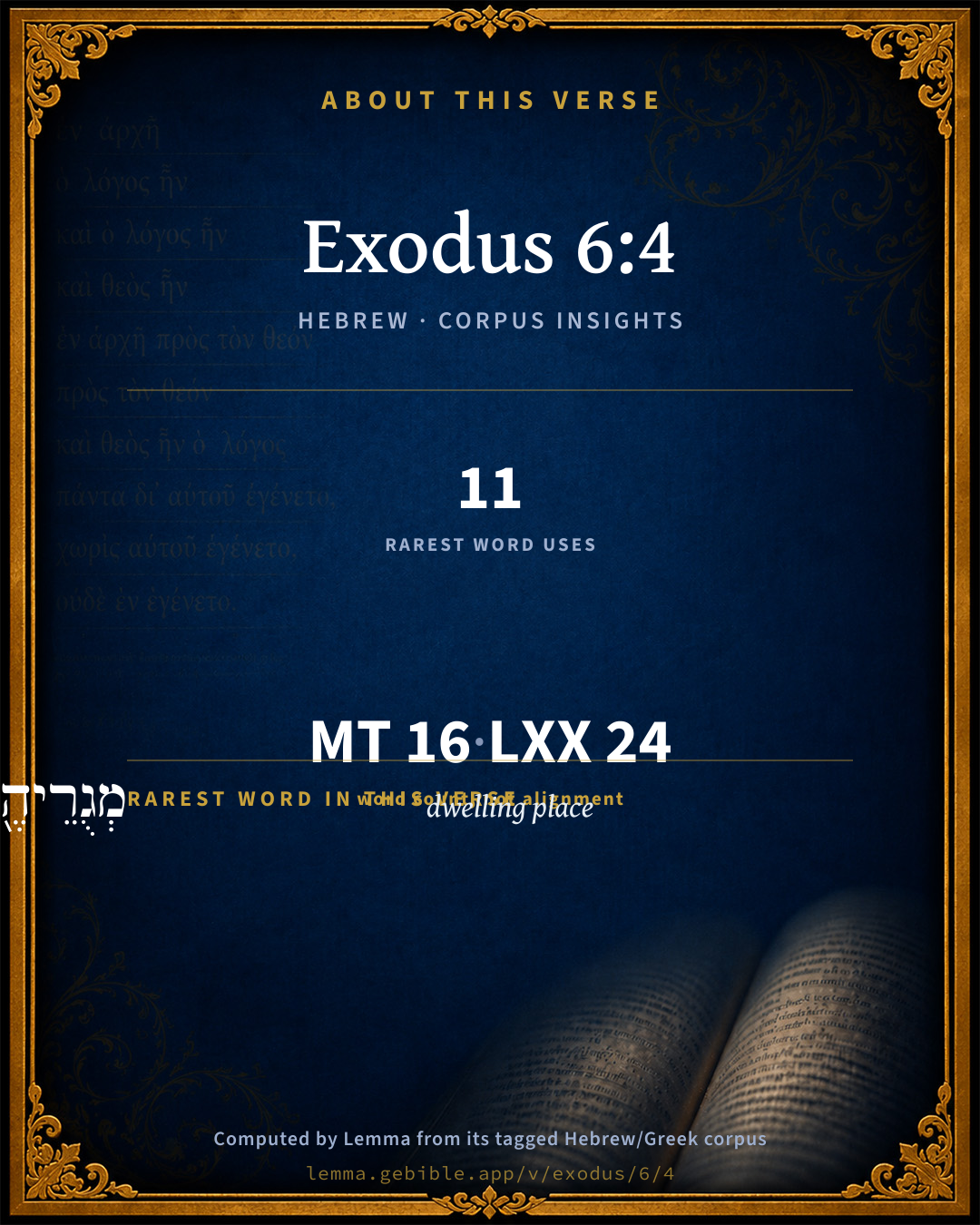
16
words
11
distinct lemmas
Pentateuch
section

Notable vocabulary

The rarest word here is מְגֻרֵיהֶ֖ם dwelling place H4033 — appearing just 11 times in the whole Hebrew Bible.

Shared distinctive vocabulary

מְגֻרֵיהֶ֖ם dwelling place H4033 occurs in 10 verses of the Hebrew Bible. Also found in:

Grammatical profile

  • 3 verbs
  • 5 nouns
  • 3 prepositions
  • 5 particles

Verb forms

  • הֲקִמֹ֤תִי Hiphil · Perfect
  • לָתֵ֥ת Qal · Infinitive Construct
  • גָּ֥רוּ Qal · Perfect

Repetition

A word recurs within this verse — often emphatic in Hebrew:

  • אֶ֣רֶץ land H776 ×2

Hebrew & Septuagint length

In English translation the verse runs 26 words from the Hebrew and 27 from the Septuagint (LXX English) — closely comparable.

A rough comparison of the two English renderings, which tokenize alike — not a word-level alignment.

Word counts can differ between the Hebrew and the Greek without any difference in meaning — e.g. the Hebrew direct-object marker אֵת has no separate Greek word, and Greek often adds the article ὁ.

In the original languages it is 16 Hebrew tokens and 24 Greek tokens — but the two are counted differently (Hebrew bundles its prefixes and suffixes into one token; the Greek is in lemma form), so that isn’t a like-for-like length.

Cross-references

14

Topical passages linked to Exodus 6:4 in the Treasury of Scripture Knowledge — connected by theme and wording, ordered by reader-vote popularity; previews shown in the World English Bible.

  • Genesis 28:4 and give you the blessing of Abraham, to you, and to your seed with you, that you may inherit the land where you travel, which God gave to Abraham."
  • Genesis 15:18 In that day Yahweh made a covenant with Abram, saying, "To your seed have I given this land, from the river of Egypt to the great river, the river Euphrates:
  • Genesis 17:7–8 I will establish my covenant between me and you and your seed after you throughout their generations for an everlasting covenant, to be a God to you and to your seed after you.
  • Genesis 26:3 Sojourn in this land, and I will be with you, and will bless you. For to you, and to your seed, I will give all these lands, and I will establish the oath which I swore to Abraham your father.
  • Isaiah 55:3 Turn your ear, and come to me; hear, and your soul shall live: and I will make an everlasting covenant with you, even the sure mercies of David.
  • Acts 7:5 He gave him no inheritance in it, no, not so much as to set his foot on. He promised that he would give it to him for a possession, and to his seed after him, when he still had no child.
  • Genesis 6:18 But I will establish my covenant with you. You shall come into the ark, you, your sons, your wife, and your sons' wives with you.
  • Genesis 15:13 He said to Abram, "Know for sure that your seed will live as foreigners in a land that is not theirs, and will serve them. They will afflict them four hundred years.
  • Genesis 17:4 "As for me, behold, my covenant is with you. You will be the father of a multitude of nations.
  • Genesis 17:13 He who is born in your house, and he who is bought with your money, must be circumcised. My covenant will be in your flesh for an everlasting covenant.
  • Genesis 23:4 "I am a stranger and a foreigner living with you. Give me a possession of a burying-place with you, that I may bury my dead out of my sight."
  • Genesis 28:13 Behold, Yahweh stood above it, and said, "I am Yahweh, the God of Abraham your father, and the God of Isaac. The land whereon you lie, to you will I give it, and to your seed.
  • 2 Samuel 23:5 Most assuredly my house is not so with God; Yet he has made with me an everlasting covenant, Ordered in all things, and sure: For it is all my salvation, and all [my] desire, Although he doesn't make it grow.
  • Psalms 105:12 When they were but a few men in number, Yes, very few, and foreigners in it.

Cross-references courtesy of OpenBible.info (CC BY 4.0).

Hebrew and Greek witnesses Masoretic Hebrew ↔ Greek Septuagint

The same verse in the two great witnesses to the Old Testament, shown verse-for-verse.

These are two independent witnesses, not word-aligned to each other, and the Septuagint is shown in lemma (dictionary) form.

Hebrew Exodus 6:4 Masoretic · Westminster Leningrad Codex

וְגַ֨ם הֲקִמֹ֤תִי אֶת בְּרִיתִי֙ אִתָּ֔ם לָתֵ֥ת לָהֶ֖ם אֶת אֶ֣רֶץ כְּנָ֑עַן אֵ֛ת אֶ֥רֶץ מְגֻרֵיהֶ֖ם אֲשֶׁר גָּ֥רוּ בָֽהּ

I have also established my covenant with them, to give them the land of Canaan, the land of their travels, in which they lived as aliens.

World English Bible · Public Domain

Greek LXX Exodus 6:4 Septuagint · lemma form

καί ἵστημι ὁ διαθήκη ἐγώ πρός αὐτός ὥστε δίδωμι αὐτός ὁ γῆ ὁ χαναναῖος ὁ γῆ ὅς παραοἰκέω ἐν ὅς καί παραοἰκέω ἐπί αὐτός

And I established my covenant with them, to give them the land of the Chananites, the land wherein they sojourned, in which also they lived as strangers.

LXX2012 (modern English Septuagint) · Public Domain

Hebrew: Westminster Leningrad Codex (CC BY 4.0). Greek: Septuagint (public domain); English from LXX2012 (modern English Septuagint) (Public Domain). How the Septuagint differs from the Hebrew →

Targum (Aramaic paraphrase)

2

The Targum is the ancient Jewish Aramaic paraphrase of the Hebrew Scriptures — an interpretive translation, not the Hebrew text itself. Onkelos (literal) and Pseudo-Jonathan (expansive) render the Torah, and Jonathan the Prophets. Coverage is partial: where no permissively-licensed English translation exists for a verse, only the Aramaic is shown. This is verse-level text, not a word-by-word alignment to the Hebrew.

  1. Targum Onkelos Torah (Genesis–Deuteronomy)
    וְאַף אֲקֵימִית יָת קְיָמִי עִמְהוֹן לְמִתַּן לְהוֹן יָת אַרְעָא דִכְנָעַן יָת אַרְעָא תּוֹתָבוּתְהוֹן דְאִתּוֹתָבוּ בָהּ:

    (no public-domain English translation for this verse)

    Targum Onkelos — Aramaic: “Onkelos Genesis” (public domain); “Onkelos Exodus” (public domain); “Onkelos Leviticus” (public domain); “Onkelos Numbers” (public domain); “Onkelos Deuteronomy” (public domain). English: “Sefaria Community Translation” (CC0 1.0 (public-domain dedication)); “J.W. Etheridge. The Targums of Onkelos and Jonathan Ben Uzziel on the Pentateuch. London: Longmans, Green, 1862” (public domain). Text via Sefaria.

  2. Targum Pseudo-Jonathan Torah (Genesis–Deuteronomy)
    וּלְחוֹד אַקֵימִית יַת קְיָימִי עִמְהוֹן לְמִתַּן לְהוֹן יַת אַרְעָא דִכְנָעַן יַת אַרַע תּוֹתָבוּתְהוֹן דְאִיתּוֹתְבוּ בָהּ

    And I confirmed also My covenant with them, to give them the land of Kenaan, the land of their sojourning in which they were sojourners.

    Targum Pseudo-Jonathan — Aramaic: “Targum Jonathan on Genesis” (public domain); “Targum Jonathan on Exodus” (public domain); “Targum Jonathan on Leviticus” (public domain); “Targum Jonathan on Numbers” (public domain); “Targum Jonathan on Deuteronomy” (public domain). English: “The Targum of Jonathan ben Uzziel, trans. J. W. Etheridge, London, 1862” (public domain). Text via Sefaria.

Commentary

Notes on Exodus 6:4 from classic Christian and Jewish commentators (each source and its license shown beneath its notes). The classic Christian expositions comment on the surrounding passage and are grouped to its opening verse, so a note may address several verses; the Jewish commentaries on the Tanakh (Rashi and others) are per-verse, so they appear only where the commentator wrote on this verse.

Lemma curates 59 commentaries, every one of them public domain or Creative Commons licensed, each selected and text-cleaned for this edition rather than reprinted as found. About our sources →

Trapp's Complete Commentary

John Trapp

Exo 6:4 And I have also established my covenant with them, to give them the land of Canaan, the land of their pilgrimage, wherein they were strangers.

Ver. 4. To give them the land of Canaan.] And a better thing with it, the kingdom of heaven. {Heb 11:10; Heb 11:16}

John Trapp, A Commentary or Exposition upon All the Books of the Old and New Testament (1647–1656) — public domain. Text from a community e-Sword module.

The Biblical Illustrator

Joseph S. Exell

Exo_6:4-5

I have also established My covenant with them.

A true pattern of gospel redemption

I. That gospel redemption comes to the soul after a period of moral bondage and distress.

1. It finds the soul in a condition of moral bondage. Whom the Egyptians keep in bondage. It is the bondage of sin. It has been long continued, through many years of our lives. It has been degrading. It has been fruitless to ourselves. Almost hopeless.

2. It finds the soul in a condition of anxious grief. I have also heard the groaning, etc. Tears of repentance. Cries for pardon.

3. It is generally preceded by some Christian agency. Aim of ministry to awaken desire for moral freedom.

II. That gospel redemption comes to the soul by virtue of a Divine covenant and promise. I have remembered, etc.

1. God through Christ has made a covenant of salvation with all who trust in the atonement.

2. By virtue of this covenant, all contrite and believing souls may find rest in and pardon from God.

3. This covenant is--

(1) Unique.

(2) Merciful.

(3) Of long standing.

III. That gospel redemption brings the soul into holy and responsible relationship to God. And I will take you to Me for a people, and I will be to you a God (Exo_6:7).

1. It constitutes the soul a Divine possession

2. It places the soul under the peculiar guardianship of the Infinite.

IV. That gospel redemption leads the faithful into the inheritance of Canaan. What a change! All things are yours. (J. S. Exell, M. A.)

Reasons for human redemption

I. The burden of man is a reason for human redemption. No human hand, but Christ alone, can remove it.

II. The Lordship of Christ is a reason for human redemption. He only could fulfil violated law; forgive past neglect; and enable us to keep it in future.

III. The covenant of God is a reason for human redemption. (J. S. Exell, M. A.)

Gods covenant to His people

1. Stated.

2. Settled.

3. Kept.

4. Happy.

5. Restful.

The Biblical Illustrator, edited by Joseph S. Exell (c. 1880s–1900s) — public domain. Text from a community e-Sword module.

Adam Clarke's Commentary

Verse 4. I have also established my covenant] I have now fully purposed to give present effect to all my engagements with your fathers, in behalf of their posterity.

Adam Clarke's Commentary on the Bible (1810–1826) — public domain. Text from a community e-Sword/MySword module.

Ellicott's Commentary for English Readers

(4) My covenant.—See Gen_15:18-21; Gen_17:7-8; Gen_26:3-4; Gen_35:12. &c.

The land of Canaan.—Canaan proper was the tract between Sidon and Gaza (Gen_10:19), which is now counted as “Palestine “; but the region promised to Abraham, and included in a larger sense of the word “Canaan,” was very much more extensive, reaching as it did from the Nile to the Euphrates (Gen_15:18). This vast territory was actually possessed by Israel under David and Solomon (1Ki_4:21-24).

The land of their pilgrimage, wherein they were strangers.—Heb., The land of their sojournings, wherein they sojourned. (Comp. Gen_17:8; Gen_23:4; Gen_28:4.) Abraham, Isaac, and Jacob were occupants of Canaan merely by sufferance: they were allowed to dwell in it because it was not half peopled; but the ownership was recognised as belonging to the Canaanite nations, Hittites and others (Gen_20:15; Gen_23:3-20, &c).

A Bible Commentary for English Readers, edited by Charles John Ellicott (1878–1897) — public domain. Text from a community e-Sword module.

The Cambridge Bible for Schools and Colleges

gen. ed. J. J. S. Perowne

4. I also established] without ‘have,’ the reference being to Gen_17:7. Established means ‘set up,’ ‘concluded,’ not ‘gave effect to’: to ‘establish a covenant’ is a standing expression in P, Gen_6:18; Gen_9:9; Gen_9:11; Gen_9:17; Gen_17:7; Gen_17:19; Gen_17:21 (elsewhere, in the same sense, only Eze_16:60; Eze_16:62). P never uses the ordinary Heb. expression, ‘cut a covenant’ (Exo_23:32, Exo_24:8, Exo_34:19, &c.).

my covenant] The covenant concluded with Abraham in Gen_17:1-2; Gen_17:7-8 (P) that, if Abraham walked blamelessly before God, He would multiply him, be a God to him and his seed after him, and give to his descendants the land of their sojournings, Canaan (cf. Gen_28:4; Gen_35:12,—both also P).

the land of their sojournings] Gen_17:8; Gen_23:4; also Gen_36:7; Gen_37:1 (all P), Gen 20:38†.

The Cambridge Bible for Schools and Colleges (gen. ed. J. J. S. Perowne; Cambridge University Press, 1878–1918) — public domain. Text from a community e-Sword module.

John Gill's Exposition

And I have also heard the groaning of the children of Israel,.... For the Lord is not only the eternal and immutable Being in his purposes and promises, and a covenant keeping God; but he is compassionate and merciful, and sympathizes with his people in all their afflictions; he takes notice of their sighs and groans, as he now did those of his people in Egypt:

whom the Egyptians keep in bondage; and which was the reason of their groaning; their bondage being so hard and rigorous, in which they were detained by Pharaoh, who refused to let them go, though Moses in the name of the Lord had required him to do it:

and I have remembered my covenant; concerning bringing them out of Egypt into the land of Canaan, which he would quickly do, and thereby make it appear he was mindful of his covenant, which is indeed never forgotten by him, though it may seem to be.

John Gill's Exposition of the Whole Bible (1746–1763) — public domain (CC PDM 1.0). Text via the HelloAO Bible API.

The Pulpit Commentary

I have established my covenant with them. Compare Gen_15:18-21 Gen_17:7, 8 26:3 28:13. The land of Canaan, in a narrow acceptation, reached "from Sidon unto Gaza"; (Gen_10:19) in a wider sense it included the whole tract between "the river of Egypt (Wady-el-Arish) and the great river, the river Euphrates". (Gen_15:18) It was this larger tract which was promised by God to Abraham. The land of their pilgrimage, wherein they were strangers. Literally, "the land of their sojourns wherein they sojourned." (So Kalisch.) It was by permission of the lords of the soil the Canaaaites, Perizzites, Hittites, and others, that Abraham and his descendants dwelt in Canaan to the time of Jacob"s descent into Egypt. (see Gen_12:6 Gen_13:7 Gen_23:7 Gen_27:46, etc.)

Vers. 4-8. God a keeper of covenants.

God is declared in Scripture to be one who "keepeth covenant and mercy, yea, to a thousand generations". (Deu_7:9) He is ever faithful. He cannot lie. He is not a man that he should repent. The bow which he set in the cloud, when he covenanted with Noah that the waters should no more become a flood to destroy all flesh, is still there, and the promise of which it was the sign has been kept there has come no repetition of the Flood, no second destruction of mankind by water. God has kept the covenant which he made with Israel at Sinai first, on the side of promise, in giving them all the good things which he said he would give them; and then, on the side of threatening, in bringing upon them all the calamities which he said he would bring. With Christians, too, God enters into covenant at their baptism, promising them protection, spiritual aid, and eternal life in heaven, on their maintaining faith and repentance. This covenant, like his others, he will assuredly keep. Let them be but true to him, and they need have no fear but that he will be true to them. The Promised Land will be theirs he will give it to them for an heritage he, Jehovah!

The Pulpit Commentary (1880–1919), ed. H.D.M. Spence-Jones & Joseph S. Exell — public domain. Text from a community e-Sword module.

Rashi

Rabbi Shlomo Yitzchaki (Rashi)

וגם הקמתי את בריתי וגו׳ Then, ALSO, when I appeared unto them by the name of God Almighty I ESTABLISHED and set up MY COVENANT between Myself and them

לתת להם את ארץ כנען TO GIVE THEM THE LAND OF CANAAN — Of Abraham it is stated in the chapter that contains the commandment of the Circumcision, (Genesis 17:1, and 17:8) “[The Lord appeared to Abraham and said unto him], I am God Almighty etc., and I will give to thee and to thy seed after thee the land of thy sojourning”. Of Isaac it is stated, (Genesis 26:3) “[The Lord appeared unto him and said], For unto thee and unto thy seed I will give all these countries, and I will establish the oath which I sware unto Abraham, thy father”, and that oath here referred to which I sware to Abraham I uttered by the name of God Almighty. Of Jacob it is stated, (Genesis 35:9, 11, 12) “[And God appeared unto Jacob … and God said unto him], I am God Almighty; be fruitful and multiply, … the land which I gave [Abraham and Isaac to thee I will give it] etc.” So you see that I made certain vows to them and I have not yet fulfilled them.

Rashi on the Tanakh — English translations: “The Judaica Press complete Tanach with Rashi, translated by A. J. Rosenberg” (CC BY 4.0); “Pentateuch with Rashi's commentary by M. Rosenbaum and A.M. Silbermann, 1929-1934” (public domain); “The Metsudah Tanach series, Lakewood, N.J” (CC BY 4.0); and “The Book of Joshua, Metsudah Publications, 1997” (CC BY 4.0). Text via Sefaria.

Ramban (Nachmanides)

Rabbi Moshe ben Nachman (Ramban / Nachmanides)

AND I HAVE ALSO ESTABLISHED MY COVENANT WITH THEM … AND MOREOVER I HAVE HEARD THE GROANING OF THE CHILDREN OF ISRAEL. The meaning thereof is as follows: “I have appeared to the patriarchs by the Name ‘E-il Sha-dai’ and I have also established this covenant [by this Divine Name] before Me, and moreover with My Great Name I have now heard the groaning of the children of Israel, and I have remembered My covenant which I have established for them with Me.” The student learned [in the mystic lore of the Cabala] will understand.Now as regards what our Rabbis have expounded: i.e., that [the Holy One, blessed be He, said to Moses], “Alas for those that are gone, [namely, the patriarchs], and are no more to be found! Many a time did I reveal Myself to Abraham, Isaac, and Jacob by the Name E-il Sha-dai, and I did not inform them that My Name is the Eternal as I have said it to you, and yet none of them cast aspersions upon My dealings with them, etc. Moreover, none of them asked Me what My Name is, as you asked. Right at the beginning of My mission, you said to Me, ‘What is Your Name?’ And at the end you said, For since I came to Pharaoh to speak in Thy name, he hath dealt ill with this people, etc.”, 5:23. It is in connection with this [complaint] that G-d said to Moses, And I have also established My covenant with them, etc., Shemoth Rabbah). The purport of this Midrash likewise fits in with the text. The Rabbis, of blessed memory, found it difficult to understand why G-d mentioned the prophecy of the patriarchs altogether, diminishing their accomplishment in prophecy and saying that He appeared to them only by the Name of E-il Sha-dai. What purpose did that serve? He could have said, “I am the Eternal, and wherefore say unto the children of Israel: ‘I am the Eternal, and I will bring you [from under the burdens of the Egyptians], and you shall know that I am the Eternal Who brought you out.’” Therefore the Rabbis explained that the message constituted a rebuke to Moses, telling him: “Behold, the patriarchs, whose accomplishment in prophecy was not as high as yours inasmuch as they contemplated Deity only through the Name E-il Sha-dai, believed in Me, And I have also established My covenant with them, and I have heard the groaning of their children for their sake. Surely you who have known Me by the Great Name and whom I have given My assurance [by that Name], you should have trusted in [My] mercies and assured Israel in My Name that I will do signs and wonders for them.” This interpretation too is correct and fitting.

Ramban (Nachmanides) on the Tanakh — English translation: “Commentary on the Torah by Ramban (Nachmanides). Translated and annotated by Charles B. Chavel. New York, Shilo Pub. House, 1971-1976” (CC BY 4.0). Text via Sefaria.

Lesson kit

Teaching starters — assembled from the data on this page, not authored interpretation. Every prompt links to the verse data it draws on. Edit before teaching.

Exodus, in the Pentateuch, opens this verse with 16 words (11 distinct Hebrew lemmas). Its most distinctive word is mâgûwr (“dwelling place”). A historical commentator’s framing appears above. Read the whole chapter for the surrounding context.

Discussion questions

  1. What does “dwelling place” (mâgûwr) contribute to the verse as a whole?
  2. Genesis 17:8 shares the word «dwelling place» with this verse. How do the two illuminate each other?
  3. “land” occurs 2× in this one verse. What is the effect of the repetition?
  4. The translations on this page render this verse differently — a whole-verse word diff, not a word-by-word alignment. What might account for the different wordings?
  5. The verb «הֲקִמֹ֤תִי» is Hiphil Perfect. How does its form color the action?
  6. Reading how Trapp's Complete Commentary and The Biblical Illustrator read this verse, where do the two commentators agree and where do they part?

Things to notice

Reading settings

Reading text

Shown beneath each verse's original-language words.

Old Testament
Old Testament edition

Read the OT as the Masoretic Hebrew (MT) or the Greek Septuagint (LXX).

English shown for the Greek Septuagint (in the Hebrew ↔ Greek comparison).

Comparing translations? Open the Compare panel on any verse page to stack up to four side by side.