1 Kings 1:48

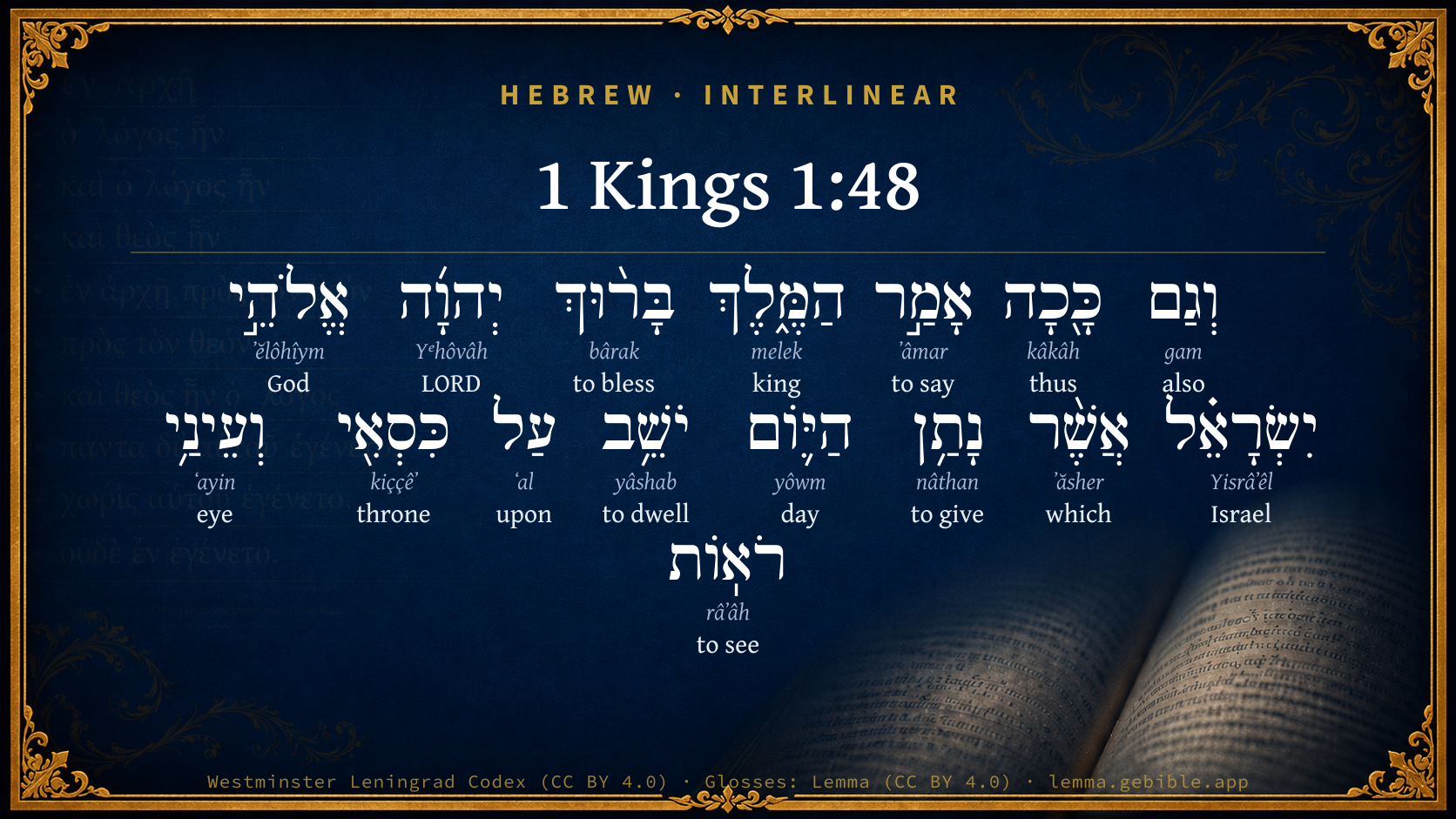
Hebrew (Westminster Leningrad Codex) 1 Kings 1:48 appears in the Hebrew Old Testament. The text above is from the Westminster Leningrad Codex. Each word links to its Strong’s number, a concise gloss, and parsing drawn from the Open Scriptures Hebrew Bible morphology. Click any word for its full Brown-Driver-Briggs (BDB) entry.
Download image
Cite this verse

1 Kings 1:48 (World English Bible). Public Domain. Lemma interlinear Bible study tool, https://lemma.gebible.app/v/1-kings/1/48.

Show BibTeX & RIS
BibTeX
RIS
English Translation
Also thus said the king, Blessed be Yahweh, the God of Israel, who has given one to sit on my throne this day, my eyes even seeing it.
World English Bible · Public Domain
Download a study sheet

One document with this verse’s original text, its word-by-word gloss line, the meaning frame, cross-references with their text, attributed commentary, and full source and license credits — printable, and it pastes into notes with its structure intact.

This verse Autodidact and up

Study sheet (.html) Plain text (.txt)

A passage Seminary Student

Up to 50 verses in one chapter. A passage sheet keeps up to 6 commentary sources and 12 cross-references per verse, in the order this page ranks them, and says so on the sheet whenever that leaves anything out. Ask for a single verse and you get the Autodidact verse sheet above.

Everything on this page stays free to read, with no account — the sheet is a download of what is already on screen, not access to it.

Want to remove ads? Support Godless Engineer
Compare translations 3

The same verse in 3 English versions, stacked beneath the original-language interlinear above. Click any original word for its lexicon entry.

Each is an independent rendering of the whole verse — the interlinear is not word-aligned to these translations.

Highlighted words mark where these versions differ — a whole-verse word diff, not a word-by-word alignment.

  • World English Bible Public Domain
    Also thus said the king, Blessed be Yahweh, the God of Israel, who has given one to sit on my throne this day, my eyes even seeing it.
  • King James Version Public Domain
    And also thus said the king, Blessed be the LORD God of Israel, which hath given one to sit on my throne this day, mine eyes even seeing it.
  • unfoldingWord Literal Text CC BY-SA 4.0
    And also, thus said the king, ‘Blessed Yahweh, the God of Israel, who today has given a sitter on my throne, and my eyes are seeing.’”

unfoldingWord Literal Text — © unfoldingWord, licensed CC BY-SA 4.0. Word-aligned USFM3 via Door43 (git.door43.org/unfoldingWord/en_ult).

Versions to compare (up to 4)

3 of 4 selected

Show all 18 translations

Every available English version of this verse, each an independent rendering of the whole verse.

  • World English Bible Public Domain
    Also thus said the king, Blessed be Yahweh, the God of Israel, who has given one to sit on my throne this day, my eyes even seeing it.
  • Berean Standard Bible Public Domain
    saying, ‘Blessed be the LORD, the God of Israel! Today He has provided one to sit on my throne, and my eyes have seen it.’”
  • Majority Standard Bible Public Domain
    saying, ‘Blessed be the LORD, the God of Israel! Today He has provided one to sit on my throne, and my eyes have seen it.’”
  • King James Version Public Domain
    And also thus said the king, Blessed be the LORD God of Israel, which hath given one to sit on my throne this day, mine eyes even seeing it.
  • American Standard Version (1901) Public Domain
    And also thus said the king, Blessed be Jehovah, the God of Israel, who hath given one to sit on my throne this day, mine eyes even seeing it.
  • Revised Version (1885) Public Domain
    And also thus said the king, Blessed be the LORD, the God of Israel, which hath given one to sit on my throne this day, mine eyes even seeing it.
  • Geneva Bible (1599) Public Domain
    And thus sayd the King also, Blessed bee the Lord God of Israel, who hath made one to sit on my throne this day, euen in my sight.
  • Douay-Rheims (1899) Public Domain
    And he said: Blessed be the Lord the God of Israel, who hath given this day one to sit on my throne, my eyes seeing
  • Young's Literal Translation Public Domain
    and also thus hath the king said, Blessed `is' Jehovah, God of Israel, who hath given to-day `one' sitting on my throne, and mine eyes seeing.'
  • Literal Standard Version CC BY-SA 4.0
    and also thus the king has said, Blessed [is] YHWH, God of Israel, who has given [one] sitting on my throne today, and my eyes are seeing.”
  • Unlocked Literal Bible CC BY-SA 4.0
    The king also said, 'Blessed be Yahweh, the God of Israel, who has given a person to sit on my throne this day, and that my own eyes should see it.'”
  • unfoldingWord Literal Text CC BY-SA 4.0
    And also, thus said the king, ‘Blessed Yahweh, the God of Israel, who today has given a sitter on my throne, and my eyes are seeing.’”
  • Darby Bible Public Domain
    And also thus said the king: Blessed be Jehovah, the God of Israel, who has given one to sit on my throne this day, mine eyes even seeing it.
  • World Messianic Bible Public Domain
    Also thus said the king, ‘Blessed be the LORD, the God of Israel, who has given one to sit on my throne today, my eyes even seeing it.’”
  • Webster's Bible Public Domain
    And also thus said the king, Blessed be the LORD God of Israel, who hath given one to sit on my throne this day, my eyes even seeing it.
  • Free Bible Version CC BY-SA 4.0
    and said, ‘Praise the Lord, the God of Israel! Today he has provided a successor to sit on my throne, and I have been privileged to see it.’”
  • Bible in Basic English Public Domain
    Then the king said, May the God of Israel be praised, who has given one of my seed to be king in my place this day and has let my eyes see it.
  • JPS Tanakh (1917) Public Domain
    And also thus said the king: Blessed be the LORD, the God of Israel, who hath given one to sit on my throne this day, mine eyes even seeing it.'

Literal Standard Version (2020), Covenant Press — licensed CC BY-SA 4.0. Text via the HelloAO Bible API (eBible.org). Unlocked Literal Bible (unfoldingWord) — licensed CC BY-SA 4.0. Text via the HelloAO Bible API (eBible.org). unfoldingWord Literal Text — © unfoldingWord, licensed CC BY-SA 4.0. Word-aligned USFM3 via Door43 (git.door43.org/unfoldingWord/en_ult). Free Bible Version, Dr. Jonathan Gallagher — licensed CC BY-SA 4.0. Text via the HelloAO Bible API (eBible.org).

Word by word

More ways to search: Search by grammar → Find every occurrence → Compare this word →

Practice this passage: Drill this verse → Learn its vocabulary →

כָּ֖כָה
kâkâh
  1. וְגַם gam H1571 “and · also” Conjunction + Particle, Accusative
  2. אָמַ֣ר ʼâmar H559 “to say” Verb, Qal, Perfect, 3rd Person, Masculine, Singular
  3. הַמֶּ֑לֶךְ melek H4428 “the · king” Particle, Definite Article + Noun, Common, Masculine, Singular, Absolute
  4. בָּר֨וּךְ bârak H1288 “blessed” Verb, Qal, Participle Passive, Masculine, Singular, Absolute
  5. יְהוָ֜ה Yᵉhôvâh H3068 “LORD” Noun, Proper
  6. אֱלֹהֵ֣י ʼĕlôhîym H430 “God(s) of” Noun, Common, Masculine, Plural, Construct
  7. יִשְׂרָאֵ֗ל Yisrâʼêl H3478 “Israel” Noun, Proper
  8. אֲשֶׁ֨ר ʼăsher H834 “which” Particle, Relative
  9. נָתַ֥ן nâthan H5414 “to give” Verb, Qal, Perfect, 3rd Person, Masculine, Singular
  10. הַיּ֛וֹם yôwm H3117 “the · day” Particle, Definite Article + Noun, Common, Masculine, Singular, Absolute
  11. יֹשֵׁ֥ב yâshab H3427 “dwelling” Verb, Qal, Participle Active, Masculine, Singular, Absolute
  12. עַל ʻal H5921 “upon” Preposition
  13. כִּסְאִ֖י kiççêʼ H3678 “throne · my” Noun, Common, Masculine, Singular, Construct + Suffix, Personal, 1st Person, Common, Singular
  14. וְעֵינַ֥י ʻayin H5869 “and · eyes · my” Conjunction + Noun, Common, Both, Dual, Construct + Suffix, Personal, 1st Person, Common, Singular
  15. רֹאֽוֹת râʼâh H7200 “seeing” Verb, Qal, Participle Active, Feminine, Plural, Absolute

About this verse

These counts appear in no published source. They are computed here, from the morphology-tagged text and Lemma’s own curated glosses. What Lemma adds →

16
words
16
distinct lemmas
Historical
section

Shared distinctive vocabulary

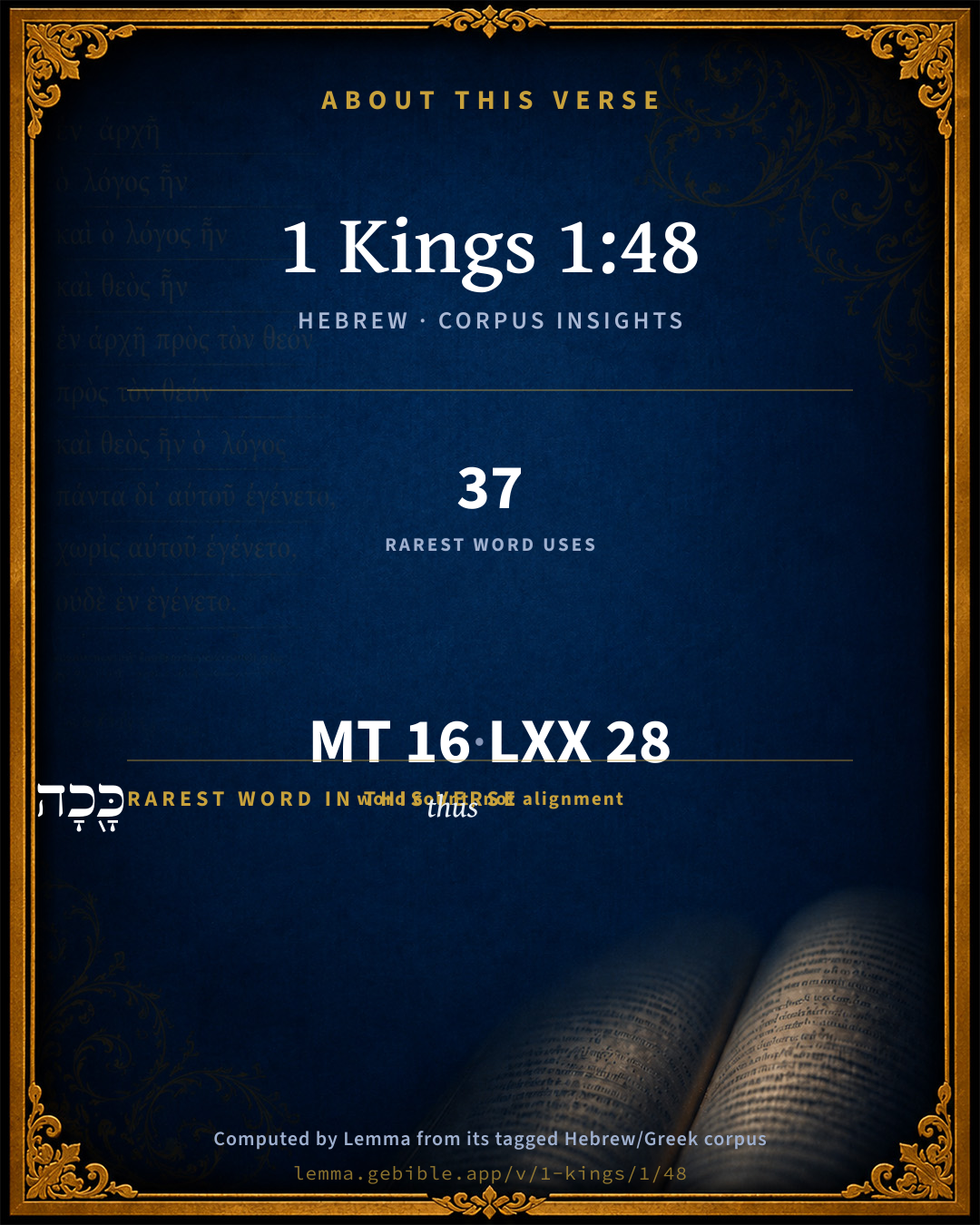
כָּ֖כָה thus H3602 occurs in 35 verses of the Hebrew Bible. Also found in:

Grammatical profile

  • 5 verbs
  • 7 nouns
  • 1 preposition
  • 1 adverb
  • 2 particles

Verb forms

  • אָמַ֣ר Qal · Perfect
  • בָּר֨וּךְ Qal · Participle Passive
  • נָתַ֥ן Qal · Perfect
  • יֹשֵׁ֥ב Qal · Participle Active
  • רֹאֽוֹת Qal · Participle Active

Hebrew & Septuagint length

In English translation the verse runs 28 words from the Hebrew and 30 from the Septuagint (LXX English) — closely comparable.

A rough comparison of the two English renderings, which tokenize alike — not a word-level alignment.

Word counts can differ between the Hebrew and the Greek without any difference in meaning — e.g. the Hebrew direct-object marker אֵת has no separate Greek word, and Greek often adds the article ὁ.

In the original languages it is 16 Hebrew tokens and 28 Greek tokens — but the two are counted differently (Hebrew bundles its prefixes and suffixes into one token; the Greek is in lemma form), so that isn’t a like-for-like length.

Cross-references

22

Topical passages linked to 1 Kings 1:48 in the Treasury of Scripture Knowledge — connected by theme and wording, ordered by reader-vote popularity; previews shown in the World English Bible.

  • 1 Kings 3:6 Solomon said, You have shown to your servant David my father great loving kindness, according as he walked before you in truth, and in righteousness, and in uprightness of heart with you; and you have kept for him this great loving kindness, that you have given him a son to sit on his throne, as it is this day.
  • Psalms 132:11–12 Yahweh has sworn to David in truth. He will not turn from it: "I will set the fruit of your body on your throne.
  • Genesis 14:20 and blessed be God Most High, who has delivered your enemies into your hand." Abram gave him a tenth of all.
  • 2 Samuel 7:12 When your days are fulfilled, and you shall sleep with your fathers, I will set up your seed after you, who shall proceed out of your bowels, and I will establish his kingdom.
  • 2 Samuel 24:3 Joab said to the king, Now Yahweh your God add to the people, however many they may be, one hundred times; and may the eyes of my lord the king see it: but why does my lord the king delight in this thing?
  • 1 Chronicles 17:11–14 It shall happen, when your days are fulfilled that you must go to be with your fathers, that I will set up your seed after you, who shall be of your sons; and I will establish his kingdom.
  • 1 Chronicles 17:17 This was a small thing in your eyes, God; but you have spoken of your servant's house for a great while to come, and have regarded me according to the estate of a man of high degree, Yahweh God.
  • 1 Chronicles 29:10 Therefore David blessed Yahweh before all the assembly; and David said, You are blessed, Yahweh, the God of Israel our father, forever and ever.
  • 1 Chronicles 29:20 David said to all the assembly, Now bless Yahweh your God. All the assembly blessed Yahweh, the God of their fathers, and bowed down their heads, and worshiped Yahweh, and the king.
  • Nehemiah 9:5 Then the Levites, Jeshua, and Kadmiel, Bani, Hashabneiah, Sherebiah, Hodiah, Shebaniah, [and] Pethahiah, said, Stand up and bless Yahweh your God from everlasting to everlasting; and blessed be your glorious name, which is exalted above all blessing and praise.
  • Psalms 34:1 I will bless Yahweh at all times. His praise will always be in my mouth.
  • Psalms 41:13 Blessed be Yahweh, the God of Israel, From everlasting and to everlasting! Amen and amen.
  • Psalms 72:17–19 His name endures forever. His name continues as long as the sun. Men shall be blessed by him. All nations will call him blessed.
  • Psalms 103:1–2 Praise Yahweh, my soul! All that is within me, praise his holy name!
  • Psalms 128:5–6 May Yahweh bless you out of Zion, And may you see the good of Jerusalem all the days of your life.
  • Psalms 145:2 Every day I will praise you. I will extol your name forever and ever.
  • Proverbs 17:6 Children's children are the crown of old men; The glory of children are their parents.
  • Daniel 4:34 At the end of the days I, Nebuchadnezzar, lifted up my eyes to heaven, and my understanding returned to me, and I blessed the Most High, and I praised and honored him who lives forever; for his dominion is an everlasting dominion, and his kingdom from generation to generation.
  • Luke 1:46–47 Mary said, "My soul magnifies the Lord.
  • Luke 1:68–69 "Blessed be the Lord, the God of Israel, For he has visited and worked redemption for his people;
  • Ephesians 1:3 Blessed be the God and Father of our Lord Jesus Christ, who has blessed us with every spiritual blessing in the heavenly places in Christ;
  • 1 Peter 1:3 Blessed be the God and Father of our Lord Jesus Christ, who according to his great mercy became our father again to a living hope through the resurrection of Jesus Christ from the dead,

Cross-references courtesy of OpenBible.info (CC BY 4.0).

Hebrew and Greek witnesses Masoretic Hebrew ↔ Greek Septuagint

The same verse in the two great witnesses to the Old Testament, shown verse-for-verse.

These are two independent witnesses, not word-aligned to each other, and the Septuagint is shown in lemma (dictionary) form.

Hebrew 1 Kings 1:48 Masoretic · Westminster Leningrad Codex

וְגַם כָּ֖כָה אָמַ֣ר הַמֶּ֑לֶךְ בָּר֨וּךְ יְהוָ֜ה אֱלֹהֵ֣י יִשְׂרָאֵ֗ל אֲשֶׁ֨ר נָתַ֥ן הַיּ֛וֹם יֹשֵׁ֥ב עַל כִּסְאִ֖י וְעֵינַ֥י רֹאֽוֹת

Also thus said the king, Blessed be Yahweh, the God of Israel, who has given one to sit on my throne this day, my eyes even seeing it.

World English Bible · Public Domain

Greek LXX 1 Kings 1:48 Septuagint · lemma form

καί γέ οὕτως εἶπον ὁ βασιλεύς εὐλογητός κύριος ὁ θεός ἰσραήλ ὅς δίδωμι σήμερον ἐκ ὁ σπέρμα ἐγώ καταἧμαι ἐπί ὁ θρόνος ἐγώ καί ὁ ὀφθαλμός ἐγώ βλέπω

Moreover thus said the king, Blessed be the Lord God of Israel, who has this day appointed one of my seed sitting on my throne, and my eyes see it.

LXX2012 (modern English Septuagint) · Public Domain

On this verse, The Cambridge Bible for Schools and Colleges discusses the Septuagint’s reading. Read the note in Commentary ↓

Hebrew: Westminster Leningrad Codex (CC BY 4.0). Greek: Septuagint (public domain); English from LXX2012 (modern English Septuagint) (Public Domain). How the Septuagint differs from the Hebrew →

Targum (Aramaic paraphrase)

1

The Targum is the ancient Jewish Aramaic paraphrase of the Hebrew Scriptures — an interpretive translation, not the Hebrew text itself. Onkelos (literal) and Pseudo-Jonathan (expansive) render the Torah, and Jonathan the Prophets. Coverage is partial: where no permissively-licensed English translation exists for a verse, only the Aramaic is shown. This is verse-level text, not a word-by-word alignment to the Hebrew.

  1. Targum Jonathan Prophets (Joshua–Malachi)
    וְאַף כְּדֵין אָמַר מַלְכָּא בְּרִיךְ יְיָ אֱלָהָא דְיִשְׂרָאֵל דִיהַב יוֹמָא דֵין בַּר יָתֵיב עַל כּוּרְסֵי מַלְכוּתִי וְעֵינַי חֲזָאָן:

    (no public-domain English translation for this verse)

    Targum Jonathan — Aramaic: “Mikraot Gedolot” (public domain). English: “Sefaria Community Translation” (CC0 1.0 (public-domain dedication)); “London "Chaldee Paraphrase," 1871” (public domain). Text via Sefaria.

Commentary

Notes on 1 Kings 1:48 from classic Christian and Jewish commentators (each source and its license shown beneath its notes). The classic Christian expositions comment on the surrounding passage and are grouped to its opening verse, so a note may address several verses; the Jewish commentaries on the Tanakh (Rashi and others) are per-verse, so they appear only where the commentator wrote on this verse.

Lemma curates 59 commentaries, every one of them public domain or Creative Commons licensed, each selected and text-cleaned for this edition rather than reprinted as found. About our sources →

Trapp's Complete Commentary

John Trapp

1Ki 1:48 And also thus said the king, Blessed [be] the LORD God of Israel, which hath given [one] to sit on my throne this day, mine eyes even seeing [it].

Ver. 48. To sit on my throne this day.] Nevertheless David did not during his life wholly lay aside the kingly power; but gave it to his son whilst he was yet alive.

John Trapp, A Commentary or Exposition upon All the Books of the Old and New Testament (1647–1656) — public domain. Text from a community e-Sword module.

The Biblical Illustrator

Joseph S. Exell

1Ki_1:48

Blessed be the Lord God of Israel.

The joy of aged and dying saints

It is matter of great joy and thankfulness to aged Christians, when they are dying, to leave their families in prosperous and peaceful circumstances; and especially, rising up in their stead to serve God and support religion.

I. To illustrate this observation.

1. It is a pleasure to an aged, dying Christian to leave his family in prosperous circumstances. It is the character of a good man, that he is not a lover of this world, nor anxiously solicitous about future events. Nevertheless, he considers himself as obliged, by the laws of nature, reason, and the gospel, to provide for those of his own house. He is not solicitous to heap up so much wealth for them as may be likely to make them idle, proud, and luxurious; but only so much as may fix them comfortably in the world; in that middle station which may be most friendly to their piety and happiness. He rejoiceth in that declaration of Solomon, The just man walketh in his integrity: his children are blessed after him; and he dieth with a full persuasion that it will be confirmed to his children.

2. It is a greater pleasure to him to leave his descendants in unity and love. Contentions and quarrels, between whomsoever they happen, are grievous to all the sons of peace, dishonourable to religion and injurious to its power; but between those of the same stock and family they are most shameful and pernicious. The aged saint, when he is going to the world of peace, is delighted to see his descendants loving as brethren, courteous and kind one to another.

3. It is his greatest joy to leave his descendants in the way of holiness, and zealous for the support of religion. A wise son, saith Solomon, maketh a glad father. The father of a wise child rejoiceth in him: especially when he is quitting the stage of life, and can do no more for the Church of God than pour out his prayers for its prosperity.

II. Why such a prospect giveth so much joy to aged and dying Christians.

1. This joy ariseth, in part, from their natural love to their descendants. God hath implanted in all creatures a strong affection to their offspring, in order that they may preserve and sustain them till they are capable of providing for themselves. This natural instinct or affection is, in good men, sanctified by religion.

2. The concern which aged Christians feel for the honour of God and Christ, and for the continuance and spread of religion, increaseth this joy. The great object of a good mans desire is, that God in all things may be glorified through Jesus Christ; that His perfections may be seen and manifested in the world, especially by the spread of His glorious gospel; and that He may receive that reverence, homage, and love, which is due to Him from all His rational, especially His redeemed, creatures.

3. His prospect of meeting his pious descendants again in the heavenly world. It is a most reviving and glorious consolation which the gospel affords to dying saints, that when they part with pious friends and relatives, it is not an eternal separation; it is indeed but a short one. For when Christ shall be revealed from heaven, there shall be a gathering together of all His saints unto Him; and He will so range and dispose them in the heavenly mansions, that those who were united in the bonds of pious friendship here, shall be happy in the renewed acquaintance and society of each other, and shall be ever with one another and with the Lord.

III. Inferences.

1. It should be the earnest desire, and diligent care, of all parents, that they may have this joy.

2. Aged Christians who have this joy ought to be very thankful. Bless the Lord God of Israel, as David did, that He hath given you dutiful and religions children, and spared you to be witnesses of their holy conversation.

3. It is the duty of young persons to fulfil their parents joy. Let them be solicitous to cherish and manifest those graces and dispositions which will afford their parents much comfort, especially when they are aged and dying. The father of the righteous, saith Solomon, shall greatly rejoice, and he that begetteth a wise child shall have joy of him. Thy father and thy mother shall be glad, and she that bare thee shall rejoice. (J. Orton, S. T. P.)

The Biblical Illustrator, edited by Joseph S. Exell (c. 1880s–1900s) — public domain. Text from a community e-Sword module.

The Cambridge Bible for Schools and Colleges

gen. ed. J. J. S. Perowne

48. the Lord God] See on 1Ki_1:30.

given one to sit] Of course he means ‘one of my own family and the one whom I specially wished.’ The LXX. adds here the words ‘of my seed’ and a like addition is made in some of the other versions. There can however be no misunderstanding of the king’s meaning without any such supplement. The king’s thankfulness was not for an occupier, but for the particular person now put on the throne.

The report brought by Jonathan (1Ki_1:43-48) seems like the language of one who had been a spectator of what he relates. If this were so, we must assume king David to have been carried from his bedchamber into some reception-room where he could listen, as he lay, to the congratulations mentioned in 1Ki_1:47. The adding on of one particular after another, with the repetition of the same conjunction ונם = and also, is exactly after the style of a messenger in great haste.

The Cambridge Bible for Schools and Colleges (gen. ed. J. J. S. Perowne; Cambridge University Press, 1878–1918) — public domain. Text from a community e-Sword module.

John Gill's Exposition

And also thus said the king,.... Being in a proper posture for an address to God:

blessed be the Lord God of Israel, which hath given one to sit on my throne this day, mine eyes seeing it; he ascribes this whole affair to God, and his kind providence, though all things were done according to his own orders; and gives thanks to him, who had directed him to take such steps as these were, and that the business was finished without any obstruction, and to the great joy and satisfaction of the people; and that there was such a prospect of Solomon's having a happy and peaceable reign.

John Gill's Exposition of the Whole Bible (1746–1763) — public domain (CC PDM 1.0). Text via the HelloAO Bible API.

The Pulpit Commentary

And also thus saith the king, Blessed be the Lord God of Israel, which hath given one to sit on my throne this day, mine eyes even seeing it. These last words are added because it is quite an exceptional thing for a king to see his successor on the throne.

The Pulpit Commentary (1880–1919), ed. H.D.M. Spence-Jones & Joseph S. Exell — public domain. Text from a community e-Sword module.

John Wesley's Explanatory Notes

Blessed, &c. - It is a great satisfaction to good men, when they are going out of the world, to see their children rising up in their stead, to serve God and their generation: and especially to see peace upon Israel, and the establishment of it.

John Wesley, Explanatory Notes Upon the Whole Bible (1754–1765) — public domain. Text via the GEBible commentary corpus.

Lesson kit

Teaching starters — assembled from the data on this page, not authored interpretation. Every prompt links to the verse data it draws on. Edit before teaching.

1 Kings, in the Historical, opens this verse with 16 words (16 distinct Hebrew lemmas). Its most distinctive word is kâkâh (“thus”). A historical commentator’s framing appears above. Read the whole chapter for the surrounding context.

Discussion questions

  1. How does “thus” (kâkâh) shape what this verse is saying?
  2. Exodus 12:11 shares the word «thus» with this verse. How do the two illuminate each other?
  3. The translations on this page render this verse differently — a whole-verse word diff, not a word-by-word alignment. What might account for the different wordings?
  4. The verb «אָמַ֣ר» is Qal Perfect. How does its form color the action?
  5. Reading how Trapp's Complete Commentary and The Biblical Illustrator read this verse, where do the two commentators agree and where do they part?

Things to notice

Reading settings

Reading text

Shown beneath each verse's original-language words.

Old Testament
Old Testament edition

Read the OT as the Masoretic Hebrew (MT) or the Greek Septuagint (LXX).

English shown for the Greek Septuagint (in the Hebrew ↔ Greek comparison).

Comparing translations? Open the Compare panel on any verse page to stack up to four side by side.