Exodus 23:27

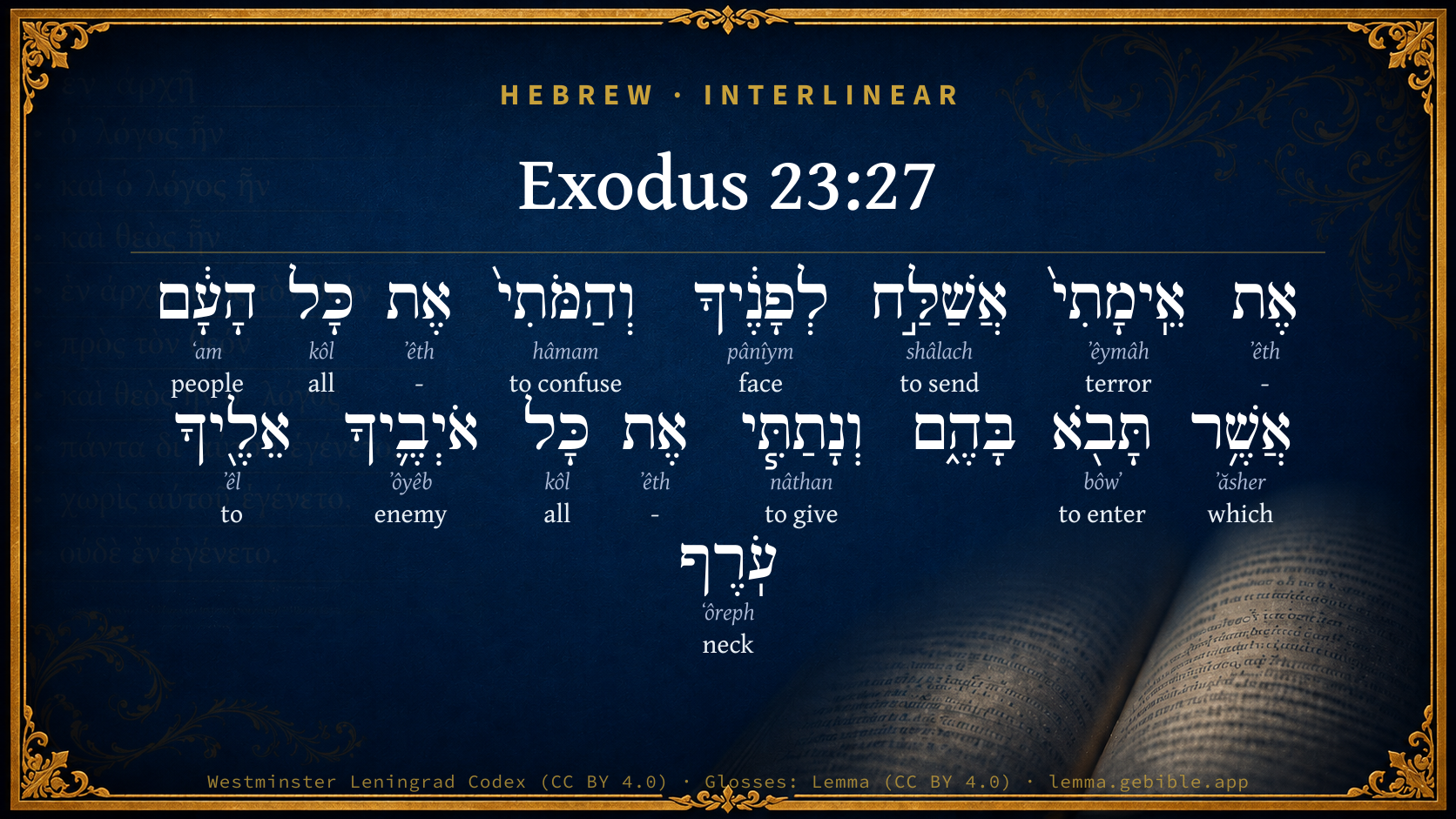
Hebrew (Westminster Leningrad Codex) Exodus 23:27 appears in the Hebrew Old Testament. The text above is from the Westminster Leningrad Codex. Each word links to its Strong’s number, a concise gloss, and parsing drawn from the Open Scriptures Hebrew Bible morphology. Click any word for its full Brown-Driver-Briggs (BDB) entry.
Download image
Cite this verse

Exodus 23:27 (World English Bible). Public Domain. Lemma interlinear Bible study tool, https://lemma.gebible.app/v/exodus/23/27.

Show BibTeX & RIS
BibTeX
RIS
English Translation
I will send my terror before you, and will confuse all the people to whom you come, and I will make all your enemies turn their backs to you.
World English Bible · Public Domain
Download a study sheet

One document with this verse’s original text, its word-by-word gloss line, the meaning frame, cross-references with their text, attributed commentary, and full source and license credits — printable, and it pastes into notes with its structure intact.

This verse Autodidact and up

Study sheet (.html) Plain text (.txt)

A passage Seminary Student

Up to 50 verses in one chapter. A passage sheet keeps up to 6 commentary sources and 12 cross-references per verse, in the order this page ranks them, and says so on the sheet whenever that leaves anything out. Ask for a single verse and you get the Autodidact verse sheet above.

Everything on this page stays free to read, with no account — the sheet is a download of what is already on screen, not access to it.

Want to remove ads? Support Godless Engineer
Compare translations 3

The same verse in 3 English versions, stacked beneath the original-language interlinear above. Click any original word for its lexicon entry.

Each is an independent rendering of the whole verse — the interlinear is not word-aligned to these translations.

Highlighted words mark where these versions differ — a whole-verse word diff, not a word-by-word alignment.

  • World English Bible Public Domain
    I will send my terror before you, and will confuse all the people to whom you come, and I will make all your enemies turn their backs to you.
  • King James Version Public Domain
    I will send my fear before thee, and will destroy all the people to whom thou shalt come, and I will make all thine enemies turn their backs unto thee.
  • unfoldingWord Literal Text CC BY-SA 4.0
    I will send my terror before your face, and I will confuse all of the people into whom you will go, and I will give the back of the neck of all of your enemies to you.

unfoldingWord Literal Text — © unfoldingWord, licensed CC BY-SA 4.0. Word-aligned USFM3 via Door43 (git.door43.org/unfoldingWord/en_ult).

Versions to compare (up to 4)

3 of 4 selected

Show all 18 translations

Every available English version of this verse, each an independent rendering of the whole verse.

  • World English Bible Public Domain
    I will send my terror before you, and will confuse all the people to whom you come, and I will make all your enemies turn their backs to you.
  • Berean Standard Bible Public Domain
    I will send My terror ahead of you and throw into confusion every nation you encounter. I will make all your enemies turn and run.
  • Majority Standard Bible Public Domain
    I will send My terror ahead of you and throw into confusion every nation you encounter. I will make all your enemies turn and run.
  • King James Version Public Domain
    I will send my fear before thee, and will destroy all the people to whom thou shalt come, and I will make all thine enemies turn their backs unto thee.
  • American Standard Version (1901) Public Domain
    I will send my terror before thee, and will discomfit all the people to whom thou shalt come, and I will make all thine enemies turn their backs unto thee.
  • Revised Version (1885) Public Domain
    I will send my terror before thee, and will discomfit all the people to whom thou shalt come, and I will make all thine enemies turn their backs unto thee.
  • Geneva Bible (1599) Public Domain
    I will send my feare before thee, and will destroy all the people among whome thou shalt go: and I will make all thine enemies turne their backes vnto thee:
  • Douay-Rheims (1899) Public Domain
    I will send my fear before thee, and will destroy all the people to whom thou shalt come: and will turn the backs of all thy enemies before thee.
  • Young's Literal Translation Public Domain
    My terror I send before thee, and I have put to death all the people among whom thou comest, and I have given the neck of all thine enemies unto thee.
  • Literal Standard Version CC BY-SA 4.0
    I send My terror before you, and I have put to death all the people among whom you come, and I have given the neck of all your enemies to you.
  • Unlocked Literal Bible CC BY-SA 4.0
    I will send fear of myself on those into whose land you advance. I will kill all the people whom you meet. I will make all your enemies turn their backs to you in fright.
  • unfoldingWord Literal Text CC BY-SA 4.0
    I will send my terror before your face, and I will confuse all of the people into whom you will go, and I will give the back of the neck of all of your enemies to you.
  • Darby Bible Public Domain
    I will send my fear before thee, and confound every people to which thou comest, and will make all thine enemies turn their back to thee.
  • World Messianic Bible Public Domain
    I will send my terror before you, and will confuse all the people to whom you come, and I will make all your enemies turn their backs to you.
  • Webster's Bible Public Domain
    I will send my fear before thee, and will destroy all the people to whom thou shalt come, and I will make all thy enemies turn their backs to thee.
  • Free Bible Version CC BY-SA 4.0
    I will send terror about me ahead of you which will throw every nation you meet into panic. I will make all your enemies turn and run away.
  • Bible in Basic English Public Domain
    I will send my fear before you, putting to flight all the people to whom you come; all those who are against you will go in flight, turning their backs before you.
  • JPS Tanakh (1917) Public Domain
    I will send My terror before thee, and will discomfit all the people to whom thou shalt come, and I will make all thine enemies turn their backs unto thee.

Literal Standard Version (2020), Covenant Press — licensed CC BY-SA 4.0. Text via the HelloAO Bible API (eBible.org). Unlocked Literal Bible (unfoldingWord) — licensed CC BY-SA 4.0. Text via the HelloAO Bible API (eBible.org). unfoldingWord Literal Text — © unfoldingWord, licensed CC BY-SA 4.0. Word-aligned USFM3 via Door43 (git.door43.org/unfoldingWord/en_ult). Free Bible Version, Dr. Jonathan Gallagher — licensed CC BY-SA 4.0. Text via the HelloAO Bible API (eBible.org).

Word by word

More ways to search: Search by grammar → Find every occurrence → Compare this word →

Practice this passage: Drill this verse → Learn its vocabulary →

וְהַמֹּתִי֙
hâmam
H2000
“and · to confuse”
Conjunction + Verb, Qal, Sequential Perfect, 1st Person, Common, Singular
Part of Speech
Conjunction + Verb
Stem
Qal
Form
Sequential Perfect
Person
1st Person
Gender
Common
Number
Singular
Full BDB Definition

Origin: a primitive root [compare H1949 , H1993 ]

TWOT: 507

to move noisily, confuse, make a noise, discomfit, break, consume, crush, destroy, trouble, vex - (Qal) - to move noisily - to confuse, discomfit, vex
  1. אֶת ʼêth H853 “-” Particle, Direct Object
  2. אֵֽימָתִי֙ ʼêymâh H367 “terror · my” Noun, Common, Feminine, Singular, Construct + Suffix, Personal, 1st Person, Common, Singular
  3. אֲשַׁלַּ֣ח shâlach H7971 “to send” Verb, Piel, Imperfect, 1st Person, Common, Singular
  4. לְפָנֶ֔יךָ pânîym H6440 “to/for · face(s) · your” Preposition + Noun, Common, Both, Plural, Construct + Suffix, Personal, 2nd Person, Masculine, Singular
  5. אֶת ʼêth H853 “-” Particle, Direct Object
  6. כָּל kôl H3605 “all of” Noun, Common, Masculine, Singular, Construct
  7. הָעָ֔ם ʻam H5971 “the · people” Particle, Definite Article + Noun, Common, Masculine, Singular, Absolute
  8. אֲשֶׁ֥ר ʼăsher H834 “which” Particle, Relative
  9. תָּבֹ֖א bôwʼ H935 “to enter” Verb, Qal, Imperfect, 2nd Person, Masculine, Singular
  10. וְנָתַתִּ֧י nâthan H5414 “and · to give” Conjunction + Verb, Qal, Sequential Perfect, 1st Person, Common, Singular
  11. אֶת ʼêth H853 “-” Particle, Direct Object
  12. כָּל kôl H3605 “all of” Noun, Common, Masculine, Singular, Construct
  13. אֹיְבֶ֛יךָ ʼôyêb H341 “enemy · you” Verb, Qal, Participle Active, Masculine, Plural, Construct + Suffix, Personal, 2nd Person, Masculine, Singular
  14. אֵלֶ֖יךָ ʼêl H413 “to · you” Preposition + Suffix, Personal, 2nd Person, Masculine, Singular
  15. עֹֽרֶף ʻôreph H6203 “neck” Noun, Common, Masculine, Singular, Absolute

About this verse

These counts appear in no published source. They are computed here, from the morphology-tagged text and Lemma’s own curated glosses. What Lemma adds →

17
words
13
distinct lemmas
Pentateuch
section

Notable vocabulary

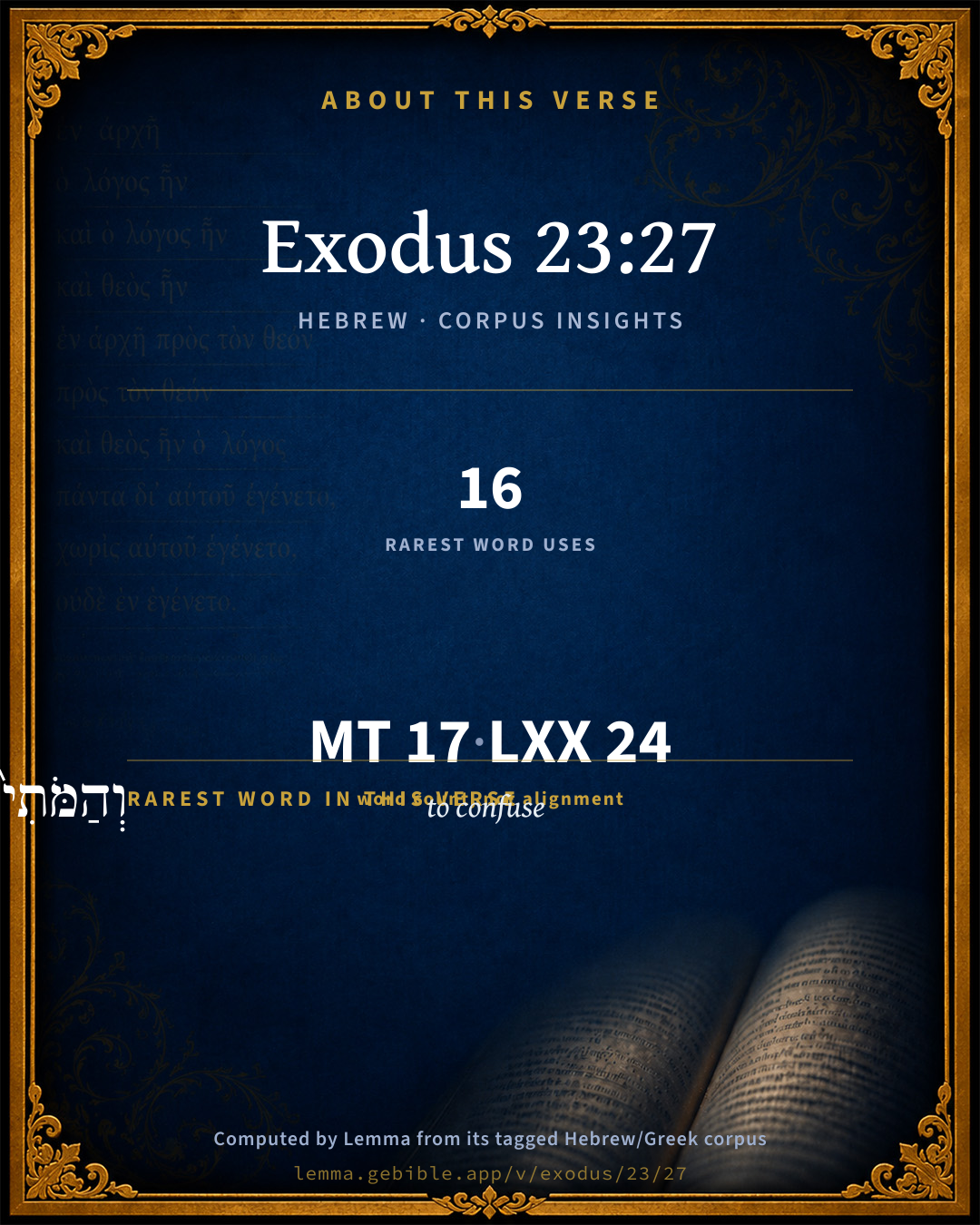
The rarest word here is וְהַמֹּתִי֙ to confuse H2000 — appearing just 16 times in the whole Hebrew Bible.

Shared distinctive vocabulary

וְהַמֹּתִי֙ to confuse H2000 occurs in 14 verses of the Hebrew Bible. Also found in:

Grammatical profile

  • 5 verbs
  • 6 nouns
  • 2 prepositions
  • 4 particles

Verb forms

  • אֲשַׁלַּ֣ח Piel · Imperfect
  • וְהַמֹּתִי֙ Qal · Sequential Perfect
  • תָּבֹ֖א Qal · Imperfect
  • וְנָתַתִּ֧י Qal · Sequential Perfect
  • אֹיְבֶ֛יךָ Qal · Participle Active

Repetition

A word recurs within this verse — often emphatic in Hebrew:

Hebrew & Septuagint length

In English translation the verse runs 29 words from the Hebrew and 30 from the Septuagint (LXX English) — closely comparable.

A rough comparison of the two English renderings, which tokenize alike — not a word-level alignment.

Word counts can differ between the Hebrew and the Greek without any difference in meaning — e.g. the Hebrew direct-object marker אֵת has no separate Greek word, and Greek often adds the article ὁ.

In the original languages it is 17 Hebrew tokens and 24 Greek tokens — but the two are counted differently (Hebrew bundles its prefixes and suffixes into one token; the Greek is in lemma form), so that isn’t a like-for-like length.

Cross-references

11

Topical passages linked to Exodus 23:27 in the Treasury of Scripture Knowledge — connected by theme and wording, ordered by reader-vote popularity; previews shown in the World English Bible.

  • Deuteronomy 2:25 This day will I begin to put the dread of you and the fear of you on the peoples who are under the whole sky, who shall hear the report of you, and shall tremble, and be in anguish because of you.
  • Genesis 35:5 They traveled: and a terror of God was on the cities that were round about them, and they didn't pursue the sons of Jacob.
  • Deuteronomy 7:23 But Yahweh your God will deliver them up before you, and will confuse them with a great confusion, until they be destroyed.
  • Deuteronomy 11:25 There shall no man be able to stand before you: Yahweh your God shall lay the fear of you and the dread of you on all the land that you shall tread on, as he has spoken to you.
  • Exodus 15:14–16 The peoples have heard. They tremble. Pangs have taken hold on the inhabitants of Philistia.
  • Psalms 18:40 You have also made my enemies turn their backs to me, That I might cut off those who hate me.
  • Deuteronomy 11:23 then will Yahweh drive out all these nations from before you, and you shall dispossess nations greater and mightier than yourselves.
  • 1 Samuel 14:15 There was a trembling in the camp, in the field, and among all the people; the garrison, and the spoilers, they also trembled; and the earth quaked: so there was an exceeding great trembling.
  • 2 Kings 7:6 For the Lord had made the host of the Syrians to hear a noise of chariots, and a noise of horses, even the noise of a great host: and they said one to another, Behold, the king of Israel has hired against us the kings of the Hittites, and the kings of the Egyptians, to come on us.
  • 2 Chronicles 14:14 They struck all the cities round about Gerar; for the fear of Yahweh came on them: and they despoiled all the cities; for there was much spoil in them.
  • Joshua 2:9–11 and she said to the men, I know that Yahweh has given you the land, and that the fear of you is fallen on us, and that all the inhabitants of the land melt away before you.

Cross-references courtesy of OpenBible.info (CC BY 4.0).

Hebrew and Greek witnesses Masoretic Hebrew ↔ Greek Septuagint

The same verse in the two great witnesses to the Old Testament, shown verse-for-verse.

These are two independent witnesses, not word-aligned to each other, and the Septuagint is shown in lemma (dictionary) form.

Hebrew Exodus 23:27 Masoretic · Westminster Leningrad Codex

אֶת אֵֽימָתִי֙ אֲשַׁלַּ֣ח לְפָנֶ֔יךָ וְהַמֹּתִי֙ אֶת כָּל הָעָ֔ם אֲשֶׁ֥ר תָּבֹ֖א בָּהֶ֑ם וְנָתַתִּ֧י אֶת כָּל אֹיְבֶ֛יךָ אֵלֶ֖יךָ עֹֽרֶף

I will send my terror before you, and will confuse all the people to whom you come, and I will make all your enemies turn their backs to you.

World English Bible · Public Domain

Greek LXX Exodus 23:27 Septuagint · lemma form

καί ὁ φόβος ἀποστέλλω ἡγέομαι σύ καί ἐκἵστημι πᾶς ὁ ἔθνος εἰς ὅς σύ εἰςπορεύομαι εἰς αὐτός καί δίδωμι πᾶς ὁ ὑπεναντίος σύ φυγάς

And I will send terror before you, and I will strike with amazement all the nations to which you shall come, and I will make all your enemies to flee.

LXX2012 (modern English Septuagint) · Public Domain

On this verse, The Preacher's Complete Homiletical Commentary discusses the Septuagint’s reading. Read the note in Commentary ↓

Hebrew: Westminster Leningrad Codex (CC BY 4.0). Greek: Septuagint (public domain); English from LXX2012 (modern English Septuagint) (Public Domain). How the Septuagint differs from the Hebrew →

Targum (Aramaic paraphrase)

2

The Targum is the ancient Jewish Aramaic paraphrase of the Hebrew Scriptures — an interpretive translation, not the Hebrew text itself. Onkelos (literal) and Pseudo-Jonathan (expansive) render the Torah, and Jonathan the Prophets. Coverage is partial: where no permissively-licensed English translation exists for a verse, only the Aramaic is shown. This is verse-level text, not a word-by-word alignment to the Hebrew.

  1. Targum Onkelos Torah (Genesis–Deuteronomy)
    יָת אֵימְתִי אֲשַׁלַח קֳדָמָךְ ואֶתְּפַר (נ״‎א וֶאֱשַׁגֵשׁ) יָת כָּל עַמָא דְאַתְּ אָתֵי לַאֲגָחָא בְּהוֹן וְאֶמְסַר יָת כָּל בַּעֲלֵי דְבָבָךְ קֳדָמָךְ מְחַזְרֵי קְדָל:

    (no public-domain English translation for this verse)

    Targum Onkelos — Aramaic: “Onkelos Genesis” (public domain); “Onkelos Exodus” (public domain); “Onkelos Leviticus” (public domain); “Onkelos Numbers” (public domain); “Onkelos Deuteronomy” (public domain). English: “Sefaria Community Translation” (CC0 1.0 (public-domain dedication)); “J.W. Etheridge. The Targums of Onkelos and Jonathan Ben Uzziel on the Pentateuch. London: Longmans, Green, 1862” (public domain). Text via Sefaria.

  2. Targum Pseudo-Jonathan Torah (Genesis–Deuteronomy)
    יַת אֵימְתִי אֲשַׁדֵּר קֳדָמָךְ וָאֶשְׁגַשׁ יַת כָּל עַמְמַיָא דְאַנְתְּ אָתֵי לְסַדְרָא בְּהוֹן סִדְרֵי קְרָבָא וְאִיתֵּין יַת כָּל בַּעֲלֵי דְבָבָךְ קֳדָמָךְ מְחַזְרֵי קְדָל

    My terror will I send before thee, and will perturb all the peoples to whom thou comest, that thou mayest wage battle against them; and I will make all thy enemies turn back before thee.

    Targum Pseudo-Jonathan — Aramaic: “Targum Jonathan on Genesis” (public domain); “Targum Jonathan on Exodus” (public domain); “Targum Jonathan on Leviticus” (public domain); “Targum Jonathan on Numbers” (public domain); “Targum Jonathan on Deuteronomy” (public domain). English: “The Targum of Jonathan ben Uzziel, trans. J. W. Etheridge, London, 1862” (public domain). Text via Sefaria.

Commentary

Notes on Exodus 23:27 from classic Christian and Jewish commentators (each source and its license shown beneath its notes). The classic Christian expositions comment on the surrounding passage and are grouped to its opening verse, so a note may address several verses; the Jewish commentaries on the Tanakh (Rashi and others) are per-verse, so they appear only where the commentator wrote on this verse.

Lemma curates 59 commentaries, every one of them public domain or Creative Commons licensed, each selected and text-cleaned for this edition rather than reprinted as found. About our sources →

Trapp's Complete Commentary

John Trapp

Exo 23:27 I will send my fear before thee, and will destroy all the people to whom thou shalt come, and I will make all thine enemies turn their backs unto thee.

Ver. 27. My fear before thee.] Strike a panic fear into the hearts of thine enemies, so that they shall flee at the noise of a driven leaf; they shall be made & corde suo fugitivi, as Tertullian hath it.

John Trapp, A Commentary or Exposition upon All the Books of the Old and New Testament (1647–1656) — public domain. Text from a community e-Sword module.

Joseph Benson's Commentary

Exo 23:27-28. I will send my fear before thee — And they that fear will soon flee: I will strike a terror into the inhabitants of Canaan, which shall facilitate the conquest of them, Joe 2:9-10. I will send hornets before thee — Thus Joshua observes, (Jos 24:12,) that the Amorites were driven out, not by the sword and bow of the Israelites, but by the sting of these hornets, which are a kind of wasps, only larger and fiercer than the ordinary wasp. Some explain the word hornet metaphorically, I will send my terror before thee as a hornet, it appearing to them improbable that a parcel of insects should drive out a nation. But they are fully confuted by Bochart, who produces many instances of nations being forced to leave their country by these and such like contemptible creatures, appealing to the testimony of Herodotus, Appianus, and Strabo. And he particularly observes, that the sting of this sort of wasp, called a hornet, is of all others the most pernicious; for it seldom stings a man, as Pliny says, (lib. 11. c. 21,) without throwing him into the rage of a fever.

Joseph Benson's Commentary on the Old and New Testaments (1811–1818) — public domain. Text from a community e-Sword module.

The Preacher's Complete Homiletical Commentary

Joseph S. Exell (gen. ed.)

MAIN HOMILETICS OF THE PARAGRAPH.—Exo_23:27-33

THE POWER OF MORAL FORCES

In our estimation of the powers of the world we do not always give sufficient prominence to the power of moral forces. Much has been accomplished by material force, but this must be under the direction of intellectual force. And this is shorn of its greatest strength if it be not allied with moral force. The greatest movements of the world have been moral movements. The battles that have done most to shape the destinies of mankind have been those where moral forces have been largely at work. The power which must be exalted above all others is moral and spiritual power. Consider then the grandeur of moral forces.

I. The strength of moral forces. God’s fear is a moral power, is a religious power; and this is to exercise an intimidating influence upon the enemies of Israel. God’s people are to win their onward way to the promised land, not by force of arms, not by skill and heroism and strategy on the battle field; but by the all-subduing force of a Divine fear scattering the opposing hosts. We have heard what an unreasonable panic can do in paralysing an army and causing it to flee. But here is a true cause for panic—even God’s fear. The people of God must seek to be strong by the possession and exercise of moral force.

II. The power of littles backed by moral force. We need not inquire whether the word hornets is used in a literal or a metaphorical sense; for the lesson is equally true that moral force can accomplish great results by means of small instrumentalities. It only requires to send forth the hornets, and they will drive out the Hivite, the Canaanite, and the Hittite. If the moral force be there, the feeblest instrumentalities will be sufficiently adequate to the achievement of stupendous and glorious results. Look not to the size and strength of the material forces, but to the vigour and power of the moral force. The world’s true victors are the moral victors. If only locusts constitute their army, yet the Hivite, the Canaanite, and the Hittite will flee before their conquering march.

III. Moral forces move to the production of distant results. In all our contests we are impatient of results. But those that work in the moral sphere have need of much patience The enemies are not to be driven out in one year. Regard must be had to the future. Unseen Divine preparations are going on while we are fretting with impatience. If the victory were gained too soon, the land might become desolate, and the beasts of the field might multiply to the destruction of the victors. He who rules in the moral sphere knows best how to guide moral forces.

IV. The movements of moral forces are not hurried. By little and little I will drive them out from before thee, until thou be increased, and inherit the land. The best disciplined armies move with precision. There is no hot haste in Divine movements. By little and little is a very general law of Divine procedure both in the kingdoms of nature and of grace. That which is to be lasting, must be by little and little; and therefore moral movements must be according to this law, for they are to produce permanent results.

V. Moral forces will continue to move until the purpose is finally accomplished. The fear will operate, and the hornets must sting, and all forces must be brought into play, until the time has come to set the bounds from the Red Sea on the south even unto the sea of the Philistines, or Mediterranean Sea, on the west; and from the Arabian desert on the east to the river Euphrates on the north. Divine purpose cannot fail. There may be seeming delay, but never defeat. Through the centuries the purpose is ever ripening. Nothing is so certain in the universe as that these moral forces must ultimately prevail.

VI. Moral forces are ever on the side of right doers. There must be no compromises with evil if the moral forces of the universe are to be enlisted on our side and in our cause. Thou shalt make no covenant with false gods. Moral strength departs so soon as we enter into unholy alliance with the wicked. Evil companionship leads to evil conduct. To serve false gods is to set for ourselves a destructive snare. The wicked are weak, and impart weakness. The righteous are bold as a lion. They themselves are irresistible moral forces.

—W. Burrows, B.A.

SUGGESTIVE COMMENTS ON THE VERSES

WORLDLINESS.—Exo_23:24-25; Exodus 32, 33

Nothing is more emphatic in the Old and New Testaments than God’s condemnation of worldliness. Theologians have frequently mystified and misrepresented it, but in these clauses, as elsewhere, it is exhibited in an intensely real and personal form. The Israelites were to be placed in the midst of a people who knew not God, and who followed customs that God abhorred. But they were to have no communion with the one, Exo_23:32, and to keep themselves unspotted from the other. Notice—

I. That worldliness is described. It is—

1. Not asceticism. That was utterly foreign to the whole genius of the Jewish system. No race ever had more facilities for intercourse with other nations, or more extensively used them. The Jews have been, all through their history, a commercial nation (1Co_5:10).

2. But intimacy and friendship with irreligious men—

(1.) not, however, that which is necessary to the performance of kindly offices (see Exo_23:4-5), but

(2.) partaking of their spirit; “making a covenant with them,” implying affinity, sympathy of soul, and fellowship.

3. And conformity to irreligious customs, “doing after their works,” “making a covenant with their gods.” Irreligious customs may be broadly characterised as—

(1.) Those which God cannot sanction.

(2.) Those which can do no real and lasting good.

II. That worldliness is dangerous.

1. It brings a snare.

(1.) Fellowship with ungodly men may through fear of ridicule or singularity draw us into ungodly practices.

(2.) Conformity with worldly customs may beget a liking for them which may draw us utterly into the vortex.

2. It leads to sin. “Lest they make thee sin against Me” (1Jn_5:19).

(1.) It extinguishes the love of God (1Jn_2:15).

(2.) It leads to enmity towards God. “No man can serve two masters,” &c. (Jas_4:4).

3. It ensures God’s condemnation (Deu_7:4; 1Co_11:12).

III. That the duty of unworldliness is enjoined.

1. Nonconformity. “Thou shalt not,” Exo_23:24-32, abstinence from worldly fellowship and customs, &c., but not abstinence merely, but—

2. Active antagonism. He who is not for God in this matter is against Him. “Thou shalt utterly overthrow them and break down their images.”

3. Positive unworldliness. “Ye shall serve the Lord your God” (Joh_5:19).

IV. That those who observe the duty of unworldliness are blessed. “And He shall bless,” &c.

1. Often literally. Worldliness brings excess, exhaustion, and disease. Godliness promotes temperance and health.

2. Always spiritually. Even eating and drinking, if to the glory of God, are ministers of blessing, and in addition to that there is moral satisfaction, approbation of conscience, and a sense of the benediction of heaven. In conclusion—i. Christ has overcome the world and destroyed the fear of it (Joh_16:33). ii. God will keep us from its evil in our necessary contact with it (Joh_17:15). iii. Faith will be equal to any emergency (1Jn_5:4; Rom_12:1-2). iv. Nonconformity to the world is one of the tests of the new birth (1Jn_5:4).

—J. W. Burn.

PROSPECTS AND PROGRESS.—Exo_23:26-31

Learn—

I. That there is a bright and extensive prospect before God’s people, Exo_23:26-31.

1. If the Christian’s prospect is at any time dark, it is because a gloom has settled upon his hope. The promised land in all its fertility and beauty is a fact both in this life and in that which is to come.

2. If the Christian’s prospect is at all contracted, it is because of the narrowness of his faith. The promise is as broad as God can make it, and if the believer is at any time disappointed, it is not because God is straitened, but because he is straitened in himself.

3. Let the Christian be fully alive to his privileges, and feel that this broad and beautiful land is for him. Let nothing blanch his courage or divert his step. But let him “strive to enter in.”

II. That this prospect is to become his inheritance by Divine power and human exertion. These are always linked together (Php_2:12. See some excellent remarks in Hooker’s Sermons, i. vol. iii.).

1. God’s energy was exerted—

(1.) in giving them the land,

(2.) in driving out its inhabitants. So God in Christ has effectually weakened the power of our adversaries, bruised the serpent’s head, destroyed his works, and overcome the world,

(3.) in being present with them in all their undertakings, Exo_23:20-23. So God says to us, “Certainly I will be with thee.” “If God be for us, who can be against us.”

2. But that energy was conditional—upon their exertions.

(1.) Upon their use of means. So we must make use of means. The whole armour of God, steady resistance, courage, activity, zeal.

(2.) Upon the cultivation of their own strength, “Until thou be increased:” so we, by the use of means, must grow in grace, and in the knowledge of our Lord Jesus Christ. “Add to your faith,” &c.

III. That this prospect was not to be inherited all at once, but by degrees, Exo_23:29-30.

1. Because this is God’s usual method of working in the formation of the world, in the course of providence, in the construction of nations, in physical growth. The law of progress is written everywhere.

(1.) Let not the sceptic sneer at the individual Christian because he is not perfect, nor at the Church because it is not universal, because God never wantonly interferes with the course of nature or of grace.

(2.) Let not the Christian be discouraged at his imperfections if he is “going on to perfection,” and “pressing toward the mark.” Let not the Church be discouraged at the limited range of her operations if she is, as far as she can, “preaching the gospel to every creature.”

2. Because a sudden occupation of the land might be dangerous to themselves. They could not cover the whole space, and the uncultivated tracts would be a covert for wild beasts. Let the inhabitants remain, “till thou be increased and inherit the land.”

(1.) A word to the Church—perhaps it is wise that in her past and present condition she has not “covered the whole earth.” God wants the work done properly and perfectly. Is it not fitting then that her own growth in grace, power, and purity, in all moral perfections should be promoted first? It were hardly desirable, since the work will be accomplished properly and perfectly, that the Church, as it has presented itself in any century of its past development (witness its superstitious fears, corruption, &c.) should be universal. Better to let other systems keep their place a little longer, than that the Church, weak by internal discord and lack of faith, should be unequal to fill their place, and perhaps be beaten by worse foes—her own arrogance and pride.

3. A word to the believer. It is wise that some enemies should remain a little longer perhaps. They test your faith and patience, while other departments of spiritual life and grace are preparing for a contest which shall eventuate in their perfect overthrow.

In conclusion, see 1Co_15:57-58.

—J. W. Burn.

ILLUSTRATIONS

BY

REV. WILLIAM ADAMSON

Hornet-Harms! Exo_23:28. The hornet is abundant in the Holy Land. The species are larger than ours. Instances are on record in profane history where these have multiplied to such a degree as to become a pest to the inhabitants. Probably the insect meant is the Abyssinian fly. Its bite produces fatal boils; and at the very buzzing of a swarm the cattle run almost mad with terror. The Septuagint translates the word “wasps.” But Dr. Tristram thinks that the word “hornets” here is metaphorical, and is used of a panic, i.e., of sharp stings of fear, by which flying rumours stung them so that they fled. It is wisely counselled to avoid the pugnacious, poisonous, quarrelsome character of the hornet: such are proverbially called “waspish;” a number of them are rightly designated a hornet’s nest. However, it seems best to regard these hornets as material agencies—types of the moral agencies to which they have given place in subsequent ages of the world.

“Owls, ravens, crickets, seem the watch of death;

Nature’s worst vermin scare her godlike sons.”

—Lee.

Grace-Growth! Exo_23:30. “The path of the just is as a shining light that shineth more and more unto the perfect day.” Many a struggle the spiritual Israel have in overcoming inherent leanings to sin; but, by little and little, they shall drive them out. And as a man, looking at a dial, cannot see the shadow move, yet after a while perceives that it has moved; so it is with Christian progress. The surrounding nations could see the result of Israel’s gradual conquest of the Canaanite nationalities, until the land became entirely their own possession. The work of grace, says Salter, if begun, is gradually and continually going on; and it will not be completed till the image of God can be seen perfectly reflected in us. The conquest of self is steadily and expansively progressing; and by and by the triumph will be wholly achieved. Yet, as Bishop Reynolds says, we must not expect a fulness until the time of the restitution of all things—wherein the light, which is here but sown for the righteous, shall grow up into a full harvest of Canaan conquest. There may be slowness in the struggle onwards to absolute possession, but there is also sureness: “Thou shalt inherit the land.”

“No mortal eye the manner sees,

The imperceptible degrees,

By which our Lord conducts His plan,

And brings us to a perfect man.”

—Wesley.

Prospect! Exo_23:20-30. God allures Israel from the present, where all was dark and uncomely, into the future, where all was bright and fair. He, as it were, takes the Hebrew host by the hand, and leads them, as a father his child, out from the gloomy wilderness region, which they were pacing somewhat sadly, into the fertile fields and fruitful glades of Canaan; so that joy, or at least the faint reflection of it, stole into their hearts, and lifted up their heavy eyes. And how cheering the Christian’s prospect of the heavenly Canaan—that rest which remaineth for the people of God. It transfuses the life of heaven through our frame; either, on the one hand, making our languid pulse to beat more swiftly; or, on the other, our feverish pulse to throb more calmly and evenly. It acts as a regulator of the soul in its wild and inconstant movements—neither allowing the spiritual Hebrew to sink too low, nor to soar too high. It fills with energy to face the toils, and with ready courage to brave the dangers, of the night.

“From strength to strength advancing, only he,

His soul well knit and all his battles won,

Mounts, and that hardly, to eternal life.”

—Arnold.

World-Snares! Exo_23:32-33.

(1.) As you love your souls, beware of the world. It has slain its thousands and tens of thousands. What ruined Lots wife, but the world? What ruined Achan, but the world? What ruined Haman, but the world? What ruined Demas, but the world? What ruined Judas, but the world? The gods of this world are indeed a snare.

(2.) The pleasures of the world are not like the waters of the Nile, which leave, when they are gone, the germs of beauty and fertility to bud and blossom, and cheer the heart of man. On the contrary, they are like those streams polluted by the washings of poisonous minerals, depositing the seeds of disease and death to all who drink them.

(3.) The Reubenites, having taken a liking to the country which was first conquered because it was prolific in pasture, renounced the promise of interest in the Holy Land; which “love of the world” proved a snare to them, and subsequently their destruction. So the gods of this world, the pleasures of sin, lure men to delight in the present, and forego all hope of heaven.

(4.) A man residing on the coast of England, and seeing his neighbours grow rich with foreign trade, converted his goods into gold, went to Spain, and bought a cargo of figs. On his way home a great storm compelled him to throw the cargo overboard. When again tempted by the sea, he said: “No; your fair looks shall never deceive me again; they once proved a snare to me: get thee hence, for I’ll have none of them.”

“Is this a friend indeed, that I should sell

My soul to her, give her my life and youth,

Till my feet, cloven too, take hold on hell?”

—Rossetti.

The Preacher's Complete Homiletical Commentary (gen. ed. Joseph S. Exell; Funk & Wagnalls, c. 1892) — public domain (pre-1929). A full-Bible homiletical/sermon-outline anthology covering 65 of 66 books (2 John is absent from the source module). Text from a community e-Sword module.

Geneva Bible (1599)

Geneva Bible translators

I will make them afraid at thy coming and send mine Angel to destroy them, as Exod. 35:2.

Geneva Bible (1599) marginal notes — public domain. Text via Bolls.life.

The Cambridge Bible for Schools and Colleges

gen. ed. J. J. S. Perowne

27. my terror] a terror greater than ordinary causes would seem capable of producing, and so attributed directly to God: what we should call a panic. Cf. the ‘terror’ (not the Heb. word used here), and ‘trembling,’ ‘of God,’ in the same sense, in Gen_35:5, 1Sa_14:15 (RVm.); and Zec_14:13.

discomfit] i.e. throw into confusion: cf. Exo_14:24.

27–30. Jehovah will further help Israel effectually to drive out the nations of Canaan.

The Cambridge Bible for Schools and Colleges (gen. ed. J. J. S. Perowne; Cambridge University Press, 1878–1918) — public domain. Text from a community e-Sword module.

John Gill's Exposition

I will not drive them out from before thee in one year,.... This is observed before hand, lest the Israelites should be discouraged, and fear they should never be rid of them; and it was so ordered in Providence for the following reason:

lest the land become desolate; there being not a sufficient number of Israelites to replace in their stead, to repeople the land, and to cultivate it; and yet their number was very large, being, when they came out of Egypt, as is generally computed, about two millions and a half, besides the mixed multitude of Egyptians and others, and during their forty years in the wilderness must be greatly increased:

and the beast of the field multiply against thee; there being so much waste ground for them to prowl about in, they would so increase as to make head against them, and be too many for them; or, however, it would be difficult to keep them under control: the Targum of Jonathan adds,"when they shall come to eat their carcasses (the carcasses of the Canaanites slain in war), and may hurt thee.''

John Gill's Exposition of the Whole Bible (1746–1763) — public domain (CC PDM 1.0). Text via the HelloAO Bible API.

Albert Barnes' Notes on the Bible

Destroy - Rather, overthrow. See Exo 23:23.

Albert Barnes' Notes on the Bible (1834–1885) — public domain. Text from a community e-Sword/MySword module.

Haydock's Catholic Bible Commentary

Destroy. Hebrew, "fill with consternation."

George Leo Haydock (1774–1849), Haydock's Catholic Family Bible and Commentary, 1859 edition — public domain. Excludes Psalms (Douay-Rheims chapter numbering differs from Protestant) and Deuterocanonical books (Catholic canon only).

Matthew Poole's English Annotations

My fear, i.e. a great terror, or a terror wrought by me. See Exo 33:2; Jos 24:12

Matthew Poole's English Annotations on the Holy Bible (1683–1685) — public domain. Text from a community e-Sword/MySword module.

Whedon's Commentary on the Bible

Daniel D. Whedon

27. My fear — Such awe and terror as resulted from the report of God’s terrible doings among the nations. Comp. Deu_2:25; Jos_2:9-11.

Daniel D. Whedon (gen. ed.), Commentary on the Old and New Testaments (1874–1909) — public domain. Text from a community e-Sword module.

The Pulpit Commentary

I will send my fear before thee. The fear which fell upon the nations is seen first in the case of Balak and the Moabites. "Moab was sore aft-aid of the people, because they were many". (Num_22:3) Later it is spoken of by Rahab as general. (Jos_2:9, Jos_2:11) A very signal indication of the alarm felt is given in the history of the Gibeonites. (Jos_9:3, Jos_9:27) I will make all thine enemies turn their backs unto thee. For the fulfilment of this promise see Num_21:3, Num_21:24, 35 31:7; Jos_8:20-24 Jos_10:10, etc. Had their obedience been more complete, the power of the Canaanitish nations would have been more thoroughly broken, and the sufferings and servitudes related in the Book of Judges would not have had to be endured.

The Pulpit Commentary (1880–1919), ed. H.D.M. Spence-Jones & Joseph S. Exell — public domain. Text from a community e-Sword module.

John Wesley's Explanatory Notes

I will send my fear before thee - And they that fear will soon flee. Hoseats of hornets also made way for the hosts of Israel; such mean creatures can God make use of for the chastising of his people's enemies.

John Wesley, Explanatory Notes Upon the Whole Bible (1754–1765) — public domain. Text via the GEBible commentary corpus.

Rashi

Rabbi Shlomo Yitzchaki (Rashi)

והמתי I WILL CONFOUND — This is equivalent to וְהָמַמְתִּי (i. e. the root is המם). Its rendering in the Targum is ואשנש “and I will confound”. Similar is every verb the root of which has its last letter doubled (verbs ע"ע): when it is changed (conjugated) to express the idea of “I have done something” (i. e. the first person singular perfect of the Kal; the same really applies to some inflected forms of other conjugations also) there are occasions when one omits the doubled letter (it is actually the first of the two similar letters) and dageshes the remaining letter of these two and vowels it with מלאפום (our חולם). Examples are: וְהַמֹּתִי which is of the same derivation as, (Isaiah 28:28) “and the wheel of his cart makes a confused noise (המם)”; (Ecclesiastes 2:20) וְסַבֹּתִי, “and I turned about” which is of the same derivation as, (I Samuel 7:16) “and he went round (וסבב) to Bethel”; (Psalms 116:6) דַלֹּתִי “I was low”, of the same derivation as, (Isaiah 19:6) “The waters shall become low (דללו) and dried up”; (Isaiah 49:16) “I have graven thee (חַקֹּתִיךְ) upon the palms of my hand”, of the same derivation as, (Judges 5:15) “things engraved (חקקי) in the heart”; (I Samuel 12:3) את מי רַצֹּתִי “whom have I crushed”, of the same derivation as, (Job 20:19) “because he hath crushed (רצץ) and hath forsaken the poor”. He, however, who translates it in the Targum by וְאֶקְטַל, is in error. For if it were derived from the root denoting death (מות), the ה in it would not be vowelled with Patach and its מ would not be dageshed nor vowelled with חולם, but it would read וְהַמַתִּי, as, (Numbers 14:15) “Now if Thou shalt kill (וְהַמַתָּ) this people”, the ת being dageshed because it would come in place of two ת’s, one being a root-letter — for no form of מות can be written without at least one ת (that in the root) — and the other being a servile letter (part of the suffix), just as תִּי in אמר-תי and חמא-תי and עשי-תי. Similarly with נתתי: the second ת is dageshed because it comes in the place of two ת’s — since it (the word) really requires three ת’s, two for the root, as in, (Joshua 10:12) “the day when the Lord giveth (תת)”, and in, (Ecclesiastes 3:13) “it is the gift (מתת) of God”, — and the third as a servile letter.

ערף NAPE OF THE NECK — i. e. they will flee before you and so turn the napes of their necks to you.

Rashi on the Tanakh — English translations: “The Judaica Press complete Tanach with Rashi, translated by A. J. Rosenberg” (CC BY 4.0); “Pentateuch with Rashi's commentary by M. Rosenbaum and A.M. Silbermann, 1929-1934” (public domain); “The Metsudah Tanach series, Lakewood, N.J” (CC BY 4.0); and “The Book of Joshua, Metsudah Publications, 1997” (CC BY 4.0). Text via Sefaria.

Lesson kit

Teaching starters — assembled from the data on this page, not authored interpretation. Every prompt links to the verse data it draws on. Edit before teaching.

Exodus, in the Pentateuch, opens this verse with 17 words (13 distinct Hebrew lemmas). Its most distinctive word is hâmam (“to confuse”). A historical commentator’s framing appears above. Read the whole chapter for the surrounding context.

Discussion questions

  1. The word hâmam carries the sense “to confuse.” How does it shape the verse?
  2. Exodus 14:24 shares the word «to confuse» with this verse. How do the two illuminate each other?
  3. “all” occurs 2× in this one verse. What is the effect of the repetition?
  4. These translations render this verse differently; the difference is in the English rendering, not the original. What questions does that raise?
  5. The verb «אֲשַׁלַּ֣ח» is Piel Imperfect. How does its form color the action?
  6. Reading how Trapp's Complete Commentary and Joseph Benson's Commentary read this verse, where do the two commentators agree and where do they part?

Things to notice

Reading settings

Reading text

Shown beneath each verse's original-language words.

Old Testament
Old Testament edition

Read the OT as the Masoretic Hebrew (MT) or the Greek Septuagint (LXX).

English shown for the Greek Septuagint (in the Hebrew ↔ Greek comparison).

Comparing translations? Open the Compare panel on any verse page to stack up to four side by side.