
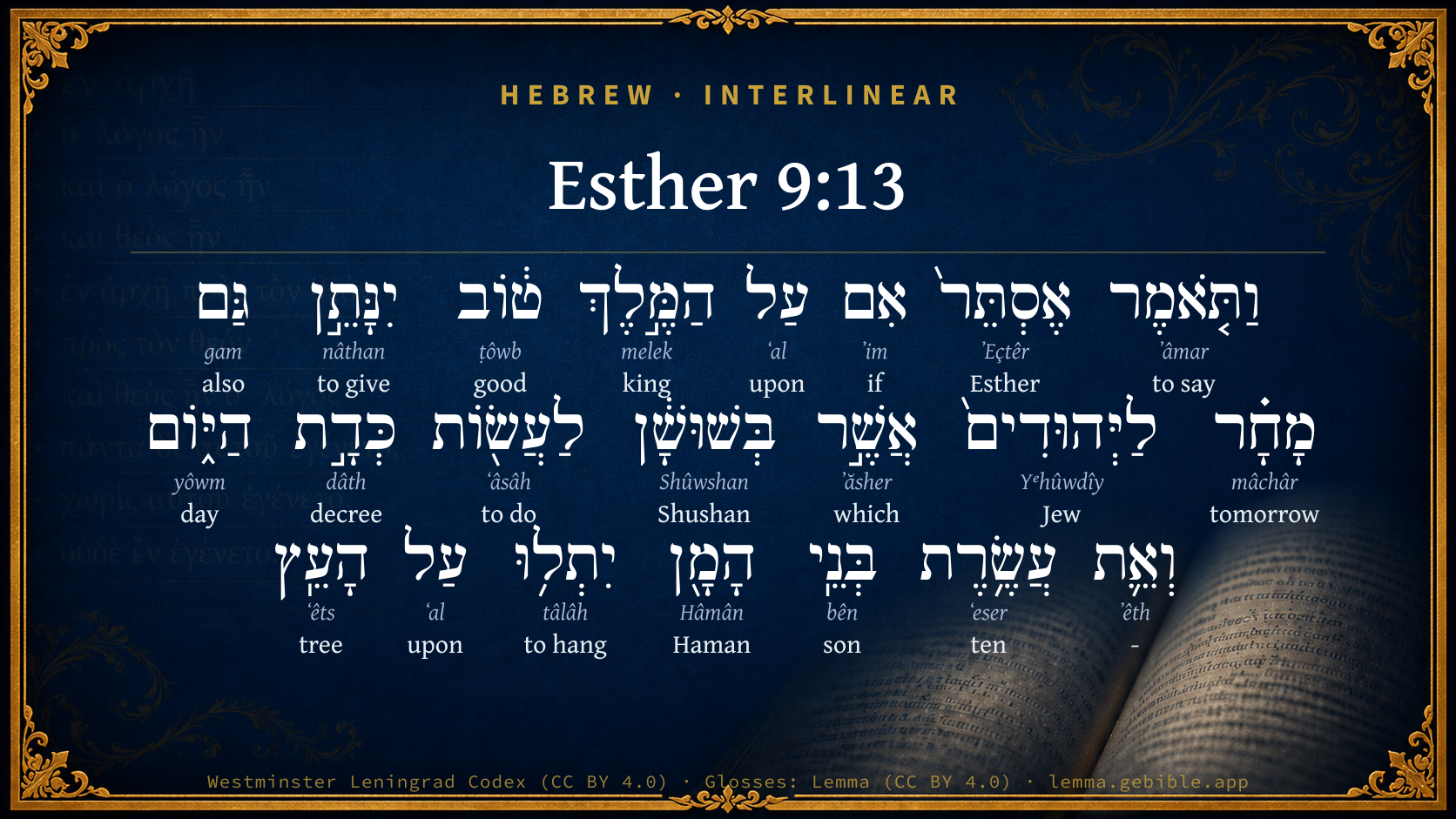
Esther 9:13

Hebrew (Westminster Leningrad Codex) Esther 9:13 appears in the Hebrew Old Testament. The text above is from the Westminster Leningrad Codex. Each word links to its Strong’s number, a concise gloss, and parsing drawn from the Open Scriptures Hebrew Bible morphology. Click any word for its full Brown-Driver-Briggs (BDB) entry.
Download image
Cite this verse

Esther 9:13 (World English Bible). Public Domain. Lemma interlinear Bible study tool, https://lemma.gebible.app/v/esther/9/13.

Show BibTeX & RIS
BibTeX
RIS
English Translation
Then said Esther, If it please the king, let it be granted to the Jews who are in Shushan to do tomorrow also according to this day's decree, and let Haman's ten sons be hanged on the gallows.
World English Bible · Public Domain
Download a study sheet

One document with this verse’s original text, its word-by-word gloss line, the meaning frame, cross-references with their text, attributed commentary, and full source and license credits — printable, and it pastes into notes with its structure intact.

This verse Autodidact and up

Study sheet (.html) Plain text (.txt)

A passage Seminary Student

Up to 50 verses in one chapter. A passage sheet keeps up to 6 commentary sources and 12 cross-references per verse, in the order this page ranks them, and says so on the sheet whenever that leaves anything out. Ask for a single verse and you get the Autodidact verse sheet above.

Everything on this page stays free to read, with no account — the sheet is a download of what is already on screen, not access to it.

Want to remove ads? Support Godless Engineer
Compare translations 3

The same verse in 3 English versions, stacked beneath the original-language interlinear above. Click any original word for its lexicon entry.

Each is an independent rendering of the whole verse — the interlinear is not word-aligned to these translations.

Highlighted words mark where these versions differ — a whole-verse word diff, not a word-by-word alignment.

  • World English Bible Public Domain
    Then said Esther, If it please the king, let it be granted to the Jews who are in Shushan to do tomorrow also according to this day's decree, and let Haman's ten sons be hanged on the gallows.
  • King James Version Public Domain
    Then said Esther, If it please the king, let it be granted to the Jews which are in Shushan to do to morrow also according unto this day's decree, and let Haman's ten sons be hanged upon the gallows.
  • unfoldingWord Literal Text CC BY-SA 4.0
    And Esther said, “If it is good to the king, let it be given also tomorrow to the Jews who are in Susa to do according to the law of today, and let the ten sons of Haman hang on the pole.”

unfoldingWord Literal Text — © unfoldingWord, licensed CC BY-SA 4.0. Word-aligned USFM3 via Door43 (git.door43.org/unfoldingWord/en_ult).

Versions to compare (up to 4)

3 of 4 selected

Show all 18 translations

Every available English version of this verse, each an independent rendering of the whole verse.

  • World English Bible Public Domain
    Then said Esther, If it please the king, let it be granted to the Jews who are in Shushan to do tomorrow also according to this day's decree, and let Haman's ten sons be hanged on the gallows.
  • Berean Standard Bible Public Domain
    Esther replied, “If it pleases the king, may the Jews in Susa also have tomorrow to carry out today’s edict, and may the bodies of Haman’s ten sons be hanged on the gallows.”
  • Majority Standard Bible Public Domain
    Esther replied, “If it pleases the king, may the Jews in Susa also have tomorrow to carry out today’s edict, and may the bodies of Haman’s ten sons be hanged on the gallows.”
  • King James Version Public Domain
    Then said Esther, If it please the king, let it be granted to the Jews which are in Shushan to do to morrow also according unto this day's decree, and let Haman's ten sons be hanged upon the gallows.
  • American Standard Version (1901) Public Domain
    Then said Esther, If it please the king, let it be granted to the Jews that are in Shushan to do to-morrow also according unto this day's decree, and let Haman's ten sons be hanged upon the gallows.
  • Revised Version (1885) Public Domain
    Then said Esther, If it please the king, let it be granted to the Jews which are in Shushan to do tomorrow also according unto this day’s decree, and let Haman’s ten sons be hanged upon the gallows.
  • Geneva Bible (1599) Public Domain
    Then sayd Ester, If it please the King, let it be granted also to morow to the Iewes that are in Shushan, to do according vnto this daies decree, that they may hang vpon ye tree Hamans ten sonnes.
  • Douay-Rheims (1899) Public Domain
    And she answered: If it please the king, let it be granted to the Jews, to do to morrow in Susan as they have done to day, and that the ten sons of Aman may be hanged upon gibbets.
  • Young's Literal Translation Public Domain
    And Esther saith, `If to the king `it be' good, let it be given also to-morrow, to the Jews who `are' in Shushan, to do according to the law of to-day; and the ten sons of Haman they hang on the tree.'
  • Literal Standard Version CC BY-SA 4.0
    And Esther says, “If [it is] good to the king, let it also be given tomorrow, to the Jews who [are] in Shushan, to do according to the law of today; and the ten sons of Haman they hang on the tree.”
  • Unlocked Literal Bible CC BY-SA 4.0
    Esther said, “If it pleases the king, let the Jews who are in Susa be permitted to carry out this day's decree tomorrow also, and let the bodies of Haman's ten sons be hanged on gallows.”
  • unfoldingWord Literal Text CC BY-SA 4.0
    And Esther said, “If it is good to the king, let it be given also tomorrow to the Jews who are in Susa to do according to the law of today, and let the ten sons of Haman hang on the pole.”
  • Darby Bible Public Domain
    And Esther said, If it please the king, let it be granted to the Jews that are in Shushan to do to-morrow also according to this day's decree, and let Haman's ten sons be hanged upon the gallows.
  • World Messianic Bible Public Domain
    Then Esther said, “If it pleases the king, let it be granted to the Jews who are in Susa to do tomorrow also according to today’s decree, and let Haman’s ten sons be hanged on the gallows.”
  • Webster's Bible Public Domain
    Then said Esther, If it shall please the king, let it be granted to the Jews who are in Shushan to do to-morrow also according to this day's decree, and let Haman's ten sons be hanged upon the gallows.
  • Free Bible Version CC BY-SA 4.0
    “If it please Your Majesty,” Esther replied, “allow the Jews in Susa be allowed to do the same tomorrow as they did today, following the decree. Also, let the ten sons of Haman be impaled on poles.”
  • Bible in Basic English Public Domain
    Then Esther said, If it is the king's pleasure, let authority be given to the Jews in Shushan to do tomorrow as has been done today, and let orders be given for the hanging of Haman's ten sons.
  • JPS Tanakh (1917) Public Domain
    Then said Esther: 'If it please the king, let it be granted to the Jews that are in Shushan to do to-morrow also according unto this day's decree, and let Haman's ten sons be hanged upon the gallows.'

Literal Standard Version (2020), Covenant Press — licensed CC BY-SA 4.0. Text via the HelloAO Bible API (eBible.org). Unlocked Literal Bible (unfoldingWord) — licensed CC BY-SA 4.0. Text via the HelloAO Bible API (eBible.org). unfoldingWord Literal Text — © unfoldingWord, licensed CC BY-SA 4.0. Word-aligned USFM3 via Door43 (git.door43.org/unfoldingWord/en_ult). Free Bible Version, Dr. Jonathan Gallagher — licensed CC BY-SA 4.0. Text via the HelloAO Bible API (eBible.org).

Word by word

More ways to search: Search by grammar → Find every occurrence → Compare this word →

Practice this passage: Drill this verse → Learn its vocabulary →

בְּשׁוּשָׁ֔ן
Shûwshan
H7800
“in/at · Shushan”
Preposition + Noun, Proper
Part of Speech
Preposition + Noun
Type
Proper
Full BDB Definition

Origin: the same as H7799

TWOT: None

Shushan or Susa = "lily" - the winter residence of the Persian kings; located on the river Ulai or Choaspes
  1. וַתֹּ֤אמֶר ʼâmar H559 “and · to say” Conjunction + Verb, Qal, Sequential Imperfect, 3rd Person, Feminine, Singular
  2. אֶסְתֵּר֙ ʼEçtêr H635 “Esther” Noun, Proper
  3. אִם ʼim H518 “if” Conjunction
  4. עַל ʻal H5921 “upon” Preposition
  5. הַמֶּ֣לֶךְ melek H4428 “the · king” Particle, Definite Article + Noun, Common, Masculine, Singular, Absolute
  6. ט֔וֹב ṭôwb H2896 “good” Adjective, Adjective, Masculine, Singular, Absolute
  7. יִנָּתֵ֣ן nâthan H5414 “to give” Verb, Niphal, Jussive, 3rd Person, Masculine, Singular
  8. גַּם gam H1571 “also” Particle, Accusative
  9. מָחָ֗ר mâchâr H4279 “tomorrow” Noun, Common, Masculine, Singular, Absolute
  10. לַיְּהוּדִים֙ Yᵉhûwdîy H3064 “to/for the · Jew” Preposition, Determined + Adjective, Adjective, Masculine, Plural, Absolute
  11. אֲשֶׁ֣ר ʼăsher H834 “which” Particle, Relative
  12. לַעֲשׂ֖וֹת ʻâsâh H6213 “to do” Preposition + Verb, Qal, Infinitive Construct
  13. כְּדָ֣ת dâth H1881 “like/as · decree of” Preposition + Noun, Common, Feminine, Singular, Construct
  14. הַיּ֑וֹם yôwm H3117 “the · day” Particle, Definite Article + Noun, Common, Masculine, Singular, Absolute
  15. וְאֵ֛ת ʼêth H853 “and · -” Conjunction + Particle, Direct Object
  16. עֲשֶׂ֥רֶת ʻeser H6235 “ten” Adjective, Cardinal number, Masculine, Singular, Construct
  17. בְּנֵֽי bên H1121 “sons of” Noun, Common, Masculine, Plural, Construct
  18. הָמָ֖ן Hâmân H2001 “Haman” Noun, Proper
  19. יִתְל֥וּ tâlâh H8518 “to hang” Verb, Qal, Jussive, 3rd Person, Masculine, Plural
  20. עַל ʻal H5921 “upon” Preposition
  21. הָעֵֽץ ʻêts H6086 “the · tree” Particle, Definite Article + Noun, Common, Masculine, Singular, Absolute

About this verse

These counts appear in no published source. They are computed here, from the morphology-tagged text and Lemma’s own curated glosses. What Lemma adds →

22
words
21
distinct lemmas
Historical
section

Notable vocabulary

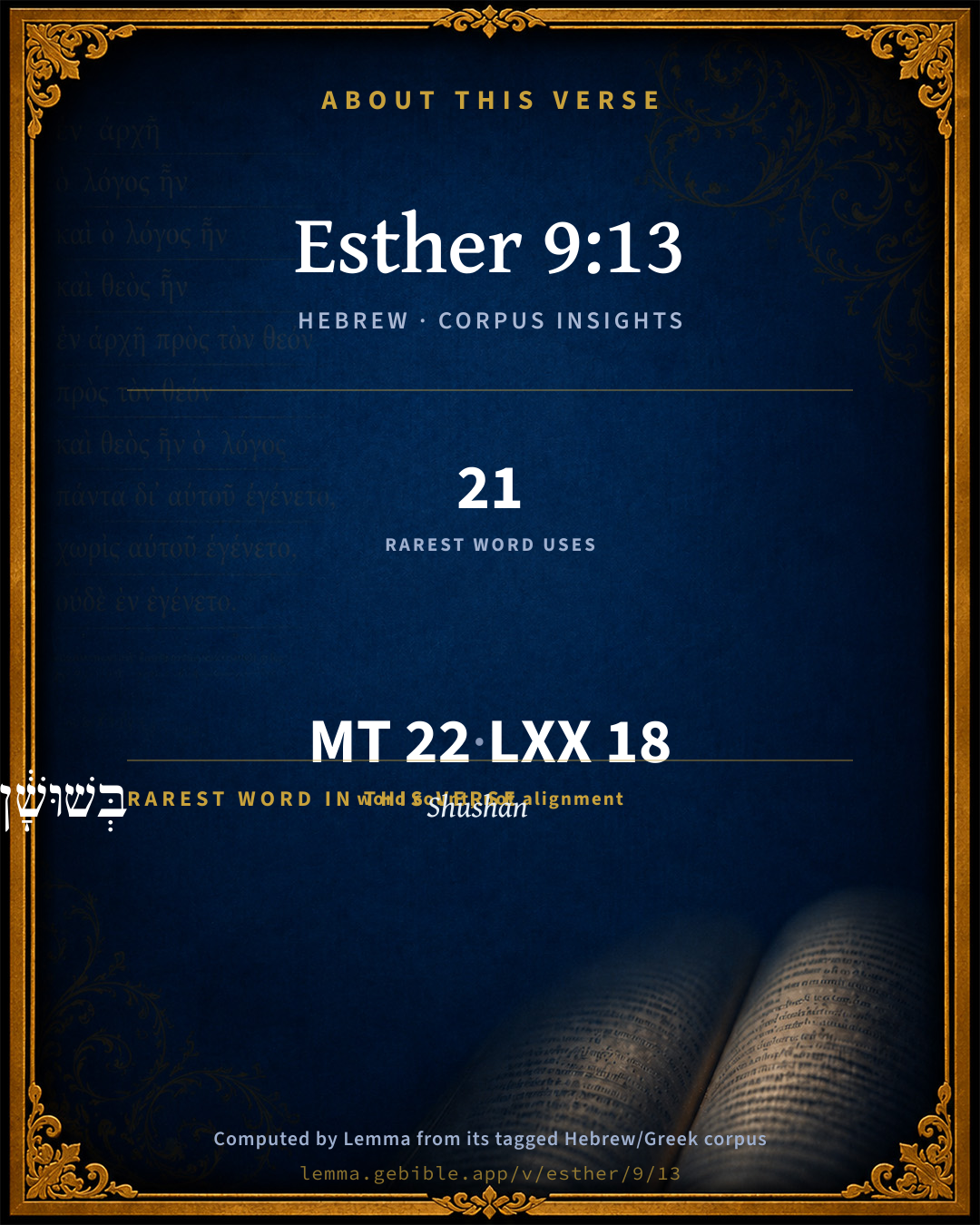
The rarest word here is בְּשׁוּשָׁ֔ן Shushan H7800 — appearing just 21 times in the whole Hebrew Bible.

Shared distinctive vocabulary

בְּשׁוּשָׁ֔ן Shushan H7800 occurs in 19 verses of the Hebrew Bible. Also found in:

Grammatical profile

  • 4 verbs
  • 9 nouns
  • 3 adjectives
  • 2 prepositions
  • 1 conjunction
  • 3 particles

Verb forms

  • וַתֹּ֤אמֶר Qal · Sequential Imperfect
  • יִנָּתֵ֣ן Niphal · Jussive
  • לַעֲשׂ֖וֹת Qal · Infinitive Construct
  • יִתְל֥וּ Qal · Jussive

Repetition

A word recurs within this verse — often emphatic in Hebrew:

Hebrew & Septuagint length

In English translation the verse runs 38 words from the Hebrew and 26 from the Septuagint (LXX English) — the Septuagint runs noticeably shorter here. See the side-by-side →

A rough comparison of the two English renderings, which tokenize alike — not a word-level alignment.

Word counts can differ between the Hebrew and the Greek without any difference in meaning — e.g. the Hebrew direct-object marker אֵת has no separate Greek word, and Greek often adds the article ὁ.

In the original languages it is 22 Hebrew tokens and 18 Greek tokens — but the two are counted differently (Hebrew bundles its prefixes and suffixes into one token; the Greek is in lemma form), so that isn’t a like-for-like length.

Cross-references

6

Topical passages linked to Esther 9:13 in the Treasury of Scripture Knowledge — connected by theme and wording, ordered by reader-vote popularity; previews shown in the World English Bible.

  • Esther 8:11 in which the king granted the Jews who were in every city to gather themselves together, and to stand for their life, to destroy, to kill, and to cause to perish, all the power of the people and province that would assault them, [their] little ones and women, and to take the spoil of them for a prey,
  • Deuteronomy 21:23 his body shall not remain all night on the tree, but you shall surely bury him the same day; for he who is hanged is accursed of God; that you don't defile your land which Yahweh your God gives you for an inheritance.
  • 2 Samuel 21:6 let seven men of his sons be delivered to us, and we will hang them up to Yahweh in Gibeah of Saul, the chosen of Yahweh. The king said, I will give them.
  • 2 Samuel 21:9 He delivered them into the hands of the Gibeonites, and they hanged them in the mountain before Yahweh, and they fell [all] seven together. They were put to death in the days of harvest, in the first days, at the beginning of barley harvest.
  • Esther 9:15 The Jews who were in Shushan gathered themselves together on the fourteenth day also of the month Adar, and killed three hundred men in Shushan; but they didn't lay their hand on the spoil.
  • Galatians 3:13 Christ redeemed us from the curse of the law, having become a curse for us. For it is written, "Cursed is everyone who hangs on a tree,"

Cross-references courtesy of OpenBible.info (CC BY 4.0).

Hebrew and Greek witnesses Masoretic Hebrew ↔ Greek Septuagint

The same verse in the two great witnesses to the Old Testament, shown verse-for-verse.

Here the Septuagint runs noticeably shorter than the Hebrew — LXX2012 (modern English Septuagint) 26 words vs World English Bible 38. A rough length comparison of the two English translations, not a word-level alignment — read both below.

These are two independent witnesses, not word-aligned to each other, and the Septuagint is shown in lemma (dictionary) form.

Hebrew Esther 9:13 Masoretic · Westminster Leningrad Codex

וַתֹּ֤אמֶר אֶסְתֵּר֙ אִם עַל הַמֶּ֣לֶךְ ט֔וֹב יִנָּתֵ֣ן גַּם מָחָ֗ר לַיְּהוּדִים֙ אֲשֶׁ֣ר בְּשׁוּשָׁ֔ן לַעֲשׂ֖וֹת כְּדָ֣ת הַיּ֑וֹם וְאֵ֛ת עֲשֶׂ֥רֶת בְּנֵֽי הָמָ֖ן יִתְל֥וּ עַל הָעֵֽץ

Then said Esther, If it please the king, let it be granted to the Jews who are in Shushan to do tomorrow also according to this day's decree, and let Haman's ten sons be hanged on the gallows.

World English Bible · Public Domain

Greek LXX Esther 9:13 Septuagint · lemma form

καί εἶπον εσθηρ ὁ βασιλεύς δίδωμι ὁ ἰουδαῖος χράομαι ὡσαύτως ὁ αὔριον ὥστε ὁ δέκα υἱός κρεμάζω αμαν

And Esther said to the king, let it be granted to the Jews so to treat them tomorrow as to hand the ten sons of Aman.

LXX2012 (modern English Septuagint) · Public Domain

Hebrew: Westminster Leningrad Codex (CC BY 4.0). Greek: Septuagint (public domain); English from LXX2012 (modern English Septuagint) (Public Domain). How the Septuagint differs from the Hebrew →

Commentary

Notes on Esther 9:13 from classic Christian and Jewish commentators (each source and its license shown beneath its notes). The classic Christian expositions comment on the surrounding passage and are grouped to its opening verse, so a note may address several verses; the Jewish commentaries on the Tanakh (Rashi and others) are per-verse, so they appear only where the commentator wrote on this verse.

Lemma curates 59 commentaries, every one of them public domain or Creative Commons licensed, each selected and text-cleaned for this edition rather than reprinted as found. About our sources →

Trapp's Complete Commentary

John Trapp

Est 9:13 Then said Esther, If it please the king, let it be granted to the Jews which [are] in Shushan to do to morrow also according unto this day’s decree, and let Haman’s ten sons be hanged upon the gallows.

Ver. 13. Then said Esther, If it please the king, &c.] See Est 5:4; Est 5:8.

Let it be granted to the Jews, &c.] The enemies at Shushan could not be all caught the first day; lest therefore those that lurked should hereafter prove troublesome to the Church by hatching new plots, she begs that they also may receive condign punishment, and Haman’s sons be hanged up for an example. This she requested not out of private and personal spleen to any, but for the glory of God and the Church’s peace. Had her aims been otherwise than good, her good actions could not have showed her a good woman. For, though a good aim doth not make a bad action good, as we see in Uzzah; yet a bad aim maketh a good action bad, as we see in Jehu. Lavater’s note may not here be let slip: the diligence that Esther used in rooting out her temporal enemies should quicken us to do the like to our spiritual, viz. those evil affections, motions, and passions, that war against the soul These be our Medes and Persians, with whom we must make no truce, but maintain a constant deadly feud, till we have mastered and mortified them all, Col 3:5 Rom 8:13; for till that be done effectually we must never look to have true peace, either within ourselves or with others.

And let Haman’s ten sons be hanged] Had Haman been now alive, himself by right should have been their hangman. There was a young man among the Switzers that went about to usurp the government, and alter their free state. Him they condemned to death, and appointed his father for executioner, as the cause of his evil education. But because Haman was hanged before, his sons (though dead) shall now hang with him. Neither was it cruelty or revenge in Esther, to crave this of the king, but zeal to God, and fervent love to his people, whose welfare she sought by all means possible to promote. As for herself, she could joyfully say of Haman, as David did of Doeg, "Lo, this is the man that made not God his strength; but trusted in the abundance of his riches, and strengthened himself in his wickedness. But I am like a green olive tree in the house of God: I trust in the mercy of God for ever and ever. I will praise thee for ever, because thou hast done it: and I will wait on thy name; for it is good before thy saints," Psa 52:7-9.

John Trapp, A Commentary or Exposition upon All the Books of the Old and New Testament (1647–1656) — public domain. Text from a community e-Sword module.

Joseph Benson's Commentary

Est 9:13. Let it be granted to the Jews to do to-morrow also according to this day’s decree — To kill their implacable enemies. For it is probable that the greatest and worst of them had hidden themselves for that day; after which, the commission granted to the Jews being expired, they confidently returned to their houses, where they were taken and slain, by virtue of this private and unexpected order. And let Haman’s ten sons be hanged upon the gallows — They were slain before; now let their bodies be hanged on their father’s gallows, for their greater infamy, and the terror of all others who shall presume to abuse the king in like manner, or to persuade him to execute such cruelties upon his subjects. “It is not unlikely,” says Dr. Dodd, “that many might be enraged at Haman’s death, and his sons, in particular, might set themselves at the head of those who were bold enough to attempt the destruction of the Jews at Shushan, being resolved to revenge their father’s death, though in so doing they were sure to meet with their own. This seems to suggest one reason why Esther was so solicitous to have their dead bodies hung on the gallows, because they had shown more malice and indignation against the Jews, and, on the day when the cruel edict came to take place, had made more desperate attacks upon them, than any others; though the reason of state, in this severity, might be to expose the family to greater infamy, and to deter other counsellors at any time from abusing the king with false representations. For though the Jews suffered none to hang on the tree, as they called the gallows, longer than till the evening of the day whereon they were executed, yet other nations let them hang till they were consumed, (as appears from the story of the Gibeonites, 2Sa 21:9,) or devoured by crows, vultures, or other ravenous creatures.” See Patrick.

Joseph Benson's Commentary on the Old and New Testaments (1811–1818) — public domain. Text from a community e-Sword module.

Tyndale Open Study Notes

Tyndale Open Resources

9:13 Possibly Esther knew that some of the people in Susa who had attacked Jews on the first day had gotten away and would be planning additional attacks to avenge the death of Haman.

Tyndale Open Study Notes — © Tyndale Open Resources, licensed CC BY-SA 4.0. Text via the HelloAO Bible API.

Geneva Bible (1599)

Geneva Bible translators

This she requireth not for desire of vengeance, but with zeal to see God’s judgments executed against his enemies.

Geneva Bible (1599) marginal notes — public domain. Text via Bolls.life.

Jamieson, Fausset & Brown

Robert Jamieson, A. R. Fausset & David Brown

let it be granted to the Jews which are in Shushan to do to-morrow also according unto this day's decree--Their enemies adroitly concealing themselves for the first day might have returned on the next, when they imagined that the privilege of the Jews was expired; so that that people would have been surprised and slain. The extension of the decree to another day at the queen's special desire has exposed her to the charge of being actuated by a cruel and vindictive disposition. But her conduct in making this request is capable of full vindication, on the ground (1) that Haman's sons having taken a prominent part in avenging their father's fall, and having been previously slain in the melee, the order for the exposure of their dead bodies on the gallows was only intended to brand them with public infamy for their malice and hatred to the Jews; and (2) the anti-Jewish party having, in all probability, been instigated through the arts or influence of Haman to acts of spiteful and wanton oppression, the existing state of feeling among the natives required some vigorous and decisive measure to prevent the outbreak of future aggressions. The very circumstances of their slaying 800 eight hundred Jews in the immediate vicinity of the court (v. 6, 15) is a proof of the daring energy and deep-rooted malice by which multidues were actuated against the Jews. To order an extension, therefore, of the permissive edict to the Jews to defend themselves, was perhaps no more than affording an opportunity for their enemies to be publicly known. Though it led to so awful a slaughter of seventy-five thousand of their enemies, there is reason to believe that these were chiefly Amalekites, in the fall of whom on this occasion, the prophecies (Exo 17:14, 16; Deu 25:19) against that doomed race were accomplished.

Jamieson, Fausset & Brown — Commentary Critical and Explanatory on the Whole Bible (1871) — public domain (CC PDM 1.0). Text via the HelloAO Bible API.

Adam Clarke's Commentary

Verse 13. Let Haman's ten sons be hanged] They had been slain the preceding day, and now she requests that they may be exposed on posts or gibbets, as a terror to those who sought the destruction of the Jews.

Adam Clarke's Commentary on the Bible (1810–1826) — public domain. Text from a community e-Sword/MySword module.

Ellicott's Commentary for English Readers

(13) Then said Esther . . .—In the terse words of the heading, “Ahasuerus, at the request of Esther, granteth another day of slaughter, and Hainan’s sons to be hanged.” It seems impossible here to acquit Esther of simple blood - thirstiness. Before the slaughter of the 13th of Adar was actually over, it is obvious that the Jews were no longer in any danger. It was known that the sympathies of the Court were entirely with the Jews, and the officers of the king consequently took their part. After one day’s slaughter, in which in the capital alone 500 men were killed, we may be quite certain that the Jews were masters of the situation, and therefore we do not hesitate to call Esther’s fresh action needless butchery. Were anything needed to bring out the matter in its true light, it might be seen in the request that the sons of Haman might be hanged. They had already been killed (Est_9:10), doubtless among the first, and Esther, therefore, asks for the dead bodies to be crucified, a gratuitous outrage on the dead. Because Esther was a person whom God made use of as an agent for a great purpose, we are not called upon to tone down and explain away the black spots in her history. To suggest that Esther had reason to fear “a renewal of the attacks of the enemies of the Jews” is out of the question, when the Jews had their feet on their necks. We must not, on the other hand, judge Esther according to the high Christian standard. It is true that the Old Testament taught “vengeance is Mine” but it needed the teaching of the New Testament to bring that truth home to men.

A Bible Commentary for English Readers, edited by Charles John Ellicott (1878–1897) — public domain. Text from a community e-Sword module.

The Cambridge Bible for Schools and Colleges

gen. ed. J. J. S. Perowne

13. There may have been special reasons why the extension of time was needed in Susa in order to ensure the Jews’ complete success in exterminating their foes there. The attitude of Esther and Mordecai towards the whole question of the permissibility of revenge was naturally that of their contemporaries, and so it is not to be judged by us on Christian principles.

be hanged upon the gallows] She asks that the bodies may be impaled or hung on a gibbet, so as to crown their disgrace, and serve as a terrible example.

The Cambridge Bible for Schools and Colleges (gen. ed. J. J. S. Perowne; Cambridge University Press, 1878–1918) — public domain. Text from a community e-Sword module.

John Gill's Exposition

For the Jews that were in Shushan gathered themselves together on the fourteenth day also of the month Adar,.... As they had on the thirteenth:

and slew three hundred men at Shushan; the Targum adds, of the family of Amalek: but there is no reason to confine it to them; it respects all such as were the enemies of the Jews, and rose up against them; so that the whole number slain in Shushan were eight hundred persons, besides the sons of Human:

but on the prey they laid not their hand; See Gill on Est 9:7.

John Gill's Exposition of the Whole Bible (1746–1763) — public domain (CC PDM 1.0). Text via the HelloAO Bible API.

Haydock's Catholic Bible Commentary

Susan. Aman’s influence had been the greatest there, and had stirred up many enemies of the Jews, who were to be carefully sought out. (Haydock) --- If we should consider only the dictates of clemency, we should think that the Jews were too eager in their revenge. But when we reflect, that their enemies had intended to destroy them all, and to seize their effects, we shall allow that they did not exceed the limits of justice, as they acted by royal authority, and abstained from touching any effects of the deceased. (Calmet) --- In the capital, 800 men fell victims to their fury. But as the citizens of that place were probably the most guilty, we must not imagine that other cities would be treated with the like severity. (Haydock) --- Gibbets, for a terror to the wicked. (Menochius) --- This disgrace was not unusual, chap. xvi.18. Polycrates was treated thus. (Herodotus iii. 125.)

George Leo Haydock (1774–1849), Haydock's Catholic Family Bible and Commentary, 1859 edition — public domain. Excludes Psalms (Douay-Rheims chapter numbering differs from Protestant) and Deuterocanonical books (Catholic canon only).

Matthew Poole's English Annotations

According to this day’s decree, i.e. to kill their implacable enemies. For it is not improbable that the greatest and worst of them had politicly withdrawn or hidden themselves for that day; after which, the commission granted to the Jews being expired, they confidently returned to their homes, where they were taken and slain by virtue of this private and unexpected decree.

Haman’s sons were slain before; now let their bodies be hanged upon their father’s gallows, for their greater infamy, and the terror of all others who shall presume to abuse the king in like manner, or to persuade him to execute such cruelties upon his own subjects. This custom of hanging up the bodies of malefactors after their death was frequent among the Jews, and Persians also, as is well known.

Matthew Poole's English Annotations on the Holy Bible (1683–1685) — public domain. Text from a community e-Sword/MySword module.

Whedon's Commentary on the Bible

Daniel D. Whedon

13. To do to-morrow also according unto this day’s decree — This request of Esther has been pronounced the offspring of a bloodthirsty vengeance, and desire to have another day for the butchery of enemies. But what was this day’s decree which the queen desired to be continued another day? Merely “to stand for their life” against all that would assault them. See note on Est_9:2, and Est_8:11. Hence we infer that the queen believed, or had reason to suspect, that the enemies of the Jews in Shushan would renew the attack upon the following day. So fearfully enraged were these enemies that they were likely to retaliate for their losses by an unauthorized continuance of the fight, and it was to secure her people against such an event Esther wisely made this request. This extension of the decree was to have effect only in Shushan, not in the provinces.

Let Haman’s ten sons be hanged — They had been already slain, (Est_9:10,) and now Esther would have their dead bodies impaled, in order to strike terror into the hearts of the Jews’ enemies, and thus, as far as possible, prevent further strife and bloodshed.

Daniel D. Whedon (gen. ed.), Commentary on the Old and New Testaments (1874–1909) — public domain. Text from a community e-Sword module.

The Pulpit Commentary

Esther"s request for a second day of slaughter has a bloodthirsty appearance; but, without a more complete knowledge of the facts than we possess, we cannot say that it was unjustifiable. It would seem that the Jews in Susa gathered themselves in the upper town on the appointed day, and were engaged there the whole day with their enemies. Esther asks that they may be allowed a second day either in the upper or the lower town, it is not clear which to complete their work, and free themselves from all danger of further persecution from their foes. She is not likely to have made this request unless prompted to make it by Mordecai, who must have had means of knowing how matters really stood, and, as the chief minister over the whole nation, is likely to have been actuated rather by general views of policy than by a blind spirit of revenge. Still it must be granted that there is something essentially Jewish in Esther"s request, and indeed in the tone of the entire book which bears her name

The Pulpit Commentary (1880–1919), ed. H.D.M. Spence-Jones & Joseph S. Exell — public domain. Text from a community e-Sword module.

John Wesley's Explanatory Notes

Let it, &c. - To kill their implacable enemies. For it is not improbable that the greatest and worst of them had hidden themselves for that day; after which, the commission granted to the Jews being expired, they confidently returned to their homes. Hanged - They were slain before; now let their bodies be hanged on their father's gallows, for their greater infamy, and the terror of all others who shall presume to abuse the king in like manner, or to persuade him to execute such cruelties upon his subjects.

John Wesley, Explanatory Notes Upon the Whole Bible (1754–1765) — public domain. Text via the GEBible commentary corpus.

Keil & Delitzsch

C. F. Keil & F. Delitzsch

Esther requested: "let it be granted to the Jews which are in Susa to do to-morrow also according to the decree of to-day (i.e., exactly as to-day), and let the ten sons of Haman be hanged upon the tree," i.e., their dead bodies nailed on crosses - majoris infamiae causa, according to Hebrew and Persian custom; comp. Deu 21:22 and the explanation of Ezr 6:11. On the motive for this request, see above, p. 194.

Keil & Delitzsch — Biblical Commentary on the Old Testament (1861–1891) — public domain (CC PDM 1.0). Text via the HelloAO Bible API. (Old Testament only.)

unfoldingWord translationNotes

Door43 World Missions Community

to carry out this day's decree tomorrow also

"Carry out" here is an idiom meaning to do something that was commanded or planned. AT: "to obey today's decree tomorrow also" or "to do tomorrow also what was decreed that they should do today" (See: Idiom)

ten sons

"10 sons" (See: Numbers)

gallows

This was a structure used for killing people by tying one end of a rope around the top of the structure and the other end of the rope around their necks and hanging them from it. See how you translated this in Esther 2:23. AT: "a frame for hanging people" (See: Translate Unknowns)

translationWords

Esther

Jew

decree

unfoldingWord translationNotes — © Distant Shores Media and the Door43 World Missions Community, licensed CC BY-SA 4.0. Source: git.door43.org/Door43/en_tn.

Rashi

Rabbi Shlomo Yitzchaki (Rashi)

and let them hang Haman’s ten sons on the gallows those who were slain.

Rashi on the Tanakh — English translations: “The Judaica Press complete Tanach with Rashi, translated by A. J. Rosenberg” (CC BY 4.0); “Pentateuch with Rashi's commentary by M. Rosenbaum and A.M. Silbermann, 1929-1934” (public domain); “The Metsudah Tanach series, Lakewood, N.J” (CC BY 4.0); and “The Book of Joshua, Metsudah Publications, 1997” (CC BY 4.0). Text via Sefaria.

Lesson kit

Teaching starters — assembled from the data on this page, not authored interpretation. Every prompt links to the verse data it draws on. Edit before teaching.

Esther, in the Historical, opens this verse with 22 words (21 distinct Hebrew lemmas). Its most distinctive word is Shûwshan (“Shushan”). The Greek Septuagint runs shorter here. A historical commentator’s framing appears above. Read the whole chapter for the surrounding context.

Discussion questions

  1. How does “Shushan” (Shûwshan) shape what this verse is saying?
  2. Nehemiah 1:1 shares the word «Shushan» with this verse. How do the two illuminate each other?
  3. “upon” occurs 2× in this one verse. What is the effect of the repetition?
  4. Compared with the Hebrew, the Septuagint runs shorter here. What questions does that raise?
  5. These translations render this verse differently; the difference is in the English rendering, not the original. What questions does that raise?
  6. The verb «וַתֹּ֤אמֶר» is Qal Sequential Imperfect. How does its form color the action?
  7. Reading how Trapp's Complete Commentary and Joseph Benson's Commentary read this verse, where do the two commentators agree and where do they part?

Things to notice

Reading settings

Reading text

Shown beneath each verse's original-language words.

Old Testament
Old Testament edition

Read the OT as the Masoretic Hebrew (MT) or the Greek Septuagint (LXX).

English shown for the Greek Septuagint (in the Hebrew ↔ Greek comparison).

Comparing translations? Open the Compare panel on any verse page to stack up to four side by side.