Genesis 46:25

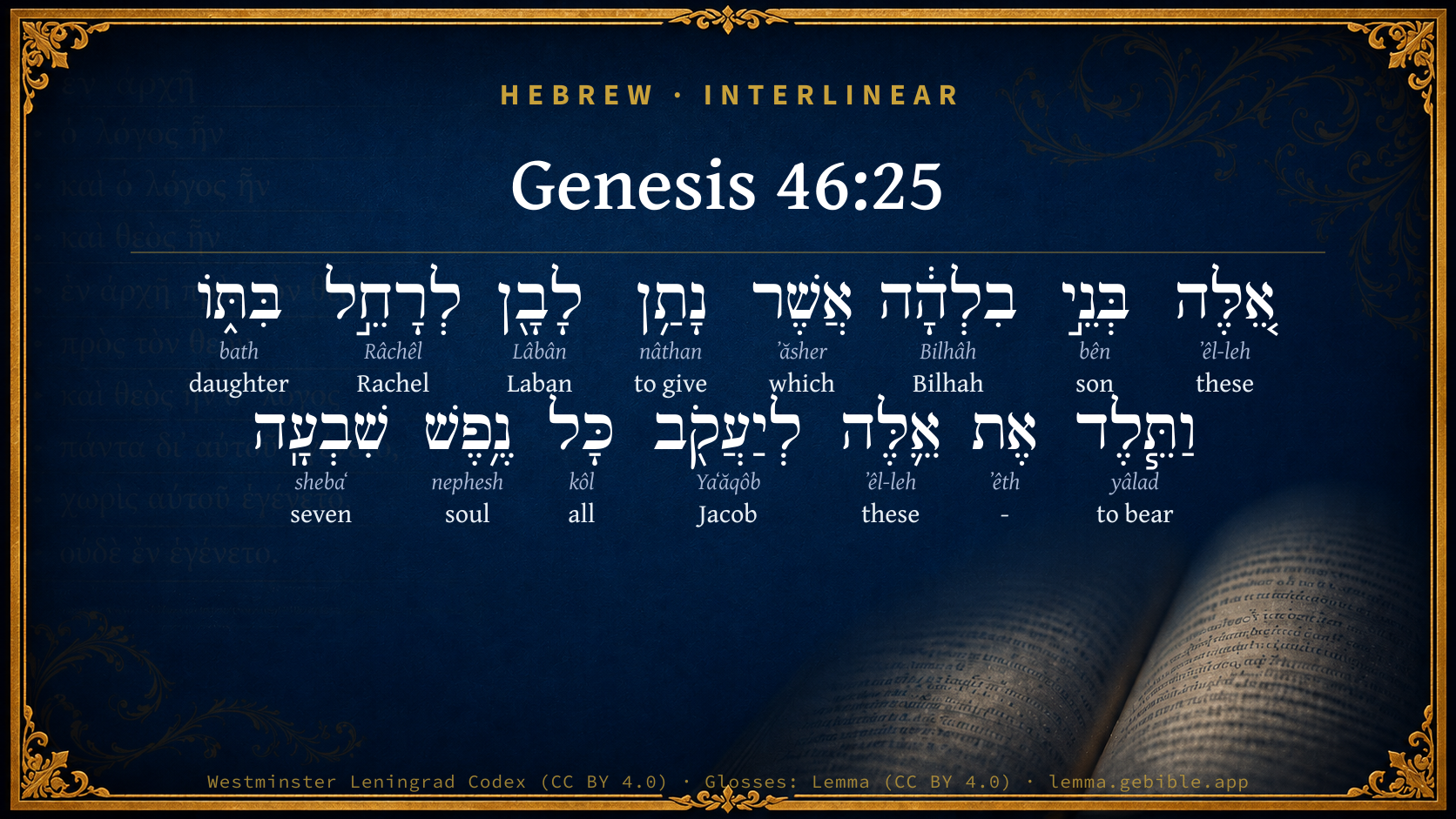
Hebrew (Westminster Leningrad Codex) Genesis 46:25 appears in the Hebrew Old Testament. The text above is from the Westminster Leningrad Codex. Each word links to its Strong’s number, a concise gloss, and parsing drawn from the Open Scriptures Hebrew Bible morphology. Click any word for its full Brown-Driver-Briggs (BDB) entry.
Download image
Cite this verse

Genesis 46:25 (World English Bible). Public Domain. Lemma interlinear Bible study tool, https://lemma.gebible.app/v/genesis/46/25.

Show BibTeX & RIS
BibTeX
RIS
English Translation
These are the sons of Bilhah, whom Laban gave to Rachel, his daughter, and these she bore to Jacob: all the souls were seven.
World English Bible · Public Domain
Download a study sheet

One document with this verse’s original text, its word-by-word gloss line, the meaning frame, cross-references with their text, attributed commentary, and full source and license credits — printable, and it pastes into notes with its structure intact.

This verse Autodidact and up

Study sheet (.html) Plain text (.txt)

A passage Seminary Student

Up to 50 verses in one chapter. A passage sheet keeps up to 6 commentary sources and 12 cross-references per verse, in the order this page ranks them, and says so on the sheet whenever that leaves anything out. Ask for a single verse and you get the Autodidact verse sheet above.

Everything on this page stays free to read, with no account — the sheet is a download of what is already on screen, not access to it.

Want to remove ads? Support Godless Engineer
Compare translations 3

The same verse in 3 English versions, stacked beneath the original-language interlinear above. Click any original word for its lexicon entry.

Each is an independent rendering of the whole verse — the interlinear is not word-aligned to these translations.

Highlighted words mark where these versions differ — a whole-verse word diff, not a word-by-word alignment.

  • World English Bible Public Domain
    These are the sons of Bilhah, whom Laban gave to Rachel, his daughter, and these she bore to Jacob: all the souls were seven.
  • King James Version Public Domain
    These are the sons of Bilhah, which Laban gave unto Rachel his daughter, and she bare these unto Jacob: all the souls were seven.
  • unfoldingWord Literal Text CC BY-SA 4.0
    Those the sons of Bilhah, whom Laban had given to Rachel his daughter. And she bore those for Jacob; all the souls seven.

unfoldingWord Literal Text — © unfoldingWord, licensed CC BY-SA 4.0. Word-aligned USFM3 via Door43 (git.door43.org/unfoldingWord/en_ult).

Versions to compare (up to 4)

3 of 4 selected

Show all 18 translations

Every available English version of this verse, each an independent rendering of the whole verse.

  • World English Bible Public Domain
    These are the sons of Bilhah, whom Laban gave to Rachel, his daughter, and these she bore to Jacob: all the souls were seven.
  • Berean Standard Bible Public Domain
    These are the sons of Jacob born to Bilhah, whom Laban gave to his daughter Rachel—seven in all.
  • Majority Standard Bible Public Domain
    These are the sons of Jacob born to Bilhah, whom Laban gave to his daughter Rachel—seven in all.
  • King James Version Public Domain
    These are the sons of Bilhah, which Laban gave unto Rachel his daughter, and she bare these unto Jacob: all the souls were seven.
  • American Standard Version (1901) Public Domain
    These are the sons of Bilhah, whom Laban gave unto Rachel his daughter, and these she bare unto Jacob: all the souls were seven.
  • Revised Version (1885) Public Domain
    These are the sons of Bilhah, which Laban gave unto Rachel his daughter, and these she bare unto Jacob: all the souls were seven.
  • Geneva Bible (1599) Public Domain
    These are the sonnes of Bilhah, which Laban gaue vnto Rahel his daughter, and shee bare these to Iaakob, in all, seuen soules.
  • Douay-Rheims (1899) Public Domain
    These are the sons of Bala, whom Laban gave to Rachel his daughter: and these she bore to Jacob: all the souls, seven.
  • Young's Literal Translation Public Domain
    These `are' sons of Bilhah, whom Laban gave to Rachel his daughter; and she beareth these to Jacob -- all the persons `are' seven.
  • Literal Standard Version CC BY-SA 4.0
    These [are] sons of Bilhah, whom Laban gave to his daughter Rachel; and she bears these to Jacob—all the persons [are] seven.
  • Unlocked Literal Bible CC BY-SA 4.0
    These were the sons born to Jacob by Bilhah, whom Laban gave to Rachel his daughter—seven in all.
  • unfoldingWord Literal Text CC BY-SA 4.0
    Those the sons of Bilhah, whom Laban had given to Rachel his daughter. And she bore those for Jacob; all the souls seven.
  • Darby Bible Public Domain
    -- These are the sons of Bilhah, whom Laban gave to Rachel his daughter; and she bore these to Jacob: all the souls were seven.
  • World Messianic Bible Public Domain
    These are the sons of Bilhah, whom Laban gave to Rachel, his daughter, and these she bore to Jacob: all the souls were seven.
  • Webster's Bible Public Domain
    These are the sons of Bilhah, whom Laban gave to Rachel his daughter, and she bore these to Jacob: all the souls were seven.
  • Free Bible Version CC BY-SA 4.0
    These are the sons of Jacob that Bilhah had, the servant given by Laban to his daughter Rachel, a total of seven children and grandchildren.
  • Bible in Basic English Public Domain
    These were the children of Bilhah, whom Laban gave to his daughter Rachel, seven persons.
  • JPS Tanakh (1917) Public Domain
    These are the sons of Bilhah, whom Laban gave unto Rachel his daughter, and these she bore unto Jacob; all the souls were seven.

Literal Standard Version (2020), Covenant Press — licensed CC BY-SA 4.0. Text via the HelloAO Bible API (eBible.org). Unlocked Literal Bible (unfoldingWord) — licensed CC BY-SA 4.0. Text via the HelloAO Bible API (eBible.org). unfoldingWord Literal Text — © unfoldingWord, licensed CC BY-SA 4.0. Word-aligned USFM3 via Door43 (git.door43.org/unfoldingWord/en_ult). Free Bible Version, Dr. Jonathan Gallagher — licensed CC BY-SA 4.0. Text via the HelloAO Bible API (eBible.org).

Word by word

More ways to search: Search by grammar → Find every occurrence → Compare this word →

Practice this passage: Drill this verse → Learn its vocabulary →

בִלְהָ֔ה
Bilhâh
H1090
“Bilhah”
Noun, Proper
Part of Speech
Noun
Type
Proper
Full BDB Definition

Origin: from H1089

TWOT: None

Bilhah = "troubled" - Rachel's handmaid whom she gave to Jacob as a concubine, mother to two of Jacob's children, Dan and Naphtali (noun proper feminine) - a city in Simeon (noun proper locative)
  1. אֵ֚לֶּה ʼêl-leh H428 “these” Pronoun, Demonstrative, Common, Plural
  2. בְּנֵ֣י bên H1121 “sons of” Noun, Common, Masculine, Plural, Construct
  3. אֲשֶׁר ʼăsher H834 “which” Particle, Relative
  4. נָתַ֥ן nâthan H5414 “to give” Verb, Qal, Perfect, 3rd Person, Masculine, Singular
  5. לָבָ֖ן Lâbân H3837 “Laban” Noun, Proper
  6. לְרָחֵ֣ל Râchêl H7354 “to/for · Rachel” Preposition + Noun, Proper
  7. בִּתּ֑וֹ bath H1323 “daughter · his” Noun, Common, Feminine, Singular, Construct + Suffix, Personal, 3rd Person, Masculine, Singular
  8. וַתֵּ֧לֶד yâlad H3205 “and · to bear” Conjunction + Verb, Qal, Sequential Imperfect, 3rd Person, Feminine, Singular
  9. אֶת ʼêth H853 “-” Particle, Direct Object
  10. אֵ֛לֶּה ʼêl-leh H428 “these” Pronoun, Demonstrative, Common, Plural
  11. לְיַעֲקֹ֖ב Yaʻăqôb H3290 “to/for · Jacob” Preposition + Noun, Proper
  12. כָּל kôl H3605 “all of” Noun, Common, Masculine, Singular, Construct
  13. נֶ֥פֶשׁ nephesh H5315 “soul” Noun, Common, Both, Singular, Absolute
  14. שִׁבְעָֽה shebaʻ H7651 “seven” Adjective, Cardinal number, Masculine, Singular, Absolute

About this verse

These counts appear in no published source. They are computed here, from the morphology-tagged text and Lemma’s own curated glosses. What Lemma adds →

15
words
14
distinct lemmas
Pentateuch
section

Notable vocabulary

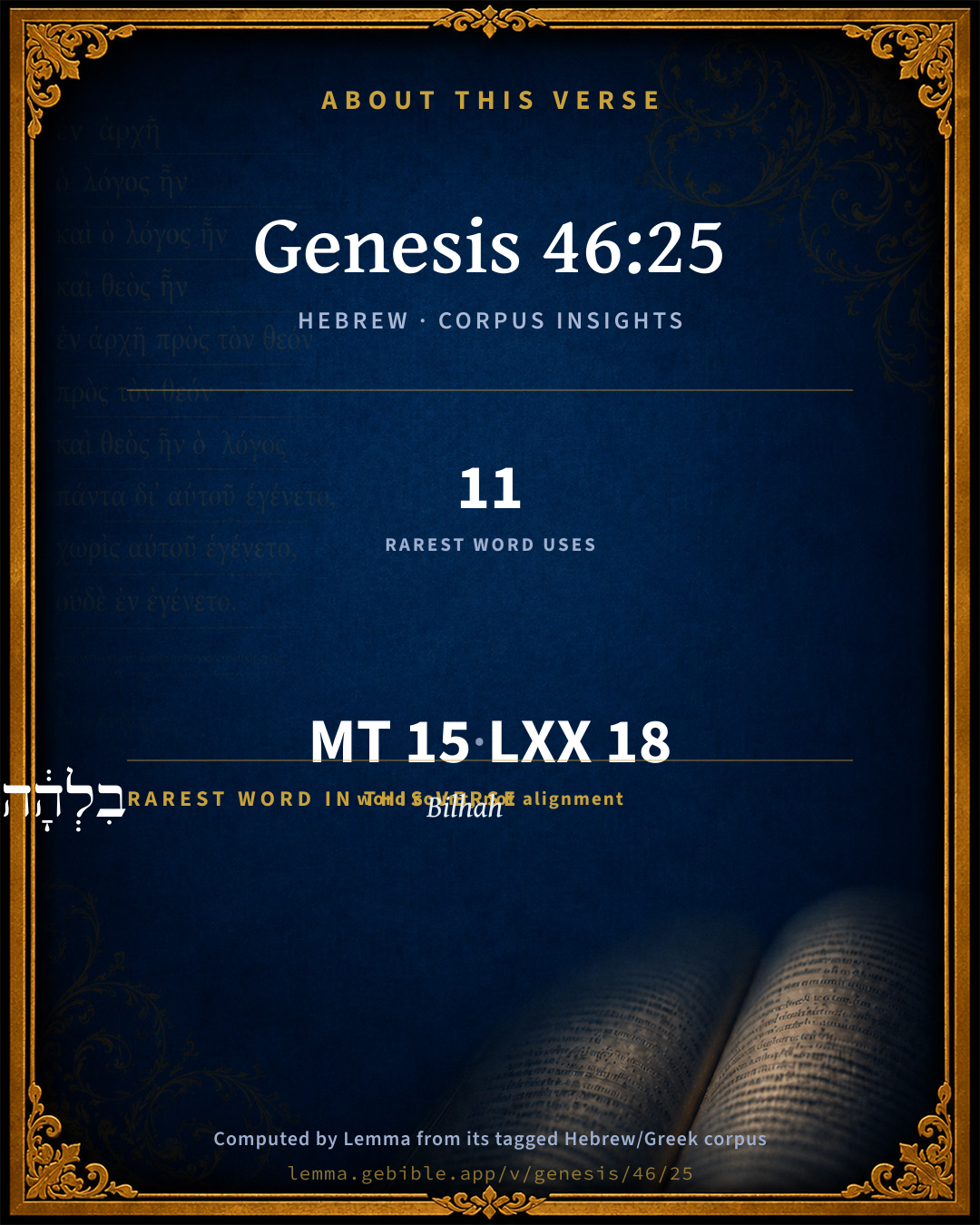
The rarest word here is בִלְהָ֔ה Bilhah H1090 — appearing just 11 times in the whole Hebrew Bible.

Shared distinctive vocabulary

בִלְהָ֔ה Bilhah H1090 occurs in 11 verses of the Hebrew Bible. Also found in:

Grammatical profile

  • 2 verbs
  • 8 nouns
  • 1 adjective
  • 2 pronouns
  • 2 particles

Verb forms

  • נָתַ֥ן Qal · Perfect
  • וַתֵּ֧לֶד Qal · Sequential Imperfect

Repetition

A word recurs within this verse — often emphatic in Hebrew:

  • אֵ֚לֶּה these H428 ×2

Hebrew & Septuagint length

In English translation the verse runs 24 words from the Hebrew and 22 from the Septuagint (LXX English) — closely comparable.

A rough comparison of the two English renderings, which tokenize alike — not a word-level alignment.

Word counts can differ between the Hebrew and the Greek without any difference in meaning — e.g. the Hebrew direct-object marker אֵת has no separate Greek word, and Greek often adds the article ὁ.

In the original languages it is 15 Hebrew tokens and 18 Greek tokens — but the two are counted differently (Hebrew bundles its prefixes and suffixes into one token; the Greek is in lemma form), so that isn’t a like-for-like length.

Cross-references

5

Topical passages linked to Genesis 46:25 in the Treasury of Scripture Knowledge — connected by theme and wording, ordered by reader-vote popularity; previews shown in the World English Bible.

  • Genesis 29:29 Laban gave to Rachel his daughter Bilhah, his handmaid, to be her handmaid.
  • Genesis 30:3–8 She said, "Behold, my maid Bilhah. Go in to her, that she may bear on my knees, and I also may obtain children by her."
  • Genesis 35:22 It happened, while Israel lived in that land, that Reuben went and lay with Bilhah, his father's concubine, and Israel heard of it. Now the sons of Jacob were twelve.
  • Genesis 35:25 The sons of Bilhah (Rachel's handmaid): Dan and Naphtali.
  • Exodus 1:2 Reuben, Simeon, Levi, and Judah,

Cross-references courtesy of OpenBible.info (CC BY 4.0).

Hebrew and Greek witnesses Masoretic Hebrew ↔ Greek Septuagint

The same verse in the two great witnesses to the Old Testament, shown verse-for-verse.

These are two independent witnesses, not word-aligned to each other, and the Septuagint is shown in lemma (dictionary) form.

Hebrew Genesis 46:25 Masoretic · Westminster Leningrad Codex

אֵ֚לֶּה בְּנֵ֣י בִלְהָ֔ה אֲשֶׁר נָתַ֥ן לָבָ֖ן לְרָחֵ֣ל בִּתּ֑וֹ וַתֵּ֧לֶד אֶת אֵ֛לֶּה לְיַעֲקֹ֖ב כָּל נֶ֥פֶשׁ שִׁבְעָֽה

These are the sons of Bilhah, whom Laban gave to Rachel, his daughter, and these she bore to Jacob: all the souls were seven.

World English Bible · Public Domain

Greek LXX Genesis 46:25 Septuagint · lemma form

οὗτος υἱός βαλλα ὅς δίδωμι λαβαν ραχηλ ὁ θυγάτηρ αὐτός ὅς τίκτω οὗτος ὁ ἰακώβ πᾶς ψυχή ἑπτά

These are the sons of Balla, whom Laban gave to his daughter Rachel, who bore these to Jacob; all the souls, seven.

LXX2012 (modern English Septuagint) · Public Domain

Hebrew: Westminster Leningrad Codex (CC BY 4.0). Greek: Septuagint (public domain); English from LXX2012 (modern English Septuagint) (Public Domain). How the Septuagint differs from the Hebrew →

Targum (Aramaic paraphrase)

2

The Targum is the ancient Jewish Aramaic paraphrase of the Hebrew Scriptures — an interpretive translation, not the Hebrew text itself. Onkelos (literal) and Pseudo-Jonathan (expansive) render the Torah, and Jonathan the Prophets. Coverage is partial: where no permissively-licensed English translation exists for a verse, only the Aramaic is shown. This is verse-level text, not a word-by-word alignment to the Hebrew.

  1. Targum Onkelos Torah (Genesis–Deuteronomy)
    אִלֵּין בְּנֵי בִלְהָה דִּיהַב לָבָן לְרָחֵל בְּרַתֵּהּ וִילִידַת יָת אִלֵּין לְיַעֲקֹב כָּל נַפְשָׁא שִׁבְעָא

    (no public-domain English translation for this verse)

    Targum Onkelos — Aramaic: “Onkelos Genesis” (public domain); “Onkelos Exodus” (public domain); “Onkelos Leviticus” (public domain); “Onkelos Numbers” (public domain); “Onkelos Deuteronomy” (public domain). English: “Sefaria Community Translation” (CC0 1.0 (public-domain dedication)); “J.W. Etheridge. The Targums of Onkelos and Jonathan Ben Uzziel on the Pentateuch. London: Longmans, Green, 1862” (public domain). Text via Sefaria.

  2. Targum Pseudo-Jonathan Torah (Genesis–Deuteronomy)
    אִלֵין בְּנֵי בִלְהָה דִיהַב לָבָן לְרָחֵל בְּרַתֵּיהּ וִילֵידַת יַת אִלֵין לְיַעֲקב כָּל נַפְשָׁתָא שׁוּבְעָא

    These are the sons of Bilhah whom Laban gave to Rahel his daughter; and she bare them unto Jakob, all the souls seven.

    Targum Pseudo-Jonathan — Aramaic: “Targum Jonathan on Genesis” (public domain); “Targum Jonathan on Exodus” (public domain); “Targum Jonathan on Leviticus” (public domain); “Targum Jonathan on Numbers” (public domain); “Targum Jonathan on Deuteronomy” (public domain). English: “The Targum of Jonathan ben Uzziel, trans. J. W. Etheridge, London, 1862” (public domain). Text via Sefaria.

Commentary

Notes on Genesis 46:25 from classic Christian and Jewish commentators (each source and its license shown beneath its notes). The classic Christian expositions comment on the surrounding passage and are grouped to its opening verse, so a note may address several verses; the Jewish commentaries on the Tanakh (Rashi and others) are per-verse, so they appear only where the commentator wrote on this verse.

Lemma curates 59 commentaries, every one of them public domain or Creative Commons licensed, each selected and text-cleaned for this edition rather than reprinted as found. About our sources →

Ellicott's Commentary for English Readers

(25) All the souls were seven.—Made up of Dan and one son, and Naphtali and four sons.

Excepting Benjamin, the other genealogies do not offer any great difficulties; for variations in the spelling of names are too common to cause surprise, and names would be omitted whenever in later times the family had ceased to have a representative. Thus, probably, no member of the tribe of Dan returned from the Captivity with an authenticated genealogy, and therefore no mention of them is made in the book of Chronicles. The utter confusion in the genealogy of Benjamin is the natural result of the ruinous war narrated in Judges 20, 21; but when that tribe produced a king, the utmost care would be taken to remedy, as far as possible, the destruction of documents caused by that struggle; and the genealogy in 1 Chronicles 8 is the royal pedigree of King Saul.

A Bible Commentary for English Readers, edited by Charles John Ellicott (1878–1897) — public domain. Text from a community e-Sword module.

John Gill's Exposition

And Joseph made ready his chariot,.... Or "bound" (y) it, fastened the horses to it, harnessed them, and put them to; this he did not himself, as Jarchi thinks, for the honour of his father; but rather, as Aben Ezra, by ordering his servants to do it:

and went up to meet Israel his father in Goshen; that being higher than the other part of Egypt, as it must be, if it was in Thebes, or upper Egypt, as some Jewish writers say (z); and Fium, supposed to be the place the Israelites dwelt in, see Gen 47:11, stood very high (a):

and presented himself unto him; alighted from his chariot, and came up to his father, and stood before him, and showed himself to him, declaring who he was:

and he fell on his neck, and wept on his neck a good while: either Jacob fell on the neck of Joseph, and wept over him a good while before he could speak to him, as the father of the prodigal son fell on his neck and kissed him, Luk 15:20; or, as Jarchi, Joseph fell on his father's neck, as he had done upon his brethren before, but wept over him longer; their embraces were no doubt mutual and extremely affectionate, that for a while they were not able to speak a word to each other.

(y) "et ligavit", Pagninus, Montanus, Vatablus; "tum alligavit", Schmidt. (z) Hieron. Quaestion. in Genesim, fol. 72. M. tom. 3. (a) Leo. African. Descriptio Africae, l. 8. p. 722.

John Gill's Exposition of the Whole Bible (1746–1763) — public domain (CC PDM 1.0). Text via the HelloAO Bible API.

The Pulpit Commentary

These are the sons of Bilhah, which Laban gave unto Rachel his daughter, and she bare these unto Jacob: all the souls were seven.

The Pulpit Commentary (1880–1919), ed. H.D.M. Spence-Jones & Joseph S. Exell — public domain. Text from a community e-Sword module.

Lesson kit

Teaching starters — assembled from the data on this page, not authored interpretation. Every prompt links to the verse data it draws on. Edit before teaching.

Genesis, in the Pentateuch, opens this verse with 15 words (14 distinct Hebrew lemmas). Its most distinctive word is Bilhâh (“Bilhah”). A historical commentator’s framing appears above. Read the whole chapter for the surrounding context.

Discussion questions

  1. What does “Bilhah” (Bilhâh) contribute to the verse as a whole?
  2. How does Genesis 29:29, which shares the word «Bilhah», read alongside this verse?
  3. What does the repetition of “these” (2× in this one verse) do in this verse?
  4. These translations render this verse differently. What is at stake in choosing one wording over another?
  5. «נָתַ֥ן» is a Qal Perfect verb. How does that grammatical form shape the action described?
  6. Compare how Ellicott's Commentary for English Readers and John Gill's Exposition read this verse. Where do they agree or differ?

Things to notice

Reading settings

Reading text

Shown beneath each verse's original-language words.

Old Testament
Old Testament edition

Read the OT as the Masoretic Hebrew (MT) or the Greek Septuagint (LXX).

English shown for the Greek Septuagint (in the Hebrew ↔ Greek comparison).

Comparing translations? Open the Compare panel on any verse page to stack up to four side by side.