
Genesis 28:13

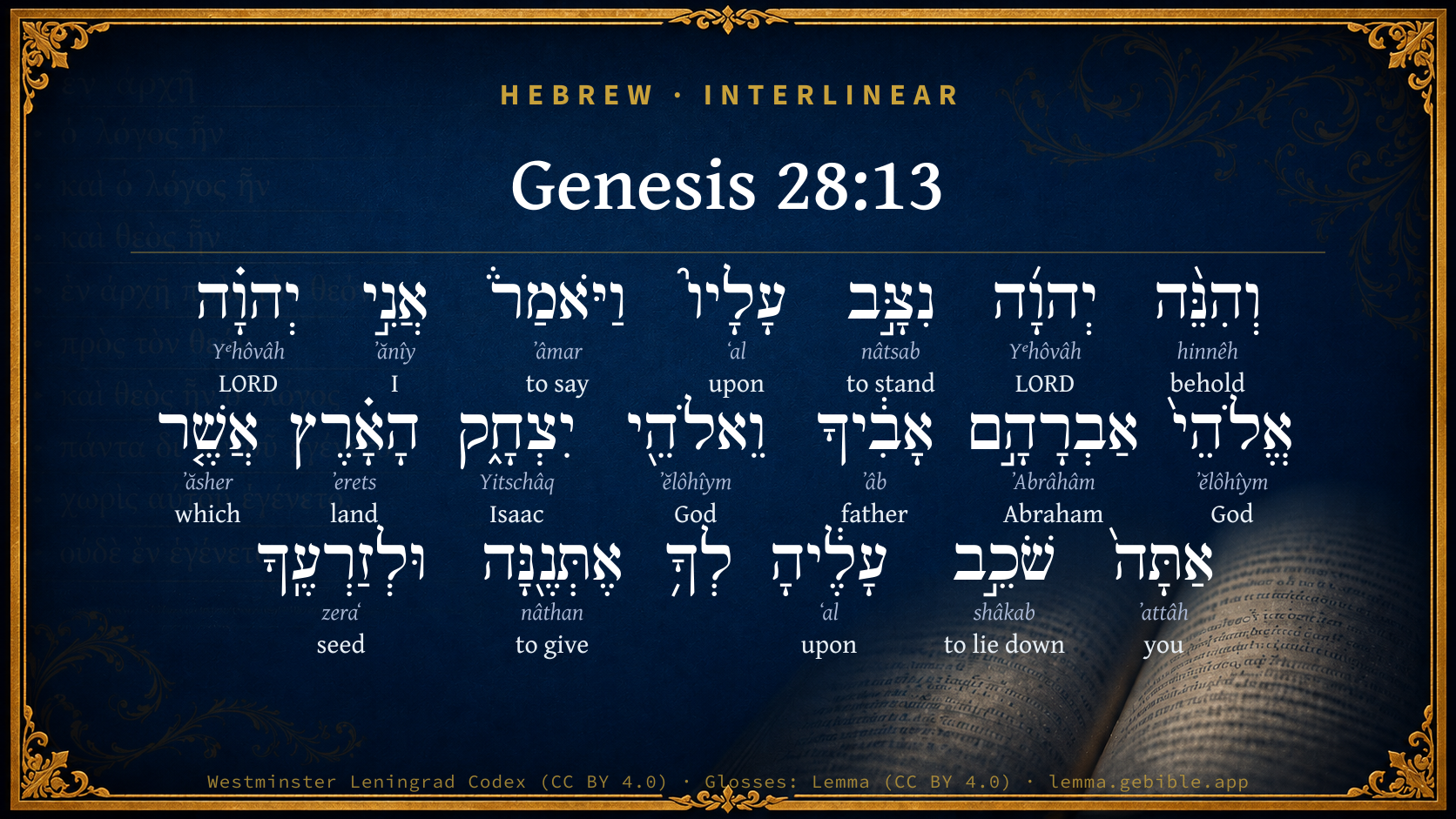
Hebrew (Westminster Leningrad Codex) Genesis 28:13 appears in the Hebrew Old Testament. The text above is from the Westminster Leningrad Codex. Each word links to its Strong’s number, a concise gloss, and parsing drawn from the Open Scriptures Hebrew Bible morphology. Click any word for its full Brown-Driver-Briggs (BDB) entry.
Download image
Cite this verse

Genesis 28:13 (World English Bible). Public Domain. Lemma interlinear Bible study tool, https://lemma.gebible.app/v/genesis/28/13.

Show BibTeX & RIS
BibTeX
RIS
English Translation
Behold, Yahweh stood above it, and said, "I am Yahweh, the God of Abraham your father, and the God of Isaac. The land whereon you lie, to you will I give it, and to your seed.
World English Bible · Public Domain
Download a study sheet

One document with this verse’s original text, its word-by-word gloss line, the meaning frame, cross-references with their text, attributed commentary, and full source and license credits — printable, and it pastes into notes with its structure intact.

This verse Autodidact and up

Study sheet (.html) Plain text (.txt)

A passage Seminary Student

Up to 50 verses in one chapter. A passage sheet keeps up to 6 commentary sources and 12 cross-references per verse, in the order this page ranks them, and says so on the sheet whenever that leaves anything out. Ask for a single verse and you get the Autodidact verse sheet above.

Everything on this page stays free to read, with no account — the sheet is a download of what is already on screen, not access to it.

Want to remove ads? Support Godless Engineer
Compare translations 3

The same verse in 3 English versions, stacked beneath the original-language interlinear above. Click any original word for its lexicon entry.

Each is an independent rendering of the whole verse — the interlinear is not word-aligned to these translations.

Highlighted words mark where these versions differ — a whole-verse word diff, not a word-by-word alignment.

  • World English Bible Public Domain
    Behold, Yahweh stood above it, and said, "I am Yahweh, the God of Abraham your father, and the God of Isaac. The land whereon you lie, to you will I give it, and to your seed.
  • King James Version Public Domain
    And, behold, the LORD stood above it, and said, I am the LORD God of Abraham thy father, and the God of Isaac: the land whereon thou liest, to thee will I give it, and to thy seed;
  • unfoldingWord Literal Text CC BY-SA 4.0
    And behold, Yahweh was standing above it, and he said, “I Yahweh, the God of Abraham your grandfather and the God of Isaac. The land that you are lying on I will give to you and to your offspring.

unfoldingWord Literal Text — © unfoldingWord, licensed CC BY-SA 4.0. Word-aligned USFM3 via Door43 (git.door43.org/unfoldingWord/en_ult).

Versions to compare (up to 4)

3 of 4 selected

Show all 18 translations

Every available English version of this verse, each an independent rendering of the whole verse.

  • World English Bible Public Domain
    Behold, Yahweh stood above it, and said, "I am Yahweh, the God of Abraham your father, and the God of Isaac. The land whereon you lie, to you will I give it, and to your seed.
  • Berean Standard Bible Public Domain
    And there at the top the LORD was standing and saying, “I am the LORD, the God of your father Abraham and the God of Isaac. I will give you and your descendants the land on which you now lie.
  • Majority Standard Bible Public Domain
    And there at the top the LORD was standing and saying, “I am the LORD, the God of your father Abraham and the God of Isaac. I will give you and your descendants the land on which you now lie.
  • King James Version Public Domain
    And, behold, the LORD stood above it, and said, I am the LORD God of Abraham thy father, and the God of Isaac: the land whereon thou liest, to thee will I give it, and to thy seed;
  • American Standard Version (1901) Public Domain
    And, behold, Jehovah stood above it, and said, I am Jehovah, the God of Abraham thy father, and the God of Isaac. The land whereon thou liest, to thee will I give it, and to thy seed.
  • Revised Version (1885) Public Domain
    And, behold, the LORD stood above it, and said, I am the LORD, the God of Abraham thy father, and the God of Isaac: the land whereon thou liest, to thee will I give it, and to thy seed;
  • Geneva Bible (1599) Public Domain
    And behold, the Lord stoode aboue it, and sayd, I am the Lord God of Abraham thy father, and the God of Izhak: the land, vpon the which thou sleepest, wil I giue thee and thy seede.
  • Douay-Rheims (1899) Public Domain
    And the Lord leaning upon the ladder, saying to him: I am the Lord God of Abraham thy father, and the God of Isaac; the land, wherein thou sleepest, I will give to thee and to thy seed.
  • Young's Literal Translation Public Domain
    and lo, Jehovah is standing upon it, and He saith, `I `am' Jehovah, God of Abraham thy father, and God of Isaac; the land on which thou art lying, to thee I give it, and to thy seed;
  • Literal Standard Version CC BY-SA 4.0
    and behold, YHWH is standing on it, and He says, “I [am] YHWH, God of your father Abraham, and God of Isaac; the land on which you are lying, to you I give it, and to your seed;
  • Unlocked Literal Bible CC BY-SA 4.0
    Behold, Yahweh stood above it and said, “I am Yahweh, the God of Abraham your father, and the God of Isaac. The land on which you are lying, I will give to you and to your descendants.
  • unfoldingWord Literal Text CC BY-SA 4.0
    And behold, Yahweh was standing above it, and he said, “I Yahweh, the God of Abraham your grandfather and the God of Isaac. The land that you are lying on I will give to you and to your offspring.
  • Darby Bible Public Domain
    And behold, Jehovah stood above it. And he said, I am Jehovah, the God of Abraham, thy father, and the God of Isaac: the land on which thou liest, to thee will I give it, and to thy seed.
  • World Messianic Bible Public Domain
    Behold, the LORD stood above it, and said, “I am the LORD, the God of Abraham your father, and the God of Isaac. I will give the land you lie on to you and to your offspring.
  • Webster's Bible Public Domain
    And behold, the LORD stood above it, and said, I am the LORD God of Abraham thy father, and the God of Isaac: the land on which thou liest, to thee will I give it, and to thy seed.
  • Free Bible Version CC BY-SA 4.0
    Then he saw the Lord standing over him, who said, “I am the Lord, the God of your father Abraham, and the God of Isaac. I'm giving you and your descendants the land you're lying on.
  • Bible in Basic English Public Domain
    And he saw the Lord by his side, saying, I am the Lord, the God of Abraham your father, and the God of Isaac: I will give to you and to your seed this land on which you are sleeping.
  • JPS Tanakh (1917) Public Domain
    And, behold, the LORD stood beside him, and said: 'I am the LORD, the God of Abraham thy father, and the God of Isaac. The land whereon thou liest, to thee will I give it, and to thy seed.

Literal Standard Version (2020), Covenant Press — licensed CC BY-SA 4.0. Text via the HelloAO Bible API (eBible.org). Unlocked Literal Bible (unfoldingWord) — licensed CC BY-SA 4.0. Text via the HelloAO Bible API (eBible.org). unfoldingWord Literal Text — © unfoldingWord, licensed CC BY-SA 4.0. Word-aligned USFM3 via Door43 (git.door43.org/unfoldingWord/en_ult). Free Bible Version, Dr. Jonathan Gallagher — licensed CC BY-SA 4.0. Text via the HelloAO Bible API (eBible.org).

Word by word

More ways to search: Search by grammar → Find every occurrence → Compare this word →

Practice this passage: Drill this verse → Learn its vocabulary →

נִצָּ֣ב
nâtsab
H5324
“standing”
Verb, Niphal, Participle Active, Masculine, Singular, Absolute
Part of Speech
Verb
Stem
Niphal
Form
Participle Active
Gender
Masculine
Number
Singular
State
Absolute
Full BDB Definition

Origin: a primitive root

TWOT: 1398

to stand, take one's stand, stand upright, be set (over), establish - (Niphal) - to station oneself, take one's stand - to stand, be stationed - to stand, take an upright position - to be stationed, be appointed - deputy, prefect, appointed, deputed (substantive) - to stand firm - (Hiphil) - to station, set - to set up, erect - to cause to stand erect - to fix, establish - (Hophal) to be fixed, be determined, be stationary
  1. וְהִנֵּ֨ה hinnêh H2009 “and · behold” Conjunction + Particle, Demonstrative
  2. יְהוָ֜ה Yᵉhôvâh H3068 “LORD” Noun, Proper
  3. עָלָיו֮ ʻal H5921 “upon · him” Preposition + Suffix, Personal, 3rd Person, Masculine, Singular
  4. וַיֹּאמַר֒ ʼâmar H559 “and · to say” Conjunction + Verb, Qal, Sequential Imperfect, 3rd Person, Masculine, Singular
  5. אֲנִ֣י ʼănîy H589 “I” Pronoun, Personal, 1st Person, Common, Singular
  6. יְהוָ֗ה Yᵉhôvâh H3068 “LORD” Noun, Proper
  7. אֱלֹהֵי֙ ʼĕlôhîym H430 “God(s) of” Noun, Common, Masculine, Plural, Construct
  8. אַבְרָהָ֣ם ʼAbrâhâm H85 “Abraham” Noun, Proper
  9. אָבִ֔יךָ ʼâb H1 “father · your” Noun, Common, Masculine, Singular, Construct + Suffix, Personal, 2nd Person, Masculine, Singular
  10. וֵאלֹהֵ֖י ʼĕlôhîym H430 “and · God(s) of” Conjunction + Noun, Common, Masculine, Plural, Construct
  11. יִצְחָ֑ק Yitschâq H3327 “Isaac” Noun, Proper
  12. הָאָ֗רֶץ ʼerets H776 “the · land” Particle, Definite Article + Noun, Common, Both, Singular, Absolute
  13. אֲשֶׁ֤ר ʼăsher H834 “which” Particle, Relative
  14. אַתָּה֙ ʼattâh H859 “you” Pronoun, Personal, 2nd Person, Masculine, Singular
  15. שֹׁכֵ֣ב shâkab H7901 “lying down” Verb, Qal, Participle Active, Masculine, Singular, Absolute
  16. עָלֶ֔יהָ ʻal H5921 “upon · her” Preposition + Suffix, Personal, 3rd Person, Feminine, Singular
  17. אֶתְּנֶ֖נָּה nâthan H5414 “to give · her” Verb, Qal, Imperfect, 1st Person, Common, Singular + Suffix, Personal, 3rd Person, Feminine, Singular
  18. וּלְזַרְעֶֽךָ zeraʻ H2233 “and · to/for · seed · your” Conjunction + Preposition + Noun, Common, Masculine, Singular, Construct + Suffix, Personal, 2nd Person, Masculine, Singular

About this verse

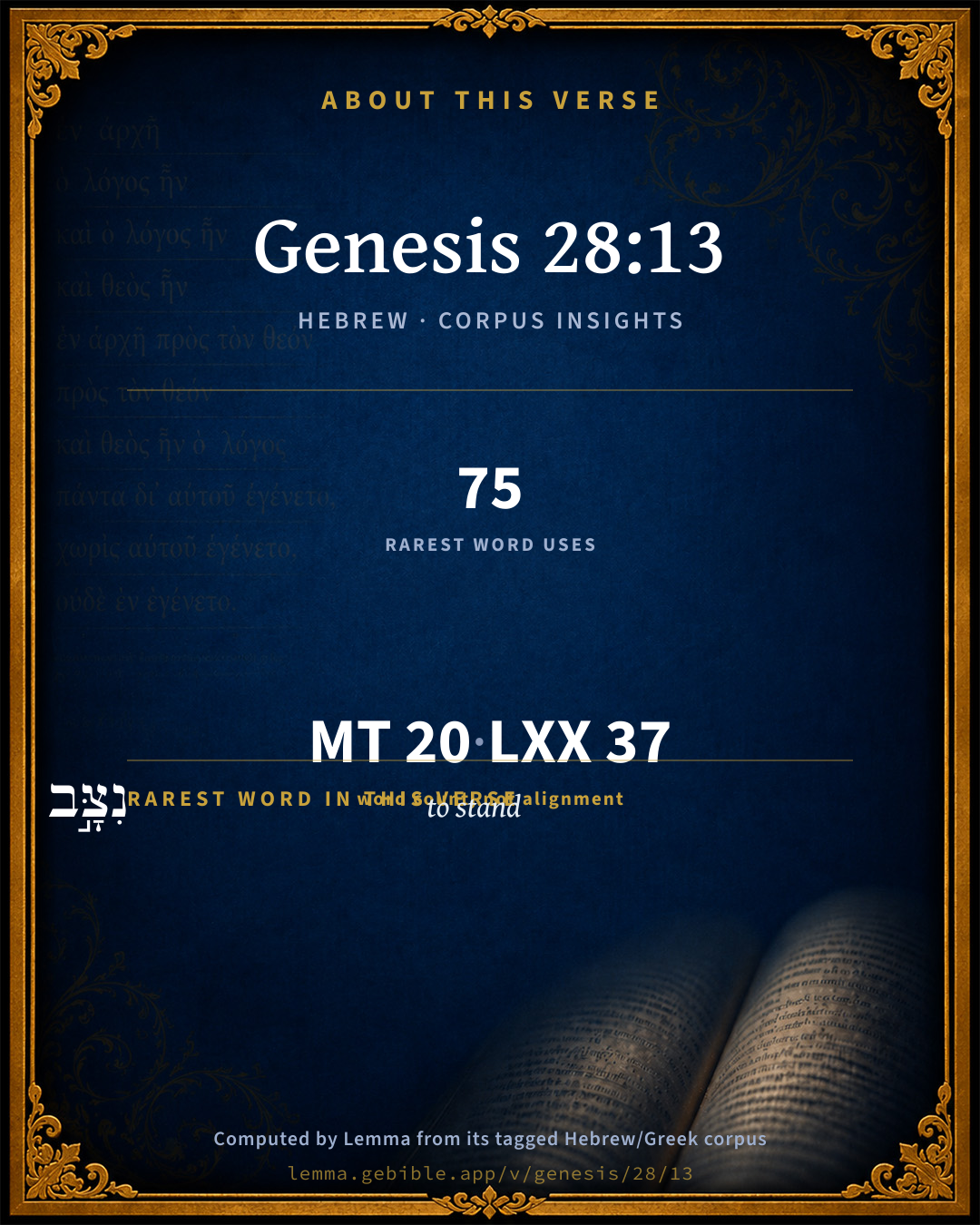
These counts appear in no published source. They are computed here, from the morphology-tagged text and Lemma’s own curated glosses. What Lemma adds →

20
words
16
distinct lemmas
Pentateuch
section

Grammatical profile

  • 4 verbs
  • 9 nouns
  • 2 pronouns
  • 3 prepositions
  • 2 particles

Verb forms

  • נִצָּ֣ב Niphal · Participle Active
  • וַיֹּאמַר֒ Qal · Sequential Imperfect
  • שֹׁכֵ֣ב Qal · Participle Active
  • אֶתְּנֶ֖נָּה Qal · Imperfect

Repetition

Words recur within this verse — often emphatic in Hebrew:

  • יְהוָ֜ה LORD H3068 ×2
  • עָלָיו֮ upon H5921 ×2
  • אֱלֹהֵי֙ God H430 ×2

Hebrew & Septuagint length

In English translation the verse runs 36 words from the Hebrew and 39 from the Septuagint (LXX English) — closely comparable.

A rough comparison of the two English renderings, which tokenize alike — not a word-level alignment.

Word counts can differ between the Hebrew and the Greek without any difference in meaning — e.g. the Hebrew direct-object marker אֵת has no separate Greek word, and Greek often adds the article ὁ.

In the original languages it is 20 Hebrew tokens and 37 Greek tokens — but the two are counted differently (Hebrew bundles its prefixes and suffixes into one token; the Greek is in lemma form), so that isn’t a like-for-like length.

Cross-references

23

Topical passages linked to Genesis 28:13 in the Treasury of Scripture Knowledge — connected by theme and wording, ordered by reader-vote popularity; previews shown in the World English Bible.

  • Genesis 13:15 for all the land which you see, I will give to you, and to your offspring forever.
  • Genesis 35:12 The land which I gave to Abraham and Isaac, I will give it to you, and to your seed after you will I give the land."
  • Genesis 48:3 Jacob said to Joseph, "God Almighty appeared to me at Luz in the land of Canaan, and blessed me,
  • Genesis 26:24 Yahweh appeared to him the same night, and said, "I am the God of Abraham your father. Don't be afraid, for I am with you, and will bless you, and multiply your seed for my servant Abraham's sake."
  • Genesis 35:1 God said to Jacob, "Arise, go up to Bethel, and live there. Make there an altar to God, who appeared to you when you fled from the face of Esau your brother."
  • Genesis 12:7 Yahweh appeared to Abram, and said, "I will give this land to your seed." He built an altar there to Yahweh, who appeared to him.
  • Exodus 3:6 Moreover he said, "I am the God of your father, the God of Abraham, the God of Isaac, and the God of Jacob." Moses hid his face; for he was afraid to look at God.
  • Genesis 46:3 He said, "I am God, the God of your father. Don't be afraid to go down into Egypt; for there I will make of you a great nation.
  • Matthew 22:32 'I am the God of Abraham, and the God of Isaac, and the God of Jacob?' God is not the God of the dead, but of the living."
  • Hebrews 11:16 But now they desire a better country, that is, a heavenly one. Therefore God is not ashamed of them, to be called their God, for he has prepared a city for them.
  • Genesis 17:6–7 I will make you exceeding fruitful, and I will make nations of you. Kings will come out of you.
  • Genesis 26:3 Sojourn in this land, and I will be with you, and will bless you. For to you, and to your seed, I will give all these lands, and I will establish the oath which I swore to Abraham your father.
  • Genesis 31:42 Unless the God of my father, the God of Abraham, and the fear of Isaac, had been with me, surely now you would have sent me away empty. God has seen my affliction and the labor of my hands, and rebuked you last night."
  • Genesis 35:17 It happened that, when she was in hard labor, that the midwife said to her, "Don't be afraid, for now you will have another son."
  • Genesis 15:1 After these things the word of Yahweh came to Abram in a vision, saying, "Don't be afraid, Abram. I am your shield, your exceedingly great reward."
  • Genesis 28:4 and give you the blessing of Abraham, to you, and to your seed with you, that you may inherit the land where you travel, which God gave to Abraham."
  • Genesis 32:9 Jacob said, "God of my father Abraham, and God of my father Isaac, Yahweh, who said to me, 'Return to your country, and to your relatives, and I will do you good.'
  • Genesis 35:6–7 So Jacob came to Luz, which is in the land of Canaan (the same is Bethel), he and all the people who were with him.
  • Genesis 35:15 Jacob called the name of the place where God spoke with him "Bethel."
  • Exodus 3:15–16 God said moreover to Moses, "You shall tell the children of Israel this, 'Yahweh, the God of your fathers, the God of Abraham, the God of Isaac, and the God of Jacob, has sent me to you.' This is my name forever, and this is my memorial to all generations.
  • Psalms 105:11 Saying, "To you I will give the land of Canaan, The lot of your inheritance;"
  • Ezekiel 37:24–25 My servant David shall be king over them; and they all shall have one shepherd: they shall also walk in my ordinances, and observe my statutes, and do them.
  • Acts 7:5 He gave him no inheritance in it, no, not so much as to set his foot on. He promised that he would give it to him for a possession, and to his seed after him, when he still had no child.

Cross-references courtesy of OpenBible.info (CC BY 4.0).

Hebrew and Greek witnesses Masoretic Hebrew ↔ Greek Septuagint

The same verse in the two great witnesses to the Old Testament, shown verse-for-verse.

These are two independent witnesses, not word-aligned to each other, and the Septuagint is shown in lemma (dictionary) form.

Hebrew Genesis 28:13 Masoretic · Westminster Leningrad Codex

וְהִנֵּ֨ה יְהוָ֜ה נִצָּ֣ב עָלָיו֮ וַיֹּאמַר֒ אֲנִ֣י יְהוָ֗ה אֱלֹהֵי֙ אַבְרָהָ֣ם אָבִ֔יךָ וֵאלֹהֵ֖י יִצְחָ֑ק הָאָ֗רֶץ אֲשֶׁ֤ר אַתָּה֙ שֹׁכֵ֣ב עָלֶ֔יהָ לְךָ֥ אֶתְּנֶ֖נָּה וּלְזַרְעֶֽךָ

Behold, Yahweh stood above it, and said, "I am Yahweh, the God of Abraham your father, and the God of Isaac. The land whereon you lie, to you will I give it, and to your seed.

World English Bible · Public Domain

Greek LXX Genesis 28:13 Septuagint · lemma form

ὁ δέ κύριος ἐπιστηρίζω ἐπί αὐτός καί εἶπον ἐγώ κύριος ὁ θεός αβρααμ ὁ πατήρ σύ καί ὁ θεός ισαακ μή φοβέω ὁ γῆ ἐπί ὅς σύ καταεὕδω ἐπί αὐτός σύ δίδωμι αὐτός καί ὁ σπέρμα σύ

And the Lord stood upon it, and said, I am the God of your father Abraam, and the God of Isaac; fear not, the land on which you lie, to you will I give it, and to your seed.

LXX2012 (modern English Septuagint) · Public Domain

On this verse, The Cambridge Bible for Schools and Colleges discusses the Septuagint’s reading. Read the note in Commentary ↓

Hebrew: Westminster Leningrad Codex (CC BY 4.0). Greek: Septuagint (public domain); English from LXX2012 (modern English Septuagint) (Public Domain). How the Septuagint differs from the Hebrew →

Targum (Aramaic paraphrase)

2

The Targum is the ancient Jewish Aramaic paraphrase of the Hebrew Scriptures — an interpretive translation, not the Hebrew text itself. Onkelos (literal) and Pseudo-Jonathan (expansive) render the Torah, and Jonathan the Prophets. Coverage is partial: where no permissively-licensed English translation exists for a verse, only the Aramaic is shown. This is verse-level text, not a word-by-word alignment to the Hebrew.

  1. Targum Onkelos Torah (Genesis–Deuteronomy)
    וְהָא יְקָרָא דַיְיָ מְעַתַּד עִלָווֹהִי וַאֲמַר אֲנָא יְיָ אֱלָהֵהּ דְּאַבְרָהָם אָבוּךְ וֵאלָהֵהּ דְּיִצְחָק אַרְעָא דִּי אַתְּ שְׁכִיב עֲלַהּ לָךְ אֶתְּנִנַּהּ וְלִבְנָיךְ

    (no public-domain English translation for this verse)

    Targum Onkelos — Aramaic: “Onkelos Genesis” (public domain); “Onkelos Exodus” (public domain); “Onkelos Leviticus” (public domain); “Onkelos Numbers” (public domain); “Onkelos Deuteronomy” (public domain). English: “Sefaria Community Translation” (CC0 1.0 (public-domain dedication)); “J.W. Etheridge. The Targums of Onkelos and Jonathan Ben Uzziel on the Pentateuch. London: Longmans, Green, 1862” (public domain). Text via Sefaria.

  2. Targum Pseudo-Jonathan Torah (Genesis–Deuteronomy)
    וְהָא יְקָרָא דַיְיָ מְעַתֵּד עִילוֹי וַאֲמַר לֵיהּ אֲנָא יְיָ אֱלָהֵיהּ דְאַבְרָהָם אָבוּךְ וֵאלָהֵיהּ דְיִצְחָק אַרְעָא דְאַנְתְּ שְׁכִיב עֲלָהּ לָךְ אֶתְּנִינָהּ וְלִבְנָךְ

    And, behold, the Glory of the Lord stood above him, and He said to him, I am the Lord the God of Abraham thy father, and the God of Izhak, The land on which thou art lying I will give to thee and to thy sons.

    Targum Pseudo-Jonathan — Aramaic: “Targum Jonathan on Genesis” (public domain); “Targum Jonathan on Exodus” (public domain); “Targum Jonathan on Leviticus” (public domain); “Targum Jonathan on Numbers” (public domain); “Targum Jonathan on Deuteronomy” (public domain). English: “The Targum of Jonathan ben Uzziel, trans. J. W. Etheridge, London, 1862” (public domain). Text via Sefaria.

Commentary

Notes on Genesis 28:13 from classic Christian and Jewish commentators (each source and its license shown beneath its notes). The classic Christian expositions comment on the surrounding passage and are grouped to its opening verse, so a note may address several verses; the Jewish commentaries on the Tanakh (Rashi and others) are per-verse, so they appear only where the commentator wrote on this verse.

Lemma curates 59 commentaries, every one of them public domain or Creative Commons licensed, each selected and text-cleaned for this edition rather than reprinted as found. About our sources →

The Cambridge Bible for Schools and Colleges

gen. ed. J. J. S. Perowne

13. the Lord stood] Lit. “was set, established, stationed,” LXX ἐπεστήρικτο, Vulg. “innixum.” The appearance of Jehovah is mentioned, but not described.

above it] Better, probably, as R.V. marg., beside him. Both renderings are possible. We should perhaps prefer that of the margin. The preposition is the same as in the account of the appearance of the three men to Abraham, Gen_18:2 (“Lo, three men stood over against him”). On the other hand, the versions LXX ἐπʼ αὐτῆς, Lat. and Syr. Pesh., render as R.V. text. But the substance of Gen_28:13-15 is a personal revelation to Jacob. It is distinct from the vision of Gen_28:12, which, on a great and impressive scale, taught the general lesson of the union between earth and heaven. There is, therefore, reason for preferring the personal allusion, either “beside him,” or “over (i.e. bending over) him.” Jacob is lying down: Jehovah is standing by him. Jacob is made to realize the ever-protecting Presence, at his side, or watching over him.

and said] The blessing of Jacob consists of (1) the Divine personal revelation; (2) the promise of the land (Gen_28:13); (3) the multiplication of his descendants (Gen_28:14); (4) the world’s blessing through his seed (Gen_28:14); (5) the personal promise of Presence and Protection (Gen_28:15).

thy father] i.e. thy ancestor. Abraham’s name is mentioned as that of the first recipient of the Divine promise.

the land] The renewal of the promise to Abraham, Gen_13:14-16.

The Cambridge Bible for Schools and Colleges (gen. ed. J. J. S. Perowne; Cambridge University Press, 1878–1918) — public domain. Text from a community e-Sword module.

Trapp's Complete Commentary

John Trapp

Gen 28:13 And, behold, the LORD stood above it, and said, I [am] the LORD God of Abraham thy father, and the God of Isaac: the land whereon thou liest, to thee will I give it, and to thy seed;

Ver. 13. I am the Lord God of Abraham, &c.] What an honour is this to Abraham, that God was not ashamed to be called his and his son’s God! Eusebius the historian, was called Eusebius Pamphili, for the love that was between him and the martyr Pamphilus, as St Jerome testifieth. "Friend to Sir Philip Sidney," is engraven upon a nobleman’s {a} tomb in this kingdom, as one of his titles. Behold the goodness of God, stooping so low as to style himself "the God of Abraham"; and Abraham again, "the friend of God."

{a} The old Lord Brook.

John Trapp, A Commentary or Exposition upon All the Books of the Old and New Testament (1647–1656) — public domain. Text from a community e-Sword module.

Geneva Bible (1599)

Geneva Bible translators

He felt the force of this promise only by faith: for all his lifetime he was but a stranger in this land.

Geneva Bible (1599) marginal notes — public domain. Text via Bolls.life.

Jamieson, Fausset & Brown

Robert Jamieson, A. R. Fausset & David Brown

The Lord stood above it, and said--That Jacob might be at no loss to know the purport of the vision, he heard the divine voice; and the announcement of His name, together with a renewal of the covenant, and an assurance of personal protection, produced at once the most solemnizing and inspiriting effect on his mind.

Jamieson, Fausset & Brown — Commentary Critical and Explanatory on the Whole Bible (1871) — public domain (CC PDM 1.0). Text via the HelloAO Bible API.

Adam Clarke's Commentary

Verse 13. I am the Lord God of Abraham] Here God confirms to him the blessing of Abraham, for which Isaac had prayed, Ge 28:3-4.

Adam Clarke's Commentary on the Bible (1810–1826) — public domain. Text from a community e-Sword/MySword module.

John Calvin's Commentaries

13. I am the Lord God of Abraham. This is the third point which, I said, was to be noticed: for mute visions are cold; therefore the word of the Lord is as the soul which quickens them. The figure, therefore, of the ladder was the inferior appendage of this promise; just as God illustrates and adorns his word by external symbols, that both greater clearness and authority may be added to it. Whence also we prove that sacraments in the Papacy are frivolous, because no voice is heard in them which may edify the soul. We may therefore observe, that whenever God manifested himself to the fathers, he also spoke, lest a mute vision should have held them in suspense. Under the name יהוהJehovah God teaches that he is the only Creator of the world, that Jacob might not seek after other gods. But since his majesty is in itself incomprehensible, he accommodates himself to the capacity of his servant, by immediately adding, that he is the God of Abraham and Isaac. For though it is necessary to maintain that the God whom we worship is the only God; yet because when our senses would aspire to the comprehension of his greatness, they fail at the first attempt; we must diligently cultivate that sobriety which teaches us not to desire to know more concerning him than he reveals unto us; and then he, accommodating himself to our weakness, according to his infinite goodness, sill omit nothing which tends to promote our salvation. And whereas he made a special covenant with Abraham and Isaac, proclaiming himself their God, he recalls his servant Jacob to the true source of faith, and retains him also in his perpetual covenant. This is the sacred bond of religion, by which all the sons of God are united among themselves, when from the first to the last they hear the same promise of salvation, and agree together in one common hope. And this is the effect of that benediction which Jacob had lately received from his father; because God with his own mouth pronounces him to be the heir of the covenant, lest the mere testimony of man should be thought illusive.

The land whereon thou liest. We read that the land was given to his posterity; yet he himself was not only a stranger in it to the last, but was not permitted even to die there. Whence we infer, that under the pledge or earnest of the land, something better and more excellent was given, seeing that Abraham was a spiritual possessor of the land, and contented with the mere beholding of it, fixed his chief regard on heaven. We, may observe, however, that the seed of Jacob is here placed in opposition to the other sons of Abraham, who, according to the flesh, traced their origin to him, but were cut off from the holy people: yet, from the time when the sons of Jacob entered the land of Canaan, they had the perpetual inheritance unto the coming of Christ, by whose advent the world was renewed.

John Calvin's Commentaries (1540-1563) — public domain. Text from the Calvin Translation Society English edition (1840s-50s) via the Christian Classics Ethereal Library (ccel.org). Calvin's coverage is partial (roughly two-thirds of the Bible); uncommented books and verses are honest gaps, never fabricated. The 19th-century editor's footnotes and remarks are omitted so the notes are faithfully Calvin's own voice.

John Gill's Exposition

And behold, the Lord stood above it,.... Ordering, directing, and overruling all things in Providence, for the glory of his name and the good of his people; and may signify, as the ladder may be a figure of Christ, that Jehovah the Father, is above him, as man and Mediator, and makes himself known in and by him, and delivers out all his blessings and promises through him, both temporal and spiritual, and such as follow:

and said, I am the Lord God of Abraham thy father, and the God of Isaac: their covenant God and Father in Christ, who had made promises unto them, and bestowed blessings upon them; and the same was and would continue to be the God of Jacob, which is strongly intimated:

the land whereon thou liest, to thee will I give it, and to thy seed; meaning not that small pittance of land only on which his body then lay, and which it covered, but all the land of which it was a part, even the whole land of Canaan; hereby entailing it on him and his seed, and so explaining and confirming the blessing of his father Isaac; and by which it appears, that all that had been done was under a divine direction, and according to the will of God.

John Gill's Exposition of the Whole Bible (1746–1763) — public domain (CC PDM 1.0). Text via the HelloAO Bible API.

Haydock's Catholic Bible Commentary

Thy father, or grandfather. God joins the dead with the living, to shew that all live to him, and that the soul is immortal. (Haydock)

George Leo Haydock (1774–1849), Haydock's Catholic Family Bible and Commentary, 1859 edition — public domain. Excludes Psalms (Douay-Rheims chapter numbering differs from Protestant) and Deuterocanonical books (Catholic canon only).

Whedon's Commentary on the Bible

Daniel D. Whedon

13. The Lord stood — A personal visional revelation of Jehovah. The Targum of Onkelos reads: “The glory of the Lord stood above.” It was a theophany that impressed Jacob with a fearful awe. Gen_28:17.

The land… to thy seed — Compare the same promise made to Abraham in Gen_13:15; Gen_15:18.

Daniel D. Whedon (gen. ed.), Commentary on the Old and New Testaments (1874–1909) — public domain. Text from a community e-Sword module.

The Pulpit Commentary

And, behold, dream-vision is so glorious that the narrator represents it by a threefold hGehi (Lange)the Lord stood above it, the change in the Divine name is not to be explained by assigning vers. 13-16 to the Jehovistic editor (Tuch, Bleek) or to a subsequent redactor (Davidson), since without it the Elohistic document would be abrupt, if not incomplete (Kalisch), but by recalling the fact that it is not the general pro vide nce of the Deity over his creature man, but the special superintendence of the God of Abraham and of Isaac over his chosen people, that the symbolic ladder was intended to depict (Hengstenberg)and said, I am the Lord God of Abraham thy father, and the God of Isaac: thus not simply proclaiming his personal name Jehovah, but announcing himself as the Elohim who had solemnly entered into covenant with his ancestors, and who had now come, in virtue of that covenant, to renew to him the promises he had previously given themthe land whereon thou liest, to thee will I give it, and to thy seed given to Abraham, Gen_13:15; to Isaac, Gen_26:3.

The Pulpit Commentary (1880–1919), ed. H.D.M. Spence-Jones & Joseph S. Exell — public domain. Text from a community e-Sword module.

Rashi

Rabbi Shlomo Yitzchaki (Rashi)

נצב עליו STOOD ABOVE HIM to guard him (Genesis Rabbah 69:3).

ואלהי יצחק AND THE GOD OF ISAAC — Although we do not find in the Scriptures that God associates his Name with that of the righteous whilst they are yet alive by writing, “The God of so-and-so”, — because it is said (Job 15:15) “Behold He putteth no trust even in His holy ones” — here, however, He associated his Name with that of Isaac because his eyes had become dim and he was confined to the house, so that he might be regarded as dead and as though the evil inclination had already passed away from him and he was unlikely to sin any more (Midrash Tanchuma, Toldot 7).

שכב עליה THE LAND WHEREON THOU LIEST — The Holy One, blessed be He, rolled together the entire Land of Israel under him, thus intimating to him that it would be as easily conquered by his descendants (Chullin 91b) as a piece of land four cubits in length, which is the space covered by a person lying down (see Rashi, Chullin 91b, and the note of the ב"ח thereon).

Rashi on the Tanakh — English translations: “The Judaica Press complete Tanach with Rashi, translated by A. J. Rosenberg” (CC BY 4.0); “Pentateuch with Rashi's commentary by M. Rosenbaum and A.M. Silbermann, 1929-1934” (public domain); “The Metsudah Tanach series, Lakewood, N.J” (CC BY 4.0); and “The Book of Joshua, Metsudah Publications, 1997” (CC BY 4.0). Text via Sefaria.

Radak

Rabbi David Kimhi (Radak)

והנה ה' נצב עליו, this would be a reference to Exodus 19,20 where we read וירד ה' על הר סיני, “the Lord descended on Mount Sinai.” Others say that G’d showed Yaakov details of the sacrificial service in the Temple, the ladder serving as a model of the function of the altar. וראשו מגיע השמימה, an allusion to the smoke from the sacrifices rising from the altar in the Temple, especially that of the daily incense offering. These would be received with goodwill by the Lord.

והנה מלאכי אלוקים עולים ויורדים בו, a reference to the priests who offer the animal offerings and the incense. We also find among the explanations given by our sages for this dream (compare Rashi on verse 11 and 17) that Yaakov viewed himself during this dream as standing on Mount Moriah as he was familiar with the appearance of the location from both the description he had heard from his father and from his grandfather Avraham. This is why he said that this place would become the House of G’d in the future and the gateway to heaven (verses 22 and 17). The reason was that this place on earth is directly opposite the throne of G’d in the celestial regions. As to the reason he named the site בית א-ל, this was because he saw in a prophetic vision [seeing that he had been granted the vision there, Ed.] that the site itself was holy, not only the Temple that would be erected on it. This is why he immediately built an altar there. I have also found among the sayings of the sages on these verses that the ladder had 4 rungs. According to that Midrash the width of the ladder was such that 4 angels could simultaneously ascend and descend on it. When they would pass each other on their respective ascent and descent they would occupy the full width of the rung. Each angel symbolised one “governor” of the world as we know from Daniel 10,6 וגויתו כתרשיש. “its body” the size of Tarshish (another term for the “governor.”) These Rabbis have a tradition that Tarshish is one of three such “governors” of the universe. We have to understand what is so important in this interpretation. According to the superficial meaning the width of the ladder would have been wide enough to accommodate 4 such governors, something that seems hard to understand. Maimonides has shown us a window through which to understand what was meant by this statement of Daniel. [the author does not necessarily adopt the views expressed by Maimonides in Moreh Nevuchim section 2, chapters 9 and 10, but employs a similar concept, explaining what occurred on the ladder during Yaakov’s dream. Ed.] He explained that the universe consists basically of three phenomena, the third one being the angels (abstract disembodied intelligent creatures. Moreh Nevuchim 2,10) The four ”rungs” of the ladder would be understood as 4 כדורים described in Moreh Nevuchim second part chapter 9 as a condensation of the nine planets to merely four, some being absorbed to become part of the domain of others. In that scheme of things G’d assigned specific functions to specific planets such as the sun (in charge of fire, heat) and the moon (in charge of water, to wit its influence on the tides), various orbiting planets creating the motion resulting in rain or wind respectively. At any rate, the concept of G’d having assigned 4 distinct such “angels,” i.e. agents of His to run the physical “lower” universe would be what G’d showed Yaakov in the dream of “angels” ascending and descending. Whereas these forces are portrayed in constant motion, such motion by definition cannot be constantly in a single direction. They are therefore portrayed as “ascending” or “descending.” This naturally involves their passing each other at a certain point. Symbolically speaking, the “ladder” the framework within which they operate, must be wide enough to allow this. This is possibly what the Midrash quoted in Maimonides has in mind. [Our editions of the Midrash do not have this paragraph. Ed.] [Another way of looking at the ascending and descending “angels” is that they represent the quest of man for wisdom regarding G’d and His universe, i.e. ascending, and the agents of G’d meeting man halfway in providing him with such knowledge, i.e. “descending.” Alternatively, after man has ascended to receive divinely inspired insights he returns to earth “descends,” to incorporate the newly gained insights in his world view. Akeydat Yitzchok. Ed.] G’d being portrayed as “standing” on top of the ladder is a reminder that the knowledge obtained by man is not from independently powerful phenomena but that these apparently powerful forces are only carrying out His instructions.

והנה ה' נצב עליו, the meaning of the word עליו is not clear. It could refer to G’d on top of the ladder, but it could also refer to Yaakov, meaning G’d was providing Yaakov with new insights originating from the wisdom available in the celestial regions, i.e. the top of the ladder. If so, the reason this is described sequentially as an ascent followed by a descent is that the ascent describes man’s learning process, something concentrated in the head, the mind. Once he has absorbed the new knowledge he has to use it, transmit it to the lower parts of his body, which carries out the lessons learned. The reason why the words עולים and יורדים appear in the plural mode is that both the שכל and the פועל, [theoretical pure reason and the practical reason have to absorb these lessons. My wording. Ed.] The descending “angels” describe the two basic elements in G’d’s supervisory scheme of guiding the history of the universe, the direct and indirect supervision and intervention by G’d known as hashgachah peratit, and the general supervision by G’d’s agents the כדורים or גלגלים known in everyday language as mazzalot. Since Yaakov was fleeing from his home, and no doubt his mental and spiritual equilibrium had been traumatised somewhat by recent events, G’d showed him these insights to not only repair the damage, but to provide him with knowledge he had not yet possessed previously. He promised to give him the land that he was presently running away from, and reassured him that it was well within the Supreme Power, the Lord, to accomplish all this when the time would be ripe. He reassured him that he, Yaakov, indeed was Yitzchok’s real descendant and that all the promises made to Avraham would bear fruition through him and his descendants. אביך, although Avraham was not your biological father he was like your father to you and not to the other grandchildren he had from other sons. Avraham’s inheritance would devolve only on Yaakov.

והנה...אשר אתה שוכב עליה, the meaning is not that Yaakov would be given only the tiny piece of earth he was lying on at that time, but G’d referred to the tiny sample of the land of Israel Yaakov was lying on at that type as being a symbol of the land of Israel of the future. We have a similar construction in Genesis 13,15 where G’d speaks of “all the land Avraham can see.” If He had meant that Avraham’s descendants would inherit only what was within Avraham’s range of vision at that moment, the promise would have been meaningless. G’d used the piece of land he stood on as a symbol of what He would give to his descendants in the future. Concerning the Midrash (mentioned by Rashi) that G’d had “folded” the whole of the land of Israel beneath the tiny piece of earth occupied by Yaakov at the time when He made this promise, surely the meaning of the Midrash is that G’d’s promise is to be understood “as if he had folded, etc.”

Radak on the Tanakh — English translations: “Sefaria Community Translation” (CC0 1.0 (public-domain dedication)); “Eliyahu Munk, HaChut Hameshulash” (CC BY 4.0); “Rabbi Mike Feuer, Jerusalem Anthology” (CC BY 4.0); and “R. David Kimhi on the first book of Psalms, Translated by R.G. Finch, London, 1919” (public domain). Text via Sefaria.

Lesson kit

Teaching starters — assembled from the data on this page, not authored interpretation. Every prompt links to the verse data it draws on. Edit before teaching.

Genesis, in the Pentateuch, opens this verse with 20 words (16 distinct Hebrew lemmas). Its most distinctive word is nâtsab (“to stand”). A historical commentator’s framing appears above. Read the whole chapter for the surrounding context.

Discussion questions

  1. What does “to stand” (nâtsab) contribute to the verse as a whole?
  2. Genesis 13:15 shares this passage’s theme. How do the two illuminate each other?
  3. “LORD” occurs 2× in this one verse. What is the effect of the repetition?
  4. These translations render this verse differently. What is at stake in choosing one wording over another?
  5. The verb «נִצָּ֣ב» is Niphal Participle Active. How does its form color the action?
  6. Reading how The Cambridge Bible for Schools and Colleges and Trapp's Complete Commentary read this verse, where do the two commentators agree and where do they part?

Things to notice

Reading settings

Reading text

Shown beneath each verse's original-language words.

Old Testament
Old Testament edition

Read the OT as the Masoretic Hebrew (MT) or the Greek Septuagint (LXX).

English shown for the Greek Septuagint (in the Hebrew ↔ Greek comparison).

Comparing translations? Open the Compare panel on any verse page to stack up to four side by side.