
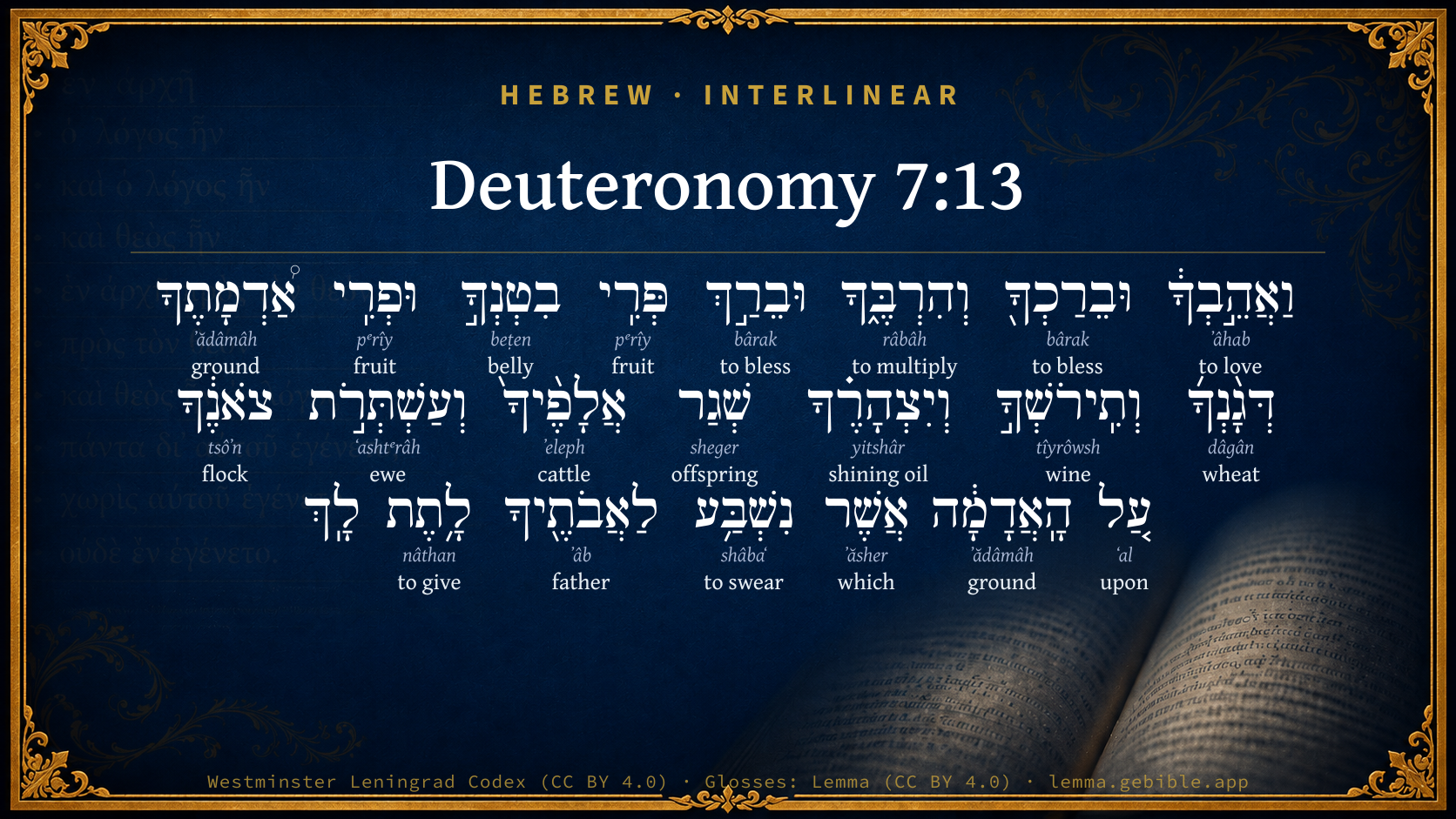
Deuteronomy 7:13

Hebrew (Westminster Leningrad Codex) Deuteronomy 7:13 appears in the Hebrew Old Testament. The text above is from the Westminster Leningrad Codex. Each word links to its Strong’s number, a concise gloss, and parsing drawn from the Open Scriptures Hebrew Bible morphology. Click any word for its full Brown-Driver-Briggs (BDB) entry.
Download image
Cite this verse

Deuteronomy 7:13 (World English Bible). Public Domain. Lemma interlinear Bible study tool, https://lemma.gebible.app/v/deuteronomy/7/13.

Show BibTeX & RIS
BibTeX
RIS
English Translation
and he will love you, and bless you, and multiply you; he will also bless the fruit of your body and the fruit of your ground, your grain and your new wine and your oil, the increase of your cattle and the young of your flock, in the land which he swore to your fathers to give you.
World English Bible · Public Domain
Highlights
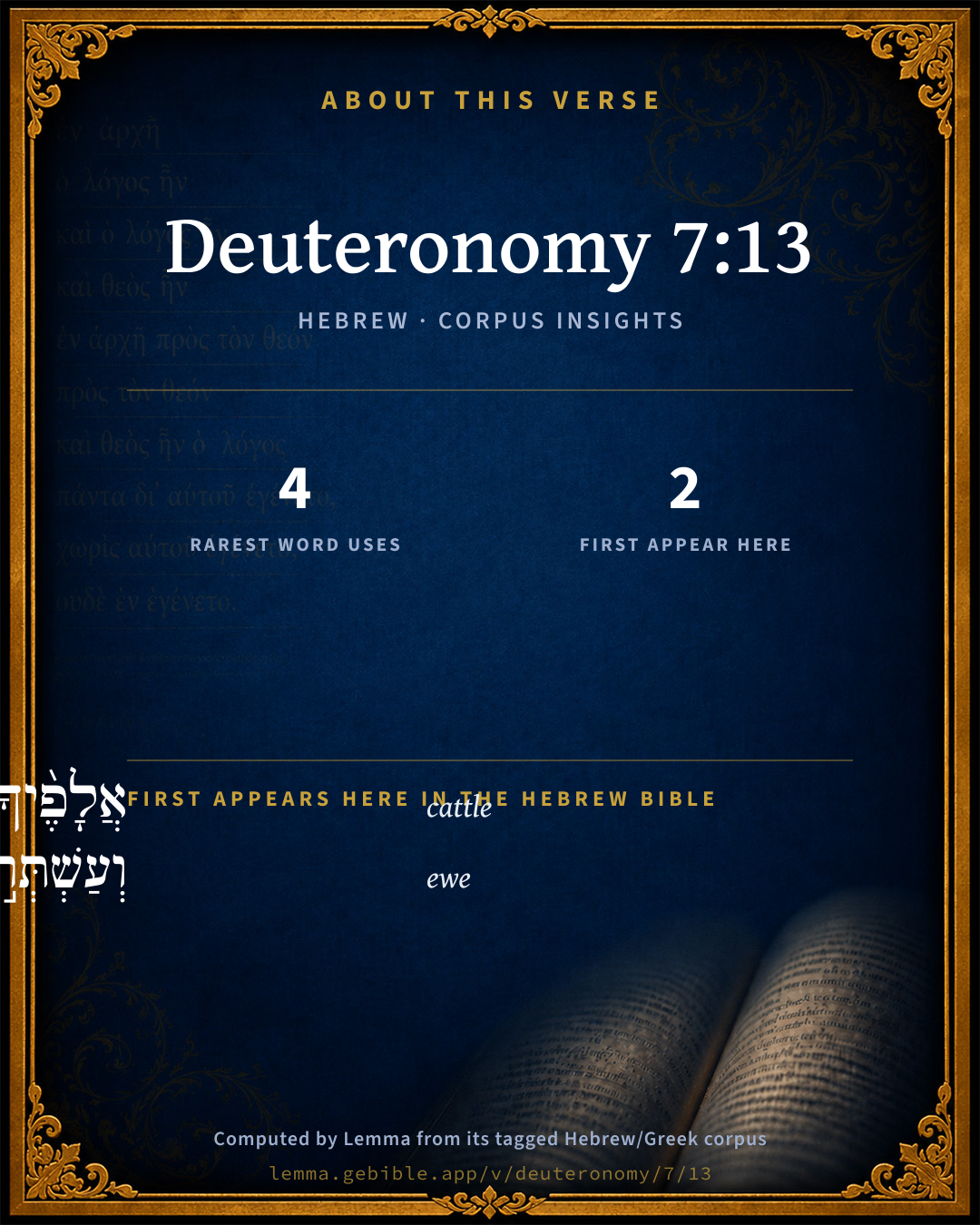
  • 2 first appearances in the Hebrew Bible
Full analysis ↓
Download a study sheet

One document with this verse’s original text, its word-by-word gloss line, the meaning frame, cross-references with their text, attributed commentary, and full source and license credits — printable, and it pastes into notes with its structure intact.

This verse Autodidact and up

Study sheet (.html) Plain text (.txt)

A passage Seminary Student

Up to 50 verses in one chapter. A passage sheet keeps up to 6 commentary sources and 12 cross-references per verse, in the order this page ranks them, and says so on the sheet whenever that leaves anything out. Ask for a single verse and you get the Autodidact verse sheet above.

Everything on this page stays free to read, with no account — the sheet is a download of what is already on screen, not access to it.

Want to remove ads? Support Godless Engineer
Compare translations 3

The same verse in 3 English versions, stacked beneath the original-language interlinear above. Click any original word for its lexicon entry.

Each is an independent rendering of the whole verse — the interlinear is not word-aligned to these translations.

Highlighted words mark where these versions differ — a whole-verse word diff, not a word-by-word alignment.

  • World English Bible Public Domain
    and he will love you, and bless you, and multiply you; he will also bless the fruit of your body and the fruit of your ground, your grain and your new wine and your oil, the increase of your cattle and the young of your flock, in the land which he swore to your fathers to give you.
  • King James Version Public Domain
    And he will love thee, and bless thee, and multiply thee: he will also bless the fruit of thy womb, and the fruit of thy land, thy corn, and thy wine, and thine oil, the increase of thy kine, and the flocks of thy sheep, in the land which he sware unto thy fathers to give thee.
  • unfoldingWord Literal Text CC BY-SA 4.0
    And he will love you and bless you and multiply you. And he will bless the fruit of your womb and the fruit of your ground, your grain and your new wine and your oil, the increase of your cattle and the young of your flocks, on the land that he swore to your fathers to give to you.

unfoldingWord Literal Text — © unfoldingWord, licensed CC BY-SA 4.0. Word-aligned USFM3 via Door43 (git.door43.org/unfoldingWord/en_ult).

Versions to compare (up to 4)

3 of 4 selected

Show all 18 translations

Every available English version of this verse, each an independent rendering of the whole verse.

  • World English Bible Public Domain
    and he will love you, and bless you, and multiply you; he will also bless the fruit of your body and the fruit of your ground, your grain and your new wine and your oil, the increase of your cattle and the young of your flock, in the land which he swore to your fathers to give you.
  • Berean Standard Bible Public Domain
    He will love you and bless you and multiply you. He will bless the fruit of your womb and the produce of your land—your grain, new wine, and oil, the young of your herds and the lambs of your flocks—in the land that He swore to your fathers to give you.
  • Majority Standard Bible Public Domain
    He will love you and bless you and multiply you. He will bless the fruit of your womb and the produce of your land—your grain, new wine, and oil, the young of your herds and the lambs of your flocks—in the land that He swore to your fathers to give you.
  • King James Version Public Domain
    And he will love thee, and bless thee, and multiply thee: he will also bless the fruit of thy womb, and the fruit of thy land, thy corn, and thy wine, and thine oil, the increase of thy kine, and the flocks of thy sheep, in the land which he sware unto thy fathers to give thee.
  • American Standard Version (1901) Public Domain
    and he will love thee, and bless thee, and multiply thee; he will also bless the fruit of thy body and the fruit of thy ground, thy grain and thy new wine and thine oil, the increase of thy cattle and the young of thy flock, in the land which he sware unto thy fathers to give thee.
  • Revised Version (1885) Public Domain
    and he will love thee, and bless thee, and multiply thee: he will also bless the fruit of thy body and the fruit of thy ground, thy corn and thy wine and thine oil, the increase of thy kine and the young of thy flock, in the land which he sware unto thy fathers to give thee.
  • Geneva Bible (1599) Public Domain
    And he wil loue thee, and blesse thee, and multiplie thee: he will also blesse the fruite of thy wombe, and the fruite of thy land, thy corne and thy wine, and thine oyle and the increase of thy kine, and the flockes of thy sheepe in the land, which he sware vnto thy fathers to giue thee.
  • Douay-Rheims (1899) Public Domain
    And he will love thee and multiply thee, and will bless the fruit of thy womb, and the fruit of thy land, thy corn, and thy vintage, thy oil, and thy herds, and the flocks of thy sheep upon the land, for which he swore to thy fathers that he would give it thee.
  • Young's Literal Translation Public Domain
    and hath loved thee, and blessed thee, and multiplied thee, and hath blessed the fruit of thy womb, and the fruit of thy ground, thy corn, and thy new wine, and thine oil, the increase of thine oxen, and the wealth of thy flock, on the ground which He hath sworn to thy fathers to give to thee.
  • Literal Standard Version CC BY-SA 4.0
    and has loved you, and blessed you, and multiplied you, and has blessed the fruit of your womb, and the fruit of your ground, your grain, and your new wine, and your oil, the increase of your oxen, and the wealth of your flock, on the ground which He has sworn to your fathers to give to you.
  • Unlocked Literal Bible CC BY-SA 4.0
    He will love you, bless you, and multiply you; he will also bless the fruit of your body and the fruit of your ground, your grain, your new wine, and your oil, the multiplication of your cattle and the young of your flocks, in the land that he swore to your fathers to give you.
  • unfoldingWord Literal Text CC BY-SA 4.0
    And he will love you and bless you and multiply you. And he will bless the fruit of your womb and the fruit of your ground, your grain and your new wine and your oil, the increase of your cattle and the young of your flocks, on the land that he swore to your fathers to give to you.
  • Darby Bible Public Domain
    and he will love thee, and bless thee, and multiply thee, and will bless the fruit of thy womb, and the fruit of thy ground, thy corn and thy new wine, and thine oil, the offspring of thy kine, and the increase of thy sheep, in the land which he swore unto thy fathers to give thee.
  • World Messianic Bible Public Domain
    He will love you, bless you, and multiply you. He will also bless the fruit of your body and the fruit of your ground, your grain and your new wine and your oil, the increase of your livestock and the young of your flock, in the land which he swore to your fathers to give you.
  • Webster's Bible Public Domain
    And he will love thee, and bless thee, and multiply thee: he will also bless thy children, and the fruit of thy land, thy corn, and thy wine, and thy oil, the increase of thy kine, and the flocks of thy sheep, in the land which he swore to thy fathers to give thee.
  • Free Bible Version CC BY-SA 4.0
    He will love you and bless you and give you many descendants. He will bless your children and the crops your land produces—your grain, new wine, and olive oil, the calves of your cattle herds and the lambs of your flocks—in the land that he promised your forefathers to give you.
  • Bible in Basic English Public Domain
    And he will give you his love, blessing you and increasing you: he will send his blessing on the offspring of your body and the fruit of your land, your grain and your wine and your oil, the increase of your cattle and the young of your flock, in the land which by his oath to your fathers he undertook to give you.
  • JPS Tanakh (1917) Public Domain
    and He will love thee, and bless thee, and multiply thee; He will also bless the fruit of thy body and the fruit of thy land, thy corn and thy wine and thine oil, the increase of thy kine and the young of thy flock, in the land which He swore unto thy fathers to give thee.

Literal Standard Version (2020), Covenant Press — licensed CC BY-SA 4.0. Text via the HelloAO Bible API (eBible.org). Unlocked Literal Bible (unfoldingWord) — licensed CC BY-SA 4.0. Text via the HelloAO Bible API (eBible.org). unfoldingWord Literal Text — © unfoldingWord, licensed CC BY-SA 4.0. Word-aligned USFM3 via Door43 (git.door43.org/unfoldingWord/en_ult). Free Bible Version, Dr. Jonathan Gallagher — licensed CC BY-SA 4.0. Text via the HelloAO Bible API (eBible.org).

Word by word

More ways to search: Search by grammar → Find every occurrence → Compare this word →

Practice this passage: Drill this verse → Learn its vocabulary →

וְעַשְׁתְּרֹ֣ת
ʻashtᵉrâh
H6251
“and · ewe”
Conjunction + Noun, Proper
Part of Speech
Conjunction + Noun
Type
Proper
Full BDB Definition

Origin: probably from H6238

TWOT: 1718a

ewe, flock, increase, young
  1. וַאֲהֵ֣בְךָ֔ ʼâhab H157 “and · to love · you” Conjunction + Verb, Qal, Sequential Perfect, 3rd Person, Masculine, Singular + Suffix, Personal, 2nd Person, Masculine, Singular
  2. וּבֵרַכְךָ֖ bârak H1288 “and · to bless · you” Conjunction + Verb, Piel, Sequential Perfect, 3rd Person, Masculine, Singular + Suffix, Personal, 2nd Person, Masculine, Singular
  3. וְהִרְבֶּ֑ךָ râbâh H7235 “and · to multiply · you” Conjunction + Verb, Hiphil, Sequential Perfect, 3rd Person, Masculine, Singular + Suffix, Personal, 2nd Person, Masculine, Singular
  4. וּבֵרַ֣ךְ bârak H1288 “and · to bless” Conjunction + Verb, Piel, Sequential Perfect, 3rd Person, Masculine, Singular
  5. פְּרִֽי pᵉrîy H6529 “fruit of” Noun, Common, Masculine, Singular, Construct
  6. בִטְנְךָ֣ beṭen H990 “belly · your” Noun, Common, Feminine, Singular, Construct + Suffix, Personal, 2nd Person, Masculine, Singular
  7. וּפְרִֽי pᵉrîy H6529 “and · fruit of” Conjunction + Noun, Common, Masculine, Singular, Construct
  8. אַ֠דְמָתֶךָ ʼădâmâh H127 “ground · your” Noun, Common, Feminine, Singular, Construct + Suffix, Personal, 2nd Person, Masculine, Singular
  9. דְּגָ֨נְךָ֜ dâgân H1715 “wheat · your” Noun, Common, Masculine, Singular, Construct + Suffix, Personal, 2nd Person, Masculine, Singular
  10. וְתִֽירֹשְׁךָ֣ tîyrôwsh H8492 “and · wine · your” Conjunction + Noun, Common, Masculine, Singular, Construct + Suffix, Personal, 2nd Person, Masculine, Singular
  11. וְיִצְהָרֶ֗ךָ yitshâr H3323 “and · shining oil · your” Conjunction + Noun, Common, Masculine, Singular, Construct + Suffix, Personal, 2nd Person, Masculine, Singular
  12. שְׁגַר sheger H7698 “offspring of” Noun, Common, Masculine, Singular, Construct
  13. אֲלָפֶ֨יךָ֙ ʼeleph H504 “cattle · your” Noun, Common, Masculine, Plural, Construct + Suffix, Personal, 2nd Person, Masculine, Singular
  14. צֹאנֶ֔ךָ tsôʼn H6629 “flock · your” Noun, Common, Both, Singular, Construct + Suffix, Personal, 2nd Person, Masculine, Singular
  15. עַ֚ל ʻal H5921 “upon” Preposition
  16. הָֽאֲדָמָ֔ה ʼădâmâh H127 “the · ground” Particle, Definite Article + Noun, Common, Feminine, Singular, Absolute
  17. אֲשֶׁר ʼăsher H834 “which” Particle, Relative
  18. נִשְׁבַּ֥ע shâbaʻ H7650 “to swear” Verb, Niphal, Perfect, 3rd Person, Masculine, Singular
  19. לַאֲבֹתֶ֖יךָ ʼâb H1 “to/for · fathers · your” Preposition + Noun, Common, Masculine, Plural, Construct + Suffix, Personal, 2nd Person, Masculine, Singular
  20. לָ֥תֶת nâthan H5414 “to give” Preposition + Verb, Qal, Infinitive Construct

About this verse

These counts appear in no published source. They are computed here, from the morphology-tagged text and Lemma’s own curated glosses. What Lemma adds →

22
words
18
distinct lemmas
Pentateuch
section

Notable vocabulary

The rarest word here is וְעַשְׁתְּרֹ֣ת ewe H6251 — appearing just 4 times in the whole Hebrew Bible.

First appearance in Scripture

These words make their first canonical appearance in the Hebrew Bible here:

  • אֲלָפֶ֨יךָ֙ cattle H504
  • וְעַשְׁתְּרֹ֣ת ewe H6251

Shared distinctive vocabulary

וְעַשְׁתְּרֹ֣ת ewe H6251 occurs in 4 verses of the Hebrew Bible. Also found in:

Grammatical profile

  • 6 verbs
  • 13 nouns
  • 2 prepositions
  • 1 particle

Verb forms

  • וַאֲהֵ֣בְךָ֔ Qal · Sequential Perfect
  • וּבֵרַכְךָ֖ Piel · Sequential Perfect
  • וְהִרְבֶּ֑ךָ Hiphil · Sequential Perfect
  • וּבֵרַ֣ךְ Piel · Sequential Perfect
  • נִשְׁבַּ֥ע Niphal · Perfect
  • לָ֥תֶת Qal · Infinitive Construct

Repetition

Words recur within this verse — often emphatic in Hebrew:

  • וּבֵרַכְךָ֖ to bless H1288 ×2
  • פְּרִֽי fruit H6529 ×2
  • אַ֠דְמָתֶךָ ground H127 ×2

Hebrew & Septuagint length

In English translation the verse runs 58 words from the Hebrew and 59 from the Septuagint (LXX English) — closely comparable.

A rough comparison of the two English renderings, which tokenize alike — not a word-level alignment.

Word counts can differ between the Hebrew and the Greek without any difference in meaning — e.g. the Hebrew direct-object marker אֵת has no separate Greek word, and Greek often adds the article ὁ.

Cross-references

14

Topical passages linked to Deuteronomy 7:13 in the Treasury of Scripture Knowledge — connected by theme and wording, ordered by reader-vote popularity; previews shown in the World English Bible.

  • John 14:21 One who has my commandments, and keeps them, that person is one who loves me. One who loves me will be loved by my Father, and I will love him, and will reveal myself to him."
  • Deuteronomy 28:3–5 Blessed shall you be in the city, and blessed shall you be in the field.
  • John 15:10 If you keep my commandments, you will remain in my love; even as I have kept my Father's commandments, and remain in his love.
  • Exodus 23:25 You shall serve Yahweh your God, and he will bless your bread and your water, and I will take sickness away from your midst.
  • John 16:27 for the Father himself loves you, because you have loved me, and have believed that I came forth from God.
  • Deuteronomy 28:11 Yahweh will make you plenteous for good, in the fruit of your body, and in the fruit of your cattle, and in the fruit of your ground, in the land which Yahweh swore to your fathers to give you.
  • Job 42:12 So Yahweh blessed the latter end of Job more than his beginning. He had fourteen thousand sheep, six thousand camels, one thousand yoke of oxen, and a thousand female donkeys.
  • Proverbs 10:22 Yahweh's blessing brings wealth, And he adds no trouble to it.
  • Malachi 3:10–11 Bring the whole tithe into the store-house, that there may be food in my house, and test me now in this," says Yahweh of hosts, "if I will not open you the windows of heaven, and pour you out a blessing, that there shall not be room enough for.
  • Matthew 6:33 But seek first God's Kingdom, and his righteousness; and all these things will be given to you as well.
  • Psalms 144:12–15 Then our sons will be like well-nurtured plants, Our daughters like pillars carved to adorn a palace.
  • Deuteronomy 7:7 Yahweh didn't set his love on you, nor choose you, because you were more in number than any people; for you were the fewest of all peoples:
  • Psalms 1:3 He will be like a tree planted by the streams of water, That brings forth its fruit in its season, Whose leaf also does not wither. Whatever he does shall prosper.
  • Psalms 11:7 For Yahweh is righteous. He loves righteousness. The upright shall see his face.

Cross-references courtesy of OpenBible.info (CC BY 4.0).

Hebrew and Greek witnesses Masoretic Hebrew ↔ Greek Septuagint

The same verse in the two great witnesses to the Old Testament, shown verse-for-verse.

These are two independent witnesses, not word-aligned to each other, and the Septuagint is shown in lemma (dictionary) form.

Hebrew Deuteronomy 7:13 Masoretic · Westminster Leningrad Codex

וַאֲהֵ֣בְךָ֔ וּבֵרַכְךָ֖ וְהִרְבֶּ֑ךָ וּבֵרַ֣ךְ פְּרִֽי בִטְנְךָ֣ וּפְרִֽי אַ֠דְמָתֶךָ דְּגָ֨נְךָ֜ וְתִֽירֹשְׁךָ֣ וְיִצְהָרֶ֗ךָ שְׁגַר אֲלָפֶ֨יךָ֙ וְעַשְׁתְּרֹ֣ת צֹאנֶ֔ךָ עַ֚ל הָֽאֲדָמָ֔ה אֲשֶׁר נִשְׁבַּ֥ע לַאֲבֹתֶ֖יךָ לָ֥תֶת לָֽךְ

and he will love you, and bless you, and multiply you; he will also bless the fruit of your body and the fruit of your ground, your grain and your new wine and your oil, the increase of your cattle and the young of your flock, in the land which he swore to your fathers to give you.

World English Bible · Public Domain

Greek LXX Deuteronomy 7:13 Septuagint · lemma form

καί ἀγαπάω σύ καί εὐλογέω σύ καί πληθύνω σύ καί εὐλογέω ὁ ἔκγονος ὁ κοιλία σύ καί ὁ καρπός ὁ γῆ σύ ὁ σῖτος σύ καί ὁ οἶνος σύ καί ὁ ἔλαιον σύ ὁ βουκόλιον ὁ βοῦς σύ καί ὁ ποίμνιον ὁ πρόβατον σύ ἐπί ὁ γῆ ὅς ὄμνυμι κύριος ὁ πατήρ σύ δίδωμι σύ

And he will love you, and bless you, and multiply you; and he will bless the off-spring of your body, and the fruit of your land, your corn, and your wine, and your oil, the herds of your oxen, and the flocks of your sheep, on the land which the Lord swore to your fathers to give to you.

LXX2012 (modern English Septuagint) · Public Domain

On this verse, The Cambridge Bible for Schools and Colleges discusses the Septuagint’s reading. Read the note in Commentary ↓

Hebrew: Westminster Leningrad Codex (CC BY 4.0). Greek: Septuagint (public domain); English from LXX2012 (modern English Septuagint) (Public Domain). How the Septuagint differs from the Hebrew →

Targum (Aramaic paraphrase)

2

The Targum is the ancient Jewish Aramaic paraphrase of the Hebrew Scriptures — an interpretive translation, not the Hebrew text itself. Onkelos (literal) and Pseudo-Jonathan (expansive) render the Torah, and Jonathan the Prophets. Coverage is partial: where no permissively-licensed English translation exists for a verse, only the Aramaic is shown. This is verse-level text, not a word-by-word alignment to the Hebrew.

  1. Targum Onkelos Torah (Genesis–Deuteronomy)
    וְיִרְחֲמִנָךְ וִיבָרֵכִנָךְ וְיַסְגִינָךְ וִיבָרֵךְ וַלְדָא דִמְעָךְ וְאִבָּא דְאַרְעָךְ עִבוּרָךְ וְחַמְרָךְ וּמִשְׁחָךְ בַּקְרֵי תוֹרָיךְ וְעֶדְרֵי עָנָךְ עַל אַרְעָא דִי קַיִים לַאֲבָהָתָךְ לְמִתַּן לָךְ

    (no public-domain English translation for this verse)

    Targum Onkelos — Aramaic: “Onkelos Genesis” (public domain); “Onkelos Exodus” (public domain); “Onkelos Leviticus” (public domain); “Onkelos Numbers” (public domain); “Onkelos Deuteronomy” (public domain). English: “Sefaria Community Translation” (CC0 1.0 (public-domain dedication)); “J.W. Etheridge. The Targums of Onkelos and Jonathan Ben Uzziel on the Pentateuch. London: Longmans, Green, 1862” (public domain). Text via Sefaria.

  2. Targum Pseudo-Jonathan Torah (Genesis–Deuteronomy)
    וִירַחֲמִינְכוֹן וִיבָרְכִינְכוֹן וְיַסְגִינְכוֹן וִיבָרֵךְ וַלְדֵי מְעֵיכוֹן וּפֵירוֹי אַרְעֲכוֹן עִיבּוּרֵיכוֹן חֲמָרֵיכוֹן וּמִשְׁחֵיכוֹן בַּקְרַת תּוֹרֵיכוֹן וְעֶדְרֵי עַנְכוֹן עַל אַרְעָא דְקַיֵּים לְאַבְהָתָךְ לְמִתַּן לָךְ

    And He will love, bless, and multiply you, and will bless the children of your wombs, the fruit of your ground, your corn, wine, and oil, the herds of your oxen, and the flocks of your sheep, on the land which He sware to your fathers to give you.

    Targum Pseudo-Jonathan — Aramaic: “Targum Jonathan on Genesis” (public domain); “Targum Jonathan on Exodus” (public domain); “Targum Jonathan on Leviticus” (public domain); “Targum Jonathan on Numbers” (public domain); “Targum Jonathan on Deuteronomy” (public domain). English: “The Targum of Jonathan ben Uzziel, trans. J. W. Etheridge, London, 1862” (public domain). Text via Sefaria.

Commentary

Notes on Deuteronomy 7:13 from classic Christian and Jewish commentators (each source and its license shown beneath its notes). The classic Christian expositions comment on the surrounding passage and are grouped to its opening verse, so a note may address several verses; the Jewish commentaries on the Tanakh (Rashi and others) are per-verse, so they appear only where the commentator wrote on this verse.

Lemma curates 59 commentaries, every one of them public domain or Creative Commons licensed, each selected and text-cleaned for this edition rather than reprinted as found. About our sources →

Trapp's Complete Commentary

John Trapp

Deu 7:13 And he will love thee, and bless thee, and multiply thee: he will also bless the fruit of thy womb, and the fruit of thy land, thy corn, and thy wine, and thine oil, the increase of thy kine, and the flocks of thy sheep, in the land which he sware unto thy fathers to give thee.

Ver. 13. And he will love thee.] So he did before, {Deu 7:8} but so he will continue to do. See a like expression in 1Jn 5:13, "These things write I unto you that believe on the name of the Son of God, that ye may believe on the name of the Son of God."

John Trapp, A Commentary or Exposition upon All the Books of the Old and New Testament (1647–1656) — public domain. Text from a community e-Sword module.

Ellicott's Commentary for English Readers

(13) The flocks.—The word here employed for flocks is peculiar to Deuteronomy in this sense. It occurs in Deu_28:4; Deu_28:18; Deu_28:51. It is in form identical with Ashtaroth, and signifies “increase,” or progeny.

A Bible Commentary for English Readers, edited by Charles John Ellicott (1878–1897) — public domain. Text from a community e-Sword module.

The Cambridge Bible for Schools and Colleges

gen. ed. J. J. S. Perowne

13. love … bless … and multiply thee] Cp. Gen_22:17 (E?), Gen_26:24 (J), bless and multiply; note the characteristic addition love by D. The blessings which follow are material; similarly but varied in Deu_28:4; Deu_28:11; Deu_28:18; Deu_28:51, Deu_30:9, all Sg. Note the interesting differences in Hosea’s similar lists: bread, water, wool, flax, oil, drink, corn, wine, oil (Hos_2:5; Hos_2:8 f., Hos_2:15; Hos_2:22). Hosea, writing for the N. kingdom, gives flax, which D omits; all the rest are characteristic of Judah. Hosea’s treatment of the subject is more spiritual; he gives the moral blessings of the relation of Jehovah and Israel in greater, the material in less, detail than D.

fruit of thy body] womb, as in A.V.; Gen_30:2 (E).

corn … wine … oil] Deu_11:14, Deu_12:17, Deu_14:23, Deu_28:51. The terms used denote these products in a less manufactured slate. Wine is tîrôsh not yain, corn dagan not ḥiṭṭim, oil yiṣhar not shemen. Tîrôsh, though not entirely unfermented or harmless (Hos_4:11), was nevertheless a much fresher extract of the grape than yain, it is new wine or must; dagan is corn which has been threshed out (Num_18:27); and yiṣhar is fresh oil (abb. from Driver in loco and on pp. xx f. of his 3rd ed.).

the increase of thy kine] Deu_28:4; Deu_28:18; Deu_28:51 : what drops from or is cast by, an animal; Exo_13:12 (J) that cometh of a beast. Nowhere else. Kine, rather cattle, the noun is masc.

the young of thy flock] Lit. the ‘Ashtoreths. ‘A phrase like this, which has descended from religion into ordinary life, and is preserved among the monotheistic Hebrews, is very old evidence for the association of Astarte with the sheep.’ (W. R. Smith, Rel. of the Semites, 458.)

in the land, etc.] See Deu_6:10 : after sware, Sam. and LXX read Jehovah.

The Cambridge Bible for Schools and Colleges (gen. ed. J. J. S. Perowne; Cambridge University Press, 1878–1918) — public domain. Text from a community e-Sword module.

John Gill's Exposition

And he will love thee,.... As he has done, and rest in his love, and give further instances and proofs of it:

and bless thee, and multiply thee; that is bless thee with a multiplication of offspring, which was what was often promised to Abraham, Isaac, and Jacob; that their seed should be as the stars of heaven, the dust of the earth, and the sand of the sea:

he will also bless the fruit of thy womb; not only give strength to conceive, but carry on the pregnancy, preserve the foetus, and prevent miscarrying:

and the fruit of thy land, thy corn, and thy wine, and thine oil; which were the principal produce of it:

the increase of thy kine, and the flocks of thy sheep: their larger and lesser cattle, oxen and sheep: in the land which he sware unto thy fathers to give thee; the land of Canaan, given in promise, and that established by an oath.

John Gill's Exposition of the Whole Bible (1746–1763) — public domain (CC PDM 1.0). Text via the HelloAO Bible API.

Albert Barnes' Notes on the Bible

Flocks of thy sheep - Render it instead: “the ewes of thy sheep.” The phrase is unique to Deuteronomy. The Hebrew word for “ewes” is the plural form of Ashtoreth, the well-known name of the “goddess of the Zidonians” 1Ki 11:5. This goddess, called by the Classical writers “Astarte,” and identified with “Venus,” represented the fruitfulness of nature.

Albert Barnes' Notes on the Bible (1834–1885) — public domain. Text from a community e-Sword/MySword module.

Haydock's Catholic Bible Commentary

Womb. He will grant thee many children. (Menochius) --- This was esteemed a very great blessing, at a time when they might hope to give birth to the Messias. (Calmet)

George Leo Haydock (1774–1849), Haydock's Catholic Family Bible and Commentary, 1859 edition — public domain. Excludes Psalms (Douay-Rheims chapter numbering differs from Protestant) and Deuterocanonical books (Catholic canon only).

Matthew Poole's English Annotations

He will love thee; he will continue to love thee, and to manifest his love to thee, he will not repent of his love to thee.

Matthew Poole's English Annotations on the Holy Bible (1683–1685) — public domain. Text from a community e-Sword/MySword module.

The Pulpit Commentary

This favor would take effect in a blessing on the fruit of the womb, the produce of the field, and the increase of their flocks and herds. (Exo_23:25-27) Thy corn, and thy wine, and thine oil. These comprise the fruitful products of the soil, and in their combination express general fertility and abundance. By corn (ndi) is undoubtedly to be understood the cereal products generally used for food. It may be doubted if tirosh (cwOrti), properly means wine. The word is often rendered in the Authorized Version by new wine, and this is the meaning generally given in the lexicons. As, however, it is almost constantly joined with corn and oil, the immediate products of the soil at least as unchanged by any process or manufacture it is rather to be regarded as designating ripe grapes than wine. That, moreover, which was to be gathered, (Deu_11:14) which might be tithed , (Deu_12:17 Deu_14:23) which might be described as fruit, (2Ch_31:5) as being in the cluster, (Isa_65:8) and as capable of being dried up or parched, (Joe_1:10 and trodden, Mic_7:15) could not be a fluid like fermented nine. As the grape juice, however, was that from which wine was elicited, tirosh is sometimes used tropically for wine. (Isa_62:8; Hos_4:11) Just as corn is used for bread (Lam_2:12; Hos_7:14) The oil here mentioned, and elsewhere joined with dagan and tirosh, is the pure fresh olive oil (rh; xyi, from rhx; to shine), obtained by pressure from the berries of the olive, and used for food as well as for other purposes by the Jews. (see notes on Deu_8:8) Flocks of thy sheep. The Hebrew is very peculiar here; the same expression occurs only in this book. (Deu_28:4, Deu_28:18, Deu_28:51) Literally rendered, it is the Astartes (Ashtaroth) of thy sheep. Kimchi says it means "the females of the sheep" (axh twbqn), and this Gesenius adopts, rendering the phrase by "ewes." Astarte ("Ash-toreth, plu. "Ashtaroth) was the Phoenician Venus, and it is supposed that the females of the flock were called Astartes orVenuses, as propagating the flock. There is, however, another way of explaining the word as here used, by referring it to a root ashar (rv;), signifying to be multiplied, to be rich; whence the name given to the females as the multipliers of the flock, without any reference to Astarte.

The Pulpit Commentary (1880–1919), ed. H.D.M. Spence-Jones & Joseph S. Exell — public domain. Text from a community e-Sword module.

John Wesley's Explanatory Notes

He will love thee - He will continue to love thee, and to manifest his love to thee.

John Wesley, Explanatory Notes Upon the Whole Bible (1754–1765) — public domain. Text via the GEBible commentary corpus.

Rashi

Rabbi Shlomo Yitzchaki (Rashi)

שגר אלפיך means the offspring of thy oxen which the female casts out (שגר) from its womb.

ועשתרות צאנך AND THE BREEDS OF THY FLOCK — Menachem ben Seruk explains this expression to be parallel to אבירי בשן, which means: "the strong rams of Bashan” (Psalms 22:13), i.e. the choicest of the sheep, similar to (Genesis 14:5), “Ashteroth (עשתרות) Karnaim", where also it is an expression for “strength" (so that עשתרות denotes “the strong ones"). Onkelos. however, translates it: “and the flocks of thy sheep". Our Rabbis said: Why is their name called עשתרות? Because they enrich (עשר) their owner (through the sale of their wool, etc.) (cf. Chullin 84b).

Rashi on the Tanakh — English translations: “The Judaica Press complete Tanach with Rashi, translated by A. J. Rosenberg” (CC BY 4.0); “Pentateuch with Rashi's commentary by M. Rosenbaum and A.M. Silbermann, 1929-1934” (public domain); “The Metsudah Tanach series, Lakewood, N.J” (CC BY 4.0); and “The Book of Joshua, Metsudah Publications, 1997” (CC BY 4.0). Text via Sefaria.

Ramban (Nachmanides)

Rabbi Moshe ben Nachman (Ramban / Nachmanides)

VA’AHEIVCHA’ (AND HE WILL LOVE THEE). The meaning thereof is that when you will observe the ordinances [i.e., the judgments] out of a love for G-d, He will love you as well. It is possible that va’aheivcha is transitive, meaning that He will cause you to be beloved by the families of those judged [to punishment] and you will not be hated because of [what you have done to] them. And He will bless thee, that there shall no evil befall thee because of the judgment [you have rendered]. And He will multiply thee, that you will not be diminished because of the death of the transgressors, even if many are slain such as the people of an apostate city.

Ramban (Nachmanides) on the Tanakh — English translation: “Commentary on the Torah by Ramban (Nachmanides). Translated and annotated by Charles B. Chavel. New York, Shilo Pub. House, 1971-1976” (CC BY 4.0). Text via Sefaria.

Lesson kit

Teaching starters — assembled from the data on this page, not authored interpretation. Every prompt links to the verse data it draws on. Edit before teaching.

Deuteronomy, in the Pentateuch, opens this verse with 22 words (18 distinct Hebrew lemmas). Its most distinctive word is ʻashtᵉrâh (“ewe”). A historical commentator’s framing appears above. Read the whole chapter for the surrounding context.

Discussion questions

  1. How does “ewe” (ʻashtᵉrâh) shape what this verse is saying?
  2. 2 words here appear for the first time in Scripture. What is being introduced at this debut?
  3. Deuteronomy 28:4 shares the word «ewe» with this verse. How do the two illuminate each other?
  4. “to bless” occurs 2× in this one verse. What is the effect of the repetition?
  5. The translations on this page render this verse differently — a whole-verse word diff, not a word-by-word alignment. What might account for the different wordings?
  6. The verb «וַאֲהֵ֣בְךָ֔» is Qal Sequential Perfect. How does its form color the action?
  7. Reading how Trapp's Complete Commentary and Ellicott's Commentary for English Readers read this verse, where do the two commentators agree and where do they part?

Things to notice

  • 2 words make their first canonical appearance in Scripture here.
  • These translations choose different wording for 17 words in this verse.
  • “to bless” occurs 2× in this single verse.
  • 18 distinct Hebrew lemmas span 22 words in this verse.

Reading settings

Reading text

Shown beneath each verse's original-language words.

Old Testament
Old Testament edition

Read the OT as the Masoretic Hebrew (MT) or the Greek Septuagint (LXX).

English shown for the Greek Septuagint (in the Hebrew ↔ Greek comparison).

Comparing translations? Open the Compare panel on any verse page to stack up to four side by side.