
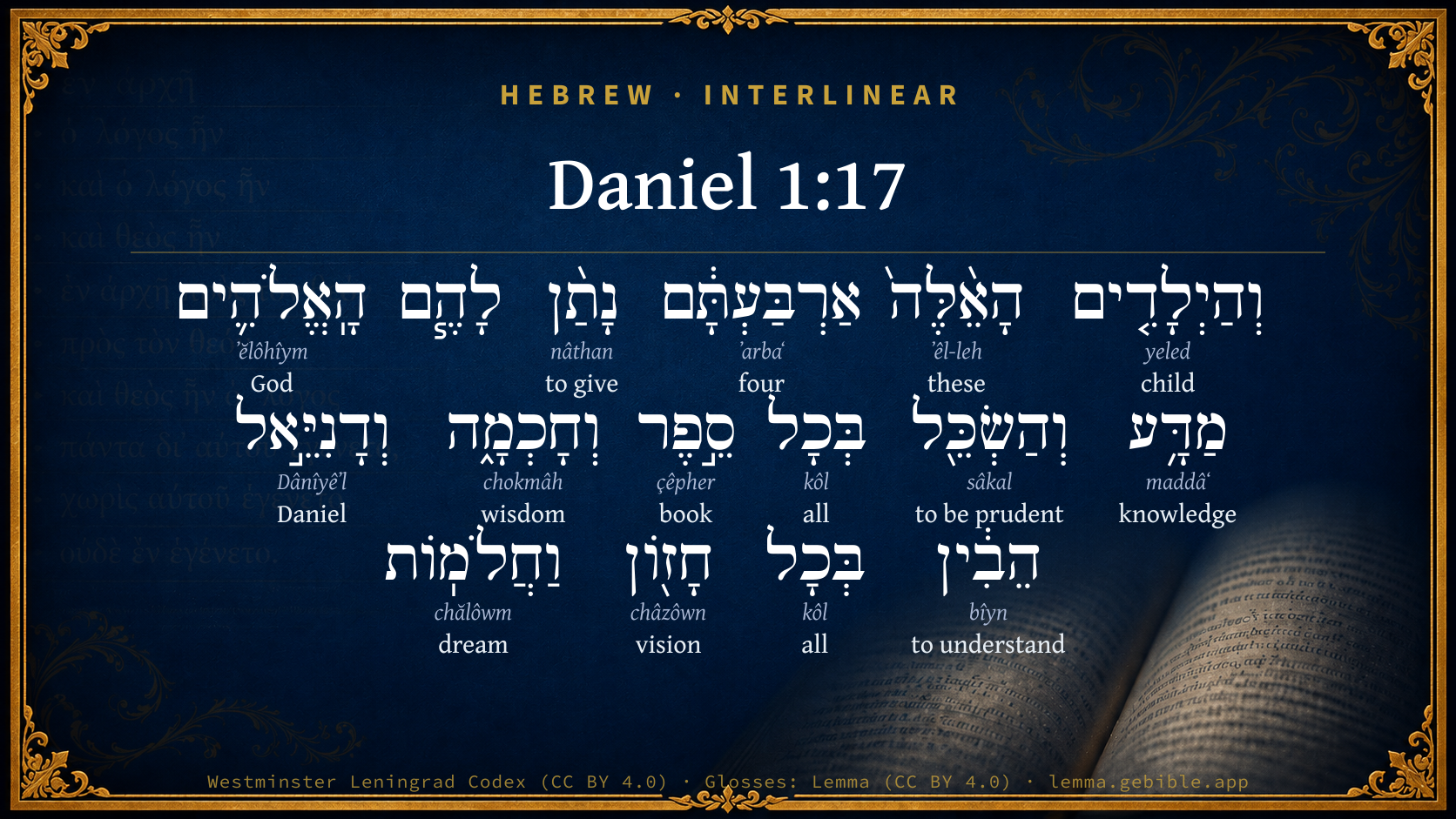
Daniel 1:17

Hebrew (Westminster Leningrad Codex) Daniel 1:17 appears in the Hebrew Old Testament. The text above is from the Westminster Leningrad Codex. Each word links to its Strong’s number, a concise gloss, and parsing drawn from the Open Scriptures Hebrew Bible morphology. Click any word for its full Brown-Driver-Briggs (BDB) entry.
Download image
Cite this verse

Daniel 1:17 (World English Bible). Public Domain. Lemma interlinear Bible study tool, https://lemma.gebible.app/v/daniel/1/17.

Show BibTeX & RIS
BibTeX
RIS
English Translation
Now as for these four youths, God gave them knowledge and skill in all learning and wisdom: and Daniel had understanding in all visions and dreams.
World English Bible · Public Domain
Download a study sheet

One document with this verse’s original text, its word-by-word gloss line, the meaning frame, cross-references with their text, attributed commentary, and full source and license credits — printable, and it pastes into notes with its structure intact.

This verse Autodidact and up

Study sheet (.html) Plain text (.txt)

A passage Seminary Student

Up to 50 verses in one chapter. A passage sheet keeps up to 6 commentary sources and 12 cross-references per verse, in the order this page ranks them, and says so on the sheet whenever that leaves anything out. Ask for a single verse and you get the Autodidact verse sheet above.

Everything on this page stays free to read, with no account — the sheet is a download of what is already on screen, not access to it.

Want to remove ads? Support Godless Engineer
Compare translations 3

The same verse in 3 English versions, stacked beneath the original-language interlinear above. Click any original word for its lexicon entry.

Each is an independent rendering of the whole verse — the interlinear is not word-aligned to these translations.

Highlighted words mark where these versions differ — a whole-verse word diff, not a word-by-word alignment.

  • World English Bible Public Domain
    Now as for these four youths, God gave them knowledge and skill in all learning and wisdom: and Daniel had understanding in all visions and dreams.
  • King James Version Public Domain
    As for these four children, God gave them knowledge and skill in all learning and wisdom: and Daniel had understanding in all visions and dreams.
  • unfoldingWord Literal Text CC BY-SA 4.0
    As for these four youths, God gave them knowledge and insight in all literature and wisdom, and Daniel had understanding in all visions and dreams.

unfoldingWord Literal Text — © unfoldingWord, licensed CC BY-SA 4.0. Word-aligned USFM3 via Door43 (git.door43.org/unfoldingWord/en_ult).

Versions to compare (up to 4)

3 of 4 selected

Show all 18 translations

Every available English version of this verse, each an independent rendering of the whole verse.

  • World English Bible Public Domain
    Now as for these four youths, God gave them knowledge and skill in all learning and wisdom: and Daniel had understanding in all visions and dreams.
  • Berean Standard Bible Public Domain
    To these four young men God gave knowledge and understanding in every kind of literature and wisdom. And Daniel had insight into all kinds of visions and dreams.
  • Majority Standard Bible Public Domain
    To these four young men God gave knowledge and understanding in every kind of literature and wisdom. And Daniel had insight into all kinds of visions and dreams.
  • King James Version Public Domain
    As for these four children, God gave them knowledge and skill in all learning and wisdom: and Daniel had understanding in all visions and dreams.
  • American Standard Version (1901) Public Domain
    Now as for these four youths, God gave them knowledge and skill in all learning and wisdom: and Daniel had understanding in all visions and dreams.
  • Revised Version (1885) Public Domain
    Now as for these four youths, God gave them knowledge and skill in all learning and wisdom: and Daniel had understanding in all visions and dreams.
  • Geneva Bible (1599) Public Domain
    As for these foure children, God gaue them knowledge, and vnderstanding in al learning and wisedome: also he gaue Daniel vnderstanding of all visions and dreames.
  • Douay-Rheims (1899) Public Domain
    And to these children God gave knowledge, and understanding in every book, and wisdom: but to Daniel the understanding also of all visions and dreams.
  • Young's Literal Translation Public Domain
    As to these four lads, God hath given to them knowledge and understanding in every `kind of' literature, and wisdom; and Daniel hath given instruction about every `kind of' vision and dreams.
  • Literal Standard Version CC BY-SA 4.0
    As for these four boys, God has given to them knowledge and understanding in every [kind of] literature, and wisdom; and Daniel has given instruction about every [kind of] vision and dreams.
  • Unlocked Literal Bible CC BY-SA 4.0
    As for these four young men, God gave them knowledge and insight in all literature and wisdom, and Daniel could understand all kinds of visions and dreams.
  • unfoldingWord Literal Text CC BY-SA 4.0
    As for these four youths, God gave them knowledge and insight in all literature and wisdom, and Daniel had understanding in all visions and dreams.
  • Darby Bible Public Domain
    As for these four youths, God gave them knowledge and skill in all learning and wisdom; and Daniel had understanding in all visions and dreams.
  • World Messianic Bible Public Domain
    Now as for these four youths, God gave them knowledge and skill in all learning and wisdom; and Daniel had understanding in all visions and dreams.
  • Webster's Bible Public Domain
    As for these four children, God gave them knowledge and skill in all learning and wisdom: and Daniel had understanding in all visions and dreams.
  • Free Bible Version CC BY-SA 4.0
    God gave these four young men the ability to learn and understand in all areas of literature and knowledge, while Daniel was also given the gift of interpreting all kinds of visions and dreams.
  • Bible in Basic English Public Domain
    Now as for these four young men, God gave them knowledge and made them expert in all book-learning and wisdom: and Daniel was wise in all visions and dreams.
  • JPS Tanakh (1917) Public Domain
    Now as for these four youths, God gave them knowledge and skill in all learning and wisdom; and Daniel had understanding in all visions and dreams.

Literal Standard Version (2020), Covenant Press — licensed CC BY-SA 4.0. Text via the HelloAO Bible API (eBible.org). Unlocked Literal Bible (unfoldingWord) — licensed CC BY-SA 4.0. Text via the HelloAO Bible API (eBible.org). unfoldingWord Literal Text — © unfoldingWord, licensed CC BY-SA 4.0. Word-aligned USFM3 via Door43 (git.door43.org/unfoldingWord/en_ult). Free Bible Version, Dr. Jonathan Gallagher — licensed CC BY-SA 4.0. Text via the HelloAO Bible API (eBible.org).

Word by word

More ways to search: Search by grammar → Find every occurrence → Compare this word →

Practice this passage: Drill this verse → Learn its vocabulary →

מַדָּ֥ע
maddâʻ
H4093
“knowledge”
Noun, Common, Masculine, Singular, Absolute
Part of Speech
Noun
Type
Common
Gender
Masculine
Number
Singular
State
Absolute
Full BDB Definition

Origin: from H3045

TWOT: 848g

knowledge, thought - knowledge - mind, thought, place of knowledge
  1. וְהַיְלָדִ֤ים yeled H3206 “and · the · children” Conjunction + Particle, Definite Article + Noun, Common, Masculine, Plural, Absolute
  2. הָאֵ֨לֶּה֙ ʼêl-leh H428 “the · these” Particle, Definite Article + Pronoun, Demonstrative, Common, Plural
  3. אַרְבַּעְתָּ֔ם ʼarbaʻ H702 “four · their” Adjective, Cardinal number, Masculine, Singular, Construct + Suffix, Personal, 3rd Person, Masculine, Plural
  4. נָתַ֨ן nâthan H5414 “to give” Verb, Qal, Perfect, 3rd Person, Masculine, Singular
  5. הָֽאֱלֹהִ֛ים ʼĕlôhîym H430 “the · God(s)” Particle, Definite Article + Noun, Common, Masculine, Plural, Absolute
  6. וְהַשְׂכֵּ֖ל sâkal H7919 “and · to be prudent” Conjunction + Verb, Hiphil, Infinitive Absolute
  7. בְּכָל kôl H3605 “in/at · all of” Preposition + Noun, Common, Masculine, Singular, Construct
  8. סֵ֣פֶר çêpher H5612 “book” Noun, Common, Masculine, Singular, Absolute
  9. וְחָכְמָ֑ה chokmâh H2451 “and · wisdom” Conjunction + Noun, Common, Feminine, Singular, Absolute
  10. וְדָנִיֵּ֣אל Dânîyêʼl H1840 “and · Daniel” Conjunction + Noun, Proper
  11. הֵבִ֔ין bîyn H995 “to understand” Verb, Hiphil, Perfect, 3rd Person, Masculine, Singular
  12. בְּכָל kôl H3605 “in/at · all of” Preposition + Noun, Common, Masculine, Singular, Construct
  13. חָז֖וֹן châzôwn H2377 “vision” Noun, Common, Masculine, Singular, Absolute
  14. וַחֲלֹמֽוֹת chălôwm H2472 “and · dreams” Conjunction + Noun, Common, Masculine, Plural, Absolute

About this verse

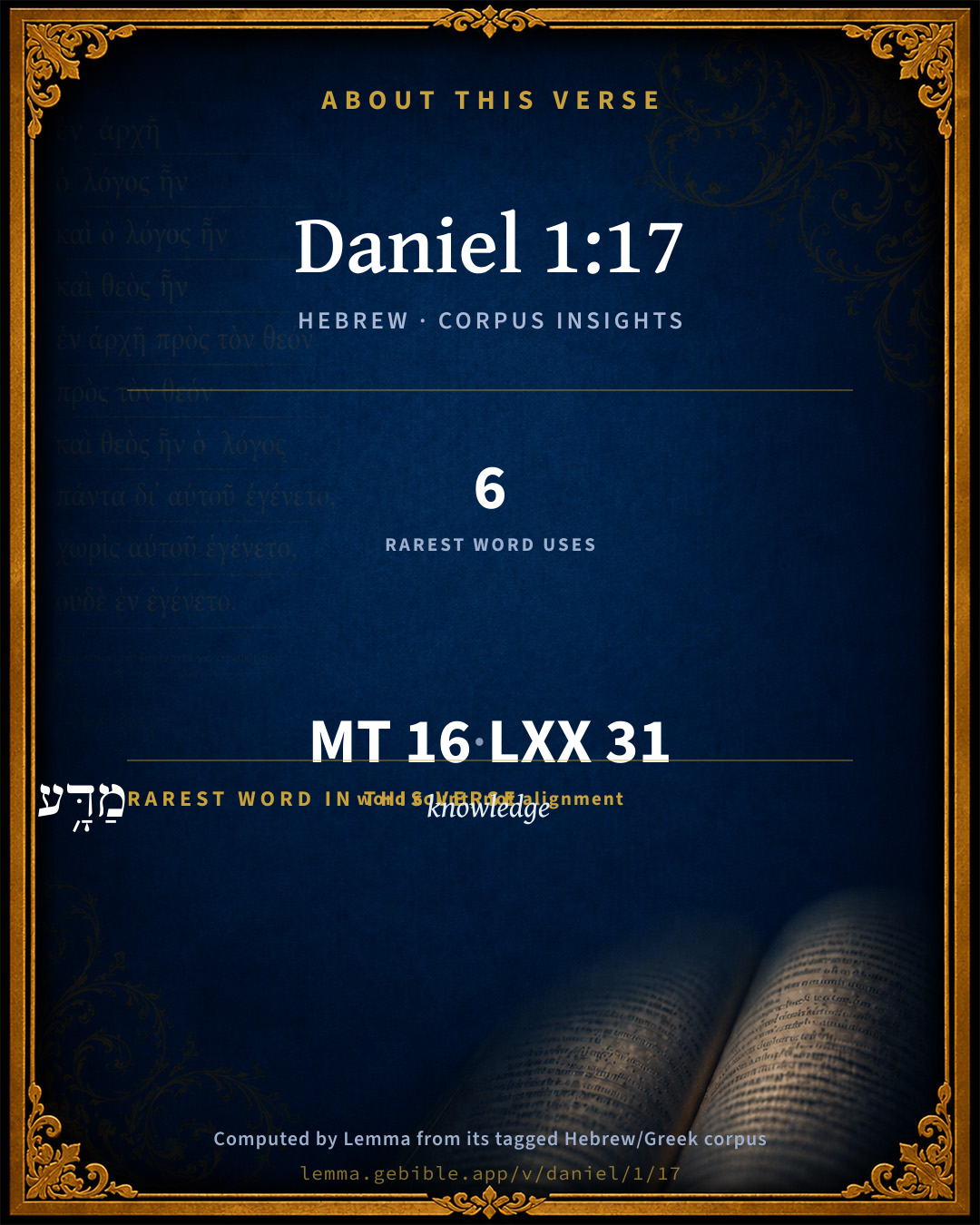
These counts appear in no published source. They are computed here, from the morphology-tagged text and Lemma’s own curated glosses. What Lemma adds →

16
words
14
distinct lemmas
Prophets
section

Notable vocabulary

The rarest word here is מַדָּ֥ע knowledge H4093 — appearing just 6 times in the whole Hebrew Bible.

Shared distinctive vocabulary

מַדָּ֥ע knowledge H4093 occurs in 6 verses of the Hebrew Bible. Also found in:

Grammatical profile

  • 3 verbs
  • 10 nouns
  • 1 adjective
  • 1 pronoun
  • 1 preposition

Verb forms

  • נָתַ֨ן Qal · Perfect
  • וְהַשְׂכֵּ֖ל Hiphil · Infinitive Absolute
  • הֵבִ֔ין Hiphil · Perfect

Repetition

A word recurs within this verse — often emphatic in Hebrew:

  • בְּכָל all H3605 ×2

Hebrew & Septuagint length

In English translation the verse runs 26 words from the Hebrew and 26 from the Septuagint (LXX English) — the same length.

A rough comparison of the two English renderings, which tokenize alike — not a word-level alignment.

Word counts can differ between the Hebrew and the Greek without any difference in meaning — e.g. the Hebrew direct-object marker אֵת has no separate Greek word, and Greek often adds the article ὁ.

In the original languages it is 16 Hebrew tokens and 31 Greek tokens — but the two are counted differently (Hebrew bundles its prefixes and suffixes into one token; the Greek is in lemma form), so that isn’t a like-for-like length.

Cross-references

30

Topical passages linked to Daniel 1:17 in the Treasury of Scripture Knowledge — connected by theme and wording, ordered by reader-vote popularity; previews shown in the World English Bible.

  • 1 Kings 3:12 behold, I have done according to your word: behold, I have given you a wise and an understanding heart; so that there has been none like you before you, neither after you shall any arise like you.
  • James 1:5 But if any of you lacks wisdom, let him ask of God, who gives to all liberally and without reproach; and it will be given to him.
  • Job 32:8 But there is a spirit in man, And the breath of the Almighty gives them understanding.
  • Daniel 2:21 He changes the times and the seasons; he removes kings, and sets up kings; he gives wisdom to the wise, and knowledge to those who have understanding;
  • Daniel 2:23 I thank you, and praise you, you God of my fathers, who have given me wisdom and might, and have now made known to me what we desired of you; for you have made known to us the king's matter.
  • Proverbs 2:6 For Yahweh gives wisdom. Out of his mouth comes knowledge and understanding.
  • Colossians 1:9 For this cause, we also, since the day we heard this, don't cease praying and making requests for you, that you may be filled with the knowledge of his will in all spiritual wisdom and understanding,
  • Psalms 119:98–100 Your commandments make me wiser than my enemies, For your commandments are always with me.
  • Acts 6:10 They weren't able to withstand the wisdom and the Spirit by which he spoke.
  • Numbers 12:6 He said, Hear now my words: if there be a prophet among you, I Yahweh will make myself known to him in a vision, I will speak with him in a dream.
  • 2 Chronicles 26:5 He set himself to seek God in the days of Zechariah, who had understanding in the vision of God: and as long as he sought Yahweh, God made him to prosper.
  • Ezekiel 28:3 behold, you are wiser than Daniel; there is no secret that is hidden from you;
  • Acts 7:22 Moses was instructed in all the wisdom of the Egyptians. He was mighty in his words and works.
  • James 1:17 Every good gift and every perfect gift is from above, coming down from the Father of lights, with whom can be no variation, nor turning shadow.
  • 1 Kings 3:28 All Israel heard of the judgment which the king had judged; and they feared the king: for they saw that the wisdom of God was in him, to do justice.
  • 1 Kings 4:29–31 God gave Solomon wisdom and understanding exceeding much, and very great understanding, even as the sand that is on the sea-shore.
  • Ecclesiastes 2:26 For to the man who pleases him, God gives wisdom, knowledge, and joy; but to the sinner he gives travail, to gather and to heap up, that he may give to him who pleases God. This also is vanity and a chasing after wind.
  • Daniel 2:19 Then was the secret revealed to Daniel in a vision of the night. Then Daniel blessed the God of heaven.
  • Daniel 4:9–10 Belteshazzar, master of the magicians, because I know that the spirit of the holy gods is in you, and no secret troubles you, tell me the visions of my dream that I have seen, and the interpretation of it.
  • Daniel 7:1 In the first year of Belshazzar king of Babylon Daniel had a dream and visions of his head on his bed: then he wrote the dream and told the sum of the matters.
  • Daniel 10:1 In the third year of Cyrus king of Persia a thing was revealed to Daniel, whose name was called Belteshazzar; and the thing was true, even a great warfare: and he understood the thing, and had understanding of the vision.
  • Acts 7:10 and delivered him out of all his afflictions, and gave him favor and wisdom before Pharaoh, king of Egypt. He made him governor over Egypt and all his house.
  • Genesis 41:8–15 It happened in the morning that his spirit was troubled, and he sent and called for all the magicians of Egypt, and all the wise men of it. Pharaoh told them his dream, but there was no one who could interpret them to Pharaoh.
  • 2 Chronicles 1:10 Give me now wisdom and knowledge, that I may go out and come in before this people; for who can judge this your people, that is so great?
  • 2 Chronicles 1:12 wisdom and knowledge is granted to you; and I will give you riches, and wealth, and honor, such as none of the kings have had who have been before you; neither shall there any after you have the like.
  • Isaiah 28:26 For his God does instruct him aright, [and] does teach him.
  • Daniel 5:11–12 There is a man in your kingdom, in whom is the spirit of the holy gods; and in the days of your father light and understanding and wisdom, like the wisdom of the gods, were found in him; and the king Nebuchadnezzar your father, the king, [I say], your father, made him master of the magicians, enchanters, Chaldeans, and soothsayers;
  • Daniel 5:14 I have heard of you, that the spirit of the gods is in you, and that light and understanding and excellent wisdom are found in you.
  • Luke 21:15 for I will give you a mouth and wisdom which all your adversaries will not be able to withstand or to contradict.
  • 1 Corinthians 12:7–11 But to each one is given the manifestation of the Spirit for the profit of all.

Cross-references courtesy of OpenBible.info (CC BY 4.0).

Hebrew and Greek witnesses Masoretic Hebrew ↔ Greek Septuagint

The same verse in the two great witnesses to the Old Testament, shown verse-for-verse.

These are two independent witnesses, not word-aligned to each other, and the Septuagint is shown in lemma (dictionary) form.

Hebrew Daniel 1:17 Masoretic · Westminster Leningrad Codex

וְהַיְלָדִ֤ים הָאֵ֨לֶּה֙ אַרְבַּעְתָּ֔ם נָתַ֨ן לָהֶ֧ם הָֽאֱלֹהִ֛ים מַדָּ֥ע וְהַשְׂכֵּ֖ל בְּכָל סֵ֣פֶר וְחָכְמָ֑ה וְדָנִיֵּ֣אל הֵבִ֔ין בְּכָל חָז֖וֹן וַחֲלֹמֽוֹת

Now as for these four youths, God gave them knowledge and skill in all learning and wisdom: and Daniel had understanding in all visions and dreams.

World English Bible · Public Domain

Greek LXX Daniel 1:17 Septuagint · lemma form

καί ὁ νεανίσκος δίδωμι ὁ κύριος ἐπιστήμη καί σύνεσις καί φρόνησις ἐν πᾶς γραμματικός τέχνη καί ὁ δανιηλ δίδωμι σύνεσις ἐν πᾶς ῥῆμα καί ὅραμα καί ἐνύπνιον καί ἐν πᾶς σοφία

And as for these four children, God gave them understanding and prudence in all learning and wisdom: and Daniel had understanding in all visions and dreams.

LXX2012 (modern English Septuagint) · Public Domain

On this verse, The Pulpit Commentary discusses the Septuagint’s reading. Read the note in Commentary ↓

Hebrew: Westminster Leningrad Codex (CC BY 4.0). Greek: Septuagint (public domain); English from LXX2012 (modern English Septuagint) (Public Domain). How the Septuagint differs from the Hebrew →

Commentary

Notes on Daniel 1:17 from classic Christian and Jewish commentators (each source and its license shown beneath its notes). The classic Christian expositions comment on the surrounding passage and are grouped to its opening verse, so a note may address several verses; the Jewish commentaries on the Tanakh (Rashi and others) are per-verse, so they appear only where the commentator wrote on this verse.

Lemma curates 59 commentaries, every one of them public domain or Creative Commons licensed, each selected and text-cleaned for this edition rather than reprinted as found. About our sources →

Matthew Henry's Commentary

Concerning Daniel and his fellows we have here,

I. Their great attainments in learning, Dan 1:17. They were very sober and diligent, and studied hard; and we may suppose their tutors, finding them of an uncommon capacity, took a great deal of pains with them, but, after all, their achievements are ascribed to God only. It was he that gave them knowledge and skill in all learning and wisdom; for every good and perfect gift is from above, from the Father of the lights. It is the Lord our God that gives men power to get this wealth; the mind is furnished only by him that formed it. The great learning which God gave these four children was, 1. A balance for their losses. They had, for the iniquity of their fathers, been deprived of the honours and pleasures that would have attended their noble extraction; but, to make them amends for that, God, in giving them learning, gave them better honours and pleasures than those they had been deprived of. 2. A recompence for their integrity. They kept to their religion, even in the minutest instances of it, and would not so much as defile themselves with the king's meat or wine, but became, in effect, Nazarites; and now God rewarded them for it with eminency in learning; for God gives to a man that is good in his sight, wisdom, and knowledge, and joy with them, Ecc 2:26. To Daniel he gave a double portion; he had understanding in visions and dreams; he knew how to interpret dreams, as Joseph, not by rules of art, such as are pretended to be given by the oneirocritics, but by a divine sagacity and wisdom which God gave him. Nay, he was endued with a prophetic spirit, by which he was enabled to converse with God, and to receive the notices of divine things in dreams and visions, Num 12:6. According to this gift given to Daniel, we find him, in this book, all along employed about dreams and visions, interpreting or entertaining them; for, as every one has received the gift, so shall he have an opportunity, and so should he have a heart, to minister the same, Pe1 4:10.

II. Their great acceptance with the king. After three years spent in their education (they being of some maturity, it is likely, when they came, perhaps about twenty years old) they were presented to the king with the rest that were of their standing, Dan 1:18. And the king examined them and communed with them himself, Dan 1:19. He could do it, being a man of parts and learning himself, else he would not have come to be so great; and he would do it, for it is the wisdom of princes, in the choice of the persons they employ, to see with their own eyes, to exercise their own judgment, and not trust too much to the representation of others. The king examined them not so much in the languages, in the rules of oratory or poetry, as in all matters of wisdom and understanding, the rules of prudence and true politics; he enquired into their judgment about the due conduct of human life and public affairs; not "Were they wits?" but, "Were they wise?" And he not only found them to excel the young candidates for preferment that were of their own standing, but found that they had more understanding than the ancients, than all their teachers, Psa 119:99, Psa 119:100. So far was the king from being partial to his own countrymen, to seniors, to those of his own religion and of an established reputation, that he freely owned that, upon trial, he found those poor young captive Jews ten times wiser and better than all the magicians that were in all his realm, Dan 1:20. He was soon aware of something extraordinary in these young men, and, which gave him a surprising satisfaction, was soon aware that a little of their true divinity was preferable to a great deal of the divination he had been used to. What is the chaff to the wheat? what are the magicians' rods to Aaron's? There was no comparison between them. These four young students were better, were ten times better, than all the old practitioners, put them all together, that were in all his realm, and we may be sure that they were not a few. This contempt did God pour upon the pride of the Chaldeans, and this honour did he put upon the low estate of his own people; and thus did he make not only these persons, but the rest of their nation for their sakes, the more respected in the land of their captivity. Lastly, This judgment being given concerning them, they stood before the king (Dan 1:19); they attended in the presence-chamber, nay, and in the council-chamber, for to see the king's face is the periphrasis of a privy-counsellor, Est 1:14. This confirms Solomon's observation, Seest thou a man diligent in his business, sober and humble? he shall stand before kings; he shall not stand before mean men. Industry is the way to preferment. How long the other three were about the court we are not told; but Daniel, for his part, continued to the first year of Cyrus (Dan 1:21), though not always alike in favour and reputation. He lived and prophesied after the first year of Cyrus; but that is mentioned to intimate that he lived to see the deliverance of his people out of their captivity and their return to their own land. Note, Sometimes God favours his servants that mourn with Zion in her sorrows to let them live to see better times with the church than they saw in the beginning of their days and to share with her in her joys.

Matthew Henry's Commentary on the Whole Bible (1708–1710) — public domain (CC PDM 1.0). Text via the HelloAO Bible API.

Jamieson, Fausset & Brown

Robert Jamieson, A. R. Fausset & David Brown

God gave them knowledge-- (Exo 31:2-3; Kg1 3:12; Job 32:8; Jam 1:5, Jam 1:17).

Daniel had understanding in . . . dreams--God thus made one of the despised covenant-people eclipse the Chaldean sages in the very science on which they most prided themselves. So Joseph in the court of Pharaoh (Gen 40:5; Gen 41:1-8). Daniel, in these praises of his own "understanding," speaks not through vanity, but by the direction of God, as one transported out of himself. See my Introduction, "CONTENTS OF THE BOOK."

Jamieson, Fausset & Brown — Commentary Critical and Explanatory on the Whole Bible (1871) — public domain (CC PDM 1.0). Text via the HelloAO Bible API.

Trapp's Complete Commentary

John Trapp

Dan 1:17 As for these four children, God gave them knowledge and skill in all learning and wisdom: and Daniel had understanding in all visions and dreams.

Ver. 17. As for these four children, God gave them knowledge and skill in all learning.] Both natural and supernatural. In the art of grammar, saith Symmachus; in every book, saith the Latin interpreter. There was potus ex fonte, fletus in prece, somnns in codice, as Ambrose speaketh: they drank Adam’s ale, prayed with tears, slept with a book in their hands. Whether they read the curious books of the magicians (fitter to be burnt, Act 19:19) is another question. Osiander thinketh that their Chaldean tutors would have obtruded upon them such kind of learning also; but as they abstained from the king’s meat, so they did, likely, from such corrupt and unlawful arts. Other commendable learning they looked into, as did also Moses, Solomon, Paul, &c. But what meant Pope Paul II to condemn all learned artists for heretics, and to tell his Romans that it was learning enough for a man to be able to read and write? {a} Nebuchadnezzar was of another mind, and Daniel and his fellows went further than so. Learning hath no enemy but ignorance.

In all visions and dreams,] i.e., In all kind of prophecy. See Num 12:6.

{a} Jac. Rev. De Vit. Pont., 244.

John Trapp, A Commentary or Exposition upon All the Books of the Old and New Testament (1647–1656) — public domain. Text from a community e-Sword module.

Joseph Benson's Commentary

Dan 1:17. As for these four children — The Hebrew is literally, As to these children, or young men, each of them four: to them God gave knowledge and skill in all learning and wisdom — That is, in all sorts of learning and knowledge. They became particularly skilful in those parts of the Chaldean learning which were really useful, and which might recommend them to the favour of the kings both of Babylon and Persia, and qualify them for places of trust under them; as Moses’s education in the Egyptian learning fitted him to be a ruler of God’s people. And Daniel had understanding in all visions and dreams — Daniel excelled the others in the gift of prophecy, and in his extraordinary skill in interpreting all sorts of visions and dreams, namely, such as were sent of God, and foreshowed future events, under the cover of certain images and representations, which required an interpretation in order to the understanding of their true signification. But we must not suppose that Daniel attained this skill by any study or rules of art. It was God’s supernatural gift unto him, as was the same kind of knowledge which Joseph possessed and manifested when he interpreted the dreams of Pharaoh, and those of the chief butler and baker.

Joseph Benson's Commentary on the Old and New Testaments (1811–1818) — public domain. Text from a community e-Sword module.

Keil & Delitzsch

C. F. Keil & F. Delitzsch

The progress of the young men in the wisdom of the Chaldeans, and their appointment to the service of the king.

As God blessed the resolution of Daniel and his three friends that they would not defile themselves by the food, He also blessed the education which they received in the literature (ספר, Dan 1:17 as Dan 1:4) and wisdom of the Chaldeans, so that the whole four made remarkable progress therein. But besides this, Daniel obtained an insight into all kinds of visions and dreams, i.e., he attained great readiness in interpreting visions and dreams. This is recorded regarding him because of what follows in this book, and is but a simple statement of the fact, without any trace of vainglory. Instruction in the wisdom of the Chaldeans was, besides, for Daniel and his three friends a test of their faith, since the wisdom of the Chaldeans, from the nature of the case, was closely allied to the Chaldean idolatry and heathen superstition, which the learners of this wisdom might easily be led to adopt. But that Daniel and his friends learned only the Chaldean wisdom without adopting the heathen element which was mingled with it, is evidenced from the stedfastness in the faith with which at a later period, at the danger of their lives (cf. Dan 3:6), they stood aloof from all participation in idolatry, and in regard to Daniel in particular, from the deep glance into the mysteries of the kingdom of God which lies before us in his prophecies, and bears witness of the clear separation between the sacred and the profane. But he needed to be deeply versed in the Chaldean wisdom, as formerly Moses was in the wisdom of Egypt (Act 7:22), so as to be able to put to shame the wisdom of this world by the hidden wisdom of God.

Dan 1:18-20

After the expiry of the period of three years the youths were brought before the king. They were examined by him, and these four were found more intelligent and discriminating than all the others that had been educated along with them (מכּלּם, "than all," refers to the other Israelitish youths, Dan 1:3, that had been brought to Babylon along with Daniel and his friends), and were then appointed to his service. יעמדוּ, as in Dan 1:5, of standing as a servant before his master. The king found them indeed, in all matters of wisdom about which he examined them, to excel all the wise men in the whole of his kingdom. Of the two classes of the learned men of Chaldea, who are named instar omnium in Dan 1:20, see at Dan 2:2.

Dan 1:21

In Dan 1:21 the introduction to the book is concluded with a general statement as to the period of Daniel's continuance in the office appointed to him by God. The difficulty which the explanation of ויהי offers is not removed by a change of the reading into ויחי, since Daniel, according to Dan 10:1, lived beyond the first year of Cyrus and received divine revelations. עד marks the terminus ad quem in a wide sense, i.e., it denotes a termination without reference to that which came after it. The first year of king Cyrus is, according to Ch2 36:22; Ezr 1:1; Ezr 6:3, the end of the Babylonish exile, and the date, "to the first year of king Cyrus," stands in close relation to the date in Dan 1:1, Nebuchadnezzar's advance against Jerusalem and the first taking of the city, which forms the commencement of the exile; so that the statement, "Daniel continued unto the first year of king Cyrus," means only that he lived and acted during the whole period of the exile in Babylon, without reference to the fact that his work continued after the termination of the exile. Cf. The analogous statement, Jer 1:2., that Jeremiah prophesied in the days of Josiah and Jehoiakim to the end of the eleventh year of Zedekiah, although his book contains prophecies also of a date subsequent to the taking of Jerusalem. ויהי stands neither for ויחי, he lived, nor absolutely in the sense of he existed, was present; for though היה means existere, to be, yet it is never used absolutely in this sense, as חיּה, to live, but always only so that the "how" or "where" of the being or existence is either expressly stated, or at least is implied in the connection. Thus here also the qualification of the "being" must be supplied from the context. The expression will then mean, not that he lived at the court, or in Babylon, or in high esteem with the king, but more generally, in the place to which God had raised him in Babylon by his wonderful endowments.

Keil & Delitzsch — Biblical Commentary on the Old Testament (1861–1891) — public domain (CC PDM 1.0). Text via the HelloAO Bible API. (Old Testament only.)

Tyndale Open Study Notes

Tyndale Open Resources

1:17 All four young men were outstanding students. God gave Daniel the special ability to interpret . . . visions and dreams, which were often prophetic (cp. Joseph, Gen 37:5-11).

Tyndale Open Study Notes — © Tyndale Open Resources, licensed CC BY-SA 4.0. Text via the HelloAO Bible API.

Ibn Ezra

Rabbi Abraham ibn Ezra

[Daniel 1:17] Veha-yeladim (וְהַיְלָדִים - And [to] these youths): The reason [it specifies] “the four of them” (arba’atam - אַרְבַּעְתָּם) is [to emphasize] that they were equal in all [general] wisdom. However, Daniel had an additional [ability] beyond them, in that he understood every vision and the interpretation of dreams, for he alone was a prophet, and not the [other] three.

Ibn Ezra on the Tanakh — English translations: “Sefaria Community Translation” (CC0 1.0 (public-domain dedication)); “Yalkut, Sifsei Chachomim Chumash, Metsudah Publications, 2009” (CC BY 4.0); and “Commentary of Ibn Ezra on Isaiah - trans. by M. Friedlander, 1873” (public domain). Text via Sefaria.

Geneva Bible (1599)

Geneva Bible translators

Meaning, in the liberal sciences, and natural knowledge, and not in the magical arts which are forbidden, Deut. 18:11.

So that he only was a Prophet and none of the others: for by dreams and visions God appeared to his Prophets, Num. 12:6

Geneva Bible (1599) marginal notes — public domain. Text via Bolls.life.

Adam Clarke's Commentary

Verse 17. As for these four children] Young men or youths. Our translation gives a false idea.

In all visions and dreams.] That is, such as are Divine; for as to dreams in general, they have as much signification as they have connexion, being the effects of the state of the body, of the mind, or of the circumstances of the dreamer. A dream may be considered supernatural, if it have nothing preposterous, nothing monstrous, and nothing irregular. If the whole order and consequences of the things be preserved in them, from beginning to end, then we may presume they are supernatural. In such dreams Daniel had understanding.

Adam Clarke's Commentary on the Bible (1810–1826) — public domain. Text from a community e-Sword/MySword module.

John Calvin's Commentaries

The Prophet here shows what we have already touched upon, how his authority was acquired for exercising the prophetic office with greater advantage. He ought to be distinguished by fixed marks, that the Jews first, and foreigners afterwards, might acknowledge him to be endued with the prophetic spirit. But a portion of this favor was shared with his three companions; yet he excelled them all, because God fitted him specially for his office. Here the end is to be noticed, because it would be incorrect to say that their reward was bestowed by God, because they lived both frugally and heavenly, and spontaneously abstained from the delicacies of the palace; for God had quite a different intention. For he wished, as I have already said, to extol Daniel, to enable him to shew with advantage that Israel’s God is the only God; and as he wished his companions to excel hereafter in political government, he presented them also with some portion of his Spirit. But it is worthwhile to set Daniel before our eyes; because, as I have said, before God appointed him his Prophet, he wished to adorn him with his own insignia, to procure confidence in his teaching. He says, therefore, to those four boys, or youths, knowledge and science were given in all literature and wisdom Daniel was endued with a very singular gift — he was to be an interpreter of dreams, and an explainer of visions. Since Daniel here speaks of literature, without doubt he simply means the liberal arts, and does not comprehend the magical arts which flourished then and afterwards in Chaldea. We know that nothing was sincere among unbelievers; and, on the other hand, I have previously admonished you, that Daniel was not imbued with the superstitions in those days highly esteemed in that nation. Through discontent with genuine science, they corrupted the study of the stars; but Daniel and his associates were so brought up among the Chaldeans, that they were not tinctured with those mixtures and corruptions which ought always to be separated from true science. It would be absurd, then, to attribute to God the approval of magical arts, which it is well known were severely prohibited and condemned by the law itself. (Deuteronomy 18:10.) Although God abominates those magical superstitions as the works of the devil, this does not prevent Daniel and his companions from being divinely adorned with this gift, and being very well versed in all the literature of the Chaldees. Hence this ought to be restricted to true and natural science. As it respects Daniel, he says, he understood even, visions and dreams and we know how by these two methods the Prophets were instructed in the will of God. (Numbers 12:6.) For while God there blames Aaron and Miriam, he affirms this to be his usual method; as often as he wishes to manifest his designs to the Prophets, he addresses them by visions and dreams. But Moses is treated out of the common order of men, because he is addressed face to face, and mouth to mouth. God, therefore, whenever he wished to make use of his Prophets, by either visions or dreams, made known to them what he wished to be proclaimed to the people. When, therefore, it is here said, — Daniel understood dreams and visions, it has the sense of being endued with the prophetic spirit. While his companions were superior masters and teachers in all kinds of literature, he alone was a Prophet of God.

We now understand the object of this distinction, when an acquaintance with visions and dreams was ascribed peculiarly to Daniel. And here our previous assertion is fully confirmed, namely, that Daniel was adorned with the fullest proofs of his mission, to enable him afterwards to undertake the prophetic office with greater confidence, and acquire greater attention to his teaching. God could, indeed, prepare the in a single moment, and by striking terror and reverence into the minds of all, induce them to embrace his teaching; but he wished to raise his servant by degrees, and to bring him forth at the fitting time, and not too suddenly so that all might know by marks impressed for many years how to distinguish him from the common order of men. It afterwards follows:

John Calvin's Commentaries (1540-1563) — public domain. Text from the Calvin Translation Society English edition (1840s-50s) via the Christian Classics Ethereal Library (ccel.org). Calvin's coverage is partial (roughly two-thirds of the Bible); uncommented books and verses are honest gaps, never fabricated. The 19th-century editor's footnotes and remarks are omitted so the notes are faithfully Calvin's own voice.

Ellicott's Commentary for English Readers

(17) Learning and wisdom.—These appear to be contrasted in this verse. The former refers to literature, and implies the knowledge of secular subjects; the latter implies philosophy and theology, and perhaps, also, an acquaintance with the meaning of portents. Abundant instances of the latter may be found in the Records of the Past (see vol. v., p. 167).

A Bible Commentary for English Readers, edited by Charles John Ellicott (1878–1897) — public domain. Text from a community e-Sword module.

The Cambridge Bible for Schools and Colleges

gen. ed. J. J. S. Perowne

17. Now as for these four youths, God gave them knowledge (the word rendered science in Dan_1:4), and intelligence (cf. intelligent, Dan_1:4) in all literature (Dan_1:4) and wisdom] ‘Wisdom’ is used here, in a concrete sense, of an intelligently arranged body of principles, or, as we should now say, science. The term must be understood as representing the popular estimate of the subjects referred to: for the ‘wisdom’ of the Chaldaean priests, except in so far as it took cognizance of the actual facts of astronomy, was in reality nothing but a systematized superstition.

and Daniel had understanding in all visions and dreams] or, ‘in every kind of vision and dreams.’ This was a point in which Daniel excelled the rest. The words are intended as introductory to the narrative following.

17–19. At the end of the three years (Dan_1:5), Daniel and his three companions are brought before the king; and being found by him to be the most proficient of all whom he had directed to be educated, are promoted to a place among his personal attendants.

The Cambridge Bible for Schools and Colleges (gen. ed. J. J. S. Perowne; Cambridge University Press, 1878–1918) — public domain. Text from a community e-Sword module.

John Gill's Exposition

As for these four children, God gave them knowledge and skill in all learning and wisdom,.... As they prospered in their bodies, they succeeded in their studies, and improved in their minds, and became great proficients in all kind of lawful and useful knowledge; not owing so much to their own sagacity and diligence, and the goodness and ability of their teachers, as to the blessing of God on their instructions and studies; for, as all natural, so all acquired parts are to be ascribed to God; and which these were favoured with by him in a very great manner, to answer some purposes of his. This is to be understood, not of magic art, vain philosophy, judicial astrology, to which the Chaldeans were addicted; but of learning and wisdom, laudable and useful, both in things natural and political; for these men, who scrupled eating and drinking what came from the king's table, would never indulge themselves in the study of vain, curious, and unlawful knowledge; much less would God have blessed the study of such things, and still less be said to give them knowledge and skill therein:

and Daniel had understanding in all visions and dreams; besides knowledge and skill in all learning and wisdom, in languages and sciences, in common with the other young men; he had the honour of seeing very remarkable visions of future things, and of interpreting dreams; and this not by rules of art, such as the Oneirocritics use, but by the gift of God; of which many singular instances follow in this book.

John Gill's Exposition of the Whole Bible (1746–1763) — public domain (CC PDM 1.0). Text via the HelloAO Bible API.

Albert Barnes' Notes on the Bible

As for these four children - On the word “children,” see the notes at Dan 1:4. Compare Dan 1:6.

God gave them knowledge and skill - See the notes at Dan 1:9. There is no reason to suppose that in the “knowledge and skill” here referred to, it is meant to be implied that there was anything miraculous, or that there was any direct inspiration. Inspiration was evidently confined to Daniel, and pertained to what is spoken of under the head of “visions and dreams.” The fact that “all” this was to be attributed to God as his gift, is in accordance with the common method of speaking in the Scriptures; and it is also in accordance with “fact,” that “all” knowledge is to be traced to God. See Exo 31:2-3. God formed the intellect; he preserves the exercise of reason; he furnishes us instructors; he gives us clearness of perception; he enables us to take advantage of bright thoughts and happy suggestions which occur in our own minds, as much as he sends rain, and dew, and sunshine on the fields of the farmer, and endows him with skill. Compare Isa 28:26, “For his God doth instruct him.” The knowledge and skill which we may acquire, therefore, should be as much attributed to God as the success of the farmer should. Compare Job 32:8, “For there is a spirit in man, and the inspiration of the Almighty giveth them understanding.” In the case before us, there is no reason to doubt that the natural powers of these young men had been diligently applied during the three years of their trial Dan 1:5, and under the advantages of a strict course of temperance; and that the knowledge here spoken of was the result of such an application to their studies. On the meaning of the words “knowledge” and “skill” here, see the notes at Dan 1:4.

In all learning and wisdom - See also the notes at Dan 1:4.

And Daniel had understanding - Showing that in that respect there was a special endowment in his case; a kind of knowledge imparted which could be communicated only by special inspiration. The margin is, “he made Daniel understand.” The margin is in accordance with the Hebrew, but the sense is the same.

In all visions - On the word rendered “visions” - חזון châzôn - see the notes at Isa 1:1, and the introduction to Isaiah, Section 7. (4). It is a term frequently employed in reference to prophecy, and designates the usual method by which future events were made known. The prophet was permitted to see those events “as if” they were made to pass before the eye, and to describe them “as if” they were objects of sight. Here the word seems to be used to denote all supernatural appearances; all that God permitted him to see that in any way shadowed forth the future. It would seem that men who were not inspired were permitted occasionally to behold such supernatural appearances, though they were not able to interpret them. Thus their attention would be particularly called to them, and they would be prepared to admit the truth of what the interpreter communicated to them. Compare Dan. 4; Dan 5:5-6; Gen 40:5; Gen 41:1-7. Daniel was so endowed that he could interpret the meaning of these mysterious appearances, and thus convey important messages to men. The same endowment had been conferred on Joseph when in Egypt. See the passages referred to in Genesis.

And dreams - One of the ways by which the will of God was anciently communicated to men. See Introduction to Isaiah, Section 7. (2), and the notes at Job 33:14-18. Daniel, like Joseph before him, was supernaturally endowed to explain these messages which God sent to men, or to unfold these preintimations of coming events. This was a kind of knowledge which the Chaldeans particularly sought, and on which they especially prided themselves; and it was important, in order to “stain the pride of all human glory,” and to make “the wisdom of the wise” in Babylon to be seen to be comparative “folly,” to endow one man from the land of the prophets in the most ample manner with this knowledge, as it was important to do the same thing at the court of Pharaoh by the superior endowments of Joseph Gen 41:8.

Albert Barnes' Notes on the Bible (1834–1885) — public domain. Text from a community e-Sword/MySword module.

Haydock's Catholic Bible Commentary

Dreams. He was learned in all the sciences of the country, like Moses. (Acts vii. 22.) (Calmet) --- They studies these things, in order to refute what was erroneous: discunt....ut judicent. (St. Jerome) --- The Chaldeans paid great attention to dreams. Daniel acquired the knowledge of such as were sent from heaven by the gift of God, as Joseph had done. To pay any regard to common dreams would be childish (Calmet) and sinful, if the person depend on them for the knowledge of futurity. (Haydock)

George Leo Haydock (1774–1849), Haydock's Catholic Family Bible and Commentary, 1859 edition — public domain. Excludes Psalms (Douay-Rheims chapter numbering differs from Protestant) and Deuterocanonical books (Catholic canon only).

Matthew Poole's English Annotations

We must own

knowledge, and skill, and wisdom to come from God, Jam 1:5. These are beams of light shining in us from the Father of lights, and a man can receive nothing of this unless it be given him from above, Joh 3:27.

Object. But was not this magic, and was not this learning forbidden as abomination to the Lord, Deu 18:9-14?

Answ. The Chaldeans used lawful arts and sciences, and unlawful; these four young men, Daniel and his companions, used only those that were lawful; rejecting all that wisdom which is sensual, carnal, and devilish, Jam 3:15. In all visions and dreams; not in idle, vain, and lying, but in such as were sent of God, and predictions of things to come, as Num 12:6, such as the prophets had. Such was that of Nebuchadnezzar.

Matthew Poole's English Annotations on the Holy Bible (1683–1685) — public domain. Text from a community e-Sword/MySword module.

Whedon's Commentary on the Bible

Daniel D. Whedon

17. God gave these four Hebrew youths “knowledge and skill in every kind of books” (Hebrews) The Hebrews wrote their books generally upon parchment, the Egyptians upon papyrus, the Babylonians upon clay tablets. These tablets were stored by hundreds of thousands in the palace library, and so arranged as to be easily accessible to visitors and students. The princes who were to be fitted for state offices would no doubt have a special post-graduate course differing from that provided for those who were to be priests or “magicians,’’ but the preliminary training might be the same in both cases. It seems strange to many that these boys who were so scrupulous about touching heathen food (Dan_1:8) would so eagerly grasp the heathen learning; but they might not have seen that this was necessarily connected with idolatry. They certainly are not represented as accepting the religion of Babylon with its other wisdom.

Visions and dreams — Both the Babylonians and the Hebrews believed that the divine will was often revealed to man through this agency. (See Dan_2:1; Gen_41:15; Num_12:6.) No doubt the study of omens and dreams was a prominent part of the curriculum of the Babylonian schools, and there is no reason to suppose that a Hebrew youth at this era would doubt its value, although in later ages heathen learning of every kind became abominable in their eyes.

Daniel D. Whedon (gen. ed.), Commentary on the Old and New Testaments (1874–1909) — public domain. Text from a community e-Sword module.

The Pulpit Commentary

As for these four children, God gave them knewledge and skill in all learning and wisdom: and Daniel had understanding in all visions and dreams. Or, as the words might be more accurately rendered, "these lads, the four of them". (Eze_1:8-10) This indicates that somehow they were separated off into a quaternion. In Ezekiel, where a similar phrase cecum, the four cherubim form a quaternion in a very special way. As we have already seen, the Assyrians in a feast arranged the guests in messes of four. Those thus seated together would most likely be associated in some other way. In the case of these youths, who were permanent guests at the table of the King of Babylon, they would most likely be associated in their studies from the first. The Septuagint Version omits the numeral, but is pleonastic in a way that suggests a coalescing of different readings. The rendering is, "And to the youths the Lord gave understanding and knowledge and wisdom in the art of learning (the grammatic art grammar), and to Daniel he gave understanding of every kind (in every word), and in visions, and in dreams, and in every kind of wisdom." The omission of the word "four," and the insertion of two words, "understanding" and "knowledge," suggest that the one has somehow taken the place of the other; it may be that the word hmr was read instead of tbra. The Massoretic original of the phrase, "skill in all learning," may be rendered literally, "skill in every kind of books." This has a special meaning in regard to the Babylonian and Assyrian books, which were clay tablets incised when wet, and burnt into permanence. Rolls of parchment were, as we see from Jeremiah, the common material for books among the Jews. Among the Egyptians, papyrus largely took the place of parchment, so the knowledge "of every kind of books" meant "every language." It is certain that three languages were to a certain extent in use in Babylon Aramaic, the ordinary language of business and diplomacy; Assyrian, the court language, the language in which histories and dedications were written; Accadian, the old sacred tongue, in which all the formulae of worship and the forms of incantation had been originally written. From the fact that Rabshakeh could talk Hebrew when conversing with Eliakim and Shebna, it would seem that the accomplish-merit required from a diplomat implied the knowledge of the languages of the various nations subject to the Babylonian Empire or eonterminous with it. "Knowledge and skill in all learning and wisdom" would seem to mean the complete eurriculum fitted to make these youths able diplomatists and wise councillors. And Daniel had understanding in all visions and dreams. All the nations of antiquity laid stress on dreams as means by which the future was revealed to men; but in no nation was there so elaborate a system of interpretation as among the Babyhmians. Lenormant ("La Divination") gives a long account, with many passages translated from their books, of their mode of interpreting dreams. "Visions" may be regarded as appearances of the nature of the alleged second sight among the Scottish Highlanders. It may, however, refer to appearances which are regarded as omens of good or evil fortune. We see in all the elaborate distinctions of omens preserved to us in Lenormant only the folly of superstition; but we may not assume that Daniel and his friends did not believe in them. It has been objected that if Daniel and his friends were so scrupulous in regard to the dainties and. the wines of the Babylonian monarch, because these were connected with idol-worship, they ought logically to have refused to learn these superstitious formulae. But men are never completely logical; life is wider than logic, and hence there are always elements that are left out in our calculations. The possession even of Divine inspiration would not suffer men to annul the two millennia and a half that separate us from the days of Daniel. They Daniel and his friends did not see in this so-called science of oneiromancy mere superstition. Still less did they recognize it as having a necessary connection with the idolatries of Babylon. In the following chapter we see the theory Daniel himself had of the matter, namely, that God used dreams as means to make known the future to men. No one can say he was mistaken in this. When Luther described heaven to his child, he filled it with what would be most happy for the little boy; he takes the child at the stage at which he is, and tells him the truth, but in limitations suited to his knowledge. May we not reasonably argue that the great Father deals so with his children? When they are in the state of knowledge that makes them expect to have his will revealed to them in dreams and omens, then he will make known his will by dreams. Daniel knew all that Chaldean science could tell him, but he saw that it was limited, that behind all the canons of interpretation there was the Eternal Mind, the Great Thinker, whose thoughts are things. In other words, he did not recognize the so-called science of Babylon, its astrology, its incantations, its omens, its interpretations of dreams as false so much as limited. It has been placed by Jerome as a parallel, that Moses was learned in all the learning of the Egyptians. Jerome assumes "they learned not that they might follow, but that they might judge and convict (convincant)." We do not see the need of any such supposition. In their own land they in all likelihood believed in the interpretation of dreams, not unlikely in omens too in some degree. When they came to Babylon they came among a people who halt reduced all this to a form that had a delusive appearance of scientific accuracy. They could not fail to believe in all these things. Long after the latest critical date of Daniel, the Jews believed in omens and dreams. Josephus tells us of his own skill in these matters, and is still more explicit in respect to the wisdom of the Essenes in regard to the future. Students of the Talmud will not require to be told of the bath-qol and other means by which a knowledge of the future was derived. We must, we fear, assume that Daniel was not so far ahead of his contemporaries as not to believe in the science of Babylon, and therefore to expect him to protest against it and refuge to acquire it is absurd in the last degree. This fact of these four Hebrew youths not objecting to heathen learning is,n indirect proof of the early date of Daniel. It"this book had been written in the days of the Maccabees, then the learning of the Chaldeans would be a synonym for the learning of the Greeks. We know that, so far from the Hasideem the party from whom, by hypothesis, "Daniel" emanated looking favourably on Greek learning, they hated and abhorred it. We see in the Second Book of Maccabees (RAPC 2Ma 4:14) the feelings with which they regarded those who favoured Greek manners; how even the innocent game of discus was full of horror for them, because it was Greek (1:14); and in the first book with what horror the pious looked on the erection of a gymnasium in Jerusalem. This hatred of everything Greek was very natural, and certainly was very much in evidence in their history. For business purposes they had to know the Greek language; but the learning, the philosophy, and literature of Greece would have been to those engaged in the Maccabean struggle abomination. Is it, then, to be imagined that a writer of the Maccabean period, describing an ancient hero from whose example his contemporaries were to draw encouragement and guidance, would represent him as zealously addicting himself to the pursuit of Gentile learning, and making such progress in it that he excelled all competitors? The attitude ascribed to him would have been more like that of the Rabbi Akiba, who declared that "Greek learning could be studied in an hour that was neither day nor night;" or like that other rabbi, who declared that "the translation of the Scripture into Greek was a disaster to Judaism equal in horror to the fall of Jerusalem." We hear a great deal of the historic imagination and the necessity of applying it to questions of Biblical criticism. Surely the minds must be strangely deficient in the power of imaginative reconstruction who cannot feel the thrill of abhorrence of everything foreign that must have filled the Jews during the Maccabean struggle. If the critics had only realized this, they would have seen how utterly impossible it is to conceive that a religious novel, written at that time, intended to nerve the Jews for fiercer resistance to their oppressors, should represent the hero complacently acquiring Gentile learning, and acting the submissive courtier in the tyrant"s palace.

The Pulpit Commentary (1880–1919), ed. H.D.M. Spence-Jones & Joseph S. Exell — public domain. Text from a community e-Sword module.

unfoldingWord translationNotes

Door43 World Missions Community

God gave them knowledge and insight

This can be reworded so that the abstract nouns "knowledge" and "insight" can be expressed as the verbs "learn" and "understand." AT: "God gave them the ability to learn and understand clearly" (See: Abstract Nouns)

in all literature and wisdom

Here "all" is a generalization to show that they had a very good education and understanding. AT: "in many things that the Babylonians had written and studied" (See: Hyperbole and Generalization)

translationWords

God

wise

Daniel

vision

dream

king

Nebuchadnezzar

unfoldingWord translationNotes — © Distant Shores Media and the Door43 World Missions Community, licensed CC BY-SA 4.0. Source: git.door43.org/Door43/en_tn.

Lesson kit

Teaching starters — assembled from the data on this page, not authored interpretation. Every prompt links to the verse data it draws on. Edit before teaching.

Daniel, in the Prophets, opens this verse with 16 words (14 distinct Hebrew lemmas). Its most distinctive word is maddâʻ (“knowledge”). A historical commentator’s framing appears above. Read the whole chapter for the surrounding context.

Discussion questions

  1. The word maddâʻ carries the sense “knowledge.” How does it shape the verse?
  2. 2 Chronicles 1:10 shares the word «knowledge» with this verse. How do the two illuminate each other?
  3. “all” occurs 2× in this one verse. What is the effect of the repetition?
  4. These translations render this verse differently. What is at stake in choosing one wording over another?
  5. The verb «נָתַ֨ן» is Qal Perfect. How does its form color the action?
  6. Reading how Matthew Henry's Commentary and Jamieson, Fausset & Brown read this verse, where do the two commentators agree and where do they part?

Things to notice

Reading settings

Reading text

Shown beneath each verse's original-language words.

Old Testament
Old Testament edition

Read the OT as the Masoretic Hebrew (MT) or the Greek Septuagint (LXX).

English shown for the Greek Septuagint (in the Hebrew ↔ Greek comparison).

Comparing translations? Open the Compare panel on any verse page to stack up to four side by side.