Genesis 24:41

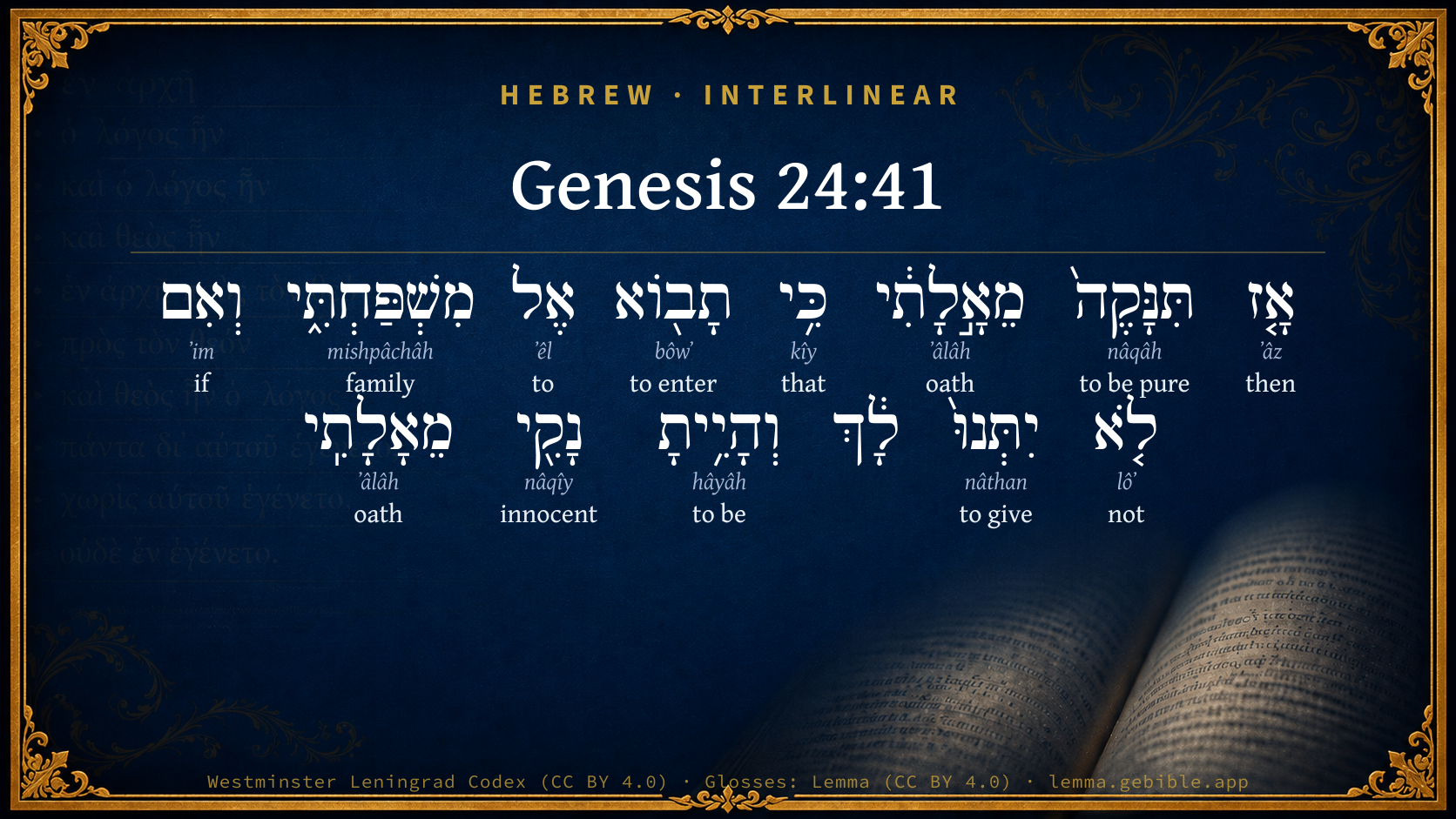
Hebrew (Westminster Leningrad Codex) Genesis 24:41 appears in the Hebrew Old Testament. The text above is from the Westminster Leningrad Codex. Each word links to its Strong’s number, a concise gloss, and parsing drawn from the Open Scriptures Hebrew Bible morphology. Click any word for its full Brown-Driver-Briggs (BDB) entry.
Download image
Cite this verse

Genesis 24:41 (World English Bible). Public Domain. Lemma interlinear Bible study tool, https://lemma.gebible.app/v/genesis/24/41.

Show BibTeX & RIS
BibTeX
RIS
English Translation
Then will you be clear from my oath, when you come to my relatives. If they don't give her to you, you shall be clear from my oath.'
World English Bible · Public Domain
Highlights
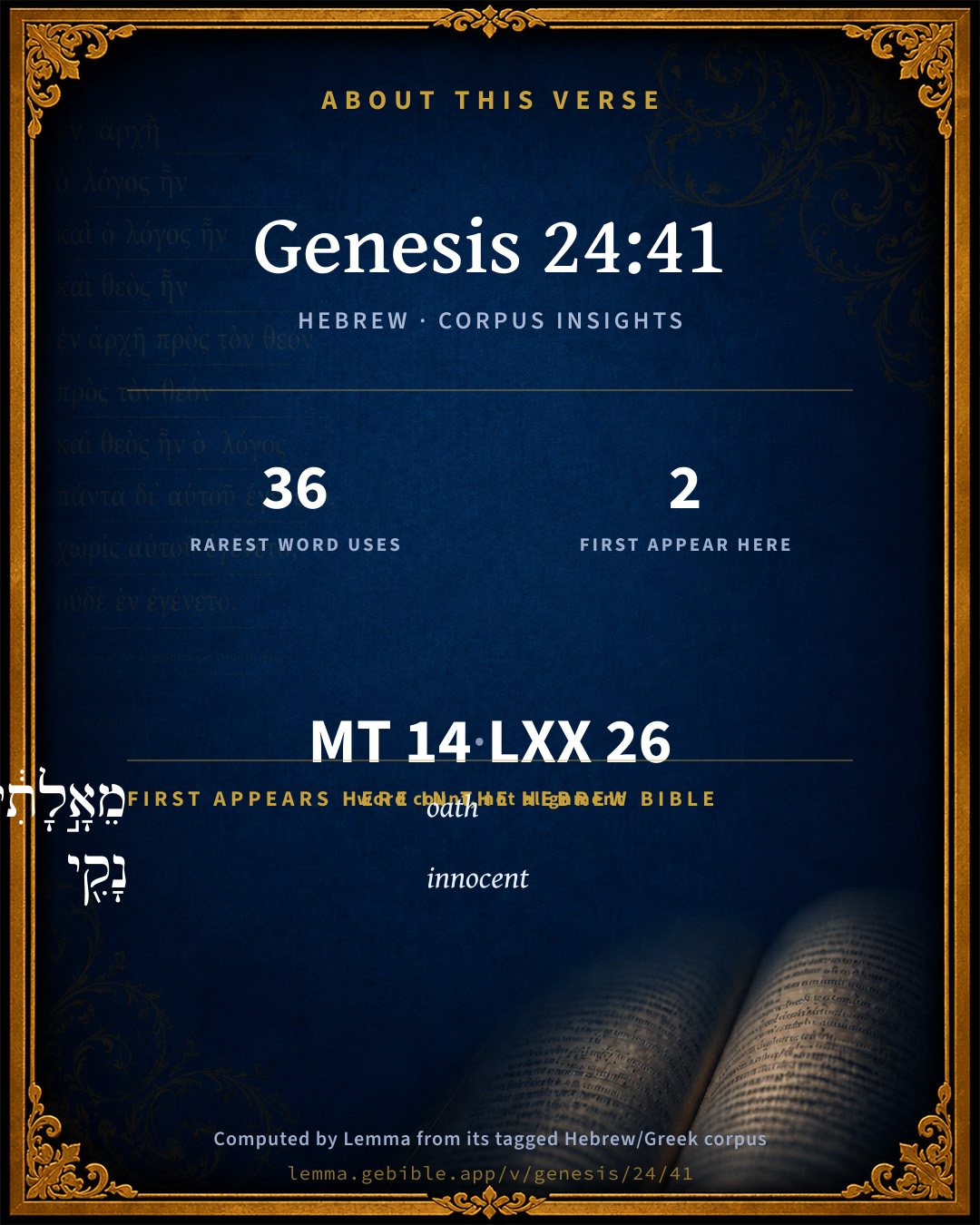
  • 2 first appearances in the Hebrew Bible
Full analysis ↓
Download a study sheet

One document with this verse’s original text, its word-by-word gloss line, the meaning frame, cross-references with their text, attributed commentary, and full source and license credits — printable, and it pastes into notes with its structure intact.

This verse Autodidact and up

Study sheet (.html) Plain text (.txt)

A passage Seminary Student

Up to 50 verses in one chapter. A passage sheet keeps up to 6 commentary sources and 12 cross-references per verse, in the order this page ranks them, and says so on the sheet whenever that leaves anything out. Ask for a single verse and you get the Autodidact verse sheet above.

Everything on this page stays free to read, with no account — the sheet is a download of what is already on screen, not access to it.

Want to remove ads? Support Godless Engineer
Compare translations 3

The same verse in 3 English versions, stacked beneath the original-language interlinear above. Click any original word for its lexicon entry.

Each is an independent rendering of the whole verse — the interlinear is not word-aligned to these translations.

Highlighted words mark where these versions differ — a whole-verse word diff, not a word-by-word alignment.

  • World English Bible Public Domain
    Then will you be clear from my oath, when you come to my relatives. If they don't give her to you, you shall be clear from my oath.'
  • King James Version Public Domain
    Then shalt thou be clear from this my oath, when thou comest to my kindred; and if they give not thee one, thou shalt be clear from my oath.
  • unfoldingWord Literal Text CC BY-SA 4.0
    Then you will be clear from my oath: When you go to my clan, and if they will not give her to you, then you will be clear from my oath.’

unfoldingWord Literal Text — © unfoldingWord, licensed CC BY-SA 4.0. Word-aligned USFM3 via Door43 (git.door43.org/unfoldingWord/en_ult).

Versions to compare (up to 4)

3 of 4 selected

Show all 18 translations

Every available English version of this verse, each an independent rendering of the whole verse.

  • World English Bible Public Domain
    Then will you be clear from my oath, when you come to my relatives. If they don't give her to you, you shall be clear from my oath.'
  • Berean Standard Bible Public Domain
    And when you go to my kindred, if they refuse to give her to you, then you will be released from my oath.’
  • Majority Standard Bible Public Domain
    And when you go to my kindred, if they refuse to give her to you, then you will be released from my oath.’
  • King James Version Public Domain
    Then shalt thou be clear from this my oath, when thou comest to my kindred; and if they give not thee one, thou shalt be clear from my oath.
  • American Standard Version (1901) Public Domain
    Then shalt thou be clear from my oath, when thou comest to my kindred. And if they give her not to thee, thou shalt be clear from my oath.
  • Revised Version (1885) Public Domain
    then shalt thou be clear from my oath, when thou comest to my kindred; and if they give her not to thee, thou shalt be clear from my oath.
  • Geneva Bible (1599) Public Domain
    Then shalt thou be discharged of mine othe, when thou commest to my kinred: and if they giue thee not one, thou shalt be free from mine othe.
  • Douay-Rheims (1899) Public Domain
    But thou shalt be clear from my curse, when thou shalt come to my kindred, if they will not give thee one.
  • Young's Literal Translation Public Domain
    then art thou acquitted from my oath, when thou comest unto my family, and if they give not `one' to thee; then thou hast been acquitted from my oath.
  • Literal Standard Version CC BY-SA 4.0
    then you are acquitted from my oath, when you come to my family; and if they do not give [one] to you, then you have been acquitted from my oath.
  • Unlocked Literal Bible CC BY-SA 4.0
    But you will be free from my oath if you come to my relatives and they will not give her to you. Then you will be free from my oath.'
  • unfoldingWord Literal Text CC BY-SA 4.0
    Then you will be clear from my oath: When you go to my clan, and if they will not give her to you, then you will be clear from my oath.’
  • Darby Bible Public Domain
    Then shalt thou be quit of my oath, when thou shalt have come to my family. And if they give thee not [one], thou shalt be quit of my oath.
  • World Messianic Bible Public Domain
    Then you will be clear from my oath, when you come to my relatives. If they don’t give her to you, you shall be clear from my oath.’
  • Webster's Bible Public Domain
    Then shalt thou be clear from this my oath, when thou comest to my kindred; and if they give not thee one, thou shalt be clear from my oath.
  • Free Bible Version CC BY-SA 4.0
    You will be released from the oath you swear to me if, when you go to my family, they refuse to let her return with you.’
  • Bible in Basic English Public Domain
    And you will be free from your oath to me when you come to my people; and if they will not give her to you, you will be free from your oath.
  • JPS Tanakh (1917) Public Domain
    then shalt thou be clear from my oath, when thou comest to my kindred; and if they give her not to thee, thou shalt be clear from my oath.

Literal Standard Version (2020), Covenant Press — licensed CC BY-SA 4.0. Text via the HelloAO Bible API (eBible.org). Unlocked Literal Bible (unfoldingWord) — licensed CC BY-SA 4.0. Text via the HelloAO Bible API (eBible.org). unfoldingWord Literal Text — © unfoldingWord, licensed CC BY-SA 4.0. Word-aligned USFM3 via Door43 (git.door43.org/unfoldingWord/en_ult). Free Bible Version, Dr. Jonathan Gallagher — licensed CC BY-SA 4.0. Text via the HelloAO Bible API (eBible.org).

Word by word

More ways to search: Search by grammar → Find every occurrence → Compare this word →

Practice this passage: Drill this verse → Learn its vocabulary →

מֵאָ֣לָתִ֔י
ʼâlâh
H423
“from · oath · my”
Preposition + Noun, Common, Feminine, Singular, Construct + Suffix, Personal, 1st Person, Common, Singular
Part of Speech
Preposition + Noun
Type
Common
Gender
Feminine
Number
Singular
State
Construct
Full BDB Definition

Origin: from H422

TWOT: 91a

oath - oath of covenant - curse - from God - from men - execration
  1. אָ֤ז ʼâz H227 “then” Adverb
  2. תִּנָּקֶה֙ nâqâh H5352 “to be pure” Verb, Niphal, Imperfect, 2nd Person, Masculine, Singular
  3. כִּ֥י kîy H3588 “that” Conjunction
  4. תָב֖וֹא bôwʼ H935 “to enter” Verb, Qal, Imperfect, 2nd Person, Masculine, Singular
  5. אֶל ʼêl H413 “to” Preposition
  6. מִשְׁפַּחְתִּ֑י mishpâchâh H4940 “family · my” Noun, Common, Feminine, Singular, Construct + Suffix, Personal, 1st Person, Common, Singular
  7. וְאִם ʼim H518 “and · if” Conjunction + Conjunction
  8. לֹ֤א lôʼ H3808 “not” Particle, Negative
  9. יִתְּנוּ֙ nâthan H5414 “to give” Verb, Qal, Imperfect, 3rd Person, Masculine, Plural
  10. וְהָיִ֥יתָ hâyâh H1961 “and · to be” Conjunction + Verb, Qal, Perfect, 2nd Person, Masculine, Singular
  11. נָקִ֖י nâqîy H5355 “innocent” Adjective, Adjective, Masculine, Singular, Absolute
  12. מֵאָלָתִֽי ʼâlâh H423 “from · oath · my” Preposition + Noun, Common, Feminine, Singular, Construct + Suffix, Personal, 1st Person, Common, Singular

About this verse

These counts appear in no published source. They are computed here, from the morphology-tagged text and Lemma’s own curated glosses. What Lemma adds →

14
words
12
distinct lemmas
Pentateuch
section

First appearance in Scripture

These words make their first canonical appearance in the Hebrew Bible here:

  • מֵאָ֣לָתִ֔י oath H423
  • נָקִ֖י innocent H5355

Shared distinctive vocabulary

מֵאָ֣לָתִ֔י oath H423 occurs in 32 verses of the Hebrew Bible. Also found in:

Grammatical profile

  • 4 verbs
  • 3 nouns
  • 1 adjective
  • 2 prepositions
  • 2 conjunctions
  • 1 adverb
  • 1 particle

Verb forms

  • תִּנָּקֶה֙ Niphal · Imperfect
  • תָב֖וֹא Qal · Imperfect
  • יִתְּנוּ֙ Qal · Imperfect
  • וְהָיִ֥יתָ Qal · Perfect

Repetition

A word recurs within this verse — often emphatic in Hebrew:

  • מֵאָ֣לָתִ֔י oath H423 ×2

Hebrew & Septuagint length

In English translation the verse runs 28 words from the Hebrew and 33 from the Septuagint (LXX English) — closely comparable.

A rough comparison of the two English renderings, which tokenize alike — not a word-level alignment.

Word counts can differ between the Hebrew and the Greek without any difference in meaning — e.g. the Hebrew direct-object marker אֵת has no separate Greek word, and Greek often adds the article ὁ.

In the original languages it is 14 Hebrew tokens and 26 Greek tokens — but the two are counted differently (Hebrew bundles its prefixes and suffixes into one token; the Greek is in lemma form), so that isn’t a like-for-like length.

Cross-references

2

Topical passages linked to Genesis 24:41 in the Treasury of Scripture Knowledge — connected by theme and wording, ordered by reader-vote popularity; previews shown in the World English Bible.

  • Genesis 24:8 If the woman isn't willing to follow you, then you shall be clear from this my oath. Only you shall not bring my son there again."
  • Deuteronomy 29:12 that you may enter into the covenant of Yahweh your God, and into his oath, which Yahweh your God makes with you this day;

Cross-references courtesy of OpenBible.info (CC BY 4.0).

Hebrew and Greek witnesses Masoretic Hebrew ↔ Greek Septuagint

The same verse in the two great witnesses to the Old Testament, shown verse-for-verse.

These are two independent witnesses, not word-aligned to each other, and the Septuagint is shown in lemma (dictionary) form.

Hebrew Genesis 24:41 Masoretic · Westminster Leningrad Codex

אָ֤ז תִּנָּקֶה֙ מֵאָ֣לָתִ֔י כִּ֥י תָב֖וֹא אֶל מִשְׁפַּחְתִּ֑י וְאִם לֹ֤א יִתְּנוּ֙ לָ֔ךְ וְהָיִ֥יתָ נָקִ֖י מֵאָלָתִֽי

Then will you be clear from my oath, when you come to my relatives. If they don't give her to you, you shall be clear from my oath.'

World English Bible · Public Domain

Greek LXX Genesis 24:41 Septuagint · lemma form

τότε ἀθῷος εἰμί ἀπό ὁ ἀρά ἐγώ ἡνίκα γάρ ἐάν ἔρχομαι εἰς ὁ ἐμός φυλή καί μή σύ δίδωμι καί εἰμί ἀθῷος ἀπό ὁ ὁρκισμός ἐγώ

Then shall you be clear from my curse, for whenever you shall have come to my tribe, and they shall not give her to you, then shall you be clear from my oath.

LXX2012 (modern English Septuagint) · Public Domain

Hebrew: Westminster Leningrad Codex (CC BY 4.0). Greek: Septuagint (public domain); English from LXX2012 (modern English Septuagint) (Public Domain). How the Septuagint differs from the Hebrew →

Targum (Aramaic paraphrase)

2

The Targum is the ancient Jewish Aramaic paraphrase of the Hebrew Scriptures — an interpretive translation, not the Hebrew text itself. Onkelos (literal) and Pseudo-Jonathan (expansive) render the Torah, and Jonathan the Prophets. Coverage is partial: where no permissively-licensed English translation exists for a verse, only the Aramaic is shown. This is verse-level text, not a word-by-word alignment to the Hebrew.

  1. Targum Onkelos Torah (Genesis–Deuteronomy)
    בְּכֵן תְּהֵי זַכַּי (נ''י זַכָּא) מִמּוּמָתִי אֲרֵי תְהַךְ לְזַרְעִיתִי וְאִם לָא יִתְּנוּן לָךְ וּתְהֵי זַכַּי מִמּוּמָתִי

    (no public-domain English translation for this verse)

    Targum Onkelos — Aramaic: “Onkelos Genesis” (public domain); “Onkelos Exodus” (public domain); “Onkelos Leviticus” (public domain); “Onkelos Numbers” (public domain); “Onkelos Deuteronomy” (public domain). English: “Sefaria Community Translation” (CC0 1.0 (public-domain dedication)); “J.W. Etheridge. The Targums of Onkelos and Jonathan Ben Uzziel on the Pentateuch. London: Longmans, Green, 1862” (public domain). Text via Sefaria.

  2. Targum Pseudo-Jonathan Torah (Genesis–Deuteronomy)
    בְּכֵין תִּזְדְכִי מִמוֹמָתִי אִין תֵיעוֹל לְבֵית יִחוּסִי וְאִין לָא יִנָתְנוּן לָךְ וּתְהִי זַכָּאִי מִמוּמָתִי

    Then shalt thou be free from my oath: if, when thou art come to the house of my kindred, they give not to thee, thou shalt be free from thy oath.

    Targum Pseudo-Jonathan — Aramaic: “Targum Jonathan on Genesis” (public domain); “Targum Jonathan on Exodus” (public domain); “Targum Jonathan on Leviticus” (public domain); “Targum Jonathan on Numbers” (public domain); “Targum Jonathan on Deuteronomy” (public domain). English: “The Targum of Jonathan ben Uzziel, trans. J. W. Etheridge, London, 1862” (public domain). Text via Sefaria.

Commentary

Notes on Genesis 24:41 from classic Christian and Jewish commentators (each source and its license shown beneath its notes). The classic Christian expositions comment on the surrounding passage and are grouped to its opening verse, so a note may address several verses; the Jewish commentaries on the Tanakh (Rashi and others) are per-verse, so they appear only where the commentator wrote on this verse.

Lemma curates 59 commentaries, every one of them public domain or Creative Commons licensed, each selected and text-cleaned for this edition rather than reprinted as found. About our sources →

Trapp's Complete Commentary

John Trapp

Gen 24:41 Then shalt thou be clear from [this] my oath, when thou comest to my kindred; and if they give not thee [one], thou shalt be clear from my oath.

Ver. 41. {See Trapp on "Gen 24:8"}

John Trapp, A Commentary or Exposition upon All the Books of the Old and New Testament (1647–1656) — public domain. Text from a community e-Sword module.

Geneva Bible (1599)

Geneva Bible translators

Which by mine authority I caused thee to make.

Geneva Bible (1599) marginal notes — public domain. Text via Bolls.life.

John Gill's Exposition

And she made haste, and let down her pitcher from her shoulder,.... See Gill on Gen 24:18.

And said, drink, and I will give thy camels drink also. See Gill on Gen 24:19.

so I drank, and she made the camels drink also. See Gill on Gen 24:20.

John Gill's Exposition of the Whole Bible (1746–1763) — public domain (CC PDM 1.0). Text via the HelloAO Bible API.

Haydock's Catholic Bible Commentary

Curse, which always attends the person who does not endeavour to comply with a lawful oath. (Haydock) --- The Hebrews commonly added in this sense, May God do these things to me, and still more, if I prove false. (Menochius) --- In this sense, Abraham’s steward gives the meaning of his master, as he had hitherto repeated his very words at full length. This perfectly agrees with the style of the heroic ages; such as we find expressed in the poems of Homer, the most ancient work of any heathen author. The account which he gives of the noble simplicity of those ages, when the ladies went for water, and princes prepared the entertainments for their guests, cannot fail to strike us, when we compare the works of that admired author with the inspired writings. (Haydock)

George Leo Haydock (1774–1849), Haydock's Catholic Family Bible and Commentary, 1859 edition — public domain. Excludes Psalms (Douay-Rheims chapter numbering differs from Protestant) and Deuterocanonical books (Catholic canon only).

Matthew Poole's English Annotations

Clear from this my oath; Heb. from my curse, denounced against thee if thou shouldst violate thine oath. The words oath and curse are ofttimes indifferently used, because they commonly go together, and sometimes they are both expressed, as Num 5:21.

Matthew Poole's English Annotations on the Holy Bible (1683–1685) — public domain. Text from a community e-Sword/MySword module.

Lesson kit

Teaching starters — assembled from the data on this page, not authored interpretation. Every prompt links to the verse data it draws on. Edit before teaching.

Genesis, in the Pentateuch, opens this verse with 14 words (12 distinct Hebrew lemmas). Its most distinctive word is ʼâlâh (“oath”). A historical commentator’s framing appears above. Read the whole chapter for the surrounding context.

Discussion questions

  1. What does “oath” (ʼâlâh) contribute to the verse as a whole?
  2. 2 words make their first appearance in Scripture here. What does this debut establish?
  3. How does Genesis 26:28, which shares the word «oath», read alongside this verse?
  4. What does the repetition of “oath” (2× in this one verse) do in this verse?
  5. These translations render this verse differently; the difference is in the English rendering, not the original. What questions does that raise?
  6. «תִּנָּקֶה֙» is a Niphal Imperfect verb. How does that grammatical form shape the action described?
  7. Compare how Trapp's Complete Commentary and Geneva Bible (1599) read this verse. Where do they agree or differ?

Things to notice

Reading settings

Reading text

Shown beneath each verse's original-language words.

Old Testament
Old Testament edition

Read the OT as the Masoretic Hebrew (MT) or the Greek Septuagint (LXX).

English shown for the Greek Septuagint (in the Hebrew ↔ Greek comparison).

Comparing translations? Open the Compare panel on any verse page to stack up to four side by side.