
Genesis 39:20

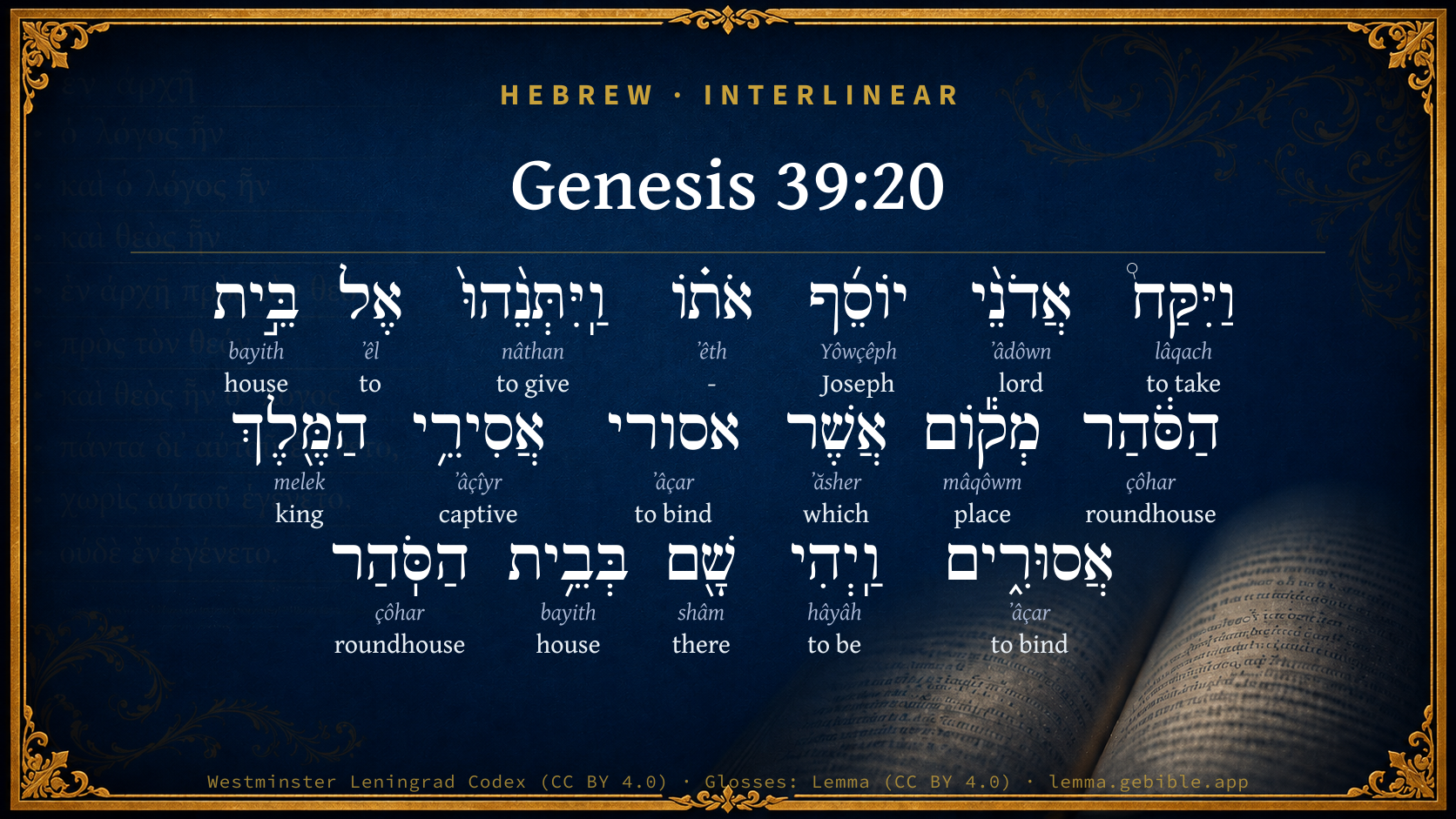
Hebrew (Westminster Leningrad Codex) Genesis 39:20 appears in the Hebrew Old Testament. The text above is from the Westminster Leningrad Codex. Each word links to its Strong’s number, a concise gloss, and parsing drawn from the Open Scriptures Hebrew Bible morphology. Click any word for its full Brown-Driver-Briggs (BDB) entry.
Download image
Cite this verse

Genesis 39:20 (World English Bible). Public Domain. Lemma interlinear Bible study tool, https://lemma.gebible.app/v/genesis/39/20.

Show BibTeX & RIS
BibTeX
RIS
English Translation
Joseph's master took him, and put him into the prison, the place where the king's prisoners were bound, and he was there in custody.
World English Bible · Public Domain
Highlights
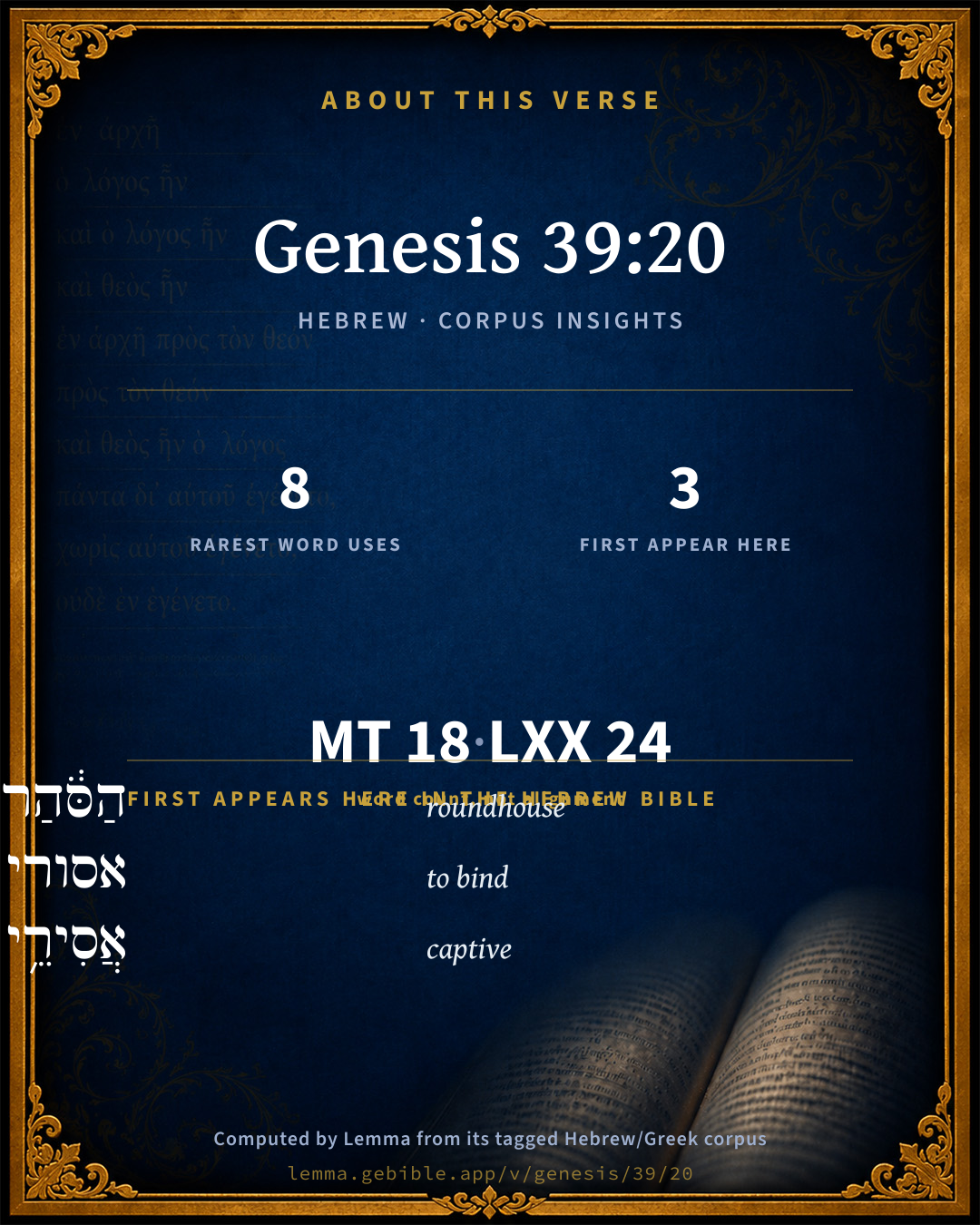
  • 3 first appearances in the Hebrew Bible
Full analysis ↓
Download a study sheet

One document with this verse’s original text, its word-by-word gloss line, the meaning frame, cross-references with their text, attributed commentary, and full source and license credits — printable, and it pastes into notes with its structure intact.

This verse Autodidact and up

Study sheet (.html) Plain text (.txt)

A passage Seminary Student

Up to 50 verses in one chapter. A passage sheet keeps up to 6 commentary sources and 12 cross-references per verse, in the order this page ranks them, and says so on the sheet whenever that leaves anything out. Ask for a single verse and you get the Autodidact verse sheet above.

Everything on this page stays free to read, with no account — the sheet is a download of what is already on screen, not access to it.

Want to remove ads? Support Godless Engineer
Compare translations 3

The same verse in 3 English versions, stacked beneath the original-language interlinear above. Click any original word for its lexicon entry.

Each is an independent rendering of the whole verse — the interlinear is not word-aligned to these translations.

Highlighted words mark where these versions differ — a whole-verse word diff, not a word-by-word alignment.

  • World English Bible Public Domain
    Joseph's master took him, and put him into the prison, the place where the king's prisoners were bound, and he was there in custody.
  • King James Version Public Domain
    And Joseph's master took him, and put him into the prison, a place where the king's prisoners were bound: and he was there in the prison.
  • unfoldingWord Literal Text CC BY-SA 4.0
    Then Joseph’s master took him and put him in the round-house, the place where the prisoners of the king were bound. So he was there in the round-house,

unfoldingWord Literal Text — © unfoldingWord, licensed CC BY-SA 4.0. Word-aligned USFM3 via Door43 (git.door43.org/unfoldingWord/en_ult).

Versions to compare (up to 4)

3 of 4 selected

Show all 17 translations

Every available English version of this verse, each an independent rendering of the whole verse.

  • World English Bible Public Domain
    Joseph's master took him, and put him into the prison, the place where the king's prisoners were bound, and he was there in custody.
  • Berean Standard Bible Public Domain
    So Joseph’s master took him and had him thrown into the prison where the king’s prisoners were confined. While Joseph was there in the prison,
  • Majority Standard Bible Public Domain
    So Joseph’s master took him and had him thrown into the prison where the king’s prisoners were confined. While Joseph was there in the prison,
  • King James Version Public Domain
    And Joseph's master took him, and put him into the prison, a place where the king's prisoners were bound: and he was there in the prison.
  • American Standard Version (1901) Public Domain
    And Joseph's master took him, and put him into the prison, the place where the king's prisoners were bound: and he was there in the prison.
  • Revised Version (1885) Public Domain
    And Joseph’s master took him, and put him into the prison, the place where the king’s prisoners were bound: and he was there in the prison.
  • Geneva Bible (1599) Public Domain
    And Iosephs master tooke him and put him in prison, in the place, where the kings prisoners lay bounde: and there he was in prison.
  • Young's Literal Translation Public Domain
    and Joseph's lord taketh him, and putteth him unto the round-house, a place where the king's prisoners `are' bound; and he is there in the round-house.
  • Literal Standard Version CC BY-SA 4.0
    and Joseph’s lord takes him, and puts him to the round-house, a place where the king’s prisoners [are] bound; and he is there in the round-house.
  • Unlocked Literal Bible CC BY-SA 4.0
    Joseph's master took him and put him in prison, the place where the king's prisoners were confined. He was there in the prison.
  • unfoldingWord Literal Text CC BY-SA 4.0
    Then Joseph’s master took him and put him in the round-house, the place where the prisoners of the king were bound. So he was there in the round-house,
  • Darby Bible Public Domain
    And Joseph's lord took him and put him into the tower-house, [the] place where the king's prisoners were confined; and he was there in the tower-house.
  • World Messianic Bible Public Domain
    Joseph’s master took him, and put him into the prison, the place where the king’s prisoners were bound, and he was there in custody.
  • Webster's Bible Public Domain
    And Joseph's master took him, and put him into the prison, a place where the king's prisoners were bound: and he was there in the prison.
  • Free Bible Version CC BY-SA 4.0
    He took Joseph and put him in the prison where the king's prisoners were kept, and there he stayed.
  • Bible in Basic English Public Domain
    And Joseph's master took him and put him in prison, in the place where the king's prisoners were kept in chains, and he was there in the prison-house.
  • JPS Tanakh (1917) Public Domain
    And Joseph's master took him, and put him into the prison, the place where the king's prisoners were bound; and he was there in the prison.

Literal Standard Version (2020), Covenant Press — licensed CC BY-SA 4.0. Text via the HelloAO Bible API (eBible.org). Unlocked Literal Bible (unfoldingWord) — licensed CC BY-SA 4.0. Text via the HelloAO Bible API (eBible.org). unfoldingWord Literal Text — © unfoldingWord, licensed CC BY-SA 4.0. Word-aligned USFM3 via Door43 (git.door43.org/unfoldingWord/en_ult). Free Bible Version, Dr. Jonathan Gallagher — licensed CC BY-SA 4.0. Text via the HelloAO Bible API (eBible.org).

Word by word

More ways to search: Search by grammar → Find every occurrence → Compare this word →

Practice this passage: Drill this verse → Learn its vocabulary →

הַסֹּ֔הַר
çôhar
H5470
“the · roundhouse”
Particle, Definite Article + Noun, Common, Masculine, Singular, Absolute
Part of Speech
Particle + Noun
Type
Common
Gender
Masculine
Number
Singular
State
Absolute
Full BDB Definition

Origin: from the same as H5469

TWOT: 1468b

house of roundness, roundhouse, prison - name of a prison
  1. וַיִּקַּח֩ lâqach H3947 “and · to take” Conjunction + Verb, Qal, Sequential Imperfect, 3rd Person, Masculine, Singular
  2. אֲדֹנֵ֨י ʼâdôwn H113 “lords of” Noun, Common, Masculine, Plural, Construct
  3. יוֹסֵ֜ף Yôwçêph H3130 “Joseph” Noun, Proper
  4. אֹת֗וֹ ʼêth H853 “- · him” Particle, Direct Object + Suffix, Personal, 3rd Person, Masculine, Singular
  5. וַֽיִּתְּנֵ֨הוּ֙ nâthan H5414 “and · to give · him” Conjunction + Verb, Qal, Sequential Imperfect, 3rd Person, Masculine, Singular + Suffix, Personal, 3rd Person, Masculine, Singular
  6. אֶל ʼêl H413 “to” Preposition
  7. בֵּ֣ית bayith H1004 “house of” Noun, Common, Masculine, Singular, Construct
  8. מְק֕וֹם mâqôwm H4725 “place of” Noun, Common, Masculine, Singular, Construct
  9. אֲשֶׁר ʼăsher H834 “which” Particle, Relative
  10. אסורי ʼâçar H631 “bound” Verb, Qal, Participle Passive, Masculine, Plural, Construct
  11. אֲסִירֵ֥י ʼâçîyr H615 “captives of” Noun, Common, Masculine, Plural, Construct
  12. הַמֶּ֖לֶךְ melek H4428 “the · king” Particle, Definite Article + Noun, Common, Masculine, Singular, Absolute
  13. אֲסוּרִ֑ים ʼâçar H631 “bound” Verb, Qal, Participle Passive, Masculine, Plural, Absolute
  14. וַֽיְהִי hâyâh H1961 “and · to be” Conjunction + Verb, Qal, Sequential Imperfect, 3rd Person, Masculine, Singular
  15. שָׁ֖ם shâm H8033 “there” Adverb
  16. בְּבֵ֥ית bayith H1004 “in/at · house of” Preposition + Noun, Common, Masculine, Singular, Construct
  17. הַסֹּֽהַר çôhar H5470 “the · roundhouse” Particle, Definite Article + Noun, Common, Masculine, Singular, Absolute

About this verse

These counts appear in no published source. They are computed here, from the morphology-tagged text and Lemma’s own curated glosses. What Lemma adds →

18
words
15
distinct lemmas
Pentateuch
section

Notable vocabulary

The rarest word here is הַסֹּ֔הַר roundhouse H5470 — appearing just 8 times in the whole Hebrew Bible.

First appearance in Scripture

These words make their first canonical appearance in the Hebrew Bible here:

  • הַסֹּ֔הַר roundhouse H5470
  • אסורי to bind H631
  • אֲסִירֵ֥י captive H615

Shared distinctive vocabulary

הַסֹּ֔הַר roundhouse H5470 occurs in 6 verses of the Hebrew Bible. Also found in:

Grammatical profile

  • 5 verbs
  • 9 nouns
  • 1 preposition
  • 1 adverb
  • 2 particles

Verb forms

  • וַיִּקַּח֩ Qal · Sequential Imperfect
  • וַֽיִּתְּנֵ֨הוּ֙ Qal · Sequential Imperfect
  • אסורי Qal · Participle Passive
  • אֲסוּרִ֑ים Qal · Participle Passive
  • וַֽיְהִי Qal · Sequential Imperfect

Repetition

Words recur within this verse — often emphatic in Hebrew:

  • בֵּ֣ית house H1004 ×2
  • הַסֹּ֔הַר roundhouse H5470 ×2
  • אסורי to bind H631 ×2

Hebrew & Septuagint length

In English translation the verse runs 24 words from the Hebrew and 24 from the Septuagint (LXX English) — the same length.

A rough comparison of the two English renderings, which tokenize alike — not a word-level alignment.

Word counts can differ between the Hebrew and the Greek without any difference in meaning — e.g. the Hebrew direct-object marker אֵת has no separate Greek word, and Greek often adds the article ὁ.

In the original languages it is 18 Hebrew tokens and 24 Greek tokens — but the two are counted differently (Hebrew bundles its prefixes and suffixes into one token; the Greek is in lemma form), so that isn’t a like-for-like length.

Cross-references

9

Topical passages linked to Genesis 39:20 in the Treasury of Scripture Knowledge — connected by theme and wording, ordered by reader-vote popularity; previews shown in the World English Bible.

  • Genesis 40:15 For indeed, I was stolen away out of the land of the Hebrews, and here also have I done nothing that they should put me into the dungeon."
  • Genesis 40:1–3 It happened after these things, that the butler of the king of Egypt and his baker offended their lord, the king of Egypt.
  • Genesis 41:9–14 Then the chief cupbearer spoke to Pharaoh, saying, "I remember my faults today.
  • Psalms 105:18–19 They bruised his feet with shackles. His neck was locked in irons,
  • Isaiah 53:8 By oppression and judgment he was taken away; and as for his generation, who [among them] considered that he was cut off out of the land of the living for the disobedience of my people to whom the stroke [was due]?
  • Daniel 3:21–22 Then these men were bound in their pants, their tunics, and their mantles, and their [other] garments, and were cast into the midst of the burning fiery furnace.
  • 2 Timothy 2:9 in which I suffer hardship to the point of chains as a criminal. But God's word isn't chained.
  • 1 Peter 2:19 For it is commendable if someone endures pain, suffering unjustly, because of conscience toward God.
  • Psalms 76:10 Surely the wrath of man praises you. The survivors of your wrath are restrained.

Cross-references courtesy of OpenBible.info (CC BY 4.0).

Hebrew and Greek witnesses Masoretic Hebrew ↔ Greek Septuagint

The same verse in the two great witnesses to the Old Testament, shown verse-for-verse.

These are two independent witnesses, not word-aligned to each other, and the Septuagint is shown in lemma (dictionary) form.

Hebrew Genesis 39:20 Masoretic · Westminster Leningrad Codex

וַיִּקַּח֩ אֲדֹנֵ֨י יוֹסֵ֜ף אֹת֗וֹ וַֽיִּתְּנֵ֨הוּ֙ אֶל בֵּ֣ית הַסֹּ֔הַר מְק֕וֹם אֲשֶׁר אסורי אֲסִירֵ֥י הַמֶּ֖לֶךְ אֲסוּרִ֑ים וַֽיְהִי שָׁ֖ם בְּבֵ֥ית הַסֹּֽהַר

Joseph's master took him, and put him into the prison, the place where the king's prisoners were bound, and he was there in custody.

World English Bible · Public Domain

Greek LXX Genesis 39:20 Septuagint · lemma form

καί λαμβάνω ὁ κύριος ιωσηφ ἐνβάλλω αὐτός εἰς ὁ ὀχύρωμα εἰς ὁ τόπος ἐν ὅς ὁ δεσμώτης ὁ βασιλεύς καταἔχω ἐκεῖ ἐν ὁ ὀχύρωμα

And his master took Joseph, and cast him into the prison, into the place where the king's prisoners are kept, there in the prison.

LXX2012 (modern English Septuagint) · Public Domain

On this verse, The Cambridge Bible for Schools and Colleges discusses the Septuagint’s reading. Read the note in Commentary ↓

Hebrew: Westminster Leningrad Codex (CC BY 4.0). Greek: Septuagint (public domain); English from LXX2012 (modern English Septuagint) (Public Domain). How the Septuagint differs from the Hebrew →

Targum (Aramaic paraphrase)

2

The Targum is the ancient Jewish Aramaic paraphrase of the Hebrew Scriptures — an interpretive translation, not the Hebrew text itself. Onkelos (literal) and Pseudo-Jonathan (expansive) render the Torah, and Jonathan the Prophets. Coverage is partial: where no permissively-licensed English translation exists for a verse, only the Aramaic is shown. This is verse-level text, not a word-by-word alignment to the Hebrew.

  1. Targum Onkelos Torah (Genesis–Deuteronomy)
    וּנְסִיב רִבּוֹנֵהּ דְּיוֹסֵף יָתֵהּ וִיהָבֵיה לְבֵית אֲסִירֵי אֲתַר דִּי אֲסִירֵי מַלְכָּא אֲסִירִין וַהֲוָה תַמָּן בְּבֵית אֲסִירֵי

    (no public-domain English translation for this verse)

    Targum Onkelos — Aramaic: “Onkelos Genesis” (public domain); “Onkelos Exodus” (public domain); “Onkelos Leviticus” (public domain); “Onkelos Numbers” (public domain); “Onkelos Deuteronomy” (public domain). English: “Sefaria Community Translation” (CC0 1.0 (public-domain dedication)); “J.W. Etheridge. The Targums of Onkelos and Jonathan Ben Uzziel on the Pentateuch. London: Longmans, Green, 1862” (public domain). Text via Sefaria.

  2. Targum Pseudo-Jonathan Torah (Genesis–Deuteronomy)
    וּנְסִיב עֵטָתָא רִבּוֹנֵיהּ דְיוֹסֵף מִן כּוּמְרָנַיָא דְבַדְקַן דְחֶלְבּוֹנָא הוּא וְלָא קְטַל יָתֵיהּ וְיַהֲבֵיהּ בְּבֵי אֲסִירֵי אָתַר דַאֲסִירֵי מַלְכָּא אֲסִירִין וַהֲוָה תַמָן בְּבֵית אֲסִירֵי

    And Joseph's master took counsel of the priests, who ____ put him not to death, but delivered him into the house of the bound, where the king's prisoners were bound; and he was there in the house of the bound.

    Targum Pseudo-Jonathan — Aramaic: “Targum Jonathan on Genesis” (public domain); “Targum Jonathan on Exodus” (public domain); “Targum Jonathan on Leviticus” (public domain); “Targum Jonathan on Numbers” (public domain); “Targum Jonathan on Deuteronomy” (public domain). English: “The Targum of Jonathan ben Uzziel, trans. J. W. Etheridge, London, 1862” (public domain). Text via Sefaria.

Commentary

Notes on Genesis 39:20 from classic Christian and Jewish commentators (each source and its license shown beneath its notes). The classic Christian expositions comment on the surrounding passage and are grouped to its opening verse, so a note may address several verses; the Jewish commentaries on the Tanakh (Rashi and others) are per-verse, so they appear only where the commentator wrote on this verse.

Lemma curates 59 commentaries, every one of them public domain or Creative Commons licensed, each selected and text-cleaned for this edition rather than reprinted as found. About our sources →

Trapp's Complete Commentary

John Trapp

Gen 39:20 And Joseph’s master took him, and put him into the prison, a place where the king’s prisoners [were] bound: and he was there in the prison.

Ver. 20. And Joseph’s master took him.] It was a providence that he had not presently slain him upon that false accusation. The devil is first a liar, and then a murderer; {Joh 8:44} but he is limited by God. Joseph is imprisoned in the round tower, where "they hurt his feet with fetters; the iron entered into his soul." {Psa 105:18, marg.} He, meanwhile, either pleads not, or is not heard. Doubtless he denied the fact; but durst not accuse the offender. His innocency might afterwards appear, and thereupon the chief keeper show him favour. {Gen 39:21} But his master should have been better advised. If he lived till Joseph was advanced, he had as good cause to fear his power, as ever Joseph’s brethren had. Cardinal Wolsey was first schoolmaster of Magdalen School in Oxford; after that, beneficed by Marquess Dorset, whose children he had there taught; where he had not long been, but one Sir James Paulet, upon some displeasure, set him by the heels: which affront was afterwards neither forgotten nor forgiven. For when the schoolmaster became Lord Chancellor of England, he sent for him; and after a sharp reproof, imprisoned him: {a} a good precedent for men in authority which work their own wiles without wit; not to punish out of humour, &c. Discite iustitiam moniti, &c. Despise not any man’s lowness; we know not his destiny.

{a} Negotiations of Card. Wols., p. 2.

John Trapp, A Commentary or Exposition upon All the Books of the Old and New Testament (1647–1656) — public domain. Text from a community e-Sword module.

Joseph Benson's Commentary

Gen 39:20-21. Where the king’s prisoners were bound — Potiphar, it is likely, chose that prison because it was the worst; for there “the irons entered into the soul,” Psa 105:18, but God designed it to pave the way to his enlargement. Our Lord Jesus, like Joseph, was bound, and numbered with transgressors. But the Lord was with Joseph, and showed him mercy. No gates nor bars can shut out his gracious presence from his people. God gave him favour in sight of the keeper of the prison — God can raise up friends for his people, even where they little expect them. The keeper saw that God was with him, and that every thing prospered under his hand, and therefore intrusted him with the management of the affairs of the prison.

Joseph Benson's Commentary on the Old and New Testaments (1811–1818) — public domain. Text from a community e-Sword module.

MacLaren's Expositions of Holy Scripture

Alexander MacLaren

Genesis

GOODNESS IN A DUNGEON

Gen 39:20 - Gen 39:23. - Gen 40:1 - Gen 40:15.

Potiphar was ‘captain of the guard,’ or, as the title literally runs, chief of the executioners. In that capacity he had charge of the prison, which was connected with his house {Gen 40:3}. It is, therefore, quite intelligible that he should have put Joseph in confinement on his own authority, and the distinction drawn between such a prisoner and the ‘king’s prisoners,’ who were there by royal warrant or due process of law, is natural. Such high-handed treatment of a slave was a small matter, and it was merciful as well as arrogant, for death would have been the punishment of the crime of which Joseph was accused. Either Potiphar was singularly lenient, or, as is perhaps more probable, he did not quite believe his wife’s story, and thought it best to hush up a scandal. The transfer of Joseph from the house to the adjoining prison would be quietly managed, and then no more need be said about an ugly business.

So now we see him at the lowest ebb of his fortunes, flung down in a moment by a lie from the height to which he had slowly been climbing, having lost the confidence of his master, and earned the unslumbering hatred of a wicked woman. He had wrecked his career by his goodness. ‘What a fool!’ says the world. ‘How badly managed things are in this life,’ say doubters, ‘that virtue should not be paid by prosperity!’ But the end, even the nearer end in this life, will show whether he was a fool, and whether things are so badly arranged; and the lesson enforced by the picture of Joseph in his dungeon, and which young beginners in life have special need to learn, is that, come what will of it, right is right, and sin is sin, that consequences are never to deter from duty, and that it is better to have a clean conscience and be in prison than do wickedness and sit at a king’s table. A very threadbare lesson, but needing to be often repeated.

‘But the Lord was with Joseph.’ That is one of the eloquent ‘buts’ of Scripture. The prison is light when God is there, and chains do not chafe if He wraps His love round them. Many a prisoner for God since Joseph’s time has had his experience repeated, and received tenderer tokens from Him in a dungeon than ever before. Paul the prisoner, John in Patmos, Bunyan in Bedford jail, George Fox in Lancaster Castle, Rutherford in Aberdeen, and many more, have found the Lord with them, and showing them His kindness. We may all be sure that, if ever faithfulness to conscience involves us in difficulties, the faithfulness and the difficulties will combine to bring to us sweet and strong tokens of God’s approval and presence, the winning of which will make a prison a palace and a gate of heaven.

Joseph’s relations to jailer and fellow-prisoners are beautiful and instructive. The former is called ‘the keeper of the prison,’ and is evidently Potiphar’s deputy, in more immediate charge of the prison. Of course, the great man had an underling to do the work, and probably that underling was not chosen for sweetness of temper or facile leniency to his charges. But he fell under the charm of Joseph’s character-all the more readily, perhaps, because his occupation had not brought many good men to his knowledge. This jewel would flash all the more brightly for the dark background of criminals, and the jailer would wonder at a type of character so unlike what he was accustomed to. Eastern prisons to-day present a curious mixture of cruelty and companionship. The jailers are on intimate terms with prisoners, and yet are ready to torture them. There is no discipline, nor any rules, nor inspection. The jailer does as he likes. So it seems to have been in Egypt, and there would be nothing unnatural in making a prisoner jailer of the rest, and leaving everything in his hands. The ‘keeper of the prison’ was lazy, like most of us, and very glad to shift duties on to any capable shoulders. Such a thing would, of course, be impossible with us, but it is a bit of true local colouring here.

Joseph won hearts because God was with him, as the story is careful to point out. Our religion should recommend us, and therefore itself, to those who have to do with us. It is not enough that we should be severely righteous, as Joseph had been, or ready to meet trouble with stoical resignation, but we are to be gentle and lovable, gracious towards men, because we receive grace from God. We owe it to our Lord and to our fellows, and to ourselves, to be magnets to attract to Jesus, by showing how fair He can make a life. Joseph in prison found work to do, and he did not shirk it. He might have said to himself: ‘This is poor work for me, who had all Potiphar’s house to rule. Shall such a man as I come down to such small tasks as this?’ He might have sulked or desponded in idleness, but he took the kind of work that offered, and did his best by it. Many young people nowadays do nothing, because they think themselves above the small humdrum duties that lie near them. It would do some of us good to remember Joseph in the jail, and his cheerful discharge of what his hands found to do there.

Of course, work done ‘because the Lord was with him,’ in the consciousness of His presence, and in obedience to Him, went well. ‘The Lord made it to prosper,’ as He always will make such work.

‘When thou dost favour any action,

It runs, it flies.’

And even if, sometimes, work done in the fear of the Lord does not outwardly prosper, it does so in deepest truth, if it work in us the peaceable fruit of righteousness. We need to have a more Christian idea of what constitutes prosperity, and then we shall understand that there are no exceptions to the law that, if a man does his work by God and with God and for God, ‘that which he does, the Lord makes it to prosper.’

The help that Joseph gave by interpreting the two high officials’ dreams cannot be considered here in detail, but we note that the names of similar officers, evidently higher in rank than we should suppose, with our notions of bakers and butlers, are found in Egyptian documents, and that these two were ‘king’s prisoners,’ and put in charge of Potiphar, who alleviated their imprisonment by detailing Joseph as their attendant, thus showing that his feeling to the young Hebrew was friendly still. Dreams are the usual method of divine communication in Genesis, and belong to a certain stage in the process of revelation. The friend of God, who is in touch with Him, can interpret these. ‘The secret of the Lord is with them that fear Him,’ and it is still true that they who live close by God have insight into His purposes. Joseph showed sympathy with the two dreamers, and his question, ‘Why look ye so sadly?’ unlocked their hearts. He was not so swallowed up in his own trouble as to be blind to the signs of another’s sorrow, or slow to try to comfort. Grief is apt to make us selfish, but it is meant to make us tender of heart and quick of hand to help our fellows in calamity. We win comfort for our own sorrows by trying to soothe those of others. Jesus stooped to suffer that He might succour them that suffer, and we are to tread in His steps.

Alexander MacLaren, Expositions of Holy Scripture (1904–1910) — public domain. Text from a community e-Sword module.

Geneva Bible (1599)

Geneva Bible translators

Hebrew, in the prison house.

His evil intreatment in the prison may be gathered of Ps. 105:18.

Geneva Bible (1599) marginal notes — public domain. Text via Bolls.life.

Jamieson, Fausset & Brown

Robert Jamieson, A. R. Fausset & David Brown

Joseph's master took him, and put him into the prison--the roundhouse, from the form of its construction, usually attached to the dwelling of such an officer as Potiphar. It was partly a subterranean dungeon (Gen 41:14), though the brick-built walls rose considerably above the surface of the ground, and were surmounted by a vaulted roof somewhat in the form of an inverted bowl. Into such a dungeon Potiphar, in the first ebullition of rage, threw Joseph and ordered him to be subjected further to as great harshness of treatment (Psa 105:18) as he dared; for the power of masters over their slaves was very properly restrained by law, and the murder of a slave was a capital crime.

a place where the king's prisoners were bound--Though prisons seem to have been an inseparable appendage of the palaces, this was not a common jail--it was the receptacle of state criminals; and, therefore, it may be presumed that more than ordinary strictness and vigilance were exercised over the prisoners. In general, however, the Egyptian, like other Oriental prisons, were used solely for the purposes of detention. Accused persons were cast into them until the charges against them could be investigated; and though the jailer was responsible for the appearance of those placed under his custody, yet, provided they were produced when called, he was never interrogated as to the way in which he had kept them.

Jamieson, Fausset & Brown — Commentary Critical and Explanatory on the Whole Bible (1871) — public domain (CC PDM 1.0). Text via the HelloAO Bible API.

Adam Clarke's Commentary

Verse 20. Put him into the prison] בית סהר beith sohar, literally the round house; in such a form the prison was probably built.

Adam Clarke's Commentary on the Bible (1810–1826) — public domain. Text from a community e-Sword/MySword module.

John Calvin's Commentaries

20. And put him into the prison. Though Moses does not state with what degree of severity Joseph was afflicted at the beginning of his imprisonment, yet we readily gather that he was not allowed any liberty, but was thrust into some obscure dungeon. The authority of Potiphar was paramount; he had the keeper of the prison under his power, and at his disposal. What clemency could be hoped for from a man who was jealous and carried away with the vehemence of his anger? There is no doubt that what is related of Joseph in Psalm 105:18,

“His feet were made fast in fetters, and the iron entered into his soul,”

had been handed down by tradition from the fathers. What a reward of innocence! For, according to the flesh, he might ascribe whatever he was suffering to his integrity. Truly, in this temptation he must have mourned in great perplexity and anxiety before God. And though Moses does not record his prayers, yet, since it is certain that he was not crushed beneath the cross, and did not murmur against it, it is also probable that he was reposing on the hope of Divine help. And to flee unto God is the only stay which will support us in our afflictions, the only armor which renders us invincible.

John Calvin's Commentaries (1540-1563) — public domain. Text from the Calvin Translation Society English edition (1840s-50s) via the Christian Classics Ethereal Library (ccel.org). Calvin's coverage is partial (roughly two-thirds of the Bible); uncommented books and verses are honest gaps, never fabricated. The 19th-century editor's footnotes and remarks are omitted so the notes are faithfully Calvin's own voice.

The Cambridge Bible for Schools and Colleges

gen. ed. J. J. S. Perowne

20. into the prison] Lit. “into the house of roundness,” or “the round house.” Possibly the Heb. expression, “the house of sohar,” may be an attempt to transliterate an Egyptian word, with a similar sound, by means of a familiar Heb. word sohar. LXX ὀχύρωμα, Lat. carcer. It only occurs here, and Gen_39:23, and Gen_40:3; Gen_40:5. On the whole, if Joseph’s master believed the tale that had been told him, the punishment inflicted was less violent than we should have expected in such an age.

the place … were bound] These words are considered by many scholars to be introduced by the Compiler, in order to lead up to the description of the prison scene in the E narrative of ch. 40.

The Cambridge Bible for Schools and Colleges (gen. ed. J. J. S. Perowne; Cambridge University Press, 1878–1918) — public domain. Text from a community e-Sword module.

John Gill's Exposition

And Joseph's master took him, and put him into the prison,.... Which was in or adjoining to his house, Gen 40:3; of himself he had power to do this, as the captain of the guard; and as he was the chief of the executioners, as some take his office to be, it is much he did not in his passion deliver him up into their hands to put him to death at once; but it may be through the great respect he had had for Joseph, which was not wholly extinguished by this impeachment of him; and especially if he heard Joseph's apology for himself before he committed him, his passion might subside a little, though for the credit of his wife he might take this step; or however things were so overruled by the providence of God, who has the hearts of all men in his hands, that he should do what he did. The word for "prison" has the signification of roundness, and may be rendered the "round house" (t), or "round tower"; and some Jewish writers, as Mercer observes, take it to be in this form, that it was made under ground, and at the top of it was an hole which let in light, and at which they went into it. Aben Ezra is at a loss to say whether it is an Hebrew or Egyptian word, and inclines to the latter, because he thinks it is explained in the next clause:

a place where the king's prisoners were bound; such as were guilty of high treason, or however of high crimes and misdemeanours against him; and so was a prison in which men were strictly kept and used hardly, as was Joseph at first, as appears from Psa 105:18,

and he was there in the prison; he continued there, some of the Jewish writers say (u) ten years, others twelve (w); and so long he must be, if he was but one year in Potiphar's house; for there were thirteen years between his being sold into Egypt, and his appearance before Pharaoh; he was seventeen when he was sold, and he was thirty when he stood before Pharaoh, being took out of prison, see Gen 37:2; but it is more likely that he was a longer time in Potiphar's house, and a lesser time in prison.

(t) "rotundam turrim", Junius & Tremellius; "domum rotundi carceris", Piscator: "round house", Ainsworth; "vox Hebraea significat carcerem rotundum in modum lunae", Vatablus; so Ben Melech. (u) Pirke Eliezer, c. 39. (w) Seder Olam Rabba, c. 2. p. 5. Shalshalet Hakabala, fol. 3. 2.

John Gill's Exposition of the Whole Bible (1746–1763) — public domain (CC PDM 1.0). Text via the HelloAO Bible API.

Matthew Poole's English Annotations

Quest. Why did he not kill him, the crime being capital, and he having so undoubted a power in his hand to do it?

Answ. It is probable he was a little moderated by Joseph’s apology, which doubtless he made for himself, though it be not here recorded.

2. This is to be ascribed to the good providence of God, which restrains the waves of the sea, and the passions of men, and sets them their bounds which they shall not pass, which watched over Joseph in a peculiar manner.

The king’s prisoners; traitors, or great offenders against the king, whose prison doubtless was none of the easiest and therefore it is called a dungeon, Gen 40:15; 41:14; and he endured great hardship in it. See Psa 105:18.

Matthew Poole's English Annotations on the Holy Bible (1683–1685) — public domain. Text from a community e-Sword/MySword module.

Whedon's Commentary on the Bible

Daniel D. Whedon

20. Put him into the prison — Or, house of the round tower, “the fortified house where the king’s prisoners were guarded. A very light punishment, considering the severity of the Egyptian laws, apparently showing that it was inflicted rather to save his wife’s reputation than to punish Joseph. (Le Clerc.) There is no evidence that Joseph attempted to vindicate himself. Indeed, it would have been useless. It was one of those fearful trials which shut the righteous man up to a single course, namely, to suffer, and wait in faith.” — Newhall.

Daniel D. Whedon (gen. ed.), Commentary on the Old and New Testaments (1874–1909) — public domain. Text from a community e-Sword module.

The Pulpit Commentary

And Joseph"s master took him, and put him into the prison, literally house of enclosure; sohar, from sahar, to encircle, meaning probably a turreted, arched, or rounded building for the confinement of prisonersa place where the king"s prisoners (i.e. State offenders) were bound: and he was there in the prison. This, which some regard as having been a mild punishment (Delitzsch, Keil), since, according to Diodorus Siculus, the laws of the Egyptians were specially severe in their penalties for offences against women, is represented by a Hebrew psalmist (Psa_105:18) as having been accompanied with bodily tortures, at least for a time; for his speedy elevation to a place of trust within the prison almost gives countenance to the idea (Kurtz, Lange, &c.) that Potiphar did not believe his wife"s story, and only incarcerated Joseph for the sake of appearances. That Joseph was not immediately punished with death is not improbable (Bohlen), but exceedingly natural, since Joseph was Potiphar"s favorite (Havernick). ;

The Pulpit Commentary (1880–1919), ed. H.D.M. Spence-Jones & Joseph S. Exell — public domain. Text from a community e-Sword module.

John Wesley's Explanatory Notes

Where the king's prisoners were bound - Potiphar, it is likely, chose that prison because it was the worst; for there the irons entered into the soul, Psalm cv, 18, but God designed it to pave the way to his enlargement. Our Lord Jesus, like Joseph was bound, and numbered with the transgressors.

John Wesley, Explanatory Notes Upon the Whole Bible (1754–1765) — public domain. Text via the GEBible commentary corpus.

Ramban (Nachmanides)

Rabbi Moshe ben Nachman (Ramban / Nachmanides)

AND HE PUT HIM INTO PRISON, THE PLACE WHERE THE KING’s PRISONERS WERE BOUND. Rabbi Abraham ibn Ezra says that the verse itself explains that a beth haso’ar (prison) is “a place where the king’s prisoners were bound.” The reason this is stated in the verse itself is that beth haso’ar is an Egyptian word, for it is the style of Scripture to explain foreign words just as, they cast pur, that is the lot. This interpretation is of no significance. Rather, And he put him into the prison, means that he put him into a certain prison recognized as the royal prison, which was the place where the king’s prisoners were bound. The sense of the verse is thus to state that this was the cause of the butler and the baker being imprisoned with him.It is possible that the term, “the king’s prisoners,” means his servants and attendants who have sinned against him in matters of state, as other prisoners of the people sentenced by judges and officers were placed in another prison house. Scripture relates that they placed Joseph in the king’s prison because of his master’s love for Joseph, all of which was caused by G-d.Linguists. explain sohar as an arched chamber, similar in expression to, agan hasohar (a round goblet). In my opinion it is an underground house having a small opening above ground, through which the prisoners are lowered and from which they have light. The word sohar is thus derived from the word sihara (light) in Aramaic, just as in Hebrew, Scripture says; A transparency (‘tzohar’) shalt thou make to the ark, the word tzohar being derived from tzaharayim (mid-day — when the light reaches its zenith). The difference between tzohar and sohar is that tzohar connotes an abundance of light, while sohar connotes minimal light.

Ramban (Nachmanides) on the Tanakh — English translation: “Commentary on the Torah by Ramban (Nachmanides). Translated and annotated by Charles B. Chavel. New York, Shilo Pub. House, 1971-1976” (CC BY 4.0). Text via Sefaria.

Lesson kit

Teaching starters — assembled from the data on this page, not authored interpretation. Every prompt links to the verse data it draws on. Edit before teaching.

Genesis, in the Pentateuch, opens this verse with 18 words (15 distinct Hebrew lemmas). Its most distinctive word is çôhar (“roundhouse”). A historical commentator’s framing appears above. Read the whole chapter for the surrounding context.

Discussion questions

  1. How does “roundhouse” (çôhar) shape what this verse is saying?
  2. 3 words here appear for the first time in Scripture. What is being introduced at this debut?
  3. Genesis 39:21 shares the word «roundhouse» with this verse. How do the two illuminate each other?
  4. “house” occurs 2× in this one verse. What is the effect of the repetition?
  5. These translations render this verse differently; the difference is in the English rendering, not the original. What questions does that raise?
  6. The verb «וַיִּקַּח֩» is Qal Sequential Imperfect. How does its form color the action?
  7. Reading how Trapp's Complete Commentary and Joseph Benson's Commentary read this verse, where do the two commentators agree and where do they part?

Things to notice

Reading settings

Reading text

Shown beneath each verse's original-language words.

Old Testament
Old Testament edition

Read the OT as the Masoretic Hebrew (MT) or the Greek Septuagint (LXX).

English shown for the Greek Septuagint (in the Hebrew ↔ Greek comparison).

Comparing translations? Open the Compare panel on any verse page to stack up to four side by side.