Genesis 30:26

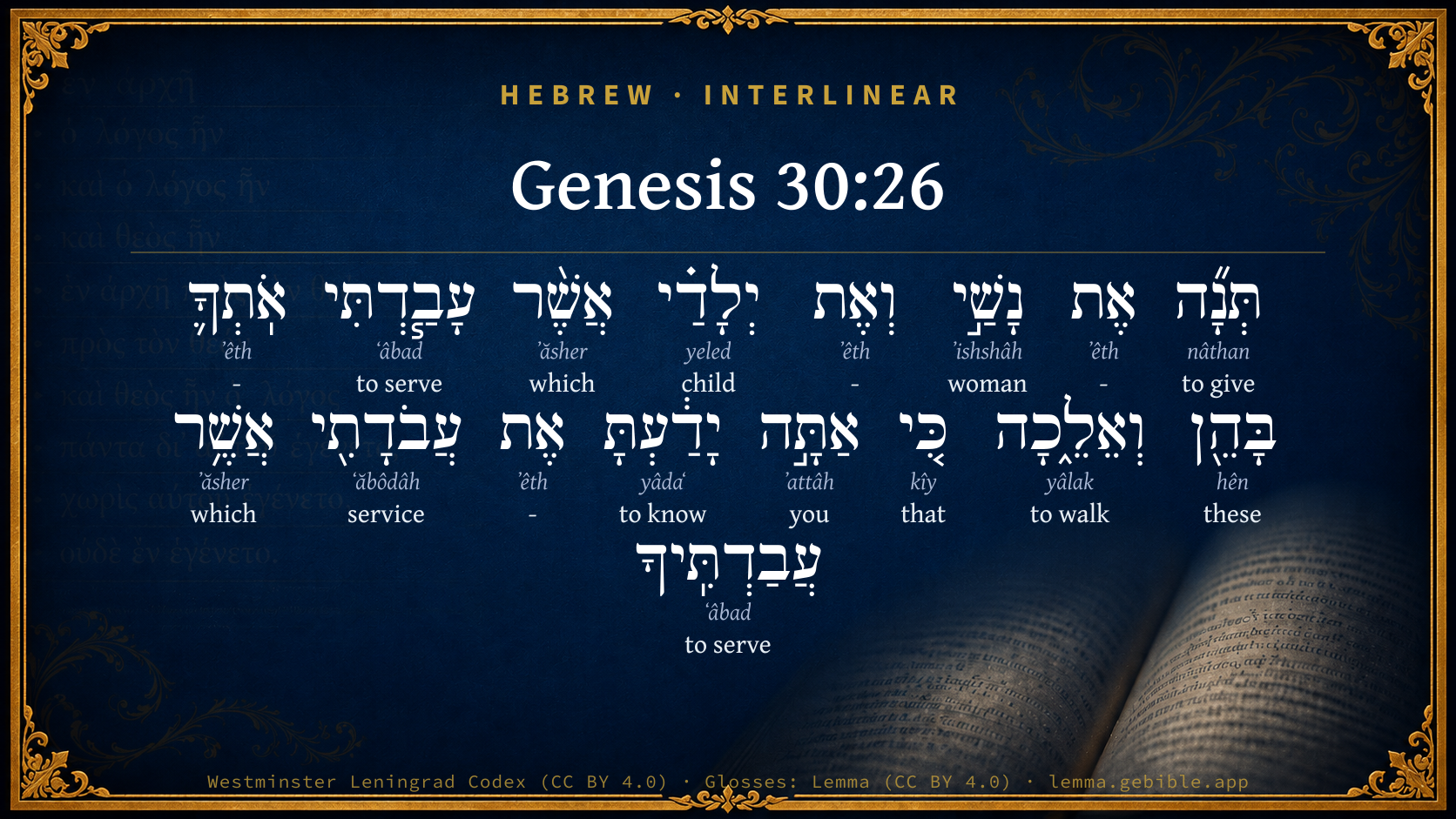
Hebrew (Westminster Leningrad Codex) Genesis 30:26 appears in the Hebrew Old Testament. The text above is from the Westminster Leningrad Codex. Each word links to its Strong’s number, a concise gloss, and parsing drawn from the Open Scriptures Hebrew Bible morphology. Click any word for its full Brown-Driver-Briggs (BDB) entry.
Download image
Cite this verse

Genesis 30:26 (World English Bible). Public Domain. Lemma interlinear Bible study tool, https://lemma.gebible.app/v/genesis/30/26.

Show BibTeX & RIS
BibTeX
RIS
English Translation
Give me my wives and my children for whom I have served you, and let me go: for you know my service with which I have served you."
World English Bible · Public Domain
Download a study sheet

One document with this verse’s original text, its word-by-word gloss line, the meaning frame, cross-references with their text, attributed commentary, and full source and license credits — printable, and it pastes into notes with its structure intact.

This verse Autodidact and up

Study sheet (.html) Plain text (.txt)

A passage Seminary Student

Up to 50 verses in one chapter. A passage sheet keeps up to 6 commentary sources and 12 cross-references per verse, in the order this page ranks them, and says so on the sheet whenever that leaves anything out. Ask for a single verse and you get the Autodidact verse sheet above.

Everything on this page stays free to read, with no account — the sheet is a download of what is already on screen, not access to it.

Want to remove ads? Support Godless Engineer
Compare translations 3

The same verse in 3 English versions, stacked beneath the original-language interlinear above. Click any original word for its lexicon entry.

Each is an independent rendering of the whole verse — the interlinear is not word-aligned to these translations.

Highlighted words mark where these versions differ — a whole-verse word diff, not a word-by-word alignment.

  • World English Bible Public Domain
    Give me my wives and my children for whom I have served you, and let me go: for you know my service with which I have served you."
  • King James Version Public Domain
    Give me my wives and my children, for whom I have served thee, and let me go: for thou knowest my service which I have done thee.
  • unfoldingWord Literal Text CC BY-SA 4.0
    Give me my wives and my children for whom I have served you, so that I may go. For you yourself know my service that I have served you.”

unfoldingWord Literal Text — © unfoldingWord, licensed CC BY-SA 4.0. Word-aligned USFM3 via Door43 (git.door43.org/unfoldingWord/en_ult).

Versions to compare (up to 4)

3 of 4 selected

Show all 18 translations

Every available English version of this verse, each an independent rendering of the whole verse.

  • World English Bible Public Domain
    Give me my wives and my children for whom I have served you, and let me go: for you know my service with which I have served you."
  • Berean Standard Bible Public Domain
    Give me my wives and children for whom I have served you, that I may go on my way. You know how hard I have worked for you.”
  • Majority Standard Bible Public Domain
    Give me my wives and children for whom I have served you, that I may go on my way. You know how hard I have worked for you.”
  • King James Version Public Domain
    Give me my wives and my children, for whom I have served thee, and let me go: for thou knowest my service which I have done thee.
  • American Standard Version (1901) Public Domain
    Give me my wives and my children for whom I have served thee, and let me go: for thou knowest my service wherewith I have served thee.
  • Revised Version (1885) Public Domain
    Give me my wives and my children for whom I have served thee, and let me go: for thou knowest my service wherewith I have served thee.
  • Geneva Bible (1599) Public Domain
    Giue me my wiues and my children, for whom I haue serued thee, and let me go: for thou knowest what seruice I haue done thee.
  • Douay-Rheims (1899) Public Domain
    Give me my wives, and my children, for whom I have served thee, that I may depart: thou knowest the service that I have rendered thee.
  • Young's Literal Translation Public Domain
    give up my wives and my children, for whom I have served thee, and I go; for thou -- thou hast known my service which I have served thee.'
  • Literal Standard Version CC BY-SA 4.0
    give up my wives and my children, for whom I have served you, and I go; for you have known my service which I have served you.”
  • Unlocked Literal Bible CC BY-SA 4.0
    Give me my wives and my children for whom I have served you, and let me go, for you know the service I have given you.”
  • unfoldingWord Literal Text CC BY-SA 4.0
    Give me my wives and my children for whom I have served you, so that I may go. For you yourself know my service that I have served you.”
  • Darby Bible Public Domain
    Give [me] my wives for whom I have served thee, and my children; that I may go away, for thou knowest my service which I have served thee.
  • World Messianic Bible Public Domain
    Give me my wives and my children for whom I have served you, and let me go; for you know my service with which I have served you.”
  • Webster's Bible Public Domain
    Give me my wives and my children, for whom I have served thee, and let me go: for thou knowest my service which I have done thee.
  • Free Bible Version CC BY-SA 4.0
    Give me my wives and children because I worked for you to have them. Let me go now because you know very well how much work I've done for you.”
  • Bible in Basic English Public Domain
    Give me my wives and my children, for whom I have been your servant, and let me go: for you have knowledge of all the work I have done for you.
  • JPS Tanakh (1917) Public Domain
    Give me my wives and my children for whom I have served thee, and let me go; for thou knowest my service wherewith I have served thee.'

Literal Standard Version (2020), Covenant Press — licensed CC BY-SA 4.0. Text via the HelloAO Bible API (eBible.org). Unlocked Literal Bible (unfoldingWord) — licensed CC BY-SA 4.0. Text via the HelloAO Bible API (eBible.org). unfoldingWord Literal Text — © unfoldingWord, licensed CC BY-SA 4.0. Word-aligned USFM3 via Door43 (git.door43.org/unfoldingWord/en_ult). Free Bible Version, Dr. Jonathan Gallagher — licensed CC BY-SA 4.0. Text via the HelloAO Bible API (eBible.org).

Word by word

More ways to search: Search by grammar → Find every occurrence → Compare this word →

Practice this passage: Drill this verse → Learn its vocabulary →

בָּהֵ֖ן
hên
H2004
“in/at · them”
Preposition + Suffix, Personal, 3rd Person, Feminine, Plural
Part of Speech
Preposition
Full BDB Definition

Origin: from H1931

TWOT: 504

they, these, the same, who
  1. תְּנָ֞ה nâthan H5414 “give” Verb, Qal, Imperative, 2nd Person, Masculine, Singular + Suffix, h
  2. אֶת ʼêth H853 “-” Particle, Direct Object
  3. נָשַׁ֣י ʼishshâh H802 “women · my” Noun, Common, Feminine, Plural, Construct + Suffix, Personal, 1st Person, Common, Singular
  4. וְאֶת ʼêth H853 “and · -” Conjunction + Particle, Direct Object
  5. יְלָדַ֗י yeled H3206 “children · my” Noun, Common, Masculine, Plural, Construct + Suffix, Personal, 1st Person, Common, Singular
  6. אֲשֶׁ֨ר ʼăsher H834 “which” Particle, Relative
  7. עָבַ֧דְתִּי ʻâbad H5647 “to serve” Verb, Qal, Perfect, 1st Person, Common, Singular
  8. אֹֽתְךָ֛ ʼêth H853 “- · you” Particle, Direct Object + Suffix, Personal, 2nd Person, Masculine, Singular
  9. וְאֵלֵ֑כָה yâlak H3212 “and · to walk” Conjunction + Verb, Qal, Cohortative, 1st Person, Common, Singular
  10. כִּ֚י kîy H3588 “that” Conjunction
  11. אַתָּ֣ה ʼattâh H859 “you” Pronoun, Personal, 2nd Person, Masculine, Singular
  12. יָדַ֔עְתָּ yâdaʻ H3045 “to know” Verb, Qal, Perfect, 2nd Person, Masculine, Singular
  13. אֶת ʼêth H853 “-” Particle, Direct Object
  14. עֲבֹדָתִ֖י ʻăbôdâh H5656 “service · my” Noun, Common, Feminine, Singular, Construct + Suffix, Personal, 1st Person, Common, Singular
  15. אֲשֶׁ֥ר ʼăsher H834 “which” Particle, Relative
  16. עֲבַדְתִּֽיךָ ʻâbad H5647 “to serve · you” Verb, Qal, Perfect, 1st Person, Common, Singular + Suffix, Personal, 2nd Person, Masculine, Singular

About this verse

These counts appear in no published source. They are computed here, from the morphology-tagged text and Lemma’s own curated glosses. What Lemma adds →

17
words
12
distinct lemmas
Pentateuch
section

Notable vocabulary

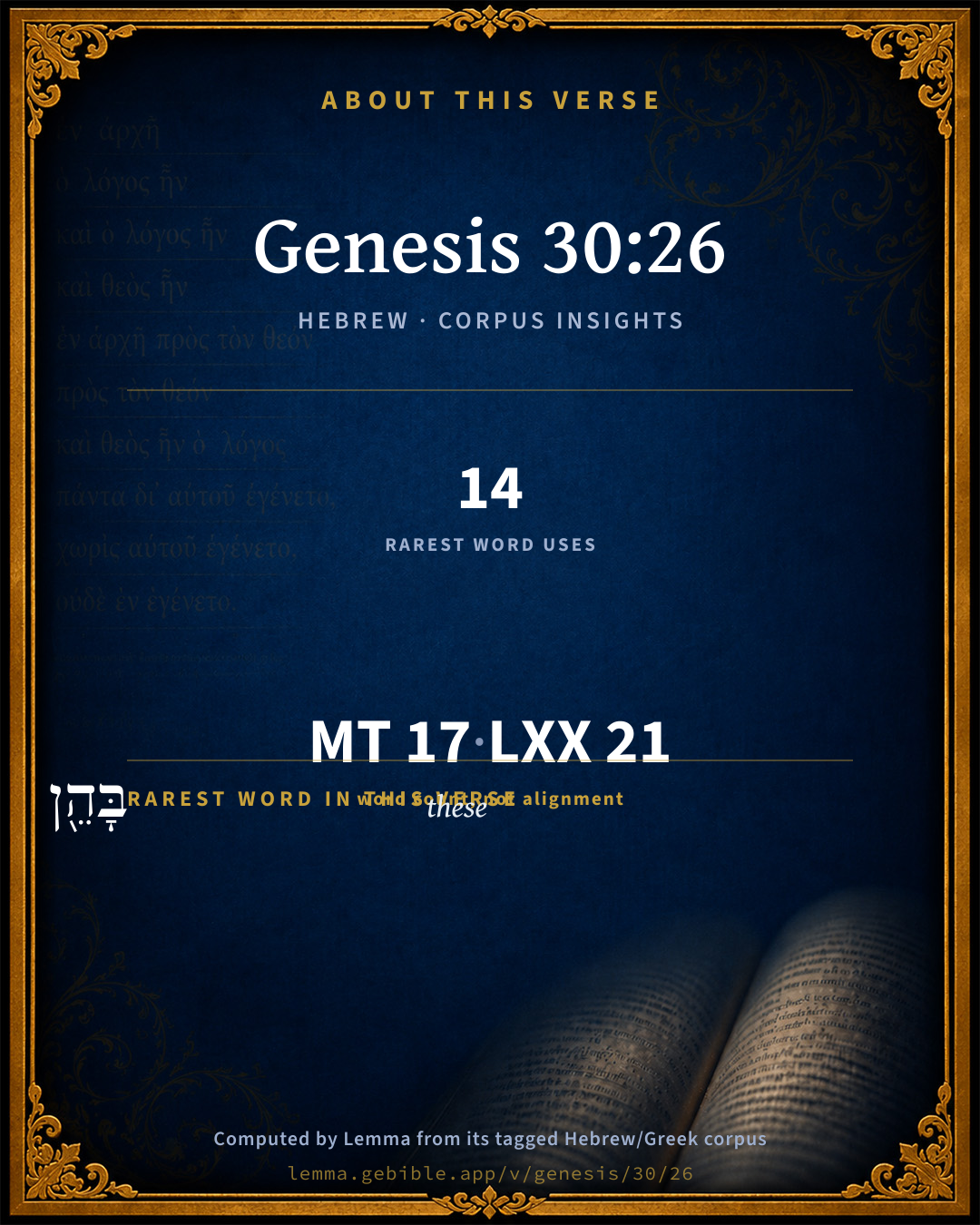
The rarest word here is בָּהֵ֖ן these H2004 — appearing just 14 times in the whole Hebrew Bible.

Shared distinctive vocabulary

בָּהֵ֖ן these H2004 occurs in 14 verses of the Hebrew Bible. Also found in:

Grammatical profile

  • 5 verbs
  • 3 nouns
  • 1 pronoun
  • 1 preposition
  • 1 conjunction
  • 6 particles

Verb forms

  • תְּנָ֞ה Qal · Imperative
  • עָבַ֧דְתִּי Qal · Perfect
  • וְאֵלֵ֑כָה Qal · Cohortative
  • יָדַ֔עְתָּ Qal · Perfect
  • עֲבַדְתִּֽיךָ Qal · Perfect

Repetition

Words recur within this verse — often emphatic in Hebrew:

  • עָבַ֧דְתִּי to serve H5647 ×2
  • אֲשֶׁ֨ר which H834 ×2

Hebrew & Septuagint length

In English translation the verse runs 28 words from the Hebrew and 26 from the Septuagint (LXX English) — closely comparable.

A rough comparison of the two English renderings, which tokenize alike — not a word-level alignment.

Word counts can differ between the Hebrew and the Greek without any difference in meaning — e.g. the Hebrew direct-object marker אֵת has no separate Greek word, and Greek often adds the article ὁ.

In the original languages it is 17 Hebrew tokens and 21 Greek tokens — but the two are counted differently (Hebrew bundles its prefixes and suffixes into one token; the Greek is in lemma form), so that isn’t a like-for-like length.

Cross-references

8

Topical passages linked to Genesis 30:26 in the Treasury of Scripture Knowledge — connected by theme and wording, ordered by reader-vote popularity; previews shown in the World English Bible.

  • Genesis 29:30 He went in also to Rachel, and he loved also Rachel more than Leah, and served with him yet seven other years.
  • Hosea 12:12 Jacob fled into the country of Aram, And Israel served to get a wife, And for a wife he tended flocks and herds.
  • Genesis 29:19–20 Laban said, "It is better that I give her to you, than that I should give her to another man. Stay with me."
  • Genesis 31:6 You know that I have served your father with all of my strength.
  • Genesis 31:26 Laban said to Jacob, "What have you done, that you have deceived me, and carried away my daughters like captives of the sword?
  • Genesis 31:31 Jacob answered Laban, "Because I was afraid, for I said, 'Lest you should take your daughters from me by force.'
  • Genesis 31:38–41 These twenty years have I been with you. Your ewes and your female goats have not cast their young, and I haven't eaten the rams of your flocks.
  • Genesis 30:29–30 He said to him, "You know how I have served you, and how your cattle have fared with me.

Cross-references courtesy of OpenBible.info (CC BY 4.0).

Hebrew and Greek witnesses Masoretic Hebrew ↔ Greek Septuagint

The same verse in the two great witnesses to the Old Testament, shown verse-for-verse.

These are two independent witnesses, not word-aligned to each other, and the Septuagint is shown in lemma (dictionary) form.

Hebrew Genesis 30:26 Masoretic · Westminster Leningrad Codex

תְּנָ֞ה אֶת נָשַׁ֣י וְאֶת יְלָדַ֗י אֲשֶׁ֨ר עָבַ֧דְתִּי אֹֽתְךָ֛ בָּהֵ֖ן וְאֵלֵ֑כָה כִּ֚י אַתָּ֣ה יָדַ֔עְתָּ אֶת עֲבֹדָתִ֖י אֲשֶׁ֥ר עֲבַדְתִּֽיךָ

Give me my wives and my children for whom I have served you, and let me go: for you know my service with which I have served you."

World English Bible · Public Domain

Greek LXX Genesis 30:26 Septuagint · lemma form

ἀποδίδωμι ὁ γυνή ἐγώ καί ὁ παιδίον περί ὅς δουλεύω σύ ἵνα ἀποἔρχομαι σύ γάρ γιγνώσκω ὁ δουλεία ὅς δουλεύω σύ

Restore my wives and my children, for whom I have served you, that I may depart, for you know the service wherewith I have served you.

LXX2012 (modern English Septuagint) · Public Domain

Hebrew: Westminster Leningrad Codex (CC BY 4.0). Greek: Septuagint (public domain); English from LXX2012 (modern English Septuagint) (Public Domain). How the Septuagint differs from the Hebrew →

Targum (Aramaic paraphrase)

2

The Targum is the ancient Jewish Aramaic paraphrase of the Hebrew Scriptures — an interpretive translation, not the Hebrew text itself. Onkelos (literal) and Pseudo-Jonathan (expansive) render the Torah, and Jonathan the Prophets. Coverage is partial: where no permissively-licensed English translation exists for a verse, only the Aramaic is shown. This is verse-level text, not a word-by-word alignment to the Hebrew.

  1. Targum Onkelos Torah (Genesis–Deuteronomy)
    הַב יָת נְשַׁי וְיָת בְּנַי דִּי פְלָחִית יָתָךְ בְּהֵן וְאֵזִיל אֲרֵי אַתְּ יְדַעְתָּ יָת פָּלְחָנִי דִּי פְלָחִתָּךְ

    (no public-domain English translation for this verse)

    Targum Onkelos — Aramaic: “Onkelos Genesis” (public domain); “Onkelos Exodus” (public domain); “Onkelos Leviticus” (public domain); “Onkelos Numbers” (public domain); “Onkelos Deuteronomy” (public domain). English: “Sefaria Community Translation” (CC0 1.0 (public-domain dedication)); “J.W. Etheridge. The Targums of Onkelos and Jonathan Ben Uzziel on the Pentateuch. London: Longmans, Green, 1862” (public domain). Text via Sefaria.

  2. Targum Pseudo-Jonathan Torah (Genesis–Deuteronomy)
    הַב לִי יַת נְשַׁי וְיַת בְּנַיי דִפְלָחִית יָתָךְ בְּגִנְהוֹן וְאִיזֵל אֲרוּם אַנְתְּ יָדְעַת פּוּלְחָנִי דִי פְלַחְתָּךְ

    Give me my wives and my children, for whom I have served thee, and I will go; for thou knowest my service with which I have served thee.

    Targum Pseudo-Jonathan — Aramaic: “Targum Jonathan on Genesis” (public domain); “Targum Jonathan on Exodus” (public domain); “Targum Jonathan on Leviticus” (public domain); “Targum Jonathan on Numbers” (public domain); “Targum Jonathan on Deuteronomy” (public domain). English: “The Targum of Jonathan ben Uzziel, trans. J. W. Etheridge, London, 1862” (public domain). Text via Sefaria.

Commentary

Notes on Genesis 30:26 from classic Christian and Jewish commentators (each source and its license shown beneath its notes). The classic Christian expositions comment on the surrounding passage and are grouped to its opening verse, so a note may address several verses; the Jewish commentaries on the Tanakh (Rashi and others) are per-verse, so they appear only where the commentator wrote on this verse.

Lemma curates 59 commentaries, every one of them public domain or Creative Commons licensed, each selected and text-cleaned for this edition rather than reprinted as found. About our sources →

Trapp's Complete Commentary

John Trapp

Gen 30:26 Give [me] my wives and my children, for whom I have served thee, and let me go: for thou knowest my service which I have done thee.

Ver. 26. Let me go.] Here Jacob was too hasty; as Moses was, in doing justice before his time, and therefore fled for it. {Exo 2:11-14}

John Trapp, A Commentary or Exposition upon All the Books of the Old and New Testament (1647–1656) — public domain. Text from a community e-Sword module.

The Cambridge Bible for Schools and Colleges

gen. ed. J. J. S. Perowne

26. my wives and my children] Jacob’s request implies that Laban as the head of the family possessed control over his married daughters and their children, who were included in Jacob’s wages.

The Cambridge Bible for Schools and Colleges (gen. ed. J. J. S. Perowne; Cambridge University Press, 1878–1918) — public domain. Text from a community e-Sword module.

John Gill's Exposition

For it was little which thou hadst before I came,.... Perhaps but a single flock, and that not a very large one, since Rachel, his youngest daughter, had the care of it:

and it is now increased unto a multitude; or "broke forth" (m), spread itself over the fields and plains, hills and mountains adjacent, so that they were covered with his sheep, these bringing forth thousands and ten thousands, Psa 144:13,

and the Lord hath blessed thee since my coming; or "at my foot" (n); ever since he set foot in his house. Aben Ezra observes it as a proverbial saying, such an one has a good foot, a lucky one, wherever he comes a blessing or success goes with him; or the meaning may be, wherever Jacob went or led his flock, and fed it, it prospered, the blessing of God going with him. Onkelos renders it, "for my sake"; and so it is the same with what Laban had observed and owned, Gen 30:27,

and now, when shall I provide for mine own house? suggesting it was his duty to do it, and it was high time he did it, since he had a large family to provide for; see Ti1 5:8.

(m) "erupit", Junius & Tremellius, Piscator, Drusius. (n) "ad pedem meum", Montanus, Piscator, Drusius, Schmidt.

John Gill's Exposition of the Whole Bible (1746–1763) — public domain (CC PDM 1.0). Text via the HelloAO Bible API.

Whedon's Commentary on the Bible

Daniel D. Whedon

26. Thou knowest my service — Jacob is not afraid to reckon on the value of his labours, and Laban had, doubtless, profited greatly by them —as he at once acknowledged. Gen_30:27.

Daniel D. Whedon (gen. ed.), Commentary on the Old and New Testaments (1874–1909) — public domain. Text from a community e-Sword module.

The Pulpit Commentary

Give me (suffer me to take) my wives and my children, for whom I have served thee, and let me go (literally, and I will go): for thou knowest my service which I have done thee implying that he had faithfully implemented his engagement, and that Laban was aware of the justness of his demand to be released from further servitude.

The Pulpit Commentary (1880–1919), ed. H.D.M. Spence-Jones & Joseph S. Exell — public domain. Text from a community e-Sword module.

Rashi

Rabbi Shlomo Yitzchaki (Rashi)

תנה את נשי וגו GIVE ME MY WIVES etc. — I have no wish to go away except with your permission.

Rashi on the Tanakh — English translations: “The Judaica Press complete Tanach with Rashi, translated by A. J. Rosenberg” (CC BY 4.0); “Pentateuch with Rashi's commentary by M. Rosenbaum and A.M. Silbermann, 1929-1934” (public domain); “The Metsudah Tanach series, Lakewood, N.J” (CC BY 4.0); and “The Book of Joshua, Metsudah Publications, 1997” (CC BY 4.0). Text via Sefaria.

Radak

Rabbi David Kimhi (Radak)

תנה, seeing that all my belongings are still in your house.

אשר עבדתי אותך, for whom I have served you. Yaakov meant that Lavan had no legal right to detain them seeing Yaakov had served for them, i.e. had paid for them in full. He wanted to take them home with him.

בהן, the word refers to the word נשי earlier in the verse.

Radak on the Tanakh — English translations: “Sefaria Community Translation” (CC0 1.0 (public-domain dedication)); “Eliyahu Munk, HaChut Hameshulash” (CC BY 4.0); “Rabbi Mike Feuer, Jerusalem Anthology” (CC BY 4.0); and “R. David Kimhi on the first book of Psalms, Translated by R.G. Finch, London, 1919” (public domain). Text via Sefaria.

Lesson kit

Teaching starters — assembled from the data on this page, not authored interpretation. Every prompt links to the verse data it draws on. Edit before teaching.

Genesis, in the Pentateuch, opens this verse with 17 words (12 distinct Hebrew lemmas). Its most distinctive word is hên (“these”). A historical commentator’s framing appears above. Read the whole chapter for the surrounding context.

Discussion questions

  1. The word hên carries the sense “these.” How does it shape the verse?
  2. How does Genesis 19:29, which shares the word «these», read alongside this verse?
  3. What does the repetition of “to serve” (2× in this one verse) do in this verse?
  4. These translations render this verse differently; the difference is in the English rendering, not the original. What questions does that raise?
  5. «תְּנָ֞ה» is a Qal Imperative verb. How does that grammatical form shape the action described?
  6. Compare how Trapp's Complete Commentary and The Cambridge Bible for Schools and Colleges read this verse. Where do they agree or differ?

Things to notice

Reading settings

Reading text

Shown beneath each verse's original-language words.

Old Testament
Old Testament edition

Read the OT as the Masoretic Hebrew (MT) or the Greek Septuagint (LXX).

English shown for the Greek Septuagint (in the Hebrew ↔ Greek comparison).

Comparing translations? Open the Compare panel on any verse page to stack up to four side by side.