
Exodus 28:27

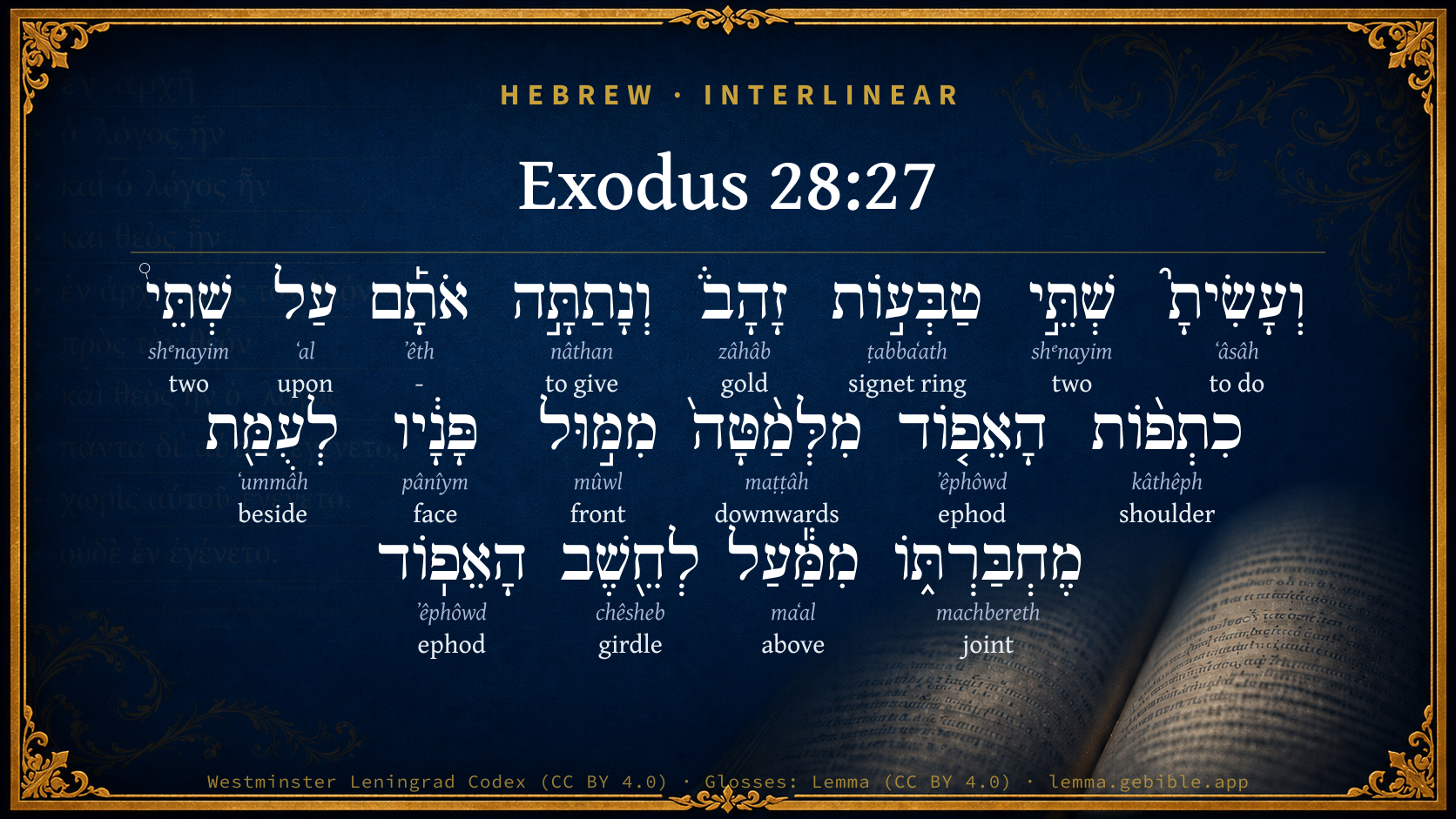
Hebrew (Westminster Leningrad Codex) Exodus 28:27 appears in the Hebrew Old Testament. The text above is from the Westminster Leningrad Codex. Each word links to its Strong’s number, a concise gloss, and parsing drawn from the Open Scriptures Hebrew Bible morphology. Click any word for its full Brown-Driver-Briggs (BDB) entry.
Download image
Cite this verse

Exodus 28:27 (World English Bible). Public Domain. Lemma interlinear Bible study tool, https://lemma.gebible.app/v/exodus/28/27.

Show BibTeX & RIS
BibTeX
RIS
English Translation
You shall make two rings of gold, and shall put them on the two shoulder-pieces of the ephod underneath, in the forepart of it, close by the coupling of it, above the skillfully woven band of the ephod.
World English Bible · Public Domain
Download a study sheet

One document with this verse’s original text, its word-by-word gloss line, the meaning frame, cross-references with their text, attributed commentary, and full source and license credits — printable, and it pastes into notes with its structure intact.

This verse Autodidact and up

Study sheet (.html) Plain text (.txt)

A passage Seminary Student

Up to 50 verses in one chapter. A passage sheet keeps up to 6 commentary sources and 12 cross-references per verse, in the order this page ranks them, and says so on the sheet whenever that leaves anything out. Ask for a single verse and you get the Autodidact verse sheet above.

Everything on this page stays free to read, with no account — the sheet is a download of what is already on screen, not access to it.

Want to remove ads? Support Godless Engineer
Compare translations 3

The same verse in 3 English versions, stacked beneath the original-language interlinear above. Click any original word for its lexicon entry.

Each is an independent rendering of the whole verse — the interlinear is not word-aligned to these translations.

Highlighted words mark where these versions differ — a whole-verse word diff, not a word-by-word alignment.

  • World English Bible Public Domain
    You shall make two rings of gold, and shall put them on the two shoulder-pieces of the ephod underneath, in the forepart of it, close by the coupling of it, above the skillfully woven band of the ephod.
  • King James Version Public Domain
    And two other rings of gold thou shalt make, and shalt put them on the two sides of the ephod underneath, toward the forepart thereof, over against the other coupling thereof, above the curious girdle of the ephod.
  • unfoldingWord Literal Text CC BY-SA 4.0
    And you shall make two rings of gold, and you shall put them on the two shoulder-pieces of the ephod on the bottom of the front of its face, close to its joining above the skillfully crafted waistband of the ephod.

unfoldingWord Literal Text — © unfoldingWord, licensed CC BY-SA 4.0. Word-aligned USFM3 via Door43 (git.door43.org/unfoldingWord/en_ult).

Versions to compare (up to 4)

3 of 4 selected

Show all 18 translations

Every available English version of this verse, each an independent rendering of the whole verse.

  • World English Bible Public Domain
    You shall make two rings of gold, and shall put them on the two shoulder-pieces of the ephod underneath, in the forepart of it, close by the coupling of it, above the skillfully woven band of the ephod.
  • Berean Standard Bible Public Domain
    Make two additional gold rings and attach them to the bottom of the two shoulder pieces of the ephod, on its front, near its seam just above its woven waistband.
  • Majority Standard Bible Public Domain
    Make two additional gold rings and attach them to the bottom of the two shoulder pieces of the ephod, on its front, near its seam just above its woven waistband.
  • King James Version Public Domain
    And two other rings of gold thou shalt make, and shalt put them on the two sides of the ephod underneath, toward the forepart thereof, over against the other coupling thereof, above the curious girdle of the ephod.
  • American Standard Version (1901) Public Domain
    And thou shalt make two rings of gold, and shalt put them on the two shoulder-pieces of the ephod underneath, in the forepart thereof, close by the coupling thereof, above the skilfully woven band of the ephod.
  • Revised Version (1885) Public Domain
    And thou shalt make two rings of gold, and shalt put them on the two shoulderpieces of the ephod underneath, in the forepart thereof, close by the coupling thereof, above the cunningly woven band of the ephod.
  • Geneva Bible (1599) Public Domain
    And two other rings of golde thou shalt make, and put them on the two sides of the Ephod, beneath in the forepart of it ouer against the coupling of it vpon the broydred garde of the Ephod.
  • Douay-Rheims (1899) Public Domain
    Moreover also other two rings of gold, which are to be set on each side of the ephod beneath, that looketh towards the nether joining, that the rational may be fitted with the ephod,
  • Young's Literal Translation Public Domain
    and thou hast made two rings of gold, and hast put them on the two shoulders of the ephod, beneath, over-against its front, over-against its joining, above the girdle of the ephod,
  • Literal Standard Version CC BY-SA 4.0
    and you have made two rings of gold, and have put them on the two shoulders of the ephod, from beneath, in front of its face, close by its joining, above the girdle of the ephod,
  • Unlocked Literal Bible CC BY-SA 4.0
    You must make two more gold rings, and you must attach them to the bottom of the two shoulder pieces of the front of the ephod, close to its seam above the finely-woven waistband of the ephod.
  • unfoldingWord Literal Text CC BY-SA 4.0
    And you shall make two rings of gold, and you shall put them on the two shoulder-pieces of the ephod on the bottom of the front of its face, close to its joining above the skillfully crafted waistband of the ephod.
  • Darby Bible Public Domain
    And two rings of gold shalt thou make, and shalt put them upon the two shoulder-pieces of the ephod underneath, to the front thereof just by the coupling thereof, above the girdle of the ephod.
  • World Messianic Bible Public Domain
    You shall make two rings of gold, and shall put them on the two shoulder straps of the ephod underneath, in its forepart, close by its coupling, above the skillfully woven band of the ephod.
  • Webster's Bible Public Domain
    And two other rings of gold thou shalt make, and shalt put them on the two sides of the ephod underneath, towards the forepart of it, over against the other coupling thereof, above the curious girdle of the ephod.
  • Free Bible Version CC BY-SA 4.0
    Make two more gold rings and attach them to the bottom of the two shoulder pieces of the front side of the ephod, near where it joins its woven waistband.
  • Bible in Basic English Public Domain
    And make two more gold rings and put them on the front of the ephod at the top of the arms, at the join, over the worked band:
  • JPS Tanakh (1917) Public Domain
    And thou shalt make two rings of gold, and shalt put them on the two shoulder-pieces of the ephod underneath, in the forepart thereof, close by the coupling thereof, above the skilfully woven band of the ephod.

Literal Standard Version (2020), Covenant Press — licensed CC BY-SA 4.0. Text via the HelloAO Bible API (eBible.org). Unlocked Literal Bible (unfoldingWord) — licensed CC BY-SA 4.0. Text via the HelloAO Bible API (eBible.org). unfoldingWord Literal Text — © unfoldingWord, licensed CC BY-SA 4.0. Word-aligned USFM3 via Door43 (git.door43.org/unfoldingWord/en_ult). Free Bible Version, Dr. Jonathan Gallagher — licensed CC BY-SA 4.0. Text via the HelloAO Bible API (eBible.org).

Word by word

More ways to search: Search by grammar → Find every occurrence → Compare this word →

Practice this passage: Drill this verse → Learn its vocabulary →

מֶחְבַּרְתּ֑וֹ
machbereth
H4225
“joint · his”
Noun, Common, Feminine, Singular, Construct + Suffix, Personal, 3rd Person, Masculine, Singular
Part of Speech
Noun
Type
Common
Gender
Feminine
Number
Singular
State
Construct
Full BDB Definition

Origin: from H2266

TWOT: 598j

thing joined, joint, seam, place of joining - thing joined - place of joining
  1. וְעָשִׂיתָ֮ ʻâsâh H6213 “and · to do” Conjunction + Verb, Qal, Sequential Perfect, 2nd Person, Masculine, Singular
  2. שְׁתֵּ֣י shᵉnayim H8147 “two” Adjective, Cardinal number, Feminine, Dual, Construct
  3. טַבְּע֣וֹת ṭabbaʻath H2885 “signet rings of” Noun, Common, Feminine, Plural, Construct
  4. זָהָב֒ zâhâb H2091 “gold” Noun, Common, Masculine, Singular, Absolute
  5. וְנָתַתָּ֣ה nâthan H5414 “and · to give” Conjunction + Verb, Qal, Sequential Perfect, 2nd Person, Masculine, Singular
  6. אֹתָ֡ם ʼêth H853 “- · them” Particle, Direct Object + Suffix, Personal, 3rd Person, Masculine, Plural
  7. עַל ʻal H5921 “upon” Preposition
  8. שְׁתֵּי֩ shᵉnayim H8147 “two” Adjective, Cardinal number, Feminine, Dual, Construct
  9. כִתְפ֨וֹת kâthêph H3802 “shoulders of” Noun, Common, Feminine, Plural, Construct
  10. הָאֵפ֤וֹד ʼêphôwd H646 “the · ephod” Particle, Definite Article + Noun, Common, Masculine, Singular, Absolute
  11. מִלְּמַ֨טָּה֙ maṭṭâh H4295 “from · to/for · downwards” Preposition + Preposition + Adverb
  12. מִמּ֣וּל mûwl H4136 “from · front” Preposition + Preposition
  13. פָּנָ֔יו pânîym H6440 “face(s) · his” Noun, Common, Both, Plural, Construct + Suffix, Personal, 3rd Person, Masculine, Singular
  14. לְעֻמַּ֖ת ʻummâh H5980 “to/for · beside of” Preposition + Noun, Common, Feminine, Singular, Construct
  15. מִמַּ֕עַל maʻal H4605 “from · above” Preposition + Adverb
  16. לְחֵ֖שֶׁב chêsheb H2805 “to/for · girdle of” Preposition + Noun, Common, Masculine, Singular, Construct
  17. הָאֵפֽוֹד ʼêphôwd H646 “the · ephod” Particle, Definite Article + Noun, Common, Masculine, Singular, Absolute

About this verse

These counts appear in no published source. They are computed here, from the morphology-tagged text and Lemma’s own curated glosses. What Lemma adds →

18
words
16
distinct lemmas
Pentateuch
section

Notable vocabulary

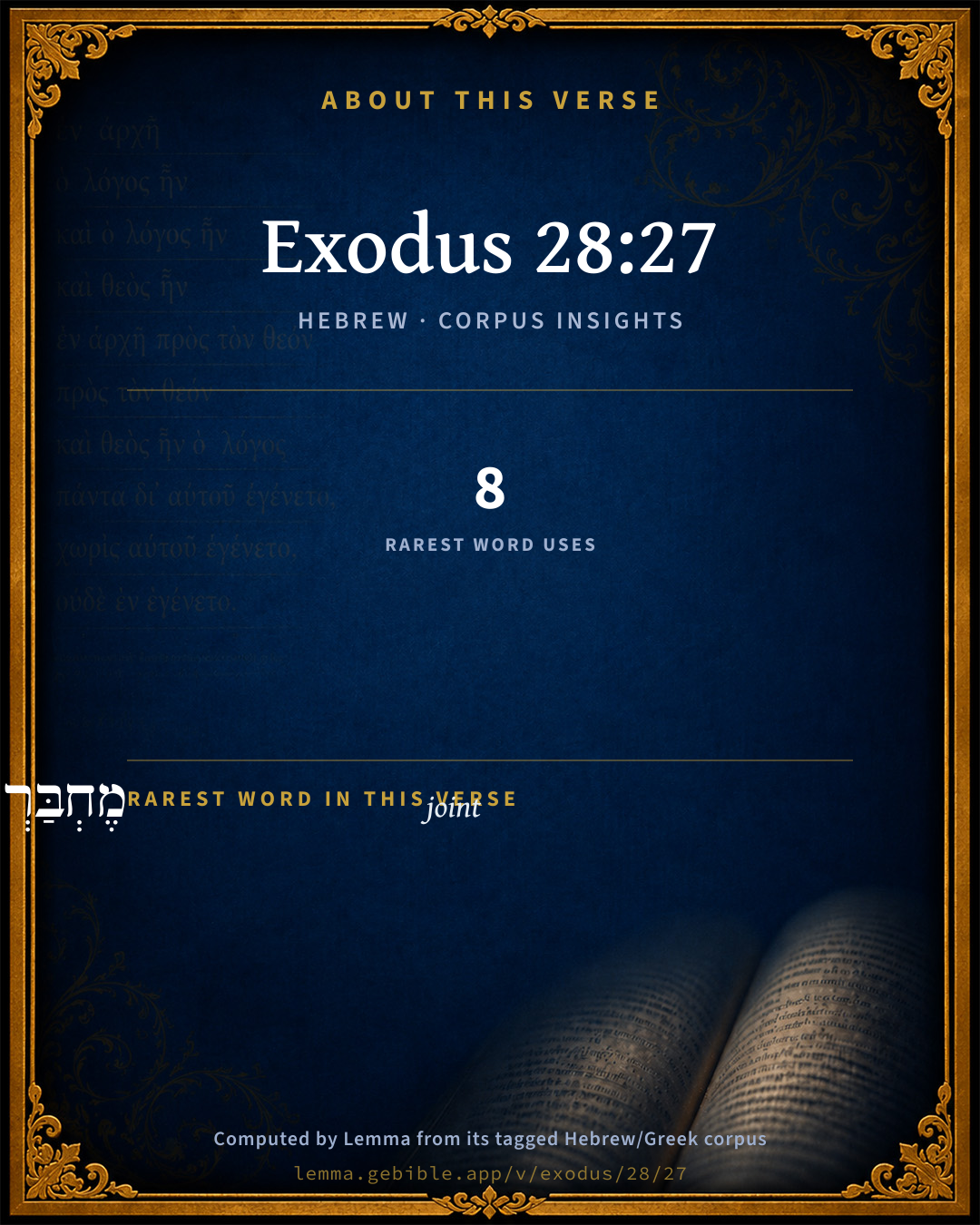
The rarest word here is מֶחְבַּרְתּ֑וֹ joint H4225 — appearing just 8 times in the whole Hebrew Bible.

Shared distinctive vocabulary

מֶחְבַּרְתּ֑וֹ joint H4225 occurs in 7 verses of the Hebrew Bible. Also found in:

Grammatical profile

  • 2 verbs
  • 9 nouns
  • 2 adjectives
  • 2 prepositions
  • 2 adverbs
  • 1 particle

Verb forms

  • וְעָשִׂיתָ֮ Qal · Sequential Perfect
  • וְנָתַתָּ֣ה Qal · Sequential Perfect

Repetition

Words recur within this verse — often emphatic in Hebrew:

  • שְׁתֵּ֣י two H8147 ×2
  • הָאֵפ֤וֹד ephod H646 ×2

Hebrew & Septuagint length

In English translation the verse runs 38 words from the Hebrew and 10 from the Septuagint (LXX English) — the Septuagint runs noticeably shorter here. See the side-by-side →

A rough comparison of the two English renderings, which tokenize alike — not a word-level alignment.

Word counts can differ between the Hebrew and the Greek without any difference in meaning — e.g. the Hebrew direct-object marker אֵת has no separate Greek word, and Greek often adds the article ὁ.

Hebrew and Greek witnesses Masoretic Hebrew ↔ Greek Septuagint

The same verse in the two great witnesses to the Old Testament, shown verse-for-verse.

Here the Septuagint runs noticeably shorter than the Hebrew — LXX2012 (modern English Septuagint) 10 words vs World English Bible 38. A rough length comparison of the two English translations, not a word-level alignment — read both below.

These are two independent witnesses, not word-aligned to each other, and the Septuagint is shown in lemma (dictionary) form.

Hebrew Exodus 28:27 Masoretic · Westminster Leningrad Codex

וְעָשִׂיתָ֮ שְׁתֵּ֣י טַבְּע֣וֹת זָהָב֒ וְנָתַתָּ֣ה אֹתָ֡ם עַל שְׁתֵּי֩ כִתְפ֨וֹת הָאֵפ֤וֹד מִלְּמַ֨טָּה֙ מִמּ֣וּל פָּנָ֔יו לְעֻמַּ֖ת מֶחְבַּרְתּ֑וֹ מִמַּ֕עַל לְחֵ֖שֶׁב הָאֵפֽוֹד

You shall make two rings of gold, and shall put them on the two shoulder-pieces of the ephod underneath, in the forepart of it, close by the coupling of it, above the skillfully woven band of the ephod.

World English Bible · Public Domain

Greek LXX Exodus 28:27 Septuagint · lemma form
And you shall make the full-length tunic all of blue.

LXX2012 (modern English Septuagint) · Public Domain

Hebrew: Westminster Leningrad Codex (CC BY 4.0). Greek: Septuagint (public domain); English from LXX2012 (modern English Septuagint) (Public Domain). How the Septuagint differs from the Hebrew →

Targum (Aramaic paraphrase)

2

The Targum is the ancient Jewish Aramaic paraphrase of the Hebrew Scriptures — an interpretive translation, not the Hebrew text itself. Onkelos (literal) and Pseudo-Jonathan (expansive) render the Torah, and Jonathan the Prophets. Coverage is partial: where no permissively-licensed English translation exists for a verse, only the Aramaic is shown. This is verse-level text, not a word-by-word alignment to the Hebrew.

  1. Targum Onkelos Torah (Genesis–Deuteronomy)
    וְתַעְבֵּד תַּרְתֵּין עִזְקָן דִדְהַב וְתִתֵּן יָתְהוֹן עַל תַּרְתֵּין כִּתְפֵּי אֵפוֹדָא מִלְרַע מִלְקֳבֵל אַפּוֹהִי לָקֳבֵל בֵּית לוֹפֵי מֵעִלָוֵי לְהֶמְיַן אֵפוֹדָא:

    (no public-domain English translation for this verse)

    Targum Onkelos — Aramaic: “Onkelos Genesis” (public domain); “Onkelos Exodus” (public domain); “Onkelos Leviticus” (public domain); “Onkelos Numbers” (public domain); “Onkelos Deuteronomy” (public domain). English: “Sefaria Community Translation” (CC0 1.0 (public-domain dedication)); “J.W. Etheridge. The Targums of Onkelos and Jonathan Ben Uzziel on the Pentateuch. London: Longmans, Green, 1862” (public domain). Text via Sefaria.

  2. Targum Pseudo-Jonathan Torah (Genesis–Deuteronomy)
    וְתַעֲבֵיד תַּרְתֵּין עִזְקַן דִּדְהַב וְתִתֵּן יַתְהוֹן עַל תְּרֵין כִּתְפֵי אֵפוֹדָא מִלְרַע מִקְבֵיל אַפּוֹי כָּל קְבֵיל בֵּית לוֹפֵי מֵעִילַוֵי לְהֶמְיַין אֵפוֹדָא

    And thou shalt make (likewise) two golden chains, and fix them upon the two shoulders of the ephod beneath, towards its front, towards the place of its conjoinment above the girdle of the ephod;

    Targum Pseudo-Jonathan — Aramaic: “Targum Jonathan on Genesis” (public domain); “Targum Jonathan on Exodus” (public domain); “Targum Jonathan on Leviticus” (public domain); “Targum Jonathan on Numbers” (public domain); “Targum Jonathan on Deuteronomy” (public domain). English: “The Targum of Jonathan ben Uzziel, trans. J. W. Etheridge, London, 1862” (public domain). Text via Sefaria.

Commentary

Notes on Exodus 28:27 from classic Christian and Jewish commentators (each source and its license shown beneath its notes). The classic Christian expositions comment on the surrounding passage and are grouped to its opening verse, so a note may address several verses; the Jewish commentaries on the Tanakh (Rashi and others) are per-verse, so they appear only where the commentator wrote on this verse.

Lemma curates 59 commentaries, every one of them public domain or Creative Commons licensed, each selected and text-cleaned for this edition rather than reprinted as found. About our sources →

Ellicott's Commentary for English Readers

(27, 28) Two gold rings were also to be sewn on to the ephod, low down and in front, so as just to appear above the “curious girdle of the ephod,” and the lower rings of the breastplate were to be laced to these rings by a “lace of blue.” The breastplate was thus securely attached to the ephod, and showed above the “curious girdle” without covering it.

A Bible Commentary for English Readers, edited by Charles John Ellicott (1878–1897) — public domain. Text from a community e-Sword module.

The Cambridge Bible for Schools and Colleges

gen. ed. J. J. S. Perowne

27. underneath, &c.] low down, in front of it.

close to its juncture (with the shoulder-straps), above the band of the ephod] The directions are not very clear: but the shoulder-straps seem to be continued down the front of the ephod, on its right and left sides, as far as the band (v. 8): the lower edge of the pouch was just above this band, and it was tied by the two pieces of blue lace to the rings in the shoulder-straps close to where these were sewn to the ephod.

The Cambridge Bible for Schools and Colleges (gen. ed. J. J. S. Perowne; Cambridge University Press, 1878–1918) — public domain. Text from a community e-Sword module.

John Gill's Exposition

And they shall bind the breastplate by the rings thereof,.... By the rings at the lower ends of it, as it was by the rings at the upper ends of it to the shoulder pieces of the ephod; or "lift it up", so some interpret it (w) as if it was said, they shall lift up the breastplate to join it with the ephod that is above it:

unto the rings of the ephod with a lace of blue; this blue lace was put both into the rings of the breastplate and into the rings of the ephod, and so being tied in a knot, fastened them together, as the shoulder pieces of the ephod and the breastplate were coupled above, with wreathen chains of gold put into rings: now this was done:

that it may be above the curious girdle of the ephod: that the breastplate might be above it, or else the lace of blue:

and that the breastplate be not loosed from the ephod: but be kept tight and close to it by the wreathen chains above, and by the knots of blue lace below; which may denote the conjunction of the prophetic and priestly offices in Christ; the former being signified by the breastplate of judgment, in which the Urim and Thummim were, and the latter by the ephod; or else the union of the saints to Christ, the bond of which is everlasting love, from which there can be no separation; this union can never be dissolved, his people can never be loosed from him, they are members of his body, and one spirit with him.

(w) R. Sol. Urbin. Ohel Moed, fol. 89. 2.

John Gill's Exposition of the Whole Bible (1746–1763) — public domain (CC PDM 1.0). Text via the HelloAO Bible API.

Matthew Poole's English Annotations

Two other rings, to answer the two rings in the breastplate, that by all these the breastplate might be the better fastened to the ephod.

On the two sides of the ephod underneath; in the lower part of the ephod, or in that part of it which is under the lowest part of the breastplate.

Toward the forepart thereof; towards the breast.

Over-against the other coupling thereof, i.e. over-against the ouches on the shoulder-pieces, where the upper part of the breastplate was fastened to the ephod.

Matthew Poole's English Annotations on the Holy Bible (1683–1685) — public domain. Text from a community e-Sword/MySword module.

The Pulpit Commentary

Over against the other coupling thereof. Rather, "near its joining." The "joining" of the ephod is perhaps the place where the "curious girdle" was woven on to it.

The Pulpit Commentary (1880–1919), ed. H.D.M. Spence-Jones & Joseph S. Exell — public domain. Text from a community e-Sword module.

Keil & Delitzsch

C. F. Keil & F. Delitzsch

Two golden rings were also to be put "upon the shoulder-pieces of the ephod underneath, toward the fore-part thereof, near the joining above the girdle of it," and to fasten the choshen from its (lower) rings to the (lower) rings of the ephod with threads of hyacinth, that it might be over the girdle (above it), and not move away (יזּח Niphal of זחח, in Arabic removit), i.e., that it might keep its place above the girdle and against the ephod without shifting.

Keil & Delitzsch — Biblical Commentary on the Old Testament (1861–1891) — public domain (CC PDM 1.0). Text via the HelloAO Bible API. (Old Testament only.)

unfoldingWord translationNotes

Door43 World Missions Community

General Information:

Yahweh continues to tell Moses what the people must do.

finely-woven waistband

This was a cloth belt made from narrow linen threads that someone twisted together to make a stronger thread. See how you translated this in Exodus 28:8.

so that it might be attached

This can be stated in active form. AT: "so that they may attach it" (See: Active or Passive)

the breastpiece might not become unattached from the ephod

This can be stated in positive form. AT: "the breastpiece would stay attached to the ephod" (See: Double Negatives)

translationWords

gold

ephod

breastplate

unfoldingWord translationNotes — © Distant Shores Media and the Door43 World Missions Community, licensed CC BY-SA 4.0. Source: git.door43.org/Door43/en_tn.

Rashi

Rabbi Shlomo Yitzchaki (Rashi)

על שתי כתפות האפוד מלמטה. ON THE TWO SHOULDER-PIECES OF THE EPHOD UNDERNEATH — underneath because the settings were placed on the upper ends of the shoulder-pieces of the ephod which came upon his shoulders beside his throat and which were folded over his shoulders and fell down in front of him; and the rings mentioned here He commanded to be put on the other end of each shoulder-piece which was joined on the ephod. This is the meaning of what is said לעמת מחברתו, “over against the joining thereof”, i. e. close by the spot where they were joined on to the ephod, namely, a little above the girdle, for the place of joining was over against the girdle. Thus these rings were placed a little above the place where the shoulder-straps began to rise from the girdle, and this is the meaning of what is said, “above the girdle of the ephod”. These were thus opposite (i. e. on a level with) the end (the lower edge) of the breastplate (but, of course, on the priest’s back, whilst the breast-plate lay in front of him). Now they placed a thread of blue purple in those rings and in the rings of the breast-plate and fastened them (the pair of rings) together by means of that thread on the right and on the left so that the lower edge of the breast-plate should not move forward and then return backward (should not move to and fro) and strike against his stomach. It followed, therefore, that it (the breast-plate) lay well upon the “Meil”.

ממול פניו TOWARDS THE FOREPART THEREOF — i. e. on the outer side.

Rashi on the Tanakh — English translations: “The Judaica Press complete Tanach with Rashi, translated by A. J. Rosenberg” (CC BY 4.0); “Pentateuch with Rashi's commentary by M. Rosenbaum and A.M. Silbermann, 1929-1934” (public domain); “The Metsudah Tanach series, Lakewood, N.J” (CC BY 4.0); and “The Book of Joshua, Metsudah Publications, 1997” (CC BY 4.0). Text via Sefaria.

Lesson kit

Teaching starters — assembled from the data on this page, not authored interpretation. Every prompt links to the verse data it draws on. Edit before teaching.

Exodus, in the Pentateuch, opens this verse with 18 words (16 distinct Hebrew lemmas). Its most distinctive word is machbereth (“joint”). The Greek Septuagint runs shorter here. A historical commentator’s framing appears above. Read the whole chapter for the surrounding context.

Discussion questions

  1. How does “joint” (machbereth) shape what this verse is saying?
  2. How does Exodus 26:4, which shares the word «joint», read alongside this verse?
  3. What does the repetition of “two” (2× in this one verse) do in this verse?
  4. The Septuagint runs shorter here than the Hebrew. What might account for the difference?
  5. These translations render this verse differently; the difference is in the English rendering, not the original. What questions does that raise?
  6. «וְעָשִׂיתָ֮» is a Qal Sequential Perfect verb. How does that grammatical form shape the action described?
  7. Compare how Ellicott's Commentary for English Readers and The Cambridge Bible for Schools and Colleges read this verse. Where do they agree or differ?

Things to notice

Reading settings

Reading text

Shown beneath each verse's original-language words.

Old Testament
Old Testament edition

Read the OT as the Masoretic Hebrew (MT) or the Greek Septuagint (LXX).

English shown for the Greek Septuagint (in the Hebrew ↔ Greek comparison).

Comparing translations? Open the Compare panel on any verse page to stack up to four side by side.