
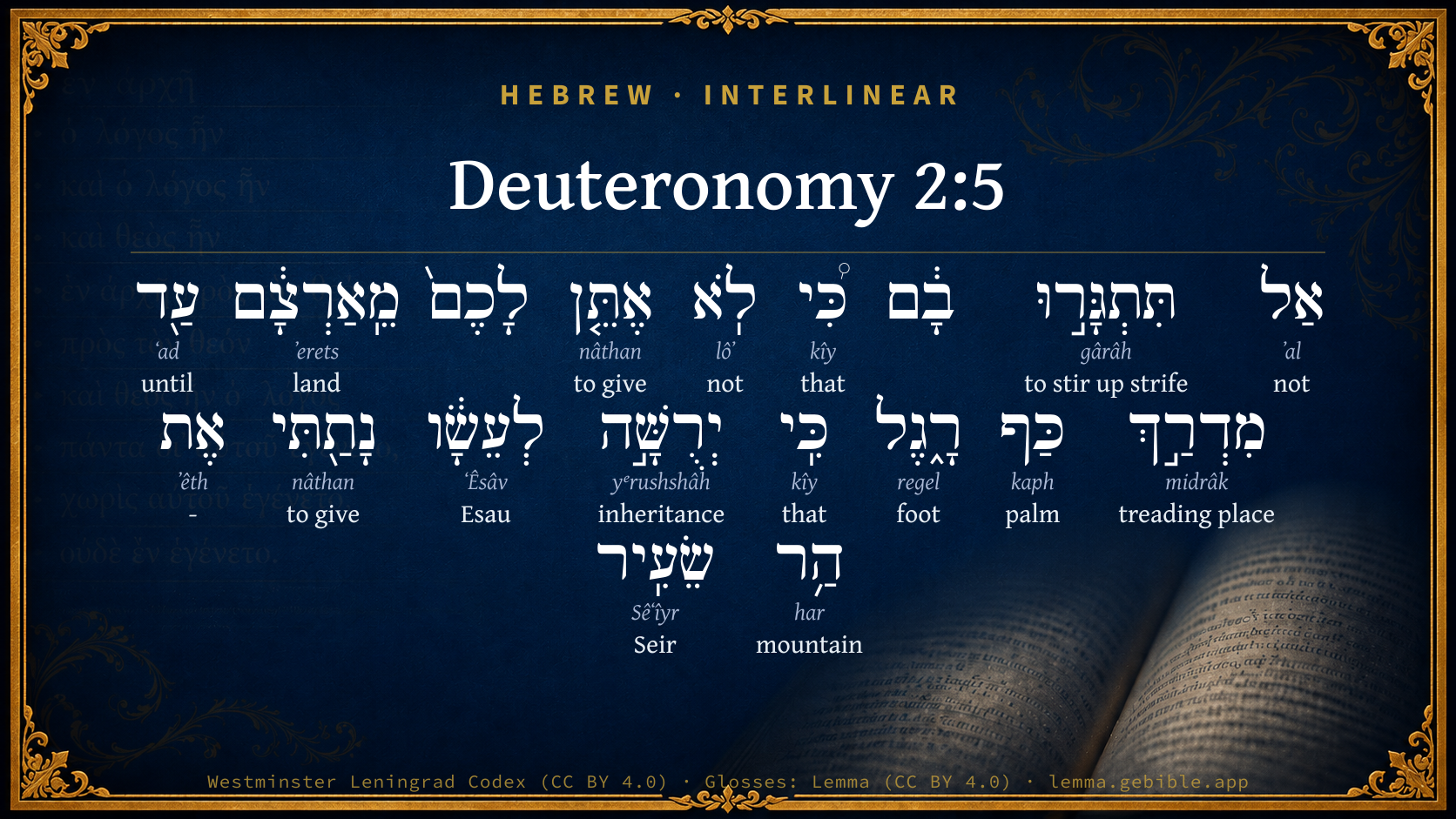
Deuteronomy 2:5

Hebrew (Westminster Leningrad Codex) Deuteronomy 2:5 appears in the Hebrew Old Testament. The text above is from the Westminster Leningrad Codex. Each word links to its Strong’s number, a concise gloss, and parsing drawn from the Open Scriptures Hebrew Bible morphology. Click any word for its full Brown-Driver-Briggs (BDB) entry.
Download image
Cite this verse

Deuteronomy 2:5 (World English Bible). Public Domain. Lemma interlinear Bible study tool, https://lemma.gebible.app/v/deuteronomy/2/5.

Show BibTeX & RIS
BibTeX
RIS
English Translation
don't contend with them; for I will not give you of their land, no, not so much as for the sole of the foot to tread on; because I have given Mount Seir to Esau for a possession.
World English Bible · Public Domain
Highlights
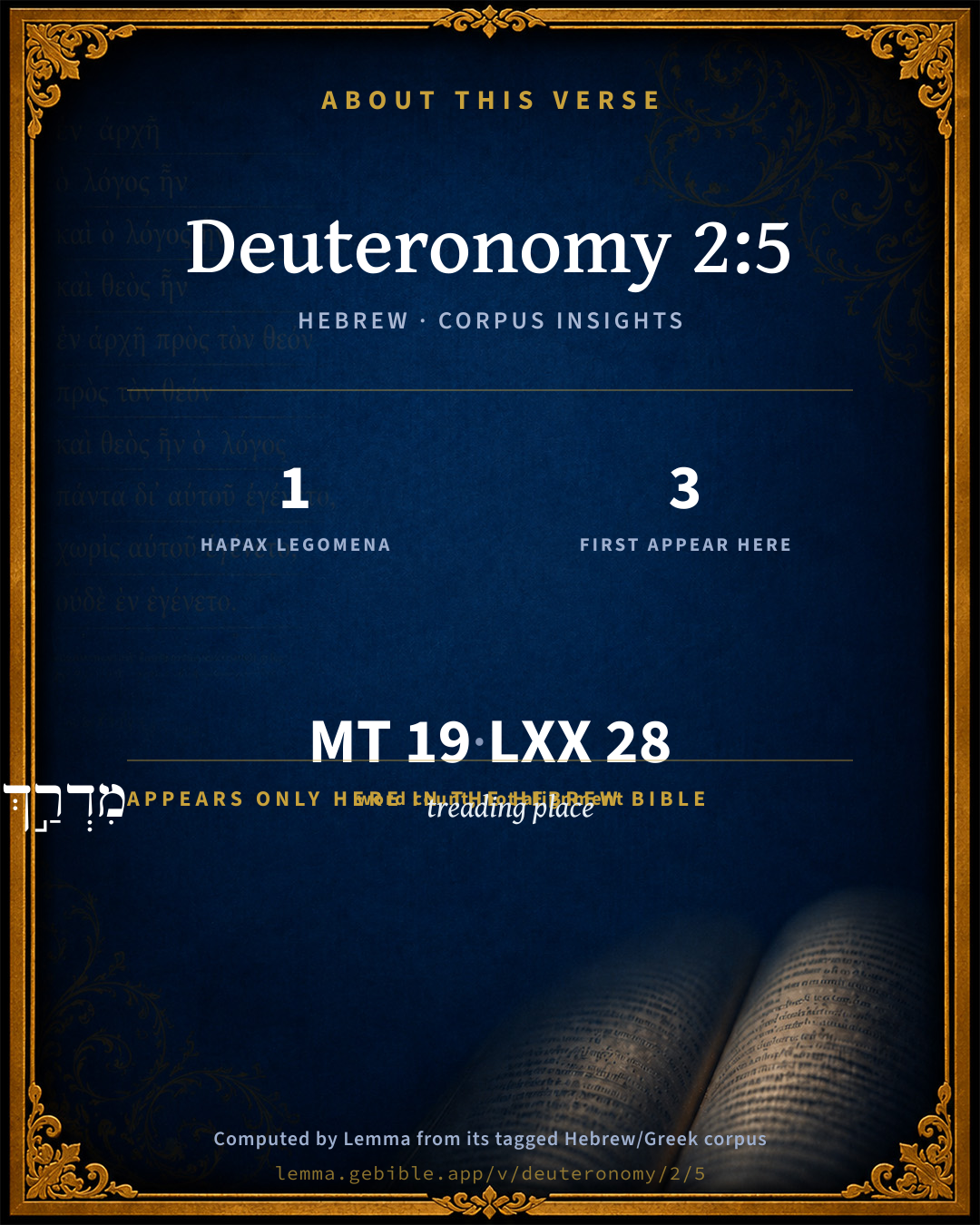
  • 1 hapax legomenon — only here in the Hebrew Bible
  • 3 first appearances in the Hebrew Bible
Full analysis ↓
Download a study sheet

One document with this verse’s original text, its word-by-word gloss line, the meaning frame, cross-references with their text, attributed commentary, and full source and license credits — printable, and it pastes into notes with its structure intact.

This verse Autodidact and up

Study sheet (.html) Plain text (.txt)

A passage Seminary Student

Up to 50 verses in one chapter. A passage sheet keeps up to 6 commentary sources and 12 cross-references per verse, in the order this page ranks them, and says so on the sheet whenever that leaves anything out. Ask for a single verse and you get the Autodidact verse sheet above.

Everything on this page stays free to read, with no account — the sheet is a download of what is already on screen, not access to it.

Want to remove ads? Support Godless Engineer
Compare translations 3

The same verse in 3 English versions, stacked beneath the original-language interlinear above. Click any original word for its lexicon entry.

Each is an independent rendering of the whole verse — the interlinear is not word-aligned to these translations.

Highlighted words mark where these versions differ — a whole-verse word diff, not a word-by-word alignment.

  • World English Bible Public Domain
    don't contend with them; for I will not give you of their land, no, not so much as for the sole of the foot to tread on; because I have given Mount Seir to Esau for a possession.
  • King James Version Public Domain
    Meddle not with them; for I will not give you of their land, no, not so much as a foot breadth; because I have given mount Seir unto Esau for a possession.
  • unfoldingWord Literal Text CC BY-SA 4.0
    You shall not fight them, for I will not give to you from their land, as as a step of the sole of a foot, for I have given Mount Seir to Esau a possession.

unfoldingWord Literal Text — © unfoldingWord, licensed CC BY-SA 4.0. Word-aligned USFM3 via Door43 (git.door43.org/unfoldingWord/en_ult).

Versions to compare (up to 4)

3 of 4 selected

Show all 18 translations

Every available English version of this verse, each an independent rendering of the whole verse.

  • World English Bible Public Domain
    don't contend with them; for I will not give you of their land, no, not so much as for the sole of the foot to tread on; because I have given Mount Seir to Esau for a possession.
  • Berean Standard Bible Public Domain
    Do not provoke them, for I will not give you any of their land, not even a footprint, because I have given Mount Seir to Esau as his possession.
  • Majority Standard Bible Public Domain
    Do not provoke them, for I will not give you any of their land, not even a footprint, because I have given Mount Seir to Esau as his possession.
  • King James Version Public Domain
    Meddle not with them; for I will not give you of their land, no, not so much as a foot breadth; because I have given mount Seir unto Esau for a possession.
  • American Standard Version (1901) Public Domain
    contend not with them; for I will not give you of their land, no, not so much as for the sole of the foot to tread on; because I have given mount Seir unto Esau for a possession.
  • Revised Version (1885) Public Domain
    contend not with them; for I will not give you of their land, no, not so much as for the sole of the foot to tread on: because I have given mount Seir unto Esau for a possession.
  • Geneva Bible (1599) Public Domain
    Ye shall not prouoke them: for I wil not giue you of their land so much as a foot breadth, because I haue giuen mount Seir vnto Esau for a possession.
  • Douay-Rheims (1899) Public Domain
    Take ye then good heed that you stir not against them. For I will not give you of their land so much as the step of one foot can tread upon, because I have given mount Seir to Esau, for a possession.
  • Young's Literal Translation Public Domain
    ye do not strive with them, for I do not give to you of their land even the treading of the sole of a foot; for a possession to Esau I have given mount Seir.
  • Literal Standard Version CC BY-SA 4.0
    you do not strive with them, for I do not give [any] of their land to you—even the treading of the sole of a foot; I have given Mount Seir to Esau for a possession.
  • Unlocked Literal Bible CC BY-SA 4.0
    not to fight with them, for I will not give you any of their land, no, not even enough for the sole of a foot to step on; for I have given Mount Seir to Esau as a possession.
  • unfoldingWord Literal Text CC BY-SA 4.0
    You shall not fight them, for I will not give to you from their land, as as a step of the sole of a foot, for I have given Mount Seir to Esau a possession.
  • Darby Bible Public Domain
    attack them not; for I will not give you of their land, no, not so much as a foot-breadth; for I have given mount Seir as a possession unto Esau.
  • World Messianic Bible Public Domain
    Don’t contend with them; for I will not give you any of their land, no, not so much as for the sole of the foot to tread on, because I have given Mount Seir to Esau for a possession.
  • Webster's Bible Public Domain
    Meddle not with them; for I will not give you of their land, no, not so much as a foot-breadth; because I have given mount Seir to Esau for a possession.
  • Free Bible Version CC BY-SA 4.0
    Don't fight them, for I'm not going to give you any of their land, not even the size of a footprint, because I have given Mount Seir to Esau and it belongs to him.
  • Bible in Basic English Public Domain
    Make no attack on them, for I will not give you any of their land, not even space enough for a man's foot: because I have given Mount Seir to Esau for his heritage.
  • JPS Tanakh (1917) Public Domain
    contend not with them; for I will not give you of their land, no, not so much as for the sole of the foot to tread on; because I have given mount Seir unto Esau for a possession.

Literal Standard Version (2020), Covenant Press — licensed CC BY-SA 4.0. Text via the HelloAO Bible API (eBible.org). Unlocked Literal Bible (unfoldingWord) — licensed CC BY-SA 4.0. Text via the HelloAO Bible API (eBible.org). unfoldingWord Literal Text — © unfoldingWord, licensed CC BY-SA 4.0. Word-aligned USFM3 via Door43 (git.door43.org/unfoldingWord/en_ult). Free Bible Version, Dr. Jonathan Gallagher — licensed CC BY-SA 4.0. Text via the HelloAO Bible API (eBible.org).

Word by word

More ways to search: Search by grammar → Find every occurrence → Compare this word →

Practice this passage: Drill this verse → Learn its vocabulary →

מִדְרַ֣ךְ
midrâk
H4096
“treading place of”
Noun, Common, Masculine, Singular, Construct
Part of Speech
Noun
Type
Common
Gender
Masculine
Number
Singular
State
Construct
Full BDB Definition

Origin: from H1869

TWOT: 453b

treading or stepping place, place to tread on
  1. אַל ʼal H408 “not” Particle, Negative
  2. תִּתְגָּר֣וּ gârâh H1624 “to stir up strife” Verb, Hithpael, Jussive, 2nd Person, Masculine, Plural
  3. כִּ֠י kîy H3588 “that” Conjunction
  4. לֹֽא lôʼ H3808 “not” Particle, Negative
  5. אֶתֵּ֤ן nâthan H5414 “to give” Verb, Qal, Imperfect, 1st Person, Common, Singular
  6. מֵֽאַרְצָ֔ם ʼerets H776 “from · land · their” Preposition + Noun, Common, Both, Singular, Construct + Suffix, Personal, 3rd Person, Masculine, Plural
  7. עַ֖ד ʻad H5704 “until” Preposition
  8. כַּף kaph H3709 “palm of” Noun, Common, Feminine, Singular, Construct
  9. רָ֑גֶל regel H7272 “foot” Noun, Common, Feminine, Singular, Absolute
  10. כִּֽי kîy H3588 “that” Conjunction
  11. יְרֻשָּׁ֣ה yᵉrushshâh H3425 “inheritance” Noun, Common, Feminine, Singular, Absolute
  12. לְעֵשָׂ֔ו ʻÊsâv H6215 “to/for · Esau” Preposition + Noun, Proper
  13. נָתַ֖תִּי nâthan H5414 “to give” Verb, Qal, Perfect, 1st Person, Common, Singular
  14. אֶת ʼêth H853 “-” Particle, Direct Object
  15. הַ֥ר har H2022 “mountain of” Noun, Common, Masculine, Singular, Construct
  16. שֵׂעִֽיר Sêʻîyr H8165 “Seir” Noun, Proper

About this verse

These counts appear in no published source. They are computed here, from the morphology-tagged text and Lemma’s own curated glosses. What Lemma adds →

19
words
15
distinct lemmas
Pentateuch
section

Notable vocabulary

1 hapax legomenon — a word that appears only here in the entire Hebrew Bible:

  • מִדְרַ֣ךְ treading place H4096

First appearance in Scripture

These words make their first canonical appearance in the Hebrew Bible here:

  • תִּתְגָּר֣וּ to stir up strife H1624
  • מִדְרַ֣ךְ treading place H4096
  • יְרֻשָּׁ֣ה inheritance H3425

Shared distinctive vocabulary

יְרֻשָּׁ֣ה inheritance H3425 occurs in 12 verses of the Hebrew Bible. Also found in:

Grammatical profile

  • 3 verbs
  • 8 nouns
  • 3 prepositions
  • 2 conjunctions
  • 3 particles

Verb forms

  • תִּתְגָּר֣וּ Hithpael · Jussive
  • אֶתֵּ֤ן Qal · Imperfect
  • נָתַ֖תִּי Qal · Perfect

Repetition

Words recur within this verse — often emphatic in Hebrew:

  • אֶתֵּ֤ן to give H5414 ×2
  • כִּ֠י that H3588 ×2

Hebrew & Septuagint length

In English translation the verse runs 38 words from the Hebrew and 37 from the Septuagint (LXX English) — closely comparable.

A rough comparison of the two English renderings, which tokenize alike — not a word-level alignment.

Word counts can differ between the Hebrew and the Greek without any difference in meaning — e.g. the Hebrew direct-object marker אֵת has no separate Greek word, and Greek often adds the article ὁ.

In the original languages it is 19 Hebrew tokens and 28 Greek tokens — but the two are counted differently (Hebrew bundles its prefixes and suffixes into one token; the Greek is in lemma form), so that isn’t a like-for-like length.

Cross-references

9

Topical passages linked to Deuteronomy 2:5 in the Treasury of Scripture Knowledge — connected by theme and wording, ordered by reader-vote popularity; previews shown in the World English Bible.

  • Genesis 36:8 Esau lived in the hill country of Seir. Esau is Edom.
  • Joshua 24:4 I gave to Isaac Jacob and Esau: and I gave to Esau Mount Seir, to possess it: and Jacob and his children went down into Egypt.
  • Deuteronomy 32:8 When the Most High gave to the nations their inheritance, When he separated the children of men, He set the bounds of the peoples According to the number of the children of Israel.
  • 2 Chronicles 20:10–12 Now, behold, the children of Ammon and Moab and Mount Seir, whom you would not let Israel invade, when they came out of the land of Egypt, but they turned aside from them, and didn't destroy them;
  • Jeremiah 27:5 I have made the earth, the men and the animals that are on the surface of the earth, by my great power and by my outstretched arm; and I give it to whom it seems right to me.
  • Daniel 4:25 that you shall be driven from men, and your dwelling shall be with the animals of the field, and you shall be made to eat grass as oxen, and shall be wet with the dew of the sky, and seven times shall pass over you; until you know that the Most High rules in the kingdom of men, and gives it to whoever he will.
  • Daniel 4:32 and you shall be driven from men; and they dwelling shall be with the animals of the field; you shall be made to eat grass as oxen; and seven times shall pass over you; until you know that the Most High rules in the kingdom of men, and gives it to whoever he will.
  • Acts 7:5 He gave him no inheritance in it, no, not so much as to set his foot on. He promised that he would give it to him for a possession, and to his seed after him, when he still had no child.
  • Acts 17:26 He made from one blood every nation of men to dwell on all the surface of the earth, having determined appointed seasons, and the boundaries of their dwellings,

Cross-references courtesy of OpenBible.info (CC BY 4.0).

Hebrew and Greek witnesses Masoretic Hebrew ↔ Greek Septuagint

The same verse in the two great witnesses to the Old Testament, shown verse-for-verse.

These are two independent witnesses, not word-aligned to each other, and the Septuagint is shown in lemma (dictionary) form.

Hebrew Deuteronomy 2:5 Masoretic · Westminster Leningrad Codex

אַל תִּתְגָּר֣וּ בָ֔ם כִּ֠י לֹֽא אֶתֵּ֤ן לָכֶם֙ מֵֽאַרְצָ֔ם עַ֖ד מִדְרַ֣ךְ כַּף רָ֑גֶל כִּֽי יְרֻשָּׁ֣ה לְעֵשָׂ֔ו נָתַ֖תִּי אֶת הַ֥ר שֵׂעִֽיר

don't contend with them; for I will not give you of their land, no, not so much as for the sole of the foot to tread on; because I have given Mount Seir to Esau for a possession.

World English Bible · Public Domain

Greek LXX Deuteronomy 2:5 Septuagint · lemma form

μή συνἅπτω πρός αὐτός πόλεμος οὐ γάρ μή δίδωμι σύ ἀπό ὁ γῆ αὐτός οὐδέ βῆμα πούς ὅτι ἐν κλῆρος δίδωμι ὁ υἱός ησαυ ὁ ὄρος ὁ σηιρ

Do not engage in war against them, for I will not give you of their land even enough to set your foot upon, for I have given mount Seir to the children of Esau as an inheritance.

LXX2012 (modern English Septuagint) · Public Domain

Hebrew: Westminster Leningrad Codex (CC BY 4.0). Greek: Septuagint (public domain); English from LXX2012 (modern English Septuagint) (Public Domain). How the Septuagint differs from the Hebrew →

Targum (Aramaic paraphrase)

2

The Targum is the ancient Jewish Aramaic paraphrase of the Hebrew Scriptures — an interpretive translation, not the Hebrew text itself. Onkelos (literal) and Pseudo-Jonathan (expansive) render the Torah, and Jonathan the Prophets. Coverage is partial: where no permissively-licensed English translation exists for a verse, only the Aramaic is shown. This is verse-level text, not a word-by-word alignment to the Hebrew.

  1. Targum Onkelos Torah (Genesis–Deuteronomy)
    לָא תִתְגָרוּן בְּהוֹן אֲרֵי לָא אֶתֵּן לְכוֹן מֵאַרְעֲהוֹן עַד מִדְרַךְ פַּרְסַת רִגְלָא אֲרֵי יְרֻתָּא לְעֵשָׂו יְהָבִית יָת טוּרָא דְשֵׂעִיר

    (no public-domain English translation for this verse)

    Targum Onkelos — Aramaic: “Onkelos Genesis” (public domain); “Onkelos Exodus” (public domain); “Onkelos Leviticus” (public domain); “Onkelos Numbers” (public domain); “Onkelos Deuteronomy” (public domain). English: “Sefaria Community Translation” (CC0 1.0 (public-domain dedication)); “J.W. Etheridge. The Targums of Onkelos and Jonathan Ben Uzziel on the Pentateuch. London: Longmans, Green, 1862” (public domain). Text via Sefaria.

  2. Targum Pseudo-Jonathan Torah (Genesis–Deuteronomy)
    לָא תִיתְגְּרוּן בְּהוֹן אֲרוּם לָא אֶתֵּן לְכוֹן מֵאַרְעַתְהוֹן עַד כְּמִיסַת פַּרְסַת רִיגְלָא אֲרוּם יְרוּתָא לְעֵשָו יְהָבִית יַת טַוְורָא דְגַבְלָא מְטוֹל אִיקָרָא דְעָבַד לַאֲבוֹי

    provoke them not; for of their land I have not given you as much as the sole of the foot; for I have given Mount Gebal an inheritance unto Esau on account of the honour which he did unto his father.

    Targum Pseudo-Jonathan — Aramaic: “Targum Jonathan on Genesis” (public domain); “Targum Jonathan on Exodus” (public domain); “Targum Jonathan on Leviticus” (public domain); “Targum Jonathan on Numbers” (public domain); “Targum Jonathan on Deuteronomy” (public domain). English: “The Targum of Jonathan ben Uzziel, trans. J. W. Etheridge, London, 1862” (public domain). Text via Sefaria.

Commentary

Notes on Deuteronomy 2:5 from classic Christian and Jewish commentators (each source and its license shown beneath its notes). The classic Christian expositions comment on the surrounding passage and are grouped to its opening verse, so a note may address several verses; the Jewish commentaries on the Tanakh (Rashi and others) are per-verse, so they appear only where the commentator wrote on this verse.

Lemma curates 59 commentaries, every one of them public domain or Creative Commons licensed, each selected and text-cleaned for this edition rather than reprinted as found. About our sources →

The Cambridge Bible for Schools and Colleges

gen. ed. J. J. S. Perowne

5. contend not with them] In its causative form the Heb. verb means to stir up, e.g. strife, Pro_15:18, etc.; here the reflex. form is to excite oneself against another, to quarrel with them. In the Pent. found only in this chapter, Deu_2:9; Deu_2:19; Deu_2:24.

for the sole of the foot to tread on] Deu_11:24; Jos_1:3.

I have given] Note the claim made by the God of Israel over other peoples (cp. Amo_1:3 to Amo_2:3, Amo_9:7), also the memory or tradition that on their entry to Canaan Israel had not violated the rights of their kinsfolk. There is no hostile feeling towards Edom, such as became irrepressible in Israel after the Exile.

for a possession] Heb. yerushshah, in the Hex. found only in this discourse, Deu_2:5; Deu_2:8; Deu_2:12; Deu_2:19 bis, Deu_3:20, and in the deuteronomic Jos_1:15; Jos_12:6-7.

The Cambridge Bible for Schools and Colleges (gen. ed. J. J. S. Perowne; Cambridge University Press, 1878–1918) — public domain. Text from a community e-Sword module.

Trapp's Complete Commentary

John Trapp

Deu 2:5 Meddle not with them; for I will not give you of their land, no, not so much as a foot breadth; because I have given mount Seir unto Esau [for] a possession.

Ver. 5. Because I have given mount Seir.] Thus the Most High divided to the nations their inheritance. {Deu 32:8} And a man must needs have some right to his inheritance, to his portion. {Psa 17:14} What Ananias had was his own whilst he had it, as Peter tells him; {Act 5:4} yet Satan had filled his heart. It is therefore a rigour to say, the wicked are usurpers of what they have, and shall be called to account for it. When the king gives a traitor his life, he gives him meat and drink that may maintain his life. That Duke of Alva is worthily taxed for a tyrant, that starved his prisoners, even after quarter; saying, though he promised to give them their lives, he did not promise to find them meat. {a} Wicked men have both a civil title to that they have, and a title before God, who will call them to account indeed at the last day, not for possessing what they had, but for abusing that possession.

{a} Grimston’s Hist. of Netherlands.

John Trapp, A Commentary or Exposition upon All the Books of the Old and New Testament (1647–1656) — public domain. Text from a community e-Sword module.

Tyndale Open Study Notes

Tyndale Open Resources

2:5 I have given them: God’s gift of a promised land was not limited to Israel. He also distributed lands to Edom, Moab (2:9), Ammon (2:19), and the Caphtorites (2:22-23). Although God had chosen Israel as a special nation (1:31; see also 7:6; 14:2; Exod 19:5), he is also the God of all nations and has a place and purpose for each (Deut 32:8; Acts 17:26)—even for those that do not recognize his sovereignty (Rom 1:16-23).

Tyndale Open Study Notes — © Tyndale Open Resources, licensed CC BY-SA 4.0. Text via the HelloAO Bible API.

Jamieson, Fausset & Brown

Robert Jamieson, A. R. Fausset & David Brown

Meddle not with them--that is, "which dwell in Seir" (Deu 2:4) --for there was another branch of Esau's posterity, namely, the Amalekites, who were to be fought against and destroyed (Gen 36:12; Exo 17:14; Deu 25:17). But the people of Edom were not to be injured, either in their persons or property. And although the approach of so vast a nomadic horde as the Israelites naturally created apprehension, they were to take no advantage of the prevailing terror to compel the Edomites to accept whatever terms they imposed. They were merely to pass "through" or along their border, and to buy meat and water of them for money (Deu 2:6). The people, kinder than their king, did sell them bread, meat, fruits, and water in their passage along their border (Deu 2:29), in the same manner as the Syrian caravan of Mecca is now supplied by the people of the same mountains, who meet the pilgrims as at a fair or market on the hadji route [ROBINSON]. Although the Israelites still enjoyed a daily supply of the manna, there was no prohibition against their eating other food when opportunity afforded. Only they were not to cherish an inordinate desire for it. Water is a scarce commodity and is often paid for by travellers in those parts. It was the more incumbent on the Israelites to do so, as, by the blessing of God, they possessed plenty of means to purchase, and the long-continued experience of the extraordinary goodness of God to them, should inspire such confidence in Him as would suppress the smallest thought of resorting to fraud or violence in supplying their wants.

Jamieson, Fausset & Brown — Commentary Critical and Explanatory on the Whole Bible (1871) — public domain (CC PDM 1.0). Text via the HelloAO Bible API.

Adam Clarke's Commentary

Verse 5. Meddle not with them] That is, the Edomites. See on Nu 20:14-21.

Adam Clarke's Commentary on the Bible (1810–1826) — public domain. Text from a community e-Sword/MySword module.

Ellicott's Commentary for English Readers

(5) I have given mount Seir unto Esau—It is worthy of notice that the development of Ishmael preceded that of Isaac, and the inheritance of Esau was won earlier than that of Jacob. (Comp. Gen_25:16 with Gen_35:23-26, and Gen_36:31 with Gen_37:1.) Isaac and Israel were still strangers and sojourners, while the Ishmaelites were princes, with towns and castles, and the Edomites dukes and kings.

A Bible Commentary for English Readers, edited by Charles John Ellicott (1878–1897) — public domain. Text from a community e-Sword module.

John Gill's Exposition

Contend not with them in battle, nor provoke them to it:

for I will not give you of their land, no not so much as a foot breadth; or as the sole of a man's foot can tread on, signifying that they should not have the least part of it, not any at all. Jarchi makes mention of an exposition of theirs, that he would give them nothing of it until should come the day of the treading of the sole of the foot in the mount of Olives, Zac 14:4, meaning not till the days of the Messiah, when Edom should be a possession of Israel; see Num 24:18, Oba 1:19.

because I have given Mount Seir unto Esau for a possession; and therefore not to be taken away from them; they have a right of inheritance of it; see Gen 36:8.

John Gill's Exposition of the Whole Bible (1746–1763) — public domain (CC PDM 1.0). Text via the HelloAO Bible API.

Albert Barnes' Notes on the Bible

I have given mount Seir to Esau - Though the descendants of Esau were conquered by David 2Sa 8:14, yet they were not dispossessed of their land, and in the reign of Jehoshaphat they regained their independence 2Ki 8:20-22.

Albert Barnes' Notes on the Bible (1834–1885) — public domain. Text from a community e-Sword/MySword module.

Haydock's Catholic Bible Commentary

Stir. Hebrew gur, meddle not, wage not war, do not molest, &c. The Idumeans near Mount Hor, afterwards refused the Hebrews a passage, and the necessaries of life, though their brethren in Mount Seir had granted them the latter, while they passed quietly along their borders, ver. 28. See Numbers xx. 21. (Haydock)

George Leo Haydock (1774–1849), Haydock's Catholic Family Bible and Commentary, 1859 edition — public domain. Excludes Psalms (Douay-Rheims chapter numbering differs from Protestant) and Deuterocanonical books (Catholic canon only).

Matthew Poole's English Annotations

Meddle not with them, to wit, in battle at this time.

Matthew Poole's English Annotations on the Holy Bible (1683–1685) — public domain. Text from a community e-Sword/MySword module.

Whedon's Commentary on the Bible

Daniel D. Whedon

5. I have given Mount Seir unto Esau — See Gen_33:16; Gen_36:8; Jos_24:4. The Edomites were subsequently conquered by David, 2Sa_8:14, but they were not deprived of their land. They afterward revolted and regained their independence. 2Ki_8:20.

Daniel D. Whedon (gen. ed.), Commentary on the Old and New Testaments (1874–1909) — public domain. Text from a community e-Sword module.

The Pulpit Commentary

Meddle not with them; literally, Excite not yourself against them, i.e. so as to strive in battle with them; comp. the use of the verb in Jer 1, "hast striven" (Authorized Version); mi, Dan_11:25 (where hmjl war, is added), "shall be stirred up to battle" (Authorized Version). Accordingly, they were enjoined to buy from them for money food and water as they required. Two different words in the Hebrew are rendered here by "buy" in the Authorized Version; the former, rbv a denominative from rbv, grain, properly means to deal in grain, whether as buyer or seller, and so to buy food; the latter, hrv means primarily to dig (a well, e.g., Gen_26:25) and, as used here, probably conveys the idea that the Israelites were to pay for permission to dig wells in the country of the Edomites to supply themselves with water as they passed along; this, however, does not necessarily follow from the use of this word, for it has also the meaning to buy. (comp. Hos_3:2, and the corresponding Arabic verb, kara, which in certain conjugations has the meaning to borrow or hire)

The Pulpit Commentary (1880–1919), ed. H.D.M. Spence-Jones & Joseph S. Exell — public domain. Text from a community e-Sword module.

Rashi

Rabbi Shlomo Yitzchaki (Rashi)

עד מדרך כף רגל — This means, Even מדרך כף רגל, as much as to say: even only treading with the feet (a single step). The text means, I do not permit you to pass into their land without their permission. — A Midrashic explanation is: I shall not give you of their land until there come the day of the treading of the sole of foot upon the Mount of Olives (the Messianic period), as it is said, (Zechariah 14:4) "And his feet shall stand [in that day upon the Mount of Olives etc.]”.

ירשה לעשו [I HAVE GIVEN MOUNT SEIR] TO ESAU AS AN INHERITANCE from Abraham. The territory of ten clans I gave (promised) him (Abraham); seven of them will be yours (the seven clans of Canaan), and the Kenites, the Kenizzites and the Kadmonites, — who are Ammon, Moab and Seir — one of them already belongs to Esau, and the other two to the children of Lot (cf. Genesis Rabbah 44:23; and Rashi on Genesis 15:19); as a reward because he (Lot) went with him (Abraham) To Egypt, and kept silent about what he said regarding his wife, “She is my sister”, he treated him as his son (and therefore he, through his children Amon and Moab, inherited part of the land promised to him) (cf. Rashi on Genesis 19:29 and Genesis Rabbah 51:6).

Rashi on the Tanakh — English translations: “The Judaica Press complete Tanach with Rashi, translated by A. J. Rosenberg” (CC BY 4.0); “Pentateuch with Rashi's commentary by M. Rosenbaum and A.M. Silbermann, 1929-1934” (public domain); “The Metsudah Tanach series, Lakewood, N.J” (CC BY 4.0); and “The Book of Joshua, Metsudah Publications, 1997” (CC BY 4.0). Text via Sefaria.

Lesson kit

Teaching starters — assembled from the data on this page, not authored interpretation. Every prompt links to the verse data it draws on. Edit before teaching.

Deuteronomy, in the Pentateuch, opens this verse with 19 words (15 distinct Hebrew lemmas). Its most distinctive word is midrâk (“treading place”). A historical commentator’s framing appears above. Read the whole chapter for the surrounding context.

Discussion questions

  1. The word midrâk carries the sense “treading place.” How does it shape the verse?
  2. This verse holds 1 word here found nowhere else in the Hebrew Bible. What might the rare word draw attention to?
  3. 3 words here appear for the first time in Scripture. What is being introduced at this debut?
  4. Deuteronomy 2:9 shares the word «inheritance» with this verse. How do the two illuminate each other?
  5. “to give” occurs 2× in this one verse. What is the effect of the repetition?
  6. These translations render this verse differently; the difference is in the English rendering, not the original. What questions does that raise?
  7. The verb «תִּתְגָּר֣וּ» is Hithpael Jussive. How does its form color the action?
  8. Reading how The Cambridge Bible for Schools and Colleges and Trapp's Complete Commentary read this verse, where do the two commentators agree and where do they part?

Things to notice

  • 1 word in this verse appears nowhere else in the Hebrew Bible.
  • 3 words make their first canonical appearance in Scripture here.
  • This verse counts 19 Hebrew ↔ 28 Greek words.
  • These translations choose different wording for 11 words in this verse.
  • “to give” occurs 2× in this single verse.

Reading settings

Reading text

Shown beneath each verse's original-language words.

Old Testament
Old Testament edition

Read the OT as the Masoretic Hebrew (MT) or the Greek Septuagint (LXX).

English shown for the Greek Septuagint (in the Hebrew ↔ Greek comparison).

Comparing translations? Open the Compare panel on any verse page to stack up to four side by side.