
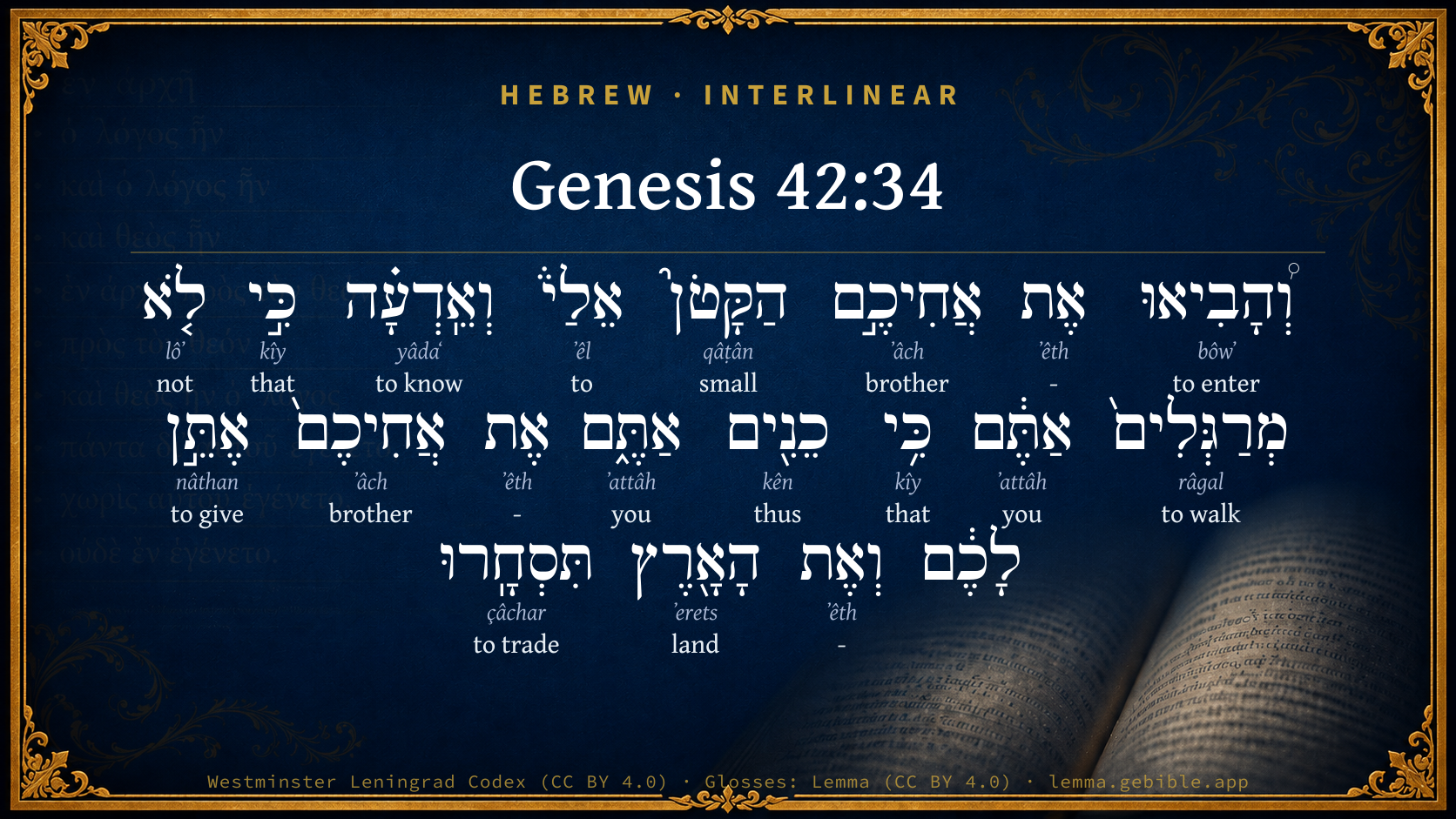
Genesis 42:34

Hebrew (Westminster Leningrad Codex) Genesis 42:34 appears in the Hebrew Old Testament. The text above is from the Westminster Leningrad Codex. Each word links to its Strong’s number, a concise gloss, and parsing drawn from the Open Scriptures Hebrew Bible morphology. Click any word for its full Brown-Driver-Briggs (BDB) entry.
Download image
Cite this verse

Genesis 42:34 (World English Bible). Public Domain. Lemma interlinear Bible study tool, https://lemma.gebible.app/v/genesis/42/34.

Show BibTeX & RIS
BibTeX
RIS
English Translation
Bring your youngest brother to me. Then I will know that you are not spies, but that you are honest men. So I will deliver your brother to you, and you shall trade in the land.'"
World English Bible · Public Domain
Download a study sheet

One document with this verse’s original text, its word-by-word gloss line, the meaning frame, cross-references with their text, attributed commentary, and full source and license credits — printable, and it pastes into notes with its structure intact.

This verse Autodidact and up

Study sheet (.html) Plain text (.txt)

A passage Seminary Student

Up to 50 verses in one chapter. A passage sheet keeps up to 6 commentary sources and 12 cross-references per verse, in the order this page ranks them, and says so on the sheet whenever that leaves anything out. Ask for a single verse and you get the Autodidact verse sheet above.

Everything on this page stays free to read, with no account — the sheet is a download of what is already on screen, not access to it.

Want to remove ads? Support Godless Engineer
Compare translations 3

The same verse in 3 English versions, stacked beneath the original-language interlinear above. Click any original word for its lexicon entry.

Each is an independent rendering of the whole verse — the interlinear is not word-aligned to these translations.

Highlighted words mark where these versions differ — a whole-verse word diff, not a word-by-word alignment.

  • World English Bible Public Domain
    Bring your youngest brother to me. Then I will know that you are not spies, but that you are honest men. So I will deliver your brother to you, and you shall trade in the land.'"
  • King James Version Public Domain
    And bring your youngest brother unto me: then shall I know that ye are no spies, but that ye are true men: so will I deliver you your brother, and ye shall traffic in the land.
  • unfoldingWord Literal Text CC BY-SA 4.0
    Then bring your youngest brother to me so that I will know that you not spies, that you honest. I will give your brother to you, and you trade the land.’”

unfoldingWord Literal Text — © unfoldingWord, licensed CC BY-SA 4.0. Word-aligned USFM3 via Door43 (git.door43.org/unfoldingWord/en_ult).

Versions to compare (up to 4)

3 of 4 selected

Show all 18 translations

Every available English version of this verse, each an independent rendering of the whole verse.

  • World English Bible Public Domain
    Bring your youngest brother to me. Then I will know that you are not spies, but that you are honest men. So I will deliver your brother to you, and you shall trade in the land.'"
  • Berean Standard Bible Public Domain
    But bring your youngest brother back to me so I will know that you are not spies but honest men. Then I will give your brother back to you, and you can trade in the land.’”
  • Majority Standard Bible Public Domain
    But bring your youngest brother back to me so I will know that you are not spies but honest men. Then I will give your brother back to you, and you can trade in the land.’”
  • King James Version Public Domain
    And bring your youngest brother unto me: then shall I know that ye are no spies, but that ye are true men: so will I deliver you your brother, and ye shall traffic in the land.
  • American Standard Version (1901) Public Domain
    and bring your youngest brother unto me: then shall I know that ye are no spies, but that ye are true men: so will I deliver you your brother, and ye shall traffic in the land.
  • Revised Version (1885) Public Domain
    and bring your youngest brother unto me: then shall I know that ye are no spies, but that ye are true men: so will I deliver you your brother, and ye shall traffick in the land.
  • Geneva Bible (1599) Public Domain
    And bring your yongest brother vnto me, that I may knowe that ye are no spies, but true men: so will I deliuer you your brother, and yee shall occupie in the land.
  • Douay-Rheims (1899) Public Domain
    And bring your youngest brother to me, that I may know you are not spies: and you may receive this man again, that is kept in prison: and afterwards may have leave to buy what you will.
  • Young's Literal Translation Public Domain
    and bring your young brother unto me, and I know that ye `are' not spies, but ye `are' right men; your brother I give to you, and ye trade with the land.'
  • Literal Standard Version CC BY-SA 4.0
    and bring your young brother to me, and I know that you [are] not spies, but you [are] right men; I give your brother to you, and you trade with the land.”
  • Unlocked Literal Bible CC BY-SA 4.0
    Bring your youngest brother to me. Then I will know that you are not spies, but that you are honest men. Then I will release your brother to you, and you will trade in the land.'”
  • unfoldingWord Literal Text CC BY-SA 4.0
    Then bring your youngest brother to me so that I will know that you not spies, that you honest. I will give your brother to you, and you trade the land.’”
  • Darby Bible Public Domain
    and bring your youngest brother to me, and I shall know that ye are not spies, but are honest. Your brother will I give up to you; and ye may trade in the land.
  • World Messianic Bible Public Domain
    Bring your youngest brother to me. Then I will know that you are not spies, but that you are honest men. So I will deliver your brother to you, and you shall trade in the land.’”
  • Webster's Bible Public Domain
    And bring your youngest brother to me: then shall I know that ye are no spies, but that ye are true men: then will I deliver to you your brother, and ye shall traffick in the land.
  • Free Bible Version CC BY-SA 4.0
    Then bring your youngest brother to me. That way I'll know you're not spies but you're telling the truth. I'll release your brother to you, and you can stay in the country and trade.’”
  • Bible in Basic English Public Domain
    And come back to me with your youngest brother: then I will be certain that you are true men, and I will give your brother back to you and let you do trade in the land.
  • JPS Tanakh (1917) Public Domain
    And bring your youngest brother unto me; then shall I know that ye are no spies, but that ye are upright men; so will I deliver you your brother, and ye shall traffic in the land.'

Literal Standard Version (2020), Covenant Press — licensed CC BY-SA 4.0. Text via the HelloAO Bible API (eBible.org). Unlocked Literal Bible (unfoldingWord) — licensed CC BY-SA 4.0. Text via the HelloAO Bible API (eBible.org). unfoldingWord Literal Text — © unfoldingWord, licensed CC BY-SA 4.0. Word-aligned USFM3 via Door43 (git.door43.org/unfoldingWord/en_ult). Free Bible Version, Dr. Jonathan Gallagher — licensed CC BY-SA 4.0. Text via the HelloAO Bible API (eBible.org).

Word by word

More ways to search: Search by grammar → Find every occurrence → Compare this word →

Practice this passage: Drill this verse → Learn its vocabulary →

תִּסְחָֽרוּ
çâchar
H5503
“to trade”
Verb, Qal, Imperfect, 2nd Person, Masculine, Plural
Part of Speech
Verb
Stem
Qal
Form
Imperfect
Person
2nd Person
Gender
Masculine
Number
Plural
Full BDB Definition

Origin: a primitive root

TWOT: 1486

to go around, go about, travel about in, go about in trade - (Qal) - to go about to and fro (in business) - trader, trafficker (participle) - (Pilpel) to palpitate
  1. וְ֠הָבִיאוּ bôwʼ H935 “and · enter” Conjunction + Verb, Hiphil, Imperative, 2nd Person, Masculine, Plural
  2. אֶת ʼêth H853 “-” Particle, Direct Object
  3. אֲחִיכֶ֣ם ʼâch H251 “brother · your” Noun, Common, Masculine, Singular, Construct + Suffix, Personal, 2nd Person, Masculine, Plural
  4. הַקָּטֹן֮ qâṭân H6996 “the · small” Particle, Definite Article + Adjective, Adjective, Masculine, Singular, Absolute
  5. אֵלַי֒ ʼêl H413 “to · me” Preposition + Suffix, Personal, 1st Person, Common, Singular
  6. וְאֵֽדְעָ֗ה yâdaʻ H3045 “and · to know” Conjunction + Verb, Qal, Cohortative, 1st Person, Common, Singular
  7. כִּ֣י kîy H3588 “that” Conjunction
  8. לֹ֤א lôʼ H3808 “not” Particle, Negative
  9. מְרַגְּלִים֙ râgal H7270 “walking” Verb, Piel, Participle Active, Masculine, Plural, Absolute
  10. אַתֶּ֔ם ʼattâh H859 “you” Pronoun, Personal, 2nd Person, Masculine, Plural
  11. כִּ֥י kîy H3588 “that” Conjunction
  12. כֵנִ֖ים kên H3651 “thus” Adjective, Adjective, Masculine, Plural, Absolute
  13. אַתֶּ֑ם ʼattâh H859 “you” Pronoun, Personal, 2nd Person, Masculine, Plural
  14. אֶת ʼêth H853 “-” Particle, Direct Object
  15. אֲחִיכֶם֙ ʼâch H251 “brother · your” Noun, Common, Masculine, Singular, Construct + Suffix, Personal, 2nd Person, Masculine, Plural
  16. אֶתֵּ֣ן nâthan H5414 “to give” Verb, Qal, Imperfect, 1st Person, Common, Singular
  17. וְאֶת ʼêth H853 “and · -” Conjunction + Particle, Direct Object
  18. הָאָ֖רֶץ ʼerets H776 “the · land” Particle, Definite Article + Noun, Common, Both, Singular, Absolute

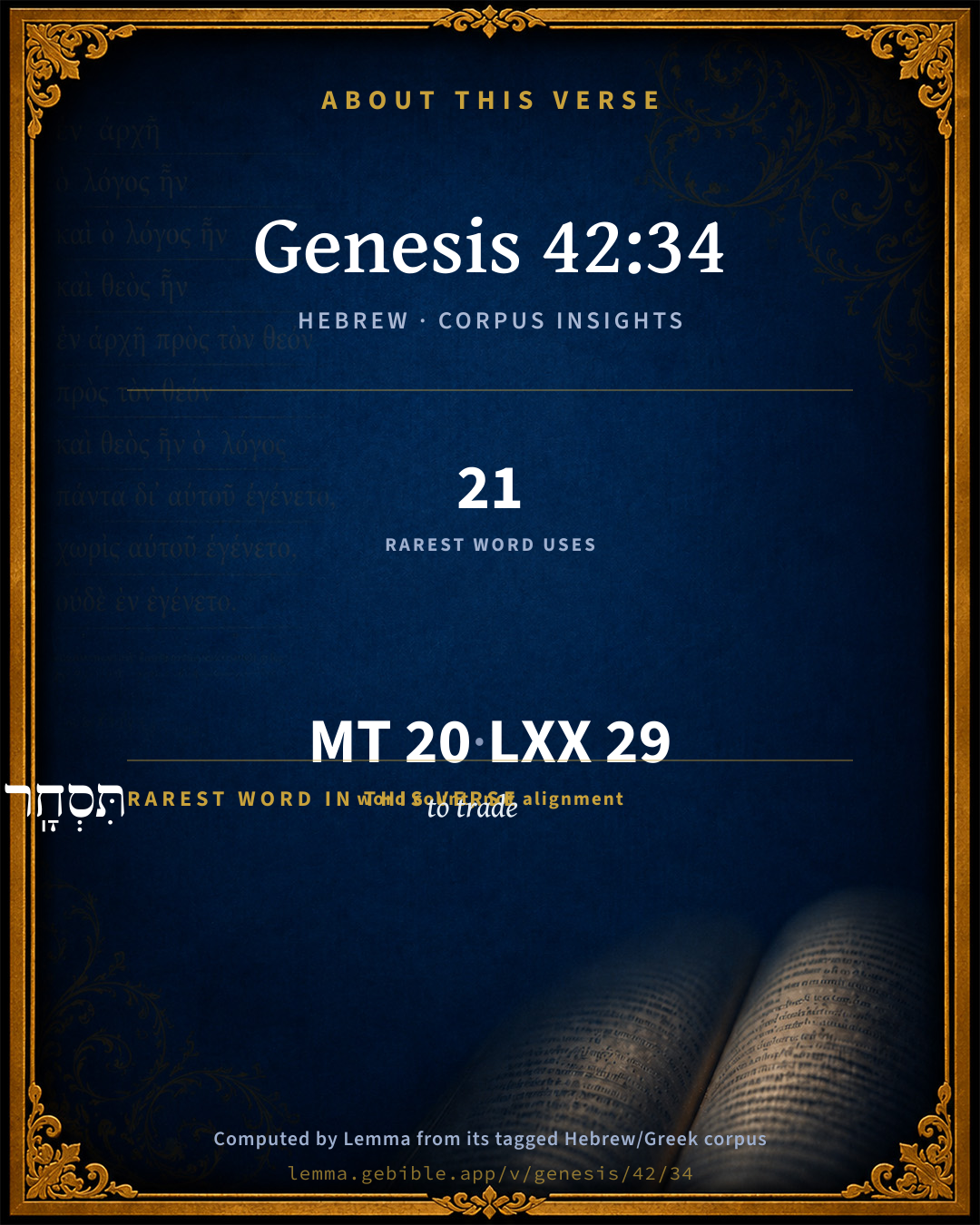
About this verse

These counts appear in no published source. They are computed here, from the morphology-tagged text and Lemma’s own curated glosses. What Lemma adds →

20
words
14
distinct lemmas
Pentateuch
section

Notable vocabulary

The rarest word here is תִּסְחָֽרוּ to trade H5503 — appearing just 21 times in the whole Hebrew Bible.

Shared distinctive vocabulary

תִּסְחָֽרוּ to trade H5503 occurs in 20 verses of the Hebrew Bible. Also found in:

Grammatical profile

  • 5 verbs
  • 3 nouns
  • 2 adjectives
  • 2 pronouns
  • 2 prepositions
  • 2 conjunctions
  • 4 particles

Verb forms

  • וְ֠הָבִיאוּ Hiphil · Imperative
  • וְאֵֽדְעָ֗ה Qal · Cohortative
  • מְרַגְּלִים֙ Piel · Participle Active
  • אֶתֵּ֣ן Qal · Imperfect
  • תִּסְחָֽרוּ Qal · Imperfect

Repetition

Words recur within this verse — often emphatic in Hebrew:

  • אֲחִיכֶ֣ם brother H251 ×2
  • כִּ֣י that H3588 ×2
  • אַתֶּ֔ם you H859 ×2

Hebrew & Septuagint length

In English translation the verse runs 36 words from the Hebrew and 37 from the Septuagint (LXX English) — closely comparable.

A rough comparison of the two English renderings, which tokenize alike — not a word-level alignment.

Word counts can differ between the Hebrew and the Greek without any difference in meaning — e.g. the Hebrew direct-object marker אֵת has no separate Greek word, and Greek often adds the article ὁ.

In the original languages it is 20 Hebrew tokens and 29 Greek tokens — but the two are counted differently (Hebrew bundles its prefixes and suffixes into one token; the Greek is in lemma form), so that isn’t a like-for-like length.

Cross-references

4

Topical passages linked to Genesis 42:34 in the Treasury of Scripture Knowledge — connected by theme and wording, ordered by reader-vote popularity; previews shown in the World English Bible.

  • Genesis 34:10 You shall dwell with us: and the land will be before you. Live and trade in it, and get possessions in it."
  • Genesis 34:21 "These men are peaceful with us. Therefore let them live in the land and trade in it. For, behold, the land is large enough for them. Let us take their daughters to us for wives, and let us give them our daughters.
  • 1 Kings 10:15 besides [that which] the traders [brought], and the traffic of the merchants, and of all the kings of the mixed people, and of the governors of the country.
  • Ezekiel 17:4 he cropped off the topmost of the young twigs of it, and carried it to a land of traffic; he set it in a city of merchants.

Cross-references courtesy of OpenBible.info (CC BY 4.0).

Hebrew and Greek witnesses Masoretic Hebrew ↔ Greek Septuagint

The same verse in the two great witnesses to the Old Testament, shown verse-for-verse.

These are two independent witnesses, not word-aligned to each other, and the Septuagint is shown in lemma (dictionary) form.

Hebrew Genesis 42:34 Masoretic · Westminster Leningrad Codex

וְ֠הָבִיאוּ אֶת אֲחִיכֶ֣ם הַקָּטֹן֮ אֵלַי֒ וְאֵֽדְעָ֗ה כִּ֣י לֹ֤א מְרַגְּלִים֙ אַתֶּ֔ם כִּ֥י כֵנִ֖ים אַתֶּ֑ם אֶת אֲחִיכֶם֙ אֶתֵּ֣ן לָכֶ֔ם וְאֶת הָאָ֖רֶץ תִּסְחָֽרוּ

Bring your youngest brother to me. Then I will know that you are not spies, but that you are honest men. So I will deliver your brother to you, and you shall trade in the land.'"

World English Bible · Public Domain

Greek LXX Genesis 42:34 Septuagint · lemma form

καί ἄγω πρός ἐγώ ὁ ἀδελφός σύ ὁ νέος καί γιγνώσκω ὅτι οὐ κατάσκοπος εἰμί ἀλλά ὅτι εἰρηνικός εἰμί καί ὁ ἀδελφός σύ ἀποδίδωμι σύ καί ὁ γῆ ἐνπορεύομαι

And bring to me your younger brother; then I shall know that you⌃ are not spies, but that you⌃ are men of peace: and I will restore you your brother, and you⌃ shall trade in the land.

LXX2012 (modern English Septuagint) · Public Domain

Hebrew: Westminster Leningrad Codex (CC BY 4.0). Greek: Septuagint (public domain); English from LXX2012 (modern English Septuagint) (Public Domain). How the Septuagint differs from the Hebrew →

Targum (Aramaic paraphrase)

2

The Targum is the ancient Jewish Aramaic paraphrase of the Hebrew Scriptures — an interpretive translation, not the Hebrew text itself. Onkelos (literal) and Pseudo-Jonathan (expansive) render the Torah, and Jonathan the Prophets. Coverage is partial: where no permissively-licensed English translation exists for a verse, only the Aramaic is shown. This is verse-level text, not a word-by-word alignment to the Hebrew.

  1. Targum Onkelos Torah (Genesis–Deuteronomy)
    וְאַיְתִיאוּ יָת אֲחוּכוֹן זְעֵירָא לְוָתִי וְאִדַּע אֲרֵי לָא אַלִּילֵי אַתּוּן אֲרֵי כֵיוָנֵי אַתּוּן יָת אֲחוּכוֹן אֶתֵּן לְכוֹן וְיָת אַרְעָא תַּעְבְּדוּן בַּהּ סְחוֹרְתָּא

    (no public-domain English translation for this verse)

    Targum Onkelos — Aramaic: “Onkelos Genesis” (public domain); “Onkelos Exodus” (public domain); “Onkelos Leviticus” (public domain); “Onkelos Numbers” (public domain); “Onkelos Deuteronomy” (public domain). English: “Sefaria Community Translation” (CC0 1.0 (public-domain dedication)); “J.W. Etheridge. The Targums of Onkelos and Jonathan Ben Uzziel on the Pentateuch. London: Longmans, Green, 1862” (public domain). Text via Sefaria.

  2. Targum Pseudo-Jonathan Torah (Genesis–Deuteronomy)
    וְאַיְתִיאוּ יַת אֲחוּכוֹן קַלִילָא לְוָתִי וְאִנְדַע אֲרוּם לָא אַלִילֵי אַתּוּן אֶלָא מְהֵימְנִי אַתּוּן יַת אֲחוּכוֹן אֶתֵּן לְכוֹן וְיַת אַרְעָא תִּתְגְרוּן בִּפְרַגְמַטְיָא

    and bring your youngest brother to me, and I shall know that you are not spies, but faithful. I will (then) restore your brother to you, and you shall transact business in the land.

    Targum Pseudo-Jonathan — Aramaic: “Targum Jonathan on Genesis” (public domain); “Targum Jonathan on Exodus” (public domain); “Targum Jonathan on Leviticus” (public domain); “Targum Jonathan on Numbers” (public domain); “Targum Jonathan on Deuteronomy” (public domain). English: “The Targum of Jonathan ben Uzziel, trans. J. W. Etheridge, London, 1862” (public domain). Text via Sefaria.

Commentary

Notes on Genesis 42:34 from classic Christian and Jewish commentators (each source and its license shown beneath its notes). The classic Christian expositions comment on the surrounding passage and are grouped to its opening verse, so a note may address several verses; the Jewish commentaries on the Tanakh (Rashi and others) are per-verse, so they appear only where the commentator wrote on this verse.

Lemma curates 59 commentaries, every one of them public domain or Creative Commons licensed, each selected and text-cleaned for this edition rather than reprinted as found. About our sources →

Trapp's Complete Commentary

John Trapp

Gen 42:34 And bring your youngest brother unto me: then shall I know that ye [are] no spies, but [that] ye [are] true [men: so] will I deliver you your brother, and ye shall traffick in the land.

Ver. 34. See Gen 42:9; Gen 42:11; Gen 42:13; Gen 42:19, &c

John Trapp, A Commentary or Exposition upon All the Books of the Old and New Testament (1647–1656) — public domain. Text from a community e-Sword module.

The Cambridge Bible for Schools and Colleges

gen. ed. J. J. S. Perowne

34. shall traffick in the land] The Vulg. paraphrases ac deinceps quae vultis emendi habeatis licentiam.

The Cambridge Bible for Schools and Colleges (gen. ed. J. J. S. Perowne; Cambridge University Press, 1878–1918) — public domain. Text from a community e-Sword module.

John Gill's Exposition

And he said, my son shall not go down with you,.... He gives a peremptory denial; this was his then present resolution and determination:

for his brother is dead; meaning Joseph, Benjamin's own brother by father and mother's side; him he supposed to be dead, such circumstances being related and produced, which made it highly probable, and he had not heard anything of him for twenty two years:

and he is left alone; Benjamin being the only surviving child of his dearly beloved Rachel, as he thought:

if mischief befall him by the way in which ye go; that is, to Egypt, whether by thieves and robbers, or by the fatigue of the journey, or by any means whatever, so that he loses his life. All the Targums interpret this mischief of death:

then shall ye bring down my gray heirs with sorrow to the grave; the sense is, should this be the case he should never lift up his head, or have any more comfort in this world, but should pass his time with continual sorrow until his gray head was laid in the grave, or till he came to the state of the dead.

Next: Genesis Chapter 43

John Gill's Exposition of the Whole Bible (1746–1763) — public domain (CC PDM 1.0). Text via the HelloAO Bible API.

Haydock's Catholic Bible Commentary

And you may, &c. Joseph had said, (ver. 20,) and you may not die, which they thus interpret. (Haydock)

George Leo Haydock (1774–1849), Haydock's Catholic Family Bible and Commentary, 1859 edition — public domain. Excludes Psalms (Douay-Rheims chapter numbering differs from Protestant) and Deuterocanonical books (Catholic canon only).

Rashi

Rabbi Shlomo Yitzchaki (Rashi)

ואת הארץ תסחרו AND YE SHALL TRAVEL IN THE LAND — It means literally, “ye may travel round the land”. All such words as סוחרים merchants, סחורה merchandise, are derived from this root סחר to go round, because the merchants travel round looking for merchandise.

Rashi on the Tanakh — English translations: “The Judaica Press complete Tanach with Rashi, translated by A. J. Rosenberg” (CC BY 4.0); “Pentateuch with Rashi's commentary by M. Rosenbaum and A.M. Silbermann, 1929-1934” (public domain); “The Metsudah Tanach series, Lakewood, N.J” (CC BY 4.0); and “The Book of Joshua, Metsudah Publications, 1997” (CC BY 4.0). Text via Sefaria.

Ramban (Nachmanides)

Rabbi Moshe ben Nachman (Ramban / Nachmanides)

AND YOU SHALL BE FREE (‘TIS’CHARU’) TO TRADE IN THE LAND. They altered it for the sake of peace so that Jacob would consent to send Benjamin along with them. It had been their desire to return immediately were it not that Jacob had said, My son shall not go down with you. Similarly, for the sake of peace, they told him Joseph’s words, ‘Leave’ one of your brothers with me, and they did not tell their father of their imprisonment or of Simeon’s imprisonment.It is possible that Joseph did tell them, And you shall be free to trade in the land, but Scripture does not relate it. If so, the intent of the statement is that “you will be able to bring merchandise at your will for the purpose of purchasing grain, and I will not take it, as compensation for your embarassment.” Similarly, their saying, The man persisted in asking about ourselves, and our family, constitutes a motivating plea to their father, [but the event never actually took place]. It may be that when they told Joseph, We are all one man’s sons, he said to them, “Not so, but you have truly come to find out the condition of the land. Now tell me if your father is alive, and if you have another brother, for I will investigate you and know what you are.” Then they said, “We are twelve brethren, the sons of one man who is presently in the land of Canaan, for he is still alive, and the youngest one is with him, and one is gone.” This was what Judah said to Joseph: My lord asked his servants, saying, Have you a father, or a brother? In a similar manner Scripture, in many places, is concise about an event or the recounting thereof, as I have mentioned. Now Rashi writes: “Tis’charu, you may travel round the land. All expressions of s’chorah (merchandise) and socharim (merchants) are derived from sochar, which means ‘going around,’ because the merchants go round looking for merchandise.”It would seem that the Rabbi [Rashi], Note 139. aimed by this interpretation to guard himself against this difficulty. in the land. Therefore, Rashi explained the word tis’charu as giving them the right to travel around the land and buy grain always without hindrance. He therefore explained their words as reporting only that Joseph had said that they would be permitted to travel around the land and always buy grain at their pleasure. But above, in the story of Shechem, Rashi did not so interpret the same expressions: Settle down ‘us’charuah’ (and engage in trade); ‘v’yis’charu othah’ (and engage in trade in it)., Verse 21.

Ramban (Nachmanides) on the Tanakh — English translation: “Commentary on the Torah by Ramban (Nachmanides). Translated and annotated by Charles B. Chavel. New York, Shilo Pub. House, 1971-1976” (CC BY 4.0). Text via Sefaria.

Lesson kit

Teaching starters — assembled from the data on this page, not authored interpretation. Every prompt links to the verse data it draws on. Edit before teaching.

Genesis, in the Pentateuch, opens this verse with 20 words (14 distinct Hebrew lemmas). Its most distinctive word is çâchar (“to trade”). A historical commentator’s framing appears above. Read the whole chapter for the surrounding context.

Discussion questions

  1. What does “to trade” (çâchar) contribute to the verse as a whole?
  2. How does Genesis 23:16, which shares the word «to trade», read alongside this verse?
  3. What does the repetition of “brother” (2× in this one verse) do in this verse?
  4. The translations on this page render this verse differently — a whole-verse word diff, not a word-by-word alignment. What might account for the different wordings?
  5. «וְ֠הָבִיאוּ» is a Hiphil Imperative verb. How does that grammatical form shape the action described?
  6. Compare how Trapp's Complete Commentary and The Cambridge Bible for Schools and Colleges read this verse. Where do they agree or differ?

Things to notice

Reading settings

Reading text

Shown beneath each verse's original-language words.

Old Testament
Old Testament edition

Read the OT as the Masoretic Hebrew (MT) or the Greek Septuagint (LXX).

English shown for the Greek Septuagint (in the Hebrew ↔ Greek comparison).

Comparing translations? Open the Compare panel on any verse page to stack up to four side by side.