
Genesis 41:48

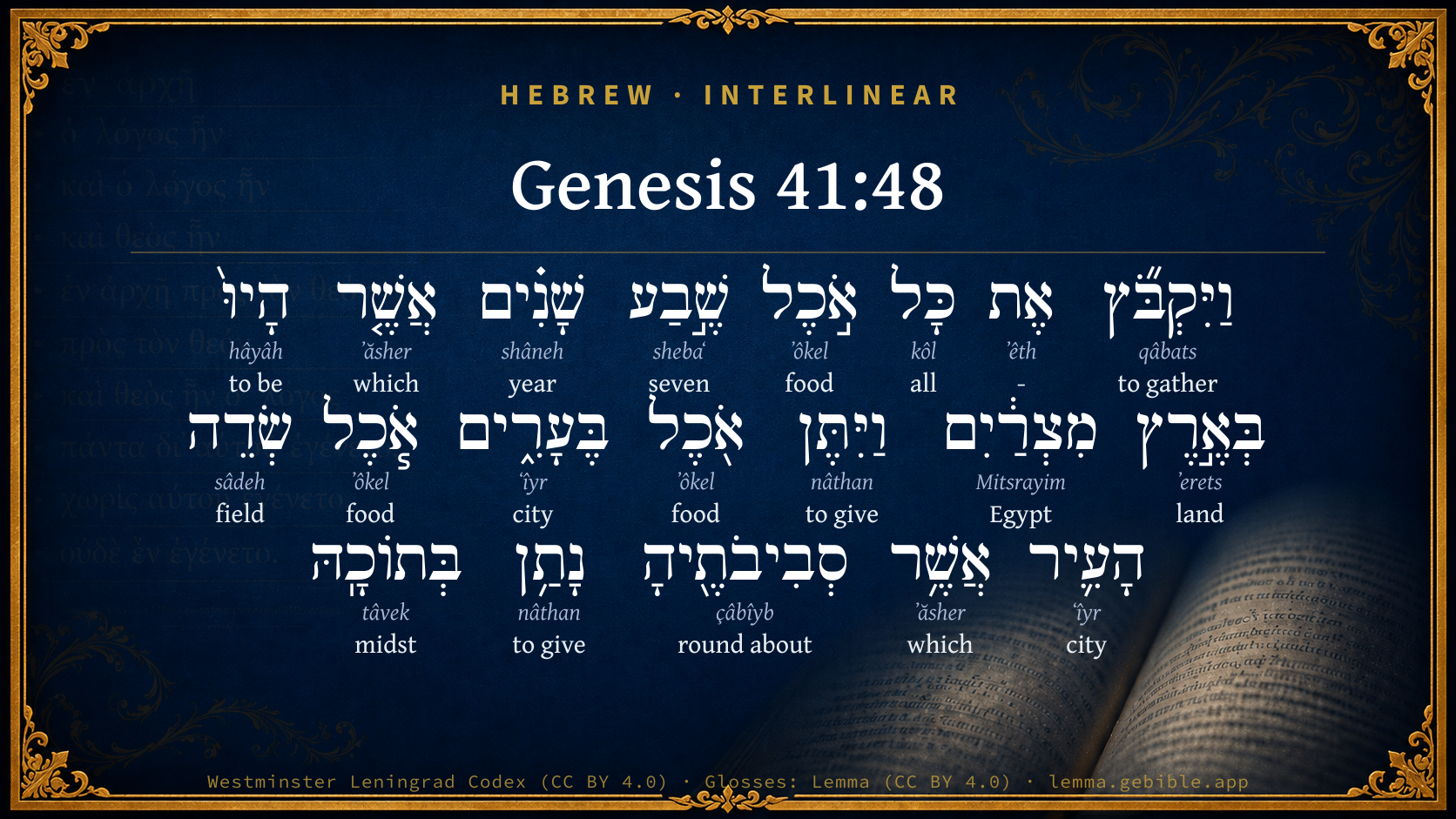
Hebrew (Westminster Leningrad Codex) Genesis 41:48 appears in the Hebrew Old Testament. The text above is from the Westminster Leningrad Codex. Each word links to its Strong’s number, a concise gloss, and parsing drawn from the Open Scriptures Hebrew Bible morphology. Click any word for its full Brown-Driver-Briggs (BDB) entry.
Download image
Cite this verse

Genesis 41:48 (World English Bible). Public Domain. Lemma interlinear Bible study tool, https://lemma.gebible.app/v/genesis/41/48.

Show BibTeX & RIS
BibTeX
RIS
English Translation
He gathered up all the food of the seven years which were in the land of Egypt, and laid up the food in the cities: the food of the field, which was round about every city, he laid up in the same.
World English Bible · Public Domain
Download a study sheet

One document with this verse’s original text, its word-by-word gloss line, the meaning frame, cross-references with their text, attributed commentary, and full source and license credits — printable, and it pastes into notes with its structure intact.

This verse Autodidact and up

Study sheet (.html) Plain text (.txt)

A passage Seminary Student

Up to 50 verses in one chapter. A passage sheet keeps up to 6 commentary sources and 12 cross-references per verse, in the order this page ranks them, and says so on the sheet whenever that leaves anything out. Ask for a single verse and you get the Autodidact verse sheet above.

Everything on this page stays free to read, with no account — the sheet is a download of what is already on screen, not access to it.

Want to remove ads? Support Godless Engineer
Compare translations 3

The same verse in 3 English versions, stacked beneath the original-language interlinear above. Click any original word for its lexicon entry.

Each is an independent rendering of the whole verse — the interlinear is not word-aligned to these translations.

Highlighted words mark where these versions differ — a whole-verse word diff, not a word-by-word alignment.

  • World English Bible Public Domain
    He gathered up all the food of the seven years which were in the land of Egypt, and laid up the food in the cities: the food of the field, which was round about every city, he laid up in the same.
  • King James Version Public Domain
    And he gathered up all the food of the seven years, which were in the land of Egypt, and laid up the food in the cities: the food of the field, which was round about every city, laid he up in the same.
  • unfoldingWord Literal Text CC BY-SA 4.0
    So he gathered all the food of the seven years that were in the land of Egypt, and he put the food in the cities. The food of the fields that surrounded city he put inside it.

unfoldingWord Literal Text — © unfoldingWord, licensed CC BY-SA 4.0. Word-aligned USFM3 via Door43 (git.door43.org/unfoldingWord/en_ult).

Versions to compare (up to 4)

3 of 4 selected

Show all 18 translations

Every available English version of this verse, each an independent rendering of the whole verse.

  • World English Bible Public Domain
    He gathered up all the food of the seven years which were in the land of Egypt, and laid up the food in the cities: the food of the field, which was round about every city, he laid up in the same.
  • Berean Standard Bible Public Domain
    During those seven years, Joseph collected all the excess food in the land of Egypt and stored it in the cities. In every city he laid up the food from the fields around it.
  • Majority Standard Bible Public Domain
    During those seven years, Joseph collected all the excess food in the land of Egypt and stored it in the cities. In every city he laid up the food from the fields around it.
  • King James Version Public Domain
    And he gathered up all the food of the seven years, which were in the land of Egypt, and laid up the food in the cities: the food of the field, which was round about every city, laid he up in the same.
  • American Standard Version (1901) Public Domain
    And he gathered up all the food of the seven years which were in the land of Egypt, and laid up the food in the cities: the food of the field, which was round about every city, laid he up in the same.
  • Revised Version (1885) Public Domain
    And he gathered up all the food of the seven years which were in the land of Egypt, and laid up the food in the cities: the food of the field, which was round about every city, laid he up in the same.
  • Geneva Bible (1599) Public Domain
    And hee gathered vp all the foode of the seuen plenteous yeeres, which were in the lande of Egypt, and layde vp foode in the cities: the foode of the fielde, that was round about euery citie, layde he vp in the same.
  • Douay-Rheims (1899) Public Domain
    (Now he was thirty years old when he stood before king Pharao) and he went round all the countries of Egypt.
  • Young's Literal Translation Public Domain
    And he gathereth all the food of the seven years which have been in the land of Egypt, and putteth food in the cities; the food of the field which `is' round about `each' city hath he put in its midst;
  • Literal Standard Version CC BY-SA 4.0
    And he gathers all the food of the seven years which have been in the land of Egypt, and puts food in the cities; the food of the field which [is] around [each] city has he put in its midst;
  • Unlocked Literal Bible CC BY-SA 4.0
    He gathered up all the food of the seven years that was in the land of Egypt and put the food in the cities. He put into each city the food from the fields that surrounded it.
  • unfoldingWord Literal Text CC BY-SA 4.0
    So he gathered all the food of the seven years that were in the land of Egypt, and he put the food in the cities. The food of the fields that surrounded city he put inside it.
  • Darby Bible Public Domain
    And he gathered up all the food of the seven years that was in the land of Egypt, and put the food in the cities; the food of the fields of the city, which were round about it, he laid up in it.
  • World Messianic Bible Public Domain
    He gathered up all the food of the seven years which were in the land of Egypt, and laid up the food in the cities. He stored food in each city from the fields around that city.
  • Webster's Bible Public Domain
    And he gathered all the food of the seven years which were in the land of Egypt, and laid up the food in the cities: the food of the field which was around every city, he laid up in the same.
  • Free Bible Version CC BY-SA 4.0
    He collected all the food during the seven good years, and he stored the grain produced in the local fields in each town.
  • Bible in Basic English Public Domain
    And Joseph got together all the food of those seven years, and made a store of food in the towns: the produce of the fields round every town was stored up in the town.
  • JPS Tanakh (1917) Public Domain
    And he gathered up all the food of the seven years which were in the land of Egypt, and laid up the food in the cities; the food of the field, which was round about every city, laid he up in the same.

Literal Standard Version (2020), Covenant Press — licensed CC BY-SA 4.0. Text via the HelloAO Bible API (eBible.org). Unlocked Literal Bible (unfoldingWord) — licensed CC BY-SA 4.0. Text via the HelloAO Bible API (eBible.org). unfoldingWord Literal Text — © unfoldingWord, licensed CC BY-SA 4.0. Word-aligned USFM3 via Door43 (git.door43.org/unfoldingWord/en_ult). Free Bible Version, Dr. Jonathan Gallagher — licensed CC BY-SA 4.0. Text via the HelloAO Bible API (eBible.org).

Word by word

More ways to search: Search by grammar → Find every occurrence → Compare this word →

Practice this passage: Drill this verse → Learn its vocabulary →

אֹ֣כֶל
ʼôkel
H400
“food of”
Noun, Common, Masculine, Singular, Construct
Part of Speech
Noun
Type
Common
Gender
Masculine
Number
Singular
State
Construct
Full BDB Definition

Origin: from H398

TWOT: 85a

food - cereal - meat - food supply - meal, dinner
  1. וַיִּקְבֹּ֞ץ qâbats H6908 “and · to gather” Conjunction + Verb, Qal, Sequential Imperfect, 3rd Person, Masculine, Singular
  2. אֶת ʼêth H853 “-” Particle, Direct Object
  3. כָּל kôl H3605 “all of” Noun, Common, Masculine, Singular, Construct
  4. שֶׁ֣בַע shebaʻ H7651 “seven” Adjective, Cardinal number, Feminine, Singular, Absolute
  5. שָׁנִ֗ים shâneh H8141 “years” Noun, Common, Feminine, Plural, Absolute
  6. אֲשֶׁ֤ר ʼăsher H834 “which” Particle, Relative
  7. הָיוּ֙ hâyâh H1961 “to be” Verb, Qal, Perfect, 3rd Person, Common, Plural
  8. בְּאֶ֣רֶץ ʼerets H776 “in/at · land of” Preposition + Noun, Common, Both, Singular, Construct
  9. מִצְרַ֔יִם Mitsrayim H4714 “Egypt” Noun, Proper
  10. וַיִּתֶּן nâthan H5414 “and · to give” Conjunction + Verb, Qal, Sequential Imperfect, 3rd Person, Masculine, Singular
  11. אֹ֖כֶל ʼôkel H400 “food” Noun, Common, Masculine, Singular, Absolute
  12. בֶּעָרִ֑ים ʻîyr H5892 “in/at the · cities” Preposition, Determined + Noun, Common, Feminine, Plural, Absolute
  13. אֹ֧כֶל ʼôkel H400 “food of” Noun, Common, Masculine, Singular, Construct
  14. שְׂדֵה sâdeh H7704 “field of” Noun, Common, Masculine, Singular, Construct
  15. הָעִ֛יר ʻîyr H5892 “the · city” Particle, Definite Article + Noun, Common, Feminine, Singular, Absolute
  16. אֲשֶׁ֥ר ʼăsher H834 “which” Particle, Relative
  17. סְבִיבֹתֶ֖יהָ çâbîyb H5439 “surroundings · her” Noun, Common, Both, Plural, Construct + Suffix, Personal, 3rd Person, Feminine, Singular
  18. נָתַ֥ן nâthan H5414 “to give” Verb, Qal, Perfect, 3rd Person, Masculine, Singular
  19. בְּתוֹכָֽהּ tâvek H8432 “in/at · midst · her” Preposition + Noun, Common, Masculine, Singular, Construct + Suffix, Personal, 3rd Person, Feminine, Singular

About this verse

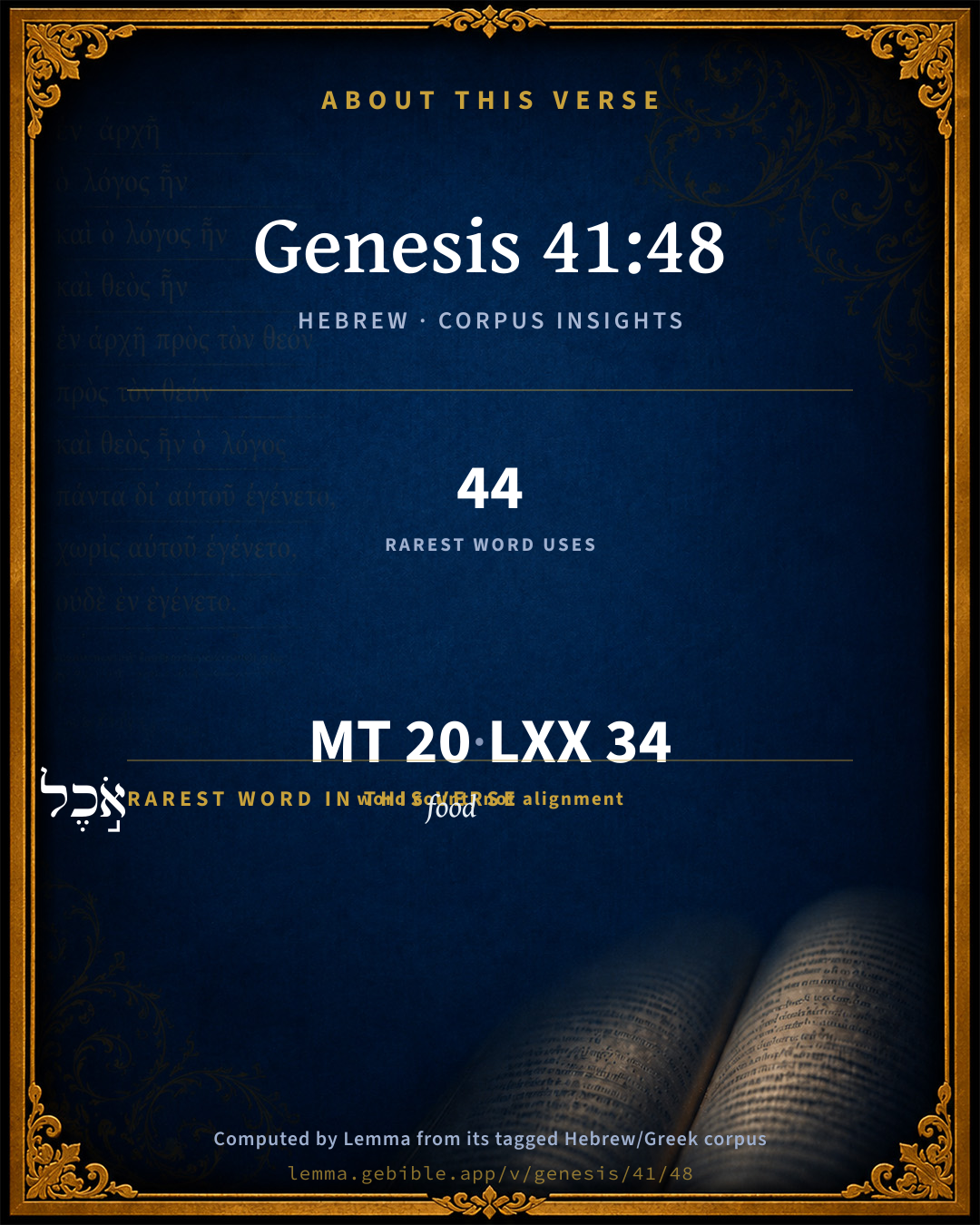
These counts appear in no published source. They are computed here, from the morphology-tagged text and Lemma’s own curated glosses. What Lemma adds →

20
words
15
distinct lemmas
Pentateuch
section

Shared distinctive vocabulary

אֹ֣כֶל food H400 occurs in 41 verses of the Hebrew Bible. Also found in:

Grammatical profile

  • 4 verbs
  • 12 nouns
  • 1 adjective
  • 3 particles

Verb forms

  • וַיִּקְבֹּ֞ץ Qal · Sequential Imperfect
  • הָיוּ֙ Qal · Perfect
  • וַיִּתֶּן Qal · Sequential Imperfect
  • נָתַ֥ן Qal · Perfect

Repetition

Words recur within this verse — often emphatic in Hebrew:

  • אֹ֣כֶל food H400 ×3
  • וַיִּתֶּן to give H5414 ×2
  • בֶּעָרִ֑ים city H5892 ×2
  • אֲשֶׁ֤ר which H834 ×2

Hebrew & Septuagint length

In English translation the verse runs 42 words from the Hebrew and 45 from the Septuagint (LXX English) — closely comparable.

A rough comparison of the two English renderings, which tokenize alike — not a word-level alignment.

Word counts can differ between the Hebrew and the Greek without any difference in meaning — e.g. the Hebrew direct-object marker אֵת has no separate Greek word, and Greek often adds the article ὁ.

In the original languages it is 20 Hebrew tokens and 34 Greek tokens — but the two are counted differently (Hebrew bundles its prefixes and suffixes into one token; the Greek is in lemma form), so that isn’t a like-for-like length.

Cross-references

2

Topical passages linked to Genesis 41:48 in the Treasury of Scripture Knowledge — connected by theme and wording, ordered by reader-vote popularity; previews shown in the World English Bible.

  • Genesis 41:34–36 Let Pharaoh do this, and let him appoint overseers over the land, and take up the fifth part of the land of Egypt's produce in the seven plenteous years.
  • Genesis 47:21 As for the people, he moved them to the cities from one end of the border of Egypt even to the other end of it.

Cross-references courtesy of OpenBible.info (CC BY 4.0).

Hebrew and Greek witnesses Masoretic Hebrew ↔ Greek Septuagint

The same verse in the two great witnesses to the Old Testament, shown verse-for-verse.

These are two independent witnesses, not word-aligned to each other, and the Septuagint is shown in lemma (dictionary) form.

Hebrew Genesis 41:48 Masoretic · Westminster Leningrad Codex

וַיִּקְבֹּ֞ץ אֶת כָּל אֹ֣כֶל שֶׁ֣בַע שָׁנִ֗ים אֲשֶׁ֤ר הָיוּ֙ בְּאֶ֣רֶץ מִצְרַ֔יִם וַיִּתֶּן אֹ֖כֶל בֶּעָרִ֑ים אֹ֧כֶל שְׂדֵה הָעִ֛יר אֲשֶׁ֥ר סְבִיבֹתֶ֖יהָ נָתַ֥ן בְּתוֹכָֽהּ

He gathered up all the food of the seven years which were in the land of Egypt, and laid up the food in the cities: the food of the field, which was round about every city, he laid up in the same.

World English Bible · Public Domain

Greek LXX Genesis 41:48 Septuagint · lemma form

καί συνἄγω πᾶς ὁ βρῶμα ὁ ἑπτά ἔτος ἐν ὅς εἰμί ὁ εὐθηνία ἐν γῆ αἴγυπτος καί τίθημι ὁ βρῶμα ἐν ὁ πόλις βρῶμα ὁ πεδίον ὁ πόλις ὁ κύκλος αὐτός τίθημι ἐν αὐτός

And he gathered all the food of the seven years, in which was the plenty in the land of Egypt; and he laid up the food in the cities; the food of the fields of a city round about it he laid up in it.

LXX2012 (modern English Septuagint) · Public Domain

On this verse, The Cambridge Bible for Schools and Colleges discusses the Septuagint’s reading. Read the note in Commentary ↓

Hebrew: Westminster Leningrad Codex (CC BY 4.0). Greek: Septuagint (public domain); English from LXX2012 (modern English Septuagint) (Public Domain). How the Septuagint differs from the Hebrew →

Targum (Aramaic paraphrase)

2

The Targum is the ancient Jewish Aramaic paraphrase of the Hebrew Scriptures — an interpretive translation, not the Hebrew text itself. Onkelos (literal) and Pseudo-Jonathan (expansive) render the Torah, and Jonathan the Prophets. Coverage is partial: where no permissively-licensed English translation exists for a verse, only the Aramaic is shown. This is verse-level text, not a word-by-word alignment to the Hebrew.

  1. Targum Onkelos Torah (Genesis–Deuteronomy)
    וּכְנַשׁ יָת כָּל עִיבוּר שְׁבַע שְׁנִין דִּי הֲווֹ בְּאַרְעָא דְמִצְרַיִם וִיהַב עִיבוּר בְּקִרְוַיָּא עִיבוּר חֲקַל קַרְתָּא דִּי בְסַחְרָנָהָא יְהַב בְּגַוָּהּ

    (no public-domain English translation for this verse)

    Targum Onkelos — Aramaic: “Onkelos Genesis” (public domain); “Onkelos Exodus” (public domain); “Onkelos Leviticus” (public domain); “Onkelos Numbers” (public domain); “Onkelos Deuteronomy” (public domain). English: “Sefaria Community Translation” (CC0 1.0 (public-domain dedication)); “J.W. Etheridge. The Targums of Onkelos and Jonathan Ben Uzziel on the Pentateuch. London: Longmans, Green, 1862” (public domain). Text via Sefaria.

  2. Targum Pseudo-Jonathan Torah (Genesis–Deuteronomy)
    וּכְנַשׁ יַת כָּל עִיבּוּר שְׁבַע שְׁנֵי שׁוּבְעָא דַהֲווֹ בְּאַרְעָא דְמִצְרַיִם וִיהַב עִיבּוּרָא בְּקִרְוַיָא עִבּוּר חַקְלֵי קַרְתָּא דִבְחוֹזְרָנָהָא כְּנַשׁ בְּגַוָוהּ

    And they gathered all the produce of the seven years of plenty which were in the land of Mizraim, and he laid up the produce in the cities; the produce of the fields which were round about a city he laid up therein.

    Targum Pseudo-Jonathan — Aramaic: “Targum Jonathan on Genesis” (public domain); “Targum Jonathan on Exodus” (public domain); “Targum Jonathan on Leviticus” (public domain); “Targum Jonathan on Numbers” (public domain); “Targum Jonathan on Deuteronomy” (public domain). English: “The Targum of Jonathan ben Uzziel, trans. J. W. Etheridge, London, 1862” (public domain). Text via Sefaria.

Commentary

Notes on Genesis 41:48 from classic Christian and Jewish commentators (each source and its license shown beneath its notes). The classic Christian expositions comment on the surrounding passage and are grouped to its opening verse, so a note may address several verses; the Jewish commentaries on the Tanakh (Rashi and others) are per-verse, so they appear only where the commentator wrote on this verse.

Lemma curates 59 commentaries, every one of them public domain or Creative Commons licensed, each selected and text-cleaned for this edition rather than reprinted as found. About our sources →

Trapp's Complete Commentary

John Trapp

Gen 41:48 And he gathered up all the food of the seven years, which were in the land of Egypt, and laid up the food in the cities: the food of the field, which [was] round about every city, laid he up in the same.

Ver. 48. And laid up the food in the cities.] He provided storehouses for every city; so they needed not to travel far. It is our happiness that we have the Word, that bread of life, brought homo to us. Yet some are so wretched, that unless God will set up a pulpit at the ale house door, they will not come to hear him. They will run to hell as fast as they can; and if God cannot catch them they care not, they will not return.

John Trapp, A Commentary or Exposition upon All the Books of the Old and New Testament (1647–1656) — public domain. Text from a community e-Sword module.

Jamieson, Fausset & Brown

Robert Jamieson, A. R. Fausset & David Brown

he gathered up all the food of the seven years--It gives a striking idea of the exuberant fertility of this land, that, from the superabundance of the seven plenteous years, corn enough was laid up for the subsistence, not only of its home population, but of the neighboring countries, during the seven years of dearth.

Jamieson, Fausset & Brown — Commentary Critical and Explanatory on the Whole Bible (1871) — public domain (CC PDM 1.0). Text via the HelloAO Bible API.

Ellicott's Commentary for English Readers

(48) All the food.—Probably besides the fifth paid as tax to the king, and out of which all the current expenses of the realm would have to be provided, Joseph bought corn largely during these years when it was at its cheapest.

A Bible Commentary for English Readers, edited by Charles John Ellicott (1878–1897) — public domain. Text from a community e-Sword module.

The Cambridge Bible for Schools and Colleges

gen. ed. J. J. S. Perowne

47–49 (J, E). The seven Good Years

48. of the seven years] Probably we should add here, with LXX and Sam., “of plenty,” which seems to have dropped out of the Hebrew text.

laid up the food] On the state granaries of Egypt and the duties of the official who supervised them, the student is referred to Erman’s Life in Ancient Egypt (E.T.), p. 108. The chief “cities” of the districts, or νομοί, into which Egypt was divided, seem here to be referred to.

The Cambridge Bible for Schools and Colleges (gen. ed. J. J. S. Perowne; Cambridge University Press, 1878–1918) — public domain. Text from a community e-Sword module.

John Gill's Exposition

And the name of the second called he Ephraim,.... Which signifies fruits or fruitfulness; and being of the dual number, may intend both his spiritual and temporal fruitfulness God had blessed him with:

for God hath caused me to be fruitful in the land of my affliction; in the land of Egypt, where he had been long afflicted, even for the space of thirteen years, more or less, in his master's house, and in the prison; but God had made him fruitful in grace and good works, in holiness, humility, &c. and oftentimes afflictive seasons are the most fruitful ones in this sense. God also bestowed great gifts upon him, as skill in the interpretation of dreams, wisdom in political affairs, a large abundance of wealth, and riches, honour and glory; to which may be added, the fruit of his body, his two children.

John Gill's Exposition of the Whole Bible (1746–1763) — public domain (CC PDM 1.0). Text via the HelloAO Bible API.

Matthew Poole's English Annotations

All the food; that is, either all sorts of grain which was proper for food; or all which he intended to gather, to wit, the fifth part, Gen 41:34.

Matthew Poole's English Annotations on the Holy Bible (1683–1685) — public domain. Text from a community e-Sword/MySword module.

unfoldingWord translationNotes

Door43 World Missions Community

He gathered up ... He put

Here "He" stands for Joseph's servants. AT: "Joseph ordered his servants to gather ... They put" (See: Synecdoche)

Joseph stored up grain like the sand of the sea

This compares the grain to the sand of sea to emphasize its great quantity. AT: "The grain that Joseph stored was as plentiful as the sand on the seashore" (See: Metaphor)

Joseph stored up ... he stopped

Here "Joseph" and "he" stand for Joseph's servants. AT: "Joseph had his servants store up ... they stopped" (See: Synecdoche)

translationWords

Egypt

grain

unfoldingWord translationNotes — © Distant Shores Media and the Door43 World Missions Community, licensed CC BY-SA 4.0. Source: git.door43.org/Door43/en_tn.

Rashi

Rabbi Shlomo Yitzchaki (Rashi)

אכל שדה העיר אשר סביבתיה נתן בתוכה THE FOOD OF THE FIELD WHICH WAS ROUND ABOUT EVERY CITY LAID HE UP IN THE SAME — for every district preserves its own produce; and for this people always put amongst the grain some of the earth of the place in which it grows and this prevents it decaying (Genesis Rabbah 90:5).

Rashi on the Tanakh — English translations: “The Judaica Press complete Tanach with Rashi, translated by A. J. Rosenberg” (CC BY 4.0); “Pentateuch with Rashi's commentary by M. Rosenbaum and A.M. Silbermann, 1929-1934” (public domain); “The Metsudah Tanach series, Lakewood, N.J” (CC BY 4.0); and “The Book of Joshua, Metsudah Publications, 1997” (CC BY 4.0). Text via Sefaria.

Ramban (Nachmanides)

Rabbi Moshe ben Nachman (Ramban / Nachmanides)

AND HE STORED UP ALL THE FOOD. “He” refers to Joseph mentioned above. The same applies to the following verse: And Joseph piled up grain… until he ceased numbering. The pronoun “he” refers to Joseph, who was mentioned.Now Rabbi Abraham ibn Ezra said that the phrase, all the food, is not to be understood literally, for otherwise they would have died of famine immediately. A similar case is the verse, And all the lands came into Egypt to Joseph to buy grain. The meaning of he stored up all the food is only that Joseph stored up all the food which he could.It appears to me to be correct that Joseph gathered all food under his control, and he gave enough of it every year for sustenance to the Egyptians, so that they should not squander it. This is the intent of his statement, And let them store up all the food of those good years that come, and pile up corn under the hand of Pharaoh… and hold it there. (food) and bar (corn). At the end of the paragraph, he will mention that Onkelos makes no distinction between them. Now in view of the fact that it says, And let them store up all the food… and pile up corn, (food) and bar (corn). At the end of the paragraph, he will mention that Onkelos makes no distinction between them. and [here in the verses before us] it says, And he stored up all the food… And Joseph piled up grain, this would indicate that he gathered whatever is eaten by man; corn, bread, and all food essential to life, even figs, fresh and dried, and similar things. He piled the corn — meaning the produce which is brought under a winnowing shovel and fan for fanning and cleansing — under the hand of Pharaoh, and he laid up in the cities enough of all the fruits for sustenance. Thus all the food was held in need for the years of famine to be drawn upon to the degree essential for life, and the balance of the corn he preserved in the storehouses.It is possible that Joseph paid them money from the royal treasures at a low market price. This was why the corn belonged to Pharaoh, and he sold it to them in the years of famine, just as it is written, And Joseph collected all the money that was found in the land of Egypt. It is possible that the king took it by force, saying: “I preserved it.” Onkelos, however, translated both ochel (food) and bar (corn) alike.. See Note 111.

Ramban (Nachmanides) on the Tanakh — English translation: “Commentary on the Torah by Ramban (Nachmanides). Translated and annotated by Charles B. Chavel. New York, Shilo Pub. House, 1971-1976” (CC BY 4.0). Text via Sefaria.

Radak

Rabbi David Kimhi (Radak)

ויקבוץ את כל אוכל, we already explained this on verse 35.

ויתן אכל בערים, he built all the storage silos in the towns and not in the villages. The twenty percent of the harvest the farmers in the villages had to turn in, Joseph stored in the cities.

Radak on the Tanakh — English translations: “Sefaria Community Translation” (CC0 1.0 (public-domain dedication)); “Eliyahu Munk, HaChut Hameshulash” (CC BY 4.0); “Rabbi Mike Feuer, Jerusalem Anthology” (CC BY 4.0); and “R. David Kimhi on the first book of Psalms, Translated by R.G. Finch, London, 1919” (public domain). Text via Sefaria.

Ibn Ezra

Rabbi Abraham ibn Ezra

All the food. That is, all that was possible to gather without causing the people to starve.

Ibn Ezra on the Tanakh — English translations: “Sefaria Community Translation” (CC0 1.0 (public-domain dedication)); “Yalkut, Sifsei Chachomim Chumash, Metsudah Publications, 2009” (CC BY 4.0); and “Commentary of Ibn Ezra on Isaiah - trans. by M. Friedlander, 1873” (public domain). Text via Sefaria.

Lesson kit

Teaching starters — assembled from the data on this page, not authored interpretation. Every prompt links to the verse data it draws on. Edit before teaching.

Genesis, in the Pentateuch, opens this verse with 20 words (15 distinct Hebrew lemmas). Its most distinctive word is ʼôkel (“food”). A historical commentator’s framing appears above. Read the whole chapter for the surrounding context.

Discussion questions

  1. What does “food” (ʼôkel) contribute to the verse as a whole?
  2. How does Genesis 14:11, which shares the word «food», read alongside this verse?
  3. What does the repetition of “food” (3× in this one verse) do in this verse?
  4. These translations render this verse differently; the difference is in the English rendering, not the original. What questions does that raise?
  5. «וַיִּקְבֹּ֞ץ» is a Qal Sequential Imperfect verb. How does that grammatical form shape the action described?
  6. Compare how Trapp's Complete Commentary and Jamieson, Fausset & Brown read this verse. Where do they agree or differ?

Things to notice

Reading settings

Reading text

Shown beneath each verse's original-language words.

Old Testament
Old Testament edition

Read the OT as the Masoretic Hebrew (MT) or the Greek Septuagint (LXX).

English shown for the Greek Septuagint (in the Hebrew ↔ Greek comparison).

Comparing translations? Open the Compare panel on any verse page to stack up to four side by side.