Exodus 22:30

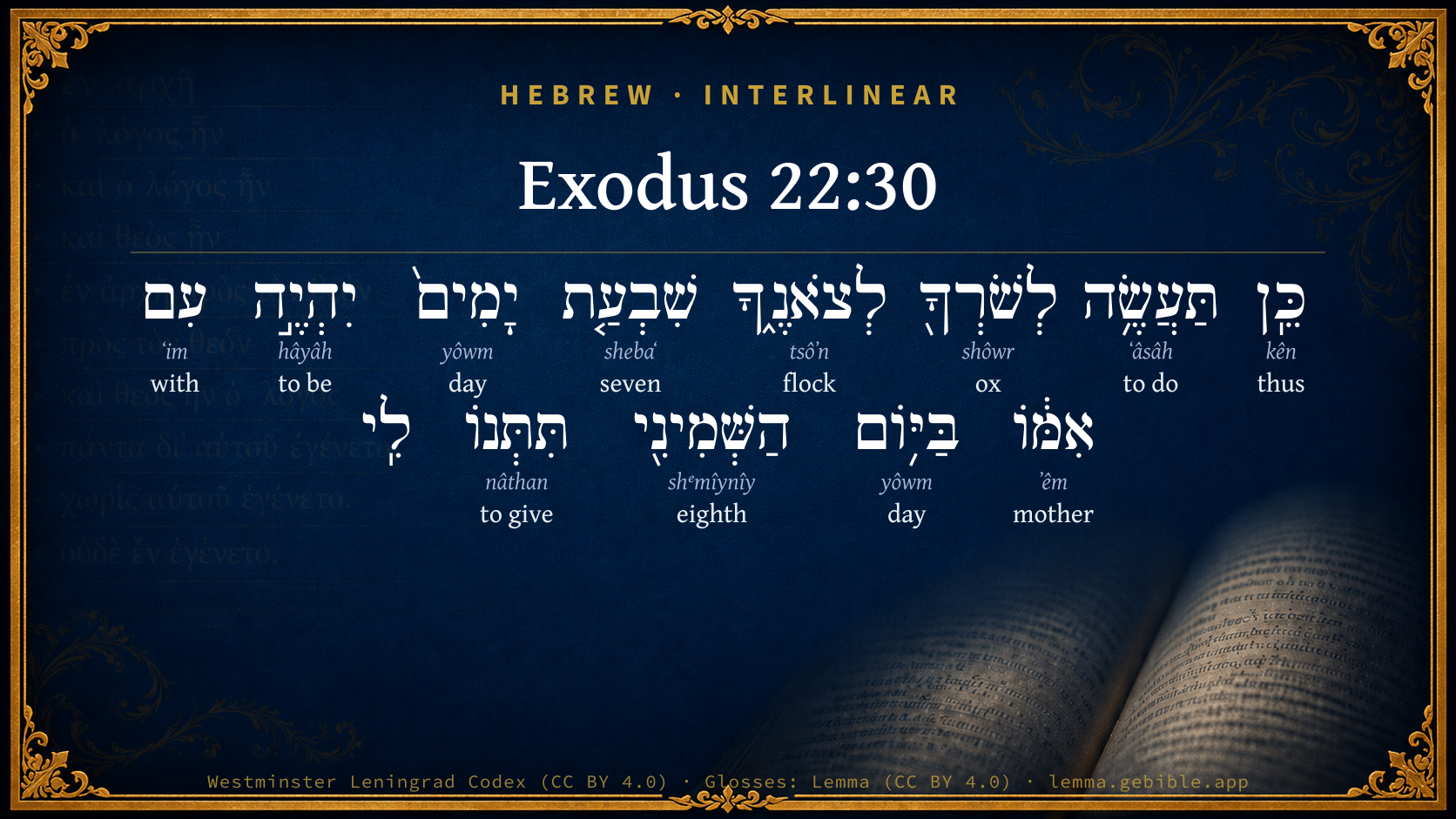
Hebrew (Westminster Leningrad Codex) Exodus 22:30 appears in the Hebrew Old Testament. The text above is from the Westminster Leningrad Codex. Each word links to its Strong’s number, a concise gloss, and parsing drawn from the Open Scriptures Hebrew Bible morphology. Click any word for its full Brown-Driver-Briggs (BDB) entry.
Download image
Cite this verse

Exodus 22:30 (World English Bible). Public Domain. Lemma interlinear Bible study tool, https://lemma.gebible.app/v/exodus/22/30.

Show BibTeX & RIS
BibTeX
RIS
English Translation
You shall do likewise with your oxen and with your sheep. Seven days it shall be with its mother, then on the eighth day you shall give it me.
World English Bible · Public Domain
Highlights
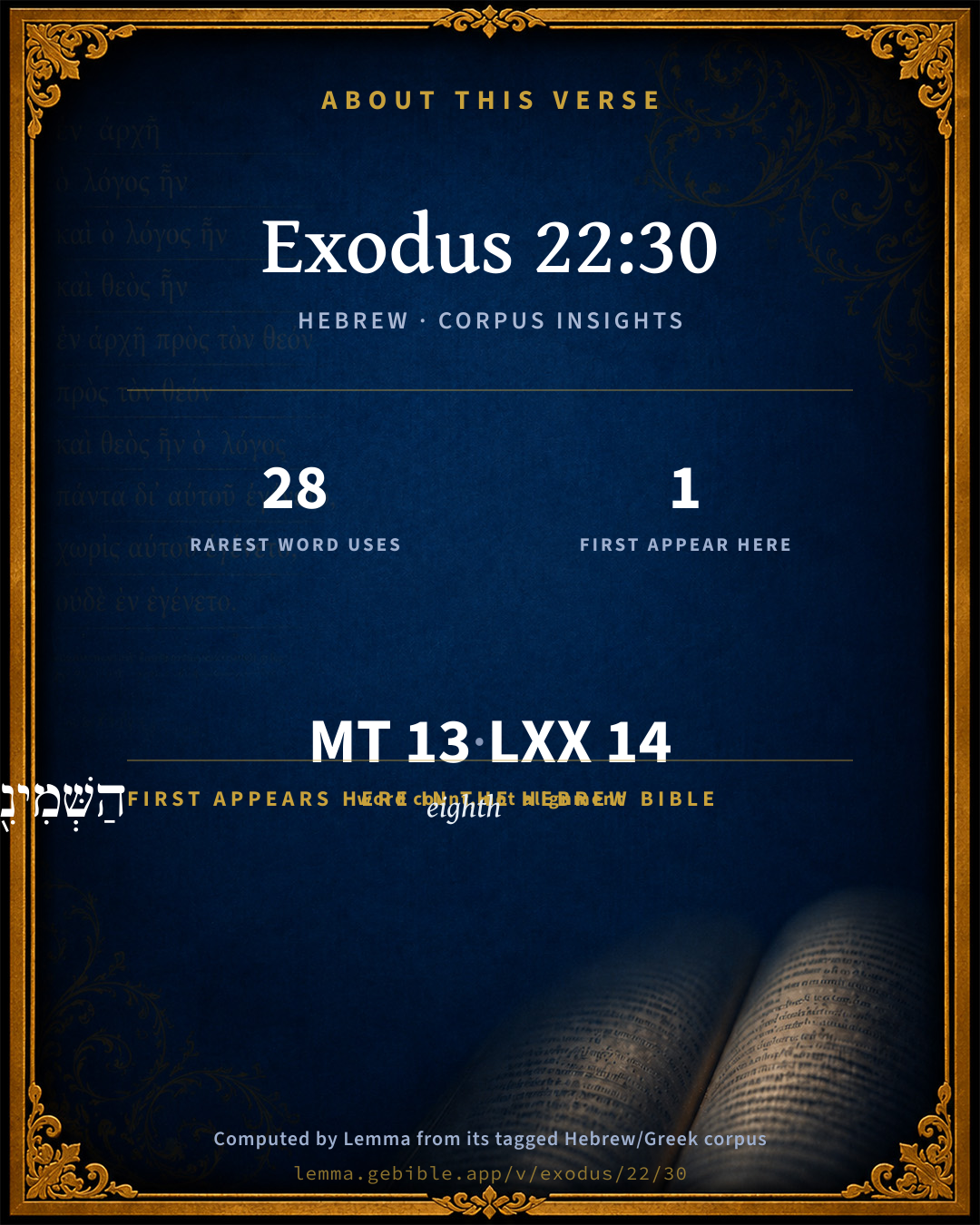
  • 1 first appearance in the Hebrew Bible
Full analysis ↓
Download a study sheet

One document with this verse’s original text, its word-by-word gloss line, the meaning frame, cross-references with their text, attributed commentary, and full source and license credits — printable, and it pastes into notes with its structure intact.

This verse Autodidact and up

Study sheet (.html) Plain text (.txt)

A passage Seminary Student

Up to 50 verses in one chapter. A passage sheet keeps up to 6 commentary sources and 12 cross-references per verse, in the order this page ranks them, and says so on the sheet whenever that leaves anything out. Ask for a single verse and you get the Autodidact verse sheet above.

Everything on this page stays free to read, with no account — the sheet is a download of what is already on screen, not access to it.

Want to remove ads? Support Godless Engineer
Compare translations 3

The same verse in 3 English versions, stacked beneath the original-language interlinear above. Click any original word for its lexicon entry.

Each is an independent rendering of the whole verse — the interlinear is not word-aligned to these translations.

Highlighted words mark where these versions differ — a whole-verse word diff, not a word-by-word alignment.

  • World English Bible Public Domain
    You shall do likewise with your oxen and with your sheep. Seven days it shall be with its mother, then on the eighth day you shall give it me.
  • King James Version Public Domain
    Likewise shalt thou do with thine oxen, and with thy sheep: seven days it shall be with his dam; on the eighth day thou shalt give it me.
  • unfoldingWord Literal Text CC BY-SA 4.0
    You shall do the same to your ox and to your sheep. Seven days it will be with its mother; on the eighth day you shall give it to me.

unfoldingWord Literal Text — © unfoldingWord, licensed CC BY-SA 4.0. Word-aligned USFM3 via Door43 (git.door43.org/unfoldingWord/en_ult).

Versions to compare (up to 4)

3 of 4 selected

Show all 18 translations

Every available English version of this verse, each an independent rendering of the whole verse.

  • World English Bible Public Domain
    You shall do likewise with your oxen and with your sheep. Seven days it shall be with its mother, then on the eighth day you shall give it me.
  • Berean Standard Bible Public Domain
    You shall do likewise with your cattle and your sheep. Let them stay with their mothers for seven days, but on the eighth day you are to give them to Me.
  • Majority Standard Bible Public Domain
    You shall do likewise with your cattle and your sheep. Let them stay with their mothers for seven days, but on the eighth day you are to give them to Me.
  • King James Version Public Domain
    Likewise shalt thou do with thine oxen, and with thy sheep: seven days it shall be with his dam; on the eighth day thou shalt give it me.
  • American Standard Version (1901) Public Domain
    Likewise shalt thou do with thine oxen, `and' with thy sheep: seven days it shall be with its dam; on the eighth day thou shalt give it me.
  • Revised Version (1885) Public Domain
    Likewise shalt thou do with thine oxen, and with thy sheep: seven days it shall be with its dam; on the eighth day thou shalt give it me.
  • Geneva Bible (1599) Public Domain
    Likewise shalt thou do with thine oxen and with thy sheepe: seuen dayes it shall bee with his damme, and the eight day thou shalt giue it me.
  • Douay-Rheims (1899) Public Domain
    Thou shalt do the same with the firstborn of thy oxen also and sheep: seven days let it be with its dam, the eighth day thou shalt give it to me.
  • Young's Literal Translation Public Domain
    so thou dost to thine ox, to thy sheep; seven days it is with its dam, on the eighth day thou dost give it to Me.
  • Literal Standard Version CC BY-SA 4.0
    so you do to your ox [and] to your sheep; it is with its mother [for] seven days, on the eighth day you give it to Me.
  • Unlocked Literal Bible CC BY-SA 4.0
    You must also do the same with your oxen and your sheep. For seven days they may remain with their mothers, but on the eighth day you must give them to me.
  • unfoldingWord Literal Text CC BY-SA 4.0
    You shall do the same to your ox and to your sheep. Seven days it will be with its mother; on the eighth day you shall give it to me.
  • Darby Bible Public Domain
    Likewise shalt thou do with thy calf, with thy sheep: seven days shall it be with its dam; on the eighth day thou shalt give it me.
  • World Messianic Bible Public Domain
    You shall do likewise with your cattle and with your sheep. It shall be with its mother seven days, then on the eighth day you shall give it to me.
  • Webster's Bible Public Domain
    Likewise shalt thou do with thy oxen, and with thy sheep: seven days it shall be with his dam; on the eighth day thou shalt give it to me.
  • Free Bible Version CC BY-SA 4.0
    You must also give me the firstborn of your cattle, sheep, and goats. They can stay with their mothers for their first seven days, but give them to me on the eighth day.
  • Bible in Basic English Public Domain
    In the same way with your oxen and your sheep: for seven days let the young one be with its mother; on the eighth day give it to me.
  • JPS Tanakh (1917) Public Domain
    (22-29) Likewise shalt thou do with thine oxen, and with thy sheep; seven days it shall be with its dam; on the eighth day thou shalt give it Me.

Literal Standard Version (2020), Covenant Press — licensed CC BY-SA 4.0. Text via the HelloAO Bible API (eBible.org). Unlocked Literal Bible (unfoldingWord) — licensed CC BY-SA 4.0. Text via the HelloAO Bible API (eBible.org). unfoldingWord Literal Text — © unfoldingWord, licensed CC BY-SA 4.0. Word-aligned USFM3 via Door43 (git.door43.org/unfoldingWord/en_ult). Free Bible Version, Dr. Jonathan Gallagher — licensed CC BY-SA 4.0. Text via the HelloAO Bible API (eBible.org).

Word by word

More ways to search: Search by grammar → Find every occurrence → Compare this word →

Practice this passage: Drill this verse → Learn its vocabulary →

הַשְּׁמִינִ֖י
shᵉmîynîy
H8066
“the · eighth”
Particle, Definite Article + Adjective, Ordinal number, Masculine, Singular, Absolute
Part of Speech
Particle + Adjective
Type
Ordinal number
Gender
Masculine
Number
Singular
State
Absolute
Full BDB Definition

Origin: from H8083

TWOT: 2411c

eighth (ordinal number)
  1. כֵּֽן kên H3651 “thus” Particle, Demonstrative
  2. תַּעֲשֶׂ֥ה ʻâsâh H6213 “to do” Verb, Qal, Imperfect, 2nd Person, Masculine, Singular
  3. לְשֹׁרְךָ֖ shôwr H7794 “to/for · ox · your” Preposition + Noun, Common, Masculine, Singular, Construct + Suffix, Personal, 2nd Person, Masculine, Singular
  4. לְצֹאנֶ֑ךָ tsôʼn H6629 “to/for · flock · your” Preposition + Noun, Common, Both, Singular, Construct + Suffix, Personal, 2nd Person, Masculine, Singular
  5. שִׁבְעַ֤ת shebaʻ H7651 “seven” Adjective, Cardinal number, Masculine, Singular, Construct
  6. יָמִים֙ yôwm H3117 “days” Noun, Common, Masculine, Plural, Absolute
  7. יִהְיֶ֣ה hâyâh H1961 “to be” Verb, Qal, Imperfect, 3rd Person, Masculine, Singular
  8. עִם ʻim H5973 “with” Preposition
  9. אִמּ֔וֹ ʼêm H517 “mother · his” Noun, Common, Feminine, Singular, Construct + Suffix, Personal, 3rd Person, Masculine, Singular
  10. בַּיּ֥וֹם yôwm H3117 “in/at the · day” Preposition, Determined + Noun, Common, Masculine, Singular, Absolute
  11. תִּתְּנוֹ nâthan H5414 “to give · him” Verb, Qal, Imperfect, 2nd Person, Masculine, Singular + Suffix, Personal, 3rd Person, Masculine, Singular

About this verse

These counts appear in no published source. They are computed here, from the morphology-tagged text and Lemma’s own curated glosses. What Lemma adds →

13
words
11
distinct lemmas
Pentateuch
section

First appearance in Scripture

This word makes its first canonical appearance in the Hebrew Bible here:

  • הַשְּׁמִינִ֖י eighth H8066

Shared distinctive vocabulary

הַשְּׁמִינִ֖י eighth H8066 occurs in 27 verses of the Hebrew Bible. Also found in:

Grammatical profile

  • 3 verbs
  • 5 nouns
  • 2 adjectives
  • 2 prepositions
  • 1 particle

Verb forms

  • תַּעֲשֶׂ֥ה Qal · Imperfect
  • יִהְיֶ֣ה Qal · Imperfect
  • תִּתְּנוֹ Qal · Imperfect

Repetition

A word recurs within this verse — often emphatic in Hebrew:

  • יָמִים֙ day H3117 ×2

Hebrew & Septuagint length

In English translation the verse runs 29 words from the Hebrew and 31 from the Septuagint (LXX English) — closely comparable.

A rough comparison of the two English renderings, which tokenize alike — not a word-level alignment.

Word counts can differ between the Hebrew and the Greek without any difference in meaning — e.g. the Hebrew direct-object marker אֵת has no separate Greek word, and Greek often adds the article ὁ.

In the original languages it is 13 Hebrew tokens and 14 Greek tokens — but the two are counted differently (Hebrew bundles its prefixes and suffixes into one token; the Greek is in lemma form), so that isn’t a like-for-like length.

Cross-references

4

Topical passages linked to Exodus 22:30 in the Treasury of Scripture Knowledge — connected by theme and wording, ordered by reader-vote popularity; previews shown in the World English Bible.

  • Leviticus 22:27 "When a bull, or a sheep, or a goat, is born, then it shall remain seven days with its mother; and from the eighth day and thenceforth it shall be accepted for the offering of an offering made by fire to Yahweh.
  • Deuteronomy 15:19 All the firstborn males that are born of your herd and of your flock you shall sanctify to Yahweh your God: you shall do no work with the firstborn of your herd, nor shear the firstborn of your flock.
  • Exodus 13:12 that you shall set apart to Yahweh all that opens the womb, and every firstborn which you have that comes from an animal. The males shall be Yahweh's.
  • Leviticus 12:3 In the eighth day the flesh of his foreskin shall be circumcised.

Cross-references courtesy of OpenBible.info (CC BY 4.0).

Hebrew and Greek witnesses Masoretic Hebrew ↔ Greek Septuagint

The same verse in the two great witnesses to the Old Testament, shown verse-for-verse.

These are two independent witnesses, not word-aligned to each other, and the Septuagint is shown in lemma (dictionary) form.

Hebrew Exodus 22:30 Masoretic · Westminster Leningrad Codex

כֵּֽן תַּעֲשֶׂ֥ה לְשֹׁרְךָ֖ לְצֹאנֶ֑ךָ שִׁבְעַ֤ת יָמִים֙ יִהְיֶ֣ה עִם אִמּ֔וֹ בַּיּ֥וֹם הַשְּׁמִינִ֖י תִּתְּנוֹ לִֽי

You shall do likewise with your oxen and with your sheep. Seven days it shall be with its mother, then on the eighth day you shall give it me.

World English Bible · Public Domain

Greek LXX Exodus 22:30 Septuagint · lemma form

καί ἀνήρ ἅγιος εἰμί ἐγώ καί κρέας θηριάλωτος οὐ ἐσθίω ὁ κύων ἀποῥίπτω αὐτός

So shall you do with your calf and your sheep and your ass; seven days shall it be under the mother, and the eighth day you shall give it to me.

LXX2012 (modern English Septuagint) · Public Domain

Hebrew: Westminster Leningrad Codex (CC BY 4.0). Greek: Septuagint (public domain); English from LXX2012 (modern English Septuagint) (Public Domain). How the Septuagint differs from the Hebrew →

Targum (Aramaic paraphrase)

2

The Targum is the ancient Jewish Aramaic paraphrase of the Hebrew Scriptures — an interpretive translation, not the Hebrew text itself. Onkelos (literal) and Pseudo-Jonathan (expansive) render the Torah, and Jonathan the Prophets. Coverage is partial: where no permissively-licensed English translation exists for a verse, only the Aramaic is shown. This is verse-level text, not a word-by-word alignment to the Hebrew.

  1. Targum Onkelos Torah (Genesis–Deuteronomy)
    וֶאֱנָשִׁין קַדִישִׁין תְּהוֹן קֳדָמָי וּבְשַׂר תְּלִישׁ מִן חֵיוָא חַיְתָא לָא תֵיכְלוּן לְכַלְבָּא תִּרְמוּן יָתֵהּ:

    (no public-domain English translation for this verse)

    Targum Onkelos — Aramaic: “Onkelos Genesis” (public domain); “Onkelos Exodus” (public domain); “Onkelos Leviticus” (public domain); “Onkelos Numbers” (public domain); “Onkelos Deuteronomy” (public domain). English: “Sefaria Community Translation” (CC0 1.0 (public-domain dedication)); “J.W. Etheridge. The Targums of Onkelos and Jonathan Ben Uzziel on the Pentateuch. London: Longmans, Green, 1862” (public domain). Text via Sefaria.

  2. Targum Pseudo-Jonathan Torah (Genesis–Deuteronomy)
    וְאַנְשִׁין קַדִּישִׁין טְעָמִין חוּלִין בִּדְכוּתָא תְּהוֹן קֳדָמַי בְּרַם בְּשַר תְּלִישׁ מִן חֵיוָותָא חַיָיא לָא תֵיכְלוּן לְכַלְבָּא תֵירְמוּן יָתֵיהּ בְּסִיטְרֵיהּ

    And holy men, tasting unconsecrated things innocently, shall you be before Me; but flesh torn by wild beasts alive you may not eat, but throw it to the dog as his portion.

    Targum Pseudo-Jonathan — Aramaic: “Targum Jonathan on Genesis” (public domain); “Targum Jonathan on Exodus” (public domain); “Targum Jonathan on Leviticus” (public domain); “Targum Jonathan on Numbers” (public domain); “Targum Jonathan on Deuteronomy” (public domain). English: “The Targum of Jonathan ben Uzziel, trans. J. W. Etheridge, London, 1862” (public domain). Text via Sefaria.

Commentary

Notes on Exodus 22:30 from classic Christian and Jewish commentators (each source and its license shown beneath its notes). The classic Christian expositions comment on the surrounding passage and are grouped to its opening verse, so a note may address several verses; the Jewish commentaries on the Tanakh (Rashi and others) are per-verse, so they appear only where the commentator wrote on this verse.

Lemma curates 59 commentaries, every one of them public domain or Creative Commons licensed, each selected and text-cleaned for this edition rather than reprinted as found. About our sources →

Trapp's Complete Commentary

John Trapp

Exo 22:30 Likewise shalt thou do with thine oxen, [and] with thy sheep: seven days it shall be with his dam; on the eighth day thou shalt give it me.

Ver. 30. On the eighth day.] When a Sabbath had once gone over it, say the Hebrews.

John Trapp, A Commentary or Exposition upon All the Books of the Old and New Testament (1647–1656) — public domain. Text from a community e-Sword module.

Tyndale Open Study Notes

Tyndale Open Resources

22:30 God is considerate even of animals (see Jon 4:11).

Tyndale Open Study Notes — © Tyndale Open Resources, licensed CC BY-SA 4.0. Text via the HelloAO Bible API.

Adam Clarke's Commentary

Verse 30. Seven days it shall be with his dam] For the mother's health it was necessary that the young one should suck so long; and prior to this time the process of nutrition in a young animal can scarcely be considered as completely formed. Among the Romans lambs were not considered as pure or clean before the eighth day; nor calves before the thirtieth: Pecoris faetus die octavo purus est, bovis trigesimo.-Plin. Hist. Nat., lib. viii.

Adam Clarke's Commentary on the Bible (1810–1826) — public domain. Text from a community e-Sword/MySword module.

Ellicott's Commentary for English Readers

(30) Thine oxen.—Rather, thy beeves. The word used is applied to horned cattle of either sex.

Seven days it shall be with his dam.—Compare Lev_22:27. The main object of forbidding sacrifice before the eighth day would appear to have beer-regard for the health and comfort of the mother, which needed the relief obtained by suckling its offspring. There may also have underlain the prohibition some reference to birth as an impure process. Compare the circumcision of the male child on the eighth day.

A Bible Commentary for English Readers, edited by Charles John Ellicott (1878–1897) — public domain. Text from a community e-Sword module.

Matthew Poole's English Annotations

Likewise, i.e. ye shall offer their first-born.

On the eighth day; not sooner, because it was till then tender and imperfect, and therefore not fit to be offered to God; but it was not tied to that day, for it might be offered afterwards, appears from Lev 22:27, even till it was a year old.

Matthew Poole's English Annotations on the Holy Bible (1683–1685) — public domain. Text from a community e-Sword/MySword module.

Whedon's Commentary on the Bible

Daniel D. Whedon

30. Seven days — Comp. also Lev_22:27.

Daniel D. Whedon (gen. ed.), Commentary on the Old and New Testaments (1874–1909) — public domain. Text from a community e-Sword module.

The Pulpit Commentary

Seven days it shall be with its dam. See Lev_22:27. The main object is that the darn may have during that time the natural relief derivable from suckling its off-spring. On the eighth day thou shalt give it me. Some analogy may be traced between this proviso and the law of circumcision. Birth was viewed as an unclean process, and nothing was fit for presentation to God excepting after an interval.

The Pulpit Commentary (1880–1919), ed. H.D.M. Spence-Jones & Joseph S. Exell — public domain. Text from a community e-Sword module.

Rashi

Rabbi Shlomo Yitzchaki (Rashi)

ואנשי קדש תהיון לי AND YE SHALL BE MEN OF HOLINESS UNTO ME — If you will be holy and keep yourselves aloof from the loathsomeness of carrion and Trefa you are Mine, if not you are not Mine (cf. Mekhilta).

ובשר בשדה טרפה [NEITHER SHALL YE EAT] ANY FLESH THAT IS TORN IN THE FIELD – The same holds good in case the animal has been torn in the house, only that Scripture speaks of what usually happens mentioning the field because it is the place where it is usual for cattle to be torn. A similar instance is, (Deuteronomy 22:27) “for he found her in the field”, but the same law would apply if he found her elsewhere. Another example is, (Deuteronomy 23:11) “Any man that is unclean by reason of uncleanliness that chanceth him by night”; the same law, however, applies to an uncleanliness that happens by day, but night is mentioned because Scripture speaks of what usually happens (Mekhilta). The Targum renders ובשר בשדה טרפה by ובשר תליש מן חיוא חיא “flesh that is torn off from a living animal”, i. e. flesh that has been torn off through a laceration caused by a wolf or a lion, from a living beast which is permitted to be eaten (e. g., a stag), or from cattle permitted to be eaten.

לכלב תשלכון אתו YE SHALL CAST IT TO THE DOGS — You may give it to a heathen as well as to the dog. Or, perhaps this is not so, but כלב is to be taken literally? Scripture, however, states with regard to carrion, (Deuteronomy 14:21) “Thou shalt give it to a stranger or sell it unto an alien”, from which it follows by a conclusion à fortiori that you may derive whatever benefit you like from the Trefa (and so you also may give it to heathen). But if this be so, what is the force of Scripture expressly saying “to the dog”? It is to teach you that the dog is to be given preference in this respect and Scripture tells you at the same time that God does not withhold the reward due to any of His creatures. The dog is entitled to reward because it is stated, (Exodus 11:7) “But against the children of Israel shall not a dog move its tongue”, and this happened. The Holy One, blessed be He, said: Give it the reward it deserves (Mekhilta).

Rashi on the Tanakh — English translations: “The Judaica Press complete Tanach with Rashi, translated by A. J. Rosenberg” (CC BY 4.0); “Pentateuch with Rashi's commentary by M. Rosenbaum and A.M. Silbermann, 1929-1934” (public domain); “The Metsudah Tanach series, Lakewood, N.J” (CC BY 4.0); and “The Book of Joshua, Metsudah Publications, 1997” (CC BY 4.0). Text via Sefaria.

Ramban (Nachmanides)

Rabbi Moshe ben Nachman (Ramban / Nachmanides)

AND YE SHALL BE HOLY MEN UNTO ME. The reason for the expression in this verse is that until now He mentioned only the ordinances and admonished them about repulsive matters, but now when He is about to begin the law of forbidden food, He prefaced it by saying, And ye shall be holy men unto Me. For in order to preserve his physical life man should [be able to] eat anything which serves that purpose, and the prohibitions concerning certain foods are only a means of guarding the purity of the soul, in order that one should eat clean things which do not give rise to harshness and coarseness in the soul. Therefore He said, And ye shall be holy men unto Me, that is to say: “I want you to be holy men so that you will become suitable for Me, to cleave to Me, for I am Holy; therefore do not defile your souls by eating abominable things.” And similarly He said, Ye shall not make yourselves detestable with any swarming thing that swarmeth, neither shall ye make yourselves unclean with them, that ye should be defiled thereby. For I am the Eternal your G-d; sanctify yourselves therefore, and be ye holy; for I am Holy. Swarming things thus make the soul detestable, but the treifah is not detestable, however abstention from eating it adds holiness.

Ramban (Nachmanides) on the Tanakh — English translation: “Commentary on the Torah by Ramban (Nachmanides). Translated and annotated by Charles B. Chavel. New York, Shilo Pub. House, 1971-1976” (CC BY 4.0). Text via Sefaria.

Lesson kit

Teaching starters — assembled from the data on this page, not authored interpretation. Every prompt links to the verse data it draws on. Edit before teaching.

Exodus, in the Pentateuch, opens this verse with 13 words (11 distinct Hebrew lemmas). Its most distinctive word is shᵉmîynîy (“eighth”). A historical commentator’s framing appears above. Read the whole chapter for the surrounding context.

Discussion questions

  1. The word shᵉmîynîy carries the sense “eighth.” How does it shape the verse?
  2. This is the first place “eighth” appears in Scripture (first appears here). What does its debut here establish?
  3. How does Leviticus 9:1, which shares the word «eighth», read alongside this verse?
  4. What does the repetition of “day” (2× in this one verse) do in this verse?
  5. These translations render this verse differently; the difference is in the English rendering, not the original. What questions does that raise?
  6. «תַּעֲשֶׂ֥ה» is a Qal Imperfect verb. How does that grammatical form shape the action described?
  7. Compare how Trapp's Complete Commentary and Tyndale Open Study Notes read this verse. Where do they agree or differ?

Things to notice

Reading settings

Reading text

Shown beneath each verse's original-language words.

Old Testament
Old Testament edition

Read the OT as the Masoretic Hebrew (MT) or the Greek Septuagint (LXX).

English shown for the Greek Septuagint (in the Hebrew ↔ Greek comparison).

Comparing translations? Open the Compare panel on any verse page to stack up to four side by side.