
Genesis 9:13

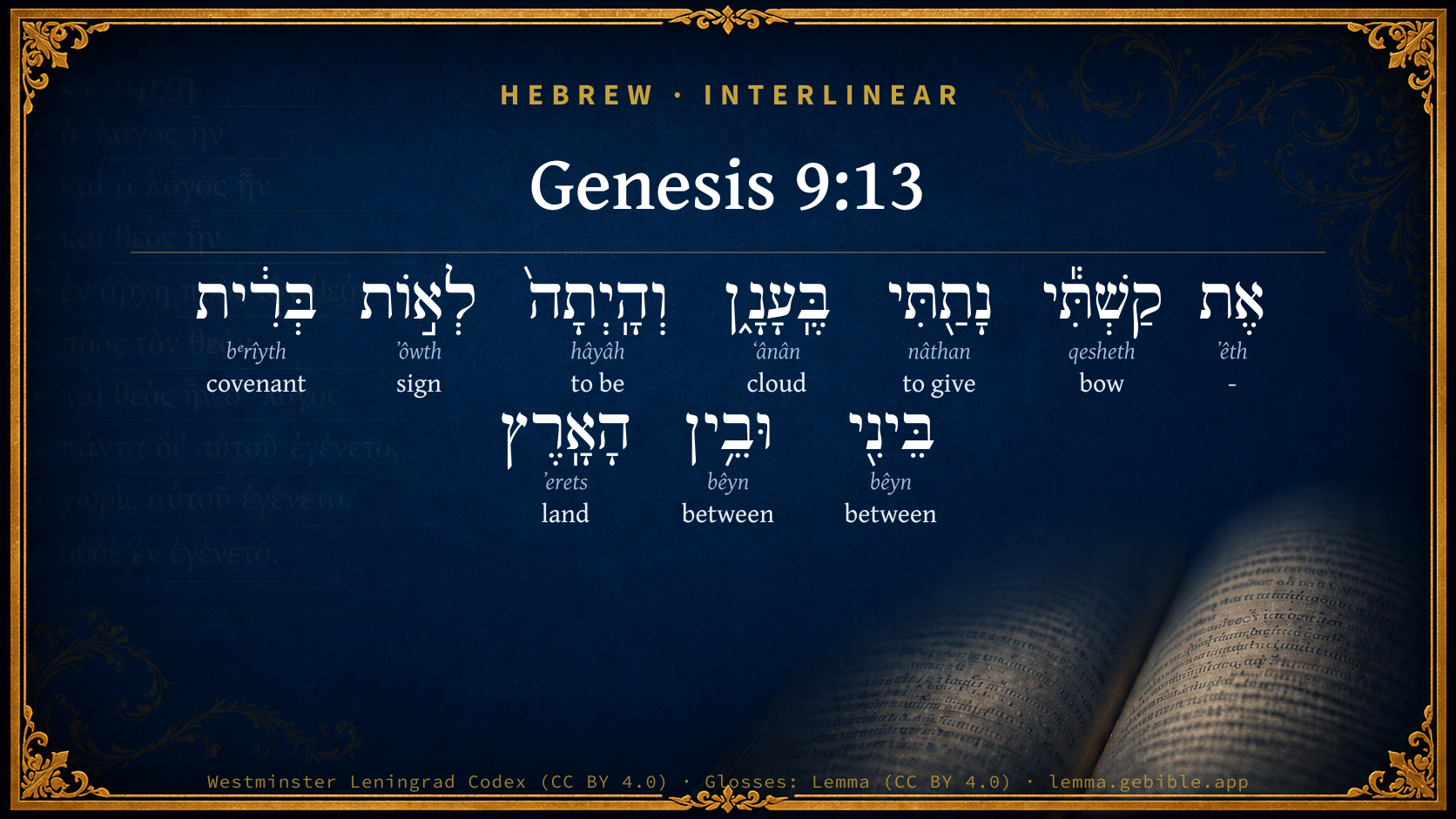
Hebrew (Westminster Leningrad Codex) Genesis 9:13 appears in the Hebrew Old Testament. The text above is from the Westminster Leningrad Codex. Each word links to its Strong’s number, a concise gloss, and parsing drawn from the Open Scriptures Hebrew Bible morphology. Click any word for its full Brown-Driver-Briggs (BDB) entry.
Download image
Cite this verse

Genesis 9:13 (World English Bible). Public Domain. Lemma interlinear Bible study tool, https://lemma.gebible.app/v/genesis/9/13.

Show BibTeX & RIS
BibTeX
RIS
English Translation
I set my rainbow in the cloud, and it will be for a sign of a covenant between me and the earth.
World English Bible · Public Domain
Highlights
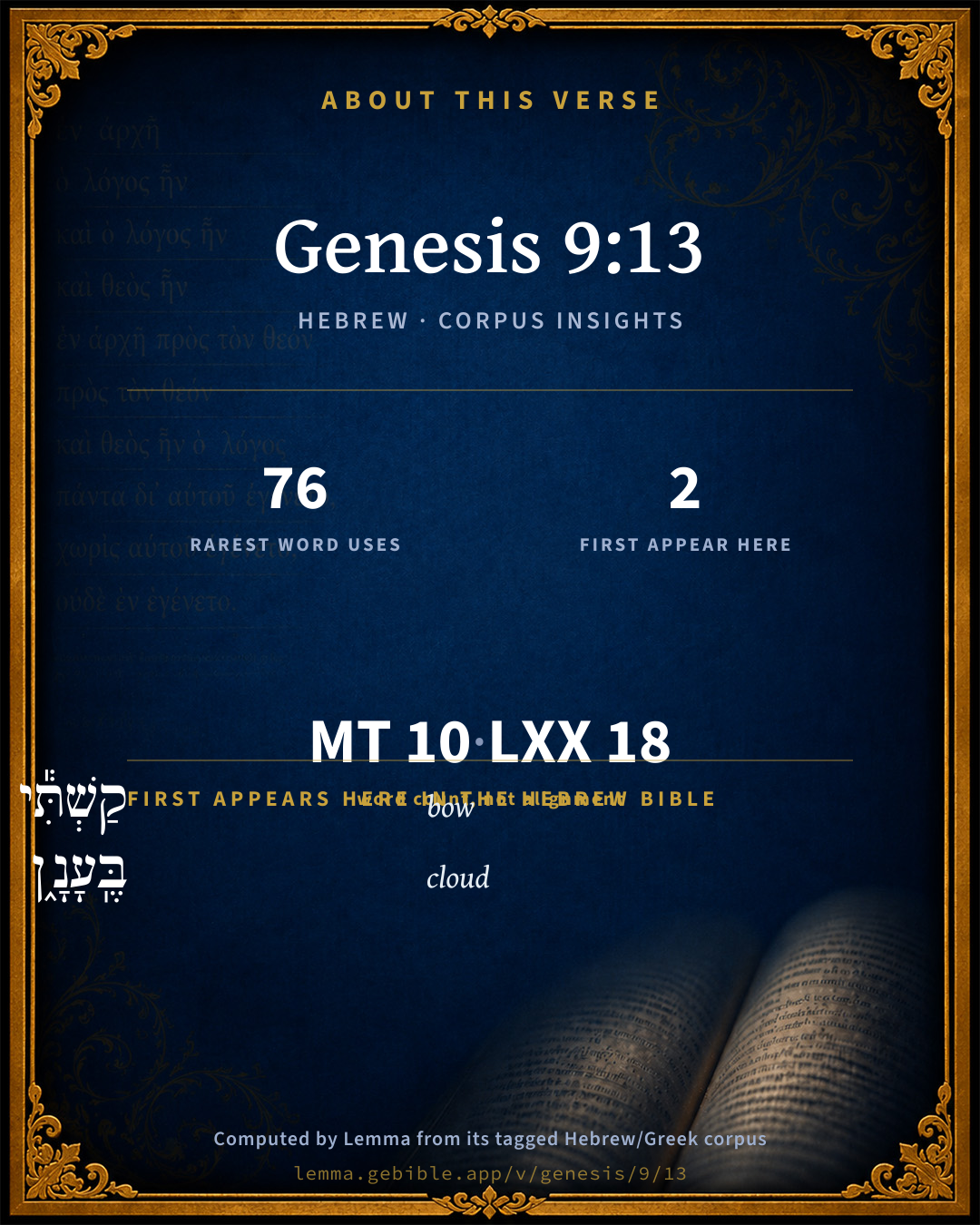
  • 2 first appearances in the Hebrew Bible
Full analysis ↓
Download a study sheet

One document with this verse’s original text, its word-by-word gloss line, the meaning frame, cross-references with their text, attributed commentary, and full source and license credits — printable, and it pastes into notes with its structure intact.

This verse Autodidact and up

Study sheet (.html) Plain text (.txt)

A passage Seminary Student

Up to 50 verses in one chapter. A passage sheet keeps up to 6 commentary sources and 12 cross-references per verse, in the order this page ranks them, and says so on the sheet whenever that leaves anything out. Ask for a single verse and you get the Autodidact verse sheet above.

Everything on this page stays free to read, with no account — the sheet is a download of what is already on screen, not access to it.

Want to remove ads? Support Godless Engineer
Compare translations 3

The same verse in 3 English versions, stacked beneath the original-language interlinear above. Click any original word for its lexicon entry.

Each is an independent rendering of the whole verse — the interlinear is not word-aligned to these translations.

Highlighted words mark where these versions differ — a whole-verse word diff, not a word-by-word alignment.

  • World English Bible Public Domain
    I set my rainbow in the cloud, and it will be for a sign of a covenant between me and the earth.
  • King James Version Public Domain
    I do set my bow in the cloud, and it shall be for a token of a covenant between me and the earth.
  • unfoldingWord Literal Text CC BY-SA 4.0
    I have set my rainbow in the clouds, and it will be the sign of the covenant between me and the earth.

unfoldingWord Literal Text — © unfoldingWord, licensed CC BY-SA 4.0. Word-aligned USFM3 via Door43 (git.door43.org/unfoldingWord/en_ult).

Versions to compare (up to 4)

3 of 4 selected

Show all 18 translations

Every available English version of this verse, each an independent rendering of the whole verse.

  • World English Bible Public Domain
    I set my rainbow in the cloud, and it will be for a sign of a covenant between me and the earth.
  • Berean Standard Bible Public Domain
    I have set My rainbow in the clouds, and it will be a sign of the covenant between Me and the earth.
  • Majority Standard Bible Public Domain
    I have set My rainbow in the clouds, and it will be a sign of the covenant between Me and the earth.
  • King James Version Public Domain
    I do set my bow in the cloud, and it shall be for a token of a covenant between me and the earth.
  • American Standard Version (1901) Public Domain
    I do set my bow in the cloud, and it shall be for a token of a covenant between me and the earth.
  • Revised Version (1885) Public Domain
    I do set my bow in the cloud, and it shall be for a token of a covenant between me and the earth.
  • Geneva Bible (1599) Public Domain
    I haue set my bowe in the cloude, and it shalbe for a signe of the couenant betweene me and the earth.
  • Douay-Rheims (1899) Public Domain
    I will set my bow in the clouds, and it shall be the sign of a covenant between me, and between the earth.
  • Young's Literal Translation Public Domain
    My bow I have given in the cloud, and it hath been for a token of a covenant between Me and the earth;
  • Literal Standard Version CC BY-SA 4.0
    My bow I have given in the cloud, and it has been for a token of a covenant between Me and the earth;
  • Unlocked Literal Bible CC BY-SA 4.0
    I have set my rainbow in the cloud, and it will be the sign of the covenant between me and the earth.
  • unfoldingWord Literal Text CC BY-SA 4.0
    I have set my rainbow in the clouds, and it will be the sign of the covenant between me and the earth.
  • Darby Bible Public Domain
    I set my bow in the clouds, and it shall be for a sign of the covenant between me and the earth.
  • World Messianic Bible Public Domain
    I set my rainbow in the cloud, and it will be a sign of a covenant between me and the earth.
  • Webster's Bible Public Domain
    I do set my bow in the cloud, and it shall be for a token of a covenant between me and the earth.
  • Free Bible Version CC BY-SA 4.0
    I've placed my rainbow in the clouds, and this will be the sign of my agreement with you and with all life on earth.
  • Bible in Basic English Public Domain
    I will put my bow in the cloud and it will be for a sign of the agreement between me and the earth.
  • JPS Tanakh (1917) Public Domain
    I have set My bow in the cloud, and it shall be for a token of a covenant between Me and the earth.

Literal Standard Version (2020), Covenant Press — licensed CC BY-SA 4.0. Text via the HelloAO Bible API (eBible.org). Unlocked Literal Bible (unfoldingWord) — licensed CC BY-SA 4.0. Text via the HelloAO Bible API (eBible.org). unfoldingWord Literal Text — © unfoldingWord, licensed CC BY-SA 4.0. Word-aligned USFM3 via Door43 (git.door43.org/unfoldingWord/en_ult). Free Bible Version, Dr. Jonathan Gallagher — licensed CC BY-SA 4.0. Text via the HelloAO Bible API (eBible.org).

Word by word

More ways to search: Search by grammar → Find every occurrence → Compare this word →

Practice this passage: Drill this verse → Learn its vocabulary →

קַשְׁתִּ֕י
qesheth
H7198
“bow · my”
Noun, Common, Feminine, Singular, Construct + Suffix, Personal, 1st Person, Common, Singular
Part of Speech
Noun
Type
Common
Gender
Feminine
Number
Singular
State
Construct
Full BDB Definition

Origin: from H7185 in the original sense of H6983 of bending

TWOT: 2093

bow - bow (for hunting, battle) - bowmen, archers - bow (figuratively of might) - rainbow
  1. אֶת ʼêth H853 “-” Particle, Direct Object
  2. נָתַ֖תִּי nâthan H5414 “to give” Verb, Qal, Perfect, 1st Person, Common, Singular
  3. בֶּֽעָנָ֑ן ʻânân H6051 “in/at the · cloud” Preposition, Determined + Noun, Common, Masculine, Singular, Absolute
  4. וְהָֽיְתָה֙ hâyâh H1961 “and · to be” Conjunction + Verb, Qal, Sequential Perfect, 3rd Person, Feminine, Singular
  5. לְא֣וֹת ʼôwth H226 “to/for · sign of” Preposition + Noun, Common, Both, Singular, Construct
  6. בְּרִ֔ית bᵉrîyth H1285 “covenant” Noun, Common, Feminine, Singular, Absolute
  7. בֵּינִ֖י bêyn H996 “between · me” Preposition + Suffix, Personal, 1st Person, Common, Singular
  8. וּבֵ֥ין bêyn H996 “and · between” Conjunction + Preposition
  9. הָאָֽרֶץ ʼerets H776 “the · land” Particle, Definite Article + Noun, Common, Both, Singular, Absolute

About this verse

These counts appear in no published source. They are computed here, from the morphology-tagged text and Lemma’s own curated glosses. What Lemma adds →

10
words
9
distinct lemmas
Pentateuch
section

First appearance in Scripture

These words make their first canonical appearance in the Hebrew Bible here:

  • קַשְׁתִּ֕י bow H7198
  • בֶּֽעָנָ֑ן cloud H6051

Grammatical profile

  • 2 verbs
  • 5 nouns
  • 2 prepositions
  • 1 particle

Verb forms

  • נָתַ֖תִּי Qal · Perfect
  • וְהָֽיְתָה֙ Qal · Sequential Perfect

Repetition

A word recurs within this verse — often emphatic in Hebrew:

  • בֵּינִ֖י between H996 ×2

Hebrew & Septuagint length

In English translation the verse runs 22 words from the Hebrew and 21 from the Septuagint (LXX English) — closely comparable.

A rough comparison of the two English renderings, which tokenize alike — not a word-level alignment.

Word counts can differ between the Hebrew and the Greek without any difference in meaning — e.g. the Hebrew direct-object marker אֵת has no separate Greek word, and Greek often adds the article ὁ.

In the original languages it is 10 Hebrew tokens and 18 Greek tokens — but the two are counted differently (Hebrew bundles its prefixes and suffixes into one token; the Greek is in lemma form), so that isn’t a like-for-like length.

Cross-references

3

Topical passages linked to Genesis 9:13 in the Treasury of Scripture Knowledge — connected by theme and wording, ordered by reader-vote popularity; previews shown in the World English Bible.

  • Ezekiel 1:28 As the appearance of the bow that is in the cloud in the day of rain, so was the appearance of the brightness round about. This was the appearance of the likeness of the glory of Yahweh. When I saw it, I fell on my face, and I heard a voice of one that spoke.
  • Revelation 4:3 that looked like a jasper stone and a sardius. There was a rainbow around the throne, like an emerald to look at.
  • Revelation 10:1 I saw a mighty angel coming down out of the sky, clothed with a cloud. A rainbow was on his head. His face was like the sun, and his feet like pillars of fire.

Cross-references courtesy of OpenBible.info (CC BY 4.0).

Hebrew and Greek witnesses Masoretic Hebrew ↔ Greek Septuagint

The same verse in the two great witnesses to the Old Testament, shown verse-for-verse.

These are two independent witnesses, not word-aligned to each other, and the Septuagint is shown in lemma (dictionary) form.

Hebrew Genesis 9:13 Masoretic · Westminster Leningrad Codex

אֶת קַשְׁתִּ֕י נָתַ֖תִּי בֶּֽעָנָ֑ן וְהָֽיְתָה֙ לְא֣וֹת בְּרִ֔ית בֵּינִ֖י וּבֵ֥ין הָאָֽרֶץ

I set my rainbow in the cloud, and it will be for a sign of a covenant between me and the earth.

World English Bible · Public Domain

Greek LXX Genesis 9:13 Septuagint · lemma form

ὁ τόξον ἐγώ τίθημι ἐν ὁ νεφέλη καί εἰμί εἰς σημεῖον διαθήκη ἀνά μέσος ἐγώ καί ὁ γῆ

I set my bow in the cloud, and it shall be for a sign of covenant between me and the earth.

LXX2012 (modern English Septuagint) · Public Domain

On this verse, The Pulpit Commentary discusses the Septuagint’s reading. Read the note in Commentary ↓

Hebrew: Westminster Leningrad Codex (CC BY 4.0). Greek: Septuagint (public domain); English from LXX2012 (modern English Septuagint) (Public Domain). How the Septuagint differs from the Hebrew →

Targum (Aramaic paraphrase)

2

The Targum is the ancient Jewish Aramaic paraphrase of the Hebrew Scriptures — an interpretive translation, not the Hebrew text itself. Onkelos (literal) and Pseudo-Jonathan (expansive) render the Torah, and Jonathan the Prophets. Coverage is partial: where no permissively-licensed English translation exists for a verse, only the Aramaic is shown. This is verse-level text, not a word-by-word alignment to the Hebrew.

  1. Targum Onkelos Torah (Genesis–Deuteronomy)
    יָת קַשְׁתִּי יְהָבִית בַּעֲנָנָא וּתְהִי לְאָת קְיָם בֵּין מֵימְרִי וּבֵין אַרְעָא

    I have set My bow in the cloud, and it shall be for a sign of the covenant between My Word and between the earth.

    Targum Onkelos — Aramaic: “Onkelos Genesis” (public domain); “Onkelos Exodus” (public domain); “Onkelos Leviticus” (public domain); “Onkelos Numbers” (public domain); “Onkelos Deuteronomy” (public domain). English: “Sefaria Community Translation” (CC0 1.0 (public-domain dedication)); “J.W. Etheridge. The Targums of Onkelos and Jonathan Ben Uzziel on the Pentateuch. London: Longmans, Green, 1862” (public domain). Text via Sefaria.

  2. Targum Pseudo-Jonathan Torah (Genesis–Deuteronomy)
    יַת קַשְׁתִּי יְהָבִית בַּעֲנָנָא וּתְהֵי לְסִימָן קְיַים בֵּין מֵימְרִי וּבֵינֵי אַרְעָא

    I have set My Bow in the cloud, and it shall be for a token of the covenant between My Word and the earth.

    Targum Pseudo-Jonathan — Aramaic: “Targum Jonathan on Genesis” (public domain); “Targum Jonathan on Exodus” (public domain); “Targum Jonathan on Leviticus” (public domain); “Targum Jonathan on Numbers” (public domain); “Targum Jonathan on Deuteronomy” (public domain). English: “The Targum of Jonathan ben Uzziel, trans. J. W. Etheridge, London, 1862” (public domain). Text via Sefaria.

Commentary

Notes on Genesis 9:13 from classic Christian and Jewish commentators (each source and its license shown beneath its notes). The classic Christian expositions comment on the surrounding passage and are grouped to its opening verse, so a note may address several verses; the Jewish commentaries on the Tanakh (Rashi and others) are per-verse, so they appear only where the commentator wrote on this verse.

Lemma curates 59 commentaries, every one of them public domain or Creative Commons licensed, each selected and text-cleaned for this edition rather than reprinted as found. About our sources →

Trapp's Complete Commentary

John Trapp

Gen 9:13 I do set my bow in the cloud, and it shall be for a token of a covenant between me and the earth.

Ver. 13. I do set my bow in the cloud, &c.] There it was before, but not till now as a token of the covenant; as still it is applied for a sign of grace from God to his Church. {Rev 4:3; Rev 10:1 Eze 1:28} It is planted in the clouds, as if man were shooting at God, and not God at man. This bow with both ends downward, and back to heaven, must needs be an emblem of mercy; for he that shooteth, holdeth the back of the bow from him. Of God’s bow we read, but not of his arrows, saith Ambrose on this text. "He hath bent his bow, and made it ready," saith David; but if "he ordain his arrows," it is not but "against the persecutors". {Psa 7:12-13} If he shoot at his servants, it is as Jonathan shot at his friend David; {2Sa 20:20} to warn them, not to wound them. They are "arrows of the Lord’s deliverance," {2Ki 13:17} which therefore he multiplies, that they may "compass him about with songs of deliverance". {Psa 32:7} If he "bend his bow like an enemy," {Lam 2:4} yet in wrath he remembereth mercy.

John Trapp, A Commentary or Exposition upon All the Books of the Old and New Testament (1647–1656) — public domain. Text from a community e-Sword module.

Joseph Benson's Commentary

Gen 9:13. I set my bow in the clouds — The rainbow, it is likely, was seen in the clouds before, but was never a seal of the covenant till now. Now, observe, 1st, This seal is affixed with repeated assurances of the truth of that promise, which it was designed to be the ratification of; I do set my bow in the cloud, Gen 9:13. It shall be seen in the cloud, Gen 9:14, and it shall be a token of the covenant, Gen 9:12-13. And I will remember my covenant, that the waters shall no more become a flood, Gen 9:15. Nay, as if the Eternal Mind needed a memorandum, I will look upon it that I may remember the everlasting covenant, Gen 9:16. 2d, The rainbow appears when the clouds are most disposed to wet; when we have most reason to fear the rain prevailing, God shows this seal of the promise that it shall not prevail. 3d, The rainbow appears when one part of the sky is clear, which intimates mercy remembered in the midst of wrath, and the clouds are hemmed, as it were, with the rainbow, that they may not overspread the heavens; for the bow is coloured rain, or the edges of a cloud gilded. As God looks upon the bow that he may remember the covenant, so should we, that we also may be ever mindful of the covenant with faith and thankfulness.

Joseph Benson's Commentary on the Old and New Testaments (1811–1818) — public domain. Text from a community e-Sword module.

Tyndale Open Study Notes

Tyndale Open Resources

9:13-16 God brought cataclysmic judgment through the rainstorm; now, the rainbow, a meteorological phenomenon associated with the rainstorm, would be an image of peace for all the earth (see 9:17). • The same Hebrew term denotes both “rainbow” and “bow.” Since God is sometimes pictured as a warrior who shoots arrows of judgment (see Deut 32:42; Pss 7:12; 18:13-14; Hab 3:9-11), some think that the imagery in Gen 9:13-17 is of the Divine Warrior hanging up his bow of judgment.

Tyndale Open Study Notes — © Tyndale Open Resources, licensed CC BY-SA 4.0. Text via the HelloAO Bible API.

Geneva Bible (1599)

Geneva Bible translators

Hereby we see that signs or sacraments ought not to be separate from the word.

Geneva Bible (1599) marginal notes — public domain. Text via Bolls.life.

Jamieson, Fausset & Brown

Robert Jamieson, A. R. Fausset & David Brown

RAINBOW. (Gen. 9:8-29)

I do set my bow in the cloud--set, that is, constitute or appoint. This common and familiar phenomenon being made the pledge of peace, its appearance when showers began to fall would be welcomed with the liveliest feelings of joy.

Jamieson, Fausset & Brown — Commentary Critical and Explanatory on the Whole Bible (1871) — public domain (CC PDM 1.0). Text via the HelloAO Bible API.

Adam Clarke's Commentary

Verse 13. I do set my bow in the cloud] On the origin and nature of the rainbow there had been a great variety of conjectures, till Anthony de Dominis, bishop of Spalatro, in a treatise of his published by Bartholus in 1611, partly suggested the true cause of this phenomenon, which was afterwards fully explained and demonstrated by Sir Isaac Newton. To enter into this subject here in detail would be improper; and therefore the less informed reader must have recourse to treatises on Optics for its full explanation. To readers in general it may be sufficient to say that the rainbow is a mere natural effect of a natural cause:

1. It is never seen but in showery weather.

2. Nor then unless the sun shines.

3. It never appears in any part of the heavens but in that opposite to the sun.

4. It never appears greater than a semicircle, but often much less.

5. It is always double, there being what is called the superior and inferior, or primary and secondary rainbow.

6. These bows exhibit the seven prismatic colours, red, orange, yellow, green, blue, indigo, and violet.

7. The whole of this phenomenon depends on the rays of the sun falling on spherical drops of water, and being in their passage through them, refracted and reflected.

The formation of the primary and secondary rainbow depends on the two following propositions;

1. When the sun shines on the drops of rain as they are falling, the rays that come from those drops to the eye of the spectator, after ONE reflection and TWO refractions, produce the primary rainbow.

2. When the sun shines on the drops of rain as they are falling, the rays that come from those drops to the eye of the spectator after TWO reflections and TWO refractions, produce the secondary rainbow.

The illustration of these propositions must be sought in treatises on Optics, assisted by plates. From the well-known cause of this phenomenon It cannot be rationally supposed that there was no rainbow in the heavens before the time mentioned in the text, for as the rainbow is the natural effect of the sun's rays falling on drops of water, and of their being refracted and reflected by them, it must have appeared at different times from the creation of the sun and the atmosphere. Nor does the text intimate that the bow was now created for a sign to Noah and his posterity; but that what was formerly created, or rather that which was the necessary effect, in certain cases, of the creation of the sun and atmosphere, should now be considered by them as an unfailing token of their continual preservation from the waters of a deluge; therefore the text speaks of what had already been done, and not of what was now done, קשתי נתתי kashti nathatti, "My bow I have given, or put in the cloud;" as if he said: As surely as the rainbow is a necessary effect of sunshine in rain, and must continue such as long as the sun and atmosphere endure, so surely shall this earth be preserved from destruction by water; and its preservation shall be as necessary an effect of my promise as the rainbow is of the shining of the sun during a shower of rain.

Adam Clarke's Commentary on the Bible (1810–1826) — public domain. Text from a community e-Sword/MySword module.

John Calvin's Commentaries

13. I do set my bow in the cloud. From these words certain eminent theologians have been induced to deny, that there was any rainbow before the deluge: which is frivolous. For the words of Moses do not signify, that a bow was then formed which did not previously exist; but that a mark was engraven upon it, which should give a sign of the divine favor towards men. That this may the more evidently appear, it will be well to recall to memory what we have elsewhere said, that some signs are natural, and some preternatural. And although there are many examples of this second class of signs in the Scriptures; yet they are peculiar, and do not belong to the common and perpetual use of the Church. For, as it pleases the Lord to employ earthly elements, as vehicles for raising the minds of men on high, so I think the celestial arch which had before existed naturally, is here consecrated into a sign and pledge; and thus a new office is assigned to it; whereas, from the nature of the thing itself, it might rather be a sign of the contrary; for it threatens continued rain. Let this therefore he the meaning, of the words, ‘As often as the rain shall alarm you, look upon the bow. For although it may seem to cause the rain to overflow the earth, it shall nevertheless be to you a pledge of returning dryness, and thus it will then become you to stand with greater confidence, than under a clear and serene sky.’ Hence it is not for us to contend with philosophers respecting the rainbow; for although its colors are the effect of natural causes, yet they act profanely who attempt to deprive God of the right and authority which he has over his creatures.

John Calvin's Commentaries (1540-1563) — public domain. Text from the Calvin Translation Society English edition (1840s-50s) via the Christian Classics Ethereal Library (ccel.org). Calvin's coverage is partial (roughly two-thirds of the Bible); uncommented books and verses are honest gaps, never fabricated. The 19th-century editor's footnotes and remarks are omitted so the notes are faithfully Calvin's own voice.

The Cambridge Bible for Schools and Colleges

gen. ed. J. J. S. Perowne

13. I do set my bow in the cloud] Better, as marg., I have set. The Hebrew would literally be rendered “I do give,” or “have given.”

The language is capable of two interpretations:

(1) “I do now, and have just for the first time, set the rainbow in the sky, that mankind may hereafter have a token of the covenant between us.”

(2) “I have appointed my bow, which you and mankind have often seen in the heavens, that henceforth it may be for a token of the covenant between us.”

The former seems preferable. Hebrew legend explains thus the origin of the rainbow. Of course, it must have been visible from the first, being dependent upon the refraction of the light from the particles of water. The words “my bow” imply either that the bow was a familiar object, or that it was God’s gift. The giving of a “token” is not necessarily equivalent to the creation of a feature in nature (cf. Gen_4:15). Nevertheless, the simplicity of the language favours the most literal interpretation; and the promise in Gen_9:14-15 suggests that the rainbow was a new phenomenon.

The Cambridge Bible for Schools and Colleges (gen. ed. J. J. S. Perowne; Cambridge University Press, 1878–1918) — public domain. Text from a community e-Sword module.

John Gill's Exposition

I do set my bow in the cloud,.... Or "I have given", or "have set it" (p); which seems as if it was at that instant set; this is the same we call the "rainbow": and so Horace (q) calls it "arcus pluvius": it is called a "bow", because of its form, being a semicircle, and a "rainbow", because it is seen in a day of rain, and is a sign of it, or of its being quickly over, Eze 1:28 and this appears in a moist dewy cloud, neither very thick nor very thin, and is occasioned by the rays of the sun opposite to it, refracted on it: and this God calls "his bow", not only because made by him, for, notwithstanding the natural causes of it, the cloud and sun, the disposition of these to produce it, such a phenomenon is of God; but also because he appointed it to be a sign and token of his covenant with his creatures; so the Heathen poets (r) call the rainbow the messenger of Juno. It is a question whether there was a rainbow before the flood, and it is not easily answered; both Jews and Christians are divided about it; Saadiah thought there was one; but Aben Ezra disapproves of his opinion, and thinks it was first now made. The greater part of Christian interpreters are of the mind of Saadiah, that it was from the beginning, the natural causes of it, the sun and cloud, being before the flood; and that it was now after it only appointed to be a sign and token of the covenant; but though the natural causes of it did exist before, it does not follow, nor is it to be proved, that there was such a disposition of them to produce such an effect; and it might be so ordered in Providence, that there should not be any, that this might be entirely a new thing, and so a wonderful one, as the word for "token" (s) signifies; and the Greeks calls the rainbow the "daughter of Thaumas" or "Wonder" (t); and be the more fit to be a sign and token of the covenant, that God would no more destroy the earth with water; for otherwise, if this had been what Noah and his sons had been used to see, it can hardly be thought sufficient to take off their fears of a future inundation, which was the end and use it was to serve, as follows:

it shall be for a token of a covenant between me and the earth; that is, between God and the creatures of the earth; or of a promise that God would no more destroy the earth, and cut off the creatures in it by a flood; for though it is a bow, yet without arrows, and is not turned downwards towards the earth, but upwards towards heaven, and so is a token of mercy and kindness, and not of wrath and anger.

(p) "dedi", Montanus; so Ainsworth; "posui", Pisator, Drusius, Buxtorf. (q) De Arte Poetica, ver. 18. (r) Nuntia Junonis varios induta colores Concipit Iris aquas--------- Ovid. Metamorph. l. 1. Fab. 7. (s) "signum, tam nudum, quam prodigiosum", Buxtorf. (t) Plato in Theaeeteto, Plutarch. de Placit, Philosoph. 3, 4. Apollodor. Bibliothec. l. 1. p. 5.

John Gill's Exposition of the Whole Bible (1746–1763) — public domain (CC PDM 1.0). Text via the HelloAO Bible API.

Haydock's Catholic Bible Commentary

My rain bow. This had been from the beginning; but it was not before appointed for a sign that the earth should no more be destroyed by water. It is styled God’s bow, on account of its beauty and grandeur. (Menochius) (Ecclesiasticus xliii. 12.) --- "As the rain-bow, which makes its appearance in the clouds, borrows all its effulgence from the sun, so those only who acknowledge the glory of Christ in God’s clouds, and do not seek their own glory, will escape destruction in the deluge," St. Augustine, contra Faust. ii. 21.

George Leo Haydock (1774–1849), Haydock's Catholic Family Bible and Commentary, 1859 edition — public domain. Excludes Psalms (Douay-Rheims chapter numbering differs from Protestant) and Deuterocanonical books (Catholic canon only).

Matthew Poole's English Annotations

I do set my bow; Heb. I have given, i.e. I will from time to time give and place. God calleth it his bow, partly because it was his workmanship, and chiefly because it was his pledge, and the seal of his promise.

In the cloud, a proper seat for it; that they might now fetch an argument of faith from thence, whence before they had matter of just fear; and that which naturally was and is a sign of rain, might by this new appointment of God be turned into an assurance that there should be no such overflowing rain as now had been.

Matthew Poole's English Annotations on the Holy Bible (1683–1685) — public domain. Text from a community e-Sword/MySword module.

Whedon's Commentary on the Bible

Daniel D. Whedon

13. Do set my bow — נתתי, I have set. The verb is in the perfect tense, but the perfect is often used with reference to future events in promises and assurances, where the speaker wishes to represent the event as so absolutely certain that it may be regarded as having already taken place. Especially is this the case in prophecies. Comp. Gen_15:18; Gen_7:16, the promises to Abraham; Jer_31:33 : “I will put my law in their inward parts,” (lit., I have put.) Kimchi remarks of this usage in the prophecies: “The thing is as certain as though already performed, it having been long determined on.” (Comp. Ges., Hebrews Gr., 126, 4.) Some (Knobel, Del., Keil, Bush, Jac.) understand the text as teaching that there had been no rainbow before the flood, perhaps from the lack of the atmospheric conditions which the phenomenon is now observed to follow. Others, following Maimonides and the most celebrated Jewish scholars, as well as Chrysostom, understand that a phenomenon which had existed from the beginning, was now made a sign of this covenant. They accordingly render נתן, “appoint, constitute,” as in 1Ki_2:35. But if the rainbow were familiar to the antediluvians, in what sense could it be a token to Noah and his family that the human race should not again be destroyed by a deluge of water? This is the question that has always perplexed expositors, especially since the natural causes of the rainbow were unfolded by the discoveries of Newton. Of course there is no difficulty to the Christian expositor in assuming, with Bush and Delitzsch, that the peculiar atmospheric conditions which now precede the rainbow did not exist before the deluge, being providentially prevented, from a foresight of the moral uses to which it was hereafter to be applied. Yet assumptions of this character are obviously to be avoided. We are decidedly of the opinion that science has increased rather than diminished the lustre of this promise, and that no unwarrantable assumption or meddlesome softening away of the express statements of the text is required by modern discoveries. After the terrible deluge storm, the sun bursts through the retiring clouds, and the glorious arch appears. It is a sign that the storm is vanquished by the sun, a beautiful trophy woven by the sunbeams and water-drops on the skirts of the retreating tempest. God points it out to Noah as a symbol of peace restored after the fierce elemental war, and science now shows us how completely it is such a symbol, it being the first flashing glance of the victorious sun through the discomfited clouds as they discharge their last shower upon the air. And Jehovah says, “I have set my bow in the cloud;” “set” is the emphatic word. He has bound the bow, wherein is the essence of the promise, to the stormy heavens; that is, the bow, or in other words, by immutable laws, the causes that produce the bow, shall never fail. The sun shall always burst through the clouds. There was a storm which, to the antediluvian world, had no end; to that doomed race no bow appeared; but man hereafter shall always see the bow in the heavens. God has set, established, it there by an immutable decree. Nature is so constituted, its forces so adjusted, that another similar convulsion can never occur. Thus is the bow set in the heavens.

Daniel D. Whedon (gen. ed.), Commentary on the Old and New Testaments (1874–1909) — public domain. Text from a community e-Sword module.

The Pulpit Commentary

I do set. Literally, I have given, or placed, an indication that the atmospheric phenomenon referred to had already frequently appeared (Syriac, Arabic, Aben Ezra, Chrysostom, Calvin, Willet, Murphy, Wordsworth, Kalisch, Lange). The contrary opinion has been maintained that it now for the first time appeared (Bush, Keil, Delitzsch), or at least that the historian thought so (Knobel); but unless there had been no rain, or the laws of light and the atmospheric conditions of the earth had been different from what they are at present, it must have been a frequent spectacle in the primeval heavens. My bow. i.e. the rainbow, toxon (LXX), (cf. Eze_1:28) The ordinary rainbow consists of a series of successive zones or bands of polarized light, forming little concentric circles in the sky, and having a common center almost always below the horizon, and diametrically opposite to the sun. It is produced by the refraction and reflection of the sun"s light through the spherical raindrops on which the rays fall, and, accordingly, must always appear, with a greater or a lesser degree of visibility, when the two material agencies come in contact The part of the sky on which the rainbow is thrown is much more bright within than without the bow. The outer space is dark, almost black; and the inner space, on the contrary, melts into the violet almost insensibly (Nichol"s "Cyclopedia of the Sciences," art. Rainbow). It is here styled God"s bow, as being his workmanship (cf. Ecc 43:12), and his seal appended to his covenant. (Gen_9:17) In the cloud, n, that which veils the heavens, from a root signifying to cover (Gesenius). And it shall be for a token, twOal= eijv shmeion, (LXX). In Greek mythology the rainbow is designated by a name (Iris) which is at least connected with eirw, to speak, and eijrhnh, peace; is represented as the daughter of Thaumas (wonder), and Electra (brightness) the daughter of Oceanus; is assigned the office of messenger to the king and queen of Olympus; and is depicted as set in heaven for a sign (Homer, "I1.," 11:27; 17:547, 548; 24:144, 159; Virgil, Aen.," 4:694; 5:606; Ovid, "Met.," 1:270; 11:585). The Persians seem to have associated the rainbow with similar ideas. An old picture, mentioned by Stolberg, represents a winged boy on a rainbow with an old man kneeling in a posture, of worship. The Hindoos describe the rainbow as a warlike weapon in the hands of Indras their god, with which he hurls flashing darts upon the impious giants;" but also as a symbol of peace exhibited to man "when the combat of the heavens is silenced." By the Chinese it is regarded as the harbinger of troubles and misfortunes on earth, and by the old Scandinavians as a bridge uniting earth and heaven ("Kalisch on Genesis," pp. 223, 224). Traditional reflections of the Biblical narrative, they do not "account for the application in the Pentateuch of the rainbow to a very remarkable purpose," or "explain why the New Testament represents the rainbow as an attribute of the Divine throne," or "why angels are sent as messengers on earth" (Kalisch); but are themselves accounted for and explained by it. The institution of the rainbow as a sign clearly negatives the idea (Aquinas, Cajetan) that it was originally and naturally a sign; which, if it was, "it was a lying sign," since the Flood came notwithstanding its prognostications (Willet). Of a covenant. The bow in the hands of man was an instrument of battle. (Gen_48:22; Pro_6:2; Zec_9:10) but the bow bent by the hand of God has become a symbol of peace" (Wordsworth). Between me and the earth.

HOMILIES BY J.F. MONTGOMERY

Ver. 13.

The bow in the cloud,

with deep joy and yet with awe must Noah have looked around him on leaving the ark. On every side signs of the mighty destruction; the earth scarcely dried, and the busy throng of men (Luk_17:27) all gone. Yet signs of new life; the earth putting forth verdure, as though preparing for a new and happier chapter of history. His first recorded act was sacrifice an acknowledgment that his preserved life was God"s gift, a new profession of faith in him. Then God gave the promise that no such destruction should again befall the earth, and so ordered the sign that the rain-cloud which might excite the fear should bring with it the rainbow, the pledge of the covenant. But as Gen_6:18 foreshadowed the Christian covenant. (1Pe_3:21) in its aspect of deliverance from destruction, the text points to the same in its beating on daily life and service. The Godward life and renewal of the will which the law could not produce (Rom_8:3) is made sure to believers through the constraining power of the love of Christ (cf. 1Jn_3:3; Rev_12:11) And if clouds should cause fear, and God"s face be hidden, and the energy of dedication grow languid, we are reminded (Rom_6:14; Gal_5:24) And in the vision of the glorified Church (Rev_4:3) the rainbow again appears, pointing back to the early sign, connecting them as parts of one scheme, and visibly setting forth the glory of God in his mercy and grace (cf. Exo_33:19 Exo_34:6; Joh_1:14)

I THE COVENANT WAS MADE WITH NOAH AND HIS SEED AS CHILDREN OF FAITH. They had believed in God"s revealed way of salvation and entered the ark (cf. Num_21:8) The root of a Christian life is belief in a finished redemption (2Co_5:14; 1Jn_5:11) not belief that the doctrine is true, but trust in the fact as the one ground of hope. Hast thou acted on God"s call; entered the ark; trusted Christ; none else, nothing else? Waitest thou for something in thyself? Noah did not think of fitness when told to enter. God calleth thee as unfit (cf. 1Ti_1:15) Try to believe; make a real effort (cf. Mat_15:28; Mar_9:23)

II THE POWER OF A CHRISTIAN LIFE; FAITH AS A HABIT OF THE MIND. Look to the bow. "Looking unto Jesus." The world is the field on which God"s grace is shown; we are the actors by whom his work is done. How shall we do this? Beset by hindrances love of the world, love of self, love of ease. We cannot of ourselves (cf. Luk_22:33, Luk_22:34; Rom_11:20) We are strong only in trusting to the power of the Lord (cf. 2Co_12:10; Php_4:13)

III IN THIS THE HOLY SPIRIT IS OUR HELPER. His office is to reveal Christ to the soul. His help is promised if sought for. M.

The Pulpit Commentary (1880–1919), ed. H.D.M. Spence-Jones & Joseph S. Exell — public domain. Text from a community e-Sword module.

John Wesley's Explanatory Notes

I set my bow in the clouds - The rainbow, 'tis likely was seen in the clouds before, but was never a seal of the covenant 'till now. Now, concerning this seal of the covenant, observe, (1.) This seal is affixed with repeated assurances of the truth of that promise, which it was designed to be the ratification of; I do set my bow in the cloud, ver. 13. It shall be seen in the cloud, ver. 14. and it shall be a token of the covenant, ver. 12, 13. And I will remember my covenant, that the waters shall no more become a flood, ver. 15. Nay, as if the eternal Mind needed a memorandum, I will look upon it that I may remember the everlasting covenant, ver. 16. (2.) The rainbow appears when the clouds are most disposed to wet; when we have most reason to fear the rain prevailing, God shews this seal of the promise that it shall not prevail. (3.) The rainbow appears when one part of the sky is clear, which imitates mercy remembered in the midst of wrath, and the clouds are hemmed as it were with the rainbow, that it may not overspread the heavens, for the bow is coloured rain, or the edges of a cloud gilded. As God looks upon the bow that he may remember the covenant, so should we, that we also may be ever mindful of the covenant with faith and thankfulness.

John Wesley, Explanatory Notes Upon the Whole Bible (1754–1765) — public domain. Text via the GEBible commentary corpus.

Scofield Reference Notes

C. I. Scofield

bow

The bow is not said to have come into existence at this time, but only to have been here invested with the character of a sign, CF. Exo 31:13. Typically, the bow, seen upon the storm clouds of judgment Gen 7:11 has been thought to speak of the cross where judgment, never to be repeated has been visted upon the believer’s sins.; Gal 3:10-14; Heb 10:14-18.

The Scofield Reference Bible (1917 edition), notes by C. I. Scofield — public domain. Text from a community e-Sword module.

Radak

Rabbi David Kimhi (Radak)

את קשתי נתתי בענן, the reason why G’d speaks of “My” rainbow, instead of “the rainbow,” is because He had now made it the visible reminder of the covenant between Himself and mankind, just as He had said ביני ובין הארץ, “between Me and the earth,” or as the prophet Ezekiel refers to this in Ezekiel 1,28 כמראה הקשת, “as the manifestation of the rainbow.” The prophet considered the vision he had seen in that chapter as comparable to the spectacle of the rainbow, i.e. something of which he stood in awe. Concerning this the question is raised in Bereshit Rabbah 35,3 that the word קשתי means מוקש לי, “an hidden obstacle for Me, a stumbling block for Me., [If I understand this correctly, the problem is if the rainbow as a reminder is supposed to frighten man into conducting himself properly so that no deluge will be necessary, or if he is to think only of the promise that there will not be another flood, just as now after the rain the sunlight appears in many different colours, something beautiful and certainly encouraging. Ed] Nowadays, the emphasis is only on the promise, as we have never experienced a deluge, unlike the sons of Noach for whom each time a rainbow appeared it reminded them of the horrible ordeal from which they had been saved.

נתתי, is in the future mode, as for instance when Avraham speaks of money in payment for the cave of Machpelah in Genesis 23,13, when he says “נתתי כסף השדה, “I have given the money for the field,” when the deal had not even been completed yet, and certainly no payment had been made. It is best to explain the formulation here as did Rav Saadyah gaon, when he said that G’d, in speaking of what had thus far been exclusively “My” rainbow, He would from this time on share with mankind, also reinforcing the rays of the sun as a blessing for man and the crops in the field. Every time rain would cease, and the rainbow would appear in the sky or on the horizon, man would be reminded of G’d’s promise not to bring on another deluge. The word נתתי in a distant past mode, actually emphasises that the phenomenon of the rainbow had existed already since the six days of creation. During the days of the deluge the rainbow had not appeared, first because the rains had been incessant, and at any rate, there was no one to appreciate it. Now, G’d promises that there would be a regular appearance of the rainbow after every rainfall. In Pessachim 54 the rainbow is listed as one of the phenomena created at dusk immediately before the original Sabbath, seeing there has not been anything new created after the 6 days of creation. The references to the rainbow have been repeated only in order to impress upon people’s minds that it is a powerful sign of G’d’s covenant.

Radak on the Tanakh — English translations: “Sefaria Community Translation” (CC0 1.0 (public-domain dedication)); “Eliyahu Munk, HaChut Hameshulash” (CC BY 4.0); “Rabbi Mike Feuer, Jerusalem Anthology” (CC BY 4.0); and “R. David Kimhi on the first book of Psalms, Translated by R.G. Finch, London, 1919” (public domain). Text via Sefaria.

Lesson kit

Teaching starters — assembled from the data on this page, not authored interpretation. Every prompt links to the verse data it draws on. Edit before teaching.

Genesis, in the Pentateuch, opens this verse with 10 words (9 distinct Hebrew lemmas). Its most distinctive word is qesheth (“bow”). A historical commentator’s framing appears above. Read the whole chapter for the surrounding context.

Discussion questions

  1. How does “bow” (qesheth) shape what this verse is saying?
  2. 2 words make their first appearance in Scripture here. What does this debut establish?
  3. How does Ezekiel 1:28, which shares this passage’s theme, read alongside this verse?
  4. What does the repetition of “between” (2× in this one verse) do in this verse?
  5. These translations render this verse differently; the difference is in the English rendering, not the original. What questions does that raise?
  6. «נָתַ֖תִּי» is a Qal Perfect verb. How does that grammatical form shape the action described?
  7. Compare how Trapp's Complete Commentary and Joseph Benson's Commentary read this verse. Where do they agree or differ?

Things to notice

Reading settings

Reading text

Shown beneath each verse's original-language words.

Old Testament
Old Testament edition

Read the OT as the Masoretic Hebrew (MT) or the Greek Septuagint (LXX).

English shown for the Greek Septuagint (in the Hebrew ↔ Greek comparison).

Comparing translations? Open the Compare panel on any verse page to stack up to four side by side.