
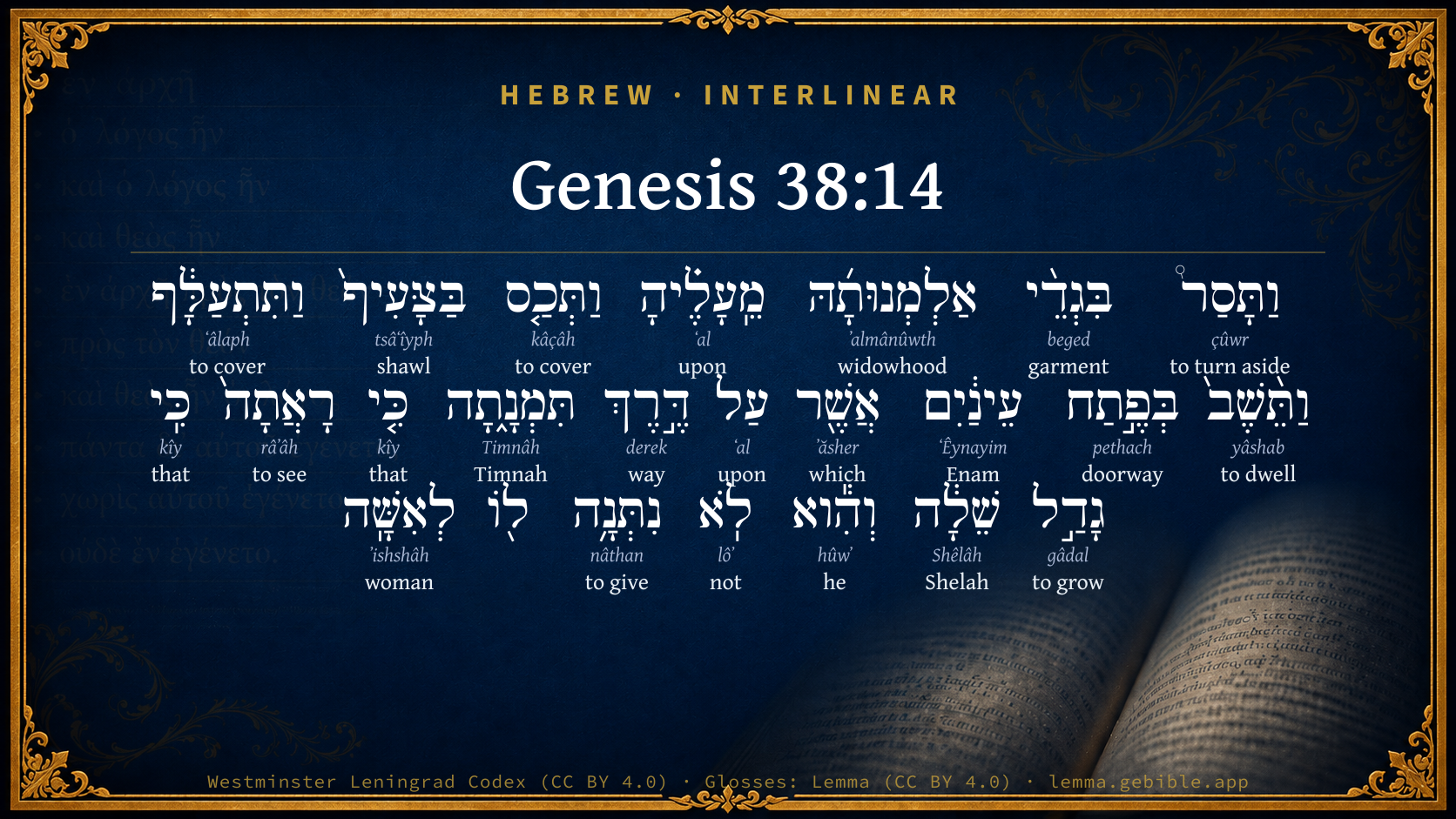
Genesis 38:14

Hebrew (Westminster Leningrad Codex) Genesis 38:14 appears in the Hebrew Old Testament. The text above is from the Westminster Leningrad Codex. Each word links to its Strong’s number, a concise gloss, and parsing drawn from the Open Scriptures Hebrew Bible morphology. Click any word for its full Brown-Driver-Briggs (BDB) entry.
Download image
Cite this verse

Genesis 38:14 (World English Bible). Public Domain. Lemma interlinear Bible study tool, https://lemma.gebible.app/v/genesis/38/14.

Show BibTeX & RIS
BibTeX
RIS
English Translation
She took off of her the garments of her widowhood, and covered herself with her veil, and wrapped herself, and sat in the gate of Enaim, which is by the way to Timnah; for she saw that Shelah was grown up, and she wasn't given to him as a wife.
World English Bible · Public Domain
Highlights
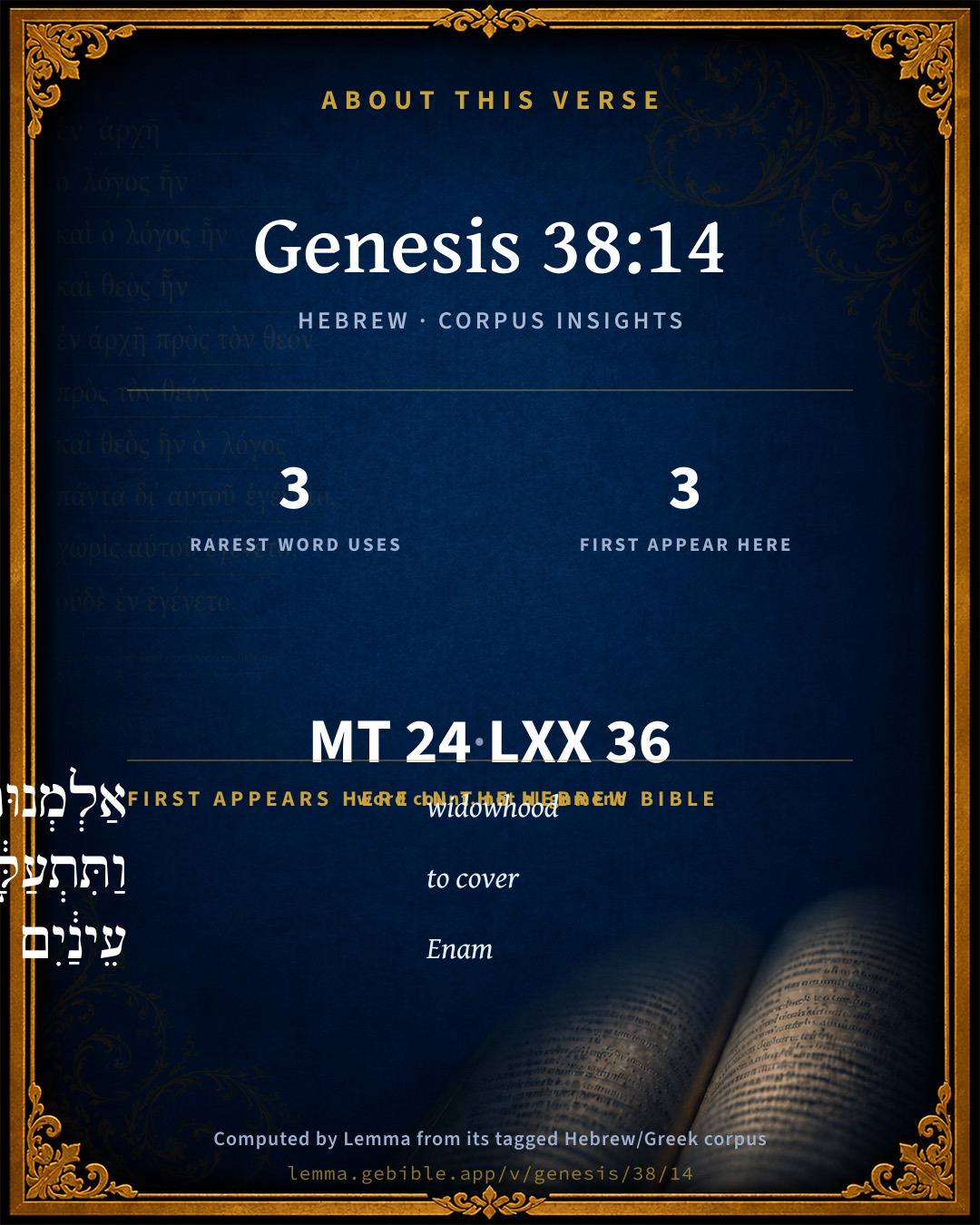
  • 3 first appearances in the Hebrew Bible
Full analysis ↓
Download a study sheet

One document with this verse’s original text, its word-by-word gloss line, the meaning frame, cross-references with their text, attributed commentary, and full source and license credits — printable, and it pastes into notes with its structure intact.

This verse Autodidact and up

Study sheet (.html) Plain text (.txt)

A passage Seminary Student

Up to 50 verses in one chapter. A passage sheet keeps up to 6 commentary sources and 12 cross-references per verse, in the order this page ranks them, and says so on the sheet whenever that leaves anything out. Ask for a single verse and you get the Autodidact verse sheet above.

Everything on this page stays free to read, with no account — the sheet is a download of what is already on screen, not access to it.

Want to remove ads? Support Godless Engineer
Compare translations 3

The same verse in 3 English versions, stacked beneath the original-language interlinear above. Click any original word for its lexicon entry.

Each is an independent rendering of the whole verse — the interlinear is not word-aligned to these translations.

Highlighted words mark where these versions differ — a whole-verse word diff, not a word-by-word alignment.

  • World English Bible Public Domain
    She took off of her the garments of her widowhood, and covered herself with her veil, and wrapped herself, and sat in the gate of Enaim, which is by the way to Timnah; for she saw that Shelah was grown up, and she wasn't given to him as a wife.
  • King James Version Public Domain
    And she put her widow's garments off from her, and covered her with a vail, and wrapped herself, and sat in an open place, which is by the way to Timnath; for she saw that Shelah was grown, and she was not given unto him to wife.
  • unfoldingWord Literal Text CC BY-SA 4.0
    So she took off her widow’s clothes from her and covered herself with a veil and wrapped herself. Then she sat at the entrance of Enaim, which on the road to Timnah, because she saw that Shelah had grown up, but she had not been given to him as a wife.

unfoldingWord Literal Text — © unfoldingWord, licensed CC BY-SA 4.0. Word-aligned USFM3 via Door43 (git.door43.org/unfoldingWord/en_ult).

Versions to compare (up to 4)

3 of 4 selected

Show all 18 translations

Every available English version of this verse, each an independent rendering of the whole verse.

  • World English Bible Public Domain
    She took off of her the garments of her widowhood, and covered herself with her veil, and wrapped herself, and sat in the gate of Enaim, which is by the way to Timnah; for she saw that Shelah was grown up, and she wasn't given to him as a wife.
  • Berean Standard Bible Public Domain
    she removed her widow’s garments, covered her face with a veil to disguise herself, and sat at the entrance to Enaim, which is on the way to Timnah. For she saw that although Shelah had grown up, she had not been given to him as a wife.
  • Majority Standard Bible Public Domain
    she removed her widow’s garments, covered her face with a veil to disguise herself, and sat at the entrance to Enaim, which is on the way to Timnah. For she saw that although Shelah had grown up, she had not been given to him as a wife.
  • King James Version Public Domain
    And she put her widow's garments off from her, and covered her with a vail, and wrapped herself, and sat in an open place, which is by the way to Timnath; for she saw that Shelah was grown, and she was not given unto him to wife.
  • American Standard Version (1901) Public Domain
    And she put off from her the garments of her widowhood, and covered herself with her veil, and wrapped herself, and sat in the gate of Enaim, which is by the way to Timnah; for she saw that Shelah was grown up, and she was not given unto him to wife.
  • Revised Version (1885) Public Domain
    And she put off from her the garments of her widowhood, and covered herself with her veil, and wrapped herself, and sat in the gate of Enaim, which is by the way to Timnah; for she saw that Shelah was grown up, and she was not given unto him to wife.
  • Geneva Bible (1599) Public Domain
    Then she put her widowes garments off from her, and couered her with a vaile, and wrapped her selfe, and sate downe in Pethah-enaim, which is by the way to Timnah, because she sawe that Shelah was growen, and she was not giuen vnto him to wife.
  • Douay-Rheims (1899) Public Domain
    And she put off the garments of her widowhood, and took a veil: and changing her dress, sat in the cross way, that leadeth to Thamnas: because Sela was grown up, and she had not been married to him.
  • Young's Literal Translation Public Domain
    and she turneth aside the garments of her widowhood from off her, and covereth herself with a vail, and wrappeth herself up, and sitteth in the opening of Enayim, which `is' by the way to Timnath, for she hath seen that Shelah hath grown up, and she hath not been given to him for a wife.
  • Literal Standard Version CC BY-SA 4.0
    and she turns aside the garments of her widowhood from off her, and covers herself with a veil, and wraps herself up, and sits in the opening of Enayim, which [is] by the way to Timnath, for she has seen that Shelah has grown up, and she has not been given to him for a wife.
  • Unlocked Literal Bible CC BY-SA 4.0
    She took off the clothing of her widowhood and covered herself with her veil and wrapped herself. She sat in the gate of Enaim, which is by the road to Timnah. For she saw that Shelah had grown up but she had not been given to him as a wife.
  • unfoldingWord Literal Text CC BY-SA 4.0
    So she took off her widow’s clothes from her and covered herself with a veil and wrapped herself. Then she sat at the entrance of Enaim, which on the road to Timnah, because she saw that Shelah had grown up, but she had not been given to him as a wife.
  • Darby Bible Public Domain
    And she put the garments of her widowhood off from her, and covered herself with a veil, and wrapped herself, and sat in the entry of Enaim, which is on the way to Timnah; for she saw that Shelah was grown, and she was not given to him as wife.
  • World Messianic Bible Public Domain
    She took off the garments of her widowhood, and covered herself with her veil, and wrapped herself, and sat in the gate of Enaim, which is on the way to Timnah; for she saw that Shelah was grown up, and she wasn’t given to him as a wife.
  • Webster's Bible Public Domain
    And she put off from her, her widow's garments, and covered her with a vail, and wrapped herself, and sat in an open place, which is by the way to Timnath: for she saw that Shelah was grown, and she was not given to him for a wife.
  • Free Bible Version CC BY-SA 4.0
    So she took off her widow's clothes and covered herself with a veil, disguising herself. She sat down beside the entrance to Enaim, which is on the way to Timnah. She had realized that even though Shelah had now grown up, nothing had been done about her marrying him.
  • Bible in Basic English Public Domain
    She took off her widow's clothing, and covering herself with her veil, she took her seat near Enaim on the road to Timnah; for she saw that Shelah was now a man, but she had not been made his wife.
  • JPS Tanakh (1917) Public Domain
    And she put off from her the garments of her widowhood, and covered herself with her veil, and wrapped herself, and sat in the entrance of Enaim, which is by the way to Timnah; for she saw that Shelah was grown up, and she was not given unto him to wife.

Literal Standard Version (2020), Covenant Press — licensed CC BY-SA 4.0. Text via the HelloAO Bible API (eBible.org). Unlocked Literal Bible (unfoldingWord) — licensed CC BY-SA 4.0. Text via the HelloAO Bible API (eBible.org). unfoldingWord Literal Text — © unfoldingWord, licensed CC BY-SA 4.0. Word-aligned USFM3 via Door43 (git.door43.org/unfoldingWord/en_ult). Free Bible Version, Dr. Jonathan Gallagher — licensed CC BY-SA 4.0. Text via the HelloAO Bible API (eBible.org).

Word by word

More ways to search: Search by grammar → Find every occurrence → Compare this word →

Practice this passage: Drill this verse → Learn its vocabulary →

בַּצָּעִיף֙
tsâʻîyph
H6809
“in/at the · shawl”
Preposition, Determined + Noun, Common, Masculine, Singular, Absolute
Part of Speech
Preposition + Noun
Type
Common
Gender
Masculine
Number
Singular
State
Absolute
Full BDB Definition

Origin: from an unused root meaning to wrap over

TWOT: 1946a

wrapper, shawl, veil
  1. וַתָּסַר֩ çûwr H5493 “and · to turn aside” Conjunction + Verb, Hiphil, Sequential Imperfect, 3rd Person, Feminine, Singular
  2. בִּגְדֵ֨י beged H899 “garments of” Noun, Common, Masculine, Plural, Construct
  3. אַלְמְנוּתָ֜הּ ʼalmânûwth H491 “widowhood · her” Noun, Common, Feminine, Singular, Construct + Suffix, Personal, 3rd Person, Feminine, Singular
  4. מֵֽעָלֶ֗יהָ ʻal H5921 “from · upon · her” Preposition + Preposition + Suffix, Personal, 3rd Person, Feminine, Singular
  5. וַתְּכַ֤ס kâçâh H3680 “and · to cover” Conjunction + Verb, Piel, Sequential Imperfect, 3rd Person, Feminine, Singular
  6. וַתִּתְעַלָּ֔ף ʻâlaph H5968 “and · to cover” Conjunction + Verb, Hithpael, Sequential Imperfect, 3rd Person, Feminine, Singular
  7. וַתֵּ֨שֶׁב֙ yâshab H3427 “and · to dwell” Conjunction + Verb, Qal, Sequential Imperfect, 3rd Person, Feminine, Singular
  8. בְּפֶ֣תַח pethach H6607 “in/at · doorway of” Preposition + Noun, Common, Masculine, Singular, Construct
  9. עֵינַ֔יִם ʻÊynayim H5879 “Enam” Noun, Proper
  10. אֲשֶׁ֖ר ʼăsher H834 “which” Particle, Relative
  11. עַל ʻal H5921 “upon” Preposition
  12. דֶּ֣רֶךְ derek H1870 “way of” Noun, Common, Both, Singular, Construct
  13. תִּמְנָ֑תָה Timnâh H8553 “Timnah · toward” Noun, Proper + Suffix, Demonstrative
  14. כִּ֤י kîy H3588 “that” Conjunction
  15. רָאֲתָה֙ râʼâh H7200 “to see” Verb, Qal, Perfect, 3rd Person, Feminine, Singular
  16. כִּֽי kîy H3588 “that” Conjunction
  17. גָדַ֣ל gâdal H1431 “to grow” Verb, Qal, Perfect, 3rd Person, Masculine, Singular
  18. שֵׁלָ֔ה Shêlâh H7956 “Shelah” Noun, Proper
  19. וְהִ֕וא hûwʼ H1931 “and · he” Conjunction + Pronoun, Personal, 3rd Person, Feminine, Singular
  20. לֹֽא lôʼ H3808 “not” Particle, Negative
  21. נִתְּנָ֥ה nâthan H5414 “to give” Verb, Niphal, Perfect, 3rd Person, Feminine, Singular
  22. לְאִשָּֽׁה ʼishshâh H802 “to/for · woman” Preposition + Noun, Common, Feminine, Singular, Absolute

About this verse

These counts appear in no published source. They are computed here, from the morphology-tagged text and Lemma’s own curated glosses. What Lemma adds →

24
words
21
distinct lemmas
Pentateuch
section

Notable vocabulary

The rarest word here is בַּצָּעִיף֙ shawl H6809 — appearing just 3 times in the whole Hebrew Bible.

First appearance in Scripture

These words make their first canonical appearance in the Hebrew Bible here:

  • אַלְמְנוּתָ֜הּ widowhood H491
  • וַתִּתְעַלָּ֔ף to cover H5968
  • עֵינַ֔יִם Enam H5879

Shared distinctive vocabulary

בַּצָּעִיף֙ shawl H6809 occurs in 3 verses of the Hebrew Bible. Also found in:

Grammatical profile

  • 7 verbs
  • 9 nouns
  • 1 pronoun
  • 3 prepositions
  • 2 conjunctions
  • 2 particles

Verb forms

  • וַתָּסַר֩ Hiphil · Sequential Imperfect
  • וַתְּכַ֤ס Piel · Sequential Imperfect
  • וַתִּתְעַלָּ֔ף Hithpael · Sequential Imperfect
  • וַתֵּ֨שֶׁב֙ Qal · Sequential Imperfect
  • רָאֲתָה֙ Qal · Perfect
  • גָדַ֣ל Qal · Perfect
  • נִתְּנָ֥ה Niphal · Perfect

Repetition

Words recur within this verse — often emphatic in Hebrew:

  • מֵֽעָלֶ֗יהָ upon H5921 ×2
  • כִּ֤י that H3588 ×2

Hebrew & Septuagint length

In English translation the verse runs 50 words from the Hebrew and 51 from the Septuagint (LXX English) — closely comparable.

A rough comparison of the two English renderings, which tokenize alike — not a word-level alignment.

Word counts can differ between the Hebrew and the Greek without any difference in meaning — e.g. the Hebrew direct-object marker אֵת has no separate Greek word, and Greek often adds the article ὁ.

In the original languages it is 24 Hebrew tokens and 36 Greek tokens — but the two are counted differently (Hebrew bundles its prefixes and suffixes into one token; the Greek is in lemma form), so that isn’t a like-for-like length.

Cross-references

5

Topical passages linked to Genesis 38:14 in the Treasury of Scripture Knowledge — connected by theme and wording, ordered by reader-vote popularity; previews shown in the World English Bible.

  • Genesis 38:26 Judah acknowledged them, and said, "She is more righteous than I, because I didn't give her to Shelah, my son." He knew her again no more.
  • Genesis 24:65 She said to the servant, "Who is the man who is walking in the field to meet us?" The servant said, "It is my master." She took her veil, and covered herself.
  • Genesis 38:11–13 Then Judah said to Tamar, his daughter-in-law, "Remain a widow in your father's house, until Shelah, my son, is grown up;" for he said, "Lest he also die, like his brothers." Tamar went and lived in her father's house.
  • Proverbs 7:12 Now she is in the streets, now in the squares, And lurking at every corner.
  • Jeremiah 3:2 Lift up your eyes to the bare heights, and see; where have you not been lain with? By the ways have you sat for them, as an Arabian in the wilderness; and you have polluted the land with your prostitution and with your wickedness.

Cross-references courtesy of OpenBible.info (CC BY 4.0).

Hebrew and Greek witnesses Masoretic Hebrew ↔ Greek Septuagint

The same verse in the two great witnesses to the Old Testament, shown verse-for-verse.

These are two independent witnesses, not word-aligned to each other, and the Septuagint is shown in lemma (dictionary) form.

Hebrew Genesis 38:14 Masoretic · Westminster Leningrad Codex

וַתָּסַר֩ בִּגְדֵ֨י אַלְמְנוּתָ֜הּ מֵֽעָלֶ֗יהָ וַתְּכַ֤ס בַּצָּעִיף֙ וַתִּתְעַלָּ֔ף וַתֵּ֨שֶׁב֙ בְּפֶ֣תַח עֵינַ֔יִם אֲשֶׁ֖ר עַל דֶּ֣רֶךְ תִּמְנָ֑תָה כִּ֤י רָאֲתָה֙ כִּֽי גָדַ֣ל שֵׁלָ֔ה וְהִ֕וא לֹֽא נִתְּנָ֥ה ל֖וֹ לְאִשָּֽׁה

She took off of her the garments of her widowhood, and covered herself with her veil, and wrapped herself, and sat in the gate of Enaim, which is by the way to Timnah; for she saw that Shelah was grown up, and she wasn't given to him as a wife.

World English Bible · Public Domain

Greek LXX Genesis 38:14 Septuagint · lemma form

καί περιαἱρέω ὁ ἱμάτιον ὁ χήρευσις ἀπό ἑαυτοῦ περιβάλλω θέριστρον καί καλλωπίζω καί καταἵζω πρός ὁ πύλη αιναν ὅς εἰμί ἐν πάροδος θαμνα ὁράω γάρ ὅτι μέγας γίγνομαι σηλωμ αὐτός δέ οὐ δίδωμι αὐτός αὐτός γυνή

And having taken off the garments of her widowhood from her, she put on a veil, and ornamented her face, and sat by the gates of Aenan, which is in the way to Thamna, for she saw that Selom was grown; but he gave her not to him for a wife.

LXX2012 (modern English Septuagint) · Public Domain

On this verse, Haydock's Catholic Bible Commentary discusses the Septuagint’s reading. Read the note in Commentary ↓

Hebrew: Westminster Leningrad Codex (CC BY 4.0). Greek: Septuagint (public domain); English from LXX2012 (modern English Septuagint) (Public Domain). How the Septuagint differs from the Hebrew →

Targum (Aramaic paraphrase)

2

The Targum is the ancient Jewish Aramaic paraphrase of the Hebrew Scriptures — an interpretive translation, not the Hebrew text itself. Onkelos (literal) and Pseudo-Jonathan (expansive) render the Torah, and Jonathan the Prophets. Coverage is partial: where no permissively-licensed English translation exists for a verse, only the Aramaic is shown. This is verse-level text, not a word-by-word alignment to the Hebrew.

  1. Targum Onkelos Torah (Genesis–Deuteronomy)
    וְאַעְדִּיאַת לְבוּשֵׁי אַרְמְלוּתַהּ מִנַּהּ וְאִתְכַּסִּיאַת בְּעֵיפָא וְאִתַּקָּנַת וִיתִיבַת בְּפָרָשׁוּת עַיְנִין דִּי עַל אֹרַח תִּמְנָת אֲרֵי חָזַת אֲרֵי רְבָא שֵׁלָה וְהִיא לָא אִתְיְהִיבַת לֵהּ לְאִנְתּוּ

    (no public-domain English translation for this verse)

    Targum Onkelos — Aramaic: “Onkelos Genesis” (public domain); “Onkelos Exodus” (public domain); “Onkelos Leviticus” (public domain); “Onkelos Numbers” (public domain); “Onkelos Deuteronomy” (public domain). English: “Sefaria Community Translation” (CC0 1.0 (public-domain dedication)); “J.W. Etheridge. The Targums of Onkelos and Jonathan Ben Uzziel on the Pentateuch. London: Longmans, Green, 1862” (public domain). Text via Sefaria.

  2. Targum Pseudo-Jonathan Torah (Genesis–Deuteronomy)
    וְאַעֲדַת לְבוּשֵׁי אַרְמְלוּתָהּ מִינָהּ וְכַסְיַית בִּרְדִידָא וְאַעַטְפַת וִיתֵיבַת בְפַרְשַׁת אָרְחִין דְכָל עַיְינִין מִסְתַּכְּלִין תַּמָן דְעַל שְׁבִילָא דְתִמְנַת אֲרוּם חָמַת אֲרוּם רַבָּא שֵׁלָה וְהִיא לָא אִתְיְהִיבַת לֵיהּ לְאִנְתּוּ

    And she put the dress of her widowhood from her, and covered herself with a veil, and wrapped herself, and sat in the dividing of the road where all eyes see, upon the way of Timnath. For she knew that Shela was grown up, yet she had not been given to him to be his wife.

    Targum Pseudo-Jonathan — Aramaic: “Targum Jonathan on Genesis” (public domain); “Targum Jonathan on Exodus” (public domain); “Targum Jonathan on Leviticus” (public domain); “Targum Jonathan on Numbers” (public domain); “Targum Jonathan on Deuteronomy” (public domain). English: “The Targum of Jonathan ben Uzziel, trans. J. W. Etheridge, London, 1862” (public domain). Text via Sefaria.

Commentary

Notes on Genesis 38:14 from classic Christian and Jewish commentators (each source and its license shown beneath its notes). The classic Christian expositions comment on the surrounding passage and are grouped to its opening verse, so a note may address several verses; the Jewish commentaries on the Tanakh (Rashi and others) are per-verse, so they appear only where the commentator wrote on this verse.

Lemma curates 59 commentaries, every one of them public domain or Creative Commons licensed, each selected and text-cleaned for this edition rather than reprinted as found. About our sources →

Trapp's Complete Commentary

John Trapp

Gen 38:14 And she put her widow’s garments off from her, and covered her with a vail, and wrapped herself, and sat in an open place, which [is] by the way to Timnath; for she saw that Shelah was grown, and she was not given unto him to wife.

Ver. 14. Covered her with a vail.] As they that do evil shun the light. She was going about a deed of darkness.

For she saw that Shelah was grown.] She ran into this foul sin, partly for revenge, and partly for issue. But this excuseth her not: for the revenge she took was private; and she should have sought a godly seed by lawful wedlock, and not by abominable incest. Discontent is the mother of much mischief; as it was in Judas, Haman, &c.

John Trapp, A Commentary or Exposition upon All the Books of the Old and New Testament (1647–1656) — public domain. Text from a community e-Sword module.

Joseph Benson's Commentary

Gen 38:14. She put her widow’s garments off, &c. — Some excuse her conduct in this by suggesting that she believed the promise made to Abraham and his seed, particularly that of the Messiah, and that she was therefore desirous to have a child by one of that family, that she might have the honour, or at least stand fair for being the mother of the Messiah. She covered her with a veil — It was the custom of harlots in those times to cover their faces, that though they were not ashamed, yet they might seem to be so: the sin of uncleanness did not go so bare-faced as it now doth.

Joseph Benson's Commentary on the Old and New Testaments (1811–1818) — public domain. Text from a community e-Sword module.

Tyndale Open Study Notes

Tyndale Open Resources

38:14-19 Tamar realized that she would have to take matters into her own hands if the family were to have a future. Tamar acted in keeping with the levirate custom (see study note on 38:8) out of loyalty to her deceased husband. She had a legal right to an heir by Judah’s son or by Judah, so she lured her father-in-law into having sex with her. Jacob’s family was deceived again, this time by a Canaanite daughter-in-law.

Tyndale Open Study Notes — © Tyndale Open Resources, licensed CC BY-SA 4.0. Text via the HelloAO Bible API.

Geneva Bible (1599)

Geneva Bible translators

Or, in the door of the fountain, or, where were two ways.

Geneva Bible (1599) marginal notes — public domain. Text via Bolls.life.

John Calvin's Commentaries

14. And sat in an open place Interpreters expound this passage variously. Literally, it is “in the door of fountains, or of eyes.” Some suppose there was a fountain which branched into two streams; others think that a broad place is indicated, in which the eyes may look around in all directions. But a third exposition is more worthy of reception; namely, that by this expression is meant a way which is forked and divided into two; because then, as it were, a door is opened before the eyes, that they which are really in one way may diverge in two directions. Probably it was a place whence Tamer might be seen, to which some by-way was near, where Judah might turn, so that he should not be guilty of fornication, in a public way, under the eyes of all. When it is said she veiled her face, we hence infer that the license of fornication was not so unbridled as that which, at this day, prevails in many places. For she dressed herself after the manner of harlots, that Judah might suspect nothing. And the Lord has caused this sense of shame to remain engraved on the hearts of those who live wickedly, that they may be witnesses to themselves of their own vileness. For if men could wash out the stains from their sins, we know that they would do so most willingly. Whence it follows, that while they flee from the light, they are affected with horror against their will, that their conscience may anticipate the judgment of God. By degrees, indeed, the greater part have so far exceeded all measure in stupor and impudence, that they are less careful to hide their faults; yet God has never suffered the sense of nature to be so entirely extinguished, by the brutal intemperance of those who desire to sin with impunity, but that their own obscenity shall compel even the most wicked to be ashamed. Base was therefore the impudence of that cynic philosopher, who, being catched in vice, boasted of planting a person. In short, the veil of Tamer shows that fornication was not only a base and filthy thing in the sight of God and the angels; but that it has always been condemned, even by those who have practiced it.

John Calvin's Commentaries (1540-1563) — public domain. Text from the Calvin Translation Society English edition (1840s-50s) via the Christian Classics Ethereal Library (ccel.org). Calvin's coverage is partial (roughly two-thirds of the Bible); uncommented books and verses are honest gaps, never fabricated. The 19th-century editor's footnotes and remarks are omitted so the notes are faithfully Calvin's own voice.

Ellicott's Commentary for English Readers

(14) In an open place.—Heb., in the gate of Enajim. Enajim means “the two fountains,” and we learn from Gen_38:21 that it was the town where Tamar’s father dwelt, and where Tamar was living with him in her widowhood. In the exploration of Palestine, Enajim has been identified with a place called Allin, Anin, or Anaim, three miles east of Tibneh, and situated upon an ancient road coming from Adullam. This makes the conclusion come to for other reasons certain, that the Timnath on the Philistine border was the town meant.

A Bible Commentary for English Readers, edited by Charles John Ellicott (1878–1897) — public domain. Text from a community e-Sword module.

The Cambridge Bible for Schools and Colleges

gen. ed. J. J. S. Perowne

14. And she put off, &c.] The neglect on Judah’s part to satisfy the requirements of the levirate rule provoked Tamar to have recourse to trickery. To our moral sense such conduct is bad and disgusting. But to Orientals, whose life depended so largely upon the sanctity of racial customs, her action may have seemed not only entertaining in its cleverness, but even honourable and justifiable in its devotion to a deceased husband’s rights.

her veil] Tamar apparelled herself in the guise of a religious prostitute (ḳedêshah, Gen_38:21), one who dedicated herself to the goddess Astarte, the Babylonian Istar. The veil was one of the symbols of Istar.

in the gate of Enaim] i.e. in the open space at the entrance into the town. The name of the town means “wells,” possibly Enam, mentioned in Jos_15:34, in the same context with Adullam.

by the way] i.e. on “the way side” (Gen_38:21): see Jer_3:2; Eze_16:15-25.

The Cambridge Bible for Schools and Colleges (gen. ed. J. J. S. Perowne; Cambridge University Press, 1878–1918) — public domain. Text from a community e-Sword module.

John Gill's Exposition

When Judah saw her, he thought her to be an harlot,.... By her posture and the place she was in:

because she had covered her face; with her veil, that he did not know her; for this is not given as a reason why he took her to be an harlot; the reason of this was, because she sat in the public road; but having covered her face he could not discern who she was, and therefore, from the other circumstance, concluded that she was an harlot, and sat there to prostitute herself to any that passed by.

John Gill's Exposition of the Whole Bible (1746–1763) — public domain (CC PDM 1.0). Text via the HelloAO Bible API.

Haydock's Catholic Bible Commentary

Veil; (theristrum) a long robe, covering the whole body, except the eyes. Thus she was disguised; or, as it were, masked, as Aquila translates. Harlots herein imitated modest women, chap. xxiv. 65. --- Cross way. Hebrew Henayim, which the Septuagint and Syriac take for a proper name. Others translate "at the gate of the eyes," which means two roads, where a person must open his eyes to judge which is the right one---or "at the gate of the two fountains leading to Thamnas," Judges xiv. 1. Prostitutes formerly infested the high roads. (Jeremias iii. 2; Ezechiel xvi. 25.) Chrysippus says, "at first harlots remained out of the city, and covered their faces; but afterwards growing more hardened, they laid aside the mask," &c.

George Leo Haydock (1774–1849), Haydock's Catholic Family Bible and Commentary, 1859 edition — public domain. Excludes Psalms (Douay-Rheims chapter numbering differs from Protestant) and Deuterocanonical books (Catholic canon only).

Matthew Poole's English Annotations

Covered her with a vail, as harlots used to do in those modester ages of the world, when they had not learnt to outface the sun, nor to glory in their villanies.

In an open place, where she night be soonest discovered by passengers. This is noted as the practice of harlots, Pro 7:12; 9:14; Jer 3:2; Eze 16:24,25.

Matthew Poole's English Annotations on the Holy Bible (1683–1685) — public domain. Text from a community e-Sword/MySword module.

Whedon's Commentary on the Bible

Daniel D. Whedon

14. In an open place — Rather, at the entrance of Enajim. This Enajim was probably the same as the Enam of Jos_15:35, which is mentioned in connexion with Jarmuth and Adullam. This act of Tamar reveals the shameful state of morals among the Canaanites, and furnishes also the occasion of showing the strength of Judah’s sensuality, and his low life as compared with what we see in Joseph.

Daniel D. Whedon (gen. ed.), Commentary on the Old and New Testaments (1874–1909) — public domain. Text from a community e-Sword module.

The Pulpit Commentary

And she put her widow"s garments off from her (to prevent detection by Judah), and covered her with a veil, to conceal her features, after the fashion of a courtesan (ver. 15; cf. Job_24:15) and wrapped herself, possibly with some large mantle (Alford)and sat in an open place, literally, in the opening (i.e. gate) of Enaim (LXX, Gesenius, Keil, Kalisch, Lange, et alii); less happily, in the opening of the eyes, i.e. in a public and open place (Calvin), in the parting of the ways, in bivio itineris (Vulgate), in the opening (or breaking forth) of the two fountains (Aben Ezra, Rosenmwhich is by (or upon) the way to Timnath; to the site of Thamna, now Tibneh, three miles to the east, on an ancient road coming from Adullam, the very road by which the patriarch Judah would have come from Adullam to Timnah, is a ruin called Allin, or Anita, or Ainim" ("Palestine Exploration," quoted by Inglis)for she saw that Shelah was grown (he was probably not much younger than either of his brothers who had died), and she was not given unto him to wife literally, for a wife.

The Pulpit Commentary (1880–1919), ed. H.D.M. Spence-Jones & Joseph S. Exell — public domain. Text from a community e-Sword module.

John Wesley's Explanatory Notes

Some excuse this by suggesting that she believed the promise made to Abraham and his seed, particularly that of the Messiah, and that she was therefore desirous to have a child by one of that family, that she might have the honour, or at least stand fair for the honour of being the mother of the Messiah. She covered her with a veil - It was the custom of harlots in those times to cover their faces, that tho' they were not ashamed, yet they might seem to be so: the sin of uncleanness did not then go so bare-faced as it now doth.

John Wesley, Explanatory Notes Upon the Whole Bible (1754–1765) — public domain. Text via the GEBible commentary corpus.

Rashi

Rabbi Shlomo Yitzchaki (Rashi)

ותתעלף AND SHE WRAPPED HERSELF — she veiled her face that he should not recognise her.

ותשב בפתח עינים AND SHE SAT AT THE ENTRANCE OF ENAYIM (literally, at the opening of the eyes) — at the place where the eyes become opened:) at the cross-road which is on the way leading to Timnah. Our Rabbis explain (Sotah 10b) that it means at the door (פתח) of our father Abraham’s residence to which all eyes עינים)) looked forward to pay a visit.

כי ראתה כי גדל שלה FOR SHE SAW THAT SHELAH WAS GROWN etc. — This was the reason why she offered herself to Judah, for she was anxious to have children from him (as an ancestor in some way or other) (Horayot 10b).

Rashi on the Tanakh — English translations: “The Judaica Press complete Tanach with Rashi, translated by A. J. Rosenberg” (CC BY 4.0); “Pentateuch with Rashi's commentary by M. Rosenbaum and A.M. Silbermann, 1929-1934” (public domain); “The Metsudah Tanach series, Lakewood, N.J” (CC BY 4.0); and “The Book of Joshua, Metsudah Publications, 1997” (CC BY 4.0). Text via Sefaria.

Radak

Rabbi David Kimhi (Radak)

ותכס בצעיף. She covered her face with the shawl in order for Yehudah not to be able to recognise her.

ותתעלף, she donned beautiful garments instead of widow’s garb in order to attract Yehudah.

ותשב בפתח עינים, at the crossroads. This was a very exposed location, visible to anyone traveling in that region.

כי ראתה כי גדל שלה, she did all this because she realised now that Yehudah had no intention of letting her be married to his son. She therefore planned to be impregnated by him (seed of his family) without his being aware of it.

Radak on the Tanakh — English translations: “Sefaria Community Translation” (CC0 1.0 (public-domain dedication)); “Eliyahu Munk, HaChut Hameshulash” (CC BY 4.0); “Rabbi Mike Feuer, Jerusalem Anthology” (CC BY 4.0); and “R. David Kimhi on the first book of Psalms, Translated by R.G. Finch, London, 1919” (public domain). Text via Sefaria.

Lesson kit

Teaching starters — assembled from the data on this page, not authored interpretation. Every prompt links to the verse data it draws on. Edit before teaching.

Genesis, in the Pentateuch, opens this verse with 24 words (21 distinct Hebrew lemmas). Its most distinctive word is tsâʻîyph (“shawl”). A historical commentator’s framing appears above. Read the whole chapter for the surrounding context.

Discussion questions

  1. What does “shawl” (tsâʻîyph) contribute to the verse as a whole?
  2. 3 words here appear for the first time in Scripture. What is being introduced at this debut?
  3. Genesis 24:65 shares the word «shawl» with this verse. How do the two illuminate each other?
  4. “upon” occurs 2× in this one verse. What is the effect of the repetition?
  5. These translations render this verse differently; the difference is in the English rendering, not the original. What questions does that raise?
  6. The verb «וַתָּסַר֩» is Hiphil Sequential Imperfect. How does its form color the action?
  7. Reading how Trapp's Complete Commentary and Joseph Benson's Commentary read this verse, where do the two commentators agree and where do they part?

Things to notice

Reading settings

Reading text

Shown beneath each verse's original-language words.

Old Testament
Old Testament edition

Read the OT as the Masoretic Hebrew (MT) or the Greek Septuagint (LXX).

English shown for the Greek Septuagint (in the Hebrew ↔ Greek comparison).

Comparing translations? Open the Compare panel on any verse page to stack up to four side by side.