
Genesis 42:37

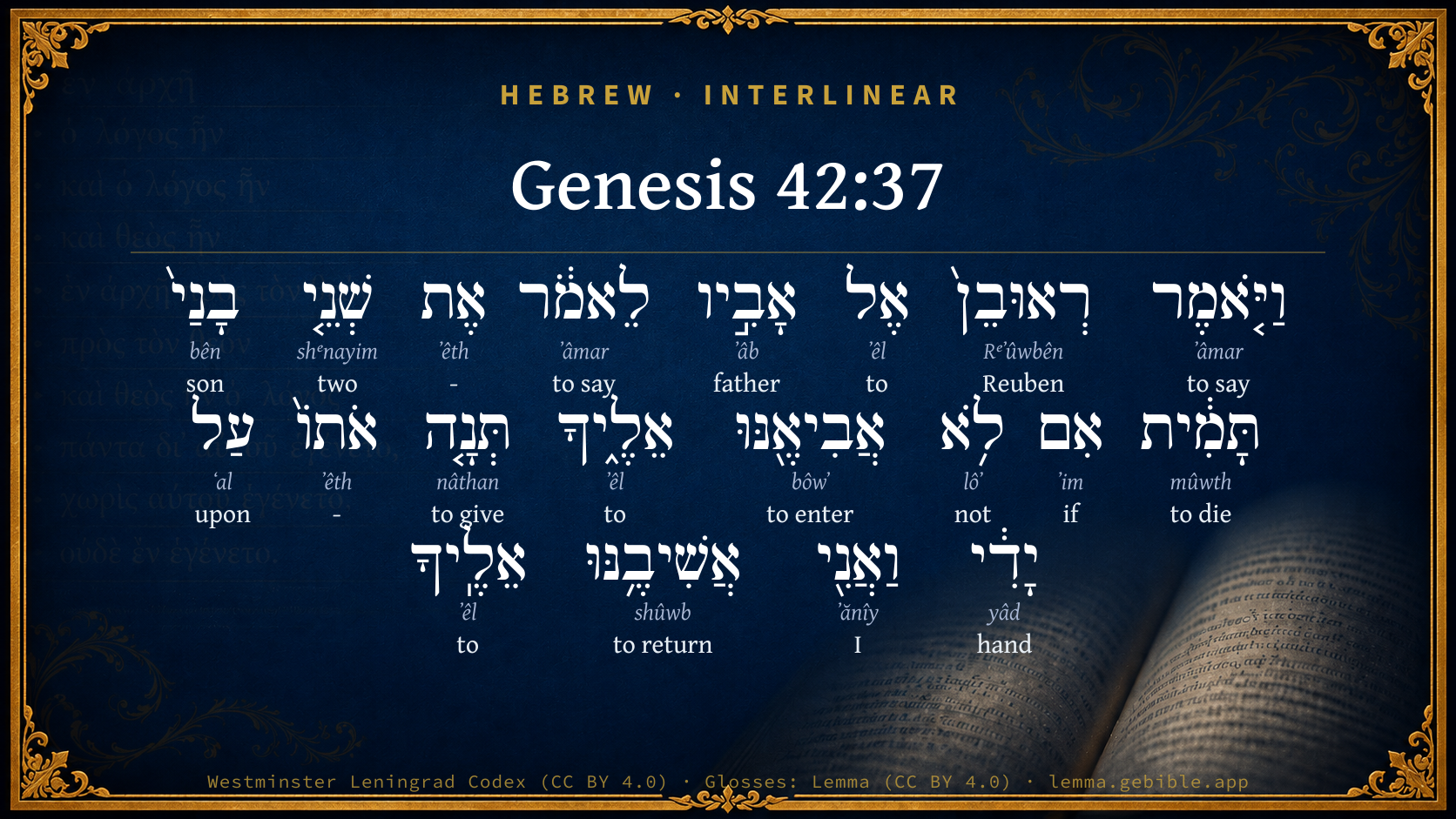
Hebrew (Westminster Leningrad Codex) Genesis 42:37 appears in the Hebrew Old Testament. The text above is from the Westminster Leningrad Codex. Each word links to its Strong’s number, a concise gloss, and parsing drawn from the Open Scriptures Hebrew Bible morphology. Click any word for its full Brown-Driver-Briggs (BDB) entry.
Download image
Cite this verse

Genesis 42:37 (World English Bible). Public Domain. Lemma interlinear Bible study tool, https://lemma.gebible.app/v/genesis/42/37.

Show BibTeX & RIS
BibTeX
RIS
English Translation
Reuben spoke to his father, saying, "Kill my two sons, if I don't bring him to you. Deliver him into my hand, and I will bring him to you again."
World English Bible · Public Domain
Download a study sheet

One document with this verse’s original text, its word-by-word gloss line, the meaning frame, cross-references with their text, attributed commentary, and full source and license credits — printable, and it pastes into notes with its structure intact.

This verse Autodidact and up

Study sheet (.html) Plain text (.txt)

A passage Seminary Student

Up to 50 verses in one chapter. A passage sheet keeps up to 6 commentary sources and 12 cross-references per verse, in the order this page ranks them, and says so on the sheet whenever that leaves anything out. Ask for a single verse and you get the Autodidact verse sheet above.

Everything on this page stays free to read, with no account — the sheet is a download of what is already on screen, not access to it.

Want to remove ads? Support Godless Engineer
Compare translations 3

The same verse in 3 English versions, stacked beneath the original-language interlinear above. Click any original word for its lexicon entry.

Each is an independent rendering of the whole verse — the interlinear is not word-aligned to these translations.

Highlighted words mark where these versions differ — a whole-verse word diff, not a word-by-word alignment.

  • World English Bible Public Domain
    Reuben spoke to his father, saying, "Kill my two sons, if I don't bring him to you. Deliver him into my hand, and I will bring him to you again."
  • King James Version Public Domain
    And Reuben spake unto his father, saying, Slay my two sons, if I bring him not to thee: deliver him into my hand, and I will bring him to thee again.
  • unfoldingWord Literal Text CC BY-SA 4.0
    Then Reuben said to his father, saying, “You may kill my two sons if I do not bring him to you. Put him in my hand, and I will return him to you.”

unfoldingWord Literal Text — © unfoldingWord, licensed CC BY-SA 4.0. Word-aligned USFM3 via Door43 (git.door43.org/unfoldingWord/en_ult).

Versions to compare (up to 4)

3 of 4 selected

Show all 18 translations

Every available English version of this verse, each an independent rendering of the whole verse.

  • World English Bible Public Domain
    Reuben spoke to his father, saying, "Kill my two sons, if I don't bring him to you. Deliver him into my hand, and I will bring him to you again."
  • Berean Standard Bible Public Domain
    Then Reuben said to his father, “You may kill my two sons if I fail to bring him back to you. Put him in my care, and I will return him.”
  • Majority Standard Bible Public Domain
    Then Reuben said to his father, “You may kill my two sons if I fail to bring him back to you. Put him in my care, and I will return him.”
  • King James Version Public Domain
    And Reuben spake unto his father, saying, Slay my two sons, if I bring him not to thee: deliver him into my hand, and I will bring him to thee again.
  • American Standard Version (1901) Public Domain
    And Reuben spake unto his father, saying, Slay my two sons, if I bring him not to thee: deliver him into my hand, and I will bring him to thee again.
  • Revised Version (1885) Public Domain
    And Reuben spake unto his father, saying, Slay my two sons, if I bring him not to thee: deliver him into my hand, and I will bring him to thee again.
  • Geneva Bible (1599) Public Domain
    Then Reuben answered his father, saying, Slay my two sonnes, if I bring him not to thee againe: deliuer him to mine hand, and I will bring him to thee againe.
  • Douay-Rheims (1899) Public Domain
    And Ruben answered him: Kill my two sons if I bring him not again to thee: deliver him unto my hand, and I will restore him to thee.
  • Young's Literal Translation Public Domain
    And Reuben speaketh unto his father, saying, `My two sons thou dost put to death, if I bring him not in unto thee; give him into my hand, and I -- I bring him back unto thee;'
  • Literal Standard Version CC BY-SA 4.0
    And Reuben speaks to his father, saying, “You put to death my two sons, if I do not bring him to you; give him into my hand, and I bring him back to you”;
  • Unlocked Literal Bible CC BY-SA 4.0
    Reuben spoke to his father, saying, “You may kill my two sons if I do not bring Benjamin back to you. Put him in my hands, and I will bring him to you again.”
  • unfoldingWord Literal Text CC BY-SA 4.0
    Then Reuben said to his father, saying, “You may kill my two sons if I do not bring him to you. Put him in my hand, and I will return him to you.”
  • Darby Bible Public Domain
    And Reuben spoke to his father, saying, Slay my two sons if I bring him not back to thee: give him into my hand, and I will bring him to thee again.
  • World Messianic Bible Public Domain
    Reuben spoke to his father, saying, “Kill my two sons, if I don’t bring him to you. Entrust him to my care, and I will bring him to you again.”
  • Webster's Bible Public Domain
    And Reuben spoke to his father, saying, Slay my two sons, if I bring him not to thee: deliver him into my hand, and I will bring him to thee again.
  • Free Bible Version CC BY-SA 4.0
    “You can kill my two sons if I don't bring him back to you,” Reuben assured him. “Trust me with him, and I will bring him home to you myself.”
  • Bible in Basic English Public Domain
    And Reuben said, Put my two sons to death if I do not come back to you with him; let him be in my care and I will give him safely back to you.
  • JPS Tanakh (1917) Public Domain
    And Reuben spoke unto his father, saying: 'Thou shalt slay my two sons, if I bring him not to thee; deliver him into my hand, and I will bring him back to thee.'

Literal Standard Version (2020), Covenant Press — licensed CC BY-SA 4.0. Text via the HelloAO Bible API (eBible.org). Unlocked Literal Bible (unfoldingWord) — licensed CC BY-SA 4.0. Text via the HelloAO Bible API (eBible.org). unfoldingWord Literal Text — © unfoldingWord, licensed CC BY-SA 4.0. Word-aligned USFM3 via Door43 (git.door43.org/unfoldingWord/en_ult). Free Bible Version, Dr. Jonathan Gallagher — licensed CC BY-SA 4.0. Text via the HelloAO Bible API (eBible.org).

Word by word

More ways to search: Search by grammar → Find every occurrence → Compare this word →

Practice this passage: Drill this verse → Learn its vocabulary →

רְאוּבֵן֙
Rᵉʼûwbên
H7205
“Reuben”
Noun, Proper
Part of Speech
Noun
Type
Proper
Full BDB Definition

Origin: from the imperative of H7200 and H1121

TWOT: None

Reuben = "behold a son" - the eldest son of Jacob by Leah - the tribe descended from Reuben - the territory inhabited by the tribe of Reuben
  1. וַיֹּ֤אמֶר ʼâmar H559 “and · to say” Conjunction + Verb, Qal, Sequential Imperfect, 3rd Person, Masculine, Singular
  2. אֶל ʼêl H413 “to” Preposition
  3. אָבִ֣יו ʼâb H1 “father · his” Noun, Common, Masculine, Singular, Construct + Suffix, Personal, 3rd Person, Masculine, Singular
  4. לֵאמֹ֔ר ʼâmar H559 “to say” Preposition + Verb, Qal, Infinitive Construct
  5. אֶת ʼêth H853 “-” Particle, Direct Object
  6. שְׁנֵ֤י shᵉnayim H8147 “two” Adjective, Cardinal number, Masculine, Dual, Construct
  7. בָנַי֙ bên H1121 “sons · my” Noun, Common, Masculine, Plural, Construct + Suffix, Personal, 1st Person, Common, Singular
  8. תָּמִ֔ית mûwth H4191 “to die” Verb, Hiphil, Imperfect, 2nd Person, Masculine, Singular
  9. אִם ʼim H518 “if” Conjunction
  10. לֹ֥א lôʼ H3808 “not” Particle, Negative
  11. אֲבִיאֶ֖נּוּ bôwʼ H935 “to enter · him” Verb, Hiphil, Imperfect, 1st Person, Common, Singular + Suffix, Personal, 3rd Person, Masculine, Singular
  12. אֵלֶ֑יךָ ʼêl H413 “to · you” Preposition + Suffix, Personal, 2nd Person, Masculine, Singular
  13. תְּנָ֤ה nâthan H5414 “give” Verb, Qal, Imperative, 2nd Person, Masculine, Singular + Suffix, h
  14. אֹתוֹ֙ ʼêth H853 “- · him” Particle, Direct Object + Suffix, Personal, 3rd Person, Masculine, Singular
  15. עַל ʻal H5921 “upon” Preposition
  16. יָדִ֔י yâd H3027 “hand · my” Noun, Common, Both, Singular, Construct + Suffix, Personal, 1st Person, Common, Singular
  17. וַאֲנִ֖י ʼănîy H589 “and · I” Conjunction + Pronoun, Personal, 1st Person, Common, Singular
  18. אֲשִׁיבֶ֥נּוּ shûwb H7725 “to return · him” Verb, Hiphil, Imperfect, 1st Person, Common, Singular + Suffix, Personal, 3rd Person, Masculine, Singular
  19. אֵלֶֽיךָ ʼêl H413 “to · you” Preposition + Suffix, Personal, 2nd Person, Masculine, Singular

About this verse

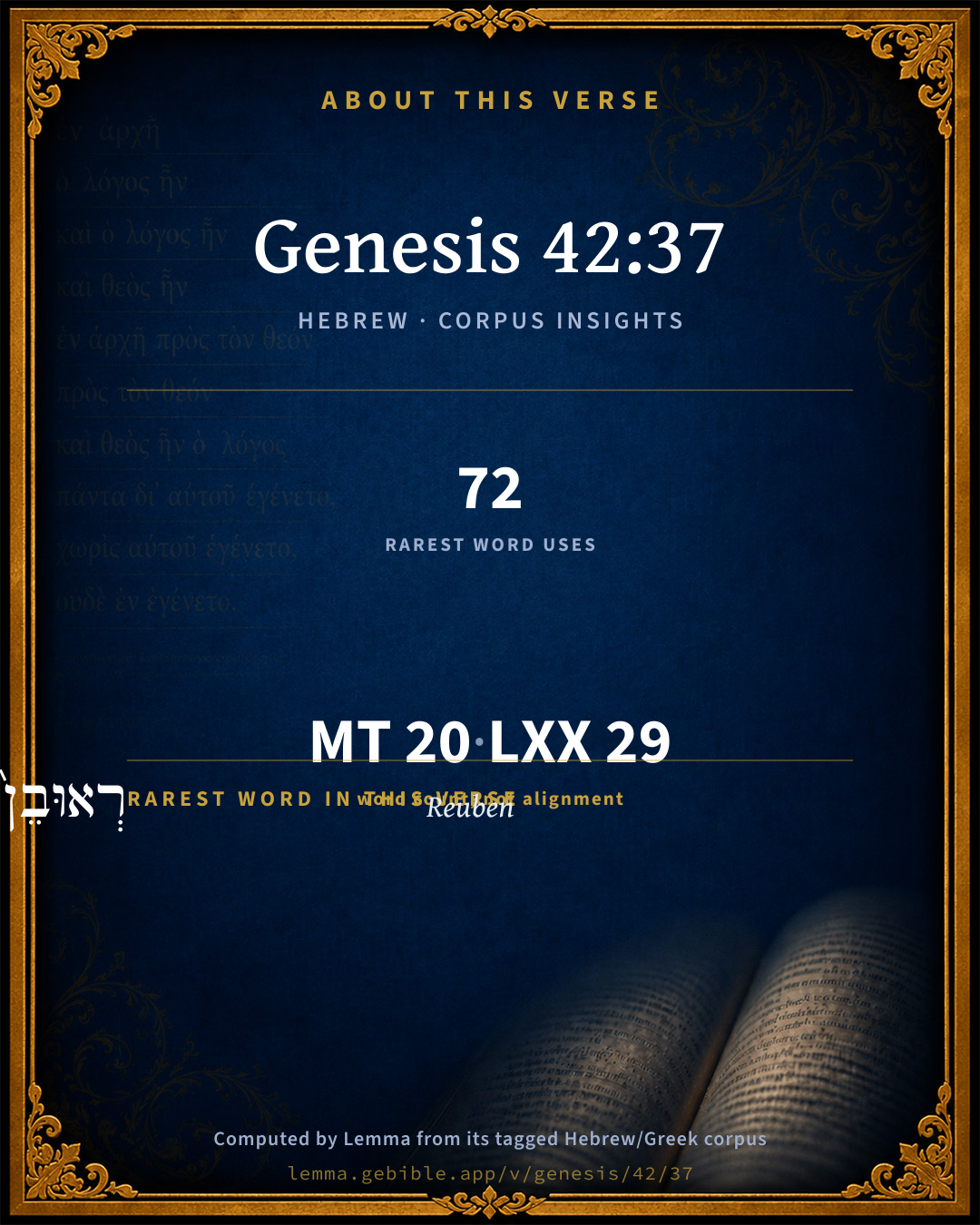
These counts appear in no published source. They are computed here, from the morphology-tagged text and Lemma’s own curated glosses. What Lemma adds →

20
words
16
distinct lemmas
Pentateuch
section

Grammatical profile

  • 6 verbs
  • 4 nouns
  • 1 adjective
  • 1 pronoun
  • 4 prepositions
  • 1 conjunction
  • 3 particles

Verb forms

  • וַיֹּ֤אמֶר Qal · Sequential Imperfect
  • לֵאמֹ֔ר Qal · Infinitive Construct
  • תָּמִ֔ית Hiphil · Imperfect
  • אֲבִיאֶ֖נּוּ Hiphil · Imperfect
  • תְּנָ֤ה Qal · Imperative
  • אֲשִׁיבֶ֥נּוּ Hiphil · Imperfect

Repetition

Words recur within this verse — often emphatic in Hebrew:

  • וַיֹּ֤אמֶר to say H559 ×2
  • אֶל to H413 ×3

Hebrew & Septuagint length

In English translation the verse runs 30 words from the Hebrew and 31 from the Septuagint (LXX English) — closely comparable.

A rough comparison of the two English renderings, which tokenize alike — not a word-level alignment.

Word counts can differ between the Hebrew and the Greek without any difference in meaning — e.g. the Hebrew direct-object marker אֵת has no separate Greek word, and Greek often adds the article ὁ.

In the original languages it is 20 Hebrew tokens and 29 Greek tokens — but the two are counted differently (Hebrew bundles its prefixes and suffixes into one token; the Greek is in lemma form), so that isn’t a like-for-like length.

Cross-references

4

Topical passages linked to Genesis 42:37 in the Treasury of Scripture Knowledge — connected by theme and wording, ordered by reader-vote popularity; previews shown in the World English Bible.

  • Genesis 46:9 The sons of Reuben: Hanoch, Pallu, Hezron, and Carmi.
  • Micah 6:7 Will Yahweh be pleased with thousands of rams? With tens of thousands of rivers of oil? Shall I give my firstborn for my disobedience? The fruit of my body for the sin of my soul?
  • Genesis 43:9 I will be collateral for him. From my hand will you require him. If I don't bring him to you, and set him before you, then let me bear the blame forever,
  • Genesis 44:32–34 For your servant became collateral for the boy to my father, saying, 'If I don't bring him to you, then I will bear the blame to my father forever.'

Cross-references courtesy of OpenBible.info (CC BY 4.0).

Hebrew and Greek witnesses Masoretic Hebrew ↔ Greek Septuagint

The same verse in the two great witnesses to the Old Testament, shown verse-for-verse.

These are two independent witnesses, not word-aligned to each other, and the Septuagint is shown in lemma (dictionary) form.

Hebrew Genesis 42:37 Masoretic · Westminster Leningrad Codex

וַיֹּ֤אמֶר רְאוּבֵן֙ אֶל אָבִ֣יו לֵאמֹ֔ר אֶת שְׁנֵ֤י בָנַי֙ תָּמִ֔ית אִם לֹ֥א אֲבִיאֶ֖נּוּ אֵלֶ֑יךָ תְּנָ֤ה אֹתוֹ֙ עַל יָדִ֔י וַאֲנִ֖י אֲשִׁיבֶ֥נּוּ אֵלֶֽיךָ

Reuben spoke to his father, saying, "Kill my two sons, if I don't bring him to you. Deliver him into my hand, and I will bring him to you again."

World English Bible · Public Domain

Greek LXX Genesis 42:37 Septuagint · lemma form

εἶπον δέ ρουβην ὁ πατήρ αὐτός λέγω ὁ δύο υἱός ἐγώ ἀποκτείνω ἐάν μή ἄγω αὐτός πρός σύ δίδωμι αὐτός εἰς ὁ χείρ ἐγώ καΐἐγώ ἀναἄγω αὐτός πρός σύ

And Ruben spoke to his father, saying, Slay my two sons, if I bring him not to you; give him into my hand, and I will bring him back to you.

LXX2012 (modern English Septuagint) · Public Domain

Hebrew: Westminster Leningrad Codex (CC BY 4.0). Greek: Septuagint (public domain); English from LXX2012 (modern English Septuagint) (Public Domain). How the Septuagint differs from the Hebrew →

Targum (Aramaic paraphrase)

2

The Targum is the ancient Jewish Aramaic paraphrase of the Hebrew Scriptures — an interpretive translation, not the Hebrew text itself. Onkelos (literal) and Pseudo-Jonathan (expansive) render the Torah, and Jonathan the Prophets. Coverage is partial: where no permissively-licensed English translation exists for a verse, only the Aramaic is shown. This is verse-level text, not a word-by-word alignment to the Hebrew.

  1. Targum Onkelos Torah (Genesis–Deuteronomy)
    וַאֲמַר רְאוּבֵן לְוַת אֲבוּהִי לְמֵימַר יָת תְּרֵין בְּנַי תְּמִית אִם לָא אַיְתִנֵּהּ לְוָתָךְ הַב יָתֵהּ עַל יְדִי וַאֲנָא אֲתֵבִנֵּהּ לָךְ

    (no public-domain English translation for this verse)

    Targum Onkelos — Aramaic: “Onkelos Genesis” (public domain); “Onkelos Exodus” (public domain); “Onkelos Leviticus” (public domain); “Onkelos Numbers” (public domain); “Onkelos Deuteronomy” (public domain). English: “Sefaria Community Translation” (CC0 1.0 (public-domain dedication)); “J.W. Etheridge. The Targums of Onkelos and Jonathan Ben Uzziel on the Pentateuch. London: Longmans, Green, 1862” (public domain). Text via Sefaria.

  2. Targum Pseudo-Jonathan Torah (Genesis–Deuteronomy)
    וַאֲמַר רְאוּבֵן לְאָבוֹי לְמֵימַר יַת תְּרֵין בְּנַיי תִּקְטוֹל בְּשַׁמַתָּא אִין לָא אִיתִינֵיהּ לְוָותָךְ הַב יָתֵיהּ עַל יְדַיי וַאֲנָא אָתֵיבִנֵיהּ לָךְ

    And Reuben spake to his father, saying Slay my two sons with a curse if I do not bring him to thee. Give him into my hand, and I will restore him to thee.

    Targum Pseudo-Jonathan — Aramaic: “Targum Jonathan on Genesis” (public domain); “Targum Jonathan on Exodus” (public domain); “Targum Jonathan on Leviticus” (public domain); “Targum Jonathan on Numbers” (public domain); “Targum Jonathan on Deuteronomy” (public domain). English: “The Targum of Jonathan ben Uzziel, trans. J. W. Etheridge, London, 1862” (public domain). Text via Sefaria.

Commentary

Notes on Genesis 42:37 from classic Christian and Jewish commentators (each source and its license shown beneath its notes). The classic Christian expositions comment on the surrounding passage and are grouped to its opening verse, so a note may address several verses; the Jewish commentaries on the Tanakh (Rashi and others) are per-verse, so they appear only where the commentator wrote on this verse.

Lemma curates 59 commentaries, every one of them public domain or Creative Commons licensed, each selected and text-cleaned for this edition rather than reprinted as found. About our sources →

Trapp's Complete Commentary

John Trapp

Gen 42:37 And Reuben spake unto his father, saying, Slay my two sons, if I bring him not to thee: deliver him into my hand, and I will bring him to thee again.

Ver. 37. Slay my two sons.] A simple and sinful offer. Reuben was the oldest, but not the wisest. Age is no just measure of wisdom. Howbeit, of him we may learn, in our parents’ fear, to be hardy and hearty; in our brethren’s distress, to be eager and earnest.

John Trapp, A Commentary or Exposition upon All the Books of the Old and New Testament (1647–1656) — public domain. Text from a community e-Sword module.

The Biblical Illustrator

Joseph S. Exell

Gen_42:37

Slay my two sons

An unlawful mode of speaking

I will give you leave to take away my life, unless I do this or that.

Such modes of speaking as this do not become the mouths of the disciples of our Redeemer. How do we know what we shall be able to do a day or an hour hence? We ought to say, If we live, and the Lord will, we shall do this or that; for a mans heart deviseth his way, but the Lord directeth his steps. When men use this language their words are not to be understood in their literal sense. They are only strong assertions, tinctured with a profane levity of mind. Death ought not to be made a by-word. It will be found a serious thing to die when death comes, if it is not habitually esteemed a serious matter by us, whilst we are living in prosperity and health. By the life of Pharaoh, ye are spies, said Joseph to his brethren. Reuben engages, by the life of his two sons, that he will bring Benjamin in safety to his father, if his father would trust the young man to his care. Surely Reuben might have learned o avoid such strong asseverations about things of this sort. It was his wish to bring Joseph home to his father, and yet he could not persuade his brethren to comply with his intentions. It was his desire to bring Simeon safe to his father, and yet he was compelled to leave him in Egypt. He had reason to hope that his brethren would not treat Benjamin as they had treated Joseph. He had reason to hope that the lord of Egypt would keep his promise. But was he so sure of both these things, and of meeting with no bad accident in the course of his journeyings, that he could warrantably pledge the life of his two sons for Benjamins happy return? He knew that Jacob would not take him at his word. But what if God should, by some untoward event, make him sensible that he had spoken amiss? (G. Lawson, D. D.)

The Biblical Illustrator, edited by Joseph S. Exell (c. 1880s–1900s) — public domain. Text from a community e-Sword module.

Joseph Benson's Commentary

Gen 42:37. Slay my two sons — This was a very rash and absurd proposal. What authority had Reuben to dispose of the lives of his children? And how could the murder of two grandchildren compensate Jacob for the loss of Benjamin? Besides, how did he know that Benjamin, if he went, would live to return, or that he should be able to restore him to his father? He ought, at least, to have said, “If the Lord will.” But he seems to have been little sensible of his dependance on Divine Providence.

Joseph Benson's Commentary on the Old and New Testaments (1811–1818) — public domain. Text from a community e-Sword module.

Tyndale Open Study Notes

Tyndale Open Resources

42:37 Reuben tried to take the lead; perhaps he thought he could get back into his father’s good favor (see 35:22), first by rescuing Joseph from certain death (37:21-22, 29-30) and now by keeping Benjamin safe.

Tyndale Open Study Notes — © Tyndale Open Resources, licensed CC BY-SA 4.0. Text via the HelloAO Bible API.

Jamieson, Fausset & Brown

Robert Jamieson, A. R. Fausset & David Brown

Reuben spake, . . . Slay my two sons, if I bring him not to thee--This was a thoughtless and unwarrantable condition--one that he never seriously expected his father would accept. It was designed only to give assurance of the greatest care being taken of Benjamin. But unforeseen circumstances might arise to render it impossible for all of them to preserve that young lad (Jam 4:13), and Jacob was much pained by the prospect. Little did he know that God was dealing with him severely, but in kindness (Heb 12:7-8), and that all those things he thought against Him were working together for his good.

Next: Genesis Chapter 43

Jamieson, Fausset & Brown — Commentary Critical and Explanatory on the Whole Bible (1871) — public domain (CC PDM 1.0). Text via the HelloAO Bible API.

Adam Clarke's Commentary

Verse 37. Slay my two sons, if I bring him not to thee] What a strange proposal made by a son to his father, concerning his grandchildren! But they show the honesty and affection of Reuben's heart; he felt deeply for his father's distress, and was determined to risk and hazard every thing in order to relieve and comfort him. There is scarcely a transaction in which Reuben is concerned that does not serve to set his character in an amiable point of view, except the single instance mentioned Ge 35:22, and which for the sake of decency and piety we should wish to understand as the Targumists have explained it. See the notes.

Adam Clarke's Commentary on the Bible (1810–1826) — public domain. Text from a community e-Sword/MySword module.

Ellicott's Commentary for English Readers

(37) Slay my two sons.—Reuben does not suppose that Jacob would really put his grandchildren to death. but simply means to offer his father a strong assurance that Benjamin would run no danger. He regarded the risk as so slight that he was willing to stake the lives of two of his children, perhaps all he then had, upon Benjamin’s safe return. To take such a proposal as meant literally is irrational. But it was but feeble talk, in agreement with the general weakness of Reuben’s character.

A Bible Commentary for English Readers, edited by Charles John Ellicott (1878–1897) — public domain. Text from a community e-Sword module.

The Cambridge Bible for Schools and Colleges

gen. ed. J. J. S. Perowne

37. Reuben] Reuben is here again prominent; cf. Gen_42:22. His words, offering his two sons as a pledge for the safe return of Benjamin, imply that a second journey to Egypt is regarded as a necessity and as a peril. Notice that here Reuben has two sons; in Gen_46:9 (P) four are mentioned.

Reuben here, as elsewhere in the E narrative, acts as leader; in the J narrative, it is Judah who makes a similar offer (Gen_43:2). Reuben acknowledges the patriarchal authority of the head of the family over the lives of his children. Cf. Gen_31:32.

The Cambridge Bible for Schools and Colleges (gen. ed. J. J. S. Perowne; Cambridge University Press, 1878–1918) — public domain. Text from a community e-Sword module.

Haydock's Catholic Bible Commentary

Kill, &c. By this proposal, he meant to signify his utmost care and zeal to bring back young Benjamin safe to his father.

George Leo Haydock (1774–1849), Haydock's Catholic Family Bible and Commentary, 1859 edition — public domain. Excludes Psalms (Douay-Rheims chapter numbering differs from Protestant) and Deuterocanonical books (Catholic canon only).

Matthew Poole's English Annotations

Slay my two sons, two of the four mentioned Gen 46:9. An absurd proposition, neither fit for him to make, nor for Jacob to accept.

Matthew Poole's English Annotations on the Holy Bible (1683–1685) — public domain. Text from a community e-Sword/MySword module.

Whedon's Commentary on the Bible

Daniel D. Whedon

37. Reuben spake — As became the firstborn. Joseph’s words (in Gen_42:18-20) seem to have satisfied him that no harm would befall Benjamin.

Daniel D. Whedon (gen. ed.), Commentary on the Old and New Testaments (1874–1909) — public domain. Text from a community e-Sword module.

The Pulpit Commentary

And Reuben spake unto his father, saying (Reuben was probably actuated by an ardent brotherly affection, which prompted him to endeavor to recover Simeon, as formerly he had sought to deliver Joseph), Slay my two sons as Reuben had four sons, (Gen_46:9) he first be understood as meaning two of my sons (Ainsworth, Murphy), either the two then present (Junius) or the two oldest (Mercerus)if I bring him (i.e. Benjamin) not to thee. Reuben"s proposal, though in one sense "the greatest and dearest offer that a son could make to a father" (Keil), was either only a sample of strong rhetoric (like Joseph"s "By the life of Pharaoh!") designed to assure his father of the impossibility of failure (Lawson, Candlish, Inglis), and of the fact that neither he nor his brethren entertained any injurious designs against Benjamin (Calvin); or, if seriously made, was not only inconsiderate and rash, spoken in the heat of the moment (Kurtz), but sinful and unnatural (Ainsworth), plusquam barbarura (Calvin), and absolutely worthless besides, as what consolation would it be to Jacob to add to the loss of a son the murder of his grandchildren? (Calvin, Willet). Deliver him into my hand, and I will bring him to thee again. Reuben might have learned to avoid strong asseverations on this point. "It was his wish to bring Joseph home to his father, and yet he could not persuade his brethren to comply with his intentions. It was his desire to bring Simeon safe to his father, and yet he was compelled to leave him in Egypt" (Lawson).

The Pulpit Commentary (1880–1919), ed. H.D.M. Spence-Jones & Joseph S. Exell — public domain. Text from a community e-Sword module.

Keil & Delitzsch

C. F. Keil & F. Delitzsch

Reuben then offered his two sons to Jacob as pledges for Benjamin, if Jacob would entrust him to his care: Jacob might slay them, if he did not bring Benjamin back-the greatest and dearest offer that a son could make to a father. But Jacob refused to let him go. "If mischief befell him by the way, he would bring down my grey hairs with sorrow into Sheol" (cf. Gen 37:35).

Keil & Delitzsch — Biblical Commentary on the Old Testament (1861–1891) — public domain (CC PDM 1.0). Text via the HelloAO Bible API. (Old Testament only.)

unfoldingWord translationNotes

Door43 World Missions Community

Put him in my hands

This is a request for Reuben to take Joseph with him and to care for him on the journey. AT: "Put me in charge of him" or "Let me take care of him" (See: Metaphor)

My son will not go down with you

It was common to use the phrase "go down" when speaking of traveling from Canaan to Egypt. AT: "My son, Benjamin, will not go with you to Egypt"

with you

Here "you" is plural and refers to Jacob's older sons. (See: Forms of You)

For his brother is dead and he alone is left

The full meaning can be made explicit. AT: "For my wife, Rachel, only had two children. Joseph is dead and Benjamin is the only one left" (See: Assumed Knowledge and Implicit Information)

on the road in which you go

"while you a traveling to Egypt and back" or "while you are away." Here "road" stands for traveling.

then you will bring down my gray hair with sorrow to Sheol

To "bring down ... to Sheol" is way of saying they will cause him to die and go to Sheol. He uses the word "down" because it was commonly believed sheol is somewhere underground. AT: "then you will cause me, an old man, to die of sorrow" (See: Idiom)

my gray hair

This stands for Jacob and emphasizes his old age. AT: "me, an old man" (See: Synecdoche)

translationWords

Reuben

Benjamin

authority

Jacob

Hades

unfoldingWord translationNotes — © Distant Shores Media and the Door43 World Missions Community, licensed CC BY-SA 4.0. Source: git.door43.org/Door43/en_tn.

Ramban (Nachmanides)

Rabbi Moshe ben Nachman (Ramban / Nachmanides)

MY TWO SONS ‘TAMITH’ (THOU SHALT SLAY). Under penalty of a curse, is not to be understood literally as meaning that Reuben was ready to forfeit the lives of his two sons. Instead, the word is to be understood in a general sense, i.e., that Reuben is willing to be punished, but not that Jacob slay Reuben’s sons. Reuben obligated himself to return Benjamin to his father, as he said to him, My two sons ‘tamith,’ meaning, “May thy punishment be upon me if I do not bring him back to you.” This is similar in intent to that which Judah said: Then I shall have sinned against thee all my days. Now Reuben said, My two sons, although he actually had four., 46:9. His intent in saying “two” was to state that “in place of one of your sons, it should be visited doubly upon my sons.”Now Jacob did not rely upon Reuben as he did upon Judah, for Judah prevailed upon his brethren. Moreover, Reuben had already sinned against his father, and therefore he would no longer rely upon him. Generally, Judah’s counsel was sound: i.e., to leave the patriarch alone until there was no bread in the house, for then he would listen. This — [Judah’s reference to the complete absence of food] — is indicated by Judah’s words to his father: That we may live, and not die, both we, and thou, and also our little ones.

Ramban (Nachmanides) on the Tanakh — English translation: “Commentary on the Torah by Ramban (Nachmanides). Translated and annotated by Charles B. Chavel. New York, Shilo Pub. House, 1971-1976” (CC BY 4.0). Text via Sefaria.

Radak

Rabbi David Kimhi (Radak)

את שני בני תמית, two of my sons. [he had four. Ed.] Reuven said something foolish in even suggesting that his father might kill his own grandsons. Yaakov responded: (not in text) “you are a foolish firstborn what makes you think that your sons are not also my sons?” Seeing that Reuven’s suggestion was so foolish, Yaakov did not even bother to formally reply to it. It did not deserve to be dignified with a serious answer. He just told him that he would not send Binyamin with him and the other brothers.

Radak on the Tanakh — English translations: “Sefaria Community Translation” (CC0 1.0 (public-domain dedication)); “Eliyahu Munk, HaChut Hameshulash” (CC BY 4.0); “Rabbi Mike Feuer, Jerusalem Anthology” (CC BY 4.0); and “R. David Kimhi on the first book of Psalms, Translated by R.G. Finch, London, 1919” (public domain). Text via Sefaria.

Lesson kit

Teaching starters — assembled from the data on this page, not authored interpretation. Every prompt links to the verse data it draws on. Edit before teaching.

Genesis, in the Pentateuch, opens this verse with 20 words (16 distinct Hebrew lemmas). Its most distinctive word is Rᵉʼûwbên (“Reuben”). A historical commentator’s framing appears above. Read the whole chapter for the surrounding context.

Discussion questions

  1. How does “Reuben” (Rᵉʼûwbên) shape what this verse is saying?
  2. Genesis 46:9 shares this passage’s theme. How do the two illuminate each other?
  3. “to say” occurs 2× in this one verse. What is the effect of the repetition?
  4. These translations render this verse differently. What is at stake in choosing one wording over another?
  5. The verb «וַיֹּ֤אמֶר» is Qal Sequential Imperfect. How does its form color the action?
  6. Reading how Trapp's Complete Commentary and The Biblical Illustrator read this verse, where do the two commentators agree and where do they part?

Things to notice

Reading settings

Reading text

Shown beneath each verse's original-language words.

Old Testament
Old Testament edition

Read the OT as the Masoretic Hebrew (MT) or the Greek Septuagint (LXX).

English shown for the Greek Septuagint (in the Hebrew ↔ Greek comparison).

Comparing translations? Open the Compare panel on any verse page to stack up to four side by side.