
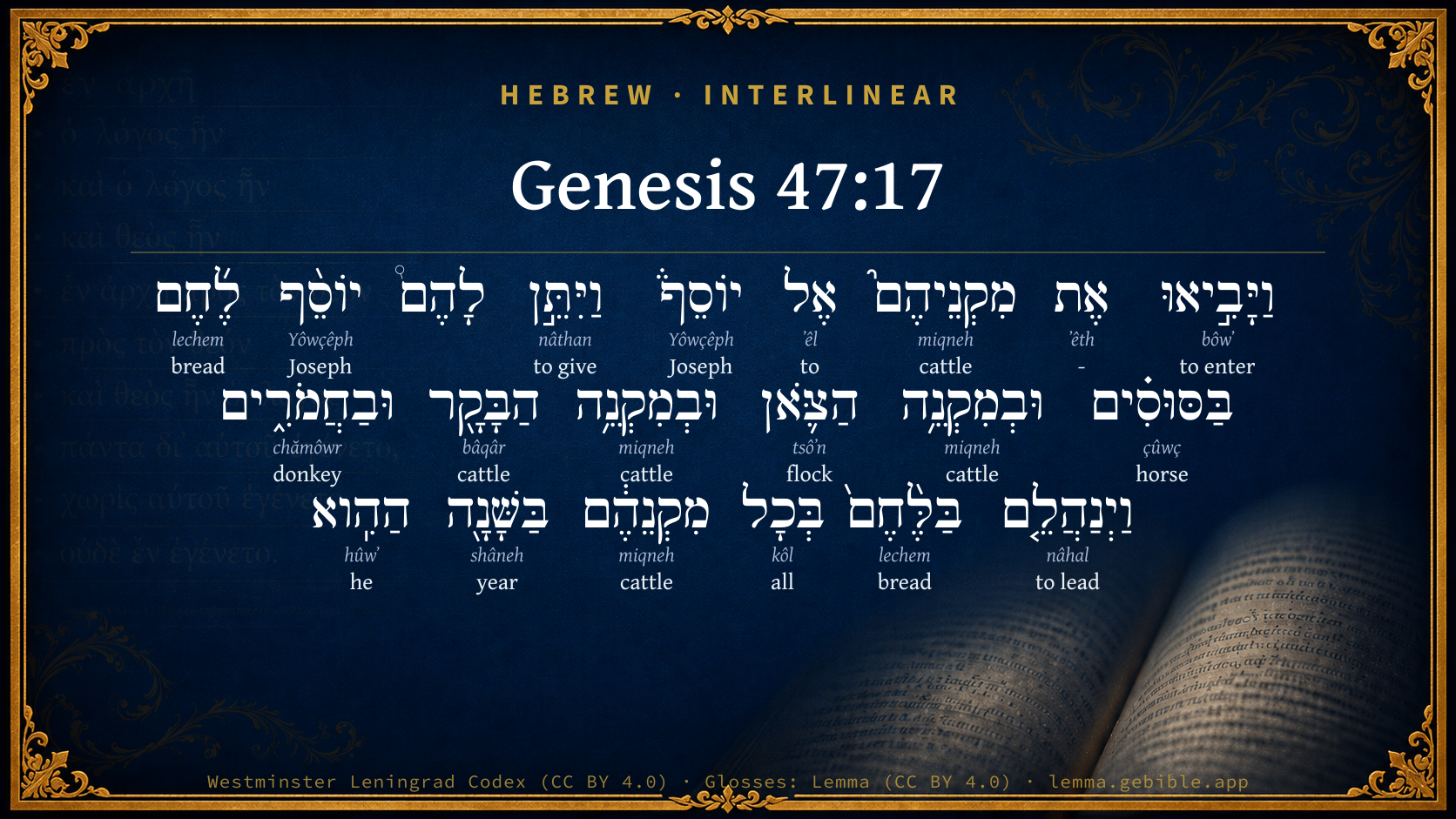
Genesis 47:17

Hebrew (Westminster Leningrad Codex) Genesis 47:17 appears in the Hebrew Old Testament. The text above is from the Westminster Leningrad Codex. Each word links to its Strong’s number, a concise gloss, and parsing drawn from the Open Scriptures Hebrew Bible morphology. Click any word for its full Brown-Driver-Briggs (BDB) entry.
Download image
Cite this verse

Genesis 47:17 (World English Bible). Public Domain. Lemma interlinear Bible study tool, https://lemma.gebible.app/v/genesis/47/17.

Show BibTeX & RIS
BibTeX
RIS
English Translation
They brought their cattle to Joseph, and Joseph gave them bread in exchange for the horses, and for the flocks, and for the herds, and for the donkeys: and he fed them with bread in exchange for all their cattle for that year.
World English Bible · Public Domain
Highlights
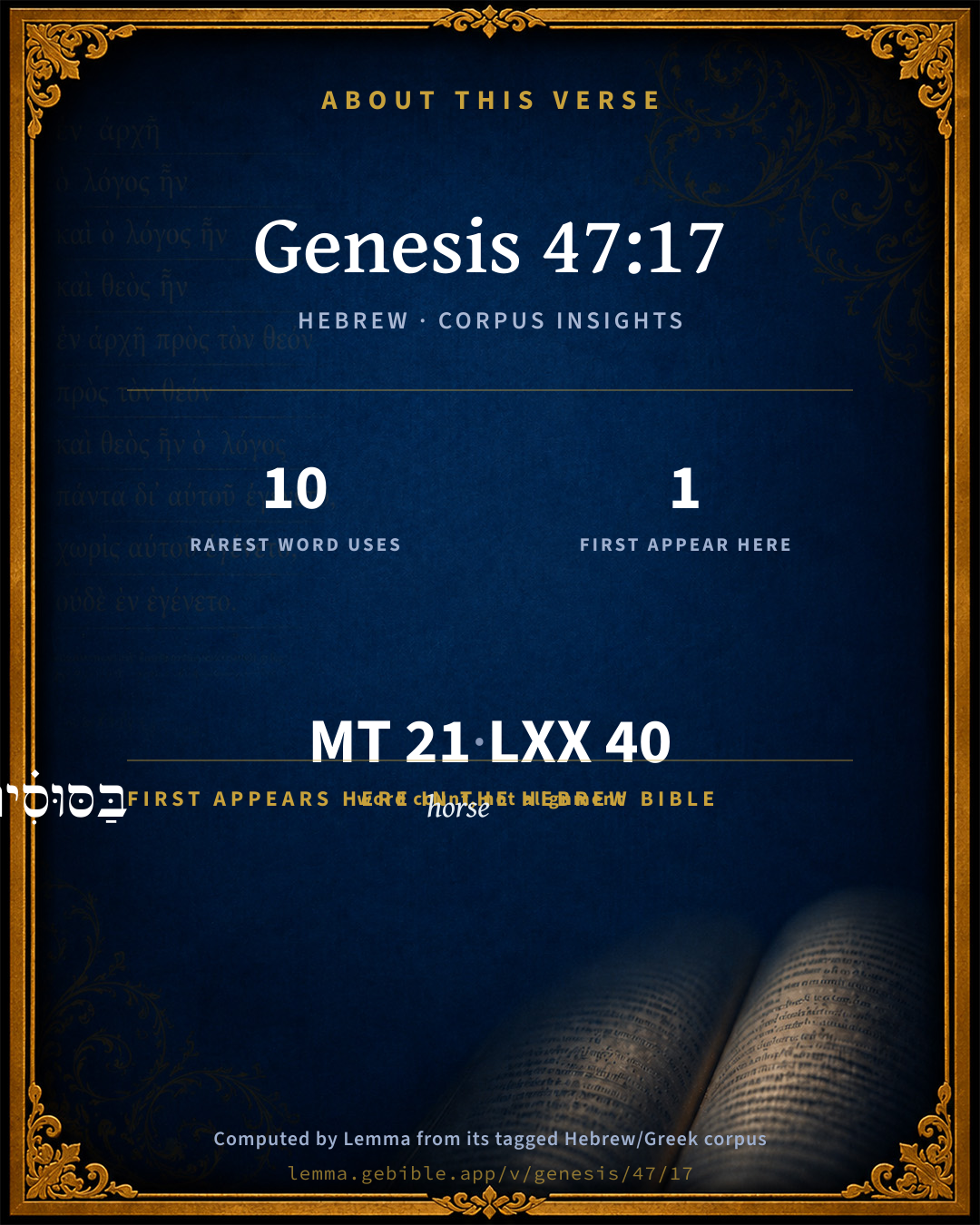
  • 1 first appearance in the Hebrew Bible
Full analysis ↓
Download a study sheet

One document with this verse’s original text, its word-by-word gloss line, the meaning frame, cross-references with their text, attributed commentary, and full source and license credits — printable, and it pastes into notes with its structure intact.

This verse Autodidact and up

Study sheet (.html) Plain text (.txt)

A passage Seminary Student

Up to 50 verses in one chapter. A passage sheet keeps up to 6 commentary sources and 12 cross-references per verse, in the order this page ranks them, and says so on the sheet whenever that leaves anything out. Ask for a single verse and you get the Autodidact verse sheet above.

Everything on this page stays free to read, with no account — the sheet is a download of what is already on screen, not access to it.

Want to remove ads? Support Godless Engineer
Compare translations 3

The same verse in 3 English versions, stacked beneath the original-language interlinear above. Click any original word for its lexicon entry.

Each is an independent rendering of the whole verse — the interlinear is not word-aligned to these translations.

Highlighted words mark where these versions differ — a whole-verse word diff, not a word-by-word alignment.

  • World English Bible Public Domain
    They brought their cattle to Joseph, and Joseph gave them bread in exchange for the horses, and for the flocks, and for the herds, and for the donkeys: and he fed them with bread in exchange for all their cattle for that year.
  • King James Version Public Domain
    And they brought their cattle unto Joseph: and Joseph gave them bread in exchange for horses, and for the flocks, and for the cattle of the herds, and for the asses: and he fed them with bread for all their cattle for that year.
  • unfoldingWord Literal Text CC BY-SA 4.0
    So they brought their livestock to Joseph, and Joseph gave bread to them for the horses and for the herd of sheep and for the herd of cattle and for the donkeys. So he provided them with bread in that year for all their livestock.

unfoldingWord Literal Text — © unfoldingWord, licensed CC BY-SA 4.0. Word-aligned USFM3 via Door43 (git.door43.org/unfoldingWord/en_ult).

Versions to compare (up to 4)

3 of 4 selected

Show all 18 translations

Every available English version of this verse, each an independent rendering of the whole verse.

  • World English Bible Public Domain
    They brought their cattle to Joseph, and Joseph gave them bread in exchange for the horses, and for the flocks, and for the herds, and for the donkeys: and he fed them with bread in exchange for all their cattle for that year.
  • Berean Standard Bible Public Domain
    So they brought their livestock to Joseph, and he gave them food in exchange for their horses, their flocks and herds, and their donkeys. Throughout that year he provided them with food in exchange for all their livestock.
  • Majority Standard Bible Public Domain
    So they brought their livestock to Joseph, and he gave them food in exchange for their horses, their flocks and herds, and their donkeys. Throughout that year he provided them with food in exchange for all their livestock.
  • King James Version Public Domain
    And they brought their cattle unto Joseph: and Joseph gave them bread in exchange for horses, and for the flocks, and for the cattle of the herds, and for the asses: and he fed them with bread for all their cattle for that year.
  • American Standard Version (1901) Public Domain
    And they brought their cattle unto Joseph; and Joseph gave them bread in exchange for the horses, and for the flocks, and for the herds, and for the asses: and he fed them with bread in exchange for all their cattle for that year.
  • Revised Version (1885) Public Domain
    And they brought their cattle unto Joseph: and Joseph gave them bread in exchange for the horses, and for the flocks, and for the herds, and for the asses: and he fed them with bread in exchange for all their cattle for that year.
  • Geneva Bible (1599) Public Domain
    So they brought their cattell vnto Ioseph, and Ioseph gaue them bread for the horses, and for the flockes of sheepe, and for the heards of cattel, and for the asses: so he fed them with bread for all their cattell that yeere.
  • Douay-Rheims (1899) Public Domain
    And when they had brought them, he gave them food in exchange for their horses, and sheep, and oxen, end asses and he maintained them that year for the exchange of their cattle.
  • Young's Literal Translation Public Domain
    And they bring in their cattle unto Joseph, and Joseph giveth to them bread, for the horses, and for the cattle of the flock, and for the cattle of the herd, and for the asses; and he tendeth them with bread, for all their cattle, during that year.
  • Literal Standard Version CC BY-SA 4.0
    And they bring in their livestock to Joseph, and Joseph gives to them bread, for the horses, and for the livestock of the flock, and for the livestock of the herd, and for the donkeys; and he tends them with bread, for all their livestock, during that year.
  • Unlocked Literal Bible CC BY-SA 4.0
    So they brought their livestock to Joseph. Joseph gave them food in exchange for the horses, for the flocks, for the herds, and for the donkeys. He fed them with bread in exchange for all their livestock that year.
  • unfoldingWord Literal Text CC BY-SA 4.0
    So they brought their livestock to Joseph, and Joseph gave bread to them for the horses and for the herd of sheep and for the herd of cattle and for the donkeys. So he provided them with bread in that year for all their livestock.
  • Darby Bible Public Domain
    And they brought their cattle to Joseph; and Joseph gave them bread for horses, and for flocks of sheep, and for herds of cattle, and for asses; and he fed them with bread for all their cattle that year.
  • World Messianic Bible Public Domain
    They brought their livestock to Joseph, and Joseph gave them bread in exchange for the horses, and for the flocks, and for the herds, and for the donkeys: and he fed them with bread in exchange for all their livestock for that year.
  • Webster's Bible Public Domain
    And they brought their cattle to Joseph: and Joseph gave them bread in exchange for horses, and for the flocks, and for the cattle of the herds, and for the asses; and he fed them with bread, for all their cattle, for that year.
  • Free Bible Version CC BY-SA 4.0
    So they brought Joseph their livestock, and he provided them with grain in exchange for their horses, sheep, goats, cattle, and donkeys. He gave them grain in return for their livestock during that year.
  • Bible in Basic English Public Domain
    So they took their cattle to Joseph and he gave them bread in exchange for their horses and flocks and herds and asses, so all that year he gave them food in exchange for their cattle.
  • JPS Tanakh (1917) Public Domain
    And they brought their cattle unto Joseph. And Joseph gave them bread in exchange for the horses, and for the flocks, and for the herds, and for the asses; and he fed them with bread in exchange for all their cattle for that year.

Literal Standard Version (2020), Covenant Press — licensed CC BY-SA 4.0. Text via the HelloAO Bible API (eBible.org). Unlocked Literal Bible (unfoldingWord) — licensed CC BY-SA 4.0. Text via the HelloAO Bible API (eBible.org). unfoldingWord Literal Text — © unfoldingWord, licensed CC BY-SA 4.0. Word-aligned USFM3 via Door43 (git.door43.org/unfoldingWord/en_ult). Free Bible Version, Dr. Jonathan Gallagher — licensed CC BY-SA 4.0. Text via the HelloAO Bible API (eBible.org).

Word by word

More ways to search: Search by grammar → Find every occurrence → Compare this word →

Practice this passage: Drill this verse → Learn its vocabulary →

וַיְנַהֲלֵ֤ם
nâhal
H5095
“and · to lead · them”
Conjunction + Verb, Piel, Sequential Imperfect, 3rd Person, Masculine, Singular + Suffix, Personal, 3rd Person, Masculine, Plural
Part of Speech
Conjunction + Verb
Stem
Piel
Form
Sequential Imperfect
Person
3rd Person
Gender
Masculine
Number
Singular
Full BDB Definition

Origin: a primitive root

TWOT: 1312

to lead, give rest, lead with care, guide to a watering place or station, cause to rest, bring to a station or place of rest, guide, refresh - (Piel) - to lead to a watering-place or station and cause to rest there - to lead or bring to a station or goal - to lead, guide - to give rest to - to refresh (with food) - (Hithpael) - to lead on - to journey by stations or stages
  1. וַיָּבִ֣יאוּ bôwʼ H935 “and · to enter” Conjunction + Verb, Hiphil, Sequential Imperfect, 3rd Person, Masculine, Plural
  2. אֶת ʼêth H853 “-” Particle, Direct Object
  3. מִקְנֵיהֶם֮ miqneh H4735 “cattle · their” Noun, Common, Masculine, Plural, Construct + Suffix, Personal, 3rd Person, Masculine, Plural
  4. אֶל ʼêl H413 “to” Preposition
  5. יוֹסֵף֒ Yôwçêph H3130 “Joseph” Noun, Proper
  6. וַיִּתֵּ֣ן nâthan H5414 “and · to give” Conjunction + Verb, Qal, Sequential Imperfect, 3rd Person, Masculine, Singular
  7. יוֹסֵ֨ף Yôwçêph H3130 “Joseph” Noun, Proper
  8. לֶ֜חֶם lechem H3899 “bread” Noun, Common, Both, Singular, Absolute
  9. בַּסּוּסִ֗ים çûwç H5483 “in/at the · horses” Preposition, Determined + Noun, Common, Masculine, Plural, Absolute
  10. וּבְמִקְנֵ֥ה miqneh H4735 “and · in/at · cattle of” Conjunction + Preposition + Noun, Common, Masculine, Singular, Construct
  11. הַצֹּ֛אן tsôʼn H6629 “the · flock” Particle, Definite Article + Noun, Common, Both, Singular, Absolute
  12. וּבְמִקְנֵ֥ה miqneh H4735 “and · in/at · cattle of” Conjunction + Preposition + Noun, Common, Masculine, Singular, Construct
  13. הַבָּקָ֖ר bâqâr H1241 “the · cattle” Particle, Definite Article + Noun, Common, Both, Singular, Absolute
  14. וּבַחֲמֹרִ֑ים chămôwr H2543 “and · in/at the · donkeys” Conjunction + Preposition, Determined + Noun, Common, Both, Plural, Absolute
  15. בַּלֶּ֨חֶם֙ lechem H3899 “in/at the · bread” Preposition, Determined + Noun, Common, Both, Singular, Absolute
  16. בְּכָל kôl H3605 “in/at · all of” Preposition + Noun, Common, Masculine, Singular, Construct
  17. מִקְנֵהֶ֔ם miqneh H4735 “cattle · their” Noun, Common, Masculine, Singular, Construct + Suffix, Personal, 3rd Person, Masculine, Plural
  18. בַּשָּׁנָ֖ה shâneh H8141 “in/at the · year” Preposition, Determined + Noun, Common, Feminine, Singular, Absolute
  19. הַהִֽוא hûwʼ H1931 “the · he” Particle, Definite Article + Pronoun, Personal, 3rd Person, Feminine, Singular

About this verse

These counts appear in no published source. They are computed here, from the morphology-tagged text and Lemma’s own curated glosses. What Lemma adds →

21
words
15
distinct lemmas
Pentateuch
section

Notable vocabulary

The rarest word here is וַיְנַהֲלֵ֤ם to lead H5095 — appearing just 10 times in the whole Hebrew Bible.

First appearance in Scripture

This word makes its first canonical appearance in the Hebrew Bible here:

  • בַּסּוּסִ֗ים horse H5483

Shared distinctive vocabulary

וַיְנַהֲלֵ֤ם to lead H5095 occurs in 10 verses of the Hebrew Bible. Also found in:

Grammatical profile

  • 3 verbs
  • 14 nouns
  • 1 pronoun
  • 2 prepositions
  • 1 particle

Verb forms

  • וַיָּבִ֣יאוּ Hiphil · Sequential Imperfect
  • וַיִּתֵּ֣ן Qal · Sequential Imperfect
  • וַיְנַהֲלֵ֤ם Piel · Sequential Imperfect

Repetition

Words recur within this verse — often emphatic in Hebrew:

  • מִקְנֵיהֶם֮ cattle H4735 ×4
  • יוֹסֵף֒ Joseph H3130 ×2
  • לֶ֜חֶם bread H3899 ×2

Hebrew & Septuagint length

In English translation the verse runs 43 words from the Hebrew and 42 from the Septuagint (LXX English) — closely comparable.

A rough comparison of the two English renderings, which tokenize alike — not a word-level alignment.

Word counts can differ between the Hebrew and the Greek without any difference in meaning — e.g. the Hebrew direct-object marker אֵת has no separate Greek word, and Greek often adds the article ὁ.

In the original languages it is 21 Hebrew tokens and 40 Greek tokens — but the two are counted differently (Hebrew bundles its prefixes and suffixes into one token; the Greek is in lemma form), so that isn’t a like-for-like length.

Cross-references

5

Topical passages linked to Genesis 47:17 in the Treasury of Scripture Knowledge — connected by theme and wording, ordered by reader-vote popularity; previews shown in the World English Bible.

  • Exodus 9:3 behold, the hand of Yahweh is on your cattle which are in the field, on the horses, on the donkeys, on the camels, on the herds, and on the flocks with a very grievous pestilence.
  • 1 Kings 10:28 The horses which Solomon had were brought out of Egypt; and the king's merchants received them in droves, each drove at a price.
  • Job 2:4 Satan answered Yahweh, and said, "Skin for skin. Yes, all that a man has will he give for his life.
  • Isaiah 31:1 Woe to those who go down to Egypt for help, and rely on horses, and trust in chariots because they are many, and in horsemen because they are very strong, but they don't look to the Holy One of Israel, neither seek Yahweh!
  • Matthew 6:24 "No one can serve two masters, for either he will hate the one and love the other; or else he will be devoted to one and despise the other. You can't serve both God and Mammon.

Cross-references courtesy of OpenBible.info (CC BY 4.0).

Hebrew and Greek witnesses Masoretic Hebrew ↔ Greek Septuagint

The same verse in the two great witnesses to the Old Testament, shown verse-for-verse.

These are two independent witnesses, not word-aligned to each other, and the Septuagint is shown in lemma (dictionary) form.

Hebrew Genesis 47:17 Masoretic · Westminster Leningrad Codex

וַיָּבִ֣יאוּ אֶת מִקְנֵיהֶם֮ אֶל יוֹסֵף֒ וַיִּתֵּ֣ן לָהֶם֩ יוֹסֵ֨ף לֶ֜חֶם בַּסּוּסִ֗ים וּבְמִקְנֵ֥ה הַצֹּ֛אן וּבְמִקְנֵ֥ה הַבָּקָ֖ר וּבַחֲמֹרִ֑ים וַיְנַהֲלֵ֤ם בַּלֶּ֨חֶם֙ בְּכָל מִקְנֵהֶ֔ם בַּשָּׁנָ֖ה הַהִֽוא

They brought their cattle to Joseph, and Joseph gave them bread in exchange for the horses, and for the flocks, and for the herds, and for the donkeys: and he fed them with bread in exchange for all their cattle for that year.

World English Bible · Public Domain

Greek LXX Genesis 47:17 Septuagint · lemma form

ἄγω δέ ὁ κτῆνος πρός ιωσηφ καί δίδωμι αὐτός ιωσηφ ἄρτος ἀντί ὁ ἵππος καί ἀντί ὁ πρόβατον καί ἀντί ὁ βοῦς καί ἀντί ὁ ὄνος καί ἐκτρέφω αὐτός ἐν ἄρτος ἀντί πᾶς ὁ κτῆνος αὐτός ἐν ὁ ἐνιαυτός ἐκεῖνος

And they brought their cattle to Joseph; and Joseph gave them bread in return for their horses, and for their sheep, and for their oxen, and for their asses; and Joseph maintained them with bread for all their cattle in that year.

LXX2012 (modern English Septuagint) · Public Domain

Hebrew: Westminster Leningrad Codex (CC BY 4.0). Greek: Septuagint (public domain); English from LXX2012 (modern English Septuagint) (Public Domain). How the Septuagint differs from the Hebrew →

Targum (Aramaic paraphrase)

2

The Targum is the ancient Jewish Aramaic paraphrase of the Hebrew Scriptures — an interpretive translation, not the Hebrew text itself. Onkelos (literal) and Pseudo-Jonathan (expansive) render the Torah, and Jonathan the Prophets. Coverage is partial: where no permissively-licensed English translation exists for a verse, only the Aramaic is shown. This is verse-level text, not a word-by-word alignment to the Hebrew.

  1. Targum Onkelos Torah (Genesis–Deuteronomy)
    וְאַיְתִיּוּ יָת גֵּיתֵיהוֹן לְוַת יוֹסֵף וִיהַב לְהוֹן יוֹסֵף לַחְמָא בְּסוּסְוָתָא וּבְגֵיתֵי עָנָא וּבְגֵיתֵי תוֹרִין וּבַחֲמָרִין וְזָנִנּוּן בְּלַחֲמָא בְּכָל גֵּיתֵיהוֹן בְּשַׁתָּא הַהִיא

    (no public-domain English translation for this verse)

    Targum Onkelos — Aramaic: “Onkelos Genesis” (public domain); “Onkelos Exodus” (public domain); “Onkelos Leviticus” (public domain); “Onkelos Numbers” (public domain); “Onkelos Deuteronomy” (public domain). English: “Sefaria Community Translation” (CC0 1.0 (public-domain dedication)); “J.W. Etheridge. The Targums of Onkelos and Jonathan Ben Uzziel on the Pentateuch. London: Longmans, Green, 1862” (public domain). Text via Sefaria.

  2. Targum Pseudo-Jonathan Torah (Genesis–Deuteronomy)
    וְאַיְיתִיוּ יַת גֵיתֵיהוֹן לְיוֹסֵף וִיהַב לְהוֹן יוֹסֵף לַחֲמָא בְּסוּסְוָון וּבְגֵיתֵי עָנָא וּבְגֵיתֵי תּוֹרֵי וּבַחְמָרָא וְזָנִינוּן בְּלַחְמָא בְּכָל גֵיתֵיהוֹן בְּשַׁתָּא הַהוּא

    And they brought their cattle to Joseph, and Joseph gave them bread for their horses, and for the flocks of sheep, the oxen, and the asses; and he sustained them with bread for all their flocks for that year

    Targum Pseudo-Jonathan — Aramaic: “Targum Jonathan on Genesis” (public domain); “Targum Jonathan on Exodus” (public domain); “Targum Jonathan on Leviticus” (public domain); “Targum Jonathan on Numbers” (public domain); “Targum Jonathan on Deuteronomy” (public domain). English: “The Targum of Jonathan ben Uzziel, trans. J. W. Etheridge, London, 1862” (public domain). Text via Sefaria.

Commentary

Notes on Genesis 47:17 from classic Christian and Jewish commentators (each source and its license shown beneath its notes). The classic Christian expositions comment on the surrounding passage and are grouped to its opening verse, so a note may address several verses; the Jewish commentaries on the Tanakh (Rashi and others) are per-verse, so they appear only where the commentator wrote on this verse.

Lemma curates 59 commentaries, every one of them public domain or Creative Commons licensed, each selected and text-cleaned for this edition rather than reprinted as found. About our sources →

Trapp's Complete Commentary

John Trapp

Gen 47:17 And they brought their cattle unto Joseph: and Joseph gave them bread [in exchange] for horses, and for the flocks, and for the cattle of the herds, and for the asses: and he fed them with bread for all their cattle for that year.

Ver. 17. And Joseph gave them bread in exchange,] An ancient and yet usual way of traffic, with savages and barbarians especially; as in Virginia, &c., where they usually change, as Glaueus did with Diomedes, χρυσεα χαλκειων. {a}

{a} Homeri Ilias, lib. vi.

John Trapp, A Commentary or Exposition upon All the Books of the Old and New Testament (1647–1656) — public domain. Text from a community e-Sword module.

Ellicott's Commentary for English Readers

(17) Horses . . . flocks . . . herds . . . asses.—The mention of horses is a most important fact in settling the much-debated question as to the dynasty under which Joseph became governor of Egypt. When Abram went there, horses do not seem as yet to have been known (see Note on Gen_12:16), but oxen and asses were common, and the former indigenous in the country (Maspero, Histoire Ancienne, pp. 11, 12). The horse was introduced by the Hyksos, according to Lenormant, Les Prem. Civilisations, i., 306 ff.; Rawlin-son, Egypt, i., 74; and the first representation of one is drawing the war-chariot of the king who expelled them. The “flocks” are expressly said in the. Hebrew to be sheep. This, too, is important; for while goats were indigenous in Egypt, sheep do not appear in the most ancient monuments, though they were introduced at an earlier date than horses.

A Bible Commentary for English Readers, edited by Charles John Ellicott (1878–1897) — public domain. Text from a community e-Sword module.

The Cambridge Bible for Schools and Colleges

gen. ed. J. J. S. Perowne

17. horses … flocks, and for the herds] Heb. cattle of the flocks, and for the cattle of the herds. Observe here the mention of horses first in the list, followed by sheep, cattle, and asses. Compare the list of the live stock belonging to the nomad Abraham in Gen_12:16, “sheep, oxen, he-asses, men-servants, maid-servants, she-asses, camels.” Camels are not mentioned here. Egyptologists inform us that the inscriptions do not record the mention of horses before the New Monarchy, circa 1530 b.c.: see note on Gen_12:16. The Egyptians owed to the Hyksos the introduction of horses and chariots.

fed them] Heb. led them as a shepherd. The same word as in Gen_33:14, “lead on softly,” and in Psa_23:2, “he leadeth me beside the still waters.”

The Cambridge Bible for Schools and Colleges (gen. ed. J. J. S. Perowne; Cambridge University Press, 1878–1918) — public domain. Text from a community e-Sword module.

John Gill's Exposition

When the year was ended, they came unto him the second year,.... Which seems to be the seventh and last year of the years of famine; not the second year of the famine, as Jarchi, but the second year of their great distress, when having spent all their money they parted with their cattle; for it cannot be thought that they should be drained of their money and cattle too in one year:

and said unto him, we will not hide it from my lord, how that our money is spent; my lord also hath our herds of cattle; both these were well known to Joseph, and therefore cannot be the things which they say they would not hide: Musculus thinks it should be rendered in the past tense, "we have not hid"; this they told him the last year, that their money was gone, and he knew he had their cattle for their last year's provision: the sense seems to be this, that seeing their money was spent, and their cattle were in the hands of Joseph, they would not, and could not conceal from him what follows:

there is not enough left in the sight of my lord, but our bodies and our lands; and the one were starving and the other desolate.

John Gill's Exposition of the Whole Bible (1746–1763) — public domain (CC PDM 1.0). Text via the HelloAO Bible API.

Rashi

Rabbi Shlomo Yitzchaki (Rashi)

וינהלם — is the same as וינהגם AND HE GUIDED, LED THEM. Similar in meaning are (Isaiah 51:18) “There is none (מנהל) to lead her”, and (Psalms 23) “he guideth me (ינהלני) beside the still waters.”

Rashi on the Tanakh — English translations: “The Judaica Press complete Tanach with Rashi, translated by A. J. Rosenberg” (CC BY 4.0); “Pentateuch with Rashi's commentary by M. Rosenbaum and A.M. Silbermann, 1929-1934” (public domain); “The Metsudah Tanach series, Lakewood, N.J” (CC BY 4.0); and “The Book of Joshua, Metsudah Publications, 1997” (CC BY 4.0). Text via Sefaria.

Lesson kit

Teaching starters — assembled from the data on this page, not authored interpretation. Every prompt links to the verse data it draws on. Edit before teaching.

Genesis, in the Pentateuch, opens this verse with 21 words (15 distinct Hebrew lemmas). Its most distinctive word is nâhal (“to lead”). A historical commentator’s framing appears above. Read the whole chapter for the surrounding context.

Discussion questions

  1. What does “to lead” (nâhal) contribute to the verse as a whole?
  2. This is the first place “horse” appears in Scripture (first appears here). What does its debut here establish?
  3. How does Genesis 33:14, which shares the word «to lead», read alongside this verse?
  4. What does the repetition of “cattle” (4× in this one verse) do in this verse?
  5. The translations on this page render this verse differently — a whole-verse word diff, not a word-by-word alignment. What might account for the different wordings?
  6. «וַיָּבִ֣יאוּ» is a Hiphil Sequential Imperfect verb. How does that grammatical form shape the action described?
  7. Compare how Trapp's Complete Commentary and Ellicott's Commentary for English Readers read this verse. Where do they agree or differ?

Things to notice

Reading settings

Reading text

Shown beneath each verse's original-language words.

Old Testament
Old Testament edition

Read the OT as the Masoretic Hebrew (MT) or the Greek Septuagint (LXX).

English shown for the Greek Septuagint (in the Hebrew ↔ Greek comparison).

Comparing translations? Open the Compare panel on any verse page to stack up to four side by side.