
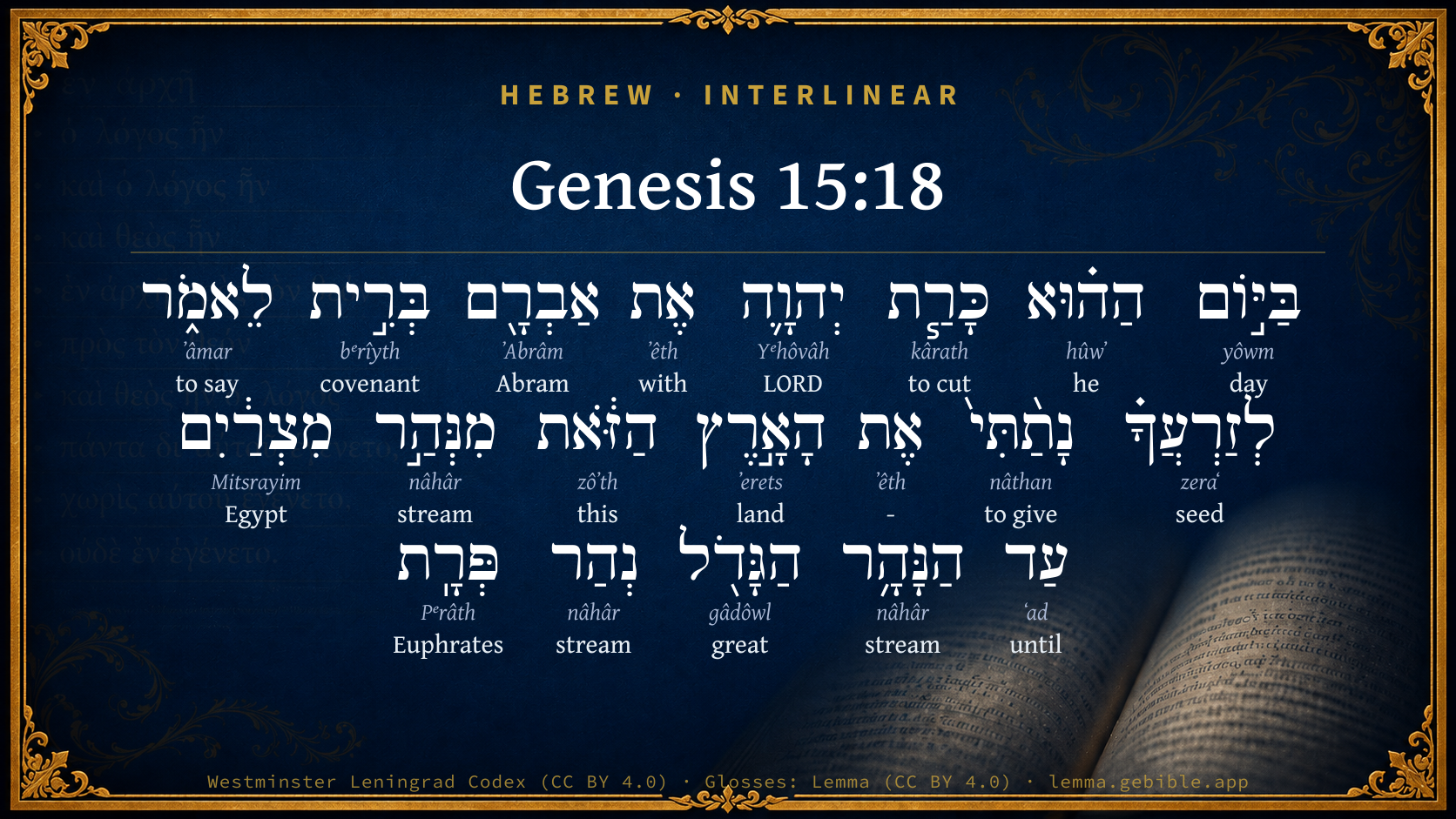
Genesis 15:18

Hebrew (Westminster Leningrad Codex) Genesis 15:18 appears in the Hebrew Old Testament. The text above is from the Westminster Leningrad Codex. Each word links to its Strong’s number, a concise gloss, and parsing drawn from the Open Scriptures Hebrew Bible morphology. Click any word for its full Brown-Driver-Briggs (BDB) entry.
Download image
Cite this verse

Genesis 15:18 (World English Bible). Public Domain. Lemma interlinear Bible study tool, https://lemma.gebible.app/v/genesis/15/18.

Show BibTeX & RIS
BibTeX
RIS
English Translation
In that day Yahweh made a covenant with Abram, saying, "To your seed have I given this land, from the river of Egypt to the great river, the river Euphrates:
World English Bible · Public Domain
Download a study sheet

One document with this verse’s original text, its word-by-word gloss line, the meaning frame, cross-references with their text, attributed commentary, and full source and license credits — printable, and it pastes into notes with its structure intact.

This verse Autodidact and up

Study sheet (.html) Plain text (.txt)

A passage Seminary Student

Up to 50 verses in one chapter. A passage sheet keeps up to 6 commentary sources and 12 cross-references per verse, in the order this page ranks them, and says so on the sheet whenever that leaves anything out. Ask for a single verse and you get the Autodidact verse sheet above.

Everything on this page stays free to read, with no account — the sheet is a download of what is already on screen, not access to it.

Want to remove ads? Support Godless Engineer
Compare translations 3

The same verse in 3 English versions, stacked beneath the original-language interlinear above. Click any original word for its lexicon entry.

Each is an independent rendering of the whole verse — the interlinear is not word-aligned to these translations.

Highlighted words mark where these versions differ — a whole-verse word diff, not a word-by-word alignment.

  • World English Bible Public Domain
    In that day Yahweh made a covenant with Abram, saying, "To your seed have I given this land, from the river of Egypt to the great river, the river Euphrates:
  • King James Version Public Domain
    In the same day the LORD made a covenant with Abram, saying, Unto thy seed have I given this land, from the river of Egypt unto the great river, the river Euphrates:
  • unfoldingWord Literal Text CC BY-SA 4.0
    On that day Yahweh cut a covenant with Abram, saying, “To your offspring I have given this land, from the river of Egypt to the great river, the Euphrates River,

unfoldingWord Literal Text — © unfoldingWord, licensed CC BY-SA 4.0. Word-aligned USFM3 via Door43 (git.door43.org/unfoldingWord/en_ult).

Versions to compare (up to 4)

3 of 4 selected

Show all 18 translations

Every available English version of this verse, each an independent rendering of the whole verse.

  • World English Bible Public Domain
    In that day Yahweh made a covenant with Abram, saying, "To your seed have I given this land, from the river of Egypt to the great river, the river Euphrates:
  • Berean Standard Bible Public Domain
    On that day the LORD made a covenant with Abram, saying, “To your descendants I have given this land—from the river of Egypt to the great River Euphrates—
  • Majority Standard Bible Public Domain
    On that day the LORD made a covenant with Abram, saying, “To your descendants I have given this land—from the river of Egypt to the great River Euphrates—
  • King James Version Public Domain
    In the same day the LORD made a covenant with Abram, saying, Unto thy seed have I given this land, from the river of Egypt unto the great river, the river Euphrates:
  • American Standard Version (1901) Public Domain
    In that day Jehovah made a covenant with Abram, saying, Unto thy seed have I given this land, from the river of Egypt unto the great river, the river Euphrates:
  • Revised Version (1885) Public Domain
    In that day the LORD made a covenant with Abram, saying, Unto thy seed have I given this land, from the river of Egypt unto the great river, the river Euphrates:
  • Geneva Bible (1599) Public Domain
    In that same day the Lord made a couenant with Abram, saying, Vnto thy seede haue I giuen this lande, from the riuer of Egypt vnto the great riuer, the riuer Euphrates.
  • Douay-Rheims (1899) Public Domain
    That day God made a covenant with Abram, saying: To thy seed will I give this land, from the river of Egypt even to the great river Euphrates.
  • Young's Literal Translation Public Domain
    In that day hath Jehovah made with Abram a covenant, saying, `To thy seed I have given this land, from the river of Egypt unto the great river, the river Phrat,
  • Literal Standard Version CC BY-SA 4.0
    In that day has YHWH made with Abram a covenant, saying, “To your seed I have given this land, from the River of Egypt to the great river, the Euphrates River,
  • Unlocked Literal Bible CC BY-SA 4.0
    On that day Yahweh made a covenant with Abram, saying, “To your descendants I hereby give this land, from the river of Egypt to the great river, the Euphrates—
  • unfoldingWord Literal Text CC BY-SA 4.0
    On that day Yahweh cut a covenant with Abram, saying, “To your offspring I have given this land, from the river of Egypt to the great river, the Euphrates River,
  • Darby Bible Public Domain
    On the same day Jehovah made a covenant with Abram, saying, Unto thy seed I give this land, from the river of Egypt to the great river, the river Euphrates;
  • World Messianic Bible Public Domain
    In that day the LORD made a covenant with Abram, saying, “I have given this land to your offspring, from the river of Egypt to the great river, the river Euphrates:
  • Webster's Bible Public Domain
    In that same day the LORD made a covenant with Abram, saying, To thy seed have I given this land, from the river of Egypt to the great river, the river Euphrates:
  • Free Bible Version CC BY-SA 4.0
    This is how the Lord made an agreement with Abram that day and promised him, “I'm giving this land to your descendants. It extends from the Wadi of Egypt to the great Euphrates River,
  • Bible in Basic English Public Domain
    In that day the Lord made an agreement with Abram, and said, To your seed have I given this land from the river of Egypt to the great river, the river Euphrates:
  • JPS Tanakh (1917) Public Domain
    In that day the LORD made a covenant with Abram, saying: 'Unto thy seed have I given this land, from the river of Egypt unto the great river, the river Euphrates;

Literal Standard Version (2020), Covenant Press — licensed CC BY-SA 4.0. Text via the HelloAO Bible API (eBible.org). Unlocked Literal Bible (unfoldingWord) — licensed CC BY-SA 4.0. Text via the HelloAO Bible API (eBible.org). unfoldingWord Literal Text — © unfoldingWord, licensed CC BY-SA 4.0. Word-aligned USFM3 via Door43 (git.door43.org/unfoldingWord/en_ult). Free Bible Version, Dr. Jonathan Gallagher — licensed CC BY-SA 4.0. Text via the HelloAO Bible API (eBible.org).

Word by word

More ways to search: Search by grammar → Find every occurrence → Compare this word →

Practice this passage: Drill this verse → Learn its vocabulary →

פְּרָֽת
Pᵉrâth
H6578
“Euphrates”
Noun, Proper
Part of Speech
Noun
Type
Proper
Full BDB Definition

Origin: from an unused root meaning to break forth

TWOT: None

Euphrates = "fruitfulness" - the largest and longest river of western Asia; rises from two chief sources in the Armenian mountains and flows into the Persian Gulf
  1. בַּיּ֣וֹם yôwm H3117 “in/at the · day” Preposition, Determined + Noun, Common, Masculine, Singular, Absolute
  2. הַה֗וּא hûwʼ H1931 “the · he” Particle, Definite Article + Pronoun, Personal, 3rd Person, Masculine, Singular
  3. כָּרַ֧ת kârath H3772 “to cut” Verb, Qal, Perfect, 3rd Person, Masculine, Singular
  4. יְהוָ֛ה Yᵉhôvâh H3068 “LORD” Noun, Proper
  5. אֶת ʼêth H854 “with” Preposition
  6. אַבְרָ֖ם ʼAbrâm H87 “Abram” Noun, Proper
  7. בְּרִ֣ית bᵉrîyth H1285 “covenant” Noun, Common, Feminine, Singular, Absolute
  8. לֵאמֹ֑ר ʼâmar H559 “to say” Preposition + Verb, Qal, Infinitive Construct
  9. לְזַרְעֲךָ֗ zeraʻ H2233 “to/for · seed · your” Preposition + Noun, Common, Masculine, Singular, Construct + Suffix, Personal, 2nd Person, Masculine, Singular
  10. נָתַ֨תִּי֙ nâthan H5414 “to give” Verb, Qal, Perfect, 1st Person, Common, Singular
  11. אֶת ʼêth H853 “-” Particle, Direct Object
  12. הָאָ֣רֶץ ʼerets H776 “the · land” Particle, Definite Article + Noun, Common, Both, Singular, Absolute
  13. הַזֹּ֔את zôʼth H2063 “the · this” Particle, Definite Article + Pronoun, Demonstrative, Feminine, Singular
  14. מִנְּהַ֣ר nâhâr H5104 “from · stream of” Preposition + Noun, Common, Masculine, Singular, Construct
  15. מִצְרַ֔יִם Mitsrayim H4714 “Egypt” Noun, Proper
  16. עַד ʻad H5704 “until” Preposition
  17. הַנָּהָ֥ר nâhâr H5104 “the · stream” Particle, Definite Article + Noun, Common, Masculine, Singular, Absolute
  18. הַגָּדֹ֖ל gâdôwl H1419 “the · great” Particle, Definite Article + Adjective, Adjective, Masculine, Singular, Absolute
  19. נְהַר nâhâr H5104 “stream of” Noun, Common, Masculine, Singular, Construct

About this verse

These counts appear in no published source. They are computed here, from the morphology-tagged text and Lemma’s own curated glosses. What Lemma adds →

20
words
18
distinct lemmas
Pentateuch
section

Notable vocabulary

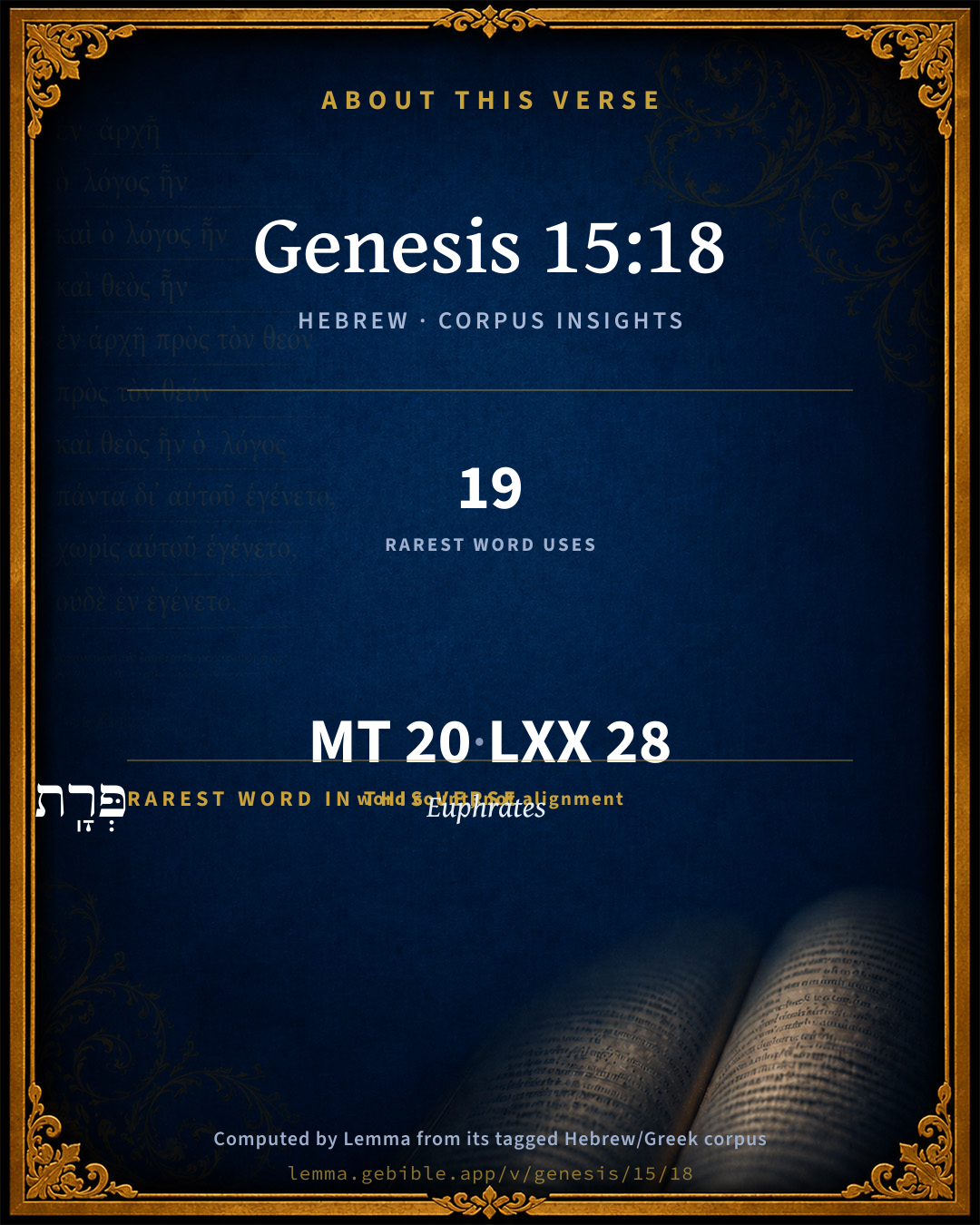
The rarest word here is פְּרָֽת Euphrates H6578 — appearing just 19 times in the whole Hebrew Bible.

Shared distinctive vocabulary

פְּרָֽת Euphrates H6578 occurs in 19 verses of the Hebrew Bible. Also found in:

Grammatical profile

  • 3 verbs
  • 11 nouns
  • 1 adjective
  • 2 pronouns
  • 2 prepositions
  • 1 particle

Verb forms

  • כָּרַ֧ת Qal · Perfect
  • לֵאמֹ֑ר Qal · Infinitive Construct
  • נָתַ֨תִּי֙ Qal · Perfect

Repetition

A word recurs within this verse — often emphatic in Hebrew:

  • מִנְּהַ֣ר stream H5104 ×3

Hebrew & Septuagint length

In English translation the verse runs 30 words from the Hebrew and 29 from the Septuagint (LXX English) — closely comparable.

A rough comparison of the two English renderings, which tokenize alike — not a word-level alignment.

Word counts can differ between the Hebrew and the Greek without any difference in meaning — e.g. the Hebrew direct-object marker אֵת has no separate Greek word, and Greek often adds the article ὁ.

In the original languages it is 20 Hebrew tokens and 28 Greek tokens — but the two are counted differently (Hebrew bundles its prefixes and suffixes into one token; the Greek is in lemma form), so that isn’t a like-for-like length.

Cross-references

40

Topical passages linked to Genesis 15:18 in the Treasury of Scripture Knowledge — connected by theme and wording, ordered by reader-vote popularity; previews shown in the World English Bible.

  • Joshua 1:3–4 Every place that the sole of your foot shall tread on, to you have I given it, as I spoke to Moses.
  • Genesis 12:7 Yahweh appeared to Abram, and said, "I will give this land to your seed." He built an altar there to Yahweh, who appeared to him.
  • Genesis 24:7 Yahweh, the God of heaven, who took me from my father's house, and from the land of my birth, who spoke to me, and who swore to me, saying, 'I will give this land to your seed.' He will send his angel before you, and you shall take a wife for my son from there.
  • Genesis 13:15 for all the land which you see, I will give to you, and to your offspring forever.
  • Deuteronomy 11:24 Every place whereon the sole of your foot shall tread shall be yours: from the wilderness, and Lebanon, from the river, the river Euphrates, even to the hinder sea shall be your border.
  • Exodus 23:27–31 I will send my terror before you, and will confuse all the people to whom you come, and I will make all your enemies turn their backs to you.
  • Numbers 34:2–3 Command the children of Israel, and tell them, When you come into the land of Canaan (this is the land that shall fall to you for an inheritance, even the land of Canaan according to the borders of it),
  • Numbers 34:5 and the border shall turn about from Azmon to the brook of Egypt, and the goings out of it shall be at the sea.
  • Nehemiah 9:8 and found his heart faithful before you, and made a covenant with him to give the land of the Canaanite, the Hittite, the Amorite, and the Perizzite, and the Jebusite, and the Girgashite, to give it to his seed, and have performed your words; for you are righteous.
  • Isaiah 27:12 It shall happen in that day, that Yahweh will beat off [his fruit] from the flood of the River to the brook of Egypt; and you shall be gathered one by one, you children of Israel.
  • Deuteronomy 34:4 Yahweh said to him, This is the land which I swore to Abraham, to Isaac, and to Jacob, saying, I will give it to your seed: I have caused you to see it with your eyes, but you shall not go over there.
  • Hebrews 13:20 Now may the God of peace, who brought again from the dead the great shepherd of the sheep with the blood of an eternal covenant, our Lord Jesus,
  • Genesis 26:4 I will multiply your seed as the stars of the sky, and will give to your seed all these lands. In your seed will all the nations of the earth be blessed,
  • Exodus 23:23 For my angel shall go before you, and bring you in to the Amorite, the Hittite, the Perizzite, the Canaanite, the Hivite, and the Jebusite; and I will cut them off.
  • 2 Chronicles 9:26 He ruled over all the kings from the River even to the land of the Philistines, and to the border of Egypt.
  • Jeremiah 32:40 and I will make an everlasting covenant with them, that I will not turn away from following them, to do them good; and I will put my fear in their hearts, that they may not depart from me.
  • Deuteronomy 1:7–8 turn you, and take your journey, and go to the hill-country of the Amorites, and to all [the places] near thereunto, in the Arabah, in the hill-country, and in the lowland, and in the South, and by the sea-shore, the land of the Canaanites, and Lebanon, as far as the great river, the river Euphrates.
  • 1 Kings 4:21 Solomon ruled over all the kingdoms from the River to the land of the Philistines, and to the border of Egypt: they brought tribute, and served Solomon all the days of his life.
  • Jeremiah 31:31–34 Behold, the days come, says Yahweh, that I will make a new covenant with the house of Israel, and with the house of Judah:
  • Genesis 28:4 and give you the blessing of Abraham, to you, and to your seed with you, that you may inherit the land where you travel, which God gave to Abraham."
  • Genesis 28:13–14 Behold, Yahweh stood above it, and said, "I am Yahweh, the God of Abraham your father, and the God of Isaac. The land whereon you lie, to you will I give it, and to your seed.
  • Genesis 35:12 The land which I gave to Abraham and Isaac, I will give it to you, and to your seed after you will I give the land."
  • Genesis 50:24 Joseph said to his brothers, "I am dying, but God will surely visit you, and bring you up out of this land to the land which he swore to Abraham, to Isaac, and to Jacob."
  • Deuteronomy 7:1 When Yahweh your God shall bring you into the land where you go to possess it, and shall cast out many nations before you, the Hittite, and the Girgashite, and the Amorite, and the Canaanite, and the Perizzite, and the Hivite, and the Jebusite, seven nations greater and mightier than you;
  • Joshua 12:1–20 Now these are the kings of the land, whom the children of Israel struck, and possessed their land beyond the Jordan toward the sunrise, from the valley of the Arnon to Mount Hermon, and all the Arabah eastward:
  • Joshua 15:4 and it passed along to Azmon, and went out at the brook of Egypt; and the goings out of the border were at the sea: this shall be your south border.
  • Joshua 19:1–38 The second lot came out for Simeon, even for the tribe of the children of Simeon according to their families: and their inheritance was in the midst of the inheritance of the children of Judah.
  • Psalms 105:11 Saying, "To you I will give the land of Canaan, The lot of your inheritance;"
  • Exodus 3:8 I have come down to deliver them out of the hand of the Egyptians, and to bring them up out of that land to a good and large land, to a land flowing with milk and honey; to the place of the Canaanite, the Hittite, the Amorite, the Perizzite, the Hivite, and the Jebusite.
  • Exodus 6:4 I have also established my covenant with them, to give them the land of Canaan, the land of their travels, in which they lived as aliens.
  • Exodus 34:11 Observe that which I command you this day. Behold, I drive out before you the Amorite, the Canaanite, the Hittite, the Perizzite, the Hivite, and the Jebusite.
  • Genesis 2:14 The name of the third river is Hiddekel: this is the one which flows in front of Assyria. The fourth river is the Euphrates.
  • Genesis 17:1–27 When Abram was ninety-nine years old, Yahweh appeared to Abram, and said to him, "I am God Almighty. Walk before me, and be blameless.
  • 2 Samuel 23:5 Most assuredly my house is not so with God; Yet he has made with me an everlasting covenant, Ordered in all things, and sure: For it is all my salvation, and all [my] desire, Although he doesn't make it grow.
  • 1 Chronicles 5:9 and eastward he lived even to the entrance of the wilderness from the river Euphrates, because their cattle were multiplied in the land of Gilead.
  • Galatians 3:15–17 Brothers, I speak like men. Though it is only a man's covenant, yet when it has been confirmed, no one makes it void, or adds to it.
  • Genesis 9:8–17 God spoke to Noah, and to his sons with him, saying,
  • 2 Samuel 8:3 David struck also Hadadezer the son of Rehob, king of Zobah, as he went to recover his dominion at the River.
  • Isaiah 55:3 Turn your ear, and come to me; hear, and your soul shall live: and I will make an everlasting covenant with you, even the sure mercies of David.
  • Jeremiah 33:20–26 Thus says Yahweh: If you can break my covenant of the day, and my covenant of the night, so that there shall not be day and night in their season;

Cross-references courtesy of OpenBible.info (CC BY 4.0).

Hebrew and Greek witnesses Masoretic Hebrew ↔ Greek Septuagint

The same verse in the two great witnesses to the Old Testament, shown verse-for-verse.

These are two independent witnesses, not word-aligned to each other, and the Septuagint is shown in lemma (dictionary) form.

Hebrew Genesis 15:18 Masoretic · Westminster Leningrad Codex

בַּיּ֣וֹם הַה֗וּא כָּרַ֧ת יְהוָ֛ה אֶת אַבְרָ֖ם בְּרִ֣ית לֵאמֹ֑ר לְזַרְעֲךָ֗ נָתַ֨תִּי֙ אֶת הָאָ֣רֶץ הַזֹּ֔את מִנְּהַ֣ר מִצְרַ֔יִם עַד הַנָּהָ֥ר הַגָּדֹ֖ל נְהַר פְּרָֽת

In that day Yahweh made a covenant with Abram, saying, "To your seed have I given this land, from the river of Egypt to the great river, the river Euphrates:

World English Bible · Public Domain

Greek LXX Genesis 15:18 Septuagint · lemma form

ἐν ὁ ἡμέρα ἐκεῖνος διατίθημι κύριος ὁ αβραμ διαθήκη λέγω ὁ σπέρμα σύ δίδωμι ὁ γῆ οὗτος ἀπό ὁ ποταμός αἴγυπτος ἕως ὁ ποταμός ὁ μέγας ποταμός εὐφράτης

In that day the Lord made a covenant with Abram, saying, To your seed I will give this land, from the river of Egypt to the great river Euphrates.

LXX2012 (modern English Septuagint) · Public Domain

Hebrew: Westminster Leningrad Codex (CC BY 4.0). Greek: Septuagint (public domain); English from LXX2012 (modern English Septuagint) (Public Domain). How the Septuagint differs from the Hebrew →

Targum (Aramaic paraphrase)

2

The Targum is the ancient Jewish Aramaic paraphrase of the Hebrew Scriptures — an interpretive translation, not the Hebrew text itself. Onkelos (literal) and Pseudo-Jonathan (expansive) render the Torah, and Jonathan the Prophets. Coverage is partial: where no permissively-licensed English translation exists for a verse, only the Aramaic is shown. This is verse-level text, not a word-by-word alignment to the Hebrew.

  1. Targum Onkelos Torah (Genesis–Deuteronomy)
    בְּיוֹמָא הַהוּא גְזַר יְיָ עִם אַבְרָם קְיָם לְמֵימָר לִבְנָךְ יְהָבִית יָת אַרְעָא הָדָא מִן נַהֲרָא דְמִצְרַיִם וְעַד נַהֲרָא רַבָּא נַהֲרָא פְרָת

    (no public-domain English translation for this verse)

    Targum Onkelos — Aramaic: “Onkelos Genesis” (public domain); “Onkelos Exodus” (public domain); “Onkelos Leviticus” (public domain); “Onkelos Numbers” (public domain); “Onkelos Deuteronomy” (public domain). English: “Sefaria Community Translation” (CC0 1.0 (public-domain dedication)); “J.W. Etheridge. The Targums of Onkelos and Jonathan Ben Uzziel on the Pentateuch. London: Longmans, Green, 1862” (public domain). Text via Sefaria.

  2. Targum Pseudo-Jonathan Torah (Genesis–Deuteronomy)
    בְּיוֹמָא הַהוּא גָזַר יְיָ עִם אַבְרָם קְיַים דְלָא לְמֵידַן בֵּיהּ בְּנוֹי וּלְמִפְרוֹקִינוּן מִן מַלְכוּתָא לְמֵימַר לִבְנָךְ אֶתֵּן יַת אַרְעָא הָדָא מִנִילוֹס דְמִצְרַיִם עַד נַהֲרָא רַבָּא נַהֲרָא פְּרָת

    In that day the Lord ordained a covenant with Abram, that He would not judge therein his sons, but would deliver them from the kingdom, saying, To thy sons will I give this land, from Nilos of Mizraim unto the great river, the river Pherath,

    Targum Pseudo-Jonathan — Aramaic: “Targum Jonathan on Genesis” (public domain); “Targum Jonathan on Exodus” (public domain); “Targum Jonathan on Leviticus” (public domain); “Targum Jonathan on Numbers” (public domain); “Targum Jonathan on Deuteronomy” (public domain). English: “The Targum of Jonathan ben Uzziel, trans. J. W. Etheridge, London, 1862” (public domain). Text via Sefaria.

Commentary

Notes on Genesis 15:18 from classic Christian and Jewish commentators (each source and its license shown beneath its notes). The classic Christian expositions comment on the surrounding passage and are grouped to its opening verse, so a note may address several verses; the Jewish commentaries on the Tanakh (Rashi and others) are per-verse, so they appear only where the commentator wrote on this verse.

Lemma curates 59 commentaries, every one of them public domain or Creative Commons licensed, each selected and text-cleaned for this edition rather than reprinted as found. About our sources →

Trapp's Complete Commentary

John Trapp

Gen 15:18 In the same day the LORD made a covenant with Abram, saying, Unto thy seed have I given this land, from the river of Egypt unto the great river, the river Euphrates:

Ver. 18. From the river of Egypt.] Sihor. {Jer 2:18} This was fulfilled in Solomon’s, and especially in Christ’s kingdom.

John Trapp, A Commentary or Exposition upon All the Books of the Old and New Testament (1647–1656) — public domain. Text from a community e-Sword module.

The Biblical Illustrator

Joseph S. Exell

Gen_15:18-21

The Lord made a covenant with Abram

Gods covenant

1.

The time of saints sacrifice amidst their troubles may be the season of Gods making covenant with them.

2. Not only promise but covenant hath God made to His Church for their consolation.

3. Word and sign, promise and pledge, make up Gods covenant.

4. Gods promise of good to come is as sure as if done already.

5. Lower mercies God may give as tokens of greater blessings--this land.

6. The Church hath had its place and portion designed in this world, for being here (Gen_15:18).

7. Gods bounds to His Church were large under the law, much more under the gospel. The ends of the earth now (Gen_15:19).

8. All peoples shall be driven out to make room for the Church of God. Multitudes can be no hindrance of making good Gods covenant to them (Gen_15:20-21). (G. Hughes, B. D.)

The river of Egypt

As the traveller pursues his weary way from Egypt to Palestine, he crosses the broad channel of a river, bounded still by its well-marked banks, but destitute of water. When the rivers of Judah flowed with water, this was the southern boundary of the country, dividing it from the land of Ham, and hence it is often alluded to as the River of Egypt. On one side is a parched desert of sand, spotted here and there with little verdant patches, where a few bushes of palm trees grow, and flowers show their smiling faces to the scorching rays of the sun that pour down as if from a glowing furnace; but, in general, dreary, waste, and bare, with nothing to relieve the eye, almost blinded by the glare of the white sand, but occasional heaps of stones, that tell of ruin and desolation. Here and there the flat sands are covered with an incrustation of fine salt, the very symbol of barrenness. The wild ass, whose house God has made the wilderness, and the barren land (Hebrews, the salt places) his dwellings, here ranges, far from the haunts of men, searching after every green thing. On the eastern side of this ancient channel the country changes. Low sand hills running in ranges parallel to the shore of the Mediterranean for a while struggle for supremacy with the verdure of grassy slopes. (P. H.Gosse.)

.

The Biblical Illustrator, edited by Joseph S. Exell (c. 1880s–1900s) — public domain. Text from a community e-Sword module.

Joseph Benson's Commentary

Gen 15:18. Unto thy seed have I given this land, from the river of Egypt, &c. — In David’s time and Solomon’s, their jurisdiction extended to the utmost of those limits, 2Ch 9:26. And it was their own fault that they were not sooner and longer in possession of all these territories. They forfeited their right by their sins, and by their own sloth and cowardice kept themselves out of possession.

Joseph Benson's Commentary on the Old and New Testaments (1811–1818) — public domain. Text from a community e-Sword module.

Keil & Delitzsch

C. F. Keil & F. Delitzsch

In Gen 15:18-21 this divine revelation is described as the making of a covenant (בּרית, from בּרה to cut, lit., the bond concluded by cutting up the sacrificial animals), and the substance of this covenant is embraced in the promise, that God would give that land to the seed of Abram, from the river of Egypt to the great river Euphrates. The river (נהר) of Egypt is the Nile, and not the brook (נחל) of Egypt (Num 34:5), i.e., the boundary stream Rhinocorura, Wady el Arish. According to the oratorical character of the promise, the two large rivers, the Nile and the Euphrates, are mentioned as the boundaries within which the seed of Abram would possess the promised land, the exact limits of which are more minutely described in the list of the tribes who were then in possession. Ten tribes are mentioned between the southern border of the land and the extreme north, "to convey the impression of universality without exception, of unqualified completeness, the symbol of which is the number ten" (Delitzsch). In other passages we find sometimes seven tribes mentioned (Deu 7:1; Jos 3:10), at other times six (Exo 3:8, Exo 3:17; Exo 23:23; Deu 20:17), at others five (Exo 13:5), at others again only two (Gen 13:7); whilst occasionally they are all included in the common name of Canaanites (Gen 12:6). The absence of the Hivites is striking here, since they are not omitted from any other list where as many as five or seven tribes are mentioned. Out of the eleven descendants of Canaan (Gen 10:15-18) the names of four only are given here; the others are included in the common name of the Canaanites. On the other hand, four tribes are given, whose descent from Canaan is very improbable. The origin of the Kenites cannot be determined. According to Jdg 1:16; Jdg 4:11, Hobab, the brother-in-law of Moses, was a Kenite. His being called Midianite (Num 10:29) does not prove that he was descended from Midian (Gen 25:2), but is to be accounted for from the fact that he dwelt in the land of Midian, or among the Midianites (Exo 2:15). This branch of the Kenites went with the Israelites to Canaan, into the wilderness of Judah (Jdg 1:16), and dwelt even in Saul's time among the Amalekites on the southern border of Judah (Sa1 15:6), and in the same towns with members of the tribe of Judah (Sa1 30:29). There is nothing either in this passage, or in Num 24:21-22, to compel us to distinguish these Midianitish Kenites from those of Canaan. The Philistines also were not Canaanites, and yet their territory was assigned to the Israelites. And just as the Philistines had forced their way into the land, so the Kenites may have taken possession of certain tracts of the country. All that can be inferred from the two passages is, that there were Kenites outside Midian, who were to be exterminated by the Israelites. On the Kenizzites, all that can be affirmed with certainty is, that the name is neither to be traced to the Edomitish Kenaz (Gen 36:15, Gen 36:42), nor to be identified with the Kenezite Jephunneh, the father of Caleb of Judah (Num 32:12; Jos 14:6 : see my Comm. on Joshua, p. 356, Eng. tr.). - The Kadmonites are never mentioned again, and their origin cannot be determined. On the Perizzites see Gen 13:7; on the Rephaims, Gen 14:5; and on the other names, Gen 10:15-16.

Keil & Delitzsch — Biblical Commentary on the Old Testament (1861–1891) — public domain (CC PDM 1.0). Text via the HelloAO Bible API. (Old Testament only.)

Scofield Reference Notes

C. I. Scofield

covenant

The Abrahamic Covenant as formed Gen 12:1-4 and confirmed; Gen 13:14-17; Gen 15:1-7; Gen 17:1-8 is in seven distinct parts:

(1) "I will make of thee a great nation." Fulfilled in a threefold way:

(a) In a natural posterity--"as the dust of the earth Gen 13:16; Joh 8:37, viz. the Hebrew people.

(b) In a spiritual posterity--"look now toward heaven. .. so shall thy seed be" Joh 8:39; Rom 4:16; Rom 4:17; Rom 9:7; Rom 9:8; Gal 3:6; Gal 3:7; Gal 3:29 viz. all men of faith, whether Jew or Gentile.

(c) fulfilled also through Ishmael Gen 17:18-20

(2) "I will bless thee." Fulfilled in two ways:

(a) temporally Gen 13:14; Gen 13:15; Gen 13:17; Gen 15:18; Gen 24:34; Gen 24:35 (b) spiritually; Gen 15:6; Joh 8:56

(3) "And make thy name great." Abraham’s is one of the universal names.

(4) "And thou shalt be a blessing" Gal 3:13; Gal 3:14

(5) "I will bless them that bless thee." In fulfilment closely related to the next clause.

(6) "And curse him that curseth thee." Wonderfully fulfilled in the history of the dispersion. It has invariably fared ill with the people who have persecuted the Jew--well with those who have protected him. The future will still more remarkably prove this principle Deu 30:7; Isa 14:1,; Joe 3:1-8; Mic 5:7-9; Hag 2:22; Zec 14:1-3; Mat 25:40; Mat 25:45.

(7) "In thee shall all the families of the earth be blessed." This is the great evangelic promise fulfilled in Abraham’s Seed, Christ Gal 3:16; Joh 8:56-58.

It brings into greater definiteness the promise of the Adamic Covenant concerning the Seed of the woman Gen 3:15

NOTE.--The gift of the land is modified by prophecies of three dispossessions and restorations Gen 15:13; Gen 15:14; Gen 15:16; Jer 25:11; Jer 25:12; Deu 28:62-65; Deu 30:1-3. Two dispossessions and restorations have been accomplished. Israel is now in the third dispersion, from which she will be restored at the return of the Lord as King under the Davidic Covenant; Deu 30:3; Jer 23:5-8; Eze 37:21-25; Luk 1:30-33; Act 15:14-17

See, for the other seven covenants:

EDENIC (See Scofield "Gen 1:28") ADAMIC See Scofield "Gen 3:15" NOAHIC See Scofield "Gen 9:1" MOSAIC See Scofield "Exo 19:25" PALESTINIAN See Scofield "Deu 30:3" DAVIDIC See Scofield "2Sa 7:16" NEW See Scofield "Heb 8:8"

The Scofield Reference Bible (1917 edition), notes by C. I. Scofield — public domain. Text from a community e-Sword module.

Tyndale Open Study Notes

Tyndale Open Resources

15:18-19 God specified the boundaries of the Promised Land. His clear message to Abram was that despite prospects of death and suffering (enslavement), he and his descendants would eventually receive the promises, for God had sworn an oath (see Heb 6:13-14). Nothing can separate God’s people from his love or the fulfillment of his plans (see Rom 8:18-39; 2 Pet 1:3-4).

Tyndale Open Study Notes — © Tyndale Open Resources, licensed CC BY-SA 4.0. Text via the HelloAO Bible API.

Geneva Bible (1599)

Geneva Bible translators

Hebrew, Perath.

Geneva Bible (1599) marginal notes — public domain. Text via Bolls.life.

Adam Clarke's Commentary

Verse 18. The Lord made a covenant] כרת ברית carath berith signifies to cut a covenant, or rather the covenant sacrifice; for as no covenant was made without one, and the creature was cut in two that the contracting parties might pass between the pieces, hence cutting the covenant signified making the covenant. The same form of speech obtained among the Romans; and because, in making their covenants they always slew an animal, either by cutting its throat, or knocking it down with a stone or axe, after which they divided the parts as we have already seen, hence among the percutere faedus, to smite a covenant, and scindere faedus, to cleave a covenant, were terms which signified simply to make or enter into a covenant.

From the river of Egypt] Not the Nile, but the river called Sichor, which was before or on the border of Egypt, near to the isthmus of Suez; see Jos 13:3; though some think that by this a branch of the Nile is meant. This promise was fully accomplished in the days of David and Solomon. See 2Sa 8:3, c., and 2Ch 9:26.

Adam Clarke's Commentary on the Bible (1810–1826) — public domain. Text from a community e-Sword/MySword module.

John Calvin's Commentaries

18. In the same day the Lord made a covenant. I willingly admit what I have alluded to above, that the covenant was ratified by a solemn rite, when the animals were divided into parts. For there seems to be a repetition, in which he teaches what was the intent of the sacrifice which he has mentioned. Here, also, we may observe, what I have said, that the word is always to be joined with the symbols, lest our eyes be fed with empty and fruitless ceremonies. God has commanded animals to be offered to him; but he has shown their end and use, by a covenant appended to them. If, then, the Lord feeds us by sacraments, we infer, that they are the evidences of his grace, and the tokens of those spiritual blessings which flow from it.

He then enumerates the nations, whose land God was about to give to the sons of Abram, in order that he may confirm what he before said concerning a numerous offspring. For that was not to be a small band of men, but an immense multitude, for which the Lord assigns a habitation of such vast extent. God had before spoken only of the Amorites, among whom Abram then dwelt; but now, for the sake of amplifying his grace, he recounts all the others by name.

John Calvin's Commentaries (1540-1563) — public domain. Text from the Calvin Translation Society English edition (1840s-50s) via the Christian Classics Ethereal Library (ccel.org). Calvin's coverage is partial (roughly two-thirds of the Bible); uncommented books and verses are honest gaps, never fabricated. The 19th-century editor's footnotes and remarks are omitted so the notes are faithfully Calvin's own voice.

Ellicott's Commentary for English Readers

(18) The Lord made a covenant.—Heb., Jehovah cut a covenant. Abram had divided the slaughtered animals, and Jehovah, by passing between them, made the whole act His own.

The river of Egypt.—That is, the Nile. In the Hebrew the Wady-el-Arish, on the southern border of Simeon, is always distinguished from the Nile. though the distinction is neglected in our version. Thus in Num_34:5; Jos_15:4; Isa_27:12 (where alone an attempt is made at accuracy by translating stream), the Hebrew has, the torrent of Egypt, that is, a stream full after the rains, but dry during the rest of the year. For a description of these torrent-beds see Isa_57:5-6, where in Gen_15:5 the word is translated valleys, and in Gen_15:6 stream. The word used here signifies a river that flows constantly; and Abram’s posterity are to found a kingdom conterminous with the Nile and the Euphrates, that is, with Egypt and Babylonia. If these bounds are large and vague, we must also remember that they are limited by the names of the ten nations which follow. Between the Nile and the Euphrates, the territories of these ten tribes is alone definitely bestowed upon Abram.

A Bible Commentary for English Readers, edited by Charles John Ellicott (1878–1897) — public domain. Text from a community e-Sword module.

The Cambridge Bible for Schools and Colleges

gen. ed. J. J. S. Perowne

18. the Lord made a covenant] A covenant, or compact, as between man and man, is necessarily impossible between God and man. God in His mercy gives the promise; man in his weakness acknowledges his willingness to obey. For the other covenants in the Pentateuch cf. 9, 17; Exodus 24. The origin of b’rîth = “covenant,” is uncertain. Some suggest barah = “eat,” in the sense of a “solemn meal.” See note on Gen_15:9.

The fate of the victims was supposed to be invoked upon the head of the party who broke the covenant. Cf. Livy, i. 24, tum illo die, Juppiter, populum Romanum sic ferito, ut ego hunc porcum hic hodie feriam, tantoque magis ferito quanto magis potes pollesque. The idea of Robertson Smith that the two parties to the covenant, standing between the pieces, partook of the mystical life of the victim (Relig. of Semites, p. 480) remains doubtful.

from the river of Egypt] The n’har Mizraim is clearly the Nile. The ideal boundaries of the future territory of Israel are here stated in hyperbolical fashion, as extending from the Nile to the Euphrates: so Jos_13:3, 1Ch_13:5. The Eastern, i.e. the Pelusiac, arm of the Nile is meant.

“The River of Egypt” is to be distinguished from “the Brook of Egypt,” naḥal Mizraim, Num_34:5, Jos_15:4; Jos_15:47, the Rhino-colura, the modern Wady-el-Arish, a watercourse on the extreme S.W. of Palestine, on the confines of Egyptian territory.

unto the great river, the river Euphrates] Cf. Deu_1:7; Deu_11:24. It was probably only in the days of Solomon that this picture of Israelite greatness was ever approximately realized; see 1Ki_4:21, Psa_80:11.

The Cambridge Bible for Schools and Colleges (gen. ed. J. J. S. Perowne; Cambridge University Press, 1878–1918) — public domain. Text from a community e-Sword module.

John Gill's Exposition

The Kenites, and the Kenizzites, and the Kadmonites. In this and the following verses ten nations are reckoned as occupying the land of Canaan at this time, whereas only seven are mentioned in the times of Moses and Joshua; and these three are not among them, and seem before those times to have been extinct, or were mixed with the other nations, and were no more distinct ones; though Aben Ezra thinks these people had two names, and Jarchi interprets them of the Edomites, Moabites, and Ammonites, who shall be the inheritance of the children of Israel in future times, according to Isa 11:14; and so the Jerusalem Talmud (t), from whence he seems to have taken it; and some are of opinion that the Midianites are meant by the Kenites, since Jethro, Moses's father in law, who was of Midian, is called the Kenite, as was also Heber, who was of the same race, Jdg 1:16; there were Kenites near to the Amalekites in the times of Balaam, and who dwelt among them in the times of Saul, Num 24:20; as there were also some of this name that descended from the father of the house of Rechab, or the Rechabites, who were associates and proselytes to the people of Israel, Ch1 2:55; the Kenizzites are supposed by some to be the descendants of Kenaz, a grandson of Esau, Gen 36:11; but then they must be so called here by anticipation, since Kenaz was not now born, and rather then would have had the name of Kenazites; besides, none of the land of the children of Esau, at least of those that dwelt about Mount Seir, was to be given to the children of Israel, Deu 1:5; could indeed the Edomites or Idumeans be intended, it might be thought this had its accomplishment in the times of David, and more especially when the Idumeans became Jews, embraced their religion, and were one people with them, in the times of Hyrcanus (u): the Kadmonites, or the Orientals, were, as Bochart (w) very probably thinks, the Hivites, who inhabited the eastern part of the land of Canaan about Mount Hermon, and from thence might have their name, as they are in the Jerusalem Targum called the children of the east; and hence came the names of Cadmus and Hermione his wife, who were Hivites, and the fable of their being turned into serpents, which the word Hivites signifies.

(t) Sheviith, fol. 37. 2. (u) Joseph Antiqu. l. 13. c. 9. sect. 1. (w) Canaan, l. 1. c. 19. col. 447.

John Gill's Exposition of the Whole Bible (1746–1763) — public domain (CC PDM 1.0). Text via the HelloAO Bible API.

Haydock's Catholic Bible Commentary

Of Egypt, a branch of the Nile, not far from Pelusium. This was to be the southern limit, and the Euphrates the northern; the two other boundaries are given, Numbers xxxiv. --- Perhaps Solomon’s empire extended so far. At least, the Jews would have enjoyed these territories, if they had been faithful. (Menochius)

George Leo Haydock (1774–1849), Haydock's Catholic Family Bible and Commentary, 1859 edition — public domain. Excludes Psalms (Douay-Rheims chapter numbering differs from Protestant) and Deuterocanonical books (Catholic canon only).

Matthew Poole's English Annotations

Unto thy seed have I given this land, i.e. decreed and promised in due time to give, which makes it as sure as if it were actually given to them. Or,

I will give; words of the past time being oft put for the future, especially in prophecies.

The river of Egypt; not Nilus, which elsewhere is so called, but a less river, as is sufficiently implied, because this is opposed to the

great river here following; but a river called Sihor, which divides Egypt from Canaan. See Num 34:5; Jos 13:3 1Ch 13:5. The accomplishment hereof, see 2Sa 8:3; 1Ki 4:21; 9:21.

Matthew Poole's English Annotations on the Holy Bible (1683–1685) — public domain. Text from a community e-Sword/MySword module.

Whedon's Commentary on the Bible

Daniel D. Whedon

18. Made a covenant — Hebrews, cut a covenant, in allusion to the cutting of the victims into pieces and passing between them. Abram had passed between the pieces before the sun went down, and now Jehovah completes the cutting of the covenant by causing the burning symbols of his presence to pass between the pieces and repeating, for the fourth time, Unto thy seed have I given this land. Comp. Gen_15:7; Gen_15:12, and Gen_7:13; Gen_7:15. The utmost boundaries of the land are here given as the river of Egypt on the southwest, unto the great river, the river Euphrates, on the north-east. The designation of the Euphrates as the great river favours the opinion that the river of Egypt is not the Nile, which was also great, but the wady-el-Arish, called the river (or brook נחל) of Egypt, in Jos_15:4. This view is further confirmed by the fact that the dominion of Israel did actually extend, in Solomon’s time, between these borders, (see 1Ki_4:24,) but never extended to the Nile. Most commentators, however, understand the Nile here, and think these two great rivers are mentioned in a general way, as representing the two great nations or world-powers on the east and west of Canaan.

Daniel D. Whedon (gen. ed.), Commentary on the Old and New Testaments (1874–1909) — public domain. Text from a community e-Sword module.

The Pulpit Commentary

Vers. 18-21. In that day the Lord made a covenant literally, cut a covenant (cf. orkia temnein, foedus icere). On the import of tyriB (vide Gen_9:9) with Abram, saying, Unto thy seed have I given this land, from the river of Egypt the Nile (Keil, Kurtz, Hengstenberg, Kalisch) rather than the Wady el Arch, or Brook of Egypt (Knobel, Lange, Clarke), at the southern limits of the country (Num_34:5; Jos_15:4; Isa_27:12) unto the great river, the river Euphrates. The ideal limits of the Holy Land, which were practically reached under David and Solomon (vide 1Ki_4:21; 2Ch_9:26) and which embraced the following subject populations, ten in number, "to convey the impression of universality without exception, of unqualified completeness" (Delitzsch). The Kenites, inhabiting the mountainous tracts in the south-west of Palestine, near the Amalekites (Num_24:21; 1Sa_15:6 1Sa_27:10) a people of uncertain origin, though (Jud_1:16 4:11) Hobab, the brother-in-law of Moses, was a Keniteand the Kenizzites, mentioned only in this passage; a people dwelling apparently in the same region with the Kenites (Murphy), who probably became extinct between the times of Abraham and Moses (Bochart), and cannot now be identified (Keil, Kalisch), though they have been connected with Kenaz the Edomite, (Gen_36:15, Gen_36:42) (Knobel)and the Kadmonites, never again referred to, but, as their name implies, an Eastern people, whose settlements extended towards the Euphrates (Kalisch)and the Hittites, the descendants of Heth; (vide Gen_10:15) identified with the Kheta and Katti of the Egyptian and Assyrian monuments, and supposed by Mr. Gladstone to be the Kheteians of the "Odyssey;" a powerful Asiatic tribe who must have early established themselves on the Euphrates, and spread from thence southward to Canaan and Egypt, and westward to Lydia and Greece, carrying with them, towards the shores of the Aegean Sea, the art and culture of Assyria and Babylon, already modified by the forms and conceptions of Egypt. The northern capital of their empire was Carchemish, about sixteen miles south of the modern Birejik; and the southern Kadesh, on an island of the Orontes (Prof. Sayce in "Frazer"s Magazine," August, 1880, art. "A forgotten Empire in Asia Minor")and the Perizzites, and the Rephaims (vide, Gen_13:7 Gen_14:5) and the Amorites, and the Canaanites, and the Oirgashites, and the Jebusites. (vide Gen_10:15-19) The boundaries of the Holy Land as here defined are regarded by some (Bohlen) as contradictory of those designated in Num_34:1-12. But

(1) the former may be viewed as the ideal (or poetical), and the latter as the actual (and prosaic), limits of the country assigned to Israel (Hengstenbreg, Keil); or

(2) the former may represent the maxima, and the latter the minima, of the promise, which admitted of a larger or a smaller fulfillment, according as Israel should in the sequel prove fit for its occupation (Augustine, Pererius, Willet, Poole, Gerlach, Kalisch, and others); or,

(3) according to a certain school of interpreters, the former may point to the wide extent of country to be occupied by the Jews on occasion of their restoration to their own land, as distinguished from their first occupation on coming up out of Egypt, or their second on returning from Babylon; or

(4) the rivers may be put for the countries with which the promised land was coterminous (Kurtz, Murphy); or

(5) strict geographical accuracy may not have been intended in defining the limits of the land of promise ("Speaker s Commentary," Inglis).

Ver. 18.

Taken into covenant.

I THE BLESSING OF THE COVENANT.

1. The ultimate blessing, to which, in both the commencement and close of the present section, the prominence is assigned, was a splendid inheritancethe land of Canaan for his descendants, and for himself the better country, of which that earthly possession was a type.

1. The mediate blessing, through which alone the last could be reached, was a distinguished seed a numerous posterity to occupy the land, and a living Savior to secure for himself the bettor country.

2. The proximate blessing, to be enjoyed while as yet the second and the third were unfulfilled, was a celestial alliance by which Jehovah himself engaged to be his shield and exceeding great reward. It is obvious that these are the blessings which the gospel confers on believers a heavenly Friend, an all-sufficient Savior, a future inheritance; whence the Abrahamic covenant was nothing different from the covenant of grace.

II THE REASON OF THE COVENANT. The essential idea in a covenant being a visible pledge for the fulfillment of a promise, the necessity for such a guarantee on the present occasion, it is apparent, could not lie with God. On the contrary, the proposal on the part of God to bind himself by a superadded engagement to implement his own gracious and spontaneous promise was an explicit condescension, if not to the feebleness of the patriarch"s faith, at least to the weakness of his human nature. Perhaps the recollection of who Jehovah was, and what he had already accomplished in bringing Abram from Ur, should have proved sufficient to authenticate the promise; but it would almost seem as if human nature, in its innocent no less than in its fallen state, instinctively craved the assistance of external symbols to enable it to clearly apprehend and firmly grasp the unseen and spiritual blessings that are wrapped up in God"s promises. In the garden of Eden the tree of life was Adam"s sacramental pledge of immortality; after the Flood the many-colored rainbow was a sign to Noah; in the Hebrew Church material symbols of unseen verifies were not awanting; while in the Christian Church the passover and circumcision have been replaced by the Lord"s Supper and baptism. The reasons that required the institution of these external signs may be held as having necessitated the solemn ritual which was exhibited to Abram.

III THE SYMBOLS OF THE COVENANT.

1. The sacrificial victims. Seeing that these were afterwards prescribed in the Mosaic legislation, which itself was a shadow of the good things to come, to be employed as propitiatory offerings, it is impossible not to regard them, though not necessarily understood as such by Abram, as types (not of Israel, Abram"s seed after the flesh simply, nor of the Church of God generally, i.e. Abram"s seed according to the spirit, though perhaps neither of these should be excluded, but) of Abram"s greater Seeds whose perfect, Divinely-appointed, and substitutionary sacrifice alone constitutes the basis of the everlasting covenant.

2. The smoking furnace and the burning lamp. Compared with the smoke and fire that afterwards appeared on Sinai when Jehovah descended to covenant with Israel, and the pillar of cloud and fire that led the march of Israel from Egypt, these at once suggest their own interpretation. They were emblems of God"s presence, and may be viewed as suggesting

(1) the combination of justice and mercy in the Divine character, and

(2) the twofold attitude in which the Deity exhibits himself to men according as they are his enemies or friends.

IV THE IMPORT OF THE COVENANT. Partly through visible sign, partly in spiritual vision, partly by audible words, the patriarch was instructed as to

1. The objective basis of his own justification, which was neither personal merit nor faith considered as an opus operatum, but the Divinely-appointed sacrifice which God was graciously pleased to accept in propitiation for human sin.

2. The true security for Gods fulfillment of the promise, which was not any outward sign or token, but the everlasting covenant which in mysterious symbol had been unfolded to him.

3. The interval of discipline allotted to the heirs of the land; for his descendants three generations of exile, servitude, and affliction, to prepare them for receiving Canaan in the fourth; and for himself a continual sojourning, without a final settling within its borders; in both cases emblematic of the saint"s experience after justification and before glorification.

4. The ultimate assumption of the inheritance by his seed a Divine voice solemnly foretelling their return from captivity, as it afterwards declared that his spiritual descendants should be emancipated and brought back to their celestial abode, and a Divine vision unfolding to his gaze the wide extent of territory they should eventually possess perhaps the limits of the earthly land melting away, as his spirit stood entranced before the gorgeous panorama, into the confines of the better country..

5. His own certain passage to the heavenly Canaan, for which he was even at that time looking a promise which belongs individually to all who are the children of Abram by faith in Jesus Christ.

See from this subject

1. The fullness of Divine blessing which the covenant con-rains.

2. The depth of Divine condescension which the covenant reveals.

3. The glorious securities which the covenant affords.

The Pulpit Commentary (1880–1919), ed. H.D.M. Spence-Jones & Joseph S. Exell — public domain. Text from a community e-Sword module.

John Wesley's Explanatory Notes

In that same day, the Lord made a covenant with Abram, saying, Unto thy seed have I given this land - He had said before, To thy seed will I give this land, but here he saith, I have given it; that is,

1. I have given the promise, the charter is sealed and delivered, and cannot be disanulled.

2. The possession is as sure in due time, as if it were now actually delivered to them. In David's time and Solomon's their jurisdiction extended to the utmost of these limits, 2 Chron. ix, 26. And it was their own fault that they were not sooner and longer in possession of all these territories. They forfeited their right by their sins, and by their own sloth and cowardice kept themselves out of possession. The present occupants are named, because their number and strength and long prescription, should be no hindrance to the accomplishment of this promise in its season; and to magnify God's love to Abram and his seed, in giving to that one nation the possession of many nations.

John Wesley, Explanatory Notes Upon the Whole Bible (1754–1765) — public domain. Text via the GEBible commentary corpus.

Rashi

Rabbi Shlomo Yitzchaki (Rashi)

לזרעך נתתי UNTO THY SEED HAVE I GIVEN — The promise of the Holy One, blessed be He, is as an accomplished fact. (Consequently the perfect tense is here used) (Genesis Rabbah 44:22).

הנהר הגדול THE GREAT RIVER—Because it is associated with (mentioned in connection with; see Rashi on Deuteronomy 1:7) the land of Israel, Scripture calls it “great” although it is the last mentioned of the four rivers that went out of Eden — as it is said (Genesis 2:14). And the fourth river is the Euphrates”. There is a popular proverb: “A king’s servant is a king; attach yourself to a captain and people will bow down to you” (Genesis Rabbah 16:3).

Rashi on the Tanakh — English translations: “The Judaica Press complete Tanach with Rashi, translated by A. J. Rosenberg” (CC BY 4.0); “Pentateuch with Rashi's commentary by M. Rosenbaum and A.M. Silbermann, 1929-1934” (public domain); “The Metsudah Tanach series, Lakewood, N.J” (CC BY 4.0); and “The Book of Joshua, Metsudah Publications, 1997” (CC BY 4.0). Text via Sefaria.

Ramban (Nachmanides)

Rabbi Moshe ben Nachman (Ramban / Nachmanides)

IN THAT DAY THE ETERNAL MADE A COVENANT WITH ABRAM, SAYING. Now the Holy One, blessed be He, promised Abraham the gift of the land many times, and all of the promises served a purpose. When he originally arrived in the land, He said to him, Unto thy seed will I give this land, but He did not clarify the extent of His gift, for included in this promise is only the land where he walked, unto the place of Shechem unto the oak of Moreh., Verse 6. Afterwards, when his merits increased while in the Land, He bestowed upon him the additional promise: Lift up now thine eyes, and look from the place where thou art, northward and southward, and eastward and westward, 13:14. meaning that He will give him all those lands in their totality, for the meaning of the expression, which thou seest, Verse 15. is not literally “with your eyes” for the sight of a person does not extend far. Rather, it means that He will give him [land which lies in] every direction in which he looks. It may be that He miraculously showed him all the land of Israel, as was the case with Moshe Rabbeinu. He further added in this second blessing: and to thy seed forever, Verse 15. and that his seed will increase as the dust of the earth. At the third time, He clarified to him the boundaries of the land, mentioning all the ten nations [who presently inhabited it], and in addition He made a covenant with him that sin would not cause [the annulment of the gift]. When He commanded him concerning circumcision, He told him, for a possession forever, that is to say, if they will be exiled from it they will again return and inherit it. (13:15), does not imply that if they will be exiled from the land they will return and re-inherit it. It assures legal title but not necessarily actual possession. However, the expression, for ‘a possession’ forever, does indicate that it is to be their land forever. Hence even if they are exiled they will return and possess it. He also added at that time, And I will be their G-d, meaning that He in His Glory will lead them, and they shall not be under the rule of a star or constellation or any power of the powers above, as will yet be explained in the Torah. Now at the time of the first gift, Scripture states, Unto thy seed will I give, the verb being in a future tense, and similarly in the second time,. (Above, 13:15). because until then He had not given him the entire land, and therefore, He said to him, will I give it. But at the third time, during the covenant, He said, Unto thy seed have I given, meaning that He will make the covenant for the gift that He had already given him. Similarly, at the time of the circumcision, when He said, for a possession forever, He said to him, And I will give unto thee, in the future tense. Rashi wrote: Unto thy seed have I given. The word of the Supreme One is as if it were already accomplished. — But there is no need for this explanation in this passage.

Ramban (Nachmanides) on the Tanakh — English translation: “Commentary on the Torah by Ramban (Nachmanides). Translated and annotated by Charles B. Chavel. New York, Shilo Pub. House, 1971-1976” (CC BY 4.0). Text via Sefaria.

Radak

Rabbi David Kimhi (Radak)

ביום ההוא כרת ה' את אברם בריתת, on the occasion of that vision G'd concluded a covenant with Avram to give the entire land of Canaan to his descendants. He hinted to him by means of this vision that they would inherit all of it at the conclusion of the final exile. We know this because now G'd named 10 tribes as being the ones whose lands would all become part of the territory of the Jewish people.

נתתי, a reference to what G'd had already given to Avram. When G'd makes a promise, it is as if He had already fulfilled it, as He does not renege. Hence the past tense, נתתי. The boundaries of these tribes at that time extended as far as the river Euphrates.

עד הנהר הגדול נהר פרת, our sages (quoted by Rashi in commenting on the word הגדול, "the great one," being applied to the river Euphrates), say that even though among the four rivers listed as emanating from Gan Eden there was a bigger river than Euphrates, this one is called "the great one," as it traverses some parts of the land of Israel (in the future).

Radak on the Tanakh — English translations: “Sefaria Community Translation” (CC0 1.0 (public-domain dedication)); “Eliyahu Munk, HaChut Hameshulash” (CC BY 4.0); “Rabbi Mike Feuer, Jerusalem Anthology” (CC BY 4.0); and “R. David Kimhi on the first book of Psalms, Translated by R.G. Finch, London, 1919” (public domain). Text via Sefaria.

Lesson kit

Teaching starters — assembled from the data on this page, not authored interpretation. Every prompt links to the verse data it draws on. Edit before teaching.

Genesis, in the Pentateuch, opens this verse with 20 words (18 distinct Hebrew lemmas). Its most distinctive word is Pᵉrâth (“Euphrates”). A historical commentator’s framing appears above. Read the whole chapter for the surrounding context.

Discussion questions

  1. How does “Euphrates” (Pᵉrâth) shape what this verse is saying?
  2. How does Genesis 2:14, which shares the word «Euphrates», read alongside this verse?
  3. What does the repetition of “stream” (3× in this one verse) do in this verse?
  4. These translations render this verse differently; the difference is in the English rendering, not the original. What questions does that raise?
  5. «כָּרַ֧ת» is a Qal Perfect verb. How does that grammatical form shape the action described?
  6. Compare how Trapp's Complete Commentary and The Biblical Illustrator read this verse. Where do they agree or differ?

Things to notice

Reading settings

Reading text

Shown beneath each verse's original-language words.

Old Testament
Old Testament edition

Read the OT as the Masoretic Hebrew (MT) or the Greek Septuagint (LXX).

English shown for the Greek Septuagint (in the Hebrew ↔ Greek comparison).

Comparing translations? Open the Compare panel on any verse page to stack up to four side by side.