Exodus 28:25

Hebrew (Westminster Leningrad Codex) Exodus 28:25 appears in the Hebrew Old Testament. The text above is from the Westminster Leningrad Codex. Each word links to its Strong’s number, a concise gloss, and parsing drawn from the Open Scriptures Hebrew Bible morphology. Click any word for its full Brown-Driver-Briggs (BDB) entry.
Download image
Cite this verse

Exodus 28:25 (World English Bible). Public Domain. Lemma interlinear Bible study tool, https://lemma.gebible.app/v/exodus/28/25.

Show BibTeX & RIS
BibTeX
RIS
English Translation
The other two ends of the two braided chains you shall put on the two settings, and put them on the shoulder-pieces of the ephod in the forepart of it.
World English Bible · Public Domain
Download a study sheet

One document with this verse’s original text, its word-by-word gloss line, the meaning frame, cross-references with their text, attributed commentary, and full source and license credits — printable, and it pastes into notes with its structure intact.

This verse Autodidact and up

Study sheet (.html) Plain text (.txt)

A passage Seminary Student

Up to 50 verses in one chapter. A passage sheet keeps up to 6 commentary sources and 12 cross-references per verse, in the order this page ranks them, and says so on the sheet whenever that leaves anything out. Ask for a single verse and you get the Autodidact verse sheet above.

Everything on this page stays free to read, with no account — the sheet is a download of what is already on screen, not access to it.

Want to remove ads? Support Godless Engineer
Compare translations 3

The same verse in 3 English versions, stacked beneath the original-language interlinear above. Click any original word for its lexicon entry.

Each is an independent rendering of the whole verse — the interlinear is not word-aligned to these translations.

Highlighted words mark where these versions differ — a whole-verse word diff, not a word-by-word alignment.

  • World English Bible Public Domain
    The other two ends of the two braided chains you shall put on the two settings, and put them on the shoulder-pieces of the ephod in the forepart of it.
  • King James Version Public Domain
    And the other two ends of the two wreathed chains thou shalt fasten in the two ouches, and put them on the shoulderpieces of the ephod before it.
  • unfoldingWord Literal Text CC BY-SA 4.0
    And you shall attach two of the ends of the two chains to the two ornamental settings, and you shall attach those to the shoulder pieces of the ephod at the front of its face.

unfoldingWord Literal Text — © unfoldingWord, licensed CC BY-SA 4.0. Word-aligned USFM3 via Door43 (git.door43.org/unfoldingWord/en_ult).

Versions to compare (up to 4)

3 of 4 selected

Show all 18 translations

Every available English version of this verse, each an independent rendering of the whole verse.

  • World English Bible Public Domain
    The other two ends of the two braided chains you shall put on the two settings, and put them on the shoulder-pieces of the ephod in the forepart of it.
  • Berean Standard Bible Public Domain
    and fasten the other ends of the two chains to the two filigree settings, attaching them to the shoulder pieces of the ephod at the front.
  • Majority Standard Bible Public Domain
    and fasten the other ends of the two chains to the two filigree settings, attaching them to the shoulder pieces of the ephod at the front.
  • King James Version Public Domain
    And the other two ends of the two wreathed chains thou shalt fasten in the two ouches, and put them on the shoulderpieces of the ephod before it.
  • American Standard Version (1901) Public Domain
    And the `other' two ends of the two wreathen chains thou shalt put on the two settings, and put them on the shoulder-pieces of the ephod in the forepart thereof.
  • Revised Version (1885) Public Domain
    And the other two ends of the two wreathen chains thou shalt put on the two ouches, and put them on the shoulderpieces of the ephod, in the forepart thereof.
  • Geneva Bible (1599) Public Domain
    And the other two endes of the two wrethen cheines, thou shalt fasten in ye two embossements, and shalt put them vpon the shoulders of the Ephod on the foreside of it.
  • Douay-Rheims (1899) Public Domain
    And the ends of the chains themselves thou shalt join together with two hooks on both sides of the ephod, which is towards the rational.
  • Young's Literal Translation Public Domain
    and the two ends of the two thick bands thou dost put on the two embroidered things, and thou hast put `them' on the shoulders of the ephod over-against its face.
  • Literal Standard Version CC BY-SA 4.0
    and you put the two ends of the two thick bands on the two filigrees, and you have put [them] on the shoulders of the ephod toward the front of its face.
  • Unlocked Literal Bible CC BY-SA 4.0
    You must attach the other ends of the two braided chains to the two settings. Then you must attach those to the shoulder pieces of the ephod at its front.
  • unfoldingWord Literal Text CC BY-SA 4.0
    And you shall attach two of the ends of the two chains to the two ornamental settings, and you shall attach those to the shoulder pieces of the ephod at the front of its face.
  • Darby Bible Public Domain
    and the two ends of the two wreathen [cords] thou shalt fasten to the two enclosures, and shalt put [them] on the shoulder-pieces of the ephod, on the front thereof.
  • World Messianic Bible Public Domain
    The other two ends of the two braided chains you shall put on the two settings, and put them on the shoulder straps of the ephod in its forepart.
  • Webster's Bible Public Domain
    And the other two ends of the two wreathed chains thou shalt fasten in the two ouches, and put them on the shoulder-pieces of the ephod before it.
  • Free Bible Version CC BY-SA 4.0
    and then fasten the opposite ends of the two chains to the ornamental gold settings on the shoulder pieces of the front side of the ephod.
  • Bible in Basic English Public Domain
    Joining the other ends of the chains to the gold frames and putting them on the front of the ephod, at the top of the arms.
  • JPS Tanakh (1917) Public Domain
    And the other two ends of the two wreathen chains thou shalt put on the two settings, and put them on the shoulder-pieces of the ephod, in the forepart thereof.

Literal Standard Version (2020), Covenant Press — licensed CC BY-SA 4.0. Text via the HelloAO Bible API (eBible.org). Unlocked Literal Bible (unfoldingWord) — licensed CC BY-SA 4.0. Text via the HelloAO Bible API (eBible.org). unfoldingWord Literal Text — © unfoldingWord, licensed CC BY-SA 4.0. Word-aligned USFM3 via Door43 (git.door43.org/unfoldingWord/en_ult). Free Bible Version, Dr. Jonathan Gallagher — licensed CC BY-SA 4.0. Text via the HelloAO Bible API (eBible.org).

Word by word

More ways to search: Search by grammar → Find every occurrence → Compare this word →

Practice this passage: Drill this verse → Learn its vocabulary →

הַֽמִּשְׁבְּצ֑וֹת
mishbᵉtsâh
H4865
“the · filigree work”
Particle, Definite Article + Noun, Common, Feminine, Plural, Absolute
Part of Speech
Particle + Noun
Type
Common
Gender
Feminine
Number
Plural
State
Absolute
Full BDB Definition

Origin: from H7660

TWOT: 2320b

plaited or filigree or chequered work (of settings for gems)
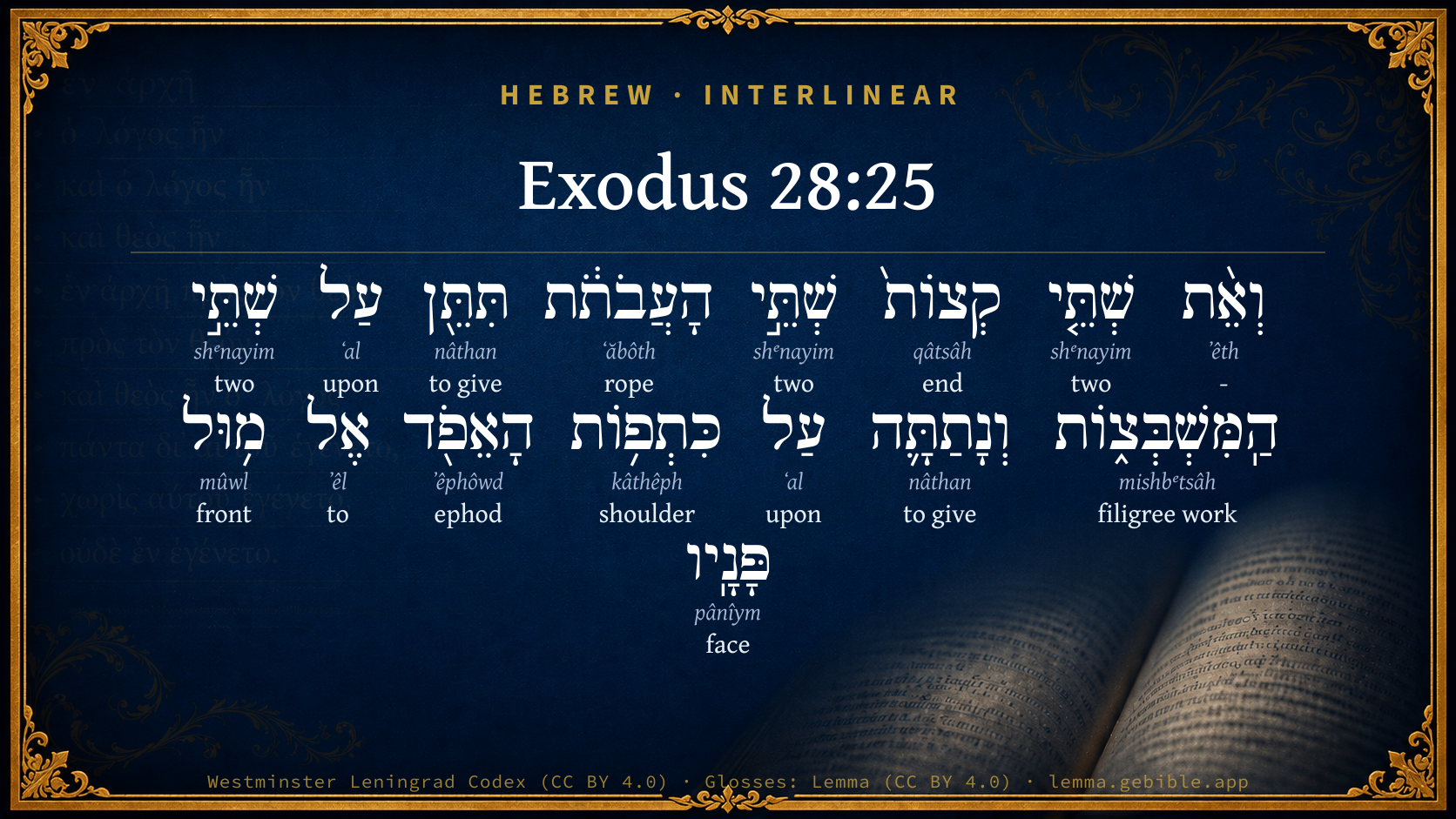
  1. וְאֵ֨ת ʼêth H853 “and · -” Conjunction + Particle, Direct Object
  2. שְׁתֵּ֤י shᵉnayim H8147 “two” Adjective, Cardinal number, Feminine, Dual, Construct
  3. קְצוֹת֙ qâtsâh H7098 “ends of” Noun, Common, Both, Plural, Construct
  4. שְׁתֵּ֣י shᵉnayim H8147 “two” Adjective, Cardinal number, Feminine, Dual, Construct
  5. הָעֲבֹתֹ֔ת ʻăbôth H5688 “the · ropes” Particle, Definite Article + Noun, Common, Both, Plural, Absolute
  6. תִּתֵּ֖ן nâthan H5414 “to give” Verb, Qal, Imperfect, 2nd Person, Masculine, Singular
  7. עַל ʻal H5921 “upon” Preposition
  8. שְׁתֵּ֣י shᵉnayim H8147 “two” Adjective, Cardinal number, Feminine, Dual, Construct
  9. וְנָתַתָּ֛ה nâthan H5414 “and · to give” Conjunction + Verb, Qal, Sequential Perfect, 2nd Person, Masculine, Singular
  10. עַל ʻal H5921 “upon” Preposition
  11. כִּתְפ֥וֹת kâthêph H3802 “shoulders of” Noun, Common, Feminine, Plural, Construct
  12. הָאֵפֹ֖ד ʼêphôwd H646 “the · ephod” Particle, Definite Article + Noun, Common, Masculine, Singular, Absolute
  13. אֶל ʼêl H413 “to” Preposition
  14. מ֥וּל mûwl H4136 “front” Preposition
  15. פָּנָֽיו pânîym H6440 “face(s) · his” Noun, Common, Both, Plural, Construct + Suffix, Personal, 3rd Person, Masculine, Singular

About this verse

These counts appear in no published source. They are computed here, from the morphology-tagged text and Lemma’s own curated glosses. What Lemma adds →

16
words
12
distinct lemmas
Pentateuch
section

Notable vocabulary

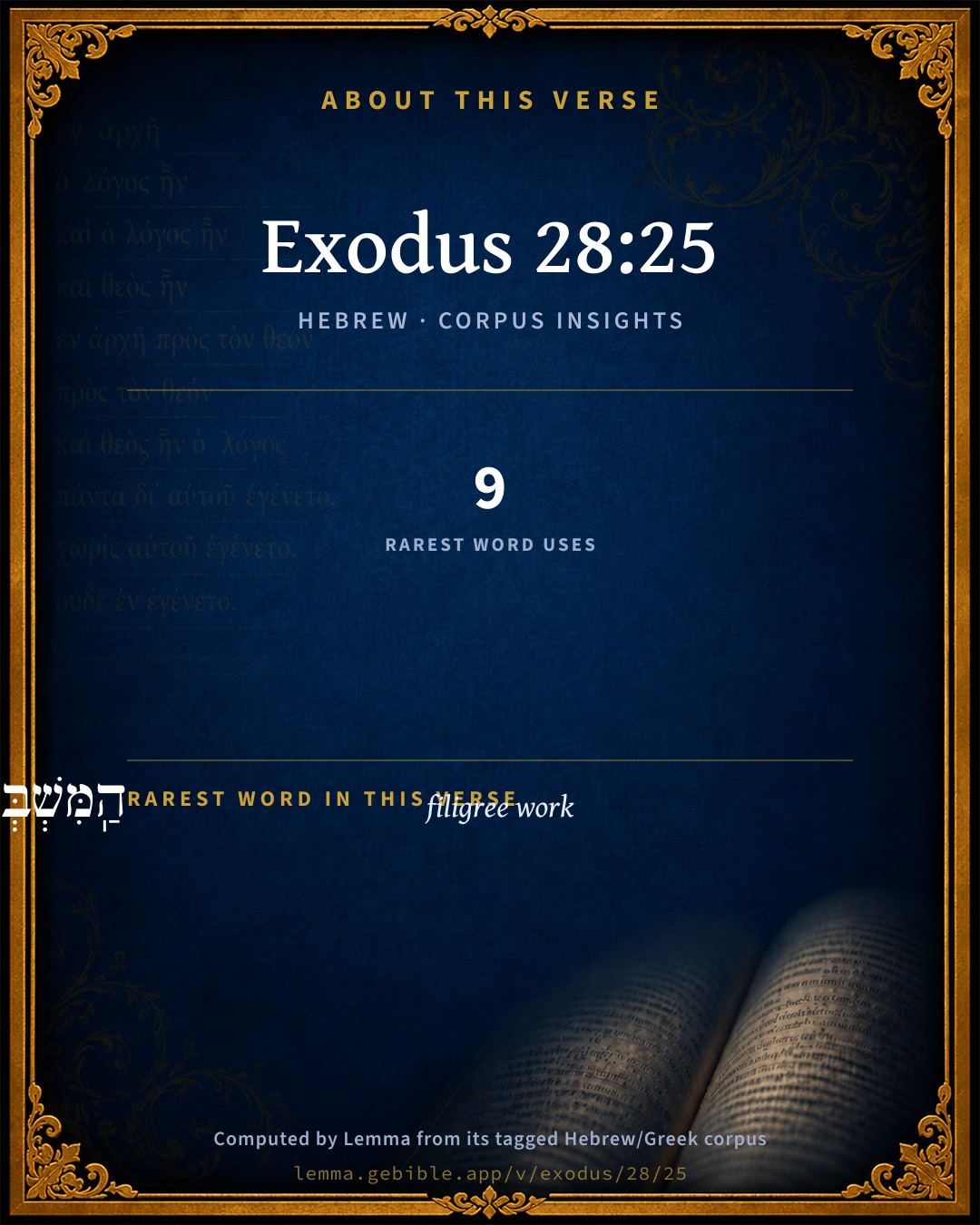
The rarest word here is הַֽמִּשְׁבְּצ֑וֹת filigree work H4865 — appearing just 9 times in the whole Hebrew Bible.

Shared distinctive vocabulary

הַֽמִּשְׁבְּצ֑וֹת filigree work H4865 occurs in 9 verses of the Hebrew Bible. Also found in:

Grammatical profile

  • 2 verbs
  • 6 nouns
  • 3 adjectives
  • 4 prepositions
  • 1 particle

Verb forms

  • תִּתֵּ֖ן Qal · Imperfect
  • וְנָתַתָּ֛ה Qal · Sequential Perfect

Repetition

Words recur within this verse — often emphatic in Hebrew:

  • שְׁתֵּ֤י two H8147 ×3
  • תִּתֵּ֖ן to give H5414 ×2
  • עַל upon H5921 ×2

Hebrew & Septuagint length

In English translation the verse runs 30 words from the Hebrew and 16 from the Septuagint (LXX English) — the Septuagint runs noticeably shorter here. See the side-by-side →

A rough comparison of the two English renderings, which tokenize alike — not a word-level alignment.

Word counts can differ between the Hebrew and the Greek without any difference in meaning — e.g. the Hebrew direct-object marker אֵת has no separate Greek word, and Greek often adds the article ὁ.

Cross-references

3

Topical passages linked to Exodus 28:25 in the Treasury of Scripture Knowledge — connected by theme and wording, ordered by reader-vote popularity; previews shown in the World English Bible.

  • Exodus 28:14 and two chains of pure gold; you make them like cords shall, of braided work: and you shall put the braided chains on the settings.
  • Exodus 39:4 They made shoulder-pieces for it, joined together. At the two ends it was joined together.
  • Exodus 39:15 They made on the breastplate chains like cords, of braided work of pure gold.

Cross-references courtesy of OpenBible.info (CC BY 4.0).

Hebrew and Greek witnesses Masoretic Hebrew ↔ Greek Septuagint

The same verse in the two great witnesses to the Old Testament, shown verse-for-verse.

Here the Septuagint runs noticeably shorter than the Hebrew — LXX2012 (modern English Septuagint) 16 words vs World English Bible 30. A rough length comparison of the two English translations, not a word-level alignment — read both below.

These are two independent witnesses, not word-aligned to each other, and the Septuagint is shown in lemma (dictionary) form.

Hebrew Exodus 28:25 Masoretic · Westminster Leningrad Codex

וְאֵ֨ת שְׁתֵּ֤י קְצוֹת֙ שְׁתֵּ֣י הָעֲבֹתֹ֔ת תִּתֵּ֖ן עַל שְׁתֵּ֣י הַֽמִּשְׁבְּצ֑וֹת וְנָתַתָּ֛ה עַל כִּתְפ֥וֹת הָאֵפֹ֖ד אֶל מ֥וּל פָּנָֽיו

The other two ends of the two braided chains you shall put on the two settings, and put them on the shoulder-pieces of the ephod in the forepart of it.

World English Bible · Public Domain

Greek LXX Exodus 28:25 Septuagint · lemma form
and you shall put the two circlets on both the shoulders of the ephod in front.

LXX2012 (modern English Septuagint) · Public Domain

Hebrew: Westminster Leningrad Codex (CC BY 4.0). Greek: Septuagint (public domain); English from LXX2012 (modern English Septuagint) (Public Domain). How the Septuagint differs from the Hebrew →

Targum (Aramaic paraphrase)

2

The Targum is the ancient Jewish Aramaic paraphrase of the Hebrew Scriptures — an interpretive translation, not the Hebrew text itself. Onkelos (literal) and Pseudo-Jonathan (expansive) render the Torah, and Jonathan the Prophets. Coverage is partial: where no permissively-licensed English translation exists for a verse, only the Aramaic is shown. This is verse-level text, not a word-by-word alignment to the Hebrew.

  1. Targum Onkelos Torah (Genesis–Deuteronomy)
    וְיָת תַּרְתֵּין גְדִילָן דְעַל תַּרְתֵּין סִטְרוֹהִי תִּתֵּן עַל תַּרְתֵּין מְרַמְצָתָא וְתִתֵּן עַל כִּתְפֵּי אֵפוֹדָא לָקֳבֵל אַפּוֹהִי:

    (no public-domain English translation for this verse)

    Targum Onkelos — Aramaic: “Onkelos Genesis” (public domain); “Onkelos Exodus” (public domain); “Onkelos Leviticus” (public domain); “Onkelos Numbers” (public domain); “Onkelos Deuteronomy” (public domain). English: “Sefaria Community Translation” (CC0 1.0 (public-domain dedication)); “J.W. Etheridge. The Targums of Onkelos and Jonathan Ben Uzziel on the Pentateuch. London: Longmans, Green, 1862” (public domain). Text via Sefaria.

  2. Targum Pseudo-Jonathan Torah (Genesis–Deuteronomy)
    וְיַת תַּרְתֵּין קְלִיעַן דְּעַל תְּרֵין סִיטְרוֹי תִּתֵּן עַל תַּרְתֵּין מְרַמְצָתָא וְתִתֵּן עַל כִּתְפֵי אֵפוֹדָא כָּל קְבֵיל אַנְפּוֹי

    and the two chains which are upon the two sides thou shalt put upon the two sockets, and set on the shoulders of the ephod against its front.

    Targum Pseudo-Jonathan — Aramaic: “Targum Jonathan on Genesis” (public domain); “Targum Jonathan on Exodus” (public domain); “Targum Jonathan on Leviticus” (public domain); “Targum Jonathan on Numbers” (public domain); “Targum Jonathan on Deuteronomy” (public domain). English: “The Targum of Jonathan ben Uzziel, trans. J. W. Etheridge, London, 1862” (public domain). Text via Sefaria.

Commentary

Notes on Exodus 28:25 from classic Christian and Jewish commentators (each source and its license shown beneath its notes). The classic Christian expositions comment on the surrounding passage and are grouped to its opening verse, so a note may address several verses; the Jewish commentaries on the Tanakh (Rashi and others) are per-verse, so they appear only where the commentator wrote on this verse.

Lemma curates 59 commentaries, every one of them public domain or Creative Commons licensed, each selected and text-cleaned for this edition rather than reprinted as found. About our sources →

The Cambridge Bible for Schools and Colleges

gen. ed. J. J. S. Perowne

25. the two rosettes] Those mentioned in vv. 13, 14.

The Cambridge Bible for Schools and Colleges (gen. ed. J. J. S. Perowne; Cambridge University Press, 1878–1918) — public domain. Text from a community e-Sword module.

John Gill's Exposition

And thou shall make two rings of gold,.... Two other rings besides those before mentioned:

and thou shalt put them upon the two ends of the breastplate; on the other two ends or corners of it:

in the border thereof which is in the side of the ephod inward: these were at the two lower ends of the breastplate, towards the ephod on the inside.

John Gill's Exposition of the Whole Bible (1746–1763) — public domain (CC PDM 1.0). Text via the HelloAO Bible API.

Matthew Poole's English Annotations

i.e. In the forepart of the ephod; or before him, i.e. the high priest, in his forepart, upon his breast.

Matthew Poole's English Annotations on the Holy Bible (1683–1685) — public domain. Text from a community e-Sword/MySword module.

unfoldingWord translationNotes

Door43 World Missions Community

General Information:

Yahweh continues to tell Moses what the people must do.

braided chains

"chains braided like cords." See how you translated this in Exodus 28:14.

to the two settings

These are two settings that enclose the stones. This can be clearly stated in the translation. AT: "to the two settings that enclose the stones" (See: Assumed Knowledge and Implicit Information)

translationWords

ephod

gold

breastplate

unfoldingWord translationNotes — © Distant Shores Media and the Door43 World Missions Community, licensed CC BY-SA 4.0. Source: git.door43.org/Door43/en_tn.

Rashi

Rabbi Shlomo Yitzchaki (Rashi)

ואת שתי קצות means, AND THE TWO EXTREMITIES OF שתי עבתת THE TWO PLAITED CHAINS — (Rashi points out that קצות is in the construct state) — i. e. the two ends of each cord

תתן על שתי המשבצות THOU SHALT FASTEN IN THE TWO SETTINGS — These are the selfsame settings which are mentioned above in the paragraph that is placed between the section on the breast-plate and the section on the ephod. There it did not explain their purpose and their position; now, however, it explains that he should fix into them the ends of the plaited chains which had been inserted in the rings of the breast-plate on the right and on the left near the neck. The two ends of the right chain he fixed in the setting on the right, and similarly in that on the left he fixed the two ends of the left chain.

ונתת AND THOU SHALT PUT the settings.

על כתפות האפד ON THE SHOULDER-PIECES OF THE EPHOD, one setting on this shoulder-piece and one on that. Consequently the shoulder-pieces of the ephod hold the breast-plate up so that it may not fall, and from them did it hang. But the lower edge of the breast-plate would still come and go (swing to and fro) and strike against his stomach and would not lie closely upon it; therefore two more rings were needed for its lower edge, as it goes on to explain.

אל מול פניו IN THE FOREPART THEREOF — i. e. in the forepart of the ephod. meaning that he should not put the settings on that surface of the shoulder-pieces which faced the מעיל, but on the upper surface which faced the outside. It is that latter surface which is called the forepart of the ephod, because the surface which is not seen, being turned towards the מעיל, cannot be called the פנים, the front.

Rashi on the Tanakh — English translations: “The Judaica Press complete Tanach with Rashi, translated by A. J. Rosenberg” (CC BY 4.0); “Pentateuch with Rashi's commentary by M. Rosenbaum and A.M. Silbermann, 1929-1934” (public domain); “The Metsudah Tanach series, Lakewood, N.J” (CC BY 4.0); and “The Book of Joshua, Metsudah Publications, 1997” (CC BY 4.0). Text via Sefaria.

Lesson kit

Teaching starters — assembled from the data on this page, not authored interpretation. Every prompt links to the verse data it draws on. Edit before teaching.

Exodus, in the Pentateuch, opens this verse with 16 words (12 distinct Hebrew lemmas). Its most distinctive word is mishbᵉtsâh (“filigree work”). The Greek Septuagint runs shorter here. A historical commentator’s framing appears above. Read the whole chapter for the surrounding context.

Discussion questions

  1. What does “filigree work” (mishbᵉtsâh) contribute to the verse as a whole?
  2. How does Exodus 28:11, which shares the word «filigree work», read alongside this verse?
  3. What does the repetition of “two” (3× in this one verse) do in this verse?
  4. The Septuagint runs shorter here than the Hebrew. What might account for the difference?
  5. These translations render this verse differently. What is at stake in choosing one wording over another?
  6. «תִּתֵּ֖ן» is a Qal Imperfect verb. How does that grammatical form shape the action described?
  7. Compare how The Cambridge Bible for Schools and Colleges and John Gill's Exposition read this verse. Where do they agree or differ?

Things to notice

Reading settings

Reading text

Shown beneath each verse's original-language words.

Old Testament
Old Testament edition

Read the OT as the Masoretic Hebrew (MT) or the Greek Septuagint (LXX).

English shown for the Greek Septuagint (in the Hebrew ↔ Greek comparison).

Comparing translations? Open the Compare panel on any verse page to stack up to four side by side.