Genesis 23:4

Hebrew (Westminster Leningrad Codex) Genesis 23:4 appears in the Hebrew Old Testament. The text above is from the Westminster Leningrad Codex. Each word links to its Strong’s number, a concise gloss, and parsing drawn from the Open Scriptures Hebrew Bible morphology. Click any word for its full Brown-Driver-Briggs (BDB) entry.
Download image
Cite this verse

Genesis 23:4 (World English Bible). Public Domain. Lemma interlinear Bible study tool, https://lemma.gebible.app/v/genesis/23/4.

Show BibTeX & RIS
BibTeX
RIS
English Translation
"I am a stranger and a foreigner living with you. Give me a possession of a burying-place with you, that I may bury my dead out of my sight."
World English Bible · Public Domain
Highlights
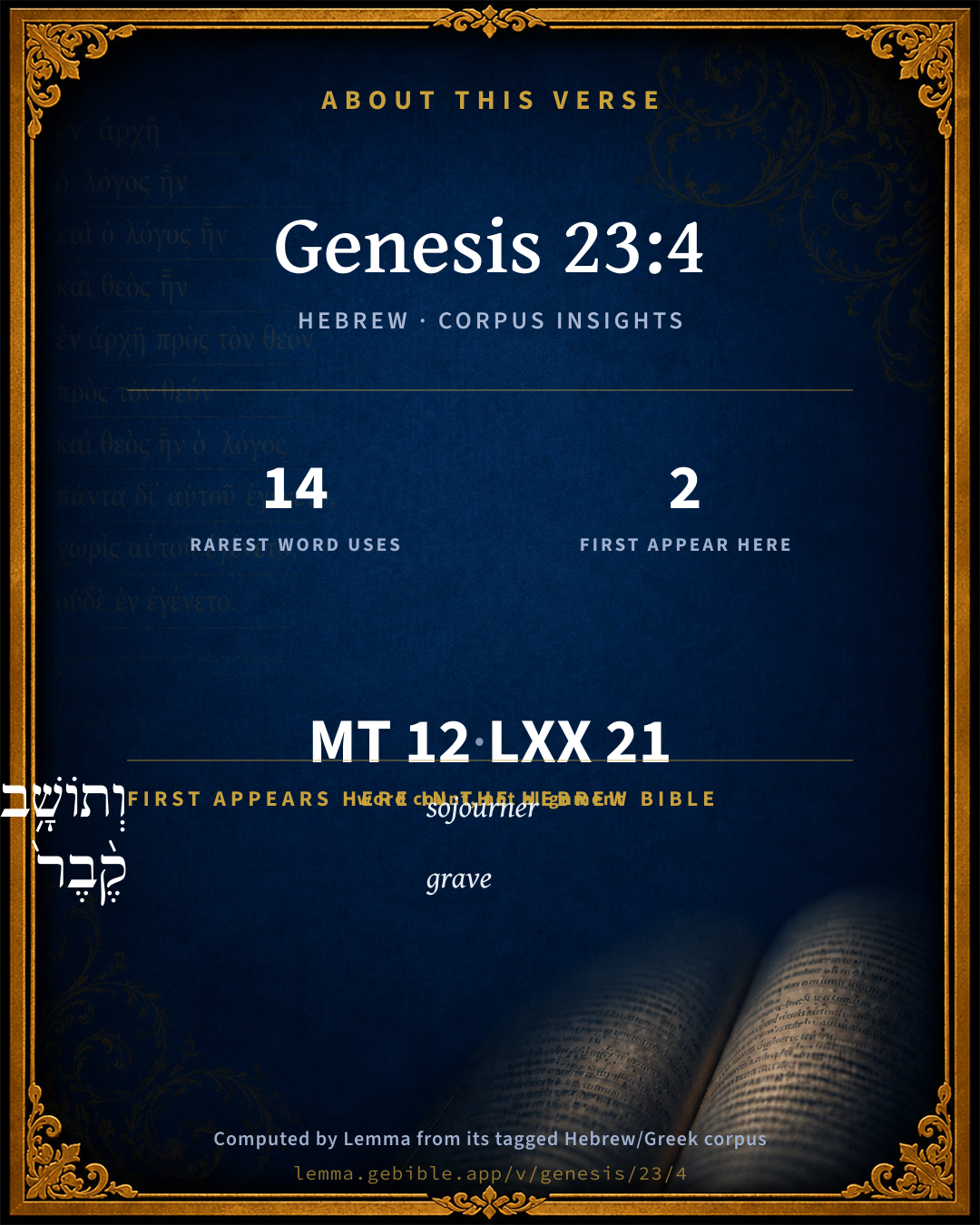
  • 2 first appearances in the Hebrew Bible
Full analysis ↓
Download a study sheet

One document with this verse’s original text, its word-by-word gloss line, the meaning frame, cross-references with their text, attributed commentary, and full source and license credits — printable, and it pastes into notes with its structure intact.

This verse Autodidact and up

Study sheet (.html) Plain text (.txt)

A passage Seminary Student

Up to 50 verses in one chapter. A passage sheet keeps up to 6 commentary sources and 12 cross-references per verse, in the order this page ranks them, and says so on the sheet whenever that leaves anything out. Ask for a single verse and you get the Autodidact verse sheet above.

Everything on this page stays free to read, with no account — the sheet is a download of what is already on screen, not access to it.

Want to remove ads? Support Godless Engineer
Compare translations 3

The same verse in 3 English versions, stacked beneath the original-language interlinear above. Click any original word for its lexicon entry.

Each is an independent rendering of the whole verse — the interlinear is not word-aligned to these translations.

Highlighted words mark where these versions differ — a whole-verse word diff, not a word-by-word alignment.

  • World English Bible Public Domain
    "I am a stranger and a foreigner living with you. Give me a possession of a burying-place with you, that I may bury my dead out of my sight."
  • King James Version Public Domain
    I am a stranger and a sojourner with you: give me a possession of a buryingplace with you, that I may bury my dead out of my sight.
  • unfoldingWord Literal Text CC BY-SA 4.0
    “I a foreigner and a sojourner among you. Give to me property for a burial place among you, so that I can bury my dead from before me.”

unfoldingWord Literal Text — © unfoldingWord, licensed CC BY-SA 4.0. Word-aligned USFM3 via Door43 (git.door43.org/unfoldingWord/en_ult).

Versions to compare (up to 4)

3 of 4 selected

Show all 18 translations

Every available English version of this verse, each an independent rendering of the whole verse.

  • World English Bible Public Domain
    "I am a stranger and a foreigner living with you. Give me a possession of a burying-place with you, that I may bury my dead out of my sight."
  • Berean Standard Bible Public Domain
    “I am a foreigner and an outsider among you. Give me a burial site among you so that I can bury my dead.”
  • Majority Standard Bible Public Domain
    “I am a foreigner and an outsider among you. Give me a burial site among you so that I can bury my dead.”
  • King James Version Public Domain
    I am a stranger and a sojourner with you: give me a possession of a buryingplace with you, that I may bury my dead out of my sight.
  • American Standard Version (1901) Public Domain
    I am a stranger and a sojourner with you. Give me a possession of a burying-place with you, that I may bury my dead out of my sight.
  • Revised Version (1885) Public Domain
    I am a stranger and a sojourner with you: give me a possession of a buryingplace with you, that I may bury my dead out of my sight.
  • Geneva Bible (1599) Public Domain
    I am a stranger, and a forreiner among you, giue me a possession of buriall with you, that I may burie my dead out of my sight.
  • Douay-Rheims (1899) Public Domain
    I am a stranger and sojourner among you: give me the right of a burying-place with you, that I may bury my dead.
  • Young's Literal Translation Public Domain
    `A sojourner and a settler I `am' with you; give to me a possession of a burying-place with you, and I bury my dead from before me.'
  • Literal Standard Version CC BY-SA 4.0
    “A sojourner and a settler I [am] with you; give to me a possession of a burying-place with you, and I bury my dead from before me.”
  • Unlocked Literal Bible CC BY-SA 4.0
    “I am a foreigner among you. Please grant me a property for a burial place among you, so that I may bury my dead.”
  • unfoldingWord Literal Text CC BY-SA 4.0
    “I a foreigner and a sojourner among you. Give to me property for a burial place among you, so that I can bury my dead from before me.”
  • Darby Bible Public Domain
    I am a stranger and a sojourner with you; give me a possession of a sepulchre with you, that I may bury my dead from before me.
  • World Messianic Bible Public Domain
    “I am a stranger and a foreigner living with you. Give me a possession of a burying-place with you, that I may bury my dead out of my sight.”
  • Webster's Bible Public Domain
    I am a stranger and a sojourner with you; give me a possession of a burying-place with you, that I may bury my dead out of my sight.
  • Free Bible Version CC BY-SA 4.0
    “I am a foreigner, a stranger living among you,” he said. “Please let me buy a burial site so I can bury my dead wife.”
  • Bible in Basic English Public Domain
    I am living among you as one from a strange country: give me some land here as my property, so that I may put my dead to rest.
  • JPS Tanakh (1917) Public Domain
    'I am a stranger and a sojourner with you: give me a possession of a burying-place with you, that I may bury my dead out of my sight.'

Literal Standard Version (2020), Covenant Press — licensed CC BY-SA 4.0. Text via the HelloAO Bible API (eBible.org). Unlocked Literal Bible (unfoldingWord) — licensed CC BY-SA 4.0. Text via the HelloAO Bible API (eBible.org). unfoldingWord Literal Text — © unfoldingWord, licensed CC BY-SA 4.0. Word-aligned USFM3 via Door43 (git.door43.org/unfoldingWord/en_ult). Free Bible Version, Dr. Jonathan Gallagher — licensed CC BY-SA 4.0. Text via the HelloAO Bible API (eBible.org).

Word by word

More ways to search: Search by grammar → Find every occurrence → Compare this word →

Practice this passage: Drill this verse → Learn its vocabulary →

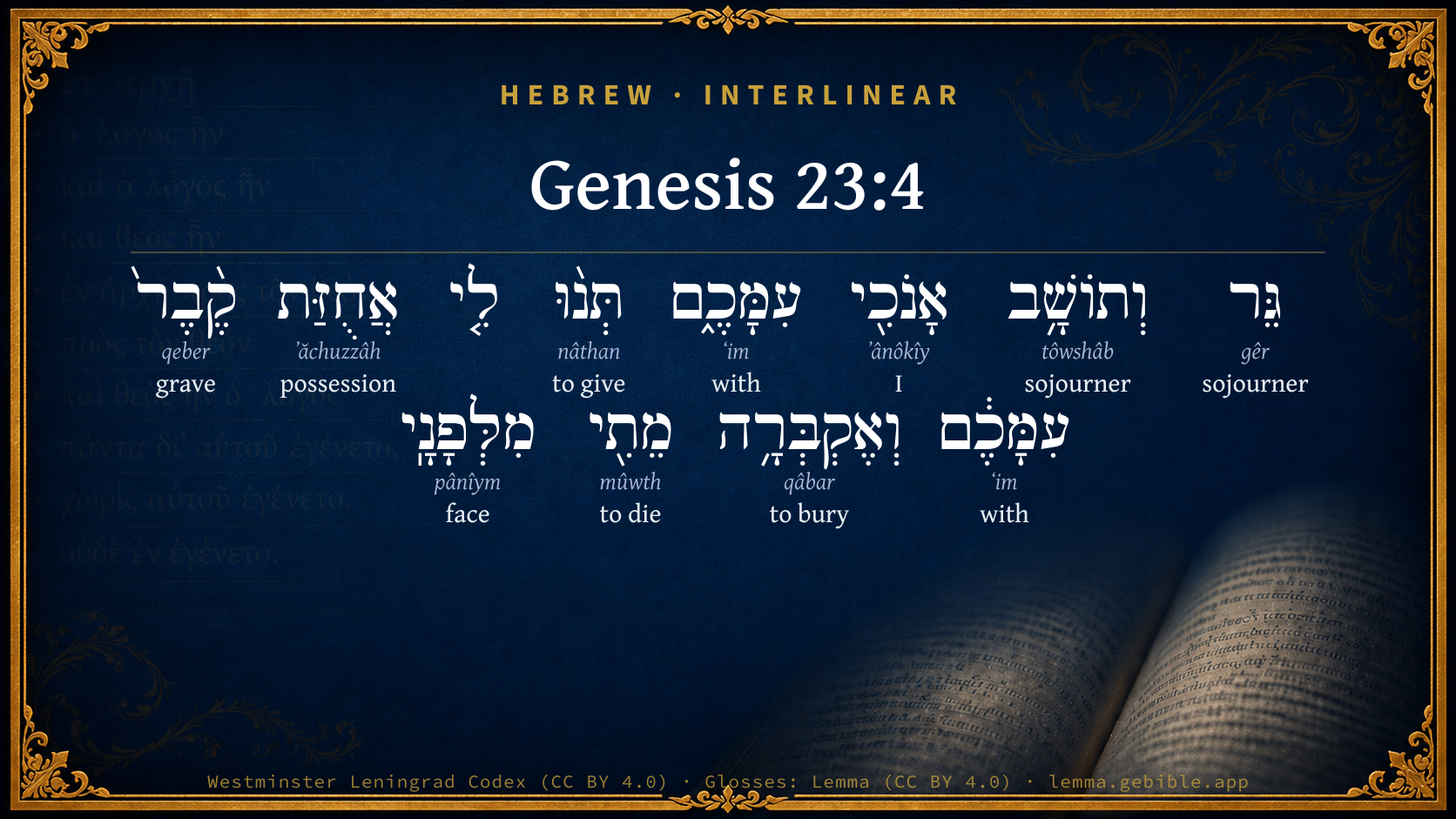
וְתוֹשָׁ֥ב
tôwshâb
H8453
“and · sojourner”
Conjunction + Noun, Common, Masculine, Singular, Absolute
Part of Speech
Conjunction + Noun
Type
Common
Gender
Masculine
Number
Singular
State
Absolute
Full BDB Definition

Origin: from H3427

TWOT: 922d

sojourner, stranger
  1. גֵּר gêr H1616 “sojourner” Noun, Common, Masculine, Singular, Absolute
  2. אָנֹכִ֖י ʼânôkîy H595 “I” Pronoun, Personal, 1st Person, Common, Singular
  3. עִמָּכֶ֑ם ʻim H5973 “with · you” Preposition + Suffix, Personal, 2nd Person, Masculine, Plural
  4. תְּנ֨וּ nâthan H5414 “give” Verb, Qal, Imperative, 2nd Person, Masculine, Plural
  5. אֲחֻזַּת ʼăchuzzâh H272 “possession of” Noun, Common, Feminine, Singular, Construct
  6. קֶ֨בֶר֙ qeber H6913 “grave” Noun, Common, Masculine, Singular, Absolute
  7. עִמָּכֶ֔ם ʻim H5973 “with · you” Preposition + Suffix, Personal, 2nd Person, Masculine, Plural
  8. וְאֶקְבְּרָ֥ה qâbar H6912 “and · to bury” Conjunction + Verb, Qal, Cohortative, 1st Person, Common, Singular
  9. מֵתִ֖י mûwth H4191 “dying · me” Verb, Qal, Participle Active, Masculine, Singular, Construct + Suffix, Personal, 1st Person, Common, Singular
  10. מִלְּפָנָֽי pânîym H6440 “from · to/for · face(s) · my” Preposition + Preposition + Noun, Common, Both, Plural, Construct + Suffix, Personal, 1st Person, Common, Singular

About this verse

These counts appear in no published source. They are computed here, from the morphology-tagged text and Lemma’s own curated glosses. What Lemma adds →

12
words
10
distinct lemmas
Pentateuch
section

Notable vocabulary

The rarest word here is וְתוֹשָׁ֥ב sojourner H8453 — appearing just 14 times in the whole Hebrew Bible.

First appearance in Scripture

These words make their first canonical appearance in the Hebrew Bible here:

  • וְתוֹשָׁ֥ב sojourner H8453
  • קֶ֨בֶר֙ grave H6913

Shared distinctive vocabulary

וְתוֹשָׁ֥ב sojourner H8453 occurs in 13 verses of the Hebrew Bible. Also found in:

Grammatical profile

  • 3 verbs
  • 5 nouns
  • 1 pronoun
  • 3 prepositions

Verb forms

  • תְּנ֨וּ Qal · Imperative
  • וְאֶקְבְּרָ֥ה Qal · Cohortative
  • מֵתִ֖י Qal · Participle Active

Repetition

A word recurs within this verse — often emphatic in Hebrew:

  • עִמָּכֶ֑ם with H5973 ×2

Hebrew & Septuagint length

In English translation the verse runs 29 words from the Hebrew and 27 from the Septuagint (LXX English) — closely comparable.

A rough comparison of the two English renderings, which tokenize alike — not a word-level alignment.

Word counts can differ between the Hebrew and the Greek without any difference in meaning — e.g. the Hebrew direct-object marker אֵת has no separate Greek word, and Greek often adds the article ὁ.

In the original languages it is 12 Hebrew tokens and 21 Greek tokens — but the two are counted differently (Hebrew bundles its prefixes and suffixes into one token; the Greek is in lemma form), so that isn’t a like-for-like length.

Cross-references

18

Topical passages linked to Genesis 23:4 in the Treasury of Scripture Knowledge — connected by theme and wording, ordered by reader-vote popularity; previews shown in the World English Bible.

  • 1 Chronicles 29:15 For we are strangers before you, and foreigners, as all our fathers were: our days on the earth are as a shadow, and there is no abiding.
  • Hebrews 11:9 By faith, he lived as an alien in the land of promise, as in a land not his own, dwelling in tents, with Isaac and Jacob, the heirs with him of the same promise.
  • Genesis 17:8 I will give to you, and to your seed after you, the land where you are traveling, all the land of Canaan, for an everlasting possession. I will be their God."
  • Psalms 119:19 I am a stranger on the earth. Don't hide your commandments from me.
  • Genesis 49:30 in the cave that is in the field of Machpelah, which is before Mamre, in the land of Canaan, which Abraham bought with the field from Ephron the Hittite as a burial place.
  • Leviticus 25:23 "'The land shall not be sold in perpetuity, for the land is mine; for you are strangers and live as foreigners with me.
  • Psalms 39:12 "Hear my prayer, Yahweh, and give ear to my cry. Don't be silent at my tears. For I am a stranger with you, A foreigner, as all my fathers were.
  • Acts 7:5 He gave him no inheritance in it, no, not so much as to set his foot on. He promised that he would give it to him for a possession, and to his seed after him, when he still had no child.
  • Hebrews 11:13–16 These all died in faith, not having received the promises, but having seen them and embraced them from afar, and having confessed that they were strangers and pilgrims on the earth.
  • Genesis 3:19 By the sweat of your face will you eat bread until you return to the ground, for out of it you were taken. For you are dust, and to dust you shall return."
  • Genesis 47:9 Jacob said to Pharaoh, "The days of the years of my pilgrimage are one hundred thirty years. Few and evil have been the days of the years of my life, and they have not attained to the days of the years of the life of my fathers in the days of their pilgrimage."
  • Genesis 50:13 for his sons carried him into the land of Canaan, and buried him in the cave of the field of Machpelah, which Abraham bought with the field, for a possession of a burying-place, from Ephron the Hittite, before Mamre.
  • Job 30:23 For I know that you will bring me to death, To the house appointed for all living.
  • Psalms 105:12–13 When they were but a few men in number, Yes, very few, and foreigners in it.
  • Ecclesiastes 6:3 If a man fathers a hundred children, and lives many years, so that the days of his years are many, but his soul is not filled with good, and moreover he has no burial; I say, that an untimely birth is better than he:
  • Ecclesiastes 12:5 Yes, they shall be afraid of heights, And terrors will be in the way; And the almond tree shall blossom, And the grasshopper shall be a burden, And desire shall fail; Because man goes to his everlasting home, And the mourners go about the streets:
  • Ecclesiastes 12:7 And the dust returns to the earth as it was, And the spirit returns to God who gave it.
  • 1 Peter 2:11 Beloved, I beg you as foreigners and pilgrims, to abstain from fleshly lusts, which war against the soul;

Cross-references courtesy of OpenBible.info (CC BY 4.0).

Hebrew and Greek witnesses Masoretic Hebrew ↔ Greek Septuagint

The same verse in the two great witnesses to the Old Testament, shown verse-for-verse.

These are two independent witnesses, not word-aligned to each other, and the Septuagint is shown in lemma (dictionary) form.

Hebrew Genesis 23:4 Masoretic · Westminster Leningrad Codex

גֵּר וְתוֹשָׁ֥ב אָנֹכִ֖י עִמָּכֶ֑ם תְּנ֨וּ לִ֤י אֲחֻזַּת קֶ֨בֶר֙ עִמָּכֶ֔ם וְאֶקְבְּרָ֥ה מֵתִ֖י מִלְּפָנָֽי

"I am a stranger and a foreigner living with you. Give me a possession of a burying-place with you, that I may bury my dead out of my sight."

World English Bible · Public Domain

Greek LXX Genesis 23:4 Septuagint · lemma form

πάροικος καί παρεπίδημος ἐγώ εἰμί μετά σύ δίδωμι οὖν ἐγώ κτῆσις τάφος μετά σύ καί θάπτω ὁ νεκρός ἐγώ ἀπό ἐγώ

I am a sojourner and a stranger among you, give me therefore possession of a burying-place among you, and I will bury my dead away from me.

LXX2012 (modern English Septuagint) · Public Domain

On this verse, The Cambridge Bible for Schools and Colleges discusses the Septuagint’s reading. Read the note in Commentary ↓

Hebrew: Westminster Leningrad Codex (CC BY 4.0). Greek: Septuagint (public domain); English from LXX2012 (modern English Septuagint) (Public Domain). How the Septuagint differs from the Hebrew →

Targum (Aramaic paraphrase)

2

The Targum is the ancient Jewish Aramaic paraphrase of the Hebrew Scriptures — an interpretive translation, not the Hebrew text itself. Onkelos (literal) and Pseudo-Jonathan (expansive) render the Torah, and Jonathan the Prophets. Coverage is partial: where no permissively-licensed English translation exists for a verse, only the Aramaic is shown. This is verse-level text, not a word-by-word alignment to the Hebrew.

  1. Targum Onkelos Torah (Genesis–Deuteronomy)
    דַּיָּר וְתוֹתַב אֲנָא עִמְּכוֹן הָבוּ לִי אַחֲסָנַת קְבוּרָא עִמְּכוֹן וְאִקְבַּר מִיתִי מִן קֳדָמָי

    (no public-domain English translation for this verse)

    Targum Onkelos — Aramaic: “Onkelos Genesis” (public domain); “Onkelos Exodus” (public domain); “Onkelos Leviticus” (public domain); “Onkelos Numbers” (public domain); “Onkelos Deuteronomy” (public domain). English: “Sefaria Community Translation” (CC0 1.0 (public-domain dedication)); “J.W. Etheridge. The Targums of Onkelos and Jonathan Ben Uzziel on the Pentateuch. London: Longmans, Green, 1862” (public domain). Text via Sefaria.

  2. Targum Pseudo-Jonathan Torah (Genesis–Deuteronomy)
    דַיָיר וְתוֹתָב אֲנָא עִמְכוֹן בְּבָעוּ זַבּוּנִי לִי אַחֲסָנַת קְבוּרְתָּא עִמְכוֹן וְאִיקְבַּר יַת מֵיתִי תַּמָן

    I am a sojourner and dweller with you; I pray sell me the inheritance of a sepulchre among you, and I will bury my dead there.

    Targum Pseudo-Jonathan — Aramaic: “Targum Jonathan on Genesis” (public domain); “Targum Jonathan on Exodus” (public domain); “Targum Jonathan on Leviticus” (public domain); “Targum Jonathan on Numbers” (public domain); “Targum Jonathan on Deuteronomy” (public domain). English: “The Targum of Jonathan ben Uzziel, trans. J. W. Etheridge, London, 1862” (public domain). Text via Sefaria.

Commentary

Notes on Genesis 23:4 from classic Christian and Jewish commentators (each source and its license shown beneath its notes). The classic Christian expositions comment on the surrounding passage and are grouped to its opening verse, so a note may address several verses; the Jewish commentaries on the Tanakh (Rashi and others) are per-verse, so they appear only where the commentator wrote on this verse.

Lemma curates 59 commentaries, every one of them public domain or Creative Commons licensed, each selected and text-cleaned for this edition rather than reprinted as found. About our sources →

Trapp's Complete Commentary

John Trapp

Gen 23:4 I [am] a stranger and a sojourner with you: give me a possession of a buryingplace with you, that I may bury my dead out of my sight.

Ver. 4. That I may bury my dead out of my sight.] She that had been "the desire of his eyes," {Eze 24:16} the sweet companion of his life, is by death so defaced, that he loathes to look on her. This we are to think on in our mourning for the dead; to bewail the common curse of mankind, the defacing of God’s image by death through sin, &c. And yet to comfort ourselves in this, that these "vile bodies" of ours, shall once be "conformed to Christ’s glorious body," {Php 3:21} the standard in incorruption, agility, beauty, brightness, and other most blessed and inconceivable parts and properties.

John Trapp, A Commentary or Exposition upon All the Books of the Old and New Testament (1647–1656) — public domain. Text from a community e-Sword module.

The Biblical Illustrator

Joseph S. Exell

Gen_23:4

I am a stranger and a sojourner among you

Strangers in the earth

I.

THE EXHORTATION. A true Christians life should be that of a stranger and a sojourner.

1. Such persons are at once recognized. Marks of nationality may be more or less prominent. Sometimes the foreigner wears a strange costume, and speaks a strange language; and sometimes these things are studiously avoided; he assumes our dress, converses in our dialect; nevertheless, there is always something about him which bespeaks the sojourner. And so should it be with the Christian.

2. These peculiarities will be observable in all the common business of life. Not, indeed, in any disregard of useful industries and occupations. A wise foreigner, passing through a strange country, will make the best use of his time, mingling with its inhabitants, studying its institutions, observing its manners and customs, examining minutely its improvements in science and art, perhaps investing largely in its agricultural implements, and mechanical machinery, and scientific apparatus, and many of its products and fabrics, ornamental and useful. He may for the time appear, more even than native citizens, attentive to and engrossed by such matters; nevertheless, every man who deals with him perceives that his interest in them is that of a sojourner, who examines and purchases with a view to some use or enjoyment in his own distant land. Just so should it be with the Christian.

3. These marks of a foreigner will be manifest in all the pleasures of life.

4. A foreigner may be known by the opinions he forms and expresses of all things that surround him. Many such things, which to us, through custom and familiarity, seem proper and consistent and natural, will often strike him strangely. This point is finely illustrated in Oliver Goldsmiths Citizen of the World.

II. As A CONSOLATION. If we are strangers and sojourners on earth, then--

1. Our better portion and grander heritage and home are in heaven. Like the patriarchs, we should look for a city whose maker is God! and, like the apostles, should rejoice to think that presently we shall be absent from the body and present with the Lord.

2. Strangers and foreigners think ever and most tenderly of their distant native lands. Of the dear doors that will open, and the loved voices that will welcome them, when, having accomplished the ends of their brief sojourn in those stranger-scenes, they cross the ocean, and cast anchor in distant harbours, and go ashore to their own cities. And herein they should be our models. Good as Christian life may be on the earth, yet there are better things in heaven. (The Preachers Monthly.)

The believer and the world; or, Abraham the stranger and sojourner

We shall attempt the task of analysing the relations which Abraham sustained to his heathen neighbours. We perceive at once that they were those of entire friendliness, but of absolute separation. We shall follow, therefore, this simple division of the subject of this chapter.

I. HIS FRIENDLINESS. Mark you, not his friendship. Let it not be implied that there was any agreement of his principles with theirs, any community of interests between them, or any sympathy in character. He was indeed their friend, but he was not their fellow, and in his friendship there was no fellowship whatsoever. Their life was abhorrent to him. Their practices were such as gave him the greatest pain. The neighbours of Abraham were cruel, covetous, and licentious beyond the very conception of the vast majority who live in Christian lands to-day. But Abraham never ceased to be on friendly terms with them. He never manifested towards them an amicable disposition, treated them with noticeable courtesy and did them signal favours. But Abraham always kept the peace, and never made an enemy among them all. Some of the stories are exceedingly beautiful, as illustrating the existing friendliness. Look, for example, at that of the covenant between Abimelech and Abraham. The feelings which neighbouring chiefs entertained toward Abraham is nowhere better shown than at the time of the sack of Sodom and the capture of Lot and his family. But this was not all. His magnanimity took a higher form and his friendliness was of nobler nature than could possibly have been displayed in any affair of temporal character. Those heathen lay upon his heart. No one ever pleaded for guilty men as Abraham did--save only their Divine Saviour. A praying friend is the best friend, and such was Abraham!

II. Is it possible, then, for one who shows such friendliness to the ungodly, to be also ABSOLUTELY SEPARATE, from them? Yes, Abraham made it plain: so plain that it was clear, not only in his own secret soul--as is so often the case; but clear also to all among whom he sojourned. They would have been glad to have had him identify himself with them. But he would not do so. Nearly seventy years he lived among them; but he was not of them. He was a confederate only, never a compatriot; a sojourner, never a citizen. As his separation from these sinners is the important thing for us to study, note the following particulars wherein it was manifested. Beginning with the simpler, observe that it appeared--

1. In the food which he ate. A trifling thing, you say, but nothing is trifling whereby the holy is set apart from the unholy. Leaven is produced by fermentation, and fermentation is a species of corruption. Therefore Abraham would have none of it. So, when the three angels appeared to him as he sat in his tent door (Gen_18:1-5)he was ready to entertain them, and offered at once to fetch them a morsel of bread for their comfort. Ah! it is worth our while to remember that in just such trifles there is a vast difference between the clean and the unclean. As some one has so wisely said, it is by trifles that we reach perfection, and perfection is no trifle.

2. In his dwelling. It was a tent, which could be easily moved from place to place. Had Abraham ever built a house, the whole meaning of his outward life would have been destroyed. It would have indicated that he had come to stay, and have rendered ridiculous his declaration, I am a sojourner with you.

3. In his private business. His avocation was in keeping with his mission, and his covenant relations to his God. He did not mingle with the ungodly multitudes. The cities, with the glare and glitter of their iniquitous life, had no attraction for him. Lot became covetous of their wealth, ambitious for their preferment, and settled in Sodom; but Lot was not a party to the everlasting covenant--not a church-member.

4. In his business transactions. He must needs have dealings with men of the world; but he so dealt with them as to emphasize his separateness. He became rich, but he never manifested any undue haste to be rich, nor took any short cut to fortune. Observe several illustrations. What a noble spirit he manifested in the dissolution of the partnership existing between himself and Lot. But his principles are more plain, if possible, in his transaction with Ephron, the Hittite (Gen_23:1-20.). The custom of the country was not the law of his life. He was the only man in all the land who conducted his business in this way.

5. Once more: his separation from the world appears in his conquest of the world. Though Abraham was a man of peace, as we have seen, yet it seems most appropriate that once, at least, in his long life, he should have exhibited his peculiar power over the men and agencies of this world. It was spiritual power for physical ends--something of which the world as yet knows little. Chedorlaomer and his allies had sacked Sodom, and were hastening away with the spoils and captives. (D. R. Breed, D. D.)

.

The Biblical Illustrator, edited by Joseph S. Exell (c. 1880s–1900s) — public domain. Text from a community e-Sword module.

Joseph Benson's Commentary

Gen 23:4. I am a stranger and a sojourner with you — Therefore I am unprovided, and must become a suiter to you for a burying-place. This was one occasion which Abraham took to confess that he was a stranger and a pilgrim upon earth. The death of our relations should effectually put us in remembrance, that we are not at home in this world. That I may bury my dead out of my sight — Death will make those unpleasant to our sight, who, while they lived, were the “desire of our eyes.” The countenance that was fresh and lively becomes pale and ghastly, and fit to be removed into the land of darkness.

Joseph Benson's Commentary on the Old and New Testaments (1811–1818) — public domain. Text from a community e-Sword module.

Scofield Reference Notes

C. I. Scofield

buryingplace

Cf. Gen 33:19; Gen 50:13; Jos 24:32; Act 7:15; Act 7:16. A discrepancy in these statements has been fancied. It disappears entirely before the natural supposition that in the interval of about eighty years between the purchase by Abraham of the family sepulchre Gen 23:4-20 and Jacob’s purchase Gen 33:19, the descendants of Hamor (or "Emmor," Act 7:15; Act 7:16 had resumed possession of the field in which the burial cave was situated. Instead of asserting an ancient title by inheritance, Jacob repurchased the field. Heth was the common ancestor.

The Scofield Reference Bible (1917 edition), notes by C. I. Scofield — public domain. Text from a community e-Sword module.

Adam Clarke's Commentary

Verse 4. I am a stranger and a sojourner] It appears from Heb 11:13-16; 1Pe 2:11, that these words refer more to the state of his mind than of his body. He felt that he had no certain dwelling place, and was seeking by faith a city that had foundations.

Give me a possession of a burying place] It has been remarked that in different nations it was deemed ignominious to be buried in another's ground; probably this prevailed in early times in the east, and it may be in reference to a sentiment of this kind that Abraham refuses to accept the offer of the children of Heth to bury in any of their sepulchres, and earnestly requests them to sell him one, that he might bury his wife in a place that he could claim as his own.

Adam Clarke's Commentary on the Bible (1810–1826) — public domain. Text from a community e-Sword/MySword module.

John Calvin's Commentaries

4. I am a stranger and a sojourner with you. This introductory sentence tends to one or other of these points; either that he may more easily gain what he desires by suppliantly asking for it; or that he may remove all suspicion of cupidity on his part. He therefore confesses, that, since he had only a precarious abode among them, he could possess no sepulcher, unless by their permission. And because, during life, they have permitted him to dwell within their territory, it was the part of humanity, not to deny him a sepulcher for his dead. If this sense be approved, then Abraham both conciliates their favor to himself, by his humility, and in declaring that the children of Heth had dealt kindly with him, he stimulates them, by this praise, to proceed in the exercise of the same liberality with which they had begun. The other sense, however, is not incongruous; namely, that Abraham, to avert the odium which might attach to him as a purchaser, declares that he desires the possession, not for the advantage of the present life, not from ambition or avarice, but only in order that his dead may not lie unburied; as if he had said, I do not refuse to continue to live a stranger among you, as I have hitherto done; I do not desire your possessions, in order that I may have something of my own, which may enable me hereafter to contend for equality with you; it is enough for me to have a place where we may be buried.

John Calvin's Commentaries (1540-1563) — public domain. Text from the Calvin Translation Society English edition (1840s-50s) via the Christian Classics Ethereal Library (ccel.org). Calvin's coverage is partial (roughly two-thirds of the Bible); uncommented books and verses are honest gaps, never fabricated. The 19th-century editor's footnotes and remarks are omitted so the notes are faithfully Calvin's own voice.

Ellicott's Commentary for English Readers

(4) A possession of a buryingplace.—While strangers might pasture their cattle upon the open downs, yet the consent of the natives seems to have been necessary before Abraham could occupy any spot permanently (Gen_15:13; Gen_20:15). He now wanted even more, and for the actual appropriation of any portion of the soil a public compact and purchase was required, which must be ratified not merely by the seller but by the consent of all the tribe, convened in full assembly at the gate of the city. Thus, in spite of his power and wealth, Abraham, as regards his legal position towards the inhabitants, was but a stranger and sojourner (Heb_11:9), and could secure a resting- place for his dead only by their consent.

A Bible Commentary for English Readers, edited by Charles John Ellicott (1878–1897) — public domain. Text from a community e-Sword module.

The Cambridge Bible for Schools and Colleges

gen. ed. J. J. S. Perowne

4. a stranger and a sojourner] Abraham describes himself, in a proverbial phrase, as one whose origin is foreign, and whose period of residence is uncertain. LXX πάροικος καὶ παρεπίδημος, Lat. advena et peregrinus; cf. Lev_25:23; 1Ch_29:15; Psa_105:12; Heb_11:9. The same phrase is employed by St Peter in 1Pe_2:11 to describe the shortness and uncertainty of life on earth, and to indicate that the true citizenship is in heaven. The “stranger,” in the Heb., belongs to the phraseology of nomad life; “the sojourner,” of settled life.

The Cambridge Bible for Schools and Colleges (gen. ed. J. J. S. Perowne; Cambridge University Press, 1878–1918) — public domain. Text from a community e-Sword module.

John Gill's Exposition

I am a stranger and a sojourner with you,.... Not a native of the place, only dwelt as a sojourner among them for a time; but had not so much as a foot of ground he could call his own, and consequently had no place to inter his dead:

give me a possession of a buryingplace with you; not that he desired it as a free gift, but that he might be allowed to make a purchase of a piece of ground to bury his dead in; so the Targum of Jonathan,"sell me a possession,'' &c. Gen 23:9; and this he was the rather desirous of, not only because it was according to the rules of humanity, and the general custom of all nations, to provide for the burial of their dead; but he was willing to have such a place in the land of Canaan for this purpose, to strengthen his faith and the faith of his posterity, and to animate their hope and expectation of being one day put into the possession of it; hence the patriarchs in later times, as Jacob and Joseph, were desirous of having their hones laid there:

that I may bury my dead out of my sight; for, though Sarah was a very lovely person in her life, and greatly desirable by Abraham, yet death had changed her countenance and was turning her into corruption, which rendered her unpleasant, and began to make her loathsome; so that there was a necessity of removing her out of his sight, who before had been so very agreeable to him; and this is the case of the dearest relation and friend at death.

John Gill's Exposition of the Whole Bible (1746–1763) — public domain (CC PDM 1.0). Text via the HelloAO Bible API.

Matthew Poole's English Annotations

The privilege of burial hath been always sought and prized by all nations, whom nature and humanity teacheth to preserve the bodies of men, which have been the temples of reasonable and immortal souls, from contempt and violation; so especially by Christians, as a testimony and pledge of their future resurrection. See Num 33:4; Deu 31:23; Job 5:26. For which cause Abraham desires a distinct burying-place separated from the pagan people.

With you, in Canaan. There he, and after him other patriarchs, earnestly desired to be buried, upon this account, that it might confirm their own and their children's faith in God's promise, and animate their children in due time to take possession of the land. See Gen 25:9; 47:29-30; 50:13,25; Exo 13:19; Heb 11:22.

That I may bury my dead out of my sight; so she that before was the desire of his eyes, Eze 24:16, is now, being dead, become their torment.

Matthew Poole's English Annotations on the Holy Bible (1683–1685) — public domain. Text from a community e-Sword/MySword module.

Whedon's Commentary on the Bible

Daniel D. Whedon

4. I am a stranger and a sojourner — Though heir of the world (Rom_4:13) and rich in promised possessions, he confessed himself but a stranger and a pilgrim, (comp. Heb_11:13-16,) and never owned a place of rest except his grave.

A possession of a burying place — “This is the first mention of burial. It was noted by the heathen historian as a characteristic of the Jews, that they preferred to bury their dead rather than to burn them. Tacitus, Hist. 5:5. It is observable that this is first mentioned when the first death takes place in the family of him who had received the promises. The care of the bodies of the departed is a custom apparently connected with the belief in their sanctity as vessels of the grace of God, and with the hope that they may be raised again in the day of the restitution of all things.” — Speaker’s Commentary.

Daniel D. Whedon (gen. ed.), Commentary on the Old and New Testaments (1874–1909) — public domain. Text from a community e-Sword module.

The Pulpit Commentary

I am a stranger and a sojourner with you. Ger, one living out of his own country, and Thoshabh, one dwelling in a land in which he is not naturalized; advena et peregrinus (Vulgate); paroikov kaidhmov (LXX). This confession of the heir of Canaan was a proof that he sought, as his real inheritance, a better country, even an heavenly. (Heb_11:13) Give me a possession of a burying-place with you. The first mention of a grave in Scripture, the word in Hebrew signifying a hole in the earth, or a mound, according as the root is taken to mean to dig (Furst) or to heap up (Gesenius). Abraham"s desire for a grave m which to deposit Sarah"s lifeless remains was dictated by that Divinely planted and, among civilized nations, universally prevailing reverence for the body which prompts men to decently dispose of their dead by rites of honorable sepulture. The burning of corpses was a practice common to the nations of antiquity; but Tacitus notes it as characteristic of the Jews that they preferred interment to cremation ("Hist.," 5:5). The wish to make Sarah"s burying-place his own possession has been traced to the instinctive desire that most nations have evinced to lie in ground belonging to themselves (Rosenm to an intention on the part of the patriarch to give a sign of his right and title to the land of Canaan by purchasing a grave in its soil , Isa_22:16 (Bush) or simply to anxiety that his dead might not lie unburied (Calvin); but it was more probably due to his strong faith that the land would yet belong to his descendants, which naturally led him to crave a resting-place in the soil with which the hopes of both himself and people were identified (Ainsworth, Bush, Kalisch). That I may bury my dead out of my sight decay not suffering the lifeless corpse to remain a fit spectacle for grief or love to gaze on.

The Pulpit Commentary (1880–1919), ed. H.D.M. Spence-Jones & Joseph S. Exell — public domain. Text from a community e-Sword module.

John Wesley's Explanatory Notes

I am a stranger and a sojourner with you - Therefore I am unprovided, and must become a suiter to you for a burying-place. This was one occasion which Abraham took to confess that he was a stranger and a pilgrim upon earth. The death of our relations should effectually mind us that we are not at home in this world. That I may bury my dead out of my sight - Death will make those unpleasant to our sight, who while they lived were the desire of our eyes. The countenance that was fresh and lively becomes pale and ghastly, and fit to be removed into the land of darkness.

John Wesley, Explanatory Notes Upon the Whole Bible (1754–1765) — public domain. Text via the GEBible commentary corpus.

Rashi

Rabbi Shlomo Yitzchaki (Rashi)

גר ותושב אנכי עמכם I AM A STRANGER AND A SETTLER WITH YOU — A stranger having come from another land, but I have settled down amongst you. A Midrashic explanation is: if you agree to sell me the land then I will regard myself as a stranger and will pay for it, but if not, I shall claim it as a settler and will take it as my legal right, because the Holy One, blessed be He, said to me, (12:7) “Unto thy seed I give this land" (Genesis Rabbah 58:6).

אחזת קבר A POSSESSION OF A BURYING PLACE — means possession of land to serve as a burying place.

Rashi on the Tanakh — English translations: “The Judaica Press complete Tanach with Rashi, translated by A. J. Rosenberg” (CC BY 4.0); “Pentateuch with Rashi's commentary by M. Rosenbaum and A.M. Silbermann, 1929-1934” (public domain); “The Metsudah Tanach series, Lakewood, N.J” (CC BY 4.0); and “The Book of Joshua, Metsudah Publications, 1997” (CC BY 4.0). Text via Sefaria.

Ramban (Nachmanides)

Rabbi Moshe ben Nachman (Ramban / Nachmanides)

I AM A STRANGER AND SOJOURNER WITH YOU. It was customary for them to have separate burial grounds for each family and one burial ground for the internment of all strangers. Now Abraham said to the children of Heth: “I am a stranger from another land and have not inherited a burial ground in this land from my ancestors. Now I am a sojourner with you since I have desired to dwell in this land. Therefore give me a burying-place for an everlasting possession just as one of you.” However, since Abraham used the word “t’nu (give), [which has the same root as matanah,” (gift)], they suspected that he desired it from them as a gift. They therefore answered him: “You are not regarded by us as a stranger or sojourner. Rather, you are a king. G-d has made you king over us, and we and our land are subservient to you. Take any burial ground you desire, and bury your dead there. It shall be unto you a possession of a burial-place forever since no one of us shall withhold it from you.”

Ramban (Nachmanides) on the Tanakh — English translation: “Commentary on the Torah by Ramban (Nachmanides). Translated and annotated by Charles B. Chavel. New York, Shilo Pub. House, 1971-1976” (CC BY 4.0). Text via Sefaria.

Radak

Rabbi David Kimhi (Radak)

גר ותושב, I describe myself first and foremost as a stranger, seeing that I have come from another country. Yet I also describe myself as a resident, seeing that I have lived among you for many years and I intend to continue to remain among you. This is why I am asking you to give me some place within your country as an inalienable place to be mine and my son’s after me. At the moment I ask for only enough to bury my dead.

ואקברה מתי מלפני, so that I can remove my wife’s body and bury it.

Radak on the Tanakh — English translations: “Sefaria Community Translation” (CC0 1.0 (public-domain dedication)); “Eliyahu Munk, HaChut Hameshulash” (CC BY 4.0); “Rabbi Mike Feuer, Jerusalem Anthology” (CC BY 4.0); and “R. David Kimhi on the first book of Psalms, Translated by R.G. Finch, London, 1919” (public domain). Text via Sefaria.

Lesson kit

Teaching starters — assembled from the data on this page, not authored interpretation. Every prompt links to the verse data it draws on. Edit before teaching.

Genesis, in the Pentateuch, opens this verse with 12 words (10 distinct Hebrew lemmas). Its most distinctive word is tôwshâb (“sojourner”). A historical commentator’s framing appears above. Read the whole chapter for the surrounding context.

Discussion questions

  1. What does “sojourner” (tôwshâb) contribute to the verse as a whole?
  2. 2 words make their first appearance in Scripture here. What does this debut establish?
  3. How does Exodus 12:45, which shares the word «sojourner», read alongside this verse?
  4. What does the repetition of “with” (2× in this one verse) do in this verse?
  5. These translations render this verse differently. What is at stake in choosing one wording over another?
  6. «תְּנ֨וּ» is a Qal Imperative verb. How does that grammatical form shape the action described?
  7. Compare how Trapp's Complete Commentary and The Biblical Illustrator read this verse. Where do they agree or differ?

Things to notice

Reading settings

Reading text

Shown beneath each verse's original-language words.

Old Testament
Old Testament edition

Read the OT as the Masoretic Hebrew (MT) or the Greek Septuagint (LXX).

English shown for the Greek Septuagint (in the Hebrew ↔ Greek comparison).

Comparing translations? Open the Compare panel on any verse page to stack up to four side by side.