Genesis 40:11

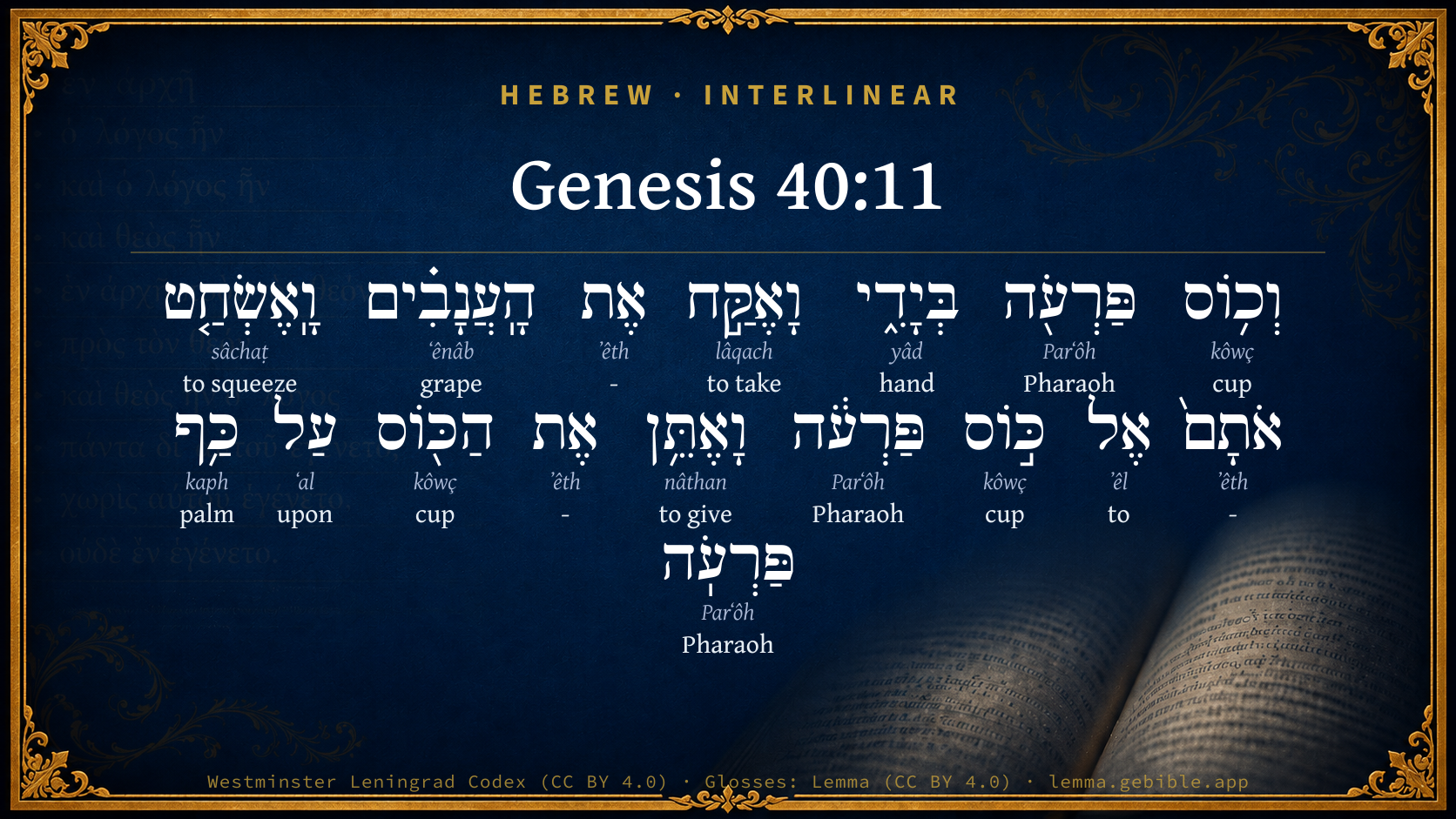
Hebrew (Westminster Leningrad Codex) Genesis 40:11 appears in the Hebrew Old Testament. The text above is from the Westminster Leningrad Codex. Each word links to its Strong’s number, a concise gloss, and parsing drawn from the Open Scriptures Hebrew Bible morphology. Click any word for its full Brown-Driver-Briggs (BDB) entry.
Download image
Cite this verse

Genesis 40:11 (World English Bible). Public Domain. Lemma interlinear Bible study tool, https://lemma.gebible.app/v/genesis/40/11.

Show BibTeX & RIS
BibTeX
RIS
English Translation
Pharaoh's cup was in my hand; and I took the grapes, and pressed them into Pharaoh's cup, and I gave the cup into Pharaoh's hand."
World English Bible · Public Domain
Highlights
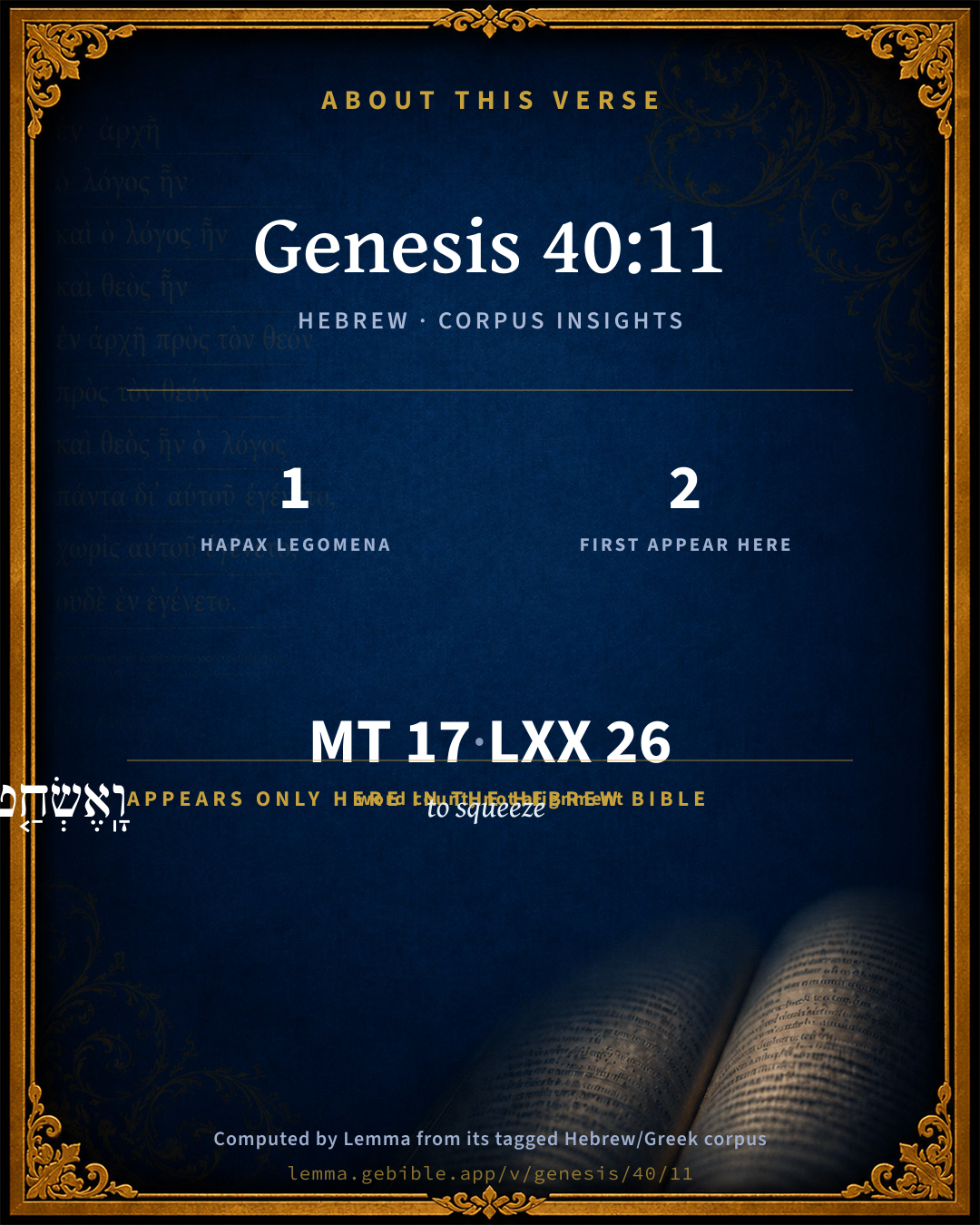
  • 1 hapax legomenon — only here in the Hebrew Bible
  • 2 first appearances in the Hebrew Bible
Full analysis ↓
Download a study sheet

One document with this verse’s original text, its word-by-word gloss line, the meaning frame, cross-references with their text, attributed commentary, and full source and license credits — printable, and it pastes into notes with its structure intact.

This verse Autodidact and up

Study sheet (.html) Plain text (.txt)

A passage Seminary Student

Up to 50 verses in one chapter. A passage sheet keeps up to 6 commentary sources and 12 cross-references per verse, in the order this page ranks them, and says so on the sheet whenever that leaves anything out. Ask for a single verse and you get the Autodidact verse sheet above.

Everything on this page stays free to read, with no account — the sheet is a download of what is already on screen, not access to it.

Want to remove ads? Support Godless Engineer
Compare translations 3

The same verse in 3 English versions, stacked beneath the original-language interlinear above. Click any original word for its lexicon entry.

Each is an independent rendering of the whole verse — the interlinear is not word-aligned to these translations.

Highlighted words mark where these versions differ — a whole-verse word diff, not a word-by-word alignment.

  • World English Bible Public Domain
    Pharaoh's cup was in my hand; and I took the grapes, and pressed them into Pharaoh's cup, and I gave the cup into Pharaoh's hand."
  • King James Version Public Domain
    And Pharaoh's cup was in my hand: and I took the grapes, and pressed them into Pharaoh's cup, and I gave the cup into Pharaoh's hand.
  • unfoldingWord Literal Text CC BY-SA 4.0
    Then the cup of Pharaoh in my hand and I took the grapes and squeezed them into the cup of Pharaoh. Then I put the cup into the hand of Pharaoh.”

unfoldingWord Literal Text — © unfoldingWord, licensed CC BY-SA 4.0. Word-aligned USFM3 via Door43 (git.door43.org/unfoldingWord/en_ult).

Versions to compare (up to 4)

3 of 4 selected

Show all 18 translations

Every available English version of this verse, each an independent rendering of the whole verse.

  • World English Bible Public Domain
    Pharaoh's cup was in my hand; and I took the grapes, and pressed them into Pharaoh's cup, and I gave the cup into Pharaoh's hand."
  • Berean Standard Bible Public Domain
    Pharaoh’s cup was in my hand, and I took the grapes, squeezed them into his cup, and placed the cup in his hand.”
  • Majority Standard Bible Public Domain
    Pharaoh’s cup was in my hand, and I took the grapes, squeezed them into his cup, and placed the cup in his hand.”
  • King James Version Public Domain
    And Pharaoh's cup was in my hand: and I took the grapes, and pressed them into Pharaoh's cup, and I gave the cup into Pharaoh's hand.
  • American Standard Version (1901) Public Domain
    and Pharaoh's cup was in my hand; and I took the grapes, and pressed them into Pharaoh's cup, and I gave the cup into Pharaoh's hand.
  • Revised Version (1885) Public Domain
    and Pharaoh’s cup was in my hand; and I took the grapes, and pressed them into Pharaoh’s cup, and I gave the cup into Pharaoh’s hand.
  • Geneva Bible (1599) Public Domain
    And I had Pharaohs cup in mine hande, and I tooke the grapes, and wrung the into Pharaohs cup, and I gaue the cup into Pharaohs hand.
  • Douay-Rheims (1899) Public Domain
    And the cup of Pharao was in my hand: and I took the grapes, and pressed them into the cup which I held, and I gave the cup to Pharao.
  • Young's Literal Translation Public Domain
    and Pharaoh's cup `is' in my hand, and I take the grapes and press them into the cup of Pharaoh, and I give the cup into the hand of Pharaoh.'
  • Literal Standard Version CC BY-SA 4.0
    and Pharaoh’s cup [is] in my hand, and I take the grapes and press them into the cup of Pharaoh, and I give the cup into the hand of Pharaoh.”
  • Unlocked Literal Bible CC BY-SA 4.0
    Pharaoh's cup was in my hand. I took the grapes and squeezed them into Pharaoh's cup, and I placed the cup into Pharaoh's hand.”
  • unfoldingWord Literal Text CC BY-SA 4.0
    Then the cup of Pharaoh in my hand and I took the grapes and squeezed them into the cup of Pharaoh. Then I put the cup into the hand of Pharaoh.”
  • Darby Bible Public Domain
    And Pharaoh's cup was in my hand; and I took the grapes, and pressed them into Pharaoh's cup, and gave the cup into Pharaoh's hand.
  • World Messianic Bible Public Domain
    Pharaoh’s cup was in my hand; and I took the grapes, and pressed them into Pharaoh’s cup, and I gave the cup into Pharaoh’s hand.”
  • Webster's Bible Public Domain
    And Pharaoh's cup was in my hand: and I took the grapes, and pressed them into Pharaoh's cup, and I gave the cup into Pharaoh's hand.
  • Free Bible Version CC BY-SA 4.0
    I was holding Pharaoh's wine cup, so I picked the grapes and squeezed them into the cup and gave it to Pharaoh.”
  • Bible in Basic English Public Domain
    And Pharaoh's cup was in my hand, and I took the grapes and crushing them into Pharaoh's cup, gave the cup into Pharaoh's hand.
  • JPS Tanakh (1917) Public Domain
    and Pharaoh's cup was in my hand; and I took the grapes, and pressed them into Pharaoh's cup, and I gave the cup into Pharaoh's hand.'

Literal Standard Version (2020), Covenant Press — licensed CC BY-SA 4.0. Text via the HelloAO Bible API (eBible.org). Unlocked Literal Bible (unfoldingWord) — licensed CC BY-SA 4.0. Text via the HelloAO Bible API (eBible.org). unfoldingWord Literal Text — © unfoldingWord, licensed CC BY-SA 4.0. Word-aligned USFM3 via Door43 (git.door43.org/unfoldingWord/en_ult). Free Bible Version, Dr. Jonathan Gallagher — licensed CC BY-SA 4.0. Text via the HelloAO Bible API (eBible.org).

Word by word

More ways to search: Search by grammar → Find every occurrence → Compare this word →

Practice this passage: Drill this verse → Learn its vocabulary →

וָֽאֶשְׂחַ֤ט
sâchaṭ
H7818
“and · to squeeze”
Conjunction + Verb, Qal, Sequential Imperfect, 1st Person, Common, Singular
Part of Speech
Conjunction + Verb
Stem
Qal
Form
Sequential Imperfect
Person
1st Person
Gender
Common
Number
Singular
Full BDB Definition

Origin: a primitive root

TWOT: 2248

(Qal) to squeeze, press out
  1. וְכ֥וֹס kôwç H3563 “and · cup of” Conjunction + Noun, Common, Feminine, Singular, Construct
  2. פַּרְעֹ֖ה Parʻôh H6547 “Pharaoh” Noun, Proper
  3. בְּיָדִ֑י yâd H3027 “in/at · hand · my” Preposition + Noun, Common, Both, Singular, Construct + Suffix, Personal, 1st Person, Common, Singular
  4. וָאֶקַּ֣ח lâqach H3947 “and · to take” Conjunction + Verb, Qal, Sequential Imperfect, 1st Person, Common, Singular
  5. אֶת ʼêth H853 “-” Particle, Direct Object
  6. הָֽעֲנָבִ֗ים ʻênâb H6025 “the · grapes” Particle, Definite Article + Noun, Common, Masculine, Plural, Absolute
  7. אֹתָם֙ ʼêth H853 “- · them” Particle, Direct Object + Suffix, Personal, 3rd Person, Masculine, Plural
  8. אֶל ʼêl H413 “to” Preposition
  9. כּ֣וֹס kôwç H3563 “cup of” Noun, Common, Feminine, Singular, Construct
  10. פַּרְעֹ֔ה Parʻôh H6547 “Pharaoh” Noun, Proper
  11. וָאֶתֵּ֥ן nâthan H5414 “and · to give” Conjunction + Verb, Qal, Sequential Imperfect, 1st Person, Common, Singular
  12. אֶת ʼêth H853 “-” Particle, Direct Object
  13. הַכּ֖וֹס kôwç H3563 “the · cup” Particle, Definite Article + Noun, Common, Feminine, Singular, Absolute
  14. עַל ʻal H5921 “upon” Preposition
  15. כַּ֥ף kaph H3709 “palm of” Noun, Common, Feminine, Singular, Construct
  16. פַּרְעֹֽה Parʻôh H6547 “Pharaoh” Noun, Proper

About this verse

These counts appear in no published source. They are computed here, from the morphology-tagged text and Lemma’s own curated glosses. What Lemma adds →

17
words
11
distinct lemmas
Pentateuch
section

Notable vocabulary

1 hapax legomenon — a word that appears only here in the entire Hebrew Bible:

  • וָֽאֶשְׂחַ֤ט to squeeze H7818

First appearance in Scripture

These words make their first canonical appearance in the Hebrew Bible here:

  • וְכ֥וֹס cup H3563
  • וָֽאֶשְׂחַ֤ט to squeeze H7818

Shared distinctive vocabulary

הָֽעֲנָבִ֗ים grape H6025 occurs in 17 verses of the Hebrew Bible. Also found in:

Grammatical profile

  • 3 verbs
  • 9 nouns
  • 2 prepositions
  • 3 particles

Verb forms

  • וָאֶקַּ֣ח Qal · Sequential Imperfect
  • וָֽאֶשְׂחַ֤ט Qal · Sequential Imperfect
  • וָאֶתֵּ֥ן Qal · Sequential Imperfect

Repetition

Words recur within this verse — often emphatic in Hebrew:

  • וְכ֥וֹס cup H3563 ×3
  • פַּרְעֹ֖ה Pharaoh H6547 ×3

Hebrew & Septuagint length

In English translation the verse runs 25 words from the Hebrew and 29 from the Septuagint (LXX English) — closely comparable.

A rough comparison of the two English renderings, which tokenize alike — not a word-level alignment.

Word counts can differ between the Hebrew and the Greek without any difference in meaning — e.g. the Hebrew direct-object marker אֵת has no separate Greek word, and Greek often adds the article ὁ.

In the original languages it is 17 Hebrew tokens and 26 Greek tokens — but the two are counted differently (Hebrew bundles its prefixes and suffixes into one token; the Greek is in lemma form), so that isn’t a like-for-like length.

Cross-references

7

Topical passages linked to Genesis 40:11 in the Treasury of Scripture Knowledge — connected by theme and wording, ordered by reader-vote popularity; previews shown in the World English Bible.

  • Nehemiah 1:11–2:1 Lord, I beg you, let now your ear be attentive to the prayer of your servant, and to the prayer of your servants, who delight to fear your name; and please prosper your servant this day, and grant him mercy in the sight of this man. Now I was cup bearer to the king.
  • 1 Kings 10:5 and the food of his table, and the sitting of his servants, and the attendance of his ministers, and their clothing, and his cup bearers, and his ascent by which he went up to the house of Yahweh; there was no more spirit in her.
  • 2 Chronicles 9:4 and the food of his table, and the sitting of his servants, and the attendance of his ministers, and their clothing, his cup bearers also, and their clothing, and his ascent by which he went up to the house of Yahweh; there was no more spirit in her.
  • Genesis 40:21 He restored the chief cupbearer to his position again, and he gave the cup into Pharaoh's hand;
  • Genesis 49:11 Binding his foal to the vine, His donkey's colt to the choice vine; He has washed his garments in wine, His robes in the blood of grapes:
  • Leviticus 10:9 "Drink no wine nor strong drink, you, nor your sons with you, when you go into the Tent of Meeting, that you don't die: it shall be a statute forever throughout your generations:
  • Proverbs 3:10 So your barns will be filled with plenty, And your vats will overflow with new wine.

Cross-references courtesy of OpenBible.info (CC BY 4.0).

Hebrew and Greek witnesses Masoretic Hebrew ↔ Greek Septuagint

The same verse in the two great witnesses to the Old Testament, shown verse-for-verse.

These are two independent witnesses, not word-aligned to each other, and the Septuagint is shown in lemma (dictionary) form.

Hebrew Genesis 40:11 Masoretic · Westminster Leningrad Codex

וְכ֥וֹס פַּרְעֹ֖ה בְּיָדִ֑י וָאֶקַּ֣ח אֶת הָֽעֲנָבִ֗ים וָֽאֶשְׂחַ֤ט אֹתָם֙ אֶל כּ֣וֹס פַּרְעֹ֔ה וָאֶתֵּ֥ן אֶת הַכּ֖וֹס עַל כַּ֥ף פַּרְעֹֽה

Pharaoh's cup was in my hand; and I took the grapes, and pressed them into Pharaoh's cup, and I gave the cup into Pharaoh's hand."

World English Bible · Public Domain

Greek LXX Genesis 40:11 Septuagint · lemma form

καί ὁ ποτήριον φαραώ ἐν ὁ χείρ ἐγώ καί λαμβάνω ὁ σταφυλή καί ἐκθλίβω αὐτός εἰς ὁ ποτήριον καί δίδωμι ὁ ποτήριον εἰς ὁ χείρ φαραώ

And the cup of Pharao was in my hand; and I took the bunch of grapes, and squeezed it into the cup, and gave the cup into Pharao's hand.

LXX2012 (modern English Septuagint) · Public Domain

Hebrew: Westminster Leningrad Codex (CC BY 4.0). Greek: Septuagint (public domain); English from LXX2012 (modern English Septuagint) (Public Domain). How the Septuagint differs from the Hebrew →

Targum (Aramaic paraphrase)

2

The Targum is the ancient Jewish Aramaic paraphrase of the Hebrew Scriptures — an interpretive translation, not the Hebrew text itself. Onkelos (literal) and Pseudo-Jonathan (expansive) render the Torah, and Jonathan the Prophets. Coverage is partial: where no permissively-licensed English translation exists for a verse, only the Aramaic is shown. This is verse-level text, not a word-by-word alignment to the Hebrew.

  1. Targum Onkelos Torah (Genesis–Deuteronomy)
    וְכַסָּא דְפַרְעֹה בִּידִי וּנְסִיבַת יָת עִנְּבַיָּא וְעַצָרִית יָתְהוֹן לְכַסָּא דְפַרְעֹה וִיהָבִית יָת כַּסָּא עַל יְדָא דְפַרְעֹה

    (no public-domain English translation for this verse)

    Targum Onkelos — Aramaic: “Onkelos Genesis” (public domain); “Onkelos Exodus” (public domain); “Onkelos Leviticus” (public domain); “Onkelos Numbers” (public domain); “Onkelos Deuteronomy” (public domain). English: “Sefaria Community Translation” (CC0 1.0 (public-domain dedication)); “J.W. Etheridge. The Targums of Onkelos and Jonathan Ben Uzziel on the Pentateuch. London: Longmans, Green, 1862” (public domain). Text via Sefaria.

  2. Targum Pseudo-Jonathan Torah (Genesis–Deuteronomy)
    חָמֵי הֲוֵית עַד דְיַהֲבִין כַּסָא דְפַרְעה בִּידִי וּנְסֵיבִית יַת עִנְבַיָיא וְעַצְרִית יַתְהוֹן לְכַסָא דְפַרְעה וִיהָבִית יַת כַּסָא עַל יְדָא דְפַרְעה

    And I gave the cup of Pharoh into my hand, and I took the grapes, and expressed them into Pharoh's cup, and gave the cup into Pharoh's hand.

    Targum Pseudo-Jonathan — Aramaic: “Targum Jonathan on Genesis” (public domain); “Targum Jonathan on Exodus” (public domain); “Targum Jonathan on Leviticus” (public domain); “Targum Jonathan on Numbers” (public domain); “Targum Jonathan on Deuteronomy” (public domain). English: “The Targum of Jonathan ben Uzziel, trans. J. W. Etheridge, London, 1862” (public domain). Text via Sefaria.

Commentary

Notes on Genesis 40:11 from classic Christian and Jewish commentators (each source and its license shown beneath its notes). The classic Christian expositions comment on the surrounding passage and are grouped to its opening verse, so a note may address several verses; the Jewish commentaries on the Tanakh (Rashi and others) are per-verse, so they appear only where the commentator wrote on this verse.

Lemma curates 59 commentaries, every one of them public domain or Creative Commons licensed, each selected and text-cleaned for this edition rather than reprinted as found. About our sources →

Trapp's Complete Commentary

John Trapp

Gen 40:11 And Pharaoh’s cup [was] in my hand: and I took the grapes, and pressed them into Pharaoh’s cup, and I gave the cup into Pharaoh’s hand.

Ver. 11. And pressed them into Pharaoh’s cup.] That he might have his wine fresh and new.

“Dulcius ex ipso fonte bibuntur aquae.”

John Trapp, A Commentary or Exposition upon All the Books of the Old and New Testament (1647–1656) — public domain. Text from a community e-Sword module.

Adam Clarke's Commentary

Verse 11. And I took the grapes and pressed them into Pharaoh's cup] From this we find that wine anciently was the mere expressed juice of the grape, without fermentation. The saky, or cup-bearer, took the bunch, pressed the juice into the cup, and instantly delivered it into the hands of his master. This was anciently the יין yain of the Hebrews, the οινος of the Greeks, and the mustum of the ancient Latins.

Adam Clarke's Commentary on the Bible (1810–1826) — public domain. Text from a community e-Sword/MySword module.

Ellicott's Commentary for English Readers

(11) And pressed them.—Plutarch, Is. et Osir. § 6, says that before the time of Psammetichus the Egyptians did not drink wine, nor make libations of it to the gods. This statement has been abundantly disproved, and probably arose from the writer supposing that the custom of, possibly, one district was the universal rule. Nevertheless, the king’s drink here does not seem to have been fermented wine, but a sort of sherbet made of fresh grape-juice and water. It is a pleasant beverage, still much used in the East, but sometimes the grape juice is left till fermentation has just begun when it acquires a pleasant briskness, and is less cloying.

Into Pharaoh’s hand.—Heb., I placed the cup upon Pharaoh’s palm. The word is used in Gen_32:25 of the hollow of Jacob’s thigh (see Note there). Here it means the hollow produced by bending the fingers inwards. Now the Hebrews always spoke of placing the cup in a person’s hand (Eze_23:31, and see Psa_75:8; Jer_51:7); and even here Joseph, though probably speaking the Egyptian language, nevertheless used the Hebrew idiom, saying, thou wilt give Pharaoh’s cup into his hand. It is the Egyptian cup-bearer, who, using the idiom of his own country, speaks of placing the cup upon Pharaoh’s palm, the reason being that Egyptian cups had no stems, but were flat bowls or saucers, held in the very way which the cup-bearer describes.

A Bible Commentary for English Readers, edited by Charles John Ellicott (1878–1897) — public domain. Text from a community e-Sword module.

The Cambridge Bible for Schools and Colleges

gen. ed. J. J. S. Perowne

11. pressed them into Pharaoh’s cup] The cupbearer did not squeeze grapes into his master’s cup in order to make wine. He squeezed, and at once the cup was full of wine. This is one of the fancies occurring in a dream. Dream-land is true to experience, and yet possesses, here and there, odd fantastic features. It is a feature in this dream that all the difficulties are successfully overcome; the chief butler, at the end of it, holds Pharaoh’s cup.

The Cambridge Bible for Schools and Colleges (gen. ed. J. J. S. Perowne; Cambridge University Press, 1878–1918) — public domain. Text from a community e-Sword module.

John Gill's Exposition

And Pharaoh's cup was in his hand,.... So it seemed to him in his dream, as it often had been when in his office:

and I took the grapes; from off the vine that was before him:

and pressed them into Pharaoh's cup; which some think was the custom of those times, to take a bunch of grapes and squeeze them into a cup, especially when they would make trial of what sort of wine they would produce; for it can hardly be thought that this was usually done, or that it was customary to drink such new wine; but it is more probable that the grapes were first pressed into another vessel, and so made wine of, and then poured into Pharaoh's cup, or mixed in it, though this circumstance is omitted. Indeed Herodotus (a) relates of the Egyptian priests, that wine pressed out of the vine is given them:

and I gave the cup into Pharaoh's hand; as he had used to do.

(a) Euterpe sive, l. 2. c. 37.

John Gill's Exposition of the Whole Bible (1746–1763) — public domain (CC PDM 1.0). Text via the HelloAO Bible API.

Rashi

Rabbi Shlomo Yitzchaki (Rashi)

ואשחט translate it as the Targum AND I PRESSED — The word occurs frequently in the Mishna (but only here in the Bible).

Rashi on the Tanakh — English translations: “The Judaica Press complete Tanach with Rashi, translated by A. J. Rosenberg” (CC BY 4.0); “Pentateuch with Rashi's commentary by M. Rosenbaum and A.M. Silbermann, 1929-1934” (public domain); “The Metsudah Tanach series, Lakewood, N.J” (CC BY 4.0); and “The Book of Joshua, Metsudah Publications, 1997” (CC BY 4.0). Text via Sefaria.

Radak

Rabbi David Kimhi (Radak)

וכוס...ואשחט, the word שחט signals closing something off. It occurs also in this sense in Shabbat 143 אין שוחטים את הפירות, that it is forbidden to squeeze the juice out of fruit on the Sabbath.

אל כוס, not “to the cup,” but “into the cup,” as for instance in Exodus 25,21 where the words ואל הארון תתן do not mean “you are to give it to the Ark,” but “you are to place it inside the Ark.”

Radak on the Tanakh — English translations: “Sefaria Community Translation” (CC0 1.0 (public-domain dedication)); “Eliyahu Munk, HaChut Hameshulash” (CC BY 4.0); “Rabbi Mike Feuer, Jerusalem Anthology” (CC BY 4.0); and “R. David Kimhi on the first book of Psalms, Translated by R.G. Finch, London, 1919” (public domain). Text via Sefaria.

Lesson kit

Teaching starters — assembled from the data on this page, not authored interpretation. Every prompt links to the verse data it draws on. Edit before teaching.

Genesis, in the Pentateuch, opens this verse with 17 words (11 distinct Hebrew lemmas). Its most distinctive word is sâchaṭ (“to squeeze”). A historical commentator’s framing appears above. Read the whole chapter for the surrounding context.

Discussion questions

  1. How does “to squeeze” (sâchaṭ) shape what this verse is saying?
  2. This verse holds 1 word here found nowhere else in the Hebrew Bible. What might the rare word draw attention to?
  3. 2 words here appear for the first time in Scripture. What is being introduced at this debut?
  4. Genesis 40:10 shares the word «grape» with this verse. How do the two illuminate each other?
  5. “cup” occurs 3× in this one verse. What is the effect of the repetition?
  6. These translations render this verse differently; the difference is in the English rendering, not the original. What questions does that raise?
  7. The verb «וָאֶקַּ֣ח» is Qal Sequential Imperfect. How does its form color the action?
  8. Reading how Trapp's Complete Commentary and Adam Clarke's Commentary read this verse, where do the two commentators agree and where do they part?

Things to notice

  • 1 word in this verse appears nowhere else in the Hebrew Bible.
  • 2 words make their first canonical appearance in Scripture here.
  • This verse counts 17 Hebrew ↔ 26 Greek words.
  • These translations choose different wording for 6 words in this verse.
  • “cup” occurs 3× in this single verse.

Reading settings

Reading text

Shown beneath each verse's original-language words.

Old Testament
Old Testament edition

Read the OT as the Masoretic Hebrew (MT) or the Greek Septuagint (LXX).

English shown for the Greek Septuagint (in the Hebrew ↔ Greek comparison).

Comparing translations? Open the Compare panel on any verse page to stack up to four side by side.