
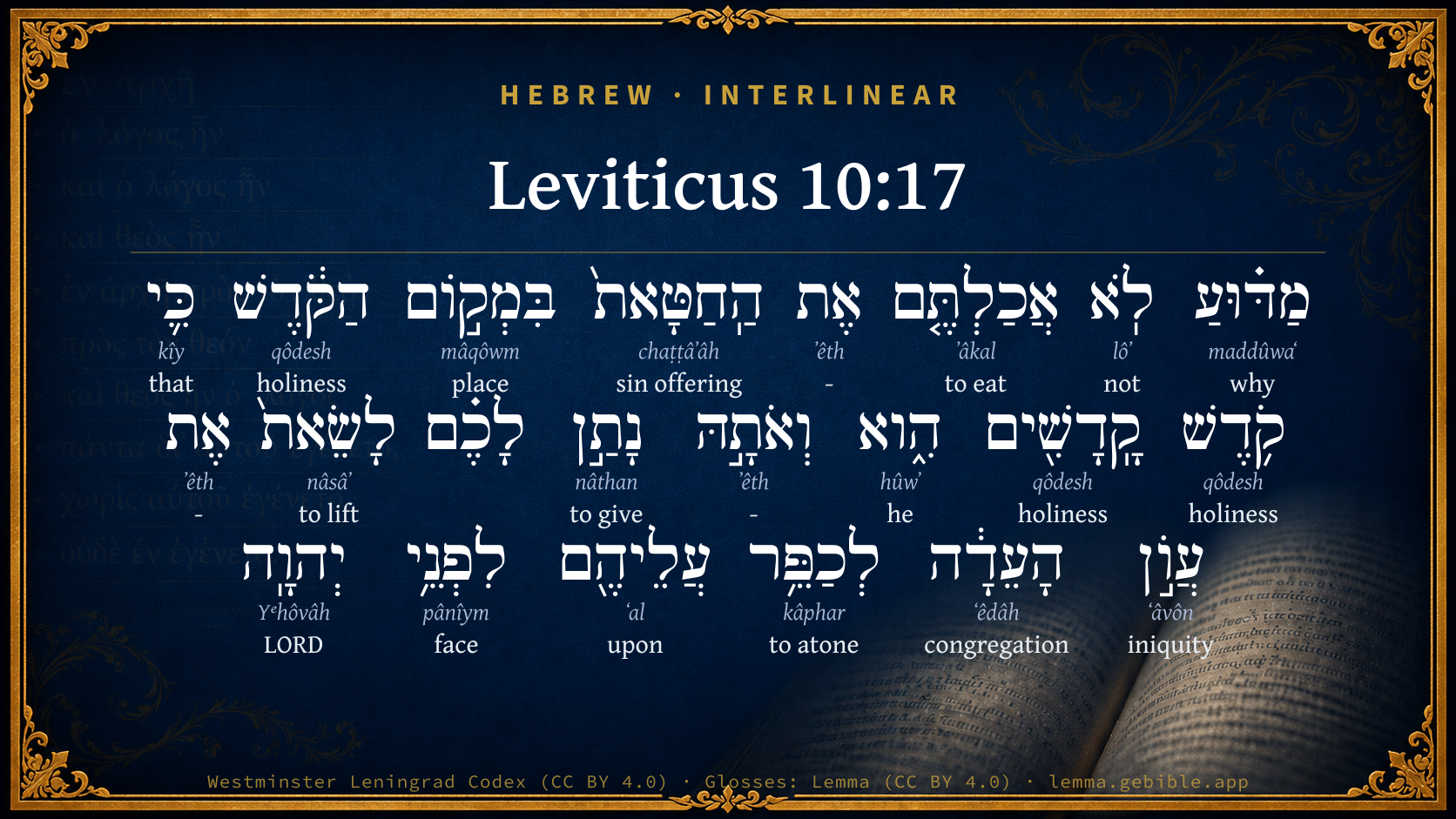
Leviticus 10:17

Hebrew (Westminster Leningrad Codex) Leviticus 10:17 appears in the Hebrew Old Testament. The text above is from the Westminster Leningrad Codex. Each word links to its Strong’s number, a concise gloss, and parsing drawn from the Open Scriptures Hebrew Bible morphology. Click any word for its full Brown-Driver-Briggs (BDB) entry.
Download image
Cite this verse

Leviticus 10:17 (World English Bible). Public Domain. Lemma interlinear Bible study tool, https://lemma.gebible.app/v/leviticus/10/17.

Show BibTeX & RIS
BibTeX
RIS
English Translation
"Why haven't you eaten the sin offering in the place of the sanctuary, seeing it is most holy, and he has given it you to bear the iniquity of the congregation, to make atonement for them before Yahweh?
World English Bible · Public Domain
Download a study sheet

One document with this verse’s original text, its word-by-word gloss line, the meaning frame, cross-references with their text, attributed commentary, and full source and license credits — printable, and it pastes into notes with its structure intact.

This verse Autodidact and up

Study sheet (.html) Plain text (.txt)

A passage Seminary Student

Up to 50 verses in one chapter. A passage sheet keeps up to 6 commentary sources and 12 cross-references per verse, in the order this page ranks them, and says so on the sheet whenever that leaves anything out. Ask for a single verse and you get the Autodidact verse sheet above.

Everything on this page stays free to read, with no account — the sheet is a download of what is already on screen, not access to it.

Want to remove ads? Support Godless Engineer
Compare translations 3

The same verse in 3 English versions, stacked beneath the original-language interlinear above. Click any original word for its lexicon entry.

Each is an independent rendering of the whole verse — the interlinear is not word-aligned to these translations.

Highlighted words mark where these versions differ — a whole-verse word diff, not a word-by-word alignment.

  • World English Bible Public Domain
    "Why haven't you eaten the sin offering in the place of the sanctuary, seeing it is most holy, and he has given it you to bear the iniquity of the congregation, to make atonement for them before Yahweh?
  • King James Version Public Domain
    Wherefore have ye not eaten the sin offering in the holy place, seeing it is most holy, and God hath given it you to bear the iniquity of the congregation, to make atonement for them before the LORD?
  • unfoldingWord Literal Text CC BY-SA 4.0
    “Why have you not eaten the sin offering in the Holy Place, for it is a holy thing of holy things? And he gave it to you to bear the iniquity of the congregation, to make atonement for them to the face of Yahweh.

unfoldingWord Literal Text — © unfoldingWord, licensed CC BY-SA 4.0. Word-aligned USFM3 via Door43 (git.door43.org/unfoldingWord/en_ult).

Versions to compare (up to 4)

3 of 4 selected

Show all 18 translations

Every available English version of this verse, each an independent rendering of the whole verse.

  • World English Bible Public Domain
    "Why haven't you eaten the sin offering in the place of the sanctuary, seeing it is most holy, and he has given it you to bear the iniquity of the congregation, to make atonement for them before Yahweh?
  • Berean Standard Bible Public Domain
    “Why didn’t you eat the sin offering in the holy place? For it is most holy; it was given to you to take away the guilt of the congregation by making atonement for them before the LORD.
  • Majority Standard Bible Public Domain
    “Why didn’t you eat the sin offering in the holy place? For it is most holy; it was given to you to take away the guilt of the congregation by making atonement for them before the LORD.
  • King James Version Public Domain
    Wherefore have ye not eaten the sin offering in the holy place, seeing it is most holy, and God hath given it you to bear the iniquity of the congregation, to make atonement for them before the LORD?
  • American Standard Version (1901) Public Domain
    Wherefore have ye not eaten the sin-offering in the place of the sanctuary, seeing it is most holy, and he hath given it you to bear the iniquity of the congregation, to make atonement for them before Jehovah?
  • Revised Version (1885) Public Domain
    Wherefore have ye not eaten the sin offering in the place of the sanctuary, seeing it is most holy, and he hath given it you to bear the iniquity of the congregation, to make atonement for them before the LORD?
  • Geneva Bible (1599) Public Domain
    Wherfore haue ye not eaten the sinne offring in the holy place, seeing it is most Holie? and God hath giuen it you, to beare the iniquitie of the Congregation, to make an atonement for them before the Lord.
  • Douay-Rheims (1899) Public Domain
    Why did you not eat in the holy place the sacrifice for sin, which is most holy, and given to you, that you may bear the iniquity of the people, and may pray for them in the sight of the Lord,
  • Young's Literal Translation Public Domain
    `Wherefore have ye not eaten the sin-offering in the holy place, for it `is' most holy -- and it He hath given to you to take away the iniquity of the company, to make atonement for them before Jehovah?
  • Literal Standard Version CC BY-SA 4.0
    “Why have you not eaten the sin-offering in the holy place, for it [is] most holy—and He has given it to you to take away the iniquity of the congregation, to make atonement for them before YHWH?
  • Unlocked Literal Bible CC BY-SA 4.0
    “Why have you not eaten the sin offering in the area of the tabernacle, since it is most holy, and since Yahweh has given it to you to take away the iniquity of the assembly, to make atonement for them before him?
  • unfoldingWord Literal Text CC BY-SA 4.0
    “Why have you not eaten the sin offering in the Holy Place, for it is a holy thing of holy things? And he gave it to you to bear the iniquity of the congregation, to make atonement for them to the face of Yahweh.
  • Darby Bible Public Domain
    Why have ye not eaten the sin-offering in a holy place? for it is most holy, and he has given it to you that ye might bear the iniquity of the assembly, to make atonement for them before Jehovah.
  • World Messianic Bible Public Domain
    “Why haven’t you eaten the sin offering in the place of the sanctuary, since it is most holy, and he has given it to you to bear the iniquity of the congregation, to make atonement for them before the LORD?
  • Webster's Bible Public Domain
    Why have ye not eaten the sin-offering in the holy place, seeing it is most holy, and God hath given it you to bear the iniquity of the congregation, to make atonement for them before the LORD?
  • Free Bible Version CC BY-SA 4.0
    “Why didn't you take the sin offering and eat it in the holy place, because it is most holy and it was given to you to take away the people's guilt by making them right before the Lord.
  • Bible in Basic English Public Domain
    Why did you not make a meal of the sin-offering in the holy place? For it is most holy and he has given it to you, so that the sin of the people may be put on it, to take away their sin before the Lord.
  • JPS Tanakh (1917) Public Domain
    'Wherefore have ye not eaten the sin-offering in the place of the sanctuary, seeing it is most holy, and He hath given it you to bear the iniquity of the congregation, to make atonement for them before the LORD?

Literal Standard Version (2020), Covenant Press — licensed CC BY-SA 4.0. Text via the HelloAO Bible API (eBible.org). Unlocked Literal Bible (unfoldingWord) — licensed CC BY-SA 4.0. Text via the HelloAO Bible API (eBible.org). unfoldingWord Literal Text — © unfoldingWord, licensed CC BY-SA 4.0. Word-aligned USFM3 via Door43 (git.door43.org/unfoldingWord/en_ult). Free Bible Version, Dr. Jonathan Gallagher — licensed CC BY-SA 4.0. Text via the HelloAO Bible API (eBible.org).

Word by word

More ways to search: Search by grammar → Find every occurrence → Compare this word →

Practice this passage: Drill this verse → Learn its vocabulary →

מַדּ֗וּעַ
maddûwaʻ
H4069
“why”
Particle, Interrogative
Part of Speech
Particle
Type
Interrogative
Full BDB Definition

Origin: from H4100 and the pass. participle of H3045

TWOT: 848h

why?, on what account?, wherefore?
  1. לֹֽא lôʼ H3808 “not” Particle, Negative
  2. אֲכַלְתֶּ֤ם ʼâkal H398 “to eat” Verb, Qal, Perfect, 2nd Person, Masculine, Plural
  3. אֶת ʼêth H853 “-” Particle, Direct Object
  4. הַֽחַטָּאת֙ chaṭṭâʼâh H2403 “the · sin offering” Particle, Definite Article + Noun, Common, Feminine, Singular, Absolute
  5. בִּמְק֣וֹם mâqôwm H4725 “in/at · place of” Preposition + Noun, Common, Masculine, Singular, Construct
  6. הַקֹּ֔דֶשׁ qôdesh H6944 “the · holiness” Particle, Definite Article + Noun, Common, Masculine, Singular, Absolute
  7. כִּ֛י kîy H3588 “that” Conjunction
  8. קֹ֥דֶשׁ qôdesh H6944 “holiness of” Noun, Common, Masculine, Singular, Construct
  9. קָֽדָשִׁ֖ים qôdesh H6944 “holy things” Noun, Common, Masculine, Plural, Absolute
  10. הִ֑וא hûwʼ H1931 “he” Pronoun, Personal, 3rd Person, Feminine, Singular
  11. וְאֹתָ֣הּ ʼêth H853 “and · - · her” Conjunction + Particle, Direct Object + Suffix, Personal, 3rd Person, Feminine, Singular
  12. נָתַ֣ן nâthan H5414 “to give” Verb, Qal, Perfect, 3rd Person, Masculine, Singular
  13. לָשֵׂאת֙ nâsâʼ H5375 “to lift” Preposition + Verb, Qal, Infinitive Construct
  14. אֶת ʼêth H853 “-” Particle, Direct Object
  15. עֲוֺ֣ן ʻâvôn H5771 “iniquity of” Noun, Common, Both, Singular, Construct
  16. הָעֵדָ֔ה ʻêdâh H5712 “the · congregation” Particle, Definite Article + Noun, Common, Feminine, Singular, Absolute
  17. לְכַפֵּ֥ר kâphar H3722 “to atone” Preposition + Verb, Piel, Infinitive Construct
  18. עֲלֵיהֶ֖ם ʻal H5921 “upon · them” Preposition + Suffix, Personal, 3rd Person, Masculine, Plural
  19. לִפְנֵ֥י pânîym H6440 “to/for · face(s) of” Preposition + Noun, Common, Both, Plural, Construct
  20. יְהוָֽה Yᵉhôvâh H3068 “LORD” Noun, Proper

About this verse

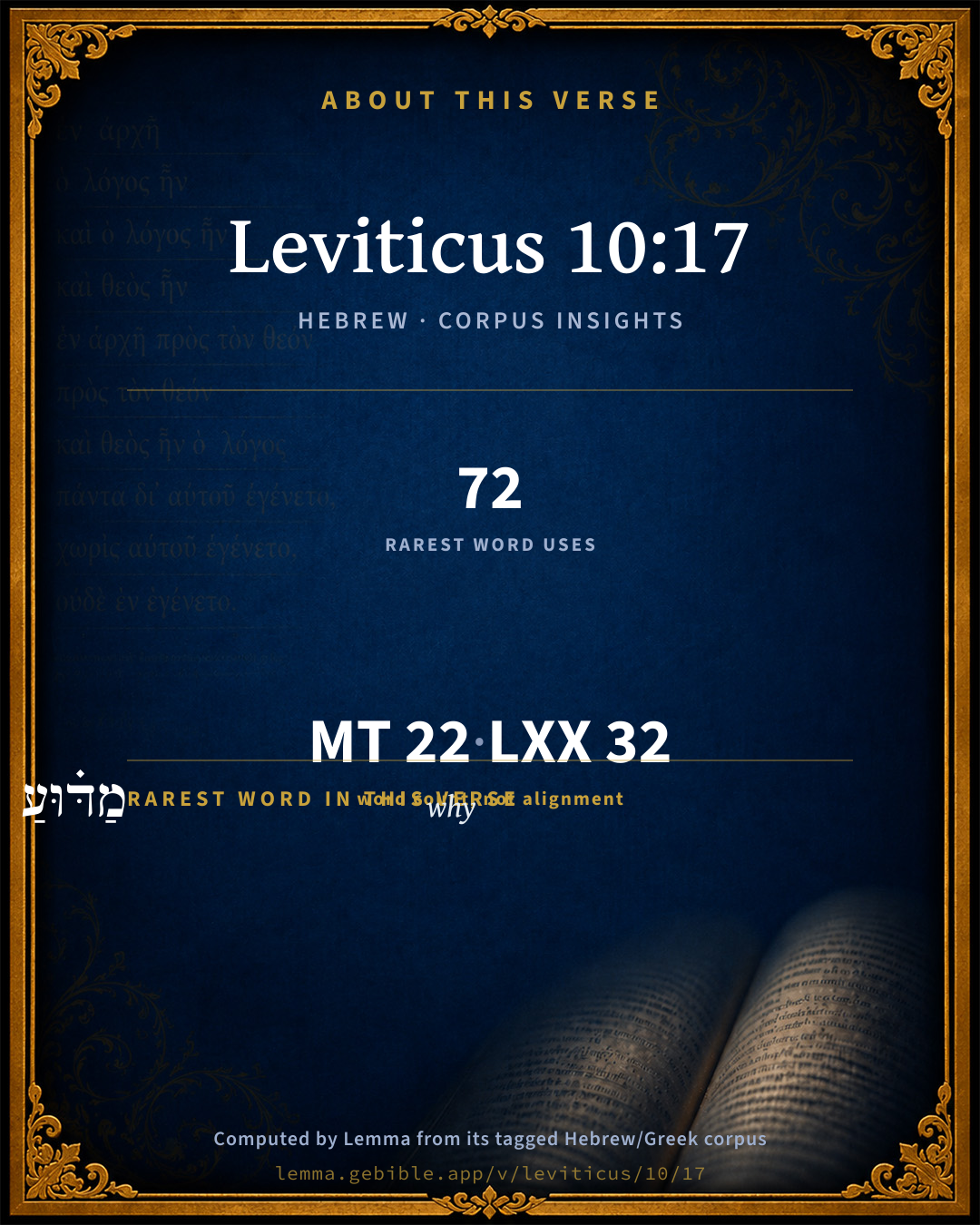
These counts appear in no published source. They are computed here, from the morphology-tagged text and Lemma’s own curated glosses. What Lemma adds →

22
words
17
distinct lemmas
Pentateuch
section

Grammatical profile

  • 4 verbs
  • 9 nouns
  • 1 pronoun
  • 2 prepositions
  • 1 conjunction
  • 5 particles

Verb forms

  • אֲכַלְתֶּ֤ם Qal · Perfect
  • נָתַ֣ן Qal · Perfect
  • לָשֵׂאת֙ Qal · Infinitive Construct
  • לְכַפֵּ֥ר Piel · Infinitive Construct

Repetition

A word recurs within this verse — often emphatic in Hebrew:

  • הַקֹּ֔דֶשׁ holiness H6944 ×3

Hebrew & Septuagint length

In English translation the verse runs 38 words from the Hebrew and 42 from the Septuagint (LXX English) — closely comparable.

A rough comparison of the two English renderings, which tokenize alike — not a word-level alignment.

Word counts can differ between the Hebrew and the Greek without any difference in meaning — e.g. the Hebrew direct-object marker אֵת has no separate Greek word, and Greek often adds the article ὁ.

In the original languages it is 22 Hebrew tokens and 32 Greek tokens — but the two are counted differently (Hebrew bundles its prefixes and suffixes into one token; the Greek is in lemma form), so that isn’t a like-for-like length.

Cross-references

14

Topical passages linked to Leviticus 10:17 in the Treasury of Scripture Knowledge — connected by theme and wording, ordered by reader-vote popularity; previews shown in the World English Bible.

  • Exodus 28:38 It shall be on Aaron's forehead, and Aaron shall bear the iniquity of the holy things, which the children of Israel shall make holy in all their holy gifts; and it shall be always on his forehead, that they may be accepted before Yahweh.
  • Leviticus 6:24–30 Yahweh spoke to Moses, saying,
  • Leviticus 7:6–7 Every male among the priests may eat of it. It shall be eaten in a holy place. It is most holy.
  • Numbers 18:1 Yahweh said to Aaron, You and your sons and your fathers' house with you shall bear the iniquity of the sanctuary; and you and your sons with you shall bear the iniquity of your priesthood.
  • Exodus 28:43 They shall be on Aaron, and on his sons, when they go in to the tent of meeting, or when they come near to the altar to minister in the holy place; that they don't bear iniquity, and die: it shall be a statute forever to him and to his descendants after him.
  • Leviticus 16:22 The goat shall carry all their iniquities on himself to a solitary land, and he shall let the goat go in the wilderness.
  • Leviticus 22:16 and so cause them to bear the iniquity that brings guilt, when they eat their holy things: for I am Yahweh who sanctifies them.'"
  • Isaiah 53:6–11 All we like sheep have gone astray; everyone has turned to his own way; and Yahweh has laid on him the iniquity of us all.
  • Ezekiel 4:4–6 Moreover lie you on your left side, and lay the iniquity of the house of Israel on it; [according to] the number of the days that you shall lie on it, you shall bear their iniquity.
  • Ezekiel 18:19–20 Yet say you, Why does not the son bear the iniquity of the father? when the son has done that which is lawful and right, and has kept all my statutes, and has done them, he shall surely live.
  • John 1:29 The next day, he saw Jesus coming to him, and said, "Behold, the Lamb of God, who takes away the sin of the world!
  • 2 Corinthians 5:21 For him who knew no sin he made to be sin on our behalf; so that in him we might become the righteousness of God.
  • Hebrews 9:28 so Christ also, having been once offered to bear the sins of many, will appear a second time, without sin, to those who are eagerly waiting for him for salvation.
  • 1 Peter 2:24 who his own self bore our sins in his body on the tree, that we, having died to sins, might live to righteousness; by whose stripes you were healed.

Cross-references courtesy of OpenBible.info (CC BY 4.0).

Hebrew and Greek witnesses Masoretic Hebrew ↔ Greek Septuagint

The same verse in the two great witnesses to the Old Testament, shown verse-for-verse.

These are two independent witnesses, not word-aligned to each other, and the Septuagint is shown in lemma (dictionary) form.

Hebrew Leviticus 10:17 Masoretic · Westminster Leningrad Codex

מַדּ֗וּעַ לֹֽא אֲכַלְתֶּ֤ם אֶת הַֽחַטָּאת֙ בִּמְק֣וֹם הַקֹּ֔דֶשׁ כִּ֛י קֹ֥דֶשׁ קָֽדָשִׁ֖ים הִ֑וא וְאֹתָ֣הּ נָתַ֣ן לָכֶ֗ם לָשֵׂאת֙ אֶת עֲוֺ֣ן הָעֵדָ֔ה לְכַפֵּ֥ר עֲלֵיהֶ֖ם לִפְנֵ֥י יְהוָֽה

"Why haven't you eaten the sin offering in the place of the sanctuary, seeing it is most holy, and he has given it you to bear the iniquity of the congregation, to make atonement for them before Yahweh?

World English Bible · Public Domain

Greek LXX Leviticus 10:17 Septuagint · lemma form

διά τίς οὐ ἐσθίω ὁ περί ὁ ἁμαρτία ἐν τόπος ἅγιος ὅτι γάρ ἅγιος ἅγιος εἰμί οὗτος δίδωμι σύ ἐσθίω ἵνα ἀποαἱρέω ὁ ἁμαρτία ὁ συναγωγή καί ἐκἱλάσκομαι περί αὐτός ἔναντι κύριος

Why did you⌃ not eat the sin-offering in the holy place? for because it is most holy he has given you this to eat, that you⌃ might take away the sin of the congregation, and make atonement for them before the Lord.

LXX2012 (modern English Septuagint) · Public Domain

On this verse, Ellicott's Commentary for English Readers discusses the Septuagint’s reading. Read the note in Commentary ↓

Hebrew: Westminster Leningrad Codex (CC BY 4.0). Greek: Septuagint (public domain); English from LXX2012 (modern English Septuagint) (Public Domain). How the Septuagint differs from the Hebrew →

Targum (Aramaic paraphrase)

2

The Targum is the ancient Jewish Aramaic paraphrase of the Hebrew Scriptures — an interpretive translation, not the Hebrew text itself. Onkelos (literal) and Pseudo-Jonathan (expansive) render the Torah, and Jonathan the Prophets. Coverage is partial: where no permissively-licensed English translation exists for a verse, only the Aramaic is shown. This is verse-level text, not a word-by-word alignment to the Hebrew.

  1. Targum Onkelos Torah (Genesis–Deuteronomy)
    מָדֵין לָא אֲכַלְתּוּן יָת חַטָאתָא בַּאֲתַר קַדִישׁ אֲרֵי קֹדֶשׁ קוּדְשִׁין הִיא וְיָתַהּ יְהַב לְכוֹן לְסַלָחָא עַל חוֹבֵי כְנִשְׁתָּא לְכַפָּרָא עֲלֵיהוֹן קֳדָם יְיָ

    (no public-domain English translation for this verse)

    Targum Onkelos — Aramaic: “Onkelos Genesis” (public domain); “Onkelos Exodus” (public domain); “Onkelos Leviticus” (public domain); “Onkelos Numbers” (public domain); “Onkelos Deuteronomy” (public domain). English: “Sefaria Community Translation” (CC0 1.0 (public-domain dedication)); “J.W. Etheridge. The Targums of Onkelos and Jonathan Ben Uzziel on the Pentateuch. London: Longmans, Green, 1862” (public domain). Text via Sefaria.

  2. Targum Pseudo-Jonathan Torah (Genesis–Deuteronomy)
    מַדֵין לָא אֲכַלְתּוּן יַת חַטָאתָא בַּאֲתַר קַדִישׁ אֲרוּם קוֹדֶשׁ קוּדְשִׁין הוּא וְיָתָהּ יְהַב לְכוֹן לְמִשְׁרֵי עַל סִרְחָנוּת כְּנִישְׁתָּא לְכַפָּרָא עֲלֵיכוֹן קֳדָם יְיָ

    Why have you not eaten the sin offering in the holy place? forasmuch as it is most sacred, and hath been given to you for absolving the sin of the congregation, to make atonement for you before the Lord;

    Targum Pseudo-Jonathan — Aramaic: “Targum Jonathan on Genesis” (public domain); “Targum Jonathan on Exodus” (public domain); “Targum Jonathan on Leviticus” (public domain); “Targum Jonathan on Numbers” (public domain); “Targum Jonathan on Deuteronomy” (public domain). English: “The Targum of Jonathan ben Uzziel, trans. J. W. Etheridge, London, 1862” (public domain). Text via Sefaria.

Commentary

Notes on Leviticus 10:17 from classic Christian and Jewish commentators (each source and its license shown beneath its notes). The classic Christian expositions comment on the surrounding passage and are grouped to its opening verse, so a note may address several verses; the Jewish commentaries on the Tanakh (Rashi and others) are per-verse, so they appear only where the commentator wrote on this verse.

Lemma curates 59 commentaries, every one of them public domain or Creative Commons licensed, each selected and text-cleaned for this edition rather than reprinted as found. About our sources →

Trapp's Complete Commentary

John Trapp

Lev 10:17 Wherefore have ye not eaten the sin offering in the holy place, seeing it [is] most holy, and [God] hath given it you to bear the iniquity of the congregation, to make atonement for them before the LORD?

Ver. 17. To bear the iniquity.] This the sinner doth subjectively, the priest typically, the Lord Christ really.

John Trapp, A Commentary or Exposition upon All the Books of the Old and New Testament (1647–1656) — public domain. Text from a community e-Sword module.

Joseph Benson's Commentary

Lev 10:17. God hath given it you to bear the iniquity of the congregation — It was given them as an encouragement to, and a reward of the careful performance of that part of their duty, whereby they expiated, bore, and took away the sins of the people by offering those sacrifices, by which, as being typical of the sacrifice of the Messiah, God was reconciled to the penitent and believing offerers.

Joseph Benson's Commentary on the Old and New Testaments (1811–1818) — public domain. Text from a community e-Sword module.

Adam Clarke's Commentary

Verse 17. To bear the iniquity of the congregation] See on "Le 6:26", &c.

Adam Clarke's Commentary on the Bible (1810–1826) — public domain. Text from a community e-Sword/MySword module.

Ellicott's Commentary for English Readers

(17) Wherefore have ye not eaten? . . . —As enjoined in Lev_6:26.

God hath given it.—That is, He has given to you the flesh of the sin offering to cat. (See Lev_6:29.)

To bear the iniquity of the congregation.—Better, to remove the iniquity of the congregation, which the priests did by making atonement for them before the Lord, as is explained in the next clause. Accordingly the flesh of the sin offering is given to the priests, that by the act of eating it they may visibly show the offerer that God has graciously accepted the expiatory sacrifice, and that it is a most holy thing. The phrase “to bear iniquity” often signifies “to bear away, to remove, to forgive iniquity.” (Comp. Gen_1:17; Exo_32:32; Psa_32:1; Psa_32:5, &c.) Hence the most ancient Versions translate it here, “that ye may take away or remove” (LXX., the Chaldee, the Syriac, &c.). The rendering of the Authorised Version, however, is that of the Vulgate, which has been followed by the Reformers both in England and on the continent, as well as by several modern expositors. This is supported by the meaning of the phrase “to bear the iniquity” in Exo_28:38; Num_18:1; Eze_4:4-6. Those who follow this rendering take the passage to mean that the priest, by eating or incorporating the victim on which the offerer had laid his guilt, actually took away the sin, or neutralised it in a mysterious way, by virtue of the sanctifying power belonging to the sacerdotal office. Others, again, who also take the phrase to mean that the priest literally takes the sin upon himself, do not explain it, but simply say, that by eating the sin-laden victim the sins of the offerer were, in some sort, laid upon the priest to be taken away by him, thus prefiguring Christ, who should be both priest and sacrifice.

A Bible Commentary for English Readers, edited by Charles John Ellicott (1878–1897) — public domain. Text from a community e-Sword module.

The Cambridge Bible for Schools and Colleges

gen. ed. J. J. S. Perowne

17. and he hath given it you to bear [mg. to take away] the iniquity of the congregation] Two interpretations of this clause have been proposed, (a) God has given the Sin-Offering for the purpose of taking away the iniquity of the congregation, (b) God has given to you the Sin-Offering (the part not burnt on the altar) to eat for the purpose of bearing (or taking away) the iniquity … The first is a general statement as to the efficacy of the Sin-Offering; the second attributes an atoning value to the eating by the priests, although not to this action apart from the ceremonial of which it formed a constituent portion. The acceptance of a sacrifice depends on the due observance of the whole appointed ritual, and each action as contributing towards the acceptance of the whole may be said to have an atoning value.

The Cambridge Bible for Schools and Colleges (gen. ed. J. J. S. Perowne; Cambridge University Press, 1878–1918) — public domain. Text from a community e-Sword module.

John Gill's Exposition

Behold, the blood of it was not brought in within the holy place,.... When that was the case, indeed, the flesh of the sin offering was not to be eaten, but burnt, see Lev 6:30 but this was not the case now, and therefore its flesh should have been eaten, and not burnt:

ye should indeed have eaten it in the holy place, as I commanded, Lev 6:26.

John Gill's Exposition of the Whole Bible (1746–1763) — public domain (CC PDM 1.0). Text via the HelloAO Bible API.

Albert Barnes' Notes on the Bible

To bear the iniquity - See Exo 28:38 note.

Albert Barnes' Notes on the Bible (1834–1885) — public domain. Text from a community e-Sword/MySword module.

Haydock's Catholic Bible Commentary

People. Offering the sacrifices of expiation, as mediators between them and God.

George Leo Haydock (1774–1849), Haydock's Catholic Family Bible and Commentary, 1859 edition — public domain. Excludes Psalms (Douay-Rheims chapter numbering differs from Protestant) and Deuterocanonical books (Catholic canon only).

Matthew Poole's English Annotations

i.e. As a reward of your service and function, whereby you do expiate, bear, and take away their sins, by offering those sacrifices, and performing those rites, by which God through Christ is reconciled to the penitent and believing offerers.

Matthew Poole's English Annotations on the Holy Bible (1683–1685) — public domain. Text from a community e-Sword/MySword module.

Whedon's Commentary on the Bible

Daniel D. Whedon

17. To bear the iniquity — The Hebrew נשׂא, nasah, he bore, with its derivatives, occurs in the Old Testament eight hundred and ninety-five times, or about once to every chapter. In relation to sin it occurs sixty-four times. It may be interpreted by portare peccatum, to bear or suffer the penalty of sin, or by auferre peccata, to remove sins. The predominant signification is that of removal; yet the other, of bearing, is by no means excluded thereby; rather was the bearing in this case a removal. “When the priests ate they incorporated sin, as it were, and the people received forgiveness unto themselves, that it might be prefigured that at some time the priest and the victim would be one person, namely, the Messiah, a prediction exactly fulfilled in Jesus of Nazareth.” — Deyling. This singular episode between Moses and Aaron sheds much light upon the sacrifices. The goat of the sin offering and whatever touched it were most holy. The priests were to eat it, and thus the sins of the people, having been transferred through the animal to the priests, were representatively borne. See Num_9:13, note.

Atonement — Lev_1:4; Lev_4:20, notes.

Daniel D. Whedon (gen. ed.), Commentary on the Old and New Testaments (1874–1909) — public domain. Text from a community e-Sword module.

John Wesley's Explanatory Notes

God hath given it to you - As a reward of your service, whereby you expiate, bear, and take away their sins, by offering those sacrifices, by which God through Christ is reconciled to the penitent and believing offerers.

John Wesley, Explanatory Notes Upon the Whole Bible (1754–1765) — public domain. Text via the GEBible commentary corpus.

Scofield Reference Notes

C. I. Scofield

atonement

(See Scofield "Exo 29:33").

The Scofield Reference Bible (1917 edition), notes by C. I. Scofield — public domain. Text from a community e-Sword module.

Rashi

Rabbi Shlomo Yitzchaki (Rashi)

מדוע לא אכלתם את החטאת במקום הקדש WHEREFORE HAVE YE NOT EATEN THE SIN OFFERING IN THE HOLY PLACE? — But had they eaten it outside the holy place? Had they not burnt it? What then did he mean when he said “in the holy place”? But he said to them in effect: Had it perhaps gone forth (been taken forth) outside the hangings of the court and so become invalid?

כי קדש קדשים הוא FOR IT IS HOLY IN THE HIGHEST DEGREE, and such sacrifices become invalid through being taken outside the hangings? If this was so you have done right in burning it! But they replied to him, “No, it has not been taken forth!” He thereupon said to them, “Since it remained in the holy place (במקום הקדש), wherefore have ye not eaten it (מדוע לא אכלתם)?!” (Sifra, Shemini, Chapter 2 4; cf. Zevachim 101a.)

'ואתה נתן לכם לשאת וגו‎ AND HE HATH GIVEN IT TO YOU TO BEAR [THE INIQUITY] etc., — for only if the priests eat it are the owners of the sin-offering (the entire Congregation in the case of the goat for the New Moon) atoned for (Sifra, Shemini, Chapter 2 4).

לשאת את עון העדה TO BEAR THE INIQUITY OF THE CONGREGATION — From this we learn that it must have been the goat for the New Moon about which he made the enquiries, for it was this that made atonement for iniquity involved in causing uncleanness to the Sanctuary and holy food (cf. Shevuot 2a), whilst the sin-offering for the eighth day of the installation ceremony and the sin-offering of Nachshan did not come (were not intended) for the purpose of atonement (Zevachim 101b).

Rashi on the Tanakh — English translations: “The Judaica Press complete Tanach with Rashi, translated by A. J. Rosenberg” (CC BY 4.0); “Pentateuch with Rashi's commentary by M. Rosenbaum and A.M. Silbermann, 1929-1934” (public domain); “The Metsudah Tanach series, Lakewood, N.J” (CC BY 4.0); and “The Book of Joshua, Metsudah Publications, 1997” (CC BY 4.0). Text via Sefaria.

Lesson kit

Teaching starters — assembled from the data on this page, not authored interpretation. Every prompt links to the verse data it draws on. Edit before teaching.

Leviticus, in the Pentateuch, opens this verse with 22 words (17 distinct Hebrew lemmas). Its most distinctive word is maddûwaʻ (“why”). A historical commentator’s framing appears above. Read the whole chapter for the surrounding context.

Discussion questions

  1. What does “why” (maddûwaʻ) contribute to the verse as a whole?
  2. How does Exodus 28:38, which shares this passage’s theme, read alongside this verse?
  3. What does the repetition of “holiness” (3× in this one verse) do in this verse?
  4. These translations render this verse differently. What is at stake in choosing one wording over another?
  5. «אֲכַלְתֶּ֤ם» is a Qal Perfect verb. How does that grammatical form shape the action described?
  6. Compare how Trapp's Complete Commentary and Joseph Benson's Commentary read this verse. Where do they agree or differ?

Things to notice

Reading settings

Reading text

Shown beneath each verse's original-language words.

Old Testament
Old Testament edition

Read the OT as the Masoretic Hebrew (MT) or the Greek Septuagint (LXX).

English shown for the Greek Septuagint (in the Hebrew ↔ Greek comparison).

Comparing translations? Open the Compare panel on any verse page to stack up to four side by side.