
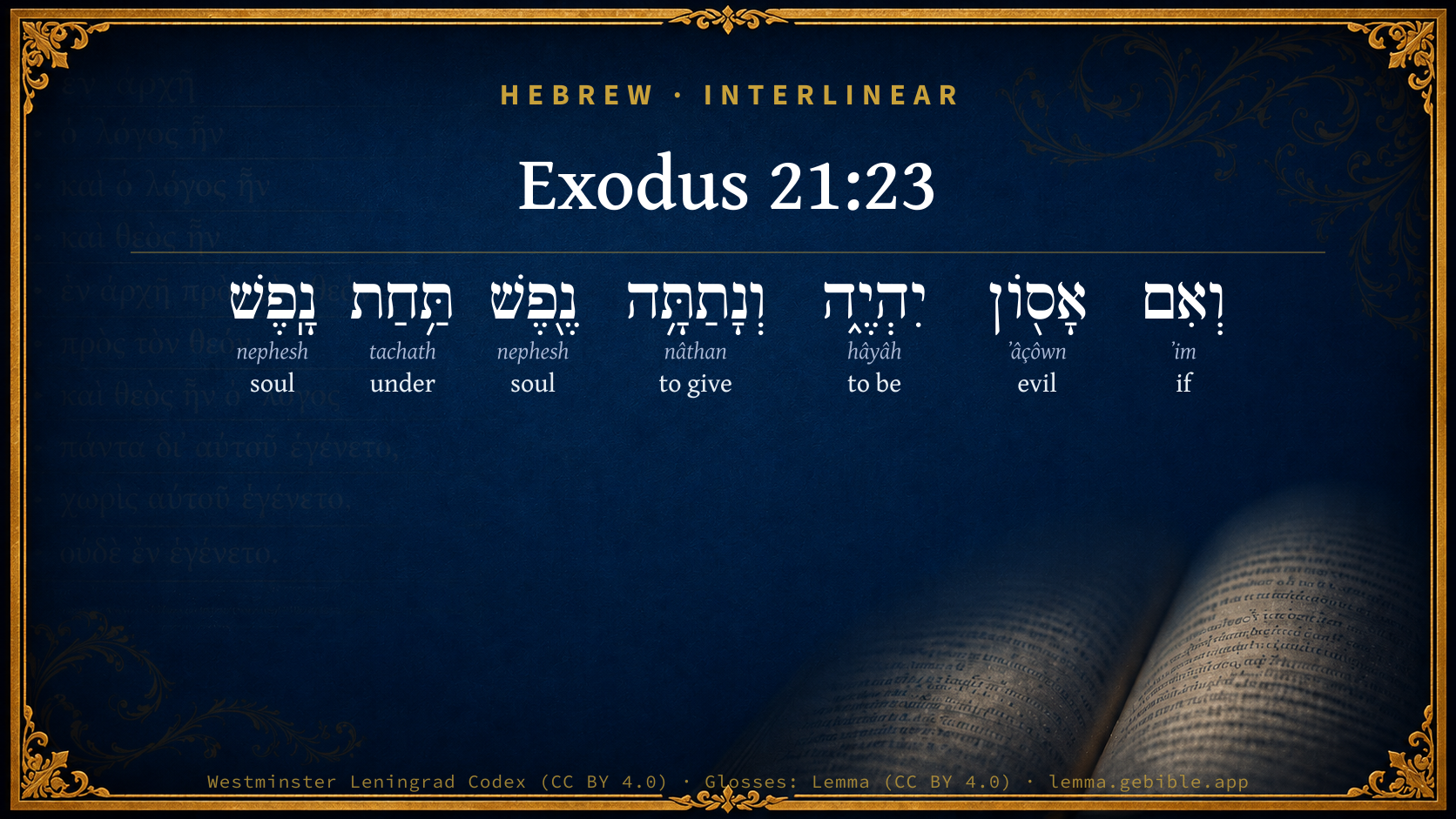
Exodus 21:23

Hebrew (Westminster Leningrad Codex) Exodus 21:23 appears in the Hebrew Old Testament. The text above is from the Westminster Leningrad Codex. Each word links to its Strong’s number, a concise gloss, and parsing drawn from the Open Scriptures Hebrew Bible morphology. Click any word for its full Brown-Driver-Briggs (BDB) entry.
Download image
Cite this verse

Exodus 21:23 (World English Bible). Public Domain. Lemma interlinear Bible study tool, https://lemma.gebible.app/v/exodus/21/23.

Show BibTeX & RIS
BibTeX
RIS
English Translation
But if any harm follows, then you must take life for life,
World English Bible · Public Domain
Download a study sheet

One document with this verse’s original text, its word-by-word gloss line, the meaning frame, cross-references with their text, attributed commentary, and full source and license credits — printable, and it pastes into notes with its structure intact.

This verse Autodidact and up

Study sheet (.html) Plain text (.txt)

A passage Seminary Student

Up to 50 verses in one chapter. A passage sheet keeps up to 6 commentary sources and 12 cross-references per verse, in the order this page ranks them, and says so on the sheet whenever that leaves anything out. Ask for a single verse and you get the Autodidact verse sheet above.

Everything on this page stays free to read, with no account — the sheet is a download of what is already on screen, not access to it.

Want to remove ads? Support Godless Engineer
Compare translations 3

The same verse in 3 English versions, stacked beneath the original-language interlinear above. Click any original word for its lexicon entry.

Each is an independent rendering of the whole verse — the interlinear is not word-aligned to these translations.

Highlighted words mark where these versions differ — a whole-verse word diff, not a word-by-word alignment.

  • World English Bible Public Domain
    But if any harm follows, then you must take life for life,
  • King James Version Public Domain
    And if any mischief follow, then thou shalt give life for life,
  • unfoldingWord Literal Text CC BY-SA 4.0
    But if there is serious injury, then you shall give a life for a life,

unfoldingWord Literal Text — © unfoldingWord, licensed CC BY-SA 4.0. Word-aligned USFM3 via Door43 (git.door43.org/unfoldingWord/en_ult).

Versions to compare (up to 4)

3 of 4 selected

Show all 18 translations

Every available English version of this verse, each an independent rendering of the whole verse.

  • World English Bible Public Domain
    But if any harm follows, then you must take life for life,
  • Berean Standard Bible Public Domain
    But if a serious injury results, then you must require a life for a life—
  • Majority Standard Bible Public Domain
    But if a serious injury results, then you must require a life for a life—
  • King James Version Public Domain
    And if any mischief follow, then thou shalt give life for life,
  • American Standard Version (1901) Public Domain
    But if any harm follow, then thou shalt give life for life,
  • Revised Version (1885) Public Domain
    But if any mischief follow, then thou shalt give life for life,
  • Geneva Bible (1599) Public Domain
    But if death follow, then thou shalt paye life for life,
  • Douay-Rheims (1899) Public Domain
    But if her death ensue thereupon, he shall render life for life.
  • Young's Literal Translation Public Domain
    and if there is mischief, then thou hast given life for life,
  • Literal Standard Version CC BY-SA 4.0
    and if there is harm [to them], then you have given life for life,
  • Unlocked Literal Bible CC BY-SA 4.0
    But if there is serious injury, then you must give a life for a life,
  • unfoldingWord Literal Text CC BY-SA 4.0
    But if there is serious injury, then you shall give a life for a life,
  • Darby Bible Public Domain
    But if mischief happen, then thou shalt give life for life,
  • World Messianic Bible Public Domain
    But if any harm follows, then you must take life for life,
  • Webster's Bible Public Domain
    And if any mischief shall follow, then thou shalt give life for life,
  • Free Bible Version CC BY-SA 4.0
    But if a serious injury does occur, then you must pay a life for a life,
  • Bible in Basic English Public Domain
    But if damage comes to her, let life be given in payment for life,
  • JPS Tanakh (1917) Public Domain
    But if any harm follow, then thou shalt give life for life,

Literal Standard Version (2020), Covenant Press — licensed CC BY-SA 4.0. Text via the HelloAO Bible API (eBible.org). Unlocked Literal Bible (unfoldingWord) — licensed CC BY-SA 4.0. Text via the HelloAO Bible API (eBible.org). unfoldingWord Literal Text — © unfoldingWord, licensed CC BY-SA 4.0. Word-aligned USFM3 via Door43 (git.door43.org/unfoldingWord/en_ult). Free Bible Version, Dr. Jonathan Gallagher — licensed CC BY-SA 4.0. Text via the HelloAO Bible API (eBible.org).

Word by word

More ways to search: Search by grammar → Find every occurrence → Compare this word →

Practice this passage: Drill this verse → Learn its vocabulary →

About this verse

These counts appear in no published source. They are computed here, from the morphology-tagged text and Lemma’s own curated glosses. What Lemma adds →

7
words
6
distinct lemmas
Pentateuch
section

Notable vocabulary

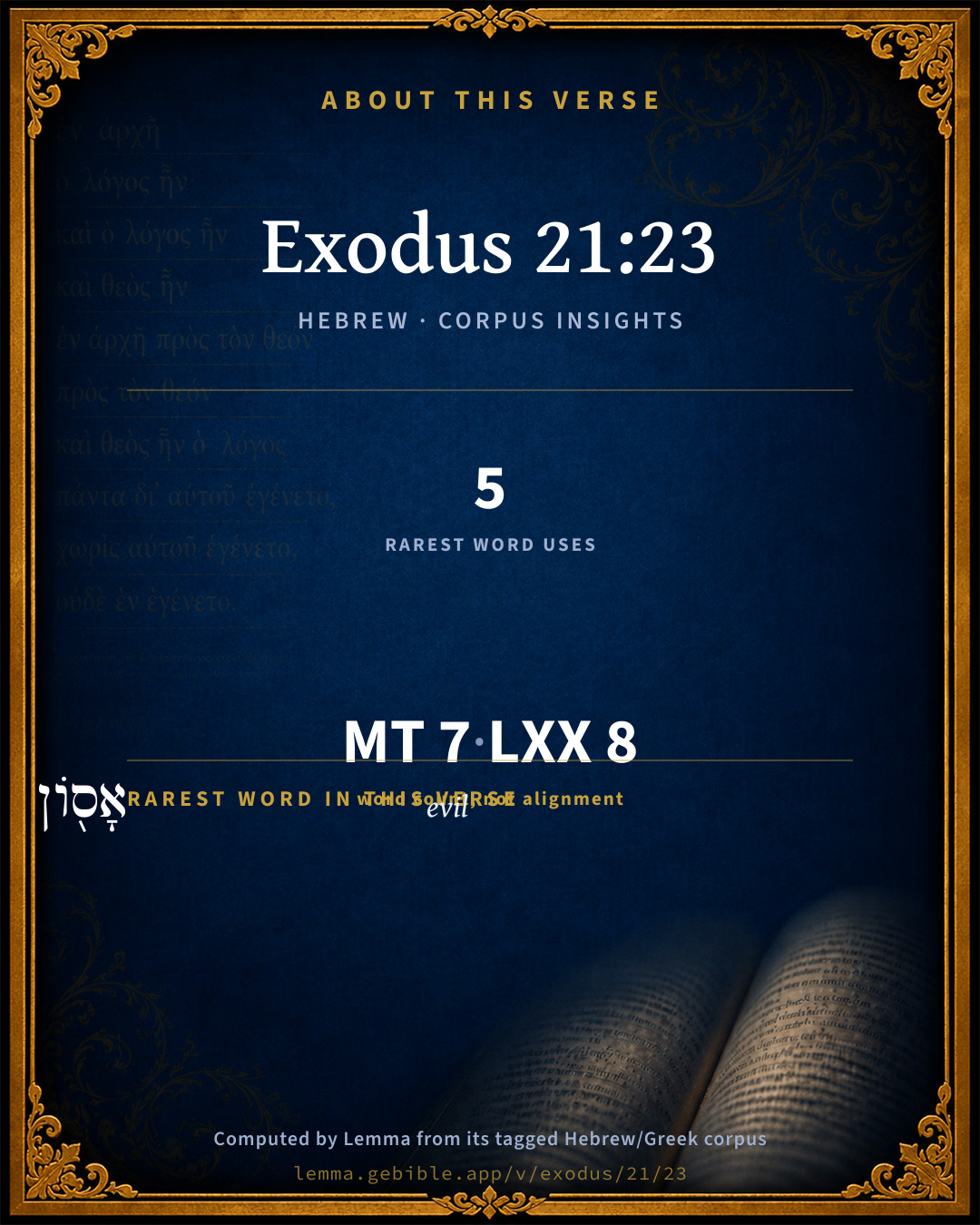
The rarest word here is אָס֖וֹן evil H611 — appearing just 5 times in the whole Hebrew Bible.

Shared distinctive vocabulary

אָס֖וֹן evil H611 occurs in 5 verses of the Hebrew Bible. Also found in:

Grammatical profile

  • 2 verbs
  • 3 nouns
  • 1 preposition
  • 1 conjunction

Verb forms

  • יִהְיֶ֑ה Qal · Imperfect
  • וְנָתַתָּ֥ה Qal · Sequential Perfect

Repetition

A word recurs within this verse — often emphatic in Hebrew:

  • נֶ֖פֶשׁ soul H5315 ×2

Hebrew & Septuagint length

In English translation the verse runs 12 words from the Hebrew and 12 from the Septuagint (LXX English) — the same length.

A rough comparison of the two English renderings, which tokenize alike — not a word-level alignment.

Word counts can differ between the Hebrew and the Greek without any difference in meaning — e.g. the Hebrew direct-object marker אֵת has no separate Greek word, and Greek often adds the article ὁ.

In the original languages it is 7 Hebrew tokens and 8 Greek tokens — but the two are counted differently (Hebrew bundles its prefixes and suffixes into one token; the Greek is in lemma form), so that isn’t a like-for-like length.

Cross-references

3

Topical passages linked to Exodus 21:23 in the Treasury of Scripture Knowledge — connected by theme and wording, ordered by reader-vote popularity; previews shown in the World English Bible.

  • Deuteronomy 19:21 Your eyes shall not pity; life [shall go] for life, eye for eye, tooth for tooth, hand for hand, foot for foot.
  • Numbers 35:31 Moreover you shall take no ransom for the life of a murderer who is guilty of death; but he shall surely be put to death.
  • Leviticus 24:19 If anyone injures his neighbor; as he has done, so shall it be done to him:

Cross-references courtesy of OpenBible.info (CC BY 4.0).

Hebrew and Greek witnesses Masoretic Hebrew ↔ Greek Septuagint

The same verse in the two great witnesses to the Old Testament, shown verse-for-verse.

These are two independent witnesses, not word-aligned to each other, and the Septuagint is shown in lemma (dictionary) form.

Hebrew Exodus 21:23 Masoretic · Westminster Leningrad Codex

וְאִם אָס֖וֹן יִהְיֶ֑ה וְנָתַתָּ֥ה נֶ֖פֶשׁ תַּ֥חַת נָֽפֶשׁ

But if any harm follows, then you must take life for life,

World English Bible · Public Domain

Greek LXX Exodus 21:23 Septuagint · lemma form

ἐάν δέ ἐκεἰκονίζω εἰμί δίδωμι ψυχή ἀντί ψυχή

But if it be perfectly formed, he shall give life for life,

LXX2012 (modern English Septuagint) · Public Domain

On this verse, John Gill's Exposition discusses the Septuagint’s reading. Read the note in Commentary ↓

Hebrew: Westminster Leningrad Codex (CC BY 4.0). Greek: Septuagint (public domain); English from LXX2012 (modern English Septuagint) (Public Domain). How the Septuagint differs from the Hebrew →

Targum (Aramaic paraphrase)

2

The Targum is the ancient Jewish Aramaic paraphrase of the Hebrew Scriptures — an interpretive translation, not the Hebrew text itself. Onkelos (literal) and Pseudo-Jonathan (expansive) render the Torah, and Jonathan the Prophets. Coverage is partial: where no permissively-licensed English translation exists for a verse, only the Aramaic is shown. This is verse-level text, not a word-by-word alignment to the Hebrew.

  1. Targum Onkelos Torah (Genesis–Deuteronomy)
    וְאִם מוֹתָא יְהֵא וְתִתֵּן נַפְשָׁא חֳלָף נַפְשָׁא:

    (no public-domain English translation for this verse)

    Targum Onkelos — Aramaic: “Onkelos Genesis” (public domain); “Onkelos Exodus” (public domain); “Onkelos Leviticus” (public domain); “Onkelos Numbers” (public domain); “Onkelos Deuteronomy” (public domain). English: “Sefaria Community Translation” (CC0 1.0 (public-domain dedication)); “J.W. Etheridge. The Targums of Onkelos and Jonathan Ben Uzziel on the Pentateuch. London: Longmans, Green, 1862” (public domain). Text via Sefaria.

  2. Targum Pseudo-Jonathan Torah (Genesis–Deuteronomy)
    וְאִין מוֹתָא יְהֵי בָהּ וּתְדִינוּן נַפְשָׁא דִקְטוֹלָא חוֹלַף נַפְשָׁא דְאִתְּתָא

    But if death befall her, then thou shalt judge the life of the killer for the life of the woman.

    Targum Pseudo-Jonathan — Aramaic: “Targum Jonathan on Genesis” (public domain); “Targum Jonathan on Exodus” (public domain); “Targum Jonathan on Leviticus” (public domain); “Targum Jonathan on Numbers” (public domain); “Targum Jonathan on Deuteronomy” (public domain). English: “The Targum of Jonathan ben Uzziel, trans. J. W. Etheridge, London, 1862” (public domain). Text via Sefaria.

Commentary

Notes on Exodus 21:23 from classic Christian and Jewish commentators (each source and its license shown beneath its notes). The classic Christian expositions comment on the surrounding passage and are grouped to its opening verse, so a note may address several verses; the Jewish commentaries on the Tanakh (Rashi and others) are per-verse, so they appear only where the commentator wrote on this verse.

Lemma curates 59 commentaries, every one of them public domain or Creative Commons licensed, each selected and text-cleaned for this edition rather than reprinted as found. About our sources →

Trapp's Complete Commentary

John Trapp

Exo 21:23 And if [any] mischief follow, then thou shalt give life for life,

Ver. 23. And if any mischief follow.] Either by death or maim, either of mother or child.

John Trapp, A Commentary or Exposition upon All the Books of the Old and New Testament (1647–1656) — public domain. Text from a community e-Sword module.

Jamieson, Fausset & Brown

Robert Jamieson, A. R. Fausset & David Brown

eye for eye--The law which authorized retaliation (a principle acted upon by all primitive people) was a civil one. It was given to regulate the procedure of the public magistrate in determining the amount of compensation in every case of injury, but did not encourage feelings of private revenge. The later Jews, however, mistook it for a moral precept, and were corrected by our Lord (Mat 5:38-42).

Jamieson, Fausset & Brown — Commentary Critical and Explanatory on the Whole Bible (1871) — public domain (CC PDM 1.0). Text via the HelloAO Bible API.

The Cambridge Bible for Schools and Colleges

gen. ed. J. J. S. Perowne

23–25. The Lex Talionis. But if any mischief happen, then compensation is to be made on the principle of the lex talionis. Vv. 23–25 are, however, worded quite generally, and mention many injuries not at all likely to happen to the woman in the special case contemplated in v. 22, or even to the combatants themselves (injuries to whom Di. thinks might be included in the ‘mischief’ meant): hence, probably, either (Budde, Bä.) vv. 23–25 are misplaced, and should be transposed to follow vv. 18, 19 (where the quarrel is of a more general kind, and serious consequences are contemplated as happening to one other of the combatants), or (McNeile) ‘mischief’ in v. 22 means definitely the woman’s death, and v. 23 assigns the penalty for it, and vv. 24, 25 are ‘an abridged summary of the laws of retaliation, which has been added here though it is not relevant to the case in point—the death of the woman.’ Similar specifications of the application of the lex talionis are given in Deu_19:21 (in the special case of the punishment to be awarded to a malicious witness: cf. Ḥamm. §§ 3, 4, for cases of false witness), and Lev_24:18; Lev_24:20 (H), in the case of any injury (‘blemish’) done to a neighbour. Comp. Mat_5:38.

The Cambridge Bible for Schools and Colleges (gen. ed. J. J. S. Perowne; Cambridge University Press, 1878–1918) — public domain. Text from a community e-Sword module.

John Gill's Exposition

And if any mischief follow,.... According as that is, so shall it be done to the smiter: if death follows:

then thou shalt give life for life; if death to the woman, so Jarchi and Aben Ezra interpret it; to which agrees the Targum of Jonathan,"but if there is death in her, then ye shall judge or condemn the life of the murderer for the life of the woman;''about which, Jarchi says, there is a difference among their doctors; some say life properly, absolutely the person himself; others say money, but not life properly; for he that intends to kill one and kills another is acquitted from death, but must pay to the heirs the price (of the person killed) as that person might be sold for in the market: and indeed it seems hard that a person that kills another at unawares should die for it; it is more reasonable that the punishment should in such a case be commuted for something less than life; and that though no satisfaction was to be taken for a wilful murderer, Num 35:31, yet it seems to imply that it might be taken for one that was so without design; as by another law cities of refuge are appointed for the manslayer at unawares: the canons of the Jews, according to Maimonides (b), run thus;"he that strikes a woman, and she miscarries and dies, although it is done ignorantly; lo, such an one is free from payment, and he does not pay anything, as it is said, "if there is no mischief, &c." the Scripture does not distinguish between what is done ignorantly and presumptuously, in a thing in which there is not death by the sanhedrim, to free him from payment; in what things? when he intends the woman; but if he intends his neighbour and strikes the woman, though she dies, since her death is, without intention, lo, this is a thing in which there is not death by the sanhedrim, and he pays the price of the birth:''the Septuagint version interprets this, not of the woman that miscarries and dies, but of the child that becomes an abortive; if that was not formed and shaped, then only a fine was to be laid, but if it was come to its proper form and shape, and so was animated or quickened, then life was to go for life: and so, according to the Salic laws, he that killed an infant in its mother's womb was to pay 8000 pence, which made two hundred shillings; but if he was the cause of a woman's miscarriage, by blows or otherwise, if the birth was animated, according to the civil law, he was to be punished with death (c): but one would think, where this is only accidental and not intended, such a punishment is too rigid and severe: however, neither this nor what follows were left to the will of a private person to inflict at his pleasure, but to the civil magistrate; and therefore no ways encourages private revenge, in favour of which it was applied by the Pharisees in Christ's time, whose gloss he refutes, Mat 5:38 nor are the words directed to the offender in this and the following cases, but to Moses, and so to all judges under him and in succession, who were to see these laws put in execution.

(b) Chobel Umazzik, c. 4. sect. 5. 6. (c) Vid L'Empereur in Misn. Bava Kama, c. 3. sect. 2.

John Gill's Exposition of the Whole Bible (1746–1763) — public domain (CC PDM 1.0). Text via the HelloAO Bible API.

Matthew Poole's English Annotations

Any mischief; either to the mother or to the child, whether it be death, or any maim or mischief.

Who

shall give life for life?

Answ. Not the private person, which would have introduced infinite mischiefs and confusions, but the magistrate; for these laws are given to Moses, and the execution of these things was committed to Moses, and others under him.

Matthew Poole's English Annotations on the Holy Bible (1683–1685) — public domain. Text from a community e-Sword/MySword module.

The Pulpit Commentary

Then thou shalt give life for life. "Life for life" seems an excessive penalty, where the injury was in a great measure accidental, and when there was certainly no design to take life. Probably the law was not now enacted for the first time, but was an old tribal institution, like the law of the "avenger of blood." There are many things in the Mosaic institutions which Moses tolerated, like "bills of divorce on account of "the hardness of their hearts.

Vers. 23, 24. Eye for eye, tooth for tooth, etc. Aristotle says in the Nicomachean Ethics, that this was the rule of justice which Rhadamanthus was supposed to act on in the judgment after death (book 5, see. 3), and that it had the approval of the Pythagoreans. Solon admitted it to a certain extent into the laws of Athens, and at Rome it found its way. into the Twelve Tables. There is a prima facie appearance of exact equality in it, which would captivate rude minds and cause the principle to be widely adopted in a rude state of society. But in practice objections would soon be felt to it. There is no exact measure of the hardness of a blow, or the severity of a wound; and "wound for wound, stripe for stripe," would open a door for very unequal inflictions "Eye for eye" would be flagrantly unjust in the case of a one-eyed man. Moreover, it is against public policy to augment unnecessarily the number of mutilated and maimed citizens, whose power to serve the state is lessened by their mutilation. Consequently in every society retaliation has at an early date given way to pecuniary compensation; and this was the case even among the Hebrews, as Kalisch has shown satisfactorily. If the literal sense was insisted on in our Lord"s day, (Mat_5:38) it was only by the Sadducees, who declined to give the law a spiritual interpretation.

Vers. 23-25. The rule of retaliation.

"To suffer that a man has done is strictest, straightest right," was a line which passed into a proverb in ancient Greece. The administration of justice is rendered very simple and easy by the adoption of the principle, which approves itself to simple minds, and might work well in a simple state of society. The law of "life for life" (ver. 23) remains, and must always remain, the basis on which society justifies the execution of the murderer. If "eve for eye, hand for hand, foot for foot" (ver. 24), were enforced, the criminal could not complain; but the State would suffer by the mutilation and consequent debilitation of its members. In the administration of "burning for burning, wound for wound, stripe for stripe" (ver. 25), there would be difficulties, it being almost impossible for the public executioner to inflict a burn, wound, or blow exactly similar to the burn, wound, or blow given by the criminal. These difficulties lead naturally to the substitution of "compensation" for "retaliation," which we find sanctioned in vers. 19, 22, 30, and 32. If the damage caused by a wound, burn, blow, or even by the loss of a slave or wife, can be estimated, and the injurer be made to pay that amount to the injured party, then the original loss is in a certain sense retaliated, and the wrongdoer" suffers what he has done." In the administration of justice the rule of retaliation has thus still a place. Retaliation is made unlawful by Christianity, (Mat_5:38-42) not in the administration of justice, but in the private dealings of man with man. We must not ourselves give blow for blow, "wound for wound, burning for burning;" no, nor gibe for gibe, slight for slight, insult for insult. Firstly, because we are not fair judges in our own case, and should be almost sure to overestimate our own injury; and, secondly, because we should provoke a continuance of strife. We should not even be eager to prosecute those who have injured us, if there be a chance that by patience and forbearance we may bring them to a better mind. We should be content to "suffer wrong," if by so doing we may win souls to Christ. The Christian law is, "Love your enemies; bless them that curse you; do good to them that hate you; and pray for them which despitefully use you and persecute you;" and the ground of the law is, that by so doing we may "overcome evil with good". (Rom_12:21)

Vers. 23-26. An eye for an eye, etc. (cf. Mat_5:38-43)

The principle here enunciated is that of the jus talionis. Stripped of its concrete form, it is simply the assertion of the dictate of justice, that when a wrong has been done to anyone, and through him to society, an adequate compensation ought to be rendered. So rendered, it is the principle underlying every system of criminal jurisprudence. We need not suppose that (in Jewish society) it was ever literally acted upon. Commutations of various kinds would be admitted (cf. ver. 30). As a rule for courts of justice, therefore, this principle must remain. Bat error arises when this rule, intended for the regulation of public justice, is transferred into private life, and is applied there to sanction the spirit of revenge. This is to pervert it from its proper purpose. So far from sanctioning private retaliation, the object of this law is to set limits to the passion for revenge, by taking the right to avenge out of the hands of private individuals altogether, and committing it to public officers. In contrast with the retaliatory disposition, our Lord inculcates on his disciples a forbearing and forgiving spirit; a spirit which seeks to overcome by love; a spirit, even, which is willing to forego legal rights, whenever by doing so, it can promote the good of a fellow man. J.O.

The Pulpit Commentary (1880–1919), ed. H.D.M. Spence-Jones & Joseph S. Exell — public domain. Text from a community e-Sword module.

Rashi

Rabbi Shlomo Yitzchaki (Rashi)

ואם אסון יהיה AND IF THERE BE ANY FURTHER MISCHIEF — in the case of the woman,

ונתת נפש תחת נפש THEN THOU SHALT GIVE SOUL FOR SOUL. Our Rabbis differ as to the explanation of the word נפש the first time it occurs here. There are some who say that it actually signifies “life” (i. e. life for life), others say that it means monetary compensation but not literally life, and they say that this must be so because he who intends to kill a certain person and inadvertently kills another instead, (as is the case here), is exempt from the death penalty, and has only to pay to his heirs his value estimating this as though he were sold as a slave in the market (Sanhedrin 79a).

Rashi on the Tanakh — English translations: “The Judaica Press complete Tanach with Rashi, translated by A. J. Rosenberg” (CC BY 4.0); “Pentateuch with Rashi's commentary by M. Rosenbaum and A.M. Silbermann, 1929-1934” (public domain); “The Metsudah Tanach series, Lakewood, N.J” (CC BY 4.0); and “The Book of Joshua, Metsudah Publications, 1997” (CC BY 4.0). Text via Sefaria.

Lesson kit

Teaching starters — assembled from the data on this page, not authored interpretation. Every prompt links to the verse data it draws on. Edit before teaching.

Exodus, in the Pentateuch, opens this verse with 7 words (6 distinct Hebrew lemmas). Its most distinctive word is ʼâçôwn (“evil”). A historical commentator’s framing appears above. Read the whole chapter for the surrounding context.

Discussion questions

  1. The word ʼâçôwn carries the sense “evil.” How does it shape the verse?
  2. Genesis 42:4 shares the word «evil» with this verse. How do the two illuminate each other?
  3. “soul” occurs 2× in this one verse. What is the effect of the repetition?
  4. These translations render this verse differently. What is at stake in choosing one wording over another?
  5. The verb «יִהְיֶ֑ה» is Qal Imperfect. How does its form color the action?
  6. Reading how Trapp's Complete Commentary and Jamieson, Fausset & Brown read this verse, where do the two commentators agree and where do they part?

Things to notice

Reading settings

Reading text

Shown beneath each verse's original-language words.

Old Testament
Old Testament edition

Read the OT as the Masoretic Hebrew (MT) or the Greek Septuagint (LXX).

English shown for the Greek Septuagint (in the Hebrew ↔ Greek comparison).

Comparing translations? Open the Compare panel on any verse page to stack up to four side by side.