
Genesis 9:2

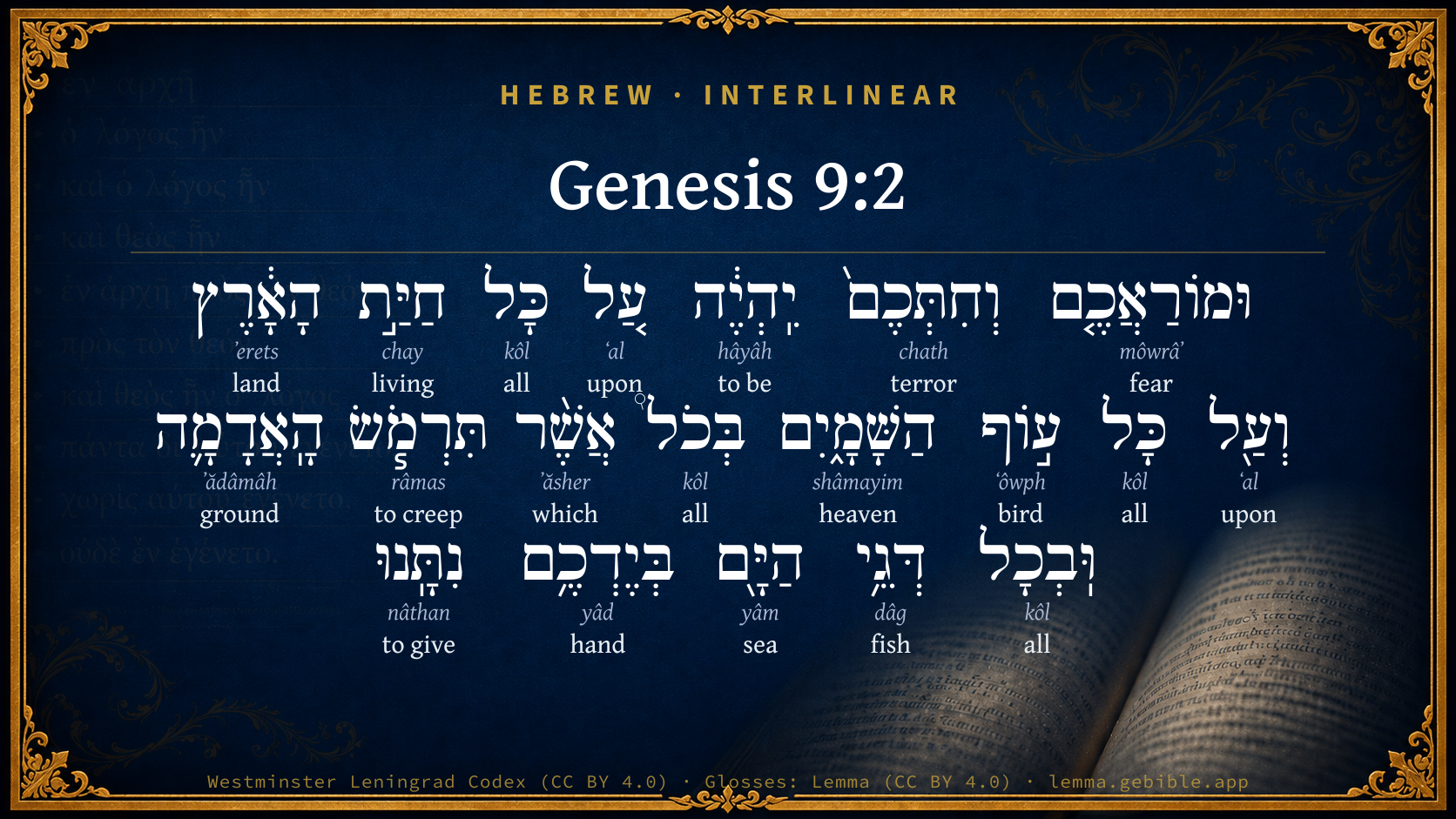
Hebrew (Westminster Leningrad Codex) Genesis 9:2 appears in the Hebrew Old Testament. The text above is from the Westminster Leningrad Codex. Each word links to its Strong’s number, a concise gloss, and parsing drawn from the Open Scriptures Hebrew Bible morphology. Click any word for its full Brown-Driver-Briggs (BDB) entry.
Download image
Cite this verse

Genesis 9:2 (World English Bible). Public Domain. Lemma interlinear Bible study tool, https://lemma.gebible.app/v/genesis/9/2.

Show BibTeX & RIS
BibTeX
RIS
English Translation
The fear of you and the dread of you will be on every animal of the earth, and on every bird of the sky. Everything that the ground teems with, and all the fish of the sea are delivered into your hand.
World English Bible · Public Domain
Highlights
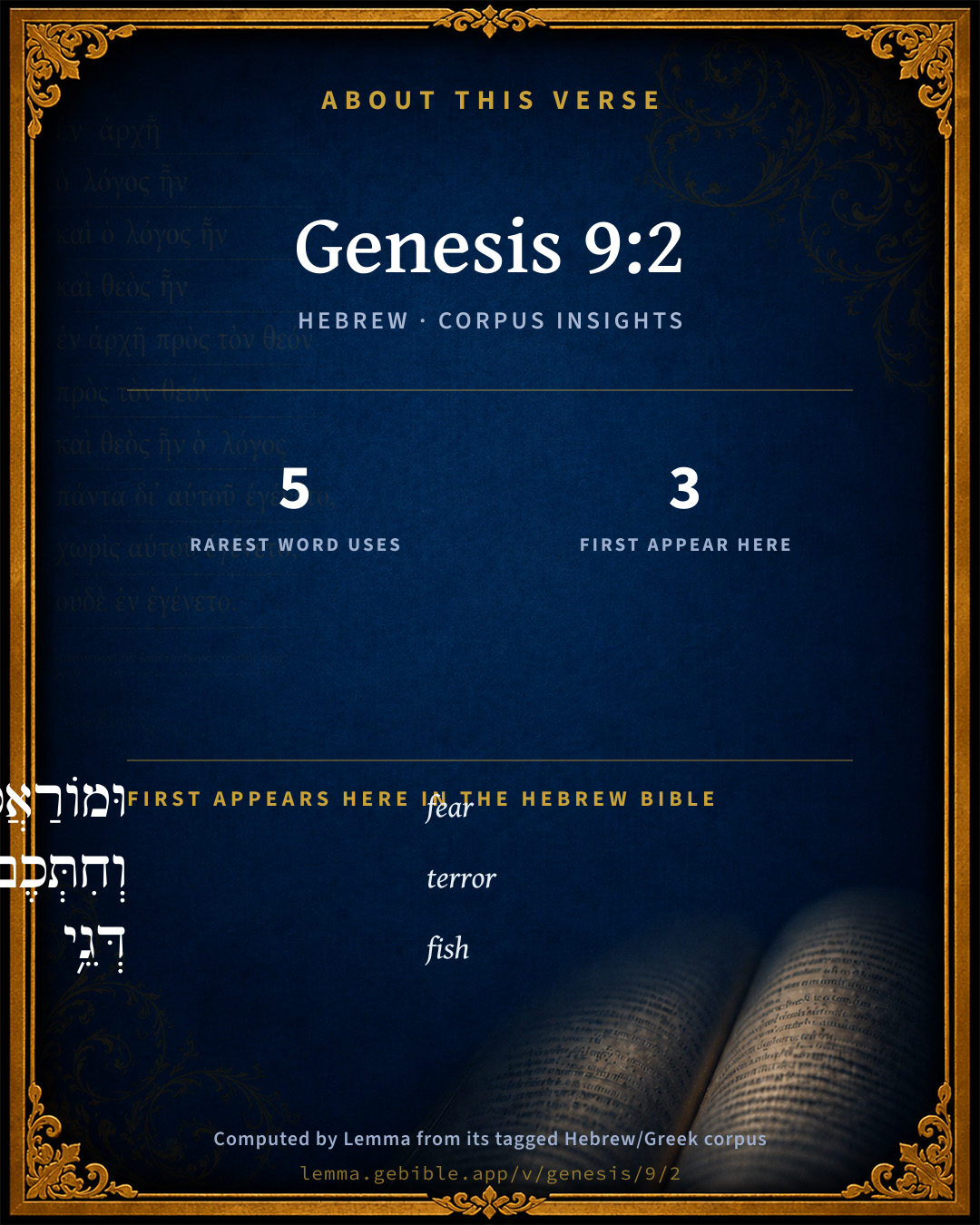
  • 3 first appearances in the Hebrew Bible
Full analysis ↓
Download a study sheet

One document with this verse’s original text, its word-by-word gloss line, the meaning frame, cross-references with their text, attributed commentary, and full source and license credits — printable, and it pastes into notes with its structure intact.

This verse Autodidact and up

Study sheet (.html) Plain text (.txt)

A passage Seminary Student

Up to 50 verses in one chapter. A passage sheet keeps up to 6 commentary sources and 12 cross-references per verse, in the order this page ranks them, and says so on the sheet whenever that leaves anything out. Ask for a single verse and you get the Autodidact verse sheet above.

Everything on this page stays free to read, with no account — the sheet is a download of what is already on screen, not access to it.

Want to remove ads? Support Godless Engineer
Compare translations 3

The same verse in 3 English versions, stacked beneath the original-language interlinear above. Click any original word for its lexicon entry.

Each is an independent rendering of the whole verse — the interlinear is not word-aligned to these translations.

Highlighted words mark where these versions differ — a whole-verse word diff, not a word-by-word alignment.

  • World English Bible Public Domain
    The fear of you and the dread of you will be on every animal of the earth, and on every bird of the sky. Everything that the ground teems with, and all the fish of the sea are delivered into your hand.
  • King James Version Public Domain
    And the fear of you and the dread of you shall be upon every beast of the earth, and upon every fowl of the air, upon all that moveth upon the earth, and upon all the fishes of the sea; into your hand are they delivered.
  • unfoldingWord Literal Text CC BY-SA 4.0
    And the fear of you and the dread of you will be on every living thing of the earth, including on every bird of the sky, on everything that moves on the ground, and on all the fish of the sea. Into your hand they are given.

unfoldingWord Literal Text — © unfoldingWord, licensed CC BY-SA 4.0. Word-aligned USFM3 via Door43 (git.door43.org/unfoldingWord/en_ult).

Versions to compare (up to 4)

3 of 4 selected

Show all 18 translations

Every available English version of this verse, each an independent rendering of the whole verse.

  • World English Bible Public Domain
    The fear of you and the dread of you will be on every animal of the earth, and on every bird of the sky. Everything that the ground teems with, and all the fish of the sea are delivered into your hand.
  • Berean Standard Bible Public Domain
    The fear and dread of you will fall on every living creature on the earth, every bird of the air, every creature that crawls on the ground, and all the fish of the sea. They are delivered into your hand.
  • Majority Standard Bible Public Domain
    The fear and dread of you will fall on every living creature on the earth, every bird of the air, every creature that crawls on the ground, and all the fish of the sea. They are delivered into your hand.
  • King James Version Public Domain
    And the fear of you and the dread of you shall be upon every beast of the earth, and upon every fowl of the air, upon all that moveth upon the earth, and upon all the fishes of the sea; into your hand are they delivered.
  • American Standard Version (1901) Public Domain
    And the fear of you and the dread of you shall be upon every beast of the earth, and upon every bird of the heavens; With all wherewith the ground teemeth, and all the fishes of the sea, into your hand are they delivered.
  • Revised Version (1885) Public Domain
    And the fear of you and the dread of you shall be upon every beast of the earth, and upon every fowl of the air; with all wherewith the ground teemeth, and all the fishes of the sea, into your hand are they delivered.
  • Geneva Bible (1599) Public Domain
    Also the feare of you, and the dread of you shalbe vpon euery beast of the earth, and vpon euery foule of the heauen, vpon all that moueth on the earth, and vpon all the fishes of the sea: into your hand are they deliuered.
  • Douay-Rheims (1899) Public Domain
    And let the fear and dread of you be upon all the beasts of the earth, and upon all the fowls of the air, and all that move upon the earth: all the fishes of the sea are delivered into your hand.
  • Young's Literal Translation Public Domain
    and your fear and your dread is on every beast of the earth, and on every fowl of the heavens, on all that creepeth on the ground, and on all fishes of the sea -- into your hand they have been given.
  • Literal Standard Version CC BY-SA 4.0
    and your fear and your dread is on every beast of the earth, and on every bird of the heavens, on all that creeps on the ground, and on all fishes of the sea—into your hand they have been given.
  • Unlocked Literal Bible CC BY-SA 4.0
    The fear of you and the dread of you will be upon every living animal on the earth, upon every bird of the sky, upon everything that goes low on the ground, and upon all the fish of the sea. They are given into your hand.
  • unfoldingWord Literal Text CC BY-SA 4.0
    And the fear of you and the dread of you will be on every living thing of the earth, including on every bird of the sky, on everything that moves on the ground, and on all the fish of the sea. Into your hand they are given.
  • Darby Bible Public Domain
    And let the fear of you and the dread of you be upon every animal of the earth, and upon all fowl of the heavens: upon all that moveth [on] the ground; and upon all the fishes of the sea: into your hand are they delivered.
  • World Messianic Bible Public Domain
    The fear of you and the dread of you will be on every animal of the earth, and on every bird of the sky. Everything that moves along the ground, and all the fish of the sea, are delivered into your hand.
  • Webster's Bible Public Domain
    And the fear of you and the dread of you shall be upon every beast of the earth, and upon every fowl of the air, upon all that moveth on the earth, and upon all the fishes of the sea; into your hand are they delivered.
  • Free Bible Version CC BY-SA 4.0
    All animals will be very afraid of you—this includes all the birds, all the creatures that run along the ground, and all the fish in the sea. You are in charge of them.
  • Bible in Basic English Public Domain
    And the fear of you will be strong in every beast of the earth and every bird of the air; everything which goes on the land, and all the fishes of the sea, are given into your hands.
  • JPS Tanakh (1917) Public Domain
    And the fear of you and the dread of you shall be upon every beast of the earth, and upon every fowl of the air, and upon all wherewith the ground teemeth, and upon all the fishes of the sea: into your hand are they delivered.

Literal Standard Version (2020), Covenant Press — licensed CC BY-SA 4.0. Text via the HelloAO Bible API (eBible.org). Unlocked Literal Bible (unfoldingWord) — licensed CC BY-SA 4.0. Text via the HelloAO Bible API (eBible.org). unfoldingWord Literal Text — © unfoldingWord, licensed CC BY-SA 4.0. Word-aligned USFM3 via Door43 (git.door43.org/unfoldingWord/en_ult). Free Bible Version, Dr. Jonathan Gallagher — licensed CC BY-SA 4.0. Text via the HelloAO Bible API (eBible.org).

Word by word

More ways to search: Search by grammar → Find every occurrence → Compare this word →

Practice this passage: Drill this verse → Learn its vocabulary →

וְחִתְּכֶם֙
chath
H2844
“and · terror · your”
Conjunction + Noun, Common, Masculine, Singular, Construct + Suffix, Personal, 2nd Person, Masculine, Plural
Part of Speech
Conjunction + Noun
Type
Common
Gender
Masculine
Number
Singular
State
Construct
Full BDB Definition

Origin: from H2865

TWOT: 784a

fear, terror - shattered, dismayed - shattered - dismayed
  1. וּמוֹרַאֲכֶ֤ם môwrâʼ H4172 “and · fear · your” Conjunction + Noun, Common, Masculine, Singular, Construct + Suffix, Personal, 2nd Person, Masculine, Plural
  2. יִֽהְיֶ֔ה hâyâh H1961 “to be” Verb, Qal, Imperfect, 3rd Person, Masculine, Singular
  3. עַ֚ל ʻal H5921 “upon” Preposition
  4. כָּל kôl H3605 “all of” Noun, Common, Masculine, Singular, Construct
  5. חַיַּ֣ת chay H2416 “living of” Noun, Common, Feminine, Singular, Construct
  6. הָאָ֔רֶץ ʼerets H776 “the · land” Particle, Definite Article + Noun, Common, Both, Singular, Absolute
  7. וְעַ֖ל ʻal H5921 “and · upon” Conjunction + Preposition
  8. כָּל kôl H3605 “all of” Noun, Common, Masculine, Singular, Construct
  9. ע֣וֹף ʻôwph H5775 “bird of” Noun, Common, Masculine, Singular, Construct
  10. הַשָּׁמָ֑יִם shâmayim H8064 “the · heaven(s)” Particle, Definite Article + Noun, Common, Masculine, Plural, Absolute
  11. בְּכֹל֩ kôl H3605 “in/at · all” Preposition + Noun, Common, Masculine, Singular, Absolute
  12. אֲשֶׁ֨ר ʼăsher H834 “which” Particle, Relative
  13. תִּרְמֹ֧שׂ râmas H7430 “to creep” Verb, Qal, Imperfect, 3rd Person, Feminine, Singular
  14. הָֽאֲדָמָ֛ה ʼădâmâh H127 “the · ground” Particle, Definite Article + Noun, Common, Feminine, Singular, Absolute
  15. וּֽבְכָל kôl H3605 “and · in/at · all of” Conjunction + Preposition + Noun, Common, Masculine, Singular, Construct
  16. דְּגֵ֥י dâg H1709 “fish of” Noun, Common, Masculine, Plural, Construct
  17. הַיָּ֖ם yâm H3220 “the · sea” Particle, Definite Article + Noun, Common, Masculine, Singular, Absolute
  18. בְּיֶדְכֶ֥ם yâd H3027 “in/at · hand · your” Preposition + Noun, Common, Both, Singular, Construct + Suffix, Personal, 2nd Person, Masculine, Plural
  19. נִתָּֽנוּ nâthan H5414 “to give” Verb, Niphal, Perfect, 3rd Person, Common, Plural

About this verse

These counts appear in no published source. They are computed here, from the morphology-tagged text and Lemma’s own curated glosses. What Lemma adds →

20
words
16
distinct lemmas
Pentateuch
section

Notable vocabulary

The rarest word here is וְחִתְּכֶם֙ terror H2844 — appearing just 5 times in the whole Hebrew Bible.

First appearance in Scripture

These words make their first canonical appearance in the Hebrew Bible here:

  • וּמוֹרַאֲכֶ֤ם fear H4172
  • וְחִתְּכֶם֙ terror H2844
  • דְּגֵ֥י fish H1709

Shared distinctive vocabulary

וְחִתְּכֶם֙ terror H2844 occurs in 5 verses of the Hebrew Bible. Also found in:

Grammatical profile

  • 3 verbs
  • 14 nouns
  • 2 prepositions
  • 1 particle

Verb forms

  • יִֽהְיֶ֔ה Qal · Imperfect
  • תִּרְמֹ֧שׂ Qal · Imperfect
  • נִתָּֽנוּ Niphal · Perfect

Repetition

Words recur within this verse — often emphatic in Hebrew:

Hebrew & Septuagint length

In English translation the verse runs 42 words from the Hebrew and 48 from the Septuagint (LXX English) — closely comparable.

A rough comparison of the two English renderings, which tokenize alike — not a word-level alignment.

Word counts can differ between the Hebrew and the Greek without any difference in meaning — e.g. the Hebrew direct-object marker אֵת has no separate Greek word, and Greek often adds the article ὁ.

Cross-references

11

Topical passages linked to Genesis 9:2 in the Treasury of Scripture Knowledge — connected by theme and wording, ordered by reader-vote popularity; previews shown in the World English Bible.

  • Psalms 8:4–8 What is man, that you think of him? The son of man, that you care for him?
  • Genesis 1:28 God blessed them. God said to them, "Be fruitful, multiply, fill the earth, and subdue it. Have dominion over the fish of the sea, over the birds of the sky, and over every living thing that moves on the earth."
  • Hosea 2:18 In that day I will make a covenant for them with the animals of the field, And with the birds of the sky, And with the creeping things of the ground. I will break the bow, the sword, and the battle out of the land, And will make them lie down safely.
  • James 3:7 For every kind of animal, bird, creeping thing, and thing in the sea, is tamed, and has been tamed by mankind.
  • Leviticus 26:6 "'I will give peace in the land, and you shall lie down, and no one will make you afraid; and I will remove evil animals out of the land, neither shall the sword go through your land.
  • Job 5:22–23 At destruction and famine you shall laugh, Neither shall you be afraid of the animals of the earth.
  • Ezekiel 34:25 I will make with them a covenant of peace, and will cause evil animals to cease out of the land; and they shall dwell securely in the wilderness, and sleep in the woods.
  • Genesis 2:19 Out of the ground Yahweh God formed every animal of the field, and every bird of the sky, and brought them to the man to see what he would call them. Whatever the man called every living creature, that was its name.
  • Genesis 35:5 They traveled: and a terror of God was on the cities that were round about them, and they didn't pursue the sons of Jacob.
  • Leviticus 26:22 I will send the wild animals among you, which will rob you of your children, destroy your cattle, and make you few in number; and your roads will become desolate.
  • Psalms 104:20–23 You make darkness, and it is night, In which all the animals of the forest prowl.

Cross-references courtesy of OpenBible.info (CC BY 4.0).

Hebrew and Greek witnesses Masoretic Hebrew ↔ Greek Septuagint

The same verse in the two great witnesses to the Old Testament, shown verse-for-verse.

These are two independent witnesses, not word-aligned to each other, and the Septuagint is shown in lemma (dictionary) form.

Hebrew Genesis 9:2 Masoretic · Westminster Leningrad Codex

וּמוֹרַאֲכֶ֤ם וְחִתְּכֶם֙ יִֽהְיֶ֔ה עַ֚ל כָּל חַיַּ֣ת הָאָ֔רֶץ וְעַ֖ל כָּל ע֣וֹף הַשָּׁמָ֑יִם בְּכֹל֩ אֲשֶׁ֨ר תִּרְמֹ֧שׂ הָֽאֲדָמָ֛ה וּֽבְכָל דְּגֵ֥י הַיָּ֖ם בְּיֶדְכֶ֥ם נִתָּֽנוּ

The fear of you and the dread of you will be on every animal of the earth, and on every bird of the sky. Everything that the ground teems with, and all the fish of the sea are delivered into your hand.

World English Bible · Public Domain

Greek LXX Genesis 9:2 Septuagint · lemma form

καί ὁ τρόμος σύ καί ὁ φόβος εἰμί ἐπί πᾶς ὁ θηρίον ὁ γῆ καί ἐπί πᾶς ὁ ὄρνεον ὁ οὐρανός καί ἐπί πᾶς ὁ κινέω ἐπί ὁ γῆ καί ἐπί πᾶς ὁ ἰχθύς ὁ θάλασσα ὑπό χείρ σύ δίδωμι

And the dread and the fear of you shall be upon all the wild beasts of the earth, on all the birds of the sky, and on all things moving upon the earth, and upon all the fishes of the sea, I have placed them under your power.

LXX2012 (modern English Septuagint) · Public Domain

On this verse, The Pulpit Commentary discusses the Septuagint’s reading. Read the note in Commentary ↓

Hebrew: Westminster Leningrad Codex (CC BY 4.0). Greek: Septuagint (public domain); English from LXX2012 (modern English Septuagint) (Public Domain). How the Septuagint differs from the Hebrew →

Targum (Aramaic paraphrase)

2

The Targum is the ancient Jewish Aramaic paraphrase of the Hebrew Scriptures — an interpretive translation, not the Hebrew text itself. Onkelos (literal) and Pseudo-Jonathan (expansive) render the Torah, and Jonathan the Prophets. Coverage is partial: where no permissively-licensed English translation exists for a verse, only the Aramaic is shown. This is verse-level text, not a word-by-word alignment to the Hebrew.

  1. Targum Onkelos Torah (Genesis–Deuteronomy)
    וְדַחֲלַתְכוֹן וְאֵימַתְכוֹן תְּהֵי עַל כָּל חֵוַת אַרְעָא וְעַל כָּל עוֹפָא דִּשְׁמַיָּא בְּכֹל דִּי תַרְחֵישׁ אַרְעָא וּבְכָל נוּנֵי יַמָּא בְּיֶדְכוֹן יְהוֹן מְסִירִין

    And the fear of you and the dread of you shall be upon every beast of the earth, and upon every fowl of the heavens, in all which creepeth upon the earth, and in all fish of the sea; into your hands shall they be delivered.

    Targum Onkelos — Aramaic: “Onkelos Genesis” (public domain); “Onkelos Exodus” (public domain); “Onkelos Leviticus” (public domain); “Onkelos Numbers” (public domain); “Onkelos Deuteronomy” (public domain). English: “Sefaria Community Translation” (CC0 1.0 (public-domain dedication)); “J.W. Etheridge. The Targums of Onkelos and Jonathan Ben Uzziel on the Pentateuch. London: Longmans, Green, 1862” (public domain). Text via Sefaria.

  2. Targum Pseudo-Jonathan Torah (Genesis–Deuteronomy)
    וְדַחֲלַתְכוֹן וְאֵימַתְכוֹן יְהֵי עַל כָּל חֵיוַת אַרְעָא וְעַל כָּל עוֹפָא דִשְׁמַיָא מִכָּל דְתַרְחֵשׁ אַרְעָא וּבְכָל נוּנֵי יַמָא בְּיֶדְכֶם יִתְמַסְרוּן

    And the fear of you and the dread of you shall be upon every beast of the earth, and on every fowl of the heavens; of all that the earth swarmeth forth, and all the fishes of the sea, into your hand are they delivered.

    Targum Pseudo-Jonathan — Aramaic: “Targum Jonathan on Genesis” (public domain); “Targum Jonathan on Exodus” (public domain); “Targum Jonathan on Leviticus” (public domain); “Targum Jonathan on Numbers” (public domain); “Targum Jonathan on Deuteronomy” (public domain). English: “The Targum of Jonathan ben Uzziel, trans. J. W. Etheridge, London, 1862” (public domain). Text via Sefaria.

Commentary

Notes on Genesis 9:2 from classic Christian and Jewish commentators (each source and its license shown beneath its notes). The classic Christian expositions comment on the surrounding passage and are grouped to its opening verse, so a note may address several verses; the Jewish commentaries on the Tanakh (Rashi and others) are per-verse, so they appear only where the commentator wrote on this verse.

Lemma curates 59 commentaries, every one of them public domain or Creative Commons licensed, each selected and text-cleaned for this edition rather than reprinted as found. About our sources →

Trapp's Complete Commentary

John Trapp

Gen 9:2 And the fear of you and the dread of you shall be upon every beast of the earth, and upon every fowl of the air, upon all that moveth [upon] the earth, and upon all the fishes of the sea; into your hand are they delivered.

Ver. 2. And the fear of you, &c.] Timor, quo a bestiis timeamini, et terror quo bestias terreatis .( Piscat.) This is a piece of God’s image yet remaining to man, that every nature of wild beasts, birds, creeping things, and things in the sea is tamed, and hath been tamed of the nature of man. {Jas 3:7, marg.} {a}

{a} Monoceros interimi potest, capi non potest . - Solin.

John Trapp, A Commentary or Exposition upon All the Books of the Old and New Testament (1647–1656) — public domain. Text from a community e-Sword module.

Tyndale Open Study Notes

Tyndale Open Resources

9:2-3 There are two modifications to the original created order. (1) Previously, humans reigned over the animals (1:28), but now animals would live in terror of humans (similar military language is found in Exod 23:27-31; Deut 11:25; 31:8). (2) The animals’ terror was related to a change in human diet. Humans were now permitted to eat the meat of animals to supplement their subsistence on grains, fruits, and vegetables (Gen 1:29).

Tyndale Open Study Notes — © Tyndale Open Resources, licensed CC BY-SA 4.0. Text via the HelloAO Bible API.

Geneva Bible (1599)

Geneva Bible translators

By the virtue of this commandment beasts rage not so much against man as they would, yea, and many serve to his use thereby.

Geneva Bible (1599) marginal notes — public domain. Text via Bolls.life.

Jamieson, Fausset & Brown

Robert Jamieson, A. R. Fausset & David Brown

And the fear of you and the dread of you--The second part re-establishes man's dominion over the inferior animals; it was now founded not as at first in love and kindness, but in terror; this dread of man prevails among all the stronger as well as the weaker members of the animal tribes and keeps away from his haunts all but those employed in his service.

Jamieson, Fausset & Brown — Commentary Critical and Explanatory on the Whole Bible (1871) — public domain (CC PDM 1.0). Text via the HelloAO Bible API.

Adam Clarke's Commentary

Verse 2. The fear of you and the dread, c.] Prior to the fall, man ruled the inferior animals by love and kindness, for then gentleness and docility were their principal characteristics. After the fall, untractableness, with savage ferocity, prevailed among almost all orders of the brute creation enmity to man seems particularly to prevail; and had not God in his mercy impressed their minds with the fear and terror of man, so that some submit to his will while others flee from his residence, the human race would long ere this have been totally destroyed by the beasts of the field. Did the horse know his own strength, and the weakness of the miserable wretch who unmercifully rides, drives, whips, goads, and oppresses him, would he not with one stroke of his hoof destroy his tyrant possessor? But while God hides these things from him he impresses his mind with the fear of his owner, so that either by cheerful or sullen submission he is trained up for, and employed in, the most useful and important purposes; and even willingly submits, when tortured for the sport and amusement of his more bruitish oppressor. Tigers, wolves, lions, and hyaenas, the determinate foes of man, incapable of being tamed or domesticated, flee, through the principle of terror, from the dwelling of man, and thus he is providentially safe. Hence, by fear and by dread man rules every beast of the earth, every fowl of the air, and every fish of the sea. How wise and gracious is this order of the Divine providence! and with what thankfulness should it be considered by every human being!

Adam Clarke's Commentary on the Bible (1810–1826) — public domain. Text from a community e-Sword/MySword module.

John Calvin's Commentaries

2. And the fear of you. This also has chiefly respect to the restoration of the world, in order that the sovereignty over the rest of animals might remain with men. And although after the fall of man, the beasts were endued with new ferocity, yet some remains of that dominion over them, which God had conferred on him in the beginning, were still left. He now also promises that the same dominion shall continue. We see indeed that wild beasts rush violently upon men, and rend and tear many of them in pieces; and if God did not wonderfully restrain their fierceness, the human race would be utterly destroyed. Therefore, what we have said respecting the inclemency of the air, and the irregularity of the seasons, is also here applicable. Savage beasts indeed prevail and rage against men in various ways, and no wonder; for since we perversely exalt ourselves against God, why should not the beasts rise up against us? Nevertheless, the providence of God is a secret bridle to restrain their violence. For, whence does it arise that serpents spare us, unless because he represses their virulence? Whence is it that tigers, elephants, lions, bears, wolves, and other wild beasts without number, do not rend, tear, and devour everything human, except that they are withheld by this subjection, as by a barrier? Therefore, it ought to be referred to the special protection and guardianship of God, that we remain in safety. For, were it otherwise, what could we expect; since they seem as if born for our destruction, and burn with the furious desire to injure us? Moreover, the bridle with which the Lord restrains the cruelty of wild beasts, to prevent them falling upon men, is a certain fear and dread which God has implanted in them, to the end that they might reverence the presence of men. Daniel especially declares this respecting kings; namely, that they are possessed of dominion, because the Lord has put the fear and the dread of them both on men and beasts. But as the first use of fear is to defend the society of mankind; so, according to the measure in which God has given to men a general authority over the beasts, there exists in the greatest and the least of men, I know not what hidden mark, which does not suffer the cruelty of wild beasts, by its violence to prevail. Another advantage, however and one more widely extended, is here noted; namely, that men may render animals subservient to their own convenience, and may apply them to various uses, according to their wishes and their necessities. Therefore, the fact that oxen become accustomed to bear the yoke; that the wildness of horses is so subdued as to cause them to carry a rider; that they receive the pack-saddle to bear burdens; that cows give milk, and suffer themselves to be milked; that sheep are mute under the hand of the shearer; all these facts are the result of this dominion, which, although greatly diminished, is nevertheless not entirely abolished.

John Calvin's Commentaries (1540-1563) — public domain. Text from the Calvin Translation Society English edition (1840s-50s) via the Christian Classics Ethereal Library (ccel.org). Calvin's coverage is partial (roughly two-thirds of the Bible); uncommented books and verses are honest gaps, never fabricated. The 19th-century editor's footnotes and remarks are omitted so the notes are faithfully Calvin's own voice.

The Cambridge Bible for Schools and Colleges

gen. ed. J. J. S. Perowne

2. the fear of you and the dread of you] This is a new feature in God’s ordering of the world. Hitherto (Gen_1:28) man had received the command (1) to replenish the earth, (2) to subdue it, (3) to have dominion over the animals. Now, however, a new stage is reached. Man hereafter is invested with the right to take the life of animals for food. The animals, therefore, are in a new measure placed at the mercy of man; and “the fear and the dread” of him are associated with man’s fresh prerogatives.

teemeth] R.V. marg. creepeth, as in Gen_1:29-30 (P).

into your hand … delivered] i.e. placed at the mercy of you who now have absolute power. Cf. Deu_19:12, “deliver him into the hand of the avenger of blood, that he may die.”

The Cambridge Bible for Schools and Colleges (gen. ed. J. J. S. Perowne; Cambridge University Press, 1878–1918) — public domain. Text from a community e-Sword module.

John Gill's Exposition

And the fear or you, and the dread of you, shall be upon every beast of the earth,.... This is a renewal, at least in part, of the grant of dominion to Adam over all the creatures; these obeyed him cheerfully, and from love, but sinning, he in a good measure lost his power over them, they rebelled against him; but now though the charter of power over them is renewed, they do not serve man freely, but are in dread of him, and flee from him; some are more easily brought into subjection to him, and even the fiercest and wildest of them may be tamed by him; and this power over them was the more easily retrieved in all probability by Noah and his sons, from the inhabitation of the creatures with them for so long a time in the ark:

and upon every fowl of the air, and upon all that moveth upon the earth, and upon all the fishes of the sea; as appears by fowls flying away, by beasts and creeping things getting off as fast as they can, and by fishes swimming away at the sight of men:

into your hand are they delivered; as the lords and proprietors of them, for their use and service, and particularly for what follows, see Psa 8:6 where there is an enumeration of the creatures subject to men.

John Gill's Exposition of the Whole Bible (1746–1763) — public domain (CC PDM 1.0). Text via the HelloAO Bible API.

Haydock's Catholic Bible Commentary

Fear, &c. God confirms the dominion of man over all the animals, though he must exercise it now by compulsion; they will not obey always without reluctance, as they would have done in the state of innocence. (Haydock)

George Leo Haydock (1774–1849), Haydock's Catholic Family Bible and Commentary, 1859 edition — public domain. Excludes Psalms (Douay-Rheims chapter numbering differs from Protestant) and Deuterocanonical books (Catholic canon only).

Matthew Poole's English Annotations

Before they loved and reverenced you as lords and friends, now they shall dread you as enemies and tyrants.

Into your hand are they delivered, for your use and service. I restore you in part to that dominion over them which you for your sins have forfeited.

Matthew Poole's English Annotations on the Holy Bible (1683–1685) — public domain. Text from a community e-Sword/MySword module.

The Pulpit Commentary

And the fear of you and the dread of you. Not simply of Noah and his sons, but of man in general. Shall be. Not for the first time, as it could not fail to be evoked by the sin of man during the previous generations, but, having already been developed, it was henceforth to be turned back upon the creature rather than directed against man. Upon. The verb to be is first construed with l, and afterwards with B. The LXX render both by ejpi, though perhaps the latter should be taken as equivalent to en, in which case the three clauses of the verse will express a gradation. The dread of man shall first overhang the beasts, then it shall enter into and take possession of them, and finally under its influence they shall fall into man"s hand. Every beast of the earth, and upon every fowl of the air, upon (literally, in; vide supra. Murphy translates with) all that moveth upon the earth, and upon (literally, in) all the fishes of the sea. This does not imply that the animals may not sometimes rise against man and destroy him (cf. Exo_8:6, Exo_8:17, Exo_8:24; Lev_26:22; 1Ki_13:24, 25 20:36; 2Ki_2:24; Eze_14:15; Act_12:23, for instances in which the creatures were made ministers of Divine justice) but simply that the normal condition of the lower creatures will be one of instinctive dread of man, causing them rather to avoid than to seek his presence a Statement sufficiently confirmed by the facts that wherever human civilization penetrates, there the dominion of the beasts retires; that even ferocious animals, such as lions, tigers, and other beasts of prey, unless provoked, usually flee from man rather than assail him. Into your hand are they delivered. Attested by

(1) man"s actual dominion over such of the creatures as are either immediately needful for or helpful to him, such as the horse, the ox, the sheep, &c.; and

(2) by man"s capability of taming and so reducing to subjection every kind of wild beast lions, tigers, &c. ;

The Pulpit Commentary (1880–1919), ed. H.D.M. Spence-Jones & Joseph S. Exell — public domain. Text from a community e-Sword module.

John Wesley's Explanatory Notes

He grants them power over the inferior creatures. He grants, 1. A title to them; into your hands they are delivered - For your use and benefit. 2. A dominion over them, without which the title would avail little; The fear of you and the dread of you shall be upon every beast - This revives a former grant, chap. i, 28, only with this difference, that man in innocency ruled by love, fallen man rules by fear. And thus far we have still the benefit of it,

1. That those creatures which are any way useful to us are reclaimed, and we use them either for service or food, or both, as they are capable.

2. Those creatures that are any way hurtful to us are restrained; so that tho' now and then man may be hurt by some of them, yet they do not combine together to rise up in rebellion against man.

John Wesley, Explanatory Notes Upon the Whole Bible (1754–1765) — public domain. Text via the GEBible commentary corpus.

Rashi

Rabbi Shlomo Yitzchaki (Rashi)

וחתכם means AND THE DREAD OF YOU, similar to (Job 6:21) “ye see a terror (חתת)." The Agada takes the word as signifying “life”, “vitality” (חיות): So long as a baby, even one day old, has life you do not have to guard it against the attacks of mice, whilst Og, king of Bashan, when dead needs to be guarded against the attacks of mice, as it is said, “And the fear of you and the terror of you shall be [upon the beasts of the field etc.].” When will the fear of you be upon the beasts? So long as you are alive (חתכם) (Shabbat 151b).

Rashi on the Tanakh — English translations: “The Judaica Press complete Tanach with Rashi, translated by A. J. Rosenberg” (CC BY 4.0); “Pentateuch with Rashi's commentary by M. Rosenbaum and A.M. Silbermann, 1929-1934” (public domain); “The Metsudah Tanach series, Lakewood, N.J” (CC BY 4.0); and “The Book of Joshua, Metsudah Publications, 1997” (CC BY 4.0). Text via Sefaria.

Radak

Rabbi David Kimhi (Radak)

ומוראכם, this formulation is parallel to the words וכבשוה, which also referred to dominance over other creatures on earth (Genesis 1,28).

וחתכם, the root of this word is חתת, and it appears in this sense in Job 6,21 or 41,25. The grammatical construction is similar to פת-פתים-פתכם.

בכל אשר תרמוש האדמה, in the first half of the verse the Torah employed the preposition על, i.e. על כל חית הארץ, whereas now it uses the prefix ב as preposition. Both prepositions are perfectly normal in classical Hebrew. It is as if the Torah had written בכל חיה שתרמוש על האדמה.

ובכל דגי הים, even though the fish do not share the same habitat as you, and are therefore presumed to have nothing to fear from you, G’d puts the fear of man in them also, regardless of their relative immunity from man. בידכם נתנו, the Torah adds these words to include reptiles, etc., be they large of small, whose movement on earth is very slow, seeing that they too move on the face of the globe. The reason why the Torah describes their movements as תרמוש in the feminine mode, is to remind us that each of these creatures possesses a נפש, a non-tangible life force, and this life-force called נפש is a feminine noun. The basic definition of “life” is the ability to move from one place to another.

Radak on the Tanakh — English translations: “Sefaria Community Translation” (CC0 1.0 (public-domain dedication)); “Eliyahu Munk, HaChut Hameshulash” (CC BY 4.0); “Rabbi Mike Feuer, Jerusalem Anthology” (CC BY 4.0); and “R. David Kimhi on the first book of Psalms, Translated by R.G. Finch, London, 1919” (public domain). Text via Sefaria.

Lesson kit

Teaching starters — assembled from the data on this page, not authored interpretation. Every prompt links to the verse data it draws on. Edit before teaching.

Genesis, in the Pentateuch, opens this verse with 20 words (16 distinct Hebrew lemmas). Its most distinctive word is chath (“terror”). A historical commentator’s framing appears above. Read the whole chapter for the surrounding context.

Discussion questions

  1. The word chath carries the sense “terror.” How does it shape the verse?
  2. 3 words make their first appearance in Scripture here. What does this debut establish?
  3. How does 1 Samuel 2:4, which shares the word «terror», read alongside this verse?
  4. What does the repetition of “all” (4× in this one verse) do in this verse?
  5. These translations render this verse differently. What is at stake in choosing one wording over another?
  6. «יִֽהְיֶ֔ה» is a Qal Imperfect verb. How does that grammatical form shape the action described?
  7. Compare how Trapp's Complete Commentary and Tyndale Open Study Notes read this verse. Where do they agree or differ?

Things to notice

  • 3 words make their first canonical appearance in Scripture here.
  • These translations choose different wording for 21 words in this verse.
  • “all” occurs 4× in this single verse.
  • 16 distinct Hebrew lemmas span 20 words in this verse.

Reading settings

Reading text

Shown beneath each verse's original-language words.

Old Testament
Old Testament edition

Read the OT as the Masoretic Hebrew (MT) or the Greek Septuagint (LXX).

English shown for the Greek Septuagint (in the Hebrew ↔ Greek comparison).

Comparing translations? Open the Compare panel on any verse page to stack up to four side by side.