
Exodus 9:23

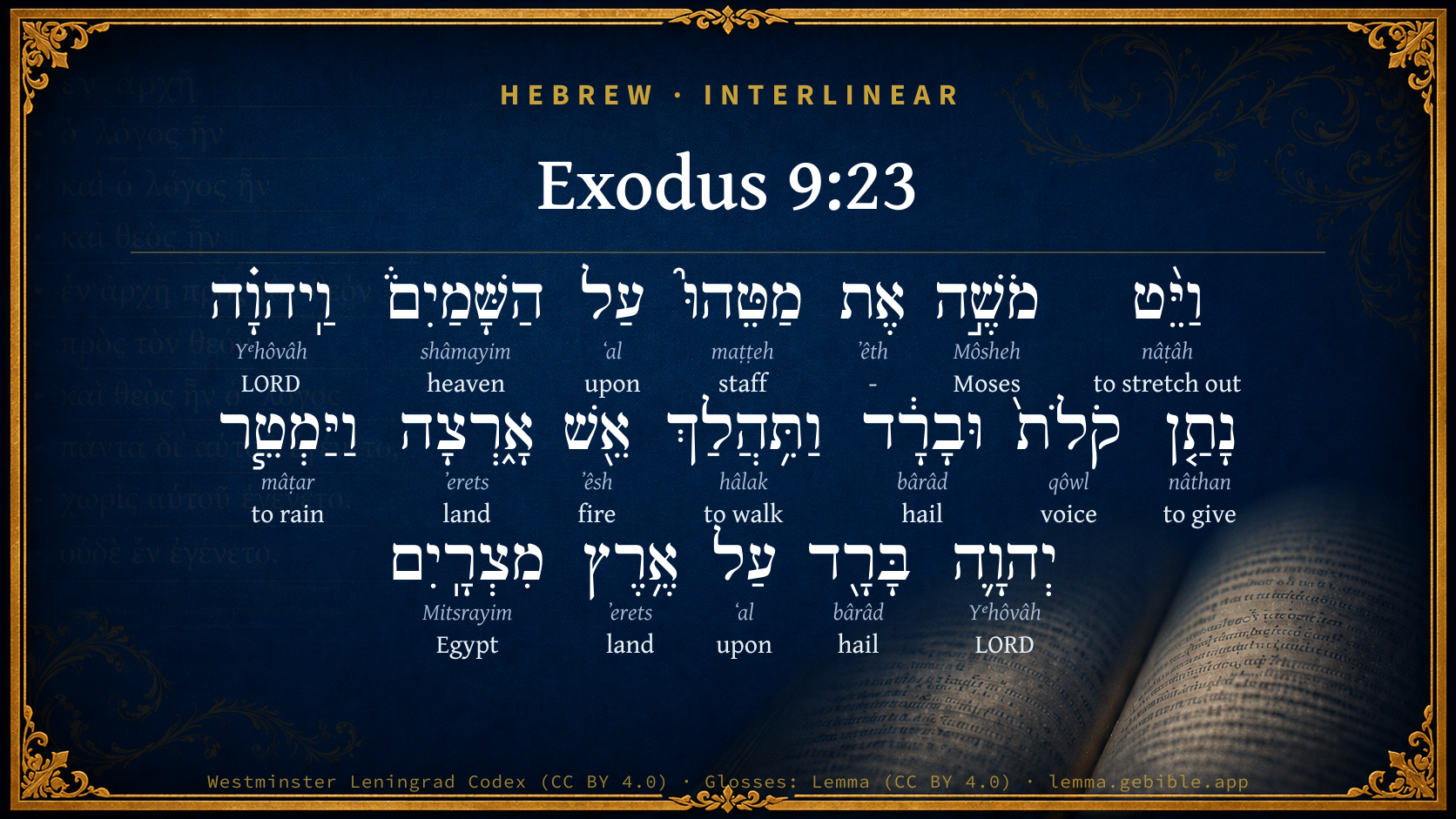
Hebrew (Westminster Leningrad Codex) Exodus 9:23 appears in the Hebrew Old Testament. The text above is from the Westminster Leningrad Codex. Each word links to its Strong’s number, a concise gloss, and parsing drawn from the Open Scriptures Hebrew Bible morphology. Click any word for its full Brown-Driver-Briggs (BDB) entry.
Download image
Cite this verse

Exodus 9:23 (World English Bible). Public Domain. Lemma interlinear Bible study tool, https://lemma.gebible.app/v/exodus/9/23.

Show BibTeX & RIS
BibTeX
RIS
English Translation
Moses stretched forth his rod toward the heavens, and Yahweh sent thunder, hail, and lightning flashed down to the earth. Yahweh rained hail on the land of Egypt.
World English Bible · Public Domain
Download a study sheet

One document with this verse’s original text, its word-by-word gloss line, the meaning frame, cross-references with their text, attributed commentary, and full source and license credits — printable, and it pastes into notes with its structure intact.

This verse Autodidact and up

Study sheet (.html) Plain text (.txt)

A passage Seminary Student

Up to 50 verses in one chapter. A passage sheet keeps up to 6 commentary sources and 12 cross-references per verse, in the order this page ranks them, and says so on the sheet whenever that leaves anything out. Ask for a single verse and you get the Autodidact verse sheet above.

Everything on this page stays free to read, with no account — the sheet is a download of what is already on screen, not access to it.

Want to remove ads? Support Godless Engineer
Compare translations 3

The same verse in 3 English versions, stacked beneath the original-language interlinear above. Click any original word for its lexicon entry.

Each is an independent rendering of the whole verse — the interlinear is not word-aligned to these translations.

Highlighted words mark where these versions differ — a whole-verse word diff, not a word-by-word alignment.

  • World English Bible Public Domain
    Moses stretched forth his rod toward the heavens, and Yahweh sent thunder, hail, and lightning flashed down to the earth. Yahweh rained hail on the land of Egypt.
  • King James Version Public Domain
    And Moses stretched forth his rod toward heaven: and the LORD sent thunder and hail, and the fire ran along upon the ground; and the LORD rained hail upon the land of Egypt.
  • unfoldingWord Literal Text CC BY-SA 4.0
    And Moses stretched his staff to the heavens, and Yahweh gave thunder and hail, and fire darted to the land. And Yahweh rained hail on the land of Egypt.

unfoldingWord Literal Text — © unfoldingWord, licensed CC BY-SA 4.0. Word-aligned USFM3 via Door43 (git.door43.org/unfoldingWord/en_ult).

Versions to compare (up to 4)

3 of 4 selected

Show all 17 translations

Every available English version of this verse, each an independent rendering of the whole verse.

  • World English Bible Public Domain
    Moses stretched forth his rod toward the heavens, and Yahweh sent thunder, hail, and lightning flashed down to the earth. Yahweh rained hail on the land of Egypt.
  • Berean Standard Bible Public Domain
    So Moses stretched out his staff toward heaven, and the LORD sent thunder and hail, and lightning struck the earth. So the LORD rained down hail upon the land of Egypt.
  • Majority Standard Bible Public Domain
    So Moses stretched out his staff toward heaven, and the LORD sent thunder and hail, and lightning struck the earth. So the LORD rained down hail upon the land of Egypt.
  • King James Version Public Domain
    And Moses stretched forth his rod toward heaven: and the LORD sent thunder and hail, and the fire ran along upon the ground; and the LORD rained hail upon the land of Egypt.
  • American Standard Version (1901) Public Domain
    And Moses stretched forth his rod toward heaven: and Jehovah sent thunder and hail, and fire ran down unto the earth; and Jehovah rained hail upon the land of Egypt.
  • Revised Version (1885) Public Domain
    And Moses stretched forth his rod toward heaven: and the LORD sent thunder and hail, and fire ran down unto the earth; and the LORD rained hail upon the land of Egypt.
  • Geneva Bible (1599) Public Domain
    Then Moses stretched out his rod towarde heauen, and the Lord sent thunder and haile, and lightening vpon the ground: and the Lord caused haile to raine vpon the land of Egypt.
  • Young's Literal Translation Public Domain
    And Moses stretcheth out his rod towards the heavens, and Jehovah hath given voices and hail, and fire goeth towards the earth, and Jehovah raineth hail on the land of Egypt,
  • Literal Standard Version CC BY-SA 4.0
    And Moses stretches out his rod toward the heavens, and YHWH has given voices and hail, and fire goes toward the earth, and YHWH rains hail on the land of Egypt,
  • Unlocked Literal Bible CC BY-SA 4.0
    Moses reached out with his staff toward the sky, and Yahweh sent thunder, hail, and lightning to the ground. He also rained hail on the land of Egypt.
  • unfoldingWord Literal Text CC BY-SA 4.0
    And Moses stretched his staff to the heavens, and Yahweh gave thunder and hail, and fire darted to the land. And Yahweh rained hail on the land of Egypt.
  • Darby Bible Public Domain
    And Moses stretched out his staff toward the heavens, and Jehovah gave thunder and hail; and the fire ran along the ground; and Jehovah rained hail on the land of Egypt.
  • World Messianic Bible Public Domain
    Moses stretched out his rod toward the heavens, and the LORD sent thunder and hail; and lightning flashed down to the earth. The LORD rained hail on the land of Egypt.
  • Webster's Bible Public Domain
    And Moses stretched forth his rod towards heaven, and the LORD sent thunder and hail, and the fire ran along upon the ground: and the LORD rained hail upon the land of Egypt.
  • Free Bible Version CC BY-SA 4.0
    Moses held up his staff toward heaven, and the Lord sent thunder and hail, and made lightning hit the ground. This is how the Lord rained hail down on Egypt.
  • Bible in Basic English Public Domain
    And Moses put out his rod to heaven: and the Lord sent thunder, and an ice-storm, and fire running down on the earth; the Lord sent an ice-storm on the land of Egypt.
  • JPS Tanakh (1917) Public Domain
    And Moses stretched forth his rod toward heaven; and the LORD sent thunder and hail, and fire ran down unto the earth; and the LORD caused to hail upon the land of Egypt.

Literal Standard Version (2020), Covenant Press — licensed CC BY-SA 4.0. Text via the HelloAO Bible API (eBible.org). Unlocked Literal Bible (unfoldingWord) — licensed CC BY-SA 4.0. Text via the HelloAO Bible API (eBible.org). unfoldingWord Literal Text — © unfoldingWord, licensed CC BY-SA 4.0. Word-aligned USFM3 via Door43 (git.door43.org/unfoldingWord/en_ult). Free Bible Version, Dr. Jonathan Gallagher — licensed CC BY-SA 4.0. Text via the HelloAO Bible API (eBible.org).

Word by word

More ways to search: Search by grammar → Find every occurrence → Compare this word →

Practice this passage: Drill this verse → Learn its vocabulary →

וַיַּמְטֵ֧ר
mâṭar
H4305
“and · to rain”
Conjunction + Verb, Hiphil, Sequential Imperfect, 3rd Person, Masculine, Singular
Part of Speech
Conjunction + Verb
Stem
Hiphil
Form
Sequential Imperfect
Person
3rd Person
Gender
Masculine
Number
Singular
Full BDB Definition

Origin: a primitive root

TWOT: 1187

to rain - (Niphal) to be rained on or upon - (Hiphil) - to rain, send rain - to rain hail, send hail
  1. וַיֵּ֨ט nâṭâh H5186 “and · to stretch out” Conjunction + Verb, Qal, Sequential Imperfect, 3rd Person, Masculine, Singular
  2. מֹשֶׁ֣ה Môsheh H4872 “Moses” Noun, Proper
  3. אֶת ʼêth H853 “-” Particle, Direct Object
  4. מַטֵּהוּ֮ maṭṭeh H4294 “staff · his” Noun, Common, Masculine, Singular, Construct + Suffix, Personal, 3rd Person, Masculine, Singular
  5. עַל ʻal H5921 “upon” Preposition
  6. הַשָּׁמַיִם֒ shâmayim H8064 “the · heaven(s)” Particle, Definite Article + Noun, Common, Masculine, Plural, Absolute
  7. וַֽיהוָ֗ה Yᵉhôvâh H3068 “and · LORD” Conjunction + Noun, Proper
  8. נָתַ֤ן nâthan H5414 “to give” Verb, Qal, Perfect, 3rd Person, Masculine, Singular
  9. קֹלֹת֙ qôwl H6963 “voices” Noun, Common, Masculine, Plural, Absolute
  10. וּבָרָ֔ד bârâd H1259 “and · hail” Conjunction + Noun, Common, Masculine, Singular, Absolute
  11. וַתִּ֥הֲלַךְ hâlak H1980 “and · to walk” Conjunction + Verb, Qal, Sequential Imperfect, 3rd Person, Feminine, Singular
  12. אֵ֖שׁ ʼêsh H784 “fire” Noun, Common, Both, Singular, Absolute
  13. אָ֑רְצָה ʼerets H776 “land · toward” Noun, Common, Both, Singular, Absolute + Suffix, Demonstrative
  14. יְהוָ֛ה Yᵉhôvâh H3068 “LORD” Noun, Proper
  15. בָּרָ֖ד bârâd H1259 “hail” Noun, Common, Masculine, Singular, Absolute
  16. עַל ʻal H5921 “upon” Preposition
  17. אֶ֥רֶץ ʼerets H776 “land of” Noun, Common, Both, Singular, Construct
  18. מִצְרָֽיִם Mitsrayim H4714 “Egypt” Noun, Proper

About this verse

These counts appear in no published source. They are computed here, from the morphology-tagged text and Lemma’s own curated glosses. What Lemma adds →

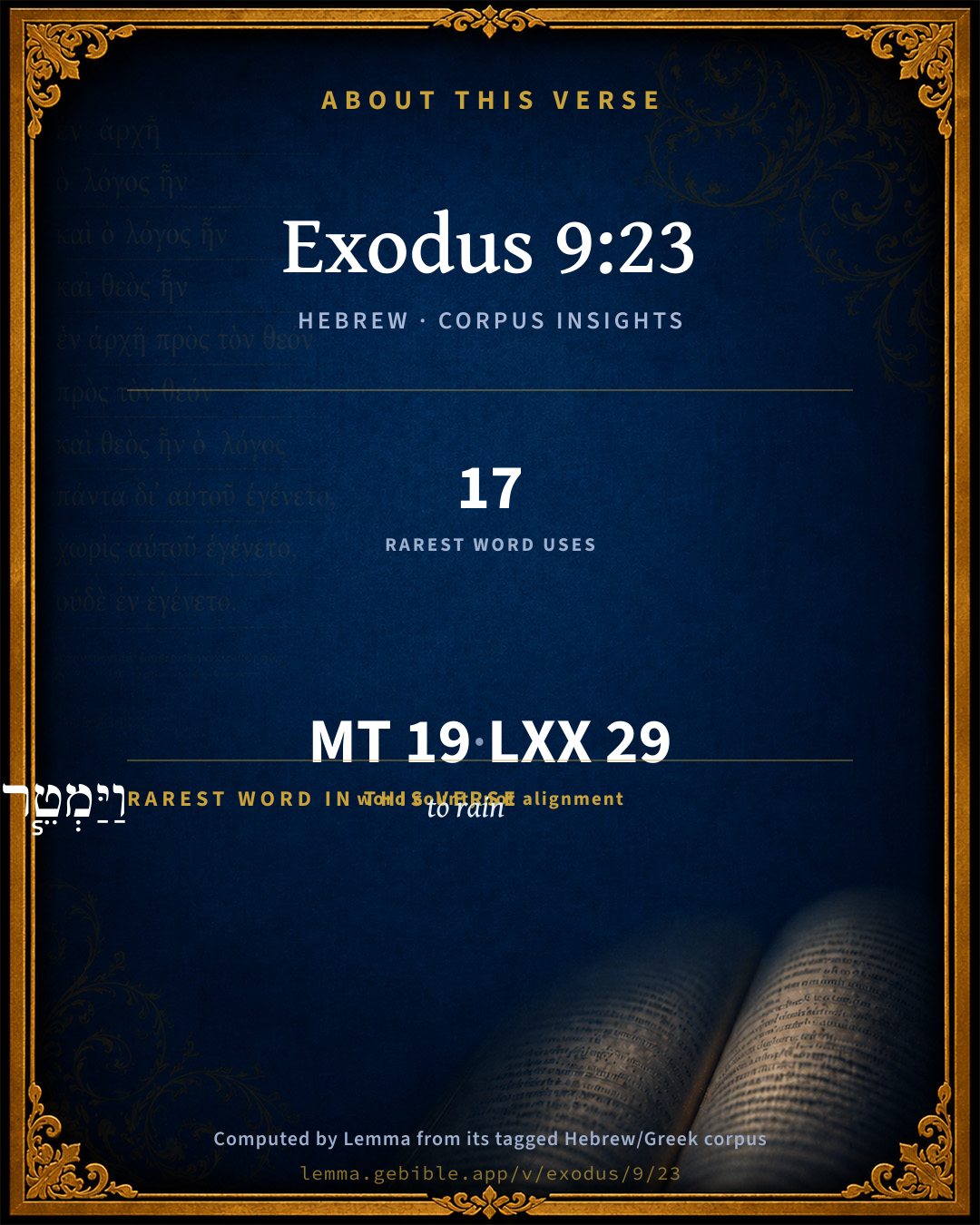
19
words
15
distinct lemmas
Pentateuch
section

Notable vocabulary

The rarest word here is וַיַּמְטֵ֧ר to rain H4305 — appearing just 17 times in the whole Hebrew Bible.

Shared distinctive vocabulary

וַיַּמְטֵ֧ר to rain H4305 occurs in 14 verses of the Hebrew Bible. Also found in:

Grammatical profile

  • 4 verbs
  • 12 nouns
  • 2 prepositions
  • 1 particle

Verb forms

  • וַיֵּ֨ט Qal · Sequential Imperfect
  • נָתַ֤ן Qal · Perfect
  • וַתִּ֥הֲלַךְ Qal · Sequential Imperfect
  • וַיַּמְטֵ֧ר Hiphil · Sequential Imperfect

Repetition

Words recur within this verse — often emphatic in Hebrew:

  • עַל upon H5921 ×2
  • וַֽיהוָ֗ה LORD H3068 ×2
  • וּבָרָ֔ד hail H1259 ×2
  • אָ֑רְצָה land H776 ×2

Hebrew & Septuagint length

In English translation the verse runs 28 words from the Hebrew and 34 from the Septuagint (LXX English) — closely comparable.

A rough comparison of the two English renderings, which tokenize alike — not a word-level alignment.

Word counts can differ between the Hebrew and the Greek without any difference in meaning — e.g. the Hebrew direct-object marker אֵת has no separate Greek word, and Greek often adds the article ὁ.

In the original languages it is 19 Hebrew tokens and 29 Greek tokens — but the two are counted differently (Hebrew bundles its prefixes and suffixes into one token; the Greek is in lemma form), so that isn’t a like-for-like length.

Cross-references

17

Topical passages linked to Exodus 9:23 in the Treasury of Scripture Knowledge — connected by theme and wording, ordered by reader-vote popularity; previews shown in the World English Bible.

  • Joshua 10:11 It happened, as they fled from before Israel, while they were at the descent of Beth Horon, that Yahweh cast down great stones from the sky on them to Azekah, and they died: they were more who died with the hailstones than they whom the children of Israel killed with the sword.
  • Psalms 18:13 Yahweh also thundered in the sky, The Most High uttered his voice: Hailstones and coals of fire.
  • Isaiah 30:30 Yahweh will cause his glorious voice to be heard, and will show the lighting down of his arm, with the indignation of [his] anger, and the flame of a devouring fire, with a blast, and tempest, and hailstones.
  • Ezekiel 38:22 With pestilence and with blood will I enter into judgment with him; and I will rain on him, and on his hordes, and on the many peoples who are with him, an overflowing shower, and great hailstones, fire, and sulfur.
  • Psalms 78:47–48 He destroyed their vines with hail, Their sycamore-fig trees with frost.
  • Psalms 148:8 Lightning and hail, snow and clouds; Stormy wind, fulfilling his word;
  • Revelation 8:7 The first sounded, and there followed hail and fire, mixed with blood, and they were thrown to the earth. One third of the earth was burnt up, and one third of the trees were burnt up, and all green grass was burnt up.
  • Psalms 29:3 Yahweh's voice is on the waters. The God of glory thunders, even Yahweh on many waters.
  • Psalms 77:18 The voice of your thunder was in the whirlwind. The lightnings lit up the world. The earth trembled and shook.
  • Psalms 105:32–33 He gave them hail for rain, With lightning in their land.
  • Exodus 19:16 It happened on the third day, when it was morning, that there were thunders and lightnings, and a thick cloud on the mountain, and the sound of an exceedingly loud trumpet; and all the people who were in the camp trembled.
  • Exodus 20:18 All the people perceived the thunderings, the lightnings, the sound of the trumpet, and the mountain smoking. When the people saw it, they trembled, and stayed at a distance.
  • 1 Samuel 12:17–18 Isn't it wheat harvest today? I will call to Yahweh, that he may send thunder and rain; and you shall know and see that your wickedness is great, which you have done in the sight of Yahweh, in asking you a king.
  • Job 37:1–5 "Yes, at this my heart trembles, And is moved out of its place.
  • Job 38:22–23 Have you entered the treasuries of the snow, Or have you seen the treasures of the hail,
  • Revelation 16:21 Great hailstones, about the weight of a talent, came down out of the sky on people. People blasphemed God because of the plague of the hail, for this plague is exceedingly severe.
  • Revelation 16:18 There were lightnings, sounds, and thunders; and there was a great earthquake, such as was not since there were men on the earth, so great an earthquake, so mighty.

Cross-references courtesy of OpenBible.info (CC BY 4.0).

Hebrew and Greek witnesses Masoretic Hebrew ↔ Greek Septuagint

The same verse in the two great witnesses to the Old Testament, shown verse-for-verse.

These are two independent witnesses, not word-aligned to each other, and the Septuagint is shown in lemma (dictionary) form.

Hebrew Exodus 9:23 Masoretic · Westminster Leningrad Codex

וַיֵּ֨ט מֹשֶׁ֣ה אֶת מַטֵּהוּ֮ עַל הַשָּׁמַיִם֒ וַֽיהוָ֗ה נָתַ֤ן קֹלֹת֙ וּבָרָ֔ד וַתִּ֥הֲלַךְ אֵ֖שׁ אָ֑רְצָה וַיַּמְטֵ֧ר יְהוָ֛ה בָּרָ֖ד עַל אֶ֥רֶץ מִצְרָֽיִם

Moses stretched forth his rod toward the heavens, and Yahweh sent thunder, hail, and lightning flashed down to the earth. Yahweh rained hail on the land of Egypt.

World English Bible · Public Domain

Greek LXX Exodus 9:23 Septuagint · lemma form

ἐκτείνω δέ μωυσῆς ὁ χείρ εἰς ὁ οὐρανός καί κύριος δίδωμι φωνή καί χάλαζα καί διατρέχω ὁ πῦρ ἐπί ὁ γῆ καί βρέχω κύριος χάλαζα ἐπί πᾶς γῆ αἴγυπτος

And Moses stretched forth his hand to heaven, and the Lord sent thunderings and hail; and the fire ran along upon the ground, and the Lord rained hail on all the land of Egypt.

LXX2012 (modern English Septuagint) · Public Domain

Hebrew: Westminster Leningrad Codex (CC BY 4.0). Greek: Septuagint (public domain); English from LXX2012 (modern English Septuagint) (Public Domain). How the Septuagint differs from the Hebrew →

Targum (Aramaic paraphrase)

2

The Targum is the ancient Jewish Aramaic paraphrase of the Hebrew Scriptures — an interpretive translation, not the Hebrew text itself. Onkelos (literal) and Pseudo-Jonathan (expansive) render the Torah, and Jonathan the Prophets. Coverage is partial: where no permissively-licensed English translation exists for a verse, only the Aramaic is shown. This is verse-level text, not a word-by-word alignment to the Hebrew.

  1. Targum Onkelos Torah (Genesis–Deuteronomy)
    וַאֲרֵים משֶׁה יָת חֻטְרֵהּ עַל צֵית שְׁמַיָא וַיְיָ יְהַב קָלִין וּבַרְדָא וּמְהַלְכָא אֶשָׁתָא עַל אַרְעָא וְאַמְטַר יְיָ בַּרְדָא עַל אַרְעָא דְמִצְרָיִם:

    (no public-domain English translation for this verse)

    Targum Onkelos — Aramaic: “Onkelos Genesis” (public domain); “Onkelos Exodus” (public domain); “Onkelos Leviticus” (public domain); “Onkelos Numbers” (public domain); “Onkelos Deuteronomy” (public domain). English: “Sefaria Community Translation” (CC0 1.0 (public-domain dedication)); “J.W. Etheridge. The Targums of Onkelos and Jonathan Ben Uzziel on the Pentateuch. London: Longmans, Green, 1862” (public domain). Text via Sefaria.

  2. Targum Pseudo-Jonathan Torah (Genesis–Deuteronomy)
    וַאֲרֵים משֶׁה יַת חוּטְרֵיהּ עַל צֵית שְׁמַיָא וַיְיָ יְהַב קָלִין וּבַרְדִין וּמְצַלְהֲבָא אֵישָׁתָא עַל אַרְעָא וְאָחִית יְיָ בַּרְדָא עַל אַרְעָא דְמִצְרָיִם

    And Mosheh lifted up his rod toward the height of the heavens, and the Lord gave forth thunders and hailstones with flaming, fire upon the ground; the Lord made the hail descend upon the land of Mizraim.

    Targum Pseudo-Jonathan — Aramaic: “Targum Jonathan on Genesis” (public domain); “Targum Jonathan on Exodus” (public domain); “Targum Jonathan on Leviticus” (public domain); “Targum Jonathan on Numbers” (public domain); “Targum Jonathan on Deuteronomy” (public domain). English: “The Targum of Jonathan ben Uzziel, trans. J. W. Etheridge, London, 1862” (public domain). Text via Sefaria.

Commentary

Notes on Exodus 9:23 from classic Christian and Jewish commentators (each source and its license shown beneath its notes). The classic Christian expositions comment on the surrounding passage and are grouped to its opening verse, so a note may address several verses; the Jewish commentaries on the Tanakh (Rashi and others) are per-verse, so they appear only where the commentator wrote on this verse.

Lemma curates 59 commentaries, every one of them public domain or Creative Commons licensed, each selected and text-cleaned for this edition rather than reprinted as found. About our sources →

Trapp's Complete Commentary

John Trapp

Exo 9:23 And Moses stretched forth his rod toward heaven: and the LORD sent thunder and hail, and the fire ran along upon the ground; and the LORD rained hail upon the land of Egypt.

Ver. 23. And the fire ran along upon the ground.] Such "hailstones and coals of fire" we also read of in Psa 18:13-15 Isa 30:30-31; and in the Roman history, when Marcus Antonius the philosopher fought with the Quades, and by the prayers of the thundering legion - κεραυνοβολος, as they were afterwards called - of the Christians, rain was obtained to the refreshing of the Roman army, ingens grando compluraque fulmina in hostes ceciderunt: Itaque licebat videre in eodem loco aquam ignemque simul de coelo cadere, atque ob eam causam, Romanos valere ac bibere. Quados exuri et penitus interire. i.e., A huge hail and many lightening bolts fell upon the enemy; fire and water fell at once from heaven; the Romans drank of the water and were relieved; the Quades were burnt by the fire, and perished. {a}

{a} Dio, in Vita M. Ant. Phil.

John Trapp, A Commentary or Exposition upon All the Books of the Old and New Testament (1647–1656) — public domain. Text from a community e-Sword module.

Geneva Bible (1599)

Geneva Bible translators

Hebrew, fire walked.

The seventh plague.

Geneva Bible (1599) marginal notes — public domain. Text via Bolls.life.

Adam Clarke's Commentary

Verse 23. The Lord sent thunder] קלת koloth, voices; but loud, repeated peals of thunder are meant.

And the fire ran along upon the ground] ותהלך אש ארצה vattihalac esh aretsah, and the fire walked upon the earth. It was not a sudden flash of lightning, but a devouring fire, walking through every part, destroying both animals and vegetables; and its progress was irresistible.

Adam Clarke's Commentary on the Bible (1810–1826) — public domain. Text from a community e-Sword/MySword module.

Ellicott's Commentary for English Readers

(23) The fire ran along upon the ground.—Heb., fire walked earthwards. Kalisch and Knobel understand by this mere ordinary lightning, but Aben-Ezra, Canon Cook, and others think that the phenomenon was such as our Version well expresses. There is no doubt that the electric fluid occasionally takes a form which has something of permanency, continuing several seconds, or even minutes, either stationary or with a slow motion. Appearances of this kind have been called “fire-balls,” and indicate an excessive electrical disturbance, involving great peril to life and property. If the expression “fire walked earthwards” does not imply anything of this kind, yet the peculiar phrase of Exo_9:24 would seem to do so.

A Bible Commentary for English Readers, edited by Charles John Ellicott (1878–1897) — public domain. Text from a community e-Sword module.

John Gill's Exposition

And Moses stretched forth his rod toward heaven,.... The same which Aaron had made use of before, but was now in the hand of Moses, and whose rod it properly was:

and the Lord sent thunder and hail, and the fire ran along upon the ground, hot thunderbolts, which struck their flocks, Psa 78:48 and hail which fell so thick and weighty as to destroy both men and cattle, and break trees in pieces, and spoil the corn, the grass, and the tender herb; and fire, that is lightning, which descended so low, and in such quantities, as ran along the ground, and consumed all it met with. Artapanus (g), an Heathen writer, who speaks of this storm of hail, says, that Moses, besides the hail, caused earthquakes by night, so that those that escaped the earthquakes were taken away by the hail, and those that escaped the hail perished by the earthquakes, which he says overthrew all the houses, and most of the temples:

and the Lord rained hail upon the land of Egypt; upon Egypt, where rain was not common, and on all the land of Egypt, when in some parts of it it was scarce known, and hail as thick as rain; ice, snow, and hail, are most rarely if ever seen there, the air not being cold enough for the production of them (h). This was the Lord's immediate doing, when there was no likelihood of it, nor any appearance of second causes concurring to produce it, and came at the exact time he had foretold it should; all which were very extraordinary.

(g) Apud Euseb. Praepar. Evangel. l. 9. c. 27. p. 435, 436. (h) Vid. Scheuchzer. Physica Sacra, vol. 1. p. 139.

John Gill's Exposition of the Whole Bible (1746–1763) — public domain (CC PDM 1.0). Text via the HelloAO Bible API.

Matthew Poole's English Annotations

The fire ran along upon the ground, devouring both herbs and cattle which were upon it, Psa 78:47,48; 105:32,33

Matthew Poole's English Annotations on the Holy Bible (1683–1685) — public domain. Text from a community e-Sword/MySword module.

The Pulpit Commentary

Moses stretched forth his rod. In the last set of three plagues, the earthly agent was Moses (Exo_9:10; Exo_10:13, Exo_10:22) whose diffidence seems to have worn off as time went on, and he became accustomed to put himself forward. Thunder and hail. Thunder had not been predicted; but it is a common accompaniment of a hail-storm, the change of temperature produced by the discharge of electricity no doubt conducing to the formation of hailstones. The fire ran along upon the ground. Some very peculiar electrical display seems to be intended something corresponding to the phenomena called "fireballs," where the electric fluid does not merely flash momentarily, but remains for several seconds, or even minutes, before it disappears.

The Pulpit Commentary (1880–1919), ed. H.D.M. Spence-Jones & Joseph S. Exell — public domain. Text from a community e-Sword module.

Lesson kit

Teaching starters — assembled from the data on this page, not authored interpretation. Every prompt links to the verse data it draws on. Edit before teaching.

Exodus, in the Pentateuch, opens this verse with 19 words (15 distinct Hebrew lemmas). Its most distinctive word is mâṭar (“to rain”). A historical commentator’s framing appears above. Read the whole chapter for the surrounding context.

Discussion questions

  1. How does “to rain” (mâṭar) shape what this verse is saying?
  2. Genesis 2:5 shares the word «to rain» with this verse. How do the two illuminate each other?
  3. “upon” occurs 2× in this one verse. What is the effect of the repetition?
  4. The translations on this page render this verse differently — a whole-verse word diff, not a word-by-word alignment. What might account for the different wordings?
  5. The verb «וַיֵּ֨ט» is Qal Sequential Imperfect. How does its form color the action?
  6. Reading how Trapp's Complete Commentary and Geneva Bible (1599) read this verse, where do the two commentators agree and where do they part?

Things to notice

Reading settings

Reading text

Shown beneath each verse's original-language words.

Old Testament
Old Testament edition

Read the OT as the Masoretic Hebrew (MT) or the Greek Septuagint (LXX).

English shown for the Greek Septuagint (in the Hebrew ↔ Greek comparison).

Comparing translations? Open the Compare panel on any verse page to stack up to four side by side.