
Exodus 12:23

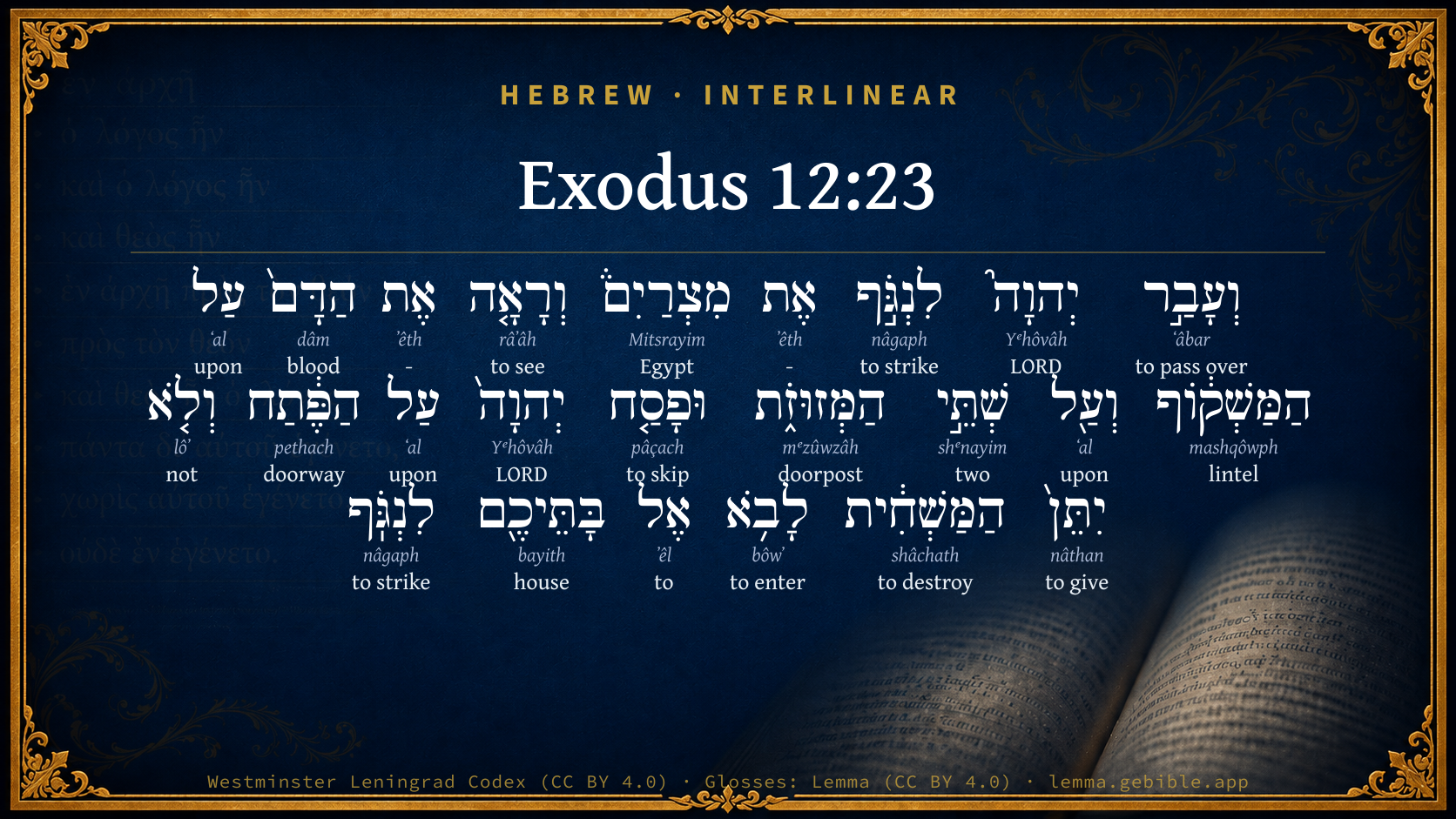
Hebrew (Westminster Leningrad Codex) Exodus 12:23 appears in the Hebrew Old Testament. The text above is from the Westminster Leningrad Codex. Each word links to its Strong’s number, a concise gloss, and parsing drawn from the Open Scriptures Hebrew Bible morphology. Click any word for its full Brown-Driver-Briggs (BDB) entry.
Download image
Cite this verse

Exodus 12:23 (World English Bible). Public Domain. Lemma interlinear Bible study tool, https://lemma.gebible.app/v/exodus/12/23.

Show BibTeX & RIS
BibTeX
RIS
English Translation
For Yahweh will pass through to strike the Egyptians; and when he sees the blood on the lintel, and on the two side-posts, Yahweh will pass over the door, and will not allow the destroyer to come in to your houses to strike you.
World English Bible · Public Domain
Download a study sheet

One document with this verse’s original text, its word-by-word gloss line, the meaning frame, cross-references with their text, attributed commentary, and full source and license credits — printable, and it pastes into notes with its structure intact.

This verse Autodidact and up

Study sheet (.html) Plain text (.txt)

A passage Seminary Student

Up to 50 verses in one chapter. A passage sheet keeps up to 6 commentary sources and 12 cross-references per verse, in the order this page ranks them, and says so on the sheet whenever that leaves anything out. Ask for a single verse and you get the Autodidact verse sheet above.

Everything on this page stays free to read, with no account — the sheet is a download of what is already on screen, not access to it.

Want to remove ads? Support Godless Engineer
Compare translations 3

The same verse in 3 English versions, stacked beneath the original-language interlinear above. Click any original word for its lexicon entry.

Each is an independent rendering of the whole verse — the interlinear is not word-aligned to these translations.

Highlighted words mark where these versions differ — a whole-verse word diff, not a word-by-word alignment.

  • World English Bible Public Domain
    For Yahweh will pass through to strike the Egyptians; and when he sees the blood on the lintel, and on the two side-posts, Yahweh will pass over the door, and will not allow the destroyer to come in to your houses to strike you.
  • King James Version Public Domain
    For the LORD will pass through to smite the Egyptians; and when he seeth the blood upon the lintel, and on the two side posts, the LORD will pass over the door, and will not suffer the destroyer to come in unto your houses to smite you.
  • unfoldingWord Literal Text CC BY-SA 4.0
    And Yahweh will pass through to strike the Egyptians. And he will see the blood on the lintel and on the two doorposts, and Yahweh will pass over the door and will not permit the causer of destruction to enter into your houses to strike.

unfoldingWord Literal Text — © unfoldingWord, licensed CC BY-SA 4.0. Word-aligned USFM3 via Door43 (git.door43.org/unfoldingWord/en_ult).

Versions to compare (up to 4)

3 of 4 selected

Show all 18 translations

Every available English version of this verse, each an independent rendering of the whole verse.

  • World English Bible Public Domain
    For Yahweh will pass through to strike the Egyptians; and when he sees the blood on the lintel, and on the two side-posts, Yahweh will pass over the door, and will not allow the destroyer to come in to your houses to strike you.
  • Berean Standard Bible Public Domain
    When the LORD passes through to strike down the Egyptians, He will see the blood on the top and sides of the doorframe and will pass over that doorway; so He will not allow the destroyer to enter your houses and strike you down.
  • Majority Standard Bible Public Domain
    When the LORD passes through to strike down the Egyptians, He will see the blood on the top and sides of the doorframe and will pass over that doorway; so He will not allow the destroyer to enter your houses and strike you down.
  • King James Version Public Domain
    For the LORD will pass through to smite the Egyptians; and when he seeth the blood upon the lintel, and on the two side posts, the LORD will pass over the door, and will not suffer the destroyer to come in unto your houses to smite you.
  • American Standard Version (1901) Public Domain
    For Jehovah will pass through to smite the Egyptians; and when he seeth the blood upon the lintel, and on the two side-posts, Jehovah will pass over the door, and will not suffer the destroyer to come in unto your houses to smite you.
  • Revised Version (1885) Public Domain
    For the LORD will pass through to smite the Egyptians; and when he seeth the blood upon the lintel, and on the two side posts, the LORD will pass over the door, and will not suffer the destroyer to come in unto your houses to smite you.
  • Geneva Bible (1599) Public Domain
    For the Lord will passe by to smite the Egyptians: and when he seeth the blood vpon the lintel and on the two doore cheekes, the Lord wil passe ouer the doore, and wil not suffer the destroyer to come into your houses to plague you.
  • Douay-Rheims (1899) Public Domain
    For the Lord will pass through striking the Egyptians: and when he shall see the blood on the transom, and on both the posts, he will pass over the door of the house, and not suffer the destroyer to come into your houses and to hurt you.
  • Young's Literal Translation Public Domain
    `And Jehovah hath passed on to smite the Egyptians, and hath seen the blood on the lintel, and on the two side-posts, and Jehovah hath passed over the opening, and doth not permit the destruction to come into your houses to smite.
  • Literal Standard Version CC BY-SA 4.0
    And YHWH has passed on to strike the Egyptians, and has seen the blood on the lintel, and on the two doorposts, and YHWH has passed over the opening, and does not permit the destruction to come into your houses to strike.
  • Unlocked Literal Bible CC BY-SA 4.0
    For Yahweh will pass through to attack the Egyptians. When he sees the blood on the top of the doorframe and on the two doorposts, he will pass over your door and not permit the destroyer to come into your houses to attack you.
  • unfoldingWord Literal Text CC BY-SA 4.0
    And Yahweh will pass through to strike the Egyptians. And he will see the blood on the lintel and on the two doorposts, and Yahweh will pass over the door and will not permit the causer of destruction to enter into your houses to strike.
  • Darby Bible Public Domain
    And Jehovah will pass through to smite the Egyptians; and when he sees the blood on the lintel, and on the two door-posts, Jehovah will pass over the door, and will not suffer the destroyer to come into your houses to smite [you].
  • World Messianic Bible Public Domain
    For the LORD will pass through to strike the Egyptians; and when he sees the blood on the lintel, and on the two door posts, the LORD will pass over the door, and will not allow the destroyer to come in to your houses to strike you.
  • Webster's Bible Public Domain
    For the LORD will pass through to smite the Egyptians; and when he seeth the blood upon the lintel, and on the two side-posts, the LORD will pass over the door, and will not suffer the destroyer to come in to your houses to smite you.
  • Free Bible Version CC BY-SA 4.0
    When the Lord passes through to punish the Egyptians, he will see the blood on the top and sides of the doorframe. He will pass over the door, and he will not allow the destroyer to enter your houses and kill you.
  • Bible in Basic English Public Domain
    For the Lord will go through the land, sending death on the Egyptians; and when he sees the blood on the two sides and the top of the door, the Lord will go over your door and will not let death come in for your destruction.
  • JPS Tanakh (1917) Public Domain
    For the LORD will pass through to smite the Egyptians; and when He seeth the blood upon the lintel, and on the two side-posts, the LORD will pass over the door, and will not suffer the destroyer to come in unto your houses to smite you.

Literal Standard Version (2020), Covenant Press — licensed CC BY-SA 4.0. Text via the HelloAO Bible API (eBible.org). Unlocked Literal Bible (unfoldingWord) — licensed CC BY-SA 4.0. Text via the HelloAO Bible API (eBible.org). unfoldingWord Literal Text — © unfoldingWord, licensed CC BY-SA 4.0. Word-aligned USFM3 via Door43 (git.door43.org/unfoldingWord/en_ult). Free Bible Version, Dr. Jonathan Gallagher — licensed CC BY-SA 4.0. Text via the HelloAO Bible API (eBible.org).

Word by word

More ways to search: Search by grammar → Find every occurrence → Compare this word →

Practice this passage: Drill this verse → Learn its vocabulary →

הַמַּשְׁק֔וֹף
mashqôwph
H4947
“the · lintel”
Particle, Definite Article + Noun, Common, Masculine, Singular, Absolute
Part of Speech
Particle + Noun
Type
Common
Gender
Masculine
Number
Singular
State
Absolute
Full BDB Definition

Origin: from H8259 in its original sense of overhanging

TWOT: 2458c

lintel (of door)
  1. וְעָבַ֣ר ʻâbar H5674 “and · to pass over” Conjunction + Verb, Qal, Sequential Perfect, 3rd Person, Masculine, Singular
  2. יְהוָה֮ Yᵉhôvâh H3068 “LORD” Noun, Proper
  3. לִנְגֹּ֣ף nâgaph H5062 “to strike” Preposition + Verb, Qal, Infinitive Construct
  4. אֶת ʼêth H853 “-” Particle, Direct Object
  5. מִצְרַיִם֒ Mitsrayim H4714 “Egypt” Noun, Proper
  6. וְרָאָ֤ה râʼâh H7200 “and · to see” Conjunction + Verb, Qal, Sequential Perfect, 3rd Person, Masculine, Singular
  7. אֶת ʼêth H853 “-” Particle, Direct Object
  8. הַדָּם֙ dâm H1818 “the · blood” Particle, Definite Article + Noun, Common, Masculine, Singular, Absolute
  9. עַל ʻal H5921 “upon” Preposition
  10. וְעַ֖ל ʻal H5921 “and · upon” Conjunction + Preposition
  11. שְׁתֵּ֣י shᵉnayim H8147 “two” Adjective, Cardinal number, Feminine, Dual, Construct
  12. הַמְּזוּזֹ֑ת mᵉzûwzâh H4201 “the · doorposts” Particle, Definite Article + Noun, Common, Feminine, Plural, Absolute
  13. וּפָסַ֤ח pâçach H6452 “and · to skip” Conjunction + Verb, Qal, Sequential Perfect, 3rd Person, Masculine, Singular
  14. יְהוָה֙ Yᵉhôvâh H3068 “LORD” Noun, Proper
  15. עַל ʻal H5921 “upon” Preposition
  16. הַפֶּ֔תַח pethach H6607 “the · doorway” Particle, Definite Article + Noun, Common, Masculine, Singular, Absolute
  17. וְלֹ֤א lôʼ H3808 “and · not” Conjunction + Particle, Negative
  18. יִתֵּן֙ nâthan H5414 “to give” Verb, Qal, Imperfect, 3rd Person, Masculine, Singular
  19. הַמַּשְׁחִ֔ית shâchath H7843 “the · destroyer” Particle, Definite Article + Noun, Common, Masculine, Singular, Absolute
  20. לָבֹ֥א bôwʼ H935 “to enter” Preposition + Verb, Qal, Infinitive Construct
  21. אֶל ʼêl H413 “to” Preposition
  22. בָּתֵּיכֶ֖ם bayith H1004 “houses · your” Noun, Common, Masculine, Plural, Construct + Suffix, Personal, 2nd Person, Masculine, Plural
  23. לִנְגֹּֽף nâgaph H5062 “to strike” Preposition + Verb, Qal, Infinitive Construct

About this verse

These counts appear in no published source. They are computed here, from the morphology-tagged text and Lemma’s own curated glosses. What Lemma adds →

24
words
19
distinct lemmas
Pentateuch
section

Notable vocabulary

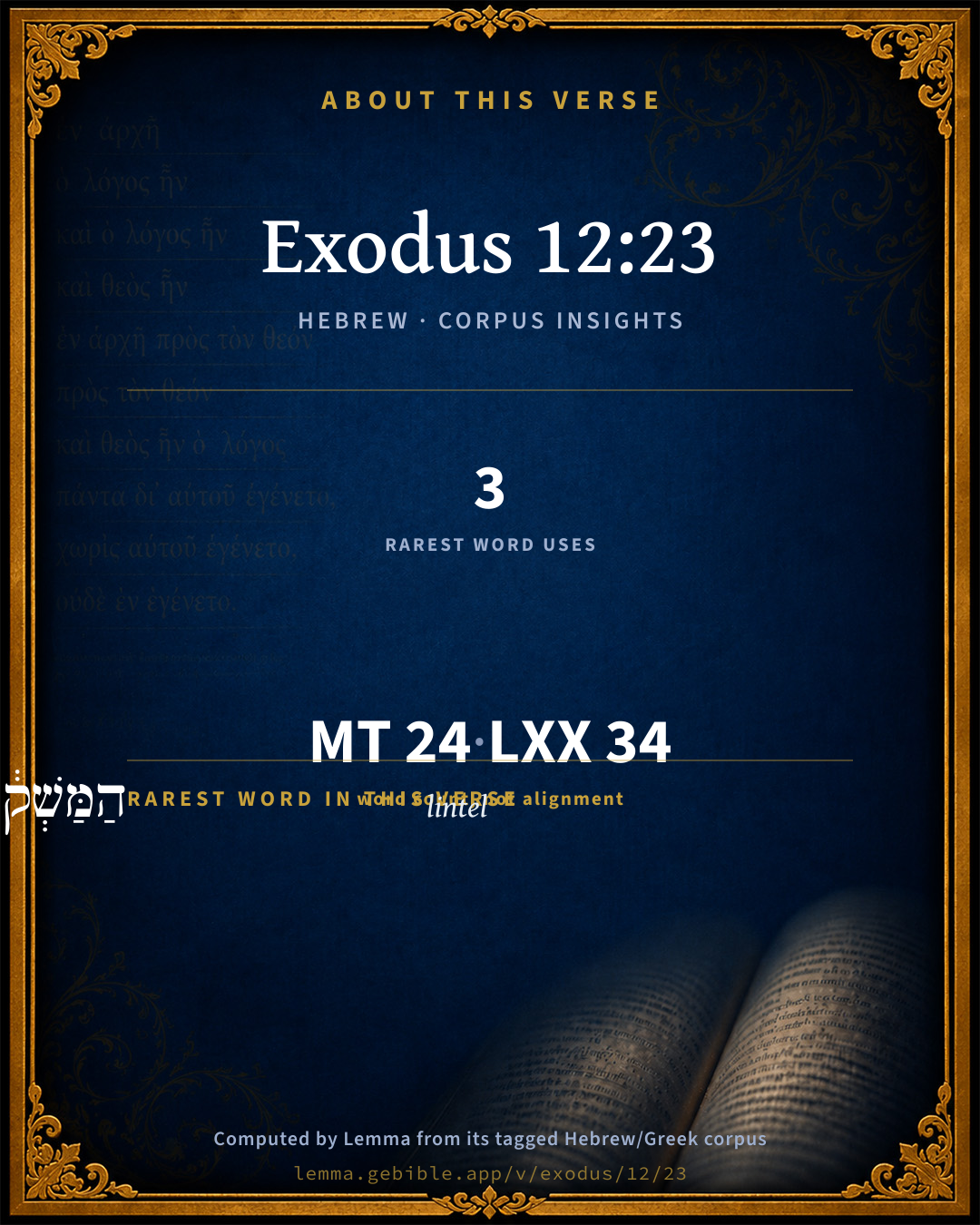
The rarest word here is הַמַּשְׁק֔וֹף lintel H4947 — appearing just 3 times in the whole Hebrew Bible.

Shared distinctive vocabulary

הַמַּשְׁק֔וֹף lintel H4947 occurs in 3 verses of the Hebrew Bible. Also found in:

Grammatical profile

  • 7 verbs
  • 9 nouns
  • 1 adjective
  • 4 prepositions
  • 3 particles

Verb forms

  • וְעָבַ֣ר Qal · Sequential Perfect
  • לִנְגֹּ֣ף Qal · Infinitive Construct
  • וְרָאָ֤ה Qal · Sequential Perfect
  • וּפָסַ֤ח Qal · Sequential Perfect
  • יִתֵּן֙ Qal · Imperfect
  • לָבֹ֥א Qal · Infinitive Construct
  • לִנְגֹּֽף Qal · Infinitive Construct

Repetition

Words recur within this verse — often emphatic in Hebrew:

  • עַל upon H5921 ×3
  • יְהוָה֮ LORD H3068 ×2
  • לִנְגֹּ֣ף to strike H5062 ×2

Hebrew & Septuagint length

In English translation the verse runs 44 words from the Hebrew and 45 from the Septuagint (LXX English) — closely comparable.

A rough comparison of the two English renderings, which tokenize alike — not a word-level alignment.

Word counts can differ between the Hebrew and the Greek without any difference in meaning — e.g. the Hebrew direct-object marker אֵת has no separate Greek word, and Greek often adds the article ὁ.

In the original languages it is 24 Hebrew tokens and 34 Greek tokens — but the two are counted differently (Hebrew bundles its prefixes and suffixes into one token; the Greek is in lemma form), so that isn’t a like-for-like length.

Cross-references

10

Topical passages linked to Exodus 12:23 in the Treasury of Scripture Knowledge — connected by theme and wording, ordered by reader-vote popularity; previews shown in the World English Bible.

  • Revelation 7:3 saying, "Don't harm the earth, neither the sea, nor the trees, until we have sealed the bondservants of our God on their foreheads!"
  • Revelation 9:4 They were told that they should not hurt the grass of the earth, neither any green thing, neither any tree, but only those people who don't have God's seal on their foreheads.
  • Hebrews 11:28 By faith, he kept the Passover, and the sprinkling of the blood, that the destroyer of the firstborn should not touch them.
  • Exodus 12:12–13 For I will go through the land of Egypt in that night, and will strike all the firstborn in the land of Egypt, both man and animal. Against all the gods of Egypt I will execute judgments: I am Yahweh.
  • 1 Corinthians 10:10 Neither grumble, as some of them also grumbled, and perished by the destroyer.
  • Ezekiel 9:6 kill utterly the old man, the young man and the virgin, and little children and women; but don't come near any man on whom is the mark: and begin at my sanctuary. Then they began at the old men that were before the house.
  • 2 Samuel 24:16 When the angel stretched out his hand toward Jerusalem to destroy it, Yahweh repented him of the evil, and said to the angel who destroyed the people, It is enough; now stay your hand. The angel of Yahweh was by the threshing floor of Araunah the Jebusite.
  • Isaiah 37:36 The angel of Yahweh went forth, and struck in the camp of the Assyrians one hundred and eighty-five thousand; and when men arose early in the morning, behold, these were all dead bodies.
  • Ezekiel 9:4 Yahweh said to him, Go through the midst of the city, through the midst of Jerusalem, and set a mark on the foreheads of the men that sigh and that cry over all the abominations that are done in the midst of it.
  • Hebrews 12:24 to Jesus, the mediator of a new covenant, and to the blood of sprinkling that speaks better than that of Abel.

Cross-references courtesy of OpenBible.info (CC BY 4.0).

Hebrew and Greek witnesses Masoretic Hebrew ↔ Greek Septuagint

The same verse in the two great witnesses to the Old Testament, shown verse-for-verse.

These are two independent witnesses, not word-aligned to each other, and the Septuagint is shown in lemma (dictionary) form.

Hebrew Exodus 12:23 Masoretic · Westminster Leningrad Codex

וְעָבַ֣ר יְהוָה֮ לִנְגֹּ֣ף אֶת מִצְרַיִם֒ וְרָאָ֤ה אֶת הַדָּם֙ עַל הַמַּשְׁק֔וֹף וְעַ֖ל שְׁתֵּ֣י הַמְּזוּזֹ֑ת וּפָסַ֤ח יְהוָה֙ עַל הַפֶּ֔תַח וְלֹ֤א יִתֵּן֙ הַמַּשְׁחִ֔ית לָבֹ֥א אֶל בָּתֵּיכֶ֖ם לִנְגֹּֽף

For Yahweh will pass through to strike the Egyptians; and when he sees the blood on the lintel, and on the two side-posts, Yahweh will pass over the door, and will not allow the destroyer to come in to your houses to strike you.

World English Bible · Public Domain

Greek LXX Exodus 12:23 Septuagint · lemma form

καί παραἔρχομαι κύριος πατάσσω ὁ αἰγύπτιος καί ὁράω ὁ αἷμα ἐπί ὁ φλιά καί ἐπί ἀμφότεροι ὁ σταθμός καί παραἔρχομαι κύριος ὁ θύρα καί οὐ ἀποἵημι ὁ ὀλεθρεύω εἰςἔρχομαι εἰς ὁ οἰκία σύ πατάσσω

And the Lord shall pass by to strike the Egyptians, and shall see the blood upon the lintel, and upon both the door-posts; and the Lord shall pass by the door, and shall not suffer the destroyer to enter into your houses to strike you.

LXX2012 (modern English Septuagint) · Public Domain

On this verse, Ellicott's Commentary for English Readers discusses the Septuagint’s reading. Read the note in Commentary ↓

Hebrew: Westminster Leningrad Codex (CC BY 4.0). Greek: Septuagint (public domain); English from LXX2012 (modern English Septuagint) (Public Domain). How the Septuagint differs from the Hebrew →

Targum (Aramaic paraphrase)

2

The Targum is the ancient Jewish Aramaic paraphrase of the Hebrew Scriptures — an interpretive translation, not the Hebrew text itself. Onkelos (literal) and Pseudo-Jonathan (expansive) render the Torah, and Jonathan the Prophets. Coverage is partial: where no permissively-licensed English translation exists for a verse, only the Aramaic is shown. This is verse-level text, not a word-by-word alignment to the Hebrew.

  1. Targum Onkelos Torah (Genesis–Deuteronomy)
    וְיִתְגְלֵי יְיָ לְמִמְחֵי יָת מִצְרַיִם וְיֶחֱזֵי יָת דְמָא עַל שַׁקְפָא וְעַל תְּרֵין סִפַּיָא וְיֵחוֹס יְיָ עַל תַּרְעָא וְלָא יִשְׁבּוֹק לְחַבָּלָא לְמֵיעַל לְבָתֵּיכוֹן לְמִמְחֵי:

    (no public-domain English translation for this verse)

    Targum Onkelos — Aramaic: “Onkelos Genesis” (public domain); “Onkelos Exodus” (public domain); “Onkelos Leviticus” (public domain); “Onkelos Numbers” (public domain); “Onkelos Deuteronomy” (public domain). English: “Sefaria Community Translation” (CC0 1.0 (public-domain dedication)); “J.W. Etheridge. The Targums of Onkelos and Jonathan Ben Uzziel on the Pentateuch. London: Longmans, Green, 1862” (public domain). Text via Sefaria.

  2. Targum Pseudo-Jonathan Torah (Genesis–Deuteronomy)
    וְיִתְגְּלֵי יְקָרָא דַיְיָ לְמִימְחֵי יַת מִצְרָאֵי וְיֶחֱמֵי יַת אַדְמָא דְעַל אִסְקוֹפָא וְעַל תַּרְתֵּין סִיפַיָא וְיָגִין מֵימְרָא דַיְיָ עַל תַּרְעָא וְלָא יִשְׁבּוֹק מַלְאָכָא מְחַבְּלָא לְמֵיעוֹל לְבָתֵּיכוֹן לְמִימְחֵי

    For the Glory of the Lord will be manifested in striking the Mizraee, and He will see the blood upon the lintel and upon the too posts, and the Word of the Lord will spread His protection over the door, and the destroying angel will not be permitted to enter your houses to smite.

    Targum Pseudo-Jonathan — Aramaic: “Targum Jonathan on Genesis” (public domain); “Targum Jonathan on Exodus” (public domain); “Targum Jonathan on Leviticus” (public domain); “Targum Jonathan on Numbers” (public domain); “Targum Jonathan on Deuteronomy” (public domain). English: “The Targum of Jonathan ben Uzziel, trans. J. W. Etheridge, London, 1862” (public domain). Text via Sefaria.

Commentary

Notes on Exodus 12:23 from classic Christian and Jewish commentators (each source and its license shown beneath its notes). The classic Christian expositions comment on the surrounding passage and are grouped to its opening verse, so a note may address several verses; the Jewish commentaries on the Tanakh (Rashi and others) are per-verse, so they appear only where the commentator wrote on this verse.

Lemma curates 59 commentaries, every one of them public domain or Creative Commons licensed, each selected and text-cleaned for this edition rather than reprinted as found. About our sources →

Trapp's Complete Commentary

John Trapp

Exo 12:23 For the LORD will pass through to smite the Egyptians; and when he seeth the blood upon the lintel, and on the two side posts, the LORD will pass over the door, and will not suffer the destroyer to come in unto your houses to smite [you].

Ver. 23. Will not suffer the destroyer.] Angels delight to be executioners of God’s judgments, and saviours of his people.

John Trapp, A Commentary or Exposition upon All the Books of the Old and New Testament (1647–1656) — public domain. Text from a community e-Sword module.

Joseph Benson's Commentary

Exo 12:23. The destroyer — The destroying angel: whether this was a good or an evil angel, we have not light to determine.

Joseph Benson's Commentary on the Old and New Testaments (1811–1818) — public domain. Text from a community e-Sword module.

Geneva Bible (1599)

Geneva Bible translators

The Angel sent of God to kill the firstborn.

Geneva Bible (1599) marginal notes — public domain. Text via Bolls.life.

Ellicott's Commentary for English Readers

(23) The destroyer.—The “plague” of Exo_12:13 is here called “the destroyer” (τὸν ὀλεθρεύοντα, LXX.), as again in Heb_12:28. Jehovah seems to have employed an angel, or “angels” (Ps. 79:48) as His agents to effect the actual slaying of the firstborn. (Comp. 2Sa_24:16; 1Ch_21:15; 2Ki_19:35.) There is no struggle or opposition (as Bishop Lowth and Redslob think) between Jehovah and” the destroyer,” who is simply His minister (Heb_1:14), bidden to enter some houses and to “pass over” others.

A Bible Commentary for English Readers, edited by Charles John Ellicott (1878–1897) — public domain. Text from a community e-Sword module.

The Cambridge Bible for Schools and Colleges

gen. ed. J. J. S. Perowne

23. pass over] The verb is cognate with pésaḥ. See on v. 13.

the destroyer] The destroying angel: cf. esp. 2Sa_24:16; also Isa_37:36. LXX. ὁ ὀλεθρεύων: cf. Heb_11:28; and (with allusion to Num_16:46-50) Wis_18:25, 1Co_10:10 (ὁ ὀλοθρευτής).

The Cambridge Bible for Schools and Colleges (gen. ed. J. J. S. Perowne; Cambridge University Press, 1878–1918) — public domain. Text from a community e-Sword module.

John Gill's Exposition

For the Lord will pass though to smite the Egyptians,.... All the firstborn in the several families, in all the towns and cities in Egypt:

and when he seeth the blood upon the lintel, and upon the two side posts; which must be understood of his taking notice of it with a special view to the good of those within the house; otherwise every thing is seen by his all seeing eye: and thus Christ, the Lamb of God, is in the midst of the throne, as though he had been slain, and is always in the view of God and his divine justice; and his blood, righteousness, and sacrifice, are always looked unto by him with pleasure, delight, and satisfaction, to the advantage of his people, as applied unto them, who are hereby accepted with him, justified in his sight, and secure from condemnation and wrath:

the Lord will pass over the door; and the house where this blood is sprinkled, and go to the next, or where Egyptians dwell; and thus justice passes over, and passes by, acquits and discharges them who are interested in the blood and sacrifice of Christ:

and will not suffer the destroyer to come in unto your houses to smite you; the destroying angel, as the Targum of Jonathan; for he seems to be distinct from the Lord, who is said to pass through and pass over, being an attendant and minister of his, to execute vengeance upon the Egyptians; and whether a good or a bad angel, it matters not, since God can make use of either to inflict judgments on men; but it may be more probably the former, even such an one as was employed in destroying the whole host of the Assyrians in one night, Kg2 19:35 and answers better in the antitype or emblem to the justice of God taking vengeance on ungodly sinners, when it is not suffered to do the saints any harm.

John Gill's Exposition of the Whole Bible (1746–1763) — public domain (CC PDM 1.0). Text via the HelloAO Bible API.

Matthew Poole's English Annotations

Will not suffer, Heb. not give him license or commission.

The destroyer, i.e. the destroying angel, which whether it were a good or bad angel is not agreed, nor is it necessary to determine.

Matthew Poole's English Annotations on the Holy Bible (1683–1685) — public domain. Text from a community e-Sword/MySword module.

The Pulpit Commentary

Compare verses 12, 13 which are closely followed. The only important difference is, the new expression, "The Lord will not suffer the destroyer to come in," which has generally been regarded as implying, that the actual agent in the killing of the first-born was a "destroying angel." But it is to be noted that elsewhere Jehovah himself is everywhere spoken of as the sole agent; and that in the present passage the word used has the meaning of "destruction" no less than that of "destroyer." Bishop Lowth"s idea of an opposition between God and the destroying angel (Comment on Isa_31:5) is scarcely tenable.

The Pulpit Commentary (1880–1919), ed. H.D.M. Spence-Jones & Joseph S. Exell — public domain. Text from a community e-Sword module.

John Wesley's Explanatory Notes

The destroyer - The destroying angel, whether this was a good or an evil angel, we have not light to determine.

John Wesley, Explanatory Notes Upon the Whole Bible (1754–1765) — public domain. Text via the GEBible commentary corpus.

unfoldingWord translationNotes

Door43 World Missions Community

pass over your door

Here the word "door" implies the entire house. This means that God will spare the Israelites in houses with blood on the doors. AT: "pass over your house" (See: Synecdoche)

translationWords

Yahweh

destroy

unfoldingWord translationNotes — © Distant Shores Media and the Door43 World Missions Community, licensed CC BY-SA 4.0. Source: git.door43.org/Door43/en_tn.

Rashi

Rabbi Shlomo Yitzchaki (Rashi)

ופסח signifies AND HE WILL SPARE; and one can also explain it to mean, “and He will leap over them” (cf. Rashi on v. 13 and on Isaiah 30:5).

ולא יתן המשחית AND HE WILL NOT GIVE THE DESTROYER He will not give him power to come in. The phrase is similar to (Genesis 31:9) “And God did not suffer him (נתנו — give him the power) to do me evil”.

Rashi on the Tanakh — English translations: “The Judaica Press complete Tanach with Rashi, translated by A. J. Rosenberg” (CC BY 4.0); “Pentateuch with Rashi's commentary by M. Rosenbaum and A.M. Silbermann, 1929-1934” (public domain); “The Metsudah Tanach series, Lakewood, N.J” (CC BY 4.0); and “The Book of Joshua, Metsudah Publications, 1997” (CC BY 4.0). Text via Sefaria.

Ramban (Nachmanides)

Rabbi Moshe ben Nachman (Ramban / Nachmanides)

AND HE WILL NOT SUFFER THE DESTROYER TO COME IN UNTO YOUR HOUSES. This means the angel that brings destruction in the world at the time of a plague, similar to that which it says, And He said to the angel that destroyed the people: It is enough; now stay thy hand. It is not, however, a reference to the One Who brought the destruction in Egypt, since it was the Holy One, blessed be He, Who smote them.

Ramban (Nachmanides) on the Tanakh — English translation: “Commentary on the Torah by Ramban (Nachmanides). Translated and annotated by Charles B. Chavel. New York, Shilo Pub. House, 1971-1976” (CC BY 4.0). Text via Sefaria.

Lesson kit

Teaching starters — assembled from the data on this page, not authored interpretation. Every prompt links to the verse data it draws on. Edit before teaching.

Exodus, in the Pentateuch, opens this verse with 24 words (19 distinct Hebrew lemmas). Its most distinctive word is mashqôwph (“lintel”). A historical commentator’s framing appears above. Read the whole chapter for the surrounding context.

Discussion questions

  1. What does “lintel” (mashqôwph) contribute to the verse as a whole?
  2. Exodus 12:7 shares the word «lintel» with this verse. How do the two illuminate each other?
  3. “upon” occurs 3× in this one verse. What is the effect of the repetition?
  4. These translations render this verse differently. What is at stake in choosing one wording over another?
  5. The verb «וְעָבַ֣ר» is Qal Sequential Perfect. How does its form color the action?
  6. Reading how Trapp's Complete Commentary and Joseph Benson's Commentary read this verse, where do the two commentators agree and where do they part?

Things to notice

Reading settings

Reading text

Shown beneath each verse's original-language words.

Old Testament
Old Testament edition

Read the OT as the Masoretic Hebrew (MT) or the Greek Septuagint (LXX).

English shown for the Greek Septuagint (in the Hebrew ↔ Greek comparison).

Comparing translations? Open the Compare panel on any verse page to stack up to four side by side.