
Exodus 24:12

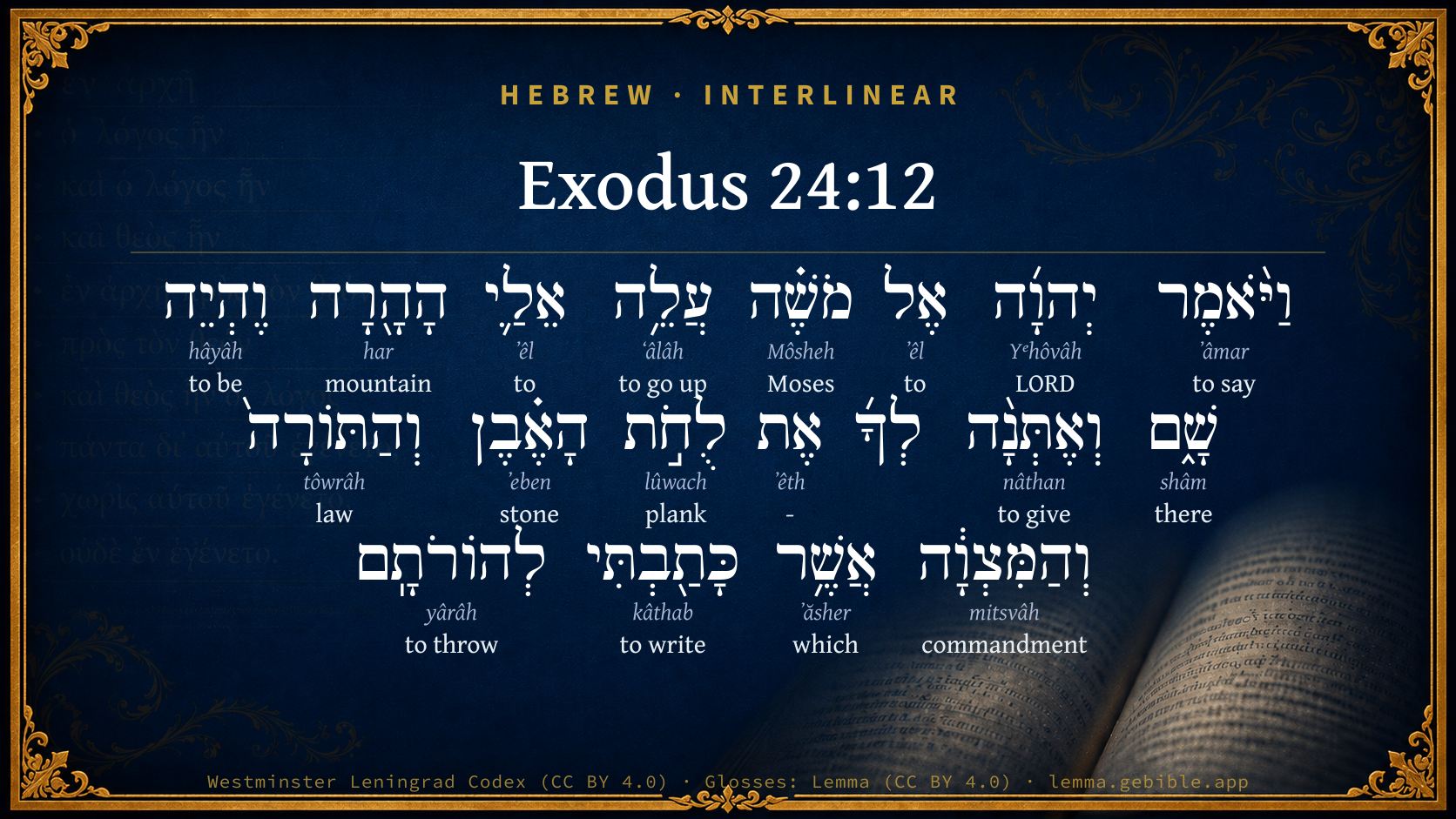
Hebrew (Westminster Leningrad Codex) Exodus 24:12 appears in the Hebrew Old Testament. The text above is from the Westminster Leningrad Codex. Each word links to its Strong’s number, a concise gloss, and parsing drawn from the Open Scriptures Hebrew Bible morphology. Click any word for its full Brown-Driver-Briggs (BDB) entry.
Download image
Cite this verse

Exodus 24:12 (World English Bible). Public Domain. Lemma interlinear Bible study tool, https://lemma.gebible.app/v/exodus/24/12.

Show BibTeX & RIS
BibTeX
RIS
English Translation
Yahweh said to Moses, "Come up to me on the mountain, and stay here, and I will give you the tables of stone with the law and the commands that I have written, that you may teach them."
World English Bible · Public Domain
Highlights
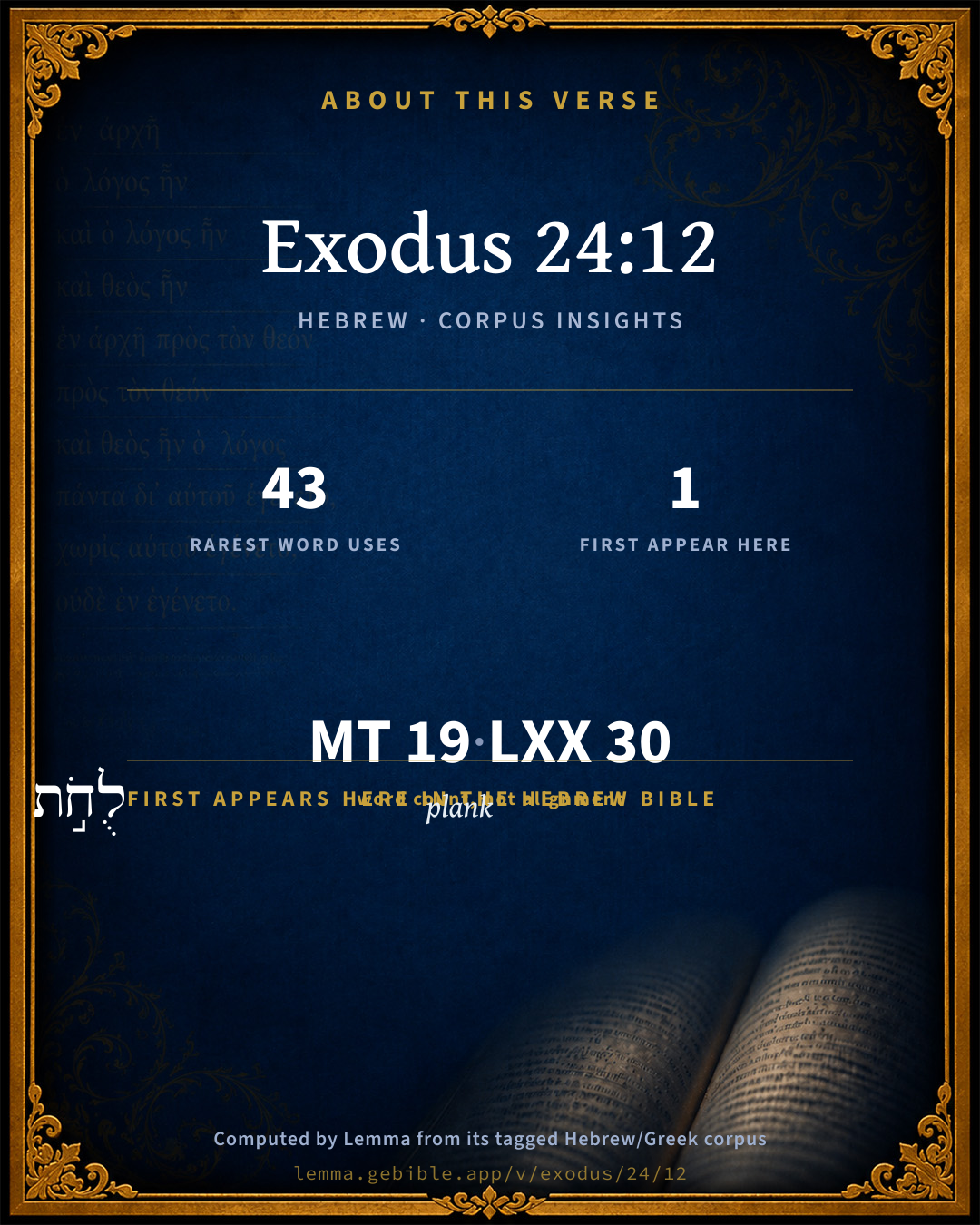
  • 1 first appearance in the Hebrew Bible
Full analysis ↓
Download a study sheet

One document with this verse’s original text, its word-by-word gloss line, the meaning frame, cross-references with their text, attributed commentary, and full source and license credits — printable, and it pastes into notes with its structure intact.

This verse Autodidact and up

Study sheet (.html) Plain text (.txt)

A passage Seminary Student

Up to 50 verses in one chapter. A passage sheet keeps up to 6 commentary sources and 12 cross-references per verse, in the order this page ranks them, and says so on the sheet whenever that leaves anything out. Ask for a single verse and you get the Autodidact verse sheet above.

Everything on this page stays free to read, with no account — the sheet is a download of what is already on screen, not access to it.

Want to remove ads? Support Godless Engineer
Compare translations 3

The same verse in 3 English versions, stacked beneath the original-language interlinear above. Click any original word for its lexicon entry.

Each is an independent rendering of the whole verse — the interlinear is not word-aligned to these translations.

Highlighted words mark where these versions differ — a whole-verse word diff, not a word-by-word alignment.

  • World English Bible Public Domain
    Yahweh said to Moses, "Come up to me on the mountain, and stay here, and I will give you the tables of stone with the law and the commands that I have written, that you may teach them."
  • King James Version Public Domain
    And the LORD said unto Moses, Come up to me into the mount, and be there: and I will give thee tables of stone, and a law, and commandments which I have written; that thou mayest teach them.
  • unfoldingWord Literal Text CC BY-SA 4.0
    And Yahweh said to Moses, “Come up to me to the mountain and be there. And I will give you the tablets of stone and the law and the commandments that I have written to teach them.”

unfoldingWord Literal Text — © unfoldingWord, licensed CC BY-SA 4.0. Word-aligned USFM3 via Door43 (git.door43.org/unfoldingWord/en_ult).

Versions to compare (up to 4)

3 of 4 selected

Show all 18 translations

Every available English version of this verse, each an independent rendering of the whole verse.

  • World English Bible Public Domain
    Yahweh said to Moses, "Come up to me on the mountain, and stay here, and I will give you the tables of stone with the law and the commands that I have written, that you may teach them."
  • Berean Standard Bible Public Domain
    Then the LORD said to Moses, “Come up to Me on the mountain and stay here, so that I may give you the tablets of stone, with the law and commandments I have written for their instruction.”
  • Majority Standard Bible Public Domain
    Then the LORD said to Moses, “Come up to Me on the mountain and stay here, so that I may give you the tablets of stone, with the law and commandments I have written for their instruction.”
  • King James Version Public Domain
    And the LORD said unto Moses, Come up to me into the mount, and be there: and I will give thee tables of stone, and a law, and commandments which I have written; that thou mayest teach them.
  • American Standard Version (1901) Public Domain
    And Jehovah said unto Moses, Come up to me into the mount, and be there: and I will give thee the tables of stone, and the law and the commandment, which I have written, that thou mayest teach them.
  • Revised Version (1885) Public Domain
    And the LORD said unto Moses, Come up to me into the mount, and be there: and I will give thee the tables of stone, and the law and the commandment, which I have written, that thou mayest teach them.
  • Geneva Bible (1599) Public Domain
    And the Lord said vnto Moses, Come vp to me into the mountaine, and be there, and I will giue thee tables of stone, and the law and the commandement, which I haue written, for to teach them.
  • Douay-Rheims (1899) Public Domain
    And the Lord said to Moses: Come up to me into the mount, and be there: and I will give thee tables of stone, and the law, and the commandments which I have written: that thou mayst teach them.
  • Young's Literal Translation Public Domain
    And Jehovah saith unto Moses, `Come up unto Me to the mount, and be there, and I give to thee the tables of stone, and the law, and the command, which I have written to direct them.'
  • Literal Standard Version CC BY-SA 4.0
    And YHWH says to Moses, “Come up to Me [on] the mountain and be there, and I give to you the tablets of stone, and the Law, and the command, which I have written to direct them.”
  • Unlocked Literal Bible CC BY-SA 4.0
    Yahweh said to Moses, “Come up to me on the mountain and stay there. I will give you the tablets of stone and the law and commandments that I have written, so that you may teach them.”
  • unfoldingWord Literal Text CC BY-SA 4.0
    And Yahweh said to Moses, “Come up to me to the mountain and be there. And I will give you the tablets of stone and the law and the commandments that I have written to teach them.”
  • Darby Bible Public Domain
    And Jehovah said to Moses, Come up to me into the mountain, and be there; and I will give thee the tables of stone, and the law, and the commandment that I have written, for their instruction.
  • World Messianic Bible Public Domain
    The LORD said to Moses, “Come up to me on the mountain, and stay here, and I will give you the stone tablets with the law and the commands that I have written, that you may teach them.”
  • Webster's Bible Public Domain
    And the LORD said to Moses, Come up to me on the mount, and be there: and I will give thee tables of stone, and a law, and commandments which I have written; that thou mayst teach them.
  • Free Bible Version CC BY-SA 4.0
    Then the Lord told Moses, “Come up the mountain to me, and stay here, so I can give you the stone tablets, with the instructions and commands I have written for them to learn.”
  • Bible in Basic English Public Domain
    And the Lord said to Moses, Come up to me on the mountain, and take your place there: and I will give you the stones on which I have put in writing the law and the orders, so that you may give the people knowledge of them.
  • JPS Tanakh (1917) Public Domain
    And the LORD said unto Moses: 'Come up to Me into the mount and be there; and I will give thee the tables of stone, and the law and the commandment, which I have written, that thou mayest teach them.'

Literal Standard Version (2020), Covenant Press — licensed CC BY-SA 4.0. Text via the HelloAO Bible API (eBible.org). Unlocked Literal Bible (unfoldingWord) — licensed CC BY-SA 4.0. Text via the HelloAO Bible API (eBible.org). unfoldingWord Literal Text — © unfoldingWord, licensed CC BY-SA 4.0. Word-aligned USFM3 via Door43 (git.door43.org/unfoldingWord/en_ult). Free Bible Version, Dr. Jonathan Gallagher — licensed CC BY-SA 4.0. Text via the HelloAO Bible API (eBible.org).

Word by word

More ways to search: Search by grammar → Find every occurrence → Compare this word →

Practice this passage: Drill this verse → Learn its vocabulary →

לֻחֹ֣ת
lûwach
H3871
“planks of”
Noun, Common, Masculine, Plural, Construct
Part of Speech
Noun
Type
Common
Gender
Masculine
Number
Plural
State
Construct
Full BDB Definition

Origin: from a primitive root

TWOT: 1091a

board, slab, tablet, plank - tablets (of stone) - boards (of wood) - plate (of metal)
  1. וַיֹּ֨אמֶר ʼâmar H559 “and · to say” Conjunction + Verb, Qal, Sequential Imperfect, 3rd Person, Masculine, Singular
  2. יְהוָ֜ה Yᵉhôvâh H3068 “LORD” Noun, Proper
  3. אֶל ʼêl H413 “to” Preposition
  4. מֹשֶׁ֗ה Môsheh H4872 “Moses” Noun, Proper
  5. עֲלֵ֥ה ʻâlâh H5927 “go up” Verb, Qal, Imperative, 2nd Person, Masculine, Singular
  6. אֵלַ֛י ʼêl H413 “to · me” Preposition + Suffix, Personal, 1st Person, Common, Singular
  7. הָהָ֖רָה har H2022 “the · mountain · toward” Particle, Definite Article + Noun, Common, Masculine, Singular, Absolute + Suffix, Demonstrative
  8. וֶהְיֵה hâyâh H1961 “and · be” Conjunction + Verb, Qal, Imperative, 2nd Person, Masculine, Singular
  9. שָׁ֑ם shâm H8033 “there” Adverb
  10. וְאֶתְּנָ֨ה nâthan H5414 “and · to give” Conjunction + Verb, Qal, Cohortative, 1st Person, Common, Singular
  11. אֶת ʼêth H853 “-” Particle, Direct Object
  12. הָאֶ֗בֶן ʼeben H68 “the · stone” Particle, Definite Article + Noun, Common, Feminine, Singular, Absolute
  13. וְהַתּוֹרָה֙ tôwrâh H8451 “and · the · law” Conjunction + Particle, Definite Article + Noun, Common, Feminine, Singular, Absolute
  14. וְהַמִּצְוָ֔ה mitsvâh H4687 “and · the · commandment” Conjunction + Particle, Definite Article + Noun, Common, Feminine, Singular, Absolute
  15. אֲשֶׁ֥ר ʼăsher H834 “which” Particle, Relative
  16. כָּתַ֖בְתִּי kâthab H3789 “to write” Verb, Qal, Perfect, 1st Person, Common, Singular
  17. לְהוֹרֹתָֽם yârâh H3384 “to throw · them” Preposition + Verb, Hiphil, Infinitive Construct + Suffix, Personal, 3rd Person, Masculine, Plural

About this verse

These counts appear in no published source. They are computed here, from the morphology-tagged text and Lemma’s own curated glosses. What Lemma adds →

19
words
17
distinct lemmas
Pentateuch
section

First appearance in Scripture

This word makes its first canonical appearance in the Hebrew Bible here:

  • לֻחֹ֣ת plank H3871

Shared distinctive vocabulary

לֻחֹ֣ת plank H3871 occurs in 33 verses of the Hebrew Bible. Also found in:

Grammatical profile

  • 6 verbs
  • 7 nouns
  • 3 prepositions
  • 1 adverb
  • 2 particles

Verb forms

  • וַיֹּ֨אמֶר Qal · Sequential Imperfect
  • עֲלֵ֥ה Qal · Imperative
  • וֶהְיֵה Qal · Imperative
  • וְאֶתְּנָ֨ה Qal · Cohortative
  • כָּתַ֖בְתִּי Qal · Perfect
  • לְהוֹרֹתָֽם Hiphil · Infinitive Construct

Repetition

A word recurs within this verse — often emphatic in Hebrew:

  • אֶל to H413 ×2

Hebrew & Septuagint length

In English translation the verse runs 38 words from the Hebrew and 38 from the Septuagint (LXX English) — the same length.

A rough comparison of the two English renderings, which tokenize alike — not a word-level alignment.

Word counts can differ between the Hebrew and the Greek without any difference in meaning — e.g. the Hebrew direct-object marker אֵת has no separate Greek word, and Greek often adds the article ὁ.

In the original languages it is 19 Hebrew tokens and 30 Greek tokens — but the two are counted differently (Hebrew bundles its prefixes and suffixes into one token; the Greek is in lemma form), so that isn’t a like-for-like length.

Cross-references

14

Topical passages linked to Exodus 24:12 in the Treasury of Scripture Knowledge — connected by theme and wording, ordered by reader-vote popularity; previews shown in the World English Bible.

  • Deuteronomy 5:22 These words Yahweh spoke to all your assembly on the mountain out of the midst of the fire, of the cloud, and of the thick darkness, with a great voice: and he added no more. He wrote them on two tables of stone, and gave them to me.
  • Exodus 31:18 He gave to Moses, when he finished speaking with him on Mount Sinai, the two tablets of the testimony, stone tablets, written with God's finger.
  • Exodus 32:15–16 Moses turned, and went down from the mountain, with the two tablets of the testimony in his hand; tablets that were written on both their sides; on the one side and on the other they were written.
  • Hebrews 9:4 having a golden altar of incense, and the ark of the covenant overlaid on all sides with gold, in which was a golden pot holding the manna, Aaron's rod that budded, and the tables of the covenant;
  • Jeremiah 31:33 But this is the covenant that I will make with the house of Israel after those days, says Yahweh: I will put my law in their inward parts, and in their heart will I write it; and I will be their God, and they shall be my people:
  • 2 Corinthians 3:3 being revealed that you are a letter of Christ, ministered by us, written not with ink, but with the Spirit of the living God; not in tablets of stone, but in tablets that are hearts of flesh.
  • Exodus 24:2 Moses alone shall come near to Yahweh, but they shall not come near, neither shall the people go up with him."
  • Exodus 24:15 Moses went up on the mountain, and the cloud covered the mountain.
  • Exodus 24:18 Moses entered into the midst of the cloud, and went up on the mountain; and Moses was on the mountain forty days and forty nights.
  • Deuteronomy 4:14 Yahweh commanded me at that time to teach you statutes and ordinances, that you might do them in the land where you go over to possess it.
  • 2 Corinthians 3:7 But if the service of death, written engraved on stones, came with glory, so that the children of Israel could not look steadfastly on the face of Moses for the glory of his face; which was passing away:
  • Ezra 7:10 For Ezra had set his heart to seek the law of Yahweh, and to do it, and to teach in Israel statutes and ordinances.
  • Nehemiah 9:13 You came down also on Mount Sinai, and spoke with them from heaven, and gave them right ordinances and true laws, good statutes and commandments,
  • Matthew 5:19 Whoever, therefore, shall break one of these least commandments, and teach others to do so, shall be called least in the Kingdom of Heaven; but whoever shall do and teach them shall be called great in the Kingdom of Heaven.

Cross-references courtesy of OpenBible.info (CC BY 4.0).

Hebrew and Greek witnesses Masoretic Hebrew ↔ Greek Septuagint

The same verse in the two great witnesses to the Old Testament, shown verse-for-verse.

These are two independent witnesses, not word-aligned to each other, and the Septuagint is shown in lemma (dictionary) form.

Hebrew Exodus 24:12 Masoretic · Westminster Leningrad Codex

וַיֹּ֨אמֶר יְהוָ֜ה אֶל מֹשֶׁ֗ה עֲלֵ֥ה אֵלַ֛י הָהָ֖רָה וֶהְיֵה שָׁ֑ם וְאֶתְּנָ֨ה לְךָ֜ אֶת לֻחֹ֣ת הָאֶ֗בֶן וְהַתּוֹרָה֙ וְהַמִּצְוָ֔ה אֲשֶׁ֥ר כָּתַ֖בְתִּי לְהוֹרֹתָֽם

Yahweh said to Moses, "Come up to me on the mountain, and stay here, and I will give you the tables of stone with the law and the commands that I have written, that you may teach them."

World English Bible · Public Domain

Greek LXX Exodus 24:12 Septuagint · lemma form

καί εἶπον κύριος πρός μωυσῆς ἀναβαίνω πρός ἐγώ εἰς ὁ ὄρος καί εἰμί ἐκεῖ καί δίδωμι σύ ὁ πυξίον ὁ λίθινος ὁ νόμος καί ὁ ἐντολή ὅς γράφω νομοθετέω αὐτός

And the Lord said to Moses, Come up to me into the mountain, and be there; and I will give you the tables of stone, the law and the commandments, which I have written to give them laws.

LXX2012 (modern English Septuagint) · Public Domain

Hebrew: Westminster Leningrad Codex (CC BY 4.0). Greek: Septuagint (public domain); English from LXX2012 (modern English Septuagint) (Public Domain). How the Septuagint differs from the Hebrew →

Targum (Aramaic paraphrase)

2

The Targum is the ancient Jewish Aramaic paraphrase of the Hebrew Scriptures — an interpretive translation, not the Hebrew text itself. Onkelos (literal) and Pseudo-Jonathan (expansive) render the Torah, and Jonathan the Prophets. Coverage is partial: where no permissively-licensed English translation exists for a verse, only the Aramaic is shown. This is verse-level text, not a word-by-word alignment to the Hebrew.

  1. Targum Onkelos Torah (Genesis–Deuteronomy)
    וַאֲמַר יְיָ לְמשֶׁה סַק לִקֳדָמַי לְטוּרָא וֶהֱוֵי תַמָן וְאֶתֵּן לָךְ יָת לוּחֵי אַבְנָא וְאוֹרַיְתָא וְתַפְקֶדְתָּא דִכְתָבִית לְאַלוּפֵיהוֹן:

    (no public-domain English translation for this verse)

    Targum Onkelos — Aramaic: “Onkelos Genesis” (public domain); “Onkelos Exodus” (public domain); “Onkelos Leviticus” (public domain); “Onkelos Numbers” (public domain); “Onkelos Deuteronomy” (public domain). English: “Sefaria Community Translation” (CC0 1.0 (public-domain dedication)); “J.W. Etheridge. The Targums of Onkelos and Jonathan Ben Uzziel on the Pentateuch. London: Longmans, Green, 1862” (public domain). Text via Sefaria.

  2. Targum Pseudo-Jonathan Torah (Genesis–Deuteronomy)
    וַאֲמַר יְיָ לְמשֶׁה סוֹק קֳדָמַי לְטַוְורָא וַהֲוֵי תַמָּן וְאֵיתַּן לָךְ יַת לוּחֵי אַבְנָא דִּבְּהוֹן רָמוּז שְׁאָר פִּתְגָמֵי אוֹרַיְיתָא וְשִׁית מְאָה וּתְלֵיסְרֵי פִקּוּדַיָיא דִכְתָבִית לְאַלּוּפֵיהוֹן

    And the Lord said to Mosheh, Ascend before Me at the mount, and I will there give thee the tables of stone on which I have set forth the rest of the words of the Law, and the six hundred and thirteen precepts which I have written for their instruction.

    Targum Pseudo-Jonathan — Aramaic: “Targum Jonathan on Genesis” (public domain); “Targum Jonathan on Exodus” (public domain); “Targum Jonathan on Leviticus” (public domain); “Targum Jonathan on Numbers” (public domain); “Targum Jonathan on Deuteronomy” (public domain). English: “The Targum of Jonathan ben Uzziel, trans. J. W. Etheridge, London, 1862” (public domain). Text via Sefaria.

Commentary

Notes on Exodus 24:12 from classic Christian and Jewish commentators (each source and its license shown beneath its notes). The classic Christian expositions comment on the surrounding passage and are grouped to its opening verse, so a note may address several verses; the Jewish commentaries on the Tanakh (Rashi and others) are per-verse, so they appear only where the commentator wrote on this verse.

Lemma curates 59 commentaries, every one of them public domain or Creative Commons licensed, each selected and text-cleaned for this edition rather than reprinted as found. About our sources →

Matthew Henry's Commentary

The public ceremony of sealing the covenant being over, Moses is called up to receive further instructions, which we have in the following chapters.

I. He is called up into the mount, and there he remains six days at some distance. Orders are given him (Exo 24:12): Come up to the mount, and be there, that is, "Expect to continue there for some considerable time." Those that would have communion with God must not only come to ordinances, but they must abide by them. Blessed are those that dwell in his house, not that merely call there. "Come up, and I will give thee a law, that thou mayest teach them." Moses taught them nothing but what he had received from the Lord, and he received nothing from the Lord but what he taught them; for he was faithful both to God and Israel, and did neither add nor diminish, but kept close to his instructions. Having received these orders, 1. He appointed Aaron and Hur to be as lords-justices in his absence, to keep the peace and good order in the congregation, Exo 24:14. The care of his government he would leave behind him when he went up into the mount, that he might not have that to distract his mind; and yet he would not leave the people as sheep having no shepherd, no, not for a few days. Good princes find their government a constant care, and their people find it a constant blessing. 2. He took Joshua up with him into the mount, v. 13. Joshua was his minister, and it would be a satisfaction to him to have him with him as a companion, during the six days that he tarried in the mount, before God called to him. Joshua was to be his successor, and therefore thus he was honoured before the people, above the rest of the elders, that they might afterwards the more readily take him for their governor; and thus he was prepared for service, by being trained up in communion with God. Joshua was a type of Christ, and (as the learned bishop Pearson well observes) Moses takes him with him into the mount, because without Jesus, in whom are hid all the treasures of wisdom and knowledge, there is no looking into the secrets of heaven, nor approaching the glorious presence of God. 3. A cloud covered the mount six days, a visible token of God's special presence there, for he so shows himself to us as at the same time to conceal himself from us. He lets us know so much as to assure us of his presence, power, and grace, but intimates to us that we cannot find him out to perfection. During these six days Moses staid waiting upon the mountain for a call into the presence-chamber, Exo 24:15, Exo 24:16. God thus tried the patience of Moses, and his obedience to that command (Exo 24:12), Be there. If Moses had been tired before the seventh day (as Saul, Sa1 13:8, Sa1 13:9), and had said, What should I wait for the Lord any longer? he would have lost the honour of entering into the cloud; but communion with God is worth waiting for. And it is fit we should address ourselves to solemn ordinances with a solemn pause, taking time to compose ourselves, Psa 108:1.

II. He is called up into a cloud on the seventh day, probably on the sabbath day, Exo 24:16. Now, 1. The thick cloud opened in the sight of all Israel, and the glory of the Lord broke forth like devouring fire, Exo 24:17. God, even our God, is a consuming fire, and so he was pleased to manifest himself in the giving of the law, that, knowing the terrors of the Lord, we may be persuaded to obey, and may by them be prepared for the comforts of the gospel, and that the grace and truth which come by Jesus Christ may be the more acceptable. 2. The entrance of Moses into the cloud was very wonderful: Moses went into the midst of the cloud, Exo 24:18. It was an extraordinary presence of mind which the grace of God furnished him with by his six day's' preparation, else he durst not have ventured into the cloud, especially when it broke out in devouring fire. Moses was sure that he who called him would protect him; and even those glorious attributes of God which are most terrible to the wicked the saints with a humble reverence rejoice in. He that walks righteously, and speaks uprightly, is able to dwell even with this devouring fire, as we are told, Isa 33:14, Isa 33:15. There are persons and works that will abide the fire, Co1 3:12, etc., and some that will have confidence before God. 3. His continuance in the cloud was no less wonderful; he was there forty days and forty nights. It should seem, the six days (Exo 24:16) were not part of the forty; for, during those six days, Moses was with Joshua, who did eat of the manna, and drink of the brook, mentioned, Deu 9:21, and while they were together it is probable that Moses did eat and drink with him; but when Moses was called into the midst of the cloud he left Joshua without, who continued to eat and drink daily while he waited for Moses's return, but thenceforward Moses fasted. Doubtless God could have said what he had now to say to Moses in one day, but, for the greater solemnity of the thing, he kept him with him in the mount forty days and forty nights. We are hereby taught to spend much time in communion with God, and to think that time best spent which is so spent. Those that would get the knowledge of God's will must meditate thereon day and night.

Matthew Henry's Commentary on the Whole Bible (1708–1710) — public domain (CC PDM 1.0). Text via the HelloAO Bible API.

The Cambridge Bible for Schools and Colleges

gen. ed. J. J. S. Perowne

12. the tables of stone] on which the Decalogue was inscribed. They are mentioned frequently in the sequel; and, remarkably enough, by different expressions, corresponding to the three principal Pent. sources: ‘in Exo_31:18 b E, as here, says “tables of stone”; P says “the two tables of the testimony” (Exo_31:18 a, Exo_32:15 a, Exo_34:29); J and Dt. say “the two tables of stones” (Exo_34:1; Exo_34:4, Deu_4:13; Deu_5:22 [Heb. 19], Exo_9:9-11, Exo_10:1; Exo_10:3)’ (Di.): Dt. says also (cf. p. 175) ‘the tables of the covenant’ (Exo_9:9; Exo_9:11; Exo_9:15).

and the direction (tôrâh) and the commandment, which I have written, to direct them (i.e. the people)] What these words refer to is a difficult and uncertain question. It cannot be the Decalogue; for not only must it be something different from the ‘tables of stone,’ but the Decalogue would not be spoken of as tôrâh. It cannot be the ‘Book of the Covenant’; for this has been already both ‘given’ to Moses and ‘written’ (vv. 4, 7). As nothing is spoken of as ‘written’ by Jehovah, except the Decalogue, it is an extremely probable conjecture that the words ‘which I have written’ are out of place, and ought to follow ‘the tables of stone’: ‘the direction and the commandment’ may then refer to something future (‘will give’): but it still remains a question what that is. It cannot be the directions about the Tabernacle contained in chs. 25–31 (even granting that these were by the same hand as Exo_24:12-15 a); for these would not be called tôrâh. Most probably (Bä. xlix) the reference is to the ‘commandment, and the statutes, and the judgements,’ which Moses is said in Deu_5:31 to have received at Horeb, but in Exo_6:1 to have first formally promulgated to the people on the eve of their entering Canaan. And the ‘commandment,’ &c., thus referred to, seem to have been in fact the ‘judgements’ of Exo_21:2 to Exo_22:17. These ‘judgements’ (cf. on v. 3), it is probable, were originally recorded by E at the point of the narrative where Dt. now stands. The Deuteronomist puts his version of the ‘judgements,’ is of other older laws, into Moses’ mouth not at Horeb but in the steppes of Moab: when, then, Dt. was combined with JE, the compiler could not well put the two versions side by side, so he put back the earlier version (Exo_21:2 to Exo_22:17) into conjunction with the rest of E’s laws Horeb (cf. Kuenen, Hex. § xiii. 32; Bä. l.c.; McNeile, p. xxvii. f.)

12–15a (E). The sequel to vv. 3–8. Moses ascends the mount to receive the two tables of stone.

The Cambridge Bible for Schools and Colleges (gen. ed. J. J. S. Perowne; Cambridge University Press, 1878–1918) — public domain. Text from a community e-Sword module.

Trapp's Complete Commentary

John Trapp

Exo 24:12 And the LORD said unto Moses, Come up to me into the mount, and be there: and I will give thee tables of stone, and a law, and commandments which I have written; that thou mayest teach them.

Ver. 12. Tables of stone.] To show, (1.) The stony hardness of the people’s hearts; (2.) The lastingness of the law.

John Trapp, A Commentary or Exposition upon All the Books of the Old and New Testament (1647–1656) — public domain. Text from a community e-Sword module.

The Biblical Illustrator

Joseph S. Exell

Exo_24:12-18

Come up to Me into the mount.

Divine preparations

I. Each one has his own position to occupy.

II. Each man has his own Divine vision. To-day we may experience Divine chidings, and to-morrow we may be on the Mount of Beatitude.

III. But there are specialities of work.

IV. Therefore there must be speciality in the preparations. Learn to be much in the right, much in prayer, much in mountain solitude; but much also with the people. Let waiting and working go hand in hand. Above all things, obey the Divine voice. (W. Burrows, B. A.)

Communion with God

I. That communion with God is necessary.

1. For religious teachers.

2. For those engaged in business.

3. For parents, etc.

II. That special places are appointed for communion with God.

1. House of God.

2. Privacy of own chamber.

III. That preparation should be made for communion with God (Exo_24:14; see Mat_6:6).

1. Guard against interruptions from without.

2. Drive away worldly and anxious thoughts within.

IV. That communion with God should be most frequently alone.

1. Presence of others may distract mind or embarrass thoughts.

2. Presence of others may divert attention from personal concerns of soul.

3. Private sins and wants to be laid bare.

V. That in communion with God, the presence of others is sometimes helpful and even necessary. Family worship--prayer meetings--for those who have common wants, interests, etc.

VI. That communion with God is the condition upon which man may witness the Divine glory (Exo_24:16-17; see Isa_6:1-13.)

VII. That communion with God may re protracted, and man must not weary of it.

VIII. That among the purposes of communion with God, are recognition of the Divine authority and preparation for future work. (J. W. Burn.)

The best recommendation

A young man once came to London bearing a letter of introduction to Baron Rothschild with the request that he would give him employment. The great banker received him warmly, but expressed his regret that he had no position for him. As the young man was going, the baron put on his hat and walked along with him, pointing out the various objects of interest. Passing a bank the rich man went in to transact some business. Afterwards the young man applied at that very bank for work, and they asked, Are you not the young man who was walking with the baron this morning? Yes. Well, you were in good company: and since we need a young man we will consider this a sufficient recommendation. To walk with God is the best recommendation. When men of the world have need of an assistant or helper, they will be likely to consider such a fact as a commendation. (A. J. Gordon.)

On the mount with God

Moses would never have been the law-giver he was had he not remained there on the mount, in sight of the glory and in communion with his God. The disciples would never have wrought as they did, had they not tarried in Jerusalem. Eminent preachers and teachers would never have thrilled and won hearts to Christ as they have, had they not gained their power in long seasons of prayer and communion with God.

1. Spiritual endowment is always the measure of success in work for Christ. Preachers fail and teachers fail because they are so little on the mount with God.

2. The want of Christian workers everywhere is revelation of the Divine glory. From this, power springs. God can use us only as we become equipped by vision of, and communion with, Him. We can tell only as we know. We know only as we are taught of God. Have we been on the mount, under the cloud? Have we seen the glory and heard the voice? What is our message from God to men? (J. E. Twitchell.)

.

The Biblical Illustrator, edited by Joseph S. Exell (c. 1880s–1900s) — public domain. Text from a community e-Sword module.

Joseph Benson's Commentary

Exo 24:12. The Lord said unto Moses, Come up — There were different stations on the mountain. The glory of the Lord occupied the highest place, the top of the mountain: to this place Moses is now called up, leaving the elders below to wait for him, and commissioning Aaron and Hur to transact any business in his absence. It has been thought that Moses might not expect so long a continuance in the mount with God as forty days and forty nights, when he enjoined the elders to tarry for him on the mount, and commissioned Aaron and Hur to go backward and forward between them and the people; and that it is not probable the elders continued all that time upon that part of the mountain where he left them. Concerning this, however, nothing can be affirmed with certainty.

Joseph Benson's Commentary on the Old and New Testaments (1811–1818) — public domain. Text from a community e-Sword module.

Whedon's Commentary on the Bible

Daniel D. Whedon

MOSES’S ASCENT INTO THE MOUNT, Exo_24:12-18.

12. Tables of stone, and a law, and commandments — This may be rendered, Tables of stone, even the law and the commandment, and would then most naturally denote the decalogue graven on tables of stone. Ewald understands the reference to be to the decalogue, and also to other laws and commandments which were to be given. The rabbinical interpretation is, that only the tables of stone refer to the decalogue, while the law here means the written law of Moses, and the commandments the oral law which was handed down by tradition, and afterward embodied in the Talmud. As Exo_24:12-18 serve for an introduction to chapters 25-31, in which so many commandments are given touching the tabernacle and the priesthood, and as Exo_32:15, shows that Moses returned with the two tables in his hand, we may best understand that these words refer to other commandments besides those of the decalogue. Moses was called up to receive not the tables only, but also other revelations.

Teach them — All the laws, and the entire revelation, were to be taught to the people.

Daniel D. Whedon (gen. ed.), Commentary on the Old and New Testaments (1874–1909) — public domain. Text from a community e-Sword module.

The Preacher's Complete Homiletical Commentary

Joseph S. Exell (gen. ed.)

MAIN HOMILETICS OF THE PARAGRAPH.—Exo_24:12-18

DIVINE PREPARATIONS

Through all the ages the Divine hand is at work. In the kingdoms of nature and of grace we notice vast preparatory processes. And the Almighty has to do with individuals as well as communities. He brings forth His chosen instruments when the fit time has come. But He does not bring forth until they are fitted for their work. Moses must dwell forty days and forty nights on Mount Sinai. As nature has its barren winter and fruitful harvest, so God’s heroes have the winter of seclusion, and the autumn of golden productiveness.

I. Each one has his proper position to occupy. Moses must go up into the Mount, be hidden in the cloud, and hold communion with the Infinite. Joshua must attend as the minister. Aaron and Hur must act in the place of Moses, and be the administrators of justice; and the elders must tarry. They may serve who only stand and wait; and this is sometimes the most arduous service. Tarry is very often an unwelcome word. Tarry when the cloud conceals a sublime mystery, and when Moses is about to penetrate that mystery. The man who can tarry in a right spirit has a well-disciplined nature. However, let each seek his proper position.

II. Each man has his own divine vision. There was one vision to Moses, and another to the children of Israel. Moses entered the cloud; but the children of Israel stood outside the cloud. And this is still true. The Almighty is differently revealed to different natures. And differently revealed to the same natures at different periods. There is the revelation of the cloud, and there is the revelation of the devouring fire. To-day we may experience Divine chidings, and to-morrow we may be on the Mount of Beatitude.

III. But there are specialities of work. Moses was the lawgiver. He was to teach unto the people the law and the commandments, which God delivered unto him on the Mount. Moses stands out in solitary grandeur as the great lawgiver of the Old Testament. His name stands high in the historic scroll. Grandest and noblest of men! His words and works speak and influence through all time.

IV. Therefore there must be speciality in the preparation. This we see in the whole of the chapter; and it has already been a subject of remark. Whatever may have been the nature of the vision vouchsafed to Moses, it must have been of a special nature. He entered the cloud and conversed with God. He breasted the devouring fire, and was not consumed. He fasted forty days and forty nights, and yet did not perish of hunger. The Bible does not satisfy an idle curiosity. No history writes the tale of that forty days and forty nights’ retirement. The deep things of spiritual retirement cannot be written. But their sublime influence will be felt. Moses was brighter, nobler, and truer for the mountain retirement. In all true life there must be seasons of disappearance and of reappearance. The man of action must be also the man of prayer. The man of mighty words must be the man of prolonged meditation. A man may have high swelling words, which are only sound and nothing more, who has never been guilty of half an hours’ deep meditation. Moses was not an empty rhetorician. Aaron was the fluent speaker, and yet the words of Moses are more powerful and vital than the words of Aaron. Learn to be much in thought, much in prayer, much in mountain solitude; but much also with the people. Be not the empty-headed demagogue; and be not the useless, selfish recluse. Let waiting and working go hand in hand. Above all things, obey the Divine voice. Wait even six days for the Divine utterance; and it may be that on the seventh, God will call to thee out of the midst of the cloud.

—W. Burrows, B.A.

SUGGESTIVE COMMENTS ON THE VERSES

COMMUNION WITH GOD.—Exo_24:12-18

All great lives have been characterised by close and frequent communion with God. Enoch, Abraham, Moses, David, our Lord, &c., &c. All Scripture and Christian history testify to the importance and benefit of communion with God. Our text teaches us—

I. That communion with God is necessary.

1. Moses went up after the solemnities of the covenant. Religious teachers, beware how your duties interfere with your devotions. You can only give what you get, and you can only get what you give by communion with God.

2. Moses went up after the performance of his official duties as judge and general of the people. Men of business, beware how your engagements interfere with your prayers. Parents, &c., you can only perform the duties of life well by the “faith and fear” which you can alone get from God.

II. That special places are appointed for communion with God. “Come up unto the mount.”

1. God’s house is appointed as the place where God records His name and vouchsafes His blessing (Heb_10:25; Mat_18:20).

2. The privacy of our own chamber (Mat_6:6).

True, where there is a praying heart there is a sanctuary; but warehouses, counting-houses, &c., are hardly places where the soul can pour itself out to God.

III. That preparation should be made for communion with God, Exo_24:14. “Shut to the door” (Mat_6:6).

1. Arrangements should be made so that this communion may not be interrupted. Let not servant, nor family, nor callers take you away from this important business; let all those matters be settled before you commence.

2. Make such preparations that all worldly and anxious thought may be left outside, and give yourselves entirely up to the business in hand. How often are we half through the service before we begin to reap any benefit. It was not without significance that the Jews had a day of preparation (Mar_15:42).

IV. That communion with God should be most frequently alone. The elders were to tarry behind. This is necessary.

1. Because the presence of others may distract the mind or embarrass the thoughts.

2. Because the presence of others may call our attention away from those intensely personal matters which concern our own souls alone.

3. Because there are sins and wants to confess, about which we should not like our dearest friends to know.

V. That in communion with God the presence of others is sometimes helpful and even necessary. “And Moses rose up and his servant Joshua.”

1. There are occasions on which we should take a friend, our wives, our children, separately with us to the throne of grace. There are matters which concern us in common, want, interest, &c. Two Christian workers, e.g., two partners in business, husband and wife about the family, &c.

2. The same applies to family worship and prayer meetings.

VI. That communion with God is the condition upon which man may witness the Divine glory. “And the glory of the Lord abode on Mount Sinai” (Exo_24:16-17; Isaiah 6)

VII. That communion with God may be protracted, and man must not weary of it (Acts 1; Luk_18:1-6; Act_12:5; 1Th_5:17). Man’s duty is “to wait upon the Lord.”

1. Sometimes God delays to test His people’s faith.

2. Sometimes in order that the course of His providence may not be abruptly interfered with.

VIII. That among the purposes of communion with God are recognition of the divine authority and preparation for future work. Moses waited for further divine instructions (chaps. 25–31.) In conclusion—

(i.) Psa_62:5; (iii.) Isa_60:21.

—J. W. Burn.

ILLUSTRATIONS

BY

REV. W. ADAMSON

Two Tables! Exo_24:12.

1. Like that remarkable architecture still found amid Porter’s “Giant Cities of Bashan,” where a door will be hewn out of the solid rock, and door, rock, and hinge are all a single stone, the two tables make but one law. The fifth commandment is the axis or hinge on which they open and close—the connecting point where you pass from the one to the other.

2. According to the Talmud, these two tables were formed of sapphires; and it is certainly remarkable that the Hebrew word sappir is derived from the same root as the words that signify a book, writing, or engraving. God’s law, like His throne, is based on “Love.” Christ is Incarnate Love—blood-besprinkled blue—sapphire soaked in sardine.

“Alone, O Love ineffable!

Thy saving name is given;

To turn aside from Thee is hell,

To walk with Thee is heaven.”

—Whitties.

Covenant-Mediation! Exo_24:12. A mediator’s hands receive the tables, thus establishing signs that grace is in the Law of Sinai. God states His claims that we may see our need of help to pay them, while our sense of ruin is designed to make us prize the gospel. Is it not grace to urge us onward towards the Cross—towards Him who is the Mediator of the New Covenant? To bring us to Christ, the law displays God’s holiness, sin’s heinousness, hell gaping at our feet. It shows that God’s whole nature abhors evil, and is pledged to execute just wrath. Peter was not alarmed to sink him fathoms deep in Galilee’s blue waters, but to persuade him to lean on Christ—“Save me, I perish.” So the law convicts the sinner that he may seek the Mediator’s help; for there is such help in Christ, and Christ alone.

“For Christ is given to be

The covenant of God to thee;

In Him—God’s golden scroll of light—

The darkest truths are clear and bright,”

—Havorgal.

Forty-Days’ Food! Exo_24:18. Clarke and Paxton Hood allude to a conversation between Rabbi Meir and another on this subject. “Is it possible that any man can fast forty days and forty nights?” To this Rabbi Meir replied, “When thou takest up thy abode in a particular city, thou must live according to its customs. Moses ascended to heaven, where they neither eat nor drink; therefore he became assimilated to them. We are accustomed to eat and drink, and when angels descend to us, they eat and drink also.” As Grozart says, truly it was a heavenly not an earthly life in the case equally of Moses, Elias, and our Lord.

“Lo! He feeds on living bread,

Drinks the fountain from above,

Leans on Jesus’ breast his head,

Feasts for ever on His love.”

—Wesley.

The Preacher's Complete Homiletical Commentary (gen. ed. Joseph S. Exell; Funk & Wagnalls, c. 1892) — public domain (pre-1929). A full-Bible homiletical/sermon-outline anthology covering 65 of 66 books (2 John is absent from the source module). Text from a community e-Sword module.

Keil & Delitzsch

C. F. Keil & F. Delitzsch

Exo 24:12-18 prepare the way for the subsequent revelation recorded in ch. 25-31, which Moses received concerning the erection of the sanctuary. At the conclusion of the covenant meal, the representatives of the nation left the mountain along with Moses. This is not expressly stated, indeed; since it followed as a matter of course that they returned to the camp, when the festival for which God had called them up was concluded. A command was then issued again to Moses to ascend the mountain, and remain there (והיה־שׁם), for He was about to give him the tables of stone, with (ו as in Gen 3:24) the law and commandments, which He had written for their instruction (cf. Exo 31:18).

Exo 24:13-14

When Moses was preparing to ascend the mountain with his servant Joshua (vid., Jos 17:9), he ordered the elders to remain in the camp (בּזה i.e., where they were) till their return, and appointed Aaron and Hur (vid., Exo 17:10) as administrators of justice in case of any disputes occurring among the people. דּברים מי־בעל whoever has matters, matters of dispute (on this meaning of בּעל see Gen 37:19).

Exo 24:15-17

When he ascended the mountain, upon which the glory of Jehovah dwelt, it was covered for six days with the cloud, and the glory itself appeared to the Israelites in the camp below like devouring fire (cf. Exo 19:16); and on the seventh day He called Moses into the cloud. Whether Joshua followed him we are not told; but it is evident from Exo 32:17 that he was with him on the mountain, though, judging from Exo 24:2 and Exo 33:11, he would not go into the immediate presence of God.

Exo 24:18

"And Moses was on the mountain forty days and forty nights," including the six days of waiting, - the whole time without eating and drinking (Deu 9:9). The number forty was certainly significant, since it was not only repeated on the occasion of his second protracted stay upon Mount Sinai (Exo 34:28; Deu 9:18), but occurred again in the forty days of Elijah's journey to Horeb the mount of God in the strength of the food received from the angel (Kg1 19:8), and in the fasting of Jesus at the time of His temptation (Mat 4:2; Luk 4:2), and even appears to have been significant in the forty years of Israel's wandering in the desert (Deu 8:2). In all these cases the number refers to a period of temptation, of the trial of faith, as well as to a period of the strengthening of faith through the miraculous support bestowed by God.

Keil & Delitzsch — Biblical Commentary on the Old Testament (1861–1891) — public domain (CC PDM 1.0). Text via the HelloAO Bible API. (Old Testament only.)

Tyndale Open Study Notes

Tyndale Open Resources

24:12 The instructions and commands to be inscribed on the tablets of stone were the ten basic principles of 20:3-17 (see 34:28) on which the specific stipulations of 21:1–23:33 depended.

Tyndale Open Study Notes — © Tyndale Open Resources, licensed CC BY-SA 4.0. Text via the HelloAO Bible API.

Geneva Bible (1599)

Geneva Bible translators

The second time.

Signifying the hardness of our hearts, except God do write his laws therein by his Spirit, Jer. 31:33; Ezek. 11:19; 2 Cor. 3:3; Heb. 8:10 and 10:16.

To wit, the people.

Geneva Bible (1599) marginal notes — public domain. Text via Bolls.life.

Jamieson, Fausset & Brown

Robert Jamieson, A. R. Fausset & David Brown

I will give thee tables of stone--The ten commandments, which had already been spoken, were to be given in a permanent form. Inscribed on stone, for greater durability, by the hand of God Himself, they were thus authenticated and honored above the judicial or ceremonial parts of the law.

Jamieson, Fausset & Brown — Commentary Critical and Explanatory on the Whole Bible (1871) — public domain (CC PDM 1.0). Text via the HelloAO Bible API.

Adam Clarke's Commentary

Verse 12. Come up to me into the mount, and be there] We may suppose Moses to have been, with Aaron, Nadab, Abihu, and the seventy elders, about midway up the mount; for it plainly appears that there were several stations on it.

Adam Clarke's Commentary on the Bible (1810–1826) — public domain. Text from a community e-Sword/MySword module.

Ellicott's Commentary for English Readers

(12) Come up to me into the mount, and be there.—After the sacrificial meal, the seventy-four persons engaged in it had descended into the plain of Er-Rahah, and possibly spent some time there, before a second summons came to Moses. This time he was directed to ascend accompanied only by his minister, Joshua (Exo_24:13), and was warned that his stay was to be a prolonged one in the words, “And be there.”

And I will give thee tables of stone . . . —It is remarkable that these are not expressly said, either here or in Exo_31:18, to have contained the ten commandments. The fact, however, is distinctly stated in Deu_5:22; and with respect to the second tables, the same is affirmed in Exo_34:28. The fiction of a double decalogue is thus precluded.

THE SECOND ASCENT OF MOSES INTO MOUNT SINAI.

(12-18) The great work still remained to be done. A series of laws had been laid down for the nation and accepted with unanimity (Exo_24:3; Exo_24:7). But “quid prosunt leges sine moribus?” It was necessary for the sustentation of the religious life of the people that a sacred polity should be instituted, a form of worship set up, and regulations established with regard to all the externals of religion—holy persons, holy places, rites, ceremonies, vestments, incense, consecration. Moses was directed to ascend into the mount, and hold prolonged communion with God, in order that he might learn the mind of God with respect to all these things. His prolonged stay for “forty days and forty nights” (Exo_24:18) was necessary to give him a full and complete knowledge of all the details so elaborately set forth in Exodus 25-30, and again in Exodus 35-40, which thenceforth constituted the essentials of the external worship of Israel, whereby the minds and habits of the people were moulded and impressed in a far more efficacious way than could ever have been done by a mere set of abstract propositions, appealing only to the intellect. “Segnius irritant animum demissa per aures, Quam quœ sunt oculis subjecta fidelibus.” The Decalogue and the Book of the Covenant had no doubt a considerable share in forming the character of the Hebrew nation; but a larger share must be assigned to the ritual and ceremonial which Moses was now instructed to set up, and which forms the main subject of the remainder of the Book.

A Bible Commentary for English Readers, edited by Charles John Ellicott (1878–1897) — public domain. Text from a community e-Sword module.

John Gill's Exposition

And the Lord said unto Moses, come up to me into the mount,.... For as yet Moses was not got up to the top of the mount, only up some part of it with the elders, though at some distance from the people: but now he is bid to come up higher:

and be there; continue there, as he did six days after this:

and I will give thee tables of stone, and a law, and commandments which I have written; that is, the law of the ten commandments, which were written on tables of stone by the Lord himself; he had already spoken them in the hearing of the people, but now he had wrote them, and that in tables of stone; partly for the duration of them, and partly to represent the hardness of the hearts of the Israelites, the stubbornness of their wills to comply with his law, their contumacy and obstinate persistence in disobedience to it:

that thou mayest teach them; these being in hand and sight, would have an opportunity of explaining them to them and inculcating them on their minds, and pressing them to yield an obedience to them.

John Gill's Exposition of the Whole Bible (1746–1763) — public domain (CC PDM 1.0). Text via the HelloAO Bible API.

Albert Barnes' Notes on the Bible

Many Jews understand the “tables of stone” to denote the Ten Commandments; “a law,” the law written in the Pentateuch; and the “commandments” (or “the commandment”), the oral or traditional law which was in after ages put into writing in the Mishna and the Gemara. But it is more probable that the Ten Commandments alone are spoken of, and that the meaning is, “the tables of stone with the law, even the commandment.”

Albert Barnes' Notes on the Bible (1834–1885) — public domain. Text from a community e-Sword/MySword module.

Matthew Poole's English Annotations

Be there, i.e. abide, as that verb is used 1Ti 4:15, and elsewhere.

Tables of stone; he chose that material, partly as very durable, yet so that it was capable of being broken, which God, foreseeing their wickedness, intended to do; and partly for signification, to note the hardness of their hearts, upon which no impression could be made but by the finger of God.

A law, and commandments, or, the law; and because that is ambiguous to the moral, and ceremonial, and judicial, he adds, even the commandment, or commandments, to wit, the ten commandments, so called by way of eminency, for these only were written by God upon the stony tables, as appears by Exo 34:28; the rest were written by Moses in a book, above, Exo 24:4.

Matthew Poole's English Annotations on the Holy Bible (1683–1685) — public domain. Text from a community e-Sword/MySword module.

The Pulpit Commentary

Vers. 12-18. MOSES" ENTRY INTO THE CLOUD, AND FORTY DAYS" COMMUNE WITH GOD. It was necessary now that Moses should receive full directions for the external worship of God, the sanctuary, and the priesthood. Every religion has something tangible and material about it holy places, holy things, rites, ceremonies, rules, forms, regulations. If man sets himself to devise these things of his own head, he may very easily go wrong, and find his elaborate inventions "an offence" to God. To avoid this to secure the result that all should be pleasing and acceptable to "the High and Holy One which inhabiteth eternity," it was thought fitting that "patterns" should be shown to Moses of all that was to be made for the worship, (Heb_8:5) and exact details given him with respect to the material, size, shape, and construction of each. The results are put before us in seven chapters (chs. 25-31.). For the purpose of allowing ample time for the communications which had to be made and of securing that undivided attention which was requisite in order that all should remain fixed in the memory, God summoned his servant to a long and solitary colloquy, on the mountain summit whereon the cloud rested, (Exo_19:18) apart from all his people. Moses, of course, obeyed; but before ascending, arranged with the elders that in his absence Aaron and Hur should have the direction of affairs, and decide all doubtful questions (ver. 14). He then went up the mountain, accompanied for part of the way by Joshua, who is now spoken of as his "minister," or "attendant" (ver. 13). Joshua probably remained with him for six days, while Moses waited for a summons to enter the cloud. On the seventh day the summons came: and Moses, leaving Joshua, entered the cloud, and was hid from the sight of all men.

Come up to me. Moses, apparently, had descended again into the plain, with Aaron and the seventy elders, after the festival was over. (See ver. 14, and compare Exo_32:1) He is now commanded to reascend, and be therei.e. , "And continue there foreshadowing the length of the stay. Tables of stone, and a law, and commandments, etc. Literally, "Tables of stone, and the law and the commandments which I have written." The three expressions alike refer to the Decalogue, which alone God wrote. That thou mayest teach them. Rather," to teach them.

God wrote the commandments on stone, in order to inculcate them with the greater force upon his people.

Vers. 12-18. Prolonged commune with God.

Prolonged commune with God is the soul"s truest strengthening, and sweetest refreshment. Without it our spirits languish we grow weary and faint worldliness creeps upon us our thoughts and discourse become "of the earth, earthy we have no life or liveliness in ourselves, and can impart none to others. Moses" commune was abnormal, extraordinary, inimitable by us in its main features its duration, locality, nearness of access, and completeness of isolation. But it may serve as a pattern to us in many respects, nevertheless.

I IN THE PREPARATION FOR IT. Here we note

(1) a ready heart. "Moses rose up did not delay, did not offer objections, did not say, "Suffer me first" to do this or that, but responded to the call of God at once.

(2) A thoughtful regard for others. Moses instructed the ciders how to act while he was away. "Tarry ye here ye to Aaron and Hur, if ye have matters to do.

(3) A willingness to help others towards the higher life, to carry them on with him, as far as he might. "Moses rose up, and his minister, Joshua.

(4) A patient and reverential waiting. Summoned, called up, bidden to draw near, he yet rested for six days outside the cloud, longing to enter in, but withheld by a sense of unworthiness and a fear of intrusion, fasting all the while, and seeking to prepare himself for the nearer approach by supplication and meditation.

II IN THE PLACE OF IT. A holy place mount of God a place sacred from common uses into which worldly thoughts could scarcely penetrate. We, who have no Sinai, have at any rate our churches, and other sacred buildings some of them always open, not merely for public worship, but for private prayer and meditation inviting us to enter in and draw nigh to God. In our houses we have, or may easily have, our oratories spots reserved for prayer and praise, and sacred thought sanctuaries in the desert of life places in which all that we see will remind us of heavenly things.

III IN THE SECLUSION OF IT. The world was shut out. Relations, elders, people, left below in the plain left with strict injunctions to remain ye here." Even the faithful Joshua parted from and "the cloud" entered. The cloud the awful cloud darkness"; (Exo_20:21) yet within the darkness a marvellous light. Such seclusion we cannot obtain but we may obtain an approach to it. We may "enter our closet, and shut to the door ", (Mat_6:6) and let it be known that we would be undisturbed; or we may seek the solitude of a church at an hour when there is no public service, and no one present who will meddle with us; or we may, even at the present day, find solitudes in nature, deep woods, or lone mountain tops, or unfrequented glens, where we may feel ourselves secure from intrusion, and stand face to face with God, and know him near, and pour out our hearts before him. A modern poet, in one of his better moments, says

My altars are the mountains, and the ocean, Earth, air, sea all that springs from the Great Whole, Who hath produced, and will receive the soul

and truly on any lone spot an altar may be raised, and worship offered, as acceptable to God as any that is addressed to him "in pillared fanes, "neath fretted roofs, "mid storied glass or sculptured monuments." Even in the whirl and bustle of a great city, solitude is not very far from us. Half an hour"s journey by steamer or rail, and ten minutes" walk, may take us into still woods, or shady lanes, or on to open heaths, where we shall not see a fellow creature or hear a sound reminding us of man.

IV IN THE CONTINUANCE OF IT. "Forty days and forty nights!" As we cannot have the complete seclusion which Moses enjoyed, so neither can we look for such sustained commune as his. We must eat and drink we can rarely leave our worldly work to others family claims, correspondence, business imperatively require our attention six weeks" interruption of communication between ourselves and the outer world would, in most cases, break or tangle all the threads of which our life is composed. But still some prolonged periods of religious contemplation and commune between the soul and God are needed, if the soul is to retain the vigour of its life, or its ability to be of service to others. With this view religious "retreats" have been devised, lasting sometimes a week or ten days. Where men"s duties allow of it, they may be well worth a trial. The weary spirit may derive more refreshment from them than from the ordinary "holiday." The heart may be purified, the aspirations raised, the insight into doctrinal truth augmented, above all, the love of God so intensified in the soul, by the suspension of all secular thought and the devotion of the whole mind to religion and worship, during the three, or five, or seven, or ten days of a "retreat," as would scarcely be possible, under the present conditions of our life, in any other way.

HOMILIES BY J. ORR Vers. 12-18. Moses ascends the mount.

Observe,

1. He alone ascends (ver. 12). Aaron and his sons, with the seventy elders,were left behind. Their privilege was great as compared with that of the body of the people. Yet even they are not permitted to enter the cloud to draw nigh into God"s immediate presence. The limitations and imperfections of the legal economy are stamped on these arrangements. How superior the standing of Christians, who are all permitted to draw nigh; who have now the privilege, formerly possessed only by Moses, of beholding with unveiled flee the Divine glory in the ecstasy of immediate vision. (2Co_3:18)

2. The design of this ascending was primarily to receive the stone tables (ver. 12). These were to be written by God"s own finger. God took every pains to impress upon the minds of the people that the law they had to deal with was his law. Its perpetuity was symbolised by the rock tablets.

3. Moses made arrangements for the conduct of business in his absence (ver. 14). His absence would be a trial of the faith and disposition of all parties.

4. The fire still burned on the summit of the mount (vers. 16, 17). This, notwithstanding the vision of ver. 10. The economy was outwardly and characteristically one of law; interiorly, one of grace. Even Moses had to wait seven days for the summons (ver. 16). J.O.

HOMILIES BY J. URQUHARTMoses" sojourn with God the type of Christ"s.

I THE MEDIATOR: MOSES THE TYPE OF JESUS. He must needs pass up into God"s presence: "Come up to me and be there." It is there, in communion with God, that gifts are received for men. The power and blessing we now receive there, are prophecies of the power and glory with which Jesus will come again.

1. He must pass up to receive the law and commandments which God hadwritten. Jesus will return with the perfected will of the Father.

2. The days of seclusion are numbered. Moses was in the mount forty daysand forty nights. We know not how many or few they be; but each hour the coming of the Lord draws nearer.

II THE ATTITUDE OF GOD"S PEOPLE MEANWHILE.

1. They tarry for the Mediator: "tarry ye here for us until we come again unto you." The attitude of the Churches to-day should be confident, joyous expectation: "this same Jesus will in like manner come again.

2. They are ministered unto by those who tarry with them (ver. 14).

(1) The blessing bestowed in these temporary leaders.

(2) Their responsibility: let them not be leaders or helpers to the people in their idolatry, as Aaron.

III THE VISION GRANTED THEM. The mountain is covered with clouds; but from the mountain top flames out the glory of the Lord. The eye cannot follow him who has entered within the veil; but we can behold the glory of the Lord, and know that every word of God will be fulfilled. U.

The Pulpit Commentary (1880–1919), ed. H.D.M. Spence-Jones & Joseph S. Exell — public domain. Text from a community e-Sword module.

John Wesley's Explanatory Notes

Come up to the mount and be there - Expect to continue there for some time.

John Wesley, Explanatory Notes Upon the Whole Bible (1754–1765) — public domain. Text via the GEBible commentary corpus.

unfoldingWord translationNotes

Door43 World Missions Community

tablets of stone and the law and commandments

God had written the law and commandments on the tablets of stone. This can be stated clearly. AT: "two stone slabs on which I have written all the laws" (See: Assumed Knowledge and Implicit Information)

with his assistant Joshua

"with Joshua who assisted him" or "with Joshua who helped him"

translationWords

law

command

Joshua

unfoldingWord translationNotes — © Distant Shores Media and the Door43 World Missions Community, licensed CC BY-SA 4.0. Source: git.door43.org/Door43/en_tn.

Rashi

Rabbi Shlomo Yitzchaki (Rashi)

ויאמר ה’ אל משה AND THE LORD SAID TO MOSES — after the Giving of the Law,

עלה אלי ההרה והיה שם COME UP TO ME INTO THE MOUNTAIN AND REMAIN THERE forty days.

את לחת האבן והתורה והמצוה אשר כתבתי להורתם [AND I WILL GIVE THEE] THE TABLETS OF STONE, AND THE LAW, AND THE COMMANDMENT WHICH I HAVE WRITTEN TO TEACH THEM — All the six hundred and thirteen commandments are implicitly contained in the Ten Commandments and may therefore be regarded as having been written on the tablets. Rabbi Saadia specified in the אזהרות which he has composed those commandments which may be associated with each of the Ten Commandments.

Rashi on the Tanakh — English translations: “The Judaica Press complete Tanach with Rashi, translated by A. J. Rosenberg” (CC BY 4.0); “Pentateuch with Rashi's commentary by M. Rosenbaum and A.M. Silbermann, 1929-1934” (public domain); “The Metsudah Tanach series, Lakewood, N.J” (CC BY 4.0); and “The Book of Joshua, Metsudah Publications, 1997” (CC BY 4.0). Text via Sefaria.

Ramban (Nachmanides)

Rabbi Moshe ben Nachman (Ramban / Nachmanides)

AND THE ETERNAL SAID UNTO MOSES: ‘COME UP TO ME INTO THE MOUNTAIN.’ This is the same command which He had said to him on the preceeding day [i.e., on the sixth of Sivan], Come up unto the Eternal; and Moses alone shall come near unto the Eternal, and now on the seventh day of Sivan He said additionally to him, and be there, and I will give thee the Tablets of stone etc., for Moses was to stay on the mountain until He would give him the Tablets of stone, and the law and the commandment. The expression which I have written refers back to the Tablets of stone; that thou mayest teach them relates to the law and the commandment. Thus the meaning of the verse is: “and I will give thee the Tablets of stone which I have written, and the law and the commandment that thou mayest teach them.” This is identical with what He said in the Book of Deuteronomy, And I will speak unto thee all the commandment, and the statutes, and the ordinances, which thou shalt teach them. Rashi wrote: “Which I have written in the Tablets of stone. That thou mayest teach them, for all the six hundred and thirteen commandments are implicit in the Ten Commandments.” And Rabbi Abraham ibn Ezra commented: “The law, this refers to the first and second commandments; and the commandment refers to the other eight mentioned.” It is a comment of no value, since the verse in Deuteronomy mentioned above, And I will speak unto thee, etc. testifies that He is speaking about all the commandments. In accordance with the opinion of our Rabbis it is possible that the expression which I have written is a hint that the whole Torah was written before Him before the creation of the world, as I have mentioned at the beginning of the Book of Genesis.

Ramban (Nachmanides) on the Tanakh — English translation: “Commentary on the Torah by Ramban (Nachmanides). Translated and annotated by Charles B. Chavel. New York, Shilo Pub. House, 1971-1976” (CC BY 4.0). Text via Sefaria.

Lesson kit

Teaching starters — assembled from the data on this page, not authored interpretation. Every prompt links to the verse data it draws on. Edit before teaching.

Exodus, in the Pentateuch, opens this verse with 19 words (17 distinct Hebrew lemmas). Its most distinctive word is lûwach (“plank”). A historical commentator’s framing appears above. Read the whole chapter for the surrounding context.

Discussion questions

  1. What does “plank” (lûwach) contribute to the verse as a whole?
  2. This is the first place “plank” appears in Scripture (first appears here). What does its debut here establish?
  3. How does Exodus 27:8, which shares the word «plank», read alongside this verse?
  4. What does the repetition of “to” (2× in this one verse) do in this verse?
  5. These translations render this verse differently. What is at stake in choosing one wording over another?
  6. «וַיֹּ֨אמֶר» is a Qal Sequential Imperfect verb. How does that grammatical form shape the action described?
  7. Compare how Matthew Henry's Commentary and The Cambridge Bible for Schools and Colleges read this verse. Where do they agree or differ?

Things to notice

Reading settings

Reading text

Shown beneath each verse's original-language words.

Old Testament
Old Testament edition

Read the OT as the Masoretic Hebrew (MT) or the Greek Septuagint (LXX).

English shown for the Greek Septuagint (in the Hebrew ↔ Greek comparison).

Comparing translations? Open the Compare panel on any verse page to stack up to four side by side.