
Exodus 25:16

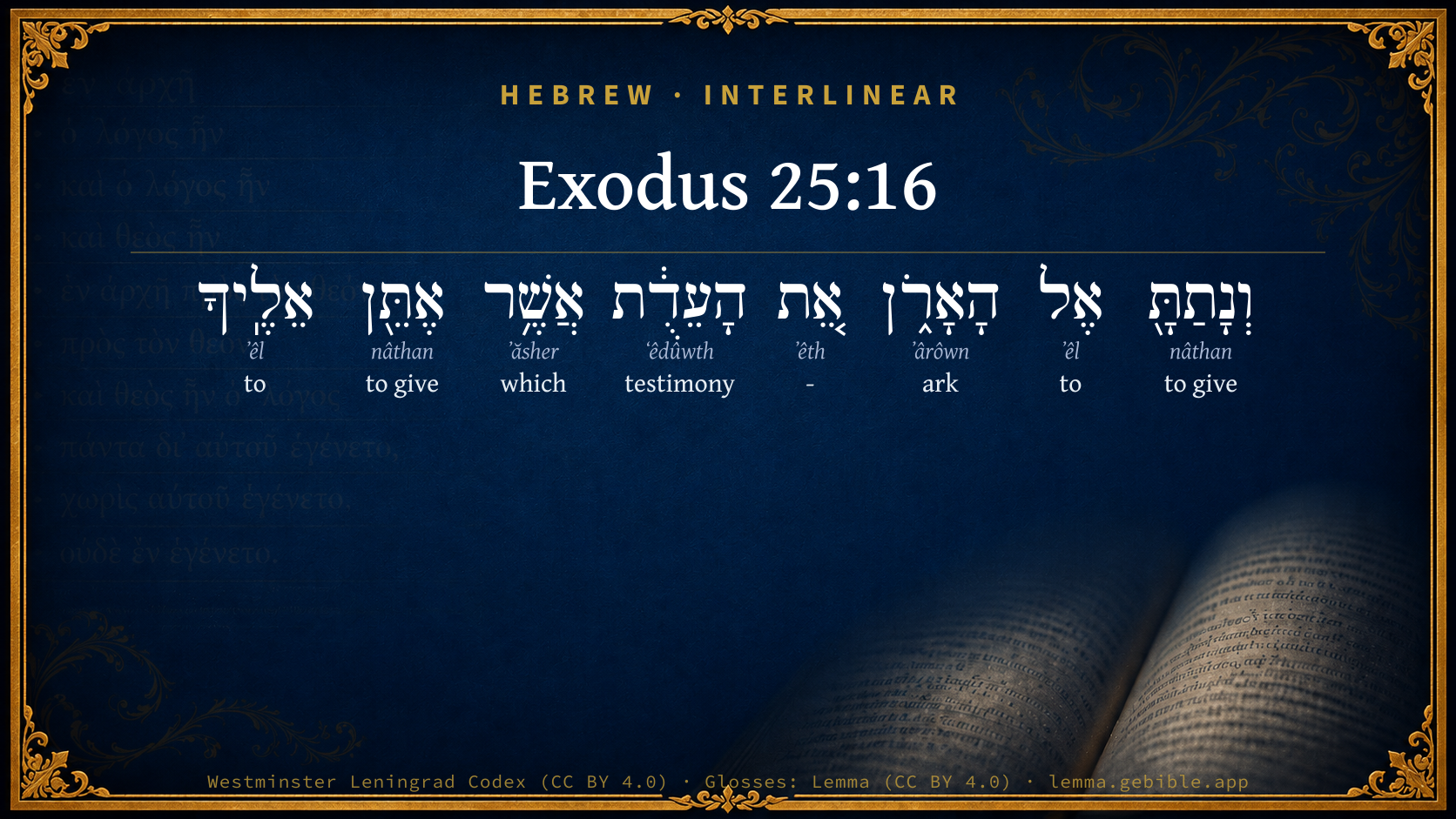
Hebrew (Westminster Leningrad Codex) Exodus 25:16 appears in the Hebrew Old Testament. The text above is from the Westminster Leningrad Codex. Each word links to its Strong’s number, a concise gloss, and parsing drawn from the Open Scriptures Hebrew Bible morphology. Click any word for its full Brown-Driver-Briggs (BDB) entry.
Download image
Cite this verse

Exodus 25:16 (World English Bible). Public Domain. Lemma interlinear Bible study tool, https://lemma.gebible.app/v/exodus/25/16.

Show BibTeX & RIS
BibTeX
RIS
English Translation
You shall put the testimony which I shall give you into the ark.
World English Bible · Public Domain
Download a study sheet

One document with this verse’s original text, its word-by-word gloss line, the meaning frame, cross-references with their text, attributed commentary, and full source and license credits — printable, and it pastes into notes with its structure intact.

This verse Autodidact and up

Study sheet (.html) Plain text (.txt)

A passage Seminary Student

Up to 50 verses in one chapter. A passage sheet keeps up to 6 commentary sources and 12 cross-references per verse, in the order this page ranks them, and says so on the sheet whenever that leaves anything out. Ask for a single verse and you get the Autodidact verse sheet above.

Everything on this page stays free to read, with no account — the sheet is a download of what is already on screen, not access to it.

Want to remove ads? Support Godless Engineer
Compare translations 3

The same verse in 3 English versions, stacked beneath the original-language interlinear above. Click any original word for its lexicon entry.

Each is an independent rendering of the whole verse — the interlinear is not word-aligned to these translations.

Highlighted words mark where these versions differ — a whole-verse word diff, not a word-by-word alignment.

  • World English Bible Public Domain
    You shall put the testimony which I shall give you into the ark.
  • King James Version Public Domain
    And thou shalt put into the ark the testimony which I shall give thee.
  • unfoldingWord Literal Text CC BY-SA 4.0
    And you shall put into the box the Testimony that I give to you.

unfoldingWord Literal Text — © unfoldingWord, licensed CC BY-SA 4.0. Word-aligned USFM3 via Door43 (git.door43.org/unfoldingWord/en_ult).

Versions to compare (up to 4)

3 of 4 selected

Show all 18 translations

Every available English version of this verse, each an independent rendering of the whole verse.

  • World English Bible Public Domain
    You shall put the testimony which I shall give you into the ark.
  • Berean Standard Bible Public Domain
    And place inside the ark the Testimony, which I will give you.
  • Majority Standard Bible Public Domain
    And place inside the ark the Testimony, which I will give you.
  • King James Version Public Domain
    And thou shalt put into the ark the testimony which I shall give thee.
  • American Standard Version (1901) Public Domain
    And thou shalt put into the ark the testimony which I shall give thee.
  • Revised Version (1885) Public Domain
    And thou shalt put into the ark the testimony which I shall give thee.
  • Geneva Bible (1599) Public Domain
    So thou shalt put in the Arke the Testimonie which I shall giue thee.
  • Douay-Rheims (1899) Public Domain
    And thou shalt put in the ark the testimony which I will give thee.
  • Young's Literal Translation Public Domain
    and thou hast put unto the ark the testimony which I give unto thee.
  • Literal Standard Version CC BY-SA 4.0
    and you have put the Testimony which I give to you into the Ark.
  • Unlocked Literal Bible CC BY-SA 4.0
    You must put into the ark the covenant decrees that I will give you.
  • unfoldingWord Literal Text CC BY-SA 4.0
    And you shall put into the box the Testimony that I give to you.
  • Darby Bible Public Domain
    And thou shalt put into the ark the testimony that I shall give thee.
  • World Messianic Bible Public Domain
    You shall put the covenant which I shall give you into the ark.
  • Webster's Bible Public Domain
    And thou shalt put into the ark the testimony which I shall give thee.
  • Free Bible Version CC BY-SA 4.0
    Place inside the Ark the Testimony which I'm going to give you.
  • Bible in Basic English Public Domain
    Inside the ark you are to put the record which I will give you.
  • JPS Tanakh (1917) Public Domain
    And thou shalt put into the ark the testimony which I shall give thee.

Literal Standard Version (2020), Covenant Press — licensed CC BY-SA 4.0. Text via the HelloAO Bible API (eBible.org). Unlocked Literal Bible (unfoldingWord) — licensed CC BY-SA 4.0. Text via the HelloAO Bible API (eBible.org). unfoldingWord Literal Text — © unfoldingWord, licensed CC BY-SA 4.0. Word-aligned USFM3 via Door43 (git.door43.org/unfoldingWord/en_ult). Free Bible Version, Dr. Jonathan Gallagher — licensed CC BY-SA 4.0. Text via the HelloAO Bible API (eBible.org).

Word by word

More ways to search: Search by grammar → Find every occurrence → Compare this word →

Practice this passage: Drill this verse → Learn its vocabulary →

About this verse

These counts appear in no published source. They are computed here, from the morphology-tagged text and Lemma’s own curated glosses. What Lemma adds →

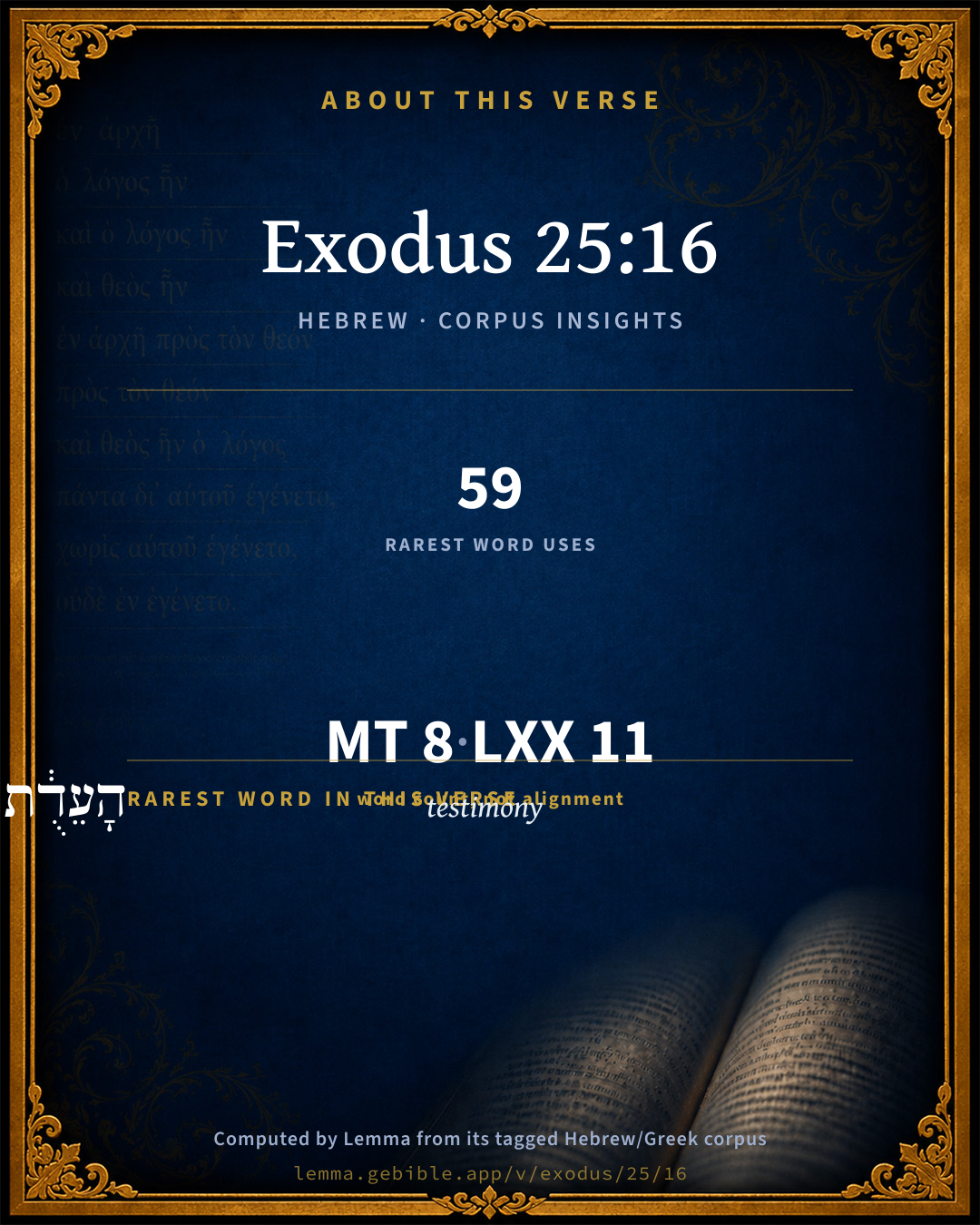
8
words
6
distinct lemmas
Pentateuch
section

Shared distinctive vocabulary

הָעֵדֻ֔ת testimony H5715 occurs in 57 verses of the Hebrew Bible. Also found in:

Grammatical profile

  • 2 verbs
  • 2 nouns
  • 2 prepositions
  • 2 particles

Verb forms

  • וְנָתַתָּ֖ Qal · Sequential Perfect
  • אֶתֵּ֖ן Qal · Imperfect

Repetition

Words recur within this verse — often emphatic in Hebrew:

  • וְנָתַתָּ֖ to give H5414 ×2
  • אֶל to H413 ×2

Hebrew & Septuagint length

In English translation the verse runs 13 words from the Hebrew and 14 from the Septuagint (LXX English) — closely comparable.

A rough comparison of the two English renderings, which tokenize alike — not a word-level alignment.

Word counts can differ between the Hebrew and the Greek without any difference in meaning — e.g. the Hebrew direct-object marker אֵת has no separate Greek word, and Greek often adds the article ὁ.

In the original languages it is 8 Hebrew tokens and 11 Greek tokens — but the two are counted differently (Hebrew bundles its prefixes and suffixes into one token; the Greek is in lemma form), so that isn’t a like-for-like length.

Cross-references

17

Topical passages linked to Exodus 25:16 in the Treasury of Scripture Knowledge — connected by theme and wording, ordered by reader-vote popularity; previews shown in the World English Bible.

  • Deuteronomy 31:26 Take this book of the law, and put it by the side of the ark of the covenant of Yahweh your God, that it may be there for a witness against you.
  • 1 Kings 8:9 There was nothing in the ark save the two tables of stone which Moses put there at Horeb, when Yahweh made a covenant with the children of Israel, when they came out of the land of Egypt.
  • Hebrews 9:4 having a golden altar of incense, and the ark of the covenant overlaid on all sides with gold, in which was a golden pot holding the manna, Aaron's rod that budded, and the tables of the covenant;
  • Exodus 16:34 As Yahweh commanded Moses, so Aaron laid it up before the Testimony, to be kept.
  • Exodus 27:21 In the tent of meeting, outside the veil which is before the testimony, Aaron and his sons shall keep it in order from evening to morning before Yahweh: it shall be a statute forever throughout their generations on the behalf of the children of Israel.
  • Exodus 30:6 You shall put it before the veil that is by the ark of the testimony, before the mercy seat that is over the testimony, where I will meet with you.
  • Exodus 30:36 and you shall beat some of it very small, and put some of it before the testimony in the tent of meeting, where I will meet with you. It shall be to you most holy.
  • Exodus 31:18 He gave to Moses, when he finished speaking with him on Mount Sinai, the two tablets of the testimony, stone tablets, written with God's finger.
  • Exodus 32:15 Moses turned, and went down from the mountain, with the two tablets of the testimony in his hand; tablets that were written on both their sides; on the one side and on the other they were written.
  • Exodus 34:29 It happened, when Moses came down from Mount Sinai with the two tablets of the testimony in Moses' hand, when he came down from the mountain, that Moses didn't know that the skin of his face shone by reason of his speaking with him.
  • Exodus 38:21 This is the amount of material used for the tent, even the Tent of the Testimony, as they were counted, according to the commandment of Moses, for the service of the Levites, by the hand of Ithamar, the son of Aaron the priest.
  • Numbers 17:4 You shall lay them up in the tent of meeting before the testimony, where I meet with you.
  • Deuteronomy 10:2–5 I will write on the tables the words that were on the first tables which you broke, and you shall put them in the ark.
  • 2 Kings 11:12 Then he brought out the king's son, and put the crown on him, and [gave him] the testimony; and they made him king, and anointed him; and they clapped their hands, and said, [Long] live the king.
  • 2 Chronicles 34:14–15 When they brought out the money that was brought into the house of Yahweh, Hilkiah the priest found the book of the law of Yahweh [given] by Moses.
  • Acts 7:44 "Our fathers had the tent of the testimony in the wilderness, even as he who spoke to Moses commanded him to make it according to the pattern that he had seen;
  • Romans 3:2 Much in every way! Because first of all, they were entrusted with the oracles of God.

Cross-references courtesy of OpenBible.info (CC BY 4.0).

Hebrew and Greek witnesses Masoretic Hebrew ↔ Greek Septuagint

The same verse in the two great witnesses to the Old Testament, shown verse-for-verse.

These are two independent witnesses, not word-aligned to each other, and the Septuagint is shown in lemma (dictionary) form.

Hebrew Exodus 25:16 Masoretic · Westminster Leningrad Codex

וְנָתַתָּ֖ אֶל הָאָרֹ֑ן אֵ֚ת הָעֵדֻ֔ת אֲשֶׁ֥ר אֶתֵּ֖ן אֵלֶֽיךָ

You shall put the testimony which I shall give you into the ark.

World English Bible · Public Domain

Greek LXX Exodus 25:16 Septuagint · lemma form

καί ἐνβάλλω εἰς ὁ κιβωτός ὁ μαρτύριον ὅς ἄν δίδωμι σύ

And you shall put into the ark the testimonies which I shall give you.

LXX2012 (modern English Septuagint) · Public Domain

Hebrew: Westminster Leningrad Codex (CC BY 4.0). Greek: Septuagint (public domain); English from LXX2012 (modern English Septuagint) (Public Domain). How the Septuagint differs from the Hebrew →

Targum (Aramaic paraphrase)

2

The Targum is the ancient Jewish Aramaic paraphrase of the Hebrew Scriptures — an interpretive translation, not the Hebrew text itself. Onkelos (literal) and Pseudo-Jonathan (expansive) render the Torah, and Jonathan the Prophets. Coverage is partial: where no permissively-licensed English translation exists for a verse, only the Aramaic is shown. This is verse-level text, not a word-by-word alignment to the Hebrew.

  1. Targum Onkelos Torah (Genesis–Deuteronomy)
    וְתִתֵּן בַּאֲרוֹנָא יָת סַהֲדוּתָא דִי אֶתֵּן לָךְ:

    (no public-domain English translation for this verse)

    Targum Onkelos — Aramaic: “Onkelos Genesis” (public domain); “Onkelos Exodus” (public domain); “Onkelos Leviticus” (public domain); “Onkelos Numbers” (public domain); “Onkelos Deuteronomy” (public domain). English: “Sefaria Community Translation” (CC0 1.0 (public-domain dedication)); “J.W. Etheridge. The Targums of Onkelos and Jonathan Ben Uzziel on the Pentateuch. London: Longmans, Green, 1862” (public domain). Text via Sefaria.

  2. Targum Pseudo-Jonathan Torah (Genesis–Deuteronomy)
    וְתִתֵּן בְּגוֹ אֲרוֹנָא יַת סַהֲדוּתָא דְאֵיתֵּן לָךְ

    And thou shalt put within the ark the Testament that I will give thee.

    Targum Pseudo-Jonathan — Aramaic: “Targum Jonathan on Genesis” (public domain); “Targum Jonathan on Exodus” (public domain); “Targum Jonathan on Leviticus” (public domain); “Targum Jonathan on Numbers” (public domain); “Targum Jonathan on Deuteronomy” (public domain). English: “The Targum of Jonathan ben Uzziel, trans. J. W. Etheridge, London, 1862” (public domain). Text via Sefaria.

Commentary

Notes on Exodus 25:16 from classic Christian and Jewish commentators (each source and its license shown beneath its notes). The classic Christian expositions comment on the surrounding passage and are grouped to its opening verse, so a note may address several verses; the Jewish commentaries on the Tanakh (Rashi and others) are per-verse, so they appear only where the commentator wrote on this verse.

Lemma curates 59 commentaries, every one of them public domain or Creative Commons licensed, each selected and text-cleaned for this edition rather than reprinted as found. About our sources →

Trapp's Complete Commentary

John Trapp

Exo 25:16 And thou shalt put into the ark the testimony which I shall give thee.

Ver. 16. The testimony.] Those tables of the testimony, {Exo 31:18} that testified what God required of them, and would be a testimony against them if disobedient. {Deu 31:26}

John Trapp, A Commentary or Exposition upon All the Books of the Old and New Testament (1647–1656) — public domain. Text from a community e-Sword module.

Geneva Bible (1599)

Geneva Bible translators

The stone tables, the rod of Aaron and Manna which were a testimony of God’s presence.

Geneva Bible (1599) marginal notes — public domain. Text via Bolls.life.

Jamieson, Fausset & Brown

Robert Jamieson, A. R. Fausset & David Brown

the testimony--that is, the two tables of stone, containing the ten commandments, and called "the testimony," because by it God did testify His sovereign authority over Israel as His people, His selection of them as the guardians of His will and worship, and His displeasure in the event of their transgressing His laws; while on their part, by receiving and depositing this law in its appointed place, they testified their acknowledgment of God's right to rule over them, and their submission to the authority of His law. The superb and elaborate style of the ark that contained "the testimony" was emblematic of the great treasure it held; in other words, the incomparable value and excellence of the Word of God, while its being placed in this chest further showed the great care which God has ever taken for preserving it.

Jamieson, Fausset & Brown — Commentary Critical and Explanatory on the Whole Bible (1871) — public domain (CC PDM 1.0). Text via the HelloAO Bible API.

Adam Clarke's Commentary

Verse 16. The testimony] The two tables of stone which were not yet given; these tables were called עדת eduth, from עד forward, onward, to bear witness to or of a person or thing. Not only the tables of stone, but all the contents of the ark, Aaron's rod, the pot of manna, the holy anointing oil, &c., bore testimony to the Messiah in his prophetic, sacerdotal, and regal offices.

Adam Clarke's Commentary on the Bible (1810–1826) — public domain. Text from a community e-Sword/MySword module.

Ellicott's Commentary for English Readers

(16) The testimony which I shall give thee.—The two tables of stone were called “the Testimony” (comp. Exo_16:34), as being God’s witness against sin (Deu_31:26). As containing them, the ark was called “the ark of the testimony” (Exo_25:22; Exo_26:34; Exo_30:6; Exo_30:26, &c.; Num_4:5; Num_7:89; Jos_4:16).

A Bible Commentary for English Readers, edited by Charles John Ellicott (1878–1897) — public domain. Text from a community e-Sword module.

The Cambridge Bible for Schools and Colleges

gen. ed. J. J. S. Perowne

16. the testimony] i.e. the attestation, or (cf. the cognate verb in Psa_50:7 ‘testify,’ Jer_11:7 ‘protest’) affirmation, averment, viz. of God’s will, and man’s duty, expressed in the Decalogue. In Dt. (Deu_4:45, Deu_6:17; Deu_6:20), and Deuteronomic writers (as 1Ki_2:3), and writers influenced by them (as Psa_119:2; Psa_119:14), the same—or almost the same—word is used, in the plural, of Divine commandments in general, as averments of God’s will; in P, in the singular, it occurs 36 times, for the Decalogue in particular, both absolutely, as here, v. 21, Exo_16:34, Lev_16:13 al., and in the expressions, the ark, tables, Dwelling (RV. tabernacle: see on v. 9), tent, and veil, of the testimony (v. 22, Exo_26:33, Exo_31:18, Exo_38:21, Lev_24:3, Num_1:50; Num_17:7, &c.). Cf. p. 193. ‘Testimony’ may also denote the law in general (Psa_19:7; Psa_119:88).

The Cambridge Bible for Schools and Colleges (gen. ed. J. J. S. Perowne; Cambridge University Press, 1878–1918) — public domain. Text from a community e-Sword module.

John Gill's Exposition

And thou shalt make two cherubim of gold,.... Which some take to be in the form of birds, and others of winged animals, such as the like were never seen, so Josephus; the Jews commonly suppose they were in the form of young men, which they observe the word signifies in the Chaldee language; others, that they were in the form of an ox, the face of an ox and a cherub being the same, Eze 1:10 and indeed their form is best discerned from account of them in Ezekiel, and in the Revelation, and from the latter we best learn what they were; they were hieroglyphics or emblems, not of the two Testaments, as many of the ancients, nor of the angels, since they are distinguished from them, much less of the trinity of persons in the Godhead; but either of the saints and true believers in Christ in common, of both dispensations, legal and evangelical, and so signified by the number "two"; and being made of gold may denote their excellency, worth, and value in the esteem of Christ; for the precious sons of Sion are comparable to fine gold for their preciousness, solidity, and duration, as well as for their sincerity and simplicity; or rather of the ministers of the word in particular; and these may be signified by two, and at the prophets of the Old Testament and the apostles of the New; and the ministers of the word in all ages, and particularly during the reign of antichrist, are called the two witnesses that prophesy in sackcloth; and being said to be of gold, may respect the grace of God bestowed on "them", comparable to gold, the gifts of the Spirit of God they are furnished with, as well as the precious truths of the Gospel committed to their trust:

of beaten work shalt thou make them, in the two ends of the mercy seat; not of gold melted and poured into a mould, and so received the form of the cherubim; nor were they first made by themselves, and then placed at the two ends of the mercy seat, and soldered to it; but they were made of the same mass of gold with the mercy seat, and beaten out of it with an hammer, and planished and smoothed, and so wrought up into this form, as appears by the following verse; and may denote the union of believers to Christ, who are one body and one spirit with him; and the union of the Old and New Testament churches in him, and who are but one church, one body, of which he is the head; and as he is the foundation of the apostles or prophets, on whom they are laid, he is the cornerstone in which they are united; and so it may likewise signify the nearness of the ministers of the word to Christ, their dependence on him, and their partaking of the same gifts and graces of his Spirit, only in measure, being made by him able ministers of the Gospel.

John Gill's Exposition of the Whole Bible (1746–1763) — public domain (CC PDM 1.0). Text via the HelloAO Bible API.

Haydock's Catholic Bible Commentary

Testimony, the law which testifies the will of God to us. (Menochius) --- An authentic record. Jeremias (xxxii. 11,) uses præceptum in the same sense. (Calmet)

George Leo Haydock (1774–1849), Haydock's Catholic Family Bible and Commentary, 1859 edition — public domain. Excludes Psalms (Douay-Rheims chapter numbering differs from Protestant) and Deuterocanonical books (Catholic canon only).

Matthew Poole's English Annotations

To wit, the two tables of stone, wherein the decalogue was written, called the

testimony here, and Exo 30:6; Lev 16:13; and more fully the tables of the testimony, Exo 31:18; Num 1:50; because they were witnesses of that covenant made between God and his people, whence they are called the tables of the covenant, Deu 9:9, and the ark, the ark of the covenant, Num 10:33. This being as a public record both of God’s mercy promised to them, and of the duty and conditions required of them. See Exo 16:34.

Matthew Poole's English Annotations on the Holy Bible (1683–1685) — public domain. Text from a community e-Sword/MySword module.

Whedon's Commentary on the Bible

Daniel D. Whedon

16. Put into the ark the testimony — Hence the name “Ark of the Testimony,” (Exo_25:22.) This testimony was Jehovah’s declarations from the mount, which were afterward written by God’s finger upon two tables of stone (Exo_31:18.) They were to be deposited in the ark as a monumental witness of the will of God.

Daniel D. Whedon (gen. ed.), Commentary on the Old and New Testaments (1874–1909) — public domain. Text from a community e-Sword module.

The Pulpit Commentary

The testimony which I will give thee, is undoubtedly the Decalogue, or in other words, the two tables of stone, written with the finger of God, and forming his testimony against sin. (Compare Deu_31:26, Deu_31:27) The main intention of the ark was to be a repository in which the two tables should be laid up.

The Pulpit Commentary (1880–1919), ed. H.D.M. Spence-Jones & Joseph S. Exell — public domain. Text from a community e-Sword module.

Keil & Delitzsch

C. F. Keil & F. Delitzsch

Into this ark Moses was to put "the testimony" (העדת; cf. Exo 40:20). This is the name given to the two tables of stone, upon which the ten words spoken by God to the whole nation were written, and which Moses was to receive from God (Exo 24:12). Because these ten words were the declaration of God upon the basis of which the covenant was concluded (Exo 34:27-28; Deu 4:13; Deu 10:1-2), these tables were called the tables of testimony (ch. Exo 31:18; Exo 34:29), or tables of the covenant (Deu 9:9; Deu 11:15).

Keil & Delitzsch — Biblical Commentary on the Old Testament (1861–1891) — public domain (CC PDM 1.0). Text via the HelloAO Bible API. (Old Testament only.)

Rashi

Rabbi Shlomo Yitzchaki (Rashi)

ונתת אל הארן — It must be explained as though it were written בארון: [AND THOU SHALT PUT] INTO THE ARK,

העדות THE TESTIMONY — the Torah (the Tablets; cf. Rashi on Exodus 40:20) which is a testimony between Me and you that I have ordained the commandments written in it (Midrash Tanchuma, Pekudei 4).

Rashi on the Tanakh — English translations: “The Judaica Press complete Tanach with Rashi, translated by A. J. Rosenberg” (CC BY 4.0); “Pentateuch with Rashi's commentary by M. Rosenbaum and A.M. Silbermann, 1929-1934” (public domain); “The Metsudah Tanach series, Lakewood, N.J” (CC BY 4.0); and “The Book of Joshua, Metsudah Publications, 1997” (CC BY 4.0). Text via Sefaria.

Lesson kit

Teaching starters — assembled from the data on this page, not authored interpretation. Every prompt links to the verse data it draws on. Edit before teaching.

Exodus, in the Pentateuch, opens this verse with 8 words (6 distinct Hebrew lemmas). Its most distinctive word is ʻêdûwth (“testimony”). A historical commentator’s framing appears above. Read the whole chapter for the surrounding context.

Discussion questions

  1. How does “testimony” (ʻêdûwth) shape what this verse is saying?
  2. Exodus 16:34 shares the word «testimony» with this verse. How do the two illuminate each other?
  3. “to give” occurs 2× in this one verse. What is the effect of the repetition?
  4. These translations render this verse differently; the difference is in the English rendering, not the original. What questions does that raise?
  5. The verb «וְנָתַתָּ֖» is Qal Sequential Perfect. How does its form color the action?
  6. Reading how Trapp's Complete Commentary and Geneva Bible (1599) read this verse, where do the two commentators agree and where do they part?

Things to notice

Reading settings

Reading text

Shown beneath each verse's original-language words.

Old Testament
Old Testament edition

Read the OT as the Masoretic Hebrew (MT) or the Greek Septuagint (LXX).

English shown for the Greek Septuagint (in the Hebrew ↔ Greek comparison).

Comparing translations? Open the Compare panel on any verse page to stack up to four side by side.